Introduction
There are relatively few reports describing the dive behaviour of male (particularly adult) southern elephant seals (Mirounga leonina (L.)), when compared to the numerous reports on female and juvenile animals (e.g. Jonker Reference Jonker and Bester1998, Field Reference Field, Hindell, Slip and Michael2001, Bailleul et al. Reference Bailleul, Charrassin, Ezraty, Girard-Ardhuin, McMahon, Field and Guinet2007). The existing reports suggest that male seals tend to target shelf areas and/or shelf edges, where they mostly forage benthically at relatively shallow depths (Hindell et al. Reference Hindell, Slip and Burton1991, Campagna et al. Reference Campagna, Fedak and McConnell1999, Biuw et al. Reference Biuw, Nøst, Stien, Zhou, Lydersen and Kovacs2010). This is in contrast to female elephant seals that mostly forage pelagically over deeper waters (Campagna et al. Reference Campagna, Le Boeuf, Blackwell, Crocker and Quintana1995, Bornemann et al. Reference Bornemann, Kreyscher, Ramdohr, Martin, Carlini, Sellmann and Plötz2000, McIntyre et al. Reference McIntyre, Bornemann, Plötz, Tosh and Bester2011). Dietary studies of southern elephant seals indicated predominant foraging on cephalopods and myctophid fish (Daneri et al. Reference Daneri, Carlini and Rodhouse2000, Daneri & Carlini Reference Daneri and Carlini2002, Cherel et al. Reference Cherel, Ducatez, Fontaine, Richard and Guinet2008), although little is known about the diets of elephant seals at a prey species level. The diet of southern elephant seals at Marion Island is practically unknown, and inter-population differences in dive and migration behaviour suggest probable differences in diet in this population when compared to others (McIntyre et al. Reference McIntyre, De Bruyn, Ansorge, Bester, Bornemann, Plötz and Tosh2010a).
Marion Island (46°54′S, 37°45′E) is one of two islands collectively forming the Prince Edward islands and is situated in the southern Indian Ocean. The southern elephant seal population here forms one of the northernmost breeding aggregations in this species. This location is relatively far away from any continental shelves, as well as the Antarctic ice-edge. Adult southern elephant seals normally haul out on land twice a year - once for the breeding season when animals give birth, wean their young, and mate (spring), and once for the obligatory moult (summer) (Le Boeuf & Laws Reference Le Boeuf and Laws1994). Movement data from this population provided evidence for a dependence in this population on the complex interactions of water movements associated with the Antarctic Circumpolar Current (ACC) and the Southwest Indian Ridge (SWIR), particularly at fracture zones, such as the Andrew Bain Fracture Zone (ABFZ) (Tosh Reference Tosh2010). The only previous investigation into the dive behaviour of male elephant seals from this population showed that animals mostly dived pelagically within relatively close proximity to Marion Island (c. 1200 km) (Malherbe Reference Malherbe1998). More recent investigations into the movements of males from Marion Island revealed much variability in distances covered, with some animals remaining very close to the island (c. 20 km), but a few others moving distances of more than 2300 km from the island (Tosh Reference Tosh2010).
Here we describe the habitat use by adult and sub-adult male southern elephant seals from Marion Island. We identify areas of increased forage effort using a method whereby we assess the relative durations of time spent near the deepest parts of dives. We further describe differences in diel vertical migration strategy observed for male animals from this population.
Methods
We deployed 24 satellite-relay data loggers (SRDLs) (Sea Mammal Research Unit (SMRU), University of St. Andrews, Scotland) on sub-adult and adult male southern elephant seals hauled out at Marion Island between April 2004 and November 2008. Seals were immobilized using a remote injection method to inject calculated dosages of ketamine (Bester Reference Bester1988a). Following immobilization, SRDLs were glued to the fur on the heads of study animals using quick-setting epoxy resin (Araldite®, Ciba Geigy). All deployments, except for one, were on males of known age and birth-site that were flipper-tagged after weaning on the island (Bester Reference Bester1988b). Series 9000 SRDLs and CTD-SRDLs were deployed as described in McIntyre et al. (Reference McIntyre, De Bruyn, Ansorge, Bester, Bornemann, Plötz and Tosh2010a). All dive, track, temperature and associated meta-data are available via the PANGAEA Data Publisher for Earth & Environmental Science (http://pangaea.de, for individual entries see supplemental material at http://dx.doi.org/doi:10.1017/S0954102012000570).
Tracks
Track data were filtered based on assumed maximum swim speeds and turning angles (Freitas et al. Reference Freitas, Lydersen, Fedak and Kovacs2008) as detailed in McIntyre et al. (Reference McIntyre, Bornemann, Plötz, Tosh and Bester2011). Filtered tracks were illustrated in ArcGIS 9.2 (ESRI Inc). Animals six years of age or older were assumed to be adults, since males on Marion Island are known to start controlling female groupings (harems) during the breeding season (Pistorius et al. Reference Pistorius, Bester and Taylor2005) at or after a secondary growth spurt in their fourth to sixth year (Ling & Bryden Reference Ling and Bryden1981). Animals younger than six years were considered sub-adults.
Dives
Estimates of individual dive locations were provided by the manufacturers (SMRU, University of St. Andrews, Scotland) and based on interpolated locations from position estimates provided by Service Argos (Collecte Localization Satellites, http://www.argos-system.org/files/pmedia/public/r363_9_argos_manual_en.pdf, accessed July 2010) after removing erroneous locations based on estimated maximum swim speeds of elephant seals (Boehme et al. Reference Boehme, Lovell, Biuw, Roquet, Nicholson, Thorpe, Meredith and Fedak2009). Individual dives were labelled as having either occurred during the day or at night (excluding periods within 30 min of the local sunrise and sunset times), based on local time values and local times of sunrise and sunset, calculated using the ‘maptools’ package (Lewin-Koh & Bivand Reference Lewin-Koh and Bivand2008) in the R environment (R Development Core Team 2008).
The transmitted dive data consisted of abstracted time/depth profiles for each dive that information was successfully transmitted for. These dive profiles consisted of four time-depth points each, each profile incorporating the deepest depth point and three others representing the points of greatest inflection as calculated by a broken-stick algorithm (Fedak et al. Reference Fedak, Lovell and Grant2001). Pressure measurements of SRDLs are accurate to < 1% of true values across a full-scale range up to 2000 dbar (Boehme et al. Reference Boehme, Lovell, Biuw, Roquet, Nicholson, Thorpe, Meredith and Fedak2009). In order to obtain reasonable estimates of time spent within the bottom phases of dives, we calculated a series of interpolated time-depth points for each dive profile, assuming a constant swim speed and direction between transmitted points, thereby increasing the number of time-depth points to 21 for each profile (for details see McIntyre et al. Reference McIntyre, De Bruyn, Ansorge, Bester, Bornemann, Plötz and Tosh2010a). After calculating the estimated time spent within the bottom 20% of each dive (bottom time), we used linear regressions to quantify the relationship between maximum dive depth, dive duration and bottom time for each track (separately for day and night dives) (Bailleul et al. Reference Bailleul, Pinaud, Hindell, Charrassin and Guinet2008, McIntyre et al. Reference McIntyre, Tosh, Plötz, Bornemann and Bester2010b). Residuals from the regression were then used to identify dives of increased ‘forage effort’, based on above-average amounts of time spent at the bottoms of dives. Sea-floor depth estimates were extracted from the GEBCO Digital Atlas (IOC et al. 2003) for each dive location estimate.
Utilization distributions
Estimated locations of dives that displayed above-average bottom times (i.e. positive residuals from the linear regressions described above) were mapped in ArcMap 9.2 (ESRI Inc). Kernel density estimates, using a quadratic kernel function, were then calculated using the Spatial Analyst Tool in ArcMap 9.2, using a search radius of 0.25° and mapped on a 0.25° grid scale. Contour plots (10, 25, 50 and 90 percentiles) were generated using Hawth's Analysis Tools (Version 3.27 © 2002–06).
Statistical analyses
We used a series of linear mixed effects models to clarify the relative influence of age (A), latitude (L), sea-floor depth (D), month of year (M) and track day (T) on daily maximum dive durations (max.ddur) and daily maximum bottom time residuals (max.btres). Daily maximum values were used here to provide an indication of: 1) the development of dive abilities (as a proxy for physiological capacity) in seals (max.ddur), and 2) influences on dives with evident maximum forage effort. Our starting full models were:
 $${Par\sim A\,{\rm{ + }}\,L\,{\rm{ + }}\,D\,{\rm{ + }}\,M\,{\rm{ + }}\,T\,{\rm{ + }}\,{{A}^{\rm{\ast}}} L\, {\rm{ + }}\,{{A}^{\rm{\ast}}} D\,{\rm{ + }}\,{{A}^{\rm{\ast}}} M \, \cr {\rm{ + }}\,{{A}^{\rm{\ast}}} T\,{\rm{ + }}\,{{i}_{seal}}\,{\rm{ + }}\,corr{\rm{,}} \eqno\rm$$
where Par = either max.ddur or max.btres, interaction terms were specified by two variables separated by *, iseal = individual seal (random term), corr = autocorrelation term (autoregressive moving average).
We considered models consisting of all combinations of fixed effects in the starting models and model selection was undertaken using second-order AIC (Akaike's information criterion) (AICc) and corresponding AIC weights (W) to select the most parsimonious models (Burnham & Anderson Reference Burnham and Anderson2002). For this and all analyses presented here, we did not distinguish between migration stages (post-breeding/post-moult) for the adult animals, due to an insufficient sample size.
To illustrate and describe the relationship between seal age and maximum dive durations (see Results) we fitted a Generalized Additive Model (GAM) to mean maximum daily dive durations for each track presented here. All analyses were undertaken in the R statistical environment (R Development Core Team 2008). We used the package nlme (Pinheiro et al. Reference Pinheiro, Bates, DebRoy and Sarkar2008) for mixed effects model analyses. Unless otherwise stated, mean values ± SD are reported. Statistical significance was set at P ≤ 0.05.
Results
Data were retained from 22 tracks after two SRDLs failed prematurely and did not return usable dive data. Tracks lasted for a mean period of 158 days (range: 61–300). Tracked seals were a mean age of 6 years 4 months (range: 1 year 9 months–13 years 7 months) at the time of deployment. Of the seals tracked, 13 were sub-adults at the time of deployment, and nine were adults.
Tracks
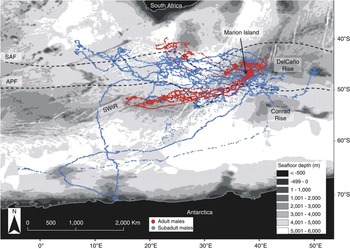
Adult male seals travelled in a predominantly westerly direction from Marion Island during their forage migrations (Fig. 1). Two animals travelled to areas north of the sub-Antarctic Front (SAF) (as indicated by Belkin & Gordon (Reference Belkin and Gordon1996)), while the remaining animals either stayed in close proximity to the island, or travelled in a south-westerly direction in closer proximity to the SWIR. Sub-adult males mostly travelled in similar directions as adult males, with some animals travelling directly west and north-west of the island to areas north of the SAF, and others travelling in a south-westerly direction south of the SWIR (Fig. 1). Two sub-adult males travelled further south than 65°S and reached areas in close proximity to the Antarctic continental shelf, while one animal in our sample travelled in an easterly direction and reached Iles Crozet. There was much variability in distances travelled from the island in animals from both age classes, although sub-adult males travelled further mean distances from the island (1400 ± 1173 km) than adult males (860 ± 660 km).
Map indicating plots of dive position estimates obtained from adult and sub-adult male southern elephant seals tracked from Marion Island. Approximate positions of the Antarctic Polar Front (APF) and sub-Antarctic Front (SAF) are indicated (from Belkin & Gordon Reference Belkin and Gordon1996). Positions of areas of shallower bathymetric features (SWIR = Southwest Indian Ridge) are also indicated. Conrad rise is an unofficial name.

Dive behaviour
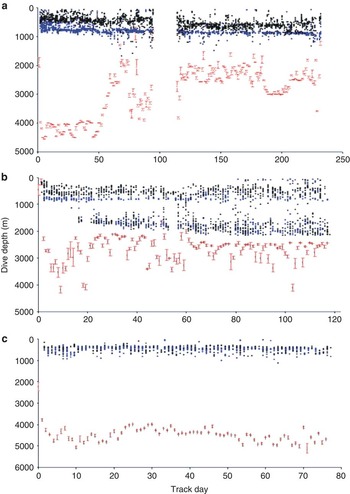
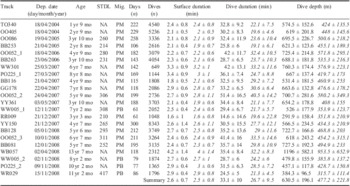
Uplinks resulted in the successful recording of 63 925 dive profiles, over 3310 seal track-days. Tracks lasted for a mean period of 157.8 ± 67.2 days and contained 2906 ± 1692 transmitted dive profiles. Sub-adult males dived to similar day- and night-time depths as adult males (Wilcoxon signed rank test: day W = 47, P = 0.47; night W = 45, P = 0.39) (Table I). Animals in our sample dived to mean depths of 618.1 ± 258.6 m during daytime dives, and to mean depths of 480.3 ± 272 m at night. Dives lasted for mean periods of 32.5 ± 12.9 min during the day and 26.5 ± 11.2 min at night. These dives were mostly pelagic over deep water (deeper than 2000 m), although some dives evidently reached the sea-floor at depths up to c. 2000 m (Fig. 2). Table II provides a summary of the dive statistics for all individually tracked males. Adult and sub-adult males mostly displayed positive diel vertical migration (DVM) throughout their migrations, diving deeper during the day, compared to night-time (e.g. Fig. 2). Some animals displayed much variation in DVM throughout their migrations (and also between migrations by the same individuals), with some exhibiting periods of evident negative DVM (Fig. 2). One animal (RR009) dived to deeper mean depths during the night, compared to daytime dives (Table II).
Summary of dive statistics obtained for male southern elephant seals. PM = post-moult migration, PB = post-breeding migration. Errors indicated represent standard deviations.

Time-series plots indicating the daytime (blue) and night-time (black) dive depths in relation to estimates of sea-floor depth (mean ± s.e.) (red) recorded for three migrations: a. shows typical profiles of a seal diving pelagically, displaying positive diel vertical migration, b. shows profiles of a seal that alternated between pelagic and very deep benthic dives, both during the day and at night, and c. shows profiles of a seal evidently not displaying a clear diel vertical migration pattern.

Summary dive statistics for individual tracks from male southern elephant seals. Dep. date = date of tag deployment, STDL = standard length (cm), Mig. = migration stage (PM = post-moult, PB = post-breeding). Night-time values are shown in italics and daytime values in plain text. Errors indicated represent standard deviations.

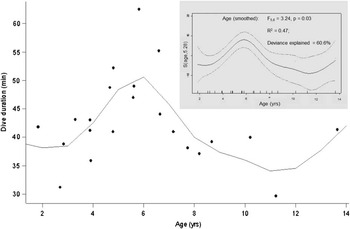
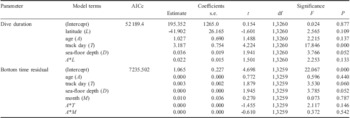
No significant differences were evident in dive durations between age classes (day W = 63.5, P = 0.76; night W = 76, P = 0.26). Dive durations increased with age in sub-adult males, but did not show such an increase within adult males. Rather, a negative relationship was evident for adult males, which indicated that dive durations became shorter with age (Fig. 3). A GAM provided a description of this trend (see Fig. 3). Maximum dive durations were best explained by a mixed model that included latitude (L), age (A), track day (T), sea-floor depth (D) and the interaction term A*L as fixed effects (Table III). Of these, only T was identified as statistically significant - indicating that dive durations tended to increase as migrations progressed. The random effect (individual seal) explained 3.94% of the variation in maximum dive durations.
Scatterplot of mean daily maximum dive durations in relation to age recorded for each tracked seal. The fitted line and inserted graph shows the fit obtained by a Generalized Additive Model.

Summary outputs from linear mixed-effects models, indicating the influence of various parameters on daily maximum dive duration and daily maximum bottom-time residual. AICc = second-order Akaike's information criterion.

The top-ranked model explaining recorded maximum bottom-time residuals included A, T, D, month (M), A*T and A*M as fixed effects (Table III). None of these were identified as statistically significant, although T (P = 0.06) and D (P = 0.052) were closest to statistical significance. The coefficient estimate for T was positive, suggesting an increase in bottom times as migrations progressed. The coefficient estimate for D was 0, suggesting a marginal influence of unclear direction. The random effect (individual seal) explained 2.15% of the variation in maximum bottom-time residuals.
Utilization distributions
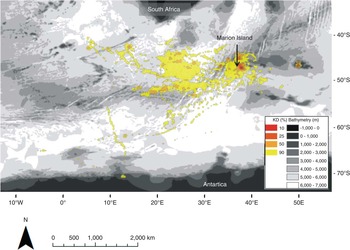
Dives with positive forage effort were distributed throughout the migration routes of tracked seals (Fig. 4) and limited differences were evident in areas utilized between day- and night-times. Areas with increased utilization were identified along the SWIR at distances of < 1000 km from Marion Island. Increases in utilization were evident also in close proximity, directly to the north-east of Marion Island. Other areas where increases in utilization were evident were distributed predominantly west of the island, but north of the SWIR, as well as a small area on the Crozet Plateau.
Habitat utilization map for the tracked male southern elephant seals. Utilization distributions were based on the locations of dives with greater-than-average bottom times.

Discussion
This study describes the spatial habitat use of male southern elephant seals from Marion Island. The predominant south-western movement of animals away from the island is a similar trend in overall movement to that shown for female seals from this population (McIntyre et al. Reference McIntyre, Bornemann, Plötz, Tosh and Bester2011). Adult males tended not to travel as far from the island as sub-adults and females (McIntyre et al. Reference McIntyre, Bornemann, Plötz, Tosh and Bester2011) and stayed in closer proximity to the island. This trend may reflect some intra-population competition avoidance (McIntyre et al. Reference McIntyre, Tosh, Plötz, Bornemann and Bester2010b), although track data obtained previously from adult males (without dive information, and therefore not included here) indicated much variability in individual travel distances (Tosh Reference Tosh2010, Oosthuizen et al. Reference Oosthuizen, Bester, Tosh, Guinet, Besson and De Bruyn2011).
Male southern elephant seals from Patagonia (Peninsula Valdés) predominantly display two dive strategies, either diving benthically to depths of less than 200 m in shallow waters on the South American continental shelf, or diving pelagically in deeper waters to depths averaging c. 400 m off the continental shelf (Campagna et al. Reference Campagna, Fedak and McConnell1999). Dives on the shelf last for mean periods of 15.1 min, while dives off the shelf are longer (mean duration of 23.1 min). Similar strategies were reported for animals from Macquarie Island (Hindell et al. Reference Hindell, Slip and Burton1991), where males reportedly dive to mean depths of 398 ± 164 m and for durations of 24 ± 9 min. Biuw et al. (Reference Biuw, Nøst, Stien, Zhou, Lydersen and Kovacs2010) reported that male southern elephant seals tracked from Bouvetøya tend to target the Dronning Maud Land shelf (Antarctica), where they predominantly undertake benthic foraging dives to depths of c. 400–500 m. The dive depths and durations recorded in this study therefore indicate that male southern elephant seals from Marion Island tend to dive to deeper depths and for longer periods of time than male elephant seals from other populations. Marion Island is surrounded by deep water, though a few prominent shelf areas with shallower water masses, such as the Del Caño Rise and the Conrad rise (unofficial name) are in relative close proximity (< 700 km from Marion Island). Male southern elephant seals from Marion Island did not travel to such shelf areas, but rather remained in deep water. In such water masses dives commonly did not reach the sea-floor and animals evidently pursued pelagic prey.
Adult males in our sample broadly adopted strategies that resulted in positive diel variation in dive depths, while strategies that resulted in neutral and negative diel variation tended to be less common. Individual seals often apparently switched between positive diel vertical migration strategies and neutral vertical migration strategies. This plasticity in strategy suggests that male elephant seals are probably less dependent on vertically migrating prey than females, but are able to successfully switch to prey at deeper depths that do not exhibit substantial vertical migration. No clear relationship seemed evident between DVM strategies and the age of animals. While younger seals tended to display positive DVM as mostly displayed by similarly sized adult females (McIntyre et al. Reference McIntyre, Bornemann, Plötz, Tosh and Bester2011), some of the younger animals tracked (e.g. RR009 - 3 years) displayed no clear DVM pattern, while some of the older seals continuously displayed positive DVM (e.g. WW005 - 7 years). This provides some support for active forage segregation between sexes in this species (McIntyre et al. Reference McIntyre, Tosh, Plötz, Bornemann and Bester2010b). However, other potential influences on DVM remain to be investigated, such as the influence of time of year and environmental variables such as temperature, salinity and chlorophyll a.
Sub-adult males appeared to rapidly increase mean dive durations between the ages of two and six, while adult animals did not exhibit this positive relationship, but rather a negative one where the older animals tended to dive for shorter periods of time. Dive durations of southern elephant seals have previously been shown to be influenced by physiological capacity associated with body size (Irvine et al. Reference Irvine, Hindell, van den Hoff and Burton2000, McIntyre et al. Reference McIntyre, Tosh, Plötz, Bornemann and Bester2010b). The trends observed here for the relationship between dive duration and age is therefore probably linked to increased physiological capacity associated with increases in size during the first six years of life. Mixed-effects model outputs suggested that the daily maximum dive durations measured in this study were only significantly influenced by track day. This result is in congruence with the association between increased physiological capacity and dive durations (Bennett et al. Reference Bennett, McConnell and Fedak2001, Hassrick et al. Reference Hassrick, Crocker, Teutschel, McDonald, Robinsons, Simmons and Costa2010). The lack of statistical significance attributable to the influence of age on maximum daily dive durations is most probably a result of the non-linear relationship between age and maximum dive durations. A GAM provided a fit to this relationship illustrating the increase in dive durations up to an approximate breeding age (c. six years), and then an apparent decrease in dive durations once animals attained such an age (Fig. 3). The rapid increase in dive durations during the first few years is probably common across sexes of both southern and northern elephant seals (Zeno et al. Reference Zeno, Crocker, Hassrick, Allen and Costa2008). Adult female elephant seal dive abilities (as expressed in dive durations) appear to remain largely unchanged, or increase with increased body size, throughout adult life (Hassrick et al. Reference Hassrick, Crocker, Teutschel, McDonald, Robinsons, Simmons and Costa2010, McIntyre et al. Reference McIntyre, Bornemann, Plötz, Tosh and Bester2011). The evident shortening of dive durations in adult male seals (reported here) may be the result of either increased forage efficiency or possibly a slight decrease in food requirements associated with a decreasing growth rate. An alternative explanation is that the age-dependent decrease in dive durations (in adults) is the result of physical fatigue (i.e. ageing or even development towards senescence), possibly due to extended periods of very deep diving, which is particularly evident in males from Marion Island (see McIntyre et al. (Reference McIntyre, De Bruyn, Ansorge, Bester, Bornemann, Plötz and Tosh2010a) for a proposed “deeper diving - shorter life” hypothesis). These trends are probably further influenced by the migration stage of a particular animal. Seals participating in the breeding haulout and defending harems are affected by the costs associated with increased energy expenditure (Galimberti et al. Reference Galimberti, Sanvito, Braschi and Boitani2007), and may be required to increase their dive durations due to increased food requirements to regain body condition. We did not take the influence of migration stage (post-breeding and post-moult) into account for this investigation due to insufficient sample sizes, but we consider it likely that differences in condition between migration stages further influence dive depths and durations.
The maps generated in this assessment indicate that areas of increased forage effort were dispersed throughout the areas visited by male southern elephant seals from Marion Island. Areas of increased utilization were particularly concentrated along the SWIR and in very close proximity, north-east of Marion Island. These maps do not reflect the number of seals utilizing specific areas, but rather the total number of dives recorded within specific areas (i.e. one seal diving continuously in a small area would suggest a higher utilization for that area). Elephant seals are known to target seamounts where they forage benthically (Maxwell et al. Reference Maxwell, Frank, Breed, Robinson, Simmons, Crocker, Gallo-Reynosa and Costa2011), though such behaviour appeared to not be particularly common amongst the male seals tracked here. The apparent association with the SWIR (this study) is considered more likely to be due to an increase in productivity in mid-water depth layers associated with increases in upwelling and mixing (Sokolov & Rintoul Reference Sokolov and Rintoul2007). Besides the evident increases of utilization in close proximity to the SWIR, most other areas of high utilization did not appear to be associated with areas of shallower bathymetry. Marion Island is in relatively close proximity to areas of shallow bathymetry such as the Conrad rise (to the south-east of Marion Island), and the Del Caño Rise (directly to the east of Marion Island). No seals in our study targeted these areas. This is in contrast to the behaviour of males from other populations (also northern elephant seals, M. angustirostris Gill) that are known to target shelf and other areas of shallow bathymetry, where they often undertake benthic dives (Hindell et al. Reference Hindell, Slip and Burton1991, Campagna et al. Reference Campagna, Fedak and McConnell1999, Le Boeuf et al. Reference Le Boeuf, Crocker, Costa, Blackwell, Webb and Houser2000, Simmons et al. Reference Simmons, Crocker, Kudela and Costa2007, Biuw et al. Reference Biuw, Nøst, Stien, Zhou, Lydersen and Kovacs2010).
Model outputs nonetheless suggested that the relative amounts of time spent at the bottom phases of dives were influenced both by track day and sea-floor depth (though statistical significance was not achieved here). No direction of influence was evident regarding the effect of sea-floor depth, and it is probable that the direction of influence will vary greatly between individual seals and the dive strategies they employ. For instance, seals that employ benthic foraging dives will probably be responsible for a negative relationship between bottom-time residuals and sea-floor depth, since increased forage effort would take place in areas with sea-floor depths that are within reach of the seals. The influence of track day on bottom-time residuals was also positive, suggesting that seals increased their forage effort as migrations progressed. This is probably the result of initial travel phases displayed by seals immediately after leaving the island on forage migrations, although it cannot be ascribed to a few individuals that did not travel any substantial distances away from Marion Island.
This investigation did not take into account the potential influences of differences in productivity associated with meso-scale oceanographic features, such as eddies or meanders. It is reasonable to assume that increases in ocean productivity associated with such features are likely to influence the locations of increased forage effort displayed by male elephant seals, and future investigations should aim to take this into account. Our sample further did not allow for interannual comparisons of areas where elephant seals displayed increased forage effort dives, or a means to assess changes in body condition of tracked seals. Future investigations will aim to provide links between at-sea foraging patterns of tracked seals (McIntyre et al. Reference McIntyre, Bornemann, Plötz, Tosh and Bester2011, this study), improvements in body condition (de Bruyn et al. Reference De Bruyn, Bester, Carlini and Oosthuizen2009) and reproductive success on land.
Acknowledgements
Thank you to the following people for their assistance with the deployment of satellite-relay data loggers in the field: Greg Hofmeyr, Brent Stewart, Phathu Radzilani, Nico de Bruyn, Mashudu Phalanndwa, Chris Oosthuizen, Thomas Mufanadzo and Ryan Reisinger. The Department of Science and Technology through the National Research Foundation (South Africa), the South African National Antarctic Programme and the Alfred Wegener Institute for Polar and Marine Research (Germany) provided financial and logistical support. Part of this research was carried out within the MEOP (Marine Mammals Exploring the Oceans Pole to Pole) project as part of the International Polar Year. Satellite tag deployment procedures were approved by the Animal Use and Care Committee of the University of Pretoria (AUCC 040827-024 and AUC 040827-023) and performed under Prince Edward Island's Research Permits R8-04 and R4-08. Procedures conformed to Antarctic Treaty legislation and the Scientific Committee on Antarctic Research code of conduct. We thank Sara Maxwell and an anonymous reviewer for their timely and constructive comments on an earlier version of this manuscript.
Supplemental material
Supplemental material detailing links to dive and track data will be found at http://dx.doi.org/doi:10.1017/S0954102012000570.