The question of how to identify and diagnose bipolar disorders (BPDs) in children has been highly controversial (Biederman et al., 1998; Geller & Luby, 1997; Geller & Tillman, 2005). In an historical context, empirical data establishing the validity of a bipolar diagnosis in school-age (older than 6 years of age) and adolescent populations has become available relatively recently in the child psychiatry literature, and late by comparison to our knowledge of other affective disorders in school-age children (for review, see Geller & Tillman, 2005; Pavuluri, Brimaher, & Naylor, 2005). Prior to these findings, skepticism prevailed about whether mania could arise in childhood. In general, BPDs were an infrequently recognized and diagnosed condition in children. Ironically, the pendulum now appears to have swung to the other extreme, with observations suggesting that there is a relatively high, indiscriminant, and in some cases inappropriate, use of the diagnosis in clinical settings.
Despite the challenges and controversies related to the identification of childhood BPD, data from numerous independent research groups has now established the validity of a childhood bipolar phenotype (e.g., Biederman et al., 2004; Findling et al., 2001; Geller et al., 2000). Although significant debate remains pertaining to the “cardinal symptoms” of the disorder, there is relative consensus that the childhood form is characterized by rapid cycling (so-called “ultradian” cycling, in which multiple cycles occur per day) with mixed depression and mania symptoms presenting concurrently (Biederman, 1995; Findling et al., 2001; Geller et al., 1995). This manifestation is similar to a more severe subtype also found in a smaller proportion of bipolar adults. In addition, numerous independent research groups have found that childhood BP is highly comorbid with attention-deficit/hyperactivity disorder (ADHD), with comorbidity rates ranging from 75 to 85% reported in different samples (Faraone, Biederman, & Monuteaux, 2001; Findling et al., 2001; Geller et al., 2000; Tillman & Geller, 2003). Geller, Zimerman, Williams, DelBello, Bolhofner, et al. (2002) have outlined key symptoms that distinguish BD from ADHD, based on an investigation designed to address this issue. This critical clinical distinction is made more difficult by the high rates of comorbidity that are observed between these two disorders.
Questions about what are the most accurate criteria to define BPD in childhood remains a hotly debated issue (Nottelmann, 2001). In question is whether the use of elation and grandiosity versus “extreme irritability” represent the “cardinal symptoms” providing the optimal trade-off between sensitivity and specificity (Tillman & Geller, 2005; Wozniak, in press). In addition, the issue of episodicity or its absence also remains controversial, with some investigators arguing that discrete episodes of mania are a prerequisite to the diagnosis and core to the definition of the disorder (Clark, 2004b; Luby, 2004, 2005). Consistent with this notion, these investigators remain skeptical that children characterized by very rapid mood cycling without discrete episodes of mania should be labeled bipolar (Clark, 2004a; Leibenluft, Charney, Towbin, Bhangoo, & Pine, 2003).
To date, studies of the nosology of childhood BPD have focused almost entirely on children older than 6 years of age. The question of whether mania can arise in even younger, preschool-age children has been virtually unexplored, with the exception of a few case studies and retrospective chart reviews (Mota-Castillo et al., 2001; Pavuluri, Janicak, & Carbray, 2002; Tumuluru, Weller, Fristad, & Weller, 2003; Tuzun, Zoroglu, & Savas, 2002). In addition, Wilens et al. (2002) conducted a study that included a small number of preschoolers in a sample comprising mainly older children. The interpretation of findings from this study was complicated by the use of standardized assessment strategies designed for older children with an inherent lack of developmental specificity for younger populations (Wilens et al., 2002). Such approaches have raised understandable concern from developmentalists about the need to distinguish early mood psychopathology from normative mood instability and from other early-onset disruptive disorders characterized by the presence of emotion dysregulation (McClellan & Speltz, 2003).
The distinction between normative extremes of the emotions and behaviors known to characterize mania versus the same emotions and behaviors that actually cross the threshold into “mania symptoms” constituting a clinical syndrome becomes more difficult with younger age. For instance, the experience and expression of joyful mood states at high frequency and/or intensity is common and normative in preschool children. Therefore, it is challenging to distinguish what might be considered clinical elation from normative extremes of joyfulness. Along similar lines, the question of how to distinguish normative fantasies about special powers and abilities from clinical grandiosity in young children is also more difficult because elevated self-esteem/confidence and fleeting seemingly grandiose behaviors may arise normatively in this developmental period.
It has also been established that broad variation in emotional functioning in young children is a normative phenomenon (Denham, 1998). On this basis, clarification of the distinction between normative mood instability and clinical mood “cycling” is of key interest. In clinical settings, it is critical not to mistake normative developmental extremes or fluctuations in mood with clinical symptoms or disorders, as doing so would be a great disservice to the child. Similarly, given the known importance of primary caregivers in preschoolers' development of emotional regulatory skills (e.g., Cicchetti & Toth, 1995b; Cole, Michel, & O'Donnell-Teti, 1994; Thompson, 1994), it is equally important not to label children with a disorder when the symptoms result from a primary failure of appropriate security, support or socialization of emotional regulation within the parent–child relationship.
Emotion Regulation and BPDs
Some of the key symptoms that characterize BP can also be understood as impairments in emotion regulatory capacities. For example, persistent or inappropriate elevated mood and/or uncontrollable feelings of joy could represent an inability to control or modulate positive affect. The presence of emotionally dysregulated behaviors in childhood psychiatric disorders has led several researchers to theorize (e.g., Cicchetti & Toth, 1995a; Cole et al., 1994; Eisenberg, Losoya, et al., 2001; Shipman & Zeman, 2001; Thompson & Calkins, 1996) that deficits in young children's capacity for emotion regulation may be at the core of early-onset psychopathological processes. However, a lack of consensus regarding the definition and measurement of emotion regulation has led to substantial controversy, and has subsequently slowed progress in this area of research (Cole, Martin, & Dennis, 2004). Furthermore, ambiguities in the operationalization of emotion regulation as a quantifiable construct have thwarted application of the existing basic developmental findings to investigations of clinical psychopathology.
Children's ability to successfully control their expressions of negative emotions in a socially appropriate manner becomes increasingly evident during the preschool period of development (Eisenberg & Fabes, 1992; Fox & Field, 1989). Investigations of normally developing children suggest that those who are better able to control and modify their inappropriate behavior, as well as use cognitive strategies to monitor their emotions, tend to be more competent in social domains. These children also have more peer success and tend to be viewed as well adjusted by adults (e.g., Lemery, Essex, & Smider, 2002; Lengua, 2002). The positive social and emotional outcomes associated with “optimal” emotion regulation in early childhood have led to an increased interest in research examining constructs (e.g., social, cognitive, and physiological) that influence the development of internal processes necessary for and employed during emotion regulation. However, relatively few studies to date have applied these constructs to early-onset mood disorders, an area in which such investigations have the potential to elucidate basic mechanisms of disorder-specific developmental psychopathology.
A core impairment in emotion regulatory capacities in disruptive disorders is suggested by research demonstrating young children at risk for and who manifest disruptive disorders (e.g., ADHD or oppositional defiant disorder [ODD]) fail to control/regulate feelings of anger, an outcome that is linked to a higher frequency of aggressive behaviors (Chang, Dodge, Schwartz, & McBrie-Chang, 2003; Eisenberg, Cumberland, et al., 2001). As a result of their aggressive behavior, these children often will experience social failures (Dodge, Coie, Pettit, & Price, 1990). Cole, Zahn-Waxler, and Smith (1994) also report that preschoolers at risk for externalizing disorders tend to under regulate their negative emotions (e.g., anger, irritability, and frustration), especially when adults are present. During a disappointment task, Cole et al. (1994) compared the emotion regulatory capacities of school age boys at high risk for disruptive disorders and same-age boys classified as low risk. Although Cole et al. (1994) found no differences in the frequencies and types of emotion regulation strategies used by the two groups, differences in their ability to sustain these strategies over time were found. That is, the at-risk disruptive group was not able to sustain the emotion regulation strategies for as long as the healthy group. The authors' proposed that preschoolers' inability to sustain adaptive emotion regulation strategies might result in their use of disruptive forms of behavior to obtain the attention and the social regulation (i.e., external regulators) assistance they need to control their emotions.
Dysregulation of emotions typically associated with internalizing disorders, such as sadness or guilt, has received considerably less attention in the empirical literature; nonetheless, a few noteworthy studies have examined the issue. Zeman, Shipman, and Suveg (2002) investigated emotion dysregulation and internalizing disorders in school-age children and found the children's inability to regulate feelings of sadness, measured by the Children's Sadness Management Scale, predicted an increase in internalizing symptoms on the Child Depression Inventory (Kovacs, 1985). Zeman et al. (2002) also suggested that poorer emotional self-awareness (i.e., acknowledging of one's own emotions) led to diminished ability to regulate negative emotions, and was associated with higher rates of internalizing symptoms. Zeman and colleagues suggested a causal mechanism for this phenomenon; specifically, they proposed that children who were unaware of their sadness may not have been able to obtain the necessary social support to relieve the sadness, and as a result, experience prolonged sad moods putting them at greater risk for poor outcomes such as depression.
Children's inability to regulate (i.e., emotional underregulation) intense externalizing or internalizing negative emotions (e.g., anger or sadness), although of major importance, is only one form of emotional dysregulation of developmental significance. Overregulation of emotions is another form of emotion dysregulation that is pertinent to developmental psychopathology. Plutchik (1993) suggested that the process of emotion overregulation might be at the core of internalizing disorders, such as anxiety or depressive disorders. Support for this notion is evidenced by the high rates of observed “behavioral inhibition” associated with internalizing disorders in childhood. Empirical and theoretical literature (e.g., Luby, Heffelfinger, Koenig-McNaught, Brown, & Spitznagel, 2004; Zahn-Waxler, Klimes-Dougan, & Slattery, 2000) has suggested that young children's inability to generate feelings of pleasure or tendencies to dampen and blunt (i.e., overregulation) feelings of joy and/or pleasure may be as important to early-onset depressive disorders as children's underregulation of sadness. For instance, Luby et al. (2002) found that children's inability to experience joy as expected in response to joy-inducing events (also referred to as anhedonia) was a highly specific marker of depression in preschool children. Thus, findings suggest that emotion regulation, specifically children's ability to sustain positive emotions and minimize negative emotions within a normative developmental range, may be key characteristics of specific early-onset affective disorders such as depressive disorders.
Given the early evidence for the potential importance of under- and overregulation of emotions in both disruptive and affective disorders, investigations of the emotion regulatory capacities of preschoolers with BPDs would seem highly relevant given the mixed internalizing and externalizing features of this disorder. Although defining the emotion regulatory capacities of this clinical population poses a unique and difficult challenge, it may also be of central importance for identifying this affective disorder when it arises very early in development. In theory, it might be expected that preschoolers with BPDs will display both over- and underregulation of different emotions either simultaneously or at different times depending upon the episode characteristics and phase of the cycle. This is because the childhood form of the disorder is most frequently manifest as “mixed” mania and depression arising concurrently in the context of very rapid cycling. Bipolar preschoolers may develop strategies that lead to the underregulation of positive emotions resulting in sustained elevated mood or “elation” while simultaneously overregulating or minimizing negative emotions even under circumstances where such emotions would be appropriate. One key and highly unique feature of this disorder appears to be the instability or variability of these regulatory capacities depending upon the phase of the cycle. This interesting feature has not been well characterized or investigated to date.
Regarding the distinction between normative extremes of preschool emotional dysregulation and emotion dysregulation that represents a symptom of BP, based on clinical observations the vast majority of young children who are referred to clinical mental health settings for “mood cycling” or clinical behavioral dysregulation often display behaviors that are so severe and impairing that the distinction between these symptoms and the normative range is not particularly ambiguous (J. Luby, unpublished data; J. Wozniak, personal communication, 2004). However, because those preschoolers presenting to clinic settings tend to have very severe symptoms, investigations of distinctions between clinical mania symptoms and normative emotional extremes remain worthwhile and necessary. Along these lines, one hypothesis of this investigation was that preschool children from the community who display mania would be significantly more impaired and display qualitatively more emotional dysregulation in the form of extreme mood states and cycling than healthy preschoolers experiencing normative emotional extremes.
Another developmental issue that is a key consideration for investigations of mood disorders in young children is the question of whether sufficient emotional/social/cognitive development has taken place for mood disorder symptoms to be possible. This issue was central to the delay in recognition of early-onset depressive disorders, as prevailing theory had suggested that young children would be too developmentally immature to experience the core symptoms of depression. Subsequently, empirical data on normative emotional development refuted this presumption and demonstrated that children as young as 3 years of age could experience complex affective states such as guilt and shame, deemed integral to the experience of depressive syndromes (Cole, Barrett, & Zahn-Waxler, 1992; Hoffman, 1984).
Pertaining to whether mania symptoms are developmentally possible during the preschool period, the question of how early in life a coherent self-concept emerges is a critical developmental issue. If preschool children do not have the capacity for a coherent self-concept, it would not be possible to manifest clinical grandiosity, a cardinal symptom of mania defined by a fixed and falsely elevated self-concept. Developmental data suggests that as young as age 4, a coherent and stable self-concept is apparent in preschool children (Thompson, Goodvin, & Meyer, in press). Based on this, one can conclude that it is not developmentally impossible to manifest grandiosity during the preschool period.
Grandiose Self-Concept and Mania
Children's self-perceptions of their own abilities and characteristics, and the accuracy of these perceptions, are thought to be key to healthy socioemotional development (Kagan, Snidman, & Arcus, 1995). Developmentalists have traditionally emphasized the importance of a positive self-concept in childhood based on the notion that a negative self-concept places an individual at greater risk for psychosocial problems (Damon & Hart, 1988). Although a positive self-concept during early childhood and throughout the life span is desirable and adaptive, the current study suggests that a rigid, unrealistic, and overly positive or negative self-concept may also be associated with developmental psychopathology. Similar to the normality of over- and underemotion regulation during the preschool developmental period, previous findings also suggest that it is normal for young children to describe themselves with inflated self-confidence, esteem, and perceptions of their own capabilities (Harter, 1999). Nonetheless, we propose that this normative phenomenon can be distinguished from clinical grandiosity.
School-age children who manifest clinically significant grandiose ideations have a grossly inflated and/or unrealistic view of their own talents, abilities, and behaviors that is fixed, pervasive, and false (Geller, Zimerman, Williams, DelBello, Frazier, et al., 2002). When questioned about whether these grandiose abilities are real, school-age bipolar children rarely give up on their inflated beliefs and will insist their perceptions are true despite tangible evidence to the contrary (Geller, Zimerman, Williams, DelBello, Frazier, et al., 2002). As stated, identifying clinically significant grandiose behavior in preschoolers is complicated by the fact that overestimating abilities, highly favorable self-impressions, and expressions of excessive self-confidence are viewed as normative features of this developmental period (Stipek, Feiler, Daniels, & Milburn, 1995). The distinction between normative and psychopathological inflation of abilities along these lines is that the normally developing preschoolers' expressions of elevated self-concept are typically grounded in concrete and observable characteristics, such as appearance, possessions, and preferences (Damon & Hart, 1988).
Along these lines, Harter and Marold (1994) demonstrated that it is typical for preschool children to brag or feel good about having many nice toys, overestimating their strength, or their ability to achieve certain goals. However, as evidenced in the current investigation when young children develop overly positive and elevated self-concept beliefs that are fixed, not reality based, and extend beyond these domains, they appear to be exhibiting signs of more serious underlying clinical symptoms and possible manifestations of grandiosity. Some clinical examples of elevated self-concept along these are lines are illustrated by preschoolers who believe, and act on the belief, that they can and should direct the household or preschool, give instructions to physicians and other authority figures that they expect to be followed, or who feel they have supernatural powers or abilities such as the ability to change the weather at will.
The Present Study
Based on the known chronicity and long-term disability of BP in adults, it is important to identify and intervene in this disorder at the earliest possible point. Based on this, and findings indicating that depressive disorders can be detected in preschool children as young as age 3, the current study was conducted as a preliminary investigation to examine whether mania symptoms could also be identified at this very early stage of development. Importantly, the current investigation sought to keep the developmental principles and prior empirical findings discussed above central throughout its entire conceptualization.
The present study aimed to explore whether age-adjusted manifestations of mania could be identified in preschool children between the ages of 3.0 and 6.0. To achieve this goal, a mania module to be included in a reliable and valid comprehensive preschool diagnostic interview was developed. Caregivers of preschool children were interviewed about the presence of mania symptoms during the last 6-month period using age-appropriate symptom descriptions. It was hypothesized that DSM-IV mania symptoms, adjusted for their age-appropriate developmental manifestations, would be detected in preschool children and could be distinguished from healthy children and those with ADHD, a widely diagnosed and valid DSM-IV disruptive behavior disorder observed in preschool children.
Method
Participants
Three hundred three preschoolers between the ages of 3.0 and 6.0 participated in a comprehensive developmental and mental health assessment at The Early Emotional Development Program (EEDP) at the Washington University School of Medicine in St Louis, Missouri. The presence of age-adjusted mania symptoms, other pertinent psychiatric symptoms, and measures of emotional, social, and cognitive development were conducted as part of a larger longitudinal study examining the nosology of preschool depression. Caregivers of preschool children were recruited from pediatricians' offices, daycares, and preschools in the St. Louis metropolitan area using the Preschool Feelings Checklist (Luby, Heffelfinger, Mrakotsky, & Hildebrand, 1999) a brief validated screening tool for early-onset emotional disorders (Luby et al., 2004). Parents who endorsed two or more “internalizing” and/or two or more “externalizing” items on the checklist as well as parents who endorsed no symptoms were contacted by a trained research assistant by phone to establish whether inclusion and exclusion criteria for study participation were met. Excluded were children with chronic medical illnesses and/or neurological problems and those with pervasive developmental disorders, language, and/or cognitive delays that would have prohibited their ability to understand the study questions.
From the 303 caregiver–child dyads who participated in the study, two subjects were excluded from the final analyses due to excessive missing data. Preschoolers (N = 301) who fell into one of four study groups of interest based on parents' responses to the Preschool Age Psychiatric Assessment (PAPA; Egger, Ascher, & Angold, 1999) were included in the following analyses. The four groups comprised a “bipolar” group characterized by meeting all DSM-IV symptom criteria for BP based on parent report. A disruptive disorders group consisting of those who met DSM-IV criteria for ADHD, ODD, and/or conduct disorder (CD) group, and a major depressive disorder (MDD) group characterized by DSM-IV MDD criteria (with the exception of duration criteria), and a group of preschoolers with no BP, MDD, or ADHD/ODD/CD (the “healthy” group) were compared. Because they were the primary diagnostic group of interest in the current analyses, any preschool participant who met DSM-IV BP criteria was included in the BP group regardless of comorbidity (e.g., could be comorbid with any other DSM-IV disorder). Preschoolers with DSM-IV disruptive disorders and any other comorbid disorder except for BP were placed into the disruptive group. Preschoolers with MDD and any other disorders except for BP or ADHD/ODD/CD were placed into the MDD group. The healthy comparison group comprised preschoolers who did not meet criteria for BP, MDD, or ADHD/ODD/CD (N = 173) and was of interest. The DSM-IV disruptive, MDD, and healthy comparison groups were included to test whether findings were specific to BP.
Procedure
Parent–child dyads who met all inclusion and exclusion criteria and agreed to study participation came to the EEDP for a comprehensive 3- to 4-hr laboratory assessment. Although children completed measures of emotional, cognitive, and social development, their primary caregivers were interviewed separately about a number of issues including their children's psychiatric symptoms using the PAPA (Egger et al., 1999). The PAPA is an interviewer-based assessment with established reliability designed for the parents of preschool children between 2 and 6 years of age (Egger et al., 2006). This means that a trained interviewer rates the presence and intensity of a symptom based on the parent's report in combination with their own knowledge of the emotion/behavior. This method, which requires substantial interviewer training, is thought to be more accurate than sole reliance on parent report directly (Angold & Costello, 2000). The PAPA covers a broad range of psychiatric symptoms, impairment resulting from symptoms, family environment and relationships, family psychosocial functioning, and life events. The PAPA includes all relevant DSM-IV criteria and their age-appropriate manifestations, all items on the Diagnostic Classification of Mental Health Disorders of Infancy and Early Childhood: Birth to Age 3—Revised (a novel diagnostic system designed specifically for infants and toddlers; Egger, Fenichel, Guedeney, Wise, & Wright, 2005), as well as clinically relevant behaviors manifested by preschoolers that do not currently appear in either diagnostic system.
Recent advances in the identification and validation of numerous preschool disorders have now demonstrated that meaningful preschool psychopathology may be missed when measures designed for older children are used in young child populations without appropriate developmental adaptation (Task Force, 2003). For this reason, a new mania module of the PAPA was developed and tested in the EEDP for this investigation. Mania items in this module were based on symptoms known in older bipolar children, but translated to describe their expected developmental manifestation in preschoolers. It was necessary to develop and test the reliability of this new age-appropriate mania module because there was no available developmentally modified instrumentation to assess mania in preschool aged children. To examine reliability of the mania module, 53 mothers were interviewed using the PAPA mania module at Time 1 and then 7 to 10 days later (at Time 2), a different interviewer administered the mania module to the same caregiver. Results indicated the mania module had very good reliability across time points with an intraclass correlation of .71.
To make the diagnosis of BD, the DSM-IV algorithm was strictly applied with the exception that duration criteria were set aside because of insufficiently detailed information about symptom durations within an episode. This was deemed clinically meaningful as the PAPA makes clear distinctions between symptom intensity, duration, and frequency, and rates these features separately. An emotion or behavior is not rated at the symptom level by definition if it is transient and normative (e.g., normative elevated moods in response to joyful events and mood lability were not coded as pathological.) Consistent with this, another feature of the recently developed mania module was that normative behaviors within the symptom dimensional domain were also coded (e.g., normative happiness/appropriate elation at a special event vs. clinical elation). This distinction is clear based on detailed definitions provided in the PAPA glossary and calibrated in training. A substantial period of initial training, supervised practice interviewing, as well as ongoing weekly calibration meetings and additional checking by a master coder (who listens to audiotapes of interviewers) was conducted throughout to maintain interrater reliability.
Once caregivers completed the PAPA, they were administered additional measures that included an assessment of various domains (e.g., social, community, relationships) of their preschoolers' developmental skill and/or impairment. The Preschool and Early Childhood Functional Assessment Scale (PECFAS; Hodges, 1994) is a semistructured parent interview that assesses the psychosocial functioning and impairment of children between the ages of 3.0 and 7.11. The reliability, internal consistency and validity of the PECFAS have been previously established (Murphy et al., 1999). Impairment dimensions that are measured include moods/emotions, self-harm, and communication, which are measured in three domains home, community, and preschool/daycare. The Vineland Adaptive Behavior Scale is a widely used valid and reliable measure with established norms (Sparrow, Carter, & Cicchetti, 1987). It was used in this investigation to assess preschooler's developmental skills/impairments in four domains, communication, daily living, socialization, and motor skills.
Data analyses
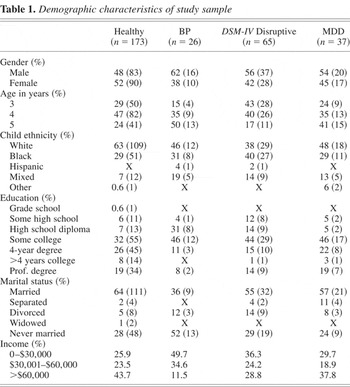
For the purpose of this investigation, preschoolers who met DSM-IV criteria for BP were compared with those who fell into two psychiatric comparison groups (MDD and DSM-IV disruptive) in addition to a group of healthy preschoolers without mood or disruptive disorders. These four groups were compared on several demographic variables, including age, gender, family income, education, marital status, and ethnicity (see Table 1). To examine whether children in the BP group were significantly different from preschoolers in the DSM-IV disruptive and healthy groups on specific symptom frequencies the chi-square statistic was used. Odds ratios were conducted to examine the probability of having specific BP symptoms based on diagnostic group classification.
Demographic characteristics of study sample

Because of the high levels of comorbidity between BP and ADHD known to occur in older children, and a similar finding in the current preschool sample reported below, the current study investigated whether findings of developmental impairment were a result of preschoolers' BP, ADHD symptoms, or the combination of both. Thus, a series of hierarchical multiple regression analyses were conducted that controlled for the effects of gender, age, and total number of ADHD symptoms (11 possible impulsive symptoms, 10 possible inattentive symptoms) manifest by each child in the entire sample. The analyses tested whether having a BP classification accounted for a significant portion of the variance in preschoolers' impairment scores beyond the variance already explained by the occurrence of gender, age, and more importantly, ADHD symptoms. A multivariate analysis of variance (MANOVA) was conducted to examine diagnostic group differences on the four subscales of the Vineland. Post hoc analyses used to test significant effects found in the overall MANOVA were corrected using Bonferroni techniques to minimize the chances of a Type I error. To further examine the capacity of the PAPA mania module to differentiate preschoolers with BP from those with ADHD, receiver operating characteristic (ROC) analyses were utilized.
Results
Twenty-six preschoolers met all DSM-IV symptom criteria for BP based on parent report on the PAPA mania module. Sixty-five were diagnosed with ADHD and/or ODD, and/or CD and 37 were included in an MDD group on the basis of having MDD without mania or ADHD (e.g., the number of children who met MDD criteria was higher but these subjects were included in other study groups). The demographic characteristics of the four study groups of interest and that were included in these analyses are shown in Table 1. Several differences between study groups were found related to child demographic variables. Preschoolers in the DSM-IV disruptive group were significantly (p < .05) younger than children in the BP group. No other age differences were found. Children in the BP group were significantly more (p < .05) likely than preschoolers in the healthy or MDD groups to have primary caregivers who had never been married. Preschoolers in the healthy group had primary caregivers who reported completing more years of education (p < .05) than children in the BP and DSM-IV disruptive groups but not the MDD group. Finally, preschoolers in the healthy group had a significantly higher (p < .05) household income than children in the BP group but not the MDD group. An additional important characteristic of the BP group is that 81% of the children in this group also had comorbid ADHD, 65% had comorbid ODD, and 65% had comorbid CD.
Diagnostic group comparisons of mania symptom frequencies
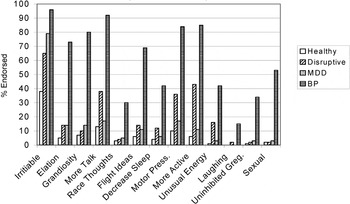
The current study investigated the differential frequencies of individual symptoms from the PAPA mania module among the four comparison groups: (a) BP, (b) MDD, (c) DSM-IV disruptive, and (d) healthy group using chi-square analyses. The overall chi-square statistic was significant (p < .05) on all 13 PAPA mania intensity items using the four group comparisons (see Figure 1). Two group comparison post hoc analyses were used to determine which pairs of the four groups differed significantly from each other on each of the mania symptoms. Post hoc tests revealed that preschoolers in the BP group were significantly (p < .05) more likely than preschoolers in both the healthy and DSM-IV disruptive group to endorse each of the 13 core mania items on the PAPA. Further, preschoolers in the BP group were significantly (p < .05) more likely than children in the MDD group to endorse all PAPA mania items except for the irritability item, which approached significance (p = .08).

The mania symptom frequencies among comparison groups.
Likelihood of specific mania symptom endorsement by diagnostic group
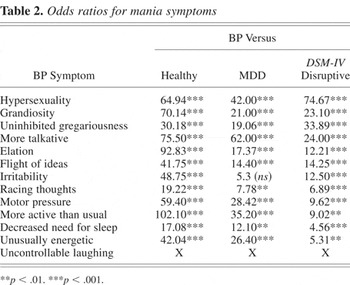
To further examine the strength of individual items in the mania module of the PAPA to predict categorical DSM-IV bipolar diagnosis, odds ratios were calculated based on the chisquare analyses. As shown in Table 2, positive response to each of the 13 mania items increased the likelihood of being diagnosed with BP when the BP and healthy group were compared for each item. Of particular interest, preschoolers with elation were 92 times more likely to be diagnosed with BP than children in the healthy group. Similarly, preschoolers who met DSM-IV criteria for grandiosity were 70 times more likely to be diagnosed with BP when compared to the healthy group.
Odds ratios for mania symptoms

Positive responses on each of the 13 items of the mania module increased the likelihood of being diagnosed with BP when the BP and DSM-IV disruptive groups were compared. That is, children diagnosed with BP were significantly more likely than preschoolers in the DSM-IV disruptive group to respond positively to each of the 13 mania items within the PAPA module. Several specific mania symptoms were found to be robust predictors of the diagnosis of BP versus DSM-IV disruptive disorders in preschool children. For instance, preschoolers with BP were 74 times more likely to exhibit the symptoms of hypersexuality than those in the DSM-IV disruptive group. Preschoolers in the BP group were 23 times more likely to manifest grandiosity than preschoolers in the DSM-IV disruptive group.
In addition, preschoolers' positive responses to all mania items except for irritability were associated with a significantly increased risk for a BP diagnosis when the BP and MDD groups were compared. Of particular interest, preschoolers in the BP group were 62 times more likely to have exhibited the “more talkative” symptom and 35 times more likely to have exhibited the “more active than usual” symptom compared to preschoolers in the MDD group. To summarize, an endorsed clinical threshold symptom manifestation on any 1 of the 13 core items (except the irritability item) from the PAPA mania module significantly increased the probability of a child having a diagnosis of BP when the BP and three other comparison groups were analyzed in a pairwise fashion.
Mania predicts functional impairment after controlling for ADHD symptoms
Hierarchical multiple regression analyses were used to examine the associations between preschoolers' BP and impairment on seven subscales of the PECFAS after controlling for the effects of children's age and gender. Age and gender were entered simultaneously in the first step of the equation, and BP diagnosis (present or absent) was entered at the second step. The first step of the analysis indicated that both preschoolers' age and gender were significantly associated with school/daycare impairment. In the second step of the same analysis, BP accounted for a significant portion (16%) of the variance in children's school/daycare impairment after controlling for the significant effect of gender. Specifically, boys and preschoolers with BP showed higher levels of school/daycare impairment. In analysis 2, BP accounted for a significant portion (13%) of the variance in preschoolers' home role impairment; there were no effects of age or gender. In analysis 3, BP accounted for 29% (p < .001) of the variance in preschoolers' community role impairment. No age or gender effects were found in this analysis. In analysis 4, preschoolers with BP showed significantly higher levels of social impairment even when accounting for the effects of gender and age. Boys as well as preschoolers with BP had significantly (p < .001) higher levels of social impairment. In analysis 5, preschoolers with BP had higher mood/emotion impairment scores. There were no effects of gender or age in relation to preschoolers' mood/emotion impairment. Analysis 6 revealed that preschoolers with BP as well as older preschoolers, scored significantly higher on the self-harm scale of the PECFAS. Analysis 7 demonstrated that preschoolers with BP had significantly more thinking/communication impairment than preschoolers without BP. In addition, boys had significantly higher thinking/communication impairment scores than girls. In the final analysis, results indicated the preschoolers with BP versus those without, as well as boys compared to girls had significantly higher total impairment scores. Preschoolers' gender and presence or absence of a BP diagnosis accounted for 31% of the total variance within preschoolers overall impairment scores.
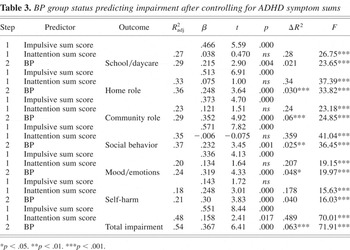
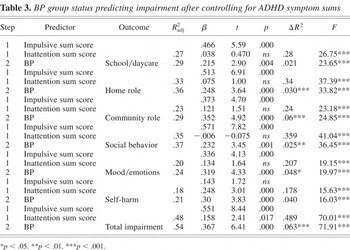
The second set of hierarchical multiple regression analyses revealed that after controlling for children's ADHD symptoms (impulsive: M = 2.8, SD = 3.05, min = 0, max = 11; inattentive: M = 1.74, SD = 2.28, min = 0, max = 10) in addition to their age and gender, preschoolers with BP were significantly more impaired on six out of the seven subscales of the PECFAS (see Table 3). For all outcome variables preschoolers' age, gender, and inattentive as well as impulsive ADHD symptoms were entered into the equation at Step 1 as the covariates, children's classification of BP was entered into the model at Step 2. Preschoolers' age, gender, and ADHD scores accounted 27% of the total variance in preschoolers' school/daycare impairment, 33% of the total variance in home role performance, 23% of the total variance in community role impairment, 35% of the variance in social behavior impairment, 20% of the total variance in preschoolers moods/emotion impairment, 18% of the variance in self-harmful behavior, and 48% of the variance in children's total impairment scores. When BP was added at Step 2, there was a significant (p < .05) R2 change in each of the above subscales as well as in the total impairment score.
BP group status predicting impairment after controlling for ADHD symptom sums
Developmental skills: Diagnostic group comparisons
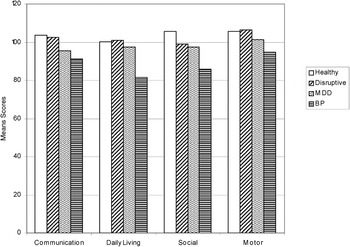
The four subscales of the Vineland were highly correlated, as expected; thus, a one-way MANOVA was conducted. The MANOVA was conducted to determine the effect of diagnostic group (BP, MDD, DSM-IV disruptive, and healthy) on the communication, daily living, social, and motor domain subscales of the Vineland, with preschoolers' age and gender entered as covariates. Significant differences were found among the four groups on the four dependent variables as a class, Wilks' Λ = .78, F (4, 257) = 5.56, p < .001. ANOVAs were conducted on each dependent variable as follow-up tests to the MANOVA (see Figure 2). Using the Bonferroni method, each ANOVA was tested at the .0125 level. The ANOVAs were all significant: communication F (3, 284) = 10.42, p < .001, daily living skills F (3, 280) = 11.83, p < .001, social F (3, 278) = 15.93, p < .001, and motor F (3, 284) = 5.53 p = .001.

Developmental skills on the Vineland Adaptive Behavior Scale.
Post hoc analyses to the univariate ANOVAs for the Vineland subscale scores consisted of conducting multiple comparisons to find which diagnostic group affected the scores most strongly. Each comparison was tested at the .0125 level divided by 4, which is the .003 level. The BP group had significantly poorer communication skills than the healthy group and the DSM-IV disruptive group. Preschoolers in the BP group had significantly lower scores on the daily living skills subscale than all three comparison groups (i.e., healthy, MDD, and ADHD). Preschoolers in the BP group had significantly lower social skill scores than the healthy, MDD, and DSM-IV disruptive groups. Last, preschoolers in the BP group scored significantly lower on the motor skills subscale than the healthy and the DSM-IV disruptive groups.
Sensitivity and specificity of mania symptoms in BP and DSM-IV disruptive disorders
ROC analyses were carried out based on a logistic model that included a categorical diagnosis of BP (based on the PAPA) as the dependent variable and a dimensional summary score of the mania items as the independent variable. Because the difficult clinical distinction between DSM-IV disruptive disorders and BP was of interest, only the BP and DSM-IV disruptive groups were included in the ROC analysis. The area under the curve for the mania dimensional summary score was .996, which represents a close to perfect diagnostic test. The point of maximal sensitivity (ability to identify children with BP) and specificity (not falsely identifying those with no BP) was found at a mania summary score of 5.5, which was associated with values of .92 and .02, respectively. The five symptoms that emerged as the most powerful to distinguish BP from DSM-IV disruptive disorders from this analysis were: hypersexuality, elation, grandiosity, hypertalkative, and flight of ideas. Therefore, based on the presence of these five symptoms, accurate diagnoses of BP for children with the actual DSM disorder (low false negative) would be made 92% of the time and presumably, a diagnosis of BP for preschoolers who do not actually have BP but instead had a DSM-IV disruptive disorder (low false positive) would occur only 2% of the time.
Discussion
In support of the study hypotheses, and in keeping with previous findings establishing that depression can arise in the preschool period, the data presented provides empirical evidence that children as young as 3 years of age manifest mania symptoms, and can meet full DSM-IV symptom criteria for BP. This diagnostic classification was based on the caregivers' report of the presence of developmentally adjusted manifestations of mania symptoms from a semistructured interview. Notably, preschool children who met criteria for BP emerged as a highly distinct and severely impaired group. Meeting the standard originally proposed by Robins, Guze, and Samuel (1970) for validation of psychiatric syndromes (which has been broadly utilized in the development of psychiatric nosologies to date), preschoolers who met criteria for BP displayed a unique constellation of symptoms that distinguished them from healthy children as well those with other psychiatric disorders. The latter finding is particularly important, as the distinction between disruptive disorders and BP remains an area in which substantial clinical confusion exists in older children. Further, and of significant clinical utility, a cluster of five mania-specific symptoms were identified that could be used to reliably distinguish mania from DSM-IV disruptive disorders in preschool children. These data also validate the findings of Geller, Zimerman, Williams, DelBello, Bolhofner, et al. (2002) and Geller, Zimerman, Williams, DelBello, Frazier, et al. (2002), who have shown that elation, grandiosity, and hypersexuality are the most specific markers of mania symptoms in older children. Also notable was the high level of comorbidity between BP and ADHD (81% of bipolar children also met criteria for ADHD) similar to rates reported in older children by numerous independent research groups (e.g., Faraone, Biederman, Mennin, Wozniak, & Spencer, 1997; Geller et al., 2000).
Despite the high levels of co-occurring BP and ADHD, the current findings illustrate that preschool BP had a unique effect on preschoolers' domain specific impairment that was independent of whether children also had comorbid ADHD or another DSM-IV disruptive disorder. That is, preschoolers with BP, the majority of who had comorbid ADHD, demonstrated a more global pattern of impairment (i.e., impairment in more domains) than children with ADHD and other disruptive behavioral disorders without BP. Furthermore, results indicated that the more severe impairment evident among preschoolers in the BP group was not due to a BP × ADHD interaction effect, as the results were replicated even after controlling for the BP preschoolers' inattentive and hyperactive symptom manifestations. These findings of global and diagnosis specific impairment in this young BP sample provides the most compelling evidence of the need for public health attention and further research in the area of early-onset BP during the preschool period.
Although it was not the primary aim of the current investigation, it is also important to note the different outcomes related to the BP versus MDD versus healthy groups. To date, we are unaware of any studies that have examined differences between the symptoms and outcomes associated with preschool BP and preschool MDD. Findings from the current study illustrated that these two groups differed significantly on each of the DSM-IV mania symptoms as described on the PAPA with the exception of irritability, which is also a key symptom of early-onset depression. These data suggest that MDD and BP may be two distinct and differentiable disorders at this early stage of development, an important finding because there is some question about whether they merge into a continuum disorder later in life.
Research and clinical implications
The identifiable impact that a BP diagnosis had on a preschoolers' domain-specific functioning beyond the effects of having comorbid ADHD raises several important issues to be addressed by clinicians and researchers in the future. The finding that preschoolers with BP had high rates of comorbid ADHD and other disruptive disorders suggests that clinicians may more readily diagnose these more widely accepted and recognized disorders but fail to assess for the potential presence of BP as well. The appropriate identification of both disorders, when present, is important due to its implications on treatment planning and prognosis. Along these lines, preschoolers with comorbid BP and ADHD for who only the ADHD is recognized and treated may not achieve optimal outcomes in general due to the failure to effectively treat the manic symptoms.
The finding that grandiosity and excessive elation were key markers of preschool BP illustrates the imperative need for further more focused investigations of the distinction between normative extremes versus clinically significant elevations in self-concept and joy intensity in preschool children. Clearer guidelines for making this important distinction would be helpful to clinicians and educators. As outlined above and elsewhere, we believe that studies of the development of “emotion regulation” may also be highly pertinent to understanding early-onset mood disorders in general and BP in particular (Luby & Belden, 2006). We propose that BP may be best understood as a fundamental impairment in the development of emotional regulatory capacities in specific domains as well as in the healthy development of self-concept. Additional research in each of these domains (i.e., emotion regulation and self-concept) as they relate to BP may provide useful tools for early interventions and for prevention.
The data presented also underscore the feasibility of identifying preschoolers with BP symptoms in community samples. Along these lines, findings demonstrate that parents' endorsement of as few as five mania items powerfully increased the likelihood of their preschoolers meeting full DSM criteria for a BP diagnosis. In addition, preschoolers with a diagnosis of BP were significantly more likely to endorse each of the 13 core symptoms of mania (except the irritability item) than preschoolers in the healthy, DSM-IV disruptive and MDD groups when data was analyzed in a pairwise fashion. This finding supports our previous claims that with age-appropriate assessment tools that are now available it is possible to identify mania in young children and to distinguish it from more commonly recognized disruptive disorders such as ADHD. Based on the current data, we believe that it is now feasible and worthwhile for practitioners to ask directly about the presence of key age-appropriate mania symptoms in young children so that populations at high risk could be identified and referred.
One issue related to the current study that remains poorly understood and has received inadequate attention is why these capacities appear unstable and changeable based on episode status. That is, in between manic episodes, higher emotional regulatory capacities and competencies may become evident. Such a phenomenon is well known in bipolar adults. This feature suggests that childhood BP is a more complex phenomenon than a stable developmental delay or aberration. Nonetheless, models of emotion regulation may be very useful in early identification and quantification of severity, recovery, and course. Future studies that investigate emotional regulation using objective observational measures as well as parent report of longer term patterns of emotional reactivity will be an important next step to elucidate the developmental psychopathology of BPDs.
Limitations
It is important to note that these basic criteria for BP were met without consideration of symptom durations. Data on symptom duration has been collected in the study sample, but is not yet available for analysis at this time. The issue of duration is an interesting and potentially important one, which will be discussed elsewhere; however, notably, duration and timing of symptoms is one area in which developmental adjustments have been evident in other early childhood affective disorders. Such temporal adjustments are proposed, and have been observed in preschool depression (Luby et al., 2002). However based on the very high levels of impairment seen in this BP group using two independent measures as discussed above, there is little doubt that this group crosses the threshold into the clinical domain regardless of duration characteristics, and is one requiring intervention.
Future research
Additional investigations of the presence and characteristics of early-onset BP symptoms in independent study samples are now needed. In addition to further validation of a preschool BP syndrome in diverse samples, investigations of specific emotional, social, physiological, and cognitive characteristics of preschool BP are warranted. By understanding the specific features of BP in preschoolers, it may become possible to develop more effective prevention and early intervention strategies. For example, if specific features of emotional dysregulatory processes could be identified in early-onset BP, parent–child dyadic therapies that target these developmental skills within the context of the primary relationship could be applied. Such treatments, designed to enhance the child's capacity for emotion regulation earlier in development, may be promising as one part of a more comprehensive treatment plan. An adaptation of Eyberg's Parent Child Interaction Therapy (PCIT), a dyadic treatment with demonstrated efficacy in preschool disruptive disorders, entitled PCIT-Emotion Development has been proposed for application to preschool BP by the first author and colleagues (Eyberg, 1988; Luby, Stalets, Blankenship, Pautsch, & McGrath, in press). Empirical testing of these kinds of age-appropriate early intervention/prevention strategies that focus on enhancing emotion development and emotion regulation early in life for BP preschoolers and/or those identified at high risk are now needed.
Conclusion
Study findings provide the first systematic and developmentally sensitive data of which we are aware for the validation of a BP syndrome in preschool children between the ages of 3.0 and 6.0. Despite the potential for confusion with normative developmental extremes and other more commonly diagnosed disruptive disorders, a symptomatically unique and distinct and clearly impairing clinical syndrome emerged in this community-based study sample when age-adjusted manifestations of mania symptoms were assessed. Future analyses that investigate systematic observations of behaviors, child report of symptom states, and physiologic reactivity data, as well as examining longitudinal course will be critical for further clarifying the clinical characteristics and prognosis of this early-onset disorder.