Introduction
Biological invasions can be divided into at least three stages: arrival, establishment and spread (Liebhold and Tobin, Reference Liebhold and Tobin2008). For invasion to be successful, the arrival stage determined by propagule pressure and the establishment phase determined by abiotic and biotic factors should be favourable (Catford et al., Reference Catford, Jansson and Nilsson2009). The life history characteristics of the invader highly influence invasion success (Sol et al., Reference Sol, Bartomeus and Griffin2012). When the founder population is small and the environment is favourable, a life history strategy that promotes fast population growth would enhance establishment (Sol et al., Reference Sol, Bartomeus and Griffin2012). Generally though, a successful invader is one which prioritizes longer adult life span with many reproductive events (Sol et al., Reference Sol, Bartomeus and Griffin2012). Resource availability is an important biotic factor which influences the establishment probability and population growth rate of an invading species (Chesson, Reference Chesson2000; Shea and Chesson, Reference Shea and Chesson2002). In communities where the invader and resident species utilize similar resources, establishment would be favoured if the invader has a superior ability to exploit available resources compared to the resident species (Sakai et al., Reference Sakai, Allendorf, Holt, Lodge, Molofsky, With, Baughman, Cabin, Cohen, Ellstrand and McCauley2001).
The oriental fruit fly, Bactrocera dorsalis (Hendel), (Diptera: Tephritidae) is an invasive species of Asian origin which invaded and expanded its range on the African continent since 2003 (Lux et al., Reference Lux, Copeland, White, Manrakhan and Billah2003, Drew et al., Reference Drew, Tsuruta and White2005, Khamis et al., Reference Khamis, Karam, Ekesi, De Meyer, Bonomi, Gomulski, Scolari, Gabrieli, Siciliano, Masiga and Kenya2009). In 2013, B. dorsalis invaded the northern parts of South Africa and is now present in the north and northeastern parts of South Africa (Manrakhan et al., Reference Manrakhan, Venter and Hattingh2015) but is still absent in other areas of the country. A number of B. dorsalis-free regions in South Africa, including the Western Cape Province, were, however, deemed suitable for the establishment of B. dorsalis based on climatic models (Hill and Terblanche, Reference Hill and Terblanche2014; De Villiers et al., Reference De Villiers, Hattingh, Kriticos, Brunel, Vayssières, Sinzogan, Billah, Mohamed, Mwatawala, Abdelgader, Salah and De Meyer2016). The Western Cape Province of South Africa is an important deciduous fruit growing region in the country (Anonymous, 2016). Most of the deciduous fruit being grown commercially are exported, bringing important revenues to the country and the region (Anonymous, 2016). Fruit flies are pests of phytosanitary concern for export fruit, including deciduous fruit markets from South Africa (Barnes et al., Reference Barnes, Hofmeyr, Groenewald, Conlong and Wohlfarter2015). The Mediterranean fruit fly, Ceratitis capitata (Wiedemann), was found to be the dominant fruit fly pest on deciduous fruit in the Western Cape Province (Manrakhan and Addison, Reference Manrakhan and Addison2013). With the potential threat of introduction of B. dorsalis in the Western Cape Province, the questions that arise are (1) would deciduous fruit be a favourable host for B. dorsalis and, if so, (2) how would utilization of deciduous fruit as a host for B. dorsalis compare with C. capitata? Differences in the use of the deciduous fruit as a host between B. dorsalis and C. capitata would provide quantitative information on the establishment and growth potential of B. dorsalis should it arrive in the Western Cape Province.
B. dorsalis (Hendel) and C. capitata (Wiedemann) (Diptera: Tephritidae) are both multivoltine species and do not enter a diapause phase (Burk and Calkins, Reference Burk and Calkins1983; Chen et al., Reference Chen, Ye and Liu2006; Goergen et al., Reference Goergen, Vayssières, Gnanvossou and Tindo2011). C. capitata, a pest of Afrotropical origin (De Meyer et al., Reference De Meyer, Copeland, Wharton, Mcpheron and Barnes2002), was recorded as the most widespread fruit fly pest species across South Africa (De Villiers et al., Reference De Villiers, Manrakhan, Addison and Hattingh2013). C. capitata and B. dorsalis both exhibit a high reproductive potential, are highly mobile and are opportunistic, broad range exploiters of fruit (Liquido et al., Reference Liquido, Cunningham and Nakagawa1990; Chen et al., Reference Chen, Ye and Liu2006; Ekesi et al., Reference Ekesi, Nderitu and Chang2007). Host plants play an important role in the ability of fruit fly species to survive and disperse (Bateman, Reference Bateman1972; Malacrida et al., Reference Malacrida, Gomulski, Bonizzoni, Bertin, Gasperi and Guglielmino2007). In Africa, B. dorsalis has been recorded on more than 80 host plants (De Meyer et al., Reference De Meyer, Mohamed and White2012). Mango appears to be its primary host in many African countries (Mwatawala et al., Reference Mwatawala, White, Maerere, Senkondo and De Meyer2004; Ekesi et al., Reference Ekesi, Nderitu and Rwomushana2006), with guava (Psidium guajava; Myrtaceae) (Vargas et al., Reference Vargas, Leblanc, Putoa and Eitam2007; Ali et al., Reference Ali, Mohamed, Mahmoud, Sabiel, Ali and Ali2014; Hussain et al., Reference Hussain, Haile and Ahmad2015) and tropical almond (Terminalia catappa; Combretaceae) being suitable reservoir hosts for the pest (Mwatawala et al., Reference Mwatawala, De Meyer, Makundi and Maerere2006, Reference Mwatawala, De Meyer, Makundi and Maerere2009). For C. capitata, 353 plant species were listed as hosts (Liquido et al., Reference Liquido, Cunningham and Nakagawa1990; Radonjić et al., Reference Radonjić, Čizmović and Pereira2013). In the northern parts of South Africa where B. dorsalis has been present since 2013, a limited host range was recorded for this pest (Theron et al., Reference Theron, Manrakhan and Weldon2017). In another recent survey on various indigenous fruits in the northern areas of South Africa, Grove et al. (Reference Grove, De Jager and De Beer2017) found that, of the 28 plant species sampled, B. dorsalis only emerged from one indigenous fruit – marula fruit (Sclerocarya birrea (A. Rich.) Hochst. (Anacardiaceae)). In that survey, however, C. capitata emerged from 12 of 28 indigenous plant species sampled (Grove et al., Reference Grove, De Jager and De Beer2017).
The literature on the use of deciduous fruit by B. dorsalis is scarce. White and Elson-Harris (Reference White and Elson-Harris1992) listed Prunus persica (L.) Batsch (Nectarine), Prunus domestica L. (Plum), Malus domestica Borkh. (Apple) and Pyrus communis L. (Pear) as host plants for B. dorsalis in China from various sources, some unpublished. Ye and Liu (Reference Ye and Liu2005) found that apple was a less preferred host for B. dorsalis in China and pear was not infested as frequently as peach, P. persica (L.) Batsch. Peach was listed as a host fruit for B. dorsalis in Hawaii by Bess and Haramoto (Reference Bess and Haramoto1961). Apart from the information on the presence and degree of infestation of B. dorsalis on some deciduous fruit, demographic parameters of B. dorsalis on deciduous fruit have not been quantified. A comparison of the demographic parameters of B. dorsalis and C. capitata on deciduous fruit would provide an estimate of the suitability of such a landscape for the establishment of B. dorsalis as well as the likelihood of potential interactions between the two species on deciduous fruit.
The main objectives of this study were therefore to compare the development, reproduction and survival of B. dorsalis and C. capitata on the main deciduous fruit types typically cultivated in the Western Cape.
Materials and methods
Fruit fly species and rearing methods
Laboratory-reared B. dorsalis and C. capitata were used for all tests. B. dorsalis was reared in the Insect Quarantine Facility of the Agricultural Research Council in Stellenbosch. They were reared at 27°C (±1°C) and 70% (±5%) humidity in Perspex™ cages (30 × 30 × 40 cm, 36 l) with a fabric sleeve under natural light conditions and provided with perforated apple halves for oviposition as well as water and a mixture of sugar and yeast as food (Barnes et al., Reference Barnes, Rosenberg, Arnolds and Johnson2007). The culture was started from infested guavas collected near Thohoyandou in Limpopo Province, South Africa (23°3′49.70″S, 30°18′14.44″E) during March 2014 and wild flies from the same area were added once a year. The perforated apple halves provided for oviposition were removed every two days. Larvae were reared on an artificial larval rearing medium (Barnes et al., Reference Barnes, Rosenberg, Arnolds and Johnson2007) with the addition of 100 g carrot powder per kg of mix and kept in separate containers on vermiculite at 27°C (±1°C) for pupation. The vermiculite was sifted to remove the pupae which were placed in honey jars marked with the date collected. The flies that emerged were released into cages marked with the day of emergence and provided with water and a mixture of sugar and yeast as food (Barnes et al., Reference Barnes, Rosenberg, Arnolds and Johnson2007), but no oviposition substrate. The flies used in the experiments were 14 (±1) days old. B. dorsalis reared in a colony under laboratory conditions reaches sexual maturity between 10 and 15 days after emergence (Bess and Haramoto, Reference Bess and Haramoto1961; Diatta et al., Reference Diatta, Rey, Vayssieres, Diarra, Coly, Lechaudel, Grechi, Ndiaye and Ndiaye2013).
C. capitata was reared in the insect rearing facility at Welgevallen experimental farm (Stellenbosch University) at 25°C (±1°C) and 70% (±5%) humidity in Perspex™ cages (800 mm3) under 12 h light/12 h dark conditions. Flies were provided with perforated apple halves for oviposition, water and a mixture of sugar and yeast as food (Barnes et al., Reference Barnes, Rosenberg, Arnolds and Johnson2007). Pupae to start the colony were obtained from colonies held at Citrus Research International (CRI) in Nelspruit. The perforated apple halves provided for oviposition were removed every 2 days. Larvae were reared on an artificial larval rearing medium (Barnes et al., Reference Barnes, Rosenberg, Arnolds and Johnson2007) and kept in separate containers on vermiculite at 25°C (±1°C) for pupation. The vermiculite was sifted to remove the pupae, which were placed in 250 ml plastic jars marked with the date collected. The flies that emerged were released into cages marked with the day of emergence and provided with water and a mixture of sugar and yeast as food (Barnes et al., Reference Barnes, Rosenberg, Arnolds and Johnson2007), but no oviposition substrate. The flies used in the experiments were 7 (±1) days old. C. capitata reared in a colony under laboratory conditions reaches sexual maturity between 4 and 6 days after emergence (Carey, Reference Carey1984).
All experiments were conducted in a quarantine insectary at the Plant Quarantine Station of the Department of Agriculture, Forestry and Fisheries in Stellenbosch (at 26°C (±1°C) and 70% (±5%) humidity with a 12 h light/12 h dark cycle). The 11 h full light cycle was provided by eight 36 W Osram™ fluorescent light tubes delivering 3350 lumens each. One hour dawn and dusk was created by connecting two 40 W bulbs (delivering 450 lumens each) to a timer switch. The 40 W bulbs were switched on simulating 1 h dawn and 1 h dusk every day within the 12 h light cycle.
Deciduous fruit tested
Four deciduous fruit types were used in all tests: P. persica (L.) Batsch, Nectarine ‘Arctic Star’ and Nectarine ‘Mongreb’; P. domestica L., Plum ‘Fortune’; M. domestica Borkh., Apple ‘Golden delicious’; P. communis L., Pear ‘Packham’. Tests were carried out between December 2016 and June 2017, depending on fruit availability.
Fruit was purchased from a shop selling fruit grown under good agricultural practice, using integrated pest management principles to reduce chemical pesticide residues on the fruit. All fruit types used were at the mature ripe stage. Fruit was then kept at 25°C overnight before use.
Development and survival of immature stages
This experiment was conducted in two separate parts: (1) determination of duration and viability of egg stages and (2) determination of larval and pupal development. In both parts of the experiment, five adult pairs (female and male) of each species were placed in 19 × 15 × 16 cm (4.5 l) aerated insect cages and provided with water and a mixture of sugar and yeast (enzymatic yeast hydrolysate, Separations, Johannesburg, South Africa) as food (in a 3:1 ratio). One test fruit was placed in each cage for 24 h. The test fruit was weighed before placement in the cage. In the first part of the experiment on egg stage development, the number of sting marks on the fruit was counted as well as the number of eggs per sting mark. All sting marks and egg pockets were dissected out and placed on moist black filter paper (9 cm in diameter, Macherey-Nagel GmbH & Co. KG) in sterile Petri dishes. The Petri dishes were kept at 25°C in a growth chamber (SMC Scientific Manufacturing, Table View, South Africa). Eggs were counted every hour for 8 h until all eggs had hatched or no further egg hatch occurred. The number of eggs that hatched was recorded. The experiment was repeated four times for each fruit type with a different cohort used for each repetition. In the second part of the experiment on larval and pupal development, the number of sting marks on the fruit was counted before placement of the entire fruit on vermiculite in individual 2 l plastic boxes with cloth in the lid for aeration, for pupation. After 7 days, the vermiculite was sieved daily and the numbers of pupae were recorded. The pupae were placed in honey jars with aerated lids for the adults to emerge. Adult emergence was recorded daily, noting the number of males and females emerging every day. The experiment was repeated four times for each fruit type with a different cohort used for each repetition.
Demographic parameters
For each fruit fly species tested, a pair of adult flies (female and male) was placed in an 11 × 12 × 18 cm (2 l) aerated insect cage and provided with water and a mixture of sugar and yeast (in a 3:1 ratio) as food. Flies for this experiment were reared for two generations from the same fruit on which they were tested. A 5 ml container (15 mm in diameter) with a 1 cm piece of test fruit covered with parafilm™ (pierced four times) was placed in each cage. The container with fruit was replaced daily and the number of sting marks, number of eggs and mortality of the adults were recorded daily for 90 days.
Statistical analysis
Effects of species, fruit type and interactions thereof on oviposition (number of sting marks, number of eggs), survival (percentage egg hatch, total number of pupae, number of pupae per gram of fruit, percentage adult emergence and number of emerged adults) and development (hours until egg hatch and number of days to pupation) were analysed using a generalized linear model (GLM) with a log link function assuming a Poisson distribution of the count data. Wald's χ2 test was used in the model to determine the significance of the response variables. The interactions between the main effects of species, fruit type and time on the parameters measured were analysed, the main effects were analysed where interactions were not significant. In the adult demographic studies, time-series data on the number of eggs produced over 90 days were analysed using linear mixed-effects models (lme4 library in nlme package) in R v. 3.5.1 (R Development Core Team) using a Poisson distribution and log link function. The models were fitted by maximum likelihood, and Bayes' information criterion (BIC) was used to compared model fits by the difference in BIC scores (where δ > 10 was considered highly significant and lower BIC was better). The initial model had fruit type and fly species as fixed effects, and cage (replicates) as a random effect to determine if cage effects were a significant factor contributing to the model's variation. This was contrasted against the same model but that ignored the cage random effect. These models showed that the addition of a random cage term significantly worsened the models. In the case of GLZ analyses, over-dispersion was assessed in each case and corrected for, if necessary. The rate of adult death was analysed using the Cox Proportional-Hazards Regression for Survival Data in R. The graphs were drawn using Statistica 13.0 (Statsoft, Tulsa, USA).
Life table parameters
Life table parameters of B. dorsalis and C. capitata on each fruit tested were determined based on data collected over 90 days. The egg load for the two species was not determined in these experiments. For B. dorsalis aged between 7 and 80 days with full access to protein, egg load was found to be 20.7 ± 2.7 per female (Chou et al., Reference Chou, Mau, Jang, Vargas and Piñero2012). Egg load of 7-day-old C. capitata with access to protein was found to be 20 per female (Prokopy et al., Reference Prokopy, Roitberg and Vargas1994). The net reproduction rate (R o) was determined using the following equation (Carey, Reference Carey1982):
 $$ \mathop \sum \limits_{x = 1}^t l_xm_x $$
where lx is the proportion of females alive on day x, and mx is the total number of female progeny produced per female on day x.
The mean generation time (T) was calculated using the following equation (Birch, Reference Birch1948):
 $$ T = \displaystyle{{\mathop \sum \nolimits^ x\; l{\rm \chi }m{\rm \chi }} \over {\mathop \sum \nolimits^ {\kern 1pt} l{\rm \chi }m{\rm \chi }}} $$
where T is the time in days.
These values were subsequently used to obtain an initial estimate of the intrinsic rate of natural population increase (r m), a dimensionless measure of increase per capita as described and refined in Birch (Reference Birch1948) and Price (Reference Price1984). The intrinsic rate of increase (r m) was estimated using iterations to solve the below equation (Watson, Reference Watson1964):
 $$ \mathop \sum \limits_{x = 1}^t \left( e \right)^{-rmx}L_xM_x = 1,\quad \chi = 1,2,3, \ldots, t\,\; {\rm days} $$
The mean net reproductive rate (R o), intrinsic rate of increase (r m) and generation time (T) were calculated for each fruit type and analysed using an ANOVA in Statistica 13.0 (Statsoft, Tulsa, USA).
Results
Oviposition and egg development
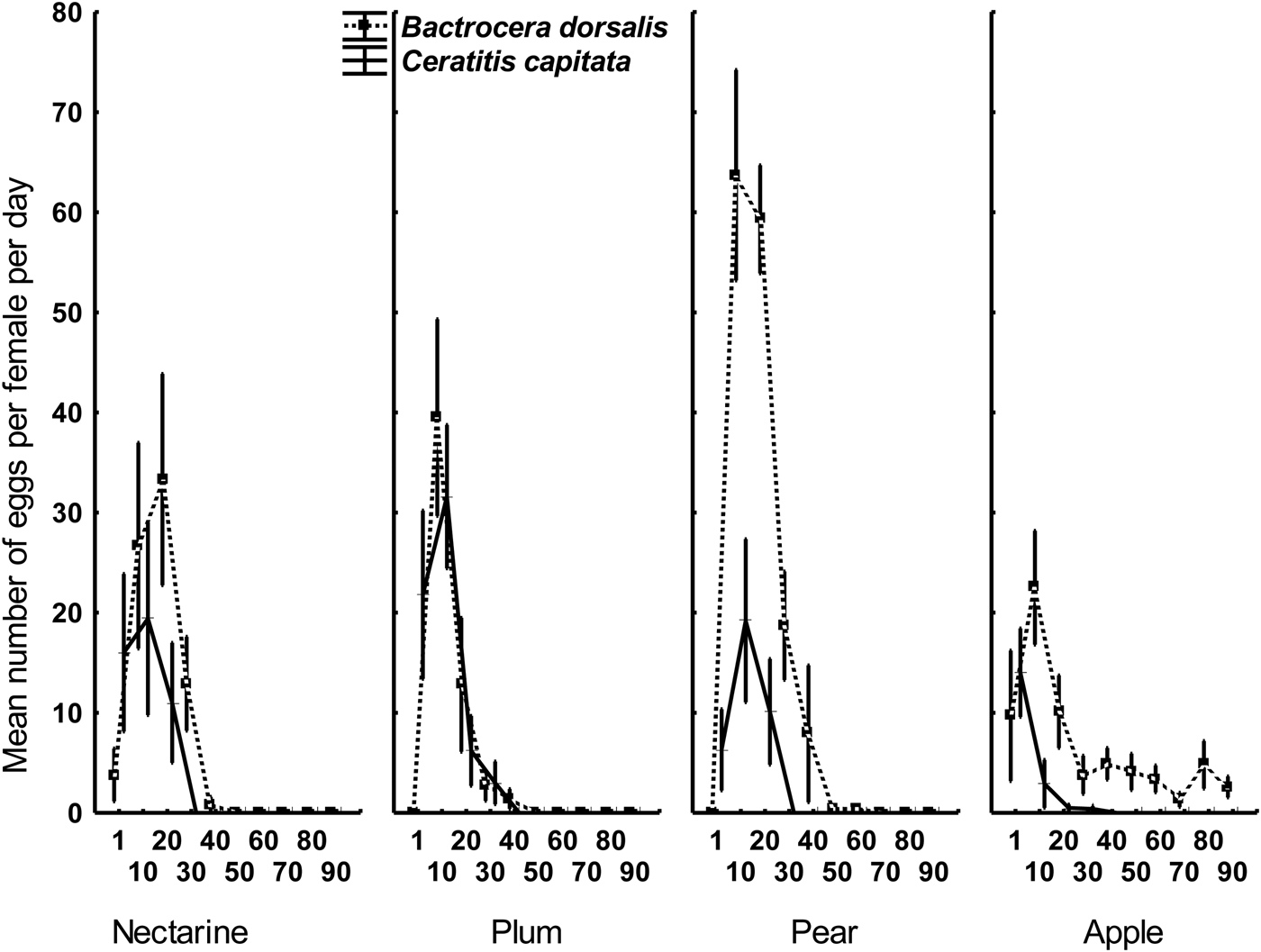
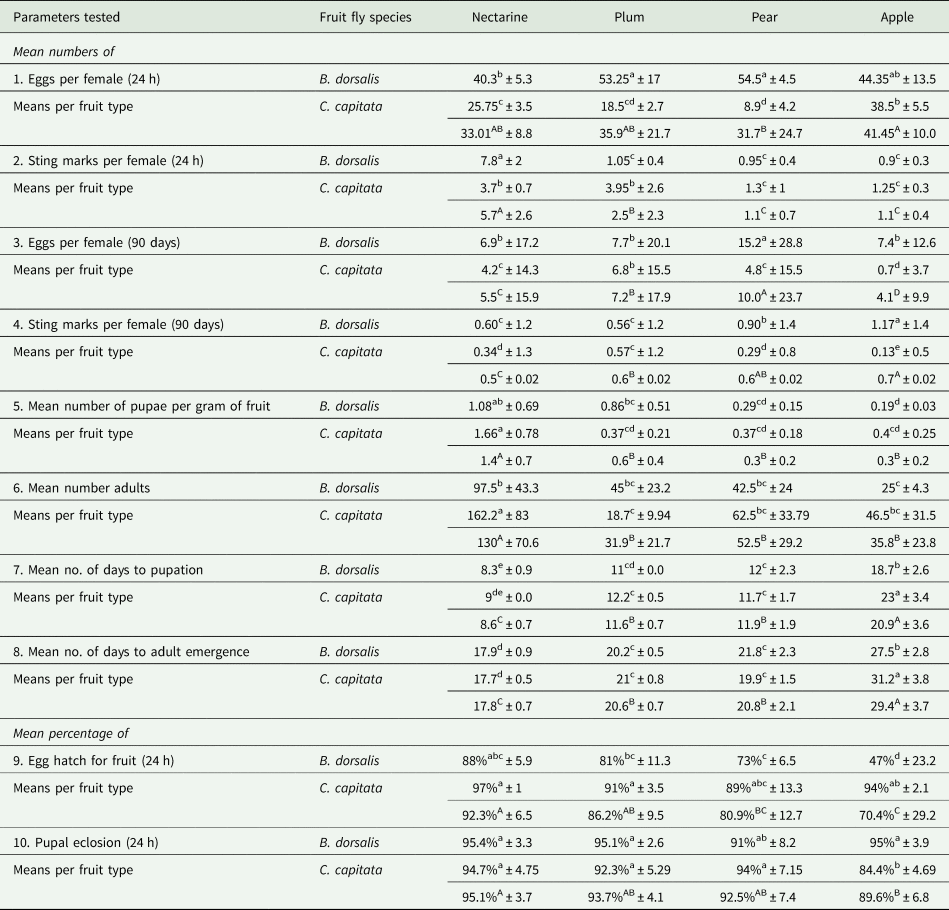
There were significant effects of fruit fly species and fruit on egg laying and sting marks for both time periods: 24 h (eggs: DF = 3, Wald's χ2 = 41.0, P < 0.001; sting marks: DF = 3, Wald's χ2 = 25.671, P < 0.001) and 90 days (eggs: DF = 3, Wald's χ2 = 41.373, P < 0.001; sting marks: DF = 3, Wald's χ2 = 49.769, P < 0.001). Over 24 h, B. dorsalis laid more eggs per female than C. capitata on all deciduous fruit types (table 1). On apple, differences in the number of eggs laid over 24 h between B. dorsalis and C. capitata were not statistically significant. Fewer eggs were laid in pear over 24 h by both species. When exposed to fruit sections over 90 days, B. dorsalis produced more eggs than C. capitata on all fruit types except on plum (table 1 and fig. 1). The number of sting marks on fruit represented oviposition attempts. In contrast to egg laying, differences in the number of oviposition attempts over 24 h between species only occurred on the stone fruit types: nectarine and plum. On nectarine, B. dorsalis had more oviposition attempts while the reverse occurred on plum. Over 90 days, there were generally more oviposition attempts by B. dorsalis than by C. capitata on all fruit except plum (table 1). Over 90 days there were more oviposition attempts on apple than other fruit types for B. dorsalis. For C. capitata, there were more oviposition attempts on plum compared to other fruit types over 90 days similar to egg-laying patterns. There was no significant interaction between day × species × fruit when analysing the mean number of oviposition attempts (DF = 3, Wald's χ2 = 7.082, P = 0.139), but there was a significant interaction between day × species × fruit when analysing the mean number of eggs deposited by a single female on the four fruit types over 90 days (DF = 3, Wald's χ2 = 12.790, P < 0.001). Egg laying by C. capitata peaked between days 16 and 38 in their adult life (fig. 1). Egg laying by B. dorsalis, on the other hand, peaked between days 23 and 45 in their adult life (fig. 1). After day 30 in the experiment (C. capitata at 38 days and B. dorsalis at 45 days), there were no significant differences in numbers of eggs laid between fruit types for both species.
The pattern of egg laying of B. dorsalis and C. capitata females on four different deciduous fruit types over 90 days. On day 1 of this study, B. dorsalis females were 14 (± 1) days old whilst C. capitata females were 7 (± 1) days old. Vertical bars denote ±0.95 confidence intervals.

Mean (±SD): (1 and 3) number of eggs per female over 24 h and 90 days, (2 and 4) number of sting marks per female over 24 h and 90 days, (5) number of pupae per gram of fruit, (6) number of adults, (7 and 8) number of days to pupation and to adult emergence, (9) percentage egg hatch and (10) percentage eclosion of C. capitata and B. dorsalis on four different deciduous fruit types

Development and survival of immature stages (5–10) were determined following a 24 h exposure to fruit. For each parameter, means followed by the same lowercase letters are not significantly different at the 0.05% probability level. For each parameter, means per fruit type followed by the same uppercase letters between columns within the same row are not significantly different at the 0.05% probability level.
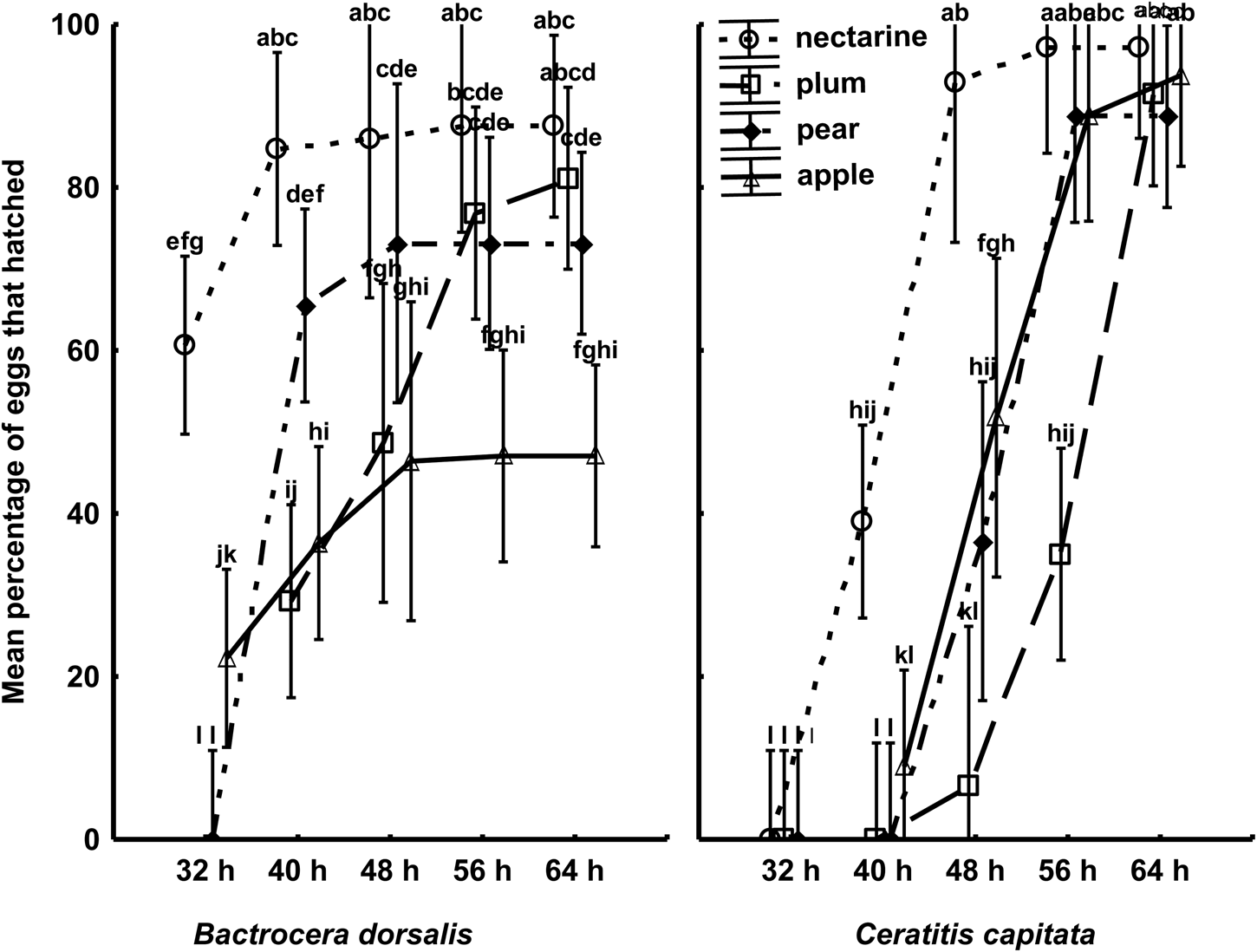
The eggs of B. dorsalis generally hatched sooner (after 32 h) than those of C. capitata (after 40 h) (fig. 2). Averaged over all fruit types, the percentage egg hatch was higher for the eggs of C. capitata than those of B. dorsalis (table 1). There was a significant interaction between time × species × fruit when analysing the mean percentage of eggs that hatched (F (12, 96) = 13.822, P < 0.001) (fig. 2). Eggs of both species hatched the fastest on nectarine (fig. 2) and average percentage egg hatch was higher on nectarine for both fly species, but this was only significantly different when compared with apple for B. dorsalis (table 1). Percentage egg hatch was also highest on nectarine for C. capitata, but this was not significantly different from any of the other fruit kinds (table 1).
The mean percentage egg hatch recorded for Bactrocera dorsalis and Ceratitis capitata on four different deciduous fruit types over 64 hours at 25 °C. ± Vertical bars denote 0.95 confidence intervals. Values indicated by the same letter do not differ significantly at p = 0.05.

Development to pupal and adult stages
Both B. dorsalis and C. capitata produced the highest mean numbers of pupae, pupae per gram of fruit and mean number of adults on nectarine (table 1). B. dorsalis produced fewer pupae and adults than C. capitata on nectarine (table 1). In contrast, on plum, pear and apple, B. dorsalis produced higher numbers of pupae than C. capitata (table 1). On plum, B. dorsalis also had a higher number of adults than C. capitata (table 1). This was not the case on the pome fruit types: pear and apple, where C. capitata had a higher number of adults compared to B. dorsalis (table 2). There were no significant interaction effects between fruit type and number of days to pupation for the two species (DF = 6, Wald's χ2 = 6.979, P = 0.323). Development (mean number of days to pupation and adult emergence) was faster on nectarine and slowest on apple for both C. capitata and B. dorsalis (table 1). Larvae of C. capitata took significantly longer than those of B. dorsalis to pupate on apple. Adult emergence was over 90% on all crops for both species, except for C. capitata on apple which was at 84% (table 1). The ratio of male:female flies was approximately 50:50 for both species on all fruit types.
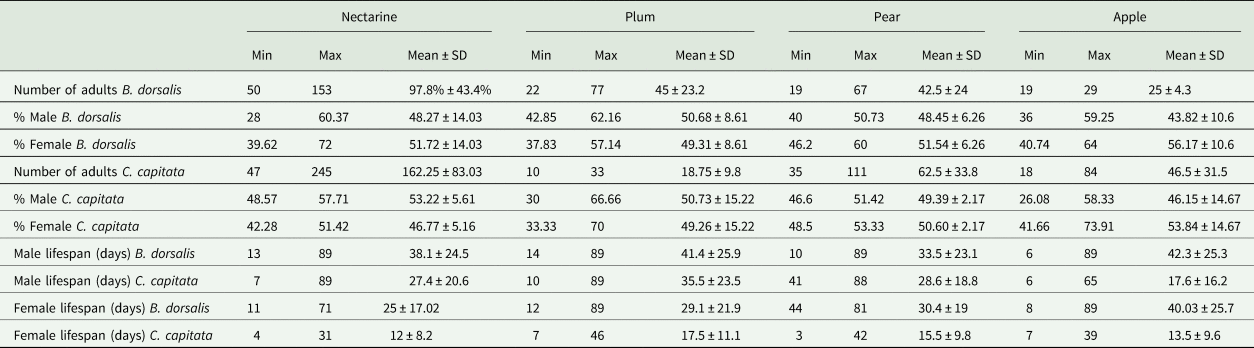
The influence of deciduous fruit type on adult formation, sex ratio and lifespan of B. dorsalis and C. capitata

Adult survival
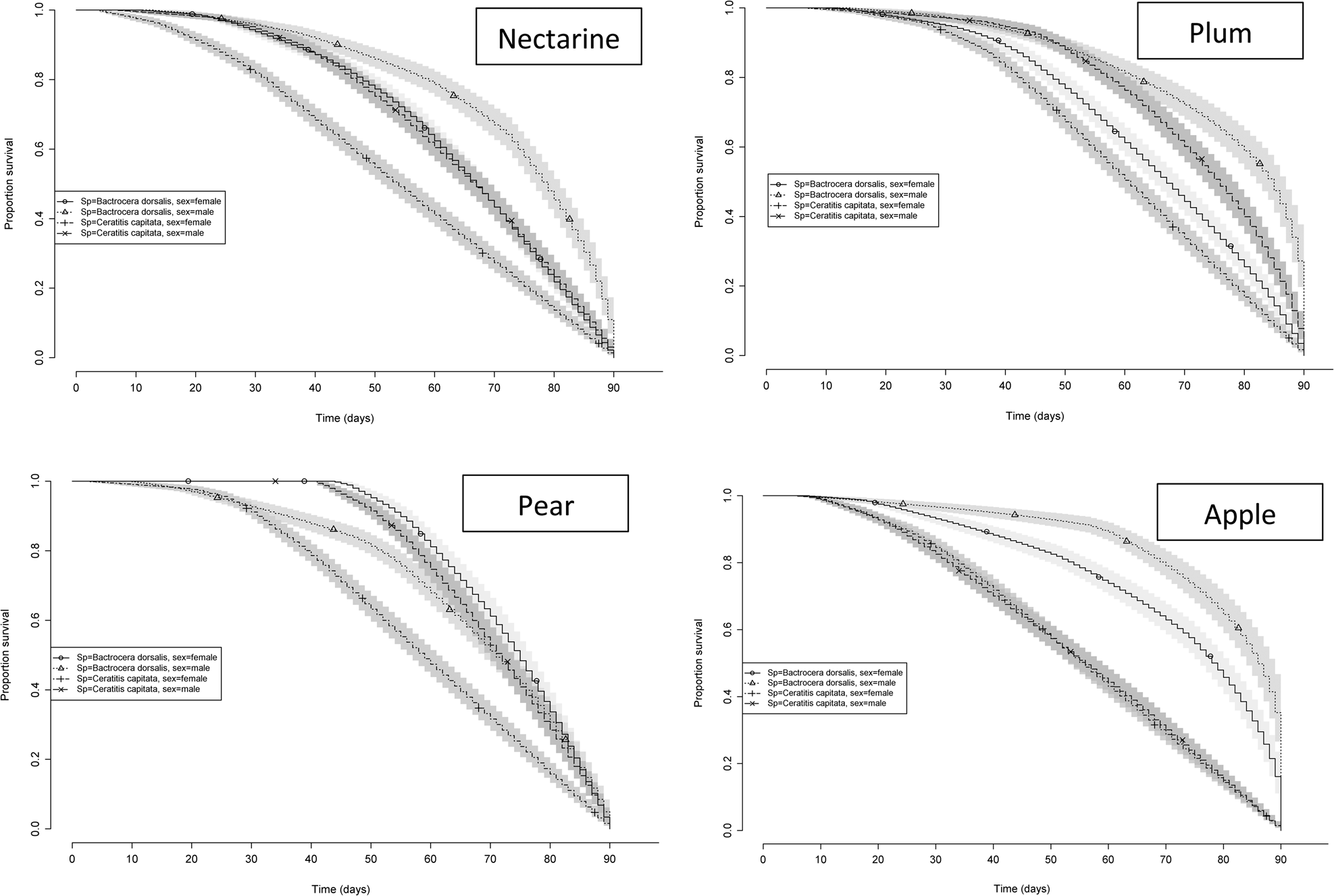
There was a significant interaction between fruit × species × sex (DF = 3, Wald's χ2 = 19.671, P < 0.001) when analysing the survival of B. dorsalis and C. capitata adults on the different fruit types (table 2).
B. dorsalis lived longer than C. capitata on all deciduous fruit types tested except for males on pear (table 2). On pear, there were no significant differences in the lifespan of males between the two species (table 2). B. dorsalis reared from apple survived longer than those reared on any of the other crops (Z = −20.7, P < 0.001), (table 2 and fig. 3). On all other crops, B. dorsalis and C. capitata had similar adult survival rates (table 2 and fig. 3). Males lived longer than females on all deciduous fruit types for both species (table 2).
Kaplan–Meier plots showing the survival of B. dorsalis (14-day-old flies) and C. capitata (7-day-old flies) males and females on four different fruit types (apples, nectarines, pears and plums). Shaded areas of each line represent 95% confidence intervals of the mean proportion of survivors.

Life table parameters
B. dorsalis had a higher net reproductive rate (R o) on all deciduous fruit tested compared to C. capitata (table 3). The value of R o was the lowest for C. capitata on apple and highest on plum. For B. dorsalis, R o was lowest on apple and highest on pear. C. capitata had a shorter generation time (T) on all deciduous fruit types tested compared to B. dorsalis. T for C. capitata was shortest on apple and longest on pear. T for B. dorsalis was longest on apple. T for B. dorsalis on fruit types other than apple was more or less similar (table 3). C. capitata had a significantly higher intrinsic rate of population increase (r m) compared to B. dorsalis on all fruit types.
Life table parameters (mean net reproductive rate, R o; mean intrinsic rate of increase r m; mean generation time T ± SD) for C. capitata and B. dorsalis on four different deciduous fruit types

Discussion
In this study, both B. dorsalis and C. capitata completed their life cycles successfully on all the deciduous fruit tested. B. dorsalis was able to survive longer as adults on deciduous fruit, made more oviposition attempts and laid more eggs than C. capitata. There were differences in larval and pupal survival rates between C. capitata and B. dorsalis according to the deciduous fruit tested. On all deciduous fruit types, the eggs of B. dorsalis hatched earlier than those of C. capitata, giving the developing B. dorsalis larvae a competitive edge over C. capitata larvae. Based on survival and reproduction data recorded in this study, a higher net reproductive rate (R o) was estimated for B. dorsalis than for C. capitata on all deciduous fruit types. Based on developmental rates, B. dorsalis was found to have a significantly lower intrinsic rate of increase (r m) and generation time (T) than C. capitata on all deciduous fruit types tested. The life history patterns of B. dorsalis and C. capitata obtained in this study are in agreement with findings from previous studies where the two species were compared in similar environments (Carey and Vargas, Reference Carey and Vargas1985; Vargas et al., Reference Vargas, Stark, Kido, Ketter and Whitehand2000). Life-history traits of B. dorsalis were previously suggested as being mixed between r-selected (high fecundity) and K-selected (longer generation times and longer life span) while traits of C. capitata fitted to r-selected species (higher intrinsic rates of increase, short generation times) (Vargas et al., Reference Vargas, Stark, Kido, Ketter and Whitehand2000). The traits of both species were preserved on the four deciduous fruit types evaluated in this study. While r-selected species are capable of rapid development, K-selected species would have greater competitive ability (Pianka, Reference Pianka1970). The K-selected traits of B. dorsalis on deciduous fruit indicate the latter would possibly out-compete C. capitata. Growth of populations of B. dorsalis would however be limited by temperature (Pieterse et al., Reference Pieterse, Terblanche and Addison2017) and the latter would possibly be the determining factor in competitive outcomes between the two species.
The demographic parameters of B. dorsalis on deciduous fruit obtained in this study are similar to those obtained on mango (recorded by Ekesi et al., Reference Ekesi, Nderitu and Chang2007), the preferred host of this fruit fly species (Ekesi et al., Reference Ekesi, Nderitu and Rwomushana2006). Ekesi et al. (Reference Ekesi, Nderitu and Chang2007) compared the demographic parameters of B. dorsalis reared on mango to those reared on an artificial diet. They found that larval development takes 10 days under similar rearing conditions, as was found in the present study, and that about 80% of the eggs and pupae emerged. Ekesi et al. (Reference Ekesi, Nderitu and Chang2007) recorded a lower number of eggs (per ten females) than was recorded in the present study on deciduous fruit (per five females). This is an indication that B. dorsalis could maintain similar or higher populations on deciduous fruit as on mango under suitable climatic conditions.
In the present study, males of C. capitata and B. dorsalis generally lived longer than con-specific females. This is similar to findings of Papadopoulos et al. (Reference Papadopoulos, Katsoyannos and Carey2002) on C. capitata and Ekesi et al. (Reference Ekesi, Nderitu and Rwomushana2006) on B. dorsalis. The impact of food restriction on the longevity of male and female Anastrepha ludens (Loew) was investigated by Carey et al. (Reference Carey, Harshman, Liedo, Müller, Wang and Zhang2008). The authors discussed the costs of reproduction in male flies (energy spent during courtship-calling and mating) and they did not find any differences in lifespan of males and females along different food gradients. The differences in adult lifespan between males and females where food was not restricted could be due to the physiological cost of producing eggs (Vargas and Carey, Reference Vargas and Carey1989), also discussed by Carey et al. (Reference Carey, Liedo, Orozco, Tatar and Vaupel1995).
Larval development success of B. dorsalis and C. capitata differed between types of deciduous fruit. For both species, nectarine offered the best larval environment compared to the other deciduous fruit types in terms of the numbers of pupae and adults produced. Development of pupae and emergence of adults took significantly longer on apple for both C. capitata and B. dorsalis. P. persica (peach and nectarine) and P. domestica (plum) have previously been found to be good hosts for B. dorsalis (Ye and Liu, Reference Ye and Liu2005) and C. capitata (Liquido et al., Reference Liquido, Cunningham and Nakagawa1990; Ovruski et al., Reference Ovruski, Schliserman and Aluja2003). Malus pumila (apple), on the other hand, was not found to be a good host for C. capitata when compared to apricot, peach and orange (Papadopoulos et al., Reference Papadopoulos, Katsoyannos and Carey2002). No larvae of C. capitata survived in apple during the host demographic studies of Carey (Reference Carey1984), who suggested that the flesh of the apple fruit was too firm for the larvae to feed on. Survival and development of other fruit fly species have been found to differ between fruit types which are within their host ranges (Hafsi et al., Reference Hafsi, Facon, Ravigné, Chiroleu, Quilici, Chermiti and Duyck2016). Hafsi et al. (Reference Hafsi, Facon, Ravigné, Chiroleu, Quilici, Chermiti and Duyck2016) found that the nutritional contents, especially the carbohydrate, lipid and fibre content of fruit, influenced larval development of polyphagous fruit flies. They used the survival rate, development time and pupal weight of larvae as indicators of performance on the fruit they tested. According to the National Nutrient Database for Standard Reference of the United States Department of Agriculture (2018) (https://ndb.nal.usda.gov), lipid and protein contents of nectarine and plum are higher than that of apple and pear. It is likely that the larval development of both B. dorsalis and C. capitata is limited by lipid and protein. Lipid and protein were found to be constantly utilized in different phases of larval-adult transition for C. capitata (Nestel et al., Reference Nestel, Tolmasky, Rabossi and Quesada-Allué2003). This would probably also be the case for B. dorsalis. The presence of phenolic components in fruit was found to decrease larval development by exerting an anti-nutritive effect (Birke and Aluja, Reference Birke and Aluja2018). Apples (343 mg/100 g) and pear (305 mg/100 g) contain higher concentrations of phenolic components than plum (122 mg/100 g) and nectarine (154 mg/100 g) (Gil et al., Reference Gil, Tomás-Barberán, Hess-Pierce and Kader2002; Imeh and Khokhar, Reference Imeh and Khokhar2002; Lombardi-Boccia et al., Reference Lombardi-Boccia, Lucarini, Lanzi, Aguzzi and Cappelloni2004).
Host fruits with longer larval development times represent potential overwintering hosts for fruit flies until environmental conditions improve again (Papadopoulos et al., Reference Papadopoulos, Katsoyannos and Carey2002). Papadopoulos et al. (Reference Papadopoulos, Carey, Katsoyannos and Kouloussis1996) found that apple, as opposed to other fruit such as pear, stay more intact and provide a refuge for larvae that protects them from the elements. In this study, a long period of egg production was found on apple for B. dorsalis. Apples could therefore represent ideal bridging hosts for B. dorsalis to survive until other fruits become available, such as citrus fruits, and suitable environmental conditions are restored.
B. dorsalis would be able to sustain its population in deciduous fruit growing areas under favourable climatic conditions. Given that B. dorsalis immatures were found to develop faster than those of C. capitata at a temperature of 26°C, competitive interactions at the larval stages between the two species can be expected. The results of this study imply that early detection and elimination of any B. dorsalis propagules are of utmost importance to protect the deciduous fruit growing area of the Western Cape from a potentially damaging pest.
Acknowledgements
The authors would like to thank H.R. Ramukhesa, S.M. Rosenberg (DAFF) and Daleen Stenekamp (Hortgro) for rearing the flies as well as M. Jacobs, V. Steyn, M. Magagula and P.J. Pieterse for technical assistance. Funding was obtained from HortGro Pome and HortGro Stone. In addition funds were received from the National Research Foundation.