INTRODUCTION
This article seeks to extend the notion of language crossing to a set of practices and a type of setting that are very different from the ones in which it was originally developed and to which it has been most commonly applied. In our definition of it, crossing involves reflexive communicative action in which a person performs specially marked speech in a language, dialect, or style that can be heard as anomalously ‘other’, raising questions of legitimacy and entitlement for the participants (Rampton Reference Rampton1995:ch.11, §1–2; Reference Rampton2009:151–53). Crossing is closely related to stylisation, and as clearly nonhabitual speech practices, they both break with ordinary modes of action and interpretation. But crossing entails a stronger sense of social or ethnic boundary transgression. When hearers encounter the transgressive disjuncture between a speaker's voice and background that crossing involves, the questions with which they make sense of it go beyond ‘why that now?’ to ‘by what right?’ or ‘with what license?’ (Rampton Reference Rampton2009:151–53; see also Auer Reference Auer2006; Quist & Jørgensen Reference Quist, Jørgensen, Auer and Wei2009).
The practices that were first called crossing occurred in principally recreational interaction among adolescents in multi-ethnic neighbourhoods affected by several decades of migration into the UK, and they were often linked to popular cultural media (see Rampton & Charalambous Reference Rampton, Charalambous, Martin-Jones, Blackledge and Creese2012 and the penultimate section below for a review of broadly similar findings in other countries). In this article, however, we move away from vernacular sites to explore the relevance of crossing to learning and teaching another language at school, focusing on young people in the Greek-Cypriot education system learning Turkish, the language of the (former) enemy. This is a situation where the legacy of war makes ongoing interethnic hostility much more intense than in the UK sites that Rampton originally studied. But we argue here that participation in these language classes also constitutes crossing, and that our case study can enrich the conceptualisation of crossing practices, contribute to the understanding of language education, and add to our knowledge of how language features in changing intergroup relations.
We begin with methodology, outlining our fieldwork and dataset, also explaining why we attend more to ideology and institutional processes than to the micro-details of interaction in what follows. After that, we sketch the history of conflict in Cyprus and the roles that state and supra-state actors played in the introduction of Turkish as a curriculum subject in 2003. We then turn to the ideological controversy around Turkish, attending first to students’ perceptions and the influence of family history and then to obstacles to Turkish language provision encountered at different institutional levels. We then turn to processes and practices that supported crossing into Turkish: the justifications that students offered; the institutional affordances and normalising routines of foreign language learning at secondary school; and the ways in which learning Turkish was interactionally framed in class. After that, we compare this case study with other accounts of crossing, bringing out its distinctiveness, and in the concluding section, we draw out the broader implications, reaffirming the specificity of crossing as a practice, arguing for the contribution that analyses of crossing can make to our understanding of language education in conflict-riven settings in particular, and peace-building more generally.
APPROACH, FIELDWORK, AND DATA
To explain the approach taken in this article, it is worth starting with the perspective on communication developed by John Gumperz, to which the concept of crossing has been tied from the outset (Rampton Reference Rampton1995:appendix 1).
From the 1970s onwards, Gumperz sought a ‘closer understanding of how linguistic signs interact with social knowledge in discourse’ (Reference Gumperz1982:29), and Silverstein subsequently formalised this agenda in the ‘total linguistic fact’: ‘[t]he total linguistic fact, the datum for a science of language is irreducibly dialectic in nature. It is an unstable mutual interaction of meaningful sign forms, contextualised to situations of interested human use and mediated by the fact of cultural ideology’ (Reference Silverstein, Mertz and Parmentier1985:220; Hanks Reference Hanks1996:230; Agha Reference Agha2007:147–50). Consistent with this, Rampton (Reference Rampton1995) focused on strips of interaction in which there was a conspicuous disjuncture between social identity and linguistic code selection (linguistic signs/sign forms), and he analysed the discursive strategies that led to the acceptance or rejection of this (discourse/situations of interested human use), also drawing on ethnographic and historical data to identify the ideological and institutional processes that threw the legitimacy of these linguistic switches into question (social knowledge/cultural ideology). And as in Gumperz's work and linguistic anthropology more generally, the investigation of this ‘dialectic’ produced a ‘dynamic view of social environments where history, economic forces and interactive processes… combine to create or to eliminate social distinctions’ (Gumperz Reference Gumperz1982:29; Rampton Reference Rampton1995:chs. 1 & 12, Reference Rampton2011).
The present study also orients to the ‘total linguistic fact’, but the historical, institutional, and ideological dimensions of language crossing feature more prominently than transcripts of interaction. In Rampton's earlier work, the linguistic switches that constituted crossing were generally both conspicuous and relatively brief, and as in many other studies, this meant that crossing could be illustrated with relatively short episodes analysed in a good deal of micro-interactional detail (Reference Rampton1995). In the present study, however, Greek Cypriots’ involvement and exposure to Turkish occurred almost continuously throughout the twice weekly ‘foreign language’ lessons that they attended, and even when students were not producing it themselves, the controversial other-language was there in front of them, in their exercise and textbooks, on the whiteboard, in their teacher's speech. So in the first instance, the scale of this activity substantially reduces the capacity of short but closely analysed transcripts of audio-data to capture these students’ experiences of crossing during these lessons. Instead, ethnographic description of the institutional setting necessarily plays a larger role. Second, the performance of these lessons was actually rather similar to many of the classes described in the literature on foreign language learning, and transcripts of typical episodes of Greek-Cypriots producing Turkish in class could leave the reader wondering whether and how these lessons were any different. So rather than, as previously, seeking to evidence crossing in the micro-interactional analysis of specific shifts into the other language, our categorisation of participation in these classes as language crossing relies on an understanding of the ideological and institutional background, combined with interactional theory and more broadly drawn empirical description.
Most of the data that informs this understanding comes from fieldwork in Turkish language classes in Greek-Cypriot secondary schools and adult institutes conducted in 2012–2013,Footnote 1 building on an earlier ethnography of such classes by Constadina Charalambous (Reference Charalambous2009, Reference Charalambous2012, Reference Charalambous2013). The secondary students were sixteen and seventeen year olds, and the adult learners were aged between twenty-five and seventy. Given the political sensitivity of the processes involved, the project was designed as a linguistic ethnography (Rampton, Maybin, & Roberts Reference Rampton, Maybin, Roberts, Snell, Shaw and Copland2015), combining analysis of interviews and classroom discourse with consideration of historical, sociopolitical, and institutional processes. Initial data analysis involved eighteen months of data processing, and produced twenty thematic reports.Footnote 2 In addition, the account also draws more indirectly on broader knowledge of Greek-Cypriot schools shaped in, for example, Panayiota Charalambous's doctoral project (P. Charalambous Reference Charalambous2010) and in the study of a peace education initiative in 2012–2014 (cf. Zembylas, Charalambous, & Charalambous Reference Zembylas, Charalambous and Charalambous2016).
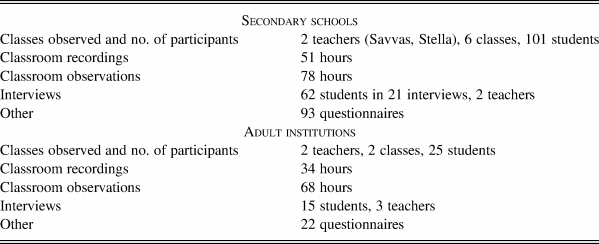
In view of this article's central aim—to explore whether and how Greek-Cypriots learning Turkish represents a significant expansion to existing accounts of language crossing—our account of crossing in Cyprus is theoretically pointed, not comprehensive. As Rampton's earlier work on crossing focused on youth (as have many studies), we also concentrate on the adolescent data, summarised in Table 1, to sharpen the comparison. But at least two simplifications in the portrait need to be recognised: (i) There were actually many more sites in Cyprus where both adolescent and adult Greek-Cypriots could learn Turkish than those we describe, displaying potentially very different dynamics from those we describe. These included a Turkish studies programme at the University of Cyprus, private tuition, and inter-communal centres committed to reconciliation. (ii) Cyprus is itself now actually very multi-ethnic and multi-lingual, even though the historic antagonism between Greek- and Turkish-Cypriots can easily suppress recognition of its diversity (Zembylas et al. Reference Zembylas, Charalambous and Charalambous2016).
Overview of the dataset.

With this account of our approach to the ‘total linguistic fact’, our fieldwork, our dataset and key caveats in place, we can start with a preliminary sketch of the historical and political background.
RECONCILIATORY POLICY INITIATIVES AGAINST A BACKGROUND OF DIVISION
In Cyprus, interethnic conflict between the Greek-Cypriot and Turkish-Cypriot communities began in the early twentieth century, when the island's two main religious groups were transformed into ethno-national groups—‘Greeks’ and ‘Turks’. In 1960, a bicommunal Republic of Cyprus was established, but there was interethnic violence between 1963 and 1967, and approximately 20,000 Turkish-Cypriots moved into ethnically pure enclaves. In 1974, after a coup d’état backed by Greece, the Turkish army intervened occupying the northern third of the island.Footnote 3 The war had devastating consequences and involved the violent relocation of around 196,000 Greek-Cypriots and 34,000 Turkish-Cypriots into, respectively, ethnically homogenized sectors in the south and north of the island (Canefe Reference Canefe2002), which are still separated by a UN buffer zone. Since then, there has been little violence, but in the government-controlled (southern) areas where our research has been based, hostile images of Turks and Turkish-Cypriots have been perpetuated in the media (Adamides Reference Adamides, Kontos, Theodoulou, Panayiotides and Alexandrou2014), in public debate, and mainstream education (Papadakis Reference Papadakis2005; Christou Reference Christou2007).
Turkish has been spoken in Cyprus for about four centuries and when Cyprus gained independence from British Administration in 1960, both languages were recognized as official languages in the constitution. Indeed, Turkish is still considered to be the second official language of the (Greek-Cypriot) Republic of Cyprus, and it is used alongside Greek in stamps, bank notes, and official documents (Karyolemou Reference Karyolemou, Nelson and Dedaić2003).Footnote 4 But rising nationalism and growing hostility between the two communities in the latter part of the twentieth century had a negative impact on Greek-Turkish/Turkish-Greek bilingualism on the island. Language was seen as essential to being ‘Greek’ or ‘Turkish’ and to the communities’ survival (Karoulla-Vrikki Reference Karoulla-Vrikki2004). Speaking the language of the other community became not just undesirable but a sign of ‘betrayal’ (Ozerk Reference Özerk2001), and Greek-Cypriot education was monolingual, Turkish never being taught in the school curriculum before 2003.
In 2003, however, this situation was somewhat disrupted. With the EU Accession Treaty in focus and negotiations for a political settlement of the Cyprus Conflict ongoing, the Turkish-Cypriot authorities lifted some of the restrictions of movement across the buffer zone in Nicosia, so that people could cross the dividing line for the first time in nearly thirty years. Very soon after, the (Greek-)Cypriot government announced that among other things (including access to health care), it would set up voluntary language classes for Greek-Cypriots who wanted to learn Turkish, both in secondary schools and adult institutes, as well as classes for Turkish-speaking adults who wanted to learn Greek. In educational documents and in interviews with senior ministry officials, all of this fitted into a rhetoric of reconciliation, and the new classes were presented as an emblem of government good will (C. Charalambous Reference Charalambous2012). These political intentions were not, however, reflected in any straightforward way either among the young people who took up the opportunity to study Turkish, or in the schools that provided it.
STUDENTS’ MIXED PERCEPTIONS OF TURKISH
The adolescents studying Turkish had very mixed political views, and these were linked to their perceptions of Turkish and its speakers.
When we asked them whether they spoke Turkish outside class, only sixteen of the sixty-two students that we interviewed in 2012–2013 claimed to know Turkish-Cypriots personally.Footnote 5 So we asked whether they would like to meet a Turkish speaker, or to know one to be able to practise their Turkish with. Thirteen (in ten out of twenty-one interviews) said they didn't “want any relations with them”, occasionally elaborating with expressions of dislike or hatred (“I don't like them”; “I don't want them”; “I wish they were effaced”). They said they didn't like seeing Turks or Turkish-Cypriots in the streets, didn't want to visit Turkey, and preferred to stay “friends and apart”, “the further the better”. Such views were regularly linked back to the 1974 war and the suffering of Greek-Cypriots (fifteen interviews), which was described as hugely traumatic. For these students, the Turks were violators who committed great and disproportionate injustice: they felt “bitterness” and “hostility”, because the Turks “inflicted evil over here”—“they are the enemy that uprooted my family”.
Other informants, however, spoke of Turkish being useful if ever there was a solution to the Cyprus problem (nine interviews out of twenty-one): “it's not a bad thing to learn a language that lives in Cyprus”; “in the future we may need them, to talk wi::th-” “Turkish girls ((laughs))” (interviewees Marinos & Michalis). But more positive views tended to be articulated in relatively general terms, in expressions of intercommunal good will or in criticisms of their own community, rather than as close personal alignment with other-ethnic individuals.Footnote 6 Some drew on the distinction between ‘Turks’ and ‘Turkish-Cypriots’, shifting the blame to ‘Turks’: Turkish-Cypriots were “more towards our side”, “more friendly towards us”. For others (in twelve interviews), the distinction between Turks and Turkish-Cypriots was dissolved in a regard for their common humanity and instead, the ‘big actors’ that take political decisions and affect the course of history—the “state”, “people higher up”, “big interests”—were distinguished from “simple people”, including women and children, who were innocent victims. Indeed, in twelve of the interviews, adolescents voiced criticisms of their own community: “we also did a lot, it's not only them”, “we gave them [Turkish-Cypriots] a hard time”. Those expressing views like these described themselves as “more open-minded”, “searching things more”, and they were also critical of one-sided nationalism with which they were “brainwashed” in their families, their communities, and their schools: “there is fanaticism on both sides”.
Turning to the nonschool experiences that informed these young people's perceptions of Turkish, it was clear that intergenerational relationships were very significant. All but seven of the sixty-two adolescent interviewees had crossed the border on visits to the Turkish-speaking part of the island, usually only once or just a few times, and most of them made these trips with their families. They described day excursions, going around “out of curiosity” to “see the place” and “see how it is”, visiting major cities, religious monuments, and archaeological and historical sites—visiting places that “we had been hearing about since we were babies”. Impressed by the natural beauty but struck by what they saw as a general state of dilapidation, these visits had much more the character of pilgrimage than tourist recreation, and in seventeen interviews, informants from refugee families said they visited family homes and occupied villages and towns where their parents or grandparents had lived before 1974, with very mixed reactions.
(1) Interview with Panayiota
Charis: ε όποτε πάμε τζιαμέ, τζείνοι που κατοικούσιν μέσα τωρά εν πάρα πολλά καλοί, συντηρούσιν το πάρα πολλα το σπίτι, ε όποτε πάμε ας πούμε τζιαι να μας υποδεχτούσιν τζιαμέ, τζιαι έχουν φαΐ να μας προσκαλέσουν να πάμε να κάτσουμε, ή πριν φύουμε να μας δώσουσιν φρέσκα φθαρτά που κάμνουσιν μόνοι τους
Yiota: ναι ναι
Charis: εξαρτάται που το χαρακτήρα του καθενού, τζιαι βέβαια το πως τους συμπεριφέρεσαι τζιαι συ
- - - - - - - - - - -
Charis: eh whenever we go there, those who live there now are really really nice, they preserve the house very much, eh whenever we go let's say they welcome us there and they have food and invite us to go and sit, or before we leave they give us fresh vegetables they produce themselves
Yiota: yes yes
Charis: it depends on the character of each person, and of course how you behave to them too
(2) Interview with Yiota
Christi: ε που ποτζεί στα κατεχόμενα εφέρασιν πάρα πολλούς που την Τουρκία, τζιαι ενεν Τουρκοκύπριοι είναι Τούρκοι, είναι οι κακοί Τούρκοι ας πούμε, εν γίνεται να πααίνει σπίτι του ο παπάς μου τζιαι να μεν τον αφήνει στο σπίτι του, το πατρικό του, να μπει απλά, όι για να πιάει κάτι, απλά να το δει, να δει πού ετζοιμάτουν τζιαι να φύει, τίποτε, εν τζιαι εννα τους ενοχλήσει {χμχμ} εν παράλογο τούτον το πράμα, να μας πιάνουν τις περιουσίες μας έτσι […] τζιαι:: εν θέλει να ξαναπάει ο παπάς μου που τζειν’ τον τζαιρό, λαλεί εν γίνεται απαράδεχτο
- - - - - - - - - - -
Christi: eh over there in the occupied areas they have brought many people from Turkey, and they are not Turkish-Cypriots, they are Turks, they are the bad Turks let's say, it's unacceptable for my father to go to his house and not to let him in his house, his parents’ house, just to enter, not in order to take something, just to see it, to see where he used to sleep and to leave, nothing, he wouldn't bother them, this thing is absurd, to take our property like that […] a::nd my father doesn't want to go again since then, he says this can't be, it's unacceptable
(3) Interview with Panayiota
Nikos: επειδή:: διούν σου εντυπώσεις πριν να πάεις ότι::: ήταν υπέροχα, ήταν σπίτι μες το βουνό, είχαμεν τες κότες τζιαμέ, τζιαι μετά θωρείς ένα χαλαμάντουρο τζιαμέ ίντα μπου::- χάνεις τέλεια την ψυχολογία σου, αλλάσσεις πολλά, αλλάσσεις πολλά, παθαίνεις ένα σο
Filippos: ή άμα πααίνεις ξερω γω με τη γιαγιά σου, τη μάμα μου τζιαι τη γιαγιά μου τζιαι ξέρω γω
Nikos: ναι, τζιαι κλαίσιν ας πούμε
- - - - - - - - - - -
Nikos: becau::se they ((parents)) give you this impression before you go, tha::t it was wonderful, it was a house in the mountains, we had our chicken there, and then you see a ramshackle there, wha::t- it ruins your psychology, you change a lot, you change a lot, you go through a shock
Filippos: or when you go like with your grandmother, my mother and my grandmother and all
Nikos: yes and they cry let's say
So attitudes to Turkish and its speakers were strongly affected by the history of violent interethnic conflict, and although the language had first been introduced to Greek-Cypriot secondary education within a rhetoric of reconciliation, this was far from universally reflected among the adolescents who chose to study it. The implementation of this policy initiative also encountered a range of obstacles in schools.
REACTIONS AND IMPEDIMENTS AT SCHOOL
Both teachers and students reported a lot of adverse reactions to their involvement with Turkish. Admittedly, the teachers told us (in 2012) that hostility to Turkey and Turkish-Cypriots had ‘simmered down’ since the first years when Turkish was introduced. Then, there had been damage to classrooms, anti-Turkish slogans and swearwords were written on the boards in class, and there were requests in lessons for the translation into Turkish of nationalist slogans like ‘a good Turk is a dead Turk’. Indeed, over the course of seven months’ fieldwork in 2012, we ourselves only witnessed a few incidents of hostility from other students. But learning Turkish was not something students could pursue discretely unnoticed—the people who had chosen Turkish were conspicuous to everyone when they all went off to different language classes twice a week—and both in informal interaction and in interviews, adolescents studying the language complained about being called ‘traitors’ by their peers, and about negative reactions from other teachers (see extract (6)).
The structural organisation of the language curriculum also made the provision of Turkish somewhat precarious. In 2012, there were 873 students learning Turkish in sixty-one classes in the Greek-Cypriot secondary system, but these were taught by just eight teachers, all Greek-Cypriot, and they worked peripatetically. Learning Turkish was not compulsory, so teachers had to recruit final and next-to-final year students in sufficient numbers to justify running these classes. Although they certainly encountered some help and encouragement from other colleagues, they often faced substantial challenges and ‘institutional sabotage’. At crucial points in the options selection process, there had been lapses in government support. Although classes were approved in 2003, Turkish was omitted from the 2004 and 2006 editions of the Ministry booklet advising secondary students on their option choices; in 2007, it was only publicised in an addendum circulated belatedly to schools; and in 2010, even though it was taught as part of the foreign language curriculum, it was left out of the section on ‘Foreign Languages’ (pp. 60–69), and presented separately (pp. 83–85). School management could also create obstacles, as shown in (4) below.
(4) Savvas in interview with Panayiota
Yiota: εμ:::, πού μπορούμε να αποδώσουμε το ότι δημιουργούνται… σε κάποια σχολεία έχουμε 4 τμήματα τζιαι σε άλλα ένα ή κανένα
Savvas: υπάρχουν πολλά τινά, πρώτον έχει να κάνει με το πως ενημερώνονται που τους συμβούλους, δεύτερον, πώς επιτρέπει ο προγραμματιστής να γίνουν τα πράγματα, η συνεργασία συμβούλου τζιαι προγραμματιστή, οι κατευθυντήριες γραμμές μας από τη διεύθυνση του σχολείου
- - - - - - - - - - -
Yiota: em:::, to what could we attribute the fact that in some schools we have 4 classes of Turkish and in others one or none?
Savvas: there are many reasons, first it has to do with the way in which they [students] get informed by the career advisors, second, the way the school timetable organiser allows things to happen, the collaboration between the career advisor and the timetable organiser, our guidelines from the school management
And other staff could be difficult, as one of the teachers made clear in her account of ‘European Languages Day’, an important marketing event, discussed in (5).
(5) Stella (Turkish language teacher) in interview with Panayiota
Yiota: τη μέρα των γλωσσών κάμνετε κάτι με τα τούρκικα;
Stella: όι, τζιαι ο [Σάββας] έκαμεν το μεγάλο θέμα για πολλά σχολεία που λεν, που με τρόπο λεν μας να μεν κάμουν […] είσσιεν ένα περιστατικό φέτος σε ένα λύκειο στην Πάφο που η καθηγήτρια [Τουρκικών] ήθελε να λάβει μέρος ως ευρωπαϊκή γλώσσα τζιαι αντιδράσαν οι αγγλικοί, τζιαι οι φιλόλογοι, “μα εν ανήκει στην ευρωπαϊκήν ένωση”, “μα αφού είπαμεν ημέρα των γλωσσών” και λοιπά, τζιαι εκάμαν της μεγάλο θέμα τζιαι έπιασεν τζιαι ο επιθεωρητής τζιαι έκαμεν τζιαι τζείνος θέμα γιατί να της κάμουν έτσι τζείνης των τουρκικών
- - - - - - - - - - -
Yiota: on the Day of Languages do you do anything with Turkish?
Stella: no, and [Savvas] made a big issue of the fact that many schools say-, in their own way they tell us not to do [things] […] there was an incident this year in one Lyceum in Paphos where the teacher [of Turkish] wanted to take part as a European language and the English teachers reacted, and the philologists, “but it does not belong to the European Union”, but we said “it's languages day” and so on, and they made a big issue out of it, and then the inspector called and also made an issue of why they did this to the Turkish-language teacher
So plainly, there was rather more involved in studying Turkish than one normally associates with ‘learning a foreign language at school’, and issues of legitimacy—crucial to the definition of crossing—loomed very large. All of this adds salience to the questions of why students should actually choose Turkish in the first place, how they would subsequently justify their choice, and how teachers could deal with this controversy, issues to which we now turn.
JUSTIFYING THE LEARNING OF TURKISH
In our interviews, the decision to study Turkish was relatively easy to explain for students who expressed good will towards Turkish speakers and were well-disposed to the possibility of reunification. For others (in more than half of the interviews), there seemed to be good security reasons for ‘knowing the language of the enemy’. Some referred to war in the future, while others said that they would be able to detect if they were being insulted in the street and swear back. Indeed, even those who were quite interested in reconciliation said that this security rationale was a very good way of warding off their critics.
(6) Maria (female, 17), Kostis (male, 17), Chrysanthi (female, 17), and Sokratis (male, 17) in interview with Panayiota
Maria: ή μιαν ημέρα […] ήρτεν η κυρία Γ., ιστορικός ((laughs))το έθνος της εν τζειπάνω ας πούμε ((laughs)) τζιαι λαλεί μου “γιατί έπιασες τα τούρκικα?” ((laughs)) τζιαι κάμνει μου τζιαι μάθημα, εφοήθηκα, εννοώ::
Kostis: ((laughs))
Maria: ε λαλώ της «κυρία καλώς ή κακώς οι τουρκοκύπριοι εν τζιαμέ, πρέπει να μάθουμεν τζι εμείς κα-», τζιαι έχω τζι ένα θείο που εν μες το- στρατιωτικό τζιαι λαλεί μου, “ε για να καταπολεμήσουμε τον εχθρό πρέπει [να ξέρεις τζιαι την κουλτούρα του, ούλλα, να τα ξέρεις ούλλα”
Sokratis: [πρέπει να μάθεις τη γλώσσα του
Chrysanthi: ε πόσα σου έβαλε κόρη;
Maria: δεκαοχτώ
Chrysanthi: ε εντάξει ((laughs))
Kostis: ((laughs))
- - - - - - - - - - -
Maria: or one day […] Mrs G. came, a historian ((laughs)) her nation is high up there let's say, ((laughs)) and she tells me “why did you choose Turkish?” and she is also my teacher, I was scared, I me::an
Kostis: ((laughs))
Maria: eh I tell her “Miss, whether we like it or not Turkish-Cypriots are there, we have to learn too th-”, and I have an uncle who is in the- a military officer and he tells me, “eh to combat the enemy you have [to know his culture too, everything, you have to know everything”
Sokratis: [you have to learn his language
Chrysanthi: hey what mark did she give you?
Maria: eighteen ((out of twenty))
Chrysanthi: eh that's ok ((laughs))
Kostis: ((laughs))
But most often, students invoked a local language ideology that was closely connected to the exigencies of upper secondary schooling and centred on similarities between the Cypriot dialects of Turkish and Greek (cf. Hadjipieris & Kabatas Reference Hadjipieris and Kabatas2015). When describing the learning of Turkish, students frequently referred to shared lexis, saying that Turkish was “very close to the Cypriot dialect that we use”, we “speak it without realizing it”, “it's familiar, it's not the first time we hear it”. This, it was said, made learning Turkish easy, along with familiar pronunciation and the readability resulting from the correspondence between grapheme and phoneme (nine interviews). Although it was very much contrary to our own and other Greek-Cypriot adults’ perceptions of how hard it is to learn Turkish, the discourse of ‘easiness’ provided a justification that sidestepped ideological controversy, and in fact it was actively propounded in workshops and guidelines for teachers. According to the advisory teacher for Turkish, “the guidelines we give to the teachers during our seminars… are ‘prove to them how easy Turkish is, in order for them to love the subject’”. Other teachers picked this up: “if they have the impression that it's easy they will try and they like it… I mean I know which bits of Turkish are difficult, eh, in those parts I will cover them painlessly let's say, so that they don't get scared” (Stella). The word was not in any of the interview questions we planned in advance, but the idea that it was efkola ‘easy’ was actually by far the most commonly given reason for learning Turkish (twenty interviews): “from all languages I believe it's the easiest” (Despina); “it's more for the marks and for the fact that it's an easy language” (Christina).
Especially in the last two years of secondary school, students were under a lot of exam pressure if they wanted to get a place in a Greek or Greek-Cypriot university. They had to study foreign languages, and choosing a language option that was easy to study could both increase their overall GPA and “reduce workload” pressure, allowing them “to have a lighter schedule”. There was a strong consensus that it was a good way “to get an A” or “20”, “to have a sure mark”, and, for very weak students, even “to pass the class”. More than that, its easiness as a school subject provided students who were anti-Turkish with a good reason for studying the language.
(7) Interview
Minas: Εν να κάμω μάθημα του κατακτητή μας, ας πούμε τζείνος που εν που πάνω μου? Εν μου αρέσκει έτσι πράμα
Yiota: Τι εννοείς?
Minas: Εν να πιάσω να μαθαίνω την γλώσσα τζείνου που με κατάκτησε τζιαι τόσο τζιαιρό έσιει με που κάτω ας πούμε.
Yiota: Αφού εσύ έπιασες το.
Minas: α?
Yiota: Εσύ το έπιασες.
Manos: Έβαλε το για μάθημα
Minas: Εγώ έβαλα το για το μάθημα, για τον βαθμό ας πούμε, μια ξένη γλώσσα ξέρω εγώ, “άτε να το πιάσουμε, σικκιμέ”. Αλλά εν την έπιασα ιμίσσιη μου για να ξέρω να μιλώ με τον ένα τζιαι τον άλλο.
Manos: αφού είπαμεν επιάσαμεν την για να περάσουμε, εν μια γλώσσα, να μάθουμε κάτι τουλάχιστο να ξέρουμε 2–3 λέξεις να μιλούμε.
- - - - - - - - - - -
Minas: am I going to learn [the language] of our conqueror, the one let's say who is above me? I don't like this thing
Yiota: what do you mean?
Minas: I'm I going to sit and learn the language of the one who conquered me and has me underneath [his power] for so long let's say?
Yiota: but you chose it [yourself]
Minas: eh?
Yiota: you chose it yourself
Manos: he took it as a course
Minas: myself, I took it as a course, for the marks let's say, a foreign language and all “all right fuck it, let's take it” but apparently I didn't take it so that I learn to speak with one or the other
Manos: but we said that [already], it's a language, we took it in order to pass ((the class)), at least to learn 2–3 words to speak
So far, our account has centred on the ideological contestation associated with Greek-Cypriots learning Turkish at secondary school: strong and divided political views on interethnic relations, shaped in family history; resistance and equivocation over policy implementation in different parts of the schooling system; and long-term language contact in Cyprus strategically constructed as resource facilitating the learning of Turkish. Clearly, teaching and learning Turkish was caught in powerful ideological cross-currents, and from our description so far, its precariousness stands out more than its sustainability. Nevertheless, these classes had managed to keep running since 2003, and to get a better sense of how this was achieved, it is worth turning more fully to the institutional structures and practices in which the learning and teaching of Turkish were enacted.
THE ORDINARINESS OF SCHOOL FOREIGN LANGUAGE LEARNING
Although the place of Turkish in the curriculum was certainly controversial and sometimes faced substantial hurdles at particular points in the academic cycle (options recruitment), there is a good case for saying that the humdrum institutional ordinariness of foreign language learning was itself significant in the promotion and sustainability of Turkish at secondary school. Curricular foreign language learning is an unspectacular but long-term and widely established activity. There is widespread international agreement that learning a foreign language is worthwhile; it is supported by professionals with subject specific expertise (language teachers); and there are well-developed grading schemes for measuring progress. With all of the administrative and delivery structures already in place, the government could slot Turkish into the system by adding it as just another language to the list of foreign languages options (with ‘foreign’ also muting its identity as an official national language).
Once Turkish had appeared among the modern language options, this could then be a first cue for students to talk to their parents about whether or not Turkish could play a part in their future, even if this reached only as far as end-of-year exams, and as we have already seen, pressures from the rest of the curriculum provided a reason for selecting Turkish as the reputedly easy language option. Once they had chosen it, then twice a week, students would find themselves participating in a space where objects and practices linked with Turkish had a routine presence close at hand, and they would also need to work out how to justify their choice to others. More than that, small linguistic tokens of Turkishness would begin to circulate through the low-key everyday activities of secondary study, travelling back and forwards between school and home in homework bags, figuring in anecdotes of classroom experience, getting mentioned in chat about tests and exams. According to several students, speaking in school-learned Turkish to parents who did not know the language was the only time they used it outside class, either ‘for fun’ or to ‘teach’ them a few things like “‘good morning’ ‘how are you’ ‘what's your name’” (Areti). Indeed, there were reports of kids inspiring their parents to start learning Turkish. Katerina, for example, told us that her parents began a year after she chose Turkish at school (“they were listening to me studying a bit and they wanted to know”), and now she uses it to teach her mum: “I was telling her some words so that she understands them, because she is English and she doesn't get it that easily so I had to explain things to her again while she was studying”. And nineteen students said that they had been encouraged to take Turkish by siblings and cousins who were learning or had learnt it themselves, most often as options at school.
(8) Interview
Yiota: Εεε χρησιμοποιάτε τα κάπου?
Mariza: Ναι, ούλλη μέρα
Yiota: α ναι; που?
Mariza: με τα αδέρφια μου, τα ανήψια μου, μαθαίνουμε ξένες γλώσσες τζιαι ανταλλάσσουμε.
Despo: Εγώ με τον αδερφό μου επειδή ήξερε τα ώρες ώρες κάθεται τζιαι ποσκολιούμαστε τζιαι μιλούμε τζιαι μαθαίνουμε
Yiota: α ναι?
Despo: ναι, τζιαι νέες λέξεις τζιαι ξέρω εγώ.
- - - - - - - - - - -
Yiota: erm, do you use it anywhere?
Mariza: yes, all the time!
Yiota: really? where?
Mariza: with my siblings, my cousins, we are learning foreign languages and we are exchanging
Despo: me with my brother, because he used to know it, sometimes he sits and we spend time together talking and learning it
Yiota: ah really?
Despo: yes, also new words and things like that
Bringing Turkish home from school certainly was not always welcomed.
(9)
a. “θκιαβάζουμε τα ((laughs)) Πάω τζιαι δκιαβάζω τους διαλόγους έσω μου τζιαι ακούει” με τάχα δκιαβάζω της μάνας μου αλλά του αρφού μου όι, εν μπορώ […] εν θέλει […] εν δέχεται” (Marina)
‘we read it ((laughs)) I go and read my dialogues at home and she listens to me, like I read to my mum, but to my brother no, I can't […] he doesn't want to […] he won't let me’ (Marina)
b. “εμένα απλά η μάμα μου εν της αρέσκει τζιαι είπε μου ότι να μεν τα μιλώ στο σπίτι αλλά εν έσιει πρόβλημα να τα διδάσκομαι” (Corina)
‘my mum simply doesn't like it and she told me not to speak it at home but she is ok with me learning it’ (Corina)
c. “ε τζιαι εντάξει επειδή εζήσαν τον πόλεμο, τζιαι επεράσαν δύσκολα, σιγά να μεν θέλουν να ακούσουν την τούρτζικη γλώσσα μες το σπίτι, αλλά ντάξει” (Froso)
‘erm ok also because they lived through the war and they had a hard time, there's no chance that they'll want to hear the Turkish language in the home, but ok’ (Froso)
Even so, despite taking limited and fragmentary forms, studying Turkish at school increased the language's currency at home, embedding it in a set of home-school relationships in which parents are conventionally expected to talk to children about their subject choices, and children are supposed to engage in school tasks with the knowledge and approval of their parents. This seemed to happen in families with very different attitudes to the Cyprus problem, and within families, it also brought out differences in perspective and/or life experience between parents and children and sisters and brothers.
But of course, all of this presupposes that lessons themselves passed off without undue commotion, so at this point, we should turn to the lessons themselves, bringing in Goffman's ‘keying’ to elaborate on our reasons for applying the notion of crossing to the students’ participation in class.
CROSSING IN ANOTHER KEY: LEARNING TURKISH AS ‘TECHNICAL REDOING’
The Turkish lessons were filled with students who held very different political views, as we have seen. So how did Turkish-language teachers cope? What did they do to avoid a classroom experience that was not traumatically riven by conflict?
As detailed in Charalambous, Charalambous, & Rampton (Reference Charalambous, Charalambous and Rampton2017), we identified three pedagogic strategies. In adult classes, teachers did occasionally introduce role-plays of scenes of everyday Cypriot activity with Turkish speakers, but this never happened in the secondary classes; as one teacher complained in 2006, “how am I going to practice dialogues in the classroom between salesmen and buyers, when students are not supposed to cross to the other side and buy things from the occupied territories?” (fieldnotes). There was also one very gifted secondary teacher who managed to ‘cosmopolitanise’ Turkish, repositioning it in a globalised Europe above and beyond the Cyprus problem.
The most common pedagogic strategy, however, was to depoliticize the learning of Turkish by decontextualising the language, disconnecting it from Turkish people, from Turkish culture, and from all of its political and emotional associations (see also C. Charalambous Reference Charalambous2013). Instead, teachers presented the language as a neutral lexico-grammatical code, and they avoided any talk about the Turks or Cypriot politics in the classroom. In fact, there is a long line of teaching that treats language as a formal code, but these teachers were aware that they were presenting a very narrow view of Turkish, explaining that they were doing this deliberately to avoid the ideological controversy around the language: “we have to be very careful about what we say so that students don't go out and say that we are doing propaganda in favour of Turkey… we have to be very careful and stay in matters of language” (Stella; Charalambous et al. Reference Charalambous, Charalambous and Rampton2017:§4.2). As a result, for the students, participation in the Turkish lessons centred on grammar and vocabulary, not culture or politics.
There were some students who participated in bicommunal networks outside school and/or had contact with Turkish-Cypriots through their families, but for the most part, they kept quiet about this in their Turkish classes (see Charalambous et al. Reference Charalambous, Charalambous and Rampton2017:§4.3 on the exceptions). Instead, learning Turkish involved a great deal of formal grammar: verbs were conjugated; terms like ‘verb’, ‘suffix’, ‘possessive’, ‘pronoun’, ‘vowel harmony’, and ‘hard vowels’ featured in explanations; grammatical rules were dictated or written on the whiteboard; and to understand and apply the rules they were being taught, students did lots of exercises with isolated and decontextualised sentences. Just as in any classroom, levels of interest and engagement varied from pupil to pupil and class to class, and the analysis of classroom audio-recordings points to very different styles of participation—enthusiastic, reluctant, playful, ironic, with the mainline of instructional discourse embellished or resisted with all kinds of side talk (C. Charalambous Reference Charalambous2009, Reference Charalambous2012). This mode of analysis could certainly be very productively extended in, for example, case studies of how individuals with different stances on the Cyprus issue managed their participation, or explorations of the impact of different kinds of pedagogic activity (C. Charalambous Reference Charalambous2013). But our argument here is that these lessons were themselves an institutional space in which crossing was the central activity, and that this involved everyone who signed up to the class and continued until the end-of-year exams. We started to make this case in our account of the ideological controversy and acute questions of legitimacy that surrounded these classes, but at this point, we need to turn to the interactional characterisation of crossing provided in earlier research on adolescents in a multi-ethnic neighbourhood in the UK.
First, previous work has shown that crossing can vary a great deal in the interactional and ideological stances that it articulates, expressing respect or disdain, approval or mockery, aspiration and revulsion (Rampton Reference Rampton1995:ch. 12). So this accommodates the diversity of attitudes revealed among the students. Second, the moments and activities that sustain crossing vary a great deal in their scale and duration, from micro-activities like greetings and self-talk to larger activities like games, jocular abuse, and musical performance (Rampton Reference Rampton and Duranti2001:49). So the duration of language lessons does not disqualify them as sites for crossing. Third and most crucially, earlier work has shown that crossing occurs in moments and events where the routine flow of everyday social order is loosened and normal social relations cannot be taken for granted, and that this occurrence in interactional spaces marked as nonroutine carries the implication that the crossers are not really claiming unqualified access to the identity associated with the language they are switching into (cf. e.g. Rampton Reference Rampton1995:ch. 7.9, ch. 12.4 et passim on ‘liminality’). To explain how this partial suspension of the ordinary world is linked to the Turkish lessons, we need to turn to Goffman's notion of keying, extending the way in which it has been used in previous theorisations of crossing (cf. Rampton Reference Rampton1995, Reference Rampton2009).
Rampton (Reference Rampton1995) identified three recurring frames for crossing in which routine assumptions about the world are temporarily problematized and partially suspended: artful performance, games, and interaction rituals. But these do not fit the Turkish lessons, which were dominated by explanations, discussions, and exercises focused on Turkish grammar and vocabulary (articulated for the most part in Greek). To explain how this specifically instructional encounter with (fragments of) Turkish qualifies as crossing, and to bring out the connection with earlier work, the notion of keying requires elaboration.
When acts are ‘keyed’, they are framed as special, nonordinary, and not to be treated naively or taken ‘straight’, and Goffman (Reference Goffman1974:ch. 3) outlines several very basic types of keying (even though they are certainly not mutually exclusive; Goffman Reference Goffman1974:79–80; Rampton Reference Rampton2009:151). ‘Make believe’ is one, and this can be aligned with artful performance: it includes playful mimicry, dramatic scriptings, and activity performed to entertain and engross the participants, ‘done with the knowledge that nothing practical will come of the doing’ (Goffman Reference Goffman1974:48–56). Games are covered by the ‘contests’ key—transformations of fighting in which the ‘the rules… supply restrictions of degree and mode of aggression’, and as in drama, there are ‘engrossing materials which observers can get carried away with, materials which generate a realm of being’ (Reference Goffman1974:56–57). The interaction rituals that support crossing can be seen as small forms of ‘ceremonial’ keying. Acts and events keyed as ceremonial have ‘a consequence that scripted dramas and even contests do not’, and rather than pretending to be someone else (as in make-believe), ‘the performer takes on the task of representing and epitomising himself [sic] in some one of his central social roles—parent, spouse, national and so forth’ (Reference Goffman1974:58; see Rampton Reference Rampton2009 for full discussion). Crucially, Goffman also identifies a fourth type of keying—what he calls technical redoings—and this fits the Turkish classes rather closely.
Technical redoings include activities like rehearsals, pedagogic demonstrations, and ‘practicings’ in which
instructor and student… focus conscious attention on an aspect of the practiced task with which competent performers no longer concern themselves. Thus, when children are being taught to read aloud, word pronunciation can become something that is continuously oriented to, as if the meaning of the words were temporarily of little account. Indeed, the same text can be used as a source of quite different abstractable issues: in the above case, spelling, phrasing, and so forth. Similarly during stage rehearsals, proficiency with lines may come first, movement and timing later. In all of this one sees again that a strip of activity is merely a starting point; all sorts of perspectives and uses can be brought to it, all sorts of motivational relevances. (Goffman Reference Goffman1974:64)
Practicing gives ‘the neophyte experience in performing under conditions in which (it is felt) no actual engagement with the world is allowed, events having been ‘decoupled’ from their usual embedment in consequentiality’ (Reference Goffman1974:59). In short, technical redoings are activities that are (i) ‘performed out of their usual context’, (ii) ‘for utilitarian purposes openly different from those of the original performance’, (iii) ‘the understanding being that the original outcome of the activity will not occur’ (Reference Goffman1974:59). This matches the Turkish lessons, in which the language was extracted from its sociocultural context ((i) above) and turned into something you needed to pass exams rather than communicate with (ii), thereby accommodating students who never wanted to talk to a Turkish speaker (iii). And just as technical redoing also allows ‘all sorts of perspectives and… motivational relevances’, these culturally sterilised lessons could accommodate students who saw Turkish as a potential weapon alongside those who hoped for better interethnic relations in the future. Of course, as Goffman makes clear, technical redoings occur in many language classrooms, and this itself added to the routine institutionality that contributed to normalising the learning of Turkish. But whereas culture usually features as an important element in foreign language education, and efforts are made to provide students with authentic representations and/or experiences of everyday life in the place where the foreign language is spoken, this was deliberately avoided in the Turkish lessons (see above, as well as C. Charalambous Reference Charalambous2013 and Rampton & Charalambous Reference Rampton and Charalambous2016 for detailed descriptions of the adverse interactional effects produced by references to culture). In short, the inauthenticity associated with technical redoing was crucial to the viability of secondary school Turkish language teaching.
Stepping back, we can generate a broader characterisation of what was happening in these lessons if we compare them with the adult classes that we studied. In the adult classes, a substantial proportion of students said that Turkish classes provided linguistic and cultural resources that could bring them closer to Turkish-Cypriots in a journey that some of them had been travelling for a number of years. Not every adult had a strong personal investment in this, but even if they were learning for work purposes, they anticipated encountering people who spoke Turkish. Likewise, not everyone in the adult classes visited the north, and when they did, some experienced trepidation or disappointment. But adult students linked the Turkish language to Turkish speakers, and saw learning Turkish as a way of strengthening connections severed by conflict in the past. In contrast, for adolescents at secondary school, the lessons seemed more like a tentative and precarious prelude to the kind of commitment that Turkish involved for adults. Rather than venturing over the threshold, they were, one might say, assembling on the porch, prevaricating in the ante-chamber. Turkish was there on the table, but they had not necessarily signed up to go any further. Students who hated the idea of contact with a Turkish speaker said that they were only doing it because they had been told that Turkish was an easy subject: for students like this, even a shift from hostility to tolerance could be a step forward. And even with students who were quite positive about the language in interviews, the idea of getting closer to Turkish speakers was regularly hedged with phrases like ‘so far but no further’, only ‘up to there’, ‘up to that point’, ‘but that's about it’, implying ‘that's all’, ‘don't think there is much more than that’.
(10) Interview
Yiota: ε:: με τους φίλους σου τους τουρκοκύπριους βρίσκεστε μόνο σε τουντην πλευρά ή:::
Phaedra: ναι εγώ εν θέλω να πάω ποτζεί, είπα τους το, εν με ενδιαφέρει, αν θέλουν να έρκουνται να ‘ρκουνται, αν δεν θέλουν “μείνετε ποτζεί εν θα σας ξαναδώ ποττέ” αλλά εν πάω ποτζεί
Yorgos: ((laughs))
Phaedra: ((laughs)) εν με ενδιαφέρει
Eleonora: ίντα φιλία ρε
Phaedra: είπαμε ρε, να μεν το παρασσιέσουμεν
- - - - - - - - - - -
Yiota: ((to Phaedra)) e::rm with your Turkish-Cypriot friends do you meet on this side only o:::r
Phaedra: yes, I don't want to go over there, I told them, I don't care, if they want to come let them come, if they don't – “stay over there, I'll never see you again” but I'm not going over there
Yorgos: ((laughs))
Phaedra: ((laughs)) I don't care
Eleonora: what a friendship man!
Phaedra: eh that's enough, let's not overdo it
COMPARISON WITH OTHER STUDIES OF CROSSING
At the start of the article, we defined language crossing as reflexive communicative action in which a person performs specially marked speech in a language, dialect, or style that can be heard as anomalously ‘other’, raising questions of legitimacy and entitlement. To explain why we consider Greek-Cypriot secondary students learning Turkish to be a case of crossing, we have described the background of violent conflict in Cyprus and the introduction of Turkish lessons as a reconciliatory policy initiative, its uneven reception in secondary schools, the mixed attitudes of the young people studying it, the institutional processes that at least partially normalised it, and the keyed interactional practices in class that allowed these adolescents to cross into Turkish without over-committing to improved interethnic relations. In the preceding section, we compared these Turkish language classes with the practices analysed in earlier investigations of crossing, showing how Goffman's keying applies to both. It is now worth extending this comparative discussion, showing the ways in which the crossing described here is similar to other studies in the literature in some respects, but very different in others.
A great many studies have described crossing as a local practice embedded within widespread ideological contestation about changing ethnic boundaries. In Europe, for example, a substantial number of studies have focused on crossing among youth in multi-ethnic urban working class locales where there are substantial postwar histories of labour immigration from abroad (e.g. Hewitt Reference Hewitt1986; Rampton Reference Rampton1995; Auer & Dirim Reference Auer, Dirim, Androutsopoulos and Georgakopoulou2003; Doran Reference Doran, Pavlenko and Blackledge2004; Jaspers Reference Jaspers2005; Lytra Reference Lytra2007; Quist & Jørgensen Reference Quist, Jørgensen, Auer and Wei2009; Madsen Reference Madsen2015; Nortier & Svendsen Reference Nortier and Svendsen2015). Widespread and intense public debate about integration, racism, and antiracism form the backdrop, but the impetus for affiliative (rather than pejorative) language crossing often develops ‘bottom-up’ from the experience of people with different ethnic backgrounds living together in the same spaces as friends, neighbours, or workmates, attending the same schools or places of work (thereby giving the lie to the racist discourses that seek to divide them). Indeed, the ethnic outgroup affiliation is sometimes so strong that there is talk of ‘wannabees’ and ‘(white) people who think they're black’ (e.g. Hewitt Reference Hewitt1986; Rampton Reference Rampton1995; Cutler Reference Cutler1999; Sweetland Reference Sweetland2002).
Compared with accounts of crossing elsewhere in Europe, the legacy of hostile division in Cyprus was much more intense and institutionalised, with roots in armed violence and Turks routinely portrayed as the traditional enemy in other parts of the curriculum (Zembylas et al. Reference Zembylas, Charalambous and Charalambous2016). Only a minority of adolescent students of Turkish had ever met a Turkish speaker, and there was no evidence of very intense cross-ethnic identification—even the most well-disposed students wanted to go ‘only so far but no further’. Rather than being a bottom-up process, opportunities to learn the language were directly derived from a government policy initiative emerging in negotiations between the Greek- and Turkish-Cypriot authorities, influenced by the European Union.
Studies of crossing often attend to the interplay between institutional platforms and local practices, and popular culture and the mass and social media are highly influential, promoting the kind of heterodox language mixing that features in everyday recreation on the ground (Rampton Reference Rampton1995:part 4; Auer Reference Auer, Mondada and Doehler2003:85–90). On the one hand, there are reductive representations of migrant neighbourhoods and ethnic populations in circulation that can feed mockery (Rampton Reference Rampton1995:ch.3; Lippi-Green Reference Lippi-Green1997; Androutsopoulos Reference Androutsopoulos2001, Reference Androutsopoulos and Heller2007; Jaspers Reference Jaspers2005; Chun Reference Chun2009; Hill Reference Hill2009; Reyes & Lo Reference Reyes and Lo2009; Quist & Jørgensen Reference Quist, Jørgensen, Auer and Wei2009:376–77), while on the other, mediated musical cultures influence affiliative crossing and stylisation on a huge scale. African-American Vernacular English, for example, has gained global currency through Hip Hop (e.g. in Brazil, Greece, Germany, Tanzania, Nigeria, Hong Kong, Japan; see Alim, Ibrahim, & Pennycook Reference Alim, Ibrahim and Pennycook2009), and as well as displaying alignment with a larger transnational community, these appropriations are also sometimes redirected towards local political struggles (Roth-Gordon Reference Roth-Gordon2009; Sarkar Reference Sarkar2009:153). In places like London, Hamburg, and Copenhagen, crossing is also typically associated with youth and ‘youth language’ (e.g. Nortier & Svendsen Reference Nortier and Svendsen2015), and it sometimes functions as a source of discomfiture to parents (Rampton Reference Rampton1995:ch. 5.6). In addition, educational institutions are generally seen to pursue purist standard language policies, and this positions crossing as a ‘low’, ‘slang’, vernacular style that departs from the forms and decorums of educated language, whether this is mono- or multi-lingual (Rampton Reference Rampton2011).
For young Greek-Cypriots, institutional platforms were also very significant, but in sharp contrast, it was schools and teachers sponsored by the state who were crucial to their sustained encounter with Turkish, supported by specifically educational incentives and the familiar routines of secondary study. In addition, rather than being an expression of youth culture, crossing into Turkish was embedded in a great deal of sensitive concern for the perceptions and experience of parents and older family members who had experienced the civil war.
Crossing and stylisation are also often closely associated with substantial changes to the traditional local vernaculars in the areas where they have been studied. Urban youth vernaculars influenced by Turkish and other minority languages have been described in Germany, Denmark, and Sweden (Kotsinas Reference Kotsinas1988; Auer & Dirim Reference Auer, Dirim, Androutsopoulos and Georgakopoulou2003; Quist Reference Quist2008; Nortier & Svendsen Reference Nortier and Svendsen2015), while in the UK, Jamaican Creole often plays a leading role reinvigorating nonstandard English among young people (Hewitt Reference Hewitt1986; Rampton Reference Rampton1995; Harris Reference Harris2006). For the Greek-Cypriot adolescents we studied, there was also a close link between Turkish and their local vernacular speech. But rather than being conceived as a relatively recent phenomena associated with youth, the mixing of Greek and Turkish features in habitual speech was deeply rooted in prewar history, and rather than indexing a resurgent multi-ethnic (or pan-Cypriot) identity, students valued this linguistic proximity within the educational logic of studying a reputedly easy language that would get them better marks.
Overall, our study addresses a number of processes covered elsewhere in the literature on crossing: interactional keying; ideological contestation over changing social boundaries; an interplay between institutional platforms and activity on the ground; indexes of intergroup contact in habitual vernacular speech. Even so, a rather different portrait of crossing emerges from our study, showing that:
• crossing can occur in situations severely affected by violent conflict as well as in multi-ethnic cities shaped by immigration;
• it can be formally promoted in education systems, not just in popular culture and informal interaction;
• it may be keyed as a ‘technical redoing’ rather than as ‘make believe’, ‘contest’, or ‘ceremonial’;
• it can be influenced as much—or more—by intergenerational than peer group relations; and
• the interethnically significant linguistic contact attested in habitual vernacular speech may lie in the past as much as the present and future.
Of course, in formulating this comparison, it is important to reemphasise that ours is not a comprehensive study of Greek-Cypriots crossing into Turkish in Cyprus—the analysis of adult learners would produce a different and (in some ways more familiar) picture. Instead, we have deliberately chosen to report on our encounter with specific but still very substantial empirical processes that stretch our understanding of the interplay of linguistic form, situated interaction, and ideology involved in crossing in a new direction. But what implications flow from this account of a different kind of crossing?
CONCLUSIONS
First, our case study serves to reaffirm the specificity of language crossing. Crossing is quite often associated with what Pennycook (Reference Pennycook and Coupland2016) calls the ‘trans-super-poly-metro movement’, and in this context, there are grounds for wondering about its continued relevance, asking whether the potentially tense interethnic dynamics that were said to give crossing its vitality and edge have now dissolved in the fluid convivialities of urban superdiversity. It so happens that the first detailed studies of crossing appeared at a time of growing optimism about interethnic relations in Britain, when ‘new ethnicities’ more at ease with difference seemed to be emerging (Hewitt Reference Hewitt1986; Gilroy Reference Gilroy1987; Hall Reference Hall1988; Rampton Reference Rampton1995). In addition, circumstances can lead to the blurring and weakening of interethnic boundaries, and this can mean that crossing becomes stylisation, which can in turn become (habitual) style (Bakhtin Reference Bakhtin1984:199; Rampton Reference Rampton1995:chs. 5 & 8.5, Reference Rampton2015). If these two points are put together, they facilitate the inference: changing conditions have led to the disappearance of crossing, submerging it in stylisation and style. But the case of Greek-Cypriots learning Turkish shows how important it is not to confound the broader cultural ambience in one particular sociohistorical locale with the specificity of crossing itself as an empirical practice. In parts of London, ethnicity certainly might be just one identity among others in interpersonal friendships, very much secondary to ‘taste, life-style, leisure preferences’ (Gilroy Reference Gilroy2006:40), and in a context of this kind, the use of someone else's ethnic language might cease to be potentially transgressive. But in Greek-Cypriot secondary schools, Turks were the traditional enemy. Ethnic difference loomed very large in the learning and use of Turkish, and far from just slipping into their ordinary speech as an index of solidary conviviality, Turkish was marked off from routine vernacular activity by all the paraphernalia of formal language learning. So clearly, ‘crossing’ isn't just another word for trans-/super-/poly-/metro-lingualism.
Second, the Greek-Cypriot case certainly is not the only instance of language education in which young people learn a language that is closely associated with violent conflict, and ‘crossing’ can be a useful concept here as well. There are broadly comparable situations, for example, in Uhlmann (Reference Uhlmann2011) on Jewish secondary students learning Arabic in Israel, O'Reilly (Reference O'Reilly1996) and Malcolm (Reference Malcolm2009) on Irish among Protestants in Northern Ireland, and Karrebaek & Ghanchi (Reference Karrebæk and Ghandchi2015) on children and adolescents of Iranian descent learning Farsi in Copenhagen (see P. Charalambous et al. Reference Charalambous, Charalambous and Rampton2017:§1 on differences between them, as well as C. Charalambous & Rampton Reference Charalambous, Rampton and Jackson2012:203 for other cases).
Crossing sensitises us to the sociolinguistic dynamics in situations of this kind, and makes us less likely, for example, to criticise language teachers like those we observed for failing to meet the expectations of communicative language teaching theory. Rather than seeing them as narrowly old-fashioned in their focus on the lexico-grammatical code and their failure to introduce authentic everyday material from the real world of the target language, we can appreciate their teaching as a keyed framing, a technical redoing, that is sensitively adapted to a setting shaped within living memory by violent conflict, where even the idea of talking to a real speaker of the target language can be challenging. We may also wonder whether the conventional metrics of success in a foreign language can grasp the tentative and precarious exposure to the other language that such classes involve for the students. Foreign language assessment generally only starts to notice and measure progress when someone begins to speak the language a little, or takes an interest in the culture, but metaphorically at least, one could characterise the secondary classes that we studied as more ‘throat-clearing’ than talk itself, more like a long, deep in-breath than an actual speaking turn. Indeed, given the fact that Turkish is listed as a national language by the Republic of Cyprus, one might be tempted at first glance to criticise its insertion into the curriculum as just one option among a number of foreign languages. The notion of crossing, however, emphasises both the significance and the multivalent fragility of the part that language can play in the renegotiation of group boundaries, and its association with linguistic ethnography and the ‘total linguistic fact’ allows us to analyse all of this empirically, demonstrating the substantiality of an intersection of linguistic, interactional and ideological processes that might otherwise remain invisible.
We can also look beyond education to peace and conflict studies, a field of research and intervention that is centrally concerned with rebuilding relationships after war and violent conflict. There is growing interest here in the low-key peace-building activity of local people, and some of this work refers to communicative strategies like politeness and avoidance, also invoking Goffman (Mac Ginty Reference Mac Ginty2014). The scope for a significant interdisciplinary contribution to this from sociolinguistics is very substantial, and the concept of crossing can play a leading role. Indeed, new forces are emerging in many places that threaten to intensify division, and in Britain for example, young people like those studied in research on crossing in the 1980s are now discursively constructed as potential threats to national security, both in legislation and political discourse (Khan Reference Khan, Arnaut, Karrebæk, Spotti and Blommaert2017). In conditions like these, crossing's value as an analytic aid to deeper understanding of how local practices can and can't, do and don't, contribute to improving group relations, is surely growing, not diminishing.
APPENDIX: TRANSCRIPTION CONVENTIONS
- ((laughs))
stage directions
- te:::xt
stretched syllable
- tex-
word abruptly cut-off
- [
overlapping speech
- [text]
analyst's explanatory gloss
- […]
speech omitted from the transcript