Research consistently shows that peer victimization (PV) puts children at risk for a wide range of psychopathological outcomes, including depression, anxiety, externalizing symptoms, health risk behaviors, nonsuicidal self-injury, and suicide (Prinstein, Boergers, & Vernberg, Reference Prinstein, Boergers and Vernberg2001; Roland, Reference Roland2002; Schwartz, Gorman, Nakamoto, & Toblin, Reference Schwartz, Gorman, Nakamoto and Toblin2005; Storch, Masia-Warner, Crisp, & Klein, Reference Storch, Masia-Warner, Crisp and Klein2005; see Hawker & Boulton, Reference Hawker and Boulton2000; and Reijntjes, Kamphuis, Prinzie, & Telch, Reference Reijntjes, Kamphius, Prinzie and Telch2010, for reviews). Of these, the link between PV and internalizing symptoms is especially strong (Boivin, Hymel, & Bukowski, Reference Boivin, Hymel and Bukowski1995; Hawker & Boulton, Reference Hawker and Boulton2000). Considerably less clear is how PV increases risk for internalizing symptoms such as depression.
Theories of contingent self-esteem offer a promising avenue for understanding how events such as PV can negatively impact mental health. The contingent self-esteem model posits that individuals base their self-worth on their experiences in personally relevant domains of functioning (Crocker & Park, Reference Crocker and Park2004; James, Reference James1890). If an individual's self-esteem is contingent on a specific domain, then perceived successes or failures in this domain will lead to state-based alterations in self-esteem (Crocker & Wolfe, Reference Crocker and Wolfe2001). Over time, repeated successes or failures in a contingent domain can generate persistent biases in evaluations of self-worth and processing of self-relevant information (Crocker, Reference Crocker2002; Crocker, Karpinski, Quinn, & Chase, Reference Crocker, Karpinski, Quinn and Chase2003). This line of reasoning parallels Harter's work on self-concept and self-esteem, in which self-perceived competence in interpersonal relationships constitutes a major building block in children's construction of global self-worth. In contrast, self-perceived social incompetence is associated with negative beliefs about the self and increased depressive symptoms (Harter, Reference Harter1999, Reference Harter, Leary and Tangney2003; Harter & Whitesell, Reference Harter and Whitesell1996; Tevendale, DuBois, Lopez, & Prindiville, Reference Tevendale, DuBois, Lopez and Prindiville1997).
These models provide theoretical bases for the hypothesis that PV contributes to psychopathological outcomes via its influence on the development of negative self-cognitions. Specifically, the experience of PV provides the victim with repeated instances of negative feedback regarding his or her social desirability. Over time, children's internalized generalizations about such events can take the form of negative self-cognitions. Moreover, PV is especially prevalent during ages when facets of self-concept are undergoing significant change (Nansel et al., Reference Nansel, Overpeck, Pilla, Ruan, Simons-Morton and Scheidt2001; Turner, Finkelhor, Hamby, Shattuck, & Ormrod, Reference Turner, Finkelhor, Hamby, Shattuck and Ormrod2011). Beginning around age 10 and progressing through adolescence, children learn that stable traits underlie certain behaviors (Rholes & Ruble, Reference Rholes and Ruble1984), and beliefs about personal competence in specific domains become increasingly stable (Cole, Jacquez, & Maschman, Reference Cole, Jacquez and Maschman2001; Harter, Reference Harter1990). Various subtypes of self-cognition become increasingly differentiated during this time (Harter, Reference Harter1990).
To date, a small but growing number of studies have examined the link between PV and various aspects of self-cognition in children and young adolescents. Troop-Gordon and Ladd (Reference Troop-Gordon and Ladd2005) found that PV predicted decreases in self-perceived social competence and global self-esteem in a sample of fourth- to sixth-grade students. In a sample of 11- to 13-year-olds, Salmivalli and Isaacs (Reference Salmivalli and Isaacs2005) found that PV did not have a significant impact on self-perception. Finally, in a sample of 9- to 10-year-olds, Boulton, Smith, and Cowie (Reference Boulton, Smith and Cowie2010) found that PV predicted negative changes in global self-worth and self-perceived social acceptance for both boys and girls, as well as negative changes in self-perceived physical appearance for girls; however, PV was not associated with changes in self-perceived athletic, behavioral, or academic competence for either gender.
Three additional studies tested similar hypotheses in samples that included broader age ranges. In a sample of third- to seventh-grade students, PV prospectively predicted decrements in self-perceived social competence but not global self-worth, and these relations did not differ by age or sex (Egan & Perry, Reference Egan and Perry1998). Among students ages 8 to 12 years, both overt and relational victimization predicted changes in inferential styles for self-characteristics (Gibb, Stone, & Crossett, Reference Gibb, Stone and Crossett2012). The association between relational victimization and self-perceptions remained significant even after controlling for concurrent depressive symptoms, and these results were not significantly moderated by age or gender. In a sample of third- to sixth-grade students, Sinclair et al. (Reference Sinclair, Cole, Dukewich, Felton, Weitlauf and Maxwell2012) found that PV predicted increases in several types of negative self-cognitions and decreases in positive self-concept. This relation was stronger for boys than for girls, and the results were stronger for relational victimization than for physical victimization. Considered jointly, these studies provide support for the impact of victimization on both negative and positive self-relevant cognitions, and they indicate that various domains of self-cognition may be differentially affected by PV.
Only two of these studies tested age as a moderator of the relation between PV and negative self-cognition, and these studies may have been limited in their ability to detect age differences owing to smaller sample sizes (Egan & Perry, Reference Egan and Perry1998; Gibb et al., Reference Gibb, Stone and Crossett2012). This represents a significant gap in the literature, because several intersecting lines of research clearly indicate the importance of development in studies of child and adolescent self-cognition, and we hypothesize that the effect of PV on the construction of self-cognition varies with age. If development matters, close examination of this relation should reveal sensitive periods during which youth are particularly susceptible to negative effects of PV. The identification of such periods could inform targeted intervention efforts by clarifying which subgroups of victimized children are at especially heightened risk for negative mental health outcomes, as well as ways in which cognitive interventions can be tailored to better suit various developmental levels.
Exactly when such sensitive periods might occur is difficult to anticipate. On one hand, considerable evidence indicates that depression-related self-cognitions become increasingly stable with age (Cole et al., Reference Cole, Ciesla, Dallaire, Jacquez, Pineda and LaGrange2008; Hankin & Abela, Reference Hankin, Abela, Hankin and Abela2005; LaGrange et al., Reference LaGrange, Cole, Dallaire, Ciesla, Pineda and Truss2008; Wigfield et al., Reference Wigfield, Eccles, Yoon, Harold, Arbreton and Freedman-Doan1997), suggesting that self-cognition may be more susceptible to social-environmental influences at younger ages. On the other hand, the importance of peer relationships increases during the transition from childhood to adolescence (Furman & Buhrmeister, Reference Furman and Buhrmeister1992; La Greca & Prinstein, Reference La Greca, Prinstein, Silverman and Ollendick1999), suggesting that PV may be more influential at slightly older ages. Therefore the current study focuses on middle childhood through early adolescence and tests age as a moderator of the prospective relation between PV and self-cognition without specific a priori hypotheses regarding the timing of sensitive periods.
Gender is also a potential moderator of the relation between PV and self-cognition. Studies have generally demonstrated that rates of depression rise more for girls than for boys during adolescence (Angold, Costello, & Worthman, Reference Angold, Costello and Worthman1998; Nolen-Hoeksema, Reference Nolen-Hoeksema1990), a phenomenon that has been discussed frequently from a cognitive vulnerability-stress perspective (Cyranowski, Frank, Young, & Shear, Reference Cyranowski, Frank, Young and Shear2000; Hankin & Abramson, Reference Hankin and Abramson2001; Hankin et al., Reference Hankin, Abramson, Moffitt, Silva, McGee and Angell1998; Hyde, Mezulis, & Abramson, Reference Hyde, Mezulis and Abramson2008; Nolen-Hoeksema & Girgus, Reference Nolen-Hoeksema and Girgus1994). Despite this, relatively little is known about gender differences in the development of cognitive diatheses or how these developmental processes relate to stressors such as PV. Again, the construct of contingent self-esteem provides theoretical clues. Some research indicates that females place greater emphasis on interpersonal relationships than do males, possibly causing PV to take a greater toll on the self-perceptions of girls than of boys (Crick, Casas, & Ku, Reference Crick, Casas and Ku1999; Paquette & Underwood, Reference Paquette and Underwood1999). In contrast, some studies suggest that boys and girls are equally impacted by PV because of its impact on social standing (e.g., Rose & Rudolph, Reference Rose and Rudolph2006). To our knowledge, no study has directly examined whether age-related sensitive periods for the effect of PV on self-cognitions differ as a function of gender. Therefore, a second specific goal of the current study was to examine gender differences in age-specific periods of heightened sensitivity to PV.
A third potential moderator is type of PV. Researchers have historically focused on overt, physical forms of victimization, in which a child is subjected to physical harm or threats of physical damage. More recent studies have begun to examine relational victimization, which Crick and Bigbee (Reference Crick and Bigbee1998) defined as the attempt to damage peer relationships by excluding the victim from group activities, spreading rumors, or withholding friendship. Studies of gender differences in the prevalence of different types of PV have generated mixed results. Although studies consistently show that boys report higher rates of physical PV than do girls, the results for relational PV are less consistent (Cole, Maxwell, Dukewich, & Yosickl, Reference Cole, Maxwell, Dukewich and Yosick2010; Crick & Grotpeter, Reference Crick and Grotpeter1995; French, Jansen, & Pidada, Reference French, Jansen and Pidada2002; Smith, Rose, & Schwartz-Mette, Reference Smith, Rose and Schwartz-Mette2010). Furthermore, studies of gender differences in the relation between type of PV and psychological outcomes have also been inconsistent (Cole et al., Reference Cole, Maxwell, Dukewich and Yosick2010; Prinstein et al., Reference Prinstein, Boergers and Vernberg2001). Overall, it is unclear whether various types of victimization are differentially associated with negative mental health outcomes or how these patterns may differ by gender. Moreover, the potential for gender differences in age-related sensitive periods has not been adequately addressed. By including age, gender, and type of victimization in the current analyses, this study aims to identify developmental trends that could help explain these conflicting findings.
These intersecting lines of research provided the impetus for the current study. Theories of contingent self-esteem and self-perceived competence suggest mechanisms whereby PV can generate risk for future psychopathology. Specifically, we hypothesized that PV provides the victim with repeated, negative social experiences, which children internalize and generalize into relatively stable negative self-cognitions. Moreover, we examined this theory within a developmental context in order to identify age-related trends in sensitivity to PV. Previous findings on gender differences in response to PV have been mixed, and we hypothesized that gender differences in the timing of sensitive periods may help reconcile these findings.
In accordance with these hypotheses, the current study obtained longitudinal data from multiple informants to address three key goals. First, we aimed to identify age ranges, or sensitive periods, during which PV has especially strong effects on self-relevant cognitions. Second, we examined age-related sensitive periods separately for each gender. Third, we examined whether self-cognitions were differentially impacted by physical and relational victimization.
Method
Participants
We recruited participants from five elementary schools and four middle schools in a metropolitan area in middle Tennessee. At both Time 1 and Time 2, letters describing the project and parental consent forms were distributed to students in the third, fourth, fifth, and sixth grades. Consent forms requested that parents explicitly grant or deny permission for their child to participate. Of these, 1,302 provided permission to participate in the study and 612 did not. Of the consented youths, 1,242 actually participated in one or both waves of data collection. Comparisons of students with and without missing data revealed that students who participated at both time points were more likely to be female (60.9% vs. 51.2%, p < .01) than were students who participated at only one time point. The groups did not differ on self-reported race or age. To avoid unnecessarily biasing the sample and to enhance the fidelity of parameter estimation, we included all participants in the data analysis and used full information maximum likelihood statistics for all parameter estimations.
At the beginning of the study, participants were evenly distributed across Grades 3 through 6, and ages ranged from 8.17 to 13.5 years (M = 10.8, SD = 1.13). Overall, the sample had roughly similar proportions of males and females (46.0% and 54.0%, respectively) and was 63.6% Caucasian, 33.5% African American, 7.6% Hispanic, 4.8% Native American, 5.4% Asian, and 4.8% other. (Because participants could endorse more than one racial/ethnic affiliation, percentages do not sum to 100%.)
Measures
PV
To offset problems with shared method variance, we assessed levels of PV using a peer nomination method, modeled after that used in studies of children's social status (e.g., Coie, Dodge, & Coppotelli, Reference Coie, Dodge and Coppotelli1982). Each participant received a list of the other consented students in their homerooms, in a randomized order. Separate forms were used to obtain peer nominations of relational and physical victimization. For physical victimization, we asked, “Some kids get bullied by other kids at school. They might get pushed around, hit, or even beaten up. From the list below, circle the names of the kids who get treated like this.” For relational victimization, we asked, “Some kids get picked on by other kids at school in different ways. They might get ignored, talked about, or made fun of. Other kids may say or do mean things behind their backs. They may even be left out or kicked out of groups. From the list below, circle the names of the kids who get treated like this.” Instructions asked respondents to mark the names of all classmates who fit a particular question. This measure has shown good evidence of convergent validity with self-reportand parent-report measures of PV among 9- to 14-year-old children in an independent sample (Cole et al., Reference Cole, Maxwell, Dukewich and Yosick2010). Scores for each student were the proportion of participating classmates who indicated that the student was physically or relationally victimized. These variables were standardized to a mean of 0 and a standard deviation of 1.
Self-cognition
In order to examine the effect of victimization on various aspects of self-concept, we obtained three self-report measures of depression-relevant self-cognitions: Harter's Self-Perception Profile for Children (SPPC; Harter, Reference Harter1982), the Cognitive Triad Inventory for Children (CTIC; Kaslow, Stark, Printz, Livingston, & Tsai, Reference Kaslow, Stark, Printz, Livingston and Tsai1992), and the Children's Automatic Thoughts Scale (CATS; Schniering & Rapee, Reference Schniering and Rapee2002).
The SPPC is a self-report inventory with 36 items reflecting developmentally appropriate domains. The current study included 18 items reflecting the scales for physical attractiveness, global self-worth, and social acceptance. For each item, children selected one of two statements to indicate whether they are more like a child with a positive self-appraisal or a child with a negative self-appraisal in a particular domain. For example, 1 item on the global self-worth scale included descriptions such as “Some kids are happy with themselves as a person” and “Other kids are often not happy with themselves.” Participants selected which statement best described them, then marked whether the selected statement was sort of true or really true about them. Responses were converted to 4-point rating scales, with higher scores reflecting better self-perceptions. The SPPC has a highly interpretable factor structure and all subscales have good internal consistency (Harter, Reference Harter1982, Reference Harter1985). In our sample, Cronbach α for the SPPC scales ranged from 0.78 to 0.85.
The CTIC (Kaslow et al., Reference Kaslow, Stark, Printz, Livingston and Tsai1992) is a 36-item child self-report questionnaire, designed to assess the “negative cognitive triad,” proposed by Beck (Reference Beck1967) as central to the etiology and maintenance of depression. The negative cognitive triad refers to a systematically negative bias in one's view of the self, world, and future. On the CTIC, children indicate whether or not they have had specific thoughts (e.g., “I am a failure,” “The world is a very mean place,” or “Nothing is likely to work out for me.”) using 3-point scales. Although the CTIC contains both positive and negative thoughts, the measure is scored so that high scores reflect negative thinking. Despite the word “triad” in the title, factor analysis of the measure reveals that a two-factor solution, reflecting general positive cognitions and general negative cognitions, emerges over the course of middle childhood (LaGrange et al., Reference LaGrange, Cole, Dallaire, Ciesla, Pineda and Truss2008). The measure has high internal consistency and good construct validity, correlating with measures of self-perception, self-worth, self-control, perceived contingency, and attributional style (Kaslow et al., Reference Kaslow, Stark, Printz, Livingston and Tsai1992; LaGrange et al., Reference LaGrange, Cole, Dallaire, Ciesla, Pineda and Truss2008). In the present study, Cronbach αs for the positive and negative CTIC scales were 0.87 and 0.88, respectively.
The CATS (Schniering & Rapee, Reference Schniering and Rapee2002) is a self-report questionnaire assessing negative self-statements and automatic thoughts in children and adolescents. Other measures (including the CTIC) are versions of adult measures, reworded for use with children. The CATS is the first measure designed specifically for children to assess the kinds of depressive cognitions described by Beck (Reference Beck1967, Reference Beck1976). The original questionnaire asks children to rate the frequency with which they have had 56 different negative thoughts in the previous week. Ratings are made on 5-point scales (1 = not at all, 5 = all the time). The current study included the 20 items that comprise the social threat subscale (e.g., “I'm afraid I will make a fool of myself”) and the personal failure subscale (e.g., “It's my fault that things have gone wrong”), with higher scores indicating more negative views. In the original study, test–retest reliability was 0.79 at 1 month (Schniering & Rapee, Reference Schniering and Rapee2002). For the current study, Cronbach αs were 0.90 for personal failure and 0.93 for social threat.
Procedures
Prior to Time 1 data collection, informed consent documents were distributed to all children in each participating classroom. We offered a $100 donation to each classroom if 90% of children returned consent forms signed by a parent or guardian, either granting or denying permission for a child's participation. Students returned signed consent forms to their classroom teachers in sealed envelopes, which were then collected by research assistants. During regular school hours, psychology graduate students gathered consented students into small groups and administered the questionnaires, reading the questionnaires aloud while allowing participants to answer the questions on their own forms. Research assistants circulated among students to answer questions before, during, and after questionnaire administration. At the end of the survey, students received snacks and a decorative pencil for their participation. At Time 2, 6 months later, the entire procedure was repeated. All procedures were approved by the institutional review board at Vanderbilt University.
Results
Preliminary analyses
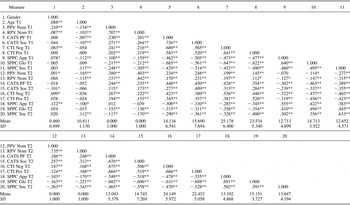
Correlations among all study variables appear in Table 1. Within-time and within-measure correlations tended to be larger than their cross-time counterparts, although many cross-wave correlations were significant and in the moderate to large range. Victimization was significantly correlated with nearly every cognitive measure both within and across waves, and these correlations were in the expected directions.
Variable correlations, means, and standard deviations

Note: T1, Time 1; PPV Nom, peer-nominated physical peer victimization; RPV Nom, peer-nominated relational PV; CATS, Children's Automatic Thoughts Scale (PF, personal failure; Soc, social threat); CTIC, Cognitive Triad Inventory for Children (Neg, negative; Pos, positive); SPPC, Self-Perception Profile for Children (App, appearance; Glo, global; Soc, social). The SPPC is scaled in the opposite direction of the CATS and CTI.
*p < .05. **p < .01.
Analysis overview
Our analytic goal was to determine age ranges for each gender during which victimization had a significant impact on self-cognition. In other words, we wanted to examine how the relation between victimization (the focal predictor) and various self-cognitions (outcomes) varied as a function of age and sex (moderators). There are two methods for probing this type of interaction. The more commonly used method is the “pick-a-point” approach (Rogosa, Reference Rogosa1980), which involves plotting and testing the conditional effect (simple slope) of the focal predictor at specified levels of the moderator. With the pick-a-point method, we would plot lines illustrating the relation between PV and cognition at an arbitrary low age (e.g., 1 SD below the mean) and an arbitrary high age (e.g., 1 SD above the mean) for the cognitions with a significant Age × PV interaction.
It is important to note that the significance of the interaction term indicates whether the slopes of the plotted lines differ significantly as a function of age. The interaction term does not indicate whether the slopes of the lines differ significantly from zero. Thus, a common follow-up for the pick-a-point approach involves calculating the significance of the arbitrarily selected simple slopes. In the current study, this would entail testing the simple slopes at “low” age (–1 SD) and at “high” age (+1 SD). Such calculations would allow us to conclude whether the effect of PV on cognition was significant at exactly these two ages.
The pick-a-point approach is appropriate when the moderator is categorical (e.g., gender or treatment condition). The pick-a-point approach is not ideal when the moderator is continuous (e.g., age) and the analysis is concerned with conditional effects across a range of moderator values. This is the case in the present study. Age is a continuous variable, and only examining the conditional effect of PV at two arbitrarily chosen values would not provide a nuanced understanding of age-related differences. The goal of the current study was to identify age ranges (instead of specific, isolated values) during which the conditional effect of PV was statistically significant.
Therefore, we elected to use the Johnson–Neyman region of significance (ROS) approach (Johnson & Fay, Reference Johnson and Fay1950; Johnson & Neyman, Reference Johnson and Neyman1936), rather than the pick-a-point approach. The ROS method identifies the full range of moderator values for which the slopes are significant. The ROS method is ideally suited for developmental studies (like the current investigation) designed to identify critical or sensitive age ranges during which one variable (e.g., PV) significantly predicts another (e.g., negative self-cognitions). For the current study, the ROS approach enabled us to identify the age ranges for boys and for girls during which PV was associated with significant changes in cognition.
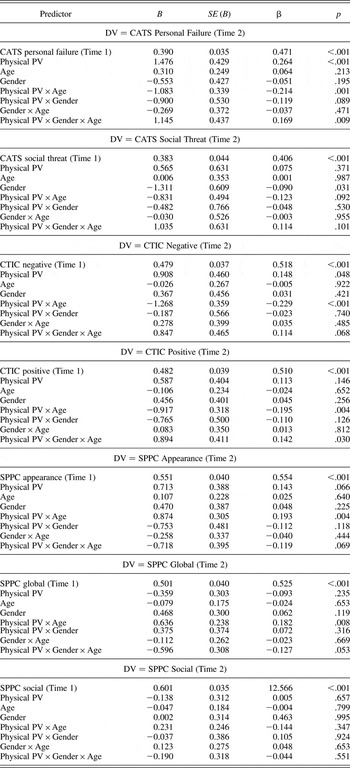
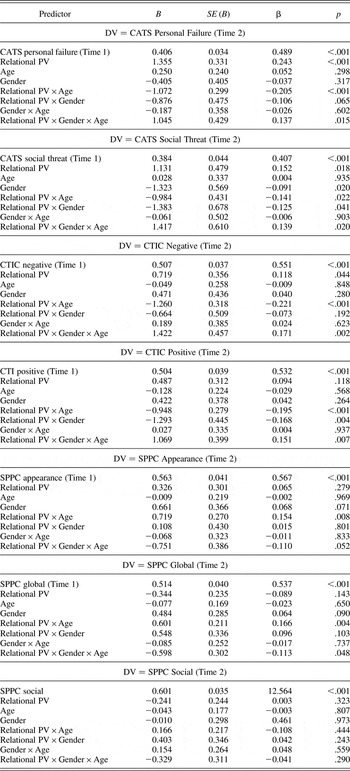
In order to use the ROS approach, we performed a series of multiple linear regressions to evaluate the longitudinal relations between PV and various types of self-cognition. For each regression, a Time 2 measure of self-cognition was the dependent variable. We entered gender, age, and peer-nominated victimization, as well as the two- and three-way interactions between these variables, as predictors. Corresponding Time 1 measures of self-cognition were included as covariates. We conducted separate analyses for relational and physical victimization (see Tables 2 and 3; note that gender was coded as 0 for girls and 1 for boys). Regressions were conducted with AMOS 18 using full information maximum likelihood to account for missing data.
Age, gender, and their interactions predicting self-cognitions subsequent to physical peer victimization (PV)

Note: DV, Dependent variable; CATS, Children's Automatic Thoughts Scale; CTIC, Cognitive Triad Inventory for Children; SPPC, Self-Perception Profile for Children.
Age, gender, and their interactions predicting self-cognitions subsequent to relational peer victimization (PV)

Note: DV, Dependent variable; CATS, Children's Automatic Thoughts Scale; CTIC, Cognitive Triad Inventory for Children; SPPC, Self-Perception Profile for Children.
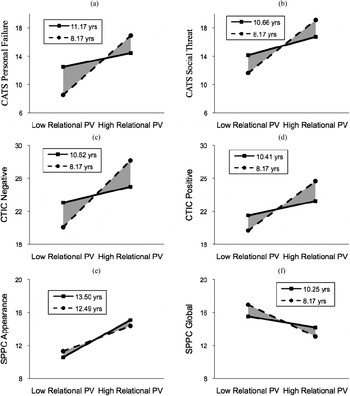
As discussed above, the values generated by each regression were used to calculate age-related regions of significance (i.e., we determined the age range during which the simple slope of Time 2 cognition on Time 1 victimization was significantly different from zero, after controlling for Time 1 cognition; Bauer & Curran, Reference Bauer and Curran2005; Johnson & Neyman, Reference Johnson and Neyman1936). Following the recommendation of Rogosa (Reference Rogosa1981), we calculated age-related regions of significance for each gender and cognitive measure, regardless of the significance of the Age × PV interaction term.Footnote 1 Because of the large number of analyses planned, we used a Bonferroni correction to control our family-wise error rate. Because we were examining seven subtypes of self-cognition, regions of significance were determined using α = 0.05/7 = 0.0071. These analyses were conducted using Preacher, Curran, and Bauer's (Reference Preacher, Curran and Bauer2006) online interaction utility, and results are presented in Figures 1 and 2.
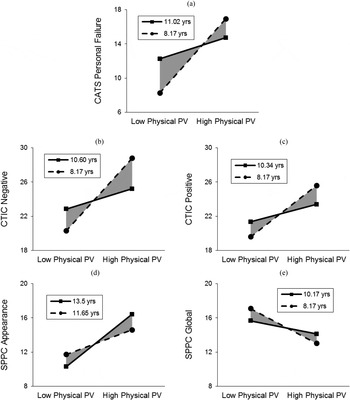
Age-related regions of significance for physical peer victimization (PV) predicting self-cognition among girls. Shaded area represents ages for which the main effect of physical PV on cognition is significant (p < .007). Note that regions of significance are not interpreted beyond the age limits of the present sample (8.17–13.5 years).

Age-related regions of significance for relational peer victimization (PV) predicting self-cognition among girls. Shaded area represents ages for which the main effect of relational PV on cognition is significant (p < .007). Note that regions of significance are not interpreted beyond the age limits of the present sample (8.17–13.5 years).

Predicting changes in self-cognitions
CATS personal failure
When the Time 2 personal failure subscale of the CATS served as the dependent variable, region of significance analyses revealed that the relation between physical PV and cognition was significant for girls under 11.02 years of age. There was no region of significance for boys.Footnote 2 In other words, physical PV predicted significant increases in perceptions of personal failure for girls ages 11.02 years and younger; physical PV did not predict significant changes in perceptions of personal failure for older girls or boys of any age.
Regions of significance should not be interpreted beyond the extremes of the values surveyed. Therefore, we did not allow our regions of significance to extend beyond the minimum and maximum ages included in the current study (8.17 and 13.5 years, respectively). For example, the relation between physical PV and CATS personal failure was significant for girls below age 11.02; however, this region is only reliable when it corresponds to the values included in the original analysis, so the region of significance is reported as 8.17 to 11.02 years of age.
We repeated the above analyses for relational PV. The association between relational PV and CATS personal failure was significant for girls under 11.17 years of age. For boys, there was no region of significance. Thus, relational PV was associated with increased self-perception of failure only for girls between the ages of 8.17 and 11.17 years.
These interactions are depicted in Figures 1a (physical PV) and 2a (relational PV). In each graph, the lines represent the relation between Time 1 PV and Time 2 personal failure (after controlling for Time 1 personal failure) at the bounds of the region of significance (i.e., at the minimum and maximum ages for which the relation of PV to self-cognition is statistically significant). The area between these lines is shaded in order to represent the region of significance, or the full age range for which this relation is significant.
Figure 1a depicts this relation with the shaded area representing the age-related region of significance for girls. As shown in Figure 1a, the association between physical PV and CATS personal failure for girls is stronger at younger ages, then decreases in magnitude as age increases and is no longer significant past age 11.02. Figure 2a depicts the region of significance for girls experiencing relational PV. Again, for girls, the association between relational PV and CATS personal failure is stronger at younger ages, then decreases in magnitude as age increases and is no longer significant past age 11.17. For boys, there were no age-related regions of significance (i.e., the relation between PV and CATS personal failure was not significant at any age) and no graphs are presented. Taken together, these findings indicate that both physical and relational PV significantly and negatively impacted CATS personal failure scores for younger girls, but this relation was not significant for older girls or boys of any age in our sample.
CATS social threat
For physical PV, there was no region of significance for girls or boys (i.e., Time 1 physical PV was not significantly associated with increased perceptions of social hostility for girls or boys at any age surveyed). Thus, no graphs are presented.
For relational PV, the region of significance for girls ranged from 8.17 to 10.66 years of age. In other words, higher levels of relational PV were associated with increased perceptions of social threat for girls between 8.17 and 10.66 years of age. This relation was not significant for older girls or for boys of any age in the current sample. Figure 2b depicts the region of significance for girls. Again, the lines represent the relation between relational PV and changes in perceptions of social threat at the bounds of the region of significance, and the shaded area represents the full age range for which this relation was significant. There was no region of significance for boys, and no graph is presented.
CTIC negative
For girls between the ages of 8.17 and 10.60 years, the experience of physical PV was associated with increases in negative cognition as measured by the CTIC, and this is depicted in Figure 1b. For relational PV, the region of significance for girls was 8.17 to 10.62 years of age, as shown in Figure 2c. For boys, there was not a significant relation between either physical PV or relational PV and scores on CTIC negative, and no graphs are presented.
CTIC positive
For physical PV, the region of significance for girls ranged from 8.17 to 10.34 years of age, and higher levels of PV were associated with higher scores on CTIC positive, which corresponds to lower levels of positive cognition (Figure 1c). For boys, no region of significance emerged. In other words, physical PV was associated with significant decreases in positive cognition as measured by the CTIC for girls between the ages of 8.17 and 10.34 years. This relation was not significant for older girls or for boys of any age surveyed. For relational PV, the region of significance for girls was 8.17 to 10.41 years of age, and higher levels of PV were again associated with lower levels of positive cognition (Figure 2d). For boys, there was no region of significance.
SPPC appearance
For girls, the region of significance was 11.65 to 13.50 years of age for physical PV (Figure 1d) and 12.49 to 13.50 years for relational PV (Figure 2e). In both cases, the strength of association increased with age, and victimization was positively correlated with higher scores of self-appraised attractiveness. There was no region of significance for boys for physical PV or for relational PV. Thus, physical and relational PV were associated with increased perceptions of personal attractiveness for older girls, but this relation was not significant for younger girls or boys of any age.
SPPC global
For physical PV, a region of significance for girls emerged between 8.17 and 10.17 years of age (Figure 1e); for boys, no region of significance emerged. For relational PV, the region of significance ranged from ages 8.17 to 10.25 years for girls, with higher levels of relational PV being associated with lower scores on global self-worth on the SPPC (Figure 2f). For boys, no region of significance emerged. Thus, physical and relational PV were associated with decreased perceptions of self-worth for younger girls, but this relation was not significant for older girls or boys of any age.
SPPC social acceptance
For physical and relational PV, there were no regions of significance for either gender. In other words, the experience of PV was not associated with self-reports of social competence for boys or girls of any age in the current sample.
Discussion
The current study examined the impact of PV on the development of self-cognitions associated with risk for depression. We found that PV was associated with changes in some but not all types of depressotypic cognitions, and these relations varied as a function of age and gender. For girls, these interactions followed a consistent pattern, with both physical and relational PV predicting increases in negative self-cognitions and decreases in positive self-cognitions among younger but not older girls. To our surprise, PV did not consistently predict changes in self-perceived social acceptance, and higher levels of PV actually predicted increases in self-perceived attractiveness among girls. For boys, PV and self-cognitions were not significantly related at any age for any of the self-cognitions assessed. These results are discussed in detail below.
Seven types of self-cognitions were included in the current study: automatic thoughts (in the domains of personal failure and social threat); positive and negative cognitions related to self, world, and future; and self-perceived competence related to appearance, global self-worth, and social interactions. These cognitions were selected because of their hypothesized roles in the etiology of depression. Among girls, the experience of physical or relational PV prospectively predicted changes in most of these cognitions, and these results followed a consistent pattern. Experiencing high levels of physical or relational PV was associated with longitudinal decreases in global self-worth and positive cognition, as well as increases in perceptions of personal failure and negative automatic thoughts. These effects were significant for girls from roughly 8 (the youngest age in the current sample) to 11 years of age and were stronger at younger ages. The effects were not significant for girls over the age of 11.
This pattern did not hold for two of the cognitive domains examined in the current study. Contrary to expectations, neither physical nor relational PV predicted changes in girls' self-perceived social competence at any age. PV also did predict changes in self-perceptions of physical attractiveness, but this effect was in the opposite direction, with higher levels of PV predicting higher levels of self-perceived attractiveness among older girls. Although these specific patterns were not anticipated, they are consistent with the growing body of evidence that PV adversely impacts some but not all domains of self-cognition (Boulton et al., Reference Boulton, Smith and Cowie2010; Egan & Perry, Reference Egan and Perry1998; Gibb et al., Reference Gibb, Stone and Crossett2012), and it will be important for future studies to continue to address this variability. Specifically, future studies may benefit from examining the specific information conveyed to the victim during PV episodes. For example, children who are teased regarding their size or complexion may develop different negative self-cognitions than children who are ridiculed for their behavior or academic performance, even though all of these victimization experiences would fall under the umbrella of verbal victimization. Future studies that go beyond subtypes of PV to investigate content of PV may help explain variability in the relation between PV and specific self-cognitions.
The results for boys did not follow a similar pattern. Among boys, for all cognitive measures, the relations between victimization and future self-cognitions were nonsignificant, and this did not vary as a function of age. As detailed above, we anticipated the existence of gender differences in age-related sensitive periods, although the exploratory nature of these analyses precluded specific hypotheses. The finding that PV was associated with increases in negative self-cognitions for girls is consistent with theories regarding the importance of interpersonal relations in the formation of self-worth, especially among females (Cambron, Acitelli, & Pettit, Reference Cambron, Acitelli and Pettit2009). We did not, however, anticipate a consistent lack of any significant relation between PV and changes in self-appraisal for boys. This finding conflicts with previous results showing similar effects among boys and girls (Boulton et al., Reference Boulton, Smith and Cowie2010; Egan & Perry, Reference Egan and Perry1998; Gibb et al., Reference Gibb, Stone and Crossett2012; Sinclair et al., Reference Sinclair, Cole, Dukewich, Felton, Weitlauf and Maxwell2012). For boys, the cognitive impact of PV may occur more slowly, emerge outside the age range of the current sample, or take a toll on other contingent domains (e.g., athletic competence) that were not assessed in the current study. Further research will be needed to address these hypotheses and reconcile the current findings for boys with the existing literature.
Considered jointly, these findings have significant theoretical implications. First, the experience of PV during middle childhood and early adolescence does contribute to the development of many, but perhaps not all, cognitive risk factors among girls. Previous studies have examined PV as a salient stressor that can interact with existing vulnerabilities to predict negative mental health outcomes (Panak & Garber, Reference Panak and Garber1992; Prinstein et al., Reference Prinstein, Boergers and Vernberg2001; Prinstein, Cheah, & Guyer, Reference Prinstein, Cheah and Guyer2005). These two perspectives are complementary and need not compete with each other. In middle childhood, PV may influence the development of negative self-cognitions among younger girls; however, in adolescence, PV may act as a salient stressor that interacts with these cognitive styles to confer risk for depression. A comparison of these models is beyond the scope of the current article, but further exploration of this hypothesis may help resolve some of the conflicting findings on the impact of victimization while also contributing to our understanding of the changing nature of cognitive vulnerabilities across childhood and adolescence (Cole et al., Reference Cole, Ciesla, Dallaire, Jacquez, Pineda and LaGrange2008).
Second, age was a significant moderator of the effects of PV on self-cognition, and the strongest effects were observed among younger girls. The current results correspond to related findings that self-perceptions become increasingly stable across middle childhood and early adolescence (Cole et al., Reference Cole, Ciesla, Dallaire, Jacquez, Pineda and LaGrange2008; Hankin & Abela, Reference Hankin, Abela, Hankin and Abela2005; LaGrange et al., Reference LaGrange, Cole, Dallaire, Ciesla, Pineda and Truss2008; Wigfield et al., Reference Wigfield, Eccles, Yoon, Harold, Arbreton and Freedman-Doan1997). Therefore, the impact of PV was strongest at younger ages, when self-relevant cognitions were still relatively malleable. Future research in this area could help clarify whether these effects are responsive to intervention or whether they consolidate into enduring patterns that remain stable over longer periods of time.
Third, boys and girls in this sample did not demonstrate similar patterns of relations between age, PV, and self-cognitions, and the combination of age and gender differences provides an important consideration for unifying the conflicting results in this area. For example, the few existing studies (Egan & Perry, Reference Egan and Perry1998; Gibb et al., Reference Gibb, Stone and Crossett2012) that examined age as a moderator of the relation between PV and self-cognition did not yield significant results; however, these studies examined the moderating impact of age and gender separately, rather than simultaneously. The current study found significant age-related differences in the impact of PV, but these interactions varied by gender as well. A consensus has yet to emerge from the current literature on gender differences in the effects of PV, and the current study clearly implicates the importance of incorporating Age × Sex interactions into models of the psychological impact of PV.
The results of the current study also have important practical and clinical implications. At the broadest level, our finding that both relational and physical PV are associated with prospective declines in positive self-cognitions and increases in negative self-cognitions among girls highlights the importance of intervening with girls who are victimized by their peers. The conventional wisdom about “sticks and stones” has been contradicted by studies from a range of disciplines, and the current study directly demonstrates that both physical and relational aggression can hurt children in significant ways. This is particularly disconcerting, given the high prevalence of victimization during middle childhood (Pelligrini & Long, Reference Pellegrini and Long2002; Sinclair et al., Reference Sinclair, Cole, Dukewich, Felton, Weitlauf and Maxwell2012). Teachers, school officials, and parents should be aware that the experience of PV, whether physical or relational, can damage self-cognitions in ways that confer risk for negative mental health outcomes, and the importance of recognizing and responding to PV must be emphasized. Moreover, our findings provide a rationale for identifying subgroups of victimized children who may substantially benefit from interventions to offset the negative impact of PV. Specifically, our consistent finding that girls ages 11 and younger were significantly affected by PV indicates that such children should be the focus of targeted prevention efforts.
These findings and recommendations must be considered in light of several limitations. First, although the current study was longitudinal, it was not experimental. Thus, the results provide preliminary support for the relation between victimization and cognitive risk factors, but strong causal inferences are not possible without random assignment to treatment and control conditions. Future studies of controlled intervention efforts could significantly enhance our understanding of cause–effect relations in this domain. Second, although the outcomes of the current study were broadly consistent, some results were unexpected: for example, the finding that PV was prospectively associated with higher levels of self-appraised attractiveness among girls. Replication research will be necessary to determine whether this pattern is best explained as Type I error. The third limitation pertains to the age range of the current sample. Although the results provide information about age-related changes in the effects of PV during middle childhood and early adolescence, we cannot speculate how such trends might change in middle or late adolescence. Fourth, the current findings have led us to speculate that the link between victimization and future depression might be mediated by the impact of victimization on self-cognitions; however, such conclusions await multiwave longitudinal investigations in which victimization, cognition, and depression are all tracked over time. Taken together, these shortcomings highlight several promising directions for future work in this field.