The ‘linguistic turn’ has stimulated controversy among historians about the role of language in politics for over thirty years.Footnote 1 Yet recent works show that the study of political language continues to evolve. In his 2010 book, researching such terms as ‘modern’, ‘society’, and ‘commonwealth’, Phil Withington argued that studying linguistic usage is an essential way to understand societies in the past. Indeed, he confirmed that ‘culture-specific words are conceptual tools that reflect a society's past experience of doing and thinking about things in certain ways’.Footnote 2 Stephen Lee has noted that political agents ‘operate within a paradigm, a set of linguistic and behavioural conventions’, and that such paradigms are flexible, created and changed by ‘men's actions and ideas’.Footnote 3 Moreover, debate has developed over the potential for anachronistic and teleological use of terminology, in particular the term ‘radicalism’. J. C. D. Clark and others have claimed that adopting ‘radicalism’ to describe any political movement before the term was invented in the 1820s is inappropriate.Footnote 4 By so doing, historians run the risk of misrepresenting earlier ideas, constructing false traditions, and inappropriately attributing current vocabulary and mores to people in the past.Footnote 5 Another study disagreed with such an approach, arguing that even if ‘radicalism’ as a term did not exist, the concepts it embodied can be found in comparable alternative contemporary terms. It remains useful as ‘an explanatory category’ provided there is ‘sensitivity to context and consequentially the situational, episodic and variegated nature of radicalism’.Footnote 6
This article examines the shifts in frequency of usage and meaning of the term ‘aristocracy’ both quantitatively and qualitatively, at specific moments and over time in England during the period 1700 to 1850. ‘Aristocracy’ has a long antecedence, stretching back to the ancient world and with clear meaning as ‘government by the few’ until the late eighteenth century. Thereafter, it has been through vicissitudes both at the hands of contemporaries and historians, adopted and adapted within various political and social contexts. The analysis of language is approached with caution here. It is clear that language is constantly evolving and contemporaries in the eighteenth century were not always consistent in their use of terms which was often experimental, particularly at times of flux. Pinpointing precise meaning to a term at any particular moment can be tricky. Indeed, seeking ‘meaning’ in past language is fraught with difficulty as Quentin Skinner and others have warned.Footnote 7 The importance of context to establishing meaning is widely recognized although what constitutes context is also the subject of debate and has been broadly interpreted.Footnote 8 Joan Scott and others have argued that language is complex and multi-dimensional; often constructed through differentiation, it develops relationally and oppositionally between different political or social groups in specific contexts or discourses.Footnote 9 And, whilst confirming that language plays an important part in adversarial politics, Dror Warhman has warned against slipping into the trap of linguistic determinism.Footnote 10 It is important therefore to explore linguistic usage in the past with care and, as far as possible, apply terms appropriately within the context or contexts of their time.
Mark Philp and Joanna Innes have recently instigated an exploration of the term ‘democracy’ through their project Re-imagining democracy, 1750–1850. The project aims to track the use and meaning of the term and explore how usage changed.Footnote 11 Of course, democracy, in common with aristocracy, has its roots in ancient Greek political language. Yet, as this article shows, whilst ‘democracy’ reflects a fairly consistent trajectory, from generally negative usage in 1700 to something positive and desirable by 1850, ‘aristocracy’ follows a much less clear trajectory. One reason for this is that in England ‘democracy’ has remained an entirely political term whereas ‘aristocracy’ also acquired social connotations.Footnote 12 Indeed, ‘aristocracy’, reflects a reverse trajectory to that of ‘democracy’; a shift in use and meaning from a primarily positive term in 1700 to a distinctly negative one by 1792. As a result of the French Revolution aristocracy became the antonym of democracy. ‘Aristocracy’ appears to have recovered, at least partially, from this denigration by the mid-nineteenth century to become a term of social description in common language. It is argued here that the prevalence of ‘aristocracy’ in contemporary writings reveals important shifts in attitudes to, ideas about, and understanding of political rights, who should rule, the role of the people in politics and social structures and hierarchies.
Methodologically the availability of digitized primary sources enables historians to search particular words and phrases within a document and whole databases of documents. Where visits to the traditional archive enabled analysis of a few hundred documents, digitized databases allow access to thousands or hundreds of thousands with new tools for making searches in a number of different ways. This allows a quantitative analysis of linguistic usage not previously possible and will inevitably change the way historians define and use terms. Indeed, digitization enables a new approach to semantics. Of course, digital resources present a new set of problems and may prove difficult to manage when attempting analysis of a term that has developed broad and imprecise usages. It is also important that large-scale digital searches are combined with close textual analysis. This research involved conventional textual analysis both in the traditional archive and in digitized resources plus keyword searches for ‘aristocracy’ and derivatives in selected digitized databases.Footnote 13 Google Ngram and Bookworm graphs are also provided to show trajectories of usage over time (see Appendix). These systems enable representation graphically of a far greater number and breadth of sources than were previously available. Such digital research provides new evidence as to how frequently ‘aristocracy’ was used in print in the past. Moreover, those who have written on the advantages and pitfalls of such digitized sources have tended to be producers rather than users, and so the potential use and value of digitized sources for historians is also examined briefly here.
I
But, first, a review of the historiography suggests that the use of ‘aristocracy’ to date does on the whole reflect the sort of adoption by historians criticized by Clark and others. A number of historians of the eighteenth century have ignored the specific political usage of ‘aristocracy’ and adopted it anachronistically and interchangeably with ‘nobility’ and other terms such as ‘the great landowners’ the ‘landed elite’ or ‘the gentry’.Footnote 14 In a social context L. Davidoff and C. Hall, describe an eighteenth century ‘aristocracy’ and the ‘middling ranks’.Footnote 15 Clark himself is no exception in English society, describing the eighteenth century famously as Anglican, aristocratic, and monarchical, an ‘aristocratic society’ which invoked aristocratic mores.Footnote 16 Indeed, historians adopt ‘aristocracy’ to describe various, often non-defined, groups of the elite even when the term is not so used in the sources they quote.Footnote 17 ‘Whig aristocracy’ is another term commonly adopted by historians, to describe members of the whig governments in power, particularly between 1714 and 1760. Indeed, J. G. A. Pocock declared that ‘aristocracy in mid-Georgian rhetoric is explicitly or implicitly preceded by the word “Whig”’, although he provided no examples of such explicit usage of ‘Whig aristocracy’.Footnote 18 Yet, as we shall see below, ‘Whig aristocracy’ did not appear in print at that time. Moreover, within this anachronistic usage, historians disagree as to how ‘aristocracy’ should be defined, in terms of titles, membership of the peerage, land ownership or wealth, and whether extended to life peers, and/or the gentry.Footnote 19 E. A. Wasson declared that ‘there is no consensus’ on the issue and there is confusion amongst historians and consequently a diversity of definitions of ‘aristocracy’ abound.Footnote 20 The discussion here is not intended to castigate (or alienate) fellow historians, but merely to highlight how their use of the term has tended to obscure rather than reveal the usage of ‘aristocracy’ in contemporary discourse. In particular, innovative tools in digitized resources enable historians to approach this issue anew.
Contemporary evidence counters the blanket definition of the elite as ‘aristocracy’ adopted by historians. The eighteenth-century English elite never described themselves or each other as ‘aristocrats’ and before 1791 ‘aristocracy’ was not a term used to describe a social rank or class.Footnote 21 The terms ‘aristocracy’, ‘nobility’, and ‘peer’ were all linked in the eighteenth century through association with the House of Lords, but, ‘aristocracy’ and ‘nobility’ were not synonyms. As William Doyle has recently argued, the elite social rank in Britain was indisputably the nobility. The antecedence of the nobility could be traced back at least to medieval times and its ideology to the Roman Republic and noble ideals of honour, valour, and virtue.Footnote 22 It was a European-wide hereditary caste, with its own laudable codes and ideals, said to be ordained by God in the natural order, or chain of being, although in reality new peerages were quite frequently created by the monarch or government.Footnote 23 Historians have referred to aristocratic mores, ‘aristocratic values’ or ‘the aristocratic ethic’, and ‘the aristocratic code’ as Clark put it, but in fact these were the codes and ideals; the defining characteristics, of the nobility.Footnote 24
Moreover, ‘nobility’ was legally defined in England as those who were members of the peerage, all of whom had a seat in the House of Lords.Footnote 25 Those non-nobles with titles such as baronets were not peers and did not have seats in the Lords. Only the eldest son of a peer was a nobleman, once he inherited his title, unlike in other European states, which led to some confusion in England regarding terminology. In practice, ‘nobility’ was often used to describe the families of peers, the elite rank.Footnote 26 In terms of the hierarchy of ranks it was common to talk of the ‘nobility, gentry, and commonality’.Footnote 27 Other terms were also applied to certain elite groups such as the ‘quality’, the ‘beau monde’, the ‘bon ton’, and the ‘macaroni’. These were, however, used not as social descriptors per se, but in circumstances that implied cultural behaviour, fashionableness, primarily of a metropolitan high society.Footnote 28 Consequently, such terms can be found primarily in literary journals, magazines, and novels.Footnote 29 Aristocracy was not applied as a social descriptor in place of ‘nobility’ or other such terms and historians have, therefore, applied it mistakenly and out of context.
II
In order to understand fully ‘aristocracy’, then, it is first necessary to explore the term's historical usage qualitatively in contemporary texts. The evidence shows that for much of the eighteenth century usage of ‘aristocracy’ does enable a clear definition. It was invoked within elite discourse on political philosophy as government by the few. As a pamphlet of 1702 put it, ‘An aristocracy is the government … by some competent number of the better sort, preferred for wisdom and other virtues for the publick good’ and later it is ‘a government of the Wealthier or Noble sort’.Footnote 30 Dr Johnson's famous Dictionary (2nd edition, 1760) defined ‘aristocracy’ in accordance with ancient Greek terms reflecting ‘greatest’ and ‘to govern’ and as ‘that form of government which places the supreme power in the nobles’.Footnote 31 All dictionaries on Eighteenth-century collections online (ECCO) identify ‘aristocracy’ as some form of government of the few. Two early dictionaries defined it as ‘a Form of Government where the supream Power is lodged in the Nobles or Peers’ or ‘a Government of some Few Men of the better sort’.Footnote 32 Nathan Bailey's dictionary which was published in many editions throughout the century consistently defined ‘aristocracy’ as ‘government by Nobles and Peers’.Footnote 33 Thus, in the eighteenth century ‘aristocracy’ defined as government by the nobles is most common.Footnote 34 And ‘aristocracy’ here referred to ‘government’ not to a social class of nobility, a government of the few, the best who reflected the ancient ideology of virtue and honour.Footnote 35
During the eighteenth century it was generally assumed, as Lord Somerset put it in the House of Commons in 1742, that ‘every form of governments must either be a monarchy, an aristocracy, a democracy or; it must be a mixture of some two of these or of all three’.Footnote 36 Prior to the French Revolution aristocracy was generally contrasted with monarchy, but aristocracy and democracy were discussed as the two main possible forms of a republic and here Montesquieu was especially influential.Footnote 37 Writers were much concerned with the disadvantages of each system, that ‘Monarchy when corrupted, degenerates into Tyranny; that Aristocracy being corrupted turns into an Oligarchy; and that Democracy was liable to Tumults and Confusions’ or indeed anarchy.Footnote 38 To English gentlemen writers the answer to such potential degeneracy was the limited monarchy or so-called ‘mixed government’ of which the English were so proud and in which aristocracy played an important part in balancing the three constituents.Footnote 39 In fact, it was implicit that this balance did not in practice reflect equality between the aristocracy and democracy. Most such eighteenth-century writers on politics accepted the greater role of aristocracy than democracy in government and democracy reflected only the propertied of society.
Less common was ‘natural aristocracy’ invoked by philosophers and political writers to identify a broader group than an aristocracy of peers but still a political term in general reflecting the classical concept of a superior nobility.Footnote 40 Writers were not always consistent or clear in their usage of the term. Harrington's Oceana (1700) identified such a ‘natural aristocracy’ of the wisest men who should naturally arise in a commonwealth. Such an aristocracy should be selected not ‘by hereditary right or the greatness of their Estates only … but by election of their excellent parts, which tends to the advancement of the influence of their virtue or authority that leads the people’. But, for Harrington, it was down to God, who ‘has … divided mankind into the few or the natural aristocracy and the many or the natural democracy’.Footnote 41 In An appeal from the new to the old whigs (1791) Edmund Burke provided a lengthy and complex discussion of a ‘natural aristocracy’ of birth and talent, consisting loosely of ‘the best’ who ultimately were ‘gentlemen’, with all the problems of definition that term might entail.Footnote 42 Such writers did not, however, envisage a ‘natural aristocracy’ in terms of a true meritocracy.
Later in eighteenth-century England ‘aristocracy’ was invoked in increasingly negative terms in accusations of hegemony and corruption against powerful whig governments. Fears that an aristocracy was gaining too much power and creating an imbalance in the constitution were often expressed, and comparisons with the ancient world were invoked.Footnote 43 When George III came to the throne in 1760 a schism developed between what may loosely be termed ‘whig’ factions. ‘Aristocracy’ then became an accusation made against a political faction that had, in the eyes of its opponents, gained too much power.Footnote 44 In the general election of 1784 the Fox–North coalition was much identified as an ‘aristocracy’.Footnote 45 A few radicals in the 1770s and 1780s also began to invoke a negative ‘aristocracy’ in their calls for reform of government.Footnote 46 David Williams accused whig factions of corruption, ‘draining the whole country of immense treasures … influence and venality’ was the occupation of an ‘intriguing aristocracy’.Footnote 47 But at this time such radicals used the term in the traditional sense to describe government of the few, albeit negatively. Indeed, Thomas Paine, in Common sense (1776), referred only to aristocracy in this sense.Footnote 48
Phyllis Deutsch and others have highlighted new challenges to the ruling elite initially as a result of the loss of the American colonies.Footnote 49 Deutsch claims that the whig elite were criticized for their social behaviour and morals which were linked to their political failings, in particular losing the war against America. Here, luxury became the private side of public corruption.Footnote 50 Charles James Fox, who combined a high political profile with a particularly dissipated lifestyle, was much criticized in this regard.Footnote 51 Whilst boundaries between the political and the social, public and private spheres may consequently have become increasingly blurred ‘aristocracy’ was still only used by contemporaries in the traditional political sense.
Thus, during much of the eighteenth century ‘aristocracy’ was a political term describing, in one way or another, government by the few, or the few who have gained too much power within given political parameters. Consequently, it did not necessarily include all or only the nobility, and ‘aristocracy’ was not at this stage a social class. ‘Aristocracy’ as a political term had no direct synonyms. Yet, at this time, linguistic usage of ‘aristocracy’ veered increasingly towards the negative and this highlights a shift in public perception about those who governed.
It was the French Revolution that brought about a change in usage of ‘aristocracy’ in England, when it developed more than one meaning. This suggests a greater focus on those in power and a change of political perspective among writers of print publications. Competing groups in the political sphere constructed different representations of the governing elite. It is well established that the French Revolution politicized social class and it was Paine's Rights of man that introduced this development in England. During the Revolution, ‘aristocrat’ became a common term of abuse in France to describe the noblesse and Paine correspondingly described the English nobility as a class of aristocracy.Footnote 52 Paine condemned the whole class of English nobility as a ‘hereditary aristocracy … separated from the general stock of society’ by unacceptable privileges.Footnote 53 Ultimately, it was necessary to ‘exterminate the monster Aristocracy, root and branch’.Footnote 54 Paine adopted a negative bipolar ‘aristocracy and people’ model of ancien régime France and applied it to England. Within Paine's political paradigm aristocracy became a direct antonym of democracy.
The radical movement that followed Paine incorporated a broad spectrum of views as to what reform England needed, with the majority remaining primarily constitutionalists rather than republicans. Yet many such constitutionalist radicals and popular societies adopted, in an often vitriolic anti-aristocratic rhetoric, Paine's use of ‘aristocracy’, with all its French connotations, within his ‘aristocracy and people’ paradigm. They invoked ‘aristocracy’ to describe both a form of corrupt government and a governing class which dominated politics and society and relied on ancient hereditary wealth, position, and privileges to justify its existence.Footnote 55 Moreover, in Part 2 of the Rights of man Paine fused his political critique with an economic critique of the social order.Footnote 56 Correspondingly, for radicals, once Britain was at war with France from 1793 and resulting hardships were felt, the political divisions of ‘aristocracy and people’ became more closely aligned with a social division of ‘rich and poor’. This broadened the delineation of ‘aristocracy’. Increasingly, accusations of economic as well as political inequality were levied by radicals against a class of aristocracy. John Thelwall pursued this issue most thoroughly and he was one of the first to seek solutions to poverty in economic terms of fair wages rather than merely in political rights.Footnote 57 Questions of who should rule and of inequality – political, social, and economic – were all profoundly contested and ‘aristocracy’ was at the heart of such contestation. The growing discontent with what radicals identified as the corrupt government had erupted within radical rhetoric into all-out condemnation of a class of ‘aristocracy’. Radicals increasingly wanted to have their voices heard within the political public sphere and challenging rhetoric became a powerful tool in this endeavour. The radical press had a hand in this at a time of expansion in print and growth in the significance of public opinion.Footnote 58 ‘Aristocracy’ was lampooned in caricatures, squibs, songs, and verse and roundly condemned in pamphlets, broadsides, and newspapers. It became a term of abuse.
Of course many, particularly loyalists (those who defended the limited monarchy and the political status quo against radical attack), continued to use ‘aristocracy’ only in the context of political theory to describe a form or part of government. Loyalists did not adopt the negative radical interpretation of ‘aristocracy’.Footnote 59 Indeed, they complained that due to radicals’ misuse of the term its meaning had become vague and difficult to determine.Footnote 60 Lord Sydney, during debates in the House of Commons in 1794, was reported as saying that perhaps for expressing certain sentiments, he ‘might be called an Aristocrat, a term of abuse which had lately become very fashionable in France, and of which, he confessed, he did not know the meaning’.Footnote 61 Certainly, ‘aristocracy’ began to crop up in other broader contexts in writings of the 1790s, but its usage was unstable at this time. For example, in 1791 Fanny Burney wrote of encountering French ‘aristocrats’ in Winchester. She later described, with disapproval, a relative's child being given three names, a practice she thought ‘rather aristocrat’.Footnote 62 In 1794, the Tory, George Canning complained that an event was attended by ‘the Dss of Devonshire – and Ld and Ldy Jersey … Lord Carlisle – and God knew what fine people besides – so as to be upon the whole rather a dullish aristocratic meeting’ and two days later at another event ‘there was as much aristocracy as before – and it was the duller’.Footnote 63 It is not clear here whether Canning was referring to a ‘Whig aristocracy’, since all those referred to were whigs, or using the term in relation to class. Either way, Canning invoked ‘aristocracy’ with negative connotations.Footnote 64
Thus, ‘aristocracy’ was much and widely used in the 1790s, and by the end of the eighteenth century it was no longer a term invoked exclusively in elite circles and political philosophy. Rather, it had become familiar to ordinary people through a broad extra-parliamentary debate which for the first time had sought the support of the mass of the people through print and in a vernacular they could understand. Because of the lack of a single word in English for a governing class that sat in both houses of parliament, radicals had hijacked the term ‘aristocracy’, imbued it with entirely negative meaning, and adopted it in preference to the shared social idiom, ‘nobility’.Footnote 65 ‘Aristocracy’ became not only a rhetorical device but also a symbol of a governing class oppositional to a broad ‘people’. It represented all that was excessive, unequal, or anachronistic in a new ‘age of revolutions’ as Paine put it. In their use of ‘aristocracy’ Painites were attacking what they perceived to be an ancien régime both political and social. It is clear, then, that the radical linguistic usage of the 1790s highlights a discontinuity, a break from previous common contemporary assumptions about England as a modern commercial nation with a universally admired mixed constitution: a land of liberty. The Enlightenment or whig belief in the potential for continual linear progress for mankind had been abruptly ruptured in Britain as well as France.
Turning attention to the nineteenth century, the evidence shows that ‘aristocracy’ in all its variants had come to stay within linguistic usage. But usage broadened out considerably with ‘aristocracy’ appearing in less familiar contexts both politically and socially making it difficult to identify clear patterns. Again, all the dictionaries examined here published between 1800 and 1850 defined ‘aristocracy’ as a form of government by the nobles, with the exception of Webster's Dictionary which included nobles and peers.Footnote 66 They do not, however, provide a social definition. Where it appeared, ‘aristocrat’ had been ubiquitously defined during the eighteenth and early nineteenth centuries as ‘a favourer of aristocracy’. But the 1818 edition of Johnson's Dictionary defined ‘aristocrat’ as ‘a word of modern use imported into this country in the early part of the French democratical revolution’.Footnote 67 ‘Whig aristocracy’ was also more frequently utilized in political debate particularly in the 1830s and 1840s when the whigs were predominant in government.Footnote 68
During the first half of the nineteenth century anti-aristocratic rhetoric was frequently invoked by political radicals targeting not only political inequality but also more fully issues of economic inequality within capitalist industrial relations. Issues related to poverty, labour disputes, and social discontent were increasingly absorbed into political radicalism. A browse of William Cobbett's Weekly Political Register on the database British newspapers 1600–1900 provides good examples of the range of early nineteenth-century anti-aristocratic radical rhetoric.Footnote 69 In 1816, the Register declared that aristocracy comprised ‘a set of courtiers, colonels, borough mongers, sinecure placemen, pensioners, and tax gatherers’.Footnote 70 In 1823, those who supported the Corn Laws were also ‘aristocracy’ and ‘that class of money-making vagabonds, who, favoured by a system of trick and fraud, make their half millions of money by watching the turn of the market’ were ‘of all the aristocracies of the world the most execrable’.Footnote 71 The paper also condemned ‘the odious aristocracy of the Jews and the jobbers, and almost as odious the aristocracy of merchants – greedy merchants and big manufacturers’.Footnote 72 During 1830 to 1832, similar themes continued. Here the Register described ‘the aristocracy of the House of Commons’.Footnote 73 It stated that the Reform Bill would, in some towns, result in ‘an aristocracy of shopkeepers’ and ‘the working classes’ would be ‘shut out altogether, they will be placed at the mercy of an upstart aristocracy of money’.Footnote 74 Thus, in the Register ‘aristocracy’ was invoked to describe government, the rich, but also an amorphous group that incorporated many that historians today might categorize as middle class.
In the build-up to the 1832 Reform Act ‘aristocracy’ was much used in radical writings with all the negative connotations of the 1790s. Usage reflects the adoption of the aristocracy and people political paradigm (although ‘the people’ might reflect middle and working classes or one or the other). Anti-aristocratic rhetoric focused on ‘Old Corruption’ and invoked ideas prevalent in the 1790s with radical Painites and Spenceans re-emerging. In The extraordinary black book John Wade declared that ‘in no former period of history was the power of the aristocracy so absolute, nor did they enjoy a tenth of their present advantages’.Footnote 75 One pamphleteer attacked the House of Commons as merely the tool of the ‘contemptibly insolent aristocrats’, who through the Reform Bill wished to continue to exclude the people from participating in government.Footnote 76 Moreover, ‘aristocracy’ was once again condemned as the unproductive class, ‘the drones in the hive of society’ who ‘exist only for lazy enjoyment’ as Paine had put it in 1792.Footnote 77 Wade divided society into the parasitic upper classes and the productive classes.Footnote 78The Agitator incorporated an aristocracy of ‘the Government, the Clergy, the Squirearchy, and the non-producers’.Footnote 79
Yet, at this time, reformism encompassed a broad set of interests and ideologies and many radical writings again reflected a constitutionalist position.Footnote 80 In particular, writings reflected the greater involvement of the middle class and parliament in reform politics. One writer declared that reformers could no longer be referred to as ‘a stupid and needy rabble … they are, on the contrary the very class in which the moral power of the country is lodged’. He expressed disbelief at ‘a parliamentary refusal of reform against the discontent of the middling classes’.Footnote 81 And anti-aristocratic rhetoric could be found on the lips of those who would not have used such language in parliament in the 1790s. In 1831, Sir John Walsh, Bart, MP condemned the cabinet, the House of Commons and the Reform Bill as ‘aristocratic’.Footnote 82
Once the Reform Act was passed, however, another change in the application of ‘aristocracy’ arose. The act enfranchised only members of the middle class. Consequently, in the eyes of working-class radicals the middle class was now on the other side and was promptly incorporated into new broader definitions of ‘aristocracy’. Here, and particularly in Chartist literature, ‘aristocracy’ might include all or any of those seen as oppositional to an industrial working class.Footnote 83 Other terms, often experimental, were also adopted alongside ‘aristocracy’ to describe such industrial middle classes. Manufacturers, mill owners, and shopkeepers were sometimes labelled ‘millocrat’, ‘cotton lord’, ‘steam aristocracy’, the ‘shopocracy’ or ‘millocracy’.Footnote 84 Chartist writings identified a broad ‘aristocracy’ that oppressed the poor and incorporated all or any of the industrial and commercial middle class. The Charter, 8 September 1839, condemned ‘the malevolence of aristocratic and shopocratic tyranny’.Footnote 85 And the Northern Star, 4 August 1838, condemned ‘the Aristocracy, Jewocracy, Millocracy, Shopocracy, and every other Ocracy which feeds on human vitals’.Footnote 86
Moreover, Philp has recently argued that from the 1830s the promotion of democracy as a form of government became more widespread. Whilst in the 1790s ‘democracy’ had been invoked by radicals, the rhetorical antagonism was primarily between ‘aristocracy and people’ on the Painite paradigm. This increased use of ‘democracy’ in the nineteenth century brought a renewed focus on aristocracy as oppositional to democracy and calls for abolition of aristocracy altogether, as Paine had argued in 1791. A number of radicals, such as Wade, identified democracy as the necessary and inevitable political system. But ‘democracy’ also became a term in wider common popular usage in the 1830s and 1840s and reflected something of a zeitgeist.Footnote 87 Aristocracy remained the common antonym of democracy, but democracy was now increasingly directly promoted as a favoured form of government.
A number of historians suggest that by 1850, with the demise of Chartism, came a decline in such radicalism. Philip Harling and Peter Jupp argued that this shift was partly due to the end of ‘Old Corruption’ and a change in government focus and style towards greater social policy with legislation such as the Factory Act 1833, the Mines Act 1842, and repeal of the Corn Laws in 1846.Footnote 88 Martin Daunton has identified the early Victorian period as one in which taxation was reformed. Of course, the English nobility had never benefited from the sort of tax privileges enjoyed by the French nobility before the Revolution. But Daunton noted that protectionism and chartered monopolies were dismantled, taxation and tax exemptions no longer favoured one group over another, particularly after Peel's reintroduction of income tax in 1842. Overall, greater transparency, accountability, and fairness were perceived in government.Footnote 89 Some sort of class consensus emerged, as a regulatory state began to develop. Yet, Margot Finn has claimed that working-class radicalism, focused on democratic change and influenced by earlier Painite and Jacobin traditions, did not die with the demise of Chartism but can be found into the 1850s and 1860s.Footnote 90 James Vernon has also identified a continued radicalism focused on ‘Old Corruption’ and invoking ‘aristocracy’ in familiar ways, in the reform movement of the 1860s. He also noted, however, a gradual closing down of the popular public political sphere in which radicals had functioned in the pre-Victorian period.Footnote 91
Certainly, a number of historians have identified a change in the usage of the term ‘aristocracy’ from the political to the social in the nineteenth century. Jupp and J. V. Beckett identified a gradual shift in its use from the 1820s ‘from a political to a social descriptor’.Footnote 92 Beckett saw aristocracy as increasingly denoting not just the peerage but the elite as a whole; the English aristocracy was the ‘governing class’.Footnote 93 A pamphlet of 1830 described aristocracy as ‘the peerage, the unpaid magistracy’, and ‘the country gentlemen of small properties’.Footnote 94 Beckett attributes this shift primarily to ‘the almost inexplicable Victorian concern with the concept of a gentleman’ and rejection of the term ‘nobility’.Footnote 95 As P. J. Corfield has noted, ‘gentleman’ was always a broader term with uncertainties as to its meaning that ‘nobility’ did not incur; it was a matter of social negotiation rather than legal definition.Footnote 96 This suggests a redefining of ‘aristocracy’ to reflect more closely a Victorian social structure based on class in which the upper class is broader than the nobility.
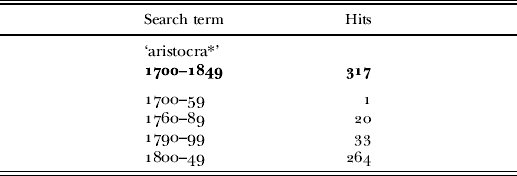
Correspondingly, the evidence shows that ‘aristocracy’ can be found in a broader set of contexts in the nineteenth century. The concept of a ‘labour aristocracy’ or ‘aristocracy of labour’ emerged in Victorian Britain among the working class denoting an elite with social and/or economic privileges that set them apart from the rest of the working class and the middle class.Footnote 97 A browse through the House of Commons parliamentary papers from 1800 to 1849 shows ‘aristocracy’ appearing in papers and debates on varied topics, including: slavery, the poor law in Scotland, education in England and Wales, management of the British Museum, commercial tariffs and regulations of Europe and America, colonial lands and emigration, and the Post Office, to name but a few. Broad usage of ‘aristocracy’, political and increasingly social, can also be found in the database Nineteenth-century UK periodicals. Footnote 98 It increasingly appeared in novels, theatre, and other cultural genres. Particularly common is ‘the aristocrat’ as hero or villain. For example, historians have noted that the image of the aristocratic seducer became a dominant theme in popular culture such as the ubiquitous melodrama.Footnote 99 As R. McWilliam has pointed out, most English melodrama was conservative and the solution to a wicked aristocrat was the good aristocrat.Footnote 100 But in the writings of the radical George W. M. Reynold, much discussed by historians in relation to melodrama, ‘aristocracy’ was consistently the villain and boundaries between popular political and social writings became blurred. He incorporated into his popular fiction, such as the best-selling, The mysteries of London (1844–8) and The Mysteries of the court of London (1844–56), radical messages focused around class inequality. Reynold also published directly radical pieces such as a series on ‘The Aristocracy: Its origins, progress and decay’ in one publication alongside neutral social tittle tattle about the aristocracy in another.Footnote 101 Thus, it appears that at a time when class had become the common system of social organization ‘aristocracy’ became a term with positive or at least neutral connotations, as well as negative ones, used in both political and social discourse to describe a looser elite class than the more restricted rank of nobility.
III
Such qualitative research findings can now be tested and enhanced by searches of quantitative digital data. The volume and frequency of word usage can be calculated within a broader selection of sources and tracked over time with greater accuracy to provide more comprehensive evidence. It has been argued that digital history renders many historical arguments based on conventional archives and methods incomplete. D. J. Cohen has claimed that theses based on conventional archival searches, that provide a limited number of examples, seem flimsier now that researchers can scan millions of books on Google.Footnote 102 And Tim Hitchcock celebrates the rise of an infinite data archive that frees historians from the constrictions of traditional archival research and will inevitably change the way we do history.Footnote 103 Indeed, Hitchcock has identified something of a ‘digital turn’.
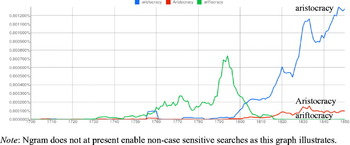
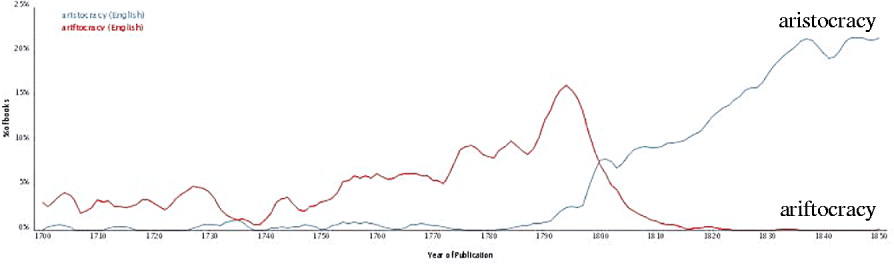
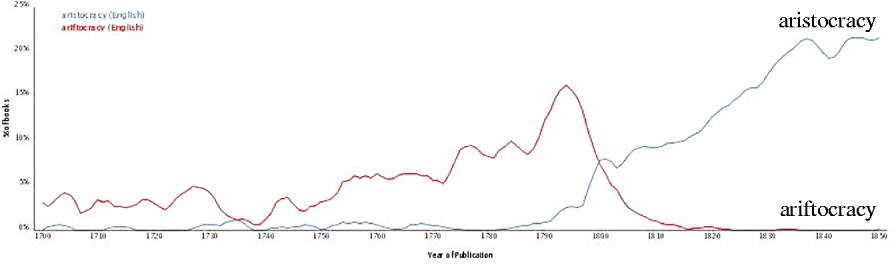
Nevertheless, historians are still debating the effect of digitization on historical research methodologies. How best to use such sources is also open to debate with many problems becoming apparent only as usage increases. Indeed, the accuracy and completeness of digitized data and the catalogues that enable access to it have been called into question.Footnote 104 Not all documents have survived the digitization process, or indeed at all.Footnote 105 Only the documents that can be found in archive or library collections are available for digitization and so even broad searches produce results that do not necessarily map out full source availability in the past. Online research can tend towards the quick and the superficial with the commonly used keyword search finding words rather than meaning and context. Keyword searches often provide previously unmanageably large numbers of results that require careful managing. The accuracy of the Optical Character Recognition (OCR)technology used in digitization has been called into question.Footnote 106 Problems with the OCR vary from one type of document to another and are greater in older documents. Questions also arise as to the stability of search engines in recovering all material relevant to a particular search. Repeated identical searches of one database may not produce the same quantity of hits.Footnote 107 Research here has found that such differences in figures are generally small and do not detrimentally affect the trends shown. Another important factor is typographical differences in terms searched on databases. The eighteenth-century use of the long ‘s’ commonly used in handwriting (that is often read today as ‘f’) instead of the shorter ‘s’ is well known and the digital sources and graphs reveal many appearances of ‘ariftocracy’. Thus, it has become increasingly clear that digitization throws up a new set of problems for historians and there is now a burgeoning genre of digital history which seeks solutions to such problems through datamining and textmining, quantitative linguistics, and new online document retrieval and analysis tools.Footnote 108
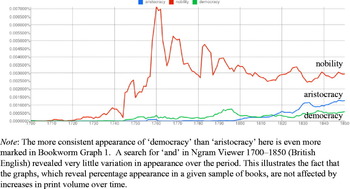
It is recognized, therefore, that the results of the digital searches here have limitations. Only printed material is included and not all possible records have been searched, but certain databases selected as examples. Further, the searches provide only absolute figures and an absolute increase in blanket usage of a term may mask a relative decline in one particular interpretative usage, or usage in one or more generic form. Yet here, the primary aim is to show trends in frequency of appearance of keywords. One advantage of keyword searches is that they show hits for all the versions and editions of one text included on the database. For example, twenty-seven versions of Paine's Rights of man Part 1 appear on ECCO between 1789 and 1799, amounting to at least thirteen editions and publications from a variety of places in the British Isles and America. Similarly, as British newspapers 1600–1900 illustrates, a number of newspapers around the country carried the same reports. This means that the tables included here represent not only each original document in which a word appears but all versions and editions of that document. The aim here is to identify how widely ‘aristocracy’ was used and such repetition reflects broader dissemination of the term, reaching a wider audience at different times and in new geographical locations. Moreover, as seen above, additional browsing of selected databases has added to and enhanced the qualitative analysis. A range of records, political, social, cultural, and scientific, have been searched digitally here for the occurrence of ‘aristocracy’, ‘nobility’, and variants, and ‘Whig aristocracy’ (see Appendix). Google Ngram, using a different source, Google books, and Bookworm using the Open Library and Internet Archive have also been accessed to provide additional data in the form of graphs showing the trajectory of appearance of such words over time.Footnote 109 Ngram and Bookworm enable a direct comparison between the appearance of a number of terms on one graph, for example ‘aristocracy’, ‘nobility’, and ‘democracy’.Footnote 110 It should be noted that Ngram and Bookworm graphs reveal the percentage of appearances of a selected term within a chosen sample of books, whereas the tables show the absolute number of documents within which a selected term appears.
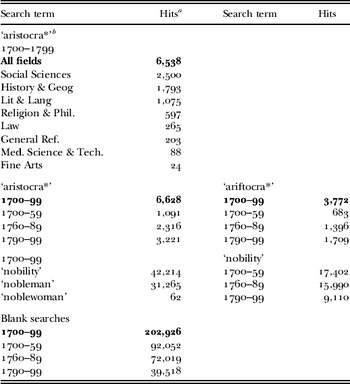
A keyword search of ECCO provides new evidence that ‘aristocracy’ was not a commonly used term in the eighteenth century. Appearance of both ‘aristocracy’ and derivatives (searched as wildcard ‘aristocra*’) and ‘ariftocra*’ grew during the century and were most prevalent in writings of 1790 to 1799.Footnote 111 Indeed, ‘aristocra*’ was invoked nearly three times more often during the final ten years than the first fifty-nine years of the century.Footnote 112 The House of Commons parliamentary papers database for 1700 to 1799 reveals an even more limited occurrence with only fifty-four hits in total, the majority of which appeared in the final ten years.Footnote 113 Such data reflects the extra-parliamentary nature of the French Revolution debate in England. On ECCO, ‘aristocrat’ only appeared thirty-seven times and ‘ariftocrat’ nineteen times before 1789. A contextual browse of some search results here confirmed that this term reflected ancient Greek political meaning before the French brought it into common usage during the Revolution. ECCO also demonstrates that ‘nobility’ and derivatives was far more commonly used than ‘aristocra*’ throughout the century, with a total of ‘73,541’ hits to a total for ‘aristocra*’ and ‘ariftocra*’ of ‘10,400’.Footnote 114 Moreover, while ‘aristocrat’ appears only 301 times and ‘ariftocrat’ sixty-one times during the eighteenth century, ‘nobleman’ generates ‘31,265’ hits on ECCO.Footnote 115 Using ‘nobility’ as a term of comparison with ‘aristocra*’ is clearly not comparing equivalent terms not least because noble was a commonly used adjective in the eighteenth century. Yet this dual usage of ‘nobility’ reflects its importance in contemporary language as a social as well as a political term. Searching for ‘Nobleman’ is also problematic as it is gender specific, and it is notable that ‘noblewoman’ has only sixty-two hits on ECCO.Footnote 116 Linguistic usage revealed on datasets of political terms such as ‘democracy’, ‘aristocracy’, and ‘nobility’ and derivatives tends to reinforce suggestions that the public political sphere in the eighteenth century was overwhelmingly male. Qualitative research has shown, however, that women did take part in politics in Britain, attending, or canvassing for votes, at elections, taking part in political demonstrations and protests, and writing pamphlets.Footnote 117
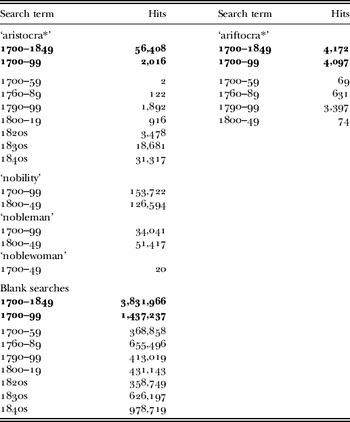
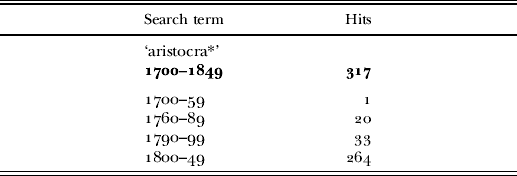
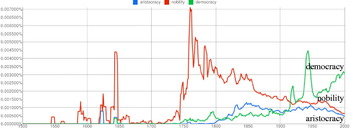
The British Library's database, British newspapers 1600–1900, confirms these findings for the eighteenth century and into the nineteenth century. It shows a significant increase in the prevalence of ‘aristocra*’ in the 1790s, a drop during 1800–19, and a massive increase during 1830–49, showing ‘18,681’ hits in the 1830s and ‘31,317’ in the 1840s. This database also reveals a higher occurrence of ‘ariftocra*’ to ‘aristocra*’ in the eighteenth century but a reverse trajectory for the nineteenth century.Footnote 118 Both the Ngram and Bookworm graphs support the finding that ‘ariftocra*’ reached a peak in appearance during the 1790s but then declined as ‘aristocra*’ rose from the 1790s to the 1850s.Footnote 119 The database also confirms continuously high figures for ‘nobility’ and derivatives throughout the period 1700 to 1849. The House of Commons parliamentary papers from 1800 to 1849 reveals 264 hits for ‘aristocra*’, which shows that it was more commonly used in parliament in the nineteenth century than the eighteenth century.Footnote 120Nineteenth-century UK periodicals reveals ‘10,484’ hits for ‘aristocra*’ between 1800 and 1849 to Eighteenth century journals’ 156 during the eighteenth century, which suggests a broader usage in the nineteenth century.Footnote 121 As shown above, the qualitative evidence reveals that ‘aristocracy’ appeared in political, social, and literary writings during the first half of the nineteenth century and became a ubiquitous term in contemporary language. This is borne out by Google Ngram Graph 7 which shows the shifting trajectories of ‘aristocracy’, ‘nobility’, and ‘democracy’ between 1500 and 2000 and the continuous appearance of ‘aristocracy’ during the nineteenth century.Footnote 122
In order to illustrate that increased appearance of ‘aristocracy’ in texts did not merely reflect a growing print industry, the number of hits for ‘aristocra*’ in ECCO and British newspapers 1600–1900 were compared with date delineated blank searches which show the total number of documents in the database for the given dates. Such comparative searches suggest that increases in hits for ‘aristocracy’ and derivatives did not merely reflect an increase in the volume of print publication.Footnote 123 Whilst the blank searches in ECCO revealed a steady decade by decade increase in the number of documents from the 1760s, with the greatest increase for the 1790s, they did not reflect the dramatic increases in appearances of ‘aristocra*’. As shown above, ‘aristocra*’ was invoked nearly three times more often during the final ten years than the first fifty-nine years of the century, yet the number of documents on ECCO for 1700–59 amounted to ‘95,052’, while those for 1790–9 totalled ‘39,518’ and the figure for 1760–9 totalled ‘111,537’. British newspapers 1600–1900 showed similar disparities between total document numbers and hits for ‘aristocra*’.Footnote 124
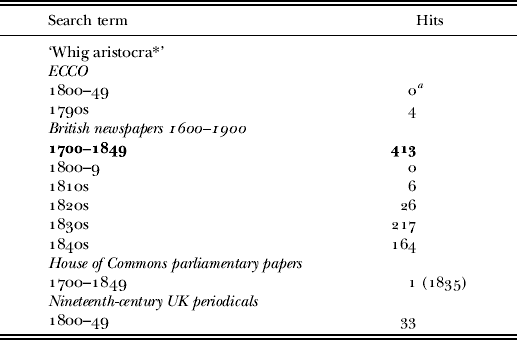
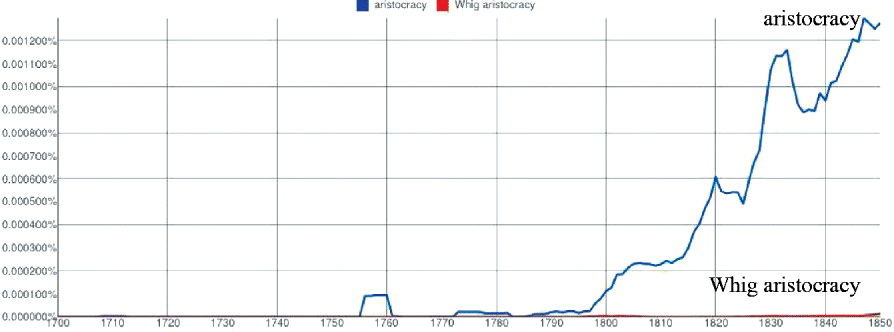
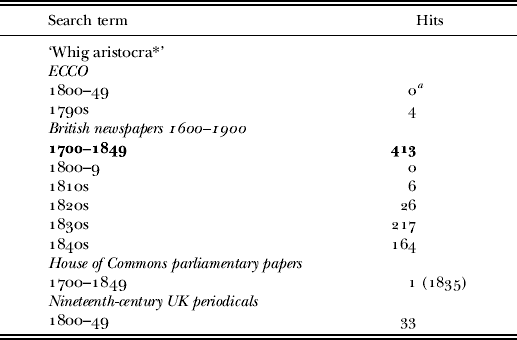
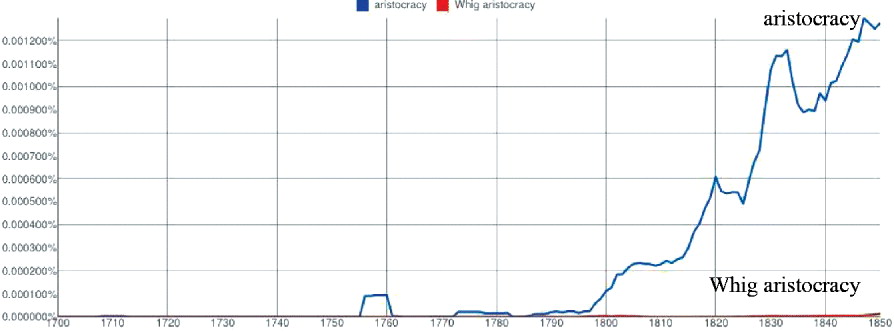
‘Whig aristocracy’, another term commonly adopted by historians, was not found in ECCO between 1700 and 1789, and only four references appeared in the 1790s. British newspapers 1600–1900 and House of Commons parliamentary papers reveal no single example in the eighteenth century. As Table 7 shows, however, usage was more common in the first half of the nineteenth century with British newspapers 1600–1900 recording the highest number of examples for ‘Whig aristocra*’ between 1830 and 1849.Footnote 125
This analysis demonstrates that both the tables and graphs reveal clear increases in the usage of ‘aristocracy’ in the later eighteenth century and into the nineteenth century although ‘nobility’ remained the dominant term throughout the period. The increase in occurrence of both ‘aristocracy’ and ‘nobility’ in absolute terms in the tables and as a percentage of published texts in the graphs also confirms the changes in usage over time.
IV
Thus, to conclude, despite limitations, keyword searches in digital resources produce valuable evidence as to the frequency of word appearance in printed texts. The database tables and Ngram and Bookworm graphs included here provide research results over a far greater number of documents in a wider variety of genres and disciplines than was previously manageable. Indeed, the data drawn from digitized material, both keyword searches and selected deeper browsing, has provided new conclusions about usage of ‘aristocracy’. The tables and graphs here reveal a generally upward trend in the appearance of ‘aristocracy’ and derivatives in print of 1700 to 1850. Such research has shown that for much of the eighteenth century ‘aristocracy’ was a term little used, with a limited and largely neutral usage within political philosophy, and that ‘aristocrat’ and ‘Whig aristocracy’ were barely used at all. Yet, during the period 1790 to 1850, usage of ‘aristocracy’ increased dramatically. In the nineteenth century, usage broadened out into social as well as political language and into a number of genres of printed material.
Whilst the quantitative research here provides evidence of the overall increase in usage of ‘aristocracy’ and in comparison with other related terms, the qualitative evidence, both in the form of digital and traditional archival research, shows more fully how the term was used. Exploring the various applications of ‘aristocracy’ in different contexts and times reveals significant moments and changes in contemporary political and social culture. In particular, it provides evidence of the complexities of negotiation around concepts such as aristocracy and democracy. In the 1790s, ‘aristocracy’ became a highly charged rhetorical device in a new political vocabulary made available by the French Revolution. It was representative of government and also an entire class unacceptable for its hereditary nature, social privileges, and disproportionate wealth. ‘Aristocracy’ was fundamentally a polemical term, a negative ‘construct’, in the discourse of reform.Footnote 126 The sources show that political debate developed in such a way as to require a term to counterpoise ‘the people’ and ultimately ‘democracy’. Such radical usage subverted the conservative definition of ‘aristocracy’ and its neutral political antecedence was temporarily obscured. In the nineteenth century, ‘aristocracy’ was adopted as a neutral social descriptor of the elite class in economic, social, and cultural contexts. But this new usage ran parallel to both the original political and radical usages until the demise of Chartism in 1848 and beyond. Indeed, during the period ‘aristocracy’ had been applied within a number of discursive frameworks and as the context shifted so did the sense of the word.Footnote 127 It had diverged far from the entirely political trajectory previously shared with ‘democracy’ to something more nebulous. Thus, the evidence illustrates that keyword searches, together with selective closer textual analysis, can provide broader and more detailed etymological evidence than was previously possible, and can develop more comprehensive linguistic histories. In particular, the availability of digitized resources enables historians to apply new methodologies to test enduring assumptions and avoid anachronistic usage of terms with a long antecedence, such as ‘aristocracy’.Footnote 128
DIGITAL TABLES AND GRAPHS
ECCO

British newspapers 1600–1900

Eighteenth-century journals

House of Commons parliamentary papers
Nineteenth-century British pamphlets

Nineteenth-century UK periodicals

‘Whig aristocracy’
Google NgramFootnote 129
(all Graphs colour online) ‘aristocracy, ‘nobility’, ‘democracy’, 1700–1850

‘aristocracy’, ‘Aristocracy’, ‘ariftocracy’, 1700–1850

‘aristocracy’, ‘aristocrat’, 1700–1850

‘nobility’, ‘nobleman’, ‘noblewoman’, 1700–1850

‘Whig aristocracy’, 1700–1850

‘aristocracy’, ‘Whig aristocracy’, 1700–1850
‘aristocracy’, ‘nobility’, ‘democracy’, 1500–2000

Bookworm GraphsFootnote 130
‘aristocracy’, ‘nobility’, ‘democracy’, 1700–1850

‘aristocracy’, ‘ariftocracy’, 1700–1850
‘nobility’, ‘nobleman’, ‘noblewoman’, 1700–1850

‘Whig aristocracy’, 1700–1850