Introduction
The relationship between institutions and entrepreneurship has long been a central focus in organizational and management research (Eberhart, Eesley, & Eisenhardt, Reference Eberhart, Eesley and Eisenhardt2017; Lounsbury & Crumley, Reference Lounsbury and Crumley2007; Sine, Cordero, & Coles, Reference Sine, Cordero and Coles2022; Sine, Haveman, & Tolbert, Reference Sine, Haveman and Tolbert2005; Tolbert, David, & Sine, Reference Tolbert, David and Sine2011). Scholars have explored how institutions influence the rates of entrepreneurship (Dobbin & Dowd, Reference Dobbin and Dowd1997; Eesley, Li, & Yang, Reference Eesley, Li and Yang2016; Sine & David, Reference Sine and David2010), the characteristics of individuals who become entrepreneurs (Eesley, Reference Eesley2016), and the types of firms created (Hiatt, Sine, & Tolbert, Reference Hiatt, Sine and Tolbert2009; Sine et al., Reference Sine, Haveman and Tolbert2005). Recently, there has been a growing focus on the role of educational institutions as critical mechanisms for fostering entrepreneurial behavior and innovation (Eesley & Lee, Reference Eesley and Lee2021; Gielnik, Uy, Funken, & Bischoff, Reference Gielnik, Uy, Funken and Bischoff2017; Walter & Block, Reference Walter and Block2016). However, most research in this domain centers on structured entrepreneurship programs or the presence of entrepreneurship courses, overlooking the broader institutional changes in curricula that shape entrepreneurial outcomes.
This paper shifts attention to a largely overlooked aspect of education: educational choice, or the flexibility students have in shaping their academic pathways through course selection. Educational choice allows students to acquire interdisciplinary skills, foster creativity, and identify entrepreneurial opportunities, all of which are critical for venture creation. By examining a curriculum reform at a prestigious Chinese university that expanded students’ ability to choose courses, this study offers new insights into how institutional changes in education influence entrepreneurial outcomes. Prior research has often treated education as a static credential (Van der Sluis, Van Praag, & Vijverberg, Reference Van der Sluis, Van Praag and Vijverberg2008), neglecting how the structure of educational experiences, such as course selection flexibility, affects entrepreneurial behavior.
This study introduces the concept of course selection flexibility as a novel mechanism linking educational reforms to entrepreneurial outcomes. Unlike prior research that primarily focuses on educational attainment or specific entrepreneurship courses, our work emphasizes how flexibility in course selection allows students to develop interdisciplinary skills, foster creativity, and identify entrepreneurial opportunities. This focus advances understanding of how curriculum structures influence entrepreneurial behavior, addressing a significant gap in the literature on the relationship between institutional reforms and entrepreneurship (King, Clemens, & Fry, Reference King, Clemens and Fry2011).
Additionally, this research highlights how individual-level moderators, such as family background and geographic origin, shape the benefits of educational reforms. For example, students from entrepreneurial families or urban areas are more likely to capitalize on flexible curricula due to their access to resources, role models, and entrepreneurial ecosystems. In contrast, students from rural or low-income backgrounds may face constraints that limit their ability to fully leverage educational choice. By integrating these moderators within a framework of resource accessibility and opportunity recognition, this study responds to calls for more nuanced examinations of how institutional reforms intersect with structural inequalities to shape entrepreneurial outcomes (Barley & Tolbert, Reference Barley and Tolbert1991; Burton, Sørensen, & Dobrev, Reference Burton, Sørensen and Dobrev2016; Eesley & Lee, Reference Eesley and Lee2021).
Finally, this paper responds to calls for more research on student and alumni entrepreneurship, which remains understudied compared to faculty spin-offs despite its relative prevalence. While much of the existing literature focuses on university-driven entrepreneurial initiatives like technology transfer offices or faculty-led ventures, this study shifts attention to how educational reforms impact student entrepreneurial behavior. By leveraging detailed transcript data and examining the long-term outcomes of curriculum changes, we contribute to a growing body of research on the conditions under which universities foster entrepreneurship among students and alumni (Åstebro, Bazzazian, & Braguinsky, Reference Åstebro, Bazzazian and Braguinsky2012; Muscio, Quaglione, & Ramaciotti, Reference Muscio, Quaglione and Ramaciotti2016; Rasmussen, Mosey, & Wright, Reference Rasmussen, Mosey and Wright2014).
Educational institutions play a central role in fostering entrepreneurship by providing students with opportunities to experiment and develop entrepreneurial skills (Grimaldi, Kenney, Siegel, & Wright, Reference Grimaldi, Kenney, Siegel and Wright2011). However, as this study reveals, the benefits of educational reforms are not uniformly distributed. Individual factors such as family background, socioeconomic status (SES), and geographic origin shape how students leverage educational choice. For example, students from entrepreneurial families benefit from role models and networks that enhance their ability to capitalize on flexible curricula (Fairlie & Robb, Reference Fairlie and Robb2007). Similarly, urban-born students have greater access to entrepreneurial ecosystems, amplifying the effects of educational choice. In contrast, students from rural or low-income backgrounds may lack the resources to fully engage with entrepreneurial opportunities, underscoring the need for targeted interventions.
Using a natural experiment in curriculum reform, we assess the impact of increased educational choice on entrepreneurial outcomes and examine how these effects are moderated by family background, SES, and urban‒rural origins. By integrating these moderators within a framework of resource accessibility and opportunity recognition, this study advances understanding of how structural inequalities intersect with institutional reforms to shape entrepreneurship.
China’s evolving institutional environment provides a valuable context for this investigation (Marquis & Qiao, Reference Marquis and Qiao2020; Phan, Zhou, & Abrahamson, Reference Phan, Zhou and Abrahamson2010; Zhou, Gao, & Zhao, Reference Zhou, Gao and Zhao2017). Universities in China are undergoing significant transformations, making them ideal settings to explore how educational reforms influence entrepreneurial outcomes. This paper leverages detailed transcript data to compare outcomes before and after the reform, offering robust evidence of how curriculum changes affect entrepreneurial behavior.
Theoretical Background
Governments have increasingly focused on education and training to boost new venture creation, prompting significant changes in higher education to equip students with the skills needed for a rapidly evolving job market. Numerous policies, programs, and courses have been introduced by governments, universities, and for-profit entities to enhance the success rate of startups (Dutt, Hawn, Vidal, Chatterji, McGahan, & Mitchell, Reference Dutt, Hawn, Vidal, Chatterji, McGahan and Mitchell2016; Katz, Reference Katz2003). However, there remains considerable uncertainty about the effectiveness of entrepreneurship training and education. Meta-analyses and reviews of entrepreneurship education have produced mixed or inconclusive results (Bae, Qian, Miao, & Fiet, Reference Bae, Qian, Miao and Fiet2014; Carpenter & Wilson, Reference Carpenter and Wilson2022; Martin, McNally, & Kay, Reference Martin, McNally and Kay2013; Nabi, Liñán, Fayolle, Krueger, & Walmsley, Reference Nabi, Liñán, Fayolle, Krueger and Walmsley2017; Rideout & Gray, Reference Rideout and Gray2013).
While accelerators often promote entrepreneurship training, the increase in startup quality they provide is sometimes due to the early closure of unsuccessful ventures (Gonzalez-Uribe & Leatherbee, Reference Gonzalez-Uribe and Leatherbee2018; Hallen, Cohen, & Bingham, Reference Hallen, Cohen and Bingham2020; Hallen, Cohen, & Park, Reference Hallen, Cohen and Park2023; Klinger & Schündeln, Reference Klinger and Schündeln2011). Recent field experiments indicate that early-stage entrepreneurs with ambitious growth expectations benefit most from training in growth-catalyst tools (Kotha, Vissa, Lin, & Corboz, Reference Kotha, Vissa, Lin and Corboz2023). Additionally, studies of MBA entrepreneurship courses show that startup quality improves as less-suited students opt out of founding startups (Lerner & Malmendier, Reference Lerner and Malmendier2013). Research on compulsory undergraduate entrepreneurship courses reveals a decrease in entrepreneurial intention among participants, even when their perceived self-efficacy increases (Fretschner & Lampe, Reference Fretschner and Lampe2019; Oosterbeek, Van Praag, & Ijsselstein, Reference Oosterbeek, Van Praag and Ijsselstein2010; Smolka, Geradts, van der Zwan, & Rauch, Reference Smolka, Geradts, van der Zwan and Rauch2024; Von Graevenitz, Harhoff, & Weber, Reference Von Graevenitz, Harhoff and Weber2010). This body of work suggests that entrepreneurship education mainly enhances startup quality by reducing the number of participants who go on to found companies (Eesley & Lee, Reference Eesley and Lee2021). As a result, several authors have called for a reassessment of the value of entrepreneurship education: ‘While the commonly held belief is that entrepreneurship education supports flourishing entrepreneurs … we call on policymakers, (business) school administrators, and educators to carefully reevaluate this assumption’ (Smolka et al., Reference Smolka, Geradts, van der Zwan and Rauch2024: 31).
A widely cited article has led many social scientists to believe that business and entrepreneurship training is ineffective in emerging economies (McKenzie & Woodruff, Reference McKenzie and Woodruff2014). However, a closer examination of the original study reveals a lack of well-designed studies with sufficient observations, suggesting potential for more positive outcomes. A decade of research since that article, along with a recent literature review by the original authors, supports a more optimistic view. Emerging evidence highlights the promise of approaches that incorporate gender considerations, continuous improvement methods (such as kaizen), localization, mentoring, heuristics, and psychological insights (McKenzie, Reference McKenzie2021; McKenzie, Osman, & Rahman, Reference McKenzie, Osman and Rahman2023). Current research is focused on how to deliver quality training programs cost-effectively, leveraging technology, markets, or targeted interventions for firms and prospective founders (McKenzie & Puerto, Reference McKenzie and Puerto2021). Despite this progress, we argue that the narrow focus on entrepreneurship-specific training overlooks the broader effects of general education on entrepreneurship.
We contend that previous conclusions about the effectiveness of education in entrepreneurship are premature. Management research should shift from asking the generic question, ‘Does entrepreneurship education work’? to the more nuanced inquiry, ‘What kind of education works for entrepreneurship’? Previous studies have primarily focused on the level of education (measured by years or advanced degrees) or entrepreneurship courses. We address this by highlighting a previously overlooked aspect of university education: the flexibility in course selection. This flexibility varies significantly, with some liberal arts universities in the US offering extensive choice, while others limit course variety or require students to commit to a major early in the application process. Prior research has often grouped these diverse curricula together, potentially overlooking how different educational structures influence entrepreneurial behavior, even when they are not directly related to starting a business.
Educational reforms influence entrepreneurship not only through institutional changes but also by interacting with individual-level factors. These moderators share a common mechanism: they shape access to resources, networks, and decision-making capabilities, which are essential for entrepreneurial action. For instance, entrepreneurial parents often transmit risk-taking attitudes and provide financial and social capital. Similarly, students from urban areas have greater exposure to diverse networks and resources, enhancing their ability to leverage educational reforms.
Prior research on entrepreneurship has examined the role of individuals’ educational and career experiences (Dobrev & Barnett, Reference Dobrev and Barnett2005). Some studies have linked educational experiences to the likelihood of engaging in entrepreneurship, noting a correlation with coursework variety (Lazear, Reference Lazear2004). However, this work has often overlooked the role of curriculum design, focusing instead on aspects like intellectual property policy (e.g., the Bayh–Dole Act, allowing federally funded research to be commercialized by granting ownership of patents to universities), faculty licensing activity, and university ownership of inventions.
In summary, most research on the impact of educational institutions on entrepreneurship has centered on specific entrepreneurship education initiatives, such as exposure to entrepreneurship classes or the introduction of university-wide programs. However, broader educational reforms and institutional changes (beyond targeted entrepreneurship programs), can also significantly influence career behavior and, ultimately, entrepreneurial activity.
Education and Entrepreneurship
Educational institutions play a crucial role in developing human capital, fostering innovation, and guiding young people toward career paths. Much of the existing literature on university-based entrepreneurship has concentrated on the roles of technology licensing offices (Di Gregorio & Shane, Reference Di Gregorio and Shane2003), university incubators (Rothaermel & Thursby, Reference Rothaermel and Thursby2005), and intellectual property policies like the Bayh–Dole Act (Grimaldi et al., Reference Grimaldi, Kenney, Siegel and Wright2011; Kenney & Patton, Reference Kenney and Patton2009, Reference Kenney and Patton2011; Mowery, Nelson, Sampat, & Ziedonis, Reference Mowery, Nelson, Sampat and Ziedonis2001). Research has also examined the impact of education level (Ahn & Winters, Reference Ahn and Winters2023; Levine & Rubinstein, Reference Levine and Rubinstein2017; Van der Sluis et al., Reference Van der Sluis, Van Praag and Vijverberg2008) and university-level factors that influence student cognition and behavior, such as persistence, engagement, and dropout rates (Hu & Wolniak, Reference Hu and Wolniak2013, Reference Hu and Wolniak2010). However, relatively little attention has been given to how the content and structure of university curricula affect entrepreneurship (Jacob, Lundqvist, & Hellsmark, Reference Jacob, Lundqvist and Hellsmark2003; Mok, Reference Mok2005).
In recent years, scholars have explored the impact of entrepreneurship education on student entrepreneurship (Lee & Eesley, Reference Lee and Eesley2018; Lyons & Zhang, Reference Lyons and Zhang2018). Research shows that entrepreneurial training can enhance students’ internal capabilities, such as self-efficacy and entrepreneurial skills (Chatterji, Delecourt, Hasan, & Koning, Reference Chatterji, Delecourt, Hasan and Koning2019) and build external resources like social capital and networks (Burt & Burzynska, Reference Burt and Burzynska2017; Guo & Miller, Reference Guo and Miller2010). However, opinions differ on its effectiveness. Some argue that entrepreneurial intentions are primarily driven by personal preferences or genetic factors rather than education (Nicolaou, Shane, Cherkas, Hunkins, & Spector, Reference Nicolaou, Shane, Cherkas, Hunkins and Spector2008), while others suggest that entrepreneurship courses may discourage students by exposing them to the risks and challenges of entrepreneurship (Oosterbeek et al., Reference Oosterbeek, Van Praag and Ijsselstein2010). Conversely, recent studies indicate that entrepreneurship education can lead to entrepreneurial action even in unfavorable environments (Walter & Block, Reference Walter and Block2016) and improve startup success and firm performance (Eesley & Lee, Reference Eesley and Lee2021; Martin et al., Reference Martin, McNally and Kay2013). However, Åstebro and Hoos (Reference Åstebro and Hoos2021) caution that sequential field experiments may be necessary to accurately assess the benefits of entrepreneurship training. Some evidence shows that entrepreneurship education positively impacts entrepreneurial entry and income, though not survival, years after graduation. Yet, a recent study warns that entrepreneurship education via television can reduce student academic performance and persistence without significant business ownership benefits (Bjorvatn, Cappelen, Sekei, Sørensen, & Tungodden, Reference Bjorvatn, Cappelen, Sekei, Sørensen and Tungodden2020). These studies focus on entrepreneurship-specific training but overlook how broader university institutional changes influence student entrepreneurial behavior. Although they have deepened our understanding of the role of higher education, they have paid limited attention to how structural reforms at the institutional level can affect student and alumni entrepreneurship post-graduation.
We theorize about educational choice, particularly in the context of curricular options in higher education, and empirically test how variations in educational choice levels influence alumni entrepreneurship. We define educational choice as an institutional characteristic that allows for individual choice in education, fostering new opportunities, mindsets, and the recombination of ideas and resources into novel actions.Footnote 1
Studying the effects of institutional environments is challenging due to the multiple forces at play. As universities implemented reforms, broader institutional changes were also occurring in the country. These educational reforms likely influenced which individuals were most prepared to take advantage of these evolving institutional conditions, shaping entrepreneurial outcomes.
Effects of Educational Choice (on Entrepreneurship)
Educational choice has been widely debated, particularly in the context of primary and secondary school options (e.g., Abdulkadiroğlu & Sönmez, Reference Abdulkadiroğlu and Sönmez2003; Lvin, Reference Lvin1991). However, less attention has been given to choice at the university-curriculum level. Educational choice, defined here as the ability to select courses within a university curriculum, offers several cognitive benefits.
First, it enhances student creativity by allowing exploration across disciplines, broadening knowledge, and fostering the ability to connect different viewpoints and question assumptions. Second, broader knowledge from educational choice can boost self-efficacy and the perceived feasibility of entrepreneurship. When students view starting a business as too difficult, they are less likely to consider entrepreneurship as a viable option (Peterman & Kennedy, Reference Peterman and Kennedy2003). Additionally, educational choice encourages students to think independently about their career decisions, a behavior linked to entrepreneurial intentions (Crant, Reference Crant1996; Zampetakis, Reference Zampetakis2008). In contrast, students following a fixed curriculum have fewer opportunities to practice decision-making. Greater autonomy in a flexible curriculum allows students to imagine different options, consider constraints, and refine their proactive decision-making and career-planning skills (Parker, Williams, & Turner, Reference Parker, Williams and Turner2006).
Educational choice can significantly enhance cognitive capabilities and skills, particularly in recognizing and seizing entrepreneurial opportunities. It allows students to learn entrepreneurial skills beyond their majors, exposing them to courses in law, accounting, finance, management, and economics – fields that contribute to general entrepreneurship-related knowledge. This aligns with the argument that generalists, who acquire a diverse set of skills, are more likely to become entrepreneurs compared to specialists (Lazear, Reference Lazear2005). Additionally, educational choice enables students to build a unique network of social ties, expanding their social capital and connecting them with potential business partners possessing diverse skills. While the importance of these factors for entrepreneurship is well established, how to cultivate them among students remains less clear (Vissa & Chacar, Reference Vissa and Chacar2009). The guiding principles, course availability, and offerings at the university level are also critical aspects of educational choice. Overall, educational choice in course selection can develop cognitive aspects and help students acquire the capabilities and resources that are key antecedents of entrepreneurial action (Crant, Reference Crant2000; McMullen & Shepherd, Reference McMullen and Shepherd2006).
If educational choice indeed fosters the cognitive dimensions that support entrepreneurship, other institutional factors or later individual choices can further enhance entrepreneurial action. The impact of institutions varies across individuals and contexts (Bercovitz & Feldman, Reference Bercovitz and Feldman2008; Eberhart & Eesley, Reference Eberhart and Eesley2018), and institutional factors can directly influence entrepreneurship. People with specific endowments or experiences may be more responsive to certain types of institutional change (Eberhart et al., Reference Eberhart, Eesley and Eisenhardt2017; Eesley, Reference Eesley2016).
While family background, SES, and urban‒rural origins differ in their specific contributions to shaping entrepreneurial outcomes, they share common underlying mechanisms. Each moderator influences students’ access to critical resources, such as financial capital, social networks, and mentorship opportunities. These resources, in turn, affect their ability to recognize, evaluate, and act on entrepreneurial opportunities. Furthermore, all three moderators interact with educational reforms by either amplifying or constraining the individual benefits of these reforms. Together, these factors highlight how structural inequalities shape the pathways through which educational choice fosters entrepreneurship.
Educational reforms that increase course selection flexibility represent a significant institutional transformation in how universities develop human capital. Drawing from institutional theory, these reforms create formal structures that legitimize diverse educational pathways and reduce constraints on individual agency (Eesley, Eberhart, Skousen, & Cheng, Reference Eesley, Eberhart, Skousen and Cheng2018; Eesley & Lee, Reference Eesley and Lee2023; North, Reference North1990; Scott, Reference Scott2008). The theoretical premise is that by allowing students to customize their educational experiences, institutions can better foster the development of entrepreneurial capabilities through experimentation and novel combinations of knowledge (Powell & Owen‐Smith, Reference Powell and Owen‐Smith1998; Rothaermel, Agung, & Jiang, Reference Rothaermel, Agung and Jiang2007).
The effectiveness of these opportunities depends critically on students’ ability to recognize, evaluate, and exploit them effectively. We propose three primary mechanisms through which entrepreneurial parents enhance their children’s ability to leverage educational flexibility toward entrepreneurial outcomes. First, children of entrepreneurs develop sophisticated mental models for identifying valuable opportunities through early exposure to business decision-making (Baron & Ensley, Reference Baron and Ensley2006). When combined with educational flexibility, these inherited cognitive frameworks enable students to better evaluate which educational combinations might yield entrepreneurial advantages (Zhao, O’Connor, Wu, & Lumpkin, Reference Zhao, O’Connor, Wu and Lumpkin2021).
Second, entrepreneurial parents provide their children with access to financial, social, and human capital resources that can be strategically deployed to maximize the benefits of educational flexibility (Aldrich & Kim, Reference Aldrich and Kim2007; Dunn & Holtz-Eakin, Reference Dunn and Holtz-Eakin2000). This resource advantage both reduces the perceived risks of experimental educational choices and provides complementary assets that enhance the value of diverse educational experiences (Eesley & Wang, Reference Eesley and Wang2017). Third, children of entrepreneurs often develop higher levels of entrepreneurial self-efficacy through parental role modeling and early exposure to business operations (Lindquist, Sol, & Van Praag, Reference Lindquist, Sol and Van Praag2015). This enhanced self-efficacy interacts with educational flexibility by increasing students’ confidence in pursuing unconventional educational combinations and subsequently translating them into entrepreneurial action (Eesley & Lee, Reference Eesley and Lee2021).
Students with entrepreneurial parents possess both the cognitive frameworks to recognize valuable educational combinations and the resources to exploit these combinations effectively. Their enhanced capacity to recognize opportunities, access critical resources, and manage uncertainties creates a multiplicative effect that strengthens the relationship between educational choice and entrepreneurial outcomes (Smith, Hamilton, & Fabian, Reference Smith, Hamilton and Fabian2020; Sørensen, Reference Sørensen2007). This theoretical logic suggests that while educational flexibility may benefit all students to some degree, those with entrepreneurial parents will demonstrate a systematically stronger ability to convert educational choice into entrepreneurial action.
Therefore, we hypothesize:
Hypothesis 1 (H1): The positive relationship between educational choice and entrepreneurial action will be stronger for alumni with entrepreneurial parents compared to those without entrepreneurial parents.
SES serves as a critical moderator in the relationship between educational choice and entrepreneurial action, complementing the moderating effect of entrepreneurial parents proposed in our first hypothesis. This additional moderation effect is grounded in resource-based theory and social capital theory, both of which are central to understanding entrepreneurship in transitional economies (Wei & Zhang, Reference Wei and Zhang2022; Zhang, Reference Zhang2014).
While entrepreneurial parents provide specific entrepreneurial knowledge and role models, high SES offers broader advantages in terms of resources and opportunities. Higher SES provides students with both tangible and intangible resources that enhance their ability to capitalize on educational reforms. Tangible resources include financial stability and access to better-quality educational institutions, while intangible resources encompass social networks, mentorship opportunities, and exposure to diverse professional environments. These resources collectively contribute to the development of entrepreneurial skills, risk tolerance, and opportunity recognition capabilities (Zampetakis, Reference Zampetakis2008).
The flexibility afforded by educational reforms, such as the credit system introduced in Chinese universities, potentially amplifies the advantages of high SES. Students from privileged backgrounds are better positioned to engage in diverse coursework, participate in entrepreneurial competitions, and pursue internships that foster innovation and creativity. This aligns with recent calls for more multidisciplinary approaches in Chinese business education to promote entrepreneurship and innovation (Fey, Reference Fey2022; Lu, Reference Lu2022).
Conversely, students from lower SES backgrounds may face constraints that limit their ability to fully leverage educational choice. These constraints may include the need for part-time employment, reduced access to entrepreneurial role models, and lower risk tolerance due to financial insecurity. Such limitations may lead to a preference for job security over entrepreneurial pursuits, potentially exacerbating existing socioeconomic disparities in entrepreneurial outcomes.
Similar to how entrepreneurial parents can provide industry-specific networks, high SES often offers broader, more diverse networks. These expanded networks, regardless of their source, can enhance students’ ability to recognize and act on entrepreneurial opportunities (Zhang, Reference Zhang2014). Furthermore, while entrepreneurial parents may instill specific entrepreneurial values, high SES can provide a financial safety net that encourages risk-taking behavior. Both factors can thus increase students’ propensity to pursue entrepreneurial paths when given educational choice.
This theoretical framework suggests that SES acts as a critical moderator, amplifying the positive effects of educational choice on entrepreneurial action for students from higher socioeconomic backgrounds. This moderation effect underscores the complex interplay between individual characteristics, institutional factors, and socioeconomic conditions in shaping entrepreneurial trajectories (Zhao et al., Reference Zhao, O’Connor, Wu and Lumpkin2021).
Based on this theoretical foundation, we propose the following hypothesis:
Hypothesis 2 (H2): Alumni from high socioeconomic backgrounds will exhibit a stronger positive relationship between educational choice and entrepreneurial action than those from lower socioeconomic backgrounds.
The geographic origin of students plays a critical role in moderating the relationship between educational choice and entrepreneurial action. This moderation effect is rooted in theories of agglomeration economies and spatial clustering of innovation (Delgado, Porter, & Stern, Reference Delgado, Porter and Stern2010). Urban environments, characterized by dense networks, greater resource availability, and proximity to entrepreneurial hubs, offer distinct advantages that can amplify the benefits of educational reforms.
Students from urban areas are more likely to encounter diverse role models, mentors, and startup opportunities, which can enhance their entrepreneurial intent and capacity (Zampetakis, Reference Zampetakis2008). These urban ecosystems provide a rich context for the application of skills and knowledge gained through flexible educational choices. The concentration of financial institutions, incubators, and innovation centers in urban areas creates a supportive infrastructure for entrepreneurial activities, allowing urban-born students to more readily translate their educational experiences into entrepreneurial outcomes.
In contrast, students from rural areas often face structural challenges that may limit their ability to fully leverage the benefits of educational reforms. These challenges include restricted access to entrepreneurial resources, networks, and early exposure to diverse business models. Rural students may also encounter psychological barriers, such as limited familiarity with entrepreneurial ecosystems, which can constrain their ability to recognize and act on entrepreneurial opportunities (Koo & Eesley, Reference Koo and Eesley2021; Weiser & Riggio, Reference Weiser and Riggio2010).
The urban‒rural divide in entrepreneurial resources and exposure is particularly pronounced in transitional economies like China, where economic development has been geographically uneven. Koo and Eesley (Reference Koo and Eesleyforthcoming) highlight this disparity, noting that urban communities often provide greater exposure to diverse ideas, resources, and entrepreneurial networks compared to rural areas. Their work emphasizes that urban individuals benefit from more extensive social networks, greater access to information, and increased opportunities for entrepreneurship, particularly in the context of China’s household registration system. Urban centers have often been the focus of policy initiatives aimed at fostering innovation and entrepreneurship, potentially exacerbating disparities in entrepreneurial outcomes between urban and rural-born students.
Furthermore, the social networks developed in urban educational institutions are likely to be more diverse and entrepreneurially oriented. Urban-born students may find it easier to build connections with peers from entrepreneurial backgrounds, further enhancing their exposure to entrepreneurial thinking and opportunities. This network effect can significantly influence the likelihood of engaging in entrepreneurial activities post-graduation (Larsson, Wennberg, Wiklund, & Wright, Reference Larsson, Wennberg, Wiklund and Wright2017).
The flexibility offered by educational reforms, such as increased course selection, may inadvertently widen the gap between urban and rural students’ entrepreneurial outcomes. Urban-born students, with their broader exposure to entrepreneurial ecosystems, may be better positioned to select courses and experiences that align with entrepreneurial goals. In contrast, rural students might lack the contextual knowledge to fully capitalize on these educational choices.
These arguments align with recent research on the importance of regional factors and institutional changes in shaping entrepreneurial outcomes. Wu and Eesley (Reference Wu and Eesley2021) highlight the role of regional migration in entrepreneurship, emphasizing the importance of location in accessing resources and opportunities. Similarly, Wu, Eesley, and Yang (Reference Wu, Eesley and Yang2021) demonstrate how institutional changes interact with individual characteristics to influence entrepreneurial strategies. Based on this theoretical framework, which highlights the significant role of geographic origin in moderating the relationship between educational choice and entrepreneurial action, we propose:
Hypothesis 3 (H3): Alumni from urban areas will exhibit a stronger positive relationship between educational choice and entrepreneurial action than those from rural communities.
This hypothesis, along with H1 (entrepreneurial parents) and H2 (SES), contributes to our understanding of how individual, family, and spatial factors intersect with educational reforms to shape entrepreneurial outcomes. Together, these hypotheses build theory to better understand the complex interplay between institutional changes in education and preexisting socioeconomic factors in fostering entrepreneurship. While educational reforms aim to democratize access to entrepreneurial opportunities, the amplification of their benefits through preexisting advantages highlights potential inequities.
This framework points to a common mechanism across all three hypotheses: the amplification of educational choice benefits through enhanced access to resources, networks, and entrepreneurial exposure. Entrepreneurial parents (H1) provide industry-specific knowledge, role models, and a safety net, creating a supportive environment for entrepreneurial action. High SES (H2) offers broader resources, diverse networks, and opportunities for risk-taking, which disproportionately benefit privileged students. Urban origin (H3) facilitates access to entrepreneurial ecosystems, financial resources, and diverse opportunities, further tilting the scales in favor of urban-born individuals. Collectively, these factors illustrate how educational reforms, despite their inclusive intentions, may inadvertently reinforce structural inequalities by enabling students with preexisting advantages to disproportionately benefit from entrepreneurial opportunities.
Methods
We begin by providing an overview of the credit system reform at one of China’s top universities and discussing how this reform may have influenced the future entrepreneurial activities of its alumni. Before 1985, the university operated under an academic year system with a fixed curriculum. Students were required to follow a predetermined set of courses each year, with no options to select courses based on their interests or change majors.
In 1985, the university introduced a credit system reform that relaxed these restrictions, allowing for greater flexibility in course selection, study duration, and the ability to change majors. This reform was part of a broader governmental initiative to modernize Chinese higher education, and many universities across China adopted similar changes during the 1980s. Wuhan University was among the first to implement the credit system reform and reported positive outcomes. The reform at the university we focus on aimed to (1) foster the development of well-rounded students, (2) expand the applicability of skills, (3) support students in developing specializations, and (4) streamline the management process.Footnote 2
Choice became an integral part of the system as students were required to select courses to meet their credit requirements. Notably, students could choose courses outside their major; for instance, a computer science major could take a management course. Each department offered a range of elective courses, giving students the flexibility to fulfill their credit requirements. During this period, the number of courses offered by most departments increased significantly. For example, in 1981, the Department of Mechanical Engineering offered 52 courses, while the Department of Electronics offered 48. By 1990, these numbers had risen to 101 and 123, respectively (University Archives).
Unlike the previous academic year system, the credit system allowed students to tailor their coursework instead of following a fixed curriculum. To evaluate the extent of this change, we conducted interviews with university alumni graduated before and after the reform. These interviews indicate that the credit system reform fostered greater deliberation, exploration, and learning – skills that are central to entrepreneurship education – even though the reform was not explicitly designed with entrepreneurship in mind.
Sample
Due to the growing influence and numerous reforms of Chinese universities, data from these universities have become increasingly valuable for studying institutions, innovation, and entrepreneurship (Helveston, Wang, Karplus, & Fuchs, Reference Helveston, Wang, Karplus and Fuchs2019; Wang, Li, & Furman, Reference Wang, Li and Furman2017). In this paper, we analyze the course credit system reform at a leading research university in China, which provides a quasi-natural experiment by altering educational choice during university years. Our study compares outcomes of graduates before and after the reform, focusing on its differential impact on those more versus less affected by the changes.
Graduates who completed their studies just before the reform serve as a control group, experiencing the same macroeconomic conditions as those who graduated just after, with the educational reform being the primary distinction. This design allows for a refined pre/post-intervention analysis.
We examine variations in coursework choices and their effects on similar individuals before and after the reform, particularly among those differentially impacted. While our approach resembles a pre/post-intervention design, it does not strictly follow the difference-in-differences (diff-in-diff) framework, as we do not know beforehand which groups were more strongly affected. By identifying individuals most influenced by the reform and controlling for both pre- and post-reform periods and time-invariant differences across groups, we effectively isolate the reform’s impact.
This methodology mitigates concerns about alternative explanations, which would require coincidental changes that align precisely with the reform and affect the same subgroups differently. By accounting for other institutional changes occurring concurrently with the credit system reform and their differential impacts, we ensure the robustness of our findings and reduce the plausibility of alternative explanations.Footnote 3
To empirically examine the relationship between educational choice and entrepreneurship, we conducted a survey of alumni who graduated from the university between 1930 and 2007. After a multiyear effort, we secured an agreement to administer the first comprehensive survey to all graduates, enabling the collection of detailed individual-level data on education, career paths, and entrepreneurial activities. University alumni represent a valuable population for studying entrepreneurship and institutional change, as demonstrated in prior research (Eesley, Reference Eesley2016; Eesley et al., Reference Eesley, Li and Yang2016; Hsu, Roberts & Eesley, Reference Hsu, Roberts and Eesley2007).
This survey offers significant advantages over existing datasets. It includes detailed panels of work history and education data spanning multiple graduating classes and is less biased in performance measures compared to government surveys. The survey instrument was adapted from an earlier alumni entrepreneurship survey conducted by the Massachusetts Institute of Technology (Hsu et al., Reference Hsu, Roberts and Eesley2007).
In collaboration with the university’s Alumni Association, which maintained contact information for nearly 30,000 alumni, we distributed questionnaires in June 2007. We received 1,620 responses via the internet and 2,026 via mail, achieving a total response rate of 12%.Footnote 4
Among the respondents, 367 alumni reported starting new enterprises after graduation. For non-entrepreneurs, we identified 2,042 alumni with entrepreneurial intentions based on their response to the question, ‘Are you planning to start a new company in the future’? The remaining non-entrepreneurs expressed no entrepreneurial intentions and no plans to start businesses in the future.
To account for alumni who had not yet started businesses but indicated the potential to do so in the future (captured by entrepreneurial intentions), we included these respondents in our analysis. We employed event history analysis to incorporate this group, allowing for a more comprehensive examination of entrepreneurial outcomes over time.Footnote 5 China suspended the college entrance examination during the Cultural Revolution (1966) and did not resume it until 1977. Students who took the entrance exam in 1977 graduated in 1982. Those graduating before 1982 were primarily workers, peasants, and soldiers rather than traditional university students. As a result, we excluded students who graduated before 1982 from our sample, focusing instead on graduates from 1982 to 2007. Robustness tests were conducted using different time windows.
This approach also allowed us to eliminate the potential influence of major historical events, such as world wars, revolutions, and shifts in government systems. After excluding observations with missing values, the final sample included 254 entrepreneurs and 861 non-entrepreneurs with entrepreneurial intentions. Detailed descriptions of individual backgrounds are provided in Appendix Tables 1–4.
Statistical Method
We employed event history analysis using Cox hazard regression models, which account for the timing of events and adjust for right-censoring in the data. The ‘failure’ years for non-entrepreneurs were right-censored to the year of the survey. We defined the year of graduation as the baseline and the incidence of entrepreneurial action as the ‘hazard’.
Independent Variables
Educational choice
We utilized the 1985 credit system reform to measure the institutionalization of educational choice at the university level. For students who entered the university from 1978 to 1998, the program lasted 5 years; after 1998, it shifted to a 4-year system.Footnote 6 Students who enrolled in 1985, when the reform began, graduated in 1990. Thus, 1990 served as the threshold to distinguish alumni who experienced the system with educational choice (i.e., those graduating in or after 1990) from those who did not (i.e., those graduating before 1990). We assigned a value of 1 to educational choice for alumni graduating after the reform and 0 otherwise.
We tested key family background characteristics as moderators that may influence the impact of educational choice on entrepreneurship. Since the family and environment in which an individual grows up have lasting effects on attitudes, cognitions, and behaviors in adulthood, we examined family-related factors to understand their potential role in shaping entrepreneurial action. Research has shown that individuals with entrepreneurial parents are more likely to start their own businesses (Powell, Greenhaus, Jaskiewicz, Combs, Balkin, & Shanine, Reference Powell, Greenhaus, Jaskiewicz, Combs, Balkin and Shanine2017; Sørensen, Reference Sørensen2007). We operationalized this variable as entrepreneurial parent, assigning a value of 1 if respondents reported having at least one entrepreneurial parent and 0 otherwise. Additionally, individuals from families with high SES tend to exhibit greater creativity and self-efficacy (Weiser & Riggio, Reference Weiser and Riggio2010). To explore this as a moderator, we measured SES using the survey question: ‘How did you evaluate the SES of your family relative to others when you were in college’? Respondents who reported above-average SES were assigned a value of 1, and those with average or below-average status were assigned a value of 0. Finally, we accounted for the influence of the birth community, as studies suggest that an individual’s place of origin can affect perceptions, choices, and achievements (Côté, Macdonald, Baker, & Abernethy, Reference Côté, Macdonald, Baker and Abernethy2006). Birth community development was coded on a scale from 1 (rural) to 4 (large city), reflecting varying levels of community development and its potential influence on future career choices.
Control Variables
We included several control variables that potentially influence individual entrepreneurial actions, covering demographic factors, education, family features, and historical events.
Demographic factors
Age has been shown to influence entrepreneurship (Levesque & Minniti, Reference Levesque and Minniti2006; Zhao et al., Reference Zhao, O’Connor, Wu and Lumpkin2021), so we controlled for age at graduation. Gender is another significant factor, with men being more likely than women to establish firms (Levesque & Minniti, Reference Levesque and Minniti2006). We assigned a value of 1 to male respondents and 0 to female respondents.
Educational factors
Educational attainment may affect entrepreneurial actions, as holding a master’s or doctoral degree is associated with entrepreneurial tendencies (Colombo & Grilli, Reference Colombo and Grilli2005; Roberts, Reference Roberts1991). We included dummy variables for master’s degree and PhD holders (1 = degree holder, 0 = otherwise). Membership in the Chinese Communist Party (CCP) may reflect proactive engagement with university policies and was measured using the survey question: ‘Are you a member of the CCP’? (1 = CCP member, 0 = otherwise). Broad knowledge across disciplines is often linked to entrepreneurship (Åstebro & Thompson, Reference Åstebro and Thompson2011; Lazear, Reference Lazear2004). We controlled for multidisciplinary study, assigning a value of 1 if respondents completed a double major or pursued a different graduate major, and 0 otherwise.
Academic majors may also influence entrepreneurship. Departments offering more courses may expose students to greater academic flexibility. We controlled for broad majors, assigning a value of 1 if a department offered courses above the median number and 0 otherwise. We also included a dummy for new majors established post-reform (e.g., computer science, law, economics, and management).
Studying abroad may increase exposure to advanced technologies and management practices, affecting entrepreneurial likelihood (Kenney, Breznitz, & Murphree, Reference Kenney, Breznitz and Murphree2013). We created a dummy variable for overseas returnees (1 = returnee, 0 = otherwise). Leadership experience, which is critical for entrepreneurship (Siegel, Siegel, & MacMillan, Reference Siegel, Siegel and MacMillan1988), was controlled for using a dummy variable indicating whether respondents led a student group during university.
Professional experience
We controlled for business sector employment, based on the survey question: ‘Please tell us about the most important jobs you’ve held since graduation’. Respondents working in business were assigned a value of 1, and those in government, academia, or nonprofits were assigned 0. Similarly, high-tech sector experience was measured as 1 if alumni worked in industries such as software, biotech, or electronics, and 0 otherwise.
Institutional and historical context
China’s institutional context changed significantly over the past few decades, influencing entrepreneurial actions (Stenholm, Acs, & Wuebker, Reference Stenholm, Acs and Wuebker2013). Before the 1978 reform, private entrepreneurship was eradicated under the planned economic system (Puffer, McCarthy, & Boisot, Reference Puffer, McCarthy and Boisot2010). After 1978, legal reforms recognized and protected property rights, fostering entrepreneurship (Nee, Reference Nee1992).
We focused on two constitutional amendments closely tied to private entrepreneurship: the 1999 amendment recognizing the nonpublic economy as part of the socialist market economy and the 2004 amendment protecting private property rights (Chen, Reference Chen2007). We included two historical event dummies to indicate whether alumni graduated before or after 1999 and 2004, respectively, to capture the effects of these institutional changes.
Results
Table 1 displays the descriptive statistics and correlation coefficients. Most correlation coefficients are less than 0.40.Footnote 7 Table 2 presents the results of Cox regression models predicting the influence of educational choice on entrepreneurial action. Model 1 includes all the control variables; Model 2 adds educational choice; Models 3, 4, and 5 further include interactions between educational choice and entrepreneurial parent, family status, and birth community; and Model 6 includes all the interaction terms. In Model 2, shown in Table 2, entrepreneurial action significantly increases with educational choice (p = 0.000). For economic significance, the hazard of engaging in entrepreneurial actions for alumni who graduated after the credit system reform is 158.8% higher than that of alumni who graduated before the credit system reform. This empirical result shows that after the implementation of greater educational choice, individuals were more likely to take entrepreneurial action. However, the interaction effects of education choice with parental entrepreneurship, family status, and birth community all turn out to be insignificant, and if any the coefficient estimates tend toward negative (Model 3 and onward). Based on these results, educational choice does not seem to differentially affect more and less privileged groups. However, this may be driven by the fact that not all students would have changed their course selection behavior post reform, and that it takes some time for students and the administration to fully adapt to the new system and for it to take effect.
Descriptive statistics

Note: N = 1,115.
Influence of educational choice on entrepreneurship

+ Notes: N = 1,115. Standard errors in parentheses. p < 0.10, *p < 0.05, **p < 0.01, ***p < 0.001.
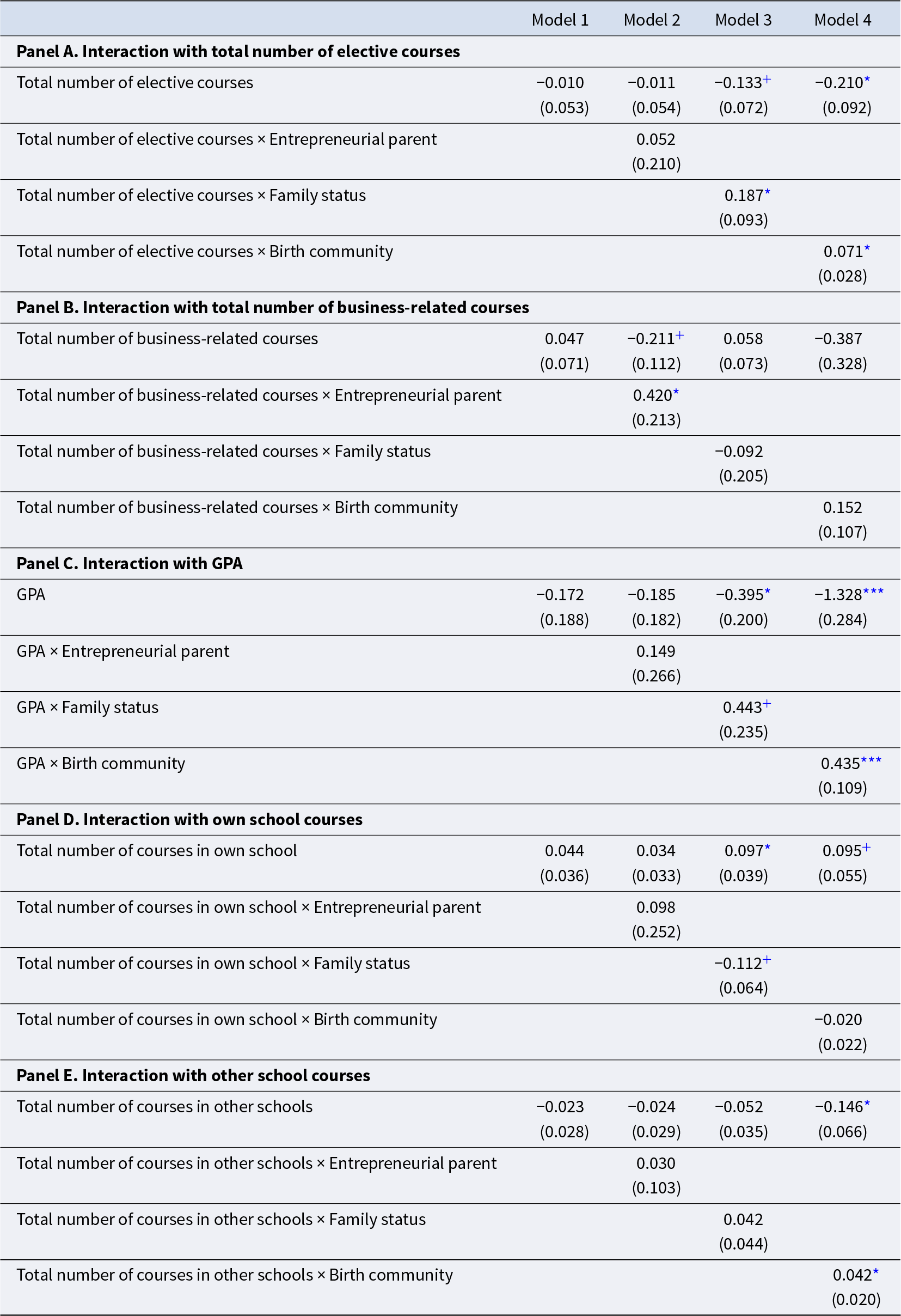
To further investigate the potential moderating effects of student background, we conducted additional analyses on the courses taken by students. We accessed course transcript data from the university for a subset of the sample, allowing us to explore new moderators. Using the name, graduation year, and department information provided in the questionnaire, we obtained records of 17,276 courses taken by 221 alumni. Among these alumni, 30 were entrepreneurs, and 141 were non-entrepreneurs with entrepreneurial intentions.
Due to data limitations in transcript availability and course details, we focused only on alumni who graduated after 1990 to examine the influence of course-related variables on entrepreneurial action in the post-reform period. After excluding missing values, the final sample for this analysis included 134 individuals. The results are presented in Table 3.
Subsample results of course-related variables

+ Notes: Alumni who graduated from the School of Economics and Management were not included when analyzing the influence of total number of business-related courses because the large numbers of business-related courses of these alumni were largely due to educational arrangement rather than individual choice. N = 134 for the results except for total number of business-related courses. N = 125 for the results of total number of business-related courses. Standard errors in parentheses. p < 0.10, *p < 0.05, ***p < 0.001. Control variables are included in all the regression results but not reported due to page limits.
Model 2 of Panel B shows that the interaction term of entrepreneurial parent and total number of business-related courses is positive and significant (p = 0.049). This indicates that students who have entrepreneurial parents and took more business-related courses (e.g., finance, law, economics, etc.) are more likely to take entrepreneurial action. The results from Model 2 provide support for H1, indicating that students with entrepreneurial parents are significantly more likely to engage in entrepreneurial activities when they took a higher number of business-related courses. These findings suggest that early exposure to entrepreneurial mindsets and resources amplifies the benefits of educational choice.
Model 3 of Panel C shows that the interaction term of family status and Grade Point Average (GPA) is positive and marginally significant (p = 0.059), and Model 4 of Panel A shows that the interaction term of birth community and GPA is positive and significant (p = 0.000). The results indicate that, after the reform offering greater educational choice, students from higher-status families or more developed birth communities with higher GPAs are more likely to engage in entrepreneurial action after graduation.
Model 3 of Panel D shows that the interaction term of family status and total number of courses in own school is negative and marginally significant (p = 0.080), and Model 4 of Panel E shows that the interaction term of birth community and total number of courses in other schools is positive and significant (p = 0.038). These results indicate that, after the reform offering greater educational choice, students from lower-status families who take more courses within their own school, and students from higher-status families who take more courses in other schools, are more likely to engage in entrepreneurial action after graduation. The findings from Model 3 in Panel A and Model 3 in Panel C of Table 3 partially support H2. Students from higher SES families were more likely to benefit from educational choice, particularly when taking a wider array of elective courses or achieving higher GPAs. However, the effect size is less pronounced compared to entrepreneurial parents, indicating that while SES influences outcomes, its impact is more context-dependent.
Model 3 of Panel A shows that the interaction term of family status and total number of elective courses is positive and significant (p = 0.045), and Model 4 of Panel A shows that the interaction term of birth community and total number of elective courses is positive and significant (p = 0.011). The results indicate that, after the reform offering greater educational choice, students from higher-status families or more developed birth communities who take a broader range of elective courses are more likely to engage in entrepreneurial action after graduation. The results from Model 4 in Panels A and C of Table 3 support H3. Individuals born in urban areas are significantly more likely to leverage educational choice for entrepreneurial ventures (p = 0.038). This advantage is likely due to greater access to resources, networks, and exposure to diverse ideas in urban environments, which amplify the benefits of course flexibility. The course transcript data reveal that while the credit system reforms provided flexibility to all students, those who actively took advantage of this flexibility – by modifying their coursework to include more electives or cross-disciplinary classes – experienced stronger positive effects on their entrepreneurial outcomes. This underscores that the reforms themselves were not sufficient; students needed to actively engage with the new opportunities to realize their potential benefits.
Supplementary Analysis
We conducted additional analyses to test the robustness of our results. To ensure reliability, we examined interactions across varying time windows, employed alternative operationalizations (e.g., income versus self-reported SES), and reanalyzed subsets of transcript data to validate our findings.
To address concerns about the influence of major macroeconomic factors, we reran models with narrower time windows. Appendix Table 5 presents results using different time intervals as robustness tests (4, 6, and 8 years before and after the credit system reform). The consistent findings across these intervals provide greater confidence in the robustness of our main results. Additional analyses using time windows of 1, 2, 3, 5, and 7 years before and after the reform yielded similar results.
We also performed tests for alternative explanations and employed alternative models, such as coarsened exact matching, as well as alternative measures for key variables. These supplementary analyses further support our theoretical framework and hypotheses, reinforcing the validity of our findings.
Qualitative Interviews
Under the academic year system, students followed a predetermined curriculum, with no opportunity to choose courses based on their interests or change majors. In contrast, the credit system introduced in 1985 allowed students to select their courses, offering greater flexibility.
To verify whether students experienced more choice in their coursework after the reform, we conducted interviews with Tsinghua alumni who graduated before and after the transition. One alumnus who graduated before the reform stated, ‘There was not much choice when I was an undergraduate. In fact, I had to follow the requirements’. Another alumnus who graduated in 1987, majoring in electrical engineering, described their experience under the earlier system:
I had to choose my major when applying to college, and didn’t know much about EE, other than that it sounded good. There was not much choice; everything was planned for students. They had largely the same classes, and the EE majors all stayed in the same dorm and did everything together. It was not easy to change your major, and I didn’t know anyone who changed. In the first year, you could choose one or two classes, and that was all.
She later enrolled at Stanford University to study electrical engineering, which gave her the opportunity to compare her educational experiences at Tsinghua and in the US. Reflecting on the differences between the two systems, she said:
I noticed and liked the difference at Stanford, where they had a certain number of credits and many more opportunities to choose courses. This was important because it was one of the first times I had the chance to make big decisions independently. Second, it gave me the opportunity to explore what was out there. I did not wind up taking classes in a different area, but I at least had the chance to learn a bit about it and see what opportunities were out there. It helped me follow and develop my interests, and exploring courses in different content areas helped to spark new ideas.
She concluded by noting that students at Tsinghua in later years enjoyed significantly more choice in their coursework than during her time. Another alumnus and entrepreneur who graduated after the reform shared his experience, saying:
I was able to choose other courses if I met the basic requirements. Actually, I took four courses beyond the requirements. It was quite beneficial for me. I got different things from different majors and degrees, and they provided me with different lenses through which to approach problems. For example, chemical engineering gave me a systematic view of solving problems. MBA and economics courses gave me a useful way to evaluate the practicality and value of a project. Physical science provided me with a new understanding of technology from a different perspective than chemical engineering.
Another alumnus, an entrepreneur who graduated in 1989, said:
My coursework at Tsinghua definitely had an impact on my entrepreneurial career. The classes that I took both in electrical engineering and in management and psychology helped me with developing ideas for running my own business. Taking classes across disciplines exposed me to new ways of approaching problems and taught me the benefits of problem solving by looking at the world using different lenses.
Our interviews with entrepreneurs revealed that their initial intentions to pursue entrepreneurship were largely driven by a passion for an idea or a personal interest. Within educational institutions, the availability of choice provides students with opportunities to explore their interests and develop independent decision-making skills. Students and alumni who discover and cultivate their own career interests may find it easier to reject more immediately lucrative job offers in favor of pursuing entrepreneurial paths. Entrepreneurship often requires individuals to make career decisions that diverge significantly from their peers, who may opt for more traditional employment. As one alumnus explained:
It was not just that we could take classes across subjects, but it was the idea that the choice was up to us. It forced me to really stop and think about my interests and to do a bit of career planning. I’d say it was probably the first major decision I had to make on my own without the guidance of my parents.
Another interviewee reinforced this idea, stating, ‘Although the engineering curriculum is very full, even having incrementally more choice makes a big difference because it gives you that chance to make independent decisions about your life and also to see what opportunities are out there’.
Another entrepreneur we interviewed also emphasized the importance of the variety of courses he had taken in providing opportunities for knowledge recombination and multiple problem-solving lenses. He graduated from the automotive engineering department in 2004 and told us, ‘I chose a lot of courses in computer science, such as data structure and software engineering’. He continued, ‘I think these courses were beneficial for me because they were useful tools to solve practice problems and they are related to what I do now as an entrepreneur’. This entrepreneur operates a business at the intersection of information technology and the automotive industry, highlighting the impact of a specific combination of coursework.
Our interviews with Tsinghua alumni indicate that the shift to a flexible, credit-based system significantly enhanced course selection, which many regarded as pivotal to their development. Before the reform, students faced limited options in their coursework. Alumni who graduated after the reform appreciated the ability to explore diverse fields, which fostered creativity, independent decision-making, and entrepreneurial skills. The reform enabled them to integrate knowledge across disciplines, enhancing problem-solving abilities and contributing to their entrepreneurial success.
Additional Analysis on Moderating Forces: Political Connections and Career Experience
We examined how individual and situational factors, such as privileged backgrounds and networks, moderate the impact of educational choice on entrepreneurship. Additional heterogeneity analysis based on CCP membership and work experience in high-tech and business sectors supports the privileged family background effects observed in our course analysis. The results suggest that the benefits of curricular changes are amplified when combined with privileged characteristics and networks, further fostering entrepreneurship.
Given the relevance of CCP membership, we explored how educational choice impacts entrepreneurship differently for CCP members. The CCP selectively recruits well-educated elites, particularly intellectual and technical experts with strong interpersonal skills (Dickson & Rublee, Reference Dickson and Rublee2000; Zhang, Reference Zhang2014). Educational choice fosters cognitive development and skill acquisition, and CCP members – proactive and informed about university policies – likely leveraged these opportunities to explore courses in other disciplines. Their active engagement in university life and access to resources may have further supported their entrepreneurial pursuits after graduation.
We also analyzed career experience in business and high-tech sectors as key moderators. During the reform period, emerging sectors such as the internet, biotech, and electronics offered riskier but potentially lucrative opportunities compared to traditional government or state-owned careers. Educational choice likely encouraged students to enter these sectors by exposing them to interdisciplinary knowledge and innovative practices, such as intellectual property laws and research and development management. Combined with on-the-job training, this foundation likely increased the likelihood of entrepreneurship, particularly for those who worked in high-tech or business sectors after the reform.
Our results indicate that educational choice significantly enhances entrepreneurial outcomes, with effects moderated by individual and situational factors, including privileged backgrounds, networks, and work experience. Additional analyses (Appendix Table 6) reveal that characteristics like CCP membership, business sector experience, and high-tech sector experience further amplify the impact of educational choice on entrepreneurship. Notably, the interaction effect of educational choice and CCP membership on entrepreneurial action is significant (p = 0.034). For CCP members, the likelihood of engaging in entrepreneurial actions following the credit system reform increased by 80.0% compared to non-members. This aligns with prior research showing that the CCP selectively recruits well-educated elites with strong interpersonal and technical skills (Dickson & Rublee, Reference Dickson and Rublee2000; Zhang, Reference Zhang2014). Educational choice enabled these individuals to take advantage of interdisciplinary opportunities and university resources, further supporting entrepreneurial pursuits.
Work experience in business and high-tech sectors also moderated the impact of educational choice. Alumni with business sector experience had a 142.9% higher likelihood of entrepreneurial action, while those with high-tech sector experience showed a 120.8% increase. These sectors, emerging during the reform period, offered riskier but potentially lucrative opportunities that demanded interdisciplinary knowledge and innovation. Educational choice facilitated the acquisition of diverse skills and knowledge, complementing on-the-job training in these sectors to foster entrepreneurship.
The results from our analysis of moderating forces, including CCP membership and career experience in business and high-tech sectors, highlight the significant role of individual and situational factors in amplifying the impact of educational choice on entrepreneurial outcomes. These findings emphasize how privileged backgrounds and networks enhance the benefits of curriculum reforms, enabling individuals to leverage interdisciplinary opportunities and gain access to emerging, high-growth sectors. Building on this analysis, we now turn to a broader discussion of how course selection flexibility serves as a novel institutional mechanism shaping entrepreneurship and its implications for research and policy.
Discussion
This study contributes to research on the relationship between institutions and entrepreneurship by introducing course selection flexibility as a novel mechanism linking curriculum reforms to entrepreneurial outcomes. Prior research on academic entrepreneurship has largely emphasized faculty spin-offs, intellectual property policies, and social embeddedness (Åstebro et al., Reference Åstebro, Bazzazian and Braguinsky2012; Kenney & Patton, Reference Kenney and Patton2009). In contrast, our findings shift attention to how broader educational reforms influence student and alumni entrepreneurship.
By examining curriculum-wide changes, this study extends research on entrepreneurship education, which has traditionally focused on structured programs or co-curricular activities (Eesley & Lee, Reference Eesley and Lee2021; Walter & Block, Reference Walter and Block2016). We demonstrate that flexibility in course selection fosters interdisciplinary skill-building, creativity, and problem-solving, all critical for entrepreneurial outcomes. However, the benefits of these reforms are not evenly distributed. Students with entrepreneurial parents, higher socioeconomic backgrounds, or urban origins are better positioned to leverage this flexibility, amplifying existing inequalities in entrepreneurial access.
Students with entrepreneurial parents benefit from early exposure to entrepreneurial activities and mindsets, which enhance their ability to recognize and pursue opportunities. Educational choice allows these students to align their coursework with entrepreneurial aspirations, further developing relevant skills and knowledge (Carr & Sequeira, Reference Carr and Sequeira2007; Lindquist et al., Reference Lindquist, Sol and Van Praag2015). Similarly, students from higher-status families leverage greater resources, networks, and financial support to tailor their education and pursue entrepreneurial ventures effectively (Aldrich & Cliff, Reference Aldrich and Cliff2003; Hurst & Lusardi, Reference Hurst and Lusardi2004). Urban-born students, with access to diverse ideas and entrepreneurial ecosystems, also capitalize on educational reforms, which enable them to explore disciplines that foster innovative thinking and entrepreneurship (Glaeser, Reference Glaeser1999; Koo & Eesley, Reference Koo and Eesleyforthcoming; Lee, Florida, & Acs, Reference Lee, Florida and Acs2004). These findings highlight how privileged backgrounds and networks amplify the impact of educational choice, creating a complementarity between institutional reforms and preexisting advantages.
This study advances theories on institutions and entrepreneurship (Eberhart et al., Reference Eberhart, Eesley and Eisenhardt2017; Sine et al., Reference Sine, Cordero and Coles2022) by underscoring the importance of curriculum design in fostering innovation. Flexible curricula allow students to align their coursework with entrepreneurial aspirations, but their benefits are heavily influenced by individual-level factors such as family background and geographic origin. These findings build on institutional theory, which highlights how changes in education can increase behavioral diversity (Haveman & Rao, Reference Haveman and Rao1997; Washington & Ventresca, Reference Washington and Ventresca2004), by showing that such changes also amplify preexisting disparities.
Our results contrast with prior studies suggesting that entrepreneurship education disproportionately benefits underrepresented groups, such as minorities or less-experienced students (Lyons & Zhang, Reference Lyons and Zhang2017, Reference Lyons and Zhang2018). Instead, we find that educational reforms like course selection flexibility may inadvertently favor privileged groups, who are better positioned to leverage these opportunities. For example, students from urban areas have greater access to entrepreneurial ecosystems, while those with entrepreneurial parents gain guidance and mentorship on navigating course options. While educational reforms can broadly foster entrepreneurial outcomes, they may exacerbate inequalities unless complemented by targeted interventions for underprivileged groups.
Policymakers and educators must address these disparities by designing targeted programs, such as mentorship for rural and low-income students or financial support for those without entrepreneurial family backgrounds. Without such measures, educational reforms may reinforce existing social and economic stratification, limiting their potential to mitigate inequality. For example, mentorship programs can bridge resource gaps, while financial aid or targeted advising can guide students without entrepreneurial family backgrounds. By designing reforms with equity in mind, universities can ensure that educational choice fosters entrepreneurship across diverse student populations, reducing disparities rather than reinforcing them.
This study makes several key contributions. First, it bridges the gap between research on educational reforms and entrepreneurship, highlighting how curriculum changes influence alumni entrepreneurial outcomes. By linking institutional reforms to individual characteristics, we advance understanding of how educational contexts interact with preexisting advantages to shape entrepreneurial trajectories. Second, we expand the literature on educational inequality, demonstrating how the benefits of educational reforms depend on moderators like family background, SES, and geographic origin. Finally, this work contributes to debates on business education in China, offering empirical support for curriculum reforms that promote creativity, entrepreneurship, and innovation.
The ongoing discussions about business education in China have largely focused on MBA programs while overlooking the broader undergraduate curriculum. Recent debates highlight the need for business schools in China to improve the use of modern technologies, adapt to local contexts, and emphasize creativity and innovation (Fey, Reference Fey2022). Our findings suggest that broader reforms in Chinese university education, such as increased course selection flexibility, could enhance creativity, entrepreneurship, and innovation by aligning curricula with local market demands. Such reforms could help students prepare for dynamic private-sector careers, breaking traditional preferences for stable government or academic roles (Zhou, Tuma, & Moen, Reference Zhou, Tuma and Moen1997). By fostering interdisciplinary skills and entrepreneurial opportunities, universities can better equip graduates to succeed in rapidly evolving industries.
Conclusion
Understanding the trade-offs and implications of educational reforms is critical for policymakers, higher education institutions, and stakeholders aiming to foster innovation and entrepreneurship. This study contributes to evidence-based decision-making by examining how university reforms, particularly course selection flexibility, shape entrepreneurial outcomes. By focusing on the interplay between institutional reforms and individual-level factors, we advance the literature on the mechanisms driving entrepreneurship.
While much attention has been given to China’s industrial policy and innovation system compared to the US, where open university systems play a pivotal role in fostering innovation (Fromhold-Eisebith & Eisebith, Reference Fromhold-Eisebith and Eisebith2005; Goldfarb & Henrekson, Reference Goldfarb and Henrekson2003), our findings emphasize the transformative potential of specific educational reforms on alumni entrepreneurship. However, the success of such reforms depends on the broader environment and complementary resources, such as economic liberalization and institutional support for entrepreneurship. Without these enabling conditions, the benefits of educational reforms may remain unrealized.
Our findings also reveal that privileged students disproportionately benefit from these reforms, as they gain greater access to high-quality resources and opportunities. This disparity underscores the need for policies that promote grassroots entrepreneurship among less-privileged populations (Lee & Hung, Reference Lee and Hung2014). For example, research by Koo and Eesley (Reference Koo and Eesleyforthcoming) on rural e-commerce entrepreneurship demonstrates the potential for entrepreneurial initiatives to reduce inequality and drive economic growth in underserved areas. Integrating educational reforms with targeted policies for grassroots and rural entrepreneurship could foster a more inclusive economic landscape. Future research should explore which university reforms and educational interventions most effectively benefit disadvantaged populations, providing better theoretical models and empirical evidence.
While prior literature often treats education as a credential or a certificate of human capital (Van der Sluis, Van Praag & Vijverberg, Reference Van der Sluis, Van Praag and Vijverberg2008), we argue that education also enables individuals to practice independent decision-making, beginning with course selection. Decision-making skills, cultivated through educational choice, are essential for entrepreneurship and career pathways. Our primary contribution lies in advancing the concept of educational choice (Lvin, Reference Lvin1991), highlighting how course selection within universities influences entrepreneurial outcomes. By reframing the question from ‘Does entrepreneurship education work’? to ‘What kind of education works for entrepreneurship’? we address a critical gap in the literature.
Our findings underscore the overlooked role of course selection flexibility in fostering entrepreneurial mindsets and behaviors. This contrasts with previous studies that focus on the level of education or the presence of entrepreneurship-specific courses while neglecting the variation in course selection rules. Educational institutions that promote entrepreneurial skills and provide students with greater autonomy in shaping their educational experiences significantly influence who becomes an entrepreneur.
Ultimately, if institutions shape the winds of creative destruction, educational institutions hold the potential to empower individuals to navigate those winds successfully, ensuring that entrepreneurial opportunities are accessible to all, regardless of their socioeconomic background.
Data availability statement
The final dataset that support the findings of this study are available at https://osf.io/unmxw/?view_only=b8bdc9b3439a4f6295411ba3897b3aca
Acknowledgements
We acknowledge funding from the Stanford Technology Ventures Program (STVP), the Kauffman Foundation, and the Richard Schulze Family Foundation.
Appendix Table 1. Distribution of Alumni by Birth Year (Aggregated Over 3 Years)

Appendix Table 2. Distribution of Alumni by Year of Graduation From the University (Aggregate Over 3 Years)

Appendix Table 3. Distribution of Alumni by Gender

Appendix Table 4. Distribution of Alumni by Alumni’s Current Province

Appendix Table 5. Different Time Intervals as a Robustness Test (4, 6, and 8 Years Before and After Credit System Reform)

+ Notes: Standard errors in parentheses. p < 0.10, *p < 0.05, **p < 0.01, ***p < 0.001. Historical event dummies are not included in the models because the values of these dummies are all 0 within small time intervals.
Appendix Table 6. Moderating Effect of CCP Membership, Business Sector, and High-Tech Sector

+ Notes: N = 1,115. Standard errors in parentheses. p < 0.10, *p < 0.05, **p < 0.01, ***p < 0.001.
Chuck Eesley (cee@stanford.edu) is associate professor of management science & engineering at Stanford University and faculty director for international entrepreneurship at the Stanford Technology Ventures Program. His research explores the intersection of entrepreneurship, innovation, and public policy, focusing on how institutional environments shape high-growth, technology-driven ventures. His recent work examines AI, startups, and global inequality, including efforts to train entrepreneurs in emerging markets.
Xiaocong Tian (tian.xiaocong@sdu.edu.cn) is associate professor at the School of Management at Shandong University. She received her PhD from the Chinese University of Hong Kong. Her current research focuses on nationalist sentiment, rhetorical strategies, corporate governance, and entrepreneurship. She is exploring these issues in the context of emerging markets, particularly in China.
Delin Yang (yangdl@sem.tsinghua.edu.cn) is professor of entrepreneurship and innovation at the School of Economics and Management, Tsinghua University. He is also the vice chairman of the Chinese Technology Economics Association. His research interests include entrepreneurship and innovation in emerging markets, with particular emphasis on institutional change influences on entrepreneurial firms. His recent research work mainly focuses on the fields of electronic information and intelligent manufacturing industry.
Yong Lee (yong.s.lee@nd.edu) is associate professor of technology, economy, and global affairs at the Keough School of Global Affairs and the technology ethics program chair at the University of Notre Dame. His research intersects the fields of labor economics, technology, entrepreneurship, and urban economics. His recent research examines technology and labor, focusing on how artificial intelligence and robotics affect labor and inequality and how society interacts with these new technologies.