INTRODUCTION
The dry matter intake (DMI) of herbage by grazing animals is commonly estimated by determining the faecal concentration of an inert marker, dosed intra-ruminally in known amounts, relative to that of a homologous internal marker present in a known concentration in the diet (Mayes et al. Reference Mayes, Lamb and Colgrove1986; Mayes & Dove Reference Mayes and Dove2000). Frequently used external markers are the long-chain even numbered n-alkanes (e.g. dotriacontane, C32). Because the epicuticular waxes of grasses contain both odd- and even-numbered alkanes but with the former present in much higher concentrations (Mayes et al. Reference Mayes, Lamb and Colgrove1986), the odd-numbered alkane homologue (e.g. C33) is commonly used as the internal marker. The recovery of both n-alkane types in faeces is high for sheep (Mayes et al. Reference Mayes, Lamb and Colgrove1986) and cattle (Oliván et al. Reference Oliván, Ferreira, Celaya and Osoro2007).
An assumption made when using the n-alkane technique is that the concentration ratio of the external and internal marker collected in a faeces sub-sample is representative of that in the total faeces output (Mayes et al. Reference Mayes, Lamb and Colgrove1986; Dillon & Stakelum Reference Dillon, Stakelum and Flanagan1988). This assumption underpins the commonly adopted practice of dosing each animal with the external marker twice daily at 12-h intervals, and concurrently collecting faecal samples for analysis of alkane concentrations (De-Stefani Aguiar et al. Reference De-Stefani Aguiar, Forbes, Rouquett, Tedeschi and Randel2013). A widely used protocol for grazing cattle is to give a total daily dose of 1 g of C32 alkane as two 500 mg aliquots (one in the morning and the other in the afternoon). This is considered to be helpful for optimizing the reliability and reproducibility of the data when estimating DMI based on the ratio of concentrations of recovered markers. However, in grazing studies conducted under extensive rangeland or upland conditions, the time required to herd and corral animals twice daily, in order to orally dose and obtain faecal samples (per rectum) may interfere with their natural grazing behaviour and, thereby, adversely influence intake. It also increases the manpower requirement and thus costs while, on difficult terrain, it exposes staff to additional health and safety risks, compared with once-daily herding and handling.
Many validation studies have been conducted on small ruminants (goats and sheep) and on dairy cattle but data for grazing beef cattle are comparatively limited (Premaratne et al. Reference Premaratne, Fontenot and Shanklin2005; Oliván et al. Reference Oliván, Ferreira, Celaya and Osoro2007; Undi et al. Reference Undi, Wilson, Ominski and Wittenberg2008). The principal objective of Expt 1 was to compare the DMI of grazing beef cattle estimated using n-alkane concentrations in the vegetation and faeces when the external marker is dosed, and faeces collected, either once or twice daily. The DMI was estimated using two twice-daily n-alkane dosing protocols: a 12-h interval between morning and evening dosings (12/12 h) and a more practical 7- and 17-h interval between morning and evening dosings and evening and morning dosings, respectively (7/17 h). The objective of Expt 2 was to establish the accuracy of a once-daily alkane dosing regime for the estimation of DMI against directly measured DMI in housed cattle offered vegetation from either a lowland perennial ryegrass pasture (LP) or semi-natural upland pasture (UP).
MATERIALS AND METHODS
Both experiments were conducted at the Agri-Food and Biosciences Institute (AFBI) farm at Hillsborough, Co. Down, UK (54°27′N, 6°4′W; 112 m a.s.l.) with the approval of the AFBI Hillsborough Ethical Review Committee. The work was conducted in accordance with the requirements of the UK Animals (Scientific Procedures) Act, 1986.
Alkane bolus preparation
The boluses for both experiments were prepared in batches of 50 as follows. Briefly, 50 g of n-dotriacontane (C32) (Minakem Corp., Beuvry-la-Forêt, France) were dissolved in 450 ml of warmed (60 °C) heptane and 5 ml portions of the solution were quickly pipetted into pre-dried cellulose boluses measuring 18 mm (bottom)×22 mm (top)×32 mm (length) (cellucotton stoppers – Rotilabo® Karl Roth, GmbH, Karlsruhe, Germany). During the dispensing process, the alkane solution was kept warm. Dosed boluses were positioned upright in a fume hood for c. 30 min before being placed in an oven at 100 °C for 20 min, to ensure maximal dispersion of the n-alkane throughout each bolus (Crawford Reference Crawford2002). Five boluses from each freshly prepared batch were taken for quality assurance testing. Boluses taken for quality assurance testing were prepared and analysed under the same protocol as is outlined for the herbage and faeces samples in the subsequent ‘sample preparation and n-alkane analysis’ section. Mean bolus C32 content was 497 mg (s.d.±40·8).
Experiment 1
Forty-eight spring-born beef cattle (12–15 month old), comprising 24 Charolais-X (9 heifers and 15 steers of mean body weights (BW) 386 kg (s.d. 45) and 432 kg (s.d. 35), respectively) and 24 Holstein-Friesian steers (mean BW 365 kg, s.d. 30), were assigned to one of three dosing/sampling regimes (R1, R2 and R3) in a factorial design (three alkane dosing regimes×two breeds). Each animal was an experimental unit within the treatment. Each of the dosing/sampling regime groups consisted of 16 animals balanced for breed, BW, age-within-breed and gender. Cattle initially grazed as a single group on a predominantly perennial ryegrass (Lolium perenne L.) sward from 1 to 11 April 2011 and were then separated according to dosing/sampling regime for the duration of the study and grazed on 0·9 ha paddocks.
The C32 alkane dosing regimes were: R1, dosed once daily (10.30 h) with two boluses (c. 500 mg each); R2, dosed twice daily (at 09.00 and 16.00 h) with one bolus (c. 500 mg each) on each occasion; and R3, dosed twice daily (at 07.00 and 19.00 h) with one bolus (c. 500 mg each) on each occasion.
Hand-harvested herbage samples (c. 200 g fresh weight per sample), considered to be representative of the herbage consumed (based on close visual observation of grazing behaviour), were taken daily from each paddock between 16 and 20 April and stored at −16 °C pending n-alkane analysis. A faeces sample (c. 200 g fresh weight) was taken daily per rectum from each animal between 18 and 22 April at 10.30 h (R1); 09.00 and 16.00 h (R2); and 07.00 and 19.00 h (R3). An additional faeces sample was taken from R1 animals at 15.00 h to obtain a combined a.m./p.m. sample comparable to that produced for R2 and R3. All fresh faeces samples were stored at 4 °C. For R2 and R3 animals only, faeces were bulked for each animal for the 5 days of collection. Faeces samples from R1 animals collected at 10.30 and 15.00 h were sub-sampled (c. 0·25 of available sample) and the sub-samples bulked (R1 Bulk) over the 5-day collection period. The remainders of each of the 10.30 and 15.00 h faeces samples from R1 animals are referred to as R1 a.m. and R1 p.m., respectively.
Experiment 2
Twelve dairy-origin (Holstein-Friesian) bulls (mean initial BW of 265 kg, s.d. 13·5 kg), were allowed a 12-day feed-in period, and were then individually housed in digestibility stalls (1·91 m long×0·93 m wide×2·33 m high), between 3 and 8 September 2012. All were orally dosed once daily (09.00 h), with two 500 mg C32 alkane boluses between 28 August and 7 September 2012. Each animal was an experimental unit and bulls were randomly allocated to one of the two experimental diets (n=6 per herbage type) and offered a known amount of fresh vegetation, ad libitum, twice a day (at 09.30 and 17.00 h). The diets consisted of herbage mechanically harvested from an area of intensively managed LP and semi-natural UP. Herbage for both diets was harvested daily between 11.00 and 16.00 h and offered to the bulls at 17.00 h or kept overnight at ambient air temperature and offered at 09.30 h.
The LP herbage was harvested from an area of 3·6 ha at AFBI Hillsborough. The pasture was predominantly composed of perennial ryegrass (Lolium perenne L.) with a small proportion of white clover (Trifolium repens) and had received a total of 220 kg N/ha in aliquots earlier in the season. This pasture had been mechanically harvested with a Haldrup forage plot harvester (J. Haldrup a/s, Løgstør, Denmark) 5 weeks prior to the commencement of feeding to allow re-growth.
The UP herbage was harvested from the College of Agriculture, Food and Rural Enterprise (CAFRE) Hill Farm, Glenwherry, Co Antrim, UK (54°50′N, 5°59′W; 312 m a.s.l.). The pasture comprised 16·7 ha of semi-natural and botanically diverse UP. Botanically, it consisted of native species such as Holcus lanatus, Carex spp., Juncus effusus, Cynosurus cristatus, Agrostis capillaris, Deschampsia flexuosa, Phleum pratense, Anthoxanthum odoratum, Nardus stricta and Molinia caerulea, together with <0·25 Lolium perenne L. and Trifolium repens L. The UP had been grazed by sheep during the spring of 2012 and the sheep removed on 31 May 2012, after which the pasture received nitrogen fertilizer (30 kg N/ha). Between 28 and 30 July areas within the upland site were mechanically harvested using an Agria 3600 mower (Agria-Werke GmbH, Mockmuhl, Germany) with a 125 cm reciprocating cutter bar. Regrowth on these areas was then mechanically harvested to provide the UP herbage for the study.
The dry matter (DM) content of the herbage offered (at 09.30 and 17.00 h) and the herbage refused were determined daily by 85 °C oven drying of a 500 g sample to constant weight. Dried herbage samples were hammer milled to pass a 0·8 mm screen in preparation for laboratory analysis. Gross energy (GE) concentration (MJ/kg DM) was determined using an isoperibol bomb calorimeter (Parr Instruments Co., Moline, Illinois, USA) according to Porter (Reference Porter1992). Nitrogen (N) was determined by the Dumas method, using an Elementar Vario Max CN (Elementar Analysensysteme GmbH, Hanau, Germany) analyser, and used to calculate crude protein content (CP=6·25×N; g/kg DM). The ash content (g/kg DM) was determined after combustion in a muffle furnace at 550 °C for 10 h. The concentrations of neutral detergent fibre (NDF) (g/kg DM) and acid detergent fibre (ADF) (g/kg DM) were determined using methods described by Cushnahan & Gordon (Reference Cushnahan and Gordon1995) and using a Fibertec system (M 1020 hot extractor and 1021 cold extractor; Tecator AB, Hoganas, Sweden). Additionally, daily subsamples of the two freshly harvested herbages (c. 250 g) were collected from 1 to 8 September and stored at −16 °C for n-alkane analysis.
The faeces voided by each animal was collected in a tray (0·93 m wide×0·71 m long×0·18 m deep), lined with a plastic sheet and positioned directly behind the animal. Faecal outputs were weighed and removed at 09.00, 13.00, 17.00 and 21.00 h from 4 to 8 September 2012 and a faecal grab sample (c. 250 g) was obtained daily per rectum from each animal at 09.00 h and weighed. All faeces samples were retained for alkane analysis.
Sample preparation and n-alkane analysis
The herbage and faeces samples collected during Expts 1 and 2 were freeze-dried or oven-dried (at 60 °C), respectively, and then hammer milled to pass a 0·8 mm screen, before saponification (at 70 °C) and subsequent extraction with heptane at room temperature (modification of the method published by Dove & Mayes Reference Dove and Mayes2006). The concentration of each alkane was determined in 0·5 μl of heptane extract by capillary gas chromatography (modification of the method published by Dove & Mayes Reference Dove and Mayes2006) on a Varian 3800 gas chromatograph (JVA Analytical, Dublin, Ireland), equipped with a Varian CP-8400 auto-sampler, a ZB-1 coated capillary column (30 m, 0·25 mm I.D., 0·25 μ film thickness; Phenomenex, Macclesfield, Cheshire, UK), and using a flame ionisation detector and a 1079 split/splitless injector, run in split mode (split ratio 50 : 1), both maintained at 310 °C. Helium was used as the carrier gas at a constant rate of flow of 1 ml/min. The oven temperature was maintained at 290 °C. The gas chromatograph was calibrated using a standard solution of synthetic n-alkanes; C27–C34 (Sigma-Aldrich Corp., St Louis, MO, USA) to determine detector response factors. One in every 20 samples was an internal quality assurance sample to ensure the extraction and the chromatography processes were thorough and quantitative.
Calculation of dry matter intake
Dry matter intake (kg/day) was estimated using C32 and C33 concentrations in herbage and faeces according to the simplified equation of Mayes et al. (Reference Mayes, Lamb and Colgrove1986) below:
 $${\rm DMI}\,\left( {{\rm kg}/{\rm day}} \right) = D_{32} /\left[ {\left( {{\rm FC}_{32} /{\rm FC}_{33}} \right) \times {\rm HC}_{33} - {\rm HC}_{32} )} \right]$$
where D 32 is the amount of dosed C32 alkane (mg/day); FC32 is the faecal concentration (mg/kg DM) of C32 alkane; FC33 is the faecal concentration (mg/kg DM) of C33 alkane; HC33 is the herbage concentration (mg/kg DM) of C33 alkane; and HC32 is the herbage concentration (mg/kg DM) of C32 alkane.
Statistical analysis
All data were analysed using GenStat 14·2 (VSN International Ltd., Hemel Hempstead, Herts., UK; Payne et al. Reference Payne, Harding, Murray, Soutar, Baird, Glaser, Welham, Gilmour, Thompson and Webster2011) for PC/Windows. All data were tested for normal distribution prior to analysis of variance.
Experiment 1
Differences in the mean concentrations of specific n-alkanes (C27, C29, C31, C32 and C33) in individual faeces samples (n=16 per treatment) and herbage samples (n=5 per treatment) for each dosing/sampling regime were tested for significance by analysis of variance and Fisher's protected least significant difference (PLSD) test. Differences in mean DMI between dosing/sampling regimes were tested for significance by analysis of variance. Differences in mean DMI for the R1 dosing/sampling regime only, calculated from n-alkane concentrations in the ‘a.m.’, ‘bulk’ and ‘p.m.’ faeces samples were analysed as a split-plot design with animal breed as the main plot and faeces sample type as the subplot.
Experiment 2
Mean values for ADF, NDF, GE and CP concentrations (variates) and in vivo dry matter digestibility (DMD) for both vegetation types (n=7 each for UP and LP) were analysed using REML repeat measures. In vivo DMD was calculated for each animal using the mean daily oven DM values for both faeces and herbage samples over the experimental period. Differences between the mean directly measured DMI and estimated DMI for each of the two diets were tested for significance by analysis of variance and Fisher's PLSD test.
RESULTS
Experiment 1: n-alkane concentrations
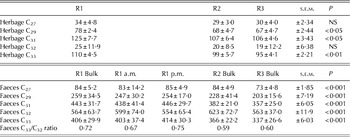
Analysis of the herbage samples taken from the grazed paddocks showed that only the concentrations of C27 and C32 were not significantly different between paddocks (Table 1). The concentrations of C29, C31 and C33 n-alkanes were significantly higher in herbage available to the R1 group than to the other two groups (P<0·05, P<0·05 and P<0·01, respectively).
Mean concentration of n-alkanes (mg/kg DM) in herbage and faeces samples for each dosing/sampling group (means±s.d.); R1 (once-daily dosing, with a.m., p.m. and bulk faeces samples), R2 (twice daily; 7/17 h interval with all faecal samples bulked) and R3 (twice daily; 12 h interval with all faecal samples bulked)

NS, not significant.
For the R1 group of cattle, the concentration of C32 in the R1 a.m. faeces sample was significantly higher than that in both the R1 Bulk and R1 p.m. samples. Means of C33 alkane concentrations for all three R1 faeces sample types were similar and significantly higher than the mean value for R2 (P<0·05) which, in turn, was higher (P<0·05) than the mean value for R3.
Experiment 1: estimated dry matter intake
When intake for R1 was calculated using the n-alkane content of a.m. faeces only, mean DMI did not differ significantly between the R1, R2 and R3 regimes (Table 2). There was also no significant difference in estimated DMI between the Charolais-X and Holstein-Friesian animals, and there was no significant interaction between breeds and dosing/sampling regimes (data not presented). Mean DMI, estimated using alkane concentrations in the R1 p.m. faeces samples, was significantly greater (by 0·95 kg) than that estimated using the R1 a.m. samples (8·31 v. 7·36 kg/day, respectively; P<0·01). Table 2 shows that DMI estimated using n-alkane concentrations in bulk faeces was significantly higher (P<0·01) for treatment R1 than for treatment R2 or R3.
Mean estimated dry matter intake (DMI) for the three dosing/sampling regimes; R1 (once-daily dosing; a.m., p.m. and bulk faeces samples), R2 (twice-daily dosing at 7/17 h interval; all faeces samples bulked) and R3 (twice-daily dosing at 12/12 h interval; all faeces samples bulked)

CV, coefficient of variation.
Experiment 2: comparison of directly measured and estimated herbage dry matter intakes
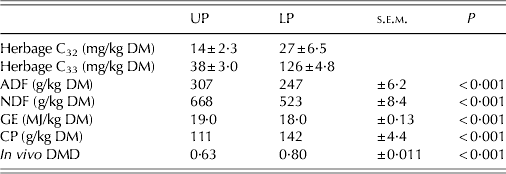
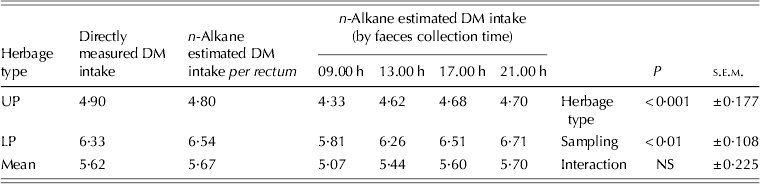
Herbage fibre contents (ADF and NDF) and GE contents were significantly greater for UP than for LP herbage. In contrast, the LP herbage had significantly higher (P<0·001) CP content and 0·17 higher DM digestibility coefficient (P<0·001; Table 3). Using directly measured intake values as the guide, the cattle consumed 29% more DMI from LP herbage than from UP herbage (P<0·001; Table 4). There was no significant interaction between herbage type and intake determination method on estimated DMI (Table 4). However, DMI calculated using n-alkane concentrations in 09.00 h faecal samples was significantly (P<0·01) lower than those calculated using faeces sampled at other times.
Mean concentration of C32 and C33 n-alkanes (±s.e.m.), proximate chemical composition and in vivo dry matter digestibility of the upland (UP) and lowland (LP) vegetation in Expt 2

DM, dry matter; ADF, acid detergent fibre; NDF, neutral detergent fibre; GE, gross energy; CP, crude protein; DMD, dry matter digestibility.
Mean directly measured and estimated intake (kg DM) calculated using alkane concentrations in faeces collected daily for 5 days at 09.00, 13.00, 17.00 and 21.00 h, and in daily samples collected per rectum at 09.00 h from bulls consuming harvested upland and lowland herbage

DM, dry matter; NS, not significant; LP, lowland pasture; UP, upland pasture.
DISCUSSION
The current study has shown that once-daily oral dosing with two 500 mg boluses of synthetic C32 alkanes, and concurrent faecal sampling, is a valid alternative to the commonly used protocol of twice-daily dosing and faeces sampling for estimating the intake of grazing cattle. When applied to two herbages harvested from different sources, and of different botanical composition and nutritional quality, the once-daily dosing and faecal sampling regime gave intake values very close to the definitive intakes measured directly and simultaneously. Indeed, the mean estimated DM intake obtained using per rectum grab samples taken at the time of dosing in the morning underestimated the intake of upland vegetation by only 2% and overestimated the intake of lowland vegetation by only 3% over directly measured intake values.
Concentrations of some alkanes, including C33 were significantly higher in the herbage treatment R1 than R2 and R3 in Expt 1, apparently confounding the effect of the treatment. However, as the calculation of intake does not require a fixed concentration of alkane, as seen from the wide difference in concentration between the two diets in Expt 2, or alkane ratio, the difference between alkane profiles in herbage in Expt 1 is not an issue. The same herbage C33/C32 concentrations were applied to all DM intake calculations for treatment R1. Thus, the significant differences between DM intakes calculated using data for R1 Bulk, R1 a.m. and R1 p.m. faeces samples were a consequence of the higher C32 n-alkane concentration in R1 a.m. faeces, which reduced the faecal C33/C32 ratio below that of both the R1 Bulk and R1 p.m. faeces samples. This was confirmed in Expt 2, where DM intakes estimated using the 09.00 h faecal samples of bulls on both herbages were significantly lower than the other estimated DM intakes and also from the directly measured DM intake values. Although not significant, there was a trend that estimated DM intake, calculated using data from the morning to evening faeces samples, increased as faecal sampling time progressed.
In a study similar to the current one, Mann & Stewart (Reference Mann and Stewart2003) compared the directly measured intake of zero-grazed Kikuyu (Pennisetum clandestinum) by Holstein-Friesian and Hereford bulls with the intake estimated by the n-alkane method, using a protocol in which alkanes were dosed once daily and faeces collected in the morning and afternoon for 7 days and found that DM intake calculated using the morning faeces samples only significantly underestimated actual DM intake, by 11%, while using the afternoon faeces sample only led to an overestimation of DM intake, by 8%. The results of Expt 1 in the current study showed that the DM intake estimated using the a.m. faeces samples only was 11% less than that estimated using the p.m. samples only. This difference was considerably less than that found by Mann & Stewart (Reference Mann and Stewart2003), who suggested that the choice of faeces sampling time was not solely responsible for the difference in estimated DM intake. They suggested that fluctuations in ruminal C32 alkane concentrations caused by the once-daily alkane dosing regime may have resulted in a variable flow of C32 alkane through the digestive tract throughout the day and contributed to differences between their DM intake estimates. They concluded that twice-daily dosing with n-alkanes in a xantham gum suspension (at a 12-h interval) is required to provide an optimally accurate estimate of DM intake. In the current study, the intake calculated using a once-daily concurrent alkane dosing and morning faecal sampling regime gave a mean DM intake value that was not significantly different from that calculated from data generated under the ‘ideal’ 12-h dosing/sampling interval. The relatively low coefficient of variation in Expt 1 indicates that the lack of significance was unlikely to have been due to a type 2 error in interpreting a lack of difference between the means.
It may also be pertinent that Mann & Stewart (Reference Mann and Stewart2003) used dried milled Kikuyu as the alkane carrier matrix while, in the current study, cellucotton boluses were the carrier matrix. Giráldez et al. (Reference Giráldez, Lamb, Lopez and Mayes2004) investigated the effects of carrier matrices including cellulose powder, paper bungs, filter paper and shredded paper, and dosing frequency on digestive kinetics and herbage intake. They considered that the very small particles of cellulose powder may have dispersed more readily in the rumen than the courser paper carrier matrices, resulting in the shorter total mean retention time of the cellulose powder than the other matrices. This may allow for better mixing of the marker with ruminal contents and reduce diurnal variation when dosing once daily. Cellulose boluses are considered to facilitate a consistent dispersion of this marker and thereby reduce the likelihood of diurnal variation of its release within the digestive tract compared with powdered dosing matrices (Mayes & Dove Reference Mayes and Dove2000; Mayes, personal communication 6 April 2011).
In Expt 2, the C33/C32 ratio in faeces accumulated over the 12-h prior to the 09.00 h per rectum sample was lower than that in the 09.00 h per rectum sample, and lower also than those in later collections of accumulated faeces (i.e. 09.00–13.00, 13.00–17.00 and 17.00–21.00 h). This resulted in a significantly lower estimate of intake when using the overnight faecal sample. These results hint at the possibility of differences in the distribution of natural and exogenous alkanes within the digesta and of accompanying differences in rates of passage through the gastrointestinal tract, thus, the flow rates of natural and dosed n-alkanes may be asynchronous at times (Mayes et al. Reference Mayes, Lamb and Colgrove1986; Dove & Mayes Reference Dove and Mayes1991; Champion et al. Reference Champion, Rutter, Penning and Rook1994; Oliván et al. Reference Oliván, Ferreira, Celaya and Osoro2007). Accordingly, during periods when feed intake is low, such as through the night, the relative rate of passage of C32 may be higher than that of C33, thus contributing to a lower C33/C32 ratio. However, as feed intake increases through the morning, the passage rates of the separate phases of digesta will change and might be expected to re-stabilize by the time of the first per rectum faeces sampling. De-Stefani Aguiar et al. (Reference De-Stefani Aguiar, Forbes, Rouquett, Tedeschi and Randel2013) suggested that variation in faecal n-alkane concentrations between sampling times might also be due to variations in an animal's diurnal grazing behaviour in the field. Furthermore, there may be differences in faecal n-alkane concentrations between grazing and indoor animals due to differences in their temporal feeding patterns.
A dosing period of 5–7 days prior to commencement of faecal sampling is required to raise and then stabilize the concentration of C32 n-alkane in the faeces (Mayes et al. Reference Mayes, Lamb and Colgrove1986; Ferreira et al. Reference Ferreira, Garcia, Rodrigues, Celaya, Dias-da-Silva and Osoro2007; Oliván et al. Reference Oliván, Ferreira, Celaya and Osoro2007). This should help buffer any surge in C32 alkane in digesta that arises as a result of once-daily dosing. The findings of Expt 2 support those of Oliván et al. (Reference Oliván, Ferreira, Celaya and Osoro2007), confirming that once per day sampling of faeces in the morning for at least 5 days is sufficient to estimate intake satisfactorily.
The success of the modification to the commonly adopted protocol, as validated in the current study, relies on adherence to all other details of the existing protocol but the results of the current study also strongly suggest that the precise timing of the a.m. faecal sampling is not critical.
CONCLUSION
Once-daily oral dosing with C32 alkanes and concurrent faecal sampling provide reliable estimates of DM intake by beef cattle offered herbages of widely contrasting quality. At a practical level, it is a valid alternative to the commonly used twice-daily dosing and sampling regime and lends itself well to estimating herbage intake in extensive or remote grazing situations where the herding of cattle twice daily may be difficult.