INTRODUCTION
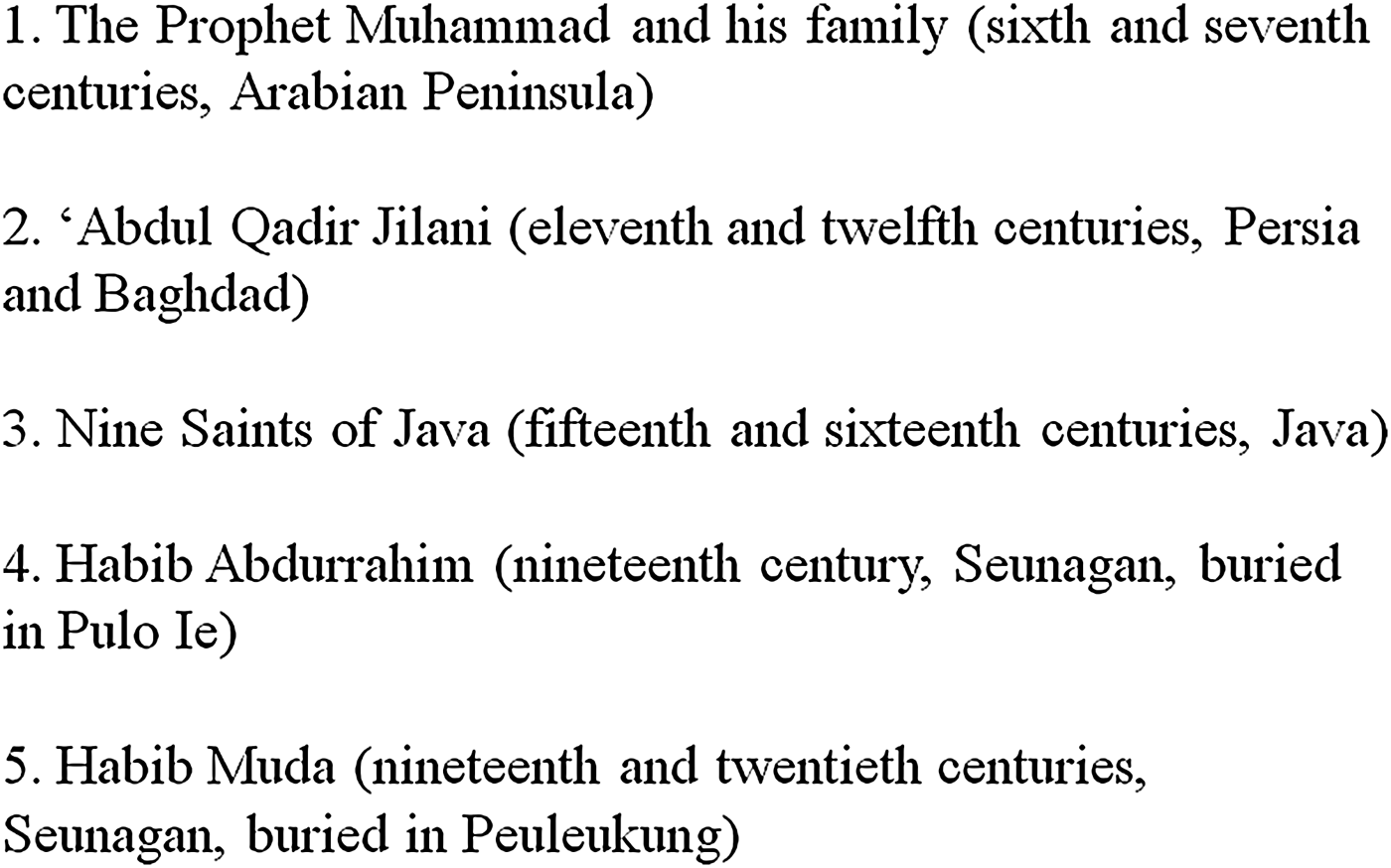
Sometime in the late 1950s, according to oral narratives that circulate widely in the Indonesian region of Seunagan, province of Aceh, a charismatic mystic named Habib Muda (d. 1972) traveled to the island of Java. On this journey to Indonesia's political and cultural center, Habib Muda met the Indonesian president, Sukarno. He counseled the president regarding the most humane way to bring an end to the Acehnese branch of an armed rebellion, known as Darul Islam, which had been ongoing in Aceh since 1953. He then requested leave of the president in order to visit the graves of the famous Nine Saints of Java (I., wali songo), widely believed to have converted Java to Islam in the fourteenth and fifteenth centuries (Florida Reference Florida1995: 319–51; Laffan Reference Laffan2011: 7–10; Rinkes Reference Rinkes, Gordon and Froger1996).Footnote 1 Claiming these saints as his ancestors, Habib Muda conducted, over a period of several days, ritual visitations (I., ziarah) at each of their graves, as well as at the grand mosque that the Nine Saints constructed in the town of Demak. On his return to Seunagan, Habib Muda brought with him two gifts, a Land Rover from President Sukarno and a Javanese dagger (I., kris) that had belonged to one of the Nine Saints.Footnote 2 He also began to espouse a version of his patrilineal genealogy that emphasized an unusual constellation of five figures: himself, his grandfather Habib Abdurrahim, the aforementioned Nine Saints of Java, the great eleventh- and twelfth-century mystic ‘Abdul Qadir Jilani, and the Prophet Muhammad (see figure 1).
Major figures in the patriline of Habib Abdurrahim

This article explores the ways in which, since the period of Habib Muda's journey to Java, this configuration of Habib Muda's genealogy has been central to practices through which people in Seunagan emplace themselves within Islamic history. At the time I conducted archival and field research in Seunagan in the late 2000s, this genealogical configuration served as a primary means through which Muslims in the region linked themselves to several interconnected Islamic pasts. Habib Muda's relatives, his devotees, and even some of his enemies all cultivated relationships to one or more of the five figures emphasized in Habib Muda's version of his patriline. In the process, they connected themselves to, among other times and places, the Islamization of Seunagan, the rise of the modern Indonesian nation, and the Islamic cosmos. I argue that Habib Muda's version of his patriline enabled Muslims in Seunagan to take themselves as active participants in the unfolding of Islamic history and, further, that this was because of the specific configuration of spatial-temporal scales his genealogy made manifest.
Scale is central to the workings of the “genealogical imagination” (Shryock Reference Shryock1997). It is vital to, for example, E. E. Evans-Pritchard's classic models of Nuer segmentary lineage, which describe genealogical idioms organized in terms of progressively more (or less) incorporative segments of patrilineal descent (1940). Nonetheless, the treatment of particular genealogies’ scalar features has remained implicit in many analyses, which often focus more intently on the “persons, events, and landscapes” that a genealogy brings into relief (Shaery-Eisenlohr Reference Shaery-Eisenlohr2009: 534).Footnote 3 Such persons, events, and landscapes always exist in constellations underpinned by specific logics and configurations of scale. These logics and configurations of scale contribute as much to a genealogy's effects as do the specific content of its links.
When taken together, the five nodes in Habib Muda's patriline underpin a narrative of the unfolding of Islamic history that links the locality of Seunagan, the space and time of the Indonesian nation, and the Islamic cosmos. Muslims in Seunagan have placed themselves within this narrative through ritual and narrative acts that establish positions vis-à-vis Habib Muda's patriline, often emphasizing specific links within the genealogy. Engaging individual nodes shifts emphases of scale within the genealogy's overall configuration. It thus supports segmentary processes whereby social ties and cleavages are expressed in moments of scalar transformation.Footnote 4 Such shifts affirm that the power that inheres more widely to transformations of scale, a power to make and remake human relationships through amplifying existing qualities and bringing into being emergent ones (Stiner et al. Reference Stiner, Earle, Smail, Shryock, Shryock and Smail2011), extends to the genealogical imagination.
The patriline espoused by Habib Muda following his journey to Java entwined multiple modes of descent: biological issue, inheritance of mystical powers, transmission of mystical knowledge, the bequeathing of custom, the mediation of divinity, and simple temporal progression.Footnote 5 Each of these modes came to be inscribed in different moments in everyday social relations in Seunagan, as well as on Seunagan's landscape and across the territory of the Indonesian nation, giving rise to powerful social and spatial hierarchies.Footnote 6 Yet what has made the patriline espoused by Habib Muda so compelling for Muslims in Seunagan has not been simply these entwined modes of descent or their social and spatial inscriptions. It has been the manner in which these modes and inscriptions, along with the five genealogical nodes on which they depend, emphasize a specific graduated series of interlocking scales of time and space. This configuration of scale is what allows Muslims in Seunagan to take themselves not as simply heirs to, but also protagonists in the unfolding of Islamic history. This is because Habib Muda's genealogy links a local arena of practice to national and cosmic scales of history.
TEUKU AZMAN'S REPORT
The earliest extant example of the genealogical configuration Habib Muda espoused following his trip to Java is found in a 1962 yearly report authored by the head administrator of the sub-regency of Seunagan (Azman Reference Azman1962). This report offers a bureaucratic snapshot of the regency, including population statistics, data on land use, information on infrastructural projects, and lists of indicators of economic development. It almost certainly was passed up a bureaucratic chain, from the sub-regency to the regency-level government, and perhaps further.
If the report seems on its surface rather unremarkable, the identity of its author and the year it was filed suggest otherwise. Its author was Habib Muda's son-in-law, Teuku Azman, who served as the head of the sub-regency of Seunagan from 1953 until the mid-1960s. Azman was the descendant of hereditary territorial chiefs (Aceh., oelèëbalang) of the nearby mountain district of Beutong, and he had risen to prominence in part because of this ancestry, clearly helping himself further by marrying Habib Muda's daughter. By the time Azman became head of the sub-regency of Seunagan, Habib Muda was already established as a charismatic mystical figure with a substantial group of followers. He had inherited the mystical powers associated with several of his ancestors, and was well known for healing the sick, arbitrating local disputes, and leading underground resistance to Dutch colonial rule in the early twentieth century (Daud Reference Daud2009; Njaksih Reference Njaksih1970).
The year 1962 was the same year in which the Acehnese branch of Darul Islam, the Indonesian-wide rebellion about which Habib Muda is said to have advised President Sukarno while visiting Java, ended. The rebellion had begun before the Indonesian Revolution (1945–1949) had secured Indonesia's political independence, and its leaders wanted to overthrow the nascent Indonesian Republic in order to found what they called the “Indonesian Islamic State” (Negara Islam Indonesia) (Formichi Reference Formichi2012; van Dijk Reference van Dijk1981). Acehnese guerillas joined Darul Islam in 1953 following a series of nationally imposed political and administrative reforms that left many Acehnese officials and religious teachers feeling marginalized in the new republic (Sjamsuddin Reference Sjamsuddin1985; van Dijk Reference van Dijk1981: 269–339).Footnote 7
Darul Islam was popular in Aceh, but Teuku Azman, in partnership with Habib Muda, opposed the rebellion. Habib Muda was one of three prominent figures in a coalition of Acehnese Islamic leaders who challenged the rebellion's ideological foundations. This coalition forwarded an interpretation of Islamic jurisprudence that declared Darul Islam an illicit revolt against a legitimate Muslim leader, Sukarno (Daud Reference Daud2009: 57–62; Waly Reference Waly1993: 115–31).
Teuku Azman's report clearly expressed its author's opposition to Darul Islam. It also included a few unusual indicators of the security situation in the region. This was most evident in its general overview, which described the followers of Habib Muda as loyal Indonesian citizens who constituted the political majority in the sub-regency. Azman positively contrasted Habib Muda's followers to a handful of Darul Islam activists in the region and attributed their loyalty to the “leadership and direction” (I., pimpinan dan asuhan) of Habib Abdurrahim, Habib Muda's grandfather. By the time Teuku Azman filed his report, Habib Abdurrahim had been the central figure in a complex of popular mysticism and ritual for at least eight decades, first as a living teacher and following his death as an object of devotional practices centered on his grave in Pulo Ie (Controleur 1935: 8–10; Snouck Hurgronje Reference Snouck Hurgronje and Swete O'Sullivan1906, II: 14; see figure 2). These mystical and devotional practices involved collective recitations of the names of God (Aceh., ziké or dike; I., zikir), praises to the Prophet Muhammad (Aceh., seulaweuët; I., selawat), and various other litanies. There were also periodic retreats for those wishing to more seriously seek esoteric knowledge and blessings.Footnote 8 By the mid-twentieth century, such activities were carried out under the institutional auspices of the Syattariyah Sufi order (I., tarekat syattariyah), and thousands of Muslims were participating.Footnote 9
Shelter for reciting litanies on Habib Abdurrahim's grave complex, Pulo Ie. Author's photo.
Teuku Azman in his report identified Habib Abdurrahim as the descendant of “the saints who built the mosque of Demak on the island of Java,” the very same saints whose graves Habib Muda had visited just a few years earlier. He also referred to Habib Abdurrahim using the title “Pole of the Universe” (I., Qoethubul Udjud), the most perfect mystical adept of an age who, in much popular Sufi thought, mediates the relationship between humans and the divine (Chodkiewicz Reference Chodkiewicz and Sherrard1993: 47–102; al-Hujw'iri Reference Nicholson1997). Finally, Azman named Habib Abdurrahim the “Promoter of Religion” (I., Pemuka Agama) and described him as the bestower of Seunagan's “local customary practice” (I., adat), which “had its origins in Islam” (I., bersumbur pada Islam). Azman thus linked the Islamization of Seunagan and the origins of Seunagan's local customary practice to Habib Abdurrahim.Footnote 10
Teuku Azman undoubtedly intended his report to laud the accomplishments of his great-grandfather-in-law, whom he credited with providing the moral foundations for the widespread loyalty to the Indonesian Republic that he claimed was evident in Seunagan. Yet the inclusion of these descriptions and titles in an otherwise ordinary regency-level report raises a question. What did drawing attention to Habib Abdurrahim's descent from the Nine Saints of Java, his role as the Promoter of Islam and founder of Seunagan's local customary practice, and his status of Pole of the Universe contribute to Teuku Azman's narrative of Habib Muda's loyalty to the Indonesian republic? Part of the answer lies in how each of these titles and descriptions evoked one or more of the five main links in the configuration of genealogy espoused by Habib Muda.
DESCENDANT OF “THE SAINTS WHO BUILT THE MOSQUE OF DEMAK ON THE ISLAND OF JAVA”
I cannot say for certain when the Nine Saints of Java became an important link in the genealogy of Habib Abdurrahim and his descendants, and Teuku Azman's report is the earliest document to make this link. What is clear is that ever since Habib Muda's purported trip to Java in the late 1950s this journey has remained the key to understanding the significance of Habib Abdurrahim and Habib Muda's ties to the Nine Saints. Of the many episodes of Habib Muda's life that his descendants and devotees told me about, it was narratives of this fateful trip that I heard most often.
Oral histories and the recently published biography of Habib Muda all agree that President Sukarno, in a gesture of gratitude for Habib Muda's enthusiastic loyalty to the Republic, invited Habib Muda to the national capital of Jakarta on the island of Java (Daud Reference Daud2009).Footnote 11 Habib Muda's published biography describes the ensuing meeting between Sukarno and Habib Muda in sentimental terms, noting that it was “full of intimacy, harmony, and … the atmosphere of Islamic brotherhood [I., ukhuwah Islamiyah]” (ibid.: 65–66). After moving the president to tears with gifts and advice that blended filial and patriotic sentiment, Habib Muda forwarded his wish to visit the graves of his ancestors, “the Saints of the land of Java” (ibid.: 66–68).
Who were these Nine Saints? On Java, the political and population center of the modern Indonesian nation, they have long been recognized as powerful Sufis and the converters of the island to Islam (Florida Reference Florida1995: 319–51; Laffan Reference Laffan2011: 7–10; Rinkes Reference Rinkes, Gordon and Froger1996), and their graves have served as pilgrimage centers (Ruslan and Nugroho Reference Ruslan and Nugroho2007). Major political figures—for example, Indonesia's first democratically elected president, Abdurrahman Wahid (in office 1999–2001)—visit their tombs and mosques at key moments in their public careers. While such prominent devotees suggest the Saints' place in popular imaginaries of Indonesia's Islamic past, the Saints' political resonances vary widely. This is especially so outside of Java, where some Indonesians identify them with an exclusively Javanese-style of Islam and in some cases denigrate them as less-than-orthodox Muslims. Others attribute the Saints' national prominence to Javanese cultural imperialism.
Habib Muda's visits to the graves of the Nine Saints were key events in narrative accounts of his journey to Java. Islamic ritual visitations at gravesites (ziarah) can be carried out by unrelated devotees of a deceased figure, but are often acts of filial devotion. Published and oral narratives of Habib Muda's trip to Java clearly mark his visits as the latter, and as a moment in which Habib Muda (re)established his patriline's genealogical ties to the Nine Saints.
Precisely which of the Nine Saints was Habib Muda's ancestor is not entirely clear. His biography identifies Sunan Giri as the ancestor from whom his patriline descends (Daud Reference Daud2009: 90). Yet some junior members of the family, as well as several devotees of Habib Muda, suggest that Habib Abdurrahim was most likely in the lineage of another of the Saints, Sunan Kalijaga.Footnote 12 More often, though, people narrating this history simply refer to the Saints as a collective entity. For instance, Teuku Azman's Reference Azman1962 report did not name any one of the Nine Saints specifically. Even the 2009 biography of Habib Muda, which names Sunan Giri as the ancestor of Habib Abdurrahim's patriline, often identifies the Nine Saints as a collective.
This suggests that more important than questions of individual lineage were broader effects of Habib Muda's cultivation of his genealogical ties to the Nine Saints. In the 1950s, Darul Islam supporters frequently vilified Sukarno and described the Indonesian central government as anti-Islamic and Javanese-dominated (Saleh Reference Saleh1956; Tiro Reference Tiro1958; van Dijk Reference van Dijk1981: 269–339). Against this, Habib Muda cultivated genealogical ties to the Nine Saints while aligning himself with Sukarno. Placing himself in the patriline of the Saints nicely bundled Habib Muda's political and religious sensibilities, both of which challenged the position of Darul Islam activists. These political and religious implications would have been immediately apparent to most Indonesians, since Sukarno similarly cultivated associations between himself, the Nine Saints, and a Javanese Islamic heritage and made his own public visits to sites associated with the Saints (Presiden Soekarno di Demak 1958).
A Javanese dagger that anchors narratives of Habib Muda's journey to Java in the Seunagan landscape confirms that the significance of descent from the Nine Saints continues to trump any that might come from identifying Habib Abdurrahim's patriline with any particular Saint. Habib Muda brought this dagger home with him from Java. Oral histories usually indicate that this dagger was a gift from Sukarno while the published biography claims instead that it was given to him by religious officials at the mosque of Demak (Daud Reference Daud2009: 80–82). In all of these narratives, it is understood to have originally belonged to one of the Nine Saints. Today it is displayed inside the main pillar of the mosque on the complex where Habib Muda was buried (see figure 3). It serves as a potent emblem of the family's ties to the Nine Saints, as both an index of Habib Muda's trip to Java and an icon of the family's Javanese descent. Most people who told me about Habib Muda's journey to Java closed their narrative by encouraging me to go and see the knife.
Javanese dagger in main pillar of mosque at the grave complex of Habib Muda, Peuleukung. Author's photo.
“THE PROMOTER OF RELIGION”
The connections between Habib Muda's patriline and the Nine Saints of Java resonate deeply for many in Seunagan because of how they buttress Habib Abdurrahim's status as, in the words of Teuku Azman's report, “the promoter of religion.” Being in the lineage of the Nine Saints supports claims that Habib Abdurrahim Islamicized Seunagan by inserting him into genealogical narratives of the Islamization of the Indonesian archipelago that began to become common just after Indonesian independence. It does so, however, with an ironic twist.
In Indonesia's colonial period, Dutch scholars and officials had authored narratives of the archipelago's Islamization that presented Islam as a relatively recent and not very influential addition to Indonesia's social, political, and religious life (Benda Reference Benda1958; Florida Reference Florida and Humphreys1997; Snouck Hurgronje Reference Snouck Hurgronje and Swete O'Sullivan1906). Colonial officials made administrative policy based on these narratives. For example, they codified family law differently in different parts of the archipelago depending on their understandings of the extent Islam had been adopted in each region (Benda Reference Benda1958; Lev Reference Lev1985; van Vollenhoven Reference van Vollenhoven and Holleman1981).
After independence, an influential group of Islamic intellectuals and activists, among them some of the new nation's most important public figures (e.g., the public intellectual HAMKA), began to assert Islam's deep roots in the archipelago. This was an act of decolonization aimed at reversing the Dutch colonial emphasis on Islam's alleged lack of influence among most Indonesians (Bowen Reference Bowen1989a; Hasymy Reference Hasymy1989). It also rhetorically integrated the far-flung archipelago into a coherent whole, deemphasizing cultural and political divisions between Indonesians by laying stress on an allegedly shared history of Islamization.Footnote 13 The narrative projects of these intellectuals took Islamization to be the destiny of the nation and implicitly projected the beginnings of national awakening to the archipelago's earliest Islamic enclaves. They took the progressive movement of Islam through the space and time of the archipelago as their primary narrative device. John Bowen, employing the theoretical language of Mikhail Bakhtin, has identified Islamization's progressive spatial-temporal movement as a new “chronotope,” a model of space-time underpinning a narrative type (Bakhtin Reference Bakhtin, Emerson and Holquist1981; Bowen Reference Bowen1989a).
The chronotope of Islamization was particularly powerful, tied as it was to the narration of Islamic and national histories as interwoven. Further, such accounts often described chains of conversion that resembled, and at times were identical with, chains of genealogical descent. In some of them an Islamizing figure moved from place to place, leaving converted regions behind him. In others it was chains of descendants who carried out the conversion process, inscribing their genealogy through lineages of converted territories. In some cases, the genealogies in these histories represented successive rulers of Islamic kingdoms whose serial rise marked the transformation of their regions into Islamic realms. In all of these scenarios, genealogical idioms were rhetorically central to descriptions of Islam's progressive movement through the archipelago, as well as Aceh's place in this progression.
While the authors of postcolonial narratives of Islamization tried to distinguish their histories from colonial ones, they inherited certain features from them. Most importantly, both Dutch and postcolonial narratives of Islamization inscribed value-laden geographies that marked some regions of the archipelago as having been more intensely Islamicized than others. Indeed, the postcolonial narratives made explicit what was at times only implied in earlier Dutch versions—that such different degrees of Islamization were the result of some regions having been Islamicized earlier than others. Narratives of this kind tended to describe Islam as moving from west to east through the archipelago. As Indonesia's westernmost point, Aceh came to be inscribed as the font of Islam for the rest, a position further supported by Aceh's status as the site of the archipelago's oldest Islamic kingdoms.Footnote 14
There was much at stake in Aceh's place in these narratives of Islamization. Already in the 1950s, Acehnese intellectuals, most notably the scholar-official Ali Hasjmy, went to great lengths to ensure that Aceh's primacy in the history of Indonesia's Islamization was enshrined in nationalist histories of the coming of Islam (Bowen Reference Bowen1989a). Given widespread support in Aceh for Darul Islam, and considering Darul Islam's portrayal of the Indonesian central government as both anti-Islamic and Javanese-dominated, many Acehnese found especially attractive the ways in which common histories of Islamization asserted Aceh's primacy over Java. In 1957, as part of an effort to end the Darul Islam rebellion, the cabinet of the Indonesian Prime Minister Djuanda Kartawidjaja reinstated Aceh's provincial status, which it had lost at the end of the Indonesian Revolution. In 1959, Aceh was granted special autonomy in three areas: education, religion, and customary practice. Scholar-officials like Ali Hasjmy defended the new political arrangement in part by arguing that Aceh's deep historical roots to Islam had allowed the province's people to make unique contributions to the Indonesian nation, for which its people deserved special recognition and administrative autonomy.Footnote 15
Habib Abdurrahim's status as the agent of Seunagan's Islamization and a descendant of the Nine Saints has important consequences in the context of these narratives, which were being popularized during the period that Habib Muda embarked on his journey to Java. According to the postcolonial narratives of Islamization that underpinned Aceh's special autonomy, Aceh had been Islamicized by the early thirteenth century. The Nine Saints, however, had lived on Java in the fifteenth and sixteenth centuries. If Habib Abdurrahim is the descendant of the Nine Saints, this suggests that Java was Islamicized before Seunagan, which seems to challenge Aceh's place as the font from which Islam spread.
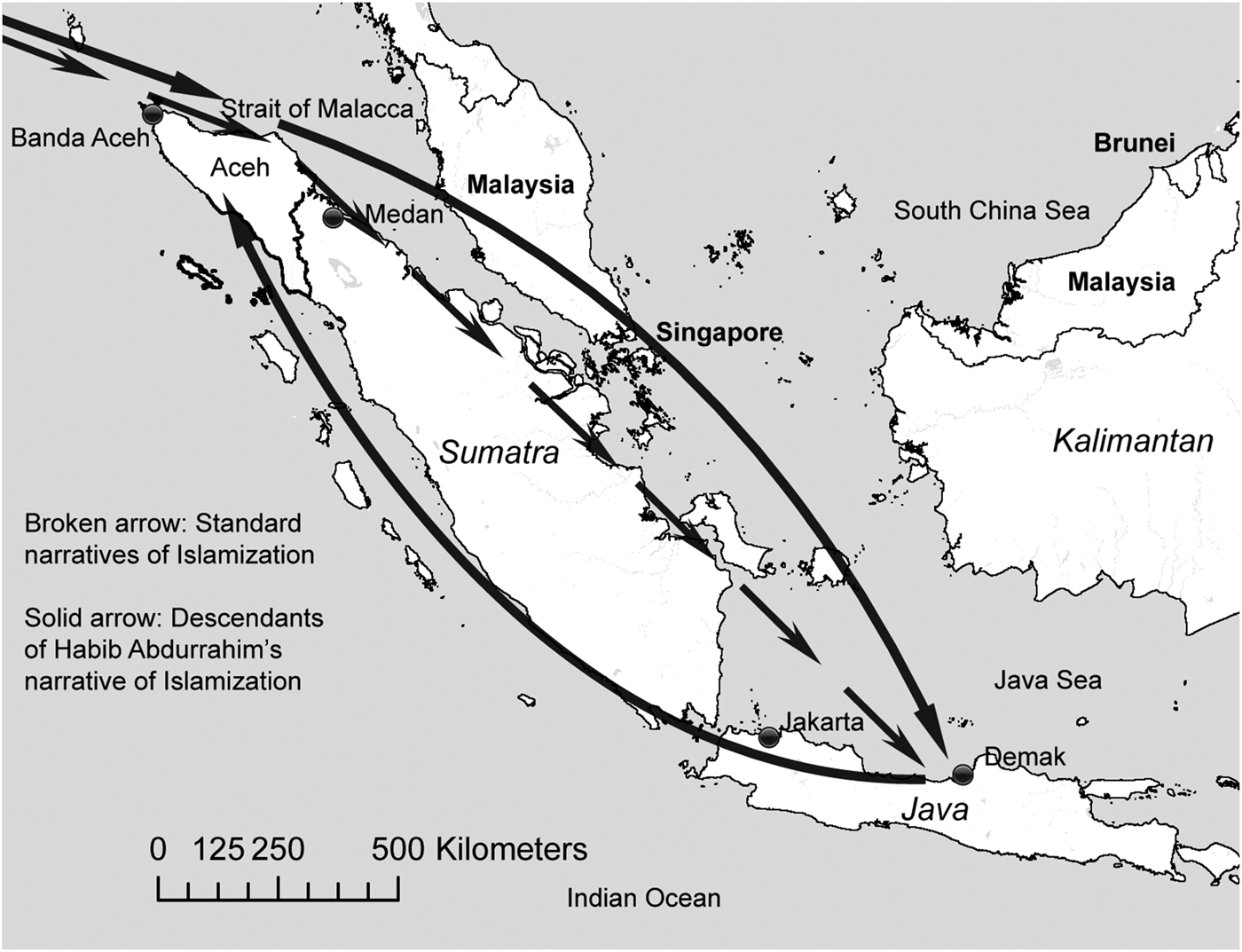
In Seunagan, it is common knowledge that Islam arrived in the region from a Javanese source, as a result of the labors of Habib Abdurrahim, whose patriline is traceable to the Nine Saints. Yet Aceh's primacy in the archipelago's Islamization has become shared wisdom across the province. Habib Abdurrahim's descendants and their devotees reconcile this apparent contradiction by suggesting that Aceh's north coast had indeed been Islamicized before any other region of the archipelago. The grand arc of Islamization, they argue, then moved to Java, before Habib Abdurrahim's ancestors returned to Aceh's west coast in order to Islamicize Seunagan. While this reconciles an apparent contradiction, it entails an instance of Islamization from Java to Aceh, reversing Islam's eastward movement, and inverting the relationship of Aceh and Java found in more common narratives of Islamization (see figure 4).
Two versions of Islamization. Image created by Daniel Birchok and Nicole Scholtz using ArcGIS software and several open-source databases.
The counterintuitive resonances of this narrative of Islamization's westward return to Aceh cannot be overstated. Habib Abdurrahim's descent from the Nine Saints of Java inserted him into the history of the archipelago's conversion to Islam in a manner that adhered to the spatial and temporal progression of narratives of Islamization while simultaneously flouting one of these narratives' most fundamental political and religious valences: the spatial and temporal primacy of Aceh over Java. The narrative thus buttressed the political ties Habib Muda fostered to President Sukarno and Java, inscribing these ties metonymically through the history of the archipelago's Islamization.Footnote 16
The unusual resonances of this version of Islamization grew only stronger, and more counterintuitive, as time passed. When an Acehnese nationalist movement calling itself the Free Acheh Movement broke out in 1976, its adherents were even more resentful toward Javanese dominance of Indonesian political and social life than Darul Islam guerrillas had been (Aspinall Reference Aspinall2009: 70–74, 193–219; Tiro Reference Tiro1984).Footnote 17 “Java” became the alterity against which Acehnese nationalists constructed their political project, defining Indonesia as synonymous with Java in a manner that made it difficult to claim both Acehnese and Indonesian identities (Aspinall Reference Aspinall2009: 70–74). Yet throughout the period of the Free Acheh Movement, which did not end until 2005, the descendants of Habib Abdurrahim continued to cultivate their links to the Nine Saints, Java, and the Indonesian central government. Today, important symbols of these relationships hang in the homes of senior members of Habib Abdurrahim's patriline and at the grave complexes of deceased members of the family. These include the dagger Habib Muda brought back from Java, photographs of family members with military officers in the field, and a framed copy of the national service star posthumously awarded to Habib Muda by the Indonesian government in 1999. More than any of these individual objects, though, it is the family's genealogy, as a synecdoche for narratives of Seunagan's Islamization, which links the members of Habib Abdurrahim's patriline to the history of the Indonesian nation.
POLE OF THE UNIVERSE
For Muslims in Seunagan, as for many other Indonesians, Islamization as the history of the nation is a compelling narrative frame, in part because narratives of the Islamization of the archipelago articulate well with other types and scales of Islamic history. One of the strangest links in the genealogy espoused by Habib Muda, but also the key in understanding how this genealogy resonates for Muslims in Seunagan at scales beyond that of Seunagan and the nation, is the eleventh- and twelfth-century Baghdad-based Sufi ‘Abdul Qadir Jilani.
Throughout the world, Sufis revere ‘Abdul Qadir Jilani for his mystical prowess and esoteric knowledge. Believed to be the founder of the Sufi order that bears his name, the Qadiriya, he is among the most paradigmatic of figures in Islamic mystical circles. Many Sufis consider him without equal (Braune Reference Braune2010; Kumar Reference Kumar1985; van Bruinessen Reference van Bruinessen1989). In Aceh, mystically inclined Muslims, including both adepts and occasional mystical practitioners, regularly tell didactic stories in which ‘Abdul Qadir Jilani is the main protagonist. All of these Sufis represent him as a primary example to be emulated and as a mediator between humans and God.
Habib Abdurrahim's links to ‘Abdul Qadir Jilani are well known in Seunagan. I once asked a young man who had introduced himself to me as a descendant of Habib Abdurrahim what his family name (I., marga) was. The descendants of Habib Abdurrahim have no documented genealogy linking them to broader branches of the Prophet Muhammad's family, and thus have no way to determine their family name. Prominent members of Habib Abdurrahim's patriline frequently respond to inquiries about this lack by noting, “Habib is our family name” (I., Habib marga kami), referring to the Arabic title used in Indonesia as a marker of respect before the names of descendants of the Prophet Muhammad. But this young man quickly responded “al-Qadiri,” identifying himself not by a recognized patriline linking him to the Prophet Muhammad, but as the descendant of ‘Abdul Qadir Jilani.
‘Abdul Qadir Jilani's presence in Habib Abdurrahim's genealogy is extremely suggestive in ways that I will describe, but it is also problematic. By the late nineteenth century, genealogical histories of the Nine Saints linked them to the patrilines of leading families from among the descendants of the Prophet Muhammad (Laffan Reference Laffan2011: 8–9).Footnote 18 Yet none of these histories explicitly tie the Nine Saints to ‘Abdul Qadir Jilani, who, although a descendant of the Prophet Muhammad, is not a link in any of the major genealogies of the Prophet's descendants in Southeast Asia.Footnote 19 Claiming ‘Abdul Qadir Jilani as an ancestor of Habib Abdurrahim thus posits a line of descent that is inconsistent with the genealogies of other Southeast Asians who have claimed the Nine Saints as ancestors.
Nonetheless, in Seunagan, ‘Abdul Qadir Jilani's presence in the patriline of Habib Abdurrahim augments the latter's status as “Pole of the Universe,” one of the titles Teuku Azman attributed to him in his 1962 report. This title is drawn from Sufi discourses traceable to at the latest the eleventh-century work of ‘Ali bin ‘Uthman al-Hijwiri (Chodkiewicz Reference Chodkiewicz and Sherrard1993: 47–102; al-Hujw'iri Reference Nicholson1997). In Southeast Asia, these discourses have been most influential in versions introduced by the fourteenth- and fifteenth-century figure ‘Abd al-Karim al-Jili, who himself was influenced by the great twelfth- and thirteenth-century Andalusian Sufi Ibn ‘Arabi (Florida Reference Florida1995: 95, 156–57; Hodgson Reference Hodgson1974, II: 227–30; Nicholson Reference Nicholson1921: 77–142). For those Muslims who orient their practice within cosmologies derived from this type of mysticism, the “axial pole” (I., qutub) represents the single most important human figure in the world at any one point in time—the “perfect man” (I., insan kamil). He mediates between humans and God, and is thought to intervene with God on behalf of devotees. For many Sufis, the well being of creation depends upon the existence of such a figure in each and every age. Without him, the universe would serve no purpose, and would break asunder.
For centuries, devotees have assumed ‘Abdul Qadir Jilani to be the most likely candidate to have filled the position of axial pole in his own age. Similarly, in some local versions of this mystical cosmology the Nine Saints are inscribed as axial poles or high-ranking members of the saintly hierarchy that surround him (Florida Reference Florida1995: 95, 156–57). Habib Abdurrahim's genealogical links to both ‘Abdul Qadir Jilani and the Nine Saints, along with his own status as Pole of the Universe, therefore draws attention to the multiple generations of figures in his patriline who, according to his devotees, have sat at the cosmological center of the universe.
There was a second way in which the patriline Habib Muda cultivated beginning in the 1950s is tied to Habib Abdurrahim's status as the Pole of the Universe. Most residents of Seunagan depict the Islamization of their region as having been the work of not only Habib Abdurrahim but also a hierarchy of “assistants” (I., pembantu) with whom the great Sufi worked. In narratives of Seunagan's Islamization dating to at least Teuku Azman's report, these assistants have been identified using a system of mystical titles. In the cosmologies just described, these titles refer to a mystical hierarchy of figures who surround and support the axial pole in his esoteric work (Chodkiewicz Reference Chodkiewicz and Sherrard1993: 47–102; Hodgson Reference Hodgson1974, II: 227–30). In Seunagan these titles have been bequeathed along the patrilines of families who can trace their lineage to one of Habib Abdurrahim's assistants (Bowen Reference Bowen1989b: 602–4).
Among the most prominent of the figures thus titled were Habib Abdurrahim's four immediate partners, identified as “pegs” (I., autad). Teuku Azman's report references these four pegs using an evocative mix of mystical and bureaucratic language: “The growth of the people of the Subregency of Seunagan … was directly under the Leadership and direction of [Habib Abdurrahim] and his staff members [I., staf2], who were called pegs [autad]” (Azman Reference Azman1962).Footnote 20 Beyond these four pegs, there were several levels of titles associated with a hierarchy of lesser assistants. It is unclear how many people in Seunagan today know the full range of these titles or whose patrilines possess them. What is apparent, though, is that at least some of the titles associated with this mystical cosmology continue to be bequeathed to the patrilineal descendants of those who can trace their ancestry to the period of Seunagan's Islamization. This means that a potentially large number of people can be associated with such titles. One of the most prominent patrilines in Seunagan, which I will discuss presently, descends from one of Habib Abdurrahim's pegs, and many people in the region know that members of this patriline can claim this mystical title.
Habib Abdurrahim's status as Pole of the Universe and his genealogical ties to ‘Abdul Qadir Jilani has two effects. On one hand, they place Habib Abdurrahim's patriline at the center of Islam's cosmic history, something reflected in the illustrious figures from the Islamic past who reside in Habib Abdurrahim's genealogy and are presumed to be axial poles of their own eras (i.e., ‘Abdul Qadir Jilani, the Nine Saints of Java). But the title of Pole of the Universe also inextricably grounds Habib Abdurrahim in the locality of Seunagan, where people still recognize the mystical hierarchy of titles used to identify the figures that assisted Habib Abdurrahim in Islamicizing Seunagan. These two scales of Islamic space and time—the cosmic and the local—are related. At least one of my interlocutors in Seunagan indicated that the system of titles derived from the Sufi cosmology maintains their mystical significance when applied to the descendants of those figures who had participated in Seunagan's Islamization, and suggested further that the holders of these titles could lose them if they failed to exhibit the appropriate esoteric qualities. This imbrication of Islam's universal mystical past with the local past of Islam in Seunagan is evoked explicitly in the last of Teuku Azman's four descriptions of Habib Abdurrahim, as the founder of Seunagan's local customary practice.
“A LOCAL CUSTOMARY PRACTICE … HAVING ITS ORIGINS IN ISLAM”
Teuku Azman's report credits Habib Abdurrahim not simply with the act of Islamicizing Seunagan, but also with the bestowing of “a local customary practice” to the people of the region. He provided few details as to what he took Seunagan's customary practice to be, aside from noting that it has “origins in Islam,” and that, as a result of this customary practice the people of Seunagan have “superior personality traits [I., tjiri2 kepribadian jang tinggi] … consistent with the Indonesian personality” (1962).
While Teuku Azman left unstated precisely what he meant by Seunagan's customary practice, one might infer what he had in mind based on categories of practice identified as local custom in Seunagan in more recent years. Several such practices, having clear antecedents in previous decades, are linked in suggestive ways to Habib Abdurrahim and his patriline. The way in which the cosmological hierarchy surrounding Habib Abdurrahim is inscribed genealogically through the bequeathing of titles along patrilines is one example. People in Seunagan recognize titles such as “pole” and “peg” as part of a local customary practice explicitly tied to Habib Abdurrahim and his acts of Islamization.
Similarly, sessions of ritual recitations accompanied by shared meals known as kandoeri (Aceh.; I., khenduri) serve as a primary instance of a local customary practice linked to Habib Abdurrahim's patriline. Kandoeri denotes a range of ritual feasts involving the exchange of food and recitation of prayers. They are part of a complex of ritual meals common in Southeast Asia and the broader Islamic world that includes the well-studied Javanese slametan (I.) (Woodward Reference Woodward1988). Social and ritual life in Seunagan revolves around such feasts. They come in many forms, depending on the occasion and the religious sensibilities of those holding and attending them. The feasts are held for yearly cyclical occasions such as major holidays, to mark seasonal transitions such as the opening of fields or the collection of the harvest, and life passage rituals ranging from birth and death to the buying or building of a house (Bowen Reference Bowen1993; Snouck Hurgronje Reference Snouck Hurgronje and Swete O'Sullivan1906, I: 202–29, 408–34). Kandoeri are the most commonly cited examples of Seunagan's robust customary practice (adat), which Acehnese in Seunagan and elsewhere frequently identified to me as among the most authentic in the province.
From the 1930s through the 1960s, the holding of kandoeri had been an issue of bitter debate in Aceh (Bowen Reference Bowen1993: 21–32; Feener Reference Feener2013). Mid-twentieth-century Islamic reformers criticized kandoeri as instances of local customary practice at odds with Islamic orthopraxy, and suggested that the practice encouraged idolatry through traffic in spirits and an overemphasis on ritual form. Indonesian Muslims (and earlier, Dutch colonial officials) argued over whether or not, and under what circumstances, instances of local customary practice (adat) were consistent with Islam (Benda Reference Benda1958; Bowen Reference Bowen2003: 1–63; Lev Reference Lev1972; Snouck Hurgronje Reference Snouck Hurgronje and Swete O'Sullivan1906; van Vollenhoven Reference van Vollenhoven and Holleman1981).Footnote 21 Yet, for those who embrace the practice kandoeri represent some of Islam's most noble qualities. For example, the majority of my interlocutors attended kandoeri regularly, and pointed to the role these feasts play in fostering “cordial social relations” (I., silaturahmi) between Muslims. In fact, kandoeri are such a central part of social life in Seunagan that to refuse to be present at them means isolating oneself from the ritual and social life of one's neighbors, behavior widely taken to be anti-social and un-Islamic. Further, the sponsoring and attending of kandoeri signals one's capacity and intent to participate in networks of social reciprocity and patronage.
Teuku Azman's claim that Seunagan's customary practice has its “origins in Islam” presumably was targeted at Islamic reformers who criticized practices such as kandoeri. This would have buttressed the ways in which Habib Abdurrahim's genealogy expressed opposition to Darul Islam, since in Aceh Darul Islam was widely taken to be ideologically aligned with reformist Islam. Indeed, much of Darul Islam's leadership in the province was drawn from well-known reformers who had campaigned against popular forms of kandoeri in the past (Abdurrahman et al. Reference Abdurrahman, Amin, Berueuh, Indrapuri, Analiansyah and Jamhuri1948). Kandoeri also have allowed Habib Muda, and the descendants of Habib Abdurrahim generally, to illustrate their central place in the networks of reciprocity and patronage these feasts enact. This is because rituals at the graves of Habib Abdurrahim and Habib Muda are taken to be kandoeri.
Most people who partake in the mystical and devotional practices associated with Habib Abdurrahim and his descendants do so through joining in collective recitations of the names of God (Aceh. ziké or dike; I., zikir), praises to the Prophet Muhammad (Aceh., seulaweuët; I., selawat), and various other litanies. These recitations occur at the graves of Habib Abdurrahim's descendants, dozens of which dot the Seunagan landscape. At small grave complexes, semi-weekly gatherings are attended exclusively by women, most of them from the village where the ritual takes place. Comparatively larger gatherings at the grave complexes of Habib Abdurrahim and Habib Muda are sponsored by their descendants and devotees. These events, attended by thousands of men and women, occur on the anniversaries of Habib Abdurrahim and Habib Muda's deaths, on the two major Islamic holidays Idul Adha and Idul Fitri, and at other times during the year. When I asked residents of Seunagan about the mystical practices associated with Habib Abdurrahim's patriline, they frequently invited me to these large events, which they identified as kandoeri.Footnote 22
Consider the comments of Sayyid Bas, a university-educated descendent of Habib Muda, still in his twenties.Footnote 23 He identified “three foundations” (Aceh., lhèē bòh dasar) of his patriline's “community” (I., komuniti). The first was the remembrance of God through the litanies recited by the members of the Syattariyah Sufi order. The second and third were the kandoeri that the descendants of Habib Abdurrahim sponsor and the cordial social relations these kandoeri foster:
Now to cordial social relations [silaturahmi]. Abu Habib Muda Seunagan [i.e., Habib Muda], he had a hobby, to go fishing. So he would go to the villages, go to the villages with his followers. Then, after he went to the place to fish, they would all eat together .… Until today, on the [anniversary of his death] there are still people from various regions who come. They are welcome.… He died maybe twenty or thirty years ago … but nonetheless to this day … many people come to his grave. And it is a routine, every year, handed down from generation to generation.
In May of 2009, I attended the yearly commemoration of the anniversary of Habib Muda's death Sayyid Bas described. Just after sunset prayers, flatbed trucks made their way slowly down the road that leads past Habib Muda's grave complex, each hauling groups of fifteen to fifty people from Seunagan and other parts of Aceh. By the time the recitations began soon after nightfall, two thousand people were sitting in groups (I., rombongan) in or near a large building across the street from the grave complex (see figure 5). This was a shelter for reciting litanies (Aceh., déah) where Habib Muda had led ritual practices. The floors of the two-story building were crammed with attendees, as was the small courtyard outside.
Kandoeri outside Habib Muda's grave complex, 2009, Peuleukung. Author's photo.
Each group of attendees recited litanies in unison, jerking their bodies back-and-forth with every syllable. Recitations were drawn largely from a corpus of praises to the Prophet Muhammad and the ninety-nine names of God (I., asmaul husna). Groups did not attempt to choreograph their litanies or bodily movements with other groups, although each group did periodically pause following crescendos that slowly built in speed and volume in their recitations. When one group would stop, others continued around them. The result was overpowering, especially for anyone who took a few moments to walk around the courtyard, battered by a cacophony of sacred syllables.
As thousands of Habib Muda's devotees recited litanies, Habib Muda's descendants conspicuously performed the generosity and reciprocity associated with the ideal of cordial social relations (silaturahmi). Behind the shelter and courtyard in which attendees were reciting litanies there was a large cooking area. Men prepared what seemed a never-ending banquet of rice, fish, eggs, vegetables, and meat, which they served all night and free of charge to those in attendance. The food was sponsored by Habib Muda's descendants and a few collateral relatives. In the days before the event, these men missed no opportunity to remind neighbors of the copious amounts of food that would be available. The men who prepared this food, most of whom were distant relatives and neighbors, took this role as a great honor. During the feast, senior members of Habib Muda's descendants remained stationed at various points on the grounds receiving visitors. In fact they received guests at the complex the day before the feast and well into the morning that followed it.
Those attending this kandoeri enthusiastically partook of this generosity, contributing in their own ways to the networks of material and spiritual reciprocity displayed in the event. Devotees came for a variety of reasons—to express personal devotion to the deceased, join in a festive bounty of goat and water buffalo curry, fulfill vows previously made to Habib Muda, seek supernatural help in meeting challenges in their occupational and personal lives, and advance their mystical knowledge.
While consistent with wider patterns of Islamic mystical and devotional practice (Cornell Reference Cornell1998; Gilsenan Reference Gilsenan1973; Hoffman Reference Hoffman1995; Werbner Reference Werbner2003), the recitations and commensality that occur at Habib Abdurrahim's grave are understood in Seunagan as essential features of local customary practice. They embed ritual practitioners in networks of material and spiritual reciprocity framed by the genealogy of Habib Abdurrahim. At such events, the deep imbrications of the patriline of Habib Abdurrahim and the “local customary practice … having its origins in Islam” described by Teuku Azman are everywhere evident, in conspicuous displays of generosity by Habib Abdurrahim's living descendants and in the grave complexes that inscribe the genealogy of his descendants on the Seunagan landscape.
THE PASTS OF ISLAMIZATION AND THE UNFOLDING OF ISLAMIC HISTORY
Habib Muda's version of Habib Abdurrahim's patriline evokes multiple, linked, and mutually reinforcing significances that derive from the ways in which the genealogy integrates different scales of space and time. At least three different Islamic pasts congeal in this patriline: the Indonesian nation expressed in terms of progressive Islamization; a mystical Islamic cosmos governed by a hierarchy of Sufi adepts; and Seunagan's realm of local customary practice. These pasts appear in different combinations in each of the patriline's five major links. How do Muslims in Seunagan locate themselves vis-à-vis the spatial-temporal resonances of Habib Abdurrahim's patriline? What kinds of relationships to these interconnected pasts do ritual and social practice in the region enable?
Over a period of two and a half weeks in June 2009 I traveled to nearly twenty graves of Habib Abdurrahim's descendants with Sayyid Amril, one of his great-great grandsons. On the mornings we had chosen to, in his words, “go to the field” (Aceh., dja’ oe lapangan) he met me at my home. There he listed several graves and their occupants: our itinerary for the day. As we worked our way from grave to grave on the back of my motorbike, we traced ties between fathers, sons, nephews, and cousins, all in ascending and descending genealogical patrilines linked to Habib Abdurrahim. At each site we paused, sometimes for extended periods, so that Sayyid Amril could relate colorful tales of the “superiority” (I., kelebihan) of each of these figures:
The child of Sayyid Abdulrasyid, he was Teungku Putik, buried here. He also had mystical powers [I., keramat]. And the child of Sayyid Muhammad Yasin, Habib Muda, he also had mystical powers. Habib Muda killed Dutch intelligence officers. Whoever was a Dutch intelligence officer, shhhhh, he was dead. Finished! With a knife. Cut down with a knife [full of] knowledge [Aceh., èleumèë]. Shh-shh-shh-shh-shh.Footnote 24 [Cut down] like a banana tree.… If there was a disagreement among villagers, and Teungku Putik said it should not be like this, it should be like that, there was silence!Footnote 25 Later we will stop for a couple of minutes, about one kilometer in from here. Get your motorbike, and I will tell you more.
It was clear that Sayyid Amril deeply enjoyed these stories. They nearly always entailed extrasensory perception or other miraculous abilities that his ancestors and uncles had used to teach their devotees esoteric truths or outsmart unsuspecting Dutch soldiers and officials.
Unlike Sayyid Amril, most people in Seunagan did not have the time or knowledge to accompany me on guided tours of these gravesites, but many were aware that these graves could be pieced together as Sayyid Amril did. Some of them could tell me stories about the person in a particular grave, usually one located in their own village. Sometimes they claimed exclusive knowledge of a locally buried figure, and identified that figure's relatives by gesturing toward their final resting places in other villages, pointing to different directions on the horizon.
The graves of Habib Abdurrahim's descendants thus inscribe a web of genealogy on the Seunagan landscape. They fit a pattern common among mystically inclined Muslims for whom genealogies become recognizable through graves and funerary sites that serve as charters of collective identity or otherwise inscribe social significance on geographic landscapes (Frank Reference Frank1996; Gladney Reference Gladney1987; Green Reference Green2012; Ho Reference Ho2006). As at these other sites, it was not simply the graves themselves that constitute these webs, but the activity of regular ritual practices at them.
In the case of the network of graves Sayyid Amril showed me in the Seunagan countryside, the webs of relationality recruit practitioners to the multi-scalar history of Seunagan's Islamization. Villagers encounter the descendants of Habib Abdurrahim, both the dead and the living, during rituals at these graves. On the holiday of the Greater Feast (I., Idul Adha) in December of 2008, for instance, groups of devotees attending the kandoeri at Habib Muda's grave faced the shelter under which he and several of his immediate family members are buried. Inside this shelter were the most senior of his living descendants, including Habib Muda's last surviving son, Abu Kodrat, and some of his cousins. After several hours of recitations, Abu Kodrat and his relatives came out from the grave complex. They slowly worked their way through the crowd of thousands, ritually greeting everyone in attendance by reaching out their hands to devotees, one-by-one. Each person thus greeted responded by taking the hand offered to him or her, leaning over it, and sniffing its backside in a common display of respect and affection offered to parents and religious teachers. Abu Kodrat then led the devotees assembled in circumambulating Habib Muda's grave.
The graves and their associated rituals link Muslims in Seunagan to Islamic pasts by providing opportunities to encounter the entwined scales of space and time that inhere in Habib Abdurrahim's patriline. Devotees with whom I spoke at the kandoeri to mark the anniversary of Habib Muda's death, for example, described to me Habib Muda's “superiority” (kelebihan) in terms of his place in national, cosmic, and local histories of Islam. They told of his national heroism as a defender of the Indonesian Republic, his virtuoso feats of ritual recitation, the mystical qualities that make him an ideal intercessor through which to seek divine favors, his position as a champion of local customary practice, and his generous contributions to networks of reciprocity at events similar to the kandoeri at which we spoke. Typical of the ways in which such descriptions link Habib Muda to local, national, and cosmic pasts is the following story, related to me by his matrilineal grandson:
During the second Dutch aggression [of the Indonesian Revolution] Lieutenant Abdul Rasani was fighting in North Sumatra, near Medan. Lieutenant Abdul Rasani was a companion of Abu [Habib Muda]. They were very close. He [Abdul Rasani] was killed one night, at three o'clock. Habib Muda woke up very upset. He told his wife that Abdul Rasani had come to visit him. He had asked permission to go to God. It was his soul [I., roh] reporting [I., melapor] to Abu before he went to God. That was before there were cellular phones.
Stories such as these emphasize Habib Muda's place in local, national, and cosmic Islamic pasts, and congeal different scales of space and time in Habib Muda's node of Habib Abdurrahim's patriline. The constellation of Islamic pasts more generally latent in this patriline frame acts through which Muslims in Seunagan place themselves within the unfolding of Islamic history. This is not simply a matter of claiming descent from Habib Abdurrahim, and most who attend such ritual activities are not in fact his descendants. Still, they place themselves in relationship to figures such as Habib Abdurrahim and Habib Muda as devotees who engage in ritual reciprocity with the patriline, allowing Habib Abdurrahim's living descendants to play the role of generous cultivators of customary practice, guarantors of cosmic blessing, and upholders of local and national unity. The lateral quality of these relationships, along with the ways in which they can be taken as echoes of previous relationships that occurred at different points in the multi-scalar histories of Habib Abdurrahim's genealogy, are key to how they serve as entry points into an unfolding Islamic history.
Of particular importance are the ways in which local, national, and cosmic pasts inhere in Habib Abdurrahim's seminal act of Islamization. As I have described, Islamization has been a central trope of postcolonial Indonesian narrative discourse. One of its crucial features has been the emphasis placed on Islamization as an ongoing process involving not simply the initial conversion of a person or region to Islam but the progressive deepening of his, her, or its Islamic qualities. The Indonesian term mengislamkan can denote either the bringing about of an initial conversion or the deepening of Islam in someone or something. Even when expressed in language that is less equivocal, for example when speaking of the “coming” or “entrance” (I., masuknya) of Islam into a region, descriptions of Islamization often imply continuing processes of deepening commitment to Islam. Precisely what such deepening commitment entails varies depending on who circulates a particular narrative and what he or she takes as the proper end of Islamization (Feener Reference Feener2013; Laffan Reference Laffan2011; Ricklefs Reference Ricklefs2012). In all cases, however, the circulation of such discourses provides an impetus for Muslims to position themselves within narratives of Islam's unfolding history, framed in terms of Islamization.
The ways in which narratives of Islamization imply the ongoing participation of Muslims in Islamic history casts Teuku Azman's description of Habib Abdurrahim in a revealing light. Habib Abdurrahim was not simply the prestigious ancestor of Habib Muda, or only a Sufi of great renown whose grave became a focal point of ritual practice. The conjoined local, national, and cosmic Islamic pasts that inhere in Habib Abdurrahim's patriline are pasts of Islamization, which meet in Habib Abdurrahim's genealogical person. Establishing links to Habib Abdurrahim, therefore, is a way of staking one's place within the history of Islamization.
Consider Nur. One evening in November 2008, he presented me with a five-page computer-generated copy of his genealogy, which includes among its links one Teungku Tjik di Kila. This Teungku Tjik di Kila is none other than one of Habib Abdurrahim's four “pegs” (autad) in the Islamization of Seunagan. He is also Nur's patrilineal ancestor. Nur's document traces Teungku Tjik di Kila's patriline backward in time through twelve generations to an unnamed “King of Syria” (I., Raja Syam). This establishes Teungku Tjik di Kila's Arab origins, while simultaneously suggesting that he descends from royalty. More important than these Arab and royal origins are the ways in which the genealogy stresses Teungku Tjik di Kila as the central link in Nur's patriline. Although Nur's copy of this genealogy extends twelve generations before Teungku Tjik di Kila and five generations after him, it is titled “The Family Lineage … of Teungku Tjik di Kila from Beginning to End” (I., Silsilah Keluarga … Tgk. Chik Dikila dari Atas ke Bawah). To my knowledge, this is the title that Nur himself had given it. He did not suggest that he had based the title on any earlier version, nor did he cite any earlier version as supporting his own.
By focusing this genealogy on the figure of Teungku Tjik di Kila, Nur draws attention to the period of Seunagan's initial Islamization, his own ancestor's role in it, and his patriline's enduring ties to the patriline of Habib Abdurrahim. All of this is foreshadowed on the genealogy's first page, which records the marriage of one “Banta Sultan” of Baghdad to the daughter of the King of Syria.Footnote 26 This marriage portends future marriages between the two patrilines.Footnote 27 Further, a note attached to this link explains that this union resulted in seven children, one of whom “went to Iran and is the ancestor of the Habib Seunagan [i.e., Habib Abdurrahim] via Syekh Abdul Qadir Jailani.”
Notice how Nur's genealogy establishes ‘Abdul Qadir Jilani as an ancestor of Habib Abdurrahim. In some respects, it is surprising that Nur emphasizes this point. Teungku Tjik di Kila's descendants are numerous, and include a prominent branch of the family that in the twentieth century produced some of the most influential critics of Habib Abdurrahim's descendants. Nur himself is a descendant of the best known of these critics, Zakaria Yunus (1906–1996), who criticized the mystical practice of Habib Abdurrahim's descendants and was a field commander for the Darul Islam rebellion on Aceh's southwest coast. Along with his siblings, Nur openly embraces Yunus’ reformist legacy. He is clearly uncomfortable with many of the mystical practices associated with Habib Abdurrahim's descendants and skeptical of the mystical implications that inhere in the use of titles such as “pole” and “peg.” One might thus expect that he would be eager to divorce his family line from its entanglements with the descendants of Habib Abdurrahim, but Nur's cultivation of his genealogy suggests otherwise.
There are many reasons why Nur might want to continue to acknowledge his genealogical links to Teungku Tjik di Kila and thus Habib Abdurrahim. While Nur himself had not run for office, at least two of the candidates for the position of regency head in the 2006 provincial elections were descendants of Teungku Tjik di Kila. Two others were descendants of Habib Abdurrahim, including the eventual winner, who is also the son of Teuku Azman.Footnote 28 Voters were aware of candidates' genealogical pedigrees, which clearly bestowed electoral advantages on some of them (Clark and Palmer Reference Clark and Palmer2008: 24).Footnote 29 Additionally, as the heirs to a tradition of Islamic reformism that self-consciously works to deepen what they take to be Islam's most fundamental qualities, Nur's emphasis on his patriline's early engagement with Islamization harmonizes with what seems to be his most deeply-felt assumptions about his family's place in Islamic history, assumptions shared by his siblings and other close relatives. Ironically, their particular attachment to Habib Abdurrahim's patriline is perhaps best illustrated in the ways in which they attempt to distance themselves from Habib Abdurrahim's descendants. Nur's brother, Teungku Fudin, for instance, once de-emphasized the mystical resonances of his title of “peg” in a conversation with me, saying, “Teungku Tjik di Kila was like the assistant head of the Office of Islamization (I., Kantor Islamisasi). That is all the title ‘peg’ means.” This playing down of the mystical significance of his patriline's title simultaneously affirmed his patriline's links to Seunagan's period of Islamization, in a bureaucratic idiom that echoed Teuku Azman's Reference Azman1962 reference to Seunagan's four pegs as “staff members” (staf2). Moreover, Teungku Fudin made this comment at the regency-level bureaucratic office where he worked, which is part of one of Aceh's several bureaucracies charged with the administration of Islam and involved in projects framed explicitly in terms of ongoing Islamization. The implicit parallel between Teungku Fudin's present occupation and that of Teungku Tjik di Kila was abundantly clear.
Nur and Teungku Fudin are striking examples of how members of Habib Abdurrahim's patriline continue to link people to the pasts of Islamization. They are particularly illustrative because both men remain invested in their patriline's place in the history of Islamization even though they are prominent critics of Habib Abdurrahim's descendants and their practices. What is more, their relationship to Habib Abdurrahim's patriline is not one of descent; they descend from a line that is involved in lateral relationships with Habib Abdurrahim's patriline. Their lines were intermarried at several points in history, and Teungku Tjik di Kila had been Habib Abdurrahim's “peg.” By emphasizing this genealogical position vis-à-vis the history of Seunagan's Islamic history, Nur and Teungku Fudin could inscribe their own activities, such as Teungku Fudin's work in his bureaucratic office, as part of a continuing history of Islamization tied to networks centering on Habib Abdurrahim's patriline. Even as he attempted to distance himself from what he saw as the misguided practice of Habib Abdurrahim's descendants, Teungku Fudin continued to identify himself in terms of his relationship to Habib Abdurrahim's patriline, his gateway to participation in the history of Islamization.
Not everyone in Seunagan can claim such an elevated title as “peg” via the genealogical patriline of Teungku Tjik di Kila. But those who want to can establish relationships of reciprocity and patronage with Habib Abdurrahim's patriline through participating in ritual meals at the graves of his descendants. The ways in which participants at kandoeri emphasize the multi-scalar aspects of Habib Muda's persona—as guardian of customary practice, national hero, and Islamic mystic—show that they are at least aware of the entangled histories of the patriline toward which they orient their practice. Indeed, their descriptions sound quite similar to those Teuku Azman offered of Habib Abdurrahim in his report. Their participation establishes their position within networks of material and spiritual reciprocity, linking them to Habib Abdurrahim's patriline and the spaces and times it brings together. Local customary practice, grand mystical cosmology, and the telos of the Indonesian nation are all conjoined in the genealogy of Habib Abdurrahim, the pasts of Islamization he inhabits, and the moments in which his devotees place themselves in relation to him, his descendants, and his ancestors.
CONCLUSION: ENTWINED PASTS AND THE SCALING EFFECTS OF GENEALOGY
The bringing together of people, places, and events separated in space and time is a fundamental capacity of genealogical idioms (Azra Reference Azra2004; Bowen Reference Bowen1989a; DeWeese Reference DeWeese1994; Evans-Pritchard Reference Evans-Pritchard1940; Henige Reference Henige1974; Ho Reference Ho2006; Irvine Reference Irvine1978; Shaery-Eisenlohr Reference Shaery-Eisenlohr2009; Shryock Reference Shryock1997). Habib Abdurrahim's patriline, as it has come to be widely espoused in Seunagan since the late 1950s, suggests that an important effect of such constellations is their capacity to give rise to configurations of spatial-temporal scale that enable novel relationships with the past. Habib Muda's version of Habib Abdurrahim's patriline is a primary idiom through which people in Seunagan describe and assert social connections and cleavages. Habib Muda's emphasis on his Javanese ancestors during Darul Islam, for example, put him in opposition to Darul Islam fighters who wished to assert Acehnese primacy and autonomy vis-à-vis Java. All of this took place within a narrative framing that is dependent on the ways Habib Muda's version of his genealogy reconfigured scales of space and time.
For Muslims in Seunagan, putting oneself in relationship with Habib Abdurrahim's patriline enables ways in which to participate in the ongoing history of Islamization. Habib Muda's genealogy inextricably ties Habib Abdurrahim to the Islamization of the Seunagan countryside, and the various figures in his patriline all look in some way to this seminal act. This act is also tied to the telos of the Indonesian nation, while it simultaneously reflects Habib Abdurrahim's (and his patriline's) status as Pole of the Universe. Some Muslims in Seunagan trace their genealogy to Habib Abdurrahim and his associates, drawing attention to parallels between historic ancestors and present-day bureaucratic efforts at Islamization. Others seek esoteric knowledge and spiritual and mystical reciprocity at kandoeri. All of these instances can be construed as participation in the ongoing history of Islamization because Habib Abdurrahim's genealogy offers a narrative that congeals local, national, and cosmic scales. In short, his patriline fashions the very space and time of Islamization. It not only provides an accessible model of what John Bowen describes as the “chronotope of Islamization” (Bowen Reference Bowen1989a), but through its genealogical idiom also enables Muslims to write themselves into the story. This depends not simply on the nodes within the genealogy, but also on the way in which together these nodes constitute a scalar configuration that connects the space and time of late twentieth- and early twenty-first-century Seunagan to the history of Islamization writ large.
Because figures such as Habib Muda often lack verifiable genealogical chains to ancestors such as the Prophet Muhammad, scholars have often taken them to be categorically local (Kraus Reference Kraus, Graf, Schröter and Wieringa2010; Sila Reference Sila2001). Yet genealogies such as Habib Abdurrahim's patriline provide powerful ways through which Muslims dispense with dichotomies of local and global Islam. Emphasizing configurations of graduated and interlocking spatial-temporal scales, Habib Muda's genealogy becomes convincing because it provides an entry point into a history that various groups and factions within Seunagan find compelling and are equipped to join. This makes it an ideal idiom to support a variety of cross-cutting segmentary processes, which allow the descendants of Teungku Tjik di Kila, for instance, to both assert themselves as the anti-mystical proponents of a reformed Islamic practice and to embrace their position as Habib Abdurrahim's “peg.” The scalar logic of the genealogy is central to this effect. Not only do particular, scalar configurations provide spatial-temporal nodes at which social actors such as Habib Muda and Nur can claim affinity or opposition to other groups, but the configuration of scale manifest in Habib Muda's genealogy constitutes a local ground through which Muslims in Seunagan can take up a place in the cosmic history of Islam, making participation in Islamization a conceptual possibility.
Habib Muda's version of Habib Abdurrahim's patriline, as an idiom of social relations in late twentieth- and early twenty-first-century Seunagan, illustrates how scale is vital to ways of relating to the past that involve inscribing oneself in the continual flow of historical processes. Transformations of scale entail transformations in not just the specific people, places, and events brought into relationship in a genealogy (or any other historically oriented idiom), but also the kinds of relationships possible within such a constellation. The pasts that have most interested me in this essay are embodied and inhabited by people who understand themselves to be taking up places within unfolding historical narratives. The ways in which Muslims in Seunagan join histories of Islamization are dependent on not simply the pasts, presents, and futures that they seek to enter, but also on the scalar logics and relationships that bring these pasts, presents, and futures into meaningful constellations.