

Spatial models of electoral competition offer a framework with which to explain both citizens’ voting choices and parties’ electoral strategies. They are based on the fundamental premise that voters’ preferences on political issues influence their voting choice, with voters tending to support a party or candidate whose program is congruent with their own preferences. This focus on political issues closely corresponds to normative theories of representation that stress the importance of ideological congruence between citizens and their representatives (Thomassen and Schmitt Reference Thomassen and Schmitt1997; Powell Reference Powell2004).
These models’ central component is the definition of the political space, characterized by one or several issue or ideological dimensions along which voters and parties can be located. Most spatial models assume that citizens are more likely to support a party that is closer to them in this space, and parties seek to adopt positions that maximize their expected vote share. While this baseline model’s simplicity is appealing, it leads to predictions about party behavior that often conflict with empirical observations (Adams, Merrill and Grofman Reference Adams, Merrill III and Grofman2005). In particular, such models typically lead to the expectation that parties will converge toward the center to maximize their vote returns. In an effort to produce more realistic hypotheses, spatial models have been extended on three fronts: by introducing additional determinants of voting choices (for example, Erikson and Romero Reference Erikson and Romero1990; Adams Reference Adams2001), by changing the incentives to which parties respond (for example, Schofield and Sened Reference Schofield and Sened2005) and by considering more sophisticated means by which voters can evaluate how their choice ultimately affects government policies (for example, Adams, Merrill and Grofman Reference Adams, Merrill III and Grofman2005; Kedar Reference Kedar2005).
This article concentrates on the first of these possible extensions. From this perspective, a significant development has been introducing models that combine two types of individual-level determinants of voting behavior: (1) spatial or policy factors and (2) “behavioral” factors, in particular party identification (Adams Reference Adams2001; Adams, Merrill and Grofman Reference Adams, Merrill III and Grofman2005). Combining these two sets of factors creates more powerful models that better explain voting choices and produce more realistic predictions about optimal party positions.
While the development of such unified models must be welcomed, this article suggests that their depiction of the role of party identification in the voting decision process is unsatisfactory. Two changes are suggested. First, unified models are usually based on the assumption that spatial factors and party identification have additive effects (Adams Reference Adams2001; Jessee Reference Jessee2010). In other words, they assume that all voters respond to spatial factors in the same way, whether or not they identify with a party. According to this assumption, party identification only affects voting choices by providing a given party a fixed advantage when voters compare and evaluate parties or candidates. Party identifiers are thus biased in favor of one party, but otherwise they respond to spatial factors in the same way as voters who do not identify with any party. This study suggests a different interpretation of the effects of traditional loyalties: party identification should not only increase the chances of supporting one’s “own” party, it should also reduce voters’ responsiveness to spatial factors. In other words, spatial factor effects should be conditional on party identification.
Second, this article suggests that it is necessary to distinguish between two distinct party-identification effects when modeling party utilities, but that this distinction is not necessary when explaining voting choice. Compared with nonidentifiers, party identification not only increases the perceived electoral attractiveness of a voter’s traditionally preferred party; it also decreases other parties’ attractiveness. This second effect is often overlooked, which may lead to an incomplete depiction of the role of party identification in the voting decision process.
These hypotheses are tested using data from four recent Dutch election studies. The results show strong support for the hypothesis that the impact of issue preferences on party evaluations is conditional on party identification. Robustness tests are performed to show that the article’s hypotheses are supported by various specifications of the spatial voting choice model and when controlling for citizens’ degree of political sophistication or socio-demographic characteristics. The rest of this article is structured as follows. First, the standard specification of unified voting choice models is presented, and two modifications are suggested. The first deals with specifying party-identification effects in party utility models. The second relates to the expected interaction effects between party identification and issue distances. Alternative spatial model specifications, which are used later in the article for robustness tests, are also introduced. The data section presents the election studies used, as well as the operationalization of all variables. The empirical analyses’ results are then presented. The article concludes by discussing the implications of these findings.
Unified Spatial Models
In a unified voting choice model, party utilities are a function of both party identification and the distances between voters and parties in the political space. If the political space is characterized by K issue dimensions, the utility of citizen i (i=1, …, n) for party j (j=1, …, J) can be defined as:
 $$y_{ij}=\mathop{\sum}\limits_k {\beta _{k} } (v_{{ik}} {\,\minus\,}p_{{jk}} )^{2} {\plus}\gamma \cdot {\rm pid}_{{ij}} {\plus}{\varepsilon}_{{ij}} .$$
In Equation 1, y ij is the utility of voter i for party j, v ik and p jk are the positions on issue k of voter i and party j, respectively. β k is the parameter that captures the impact of voter-party distances on issue k, pid ij is a dummy variable indicating whether voter i identifies with party j, γ captures the party-identification effect and ε ij is a random error term. This is similar to the model specified, for example, by Adams, Merrill and Grofman (Reference Adams, Merrill III and Grofman2005, 22).Footnote 1 One would expect party identification to increase the utility for one’s traditionally preferred party, thus the coefficient γ should be positive. Similarly, citizens should be less likely to support a party that is further away from them in the political space, resulting in negative values for the estimated β k coefficients.
This article suggests modifying this theoretical model in two ways. As mentioned in the introduction, one change deals with specifying the effect of party identification on party utilities, while the other concerns possible interaction effects between party identification and spatial distances. The remainder of this section discusses the first of these changes, while interaction effects are addressed in the following section.
In the Equation 1 model, the dependent variable is a citizen’s utility for a given party (that is, a party’s attractiveness for the citizen’s voting choice). They have a direct relationship with voting choice: citizens are expected to vote for the party for which they have the highest utility (Merrill and Grofman Reference Merrill III and Grofman1999; Adams, Merrill and Grofman Reference Adams, Merrill III and Grofman2005). At the theoretical level, spatial models are always formulated in terms of party utilities. In empirical tests of such models, however, two types of dependent variables have been used: voting choice (for example, Erikson and Romero Reference Erikson and Romero1990; Iversen Reference Iversen1994) and party utility (for example, Rabinowitz and Macdonald Reference Rabinowitz and Macdonald1989; Westholm Reference Westholm1997), which is measured, for example, using questions concerning the degree of sympathy or the propensity to vote for various parties. Several authors have emphasized the advantages of using party utilities rather than voting choice as the dependent variable (Macdonald, Rabinowitz and Listhaug Reference Macdonald, Rabinowitz and Listhaug1995; Westholm Reference Westholm1997; van der Eijk et al. Reference Van der Eijk, van der Brug, Kroh and Franklin2006). The main reason advanced by these authors is that spatial models make predictions about voters’ utilities for all parties in competition, not only those for which a voter has the highest utility. Using party utility as the dependent variable thus allows one to more thoroughly test the underlying theoretical model.
In spite of the differences between party utilities and party choice, the same theoretical models are usually tested with both dependent variables. That is, most of the previous studies that address the contrast between voting choice models and party utility models do not argue that the choice of the dependent variable may be consequential for the theoretical model specification. This study, however, suggests that this choice has important consequences for specifying party-identification effects. More precisely, we argue that using a single party-identification dummy, as in the above model, is sufficient to explain voting choice but not party utilities. In the latter case, two distinct party-identification effects should be modeled.
To explain this point in more detail, let us consider a party utility model, which aims to explain each respondent’s utility for each competing party. This implies that the relevant observations are not respondents, but respondent-by-party combinations. With respect to party identification, three types of respondent-by-party combinations can be distinguished:
-
∙ a party identifier’s utility for his or her traditionally preferred party,
-
∙ a party identifier’s utility for another party, and
-
∙ a nonidentifier’s utility for any party.
In order to distinguish among these three situations, two distinct party-identification effects must be specified. Taking a nonidentifier’s party utility as the reference point, party identification can increase voter utility for his or her traditionally preferred party and decrease the utility for other parties. When a single party-identification dummy is used, this accounts for only the first party-identification effect. In other words, using a single party-identification dummy involves the implicit assumption that, other things being equal, party identifiers’ utility for a party with which they do not identify is the same as nonidentifiers’ utility. This is a strong assumption to make, and does not appear to be supported empirically (Lachat Reference Lachat2008, Reference Lachat2011).
In order to capture these two effects, one must include two party-identification variables: Pid, which distinguishes between party identifiers and nonidentifiers, and Pid Own, which identifies the party with which identifiers usually feel close. With these two variables, the theoretical model can be formalized as:
 $$y_{{ij}} =\sum_{k} \beta _{k} (v_{{ik}} {\,\minus\,}p_{{jk}} )^{2} {\plus}\gamma _{1} \cdot {\rm pid}_{i} {\plus}\gamma _{2} \cdot {\rm pid}\,{\rm own}_{{ij}} {\plus}{\varepsilon}_{{ij}} .$$
Compared with the Equation 1 model, there are now two party-identification dummies. Among nonidentifiers, both pid i and pid own ij take a value of 0. Among party identifiers, pid i takes a value of 1 for all parties, while pid own ij takes a value of 1 for the party with which they identify, and 0 otherwise. These two variables’ effects are captured by the parameters γ 1 and γ 2. The remaining variables are defined in the same way as in Equation 1.
The parameter γ 1 corresponds to the difference between a nonidentifier’s utility for any party and a party identifier’s utility for the parties with which he or she does not identify. The parameter γ 2, by contrast, indicates the difference among party identifiers between their preferred party’s utility and that of one of its competitors. Typically, it is expected that γ 1 will be negative and γ 2 positive (and larger in absolute value than γ 1). This means that party identifiers, compared with nonidentifiers, have a higher utility for their traditionally preferred party but a lower utility for other parties.
Having emphasized the necessity of including two party-identification dummies rather than one, next follows an explanation of its relevance for party utility models but not voting choice models. With both dependent variables, it is possible to explain utility differentials between two parties. That is, these models allow us to estimate the impact of variables that make it more or less likely that a person will vote for a given party or another party. Identifying with a given party, for instance, should boost the corresponding party utility and increase the utility differential between this party and its competitors. In the Equation 2 model, this corresponds to the effect of the variable Pid Own ij . In a party utility model, this change can be observed directly by looking at the corresponding utilities, which are measured, for example, with questions concerning the propensity to vote for various parties (van der Eijk et al. Reference Van der Eijk, van der Brug, Kroh and Franklin2006). In a voting choice model, this change can be observed indirectly, as it translates into a higher probability of supporting the corresponding party.
The second party-identification effect, by contrast, does not influence the utility differential between parties. The variable Pid i influences party identifiers’ utilities for all parties by the same amount (corresponding to the parameter γ 1, which is expected to be negative) but not the utility differential between any two parties. When party utilities are observed, such effects can be captured. If voting choice is the only available information, however, this effect cannot be estimated. Since party utilities are unobserved, only changes that affect the utility differentials between two parties can be detected.Footnote 2
The conclusion of this discussion is that the Equation 2 model should be used when working with party utilities, but that the Equation 1 model suffices when party choice is the dependent variable. Although the latter model does not include one potentially important party-identification effect, it would not be wrong to use it with party choice. Simply put, some implications of a unified spatial model cannot be estimated without employing measures of party utility. This also implies that the two party-identification effects must be distinguished when measuring party utilities. Otherwise, the model makes the unjustified assumption that γ 1=0. The next section examines how party identification may moderate spatial distance effects.
Party Identification as a Moderating Variable
In the models of Equations 1 and 2, both party identification and voter-party issue distance effects are additive: the influence of voter-party distances on party utilities is independent of voters’ party-identification status. In other words, a given change in voter-party issue distances should produce the same effects on all voters’ party utilities, whether or not they identify with the corresponding party or with any party at all.
This study proposes a different conception of the voting decision process by suggesting that party identification moderates the impact of spatial distances. Since party identification represents a strong predisposition to support one of the parties (Campbell et al. Reference Campbell, Converse, Miller and Stokes1960; Green, Palmquist and Schickler Reference Green, Palmquist and Schickler2002), it should play a central role in voters’ decision processes and in how they process information. A voter’s party identification should be a highly salient and easily accessible attitude. It likely functions as a shortcut or heuristic for decision making. Much research on political cognition shows that citizens do not process all available information in a systematic manner. Instead, they rely on simple decision rules or heuristics that allow them to reach a decision at a lower cognitive cost (Chaiken Reference Chaiken1980; Fiske and Neuberg Reference Fiske and Neuberg1990; Fiske and Taylor Reference Fiske and Taylor1991; Eagly and Chaiken Reference Eagly and Chaiken1993). When voters rely on the partisan heuristic, they can evaluate parties and choose which one to support without having to incorporate issue proximities into their decision. The impact of spatial factors on party preferences should thus be weaker among party identifiers than among nonidentifiers.
It is important to emphasize that this hypothesis fits with both major conceptualizations of party identification (for example, Johnston Reference Johnston2006). The traditional party-identification model corresponds to the original concept developed in the “Michigan model” of voting choice (Campbell et al. Reference Campbell, Converse, Miller and Stokes1960). Party identification represents a psychological tie to one of the parties, which is acquired during socialization and constantly reinforced by political experience. It represents a voter’s identification with a social group and is expected to be much more stable than other political attitudes (Miller and Shanks Reference Miller and Shanks1996; Green, Palmquist and Schickler Reference Green, Palmquist and Schickler2002). The revisionist model of party identification, in contrast, comes from the rational choice tradition. It is most directly linked with the work of Downs (Reference Downs1957) and Fiorina (Reference Fiorina1981; see also Weinschenk Reference Weinschenk2010). Rather than being a defining feature of voters’ social and political identity, party identification here represents a much more limited concept. It corresponds to a summary evaluation of parties that is continuously updated as voters receive and process new political information. From this perspective, Fiorina (Reference Fiorina1981, 84) describes party identification as a “running tally of retrospective evaluations of party promises and performance.” This conceptualization of party identification is thus similar to that of an evaluation resulting from online information processing about parties (Lodge, McGraw and Stroh Reference Lodge, McGraw and Stroh1989; Lodge and Stroh Reference Lodge and Stroh1993).
This theoretical debate is important, and has significant implications for understanding party identification’s role and stability. However, it is not central for the present argument, and this article’s main hypothesis can be demonstrated using either theoretical model. Central to the argument is that party identification represents a predisposition to support one of the parties, and that it offers voters a heuristic device by which to evaluate parties. Party identification should fulfill this condition regardless of whether it is conceived as a group identity or as a summary evaluation. From the viewpoint of both theories, party identification can be expected to moderate the strength of the relationship between spatial proximities and party utilities.
In order to account for party identification’s expected moderating effect, the theoretical model must be augmented by interaction terms between party identification and voter-party distances. As this article’s empirical study will be based on party utilities, we start from the Equation 2 model and extend it as:
 $$\eqalignno{ y_{{ij}} = & \sum_{k} \beta _{k} (v_{{ik}} {\,\minus\,}p_{{jk}} )^{2} {\plus}\gamma _{1} \cdot {\rm pid}_{i} {\plus}\gamma _{2} \cdot {\rm pid}\,{\rm own}_{{ij}} {\plus}\sum_{k} \delta _{k} \cdot {\rm pid}_{i} \cdot (v_{{ik}} {\,\minus\,}p_{{jk}} )^{2} \cr & {\plus}\sum_{k} \phi _{k} \cdot {\rm pid}\,{\rm own}_{{ij}} \cdot (v_{{ik}} {\,\minus\,}p_{{jk}} )^{2} {\plus}{\varepsilon}_{{ij}} . $$
This model differs from Equation 2 by adding interactions between spatial proximities and each of the two party-identification dummies. Issue-distance effects on nonidentifiers’ party utilities are captured by the parameters β k (with k indexing the different political issues, as in the previous equation), which are expected to be negative. Among party identifiers, the effect of the voter-party distance on issue k equals β x +δ k for parties they do not identify with, and β x +δ k +ϕ k for their preferred party. These sums are expected to be negative, but smaller in magnitude than the β k coefficients, meaning that the effects of issue distances are weaker among party identifiers than nonidentifiers. That two sets of interaction terms are included means that the impact of spatial factors is allowed to vary between the three types of voter-party relations defined above—that is, not only between identifiers and nonidentifiers, but also between identifiers’ evaluations of their own parties and of the other parties. One could prefer to include a single set of interactions, assuming, for instance, that party identifiers will evaluate all parties in the same way. Yet, this study argues that this question should be settled empirically.
To sum up, this article suggests two sets of hypotheses. First, I expect party identification to have a double effect on party utilities: compared to nonidentifiers, party identification should both increase the utility of one’s preferred party and decrease the utility for the other parties. Second, I reject the usual assumption of spatial models that the impact of voter-party issue distances on party utilities is the same for all voters and parties. I suggest instead that the impact of spatial factors should be stronger among nonidentifiers than among party identifiers (regarding the evaluation of both their “own” party and the other parties).
Alternative Model Specifications
Following the above arguments, party identification is expected to weaken the relationship between voter-party issue distances and party utilities. Yet it is important to consider a possible alternative explanation. A weak effect of spatial factors among party identifiers could potentially be due to the presence of non-policy-oriented partisans. Some citizens may feel attached to a given party on non-policy grounds, without necessarily being close to it in the political space. If these voters’ utility for their preferred party is as high as those of policy-oriented partisans, the presence of such non-policy-oriented partisans would drive the expected findings. In order to make sure that this is not the reason for the suggested difference between identifiers and nonidentifiers, an alternative model will also be tested that includes political sophistication. Citizens with a higher level of political sophistication are more likely to be policy oriented, and their party utilities should be more strongly related to voter-party issue distances (Knight Reference Knight1985; Jessee Reference Jessee2010). To test whether this counter-argument holds, it is crucial to examine how the expected party identification effect varies between political novices and political experts. If the moderating effect of party identification weakens as voters’ degree of political sophistication increases, the counter-argument presented above would be sustained. This would support the hypothesis that the party-identification effect is not genuine, but is caused by a larger share of non-policy-oriented partisans among political novices. Yet, following the theoretical model developed in the previous section, one would expect the opposite effect: the higher the voters’ level of political sophistication, the stronger the difference between identifiers and nonidentifiers should be. As suggested, party identification should function as a heuristic that allows citizens to evaluate parties without needing to incorporate spatial factors. Its effect should be stronger among political experts, who are likely to be informed about party positions. Among citizens with a low degree of political sophistication, by contrast, issue voting should be weak anyway. This does not mean that sophisticated partisans will have issue preferences that are less congruent with those of their preferred party. One would expect all political experts to prefer a party that is relatively close to them in the political space. But partisans should have a very strong utility for their preferred party, which is not affected by exactly how close they are to that party in policy terms. In order to test these two rival hypotheses, the results will be replicated in a model that includes voters’ degree of political sophistication and the corresponding interaction terms with issue distances and party identification.
Additional replications will also be performed in order to test whether the results are consistent across various specifications of the spatial model. First, the model will be estimated by computing a single, overall voter-party distance. This will offer a simpler test of the articles’ core hypotheses, setting aside the variation between issues.Footnote 3 Second, there is some controversy in the literature about how to measure voter-party distances. The above equations relied on squared distances, which is the most commonly used specification in the literature, but linear distances are sometimes used instead (Merrill and Grofman Reference Merrill III and Grofman1999, 173f.; Adams, Merrill and Grofman Reference Adams, Merrill III and Grofman2005, 17; Singh Reference Singh2014). One replication will thus be based on linear distances. Another point of debate is how to measure party positions. While most applications of the proximity model rely on individual perceptions, some have suggested that average perceived positions lie closer to the underlying theory, and that they avoid projection effects, wherein voters’ perceptions are biased by their own preferences (Macdonald, Listhaug and Rabinowitz Reference Macdonald, Listhaug and Rabinowitz1991; Grynaviski and Corrigan Reference Grynaviski and Corrigan2006; but see also Rabinowitz and Macdonald Reference Rabinowitz and Macdonald1989; Pierce Reference Pierce1997).Footnote 4 While the first models estimated in this study are based on individual perceptions, robustness tests will be conducted that rely on average perceptions of party positions.
Next, some authors modify Equation 1 by adding party-specific constants. These can be interpreted as valence terms, capturing differences between the average evaluations of parties, which are independent of their policy positions (Schofield Reference Schofield2004; Schofield and Sened Reference Schofield and Sened2005, Reference Schofield and Sened2006). By adding additional parameters, this specification necessarily improves the model fit. In order to keep a more parsimonious model, the preferred specification used here does not include such valence terms, but they will be included in one of the alternative models. Finally, the model will be replicated when controlling for socio-demographic characteristics (age, gender, religious denomination, religiosity and subjective social class).
Data and Operationalization
To analyze the interplay between spatial factors and party identification, this study focuses on the 1994, 1998, 2002 and 2006 Dutch elections.Footnote 5 The Netherlands offer a multiparty system with several important issue dimensions that provide promising ground on which to test spatial voting theories, and Dutch election studies include many questions concerning both voters’ issue positions and their perceptions of party positions. These elements, in turn, multiply the number of observable implications of this article’s hypotheses. Moreover, this choice also fits with the emphasis on multiparty systems that characterizes much recent literature on electoral competition and spatial modeling (Adams, Merrill and Grofman Reference Adams, Merrill III and Grofman2005; Ezrow Reference Ezrow2005; Kedar Reference Kedar2005; Schofield and Sened Reference Schofield and Sened2006; Duch, May and Armstrong Reference Duch, May and Armstrong II2010).
An additional reason for investigating the Dutch case is linked with measuring the dependent variable, party utilities. Such measures are available in numerous national election studies, in various forms: like/dislike scales, questions on the degree of sympathy, thermometer ratings or propensities to vote. While all of these question formats measure the attractiveness of parties, they are not equivalent. As van der Eijk and Marsh (Reference Van der Eijk and Marsh2007) have shown, the “propensity to vote” questions fare better than alternative measures on several central criteria (see also Tillie Reference Tillie1995; van der Eijk et al. Reference Van der Eijk, van der Brug, Kroh and Franklin2006). In particular, propensities to vote display a stronger relationship with actual vote choice (van der Eijk and Marsh Reference Van der Eijk and Marsh2007, 11–4). This aspect is central, as party utilities are expected to be the basis on which voters make their actual choice.
Party utilities were measured by asking respondents how likely it is that they “will ever vote” for each of a series of parties.Footnote 6 Respondents answered using a ten-point scale, ranging from “certainly never” to “sometime certainly” (coded from 0 to 1 for the present analyses). Depending on the election study, the propensity to vote was measured for 9–12 parties—although only part of these can be used in the empirical analyses, as questions on the perceived issue positions were asked for a smaller number of parties.
The other variables necessary to specify the model are party identification, voters’ issue preferences, their perceptions of party positions on the corresponding dimensions and political sophistication. Voters’ and parties’ positions were measured along the following issue dimensions: euthanasia, crime (not in 1998), income differences, nuclear plants, ethnic minorities, European unification, asylum seekers (not in 1994) and social benefits (only in 1998). On all these dimensions, respondents’ positions and perception of party positions were measured using seven-point scales, recoded here to the 0–1 range.
Information on both party utilities and voter-party issue distances is available for four to six parties, depending on the election study. These parties are: the Labor Party (PvdA, all years), Liberal Party (VVD, all years), Christian-Democratic Appeal (CDA, all years), social liberal D66 (1994, 1998, 2002), Green Left Party (GroenLinks, 1998), the orthodox Protestant GPV (1998), List Pim Fortuyn (2002), the Socialist Party (2006) and the Christian Union (ChristenUnie, 2006). Party identification is based on the following question:
Many people think of themselves as adherents to a particular political party, but there are also people who do not think of themselves as an adherent to a political party. Do you think of yourself as an adherent or not as an adherent to a political party?
Respondents declaring themselves an adherent to a particular party were then asked, “To which party?”Footnote 7
Political sophistication, finally, is an index of political knowledge. In all four election studies, respondents were shown photographs of politicians and were invited to mention their name, party affiliation and political function. This information was asked about four politicians, resulting in a 13-point scale of knowledge. For the present analyses, this variable was recoded to the 0–1 range and centered.
Because the dependent variable is a scale, the Equation 3 model is estimated using ordinary least squares (OLS) regressions.Footnote 8 The structure of the dataset is stacked, meaning there are several observations for each respondent. The observations correspond to voter×party relationships rather than to individuals. This implies that the number of observations is multiplied and that it can vary across respondents, as the dependent variable or the perceived party positions may be missing for some voter×party combinations. To reflect the true number of persons interviewed, the observations for each respondent were weighted by the inverse of the number of available voter×party relationships for that person. The stacking procedure also implies that the observations corresponding to a given respondent may not be independent of one another. To avoid a possible bias, clustered standard errors were computed.
Results
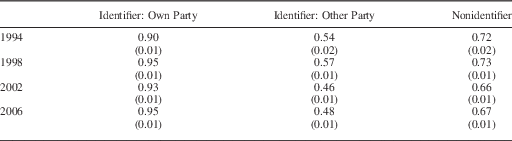
We can first consider how party utilities vary across party-identification groups. This allows us to test the hypothesis that party identification has a double effect, increasing the utility for one’s own party while decreasing other utilities. I rely for that on the estimated results of the Equation 3 model.Footnote 9 Table 1 shows the predicted party utilities and associated standard errors for voters who share the same issue positions with a given party, for three types of respondents: voters who identify with the corresponding party, those who identify with a different party and nonidentifiers. The results are similar in all four elections and reveal substantial differences in levels of party support among these groups. When they share the same issue positions, nonidentifiers’ party utility ranges from 0.66 to 0.73 (depending on the election study) on the 0–1 scale. Party identifiers have a much higher utility for their traditionally preferred party (in the 0.90–0.95 range), but a substantially lower utility for parties with which they do not identify (in the 0.46–0.57 range).
Predicted Party Utility when All Issue Distances Are Equal to 0, by Party Identification

Note: Standard errors in brackets.
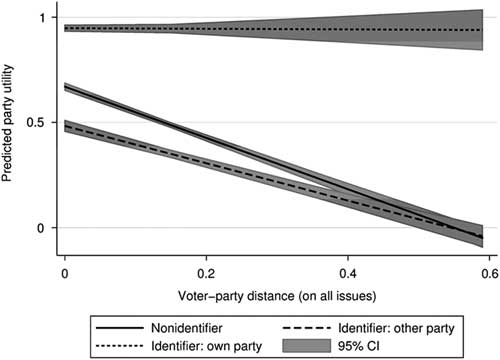
This confirms that party identification has two distinct effects: it increases the utility for one’s preferred party and decreases the utility for other parties. The latter effect, which is usually ignored, corresponds to a substantial and highly significant gap. Its magnitude ranges from 0.15 in 1998 to 0.20 in 2002 (corresponding to the difference between the last two columns of Table 1). Note that these results correspond to the estimated effects of party identification when voter-party distances are equal to zero. Given that the effects of party identification and issue distances are conditional on one another, the magnitude of these differences will vary with voter-party issue distances. Figure 1 illustrates this in the case of the 2006 election by showing how the party utilities of nonidentifiers and identifiers (for both “their” party and other parties) vary with issue distances. It shows the predicted party utilities when issue distances (on all issues simultaneously) range from 0 to 0.6, which corresponds to the average distance plus two standard deviations. The difference between nonidentifiers’ utility and identifiers’ utility for a non-preferred party decreases with larger issue distances and becomes non-significant among voters who are very distant from the corresponding parties (that is, at a distance greater than one standard deviation). At more moderate distances, however, there is a significant difference between these two predicted party utilities, which further supports the hypothesis that it is necessary to distinguish between two distinct party-identification effects. The other effect of party identification corresponds to the utility differential between nonidentifiers and identifiers’ utility for “their” party. This effect is always significant and its magnitude increases with issue distances. Results for the other elections are similar.
Predicted party utilities as a function of the voter–party issue distances and party identification, 2006 election Note: Predicted values and 95 per cent confidence intervals.

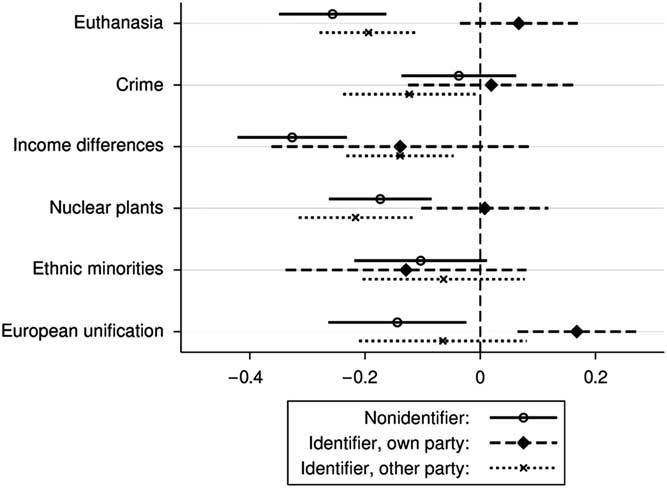
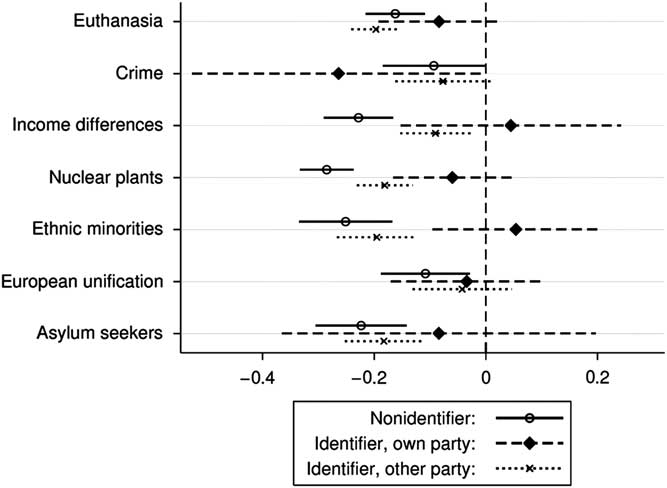
Considering now in more detail the effects of policy preferences, Figure 2 shows the estimated impact of voter-party distances in the 1994 election, separately for the three types of voter-party relations. For each issue, the estimated impact and associated 95 percent confidence interval is shown by the solid line for nonidentifiers, by the dashed line for party identifiers’ utility for their preferred party and by the dotted line for identifiers’ utilities for other parties. Considering first nonidentifiers, we observe that on most issues, the voter-party distance has a negative and significant impact on party utilities. Nonidentifiers have a lower utility for parties that are more distant from them on the issues of euthanasia, income differences, nuclear plants and European unification. These issue-distance effects are also substantially large. On the euthanasia issue, for example, a nonidentifier’s party utility decreases by a value 0.26 (on the 0–1 scale) as the voter-party distance changes from 0 to the maximum value of 1.
Impact of issue distances on party utilities by party-identification status, 1994 election

Among party identifiers, there are important differences in issue-distance effects between identifiers’ “own” party and other parties. Voters’ utility for the party with which they identify appears to be virtually unrelated to issue distances. For five out of six issues included in the 1994 model, no significant relationship exists between issue distances and party utilities for this type of voter-party relationship. Attitudes toward European unification are the only deviating case, but the estimated effect is positive. This is puzzling, as it indicates that party identifiers’ utility for their party is greater when it is further from them on the European issue. Although this result violates a proximity model’s expectations, it is a rare exception.
In contrast, party identifiers’ utilities for other parties do respond to issue distances. On the issues of euthanasia and nuclear plants, the effect is as strong as it is among nonidentifiers. In other cases, the effect is weaker than among nonidentifiers (income differences) or is not significant (ethnic minorities, European unification). Together, these results show quite clearly that the impact of issues in a proximity model varies between the three types of voter-party relations. In particular, they reveal a strong contrast between nonidentifiers’ party utilities, which are strongly influenced by issue distances, and party identifiers’ utilities for their traditionally preferred party, which appear to be unaffected by issue differences. At the same time, however, these results show that party identifiers are not entirely unresponsive to issues: their utilities for parties with which they do not identify do vary with issue distances, although the relations are weaker than (or not as systematic as) those among nonidentifiers. In other words, party identifiers are less responsive to issue distances, as expected, but the contrast with nonidentifiers is much stronger with identifiers’ utility for their own party than with their utility for other parties.
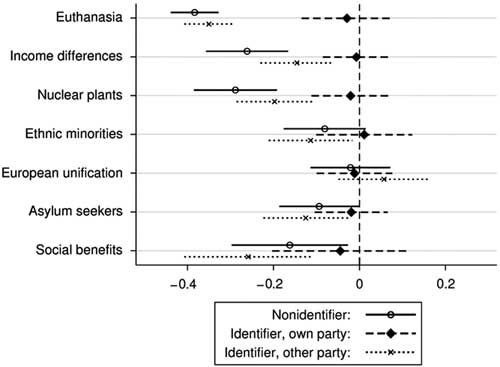
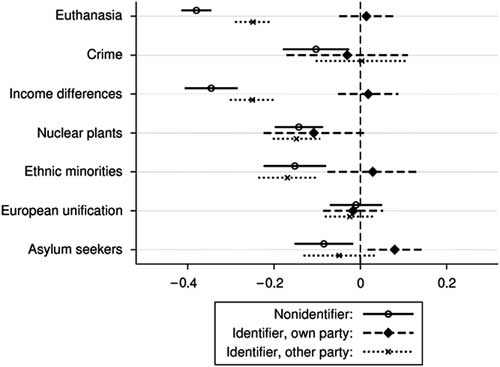
The corresponding results for the other elections are presented in a similar way in Figures 3–5. They show comparable differences between the three types of voter-party relations. Nonidentifiers’ utilities are influenced by voter-party distances on most issues. The few exceptions, such as the European unification issue in 1998 and 2006, do not influence party utilities among any group of voters. Among party identifiers, by contrast, very few issues display a significant impact on the utility for their preferred party. This is only the case for the crime issue in 2002. Attitude toward asylum seekers in 2006 also has a significant impact in that group, but the effect is positive. This is a surprising result, but it does not appear to be particularly robust: in three of the six replications described below that are based on alternative specifications of the voting-choice model, the effect is not significant.
Impact of issue distances on party utilities by party-identification status, 1998 election

Impact of issue distances on party utilities by party-identification status, 2002 election

Impact of issue distances on party utilities by party-identification status, 2006 election

Identifiers’ utilities for the other parties, by contrast, are influenced by issue distances. For some issues, this relationship is of similar strength to that observed among nonidentifiers, while for others, the relationship is weaker or not significantly different from 0. The number of issues that exerts a significant and negative impact on party utilities, as expected by the proximity-voting model, can be used as a summary measure to highlight differences across groups of voters. Among nonidentifiers, this is the case for 22 out of 27 issues. Among party identifiers, a single issue has such an impact on the utilities for their preferred party. In addition, still among party identifiers, 19 out of 27 issues are related to the utilities for other parties, and of these 19, the impact is significantly weaker than among nonidentifiers in five cases.
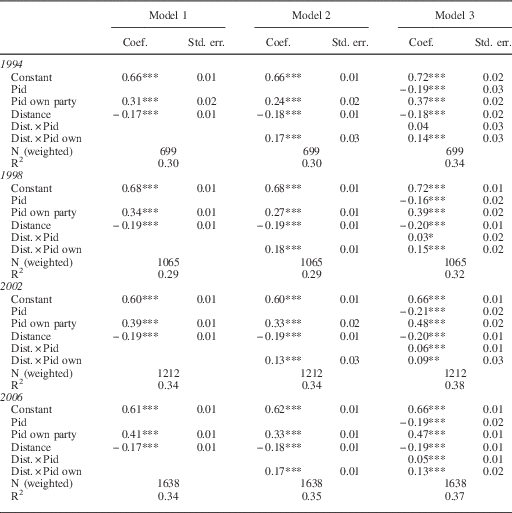
In order to better show the effects of party identification, the model was also estimated when computing the overall voter-party issue distance. In that way, the six or seven issue distances are replaced by a single spatial factor. This simpler model makes it easier to compare the model specification suggested in this article with alternative specifications. For all four elections, Table 2 shows the results of three models: a standard unified model with a single party identification dummy and no interaction (Model 1), the same model with an interaction between party identification and the spatial factor (Model 2), and the model introduced in this article, with two identification dummies and the corresponding interactions (Model 3).
Impact of the Overall Voter-Party Distance and Party Identification on Party Utilities

Note: Coefficients and robust standard errors from OLS regressions. *p<0.05; **p<0.01; ***p<0.001
Not surprisingly, the results of the third model in Table 2 are similar to those that were just reviewed. Identifying with a party both increases the utility for one’s preferred party and decreases the other utilities. This double effect cannot be captured by the other model specifications. These results also show that party identification weakens the impact of the overall voter-party distance on the utility of one’s “own” party. This effect is strong and significant in all four elections. Identifiers’ utility for the other parties is influenced by the relative spatial location, but in 1998, 2002 and 2006, the relationship is significantly weaker than among nonidentifiers. In 1994, by contrast, spatial voting is as strong for identifiers’ utility for parties with which they do not identify as for nonidentifiers. This means that a single interaction term would be sufficient in that case. However, both party-identification dummies are still necessary.
These analyses were replicated using alternative model specifications. Most important are the analyses that include political sophistication, as well as interactions with party identification and voter-party issue distances. As explained above, this allows us to test the counter-argument that the expected effect of party identification is linked with the presence of non-policy-oriented voters. The main findings are easy to summarize.Footnote 10 Among nonidentifiers, the impact of several voter-party issue distances grows stronger as citizens’ level of political sophistication increases. Party identifiers’ utility for their preferred party, by contrast, is only weakly related to issue distances, at all levels of political sophistication. Even among political experts (that is, one standard deviation above the average level of political sophistication), not a single issue is found to have a significant negative effect on identifiers’ utility for their preferred party. The general pattern is thus the same as the one observed above, except that the party-identification effect is somewhat stronger among political experts. These results offer strong support for this article’s main hypothesis.
In addition, five series of analyses were performed, each time by changing one of the model’s following aspects: using linear voter-party distances, measuring party positions as the average perceived positions, introducing a party-specific valence term, controlling for socio-demographic characteristicsFootnote 11 and estimating the model using an ordered logit regression. The corresponding results clearly point to the same overall conclusion.Footnote 12 With each of these alternative model specifications, the dominant pattern is the same: issue distances have no significant impact on party identifiers’ utility for their own party, but they do have a significant and negative impact on the other party utilities. Furthermore, very few observations support the standard assumption of spatial models, that is, in which issue distances have a negative impact on party utilities for all three types of voter-party combinations. Such cases are found only for euthanasia in 2002 (in two of the five series of replications) and nuclear plants in 2006 (in three replications). These are the only cases out of 135 (that is, issue by year by model specification) that support this traditional assumption of spatial models.
Conclusion
This article has analyzed the role of party identification in models of voting choice that combine spatial and behavioral factors. Such unified models generally assume that party-identification effects and spatial utilities are additive. All voters, whether or not they identify with a party, are expected to respond similarly to changes in parties’ relative issue positions. In contrast to this standard assumption, this article has suggested that party identifiers should respond less strongly than nonidentifiers to issue factors. This hypothesis was derived from information processing models, according to which party identification should function as a heuristic, allowing party identifiers to make their voting choice at a lower “cognitive cost,” without treating all information in a systematic way. This hypothesis should lead to a party utility pattern in which identifiers exhibit a high utility for their preferred party, lower utilities for all other competitors and wherein these utilities are only weakly affected by parties’ spatial locations.
This hypothesis was tested using data from the 1994, 1998, 2002 and 2006 Dutch election studies. These data allow us to analyze the determinants of voters’ party utilities in a multiparty system, with numerous issue dimensions. The results were largely consistent across these four elections. There was strong support for the idea that party identification affects the relationship between issue distances and party utilities. Our results demonstrate that the effects of these two sets of variables are conditional on one another. Contrary to an assumption that is frequently made, how voters respond to spatial factors depends on their party-identification status. Yet the nature of this conditional effect fits only partially with this article’s hypothesis. Party identification does not simply lead to a weaker relationship between spatial proximities and all party utilities. Rather, among party identifiers, the impact of issue distances varies across parties. While their utility for their preferred party is virtually unaffected by issue distances, party identifiers’ utilities for other parties are sensitive to issue proximities, although in many cases the relationships are weaker than those among nonidentifiers.
This pattern is dominant in the results presented above. It also seems to be quite robust, as it holds across various alternative model specifications, using linear or quadratic distances, individual or average perceptions of party positions, including (or not) a valence term or socio-demographic controls, and estimating the model using OLS or ordered logit regressions. Furthermore, the party-identification effect does not change when voters’ degree of political sophistication is controlled for. This robustness test is particularly important, as it makes it implausible that the observed effect of party identification is due to the presence of non-policy-oriented voters. Following this possible counter-argument, the party-identification effect should be weaker or nil at higher levels of political sophistication. This article’s results show that this is clearly not the case.
The current findings show that the interplay between party identification and issue preferences differs from what is usually assumed in spatial models of the voting-decision process. Party identifiers’ utilities are often less responsive to issue distances, and the utility for their preferred party is virtually unaffected by spatial considerations. While party identifiers tend to be relatively close to their preferred party in the political space, exactly how close or distant they are seems to be irrelevant in the voting-decision process. Party identifiers have a very high utility for their preferred party, which is not affected by eventual issue divergences. Of course, this does not mean that party identifiers do not care at all about issue positions. As noted above, party identifiers are usually attached to a party that is relatively close to them in the political space. The development and dynamic of party identification are thus likely to be influenced by issue closeness. But during a given election, it is only party identification, not issue distances, which influence party identifiers’ utility for their traditionally preferred party.