INTRODUCTION
Human communities of a few hundred people living on isolated islands of the Pacific can struggle to maintain their livelihoods in their territories (Bell et al. Reference Bell, Johnson and Hobday2011). While some level of autarchy exists, most islanders are involved in commodity exchanges with the outer world (Narayan & Narayan Reference Narayan and Narayan2004). Typical exports include copra, finfish, shellfish and aquaculture products (Gillett Reference Gillett2016). Exports can be part of a sustainable activity when human disturbances to the environment are limited and monitored. Over the past decades, small-scale mariculture has become a major player in sustaining islanders’ livelihoods (Gillett Reference Gillett2016). For example, black pearl farming in French Polynesia (FP) is now the second most important source of income (Andréfouët et al. Reference Andréfouët, Charpy, Lo-Yat and Lo2012). The ideal scheme is to export low quantities of a high-value natural resource that can be farmed and transported at low cost.
The giant clam Tridacna maxima (family Cardiidae, sub-family Tridacninae) represents such a resource for several remote atolls of the Eastern Tuamotu Archipelago, FP, which is a French overseas collectivity, but with administrative autonomy and with a different jurisdiction from France. These atolls had uniquely high clam densities (up to 500 individuals/m2; Andréfouët et al. Reference Andréfouët, Gilbert, Yan, Remoissenet, Payri and Chancerelle2005; Gilbert et al. Reference Gilbert, Andréfouët, Yan and Remoissenet2006a), and while clams have always been central to local livelihoods in these atolls for subsistence, the commercial exploitation of wild stocks in the past decades has fluctuated (Van Wynsberge et al. Reference Van Wynsberge, Andréfouët, Gaertner-Mazouni, Wabnitz, Gilbert, Remoissenet, Payri and Fauvelot2016).
The success of giant clam collecting, rearing, transport and restocking tests in the early 2000s in certain Tuamotu atolls (Remoissenet & Wabnitz Reference Remoissenet and Wabnitz2012) and the lack of available alternative livelihoods on many remote atolls led the FP Direction des Ressources Marines et Minières (DRMM; Fishery Service), with assistance from the Pacific Community, to develop a post-larval capture and culture strategy and policy. The DRMM is a technical service that depends on its Ministry and the FP Government to adjust and modify legislation if needed for new marine activities. The strategy, targeting lagoons with specific shallow-water (<10 m) ecological habitats and unique giant clam and/or shell aggregations (locally called ‘mapiko’), was applied to two atolls, Reao and Tatakoto, and initially focused on exports for the marine aquarium trade (Remoissenet & Wabnitz, Reference Remoissenet and Wabnitz2012). Territorial legislation, subsequent to the approval of local town halls, sanctioned these atolls to deploy spat collectors and to export T. maxima. To allow farmers to cover some of their initial costs while they waited for the maricultured clams to reach marketable size (>4 cm), the strategy also allowed farmers to export wild giant clams. This provision was implemented based on the high natural densities of clams recorded in situ, and for a period of time and quota that were determined by the DRMM according to regularly conducted stock assessments. As T. maxima is listed in Appendix II of the Convention on International Trade in Endangered Species of Wild Fauna and Flora (CITES), exports and imports of individuals (live, dead, tissue sample, etc.) are strictly regulated. Consequently, all clam exports from FP need to satisfy local, national and international regulatory measures. In early 2016, FP accounted for roughly 25% of the worldwide trade in live giant clams for the aquarium market. This is a remarkable achievement for such small and remote islands and their inhabitants.
In February 2016, local farmers in Reao alerted the DRMM that both wild and cultured clams were bleaching. Giant clams are shallow-living animals that host algal symbionts (zooxanthellae), which, through photosynthesis, provide the clam with most of the energy necessary for survival, growth and reproduction (Klumpp et al. Reference Klumpp, Bayne and Hawkins1992). Bleaching clams, similar to corals, expel their zooxanthellae when stressed, resulting in the loss of colour. The breakdown in symbiosis reduces the transfer of organic nutrients from the algae to the host (Leggat et al. Reference Leggat, Buck, Grice and Yellowlees2003) and can negatively affect their health. This includes reproductive capacity and therefore larval recruitment, upon which the spat collecting stations and the mariculture activity depend. However, of more immediate concern for farmers is that bleached, colourless clams do not have any value on the aquarium market. Trade was therefore temporarily suspended, putting at risk the livelihoods generated from an activity that had taken several years to develop.
The 2016 mass bleaching event represents a new challenge for all stakeholders with important long-term implications for management and livelihoods. It provides a textbook example of the rapid and direct consequences of global warming – magnified here by the strongest El Niño on record (Schiermeier Reference Schiermeier2015) – on natural resources and the associated socio-economic impacts for local communities that depend on them, and thus also their vulnerability to exogenous shocks. Importantly, this study highlights, through CITES, the role that national and international regulatory requirements can have in island development and economic survival, and how such requirements indirectly promote better science and monitoring to inform adaptive management through local managers (e.g. the DRMM) and scientists.
Adaptive management can be broadly defined as the regular assessment and monitoring of a system's status and its responses to management strategies to adjust and improve those strategies and to sustain and maintain the system's resilience or some of its properties (Holling Reference Holling1978). Adaptive management implies that there is a mechanism to ensure that feedback from assessment and monitoring is translated into policy for a wide-range of decision-makers, from customary to national levels. In a coral reef context, several studies, ranging from small fishing communities (e.g. in Kenya; Evans et al. Reference Evans, Brown and Allison2011) to large marine parks (e.g. the Great Barrier Marine Park Authority in Australia; McCook et al. Reference McCook, Ayling, Cappo, Choat, Evans, De Freitas, Heupel, Hughes, Jones, Mapstone, Marsh, Mills, Molloy, Pitcher, Pressey, Russ, Sutton, Sweatman, Tobin, Wachenfeld and Williamson2010), have explicitly documented in an adaptive management context the methods and targets for assessment, monitoring and feedback to decision-making, with different levels of emphasis placed on environmental, resource and socio-economic information.
Here, our objectives are: (1) to describe the targets and feedbacks needed to ensure the adaptive management of FP giant clam mariculture in the context of the threats posed by climate change; and (2) to present some of the lessons learned that we believe are broadly applicable to small islands despite the fairly unique context and setting of our study. We first quantify the number of wild and cultured clams that bleached between February and April 2016. We then discuss the implications for spat collection and farmers’ livelihoods, and consider the management and policy repercussions of this bleaching event for all stakeholders. Lastly, we describe what may be applicable to other activities in other localities beyond FP and giant clam farming.
MATERIALS AND METHODS
Giant clam culture in FP
Spat collecting stations, initially deployed in 2012, covered a total of 1384 m2 in Reao and Tatakoto. The collectors are split between a maximum of 12 authorized farmers, with six per atoll. The maximum total spat collecting surface area per farmer and the maximum total number of collectors were determined and controlled at the atoll level by the DRMM. These restrictions are in place to ensure that the harvest and production of live giant clams do not overshoot demand, given the niche nature of the marine aquarium trade market, and to stabilize prices. There are two companies based in Tahiti that export live clams for the aquarium market.
Unlike in the original trials (see Gilbert et al. Reference Gilbert, Remoissenet, Yan and Andréfouët2006b), spat collectors registered limited success at Tatakoto. This was mainly due to poor station maintenance (Remoissenet & Wabnitz Reference Remoissenet and Wabnitz2012), high predation rates on young recruits and low recruitment due to a 90% reduction in the lagoon-wide wild clam population following a mass mortality event in 2009 (Andréfouët et al. Reference Andréfouët, Van Wynsberge, Gaertner-Mazouni, Menkes, Gilbert and Remoissenet2013), which was triggered by unusual weather conditions during a La Niña year and was not explained by thermal stress-related bleaching (Andréfouët et al. Reference Andréfouët, Dutheil, Menkes, Bador and Lengaigne2015). Spat collection was much more successful in Reao, with farmers exporting a total of 10,558, 15,259 and 7098 cultured clams for the aquarium trade in 2013, 2014 and 2015, respectively (DRMM 2015). Including the export of wild clams (45,276 clams ≥12 cm for 2013, 2014 and 2015), FP now accounts for roughly 25% of the worldwide trade in live giant clams for the aquarium market.
Bleaching study site
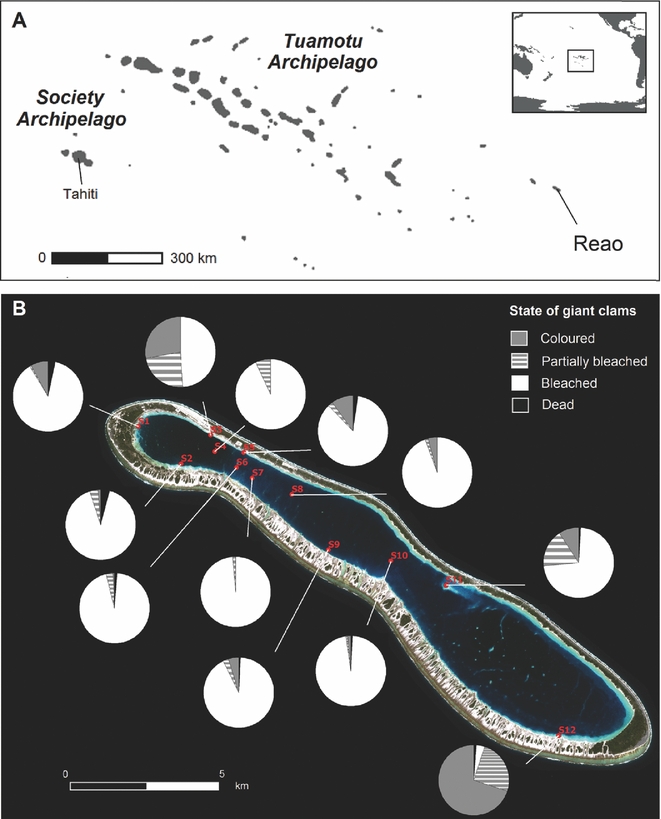
Reao (136°37’ W, 18°51’ S) is a semi-closed 24.5-km long and 5-km wide atoll in the Tuamotu Archipelago (Fig. 1) 1300 km east of Tahiti. The relatively shallow lagoon (44.1 km2 and with a maximum depth of 20 m) is hydrodynamically closed in its northern part (Fig. 1), but is connected to the ocean through several narrow and shallow channels (‘hoa’) in the south. The water renewal rate is poor as most hoa are only functional at high tide and during high wind and swell periods. Clam densities for the entire lagoon were estimated at <10 ind/m2 in 2005, and >10–12 ind/m2 in 2010 and 2013 (DRMM and Institut de Recherche pour le Développement (IRD), unpublished data).
(a) Location of Reao in the Tuamotu Archipelago (French Polynesia). (b) Satellite imagery of Reao showing the 12 stations used to monitor the bleaching event. Pie charts display the proportions of giant clams according to the different bleaching states for each station.

Bleaching levels
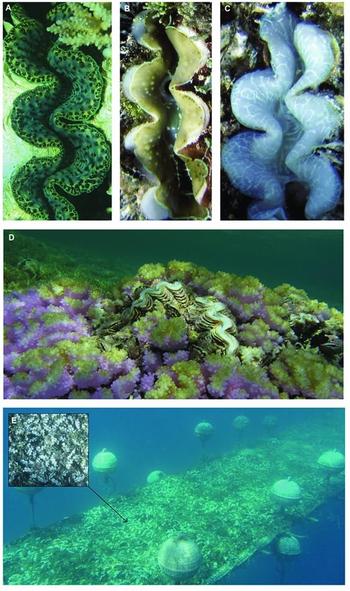
Twelve wild giant clam sites were surveyed (see Fig. 1(b)) during 3–5 April 2016. At each site, we conducted 3–10 belt-transects (10 m × 1 m), depending on mapiko sizes. Along each transect, all giant clams were measured to the nearest centimetre and classified as ‘coloured’, ‘partially bleached’, ‘bleached’ or ‘dead’. ‘Coloured’ denotes clams without any visually detectable sign of bleaching (Fig. 2(a)). ‘Bleached’ indicates that the entire mantle was fully white, without any visible pigmentation (Fig. 2(c)). If the mantle was coloured, but pale with signs of bleaching, it was classified as ‘partially bleached’ (Fig. 2(b)). ‘Dead’ clams were recently deceased empty shells (several hours to a couple of weeks) identified by a bright white epibiont-free inner surface, and found in their original position within a clam aggregate or on the substrate. Conspicuous mounds of bright white inner shells found over coral or other clams typically represent recently harvested individuals.
Coloured and bleached giant clams in the wild at Reao atoll in April 2016. (a) Coloured clam; (b) partially bleached clam; (c) bleached clam; (d) bleached clams in the wild; (e) bleached clams on a collecting station.

Thirteen spat collectors (average area: 39 m2) were surveyed between 31 March and 1 April 2016. Clam size and bleaching state were assessed for all individuals encountered using the same protocol as above. If the collectors were too large and/or too densely populated and required more than 1 hour to sample, stocks were surveyed using haphazardly distributed 0.25 m2 quadrats, with five to six quadrats per station. Surveys were directed by DRMM staff, with local farmers acting as volunteers. All protocols and findings were discussed with scientists and farmers.
Relationships between stakeholders and consequences of giant clam bleaching for management
We conducted an inventory of all formal relationships between key stakeholders, including agencies, involved in the giant clam aquarium trade and the protection of endangered species. These relationships highlight who is in charge of producing the monitoring data (i.e. assessment of stocks in the wild and live exports), who analyses these data to infer resource status and the nature as well as direction of feedbacks among agencies to inform policy-making and resource management decisions.
The roles held by different stakeholders and their connections are first described in the ‘business as usual’ condition that was known before the bleaching event. We then describe how the flow of actions between stakeholders has changed following the bleaching event. We also identify those connections that may still need to change during and after a crisis. In particular, a series of ‘possible modifications due to bleaching conditions’ were considered to indicate actions that have not yet been taken, but may become necessary.
The research priorities and management suggestions outlined herein are the result of communications and interactions among members of a diverse community of academics (SA, SVW, CCCW, LK and CM), managers/policy makers (GR and TT), members of a scientific and technical organisation in the region providing advice on sustainable marine resource management, including aquaculture (CCCW), and islanders as well as farmers involved in the local town management committee (MP, ITet, ITea, TAS and TTeak). Therefore, this analysis represents an inclusive multi-stakeholder and therefore multi-dimensional perspective on the concerns raised by and the priorities – including for research – that arise from the bleaching event. Unlike at many other locations, few barriers to knowledge exchange occurred in the present case study due to the small scale of the problem and the long working relationships between stakeholders (Cvitanovic et al. Reference Cvitanovic, Hobday, van Kerkhoff, Wilson, Dobbs and Marshall2015).
RESULTS
Survey of bleached clams
We measured and categorized a total of 3581 wild T. maxima and 1792 cultured clams. Among the wild clams, 76.7% were bleached, 8.8% were partially bleached and 1.7% were considered recently dead. Cultured clams were 90% bleached, 2.6% were partially bleached and 1.5% were considered recently dead. The distribution of the four bleaching categories varied across the lagoon, with lower proportions of wild bleached individuals found at site 12 (3.7%) and site 44 (48.8%) compared to other surveyed sites (72.6–98.6%; Fig. 1(b)).
For both wild and cultured clams, shell length was correlated with the proportion of coloured specimens (Kendall's correlation r = –0.72 and r = –0.56, respectively; Supplementary Fig. S1, available online), and the results suggest that large individuals were more vulnerable to bleaching than small individuals. Except for 1-cm length specimens, which are rarely seen in the wild (n = 20), the proportion of coloured clams was systematically higher in the wild when compared to collecting stations (Supplementary Fig. S1).
Relationships between stakeholders
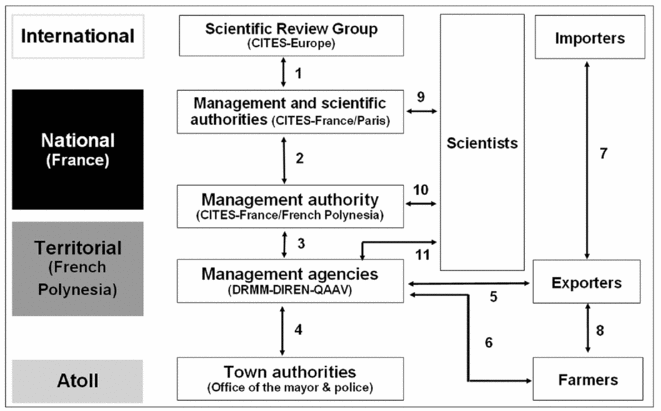
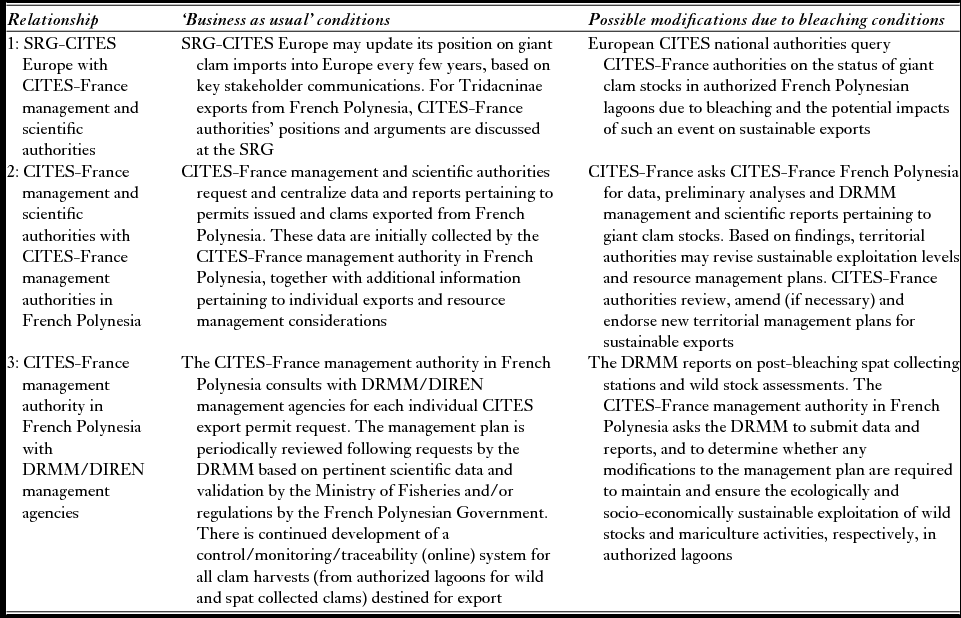
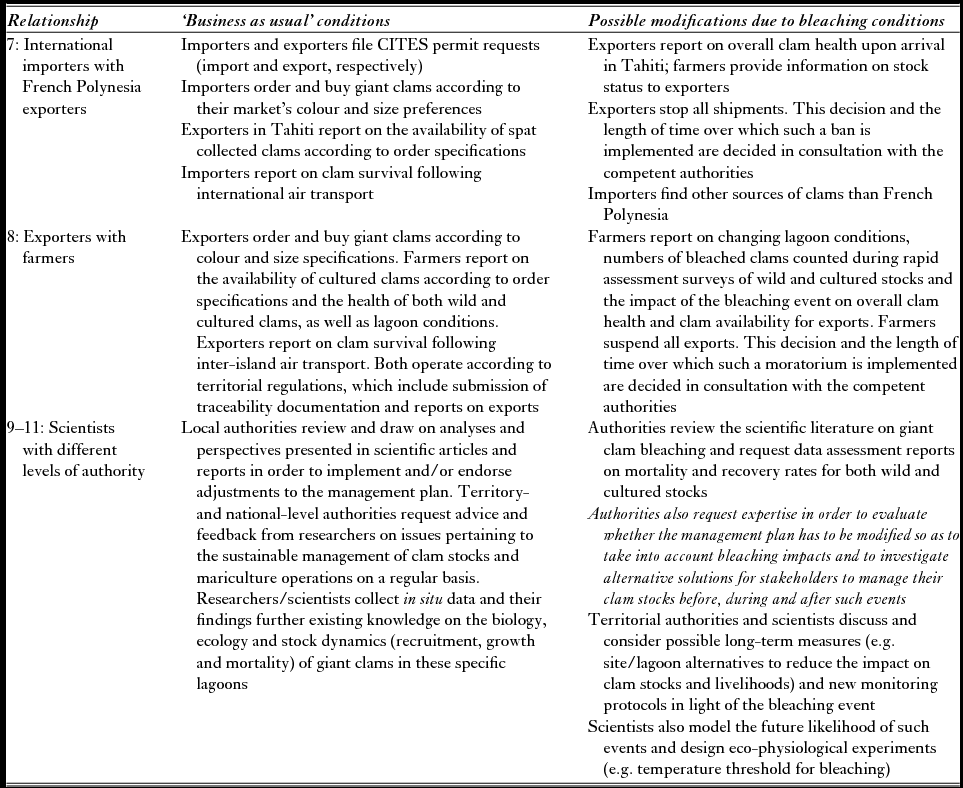
A summary of the relationships between stakeholders involved in the sustainable exploitation of Tuamotu giant clams for the aquarium trade (Fig. 3 and Tables 1–3) indicates mostly regulatory linkages between stakeholders, according to current international, national and territorial legislation or commercial contracts (e.g. between farmers and exporters) or research grants (i.e. between the DRMM and research agencies). Additional details focusing on CITES are also included in Figure 3 and Table 1.
Decision and action relationships linking stakeholders involved in the sustainable exploitation of giant clams in the Tuamotu atolls. CITES = Convention on International Trade in Endangered Species of Wild Fauna and Flora; DIREN = Environmental Service of French Polynesia; DRMM = Direction des Ressources Marines et Minières; QAAV = Qualité Alimentaire et Action Vétérinaire.

Impact of bleaching on relationships between the Convention on International Trade in Endangered Species of Wild Fauna and Flora (CITES) and stakeholders involved in the exploitation of giant clams in Tuamotu atolls. Entries in column 1 refer to the relationship numbers in Figure 3. Clam harvests for exports are only allowed from officially authorized lagoons (as of August 2016 for Tatakoto and Reao). Territorial legislation specifies that clams collected live from the wild must be ≥12 cm in size. Clams harvested live for exports from spat collecting stations (‘cultured’) must be ≥4 cm in size. SRG = Scientific Review Group; DIREN = Environmental Service of French Polynesia, which is in charge of endangered species, although the Direction des Ressources Marines et Minières oversees the exploitation of clams; DRMM = Direction des Ressources Marines et Minières.

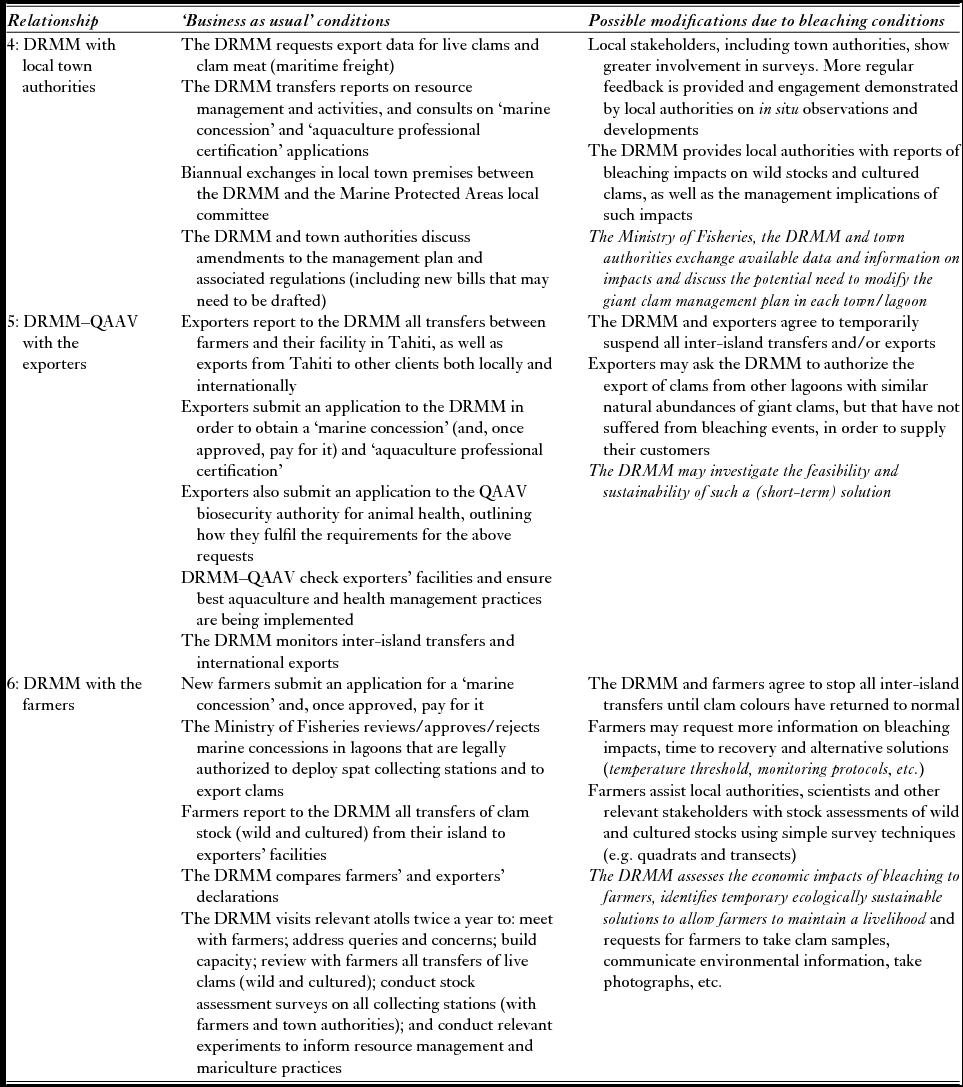
Impact of bleaching on relationships between the Direction des Ressources Marines et Minières (DRMM) and stakeholders involved in the exploitation of giant clams in Tuamotu atolls. Entries in column 1 refer to the relationship numbers in Figure 3. Italic entries indicate that these actions have not yet been taken, but could be or may become necessary. QAAV = Qualité Alimentaire et Action Vétérinaire, which is in charge of biosecurity, food quality and veterinary actions in French Polynesia.

Impact of bleaching on each set of relationships between stakeholders that are not part of the Convention on International Trade in Endangered Species of Wild Fauna and Flora (CITES) or Direction des Ressources Marines et Minières (DRRM) and are involved in the exploitation of giant clams in Tuamotu atolls. Entries in column 1 refer to the relationship numbers in Figure 3. Italic entries indicate that these actions have not yet been taken, but could be or may become necessary.

The DRMM's local strategy and policy for giant clam mariculture development were driven by the local island context and aimed to adhere to CITES regulatory management conditions. CITES is represented nationally in France through the scientific authority at the Museum National d'Histoire Naturelle and the management authority at the Ministère de l'Ecologie et du Développement Durable, both in Paris. CITES-related matters in FP are managed by the High-Commissioner's research office, the Délégation Régionale à la Recherche et à la Technologie (DRRT), who responds to enquiries made by the national office (Fig. 3 and Table 1). CITES affairs in FP are not handled only by the DRRT, as the FP Government and the DRMM both ensure that adequate national legislation is implemented for relevant resources in accordance with CITES requirements (Fig. 3 and Table 2).
Specifically, the DRMM reviews, authorizes or rejects applications for marine concessions (i.e. where a farmer can then deploy spat collectors). The DRMM also agrees with CITES on a specific production and export management plan, which is periodically reviewed and revised. For example, to provide some initial economic impetus and stability, all parties approved the initial export of a quota of live wild clams (≥12 cm). This is reviewed regularly based on stock assessment data, with the idea to be phased out over time. There are also plans to classify spat-reared clams as ‘ranched’ instead of ‘wild’ as currently labelled under CITES. The DRMM thus also links CITES with farmers and exporters (Tables 1–3). Lastly, the DRMM also works directly with farmers through the monitoring of spat collectors biannually and the provision of technical expertise, advice, training and administrative follow-up. Overall, the DRMM plays a pivotal role by interfacing between and with international agencies and national-level management agencies, town authorities, scientists, exporters and farmers (Tables 2 and 3).
The role of CITES is to verify, using data provided by the DRMM, that adequate measures are in place (through stock assessments, export controls, etc.) to ensure that trade is controlled in order to avoid utilization that is incompatible with giant clam survival (i.e. sustainable exploitation and management of stocks) (Tables 1 and 2).
The implications of the bleaching event for stakeholder relationships and natural resource management are presented and discussed below.
DISCUSSION
Giant clam mass bleaching
Elevated temperature is usually recognized as the main stressor resulting in bleaching and likely triggered the loss of colour of giant clams in Reao. Although we did not monitor in situ other variables, such as ultraviolet radiation, wind-induced mixing or water clarity that could modify heat stress (Brown Reference Brown1997), the recorded sea surface temperature (SST) values clearly implicate temperature as the most likely reason for clam bleaching (Reynolds et al. Reference Reynolds, Rayner, Smith, Stokes and Wang2002; Supplementary Fig. S2). The 2016 maximum SST is above the previous maximum of 1998, a period characterized by significant bleaching in FP (>30°C for c. 5 months; Adessi Reference Adessi2001). Temperatures above 30°C and up to 38°C were measured using a hand-held thermometer in March 2016 in some shallow and enclosed parts of the lagoon (DRMM, personal communication 2016). These are well above the satellite-monitored offshore SSTs that were also the highest on record (Supplementary Fig. S2(a) and S2(b)). The low lagoon renewal rate in Reao explains why SST inside the lagoon was above the ocean SST for the same period (Sheppard Reference Sheppard2009). Elsewhere, Junchompoo et al. (Reference Junchompoo, Sinrapasan, Penpain and Patsorn2013) also reported a mass bleaching of Tridacna squamosa and Tridacna crocea (90% bleached and 8% partially bleached) in 2010 in Thailand following unusually high temperatures (mean SST >32°C for 2 months, maximum: 34.3°C).
While 94% of cultured clams showed some signs of bleaching, a survey conducted 16 weeks after the initial surveys at two collecting stations suggests that bleaching led to an 18–50% mortality rate, with the remaining surviving clams recovering their symbiotic algae and associated colours (DRMM, personal communication 2016). Future visits will help establish the long-term mortality of bleached clams at Reao, which will provide useful future information for the lagoon ecology and for the industry. However, bleaching and discolouration level alone immediately paralyzed exports. Thus, even if all clams eventually fully recover, the transient discoloured state is one of the most critical triggers of early management decisions.
Whilst the 2016 clam bleaching event is the first to ever be documented for Reao, such events probably occurred in the past in FP, especially in 1998, and simply went unreported (Supplementary Fig. S2(a)). Bleaching of corals in FP was documented in 1984, 1987, 1991, 1994, 1998, 2002 and 2003 (Adjeroud et al. Reference Adjeroud, Michonneau, Edmunds, Chancerelle, Lison de Loma, Penin, Thibaut, Vidal-Dupiol, Salvat and Galzin2009). None occurred in Reao. Coral bleaching has been related to abnormally high temperatures, with inter-archipelago differences in bleaching intensity possibly due to solar irradiance and cloud cover (Mumby et al. Reference Mumby, Chisholm, Edwards, Andréfouët and Jaubert2001). Bleaching of giant clams has been documented twice now, in 1998 at Takapoto (Adessi Reference Adessi2001) and in 2016 at Reao. Under climate change projections, average SSTs are predicted to rise over the next decades in the Tuamotu region (Andréfouët et al. Reference Andréfouët, Dutheil, Menkes, Bador and Lengaigne2015), leading to an increase in the risk of coral bleaching (Van Hooidonk et al. Reference Van Hooidonk, Maynard and Planes2013). It is unknown whether adaptation of giant clams to changing environmental conditions could lower the risk of future bleaching, but predictions indicate that giant clams in the region, and clam farmers, are likely to experience similar conditions again.
The direct and indirect impacts of climate change on giant clam exploitation and management
Bleached or partially bleached clams have no value on the market and, due to their fragile health state, are at increased risk of dying during transport. Therefore, farmers in Reao (and Tatakoto) and exporters in Tahiti ceased the shipment of all live giant clams for 4 months. While the exact financial consequences of this decision are not yet known, farmers and exporters experienced significant income losses.
The consequences could have been worse if the situation had permanently discontinued the activity. Fortunately, the rapid response demonstrated by several of the stakeholders led to a different outcome. As soon as farmers observed clam bleaching, they reported the situation to the DRMM, allowing the agency's staff to: (i) supply farmers with information on the giant clam bleaching process, a situation they had never experienced before; (ii) provide technical advice and encourage farmers to maintain stations in the best condition possible; (iii) assess the situation in situ; and (iv) discuss and jointly agree among all local stakeholders (the DRMM, farmers, exporters and researchers) on required immediate and necessary next steps.
Given current climate change predictions, this event suggests that adaptive solutions need to be put in place now in order to protect economic development and the farmers’ and exporters’ revenue. This is necessary as several of the identified policy, scientific and financial interactions between stakeholders will be influenced by future climate change events. These relationships, from local to international levels, may have to evolve to accommodate the risks of climate change-induced bleaching (Tables 1–3), and these are also discussed below. Since research should support policy decisions, we first present the new research challenges posed by bleaching events in particular, and massive mortalities in general.
Research challenges
In FP, mariculture research programmes generally consist of a partnership between the DRMM and scientific institutions, and involve local farmers to a lesser extent. Bleaching events have short- and long-term consequences. The former can be measured relatively easily. The lower population size (through mortality) and performance of surviving individuals (growth and fecundity) due to a stressed zooxanthellae–clam symbiosis are expected to have negative consequences on reproduction and recruitment. Thus, the long-term consequences, including impacts on population dynamics and mariculture activities, will require continuing monitoring of wild stocks, including recruits, and spat collectors. These studies need to be conceived so that data can be fed into spatially explicit population models at the scale of each lagoon, also providing reports on wild stock and recruitment status (Van Wynsberge et al. Reference Van Wynsberge, Andréfouët, Gilbert, Stein and Remoissenet2013). These data will assist CITES in determining whether to authorize the collection of wild clams if bleaching disproportionately affects cultured clams, for example.
Future research should also prioritize how giant clams and their zooxanthellae in different atolls respond to thermal stress (Dubousquet et al. Reference Dubousquet, Gros, Berteaux-Lecellier, Viguier, Raharivelomanana, Bertrand and Lecellier2016), and characterize mortality and recovery rates according to different stress levels. Eco-physiological experiments in the laboratory and in situ need to investigate how temperature and other stressors (independently and in combination) affect survival, health and recovery time, with particular emphasis on those giant clams that showed higher resilience and tolerance to bleaching events. Initial reports indicate good recovery in 2016 (Pahuatini and DRMM, personal communication 2016), but farmers need to know how fragile bleached clams are and how long the animals can survive in a discoloured state, and thus understand the time needed before these giant clams may be ready for export once they recover. Exporters will also need this information to devise alternative strategies for sourcing clams, possibly by purchasing specimens from other unaffected licensed atolls, for example.
Finally, greater efforts should be expended to detect and predict the probabilities of bleaching events at the local scale. To this end, temperature loggers should be deployed across lagoons, and oceanic conditions should be regularly monitored using satellite sensors. This information should be relayed to farmers on a regular basis, especially when a high probability of bleaching is predicted, while avoiding false-positive predictions that could be costly if mitigating measures are taken for nothing. These include shading or moving their collecting stations to a more favourable location and/or depth.
Policy challenges
Sustainable exploitation of giant clams in the future, without interruptions, requires the anticipation of future mortality events such as the one recorded here. To this end, different levels of adaptive actions are needed to provide some flexibility in case of a crisis.
At the local scale, in each atoll, when temperatures are abnormal, cultured clams and/or collectors may need to be relocated. However, the position of concessions is registered and their boundaries and sizes are endorsed by a legal act. Currently, there are no legal mechanisms to allow farmers to move stations at will, even in an emergency. Therefore, some flexibility to occupy new lagoonal spaces is needed, at least temporarily, while a bleaching event is occurring.
If farmers need to move their collectors or if they need to affix shading panels, for instance, they and the DRMM may need to reconsider or adapt the current spat collector design (Fig. 1(e)). However, this design is also described in legal texts, and concessions are granted based on stations’ surface areas. Modifications of the design may require concomitant changes to the legal texts.
Flexibility will also be required in the number of giant clams farmers are authorized to collect live from the wild as a temporary solution for replacing bleached cultured clams that cannot be traded on the aquarium market. If scientific monitoring confirms that the stock and recruitment potential remains compatible with harvesting, both CITES and the DRMM could temporarily agree to modify the management plan (i.e. establishing quotas for wild clams). However, this would require the rapid processing of such a request, which in itself could be a challenge.
Finally, spat collecting activities and wild clam collection may need to be distributed across a greater number of lagoons, where stock assessments have confirmed that such an activity can sustainably take place. More atolls with collecting stations will limit the risk of a massive loss for exporters – but not for affected local farmers. However, such a decision, which falls under the responsibility of the Ministry of Fisheries, will need to involve consultation with local communities and town councils. Spat collection itself is not trivial, as station setup and maintenance requires investment of time and financial resources by local farmers, even if they are subsidised. It also requires significant efforts by the DRMM to inform, train and support a very limited number of farmers in very remote locations. Expanding the activity to other atolls raises the critical issue that, during normal conditions, clam production from more than the two currently authorized atolls may flood the aquarium market, a niche activity with c. 100,000 clams sold per year. A cost–benefit analysis could measure the exact impact of this approach, but expanding the activity to other atolls would likely have negative repercussions on clam value within FP and also, importantly, other source countries. While increasing the number of production sites in a network of atolls appears to be a sound theoretical solution to maintaining clam culture activities in FP, practically, it represents a threat to the stability of the aquarium trade itself. Therefore, this avenue should only be recommended if new markets emerge for other products, such as for meat and shells, which would be capable of absorbing the extra production.
Lessons for resources management on other islands
Adaptation to a changing climate is on the agenda for many communities, particularly those of island developing states (Adger et al. Reference Adger, Arnell and Tompkins2005; Bell et al. Reference Bell, Johnson and Hobday2011). While the situation in FP is unique and may limit its applicability to other localities, it nevertheless highlights a configuration of interactions and contributes to a portfolio of lessons that may prove useful to other localities and/or contexts (e.g. Tompkins Reference Tompkins2005).
First, solutions to climate-driven crises are unlikely to be fully local. Solutions can depend on both very wide-ranging legal frameworks (e.g. CITES in our case) and very specific local contexts. Second, even if the solutions are not driven solely by locals, these locals are, and should be, an integral part of the solution. In Reao, farmers quickly documented the bleaching event and alerted the authorities. Their observations and role in the event, and their communications with the DRMM, empowered them to take action and address the issue head on (e.g. moving stations to more favourable, cooler areas, ceasing exports, etc.). Third, the Reao case study highlights the importance of having a technical, scientifically driven management entity coordinating communications and the decision-making process. In Reao, farmers were informed of how long it may take for clams to recover, giving them perspective and hope. Unfortunately, many island countries do not have such structures in place.
CONCLUSION
Mariculture of the giant clam T. maxima for the aquarium trade represents an important alternative livelihood for islanders of the remote east Tuamotu. It is an opportunity to directly interact with the world, enhance levels of income and produce a commodity that is in demand on the global market. Elevated water temperatures associated with the 2015–2016 El Niño triggered a mass bleaching event of giant clam populations in atolls where such small-scale clam mariculture activities were taking place, directly threatening these very livelihoods, and thus also highlighting the vulnerability of this activity. Such a crisis situation allowed for the identification of the necessary adaptations within the network of stakeholders’ relationships that would yield a more resilient management system in the face of future disturbances. Responses are needed at the level of policy, research and technical practices in the field. The time scales of these adaptations vary. Some need to be fast (i.e. within a few days) and include, for instance, the ability of farmers to move spat collectors to safer locations. Other responses may require a few weeks to a few months and include monitoring data collection on the event's impacts, the authorization of new temporary concessions and the request for approval of compensatory measures (e.g. a new management plan, new quotas, etc.) from international management agencies. Finally, some long-term actions (i.e. over a few years) may be required to investigate new mariculture sites and to conduct research aimed at understanding population dynamics and physiological responses to temperature stress, for example.
Bleaching and mass mortality events both force reconsideration of a development scheme that was devised 10 years ago, when these events were not expected. This case study provides a clear example of how climate change can affect islander livelihoods and how adaptive mechanisms are required to ensure sustainable resource management and to mitigate impacts on islanders who depend on such activities.
ACKNOWLEDGEMENTS
We are grateful to the French Polynesia Ministry of Fisheries for support, and to Tetaimoearo Petero, the deputy mayor of Reao, Elisabeth Tuhei and Edwin Kehapuia for their assistance in the field. We are also grateful to the giant clam farmers of Reao for their cooperation; special thanks in particular go to Lolita Arakino, Noël Tehau and Abraham Teara. CCCW acknowledges funding from DFAT to the SPC’s FAME Division and FFEM grant no. CZZ 1454.01 B. The reviewers’ suggestions helped improve the manuscript. This is ENTROPIE contribution #204.
Supplementary material
To view supplementary material for this article, please visit https://doi.org/10.1017/S0376892917000212