The release of radioactive materials into the environment may occur intentionally or unintentionally. Although infrequent, several large-scale unintentional radiation disasters have occurred throughout the world in recent decades. The most recent was the Fukushima Daiichi nuclear power plant incident that occurred following the March 2011 Great East Japan Earthquake (also known as “Great Sendai Earthquake”) and tsunami. The tsunami waves damaged the power plant and backup generators, resulting in a reactor core failure and the release of radioactive material. This incident continues to be a threat due to persistently high radiation levels around the destroyed reactors, hundreds of unsecured fuel rods, and the continued contamination of underground water.Reference Noack1 Additionally, terrorists’ intentional use of a radiological dispersal device (RDD) or the detonation of an improvised nuclear device (IND) remains an ever-present threat. With each incident, our understanding of the human consequences deepens, and our ability to mitigate the effects on morbidity and mortality improves.
Children are a vulnerable population in radiation emergencies.Reference Bartenfeld, Peacock and Griese2 The physical, developmental, and social characteristics of children are known to place them at greater risk of harm in any disaster, but this risk is amplified in radiation emergencies.3 Greater minute ventilation, higher body-surface-area-to-mass ratio, and more rapidly dividing cells are among the unique features that make children more vulnerable to increased exposure, acute illness, and serious long-term health effects from radiation.4 Preparing for, assessing, and treating these pediatric victims can be a significant challenge for health care providers.
The National Response Framework’s Emergency Support Function #8 outlines the public health and medical services coordinated and provided by the US Department of Health and Human Services (HHS) following a mass casualty incident.Reference Couig, Martinelli and Lavin5 Among its many roles during a disaster, HHS oversees the distribution of medical countermeasures (MCMs) held within the Strategic National Stockpile (SNS) at the Centers for Disease Control and Prevention (CDC). The SNS is the nation’s largest supply of potentially life-saving pharmaceuticals and medical supplies for use in a public health emergency; it ensures that appropriate MCMs are available when and where needed to save lives.6 If a nuclear detonation (or other mass casualty radiation emergency) occurred, HHS would release the appropriate radiation MCMs from the SNS to augment supply from commercial sources. MCMs stockpiled in the SNS for radiation emergency responses include (1) chelating or blocking agents to remove internalized radioactive material or to block their uptake into organs, (2) supplies to treat traumatic injuries (eg, burns and lacerations) caused by the incident, (3) antiemetics to address the nausea and vomiting caused by radiation exposure, and (4) antimicrobial agents and myeloid cytokines for treating those at risk of developing the hematopoietic subsyndrome of acute radiation syndrome (H-ARS). H-ARS is an acute illness that occurs when a person receives a very high dose of penetrating ionizing radiation to the whole body over a very short period of time. Exposed individuals may experience bone marrow damage and may not be able to produce new white blood cells, possibly resulting in life-threatening infections and uncontrolled bleeding.7
Despite children’s unique vulnerability, there is a lack of clinical guidance around the use of radiation MCMs available commercially and in the SNS to support immediate dispensing to the pediatric population. To better understand the current pediatric capabilities and shortfalls to effectively use radiation MCMs, a review of the literature and gap analysis were performed. This article enumerates the key gaps to help public health officials, health care preparedness planners, emergency managers, researchers, and emergency medicine and pediatric clinicians better prepare for children’s needs in the event of a radiation emergency.
METHODS
Search Strategy
A comprehensive review of available medical literature, Food and Drug Administration (FDA)-approved product inserts, FDA summary reviews, medical references, and educational resources related to radiation MCMs for children was performed between May 2016 and February 2017. The search included information on the radiation MCMs available in the SNS, as well as those available commercially.
A medical librarian searched Medline, EBSCOhost, Google Scholar, and the Disaster Information Management Research Center for relevant articles in English. Search terms focused on radiation illness, radiologic or nuclear events, antineutropenics, myeloid cytokines, medical countermeasures, and pediatrics. Manuscripts lacking pediatric-specific content were excluded from review. FDA-approved product inserts and summary reviews were obtained and reviewed for all radiation MCMs. Clinical and educational resources related to pediatric radiation MCMs, developed for both health care providers and the public, were identified through searches of websites of the CDC, FDA, National Institutes of Health (NIH), Department of Defense (DOD), Radiation Emergency Assistance Center/training site (REAC/TS), National Library of Medicine’s Radiation Emergency Medical Management (REMM), US Department of Energy (DOE), World Health Organization (WHO), WebMD® (New York, NY), and UpToDate® (Wolters Kluwer, Alphen aan den Rijn, Netherlands).
For the purposes of this analysis, MCMs are divided into 2 broad categories based upon the scenarios in which they are used. The first category includes MCMs used in RDD incidents or nuclear power plant accidents. This category includes chelators and blocking products that reduce morbidity and mortality by inhibiting body tissue uptake, accelerating renal elimination, or enhancing gastrointestinal elimination of radioactive materials that have entered the body. The second category includes MCMs used in nuclear emergencies after the detonation of a nuclear weapon or IND. This category of MCMs would also be useful in scenarios involving partial or whole body external exposure as seen with radiological exposure device (RED) incidents. This category includes myeloid cytokine products that prevent or mitigate H-ARS through accelerating white blood cell production, thereby reducing the time that the patient is vulnerable to life-threatening infections.8
Four chelating or blocking MCMs were identified: calcium diethylene triamine pentaacetic acid (Ca-DTPA, Hameln, Gloucester, UK); zinc diethylene triamine pentaacetic acid (Zn-DTPA, Hameln, Gloucester, UK); Prussian Blue (Radiogardase®, Heyltex, Katy, TX); and potassium iodide sold as Iosat® (Anbex, Williamsburg, VA), ThyroSafe® (Recipharm, Stockholm, Sweden), ThyroShield® (Arco, Sharon Hill, PA), and Liquid KI® (Mission Pharmacal, San Antonio, TX).
Five myeloid cytokine agents were identified: filgrastim (Neupogen®, Amgen, Thousand Oaks, CA), pegfilgrastim (Neulasta®, Amgen, Thousand Oaks, CA), sargramostim (Leukine®, Sanofi, Paris, France), tbo-filgrastim (Granix®, Teva, Petah Tikva, Israel), and filgrastim-sndz (Zarxio®, Sandoz, Holzkirchen, Germany).
Data Abstraction and Analysis
For each MCM, data were collected on pharmacologic characteristics and educational resources and references for clinicians, parents and families, and pharmacists. Data were abstracted in Microsoft® Excel and reviewed by an interdisciplinary team of 3 pediatric health care providers, 3 public health professionals, and 3 radiation experts to identify and prioritize gaps. Gaps were identified by comparing the MCM to ideal characteristics for pediatric use – namely, that the MCM was indicated for all ages <18 years, was available in appropriate pediatric formulations, included dosing and administration instructions for children, that pediatric clinical guidelines and references were available for health care providers and pharmacists, and that educational and informational resources for parents and families were readily accessible. After gaps were identified, they were evaluated for their potential impact on pediatric morbidity and mortality, clinical management, parental and family support, and the evidence base for the use of radiation MCMs in children.
These gaps were then prioritized into high, medium, and low categories. High priority gaps were those which, if addressed, had a significant potential to decrease morbidity and mortality rates, improve clinical management of pediatric victims, strengthen parent and family education, and/or significantly enhance the ability to increase the evidence base for use of radiation MCMs in children. Medium and low priority gaps were those which met these same criteria, but to a moderate or lesser extent, with low priority gaps, including those that impact only a small segment of the pediatric population, affect fewer health care professionals, and address pediatric issues focused on long-term (rather than acute) effects of radiation emergencies.
Pharmacologic
Pharmacologic characteristics that were abstracted included elements such as available formulations (eg, suspension, crushable tablet, capsule), regulatory status (eg, approved for use in children, not approved for use in children), dosing, and mechanism of action. Appropriate pharmacologic characteristics are critical when an MCM needs to be administered to a child; for example, an MCM that is approved for children must come in an oral suspension, crushable tablet, or other form that can be easily swallowed, or otherwise administered.
Educational Resources and References for Clinicians
Educational resources and references for clinicians included items such as pediatric-specific clinical guidelines, pocket guides, handheld applications, online just-in-time training (JITT), and fact sheets. These resources are particularly important for clinicians who have little or no experience with radiation emergencies and MCMs. It is vital that health care providers have readily accessible clinical guidelines and information regarding MCMs, if appropriate and timely care is to be achieved in a radiation emergency.
Educational Resources and References for Parents and Families
Educational resources and references for parents and families included items such as pediatric-specific dosing and administration instructions, infographics, frequently asked questions (FAQs), and instructional videos. Accurate and accessible resources about radiation MCMs for parents and families will be crucial to ensuring appropriate response to (and home-based management of) possible radiation injuries, and for the minimization of false information and undue emotional distress.
Educational Resources and References for Pharmacists
Educational resources and references for pharmacists included pediatric-specific FAQs, online training, and toolkits. Pharmacists may serve a vital function in radiation emergencies in which mass dispensing of MCMs is necessary. In such cases, pharmacists will require information on pediatric formulations, dosing, and appropriate administration. In addition, pharmacists may become an important resource on radiation MCMs for clinicians, parents, and patients alike, and may need to fill that role with little or no prior experience in radiation emergencies.
RESULTS
Search Results
A total of 114 manuscripts were identified through a literature search (n=70) and by additionally reviewing reference lists of relevant articles (n=44). Seventy-six articles were excluded, for the reasons noted in the previous Methods section, after title and abstract screening, resulting in 38 articles included in the review. The primary reason for exclusion was the lack of pediatric-specific content. Five FDA summary reviews and 12 FDA-approved product inserts were identified and included in the review. In addition, 7 medical reference websites were searched and reviewed for clinical and educational content.
Pharmacologic Characteristics
Of the 4 MCMs that block or chelate radioisotopes, 3 (75%) are available in pediatric formulations, but only 1 (25%) is available over-the-counter. All 4 (100%) are FDA-approved for children <18 years of age (except for Prussian blue in children <2 years of age) and available in the SNS. Three (75%) of the MCMs provide complete pediatric dosing instructions, and all 4 (100%) have pregnancy and breastfeeding recommendations. See Table 1.
Summary of Pharmacologic Characteristics and Educational Resources for Pediatric Radiation Medical Countermeasures

a MCM, medical countermeasure; H-ARS, hematopoietic subsyndrome of acute radiation syndrome; OTC, over the counter; SNS, Strategic National Stockpile; FDA, Food and Drug Administration; JITT, just-in-time training; FAQs, frequently asked questions.
b Potassium iodide, calcium diethylene triamine pentaacetic acid, zinc diethylene triamine pentaacetic acid, Prussian blue.
c Filgrastim, pegfilgrastim, sargramostim, tbo-filgrastim, filgrastim-sndz.
For the 5 MCMs that treat H-ARS, 4 (80%) are available in pediatric formulations. None is available over-the-counter, 3 (60%) are available in the SNS (as well as the commercial market), and 2 (40%) are FDA-approved for use in all children <18 years of age with H-ARS. CDC has a Pre-Emergency Use Authorization (EUA)9 request filed with the FDA to allow for use of sargramostim for the same indication during a radiation public health emergency. Four (80%) of these MCMs provide pediatric dosing instructions, and all 5 (100%) have pregnancy and breastfeeding recommendations.
Educational Resources and References for Clinicians
Of the 4 chelating or blocking MCMs, all 4 (100%) had information on use in pediatric populations for clinicians, available in handheld apps, fact sheets, online JITT, online MCM-specific training, pocket guides, tool kits, and triage guidelines. One (25%) had pediatric-specific clinical guidelines, 2 (50%) had references on the WebMD® website, and 1 (25%) had a reference on the UpToDate® website. There were no (0%) MCM-specific clinician resources on pregnancy or breastfeeding recommendations.
For the 5 myeloid cytokine MCMs, all 5 (100%) had information for clinicians on use in pediatric populations available in pocket guides and general radiation triage guidelines, as well as references on the WebMD® and UpToDate® websites; although none (0%) listed H-ARS as an indication for use. None (0%) had online pediatric-specific MCM training, online JITT for use in children, pediatric-specific toolkits, or pediatric-specific clinical guidance for use in H-ARS. There were no (0%) MCM-specific clinician resources on recommendations for use during pregnancy or while breastfeeding.
Educational Resources and References for Parents and Families
Of the 4 chelating or blocking MCMs, 1 (25%) provided pediatric dosing guidance for parents and families, and 1 (25%) provided administration instructions. Four (100%) had a set of FAQs, guidance for use while breastfeeding, and online educational videos. Two (50%) MCMs had fact sheets and infographics.
For the 5 myeloid cytokine MCMs, none (0%) had pediatric-specific dosing guidance or administration instructions for parents and families. However, 2 (40%) package inserts contain information on self-administration, which could potentially serve as caregiver instructions. None (0%) provided online educational videos about the use of the agent in treating children with H-ARS. Only 1 (20%) offered a fact sheet and 1 (20%) a set of FAQs. None (0%) of the MCMs had infographics or guidance for use during pregnancy or while breastfeeding.
Educational Resources and References for Pharmacists
Of all 9 MCMs reviewed, there were no (0%) FAQs, toolkits, online JITT, or any other pediatric-specific educational resources for pharmacists.
Gap Identification and Prioritization
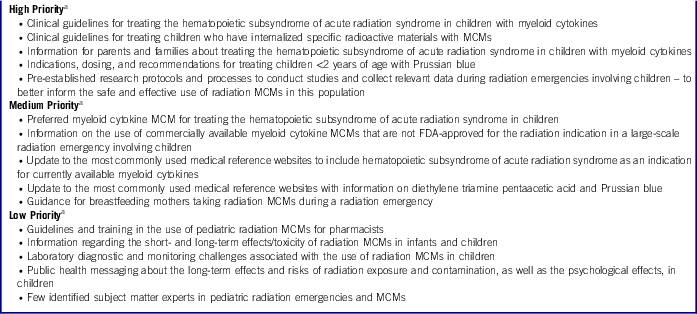
We identified 15 key gaps related to the use of radiation MCMs in the pediatric population. These were categorized as high (n=5), medium (n=5), or low priority (n=5). The high priority gaps included areas lacking clinical guidelines, patient and family information, indications for the youngest children, and pre-established research protocols to improve the knowledge base (see Table 2).
Prioritized Gaps in Pediatric Radiation Medical Countermeasures (MCMs)

a Determinations on prioritization were made as referenced in the Data Abstraction and Analysis section.
DISCUSSION
Large-scale radiation and nuclear disasters are uncommon, but when they occur, children are expected to be disproportionately affected. Identifying and addressing information gaps in the effective use of radiation MCMs in children are important steps in improving our nation’s preparedness and response to a significant radiation emergency.
High Priority Gaps in Pediatric Radiation Medical Countermeasures
No Clinical Guidelines for Treating the Hematopoietic Subsyndrome of Acute Radiation Syndrome in Children With Myeloid Cytokines
No clinical guidelines or guidance statements for using myeloid cytokines to treat children with H-ARS were identified. Most clinicians will not encounter radiation casualties in their entire career, let alone a child with H-ARS. However, despite the low frequency of these events, the results of an inadequate response or delayed treatment could have negative consequences. Many clinicians are unfamiliar with basic treatment principles for radiation injuries, and treating children in these rare circumstances will require direction and guidance, particularly regarding the use of myeloid cytokines.Reference Koenig, Goans and Hatchett10 Decisions of whom to treat, when to initiate therapy, duration of treatment, which agent to use, and what parameters to monitor are not common knowledge, nor are they currently available in most common references or resources. Without ready, pre-incident access to needed guidance during such situations, clinicians will likely look to known and trusted sources – including public health, academic, or government entities – for the direction they need. Just-in-time crucial communication to clinicians and public health officials will be dependent on an intact infrastructure, which may not be the case in a large-scale radiation emergency. As parents rely heavily on the recommendation of their child’s pediatrician, ensuring that pediatric health care providers have access to accurate and timely information will increase the likelihood of MCM uptake in the pediatric population.
No Clinical Guidelines for Treating Children Who Have Internalized Specific Radioactive Materials With Medical Countermeasures
Similarly, limited clinical guidelines or guidance statements exist for using MCMs to treat children who have internalized specific radioactive materials. While there is some guidance available for the use of potassium iodide11 in treating children who have internalized radioactive iodine (I-131), there is little guidance available for the use of Ca-DTPA, Zn-DTPA, or Prussian blue in chelating the radionuclides (plutonium/americium/curium; and cesium/thallium, respectively) affected by these pharmaceuticals. There are limited dosing recommendations in the package inserts for the DTPAs and Prussian blue, but no comprehensive pediatric guidelines were identified.
Information Is Lacking for Parents and Families About Myeloid Cytokine Treatment of Children With the Hematopoietic Subsyndrome of Acute Radiation Syndrome
There is very little information available for the public about the use of myeloid cytokines in treating H-ARS and no pediatric-specific information designed for parents and families. Each of the drug manufacturers provide online instructional videos for the self-administration of their product, but none of these specifically addresses pediatric dosing or administration. Although the CDC has a public information page on the use of Neupogen®, it provides little information regarding the treatment of children with myeloid cytokines.12 Without pre-established informational resources for parents and guardians, the burden of caregiver education is born solely by the health care provider. This will be challenging for 2 reasons. First, most clinicians have a limited understanding of radiation injuries, H-ARS, and treatment with myeloid cytokines, as noted previously. Second, providing this information in a timely manner to the large numbers of families needing it following a large-scale radiation emergency, the type most likely to result in acute radiation syndrome, would be difficult in the best of times, and only more so in the face of the anticipated infrastructure destruction accompanying such scenarios.
Indications, Dosing, and Recommendations Are Lacking for Treating Children <2 Years of Age With Prussian Blue
Prussian blue is the MCM of choice for treating radiation exposure from Cesium (Cs-137), a radioisotope used in radiation therapy, industrial radiography, and a byproduct of nuclear power plants.13 Dosing and administration guidance for Prussian blue is available for children as young as 2 years of age. However, the MCM has not been approved for use in children under 2 years of age. A Pre-EUA has been filed with the FDA but is limited to the population between 6 and 23 months of age due to the inherent challenge of solubilizing and suspending the currently available formulation into a liquid suitable for infants less than 6 months of age. The existing 500 mg capsules are not necessarily feasible for toddlers either. In February 2011, the Biomedical Advanced Research and Development Authority (BARDA) awarded a contract to develop a Prussian blue formulation for newborn infants to children up to age 2 years.14 Nevertheless, there is currently no publicly available guidance for the use of Prussian blue in this vulnerable segment of the pediatric population.
Need for Pre-Established Research Protocols and Processes to Conduct Studies and Collect Relevant Data During Radiation Emergencies Involving Children – To Better Inform the Safe and Effective Use of Radiation Medical Countermeasures in This Population
Fortunately, large-scale radiation emergencies are infrequent, and events affecting children are even rarer. Our present understanding is largely limited to data collected from events such as those in Hiroshima and Nagasaki, Japan; Chernobyl, Ukraine15; Goiânia, Brazil16; and Fukushima, Japan.17 It is therefore understandable that the evidence base and literature on the use of radiation MCMs in children are so limited. It is incumbent upon the academic and public health communities to be prepared to collect relevant data if a radiation emergency involving children occurs. The need for research-ready teams and processes has come to the forefront in recent years,Reference Lurie, Manolio and Patterson18 including considerations for pediatric research during public health emergencies.Reference Faherty, Rasmussen and Lurie19 At present, there are no known pre-established research protocols, institutional review board approvals, or processes in place to perform this critical research during a radiation emergency.
Medium and Low Priority Gaps in Pediatric Radiation Medical Countermeasures
There were 10 additional gaps identified which, although of lesser-anticipated impact to children’s outcomes in radiation emergencies, are worth further consideration. The medium priority gaps include (1) determining whether there is a preferred myeloid cytokine MCM for treating H-ARS in children, (2) information on the use of commercially available myeloid cytokine MCMs that are not FDA-approved for the radiation indication in a large-scale radiation emergency involving children, (3) updating the most commonly used medical reference websites to include hematopoietic subsyndrome of acute radiation syndrome as an indication for currently available myeloid cytokines, (4) updating the most commonly used medical reference websites with information on DTPA and Prussian blue, and (5) guidance for breastfeeding mothers taking radiation MCMs during a radiation emergency. The low priority gaps include (1) guidelines and training in the use of pediatric radiation MCMs for pharmacists, (2) information regarding the short- and long-term effects/toxicity of radiation MCMs in infants and children, (3) laboratory diagnostic and monitoring challenges associated with the use of radiation MCMs in children, (4) public health messaging about the long-term effects and risks of radiation exposure and contamination in children, and (5) identified subject matter experts in pediatric radiation emergencies and MCMs.
Limitations
The conclusions in this report are subject to some limitations. Although the literature search included widely accepted and reputable sources, additional resources and references relevant to the review may have been missed. There are other documents, correspondence, and resources shared and exchanged among governmental entities and partners that are not available in the public domain. These may provide valuable insight and help augment radiation emergency preparedness measures. In addition, the search was limited to the English language, and additional sources of information (eg, from Chernobyl, Ukraine and Goiânia, Brazil) may have been overlooked. Finally, the paucity of research and published manuscripts regarding the use of radiation MCMs in children limited our ability to draw conclusions based on broad clinical evidence or experience but further supported the need for this analysis and future study.
CONCLUSIONS
Key gaps exist in information to support the safe and successful use of MCMs in children in the event of radiation emergencies; failure to address these gaps may have negative consequences for families and communities. There is a clear need for pediatric-specific guidance to ensure that clinicians can appropriately identify, triage, and treat children who have been exposed to radiation and a need for resources for clinicians, parents and families, and pharmacists to ensure clear, accurate communication about the safety and utility of administering radiation MCMs to children.
Potential next steps include developing clinical guidance for treating children with exposure to radioactive material and H-ARS, developing a robust suite of communication tools on the safety and utility of radiation MCMs for all key audiences, developing a comprehensive implementation plan including crisis standards of care guidance, and encouraging further research into the use of radiation MCMs in the pediatric population.
Acknowledgments
The authors gratefully acknowledge the contributions of Dr Carol Pertowski.
Funding
This publication was supported by the Office of Public Health Preparedness and Response (Contract ID 200-2015-63464) and funded by the Centers for Disease Control and Prevention.
Conflict of Interest Statement
The findings and conclusions in this report are those of the authors and do not necessarily represent the official position of the Centers for Disease Control and Prevention. Use of trade names and commercial sources is for identification only and does not imply endorsement by the Centers for Disease Control and Prevention, the Public Health Service, or the US Department of Health and Human Services.