With the modesty then expected of a daughter of Britain's theatrical royalty, Fanny Kemble attributed the necessity of her 1829 stage debut to the hard circumstance of financial need. As she explained in her journal, hers was not an act of self-promotion; rather, she exposed herself to the scrutiny of London's critical establishment with the hope that interest in her performance might draw much-needed revenue into the cashbox of the Theatre Royal, Covent Garden, a venue jointly managed by her father and uncle, Charles and John Philip Kemble. However rhetorically necessary the narrative was for preserving her respectability, Kemble's financial motivation was also very real. The theatre was fiscally impaired, never quite able to square itself in relation to the expensive footing upon which the new building was erected after the fire of 1808. With construction costs high and materials scarce in the midst of the Napoleonic Wars, Charles attempted to raise ticket prices in the new theatre to help cover his expenses, raising instead public ire, in the form of protracted demonstrations known as the Old Price Riots, which bullied him into restoring the original ticket prices.
Fanny Kemble's stage success was due to more than interest in her as Charles's daughter and niece to John Philip and his sister Sarah Siddons. However many tickets were sold to satisfy public curiosity about the propagation of talent within this famous family of actors, Kemble's success was due as much to her own keen understanding of the stage as it was to a burgeoning fan culture. Critically lauded both at home and in the United States, where she and her father toured in 1832–3, Kemble revealed an ability to adapt her technique to changes both aesthetic and cultural, modeling a style of acting that encoded the economic anxieties that prompted her onto the boards, even as it helped ameliorate them. Those anxieties, as we shall see, were not limited to the feelings of financial insecurity individuals such as Kemble's father experienced. Rather, they were broad in scope, pertaining to larger systemic changes within the British and, with important differences, American economies at the turn of the nineteenth century. The primary locus and agent of this change was the modern bank, which emerged over the course of the long eighteenth century, consolidating the nascent nation-state through the introduction of a national paper currency that was backed by a central governmental authority and based on tax revenues.Footnote 1
In this essay, I read Kemble's style of acting—known as acting on “points”—within the context of this economic history, arguing not only that the “point” facilitated an aesthetic shift from the declamatory style of neoclassicism to the emotional realism of Romanticism but that this transitional technique also effected a cultural shift, one that helped audiences adapt from a specie economy, based upon intrinsic value and secured through the practice of interpersonal exchange, to a representational economy, based upon paper money that circulated abstractly through a national system of managed credit and debt. Taking as my example Kemble's performance, beginning in 1831, of Bianca in Henry Milman's play Fazio (1815), I demonstrate how, in this play about shifting registers of value, Kemble transacted a new type of representational exchange—one that helped audiences accept the economic changes that were defining them as citizen-consumers within a nationalizing economy. That Kemble performed on both sides of the Atlantic makes her a particularly compelling case study during this period of uneven economic development within the larger period of modernity.
In reading an aesthetic development in light of economic change, I follow not only theatre historians such as Tracy C. Davis, who illuminates the shifting relations of theatre production in this period, but also literary historians such as Walter Benn Michaels, Mary Poovey, and Deidre Shauna Lynch, who persuasively argue that economic relations were not merely the subject of literature during the eighteenth and nineteenth centuries but were also shaping influences upon its aesthetic forms.Footnote 2 But where Michaels, Poovey, and Lynch focus on the medium of print, I consider the more fluid representational medium of acting in order to understand the aesthetic processes by which audiences accommodated themselves to changing economic and social relations. Social meanings, in other words, are embedded not only in the narrative form of drama but also in the aesthetic form of acting, where they are activated by the dynamic—and historically changing—actor–audience relationship in performance. I argue that in performing the “point,” actors such as Kemble modeled new relationships onstage that both represented and enacted new habits of exchange, helping audiences adapt to a modernizing world.
Allegories of Value: Henry Milman's Fazio
In 1797, as the French Revolution bled into the Napoleonic Wars and the Bank of England's coffers were drained, the English Crown suspended the conversion of paper money to gold until 1821. Between those years, Britons had to learn to accept the representational value of the paper pound note, which was guaranteed by the authority of the British government. But this was not a foregone conclusion. Many Britons had been dispossessed in the Great Recoinage of 1696, which outlawed representational tokens of exchange in favor of gold and silver coins issued by the Royal Mint, making official a long-standing policy of “intrinsick value.”Footnote 3 As historian Deborah Valenze has discussed, “a two-tiered system of coinage” had been in effect prior to the Great Recoinage; the Royal Mint issued coins whose weight in specie reflected intrinsic value, and commercial tokeners produced representational tokens of exchange whose value “rested simply on the assumption of continuing neighborhood custom and popular trust.”Footnote 4 After the Great Recoinage, such tokens were officially outlawed, robbing the lifeblood of the tradespeople and commoners among whom they circulated. One hundred years later, Britons were effectively being asked to reverse course and convert from a system of intrinsic value to one of representational value. Given the uncertainties of war and the state of exception, they were understandably nervous.
Across the Atlantic, Americans experienced similar anxieties about the representation of value. Although paper money (e.g., in the form of tobacco certificates and even playing cards) had long been in circulation due to royal prohibitions against a colonial mint, rates of equivalence were unsettled, and no central banking authority in the new country regulated exchange among the thousands of regional banknotes in circulation. Indeed, in the United States, banks were individually chartered by the states; each bank issued its own paper notes in a decentralized system that would become known as “free banking.”Footnote 5 Anti-Federalist sentiments derailed repeated attempts to establish a national Bank of the United States. Alexander Hamilton first proposed such a bank in 1779, but it was not founded until 1791 because of concerns Thomas Jefferson, James Madison, and other southern agrarians voiced about centralizing the nation's banking authority in the hands of an urban mercantile elite. When the bank's charter elapsed in 1811, those concerns emerged again. President Madison, however, recognizing the need for a central bank to stabilize the national debt in times of war, changed his mind, and urged Congress to reestablish the Bank of the United States in 1816. After the Second Bank was caught up in a speculative land bubble that burst, its officers were charged with mismanagement and larceny, and the institution came under suspicion again.Footnote 6 Its new president, Nicholas Biddle, restored its integrity, leading Kentucky senator Henry Clay to urge Congress to renew its charter in 1832—before its expiration—in a political attempt to keep the issue out of that year's presidential election. Interpreting this preemptive move as a financial coup d'état, President Andrew Jackson vetoed the legislation and rode a wave of popular outrage against the “Monster” to defeat candidate Clay. Jackson literally dismantled the financial infrastructure of the Second Bank of the United States by redistributing its deposit of federal reserves among designated state banks. This put the issue of a federal bank to rest until after the Civil War. The federal government did not issue the paper dollar until 1862, and the Federal Reserve was not founded until 1913. Throughout the long eighteenth century and well into the nineteenth century, economic vicissitudes in both countries provoked questions about the certainty of value, leading Britons and Americans to harbor attitudes of distrust toward any exchange of represented value—including those transacted onstage.
Such fears and uncertainties inform Henry Hart Milman's verse drama Fazio, written in 1815 at the close of the Napoleonic Wars but six years before the Bank of England lifted its restrictions on converting the pound note to gold. The play, which was enormously popular on both sides of the Atlantic, articulates popular fears about paper money and the opacity of a centralized banking authority, and stagings of it should be understood alongside other contemporary performances such as parliamentary and congressional debates, as well as the stump speeches made by Surrey-born newspaper publisher and popular firebrand William Cobbett, who preached the value of a specie economy to rural audiences in both England and the United States.Footnote 7 However different the two countries were in terms of their economic policies at the turn of the nineteenth century—differences that included trade restrictions and government charters (in the United Kingdom) versus a policy of “free trade” and limited liability corporations (in the United States)—they both provided receptive audiences for Milman's play.Footnote 8
Fazio, which went into production almost immediately upon its publication in 1815, continued to be performed regularly throughout the nineteenth century, finally losing currency in the United Kingdom around 1845 and in the United States around 1865. As we shall see, these dates invite interesting questions about the cultural work the play—and its actors—performed for audiences in each of these different contexts; concerns with money and value are encoded in its metaphorical language and thematic design.
The story of the play, which circulated in the popular press under titles such as “The Alchymist” or “Grimaldi,” derives from Boccaccio's Decameron. In Milman's treatment, the title character is Giraldi Fazio, a Florentine alchemist, who is poor at turning dross to gold but is rich in the affection of his devoted wife, Bianca. Together, they live a happy but humble life until their fortunes change instantly when a neighbor, the miserly Bartolo, shows up at Fazio's door, having been fatally stabbed by a band of robbers. Bartolo, a Jewish pawnbroker,Footnote 9 has been marked for his riches, but, as he explains to Fazio, the robbers did not get his keys, so he dies knowing that his riches are safe, even as he laments the lost profits from an as-yet-unsigned mortgage. Alone with the corpse, Fazio ponders Bartolo's situation, recognizing that the riches Bartolo has stored up in life will not accompany him to heaven. Yet, failing to heed the moral lesson of that homily, Fazio sees “a shorter path to fame and riches,”Footnote 10 buries Bartolo's body in his yard, and assumes his wealth as his own.
Newly ascendant in the social firmament, now “Lord” Fazio experiences temptation once again, falling into the seductive arms of the Marchesa Aldabella. In a fit of jealousy, Bianca informs against her husband, naively thinking that removing his ill-gotten riches will return him to her arms. When the duke and his council sentence Fazio to die for the murder of Bartolo, Bianca pleads desperately for his life, appealing in vain to her rival for help. Meanwhile, the imprisoned Fazio, repentant of his sins, takes full responsibility for his moral turpitude and forgives Bianca, recognizing that in her love alone was his greatest wealth. As Fazio's execution is signaled by the tolling bell, the duke, having learned the truth, posthumously exonerates him of Bartolo's murder, sentences Aldabella to a convent, and offers sanctuary to Bianca's children, who are orphaned when she dies of a broken heart. Thus the tragedy ends with Fazio's fortunes reversed in both economic and moral registers, as the laws of tragic structure are reinterpreted through a code of Christian ethics.
In one of the few literary-critical treatments of the play, Daniel Watkins reads the play's obsession with money as a symptom of the ideological contradiction between the aristocratic worldview that undergirds the play's structure (i.e., in its tragic form) and the bourgeois consciousness expressed in its action (e.g., the narrative of class ascent).Footnote 11 That contradiction, he suggests, is historical in two ways: by setting the play in Renaissance Italy, Milman addresses the moment of capitalism's emergence, and by treating money as the engine of class ascent, Milman documents the social disruptions capitalism causes in his own moment. Without wishing to dispute Watkins's account—indeed, his reading aptly captures the play's anxiety about capital's disruptive force—I wish to narrow his focus on the epoch of capitalism's emergence generally to the moment of the play's composition and track the several moments and locations of the play's reception. The anxiety the play expresses is not merely a symptom of the broad social disruptions caused by the displacement of an aristocratic social order with new networks of capitalist exchange; it also exists in the very acts and instruments of exchange through which new social networks were forged, especially when those acts of exchange featured a currency whose value was only representational and was backed by an abstract authority far removed from the moment of trade. Such instruments take on a moral value in Milman's play, where intrinsic value refers not only to specie but also to the constancy of human love, and where redemption is either contingent—based on political necessity, like the Bank of England's wartime policy on converting paper to gold—or fixed, whereby an act of grace offers the lasting reward of spiritual salvation.
Cultural anxieties about money and modern banking circulate throughout the play, erupting in its metaphorical language and informing its thematic structure. When Bianca is mad with jealousy, for example, she imagines that Fazio's infidelity enacts an exchange between her and Aldabella, making an equivalence between them that debases the value of her love:
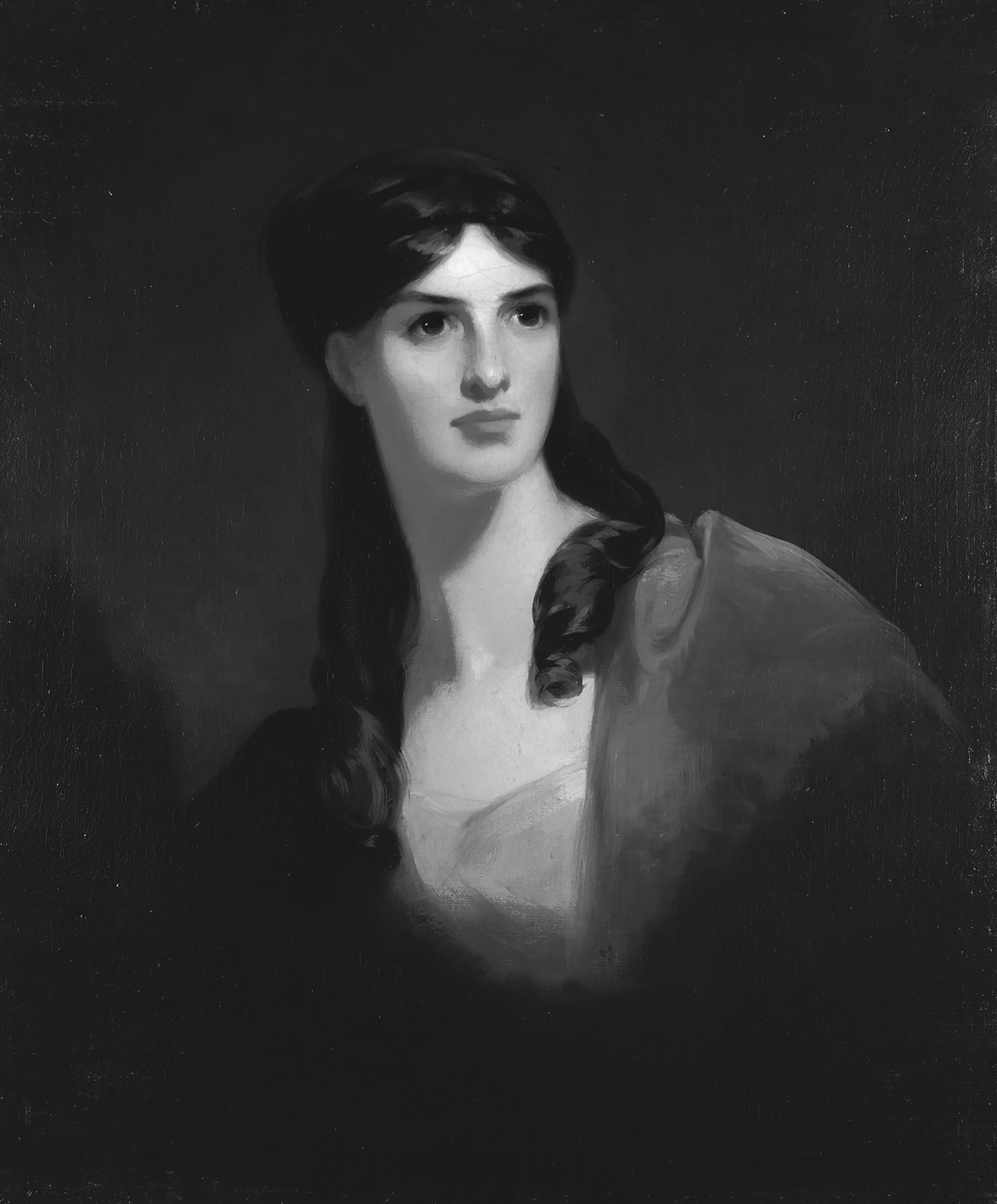
In Bianca's tortured imagining, Fazio substitutes her rival for herself and herself for her rival, becoming the center of an exchange where one is “the same” as the other. She hastens to qualify “or ’twill seem so,” desperately insisting upon a difference between the base substance of her rival's affection and her own precious love, fearing that the failed alchemist will make a false equivalence (Fig. 1).
Frances Anne Kemble as Bianca, 1833. American portraitist Thomas Sully captures the steady resolve of Kemble's countenance, representing Bianca as an emblem of constancy and intrinsic moral value. Kemble's costume—a gold dress wrapped in an earthy brown mantle—suggests her character's metaphorical function within the play's economic allegory. Courtesy of the Pennsylvania Academy of the Fine Arts, Philadelphia. Gift of Mrs. John Ford.

But if Bianca is gold in the alchemical metaphor, Aldabella is more than simply dross, as her high social stature suggests. In the play's poetic language, she is likened to a bill of exchange that bears the signature of one man—her wealthy uncle—as promise of payment to another. Explaining why she disdained Fazio in their youth, the fickle Aldabella tells him that her uncle, the Condé d'Orsoa, “deem'd me a fit mate/For highest princes; and his honest flatteries/So pamper'd me, the fatal duteousness/So grew upon me” that she felt compelled to renounce her love for him.Footnote 13 But as we see her dispense her affections liberally upon the newly wealthy and now-married Fazio, Aldabella draws against her own account, throwing into doubt the reliability of the value she claims to represent.
At the center of this exchange is Fazio, whom Milman presents as rationalizing his actions on the basis of self-interest and short-term gain. He offers various excuses to justify his postmortem theft, for example telling himself that Bartolo's riches are “but a quit-rent for the land I sold him,/Almost two yards to house him and his worms.”Footnote 14 He then reasons that because Bartolo had no kin, he would have left his riches to the state but thinks, “Marvellous little owe I this same state,/That I should be so dainty of its welfare.” On the contrary, he thinks, he aids the state—and its economy—by spending these riches and putting them back into circulation, rather than allowing them to remain “close-lock'd treasures.” Indeed, he is a liberator, proclaiming to the coins slipping through his fingers that,
Such was the argument Adam Smith made against the mercantile system in favor of a credit economy, in which specie reserves are not hoarded in a vault but are rather freed to circulate through loans that generate interest.Footnote 16 It was also, as Jennifer Jordan Baker observes, a point Benjamin Franklin made in 1729: “Money which otherwise would have lain dead in [bankers'] Hands, is made to circulate again thereby among the People.”Footnote 17
As this suggests, the play's love triangle gives expression to more than just feelings of sexual jealousy, inviting us to regard its three characters and the relations of exchange among them as part of a cultural allegory in which the pure and ever-faithful Bianca is gold, the duplicitous Aldabella is paper money, and Fazio, the careless deceiver of Bianca's love, is the bank that would claim a functional equivalence between the two. This reading suggests why the play was enormously popular among audiences who were adjusting to the new values and relations of exchange associated with the rise of modern banking. In identifying with Bianca, reviling Aldabella, and feeling pity and fear for the blind ambition that leads to Fazio's infidelity, audiences could reroute their anxieties about money through an allegory that confirmed their suspicions about paper money and a bank that would sell them short. This is not to say that they did so with awareness or, indeed, that Milman set up this allegory with conscious intent. But as even a cursory synopsis of the play makes clear, money is an explicit theme and functions as a metaphorical vehicle in much of its poetic language.
Yet while the allegory would seem to condemn the Bank of England (and banks generally) in Act III, its terms curiously shift later in the play, when the condemned Fazio divests himself of his earthly possessions in preparation for his execution. When Philario, his loyal retainer, visits him in jail, Fazio entreats him to take Bianca's portrait, lest “the coarse and vulgar executioner/Should handle it with his foul gripe.”Footnote 18 As Fazio takes the picture from his pocket, he inadvertently extracts a gold coin, prompting Philario to ask if he should take that to Bianca as well. Fazio remonstrates wildly:
As the language and the implied staging make clear, Bianca and the coin are incompatible. Although earlier in the play Bianca's love was functionally equivalent to gold, here, Fazio refuses the allegorical relationship as he invokes a different register of value. As Fazio recognizes, gold is what it is and nothing more; its exchange value is a temptation to indulge the earthly sins of greed and lust. As such, it is a “pestilence” that “Laid waste” the “Eden” of his happy life with Bianca. Recognizing that Bianca's true value is of another, more spiritual kind altogether, Fazio repents his sins and is redeemed. Here, the playwright (later the church historian and dean of St. Paul's Cathedral) transmutes the play's concerns with value into a moral register, accruing greater meaning for his theme. To a certain extent, the play's action necessitates this shift from financial to spiritual redemption. After all, audiences would be discomfited if Fazio were executed without proper absolution, especially since he is not actually guilty of murder, and the shift from economic to moral values accomplishes this.
But Milman further complicates the play's climax when he sets the coin in relation to Bianca's portrait. A common stage convention, the portrait metonymically stands for the character who cannot be present in the scene. But in Milman's hands, it takes on greater significance. Fazio's choice of Bianca over the coin is not only an affirmation of moral over economic value but also a claim that is staked for a representation over the real. Unlike the coin, which has intrinsic value, Bianca's portrait has value only insofar as it represents her and all that she represents. This may seem strange, given the drama's seeming distrust of paper money at a time when the Bank of England had suspended the redemption of paper banknotes for gold. But the play suggests that there is an important difference between worthless bills that claim to be what they are not—as figured by Aldabella—and paper that is backed by that which it represents. In the case of the Bank of England's paper banknotes, their value was backed by the authority of the Crown. That guarantee proved essential to the stability of the pound note—as well as that of the Bank of England and, indeed, of the British state during this tumultuous period of economic uncertainty.Footnote 20 This backing, the play's resolution implies, justifies the representation, allowing it to substitute for what it appears to be. In this way, the play invites audiences to accommodate themselves to a paper currency backed by the authority of the government, for in it lies real value—both moral (i.e., patriotic) and economic.
If, as I suggest, Milman's play imaginatively reroutes its audiences' anxieties about money by transferring their suspicions about bank-issued pound notes onto bills that are counterfeit, then the play's resolution would also need to reaffirm the authority of the state. This is why the duke must exonerate Fazio—if only posthumously—of the murder charge. In recognizing that Fazio is not guilty, the duke redeems not only Fazio's honor but also his own authority by aligning himself with the truth. This is also why Aldabella's sentence—which otherwise seems gratuitous—is necessary; the duke must restore moral as well as civil order. Eliding the moral and economic registers and collapsing the representation into the real, Fazio invites audiences to project their fears of economic uncertainty onto a villainess who is expelled from the world of the play and to believe in a figure of moral virtue who is presented to them as a representation.
Indeed, Bianca is a representation, even when she appears to them in the flesh of the actor who portrays her—whether this was Eliza O'Neill, whose incarnation of the role inspired Percy Bysshe Shelley (Milman's classmate at Eton) to write the part of Beatrice for her in The Cenci, or any of a number of actresses who cherished this complex and career-making role.Footnote 21 As we shall see in the following sections, the “point” technique that was foundational to the Romantic style of acting allowed actors to shift between their real offstage identities and the identities they represented onstage. In this way, Fazio inscribed a performance technique that imbued the role of Bianca with the concerns of the play. It thus invited its audiences to assume a new relationship to representations of value that could help them adapt to the changing status of paper money.
Transacting Value
In 1833, Boston socialite Anna Cabot Lowell Quincy recorded in her journal an account of the stunning performance she had witnessed earlier that night by Fanny Kemble in the role of Bianca:
The moment which I think produced most effect on the house was at the moment when Fazio is to be led off to execution in the prison. She has just been imploring the jailer to delay a few moments in the most passionate manner, when the bell tolls, the sound of which seemed to turn her into marble. She stood riveted to the spot—her eyes fixed, her cheek pale and ashen. Fazio embraces her, but she is entirely insensible of it, and he is led off the stage leaving her the solitary figure. She stood, I should think, five moments, a perfect statue, and the deathlike stillness that reigned over the crowded audience, every person seeming to hold their breath, was very striking. “She stood the bloodless image of despair” until the bell tolled again.Footnote 22
Quincy's account is remarkable for several reasons, not least of which is the close attention she pays to a single moment of Kemble's performance, recording Kemble's passions and movements in her interpretation of the role, the audience's rapt regard for the character's plight, and the actor's skill. Capturing a suspended moment of Kemble's performance, Quincy's journal entry focuses on a wordless pose brimming with meanings that exceed the spoken dialogue.
The technique Kemble used—known as a “point”—was marked by the actor's use of voice and body to realize images and meanings within the poetic text. This technique emerged at a transitional moment between the declamatory style of neoclassicism, which valued decorum—the actor's ability to speak the dramatic poetry meaningfully, using voice and rhetorical gesture to illuminate salient tropes—and Romanticism, which valued a realistic rendering of the passions that motivated a character's actions. The term seems to have been borrowed from the elocutionary reform movement that appeared in the mid to late eighteenth century, when rules of decorum were adapted to fit a new style of delivery that was beginning to emerge onstage.Footnote 23 For the elocutionary reformers, the term referred to a stop, or a “point” of punctuation—a period, a comma, a semicolon, and so forth—where the orator or actor should pause to aid the auditor's comprehension. While some reformers—such as actor-manager Thomas Sheridan (the father of playwright Richard Brinsley Sheridan)—urged a return to traditional styles of declamation where an unbroken cadence should be used to indicate metric regularity, others—such as rhetorician John Rice—praised the innovations of actors, such as David Garrick, who inserted unexpected pauses to open up new interpretations of dramatic texts.Footnote 24 Because Garrick often filled those pauses with facial expressions, changes in posture, or gestures that indicated his character's emotional state, he heralded a new style of acting that Joseph Roach identifies with a post-Cartesian shift in understanding bodily response.Footnote 25 That new style was often discussed in terms of the sublime.Footnote 26 The aesthetic experience that word describes—of reconciling conceptual opposites such as terror and pleasure through a visceral bodily response—pertains not only to the spectator's reception but also to the actor's performance in that the body materializes meanings that augment or even contradict the form or semantics of the dramatic dialogue. Thus, the “point” became a way of signifying meanings that surpassed the implied meaning of the poetic text.
Consider, for example, this review of an 1831 Covent Garden performance of Fazio, written before Kemble and her father left for the United States. The British reviewer calls attention to the complexity of the role, noting with masculinist admiration that Kemble's Bianca
is a woman drawn out of the very heart of the sex; with that mixed violence and tenderness, that self-devotion and unreasonable demand—that affection that runs by turns into all-confiding weakness or querulous suspicion; that is all agony over a doubt, or all joy in its own flatteries; that rushes to the extremes of the sentiment before patient thought can traverse the distant limits; is made up of boundless generosity and boundless avarice; is the dove and eagle commingled; and is as patient under misfortune as it is fierce under wrong—the strange but sublime contrarieties that belong to the nature of woman. For the filling up of this arduous portraiture, Miss Kemble deserves the highest praise.Footnote 27
A New York reviewer likewise remarked upon Kemble's ability to exhibit such seeming contradictions with conviction and fluid ease in this 1832 review:
Among her best points here was her threat to Fazio, that if he pronounced his rival's name she would hate him, ferociously uttered, and instantly recalled by a gush of tenderness, as capricious jealousy relented and yielded to love. Her convulsive agony at the news that her husband was feasting with Aldabella, and her gaze of indignant and lofty displeasure at the menial who stood watching her tortures—her struggle and command—“Officious slave—away!” so haughty, yet choked with the anguish of a swelling heart, and the impatient bend of the arm to accelerate the mandate which her voice was yet unable to utter, although received in silence by the audience, at once stamped this young girl as the possessor of genius of the first order.Footnote 28
That these reviewers remark upon Kemble's “sublime contrarieties,” where words and passions were often counterpointed to poignant effect, suggests that her performance was felt to be something new. Clearly they admire the actress's ability to realize the character she represents, even as they marvel at her ability to render Bianca both as an individual with her own emotional and psychological particularity and as an exemplar of an idealist conception of “woman.”
Like these reviewers, Quincy, too, identifies Kemble's performance in terms of a reconciliation of opposites that approaches the sublime. Attesting to the transitional function of the “point” between the declamatory and Romantic styles, Quincy notes that Kemble stood “a perfect statue,” an image that hovered between the iconographic, inviting audiences to “read” it much like a neoclassical tableau vivant, and the realistic, seducing them into a fictional realm where Bianca's embodied passions felt real. Kemble used her voice and gesture to represent Bianca's insensible grief with such conviction that Quincy was moved both to sympathize with the irascible woman whose jealousy had cost her the love she desired to save and to admire Kemble's realistic rendering of her character's quixotic passions. This ability to move between the representational and presentational aspects of the performance exemplifies Bert O. States's conception of “perceptual synthesis,” the audience's ability to attend simultaneously to the performed reality of a character and the actor's virtuosity in creating it.Footnote 29 What interests me about Quincy's response is what it reveals about the way audiences in the Romantic era were shifting their habits of reception from attending to the declamatory actor's technique, informed by idealist aesthetics, to the represented passions of an increasingly realistic character, capturing a moment when both perceptions were synthesized into a visceral bodily response—one presumably experienced by both the actor (or so the paradox would have it) and the audience.
While virtually all performance invites actors and audiences to move between presentational and representational frames, the “point” emerged as a formal convention during this period to underwrite an especially complicated transaction. As we have seen, Kemble was an instant celebrity from the moment of her stage debut. To audiences who recognized Charles's daughter and John Philip and Sarah's niece upon her entrance, the “point” enabled Kemble to shift between her social identity as a Kemble and the fictional identity of Bianca, the character Milman scripted with such emotional complexity.Footnote 30 What is more, it enabled Kemble to invite audiences to perceive her character as momentarily real—as a woman who inhabited the fictional world of the play—and as a literary element that contributes meaning to the overall poetic design of Milman's play.
Most histories of acting trace a larger shift from the declamatory to the Romantic style, but lost within that narrative arc is this important moment of transition in which the “point” emerged to effect a shift not only between these aesthetic modes but also between the habits of reception audiences trained on the social realities such modes expressed. Those social realities appear not only in the content of a play, but also in its form. As Fredric Jameson has demonstrated, form is meaningful, too; it encodes social realities that cannot otherwise be expressed.Footnote 31 If we bring such insights to bear upon the performance form of Kemble's “point” in Fazio, then we can see how it may have functioned to activate—however unconsciously—the cultural allegory in Milman's play. By enacting an exchange of representation for real, it offered a formal resolution to the contradictions that audiences were then experiencing with regard to the value of paper money.
Fazio may thus be read as exerting a rhetorical force on popular attitudes toward the value of paper money, helping to quell anxieties in this protracted moment of economic uncertainty. Inviting audiences to identify Bianca as a source of value, the play also asks them to accept the portrait of her—a representation—as having value because it is backed by the real that is Bianca herself. That the “real” Bianca was actually a representation incarnated by Fanny Kemble enacted a double displacement of value that the audience was able to experience directly. The audience, in other words, was a party to the transaction, negotiating the exchange between Kemble's fictive and social identities, trading their applause for a moment of complete and utter absorption in the fictional world of the play. As a trading partner, the audience was able to trace the representation back to its material source, demystifying the process of exchange the play symbolically enacted. If, as Peter de Bolla suggests, the rhetoric of “excess” that marked Romantic discourses of the sublime encoded contemporary anxieties about the effects of economic inflation, then we might see Kemble's “sublime” performance as a material example of the expression and perhaps also the amelioration of those concerns.Footnote 32
Kemble's performance of Milman's play is thus brilliant dramaturgy. It uses the convention of the “point” to enact an exchange that the play effects in its symbolic register, rendering its meanings in a way that exceeds the text to present her audiences with a sublime and satisfying aesthetic experience. As we shall see, however, reception of the play changed as both the economic anxieties it encoded and the “point” that functionally eased those anxieties began to disappear.
Shifting Registers of Literary and Theatrical Value
If the turn of the nineteenth century was marked by vicissitudes in monetary value in both the United Kingdom and the United States, it was also marked by uncertainties about other kinds of value—literary, cultural, moral, social, and political. Attempts to stabilize literary and cultural values were often directed toward the theatre, especially with regard to the regulation of public conduct. The 1737 Theatrical Licensing Act, which authorized the Lord Chamberlain to censor spoken-word dramas deemed unfit for public consumption, was followed in 1751 by the Disorderly Houses Act, which attempted to impose a like order on public behavior in all entertainment venues except the two patent houses, Covent Garden and Drury Lane. As scholars have established, the effects of these acts were broad, effectively implementing a cultural hierarchy that extended from the “legitimate” theatre, which was designated as a preserve of aesthetic ideals and literary value, to the low end of mass entertainments, which offered a predominantly sensory appeal (e.g., melodramas, musicals, ballets, pantomimes, rope dancing, animal acts, panoramas). Fazio began at the top of this cultural hierarchy (its first review, in 1816, praised it for its literary merits) before descending to the bottom; by the end of the nineteenth century, it was critically appraised as having virtually no literary or theatrical value at all. Fazio's debasement is notable not only for its extremity but also for the ways its literary and theatrical values were set at odds.
Although Fazio was written as a verse drama, it was first produced—apparently without Milman's knowledge or permission—as a melodrama entitled The Italian Wife at the unlicensed Surrey Theatre, where musical accompaniment was added so as not to violate the patents' monopoly on spoken-word drama.Footnote 33 Such tactics, while technically within the letter of the law, were popular with audiences who recognized the increasingly arbitrary distinction between “legitimate” and unlicensed theatres. Indeed, the distinction was buckling under pressure not only from managers of unlicensed houses such as the Surrey but also from those at patent houses such as Drury Lane, where Garrick had transformed “legitimate” stage acting by introducing pantomimic techniques he had borrowed from John Rich, the popular harlequin actor at Covent Garden.Footnote 34
Elocutionary reformers sought to restore decorum by regulating the line between propriety and excess in an attempt to maintain a literary standard in the legitimate theatre. For such arbiters of literary value, the declamatory theatre appealed to the ears of its aptly named “audience”: actors presented poetic verse using skillful oral delivery and restrained gestures. For investors in Romanticism's nascent realism, “pointed” effects converted audiences into “spectators,” as actors rendered their characters' passions and motivations in newly legible ways. The “point,” which existed at the fulcrum of this stylistic change, was variously practiced; some actors leaned toward the declamatory end of the continuum, whereas others shifted the weight of history toward Romanticism and moments of heightened emotion. By the end of the nineteenth century, Romanticism had elongated into more a sustained style of verisimilitude, aided by innovations in architectural, scenic, and lighting design. Functioning as a mechanism for negotiating the terms of the actor's exchange of representation for the real, the “point” also shifted the standard by which the theatre's literary and cultural value was measured.
Kemble discerned this shift, even as she helped effect it. In the fall of 1832, having just embarked upon her U.S. tour, she ruminated in her journal on her father's finely detailed “points,” comparing them to the bolder motions of Edmund Kean. With the fidelity of a loving daughter, Kemble laments the fading regard audiences have for her father's restrained and statuesque style of delivery, increasingly accustomed as they were to the spectacular performances of an actor such as Kean who produced an “effect” upon their senses. Remarking on Kean, she observes that “Indeed, he is the better artist of the two, though probably not the most intellectual man.”Footnote 35 Her father's approach, by contrast, is so detailed that it requires “laborious and minute study” that is “toilsome” in both conception and execution. As she acknowledges, it is received by audiences in much the same temper: “Few persons are able to follow such a performance with the necessary attention, and it is almost as great an exertion to see it understandingly, as to act it.”Footnote 36 What Kemble realized is that the “point” her father practiced was quite different from the technique that Kean performed. Although personal style choices no doubt marked the two actors, Kemble also seems to perceive a generational—and, indeed, historical—shift; where her father nodded to the declamatory tradition's emphasis on poetry, Kean unapologetically interpolated moments of intense passionate expression. In the midst of this transition, audiences adapted their habits of attention accordingly, shifting from a regard for the play as literature to an appreciation of the passions that motivated its characters to act. As reviews of her performances testify, Kemble facilitated the theatre's shift toward the impassioned effects that Kean made famous, further hastening the obsolescence of her father's more declamatory style of “points.”
Increasingly, the ideas in Fazio also became subsumed by its passions, and the play became known for the opportunities it offered actors—especially actresses—to render such passions onstage. By the middle of the nineteenth century, the play had become primarily a vehicle for launching an actress's career.Footnote 37 Charlotte Cushman chose it for her London debut in 1845, making the part hers with a memorably intoned line that subsequent actresses copied.Footnote 38 Praising Cushman's performance in a panegyric, Chartist writer Eliza Cook poeticized, “I had seen many ‘fret and strut their hour;’/But my brain never had become such slave/To Fiction as it did beneath thy power.”Footnote 39 Matilda Heron performed the role in 1854, and one of the Miss Batemans from the famous theatrical family of the era (probably the American-born Virginia) chose it for an 1877 London appearance. By that time, however, the play was “out of fashion” and was associated with slavish realism.Footnote 40 The thematics and narrative structure of Milman's play—its economic metaphors and cultural allegory—were no longer registering prominently, if at all, with critics and (presumably) audiences in the third quarter of the nineteenth century. Ironically, Milman's attempt to return literature to the stage became known for the claptraps it offered actresses seeking to exhibit their emotional range, serving as little more than a thin narrative frame upon which to hang moments of heightened passion. As the play transitioned from literature to spectacle, it no longer needed the “point” to facilitate exchanges among its various representational levels. As audiences entered into and became absorbed by the fictional realm of the play, they attended less and less to its poetic tropes and figures.
Perhaps this is why Fazio's stock as literature dropped in value between its first review in 1816, when an anonymous reviewer in the Quarterly Review (probably J. T. Coleridge) admired it for soliloquies “of the rarest merit,” and 1909, when Arthur Symons dismissed the play for its “childishness of construction,” citing “the naïveté with which the speeches follow one another with too carefully irregular a logic of the passions” and the “quaint, unnatural neatness” of the play's “small scenes, with their brief statement, not action.”Footnote 41 Twenty years later, Allardyce Nicoll had even less to say, briefly citing Milman in a long line of failed would-be saviors of an early nineteenth-century stage indebted to the styles of the past.Footnote 42
One of the reasons Fazio's value plummeted in both literary and theatrical value may have been related to the 1843 Theatre Regulation Act, which ended the patent theatres' monopoly on spoken-word drama and extended the Lord Chamberlain's powers of censorship to all theatrical venues. As Tracy C. Davis observes, these changes were part of a general shift in Britain from a classical to a free-trade economy in which value was configured not in terms of social utility but rather in terms of the commodity market. This shift proved to be a mixed bag for the theatre. While it gave an economic rationale to the theatre that it had not had before (arguments about the moral utility of the theatre having had limited appeal), it also reduced the performer's body to the status of a commodity, with all the troubling implications that held for female actors.Footnote 43 As feminist scholars of the Victorian era have noted, any woman whose labor did not yield an alienable product risked becoming herself marked as a commodity. For such a woman to enter into a commercial transaction was thus to summon the metaphor of the prostitute, with all of its disabling discursive power.Footnote 44 As Davis notes in her exhaustive research on working actresses, very few appear to have actually engaged in prostitution, even if they were increasingly subject to the eroticization of a commodity spectacle.Footnote 45 Because of the emotional set pieces Milman scripted into his play, actresses essaying the role of Bianca were especially at risk of being reduced to a commodity whose erotic appeal was exchanged for the price of a ticket. Thus, the tendency for spectators to focus on realistic moments of intense passion at the expense of the play's aesthetic ideals and literary design was aided and abetted by the shifting economic attitudes toward cultural production and consumption Davis has traced.
Although such an explanation may account for why Fazio began to lose critical esteem and popularity in the United Kingdom at about this time, it does not explain why the play continued to be a success in the United States, or why it was popular there to begin with. (Indeed, as economic historian Richard Sylla has demonstrated, the U.S. economy provided the free-trade model that Britain adopted.) We may thus wish to consider other factors at work. While free trade opened up British markets, allowing for unprecedented growth throughout the remainder of the nineteenth century, it was not free from the anxieties associated with investment risk. What helped allay those anxieties in Britain—but not yet in the United States—was a stable national currency that was backed by gold and secured by the authority of the government. Significantly, in 1844, one year after it passed the Theatre Regulation Act, Parliament passed the Bank Charter Act, which ended another monopoly: namely, the Bank of England's control over London commerce. The new law allowed banks within the previously restricted thirty-mile radius around London to compete with the Bank of England in most banking functions, compensating the Bank of England by designating it the official sole issuer of the English pound note. Backed by the authority of the Crown, the Bank of England's pound note bound the commercial culture in which it circulated to a national culture. Although in real terms, the paper pound note represented a value that could be converted into silver or gold, in symbolic terms, it represented a social and psychological bond among the citizen-consumers between whose wallets it passed. The modern bank could thus be added to the cultural transformations Benedict Anderson outlines as necessary for the creation of the modern nation-state as an imagined community.Footnote 46 It not only rationalized citizens' investment and participation in the nation-state, it also offered them a means by which to make that imaginary transaction real: a single national currency.
The cohesion of that imagined community, however, was premised upon the exclusion of others—to whom Yuri Slezkine refers as “Mercurians,” strangers within a host society who perform valuable but often taboo forms of labor.Footnote 47 In early modern Europe, such “service nomads” were Jews who, as goldsmiths and pawnbrokers (like Bartolo), provided banking functions that were otherwise restricted by usury laws. As host societies coalesced into nation-states and restrictions on interest-generating loans were eased, non-Jews began to assume those banking functions, increasingly regarding Jews as ethnic rather than religious “others” and therefore as “not true citizens.”Footnote 48 As Slezkine points out, the rise of the nation-state tracks with the rise of anti-Semitism. We might thus read Fazio's assumption of Bartolo's riches as a way of figuring that historical shift; although innocent of murder, he vests himself with Bartolo's money and buries a body that, marked as Jewish, is rendered “corrupt.”
Despite the ethnic tensions that threatened to compromise its integrity, an English national identity began to consolidate itself symbolically around the paper pound note, which had become the national currency by the middle of the nineteenth century. In the United States, however, this development was delayed—not only because some ethnic others were themselves considered property but also because various bank-issued currencies continued to circulate at midcentury. As economic historian Niall Ferguson narrates, “For most of the nineteenth century, America had ‘free banking’ and paper money, with up to 1600 banks issuing as many as 10,000 different kinds of banknote. . . . Only in 1863 were steps taken to reduce the number of note-issuing banks and to create a standardized national bank-note; only in 1879 was the dollar restored to a metallic exchange rate, though which metal remained controversial; and only in 1913 was a central bank finally created in the form of the Federal Reserve.”Footnote 49
This brief account of the protracted history of U.S. economic consolidation offers an interesting backdrop to the reception history of Milman's play in the United States. If Fazio continued to prove popular in the states, it may have been because the anxieties that it addressed—both thematically and formally in performance—were still very much felt. Its popularity there did not wane until the late 1870s, precisely when a national paper currency—backed by specie (if not yet a central bank)—was beginning to unify American citizen-consumers into a single national entity. It was an uneasy consolidation to be sure, following the strife of the Civil War, when a federation of state governments was forged into single national entity. Over the next thirty years, national unification was enacted by a host of performative rituals to overcome the regional and ethnic identifications that persisted (and still do), but the circulation of a national currency helped as American citizen-consumers began to participate in an increasingly nationalizing economy.
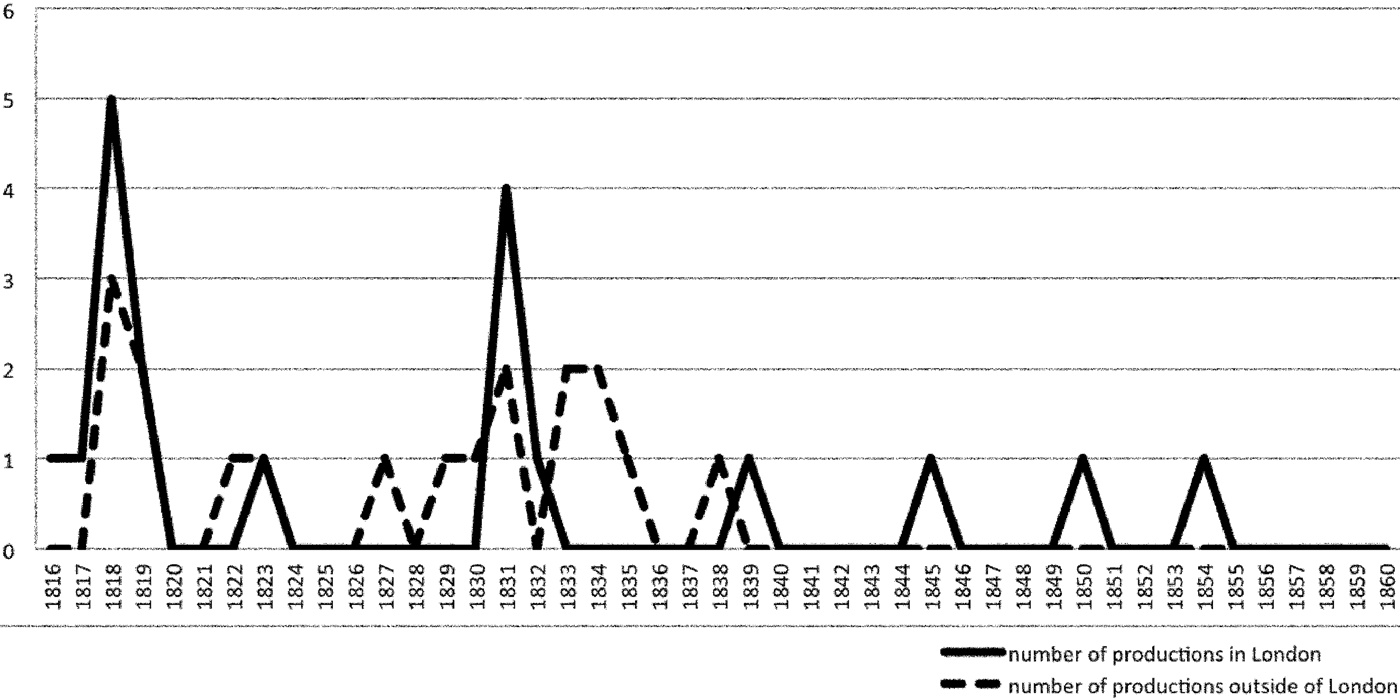
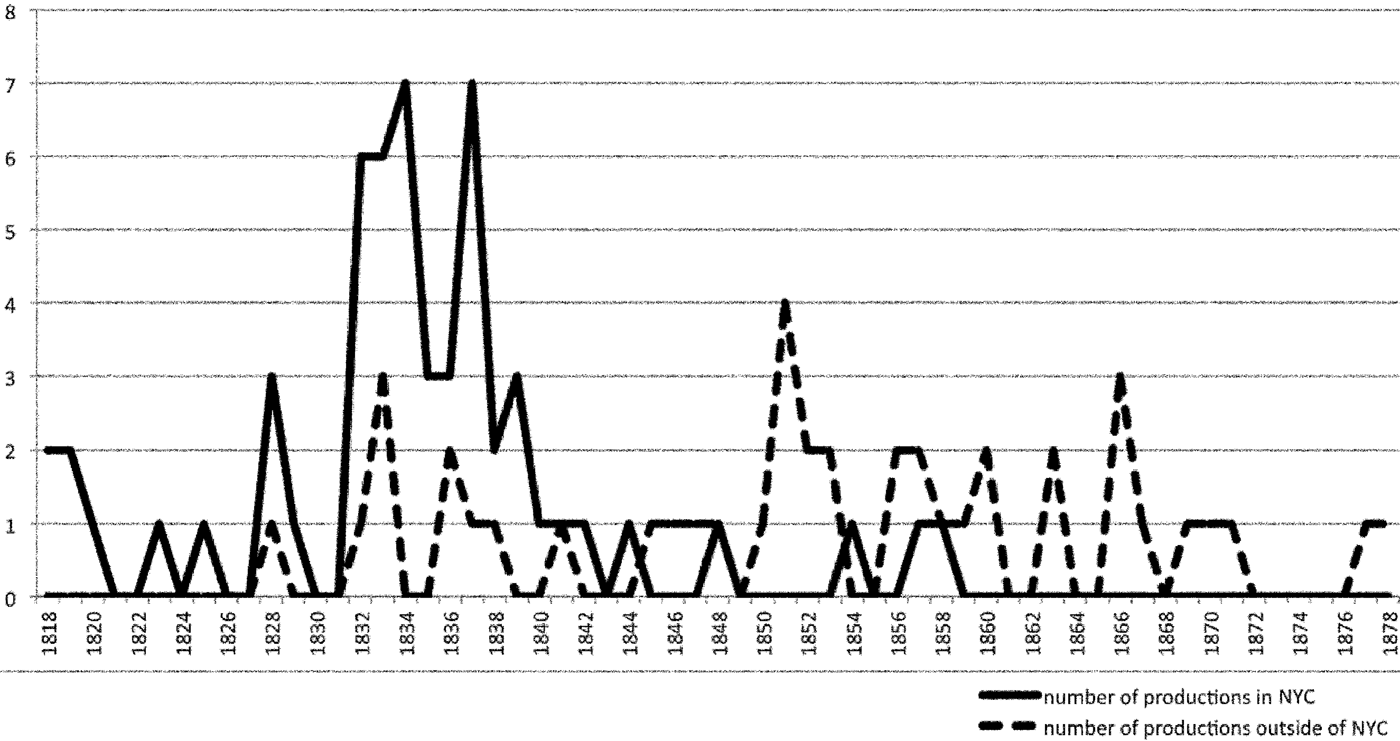
The two graphs shown (Figs. 2, 3) indicate the play's rise and fall in popularity in the two countries, based upon the number of productions mounted. In some cases, a production ran for a full week with multiple performances; in others, the play appears to have entered into repertory, with evidence of only a single (at times, a benefit) performance. Drawn from reviews in extant periodicals, the incomplete data are skewed toward evidence pertaining to London and New York City theatres. Productions from the peripheries of these metropolitan centers are included, where known, to suggest the nationalizing scope of the play's audiences (e.g., Bath, Edinburgh, Leeds, Bristol, Portsmouth, Belfast, and Dublin in the United Kingdom and Boston, Philadelphia, Charleston, Albany, Louisville, Nashville, and New Orleans in the United States). As more regional periodicals are entered into databases, a more accurate picture of the play's national popularity will emerge. Nonetheless, the concentration of data pertaining to London and New York City productions is useful, given the growing importance of both cities as national centers of finance during this period. Although incomplete, enough data exist to suggest a Morettian correlation between the play's rising and falling popularity and the exacerbation and amelioration of financial concerns in both countries.Footnote 50 As modern banking practices became established, evolving differently in each country but converging in the six defining features Sylla identifies with its modern form, the play fell out of currency.
Productions of Fazio in the United Kingdom. Note the peak of the play's popularity in 1818—after the Napoleonic Wars ended but before the suspension of gold conversion was lifted in 1821. The second notable peak occurs in 1831, which marks Fanny Kemble's debut in Bianca's role (while other actresses were also performing it outside of London). The play's popularity trails off around the time of the Bank Charter Act (1844), with productions in 1845, 1854, and 1877 (off the graph) that featured visiting American actresses. Data from British periodicals in Nineteenth Century Collections Online.
Productions of Fazio in the United States. The play's popularity peaks around 1833, as Fanny Kemble toured the United States and the second Bank of the United States was dismantled. A second peak correlates with the Panic of 1837 and the subsequent adoption of the National Banking System, with its regulated safeguards. Although the play was a mainstay on regional stages during the volatile years of Westward expansion, railroad speculation, and the Civil War, its popularity trailed off after the gold-backed paper dollar became national currency in 1878. Data taken from George Odell, Annals of the New York Stage (New York: Columbia University Press, 1927–49) and Weldon Durham, ed., American Theatre Companies, 1749–1887 American Theatre Companies, 1749–1887 (New York: Greenwood Press, 1986).
Once paper currencies were backed by specie (whether gold or silver) and guaranteed by a national government, anxieties about money and the relationship between representation and real were significantly allayed. Fazio's work was done. If the play's reputation diminished over the course of the nineteenth century, dwindling to a mere footnote in twentieth-century literary and theatre histories, the cause lies not only in the changing tastes of British and American audiences (as conventional literary and theatre histories would have it) but also in the changing cultural functions the play's thematic—and formal—design performed.
Like Fazio, the critical terminology of “points” also began to lose favor around the time that each country adopted a national currency and consolidated its modern banking practices. In the United Kingdom, the term started to fall out of critical usage in the second quarter of the nineteenth century, when even actors used the word “effect” to describe the “point” technique.Footnote 51 In the United States, however, the term persisted well into the third quarter of the century, when critics invoked the familiar standard of value even as they struggled to describe a new style of acting they were beginning to see onstage.Footnote 52 With the end of the Civil War and the adoption of a national currency, “points” finally began to disappear from the critical lexicon. Indeed, the technique had lost much of its power by 1880, a time when house lights darkened on fully appointed box sets, and even star actors entered in character.Footnote 53
Once practiced by stars and local repertory actors alike, the “point” was ubiquitous in the late eighteenth and nineteenth centuries, energizing latent meanings (such as Fazio's economic metaphors) in a range of dramatic offerings, including poetic verse dramas, melodramas, and Shakespearean plays. As a performance of representational exchange, it enabled the actor to trade his or her social identity for the identity of the character represented onstage and made this transaction transparent. By allowing the actor to enter a realm of representation—where relationships were built upon a further exchange of representations—and back out into a social world that was comfortably real and seemingly knowable, it facilitated the audience's ability to comprehend new forms of exchange (both theatrical and economic) and helped them accommodate themselves to what was formerly mysterious, fearsome, or simply unknown. The “point,” in other words, helped school audiences to understand new economic relations, even allowing them an active role in negotiating the theatrical exchange: their suspension of disbelief and their applause helped the actor move between realms. In this way, the Romantic stage served as a liminal site for transacting value (economic, literary, and theatrical), inviting audiences to participate in a modernizing economy and introducing them to new habits of social exchange.