Introduction
The number of orally administered targeted and chemotherapy drugs achieving FDA-approved indications is rising (Aisner, Reference Aisner2007). With novel mechanisms of action and specific targets, these newer drugs provide successful treatments for a large variety of tumors such as colon, breast, gastric, ovarian, or lung cancer (O'Neill and Twelves, Reference O'Neill and Twelves2002; Colomer et al., Reference Colomer, Alba and Gonzalez-Martin2010; Neuss et al., Reference Neuss, Polovich and McNiff2013). Increased use of oral targeted or chemotherapy shifts the delivery of cancer treatment from intravenous administration in a clinical setting to oral administration in a patient's home, and reduces direct medical supervision (Neuss et al., Reference Neuss, Polovich and McNiff2013). Although for many patients, outcomes and survival improved with the use of oral treatment for cancer, patients may experience side effects that can impact quality of life (QOL) (O'Neill and Twelves, Reference O'Neill and Twelves2002; Hartigan, Reference Hartigan2003). Yet, these patients have fewer opportunities to report side effects because they receive more distal care (Given et al., Reference Given, Spoelstra and Grant2011).
Patients with cancer often experience fatigue during cancer treatment, which significantly affects overall QOL and domain-specific well-being (Tanaka et al., Reference Tanaka, Akechi and Okuyama2002; Hofman et al., Reference Hofman, Ryan and Figueroa-Moseley2007; Butt et al., Reference Butt, Rosenbloom and Abernethy2008; Hauser et al., Reference Hauser, Walsh and Rybicki2008; Wang et al., Reference Wang, Ji and Visovsky2016). QOL is a broad concept and entails several domains of functioning, including physical, social, emotional, and functional well-being (Fallowfield, Reference Fallowfield2002). The prevalence and sequelae of fatigue have been described mostly in patients receiving intravenous chemotherapy, and little is known about the experience of fatigue in patients receiving oral treatment for cancer. For patients with chronic myeloid leukemia (CML) receiving treatment with tyrosine kinase inhibitors (TKIs), fatigue is the most important factor that limits patients’ QOL (Efficace et al., Reference Efficace, Baccarani and Breccia2013). In addition, one-third of patients receiving TKIs for gastrointestinal stromal tumors (GIST) report severe fatigue that was associated with poorer QOL, more psychological distress, and lower physical functioning (Poort et al., Reference Poort, van der Graaf and Tielen2016). In addition to CML and GIST, oral treatments are now also indicated for many common cancers, such as breast and lung cancer. Therefore, more knowledge on the frequency, impact on patient-reported QOL, and associated factors of fatigue during oral treatment for cancer is needed.
Oral targeted or chemotherapy results in different side effect profiles from those associated with intravenous chemotherapies that have effects on both healthy as well as cancer cells (Aisner, Reference Aisner2007). In addition, given the prolonged exposure to oral treatments compared to intermittent intravenous infusion, the presentation of fatigue may also differ. We aimed to describe the rates of fatigue in a sample of patients receiving oral treatment for various malignancies. In addition, we sought to explore the associations of fatigue with demographic and clinical factors, as well as psychosocial outcomes, to better understand patients’ treatment experiences and facilitate intervention development.
Methods
Design of the study
For the present study, we used baseline data collected as part of a randomized controlled trial aimed at improving adherence and symptom management for adult patients with diverse cancer diagnoses prescribed oral treatment for cancer (i.e., oral chemotherapy or targeted therapy). The trial compared a smart phone application intervention to standard oncology care. Between 2/13/15 and 12/31/16, we recruited patients from the outpatient oncology clinics at Massachusetts General Hospital (MGH) Cancer Center in Boston, Massachusetts and two satellite clinics (Mass General/North Shore Cancer Center and Mass General Waltham). The Institutional Review Board at Dana-Farber Cancer Institute approved the study, and we registered the trial at ClinicalTrials.gov (NCT02157519).
Participants
Eligible patients had a diagnosis of cancer and a current prescription for targeted therapy or oral chemotherapy; were 18 years or older; were proficient in English; received cancer care at MGH or a satellite clinic; had an ECOG performance status score ≤2; and possessed and used a smart phone (iOS [iPhone] or Android). We excluded patients with co-morbid delirium, dementia, or active and untreated psychotic, bipolar, or substance-dependence disorder interfering with consent. In addition, patients enrolled in clinical trials of oral treatment for cancer were excluded from participation.
Procedure
Study staff screened the electronic health record to identify potential participants with an active prescription for oral treatment for cancer. After screening patients for initial eligibility criteria, study staff contacted the oncology clinicians to seek permission to approach eligible patients during their next clinic visit. Upon receiving approval, study staff approached potentially eligible patients in a private clinic space and obtained written informed consent from those who were interested in study participation. Participants then completed baseline self-reported measures by paper questionnaires or electronically with Research Electronic Data Capture (REDCap), a HIPAA compliant, web-based survey tool. Upon completion of baseline assessment, study staff randomized participants to either the smart phone application intervention or the control group (i.e., standard oncology care).
Measures
Sociodemographic and clinical characteristics
Participants provided information on age, gender, race, education level, relationship status, and employment. We extracted information about cancer diagnosis, type of oral treatment for cancer, and other clinical characteristics from the electronic health record.
Brief Fatigue Inventory
We assessed fatigue using the 9-item Brief Fatigue Inventory (BFI) (Mendoza et al., Reference Mendoza, Wang and Cleeland1999). In addition to three items for fatigue severity (i.e., fatigue right now, usual level of fatigue during the past 24 h, and worst level of fatigue in the past 24 h), the BFI includes six items to assess the impact of fatigue on areas of daily functioning during the past 24 h (i.e., daily activity, mood, walking, work, enjoyment of life, and relations with others). All items are scored from 0 to 10, ranging from “no fatigue” to “as bad as you can imagine” for the three fatigue severity items, and from “does not interfere” to “completely interferes” for the six interference items. We obtained a global fatigue score by averaging all nine BFI items. Higher scores indicate worse fatigue and greater interference. Following recommendations by the National Comprehensive Cancer Network (NCCN) Clinical Practice Guidelines, we categorized participants into two groups based on a BFI global fatigue score cut-off of ≥4: no-mild fatigue (0–3) and moderate-severe fatigue (4–10) (National Comprehensive Cancer Network, 2018).
Hospital Anxiety and Depression Scale
To examine anxiety and depressive symptoms, we administered the 14-item Hospital Anxiety and Depression Scale (HADS) (Zigmond and Snaith, Reference Zigmond and Snaith1983). The HADS consists of two 7-item subscales for assessing anxiety and depressive symptoms in the past week. Each subscale's total score ranges from 0 to 21, with higher scores indicating worse symptoms. In addition, a score ≥8 on each subscale indicates the presence of clinically relevant anxiety or depressive symptoms (Bjelland et al., Reference Bjelland, Dahl and Haug2002).
Functional Assessment of Cancer Therapy
We used the Functional Assessment of Cancer Therapy (FACT-G), a 28-item, general patient-reported measure to assess QOL in the past 7 days in patients with cancer (Cella et al., Reference Cella, Tulsky and Gray1993). Items are scored from 0 to 4, ranging from “not at all” to “very much.” Higher scores indicate better QOL. The FACT-G includes four subscales: functional well-being, physical well-being, social/family well-being, and emotional well-being. The total general QOL score is the sum of all subscale scores. In addition, a difference in the total FACT-G of five points or more between the two groups (i.e., no-mild fatigue vs. moderate-severe fatigue) was considered a clinically significant difference in QOL (Brucker et al., Reference Brucker, Yost and Cashy2005).
Statistical analyses
Descriptive statistics were used to define sociodemographic and clinical characteristics of the sample. We conducted independent samples t-tests and Chi-Square tests to examine differences in anxiety and depressive symptoms, and QOL domains based on global fatigue severity (i.e., no-mild fatigue vs. moderate-severe fatigue). A two-sided alpha <0.05 was considered statistically significant. We used Statistical Package for the Social Sciences (SPSS, Version 24.0) for all data analyses.
Results
Based on screening the electronic health record, study staff identified a total of 696 potentially eligible patients. For 196 patients, we either did not receive a response to our request from the oncologist (n = 134) or the oncologist denied permission to approach the patient (n = 62). Study staff approached the remaining 500 patients to further assess eligibility. Of these, 35.6% were excluded because they did not own a smart phone (n = 178), and 22.0% (n = 110) declined study participation because they were not interested or had concerns about study burden. In total, 212 patients provided written informed consent and enrolled in the study. Of these, 31 participants dropped out before baseline assessment (n = 11 became ineligible; n = 17 declined to continue; and n = 3 were lost to follow-up) and 1 participant did not complete the BFI. Therefore, the final sample for this study included 180 participants.
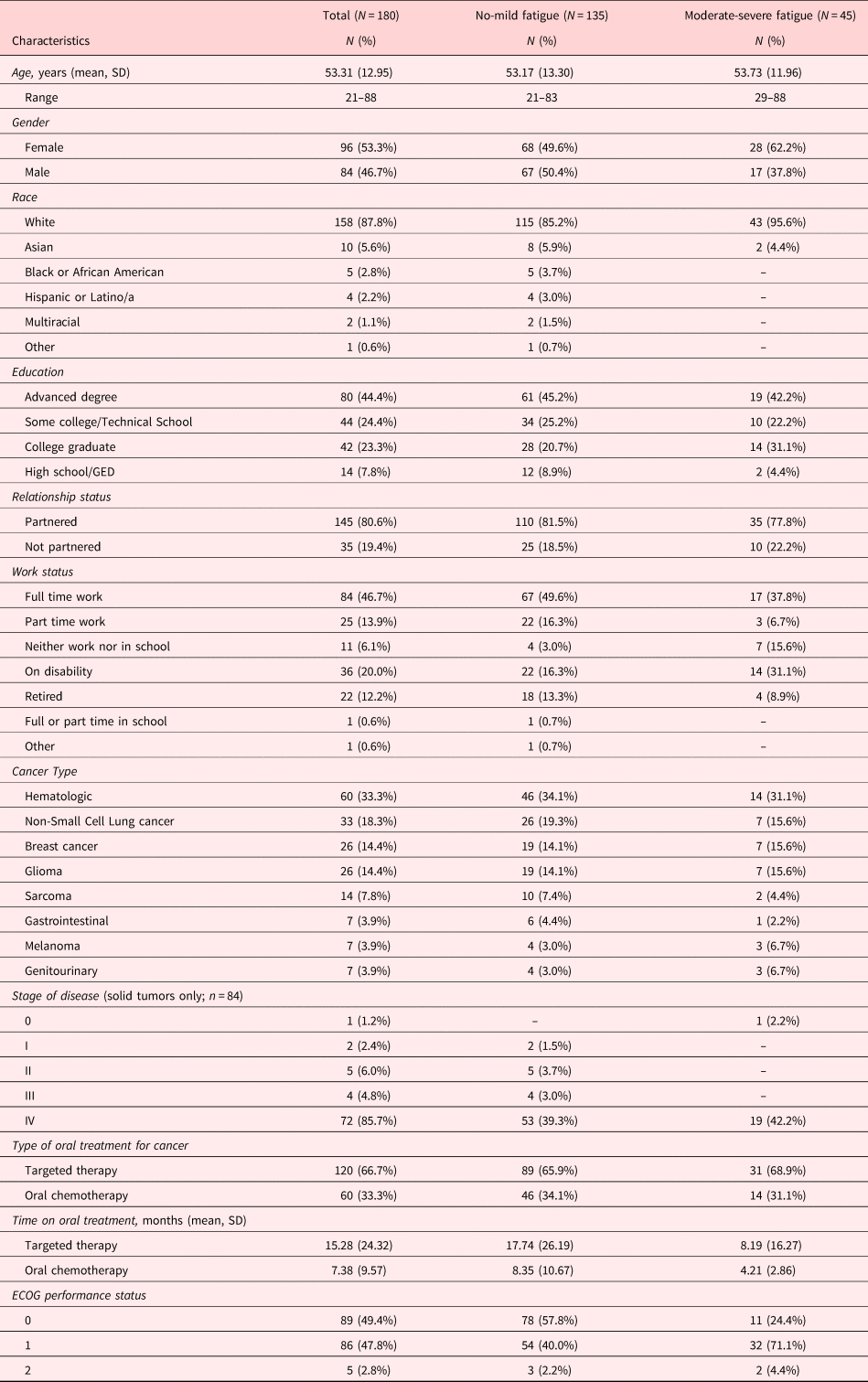
Table 1 displays participant sociodemographic and clinical characteristics. Participants were most commonly diagnosed with hematologic malignancies (33.3%), followed by non-small cell lung cancer (18.3%), breast cancer (14.4%), and glioma (14.4%). Two thirds of the sample were prescribed targeted therapy and one-third were taking oral chemotherapy. Patients on targeted therapy initiated treatment on average 15.28 months (SD = 24.32) prior to study participation compared to 7.38 months (SD = 9.57) for patients on oral chemotherapy.
Baseline characteristics

SD, standard deviation; ECOG, Eastern Cooperative Oncology Group.
Rates of clinically relevant fatigue
The mean BFI fatigue scores at baseline were as follows: 2.66 (SD = 2.25) for global fatigue, 2.92 (SD = 2.44) for fatigue right now, 3.04 (SD = 2.40) for usual fatigue, and 4.19 (SD = 2.85) for worst fatigue. Using the cut-off score (≥4) for clinically relevant global fatigue, 25.0% of the sample (n = 45) reported moderate-severe global fatigue.
Fatigue in relation to sociodemographic and clinical characteristics
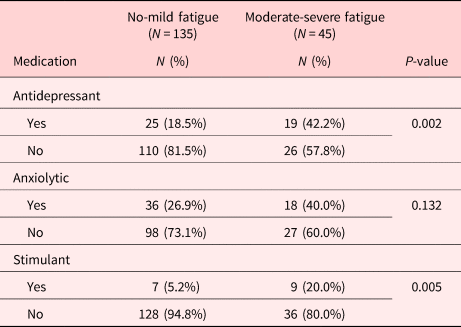
We did not find significant differences between participants with moderate-severe fatigue vs. no-mild fatigue based on age, gender, relationship status, type of cancer (solid/hematologic), or type of cancer treatment (targeted therapy/oral chemotherapy) [P’s > 0.05]. However, participants with shorter time on treatment (<12 months) were significantly more likely to report moderate-severe fatigue compared to participants with longer time on treatment (≥12 months) [P = 0.013]. In addition, participants with moderate-severe fatigue were more often on antidepressant or stimulant medication (see Table 2).
Fatigue and current use of antidepressant, anxiolytic, and stimulant medication

Associations between fatigue, anxiety, depression, and QOL
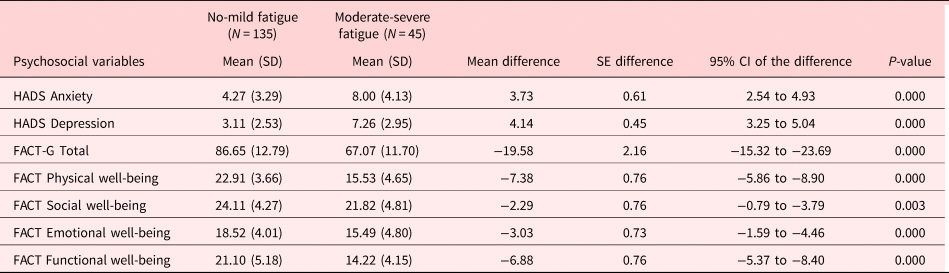
Moderate to severely fatigued participants reported significantly more anxiety symptoms (mean difference 3.73, P < 0.001) and more depressive symptoms (mean difference 3.11, P < 0.001; see Table 3). Moreover, participants with moderate-severe fatigue were more likely to have HADS scores above the cut-off for clinically relevant anxiety or depressive symptoms compared to participants with no-mild fatigue [P < 0.001]. Among participants with moderate-severe fatigue, 55.6% (n = 25/45) and 48.9% (n = 22/45) scored above the cut-off for clinically relevant anxiety and depressive symptoms, respectively, compared to 17.0% (n = 23/135) and 8.1% (n = 11/135) among participants with no-mild fatigue. In addition, moderate to severely fatigued participants reported worse QOL on total FACT-G score (mean difference −19.58, P < 0.001) compared to participants with no or mild global fatigue (see Table 3). The difference between the two groups for the total FACT-G score was clinically significant (i.e., >5 points). Differences in scores for the FACT-G subscales between moderate to severely fatigued participants compared to those with no or mild fatigue were most profound for physical well-being (mean difference −7.38, P < 0.001), followed by functional well-being (−6.88, P < 0.001), emotional well-being (−3.03, P < 0.001), and social well-being (−2.29, P = 0.003).
Anxiety, depression, and quality of life stratified for BFI global fatigue

SD, standard deviation; SE, standard error; CI, confidence interval; HADS, Hospital Anxiety and Depression Scale; FACT-G, Functional Assessment of Cancer Therapy-General.
Discussion
We examined the rates and factors associated with clinically significant fatigue in a sample of patients on oral treatment for a variety of malignancies. Using a cut-off for moderate-severe fatigue, 25% of the sample reported clinically significant global fatigue. These findings are consistent with previous studies in patients receiving conventional anticancer treatment suggesting that between 25% and 75% of patients experience some degree of fatigue during cancer treatment (Servaes et al., Reference Servaes, Verhagen and Bleijenberg2002). Among patients with advanced cancer receiving palliative treatment, 47% of patients reported severe fatigue (Peters et al., Reference Peters, Goedendorp and Verhagen2014). While the proportion of patients reporting clinically significant fatigue is slightly lower than what has been reported in studies of patients receiving intravenous chemotherapy, fatigue remains an issue for many patients on oral treatment for cancer.
We did not find significant associations between fatigue and demographic or clinical characteristics, except for time on treatment and the use of antidepressant and stimulant medication. The finding that shorter time on treatment was associated with worse fatigue and longer time on treatment with less fatigue may be explained by a response shift resulting from adaptation to levels of fatigue over time which has been found in other studies among cancer patients (Sprangers et al., Reference Sprangers, Van Dam and Broersen1999; Andrykowski et al., Reference Andrykowski, Donovan and Jacobsen2009). Notably, patients on oral chemotherapy typically have a shorter treatment duration compared to patients prescribed targeted therapies. In the current study, patients on targeted therapy comprised most of the sample, which may have influenced the results. Similarly, we did not have information on the indication for antidepressant and stimulant medication. In patients receiving cancer care for advanced disease, antidepressant medications are often prescribed for various indications (e.g., control of nausea and vomiting, pain, anorexia) (Derogatis, Reference Derogatis1982; Peterson et al., Reference Peterson, Leipman and Bongar1987; Stiefel et al., Reference Stiefel, Kornblith and Holland1990). Thus, we cannot be certain that patients were receiving these medications because of a formal diagnosis of clinical depression.
Our study revealed significant associations between clinically relevant fatigue and depression, anxiety, and QOL. The finding that fatigue levels were positively associated with depression is in line with those of several other studies in patients receiving conventional cancer treatment (Irvine et al., Reference Irvine, Vincent and Graydon1994; Anderson et al., Reference Anderson, Getto and Mendoza2003). Fatigue can either be secondary to depression or patients may experience mood disturbances because of a lack of energy. While we cannot draw conclusions on causality based on the cross-sectional design of this study, previous longitudinal studies among cancer patients showed that higher depression scores were associated with increased levels of fatigue at subsequent assessments (van Muijen et al., Reference van Muijen, Duijts and Bonefaas-Groenewoud2017; Susanne et al., Reference Susanne, Michael and Thomas2019). Consistent with a longitudinal study that indicated poorer QOL and anxiety as predictors of sustained fatigue among patients with colorectal cancer (Vardy et al., Reference Vardy, Dhillon and Pond2016), we also found that fatigue was associated with poorer QOL and anxiety. In addition, compared to QOL values as measured by the FACT-G in different groups of cancer survivors (Holzner et al., Reference Holzner, Kemmler and Cella2004), patients with moderate-severe fatigue in our study had lower QOL scores than survivors of bone marrow transplant, breast cancer survivors, and patients with Hodgkin's disease, with the exception of social well-being. Similarly, QOL scores for fatigued patients in our sample were lower compared to the FACT-G sample data from a large sample of adult patients with cancer, except for social well-being (Brucker et al., Reference Brucker, Yost and Cashy2005).
One of the strengths of this study include the use of a validated cut-off for clinically relevant fatigue and a sample of patients receiving oral treatment for various malignancies, thereby expanding our knowledge on fatigue during oral treatment for cancer beyond patients with CML and GIST. A number of potential limitations should also be considered when interpreting the results. We cannot draw conclusions about the causal relation between fatigue and other factors in this cross-sectional study. While several relevant factors were included in the study, we did not assess sleep and physical activity that could also be related to fatigue and we did not have information on prior cancer treatments or intent of treatment. Further, there is some conceptual overlap between the six BFI fatigue interference items and items from the FACT-G. This might partly explain the association between fatigue and QOL. However, in a sensitivity analysis that only included the three BFI fatigue severity items, we found similar results with the exception of the social well-being subscale. In addition, demographic and socioeconomic diversity in our sample was restricted. Patients were recruited for a mobile phone intervention and patients who did not own a smartphone were excluded from the study, which likely skews our population toward more resourced individuals and limits the generalizability of our findings to the overall population of patients receiving oral treatment for cancer. Further, we recruited patients from a single site and only 180 of 696 potentially eligible participants were enrolled and provided data for the current study. Unfortunately, we are not able to collect study data on demographic and clinical characteristics from patients who did not enroll in the study. Therefore, to explore whether key characteristics of our sample are similar to the overall population, we compared our sample characteristics with a recently published multi-site trial aimed to improve adherence among 272 patients receiving oral treatment for cancer recruited from six National Cancer Institute-designated comprehensive cancer centers (Sikorskii et al., Reference Sikorskii, Given and Given2018). While the distribution of gender and race was comparable between studies, with white participants being over-represented in both studies, our sample was younger and more educated. This potential non-representativeness to the overall population is recognized as an important limitation.
To the authors’ knowledge, this is the first study to examine clinically relevant fatigue in a large and diverse sample of patients receiving oral treatment for cancer. One in four patients reported clinically relevant fatigue that was associated with poorer psychosocial outcomes. Patient-reported fatigue was not related to clinical characteristics, with the exception of shorter time on treatment and the use of antidepressant and stimulant medication. Prior research has shown that the integration of patient-reported outcomes in clinical practice improves outcomes in patients with cancer and one of the suggested mechanisms of action is that clinicians are able to intervene early on reported symptoms (Basch et al., Reference Basch, Deal and Kris2016). Patients on oral treatment for cancer receive more distal care with less clinic visits or opportunities to discuss symptoms. Thus, routine monitoring and screening for fatigue and other symptoms seem particularly important for this patient population. In addition, longitudinal research is needed to assess fatigue during oral treatment for cancer over time, examine predictors of fatigue to inform intervention development or adaptation, and determine the best treatment for clinically relevant fatigue, especially in patients with advanced cancer.
Acknowledgments
Dr. Greer reports personal fees from Springer Publishing Company and grants from Pfizer and the National Comprehensive Cancer Network outside the submitted work. The other authors have nothing to disclose. The statements and results presented in this article are solely the responsibility of the authors and do not necessarily represent the views of the Patient-Centered Outcomes Research Institute® (PCORI®), its Board of Governors or Methodology Committee.
Funding
This work was supported by the Patient-Centered Outcomes Research Institute® (PCORI®) under Grant R-IHS-1306-03616.