British electrical manufacturing offers valuable insights into international business history because cross-border networks and agreements were instrumental to the industry's emergence. This article analyzes the factors that shaped phases in its development, weighing firm-level, national, and international influences, while surveying and comparing its various sectors. It reappraises electrical manufacturing's early decades in Britain and the nature of the global business system that prevailed before 1914. Cross-border flows of technology and knowledge significantly influenced the policies and growth of firms, and British electrical manufacturing was consequently perceived as controlled by foreign and particularly German interests. The article shows, furthermore, how a changing political landscape transformed the strategies and ownership of firms, and how the pressure to establish a nationally-controlled industry created challenges for businesses that had come to rely so extensively on cross-border interfirm relations. It reevaluates the restructuring of British electrical manufacturing during World War I and its immediate aftermath. The article, lastly, questions accounts of the industry's failure in the 1920s, while acknowledging that refounded firms retained weaknesses in organization and products, and discusses the return to strategies of cross-border networks and agreements.
Although electrical manufacturing was a key twentieth-century industry, few academic studies have investigated its growth in Britain. We do have a number of sponsored company histories.Footnote 1 John Wilson's useful account of Ferranti is available, but an analysis of the early industry provides little evidence on its firms. Robert Jones and Oliver Marriott concentrate on takeover struggles and postwar mergers.Footnote 2 Thomas Hughes explains the internationally transferable character of technology and electrical systems, and he contrasts the worldwide peripatetic activities of engineers and managers with the very national or local legislative and regulatory framework in which enterprises operated.Footnote 3 William Hausman, Peter Hertner, and Mira Wilkins stress the formative interaction of international finance, cross-border technology transfer, and the policies of national states.Footnote 4 Both books deal with the evolution of electricity supply and distribution, not electrical goods manufacture. Utilizing company archives, industry and professional association sources, trade journals, and government records, the article examines the evolution and consequences of international business for individual electrical manufacturing firms, their management, and their capabilities; it evaluates, too, the influence of international business operations alongside legislative, regulatory, and market factors.
Institutions and Markets before 1914
British manufacturers condemned the Electric Lighting Act of 1882 as the legislative misfortune that bestowed first mover advantages on foreign rivals. Despite initial broad support for concession terms of twenty-one years, the prospect of inadequate returns discouraged private investment in electricity generation. The “scrap-iron” clause added another and, in the long-term, bigger disincentive by enabling local authorities to acquire after twenty-one years generating companies at asset rather than business value. The 1888 amendment extending concession periods to forty-two years was quick recognition of the legislators' mistake. The following year brought a six-fold increase in project applications, but a subsequent economic downturn dampened any renewed enthusiasm. The small size of utilities and low technical standardization had knock-on effects for electricity prices and demand levels. The existence of many generators with varied systems also encouraged product diversity among electrical manufacturers, and inhibited scale efficiencies in heavy and power engineering and in the production of railway, tram, and mining equipment. British industrialists undoubtedly exaggerated the effects of early legislation, but the operating framework it initiated restricted both the municipal and private development of a new technology. Responding to the growing demand for electrical traction, a consolidated Act in 1898 constituted an important turning point and stimulated large-scale engineering orders, although overall demand would continue to disappoint.
Ian Byatt argues that municipally-owned and price-competitive gas supply slowed the diffusion of electrical lighting. But entrenched interests cannot by themselves explain the internationally low development of electrical power for tramways and machinery. Similar circumstances applied to Germany, where electrical systems and usage spread quickly. Observing the consequences of the short concession terms specified in the British Parliament's 1882 Act, Berlin's government decided instead on thirty years, yet this was a period less than the forty-two years finally adopted in Britain. What became Berliner Elektricitäts Werke (BEW) was founded in 1884. The city's authorities, moreover, had the right to purchase BEW compulsorily as early as 1895, with the high cost of doing so receding with every year thereafter. Hughes notes that Berlin's ownership of gas production and supply delayed the expansion of Berlin's generating capacity, but its municipal government in partnership with BEW ultimately supervised the creation of a universal electrical supply system across the city before 1914. Germany's leading electrical conglomerate, Allgemeine Elektricitäts Gesellschaft (AEG), held the majority interest in BEW for much of this period. AEG was a shareholder in some one hundred fourteen German utility enterprises, compared to eighty for Siemens & Halske, and both firms gained manufacturing economies of scale. Berlin took BEW into municipal ownership, in 1915. In New York and then Chicago, General Electric of America took the initiative to establish city-wide systems. The municipal and regional leadership shown in Newcastle-upon-Tyne, in northeast England, enabled the building of an integrated utility, and provided an exception to developments in the rest of the country.Footnote 5
British electrical manufacturers were highly critical of national and institutional “failings.” Committed to tariff reform, they portrayed international competition as unfair: Germany charged import duties on industrial goods, while free-trade Britain did not. The Callender Cable and Construction Company blamed its withdrawal from the United States, Germany, and Italy on tariffs. By 1913, Japan and Dominion governments used import duties to promote domestic industrialization. As witnesses to public enquiries, British electrical manufacturers claimed that unequal domestic competition held back the virtuous circle of scale manufacturing, standardization, falling prices, research and development (R&D), and growing electricity demand. Tariff reform undoubtedly determined Britain's political fault lines of the early 1900s, but would not have directly addressed the competitive, technological, and managerial shortcomings of its electrical manufacturers. Discriminatory railway and shipping rates in foreign countries were another target. The Board of Trade's inability to promote commerce abroad appeared to be legitimate criticism, and the disregard British banks showed for financing credit terms and overseas engineering projects led to large orders going to Continental businesses. Germany's proactive government and banking system were contrasted with Britain's laissez-faire policies.Footnote 6
Hugo Hirst was founder of General Electric Company (GEC), a distinct business from its more famous near namesake in the United States, General Electric of America (GE). He argued that German banks had evolved to meet the needs of manufacturers and founded combinations to spread the risks of large investments. Japan, interestingly, was following the German model of industrial banks and business groups. Hirst contended that eleven German banks backed Siemens & Halske, while AEG was linked to eight.Footnote 7 The conglomerate Elektro-Treuhand-Gesellschaft existed to coordinate the multiple funding of large projects. Once British banks had shown themselves to be risk-averse, Dresdner Bank financed cable-laying from German West Africa to Brazil.Footnote 8 Siemens & Halske was closely allied to Deutsche Bank, and AEG directors sat on the boards of major banks.Footnote 9 Both enterprises founded Finanzierungsgesellsschaften with German, Swiss, and Belgian banks to fund overseas power stations and utilities, on the assumption that foreign governments, municipalities, or businesses would purchase German equipment and technical expertise. Established by Siemens & Halske and AEG, Deutsch Überseeische Elektricitäts Gesellschaft (DUEG) was, among German firms, the largest holder of foreign direct investment (FDI) assets by 1914.Footnote 10 What especially infuriated British manufacturers was City of London capital being raised by German banks to secure construction contracts for German manufacturers.Footnote 11 Dick, Kerr—specialists in rail electrification—lost London's St Pancras station contract to better supported German rivals.Footnote 12 The Bombay hydroelectric project, British-owned Buenos Aires tramways, and the London United Electric Railways could be cited as further failures against foreign competitors. The humiliation seemed complete when AEG constructed a British-financed hydroelectric plant at Victoria Falls in British colonial Africa. At the Electrical Trades Committee (ETC) hearing, convened by the Board of Trade during World War I, witnesses condemned the City of London for lacking “national and imperial instinct.” Committee members gave vent to the period's ingrained anti-Semitic prejudices about powerful international Jewish financiers, while, to sustain their view of Germany's formidable industrial challenge, they praised the “patriotic” Jews who ran AEG. Business combinations and supportive networks enabled German firms to plan long-term and spend on development work. British companies, with their smaller output, relied on general mercantile agents and trading companies, while the giants of AEG and Siemens & Halske used specialist overseas organizations.Footnote 13
Hirst portrayed the British industrialists before 1914 as a “maligned, neglected quantity or as an insignificant tail to bankers, shippers, financiers, and traders in the councils of State.” The Board of Trade had no discernible policy, and Britain had “unorganized” capital flows and “speculative dividend makers,” in contrast to German industrial banks with knowledge of and commitment to industry.Footnote 14 Almost every other country, Hirst contended, secured their home market through protective measures. The links between industry, government, banks, universities, railways, and shipping lines in Germany indicated “organized competition,” and free trade orthodoxies could not meet the challenge posed by rising industrial powers.Footnote 15 Two pieces of legislation hinted at a national policy. British electrical manufacturers suspected, reasonably, that foreign companies used patent registration to block industrial developments in Britain. Under the Patents and Designs Act of 1907, rights owners were given twelve months to undertake manufacturing in the United Kingdom.Footnote 16 From 1912, the General Post Office assumed responsibility for the telephone system and built five factories to curtail equipment imports, mainly from the United States and Sweden. GEC felt confident enough to establish a factory to supply the United Kingdom’s telephone system.Footnote 17
Acquiring Capabilities before 1914
The United States and Germany's industrial transformation caused Britain to debate its seeming decline. The United States gained the technological advantage in electrical engineering and products, but Germany offered the main competitive challenge to Britain. German émigré investors, entrepreneurs, managers, and technicians were, furthermore, highly influential within Britain's own electrical industry. International, personal, family, and professional networks were instrumental in the evolution of firms, giving the German-born Hugo Hirst an advantage in his commercial diplomacy. British manufacturers accused German mining and commodity firms of controlling the supply and prices of minerals, notably in copper, zinc, and lead. A U.K. government report stated that tungsten had been almost entirely under German control before 1914.Footnote 18 Assisted by family partnerships with Henry R. Merton, a London trader, Metallsgesellschaft became the most important player in global metals markets.Footnote 19 Despite growing international tensions between European powers, the German community was widely accepted within Britain, and prominent members were inducted or naturalized into its commercial and political establishments. International tussles over Morocco, Bosnia-Herzegovina, and Tunisia, from 1905 to 1911, were early warnings of how obscure disputes might threaten European and world peace. By 1914, however, suspicion of German foreign policy and military intentions had not translated into resentment against the sixty thousand Germans settled in Britain.Footnote 20
The restless and ambitious Hirst grew GEC through forward integration of his electrical supply business. He and his two most important managers, Harry and Max Railing, were born in Germany, and in London Hirst initially operated through its sizeable German business community.Footnote 21 Formerly called Hirsch, he became a naturalized Briton in 1883, later identifying himself as a patriotic industrialist, Tariff Reformer, and imperialist. We have in the life of inventor and businessman, Wilhelm or Sir William Siemens, a parallel from an earlier generation. Settling in Britain during 1843, he took charge of the cable making company of Siemens Brothers, an allied firm of Siemens & Halske. Naturalized in 1859, Siemens navigated between obligations to his new country and to his German family and business partners. He was later appointed a Fellow of the Royal Society. His distant cousin and adopted son, Alexander, was a former Prussian officer with military honors. Having assumed the management of Siemens Brothers, he was twice President of the Institute of Electrical Engineers and a founding administrator at the National Physical Laboratory.Footnote 22 Like Hirst, Sir Ernest Cassel was both German and Jewish in origin, a Christian convert, and self-made. He had contacts throughout the City, supervised worldwide business deals, and his appointment as a Privy Counsellor underlined the strength of his personal and political connections in Britain.Footnote 23
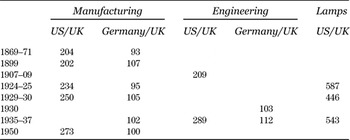
No figures exist to illustrate the relative competitiveness of British electrical manufacturing before World War I. Data point to factor-of-two differences in U.S.-U.K. output per employee for both total manufacturing and all forms of engineering, due to levels of mechanization, scale, and resource advantage. Germany matched U.K. manufacturing productivity by 1900, and Germany's performance continued to improve to 1914 before stalling in the decades that followed (see Table 1). Yet British productivity remained effective in several labor-intensive or skill-based industries.Footnote 24 Within electrical manufacturing specifically, case studies indicate that Britain proved highly competitive in cable manufacturing and related engineering, but lagged in accumulator, battery, and lamp production. In heavy electrical engineering and machinery, marked by advanced technologies and large-scale complex production, British-based producers made some headway before World War I, but the gap with U.S. or German rivals remained substantial. In 1913, Germany dominated imports to Britain in electrical machinery (54 percent), lamps (76 percent), and cables (71 percent).Footnote 25
Output per Employee for Manufacturing, Engineering Industry, and Electrical Lamps: International Comparison of the U.S., U.K., and Germany, 1869–1950

Sources: Kenneth S. Lomax, “Production and Productivity Movements in the U.K. since 1900,” Journal of the Royal Statistical Society 122, no. 22 (1959): 185–220; Charles H. Feinstein, National Income, Expenditure, and Output of the U.K., 1855 – 1965 (Cambridge, U.K., 1972), T101, T115; Monopoly & Retail Prices Commission, The Supply of Electrical Lamps (London, 1951); Stephen N. Broadberry, The Productivity Race: British Manufacturing in International Perspective, 1850 – 1990 (Cambridge, U.K., 1997), 36.
Founded in 1886, GEC was incorporated three years later.Footnote 26 The international transfer of technology and know-how defined the creation of regional and municipal electricity supply systems. The Edison and Swan United Electric Light Company was a multinational subsidiary that manufactured lamps, and it sold the Edison patents used in New York's early electrification to London's first commercial supply undertaking, subsequently importing the generators and equipment needed from the United States.Footnote 27 Cross-border networks similarly determined electrical manufacturing's evolution. When the Edison and Swan patents in carbon lamps ended in 1893, Hirst decided that GEC would produce its own. To realize his plan, he travelled to the United States for technological and managerial assistance, but made his breakthrough while on tour in Continental Europe. He acquired a patent from C. J. Robertson and brought him back to Britain as the experienced works manager of a new lamp enterprise. Robertson oversaw the plant installation, and, to meet quality and standardization levels, he trained workers in over forty processes. The Robertson Lamp Works, a partnership between GEC and Robertson himself, began mass production in 1896. GEC entered a pattern of obtaining patents abroad and importing key personnel and their expertise. From the early 1890s, GEC was adapting alternate current (AC) motors from the Swiss firm of Oerlikon and selling them to traders acting for South African mining companies. The United States' second largest electrical enterprise, Westinghouse, refused to license its AC patents, preferring to supply GEC from its own factories. Once Hirst had persuaded the Board of Trade, in 1895, to threaten a compulsory license, Westinghouse acceded to patent sharing. In the following year, GEC decided to build the Peel Works, in Manchester, to manufacture the latest motors.Footnote 28
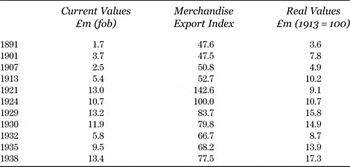
Thanks to foreign technologies and South Africa's booming gold mines, GEC was initiated into heavy engineering; the Board of Trade, which ironically Hirst would in the future criticize heavily, had played a key role in securing the necessary patents. GEC next expanded mining machinery sales to Australia, India, and China, and sold traction motors to the East India Railway. By 1900, the company employed sales agencies in Paris, Brussels, Amsterdam, Sydney, Alexandria, Tokyo, Johannesburg, and Calcutta, and imperial connections secured essential supplies and mining concessions in India. The year 1903 was the first time Britain officially recorded electrical exports, which showed a near three-fold real term increase between 1891 and 1913 (see Table 2), most prominently in favorable Empire markets. GEC purchased the Fraser and Chalmers Engineering Works because of the reputation its machinery enjoyed across the Rand goldfields. It began training personnel for posting overseas, where they were given freedom to negotiate large contracts with government departments and private businesses. By 1914, GEC had fully-owned sales subsidiaries in Australia, New Zealand, China, France, Belgium, Spain, South Africa, and Rhodesia, and a 50 percent share in two others located in Argentina and India.Footnote 29
British Exports of Electrical Goods, 1891–1938

Source: Brian R. Mitchell, British Historical Statistics (Cambridge, U.K., 1988), ch. x, T.11, T.23.
Responding to the electric generating legislation of 1898, GEC recapitalized in 1900 with the aim of financing a heavy engineering plant, at Witton, Birmingham. Although an ardent critic of the British banking system, Hirst acknowledged the contribution of Edward Holden, chairman of the City and Midland Bank, in overseeing the reincorporation. A constant advisor to GEC, Holden would secure the overdraft facilities that would underwrite the company's expansion. At Witton, GEC made military and naval searchlights and arc lamps for railways and commercial premises. Searchlight imports proved to Hirst how “subsidized, organized, and protected” foreign competition was eating into Britain's industrial structure, leaving it strategically vulnerable.Footnote 30 On the other hand, the project was not feasible without patents and support from Schuckert, a Berlin business that was acquired by Siemens & Halske in 1903 to form its heavy engineering operation, Siemens-Schuckert. The German company sent technicians to Witton to inculcate the required skills and expertise. GEC decided also to manufacture its own illuminating carbons, once again replacing imports. To do so, it brought manufacturing equipment from Germany and put production under the day-to-day management of foreign personnel. Hirst found the Admiralty and the War Office indifferent to his ventures, and, as financial losses accumulated, he was by 1906 justifying his initiative as patriotic rather than commercially motivated.Footnote 31
From its 1900 reincorporation onwards, GEC was engaged in a strategy of mechanization and greater scale, while investing in its workforce and the training of imported techniques. Hirst asserted that the German working-classes, due to better schools, military service, and personal discipline were better suited to technical education, even if they were all Social Democrats and therefore Marxists.Footnote 32 The chairman of Bergtheil & Young, who was himself of German-Jewish origin, contrasted foreign workers with the drunkards who, in his view, made up Britain's laboring classes.Footnote 33 Hirst accepted that the heads of German electrical companies had international experience and great commercial ability, but claimed that their scientific education could not explain the ousting of British firms from world markets.Footnote 34 Callender's chairman speculated about the ability of technically-qualified German executives to be practical commercial men.Footnote 35 British industrial leaders focused on government failings over tariffs, purchasing policies, and technical education rather than on their own capabilities, and their dependence on international networks disincentivized investment in scientific training and R&D.
GEC had opened the Robertson Works in Hammersmith, due to the plentiful supply of low-skilled female labor seen as suitable for the new automated processes used in producing light-bulbs. In other electrical manufacturing sectors, locations were chosen because of the existence of traditional engineering skills or proximity to firms in related industries. When, in 1898, Carl Auer von Welsbach developed his osmium filament, some 60 percent more efficient than carbon, he initiated a trail of technological and competitive challenges.Footnote 36 AEG and Siemens & Halske controlled the lamp's European patents, and their joint deal in 1903 with Philips enabled the commercial expansion of the Dutch business.Footnote 37 Hirst embarked on two years of active searching and intricate negotiation to gain a patent for a combined tungsten and osmium filament. In 1905, he was in Budapest, where he bought the Just-Hannaman rights, but, when he heard news of a squirted filament, he rushed to Berlin. GEC came to terms with Deutsche Gasglühlicht AG (DGA), which later manufactured and promoted osmium lamps in partnership with AEG and Siemens & Halske.Footnote 38 GEC sent hundreds of employees to Berlin before World War I to learn the production routines, and it imported German foremen to teach simpler tasks on site at Hammersmith. British personnel gradually replaced all foreign staff and workers, excepting the chemist who handled technical communications with Berlin. Long-term cross-border cooperation over the transfer of technology, management practices, and skills made a convincing case for German and Austrian shareholding in GEC-Osram, whose output began in 1909. Contemporaries noted how light bulb production transformed GEC into a large-scale firm.Footnote 39
German and European firms pooled their lamp patents in 1911, but competition and rights disputes continued. GE sought to restore international cooperation through a cartel, a phenomenon of global capitalism at the time. After a series of international conferences, British Thomson-Houston (a GE subsidiary), Siemens Brothers, and GEC formed the core of the Tungsten Lamp Association (TLA) in 1912. AEG, Philips, British Westinghouse, and Dick, Kerr would join for periods.Footnote 40 Clauses encouraged the pooling of future research. International cartels were organizations which made secret deals, and they were rightly treated with suspicion. The justification offered was that firms could settle disputes over patent rights, and, by avoiding price wars, invest in new technologies. Official investigations in Britain would accuse the TLA of limiting production licenses, price-fixing, and profiteering. Lamp output of 25 million in Britain for 1913 was significantly smaller than the United States at 110 million and Germany at 100 million, and compared unfavorably with the Netherlands at 16 million.Footnote 41
For Hirst, what was particularly interesting about negotiations over legal patents was the “avenues of international cooperation it throws up.” He presented a high-minded perspective: the commercial man has to be an ambassador, travelling from works to works, showing “tact and perseverance,” and forging highly complex sets of international and interfirm relationships and obligations.Footnote 42 Yet Britain's shortage of trained personnel meant that “foreign methods could not be slavishly followed but made to fit the people available.”Footnote 43 Examples of British domestic cartels before 1914 include the Cable Makers' Association (1899), whose large firms controlled some 80 percent of production, and the Telephone Cable Makers' Association (1904); for cross-border agreements, there existed the International Incandescent Lamp Trust (1903), the Carbon Filament Lamp Cartel (1911), and the Tungsten Lamp Association, all of which largely failed in their objectives.Footnote 44 But the establishment or expansion of cartels were a more notably marked trend of the interwar years. In electrical manufacturing, cartels remained only one aspect of cross-border interfirm relations and cooperation, and their attempts to control prices and markets had limited effectiveness.Footnote 45
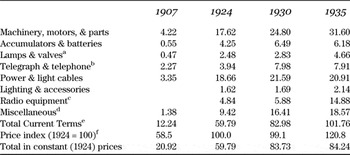
By 1907, the gross output of British electrical manufacturing firms amounted to £12.24 million (see Table 3). Three sectors were responsible for 80.4 percent of this output: machinery and motors (34.5 percent), power and light cables (27.4 percent), and telegraph and telephone cables and equipment (18.5 percent). The 1907 census lists lamps, accumulators, and batteries as major items of output for British electrical manufacturing. Radios, cooking and heating equipment, and domestic appliances first appear in the interwar period, when electrical auto parts are listed under the motor vehicle section. In the 1907 and 1924 censuses, electrical engineering forms a distinct subset of engineering, clearly differentiated from mechanical and metal engineering trades that made the boilers for power stations, and from electrical supply, tramway, and railway utility undertakings. By 1930 and 1935, electrical manufacturing was officially listed as an entirely separate industry.Footnote 46 British output expanded rapidly after 1907 and estimates put the figure in 1913 at £22.5 million, in current terms, with some £7.5 million going for exports. Still, Britain's record compared unfavorably with Germany's £60 million of output and £15 million of exports, and much of Britain's electrical industry was viewed as under foreign control.Footnote 47
Gross Output (£m) of British Electrical Manufacturing Industry, 1907–1935, in Current and Constant Terms

Sources: Census of Production (London, 1907, 1924, 1930, 1935), National Archives, London; Alfred Plummer, New British Industries in the Twentieth Century: A Survey of Development and Structure (London, 1937), 46.
Notes: a Figures for 1907 and 1924 exclude valves, and 1924 figure is approximate; b includes cables and all related equipment; c excludes valves; d includes scientific instruments, medical apparatus, meters, and cooking and heating apparatus; e excludes installation and repair work revenues; f recalculated from indices in 1935 Census of Production (for 1924, 1930, 1935 data) and in Plummer, New British Industries in the Twentieth Century, 46 (for 1907, 1924 data).
Electrical manufacturing was highly diverse in products and production techniques, composed of four main sectors: heavy engineering, such as power plant and large machinery; the “light” electrical trades, such as smaller machinery and equipment; light bulbs; and cable manufacturing and installation. British failings in the heavy sector in scale, technology, and patents attracted the most criticism, but success stories confounded notions of general national shortcomings. Founded in 1890, the firm Dick, Kerr had a high international reputation for building trams and installing tramway systems; in 1897, the company created a subsidiary, the Electrical Railway and Tramway Carriage Works Company (ERTCWC), which worked with the conglomerate Metropolitan Railway and Carriage Company. In 1905, Dick, Kerr and Metropolitan Railway merged their electric traction interests into United Electric Carriage Company (UEEC). ERTCWC and subsequently UEEC relied on U.S. engineers and works managers, who planned factory layout and standardization, and on foreign foremen who trained local workers in licensed technologies.Footnote 48 Dick, Kerr formed an alliance with the turbine and traction manufacturer, Willans & Robinson, which it fully controlled by 1916, and with large-scale engineering firms in France, Belgium, and Italy.Footnote 49 As mentioned previously, GEC made commercial breakthroughs in heavy engineering, even if it could not claim leadership. In the light electrical trades, patents tended to be foreign-owned and magneto manufacture occurred wholly overseas. Cable-making was the British electrical industry's one “brilliant exception,” and firms could exploit the country's position as a trading, imperial, and communications hub. In 1863, the leading German submarine cables firm, Siemens & Halske, built a factory at Woolwich, London because it recognized the international advantages of operating in Britain. Founded as Callender's Bitumen Telegraph and Waterproof Company Limited in 1882, the company became Callender Cable and Construction Company in 1896, in anticipation of a boom in power generation, tramways, and railway electrification orders. Callender established representative offices in India, Australia, New Zealand, South Africa, Mexico, Argentina, Hong Kong, Singapore, and Shanghai, and worked with Dick, Kerr on tramway contracts. Anticompetitive mergers and acquisitions were characteristic of the British cable industry in the 1900s, and its firms frequently took shares in lighting, power, or tramway concerns as part payment for their services. GEC entered cable manufacture in 1914, through a joint venture with the Italian tire and rubber company, Pirelli, establishing a factory in Southampton, England.Footnote 50 In 1897, Italian émigré Guillermo Marconi founded his famed wireless telegraphy company, and he went on to create two overseas subsidiaries.Footnote 51 Before World War I, the market in Britain for electric consumer durables and domestic telephones was small, and only light fittings and lamps were commonly retailed.Footnote 52 Telephone usage likewise lagged: Britain had 1.7 telephones per 100 people by 1914, while the United States and Sweden were ahead with 9.7 and 4.1 respectively.Footnote 53
Transferring Capabilities before 1914
Notable cases of U.S. and German multinationals in Britain before World War I served as a reminder that foreign firms had seized the first mover advantages in heavy engineering. Apparent market opportunities attracted investors to Britain, and the lack of a viable local partner worked against licensing or joint ventures and in favor of FDI. Instead of the acquisition of technologies, systems, personnel, and skills through interfirm networks, core capabilities were transferred intrafirm by parent multinationals to the subsidiaries they formally owned or controlled. The 1898 legislation must have been Westinghouse's main motivation, although Hirst claimed that Board of Trade intervention over GEC's access to its patents induced the U.S. firm to come to Britain.Footnote 54 George Westinghouse had established the Westinghouse Electric and Manufacturing Company in 1886. To avoid price-cutting and legal disputes over patents, GE and Westinghouse in 1896 exchanged licenses for all lines except lighting. The firms together accounted for 75 percent of U.S. electrical sales, although GE was by far the larger business. Before 1914, Westinghouse grew overseas through FDI and founded enterprises in France, Italy, Russia, and Canada.Footnote 55 Erecting an industrial complex at Trafford Park, in Manchester, U.K., with its access to skilled labor and transport connections, George Westinghouse made tangible his strategic intent to lead electrical engineering in Britain and its Empire and to transfer technological and managerial capabilities from the United States. British Westinghouse Electrical and Manufacturing Co. Ltd was created in 1899 as a miniversion of the parent business. The general managers and factory superintendents were American, and Westinghouse himself was chairman. From the outset, employees were sent to the United States to be instructed in Westinghouse methods, and parent company managers and foremen regularly traveled to Britain. The Trafford Park works introduced training courses for apprentices and for staff with university education or a good general education.
The predicted orders for British Westinghouse did not materialize. The aspiration to copy U.S. production methods—as a global best practice—presumed that British customers and their consulting engineers would work to the technical standards and conventions associated with the transferred techniques. Disorganization at Trafford Park brought recurrent failure to complete orders on time, and labor turnover was high. From 1905, British Westinghouse banked on overseas demand and especially South Africa to operate at a more efficient level. In the following year, newly-appointed expatriate personnel began cost-cutting, reorganizing the factory and sales department, and reducing capital. The bankruptcy of the U.S. parent, Westinghouse, in October 1907 nearly sank British Westinghouse, and in May 1910 the subsidiary's board asked the chairman, George Westinghouse, to step down. Within two years, as a sign of growing independence, British Westinghouse gained the right to sell anywhere in the world, although in practice it stayed out of the United States and Canada. British managers began to assume senior positions, and a new apprenticeship system acknowledged greater local responsibility for skills training. Yet the subsidiary remained dependent on Pittsburgh's technology and technical assistance, and it had no research facilities. By 1914, it was selling in India, Australia, Malaya, the Dutch East Indies, Russia, and Norway, and it had established representative offices in Melbourne and Calcutta.Footnote 56
Hirst argued that Trafford Park failed to achieve commercially-viable scale because German manufacturers enjoyed unreciprocated access to Britain, and British Westinghouse executives stated that their capital-intensive heavy engineering business was especially vulnerable to overcompetition. Hirst drew comfort from the idea that “a man who speaks American is not necessarily a heaven-sent engineer,” claiming that, as early as 1904, British Westinghouse and British Thomson-Houston (BTH) were employing key indigenous staff.Footnote 57 GEC, nonetheless, continued to rely on British Westinghouse to fulfill many of its heavy engineering orders.Footnote 58 GE was formed in 1892, through the merger of Edison Electrical and Thomson-Houston, and espoused a strategy of technological investment, production scale, and product scope. It established BTH in 1894, which initially depended on imported lines, or, with mixed success, contracting out to local manufacturers. Utilizing cooperative relations with AEG, GE left control of its BTH subsidiary to German managers. From 1899, BTH decided to establish its own factory in Rugby, with its pool of railway engineering skills and good transport links. GE owned 97 percent of the factory, which was operating by 1902, the year it established a laboratory in the United States to reaffirm its technological leadership. At BTH, British managers were exposed to the practices of GE's Schenectady, New York, factory, where they could expect to receive two years' work experience. By 1905, BTH's electrical machinery orders were eight times larger than those obtained by Britain's GEC.Footnote 59 GE exploited its technical superiority through international market-sharing and patent agreements, sometimes bolstered by minor equity stakes. Alliances reduced its interest in overseas subsidiaries, and GE's approach generally differed from that of Westinghouse. In Britain, BTH competed with foreign-owned British Westinghouse and Siemens Dynamo for heavy machinery and electrical generation orders. By 1907, GE owned the patent to the Just-Hanaman tungsten light filament, in addition to the earlier Welsbach osmium version. Once its laboratories had made important improvements, the U.S. firm turned more determinedly towards international licensing rather than FDI. Nonetheless, by 1914, GE owned or jointly controlled factories in Canada, France, Germany, and Japan, as well as England.Footnote 60
AEG was founded in 1883 after acquiring the Edison Company's patents, and grew into Germany's electrical conglomerate. Given market agreements with GE, AEG was not committed to FDI in manufacturing, but it led in worldwide investments in utilities. In 1903, when GE relinquished what had fallen to a small shareholding in AEG, the companies worked out detailed agreements on patents and national markets, and ownership in Union Elektrizitäts Gesellschaft (UEG) was transferred to GE. The firms founded in the following year a joint assembly operation in Italy.Footnote 61 AEG's rival, Siemens & Halske, made more significant investments in overseas manufacturing. It had created a London branch in 1858, concentrating on submarine cables and telegraph wires. Its Woolwich factory was constructed over the next five years, and the subsidiary was incorporated as Siemens Brothers in 1865. William Siemens strove to run Siemens Brothers as a separate entity from the German enterprise, Siemens & Halske, managed by his brother, Werner. Yet the majority of the equity remained with Berlin, also the main source of finance and the ultimate destination for two thirds of the profits. Werner insisted on a clear linkage and on the British company, Siemens Brothers, restricting itself to home and empire markets. Siemens & Halske created directly-owned subsidiaries in St. Petersburg, Russia, which was run by a third brother Carl, and in Vienna. These subsidiaries grew to be one of Russia's most important electrical enterprises and Austria-Hungary's biggest manufacturer, respectively. When Siemens Brothers's shares went public in 1881 and William died two years later, the manager Ludwig Löffler became a substantial equity owner, and Siemens Brothers operated more independently of Germany. Werner and Carl together retained majority shareholding, with the British-based enterprise still needing crucial components from Berlin. By 1888, the Siemens family had bought out Löffler and placed Alexander Siemens in charge. Siemens Brothers resumed as a formally-independent company, but whose relationship with Siemens & Halske was paramount.Footnote 62
In the 1890s, the ending of patent and production agreements intensified competition between AEG and Siemens & Halske, which lacked a substantial presence in power engineering and machinery. By 1897, Siemens & Halske had evolved into a public company, while preserving family control. Conversion facilitated the raising of bank financing, which was required to diversify the product range and to move more fully into highly capital-intensive production. In parallel, by 1899, Siemens Brothers was refounded as a public company. In 1901, Siemens Brothers opened the Siemens Dynamo factory in Stafford, producing the full range of electrical products from dynamos to light bulbs. Following Germany's economic crisis of 1901–1902, when its electrical industry consolidated, Siemens & Halske acquired Schuckert and founded its heavy engineering subsidiary Siemens-Schuckert. Siemens Brothers moved some eight hundred employees to Stafford, retaining submarine and telegraph cable production at Woolwich, and established a sales network throughout the British Empire. Werner Siemen's youngest son, Carl Friedrich, oversaw the transfer to the new works in Stafford. In 1906, the Stafford enterprise, which was formally a Siemens Brothers subsidiary, was leased to Siemens-Schuckert, whose deputy manager, Karl von Köttgen, would succeed Carl Friedrich in England within a year. The British subsidiaries were by far the largest businesses controlled by Siemens & Halske.Footnote 63 Despite having the “best type of American management,” and the support of large research laboratories at Schenectady and Pittsburgh, BTH and British Westinghouse were each an “absolute failure as a manufacturing operation,” while Siemens Dynamo lost money.Footnote 64 Walter Rutherford of Dick, Kerr echoed Hirst in stating that American Scientific Management was no compensation for absent tariffs and subsidized foreign competition.Footnote 65
The three major power manufacturers located in Britain before 1914 were foreign-owned, as were many other firms.Footnote 66 German interests controlled the Anglo-Argentine Company cable business. The Enfield Electric Cable Company was a joint venture between German firms and Standard Telephone Company, owned at the time by Western Electric, and it was run by non-naturalized German managers. AEG held 98 percent of Tudor Accumulator Company's shares. The Union Company was controlled by UEG—an AEG and then a GE subsidiary—and was located in the London and southeastern cable industry cluster around Silvertown, Woolwich, Erith, and Dagenham, where Siemens Brothers and Callender were based. The émigré entrepreneur Hermann Oppenheimer founded the Phoenix Telegraph and Electric Works Ltd.Footnote 67 Like the personal biographies of German-born entrepreneurs and financiers that settled in Britain, the history of multinational subsidiaries engaged in electrical manufacturing before World War I appears to disprove a tenet of established international business theory: they did not confront or need to develop strategies to cope with the problem of being foreign. There were no policy barriers or significant institutional biases against their operations, as indigenous enterprises complained; it was quite the contrary. Electrical manufacturers acted effectively at an international level, as exporters, and, critically, through cross-border technology and knowledge transfer, strategic alliances, and personal networks.
War and International Business 1914–1921
World War I altered government-business relationships, as well as disrupting global markets. In pursuit of total industrialized war, combatant nations reorganized their economies and mobilized entire populations and troops in unprecedented numbers. The conversion of factories into munitions makers; state controls on industrial production, transport, and manpower; and, finally, consumer rationing had deep economic, political, and social repercussions. Trade dependence brought submarine warfare and shortages. Belief in the free movement of people, goods, and capital clashed with the overriding needs of national security. For the British electrical industry, events had validated its campaign against the unfair imports that they claimed had stunted industrial progress and left the country strategically exposed. The state acquired a role in building industrial capabilities, at first to ensure victory, and subsequently to secure vital industries and long-term prosperity. The war revived British science and British electrical manufacturing. Firms introduced new product lines and expanded production, with major conglomerates aspiring to be globally competitive also emerging. For Hugo Hirst, the national emergency had forced government to talk to industrialists and to acknowledge “the importance of production in the modern economic system.”Footnote 68
By 1914, Britain had become wholly reliant on imported magnetos, some 90 percent of them manufactured by Robert Bosch, to fire the ignitions of automobiles and aircraft. At the British government's urging, six firms began magneto production, and the U.S.-owned BTH led breakthroughs in research and mass production.Footnote 69 These manufacturers gave evidence in 1916 to the ETC, which was appointed to advise the Board of Trade on future policy. While reiterating long-standing issues over tariffs and finance, the magneto makers argued for imperial-wide patent harmonization and product standardization, improved technical education, and better commercial intelligence and trade representation abroad. They accepted that British industry had underinvested in scientific research. Britain's magneto manufacturers argued that national security could again be threatened after the war and that the capital they had patriotically committed would be at risk. Their solution was legal entitlement to Bosch's patents, and a 33.3 percent import tariff, which was forthcoming under the Safeguarding of Industries Act 1921.Footnote 70 The lighting and auto-parts manufacturer Lucas grew into a large business, thanks to wartime opportunities to manufacture magnetos and other products. In the interwar years, Lucas would prosper through contractual and technical associations with British and U.S. automobile firms.Footnote 71 For the Institute of Electrical Engineers, the war presented an opportunity to prohibit unfair German competition and supported the case for large industrial groups engaged in heavy electrical engineering.Footnote 72 While condemning the curses of “ca'canny” and “one man, one vote,” the chair of the Cable Makers Association advocated for a Ministry of Industries, improved consular support overseas, preferential railway and shipping rates for exporters, and extended product standardization.Footnote 73 The British Electrical and Allied Manufacturers Association (BEAMA) broadly agreed, advocating in addition for technical education on the German model and greater industry-finance cooperation.Footnote 74
Despite diplomatic tensions before World War I, Germans had worked in various trades and established businesses in Britain without difficulties. Stories of atrocities against the Belgian population did not incite attacks on German property, but the Lusitania's sinking in May 1915 created widespread animosity. In Britain, rioters attacked German shopkeepers and tradesmen, and the army was called on to restore order. Properties owned by members of the Jewish community with German or foreign-sounding names were attacked. Approximately two thousand premises were damaged in London alone, and a temporary bread shortage ensued from the attacks on German bakers. Britain interned some thirty-two thousand Germans and Austrians, ten thousand of whom would be repatriated during the war. From November 1914, the Public Trustee was empowered to seize enemy property, share dividends, bank balances, patents, and trademarks. The Trading with the Enemy Act, effective from the beginning of 1916, prohibited and permanently sequestrated any company controlled by enemy nationals or whose business was carried out principally for the benefit of enemy aliens. By the end of 1917, property seized totaled over £107m. Suspicion fell on banks with German origins, such as Kleinwort and Schroeder. Because almost every large bank had business dealings with German nationals, the industry was subject to licensing rather than sequestration. The British government became determined to exclude all German involvement in the metal trades and achieved this objective through a licensing system under the Non-Ferrous Industry Act 1918. Deutsche Bank, Dresdner Bank, Disconto Gesellschaft, and A.R. Merton were among the banks and traders subject to official regulation, and Siemens Brothers, Siemens Dynamo, Union Cable, BASF, and Bosch would be prominent confiscations. By 1919, just over 22,000 Germans were left in Britain.Footnote 75
Sequestration and Mergers 1914–1921
Alongside the rapid growth in demand and output, the major war-time change for the electrical industry was the conversion of two heavy and power engineering multinational subsidiaries into British-owned businesses. The sequestration of Siemens Dynamo and the purchase of British Westinghouse posed attendant questions about building large-scale enterprises with independent capabilities in production, sales, and product development. In practice, successor firms would encounter difficulties in shedding long-term international associations, and long-established cross-border agreements and alliances would continue to influence strategies. The seizure of Siemens Dynamo meant that the British government had to make a major decision affecting the future of a vital industry. The ETC acknowledged the high importance of this former German subsidiary, because, compared to British Westinghouse and BTH, it was “far the best of the three in every way.”Footnote 76 At the outbreak of war, Siemens Dynamo's managing director, Köttgen was interned, and the experience and skills of his deputy, Georg von Chauvin, were deemed essential to the war. Originally a Prussian civil servant and international telegraph engineer, von Chauvin was reinvented as the naturalized British citizen George Chauvin in November 1914, and his son would see active service with the British army on the Western front. Chauvin was placed in charge of both Siemens Brothers and Siemens Dynamo, although they would operate under public supervision. By 1916, Siemens had developed into “a one-man management,” and Chauvin would claim that he had for years been seeking to make Siemens Dynamo into a locally-owned concern. He thought acquisition by a large munitions firm—a reference against the circling Vickers, the shipbuilding, engineering, and armaments conglomerate—would bring failure, and he preferred owners that could more directly understand the electrical business and inject substantial capital.Footnote 77 The ETC supported Chauvin's call for an electrical combination that could access Siemens Dynamo's expertise.Footnote 78 The Board of Trade blocked Vickers, just as it stopped the firms that ran the Cable Makers' Association from acquiring the sequestrated Union Cable Company: it wanted instead to create new and dynamic firms.Footnote 79
The war had indicated the need for amalgamations, larger plants, and stronger internal organizations, particularly in heavy engineering, if British firms were to match the resources, highly trained staff, and elaborate research organizations of German companies.Footnote 80 Yet the Siemens Brothers cable business was sold in 1917 to financiers, C.B. Crisp & Company. Concerns were expressed in Parliament about German-born managers remaining in charge of major businesses, and Chauvin's retention at Siemens Brothers was interpreted as a ruse for bringing back German control.Footnote 81 Entrenched suspicion of the visible and hidden hold of Germany on the British economy continued after World War I.Footnote 82 The Board of Trade ultimately sold Siemens Dynamo to the English Electric Manufacturing Company, which was founded in December 1918 through the merger of Phoenix Dynamo Manufacturing and the Coventry Ordnance Works, plus Dick, Kerr and associated enterprises such as Willans & Robinson. Engineering, shipbuilding, armaments, and tram makers forged strategic connections with the new business. Dick, Kerr contributed its connections with the John Brown, Cammel Laird, Thomas Firth & Sons, Harland and Wolff, and Fairfield shipbuilding and engineering conglomerates, and some of them appointed directors to English Electric's board, swapped shares, or founded joint ventures.Footnote 83 Developing the international links Dick, Kerr had created by licensing its technology and designs, English Electric formed two overseas joint ventures in tramway installation: Société Constructions Electriques de France, in partnership with Banque de l'Union Parissiene (BUP), and Société Constructions Electriques de Belgique, in alliance with Société Générale de Belgique, the financial holding company that controlled much of its country's economy. In July 1919, English Electric and a group of French companies bought shares in Société Générale Belge d'Entreprises Electriques.Footnote 84 In December, English Electric formally took control of Siemens Dynamo for its resources, know-how, and technology and because the “elimination of competition would be of considerable value.”Footnote 85 Both the Siemens and the Willans & Robinson companies were viewed as leaders in electrical generation, and these subsidiaries exchanged personnel, technical information, products, and designs. English Electric established a single headquarters to manage its six works, although ownership of Dick, Kerr was not officially transferred until April 1921.Footnote 86
For Hugo Hirst, conflict with Germany had exposed the folly of sacrificing home industries in pursuit of the lowest prices and proven the case for a “national industrial policy.”Footnote 87 The Army and Royal Navy now relied on GEC searchlights, and Hirst portrayed the building of the Witton factory as a farsighted patriotic act. When anti-German feeling reached its height, he condemned as a Bavarian the “Prussianization” of the German Empire and proudly proclaimed how he had chosen to become British. Hirst claimed, retrospectively, that he had disregarded his firm's interests by going ahead with the GEC-Osram works and that only legal, technological, and managerial necessity had forced him to involve German and American interests.Footnote 88 Nonetheless, he argued, a mere six percent foreign shareholding had ensured the transfer of essential knowledge and halted any import threat. The City and Midland Bank helped GEC to acquire these shares from the Public Trustee, but not before GEC had been boycotted in New South Wales for its German alliances. The India Office, moreover, instructed GEC to cease holding shares on behalf of enemy aliens in Travancore Minerals.Footnote 89
World conflict, said Hirst, had made the British electrical industry realize that “we have sat still too long and looked admiringly at the progress of our foreign rivals,” and, with government support, the industry should merge into two to four big concerns that would be respected worldwide.Footnote 90 Encouraged by high wartime profits, GEC embraced a strategy of manufacturing in every sector of the electrical industry at scale. From 1916, Hirst worked with Dudley Docker, the opportunistic dealmaker and chairman of the Metropolitan Carriage, Wagon and Finance Company (MCWFC). Docker's U.S. contacts enabled GEC to buy sequestrated German patent rights to automatic bulb-blowing machines. Next, Docker tried but failed to buy Siemens Dynamo for GEC. Starting in 1917, Hirst placed his hopes on a merger with MCWFC, again with the help of Docker, “ever in the vanguard where British Industrial Progress is concerned,” he asserted.Footnote 91 Once more with Docker working behind the scenes, GEC looked to buy British Westinghouse, but decided against proceeding. Without Siemens Dynamo or British Westinghouse to transform GEC, the company switched to a mixed strategy of smaller acquisitions, building new facilities, securing patents, and financing research. Self-sufficiency, paradoxically, could not end the need to acquire patents from foreign or former enemy concerns. During 1918, GEC bought Fraser and Chalmers, “to be in the forefront for heavy Plant.”Footnote 92 The City and Midland Bank supervised recapitalization during 1919, a move designed to finance postwar expansion in world markets.Footnote 93 GEC-Osram had been wholly dependent on DGA's technical resources, and, from 1916 onward, it was planning its own research facilities. GEC borrowed staff from the National Physical Laboratory, a concrete example of government support, and many of them stayed on as permanent employees. To fulfill an ambition to be a world-leading electrical manufacturer, and explicitly to avoid relying on German science, the GEC Research Laboratory was formed to serve the whole business, formally opening in 1923.Footnote 94
Dudley Docker again failed to buy Siemens Dynamo, this time for Vickers, but he did gain British Westinghouse as consolation. An admirer of German cartels, Docker wanted to build a giant electrical enterprise within the Vickers engineering and munitions conglomerate. He had the active support of the chairman, Douglas Vickers, and the Midland Bank, which, it is said, could refuse him nothing. In the charged atmosphere of World War I, British Westinghouse's board concluded that foreign ownership prejudiced its future, and, in 1917, Westinghouse in the United States sold its remaining stake. Docker's MCWFC and Vickers had joint control of British Westinghouse by May, and their dual lamp interests were placed in a recently-constituted Cosmos subsidiary. Vickers bought out MCWFC in March 1919, and, in September, British Westinghouse was renamed the Metropolitan Vickers Electrical Company (or Metro-Vick). Westinghouse and Metro-Vick remained in contact and agreed on a division of international markets. During 1918 and 1919, Docker schemed to merge Metro-Vick with BTH, in order to fashion an “electrical engineering corporation like those in US and Germany,” but terms eluded him.Footnote 95 In the meantime, Metro-Vick sold the German, French, and Italian Westinghouse companies to Swiss engineers Brown, Boveri et Cie.Footnote 96 Vickers concentrated its own electrical output at Trafford Park, and Metro-Vick accessed Vickers' worldwide selling organization. Separated from Westinghouse, Metro-Vick set up a research department with a laboratory in 1919. Sir Ernest Hiley, representing Vickers on the Metro-Vick board, stated that it was no longer in the national interest to rely on the United States for product designs and research. The aim was “to build up this business until it can take its place among the foremost industries of the world, for electrical enterprises has [sic] been too long in the hands of other nations.” The absence of scientific study, Hiley continued, had been “a great blot on the whole organization of the Company.”Footnote 97 Furthermore, Metro-Vick created an education department to recruit and train the personnel it needed in order to be internationally competitive.Footnote 98
National Firms and International Links 1921–1929
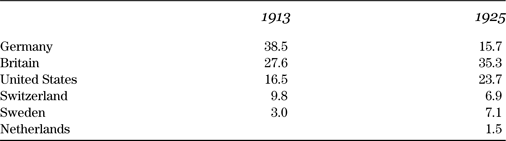
What were the consequences of wartime restructuring and organization-building? Britain's electrical manufacturers expected economic uncertainty after the war, but the depth of the 1920–1921 slump was never anticipated. However, from 1924 to 1929, they achieved notable increases in trade and output, although the disruption to Germany's economy and the loss of its overseas markets undoubtedly increased opportunities. Britain in 1913 had been behind Germany in exports of electrical machinery and apparatus, telegraph and telephone equipment, and batteries and accumulators, and it exercised leadership only in cables and wires; by 1924, Britain was selling more overseas than Germany in all four sectors. Among the six largest exporters of electrical goods by 1925, Britain held a 32 percent share in the heavy and machinery sector, and 54 percent in wire and cables. The third largest exporter of all electrical goods in 1913, Britain was ahead of the United States and Germany in 1925 with a 35 percent share (Table 4). Total British electrical exports followed an upward real-terms trend in the 1920s and showed a capacity to recover after the Great Depression (Table 2). Electrical imports relative to the domestic market fell in the 1920s, notably so in the case of machinery and insulated wire and cable (Table 5). The United States replaced Germany as the largest importer, accounting for some 60 percent. The import figures for radios, vacuum cleaners, and batteries, comparatively high at 12–17 percent, reflected a growing U.S. advantage in household appliances and consumer goods. Accumulators and magnetos remained protected by the Safeguarding of Industries Act.Footnote 99
Export Shares of Electrical Industry, by percentage, 1913 and 1925

Sources: Board of Trade, Report of the Committee on Industry and Trade, 1927, C.82018, 853, National Archives, London; League of Nations, International Economic Conference (Geneva, 1927).
Electrical Manufactured Imports as a Percentage of Consumption in Britain, 1913–1935

Source: Census of Production (London, 1924, 1930, 1935), National Archives, London.
British electrical manufacturing output was markedly higher by the mid-1920s compared to the pre-1914 period, and machinery and cables dominated in value terms. British firms had made headway in the technologically and organizationally-complex machinery sector, and retained primacy in cable-making. In the later 1920s, the building of the national grid and the rising use of electricity boosted machinery and lamp production. Radio manufacturing was an interwar phenomenon, particularly the 1930s, when televisions made their commercial appearance (Table 3). Consumer expenditure on lamps and lighting accessories expanded quickly, as did sales of domestic electrical appliances, which had been previously negligible.Footnote 100 The U.S. productivity lead in total manufacturing and in engineering lengthened. During the interwar period, total German and British manufacturing overall demonstrated similar performance levels, with German engineering gaining some ground by the end of the 1930s. British manufacturing productivity generally improved, and the British record was defendable against most industrial nations until the decades after 1945. We have no comparative data for electrical manufacture as a whole, but U.S.-U.K. output per employee ratios for lamps and radios were 543 and 347 respectively for 1935–1937 (Table 1). Figures for the period after 1945 suggest long-term productivity problems in electronic tubes and household appliances. Lamp production had evolved into a large-scale automated process, in which U.S. firms had demonstrable advantages, whereas Britain competed better in electrical machinery and accumulators, which involved substantial skills and labor input. While British producers began to compete more effectively in the heavy sector, mass production and standardization in the light electrical branches such as telephones, batteries, meters, insulated wire, and domestic appliances shifted advantages to low prices and to U.S. firms.Footnote 101 Since lamp firms were shielded by the industry's most far-reaching cartel arrangements, British lamp prices during the 1920s were high, although uncontrolled cheap nonbranded imports appeared in the 1930s.Footnote 102 Net output and employment in British electrical manufacturing grew throughout the interwar years, and net output per employee indicated improving performance in the 1920s before falling slightly during the Great Depression (Table 6).
Net Output in Current Terms, Average Annual Numbers Employed, and Net Output per Employee, U.K. Electrical Manufacturing, 1924–1935

Source: Census of Production (London, 1930, 1935), National Archives, London.
The influence of U.S. industrial companies replaced German firms as the formative influence on British, European, and Japanese electrical manufacturers, due to exports and acquisitions, but also by recasting interfirm links. Lamp making offers a notorious example. The Electric Lamp Manufacturers' Association (ELMA) was formed in 1919 as a mechanism for avoiding patent litigation. Crucially, it facilitated interfirm licensing and the pooling of research and advanced factory methods, and it sought to address overcapacity by curtailing output and price cutting. ELMA initially covered some 90 percent of world production, but was quickly undermined by low-price competitors.Footnote 103 In 1919, AEG, Siemens, and Auergesellschaft founded the Osram Company, buying up smaller German firms, and established the world's largest lamp manufacturer. In the same year, Gerald Swope led the founding of International General Electric (IGE), which would oversee plants in Europe, Latin America, and Asia, and bring GE Canada back under multinational control. Western Electric in the 1920s developed a parallel mix of overseas factories, joint ventures, and minority holdings. Through IGE, Swope expanded the international interfirm exchange of technical assistance, expertise, training, patents, and royalties, and negotiated market divisions. A renewed cooperative agreement with GE of America in 1919 formed the cornerstone of Philips' postwar policy—despite its links to German businesses—and Swope sat on the Dutch firm's board. Philips imitated the U.S. giant by buying equity in factories in Spain, England, Austria and Switzerland, and it emerged as the world's number two lamp manufacturer. In 1921, IGE acquired a minority stake in AEG, reestablishing the equity connection relinquished some eighteen years before, and the two firms extended their patent, invention, and market-sharing collaboration. When Osram and Philips' 1921 agreement to manage lamp overcapacity failed, it allowed Swope to embark on another round of commercial diplomacy. GE and Osram signed a deal in 1922, forestalling the German firm's entry into the United States, and lamp deals with AEG and Compagnie des Lampes followed. With GE's technological advantages, and networks of cross-border equity shares and interfirm agreements, Swope was instrumental in forming a company to oversee a world-wide lamp cartel. The Swiss-based Phoebus S.A. Compagnie Industrielle pour la Développement de l'Eclairage, initially involving twenty-seven firms, was founded in 1924. It bought up production capacity or compensated for reduced output, and exercised responsibility for quality standards, testing, marketing, and patent and knowledge transfer. Competition from an alliance of Scandi-navian firms, during the 1930s, would undermine Phoebus' efforts to limit international rivalry.Footnote 104 Antitrust legislation made U.S. firms wary of interfirm collusion, and, even in Europe, cartel arrangements eventually disappointed participants. A technologically-complicated industry encouraged collusive behavior in patent exchanges and standardization. But competition over service and product quality continued, and price arrangements invariably proved difficult to sustain.Footnote 105
Did the British electrical industry end its reliance on overseas technologies and interfirm agreements and develop its capabilities in management, technology, and skills? A government report documented how Britain's engineering firms had advanced in management and organization during the war, claiming they had created some of the “best works,” with modern equipment operated at the highest efficiency.Footnote 106 No British engineering business, however, had gained the scale and standardization as that achieved in the United States or Germany, and scientific departments were usually glaringly absent.Footnote 107 The 1924 Census of Production reported that production methods in British electrical engineering had noticeably improved. The Electrical Review recalled the German grip on the industry before World War I, but portrayed it in a 1925 article as much better to compete for itself.Footnote 108 For BEAMA, the insecure home market, low standardization, inadequate financial support, and the Board of Trade's failings were unresolved constraints, yet its evidence to a government committee specifically blamed individual firms for their deficiencies in mass production, scientific management, and technological research. The founding of the British Broadcasting Corporation (BBC) in1922 stimulated radio production and the consumption of cables, wires, and electricity. Though the 1919 Electricity Supply Act failed because of its reliance on voluntary mergers by generators, legislation in 1926 created a Central Electricity Board that constructed a national grid and stimulated demand for heavy generation plant and distribution equipment. Within a decade, electricity consumption in Britain equaled that of other nations with similar incomes. Some 12 percent of households had been wired for electricity by 1920, increasing to 32 percent by 1931, and to 65 percent by 1938.Footnote 109
The 1920s witnessed trends in concentration and improvements in business organization and production methods. By 1930, the four giant companies and generator equipment manufacturers of English Electric, Metro-Vick, BTH, and GEC held 30 percent of the capital invested in British electrical manufacturing, and the top twenty firms accounted for 50 percent.Footnote 110 GEC in the 1920s formally adopted a policy of recruiting university graduates and investing in management organization.Footnote 111 Metro-Vick, especially, and BTH also developed well-regarded industrial training and apprenticeships, plus programs for graduate recruitment and training for management, engineering, and technical staff.Footnote 112 But BTH, as a multinational subsidiary, relied entirely on GE's research and product development, in contrast to British-owned Metro-Vick and GEC that established their own facilities.Footnote 113 Despite its R&D initiatives, GEC remained reliant on foreign patents and commonly shared research results with rivals to meet its cartel obligations and avoid legal disputes.Footnote 114 GEC's “national” policy of not relying on German science contrasted with the reality of its cooperation with AEG and Siemens & Halske, alongside its arrangements with GE and the Standard Telephone Company, acquired by International Telegraph and Telephone (ITT).Footnote 115 Lucas grew in the 1920s as the main automotive and lighting supplier to Morris Motors. It did not invest significantly in R&D or in managerial personnel, but secured technology and product lines through market-sharing agreements with Bosch and through transatlantic commercial diplomacy.Footnote 116 In heavy engineering, Siemens-Schuckert established a close working relationship with GE, as AEG did with Brown Boveri. In 1924, Siemens-Schuckert had a patent and know-how agreement with Westinghouse, and sought to apply U.S. production methods at its factories in Germany.Footnote 117 BTH failed to invest in its factories or in managerial reorganization until joining Metro-Vick within the holding company of Associated Electrical Industries (AEI), formed in 1928 as ostensibly British-owned while being, in reality, IGE controlled. AEI oversight failed, however, to reconcile the instinctive rivalry between Metro-Vick and BTH until the Great Depression, when it cut costs in administration and duplication.Footnote 118 During the 1920s, English Electric's modest profits turned into annual losses, and the company failed to rationalize its various works. When, in 1930, English Electric appointed George Nelson from Metro-Vick as managing director, he heavily criticized the administrative methods and out-of-date machinery.Footnote 119 Before World War I, Siemens Dynamo had relied on technological inputs from Siemens-Schuckert or Siemens & Halske. Neither Siemens Dynamo nor Dick, Kerr, as predecessor firms, had the capacity to initiate an R&D function at English Electric.
Out of fear of arousing political and local criticism, cross-border arrangements were clandestine. Unstable global demand and production overcapacity predisposed firms in the 1920s toward interfirm cooperation, including cross-ownership, and toward market-sharing and output restrictions. The GEC board willingly, but confidentially, considered investment from and managerial direction by GE in 1922 and again in 1928. Although an agreement was not forthcoming, Hirst believed that “ultimately a way will be found to reconcile the needs of national industry with the requirements of any international obligations,” in effect acknowledging a significant conflict.Footnote 120 The commercially pragmatic attitude of GEC's board provides context to Docker's apparent transformation in quick time from industrial patriot into a peddler of national assets. Public rhetoric contrasted with the realities of cosmopolitan pragmatism and foot-loose deal-making. GE attempted in 1929 to take over GEC by stealth, which soured relations between the companies.Footnote 121 GE avoided a majority holding in AEG, for fear of provoking national resentment, and kept its stakes in the firm and in Siemens secret.Footnote 122 Vickers never overcame its purchase of British Westinghouse at the too high price negotiated by Docker. Although Metro-Vick formally separated from Westinghouse, cooperation over technology and markets was retained.Footnote 123 In 1927, Sir Reginald McKenna of Midland Bank approached his long-time associate, Hugo Hirst, about merging GEC, Metro-Vick and BTH. After lengthy consideration, Hirst felt that the timing was not right for GEC; instead, GE took control of Metro-Vick, less than ten years after being freed of U.S. ownership. By 1929, GE had placed Metro-Vick, BTH, Ediswan, and Ferguson-Paulin within a seemingly-British AEI.Footnote 124 Opinion within British electrical manufacturing shifted from wartime opposition to foreign ownership to support for transnational dealings and cross-shareholding and the restructuring of global overcapacity.Footnote 125 Outward FDI allowed further examples of cooperation. Starting in 1923, English Electric owned an engineering and traction motor firm in Japan, in alliance with GE and Westinghouse. In 1926, Metro-Vick formed a joint-venture with Westinghouse International and local business interests in Spain and relied on the U.S. firm to supply the expatriate staff that provided “technical control and management of the Works.”Footnote 126
Conclusion
Cross-border personal and interfirm networks and particularly links with Germany shaped British electrical manufacturing's development from the 1890s. Commercial diplomacy and international agreements determined the stages by which GEC grew into a large enterprise, including its entry into mining machinery, motors, and lamps. While Hirst identified himself and his company as British, he and his key managers had a German upbringing and transformative Europe-wide connections. Émigré Germans provided the leadership of BTH in the 1890s and GEC into the postwar period; they managed Enfield Cable, Phoenix Telegraph, Siemens Brothers, Union Cable, Siemens Dynamo, and others before 1914. Networks constituted more than signing rights and technology agreements, and required the transfer of personnel, skills, and product and production expertise. Acquiring firms had to build organizations with the “absorptive capacity” to learn and instill knowledge, systems, and routines.Footnote 127 GEC created the management and marketing capabilities to manufacture a wide range of electrical goods on an increasing scale, but showed no interest in R&D. A growing export market obviated the difficulties of comparatively slow domestic demand. Dick, Kerr expanded by adopting and learning U.S. methods in tram manufacture and likewise did not invest in product development.
Evidence points to a highly internationalized British industry characterized by determinant intercompany networks and the transfer of technologies, products, and managerial capabilities. Figures for the ratio of FDI stock to global GDP in 1914 (at 11.1 percent) would not be exceeded until 1993 (at 11.3 percent) and illustrate noteworthy levels of international economic integration.Footnote 128 Technology, knowledge, and skills acquisition through cross-border networks among electrical manufacturers indicated another significant aspect of international economic integration. The defining global dimensions of firms overlapped with influential national factors. Britain's regulatory and institutional framework contributed to electricity generation and distribution's tardy advance, and uneven and low per capita power consumption restricted the domestic market and manufacturing scale. Manufacturers blamed their unimpressive performance on electricity's slow diffusion and on free trade. The tariff question had small relevance for cable-making and installation, a recognized national success. Import duties would have raised the costs of magnetos, lamps, and generators, and did not guarantee domestic firms would commence production of them. GEC and others showed that growth and product diversification against foreign competition was feasible, given an ability to adapt acquired technologies and systems. Case examples indicate an association between managerial initiative and organizational outcomes, and they underline the relevance of firm-level factors in forming international networks and implementing capability transfer. Yet these strategies posed questions about the nation's intrinsic industrial strength. Electrical manufacturers, critical of British banks, could in fact obtain the financing to expand plants and diversify products, but they were disadvantaged in funding large-scale deals and engineering contracts at home and overseas.
Multinational investment determined the heavy sector's evolution. Westinghouse was committed to international expansion through fully-controlled subsidiaries, while GE was inclined toward licensing and strategic alliances. Siemens & Halske used family partnerships and networks to coordinate its businesses overseas, although political pressure might necessitate the involvement of local interests. None of these companies perceived a viable partner in Britain, and directly-managed subsidiaries had the advantage of easing resource, technology, and advanced knowledge transfer. U.S. and German multinationals saw the 1898 legislation as stimulating demand for traction motors and power engineering, but would be disappointed. Revealingly, large-scale foreign companies in Britain encountered operational and managerial difficulties despite compensating firm-specific advantages. Before 1914, Siemens Dynamo, BTH, and especially British Westinghouse had to adapt their methods to local market conditions: the confidence of parent multinationals in their products and management ran up against the inadequate or laggard absorptive capacity of their subsidiaries. The transfer of capabilities in the technologically and organizationally complex heavy engineering sector presented the biggest challenges.
In explaining the development of electrical enterprise in Britain up to 1914, we can draw on international business literature. One influential body of work explains FDI through the parent multinational having an ownership or firm-specific advantage in technology or management systems. The existence of localization factors, such as transport costs, tariffs, or market responsiveness, would further justify overseas production in a host economy over exporting. The parent multinational's strategy and the resources and capabilities it transfers internationally and internally shape the subsidiary's management.Footnote 129 Mainstream international business theory says less about the practicalities and limitations of resource and capability transfer, or, after the initial act of FDI, about a subsidiary's long-term evolution. British Westinghouse's early history was especially characterized by needed adaptations of transferred production methods and management, and Siemens Dynamo and BTH encountered similar challenges. The hybridization of internationally transferred practices, due to host country markets and contexts, occurred in both foreign-owned and internationally-networked local businesses, emphasizing shared concerns.Footnote 130 Enterprises face the dilemma of seeking internal or bilateral consistency in their cross-border organization or networks (facilitating international capability transfer) and external consistency with the host economy (hindering international capability transfer).Footnote 131 A focus on subsidiary management and objectives is especially relevant if British Westinghouse's long-term evolution and its changing relationship with its U.S. parent is to be understood.Footnote 132
Internationally-acquired capabilities were as transformative in Britain as those transferred to multinational subsidiaries. Firms may seek to exploit technological or managerial ownership advantages commercially, yet perceive no localization incentives in operating overseas. As opposed to directly-controlled subsidiaries, they can consider the alternative international strategy of licensing a technology, product, or process.Footnote 133 Parallel to the FDI literature, interest is usually concentrated on the licensing multinational's strategic intent and on capability transfer from a home to host economy. The role of firms buying technologies, products, and techniques through agreements and networks in effecting that transfer has received less attention. As most obviously indicated by GEC, the motives of acquirers, the ability to absorb new technologies and systems, and long-term organizational development deserve full consideration. Knowledge becomes embedded in the experience, organizational routines, practices, and documents of firms, while commercially applied and adapted to market and institutional contexts.Footnote 134 Personal connections, experience, and repeated exchanges determined the stability and efficacy of interfirm international business networks.Footnote 135 Hirst was self-admittedly no technologist, but he was an organization builder with extensive political, industry, and international connections.
Hughes argues that electrical supply evolved in a series of phases. After the period of the inventor-entrepreneur, epitomized by Thomas Edison, it was the combined activities of inventors, entrepreneurs, and financiers that enabled technology transfer from one region or nation to another. Enterprises subsequently chose between systems and resolved technological and organizational problems. The most important phase occurred during the interwar period: critical mass was achieved through a major increase in capital in accepted systems and greater involvement from governments, regulatory bodies, educational systems, and professional societies. Hausman, Hertner and Wilkins contrast the pre-1914 global economy, cross-border capital flows, and the building and management of utilities by private multinational engineering enterprises with interwar decades marked by a trend toward government intervention and publicly-owned or locally-controlled companies.Footnote 136 Electrical manufacturing's highly diverse nature is much more difficult to characterize. Technological, organizational, operational, and regulatory breakthroughs in cable-making and international telegraph services occurred at a particularly early point, by the mid-nineteenth century.Footnote 137 Global patent and production agreements and cartels had the biggest influence on the strategies of lamp enterprises. More generally, entrepreneurs and firms in electrical manufacturing had, by the 1890s, taken over from inventor-entrepreneurs; in addition, they were organizing the international transfer of technologies through licensing, networks, and FDI; and overcoming difficulties in manufacturing and marketing. World War I was a turning point: international economic relations were disrupted and state intervention in national economies could not be avoided. Trade and technology dependence raised questions about immediate and postwar national security. Sequestrated German assets forced the British government to consider industrial restructuring, and wartime circumstances induced Westinghouse to sell its subsidiary to local companies. Business leaders saw an opportunity for striking lucrative deals, and advocated, at least publicly, for the value of a nationally-owned and operationally-independent electrical industry. British firms obtained greater scale, improved management, and increased standardization, most notably in heavy and power engineering.
One notable theoretical perspective emphasizes the pressures exerted by nationally-distinct sets of embedded institutions in government, educational systems, labor markets, and technology networks on firms. Such “institutionalism” coexists uneasily with the realities of cross-border commerce and investment having a long-term influence on management practices and capabilities. Institutional theory suggests additionally that determining institutions become fixed in their composition at an early point in a nation's industrialization.Footnote 138 Analysis of how precisely national institutions shape the management of either indigenous firms or multinational subsidiaries is limited. But electrical manufacturing was highly global in strategies and organization during its formative decades, and Britain presented no significant institutional barriers to the success of émigré entrepreneurs, international commerce, or foreign-owned enterprises. The military, governmental, and economic crises caused by World War I brought both the restructuring of an industry and altered the market and institutional context. A historical perspective underlines how the development of businesses and domestic politics were not immutable or on some fixed path and how World War I created a complex, rapidly-evolving but unresolved situation for British electrical manufacturing. The conflict brought about the domestic production of magnetos and scientific appliances, use of confiscated patents, and large-scale British-owned firms in heavy and power manufacturing. Arguments over British technological declinism continue, but these companies did invest in R&D and scientific personnel.Footnote 139 BTH, as a dependent multinational subsidiary, never founded its own product development capabilities. Metro-Vick and GEC upgraded their internal organization and managerial personnel; Metro-Vick and BTH established noted and ambitious apprenticeship programs. Interwar U.S.-owned firms presented themselves as being ostensibly British, and locally-owned enterprises with their own extensive international links were complicit in protecting this public image.
The electrical industry broadens our understanding of the history of international business. British electrical manufacturing up to 1914 had developed a high and growing reliance on cross-border agreements and networks. World War I forced a reappraisal of business strategies, and larger-scale and locally-controlled firms were founded. Yet, while GEC invested in managerial personnel and R&D facilities by the early 1920s, it still relied on international alliances and interfirm cooperation. British Westinghouse and its Metro-Vick successor retained legacy relations with Westinghouse; British, European, and U.S. firms all deepened their global strategic relationships. The cross-border dimensions of electrical manufacturing conditioned business objectives, product development, and ownership from the 1890s to the 1920s. The political and economic crises of the Great Depression introduced a new phase, distinguished by state intervention, tariffs, and reliance on national demand and initiatives.Footnote 140 In the period after World War II, often responding to U.S. technological, managerial, and financial dominance, governments established locally-controlled and public electric and electronic industries in furtherance of national industrial strategies.Footnote 141