Introduction
During the last few decades, welfare state legitimacy has been discussed and studied intensively by social scientists. Yet, while much is known within the existing welfare state literature about the reasons why individuals support the welfare state, a number of unanswered questions remain. At the micro level, we know individuals are motivated to support welfare mainly because of personal interest (Brooks and Manza, Reference Brooks and Manza2006; Korpi, Reference Korpi1983; Van Oorschot, Reference Van Oorschot2002), but social norms, moral obligations and reciprocity are also motives for support (Bowles and Gintis, Reference Bowles and Gintis2000; Kangas, Reference Kangas1997; Ullrich, Reference Ullrich2002; Van Oorschot, Reference Van Oorschot2002). We also know that these motives are to some extent dependent upon the institutional context at the macro level (Albrekt Larsen, Reference Albrekt Larsen2006; Arts and Gelissen, Reference Arts and Gelissen2001; Mau, Reference Mau2003; Svallfors, Reference Svallfors1997; Taylor-Gooby, Reference Taylor-Gooby2008). However, we still do not know under which circumstances public opinion adjusts to policy designs and in which cases policy designs are adapted to public opinion. Why are welfare institutions themselves sometimes responsible for how welfare institutions transform and why, under other circumstances, does public opinion seem to drive welfare reforms? Existing studies do not answer this question. Rather, they tend to study one direction of this relationship: either the opinion–policy nexus – in which policy adjusts to opinion – or the policy–opinion nexus – in which opinion adjusts to policy.
On the one hand, studies examining the policy–opinion nexus concentrate on investigating how different welfare regimes, introduced in Esping-Andersen's (Reference Esping-Andersen1990) path-breaking book the Three Worlds of Welfare Capitalism, bring forth particular welfare opinions (e.g. Albrekt Larsen, Reference Albrekt Larsen2006; Arts and Gelissen, Reference Arts and Gelissen2001; Svallfors, Reference Svallfors1997). The main argument in these studies is that citizens approve of welfare arrangements present in their welfare regime and this ‘proves’ there is an institutional influence on individual attitudes. These studies received several critiques, but, above all, these studies are problematic because they cannot ascertain that institutions determine citizens’ attitudes (see also Halvorsen, Reference Halvorsen, Mau and Veghte2007: 253) because it is empirically difficult to prove the direction of causality in this manner. Also, studies such as these most often provide only minor support for the idea that attitudes are structured by regime type (compare Jaeger, Reference Jaeger2009). Moreover, several authors argue that in the present era of ‘permanent austerity’ (Pierson, Reference Pierson2001: 410) the internal consistency relied on by Esping-Andersen to cluster his welfare regimes may have decreased or even disappeared (Bannink and Hoogenboom, Reference Bannink and Hoogenboom2007; Hinrichs and Kangas, Reference Hinrichs and Kangas2003; Kasza, Reference Kasza2002; Pfeifer, Reference Pfeifer2009). If this is the case, welfare regimes are not likely to structure welfare attitudes because the structuring elements of welfare regimes themselves are then arbitrary in nature.
On the other hand, studies investigating the opinion–policy nexus have flaws as well. Micro-level theory states that individual opinions influence social policy because of their translation into political consequences (e.g. Brooks and Manza, Reference Brooks and Manza2006; Korpi and Palme, Reference Korpi and Palme1998). Following Page and Shapiro's classic article ‘Effects of Opinion on Policy’ (1983), numerous accounts have attempted to verify two questions. One, does public opinion affect social policy? If so, to what degree? Obviously, some authors argue there is only a modest influence (Page and Shapiro, Reference Page and Shapiro1983; Jones, Reference Jones1994), while others argue that public opinion is very important (Stimson et al., Reference Stimson, MacKuen and Erikson1995). These conclusions stand or fall with the researchers’ own arbitrary norms and ideas about what exactly constitutes a strong or modest influence. Furthermore, as Cook et al. (Reference Cook, Barabas and Page2002) show, while policy elites concerned with social security frequently invoke public opinion, these invocations are seldom empirically informed.
While both the policy–opinion nexus and the opinion–policy nexus have been subject to empirical investigation and despite the idea that reciprocal influences are also plausible, the number of studies integrating both relationships is scarce. As Svallfors argues, ‘Within some boundary limits, the relationship [between institutions and orientations: authors] is instead a probabilistic one as well as one of mutual dependency and development. Certain institutions tend to make some orientations more likely than others; given a certain set of orientations, some institutions are more easily implemented or changed than others’ (Reference Svallfors2006: 10). The absence of any empirical examinations of this mutual relationship is a shortcoming in the existing literature. This problem is exacerbated by a lack of micro-data. As Korpi and Palme (Reference Korpi and Palme1998: 682) state, ‘the empirical testing of the macro-micro links among institutions and the formation of interest and coalitions provides a major challenge for social scientists, but comparative micro-data currently are lacking’. For these reasons, Mettler et al. (Reference Mettler and Soss2004: 56) argue that we need studies with ‘wide-ranging empirical research to explore this agenda’.
One of the few studies that investigate the mutual relationship between policy and public opinion is Sharp's Sometime Connection (Reference Sharp1999), which shows there is a ‘sometime connection’ between policy and opinion. Sometimes policy seems to determine public opinion and sometimes public opinion seems to shape social policy. However, Sharp does not explain why social policy sometimes seems to follow the public's preferences, while it does not in other circumstances. Neither does she explain why it sometimes works the other way around: why does public opinion adjust to existing social policy in certain cases, while being resistant to policy influences in other cases? Building on Sharp's idea that the direction of the relationship may depend on the policy being considered, the present paper attempts to discover under which circumstances public opinion shapes social policy and under which circumstances social policy shapes public opinion. We try to disentangle the relationship in the best possible way using existing data. The central question to be answered is: in which policy areas do social policy designs follow public preferences and when does public opinion follow existing policy designs and why?
In the next section, we elaborate on existing theory before outlining a new explanation for the connection between social policy and public opinion. Following this discussion, this possible explanation is tested using longitudinal data for the Netherlands.
The opinion–policy nexus and the policy–opinion nexus
There are two dominant ideas about the link between policy and public opinion. The first focuses on reasons why public opinion supposedly influences social policy. The second focuses on why social policy is expected to influence public opinion. We outline both of these ideas below.
When considering the opinion–policy nexus, the key to understanding how policy preferences determine policy outcomes lies in the so-called power resources model (Korpi, Reference Korpi1983). The power resources model states that public opinion will influence policy through two processes. First, public opinion can assert its influence on social policy indirectly ‘through the voting ballot’. Social actors – individuals or collective actors – are differentially provided with the ability to punish or reward other actors (Korpi, Reference Korpi1983). In other words, once people have enough power resources at their disposal, they can determine the policy-formation process and the outcomes of this process. Class struggle, a conflict over the allocation of material wealth and life chances, is translated into electoral ties between class position and political parties: members of the working class have generally voted for leftist parties and members of the middle class have commonly voted for parties on the right. ‘The simplest explanation for this widespread pattern is simple economic self-interest. The leftist parties present themselves as instruments of social change in the direction of equality; the lower-income groups support them in order to become economically better off, while the higher-income groups oppose them in order to maintain their economic advantages. The statistical facts can then be taken as evidence of the importance of class factors’ (Lipset, Reference Lipset1981: 239). In short, left-wing tendencies in the working class and right-wing tendencies in the middle class may be explained by their longing for, respectively aversion to, an expensive, generous welfare state, which aims to redistribute wealth from the rich to the poor. Through the electoral process, public opinions, driven by class differences, thus assert influence on welfare state policies.
Second, public opinion may also directly influence social policy ‘through the fear of electoral punishment’. Politicians may fear future electoral punishment in reaction to unpopular policies, thereby abstaining from unpopular decisions. In various accounts, scholars have argued that in order to sustain large, expensive welfare states, public support – in the form of policy preferences – is of crucial importance (Brooks and Manza, Reference Brooks and Manza2006; Erikson et al., Reference Erikson, MacKuen and Stimson2002). Political parties attempting to reduce the size and costs of the welfare state run the risk of being punished during future elections. Brooks and Manza note that ‘government officials have incentives to incorporate policy preferences into policymaking so as to avoid voter sanctions in the form of electoral defeat or public protest’ (Brooks and Manza, Reference Brooks and Manza2006: 818). This behaviour is what Pierson (Reference Pierson1994, Reference Pierson1996, Reference Pierson2001) terms the mechanism of ‘blame avoidance’.
For the policy–opinion nexus, the question to be answered is if and how social policy determines welfare attitudes. Before answering this question, we need to stress that ‘policies, once established, act as institutions, because they create a framework in which certain resources, rules and norms are imposed upon citizens’ (Lowi, Reference Lowi1964: 644). Therefore, institutional theory applies to this relationship. Durkheim (Reference Durkheim1951), for example, argued that institutions determine individual opinion, by contending that utilitarianism provided no explanation for group solidarity, rather institutions did, by producing norms which citizens internalise. In doing so, Durkheim downplayed the role of the individual. Hence, the idea that institutions influence individual opinions is almost as old as sociology itself.
Reasons that are frequently given for a supposed influence of institutions on public opinion are that citizens do not form their opinions independently, but that they do so within a specific institutional context. The ‘most profound decisions about justice are not made by individuals as such, but by individuals thinking within and on behalf of institutions’ (Douglas, Reference Douglas1987: 124). Public policy defines the boundaries of a political community; it defines membership, and as a consequence it also defines who deserves (financial) help and who does not. Next to defining boundaries, public policy also directs public perceptions of societal problems, policy agendas and governmental action by identifying target groups and defining solutions (Mettler and Soss, Reference Mettler and Soss2004). Consequently, the ‘individual tends to leave the important decisions to his institutions while busying himself with tactics and details’ (Douglas, Reference Douglas1987: 111).
This institutional influence on public opinion is somewhat conditional: the public has to be convinced that these institutions are legitimate. Rothstein (Reference Rothstein1998: 217) puts forth three conditions for institutional legitimacy: institutions should ‘install a feeling of trust that others will cooperate’; state leaders should ‘put forward a moral argument that what is to be achieved by this cooperation is a morally just cause’; and institutions should ‘be successful in showing that the institution that is going to be responsible for the implementation of this morally good cause is a “just institution”’. Together, these three reasons are supposed to create public support. Hence, ‘[w]here “good reasons” for a certain set of social provisions are given, people are more likely to comply and to sustain the institutional asset. It is the public affirmation and recognition of welfare policies that provides the “normative fundament” on which the institutional architecture rests’ (Mau, Reference Mau2003: 31–2). In other words, individuals approve of social security institutions not only out of personal interest, but also because norms of reciprocity are embedded in these institutions (Bowles and Gintis, Reference Bowles and Gintis2000; Mau, Reference Mau2003; Ullrich, Reference Ullrich2002).
Having outlined theoretical arguments for how public opinion could influence welfare institutions as well as how welfare institutions could influence public opinion, the next question to be answered is under which circumstances the opinion–policy and under which the policy–opinion nexus is applicable. As we saw in the introduction, Sharp (Reference Sharp1999) investigated the interaction between both theoretical positions. Sharp concludes: depending upon the choice of policy domain, sometimes policy precedes opinions and sometimes opinions precede policy. Although Sharp's study is a good attempt at investigating the mutual connection between social policy and public opinion, Sharp does not explain this ‘sometime connection’; the study does not clarify when and why this connection differs by policy domain. We argue that by borrowing some ideas deriving from Pierson's (Reference Pierson1996) theory on old and new politics, an explanation can be provided. The next section explores how.
Explaining a mutual connection between social policy and public opinion
Pierson (Reference Pierson1996, Reference Pierson2001) argues that there is a fundamental difference between what he calls the old and new politics of the welfare state. Old politics refers to the policy processes during the period of welfare state establishment and expansion. Old politics was about building and designing welfare policies. In this process, politics (and through politics, public opinion) played an important role. The process was not hindered by path dependency or policy feedback mechanisms, as we will discuss below, but was driven by politicians who were still inventing policies (or institutions) in an era of welfare state expansion. Therefore, the political process offers an explanation for the introduction and expansion of ‘new’ social policy domains, in which public opinion supposedly influences policy designs as discussed above: through politics, through the power resources model and through mechanisms of blame avoidance.
In contrast to the old politics of welfare state expansion, new politics are about the decline of the welfare state through retrenchment. Pierson's main argument is that reforming highly institutionalised policies appears to be difficult because of path dependency and feedback mechanisms. Path dependency signifies that ‘once a country or region has started down a track, the costs of reversal are very high’ (Levi, Reference Levi, Lichbach and Zuckerman1997: 28), which implies that the costs of retrenchment following a period of institutional welfare expansion are high. According to Pierson, this concept of path dependency is best captured by the idea of increasing returns, which could also be described as self-reinforcing or positive feedback processes (Reference Pierson2000: 251). Following this feedback mechanism logic, existing policies seem to determine the options for future policies (hence, also transformations of these policies) to a high degree. Given these self-reinforcing mechanisms, there is little space for politicians as well as the public to influence highly institutionalised policy designs that arose during a period of welfare state expansion. On the contrary, the public has to form its attitudes within this context, which makes it likely that the public has a bias towards established and highly institutionalised policies. The study of Gusmano et al. (Reference Gusmano, Schlesinger and Thomas2002: 731) supports this argument. The authors show that ‘lessons about the performance of institutions . . . represents the most important effect of existing policy on public attitudes’. In addition, institutional theory also claims that it is important that welfare state institutions receive public approval while being established, but, thereafter, institutions begin to control the collective memory of their members (Douglas, Reference Douglas1987: 112; Mau, Reference Mau2003). Hence, institutional theory also supports these claims that public opinion is most influential during the establishment of institutions; thereafter, institutions determine individual opinions under the precondition that ‘good reasons’ for trusting these institutions are given.
Once a welfare state is established, however, new policy domains will also be introduced. For example, when retrenchment is the main goal of welfare state policies (in order to contain costs and adapt to demographic changes), new policies directed at increasing labour market participation and reintegration will be introduced (Gilbert, Reference Gilbert2004, Reference Gilbert2009; Achterberg et al., submitted). With regard to this relatively new policy domain, the discussed mechanisms of path dependency and feedback are not applicable. This means that, in general, two types of policy exist. First, there are policies that were introduced during the period of welfare state establishment and expansion, which are now highly institutionalised and thus difficult to change. Second, since the 1980s, relatively new policies have emerged, policies which are still evolving and developing, which implies that they are still easily changed. A recent study by Albrekt Larsen (Reference Albrekt Larsen2008) supports the idea that public opinion can influence relatively new, not yet highly institutionalised, policy domains. Using data for Australia, Albrekt Larsen shows that public opinion influences the relatively new social policy domain of active labour market policy. Because the general public prefers that different active labour market strategies be applied to young, unemployed workers in comparison to older, unemployed workers, exceptions for these two groups are present in actual social policy. Young people are required to meet harsher unemployment criteria than older workers.
These new policy domains, which include policies such as childcare and active labour market policy, contrast with highly institutionalised and established policy domains evident in traditional social security schemes, such as social assistance programmes, unemployment schemes, old age pension schemes or disability schemes.Footnote 1
In sum, dependent upon the policy domain, welfare policy will be more or less open to the influence of public opinion. Well-established and highly institutionalised policy subjects are likely to determine public opinion on these policies (compare Gusmano et al., Reference Gusmano, Schlesinger and Thomas2002). When policy subjects are relatively new, public opinion can influence these policy designs (compare Douglas, Reference Douglas1987; Mau, Reference Mau2003). This brings us to the following propositions:
In the case of highly established and institutionalised policy areas such as unemployment schemes or old age pensions, public opinion will follow existing social policy designs.
In the case of policy areas where the social policy design has not yet been fully established, such as labour market activation, social policy designs will follow public opinion.
Later in the paper, these two propositions will be tested empirically using Dutch longitudinal data. First, we outline the data and methodology.
Data and methods
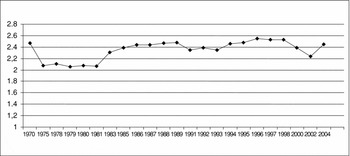
In order to test the propositions put forth above, longitudinal data are needed, particularly data that cover a long period of time and multiple policy areas. Therefore, in this paper we used representative survey data from the Netherlands: the ‘Cultural Changes in the Netherlands’ data,Footnote 2 which include information on support for unemployment schemes, old-age pensions and childcare provision. These data stem from a longitudinal project started during the 1970s, carried out by the Netherlands Institute for Social Research (SCP).Footnote 3 These surveys contain general questions on support for the welfare state and questions on support for specific social security arrangements (Figure 1 presents the trend in public opinion between 1970 and 2004). We analyse the data in two steps. We start by measuring the effect of public opinion on social policy through the use of a time-series model. This model measures the aggregate effect of public opinion on social policy. We then measure the effect of policy on public opinion by applying a multi-level model that measures the effect of policy on individual-level opinions.
Public opinion on social security expenditure.

For the time-series analyses, public preferences for more or less expenditure on social security are measured at the aggregate level by a series of four items measuring attitudes to unemployment, disability and pension schemes and attitudes about childcare facilities. Principal component analysis showed that these items could be combined into a scale (alpha = 0.74). Respondents were asked to indicate whether unemployment schemes, old age pensions and disability schemes are (1) too good, (2) sufficient, or (3) insufficient. Attitudes on childcare have been measured by asking respondents whether ‘the government should build cheaper childcare facilities’. Answer possibilities are measured on a five-point scale ranging from (1) strongly agree to (5) strongly disagree.
For the multi-level analyses, we were unable to include all four items because principal component analysis showed these items do not fall into one dimension at the individual level. However, by excluding attitudes on childcare facilities and including attitudes towards social assistance we were able to create a scale based on attitudes towards expenditure on social security benefits with a robust alpha score (alpha = 0.72). A high score on either scale indicates high support for increasing expenditure on social security arrangements.
We also use data from the OECD (2004) social expenditure database (SOCX), which provides data on welfare state spending as a percentage of GDP. We use data covering expenditure on both well-established, highly institutionalised welfare domains as well as on relatively new and evolving welfare policies. With regard to the former, expenditure data on unemployment benefits and old age pensions are used to measure traditional social policies. For the latter, we use expenditure data on active labour market policies.
Obviously, these three policies developed and changed during the period of analysis. Although we are mainly interested in the temporal order of opinion and policy changes, we briefly outline relevant developments in these Dutch schemes to give an indication of how policy influenced public opinion and vice versa. Since the 1980s, the Dutch unemployment scheme has been subject to increased restrictions and conditions. In contrast, the Dutch state pension scheme has not substantially changed since its origin in 1957, and has remained flat-rate and rather unconditional. The only significant change occurred during the 1980s, when pension schemes were individualised as a result of a decrease in male breadwinner households.Footnote 4 Dutch active labour market policy was introduced during the 1980s, and obligations to look for a job while receiving welfare state benefits have increased significantly since then.
As mentioned above, to test the mutual relationship between public opinion and social policy empirically, two different methods are used. We start by using multi-level regression analyses to test the influence of social policy on public opinion. The advantage of multi-level analysis is that it allows for the inclusion of both individual- and higher-level factors in explaining the dependent variable. Multi-level analyses are preferable for testing the policy–opinion nexus because opinion data are nested within a given year; people within a given context tend to be more similar to one another than people from two different contexts. In using this method, attitudes are measured and analysed at the individual level; therefore, public opinion in one year is independent of public opinion in the year before. However, observations of public opinion at the aggregate level are not independent of each other, meaning that standard OLS regression assumptions cannot be met. We performed four separate analyses using time-lag variables for t–1, t–2, t–3 and t–4.Footnote 5 While the literature assumes public opinion adapts itself to social policy within one year (Sharp, Reference Sharp1999), there is little empirical research to show how long it takes before policy is affected by public opinion. Therefore, we use a total of four time-lag variables to test the adaptability of policy to public opinion within one four-year election period. The intraclass correlation for our data is 0.11, which tells us that multi-level analysis is a sound methodological choice.
For the analyses of the opinion–policy nexus, we have chosen to use time-series analyses. Multi-level analysis is not possible here because policy observations, which are now the dependent variable, are not independent of each other. After all, it is very likely that policies in a certain year are very similar to policies in the preceding year. Time-series analysis with autocorrelations allows us to correct for this path dependency of social policy observations, giving a more accurate picture of the associations involved. As we did for the multi-level analyses, we use four time-lag variables for the time-series analyses as well. Yet we deviate from the literature at this point because we are not entirely convinced that public opinion can adapt itself to policy within one year. Therefore, to allow for a longer period in which public opinion adapts itself to policy and to remain consistent with our first analyses, we have decided to use the same time-lag variables of t–1, t–2, t–3 and t–4. Furthermore, in all analyses, we control for standardised unemployment because unemployment levels can influence both the policy–opinion nexus and the opinion–policy nexus (compare for example Albrekt Larsen, Reference Albrekt Larsen2006; Svallfors, Reference Svallfors1997).
Relationship between relatively established social policy domains and public opinion
In this section, results of the empirical testing of the first central propositions of this paper are presented. We test whether public opinion does or does not influence the well-established and highly institutionalised policies of unemployment and old age pensions as discussed above, simultaneously considering whether the opposite relationship exists – namely, that expenditure on these policies has the expected strong influence on public opinion. The expectation is that public opinion strongly influences relatively new active labour market policies. The opposite effect, that active labour market policies would influence public opinion, is expected to be absent or weak.
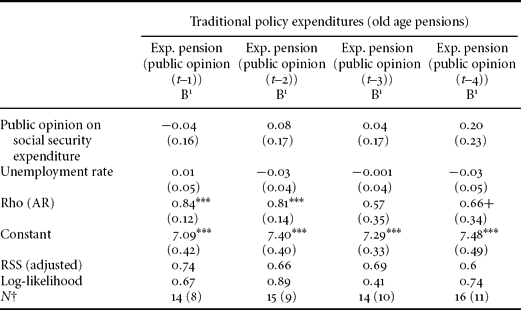
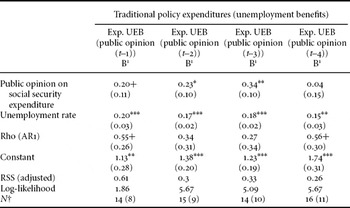
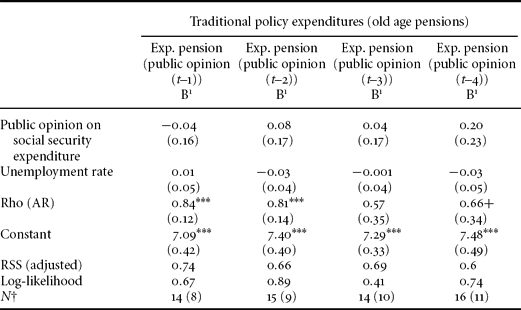
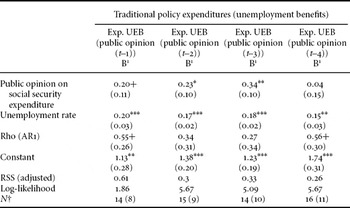
Looking at the opinion–policy nexus, results of the time-series analyses are as expected with regards to old age pensions: public opinion (with time lags of one, two, three and four years) has no influence on real expenditure for old age pension schemes (see Table 1). The strength of the parameters is weak and statistically insignificant. These results confirm our expectation: there is no policy responsiveness to public opinion on pension expenditure. In contrast, public opinion has a positive effect on unemployment expenditure with a time lag of two and three years, while it does not have an effect with a time lag of one or four years (see Table 2). Public opinion minus one and minus four years has no significant influence on the actual unemployment policy, which is in line with our expectation. However, if citizens prefer higher expenditures, actual expenditure on unemployment schemes follows public opinion after two and three years. It would appear, therefore, that unemployment benefit schemes are more susceptible to public opinion than pension schemes.
The influence of public opinion on traditional, highly institutionalised social policy (old age pension schemes): time-series analyses
Notes: ***p<0.001, **p<0.01, *p<0.05 + p<0.10.
†Number of cases at the beginning of the series (number of cases at the end of the series).
1Standard error in parentheses.
Sources: The Netherlands Institute for Social Research (SCP) data series ‘Cultural Changes in the Netherlands’ (1970–2004); OECD social expenditure data (SOCX).
The influence of public opinion on traditional, highly institutionalised social policy (unemployment schemes): time-series analyses
Notes: ***p<0.001, **p<0.01, *p<0.05 + p<0.10.
†Number of cases at the beginning of the series (number of cases at the end of the series).
1Standard error in parentheses.
Sources: The Netherlands Institute for Social Research (SCP) data series ‘Cultural Changes in the Netherlands’ (1970–2004); OECD social expenditure data (SOCX).
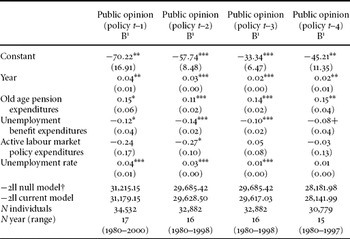
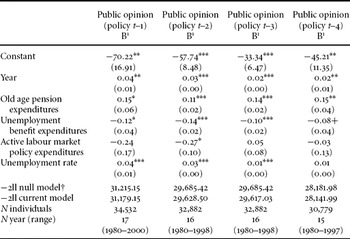
Turning to the policy–opinion nexus examined with multi-level analyses, the analyses show that the public adapt their opinion to actual expenditures on old age pensions (see Table 3).Footnote 6 Parameters for this variable are positive and strong for all time lags; hence expenditure on pensions influences opinions on expenditure after one, two, three and four years. Once again, the influence of unemployment expenditure on public opinion is not in line with our expectations. In this case, these results seem to stem from controlling for unemployment rates. When we omit this control variable, the results are in line with our expectations: public opinion follows actual expenditure on unemployment benefits.Footnote 7 It seems that support for higher expenditures on unemployment increases if the unemployment rate increases (probably due to an increasing risk of becoming unemployed). Yet support declines if actual expenditure on unemployment benefits increases because an increase in taxes would be necessary to cover the increase in expenditure. In sum, our first proposition is confirmed. Public preferences for higher expenditure do not determine expenditures on well–established, highly institutionalised policy domains. On the contrary, expenditure on these traditional policies determines public preferences for more or less expenditure on these policies.
The influence of traditional, highly institutionalised social policy and relatively new active labour market policy on public opinion: multi-level analyses
Notes: ***p<0.001, **p<0.01, *p<0.05 + p<0.10.
†Intra class correlations of null model equals 0.11.
1Standard error in parentheses.
Sources: The Netherlands Institute for Social Research (SCP) data series ‘Cultural Changes in the Netherlands’ (1970–2004); OECD social expenditure data (SOCX).
Relationship between relatively new social policy domains and public opinion
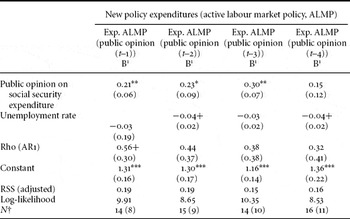
The second proposition – that social policy designs are supposed to adapt to public opinion when it concerns a relatively new and not yet institutionalised policy area – is confirmed. With regard to the opinion–policy nexus, the results show that preferences for increased social security expenditure have a positive and significant effect (even despite the low sample size) on active labour market policy expenditure (see Table 4). Public opinion also influences active labour market policy up to three years after these attitudes have been measured. With regard to the policy–opinion nexus (see Table 3), however, public opinion does not follow trends in expenditure on active labour market policy. In sum, the results substantiate proposition two. Public opinion strongly influences active labour market policy expenditures, while actual expenditures do not or only scarcely influence public opinion.
The influence of public opinion on relatively new, and not yet institutionalised social policy: time-series analyses

Notes: ***p<0.001, **p<0.01, *p<0.05 + p<0.10.
†Number of cases at the beginning of the series (number of cases at the end of the series).
1Standard error in parentheses.
Sources: The Netherlands Institute for Social Research (SCP) data series ‘Cultural Changes in the Netherlands’ (1970–2004); OECD social expenditure data (SOCX).
Conclusion
The existing literature on welfare state legitimacy fails to answer the question: in what policy areas do social policy designs precede public opinion and when does public opinion precede existing policy designs and why? Scholars examining individual-level influences on welfare state policies as well as scholars investigating institutional influences on individual welfare attitudes find empirical evidence for both relationships. Despite the existence of a plausible relationship in either direction, these scholars almost never investigate the presence of a mutual relationship. Until now, we remained unaware as to the circumstances under which welfare institutions themselves invoke public approval of welfare policies and under which circumstances public opinion seems to drive the direction of welfare policy. This gap in the literature mainly exists due to a lack of micro data. In this paper, we used longitudinal survey data from 1970 to 2004 in the Netherlands as well as social expenditure data to test this relationship between social policy and public opinion. In this manner, this paper contributes to a better understanding of social security legitimacy.
Although our analyses are an improvement from previous research (in which welfare regimes count as the institutional component in examining the policy–opinion nexus and in which studies on the opinion–policy nexus are seldom empirically informed), our analyses inevitably contain shortcomings due to the limited availability of multiple years of data within the data series. We also want to stress that a particular national Dutch context may influence our results. Therefore, a study including more welfare programmes and preferably covering more countries would be recommended. Nevertheless, although we cannot overcome the shortcoming of the small sample size (which is often a shortcoming in studying trends, but not a reason to omit trend studies), it is possible to control for the dependency of observations in relation to the dependent variables in the analyses by using time-series analysis as well as multi-level analysis.
In general, our analyses indicate there is no evidence for policy responsiveness to public opinion where traditional and highly institutionalised social security policies are concerned. However, when it comes to new and less institutionalised policy areas, such as labour market activation programmes, public opinion does seem to have its expected influence on these policies. This is a remarkable and important conclusion, which enhances existing studies that stress the importance of support for traditional social security policies. Public opinion seems to matter only in the case of new policy domains that are not yet fully established because politicians are still shaping these policies. In the case of traditional, highly institutionalised policy areas, policy feedback mechanisms induce path dependency, which leaves little room for the public to influence these policies. If we look at the consequences of these results with regard to the mechanism of blame avoidance, politicians apparently do not have to fear electoral punishment after reforming traditional, established and highly institutionalised policies such as old age pensions. Moreover, these results might have broad implications for studies that explain the outcomes of elections through class voting behaviour (e.g. Achterberg, Reference Achterberg2006). Within these studies, the main assumption is that the lower social classes vote for parties that serve the interests of employees. Our results render this assumption meaningless: if public opinion has no influence on traditional, well-established social security policy designs, then the assumptions behind class voting behaviour need to be reconsidered.
Our analyses also show that precisely the opposite relationship exists regarding the influence of social policy on public opinion. Retrenchment of unemployment or pension policy seems to lead to support for decreasing expenditure on these traditional and highly institutionalised social security arrangements. In contrast, relatively new policies, such as labour market activation, do not influence public opinion. This conclusion supports studies of scholars arguing that generous and extensive welfare states will enjoy high support (De Beer, Reference De Beer2007; Goodin and Le Grand, Reference Goodin and Le Grand1987; Korpi and Palme, Reference Korpi and Palme1998; Leisering and Leibfried, Reference Leisering and Leibfried1999; Rehm, Reference Rehm, Mau and Veghte2007; Wilensky, Reference Wilensky1975). However, our results contradict arguments that retrenchment undermines welfare state support for reasons of decreasing interests (Pierson, Reference Pierson1994, Reference Pierson2001). Our analyses show that retrenchment of traditional, highly established policy areas does not provoke electoral punishment because these policies themselves influence how the public evaluates these policies. Hence, material interest as motive for citizens’ support is overestimated. Moreover, public opinion on traditional social security policies is apparently highly shaped by these institutions.
Finally, we want to stress that we do not argue that political elites or the media have no independent influence on social policy or on public opinion. Obviously, political elites independently affect social policy designs (as shown by Albrekt Larsen and Goul Andersen, Reference Albrekt Larsen and Jørgen2009), and, at the same time, political elites and mass media affect public opinion (compare Padgett and Johns, Reference Padgett, Johns, Park, Curtice, Thomson, Phillips, Clery and Butt2010; Cook et al., Reference Cook, Barabas and Page2002). Future research should examine the relationship between social policy and public opinion by controlling for these indirect influences via mass media or political elites.
Acknowledgements
The research for this article was funded by the GAK Foundation (Stichting Instituut Gak). We would like to thank Ferry Koster, Achim Goerres, two anonymous referees and the editors of the Journal of Social Policy for their useful comments on previous versions of this paper. A previous version of the paper was presented at the 7th annual ESPAnet conference in Urbino, Italy. We would like to thank the participants of this conference session for their helpful comments.