Vancomycin-resistant Enterococcus (VRE) is responsible for bacteremia, surgical site infections, and urinary tract infections, resulting in ~1,300 deaths in the United States annually. 1 The incidence is increasing across the United States and>80% of Enterococcus faecium are now vancomycin resistant.Reference Weiner, Webb, Walters, Dudeck and Kallen 2 , Reference Seibert, Speroni, Oh, DeVoe and Jacobsen 3 Approximately 7%–11% of patients in intensive care units (ICUs) are VRE colonized.Reference Ziakas, Thapa, Rice and Mylonakis 4 Patients with VRE bacteremia have 2.5-fold greater odds of death than patients with vancomycin-susceptible enterococcal infections.Reference DiazGranados, Zimmer, Klein and Jernigan 5
Healthcare workers (HCWs) serve as intermediate vectors for VRE transmission from patient to patient in the ICU. Previous research has implicated both the ICU room environmentReference Perugini, Nomi and Lopes 6 – Reference Drees, Snydman and Schmid 8 and direct patient contact in VRE acquisition among HCWs.Reference Hayden, Blom, Lyle, Moore and Weinstein 9 , Reference Duckro, Blom, Lyle, Weinstein and Hayden 10 However, these studies were either too small or examined a number of multidrug-resistant organisms so that specific care activities related to VRE transmission could not be identified.
Understanding risk factors for VRE contamination and subsequent transmission is useful for infection prevention teams in determining how barrier precautions will be implemented. In addition, it is useful for future researchers in developing and studying novel infection prevention strategies. In this study, we sought to determine the frequency of VRE transmission to HCWs’ gowns or gloves during routine patient care in the ICU and to identify the care activities most associated with HCW contamination with VRE.
Methods
Study design and participants
We performed a prospective cohort study to determine which HCW types and patient care activities are risk factors for VRE transmission to HCWs’ gloves or gowns, a surrogate for transmission to other patients in the ICU. Between January 1, 2017, and November 15, 2017, 100 VRE-colonized patients from the medical and surgical ICUs were enrolled at the University of Maryland Medical Center. The medical ICU is a 29-bed unit providing medical care to adult patients with acute or life-threatening conditions, while the surgical ICU is a 24-bed unit which cares for adult surgical patients. These ICUs screen for VRE on admission, discharge, and once weekly as part of the VRE infection prevention active surveillance program. On each study day, e-mail alerts associated with the hospital microbiology laboratory notified research staff of recent (within 72 hours) VRE positive cultures. Patients with positive rectal surveillance cultures and 5 HCWs per patient were eligible for enrollment in the study. The Institutional Review Board of the University of Maryland, Baltimore, granted approval for the study and waived consent of participants.
Data collection
All HCW–patient activities were recorded by research staff on a standardized data collection form. All HCW activities were categorized into 2 domains: interactions with the patient (patient domain) or the patient’s environment (environmental domain). The patient domain included direct contact with the patient (eg, bathing/hygiene, wound dressing, or physical examination) or contact with the objects in direct contact with a patient (eg, bed rail, bedding, catheter or drain, artificial airway, vital signs, giving oral meds, IV tubing or IV meds, or rectal tube or bag). The environmental domain included contact with items in the ICU room environment (eg, the sink, bedside table, supply cart, lift, curtain, trash, computer medical equipment, and room furniture; see online appendix for the complete list). These patient care activities and interactions were chosen based on prior literature showing that these interactions were associated with increased transmission of several types of multidrug-resistant organisms.Reference Hayden, Blom, Lyle, Moore and Weinstein 9 , Reference Furuno, Perencevich and Johnson 11 – Reference Pineles, Morgan and Lydecker 13
Following patient care, but prior to doffing, the gloves and gown of each HCW were sampled for the presence of VRE with BBL dual Culturettes (BBL, Becton Dickinson, Sparks, MD). With a twirling motion, the swab was rubbed along each finger and the palms of both gloved hands. All HCW gowns were sampled twice along both forearms and then in a “W” pattern along the beltline using a twirling motion.
Patient demographics including age, sex, and race were abstracted form the electronic medical record. The Elixhauser Index, a validated comorbidity score used for hospitalized patients,Reference Elixhauser, Steiner, Harris and Coffey 14 , Reference Quan, Sundararajan and Halfon 15 was calculated using diagnostic codes from the International Classification of Diseases, Tenth Revision. Study researchers conferred with the nursing staff to obtain clinical characteristics including the presence or absence of invasive devices, including an artificial airway (endotracheal or tracheostomy tube), Foley catheter, central venous catheter (central line), chest tube, surgical drain, rectal tube, nasogastric tube, and whether the patient had diarrhea or wounds. To quantify VRE burden, we cultured each patient’s perianal area by gently rubbing ESwabs (Copan Diagnostics, Murrieta, CA) on the skin immediately around the anus.
Laboratory procedures
All HCW gown and glove swabs were placed into tryptic soy broth with 6.5% NaCl and were incubated for 24 hours at 35±2°C. After incubation, 50 µL from each broth tube was inoculated onto a Bile Esculin Azide Agar with 6 µg/mL vancomycin plate (Remel, Lenexa, KS) and was incubated aerobically at 35±2°C for 48 hours. The isolates were frozen in tryptic soy broth with 15% glycerol and stored at −80°C. A 1-mL aliquot of each patient perianal sample was serially diluted using Butterfield buffer. The agar plate was inoculated with 100 µL of each serial dilution and distributed evenly onto each agar plate using a cell spreader. Next, 100 µL of the original sample was inoculated into tryptic soy broth with 6.5% NaCl. The plates and broth tubes were incubated for 48 hours aerobically at 35±2°C, after which the number of bacterial colonies was counted. If there was no growth on the inoculated plates, 100 µL from the previously inoculated tryptic soy broth with 6.5% NaCl tubes was inoculated onto a plate. If there was growth on the agar after 48 hours at 35±2°C, a count of 1 colony-forming unit (CFU) was given. The colonies were subcultured and identified to the species level using VITEK II (BioMérieux, Marcy-l’Étoile, France). Antimicrobial susceptibility testing was conducted according to the Clinical Laboratory Standards Institute guidelines using the Kirby-Bauer disk diffusion method.
Statistical analysis
Frequencies, proportions, means, and standard deviations were calculated to describe patient demographics and clinical characteristics. Patient bacterial burden (x + 1) was log transformed and expressed in log10 CFU per milliliter (CFU/mL). We estimated the following associations with HCW glove or gown contamination: (1) HCW type (ie, physician or nurse practitioner, nurse, patient care technician, physical or occupational therapist, respiratory therapist, environmental service worker, or other) and (2) specific patient-care activities or interactions. Risk factors significant at α≤0.10 in the previous analyses were considered candidate predictors for the multivariable model. All models were built using logistic regression models fit by generalized estimating equations with an exchangeable correlation matrix to consider within-patient correlation and were conducted in a stepwise fashion, where the model with the lowest QIC was chosen as the final multivariable model. Potential confounders were selected a priori for all models and included patient age, race, Elixhauser Index, invasive devices, diarrhea, bacterial burden, and duration of time the HCW spent in the room.
All analyses were conducted using SAS version 9.4 software (SAS Institute, Cary, NC).
Results
The demographics and clinical characteristics of the 94 VRE-colonized patients are presented in Table 1. The mean patient age was 61 years (standard deviation,±12 years), 57% were white, 50% were men, 60% were from the medical ICU, and the median Elixhauser Index was 7.2 (range, 0–14). Also, 93% of patients had at least 1 invasive device, with a mean of 3 devices (range, 0–6). The median VRE burden found on the perianal samples was 1.3 log10 CFU/mL (range, 0–8.5).
Demographics and Clinical Characteristics of VRE Colonized ICU Patients Enrolled Between January 1, 2017, and November 15, 2017

Note. VRE, vancomycin-resistant Enterococcus; ICU, intensive care unit; SD, standard deviation; CFU, colony-forming units; mL, milliliters.
a Unless otherwise specified.
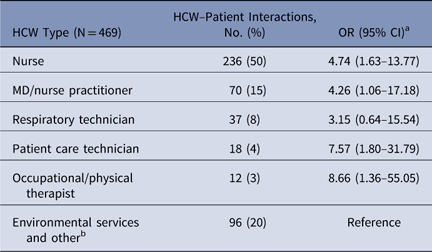
We observed 469 HCW–patient interactions, of which 61 of 469 (13%) led to contamination of HCWs’ gloves, 29 of 469 (6%) led to contamination of HCWs’ gowns, and 71 of 469 (15%) led to contamination of either HCWs’ gloves or gown with VRE. Table 2 shows the associations between HCWs type and glove or gown contamination. Compared to environmental service workers and other HCWs (eg, nutritionists, dialysis technicians, etc), occupational and physical therapists had the highest odds of glove or gown contamination (odds ratio [OR], 8.66; 95% confidence interval [CI], 1.36–55.05), followed by patient care technicians (OR, 7.57; 95% CI, 1.80–31.79), nurses (OR, 4.74; 95% CI, 1.63–13.77), and physicians/nurse practitioners (OR, 4.26; 95% CI, 1.06–17.18).
Adjusted Associations Between HCW–Patient Interactions and Glove or Gown Contamination With VRE

Note. HCW, healthcare worker; VRE, vancomycin-resistant Enterococcus; OR, odds ratio; CI, confidence interval; MD, medical doctor.
a From a generalized estimating equation model adjusted for VRE burden, diarrhea, nasogastric tube, and time HCW spent in the room.
b Other includes HCWs such as nutritionists, dialysis technicians, study researchers, etc.
The HCW observations were divided into 3 categories: interactions that involved touching the patient only (n=50), interactions that involved touching both the patient and the environment (n=333), and those that involved touching the environment only (n=83). As shown in Table 3, HCW interactions that involved touching the patient only had 3.65 (95% CI, 1.17–11.41) greater odds of contaminating their gloves or gowns compared to those that touched the environment only. Interactions that involved touching both the patient and environment had 2.78 (95% CI, 0.99–7.77) greater odds of glove or gown contamination as those who touched the environment only. On average, HCWs touched 3 different items in the patient domain and 3 different items in the environmental domain. The odds of contamination increased with the number of different patient touches (OR, 1.22; 95% CI, 1.05–1.41) and with the number of different items touched in the environment (OR, 1.07; 95% CI, 0.94–1.21).
Adjusted Associations Between Contact With Patient and Environmental Domains and HCW Glove or Gown Contamination With VRE

Note. HCW, healthcare worker; OR, odds ratio; CI, confidence interval; VRE, vancomycin-resistant Enterococcus.
a Three HCWs did not touch anything in the patient room during the observation period.
b From a generalized estimating equation model adjusted for VRE burden, diarrhea, nasogastric tube, and HCW time spent in patient room.
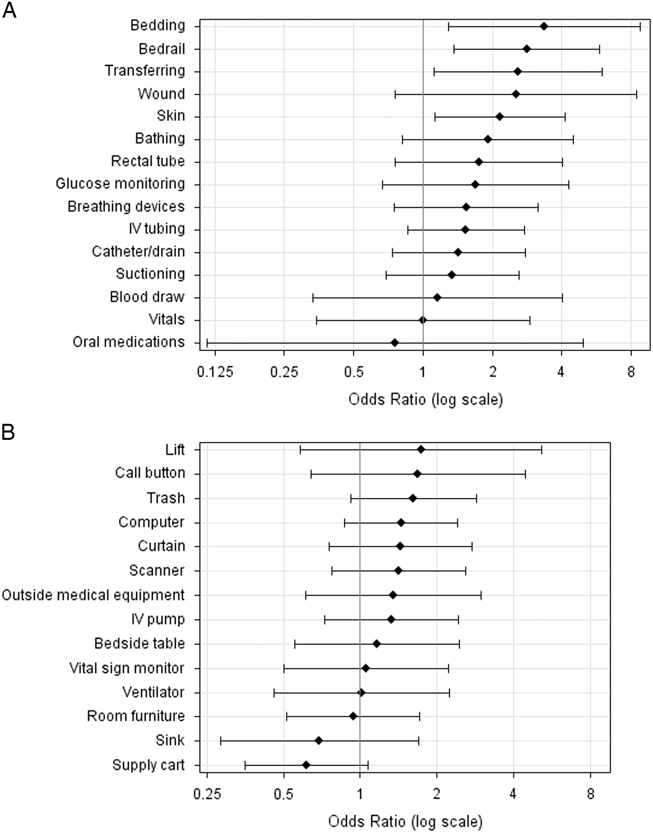
Figures 1a and 1b show the odds ratios for HCW contamination of each patient-care activity in the environment and patient domains adjusted for VRE burden, diarrhea, nasogastric tube, and time the HCW spent in the room. Figure 1a shows that HCW gown or glove contamination was associated with touching the patient’s bedding (OR, 3.36; 95% CI, 1.29–8.75), bedrail (OR, 2.83; 95% CI, 1.37–5.84), and skin (OR, 2.16; 95% CI, 1.13–4.13), and with transferring the patient into or out of bed (OR, 2.58; 95% CI, 1.11–5.99). Figure 1b shows that touching the supply cart was associated with reduced odds of contamination (OR, 0.62; 95% CI, 0.35–1.08), while touching trash (OR, 1.62; 95% CI, 0.92–2.86), was associated with increased odds. In our multivariable model, the independent predictors of HCW glove or gown contamination were touching the patient’s skin (OR, 2.18; 95% CI, 1.15–4.13) and transferring the patient (OR, 2.66; 95% CI, 1.10–6.43), adjusting for patient’s VRE burden, diarrhea, nasogastric tube, and time the HCW spent in the room.
Adjusted odds ratiosa and 95% confidence intervals of HCW glove or gown contamination for each patient care activity. (A) Patient care activities that involve touching items on or within the vicinity of the patient. (B) Patient care activities that involve touching items in the ICU room environment. aFrom a generalized estimating equation model adjusted for VRE burden, diarrhea, nasogastric tube, and time the HCW spent in the room. Abbreviations: HCW, healthcare worker and VRE, vancomycin-resistant Enterococcus.

Discussion
In this study, 15% of the HCW gowns or gloves became contaminated with VRE after providing patient care. Touching the patient or items touching the patient (eg, the patient’s bedding and bedrail) were the greatest risk factor for HCW contamination during routine patient care. Because our patient and HCW sample sizes were nearly 5 times larger than previous studies on gown and glove contamination, we were able to identify many patient care activities associated with VRE transmission to HCWs, such as touching the patient’s skin and transferring the patient into or out of bed.
We observed increased odds of glove and gown contamination among the occupational/physical therapists, patient care technicians, nurses, and physicians who were most likely to have direct contact with the patient and to perform tasks that would require them to touch or transfer the patient. The HCW interactions that involved touching the patient only conferred slightly higher odds of transmission than interactions with both the patient and the environment. Furthermore, HCWs that touched the patient only may have provided a more intense level of care than HCWs who touched both. However, these results should be interpreted with caution as these estimates may not be significantly different from one another. Odds increased 22% for each new patient contact compared with 7% increased odds for each environmental item touched. For example, the odds of glove or gown contamination is increased by 82% if the HCW had 3 different patient contacts with the patient domain (the average number of patient touches) versus an increase of 23% if the HCW had contact with 3 different environmental items.
These results are consistent with those of Morgan et al,Reference Morgan, Rogawski and Thom 7 who reported 13% VRE glove or gown contamination after patient encounters, and those of Duckro et al,Reference Duckro, Blom, Lyle, Weinstein and Hayden 10 who reported 11% of VRE transmission to gloves only. Similar to our findings, Snyder et alReference Snyder, Thom and Furuno 16 identified the presence of nasogastric feeding tubes as a patient-level risk factor for transmission of VRE to HCWs. They also found that touching the patient’s skin conferred the greatest contamination risk, specifically contact with the patient’s catheter, trunk, and lower extremities.Reference Snyder, Thom and Furuno 16 Morgan et alReference Morgan, Rogawski and Thom 7 identified duration in the room, performing a physical exam, contact with the ventilator, and environmental contamination as risk factors for HCW gown and glove contamination with multidrug-resistant organisms, but VRE-specific risk factors were not examined. Hayden et alReference Hayden, Blom, Lyle, Moore and Weinstein 9 reported that 62% of the 103 HCW–patient interactions resulted in glove contamination with VRE, although they were unable to distinguish between touching the patient and touching the environment because nearly all HCWs touched the environment. They did, however, detect increased transfer among those who touched both the patient and the environment compared those who touched the environment only (70% vs 52%).Reference Hayden, Blom, Lyle, Moore and Weinstein 9
Our findings suggest that patient contact is the main driver of HCW contamination with VRE. In a recent investigation, McDermott et alReference McDermott, Skally, O’Rourke, Humphreys and Fitzgerald-Hughes 17 conducted environmental sampling of all ICU patients (both VRE-positive and VRE-negative) and showed that 30% of ICU patients and their bed spaces were positive for VRE.Reference McDermott, Skally, O’Rourke, Humphreys and Fitzgerald-Hughes 17 Similar to our findings, McDermott et al found that high touch items closest to the patient led to increased glove contamination. In contrast to prior research,Reference Morgan, Rogawski and Thom 7 , Reference Duckro, Blom, Lyle, Weinstein and Hayden 10 our study did not find a strong association between touching items in the environment and HCW contamination. Despite our reasonably large sample size, no specific ICU room environmental object was associated with increased odds of HCW contamination.
This study has several limitations. First, we did not culture the entire glove or gown, though we did culture the areas of the gloves (fingers and palm) and gowns (arms and waist) most likely to come into contact with the patient and subsequent patients. Second, we did not culture the environment or collect data on time of last cleaning; therefore, we were unable to adjust for the bacterial burden of the environment. Many of the patient care activities were co-occurring, such that we may not have been able to distinguish risk between bundled care activities. Third, this study was conducted at a single site and may not be generalizable to other hospitals. Finally, we did not examine risk factors for VRE transmission to gowns only, an important component of Contact Precautions, due to small sample size. Future studies of MDRO transmission in ICUs should be powered to study this outcome.
Our results indicate that direct patient contact, as opposed to environmental contact, is the major driver for HCW glove or gown contamination with VRE, a surrogate outcome for transmission to other patients within the ICU. Most VRE-colonized patients are not known to clinicians and, as such, may not be on Contact Precautions and can thus be vectors for VRE transmission in the ICU. We were also able to estimate the association with VRE transmission for a variety of common patient care activities using a large sample size and prospective design.
In conclusion, these findings can help inform novel interventions such as “red boxes,” areas in which HCWs can conduct clinical assessments without donning personal protective equipment.Reference Franck, Behan, Herath, Mueller and Marhoefer 18 , Reference Blomberg 19 However, there is a need for policies to balance customization with standardization to increase adherence to infection control practices. Our finding that 15% of HCWs are contaminated with VRE after patient care should add to the debate regarding whether or not to discontinue Contact Precautions for VRE.Reference Russell, Beekmann, Polgreen, Rubin and Uslan 20 – Reference Rubin, Samore and Harris 22 Our findings contribute to the evidence for the use of Contact Precautions and hand hygiene for HCWs whose activities involve touching the patient.
Acknowledgments
We would like to thank the study participants, without whom this research would not be possible. We also thank Lisa Pineles for her help with the study logistics; Shirley Goodman and Alyssa Sbarro for their help with data collection; and Nicole Karikari, Licheng Zhao, and Gwen Paszkiewicz for specimen processing.
Financial support
This work was supported by the National Institute of Allergy and Infectious Disease at the National Institutes of Health (grant no. 5R01AI121146) and the Centers for Disease Control and Prevention (grant no. 1U54CK000450), US Department of Health and Human Services.
Conflicts of interest
All authors reported no conflicts of interest.
Supplementary materials
To view supplementary material for this article, please visit https://doi.org/10.1017/ice.2018.160