Significant outcomes
-
Accumulation of nitric oxide in the brain may interfere with the anxiolytic effects of CB1 receptor agonists.
-
Despite the observation that L-Arginine induces an anxiogenic response, this effect is not potentiated by decreasing tonic endocannabinoid signalling.
Limitations
-
Results were obtained with systemic effects of the drugs, and therefore the location in the brain of the anxiogenic and anxiolytic responses is hypothetical.
-
Given the fact that anxiety disorders are more prevalent in females, this study has the limitation of having being performed with only adult male rats.
Introduction
Maladaptive responses related to fear and anxiety are the main feature of anxiety disorders. Rodent models of panic and anxiety have been providing insights into the neurobiology of these disorders (File et al., Reference File, Lippa, Beer and Lippa2004). The elevated T-maze (ETM) is a test that evaluates anxiety- and panic-like responses that are expressed as avoidance and escape behaviours, respectively (Graeff et al., Reference Graeff, Netto and Zangrossi1998). Experiments that aimed to test the face, construct, and predictive validity of this model showed that the anxiety-like behaviour, that is avoidance, is impaired by benzodiazepines and is possibly related to generalised anxiety disorder (GAD). In contrast, escape behaviour is impaired by chronic treatment with antidepressants and is considered to model panic attacks, the main feature of panic disorder (PD) (Zangrossi & Graeff, Reference Zangrossi and Graeff2014). Further pharmacological validity showed that the gabaergic and the serotonergic systems have a critical role in the modulation of anxiety and panic-like behaviours in the ETM. Moreover, the endocannabinoid system seems to also modulate these behaviours and has been the focus of intense research (Griebel & Holmes, Reference Griebel and Holmes2013; Riebe & Wotjak, Reference Riebe and Wotjak2011). The endocannabinoid system comprises the CB1 and CB2 receptors, the endogenous ligands, anandamide (AEA), and 2-arachiydonoylglcerol, their machinery for synthesis and degradation, and the membrane transport system (Katona & Freund, Reference Katona and Freund2012). Studies employing central injections of cannabinoids in specific brain sites involving the defensive system have shown that activation of CB1 induces anxiolytic-like and panicolytic-like effects in several animal models of anxiety, including the ETM (Batista et al., Reference Batista, Gobira, Viana, Aguiar and Moreira2014; Gobira et al., Reference Gobira, Aguiar and Moreira2013; Batista et al., Reference Batista, Bastos and Moreira2015). Our previous data employing systemic injections described a similar effect in the ETM test (Gobira et al., Reference Gobira, Aguiar and Moreira2013).
The nitrergic system has also been implicated in the expression of panic and anxiety-like behaviours (Guimaraes et al., Reference Guimaraes, Beijamini, Moreira, Aguiar and De Lucca2005). In the central nervous system, the formation of nitric oxide (NO) occurs from L-Arginine (L-Arg) in a reaction catalysed by the NO synthase enzymes (NOS) (Moncada & Higgs, Reference Moncada and Higgs1993). After its production, NO diffuses across the cell membrane and can enter both pre- and postsynaptic neurons (Bredt & Snyder, Reference Bredt and Snyder1992). This gas activates the soluble enzyme guanylate cyclase and interferes with neuronal signalling (Vincent, Reference Vincent2010). Several studies report an anxiogenic role for NO, although contradictory data also exist (for reviews, see Guimarães et al., Reference Guimaraes, Beijamini, Moreira, Aguiar and De Lucca2005).
Studies with intracerebral injections have been uncovering interactions between the endocannabinoid and the nitrergic system. For instance, facilitating CB1 receptor signalling and decreasing NO production in the periaqueductal grey matter (PAG) results in an anxiolytic-like effect (Lisboa et al., Reference Lisboa, Magesto, Aguiar, Resstel and Guimaraes2013). Moreover, NO might be involved in the biphasic effects of AEA in anxiety-related responses in the PAG (Lisboa et al., Reference Lisboa, Camargo, Magesto, Resstel and Guimaraes2014). Altogether, previous studies suggest that NO and cannabinoids interact in opposite ways to modulate anxiety-like behaviours. Based on this assumption, the present study aimed to test the hypothesis that systemic L-Arg prevents the anxiolytic-like effect produced by systemic activation of CB1 receptors in rats exposed to the ETM. Moreover, we also verified whether the blockade of CB1-mediated signalling and facilitation of NO synthesis, through L-Arg administration, would synergise to produce an anxiogenic effect.
Material and methods
Animals
This study used adult male Wistar rats (250–300 g) from the animal facility of the Institute of Biological Sciences (UFMG). Animals were housed five per cage and maintained in a room with controlled temperature (25°C) and light–dark cycle starting at 18:00 h. Food and water were provided ad libitum. The protocols were approved by the local Ethical Committee on the Use of Animals of the UFMG (CEUA) under protocol number 259-2013 that follows the legislation of the National Council of Animal Experimentation (CONCEA). This legislation abides to the ARRIVE guidelines. Additional information about the experimental procedures is given in Supplementary Material.
Drugs
L-Arg (1, 10, 30, and 100 mg/kg – Sigma-Aldrich®, Missouri, USA) was dissolved in saline solution (0.9%). WIN 55,212-2 (1 mg/kg – Cayman Chemicals®, Michigan, USA) and the CB1 antagonist/inverse agonist, AM251 (1 mg/kg – Cayman Chemicals®, Michigan, USA) were dissolved in a solution of ethanol (5%), cremophor (5%), and saline. Thirty minutes after the last injections, the rats were exposed to the ETM test. The rationale for the doses employed was from previous studies (Gobira et al., Reference Gobira, Aguiar and Moreira2013; Volke et al., Reference Volke, Soosaar, Koks, Vasar and Mannisto1998). These doses do not interfere with basal locomotor activity (Gobira et al., Reference Gobira, Aguiar and Moreira2013; Jesse et al., Reference Jesse, Bortolatto, Savegnago, Rocha and Nogueira2008; Masood et al., Reference Masood, Banerjee, Vijayan and Ray2003).
Elevated T-maze
The maze is made out of wood and has two opposite arms with no walls and one perpendicular arm enclosed by a 40 cm wall, all with equal dimensions. The apparatus is elevated 50 cm from the floor. The procedure was performed as described elsewhere (Batista et al., Reference Batista, Bastos and Moreira2015). Briefly, animals were handled 3 min for 3 days, and on the fourth day, they were exposed to one of the open arms for 30 min. This exposure renders the escape reaction more sensitive to the effect of panicolytic drugs. On the fifth day, animals performed inhibitory avoidance, analysed as the latency (time in seconds) to leave the enclosed arms and escape (time in seconds) from the open arms after three trials. The cut-off time for both behaviours was 4 min. Animals that did not go to the centre of the maze during baseline measurements, that is that remained still in the enclosed arm for 4 min, were excluded from the analysis. In experiment 1, we performed a dose–response curve for L-Arg in the ETM test; L-Arg was injected 30 min before exposure to the maze. Experiment 2 consisted of pretreatment with L-Arg, 5 min before the injection of WIN55,212-2, which was administered 30 min before exposure to the maze. In experiment 3, AM251 was administered 5 min before the injection of L-Arg.
Statistical analysis
Data were subjected to a two-way analysis of variance (ANOVA) with repeated measures, considering drug treatment and trials as independent variables, followed by the post hoc Bonferroni´s test. The results are presented as mean and SEM. We performed the data analysis and designed the graphs in the software GraphPad Prism 5.
Results
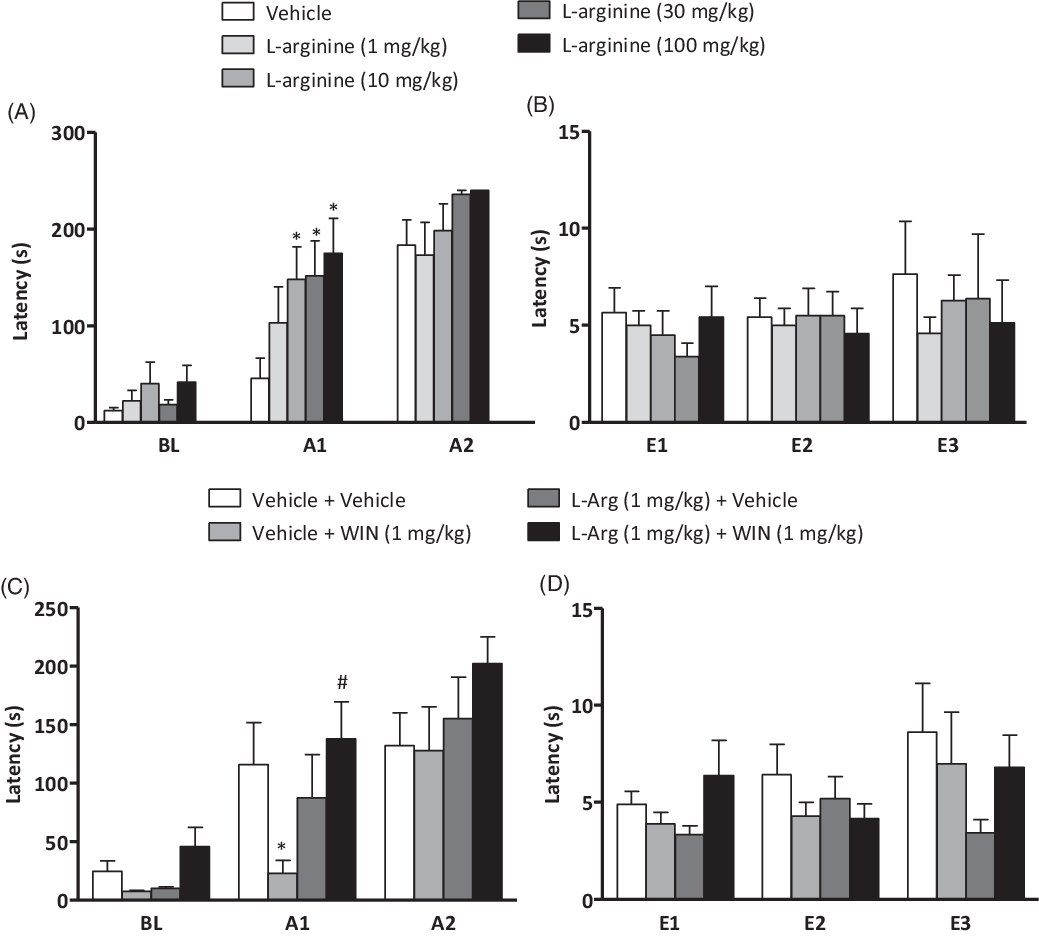
Initially, we performed a dose–response curve for L-Arg (1, 10, 30, and 100 mg/kg) to identify an ineffective dose for the subsequent experiments. For inhibitory avoidance, two-way ANOVA revealed a trial effect, meaning that animals acquired the inhibitory avoidance [F(2,90) = 84.20; p < 0.05]. There was a treatment effect [F(4,90) = 2.28; p < 0.01] and no interaction between treatment and trial [F(8,90) = 1.39; ns]. Post hoc analysis showed an increase in inhibitory avoidance latency compared to the vehicle group, suggesting an anxiogenic-like effect of L-Arg (10, 30, and 100 mg/kg) in the ETM (p < 0.05, Fig. 1(A)). Regarding the escape responses, two-way ANOVA revealed no treatment, trial, or interaction between factors, [F(4,90) = 0.74; ns], [F(2,90) = 1.07; ns], [F(8,90) = 0.48; ns], respectively, (Fig. 1(B)).
A. Dose–response curve of L-Arginine (L-Arg 1, 10, 30, and 100 mg/kg) in the ETM. L-Arg (10, 30, and 100 mg/kg) increased avoidance latencies; *p < 0.05, different from Vehicle, Bonferroni’s post hoc test (n = 12, 10, 10, 10, 8). B. Dose–response curve of L-Arg in the escape reaction of the ETM. Post hoc analysis revealed no statistical differences. Animals were exposed to the open arm of the maze 30 s after avoidance (n = 12, 10, 10, 10, 8). C. Effects of the pretreatment of WIN55,212-2 (1 mg/kg) with L-Arg (1 mg/kg) on inhibitory avoidance in rats exposed to the ETM. L-Arg was able to prevent the anxiolytic effect induced by WIN (WIN55,212-2); *p < 0.01, different from Vehicle + Vehicle; #p < 0.01, different from Vehicle + WIN (n = 12, 10, 9, 11). D. Effects of the pretreatment of WIN55,212-2 (1 mg/kg) with L-Arg (1 mg/kg) in the escape reaction of rats exposed to the ETM. Post hoc analysis revealed no statistical differences. Animals were exposed to the open arm of the maze 30 s after avoidance (n = 12, 10, 9, 11). Bars represent the mean and the vertical lines of the SEM. BL, baseline, A1, avoidance 1, A2, avoidance 2; E1, escape 1, E2, escape 2, E3, escape 3.

In the second experiment, the pretreatment with L-Arg prevented the anxiolytic-like effect induced by systemic injection of WIN55,212-2. In the inhibitory avoidance, two-way ANOVA revealed a trial effect, as expected [F(2,72) = 39.88; p < 0.01]. There was a trend for a treatment effect [F(3,72) = 2.01; p = 0.07], but no interaction between factors [F(6,72) = 1.24; ns]. This could be interpreted considering the observation that only one sample (the group receiving WIN) in one trial out of four samples of the factor ‘treatment’ was affected throughout trials, which makes the two-way analysis less prone to identify a greater difference between the treatment factor across three trials. Post hoc analysis showed a significant decrease in inhibitory avoidance latency with WIN55,212-2 (1 mg/kg) compared to the vehicle group, confirming previous studies that showed an anxiolytic-like effect of CB1 receptor agonism (p < 0.01, Fig. 1(C)). Pretreatment with L-Arg reversed this effect (L-Arg + WIN vs. Veh + WIN, p < 0.01, Fig. 1(C)). There were no treatment, trial, or interaction effects for the escape reaction [F(3,72) = 0.98; ns], [F(2,72) = 2.43; ns], [F(6,72) = 1.21; ns] (Fig. 1(D)).
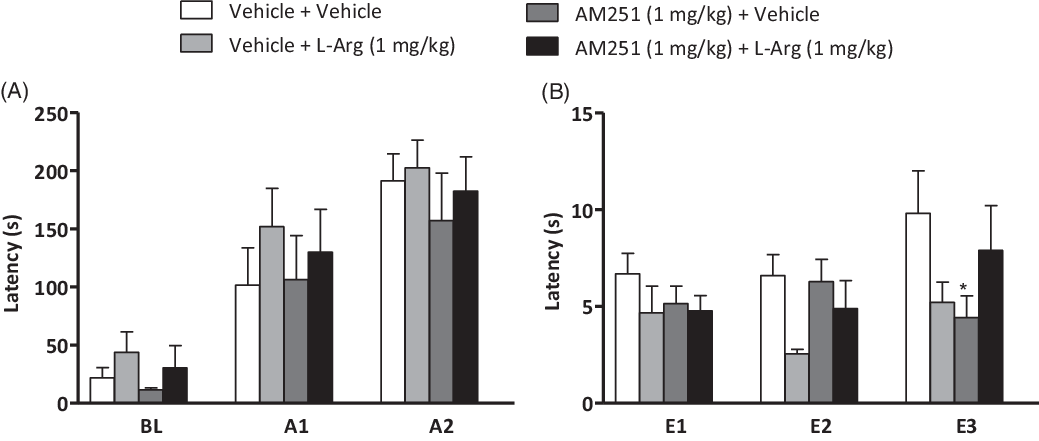
In the last experiment, we verified the effects of the combined treatment of AM251 and L-Arg in the ETM. Ineffective doses of AM251 (1 mg/kg) and L-Arg (1 mg/kg) were utilised to verify a possible synergism after the blockade of the endocannabinoid system and increase of the NO. For inhibitory avoidance, two-way ANOVA revealed a trial effect [F(2,62) = 54.05; p < 0.05]. There was no treatment effect [F(3,62) = 0.69; ns] nor interaction between factors [F(6,62) = 0.22; ns] (Fig. 2(A)). For the escape responses, analysis revealed no treatment, trial, or interaction effects, [F(3,62) = 2.42; ns], [F(2,62) = 2.42; ns], [F(6,62) = 1.15 ns], respectively, (data are not shown). Post hoc analysis showed that AM251 by itself decreased escape latency in trial three, inducing a panicogenic-like effect (p < 0.05, Bonferroni’s test) (Fig. 2(B)).
A. Effects of AM251 (1 mg/kg) and L-Arg (1 mg/kg) on inhibitory avoidance in rats exposed to the ETM. Post hoc analysis revealed no statistical differences (n = 10, 9, 7, 10). B. Effects of AM251 (1 mg/kg) and L-Arg (1 mg/kg) in the escape reaction of rats exposed to the ETM. Animals were exposed to the open arm of the maze 30 s after avoidance; administration of AM251 decreased escape (E2) latency; *p < 0.05, different from Vehicle (n = 10, 9, 7, 10). Bars represent the mean and the vertical lines of the SEM. BL, baseline, A1, avoidance 1, A2, avoidance 2; E1, escape 1, E2, escape 2, E3, escape 3.

Discussion
In this study, we showed that systemic administration of L-Arg induced anxiety-like behaviour in the ETM, whereas activation of CB1 receptors induced an anxiolytic-like effect. Importantly, an ineffective dose of L-Arg attenuated the anxiolytic-like effect induced by a CB1 receptor agonist in the ETM. Conversely, the blockade of CB1 receptors by AM251 did not induce an anxiogenic-like effect after administration of L-Arg. We did not evaluate the effects of these drugs in the open field test after the ETM. Despite this limitation, data from the literature showed no impairment in locomotor activity after i.p. administration in rats (Gobira et al., Reference Gobira, Aguiar and Moreira2013; Jesse et al., Reference Jesse, Bortolatto, Savegnago, Rocha and Nogueira2008; Masood et al., Reference Masood, Banerjee, Vijayan and Ray2003).
Previous studies have already demonstrated that L-Arg, the substrate for NOS, increases anxiety-like behaviour in the novelty-suppressed feeding test, elevated plus maze, and in the ETM (Zhang et al., Reference Zhang, Huang, Ye, Luo, Wu, Hu, Zhou, Wu, Zhu and Zhu2010; Calixto et al., Reference Calixto, Vandresen, De Nucci, Moreno and Faria2001). Contradictory data showed that NO might reduce anxiety, apparently related to the level of aversiveness of the stimuli and interaction with other neurotransmitters like the opioid system (Anand et al., Reference Anand, Gulati and Ray2012; Joshi et al., Reference Joshi, Ray and Gulati2015). Our data corroborate the hypothesis that NO facilitation increases anxiety behaviours since the systemic administration of L-Arg increased inhibitory avoidance latency in the ETM. In line with this result, inhibition of NO synthesis induces anxiolytic effects in several animal models of anxiety, including the ETM (Aguiar et al., Reference Aguiar, Hott, Deolindo, Guimaraes and Resstel2014).
Several neurotransmitters, including the endocannabinoid system, interact with NO in the brain (Lisboa et al., Reference Lisboa, Gomes, Silva, Uliana, Camargo, Guimaraes, Cunha, Joca and Resstel2015). In regards to anxiety-related responses, these interactions between the nitrergic and the endocannabinoid system occur in opposite directions, with the former increasing and the latter decreasing anxiety-related responses (Lisboa et al., Reference Lisboa, Magesto, Aguiar, Resstel and Guimaraes2013). Based on this assumption, we hypothesised that L-Arg would be able to counteract the anxiolytic-like effect induced by CB1 receptor activation. As predicted, administration of WIN55-212,2 decreased inhibitory avoidance latency, an effect mediated by CB1 receptor activation, as previously shown by our research group (Gobira et al., Reference Gobira, Aguiar and Moreira2013). The pretreatment with an ineffective dose of L-Arg prevented this effect, suggesting that the anxiolytic-like activity of WIN55-212-2 might be mediated at least in part by a decrease in the activity of NO signalling. Studies employing knockout mice for CB1 receptors reported an increase in the activity of the NOS enzymes in the cerebral cortex, reinforcing the hypothesis that the activity of NOS is dependent upon CB1 activation (Kim et al., Reference Kim, Won, Mao, Ledent, Jin and Greenberg2006). Accordingly, activation of CB1 receptors may inhibit Ca2+-dependent production of NO (Hillard et al., Reference Hillard, Muthian and Kearn1999).
The other hypothesis tested was whether the blockade of the CB1 receptor, along with the facilitation of NO synthesis by L-Arg, would result in an anxiogenic effect. Our data showed no interaction between a CB1 antagonist and L-Arg on anxiety produced by the ETM. One possible reason for the lack of effect might be that the temporary blockade of CB1-mediated signalling does not result in a sufficient increase in NOS activity in the brain to induce an anxiogenic phenotype in the ETM. Indeed, the effect of CB1 on NO production is context-and cell type-dependent (Lipina & Hundal, Reference Lipina and Hundal2017). Another possibility would be that in the presence of the CB1 antagonist, endogenous ligands could activate CB2 receptors inducing inhibition of NOS activity (Lipina & Hundal, Reference Lipina and Hundal2017). Our study did not verify this assumption and more studies are necessary to confirm this hypothesis.
In conclusion, the present results show that L-Arg effectively blocked the anxiolytic-like effect of CB1 receptor activation and that a CB1 antagonist and L-Arg do not synergise to produce an anxiogenic-like effect in the ETM. This study reinforces the interaction between endocannabinoids and NO in the modulation of behaviours related to anxiety disorders.
Acknowledgements
We would like to acknowledge Rinaldo do Nascimento for the excellent technical assistance.
Author contributions
BLA, ADC, and MFA contributed to the conception and design of the study, drafting of the article, and approval of the final version of the manuscript. BLA also performed the experiments and analysed the data.
Financial support
Moreira, F.A. thanks CNPq for a research productivity fellowship (level 2). This study was financed in part by Fundação de Amparo Pesquisa Estado de São Paulo FAPESP (2017/24304-0) and by the Coordenação de Aperfeiçoamento de Pessoal de Nível Superior-Brasil (CAPES)-Finance Code 001.
Conflicts of interest
The author declares no conflicts of interest.
Ethical standards
This study followed rigourous ethical standards of replicability, avoidance of bias, and objective analysis of the data. All efforts were made to minimize suffering of the experimental animals and to adopt the 3 Rʼs principle. The protocols were approved by the local Ethical Committee on the Use of Animals of the UFMG (CEUA) under protocol number 259-2013 that follows the legislation of the National Council of Animal Experimentation (CONCEA). This legislation abides to the ARRIVE guidelines.