INTRODUCTION
In 2011, Helena approached a Los Angeles–based nonprofit to request assistance with an immigration case. More than a decade earlier, Helena, a naturalized US citizen from El Salvador, had submitted a visa application for her sister, who was in El Salvador, to enter the United States as a lawful permanent resident. After a lengthy period of waiting, a visa was now available, so she had to prepare the final application packet. As part of this packet, she needed to provide proof of her relationship to her sister. To do so, she needed to submit copies of her and her sister’s birth certificates, showing that they had the same parents. Unfortunately for Helena and her sister, however, their father’s name did not appear on either certificate, and their mother’s surname—in El Salvador, individuals typically have two—was listed differently on each birth certificate, raising the risk that US immigration officials would consider these insufficient proof. To overcome this problem, Helena was advised to find yet another official document, such as a national identity card, that gave her mother’s full name, thus proving that the two names listed on the birth certificates referred to the same person. Locating such a document was likely to prove challenging, given that Helena’s mother was no longer living and Helena herself was in the United States. Clearly, Helena and her sister were going to have to go to considerable effort in order to proceed with their visa petition.
While Helena’s situation is unusual, the use of birth certificates as immigration documents is not. In myriad immigration cases, birth certificates are used to establish identity, nationality, age, and kin relationships, all of which may determine individuals’ eligibility to apply for particular forms of legal status. Moreover, birth certificates are “breeder documents” (Palmer Reference Palmer2000), which means that other key documents, such as passports, marriage certificates, and national identity cards, often cannot be issued by government agencies unless the requester has a valid birth certificate. Yet, as Helena discovered, birth certificates are sometimes problematic. Dates, names, and other details can be incorrect, information can be omitted, records may be duplicated or missing, and simply obtaining an original document can be difficult for individuals who are in the United States and unable to travel internationally due to their immigration status (Seuffert Reference Seuffert2009).Footnote 1 Moreover, the “stunning expansion” of immigration enforcement in the United States has increased the documentation requirements to which immigrants are subjected, the suspicion that such documents may be fraudulent, and cross-national governmental collaboration in determining documents’ validity (Bhargava Reference Bhargava2006; Rosenbloom Reference Rosenbloom2013; Abrams and Piacenti Reference Abrams and Piacenti2014).Footnote 2 How are birth certificates retrieved in practice, from government offices in immigrants’ countries of origin? What understandings of legality and authenticity underpin their use? How do the officials responsible for maintaining these registries come to see the records that they are responsible for? And how do these documents work in transnational circuits?
Addressing these questions will provide insight into the use of birth certificates as immigration documents and thus deepen understandings of ways in which globalization both reinforces and fractures citizenship. According to legal scholar Catherine Dauvergne (Reference Dauvergne2008), globalization has threatened national sovereignty in ways that lead governments to distinguish more sharply between citizens, who are seen as legitimate, and migrants, who are treated as potential security threats. As a result, she notes, “citizenship as a formal legal status is enjoying a resurgence of authority at present” (Dauvergne Reference Dauvergne2008, 119). This resurgence has occurred not only in immigrant-receiving countries, such as the United States, but also in immigrants’ countries of origin (Délano Alonso Reference Délano Alonso2018), where “the worldwide crackdown on illegal migration” (Dauvergne Reference Dauvergne2008, 119) has made immigrants both more reliant on their own governments for identity documents and less able to travel “home” in person to retrieve them. Formal citizenship in immigrants’ countries of origin is thus variegated, with some citizens able to access state-issued identity documents, while others can do so only with difficulty. Those who can access such documents enjoy “administrative citizenship,” that is, “citizenship and alienage performed by officialdom” (Stevens Reference Stevens, Lawrance and Stevens2017, 4), a status that is supposed to be “fixed, certain, stable and final” (Sadiq Reference Sadiq2017, 166; Reference Sadiq2008), but in actuality not only migrants but “a variety of marginalized groups … experience a gap between formalized institutional citizenship and their actual lived reality” (Sadiq Reference Sadiq2017, 166). For example, low-income individuals, rural populations, the indigenous, and other groups may not have had their births registered in the first place, and therefore may lack identity documents entirely, thus risking “effective statelessness” (Stevens Reference Stevens, Lawrance and Stevens2017, 3) even if formally, they are citizens of a particular country. Both the need for and difficulty of accessing documents are likely to be especially stark for irregular migrants, who may be subjected to enhanced evidentiary demands in their countries of residence even as the tightening of borders restricts their ability to obtain this evidence. Therefore, just as the category of the undocumented is legally differentiated between those who may be eligible for a legalization opportunity and those who are deportable if apprehended (Gomberg-Muñoz Reference Gomberg-Muñoz2017), so too are migrant citizens differentiated according to their ability to access their records housed in state documentation systems within their countries of origin.
In this global entanglement of persons, states, and records, documents both exceed and are insufficient for the evidentiary purposes to which they are put. Globally, immigration law has undergone securitization, that is, “the acceptance of an issue as a threat” (Dauvergne Reference Dauvergne2008, 100) regardless of whether or not the threat is real. As immigrants are deemed potential threats, the suspicion that they are committing forgery has increased, leading, in turn, to demands for additional documentation. In the United States, for example, immigration officials’ solution to the possibility that documents may be fraudulent is to send applicants a “request for evidence” or “RFE,” a process that in turn reinforces a tension between documents as proof and documents as always insufficient in recording the reality that they purport to authenticate. Documents’ reliability derives from their fixity: they are difficult to alter, they were produced at a particular time and place, the official versions are safeguarded in government offices, and they bear seals, signatures, and dates attesting to their validity. Yet, in order to be useful, documents must also be fluid: omissions, inaccuracies, or new facts must be corrected or recorded, documents that are issued for one purpose are deployed for others, and documents acquire additional meanings as they are put to new uses. Treating particular documents as suspect is therefore also linked to officials’ trust in documentation: while additional documents can always be requested, at some point officials have to accept a certain level of evidence as a means of approximating certainty, and in this sense, must rely on their counterparts in other offices or countries. Moreover, documents’ localization within particular record-keeping systems also enables them to circulate transnationally by validating their authenticity.
The twin processes of fixity and fluidity, suspicion and trust, and localization and transnationalism that give documents evidentiary force while also making them seem insufficient create particular risks and vulnerabilities for immigrants. Because US officials—like those in other receiving countries (Fassin and D’Halluin Reference Fassin and D’Halluin2005; Haas Reference Haas2017)—generally regard immigrants as a suspect population (Johnson Reference Johnson1995–96; Ordóñez Reference Ordóñez2016), immigrants are blamed for any missing records or discrepancies in their documentation. Immigrants must often attempt to correct these problems from a distance, and in so doing they have to rely on proxies (such as friends or relatives) who interact with birth registry officials on their behalf. Moreover, immigrants’ need for their birth records creates an added burden for registries, as requests for documents may increase when another country creates a legalization opportunity. If governments do not allocate additional resources to meet this added burden, then their immigrant citizens may miss opportunities to gain status. As well, immigrants are impacted by bureaucratic practices in their countries of origin, where officials determine to whom documents can be issued, whether or not requests to amend a document can be granted, how to proceed when there are discrepancies such as multiple records of the same individual’s birth, and what to do if records are missing altogether. Thus, even as they empower individuals, identity documents also subject them to state control (Gordillo Reference Gordillo2006, 163). Moreover, because documents not only reflect but are constitutive of social realities (Hull Reference Hull2012; Abrams and Piacenti Reference Abrams and Piacenti2014; Chelcea Reference Chelcea2016), those who lack documents may be rendered indeterminate. Individuals who are seeking to retrieve identity documents therefore occupy a “dual positionality” (Haas Reference Haas2017, 76): their identities may be formally authenticated, or their documents may be missing or problematic, thus calling their legal existence into question. These vulnerabilities are exacerbated when governments have access to other countries’ vital records systems.
These risks and vulnerabilities suggest that it is important for both scholars and practitioners to examine the transnational implications of highly localized bureaucratic practices in immigrants’ countries of origin. In the United States, a robust literature has examined how immigrants are impacted by their lack of access to green cards, employment authorization documents, social security numbers, and driver’s licenses (Coutin Reference Coutin2000; Menjívar Reference Menjívar2006; Horton Reference Horton2015; Gomberg-Muñoz Reference Gomberg-Muñoz2016), and clearly, birth certificates are also important immigration documents (Lawrance and Stevens Reference Lawrance and Stevens2017). Scholars who have paid attention to the relationship between birth certificates and immigration have focused primarily on the difficulty of registering children born to immigrant mothers (Castañeda Reference Castañeda2008; Bhabha Reference Bhabha2009; Wardlaw Reference Wardlaw2012; Aragón Reference Aragón2013; Bogin-Farber Reference Bogin-Farber2013; Rosenbloom Reference Rosenbloom2013) and on the experiences of transgender individuals, whose birth certificates and other documents may not accurately reflect their gender identity (Seuffert Reference Seuffert2009), rather than on the routine use of birth certificates within legalization cases. Both of these literatures would benefit from considering the ways in which the retrieval and deployment of birth certificates as immigration documents unmask what Dauvergne refers to as “the fiction of formal citizenship” (Reference Dauvergne2008, 119).
METHODS
To explore the production, retrieval, and deployment of birth certificates as immigration documents, we conducted fieldwork in a registry of vital records in El Salvador and interviewed Salvadoran officials both in the registry that we studied and in the national government. In El Salvador, Julie Mitchell volunteered at the Registry of Vital Records in El Puerto de la Libertad (“El Puerto”), a Salvadoran coastal town that is both rural (many residents work in agriculture) and also relatively cosmopolitan due to visitors to the port and beaches. For approximately twelve weeks each in 2013 and 2014 (a total of twenty-four weeks), Julie assisted registry staff who sought to register births, issue certificates, and maintain records. Both Julie Mitchell and Susan Coutin conducted interviews with officials in El Salvador, including registry staff and high-level government leaders in the Ministry of Foreign Affairs and the National Registry of Natural Persons.Footnote 3
We also bring to this study over a decade of employment or volunteer work in a Los Angeles nonprofit that provides legal services to Spanish-speaking immigrants,Footnote 4 and indeed, our interest in birth certificates derives from our observations of challenges encountered by individuals applying for legal status. Those experiences influence this study by providing us with a practical understanding of common issues that surround birth certificate use in an international context.
Our approach is unusual, because one of us is a practicing immigration attorney in the United States and the other is a professor in a social science discipline, yet we both collaborated fully in data collection, analysis, and writing. An advantage of our combined perspectives as researchers and practitioners is that we are able to bring multiple sorts of expertise—knowledge of both the relevant academic literature and of how to advocate for clients/users—to bear on our analysis. Moreover, we perhaps bridge law and social inquiry in a unique way, as practitioners are intermediaries who interact with community members while anticipating the responses of higher-level officials to whom documents must be submitted. Together, our interviews, observations, and practitioner experiences provide a rich picture of the circulation of birth certificates as immigration documents, giving us insight into “what goes on in the office” where these documents are generated (Hull Reference Hull2012, 252).
The case of El Salvador is particularly appropriate for our examination of birth certificates as immigration documents, as many of the challenges surrounding birth registry in developing countries play out in El Salvador, while the size of the Salvadoran immigrant population makes the processes that are the focus of this article particularly visible. Under-registration of births is a widespread problem, with an estimated 40 percent of births unrecorded worldwide (Bhabha Reference Bhabha2009).Footnote 5 Latin America is no exception (Duryea, Olgiati, and Stone Reference Duryea, Olgiati and Stone2006). In Brazil, for example, registering children at birth did not used to be a routine practice, as parents often waited until children were school age and actually needed these documents (Fonseca Reference Fonseca2009). Birth records have been destroyed during political conflicts (Fouratt Reference Fouratt2014), and disadvantaged groups such as low-income families, the indigenous, migrants, or those who are politically marginalized may be especially challenged in accessing identity documents (Gordillo Reference Gordillo2006; Kelly Reference Kelly2006; Fouratt Reference Fouratt2014). Fathers are not always listed on birth certificates, particularly when parents are not married or fathers are not present to register a birth (Lazarus-Black Reference Lazarus-Black1997; Seo Reference Seo2017). Birth certificates that are missing or incomplete, contain errors, or have delayed registration dates are likely to be regarded as suspect by officials in the countries where migrants may attempt to use these documents as part of an immigration case (Bhabha Reference Bhabha2009; Abrams and Piacenti Reference Abrams and Piacenti2014).
The size and unique legal history of Salvadoran immigration to the United States also pose a conundrum that we explore in this article: it is common for Salvadoran immigrants to need copies of their birth certificates but difficult for them to travel to El Salvador themselves to get them. It is estimated that 25 to 33 percent of Salvadoran citizens live outside of the country (Dirección General de Estadística y Censos 2017), with the majority living in the United States. Those who immigrated to the United States during the 1980–1992 Salvadoran civil war experienced discriminatory asylum practices (Coutin Reference Coutin2000). In response, they sued the US government in American Baptist Churches v. Thornburgh (760 F. Supp. 796 (N.D. Cal. 1991)) and won the right to apply for asylum under special rules designed to ensure fairness. Salvadoran immigrants were eventually permitted to apply for lawful permanent residency under the Nicaraguan and Central American Relief Act (NACARA) but the earliest NACARA cases were not processed until the late 1990s, often decades after applicants first immigrated. Additionally, following two major earthquakes in El Salvador in 2001, Salvadorans had the opportunity to apply for Temporary Protected Status (TPS) (U.S. National Archives and Records Administration 2001), which allowed them to stay in the United States, subject to renewal, but did not confer travel rights. This status, granted for humanitarian reasons, means that over 200,000 Salvadorans who are recipients of TPS have had to submit renewal applications every twelve to eighteen months—though the Trump administration has now rescinded Salvadorans’ TPS eligibility, an action that, as of this writing, has been enjoined.Footnote 6 Due to this legal history, which has involved denied status, temporary status, and permanent status, many Salvadorans who are in the United States rely on relatives and community members to retrieve birth records from El Salvador, where officials must determine whether these documents exist and can be issued.
MUNICIPAL REGISTRIES IN EL SALVADOR
The dynamics that shape Salvadoran immigrants’ current use of birth certificates were set in motion when procedures for recording births and other vital records were first established in El Salvador. Since the late nineteenth century, El Salvador has relied primarily on municipal governments to produce and maintain identity records. Although individual registries are subject to national laws of registration that make certificates similar across the country, each municipality’s certificate outline remains unique in form and content.Footnote 7 Additionally, despite the formation of national databases, identity records continue to be local in nature. Even national records bear roots in the municipal level because registration of important events (such as births, marriages, and deaths) is still conducted through local civil registries, which are housed within municipal city halls. The local city hall has traditionally been, and continues to be, an expression of the community’s identity, as defined through the events recorded. A localized system of registering important community events, and therein establishing identity records, recognizes the authority and autonomy of individual communities in the production of identity.
Chronicling of important events first took hold in El Salvador through local Catholic parishes, which, under Spanish law, were responsible for keeping records of births, baptisms, marriages, and deaths (Cook and Borah Reference Cook and Borah1998). In El Puerto, this practice began as early as the 1880s. Indeed, the earliest certificates housed in El Puerto’s family registry had a decidedly religious character. For instance, a translated and redacted record from 1881 stated simply, “February 27 [first name] daughter of the [surname] family was born on the 11th of the present [month], [first name and surname] is godfather.” In the early 1900s, maintenance of the books shifted from the local parish to the municipal city hall, and in 1908, article 44 of the Law of the Municipal Branch (Ley del Ramo Municipal) established that certificates of birth, marriage, and death would be recorded in separate books, signed by mayors and registry secretaries (Capacho Rodriguez, Cruz Diaz, and Lemus Lozano Reference Capacho Rodriguez, Cruz Diaz and Lemus Lozano2012).Footnote 8 In El Puerto, in approximately 1910, signatures of the city mayor and municipal secretary replaced priest signatures on the records. That task was later passed on to the director of the registry. Important religious events, including baptisms and religious marriage ceremonies, continued to be recorded in local parishes, but the registration of births became the exclusive responsibility of the municipal government.
Although the local government took over the registration of births, Catholic and other church records continued to be legally valid resources in identity production for Salvadorans. Even today, in both El Salvador and the United States, religious records are still considered secondary evidence to establish one’s identity and family relations. For example, if an individual’s birth record is destroyed, Salvadoran regulatory law authorizes the registry to replace the destroyed or deteriorated certificate with information contained in church records.Footnote 9 Specifically, the registry may consult the individual’s baptismal certificate and/or community member testimony to then rerecord the birth and issue a new certificate based on information provided by the secondary record. In this way, church records provide an unofficial backup to the existing books. Within the United States, US Citizenship and Immigration Services also gives limited deference to religious records.Footnote 10 For example, when demonstrating a parent-child relationship, officers may rely on a baptismal certificate that references parent(s’) name(s) to validate a parent-child relationship. Although Catholic church records are no longer the “official” document used to establish identity in El Salvador, they still inform the modern record system in that parish records provided the initial template upon which the modern books are based, and in that they continued to provide a secondary means of verifying identity.
The look of and information contained within birth records have also developed over time, in conjunction with international efforts to modernize and ensure the validity of birth records (Duryea, Olgiati, and Stone Reference Duryea, Olgiati and Stone2006). Early Catholic church records were written in pen with multiple records contained on a single page. These records consisted of one sentence stating the date of birth and the person who served as godparent for the baptism, and were signed by the parish priest. Even in the early 1900s, after the municipal hall took over recording births, the local registry continued to list the godparent of the registered person for approximately ten to fifteen years. By 1915, the registry in El Puerto listed not only the date of birth and date of registration, but also the time of each event that was recorded. Other significant changes that took place over the years were inclusion of parents’ biographical information on the child’s certificate, whether the child was born in or out of wedlock, the name of the registering person, the national identity number of the registering person, the signature of registering person, and the race or ethnicity of the child. After 1983, when the law regarding legitimacy was reformed, information about whether a child was born out of wedlock was no longer recorded,Footnote 11 and children were given the right to have two surnames, regardless of whether or not they had been recognized by their fathers. Additionally, as social mores regarding race changed,Footnote 12 race and ethnicity, which were noted in birth certificates from the 1930s through the 1950s, stopped being recorded. The very look of the certificates has also changed significantly. Early records were recorded with multiple entries on a single page in a bound book. Today, each certificate gets a dedicated page (sometimes two) in a three-ring binder so that certificates can easily be removed for copying and reference purposes. In addition to signatures, certificates in El Puerto are now printed on secure paper that shows the municipal seal and motto as well as registry contact information (Figure 1).
Handwritten birth certificate from 1951 and a redacted digitalized birth certificate from 2014
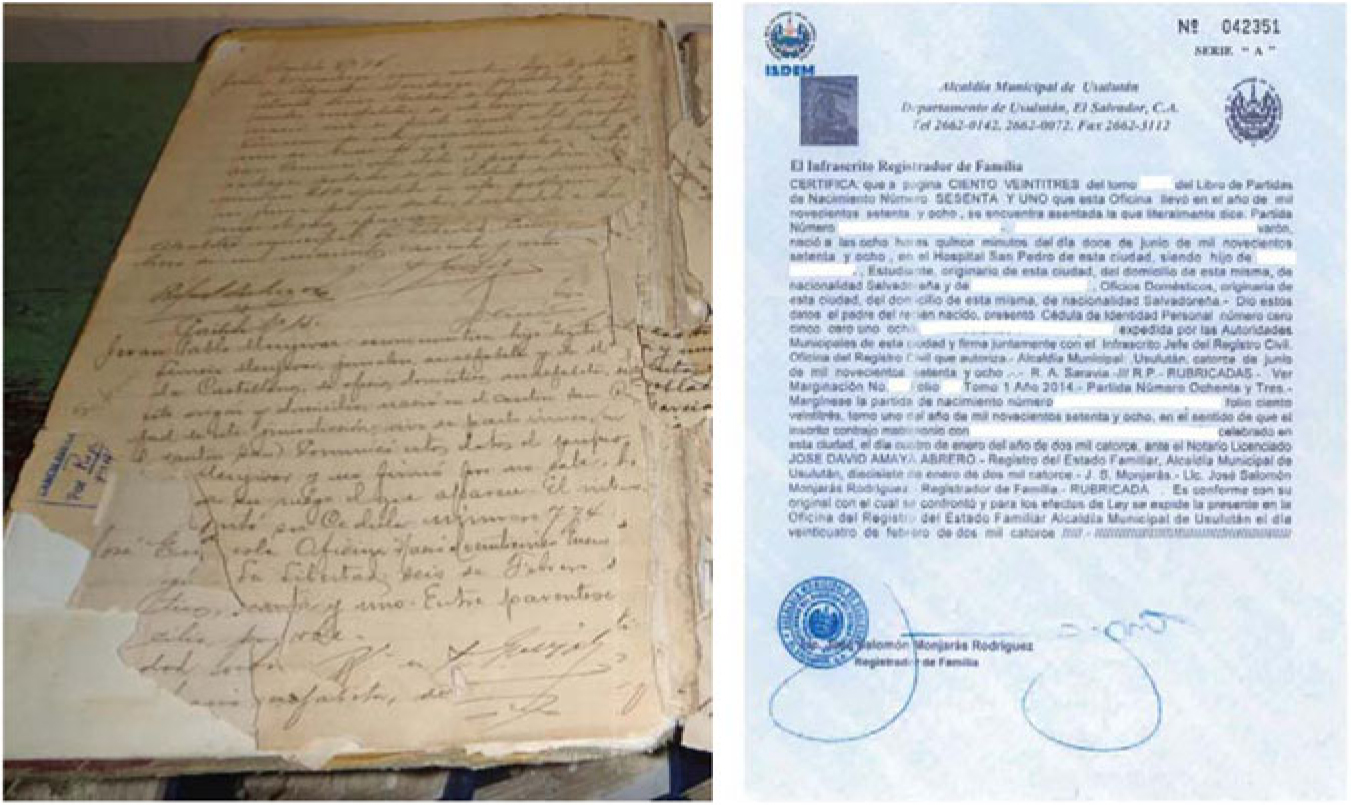
For most of the twentieth century, municipal governments in El Salvador had near exclusive control over the production of identity records. However, registries were not immune to the violence of the 1980–1992 armed conflict in El Salvador, when many municipal registries were destroyed through arson attempts that targeted city halls and government records (Sosa Alvarado, Hernández Rivera, and Orantes de Zarceño Reference Sosa Alvarado, Hernández Rivera and Orantes de Zarceño2005). In response to this trend, in 1982, the Consejo Central de Elecciones (Central Election Council) began to microfilm registry books and store them in a centralized location. Once the 1992 Peace Accords were signed, the move toward a national database gained support, as part of broader efforts to “generate a new form of peaceful social life on the basis of a valid democratic system and respect for the rule of law” (Registro Nacional de Personas Naturales n.d.(a)). In 1995, the Registro Nacional de Personas Naturales (National Registry of Natural Persons, known as “RNPN”) was formed. Although this national registry exists, it functions more as a backup for municipal records rather than as a registering entity. Although the national registry can issue copies of certificates, their legal use is extremely limited as they do not bear the signature of the secretary of the registry of vital records.Footnote 13
The recent introduction of hospital-based registrations is also changing the landscape of identification records in El Salvador. The Unidad de Registro Civil Hospitalario (Civil Registry, Hospital Unit) is a branch of the RNPN that was established in 2008Footnote 14 to eradicate under-registration of births in the country and ultimately “increase registration of all Salvadoran children, guaranteeing them the right to a name and to an identity, providing them full legal security.”Footnote 15 Through the program, select hospitals begin the registration process at the time of birth and send the records directly to the corresponding city hall. Jaime Dario Quintanilla Ruiz, Coordinator of RNPN, estimated that between six hundred thousand and eight hundred thousand Salvadorans in El Salvador were never registered.Footnote 16 By sending hospital registrations directly to city halls, RNPN hopes to make the registration process easier and more accessible for parents. Although the records are sent directly to the city hall, parent(s) still need to go to the city hall to complete the registration process. Even though parents are given ninety days to complete the process, civil registries are authorized to register children without court intervention up to age seven.Footnote 17 Hospital records and national records are ultimately still rooted in documents created at the local level because the power to record, produce, and house certificates belongs to the municipal civil registry.
The relationship between the RNPN and municipal registries reveals the power dynamics and tension between the systems. International agencies, such as the Inter-American Development Bank, promote birth registry (Duryea, Olgati, and Stone Reference Duryea, Olgiati and Stone2006), and neighboring Central American countries have transitioned from localized systems of certificate recording to a centralized system similar to RNPN, but with the power to issue certificates valid for all legal uses. For example, the Registro Nacional de las Personas (National Registry of People, known as “RENAP”) in Guatemala and the Registro Nacional de Personas (National Registry of People, known as “RNP”) in Honduras have transitioned to a national registry that has the capacity to both register and issue certified copies of registrations that are valid for virtually all legal uses. Although El Salvador through RNPN has participated in regional collaborations around documentation procedures with RENAP and RPN, national registry has never achieved similar internal support in El Salvador. Mr. Quintanilla Ruiz explained that for the 262 civil registries in the country, moving to a centralized system is a sensitive topic. Many municipal governments fear that such a move would “take away the autonomy and the books from local control.”Footnote 18 Local governments desire local control for both political reasons (local control reinforces municipal power) and practical ones (local officials may actually know the residents whose births are registered). The civil registries in El Salvador therefore continue to function with relative autonomy despite the presence of a national registry.
THE REGISTRY IN EL PUERTO
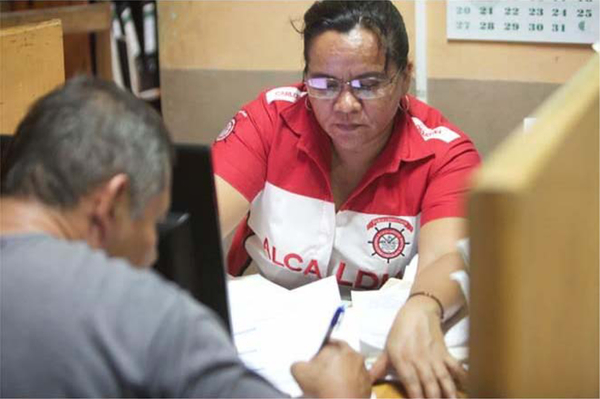
The majority of our fieldwork for this study took place in El Puerto de la Libertad, a city with a population of approximately 35,000. Located along the Pacific Coast, El Puerto is a popular weekend tourist destination for residents of the capital, San Salvador. Because the registry falls under the control of the municipal government, registry workers are often appointed by elected officials or the controlling political party. Therefore, staff often change with election outcomes, which can reduce institutional memory (Hoag Reference Hoag2010). At the time of this study (2013–2014), the mayor of El Puerto, Carlos Molina, belonged to the FMLN political party (Frente Farabundo Martí para la Liberación Nacional). Because he had served as mayor for over seven years, registry staff had remained relatively consistent. Registry workers throughout the country are overwhelmingly women, with education levels ranging from some secondary school to a university education. While there are generally four to six registry workers in El Puerto at any given time, only one is in charge of book maintenance and of locating and updating certificates within the books. The remaining workers deal almost exclusively with new registrations, customer service, and inputting paper records into a digital system (Figure 2).
A registry staff member assisting a user
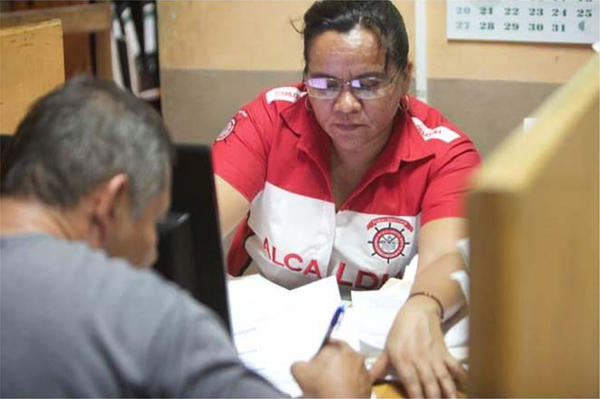
The municipal city hall is located in the center of the city, consists of a single two-story building, and serves the city proper as well as surrounding townships. The registry is one of the first offices that visitors encounter and it receives the most foot traffic. Our notes from one of our initial visits described the setting:
There are a couple of windows in the front where people can come to ask for services. At each of the two windows there is a small desk with forms that people can fill out to request their birth certificates or another document. The form is small, ¼ of a piece of paper, and asks for some specific pieces of information such as the name of the individual whose birth certificate is being requested, their date of birth, and the name of their parents.… Behind the two windows with their desks were several cubicles.… When people needed to actually meet with someone in the registro rather than to receive a service at the window, then they came in and met in one of the cubicles.… The walls … were decorated with things like a poster of a baby lying on a soft white rug with a notice reminding people to register their children’s births.
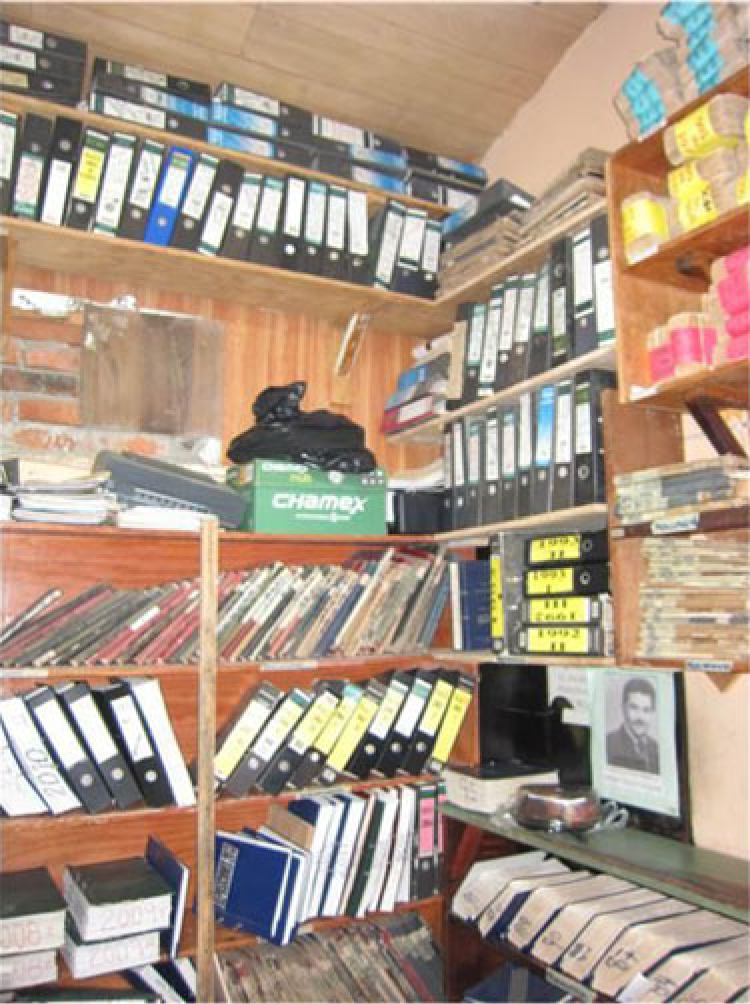
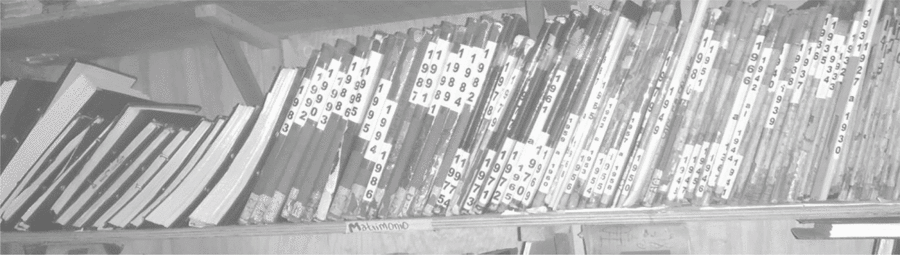
Within the registry, records and books are stored within a single small room in the back of the registry. Books dating from the late nineteenth century to the present line the walls literally from floor to ceiling. The registry houses records of births, marriages, divorces, adoptions, minor corrections, court-ordered changes to documents, copies of previously issued “cédulas” (a prior form of identification with photo issued by the municipal government), and minor children’s identification documents. The registry was a busy place. On any given day, the registry staff had to find paperwork, get signatures, attend to those at the window, address specialized needs, print or copy documents, and sometimes consult with others about a legal matter (Figures 3 and 4).
Book room within the registry
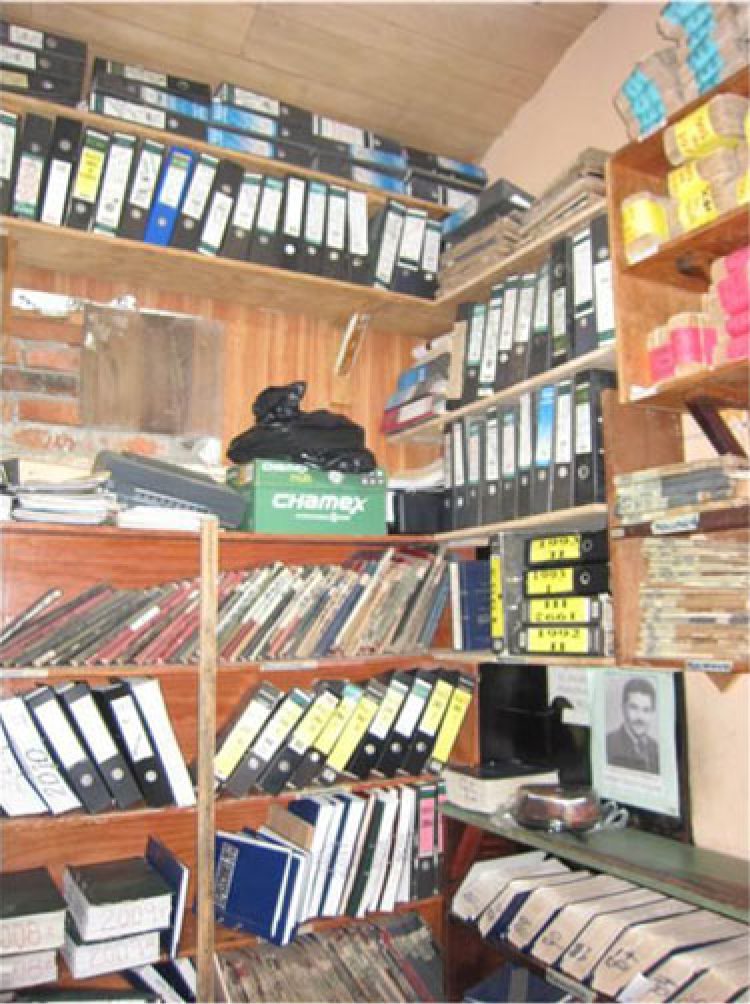
Books holding marriage certificates, organized by year

FIXITY AND FLUIDITY
A key feature that gives documents evidentiary value is their fixity, a fact that echoes the well-known distinction between “law on the books” and “law in action.” Sociolegal scholars have coined these phrases to point out that law’s meaning derives less from written codes than from the ways that statutes are interpreted in practice (Trubek Reference Trubek1990; Gould and Barclay Reference Gould and Barclay2012). While legal scholars and practitioners recognize that the meaning of written law is ever-changing (for instance, note the common reference to the “constitution” as “living”), sociolegal scholars’ commitment to the “books/action” distinction implies that written law is inert. Our analysis of the ways in which fixed records nonetheless move suggests, in contrast, that texts themselves are active. In a sense, we are examining “books in action.” Documents are issued at a particular moment in time, on the basis of evidence that the event that the document substantiates actually took place, as verified by the officials who examined this evidence and certified the document, usually through affixing their signature and stamp. Any subsequent copy is backed up by the original, which is maintained in a fixed location: a book in a particular registry office. Copies also refer back to this original location, and are not considered valid unless certified by officials. Yet, this very system of fixity is also in motion. Books literally must be taken down from shelves, opened, photocopied, and reassembled. Through photocopies, original records become portable, as individuals carry them to new locations, where they become part of new files. Records change in the process. Changes occur through translation, summary, the transfer of key facts (such as someone’s date of birth) from one document into another, and through repurposing, that is, being used for a purpose other than that for which they were initially produced. Moreover, individual documents and particular municipal registries are connected to a host of other documents. Books within the registry cross-reference each other; the local system must interact with other municipal registries, the national registry system, Salvadoran consulates, and registries in receiving countries; and records not only reference one another, but also build off of one another such that production of one document may involve or require consultation with multiple underlying documents. To have evidentiary value, birth certificates must simultaneously be rigidly stationary and fluidly mobile.
Such fixity and fluidity is evident in daily activities of the registro. The majority of individuals who sought registry services in El Puerto did so not to initiate a new registration, but rather to retrieve a previously recorded document of an event that had been registered in El Puerto. Requesters—referred to as “usuarios” or “users”—were first greeted by a registry worker who collected as much information as possible about the record in question. For example, workers might ask for the registered person’s name, parent(s), and date of birth. The registry worker then attempted to locate the certificate in a computer-based database. If the record was found in the database, the worker simply printed the document and gave it to the director of the registry for signature. If the particular document was not in the digital system (and, because registry staff were still entering documents into the system, many were not), the worker had to give the information to the bookkeeper to locate the original certificate in its appropriate book. On the spine or across the edge of the pages of each birth certificate book there appeared a year to provide for ease of locating. In an ideal scenario, the bookkeeper could find the appropriate year, pull the book, and locate the relevant certificate. The certificate could either be photocopied and certified through the registry seal and signature of the director, or inputted into the computer database and printed.
This requesting process could be completed in as little as ten minutes; however, problems often arose. For example, because they often sought certificates for community members living abroad, requesters did not always have the information needed to locate the certificate, such as the registrant’s year of birth. In such a case, the bookkeeper had to comb through different books of potential years to find the correct certificate. Another common scenario involved a certificate that had been corrected (“rectificada”), in which case the certificate might not appear in the normal book of birth records, but rather in a special book of corrections.Footnote 19 The original certificate would be annulled and would bear a stamp attesting to its invalidity. Because the digital system was local to the specific registry, only certificates registered in El Puerto could be accessed by the El Puerto registry. Individuals who did not know where a birth had been registered therefore faced challenges accessing records, because there was no centralized database containing all records. Other frequent obstacles included requesters’ not knowing registrants’ parentage, the existence of multiple registrations of the same birth, and differences between an individual’s legal name and commonly used social name.
The web of connectivity that conferred both fixity and fluidity was visible within the book room itself. In El Puerto, there were separate registry books for births, corrections, court-ordered registrations, other amendments, birth certificates issued through adoption, marriages, divorces, and deaths. Unlike in the United States, where little change occurs to a birth certificate once it is created, in El Salvador, other life events, such as marriages or divorces, or corrections to the birth certificate, were recorded on original birth certificates. As a result, certificates often cross-referenced each other. For example, a single birth certificate might have multiple margin notes referencing later-occurring events in the registered person’s life, such as the marriage of the registered person or of his or her parents. For this reason, in El Salvador, as in other countries such as the Dominican Republic,Footnote 20 birth certificates were only considered valid for specified periods, such as six months, requiring individuals to retrieve new copies of their birth records for particular legal transactions.
Cross-referencing occurred not only within but between municipal registries, as documents pertaining to a single individual could be housed in different municipalities. For example, someone might be born in one municipality, but married in another one. The city hall in El Puerto regularly received correspondence from other city halls in El Salvador with marriage certificates that registry workers then needed to record on the original birth certificate of the subject of the record. Although workers in one registry did not have access to the records of another registry, workers in the different systems developed understandings of their counterparts, and often used this information to guide users. Therefore, each individualized system, although unique, also required interoperability with other systems, including, in many cases, the US immigration system.
Another feature that makes birth registry practices simultaneously mobile and fixed is that, in recent years, El Salvador has begun recording births in both digital and book format. Digital records, while playing a prominent role in record keeping, have not replaced the books, but rather exist side by side with paper records. Within the local registry, the validity of birth certificates was verified by a computer system. However, this digital system was ultimately backed up by a paper-based book system. Every digital entry either already existed in handwritten form or was printed, signed, and placed in its corresponding book. Registry workers seemed to have more trust in a book, which appeared to them to be less susceptible to fraud than computer-generated information. This trust may stem from the fact that alterations that are made on paper documents leave traces, such as whiteout or pen marks. A computer-generated certificate on the other hand does not track these changes in the same way and, in fact, a change may be made without any visible trace of the original information. For fixity and fluidity to coexist, then, paths had to be created, and these needed to be potentially retraceable in order to be trustworthy.
SUSPICION AND TRUST
Work on securitization and documentation has emphasized the ways that papers of various sorts come to stand in for people, creating a “papereality” that may or may not correspond to individuals’ actual lives (Dery Reference Dery1998).Footnote 21 Our analysis of the devices that registry and immigration officials use to evaluate documents’ authenticity indicates that though it is in some ways alienating, papereality is constructed through personal relationships and even institutional trust. Thus, in a sense, “impersonal” documents are also deeply personal, even intimate (Seo Reference Seo2017; Abarca and Coutin Reference Abarca and Coutin2018). Acutely aware that the documents they issue were, as one official stated, “the basis of everything else that individuals obtain,” registry workers are concerned about the validity of records and sometimes suspect fraud in records that have been altered (through a correction) or are otherwise not in conformity with the majority of records. A pure document is a certificate that is considered accurate, complete, and authenticated. Signs that a document fulfills these conditions are lack of alterations, correct references across connected documents, and personal trust in officials who create and maintain the records. Although documents must be kept pure, documents are regularly suspected of being fraudulent in content or use. Because of potential fraud, El Puerto and other registries implement procedures to ensure document purity. These measures include procedures for making corrections, security measures in the paper itself, and a clear chain of command in order to produce a document. The fear that documents are fraudulent is consistent with the modernization of documentation systems and securitization of immigration laws. On the one hand, mistrust is key to ensuring that documents are valid, while on the other hand, the circulation of documents is facilitated by trust in their validity.
The significance of purity in the certificate may stem from the importance of the document and its intended use. Birth certificates hold both legal and social significance for the subject(s) of the record. Legal uses include determining parental rights and responsibilities. A certificate not only records a birth, but may also legally validate an existing kin relationship or create a new one. Legal uses are intertwined and overlap with social uses. Parentage is a case in point. Mothers are almost always named on Salvadoran birth certificates; however, fathers’ names do not always appear, and historically, birth certificates specified whether or not a child was a “legitimate” or “illegitimate” son or daughter. Salvadoran law now prohibits recording legitimacy of children, but it is still possible for a father or a mother to belatedly recognize a child.Footnote 22 The process of recognizing the child confirms an already existing social relationship, whether it be with the biological father or with another important male figure in the family.Footnote 23 When used for immigration purposes, birth certificates take on new importance for the community. In countries such as El Salvador, where foreign remittances constitute nearly 17 percent of the gross domestic product (GDP) (World Bank n.d.), access to pure documents to submit in conjunction with an application for an immigration benefit is important not only for the individual applicant, but also for the myriad family members who may depend on financial support from the applicant. Also, in a country plagued by violence, requests for certificates sometimes came in the middle of life-threatening situations. A single mother approached the registry window in El Puerto in a frenzy because her teenage child was kidnapped and presumed dead. Terrified that her younger child might also be kidnapped, the mother sought the child’s birth certificate to begin the process of sending him to the United States for safety. She also requested her disappeared child’s certificate because the police required the certificate for her to file an official report and start an investigation. Access to trustworthy certificates allows the subject of the record access to legal rights, such as filing a police report, registering for school, applying for travel documents, and getting married.
The very space in which records are kept suggests their important status. In El Puerto, they are kept in a separate room, to which only select individuals have access. Yet, birth certificates in El Puerto are treated both casually and carefully by registry workers. Registry workers regularly write on the face of records. For example, one can write “sistema” (“system”) in pencil in the margin of a certificate to denote that a record was entered into the digital system. One can also write a year along the edge of a book so that it is easy to pull off of a shelf. While making copies, one can take the book apart and reassemble it. The casualness with which they are treated is reflected in the condition of the books. Some books are so active that they are literally disintegrating from repeated use. Pages that were crumbling are covered with clear tape in an attempt to save them.
Users’ and registry officials’ attitudes toward birth certificates and other records varied. Though obtaining a particular record was often an important achievement, users did not appear to us to be emotionally attached to the documents themselves, perhaps because users were often obtaining them for others, and because these documents had to be obtained repeatedly, due to the requirement (in El Salvador) of submitting recently issued copies of birth records. Nonetheless, these documents were clearly valuable for users, because in some instances these were the only identity document they had, or, as in the example of the mother whose child had been kidnapped and presumed dead, were necessary for legal purposes. Registry officials, in contrast, seemed attached to the documents in their care. The bookkeeper in particular seemed to regard the books somewhat lovingly. When she saw one that had lots of crumbling pages, she would say affectionately, “Está muriendo,” literally, “It is dying.” She had covered her own birth certificate and those of her children with tape to ensure that they would not disintegrate. While our fieldwork did not permit us to conduct extended observations with bookkeepers at other registries, the literature on record-keeping systems suggests that it is not unusual for officials to develop emotional investments in documents (Friedman Reference Friedman, Lawrance and Stevens2017; Sadiq Reference Sadiq2017).
The importance of purity in the records comes hand in hand with constant suspicion of fraud. As one staff member at a Salvadoran nonprofit that worked with immigrants observed to us, “The whole process [of registering births] is built on a system of mistrust.” Registry workers (among other Salvadorans) develop an informal understanding of US immigration law through news reports, conversations with requesters of documents, and relationships with family members. They are concerned about fraud being committed to ensure eligibility for an immigration benefit. For example, birth certificates may be altered to show a family relationship that does not exist, such as changing or adding the name of a parent. Registry workers may also be concerned about birth certificate fraud to protect foreigners from assuming a Salvadoran identity. Due to the 1980–1992 Salvadoran civil war and the 2001 earthquakes, Salvadorans have been the beneficiaries of several immigration laws in the United States that are nationality-specific. For example, Salvadorans were recipients of Temporary Protected Status (TPS) in 1990 (due to the civil war) and again 2001 (due to the earthquakes). Salvadoran TPS recipients and individuals who sought asylum during the 1980s and early 1990s were also eligible to apply for US residency through NACARA. Mr. Quintanilla Ruiz voiced the concerns of the national registry when he said, “It is important to be careful that people who are seeking Salvadoran documents are really Salvadorans.” Reminding us that due to TPS, a number of people from other countries tried to assume Salvadoran identities, he concluded, “We must prove nationality.”Footnote 24
Registry workers are also concerned about potential fraud because it is their job to maintain the integrity of the system. The director of the registry in El Puerto, Caty Perez, continually stressed to us the personal importance to her of avoiding fraud in her job. She explained that, as the director of the registry, she could be held personally responsible for any fraudulent documents that came out of the office: “Everything I do has to be backed up (respaldada)” with evidence. Ms. Perez told us stories about the challenges posed when someone makes a claim that is not backed up by documentation. For example, the law permits people to present two witnesses to rerecord a lost certificate. Ms. Perez was concerned about the potential for fraud and felt that, despite the authority given to her to do so, it was still risky for her to record the new certificate based solely on the word of two people. As a compromise, Ms. Perez first sent the witnesses to the Department of Health for verification before proceeding. The director is the “last line of defense” against fraud in the office because, although other workers may maintain books, work with customers, and locate and reproduce documents, only the director has the authority to sign the produced record. In fact, at least two of the registry workers in El Puerto stated that they did not want the position of director because of the high level of responsibility. It was Ms. Perez’s job to detect potential fraud before it left the city hall because, if fraud was detected in the office, she feared she could be held criminally responsible.Footnote 25 While we were unable to determine the actual risk of prosecution, officials have sometimes been prosecuted,Footnote 26 and in El Salvador, public accusations of fraud or embezzlement can follow elections or changes in leadership from one political party to another.
On multiple occasions, registry staff came across or showed us certificates that were considered problematic. For example, in one case, a child had been registered twice. This double registration, which could have occurred through registry error, human mistake, miscommunication, or fraud (for example, to change the registrant’s name, birthdate, or parentage), produced such strong suspicion that the registry workers resisted issuing certificates of either of the documents because of their potential impurity. In cases such as this, when questioned about what the repercussions of the error would be, the first concern of registry workers was that the US government would not accept the document as legitimate, even though, to our knowledge, US officials would have no way of knowing that another, contradictory record existed. Additionally, alterations and corrections made to records by applying whiteout or simply crossing out the offending text were internally suspect because they did not go through the proper channels and were not “backed up by additional documentation.” The bookkeeper explained to us that those corrections were made by her predecessor and were a constant source of frustration. “I never even have a pen back here [in the bookroom], because I don’t write anything,” she told us, “I maintain the books.” In the event of suspected fraud, registry workers refused to issue the certificate(s).
To combat fraud, the registry uses secure paper with a watermark, stamps each document with seals, and ensures that each copy references the exact location where the original certificate is found. At the time of our research, the director was the only employee who was allowed to sign the final product, though, under special circumstances, a subdirector might be assigned to certify documents in the director’s absence. The Director of Consular Affairs informed us that the country has attempted to maintain a database of authorized signatures so that suspect signatures can be verified.Footnote 27 However, this effort has been challenging because there are 262 municipalities with different individuals authorized to sign. Furthermore, every time there is an election (every three years), those authorized signatures may change. Therefore, the database of signatures remains incomplete.
The process of authentication represents another contradiction arising out of the Salvadoran birth certificate system. An authenticated record (“autenticada”) means that two additional signatures are present on the certificate and that the requester paid an additional fee for the authentication. Through the process of authentication, a certificate is produced within the registry and signed by the director of the registry. The document is then taken by registry worker(s) to be signed again by the municipal secretary and the mayor. The authentication process has the potential to cause delays and inconveniences because, in El Puerto, the mayor and municipal secretary were frequently outside of the building and, in their absence, requesters had to either wait for their return, which could be minutes or hours, or, alternatively, return another day. This delay could be particularly problematic in large municipalities where community members have to travel far on the bus to reach the city hall. It also presents a financial strain for some community members because an authenticated document costs 50 percent more than a standard certificate. Although it is possible that registry workers are instructed to promote authenticated documents because of the additional money generated for the city hall, at minimum, the very existence of another layer of certification also suggests a suspicion of fraud (i.e., the need for additional verifications).
Although the registry system was characterized to us as based on “mistrust,” meaning that the registry workers were constantly suspicious of the documents coming out of their office, the officials who authenticate documents through their signatures seem to do so based on the trust they have in the other people with whom they work. Rarely did we witness the Director of the Registry independently verify the information in the certificates that she signed. In the case of authenticated documents, the additional signatures appear to give more legitimacy to the document. This could be because they assure that the content of the document has been confirmed by more than one person, or, alternatively, that it was actually issued by the registry and is not a document fraudulently produced outside of the city hall. These signatures demonstrate how the local system is built upon both trust and distrust. The authentication system reveals the distrust in the present system, through the belief that the original document is less trustworthy than the one bearing the additional signatures. The authenticated birth certificate is trusted more by users because it has signatures of important community figures (the mayor and the municipal secretary). The registry secretary told us that when she had signed her own name on a document as she was registering her child for school, the school official looked at her in awe and said, “Are you the Clerk of the Registry?” Her signature had become known locally because it was on so many certificates. At the same time, in our observation, the additional signatures that had the effect of enhancing trust in documents were not actually based on additional scrutiny or verification systems, but rather simply on the signing official’s trust in the registry workers who affixed the initial signature.
Heightened awareness of document fraud has led to further distrust in this system. Although authenticated documents were regularly suggested for international validity, based on our experience submitting certificates to US Citizenship and Immigration Services, the agency does not generally require authentication. In fact, birth certificates are regularly submitted to the US Citizenship and Immigration Services with only skeletal translations (see Figure 5), which omit the translation of the authentication and additional signatures. Of course, USCIS officials are able to examine the original document to determine whether or not its appearance and format appear authentic. Moreover, although a procedure exists to officially and properly alter a document, we could not see how a US immigration officer, untrained in the correction process of Salvadoran birth certificates, could determine the difference between a change properly backed by documentation and a change fraudulently obtained.
Birth certificate and skeletal translation form

LOCALIZATION AND TRANSNATIONALISM
The differences in the ways that Salvadoran and US officials view the authentication process suggests the importance of attending to the multiple scales at work within the production and use of birth certificates as immigration documents. Immigration law is usually a matter of national policy, even as it regulates international movement, often through localized enforcement. In the United States, subfederal enforcement, in which city officials or police attempt to regulate immigration, whether through adopting welcoming policies or attempting to exclude unauthorized noncitizens (Varsanyi Reference Varsanyi2008), has become a particular focus of interest. Birth certificates move across these scales, as they are issued locally, establish nationality, and are often recognized as valid within international legal circles. Birth certificates therefore evidence an ability to transcend scales, even as their ability to move is sometimes impeded by national boundaries.
Therefore, another contradiction that brings documents to life is the fact that local and national documentation now serves a transnational community. Transnational migrants defy many of the assumptions upon which documentation systems are based. Migrants do not remain in their countries of origin, they may be unable to return to retrieve documents, and they experience life events that are never recorded on their birth certificates. These life events, such as a marriage, would be included on their original birth certificate if the event occurred in El Salvador, but when the event occurs in the United States, it often does not appear on the Salvadoran certificate. Migrant experiences therefore generate exceptions, exceptions that are becoming all too common. Documentation systems adapt by creating procedures to capture these exceptions. Documentation systems are thus continually evolving in light of the population whose lives they record, even when immigrants themselves are “undocumented.”
Documentation needs in an international context vary greatly from the record-keeping needs of the country domestically. When a birth record is presented to an immigration officer, it is usually submitted as a copy of the original document, accompanied by a skeletal (or sometimes literal) translation. The original certificate may be requested for verification at a later date. In any given year, an immigration officer may see birth certificates from over one hundred countries. These certificates vary in size, information, security measures, and a host of other details. Frequently, the information that the officer is actually reading is only a skeletal translation of what was recorded on the certificate. The US Department of State has a Reciprocity Schedule that outlines the characteristics of civil documents that are issued by other countries and that may be submitted as part of a US visa application. The schedule for El Salvador outlines the important features to look for in Salvadoran certificates, including that they may be “typed or on stamped paper or may consist of photocopies of registry books. Either type of extract should be signed by the Civil Registry official—Jefe del Registro del Estado Familiar—and should bear the rubber stamp seal of that officer” (U.S. Department of State – Department of Consular Affairs n.d.). In addition to verifying the information about a document, immigration officers also look for these “markers” of authenticity. The U.S. Foreign Affairs Manual recognizes that certain documents may be unreliable “because of local corruption, or the ease with which such documents can be altered or counterfeited”Footnote 28 and authorizes officers to make further inquiries in the event of suspected fraud. In El Salvador, the various municipalities produce records with different signatures, stamps, and seals, meaning that certificates vary from municipality to municipality. Although registry workers in El Puerto may go to great lengths to ensure the purity of documents issued under their control, the markers of authenticity that underlie the certificates issued by their particular registry may not be recognizable to the officers reviewing the immigration application with which documents are submitted (Figure 5).
Within the US immigration context, there are certain characteristics of a document that are considered signs of potential fraud. One such feature is the time between birth and registration. A delayed registration may be viewed by an officer as evidence that an individual is fraudulently claiming a particular kin relationship (for instance, falsely claiming to be the child of a US citizen) (Abrams and Piacenti Reference Abrams and Piacenti2014). Suspected fraud may be overcome with secondary proof that the registration was done with judicial authority. While delayed registration may present a problem in the eyes of US officials, it may have resulted from very normal circumstances in El Salvador. In geographically large departments such as La Libertad, where El Puerto is located, it may be difficult for parents to travel to their designated city hall. A bus ride may be both financially straining and logistically difficult with a newborn child. Furthermore, there are social reasons that may account for the delayed registration, such as time necessary to determine expected parental roles. The months immediately following a birth may also be met with increased stress and potential illness that would prevent the parent(s) from traveling long distances to register a birth. Delayed registrations that result in heightened review in an international context therefore remain an acceptable domestic practice. Moreover, in the United States, increased anti-immigrant sentiment leading to increased documentation requirements has spillover effects on US citizens; thus efforts to prevent undocumented immigrants from voting, accessing public benefits, or obtaining driver’s licenses may also create obstacles for women, the poor, the elderly, people of color, the US citizen children of immigrant parents, and anyone who does not have their identity documents at hand (Pham Reference Pham2009; Sobel and Smith Reference Sobel and Smith2009; McKanders Reference McKanders2011; Wardlaw Reference Wardlaw2012; Bogin-Farber Reference Bogin-Farber2013; Rosenbloom Reference Rosenbloom2013). This concern about fraud may prevent US citizens and lawful permanent residents from obtaining visas for their relatives, thus prioritizing fraud prevention and immigration restriction over the preservation of bonds between spouses or parents and children (Abrams and Piacenti Reference Abrams and Piacenti2014; Gomberg-Muñoz Reference Gomberg-Muñoz2017).
Salvadoran registries have adapted in both formal and informal ways in response to Salvadorans’ needs to use birth records in international contexts. Some of these changes respond to the unique features of a transnational community. For example, in El Salvador, most identity records are public information, meaning that the information and corresponding documents can be accessed not only by the subject of the record, but by any requester. Almost all documents housed within civil registries are public records with the exception of sealed adoption records and certain court documents. The public nature of these records serves a transnational community because it provides alternative means by which migrants can access their documents. As a service provider in the United States, the first avenue that one of us suggests when clients must request a birth certificate from El Salvador is to seek the record through family members or friends abroad. The former Director of Consular Affairs, Mercedes Lopez, said that almost every birth certificate brought into a consulate is obtained through family and community member assistance.Footnote 29 In the rare event that an individual cannot obtain the necessary certificate through family or friends, the consulate may intervene on the individual’s behalf and communicate directly with the local registry. In El Puerto, community and family members regularly sought records for individuals living abroad.
Because the municipal registry system serves a transnational community, documents are continually crossing and recrossing international borders. Requesters who obtain documents typically send them to registrants in the United States through a friend or relative who is traveling there, by fax (when acceptable), or even by texting a photo of the document, if the original copy is not needed. In our experience, it was not common for individuals to mail documents, due to the risk that they would be lost and to the availability of other options. These documents contribute to a web of records that reference each other and connect multiple countries and systems. Salvadorans in the United States also participate (to a limited degree) in the actual construction of the new documents because of the nature of their transnational lives. For example, a marriage conducted in the United States may later be recorded in a Salvadoran registry so that a record of the marriage exists in El Salvador as well, something that can be important if the married couple returns to El Salvador. Not only do documents in El Salvador reference events in the United States, but more commonly, Salvadoran documents are submitted in conjunction with applications in the United States, making them a part of that US record. Subjects, requesters, and officials in both the United States and El Salvador reproduce and reconfigure the entire web of connected documents. A very local system of registering important life events is therefore much bigger than the boundaries of the municipality; this system also plays an important role in the formation of the legal identity of the transnational migrant community that it represents because the locally produced documents participate in the various international legal systems that its users access. Furthermore, changes in US immigration law and policy impact Salvadoran consulates in the United States as well as registries in El Salvador. Doris Rivas, Director of Immigration Policy in the Salvador Ministry of Foreign Affairs, pointed out to us that if the United States were to create a legalization program, Salvadoran agencies that issue documents would be inundated with requests for the passports and birth certificates that migrants living in the United States will need to submit as part of their applications. “There is insufficient capacity to meet their needs,” she worried.
CONCLUSION
In the context of transnational migration, a birth certificate’s “life” is intensified by the contradictions we identified here: securitization of immigration law and modernization of documentation systems increase both the fear that documents are fraudulent and the additional layers of verification designed to make them trustworthy; international movement creates both exceptionality and the need for interoperability, which in turn require national documentation systems to adapt. Like other state documents, birth certificates “reflect … past and present tensions, inequalities, interests, voices, and silences” (Chelcea Reference Chelcea2016, 307). The suspicion with which migrants in the United States are treated increases the evidentiary burden that they bear, while also leading any errors or discrepancies within their records to be viewed as instances of fraud. Likewise, US evidentiary requirements have ramifications for other governments, such as the registry in El Puerto, which had to issue birth certificates for Salvadorans living in the United States. Securitization, suspicion, and international movement result in a transnational web of documentation, in which the practices of users, officials, and service providers located at different nodes within this system reproduce and reconfigure the whole. Written law as materialized in legal documents and artifacts is transformed and given meaning as certificates circulate.
Making legal documents a focus of attention demonstrates that books (literally, the books that are housed on registry shelves and that must be taken off the shelf, disassembled, and reassembled when a particular document is copied) can be quite active, alive even. Our analysis of birth certificates suggests that activity may be intrinsic to these documents. Not only are the certificates regularly consulted by registry staff, their activity and movement go beyond the registry walls as the certificates travel to various national and international agencies. Although these documents are records of events that have already occurred (they record the past), the recorded events are always outside the boundaries of the document itself (Kelly Reference Kelly2006). Furthermore, they are also forward-looking, in that they become the basis for future documents and transactions. A birth certificate establishes the legal identity of a person, allowing the subject of the document to engage in other legal activity. Birth certificates therefore have a “generative capacity” (Hull Reference Hull2012, 259). Mr. Quintanilla Ruiz highlighted the relationship between documentation and social inclusion: “The right to identity is a constitutional and fundamental right which generates all other rights … it is a right to have rights.”Footnote 30 Without an identity, it is hard for individuals to demonstrate their nationality, access state services, or exercise the rights that are afforded to citizens of a given nation. Globalization therefore reinforces the need for citizenship, even as it fractures citizenship by placing practical privileges, such as the ability to access identity documents, beyond the reach of many who live outside of national boundaries.