Introduction
Psychotic and mood phenomena may co-occur in severe psychiatric disorders but neither diagnostic classifications, such as the Diagnostic and Statistical Manual of Mental Disorders, 5th edition (DSM-5) and International Classification of Diseases (ICD)-10, nor empirical studies acknowledge the presence of psychotic experiences in more common, mild to moderate depression or anxiety disorders (World Health Organization, Reference Widom, DuMont and Czaja1992; Krueger, Reference Krueger1999; American Psychiatric Association, 2013). However, all these categories have overlapping aetiology, including genetic and environmental factors, and share pathophysiological mechanisms (Goldberg et al. Reference Goldberg, Bridges, Duncan-Jones and Grayson1987; Nishida et al. Reference Nishida, Tanii, Nishimura, Kajiki, Inoue, Okada, Sasaki and Okazaki2008; Lichtenstein et al. Reference Lichtenstein, Yip, Bjork, Pawitan, Cannon, Sullivan and Hultman2009; van Os et al. Reference van Os, Linscott, Myin-Germeys, Delespaul and Krabbendam2009; Varghese et al. Reference Varghese, Scott, Welham, Bor, Najman, O'Callaghan, Williams and McGrath2011; Kelleher et al. Reference Kelleher, Connor, Clarke, Devlin, Harley and Cannon2012a , Reference Kelleher, Keeley, Corcoran, Lynch, Fitzpatrick, Devlin, Molloy, Roddy, Clarke, Harley, Arseneault, Wasserman, Carli, Sarchiapone, Hoven, Wasserman and Cannon b ). Psychotic phenomena are also relatively common, especially in young people (van Os et al. Reference van Os, Linscott, Myin-Germeys, Delespaul and Krabbendam2009; Kelleher et al. Reference Kelleher, Connor, Clarke, Devlin, Harley and Cannon2012a ), alongside depression and anxiety (Nishida et al. Reference Nishida, Tanii, Nishimura, Kajiki, Inoue, Okada, Sasaki and Okazaki2008; Varghese et al. Reference Varghese, Scott, Welham, Bor, Najman, O'Callaghan, Williams and McGrath2011; Kelleher et al. Reference Kelleher, Keeley, Corcoran, Lynch, Fitzpatrick, Devlin, Molloy, Roddy, Clarke, Harley, Arseneault, Wasserman, Carli, Sarchiapone, Hoven, Wasserman and Cannon2012b ). Often considered as harbingers of schizophrenia and related disorders (Poulton et al. Reference Poulton, Caspi, Moffitt, Cannon, Murray and Harrington2000), psychotic phenomena are also markers of suicidal thoughts and non-suicidal self-injury (Nishida et al. Reference Nishida, Tanii, Nishimura, Kajiki, Inoue, Okada, Sasaki and Okazaki2008; Kelleher et al. Reference Kelleher, Keeley, Corcoran, Lynch, Fitzpatrick, Devlin, Molloy, Roddy, Clarke, Harley, Arseneault, Wasserman, Carli, Sarchiapone, Hoven, Wasserman and Cannon2012b ; Murray & Jones, Reference Murray and Jones2012). Thus, conceptual, clinical and causal links exist between psychotic and mild to moderate mood disorders despite their inclusion as distinct entities in diagnostic classifications.
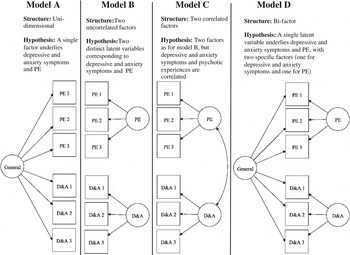
We report a study of the relationship between depressive, anxiety and psychotic experiences in two British general population cohorts, replicating the results from one independently in the other. We used item response theory (IRT; Van der Linden & Hambleton, Reference Van der Linden and Hambleton1997) to model the relationships between psychotic, depressive and anxiety phenomena at the individual item level rather than diagnosis. Fig. 1 shows our four competing hypotheses: (A) a single common underlying factor; (B) two separate factors that are uncorrelated; (C) two separate factors linked to each other; (D) two separate factors along with a primary contribution from a shared underlying ‘common’ factor measured by psychotic, depressive and anxiety items. We interpreted these models in terms of latent dimensions determining variation in psychopathology.
Conceptual models of the alternative relationships between psychotic experiences (PE), and depressive and anxiety (D&A) symptoms.

Method
Description of samples
The Avon Longitudinal Study of Parents and Children (ALSPAC) is based on the offspring of all pregnant women resident in the county of Avon, England, with expected dates of delivery between April 1991 and December 1992 (Boyd et al. Reference Boyd, Golding, Macleod, Lawlor, Fraser, Henderson, Molloy, Ness, Ring and Davey Smith2013; Fraser et al. Reference Fraser, Macdonald-Wallis, Tilling, Boyd, Golding, Davey Smith, Henderson, Macleod, Molloy, Ness, Ring, Nelson and Lawlor2013). The ALSPAC cohort consisted of 14 062 live births. We used information from 6617 individuals [3238 (48.9%) males, 3379 (51.1%) females] who provided data on psychotic, depressive and anxiety phenomena during a research interview at age 13 years.
The ROOTS cohort (Goodyer et al. Reference Goodyer, Croudace, Dunn, Herbert and Jones2010) is a school-based sample of young people recruited from secondary schools throughout the county of Cambridgeshire, England, including affluent and lower socio-economic groups, from urban, suburban and rural communities. Sampling was in two stages, initially of schools where 18 of 27 schools (two private) agreed for their year 9 classes to take part. The second stage comprised random invitation to parents and students resulting in a sample of 1238 (54.5% girls) 14-year-olds giving personal and parental consent to take part of which 1185 (95.5%) progressed to the full baseline assessment. Following the baseline interview at age 14 years and a follow-up questionnaire at age 15–16 years, the data here were collected at age 17 years when 1074 individuals [473 (44.0%) boys, 601 (56.0%) girls] were interviewed of whom 977 (91%) had complete data for the present analysis.
Measures
Depressive and anxiety symptoms
The self-reported Mood and Feelings Questionnaire (MFQ) was administered in both the ALSPAC [which used the shortened 13-item version or Short Mood and Feelings Questionnaire (SMFQ); Sharp et al. Reference Sharp, Goodyer and Croudace2006] and ROOTS (full 33-item version) (Angold et al. Reference Angold, Costello, Messer, Pickles, Winder and Silver1995) cohorts. The MFQ measures core symptoms of depression and anxiety experienced over the past 2 weeks and is typically used for screening, although also offers a summary measure of severity. From ROOTS we analysed only the 13 items that comprise the SMFQ version used in ALSPAC; each item is scored on a three-point scale: ‘not true’ = 0; ‘sometimes true’ = 1; and ‘true’ = 2.
In both cohorts behavioural and emotional problems were measured prior to the main outcome measures [MFQ and Psychosis-like Symptoms Interview (PLikSi)] using the parental version of the Strengths and Difficulties Questionnaire (SDQ; Goodman, Reference Goodman1997) that gives a total difficulties score of 0–40. This was administered at age 10 years in ALSPAC and age 15.5 years in ROOTS.
Psychotic experiences
Psychotic experiences were assessed by items comprising the semi-structured PLikSi in both ALSPAC and ROOTS. The PLikSi comprised 12 ‘core’ questions derived from the Diagnostic Interview Schedule for Children-IV (DISC-IV; Shaffer et al. Reference Shaffer, Fisher, Lucas, Dulcan and Schwab-Stone2000), and the Schedules for Clinical Assessment in Neuropsychiatry version 2.0 (SCAN 2.0; World Health Organization, Reference Wigman, van Os, Abidi, Huibers, Roelofs, Arntz, Kelleher and Peeters1994). Psychotic experiences were elicited in three domains: hallucinations, delusions and experiences of thought interference. This allowed an observer rating for the presence of any psychotic experiences (suspected or definite) in the past 6 months (scoring: ‘no psychotic experiences’ = 0, ‘suspected psychotic experiences’ = 1, ‘definite psychotic experiences’ = 2).
Several measures were taken in order to ensure the quality of PLikS interviews. In ALSPAC, the interviews were carried out by 13 psychology graduates who were trained by two experienced clinicians and SCAN trainers [a child psychiatrist and a general adult psychiatrist; Horwood et al. (Reference Horwood, Salvi, Thomas, Duffy, Gunnell, Hollis, Lewis, Menezes, Thompson, Wolke, Zammit and Harrison2008)]. The interviewers were required to reach 95% agreement whilst scoring two ‘gold standard’ interview videotapes prepared by the trainers. Monthly booster training sessions and workshops were arranged to discuss scoring of complex cases and consolidate training. All interviews were audiotaped for each interviewer until they reached eight interviews containing several items rated ‘positive’ (i.e. psychotic experiences present). These tapes were independently rated by a second interviewer. The average inter-rater reliability for PLikS interviews was good (κ = 0.7) (Horwood et al. Reference Horwood, Salvi, Thomas, Duffy, Gunnell, Hollis, Lewis, Menezes, Thompson, Wolke, Zammit and Harrison2008). A similar process was followed for the ROOTS cohort. Contact was maintained between the cohorts by one of us (P.B.J.) to discuss the process during the course of data collection and all ROOTS PLikSi decisions were decided through consensus between the interviewers and him.
Statistical analysis
Co-variation between depressive and anxiety symptoms, measured by the SMFQ, and PLikSi in each sample was initially assessed by plotting spinograms indicating the proportion of subjects at each score of the former who also reported psychotic experiences. A development of the histogram, the width of a spinogram bar is proportional to the frequency of respondents. The psychometric relationships between all items included in the PLikSi and SMFQ were then investigated using a latent variable modelling framework (Loehlin, Reference Loehlin1992). This partials-out the influence of error associated with measuring items, allows direct comparison of alternative models in terms of goodness of fit to the data, and provides simultaneous information on the distribution of items and respondents on a latent continuum.
In addition, the latent variable modelling framework addresses two methodological issues arising from the distributional properties of the data and from the survey design. First, traditional latent variable modelling relies on the assumption of a multivariate normal distribution for the definition and measurement of the latent variables. This may hold for neither psychotic experiences nor depressive and anxiety symptoms in the general population. Therefore, we used a semi-parametric modelling approach (Masyn et al. Reference Masyn, Henderson and Greenbaum2010). This approach combines finite mixture modelling and an IRT variant of factor analysis where measurement invariance constraints are imposed between the latent classes. Initial analyses of the data using this method revealed that two classes were sufficient to model the distribution of latent scores.
Second, since the data collection for PLikSi items was based on a semi-structured interview, within-interviewer clustering of responses may have influenced response variation strongly enough to affect model parameters in the factor analysis. We addressed this by using a modelling approach that corrects the standard errors of the factor model parameters for this aspect of survey design. Items in our measures were ordinal (i.e. no psychotic experiences, suspected psychotic experiences, definite psychotic experiences), so our approach can be described as semi-parametric, multi-dimensional item response modelling with standard errors adjusted for clustering of data at the interviewer level.
Four models of the possible relationship between depressive and anxiety symptoms and psychotic experiences (Fig. 1) were estimated and compared using multiple information criteria indices. We report the Akaike information criterion (AIC; Akaike, Reference Akaike1974), Bayesian information criterion (BIC; Schwarz, Reference Schwarz1978) and a BIC adjusted for sample size (SABIC; Sclove, Reference Sclove1987). Robust full information maximum likelihood was used in all model estimations.
Information functions for the two domains of items (depressive and anxiety compared with psychotic experiences) provide a graphical representation of the precision of measurement (information function; y-axis) at each location along the population latent distribution (x-axis). The position on the x-axis corresponding to the maximum information functions indicates the locations on this latent distribution where items provide best discrimination between survey respondents in terms of that continuum. Thus, the information function for any item is an index of the measurement efficiency of that item, conditional on its location on the latent continuum (Nicewander, Reference Nicewander1993).
Last, we carried out post-hoc analyses in both cohorts to examine the validity of the derived latent distribution of the common factor measured by the depressive, anxiety and psychotic experiences. We plotted factor scores against the total SDQ sum scores and fitted a linear regression model.
The PLikSi item ‘delusions of persecution’ was found to be highly correlated (≈0.99 or ≈ −0.99) with many other psychotic experiences, causing estimation problems due to collinearity. Thus, this item was excluded from analyses. Further, in the ROOTS data, collinearity (correlation over 0.99 or below −0.99) was also observed between five items (‘delusions of control’, ‘delusions not otherwise specified’, ‘thought broadcasting’, ‘thought insertion’ and ‘thought withdrawal’) and the remaining psychotic experience items (see correlations in online Supplementary Fig. S1). Therefore, data from ROOTS were analysed without these five items, i.e. for items collinear with each other only one was included in analysis. Consequently, only six psychotic experiences items were analysed in the ROOTS dataset.
Results
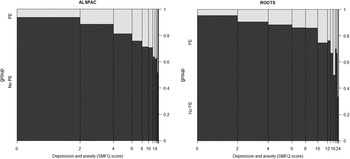
Spinograms (Fig. 2) show the proportion of people with psychotic experiences with respect to total depressive and anxiety symptom scores (SMFQ). Lower SMFQ sum-scores are more frequent in the population so are represented by wider bars than higher scores. The proportion of people in each category also reporting one or more psychotic experiences increased with higher scores for depressive and anxiety symptoms. This co-variation between the occurrence of psychotic experiences, and depressive and anxiety symptoms throughout their distributions justified further modelling of the association.
Proportions of individuals with psychotic experiences (PE; measured by the Psychosis-like Symptoms Interview) as a function of depressive and anxiety scores (Short Mood and Feelings Questionnaire; SMFQ). The width of the bars is proportional to the number of participants with corresponding SMFQ score. ALSPAC, Avon Longitudinal Study of Parents and Children.

Model comparison
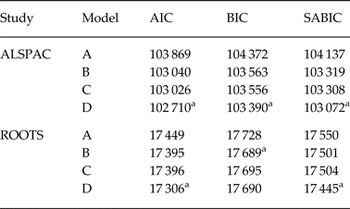
Table 1 shows the AIC, BIC and SABIC values for models A–D in the two cohorts. For all of these fit indices, the model with lowest value is preferred in terms of model fit to the data; strong indication of one model being preferred over the other is taken when the differences are greater than 10 (Kass & Raftery, Reference Kass and Raftery1995).
Comparison of model fit

AIC, Akaike information criterion; BIC, Bayesian information criterion; SABIC, BIC adjusted for sample size; ALSPAC, Avon Longitudinal Study of Parents and Children.
a Best-fitting models.
The bi-factor model (model D) was preferred in ALSPAC over models A–C. Three out of four fit indices indicated the same preference for the bi-factor model in the ROOTS sample; the BIC alone showed a slight preference for model B (i.e. two uncorrelated factors).
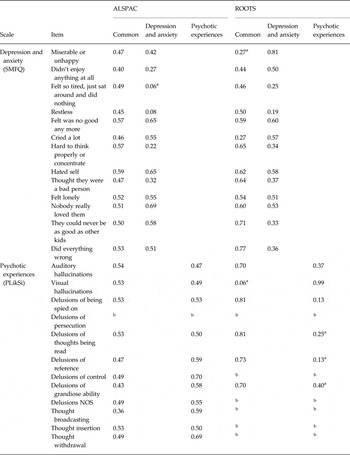
These results suggested the existence of a unitary or common underlying factor (hereafter referred to as common mental distress; CMD) in addition to the two specific factors corresponding to the residual information in (a) psychotic experiences and (b) depressive and anxiety symptoms in both cohorts. Standardized estimates for the bi-factor models are provided in Table 2.
Standardized factor loadings for the bi-factor model in the ALSPAC and ROOTS cohorts

ALSPAC, Avon Longitudinal Study of Parents and Children; SMFQ, Short Mood and Feelings Questionnaire; PLikSi, Psychosis-like Symptoms Interview; NOS, not otherwise specified.
a Non-significant (α = 0.05) factor loadings.
b Items excluded from analysis due to collinearity.
Comparison of loadings on specific and common factors in both cohorts showed that SMFQ items loaded more on the common than the specific factor, suggesting that the CMD has a great deal of overlap with depression and anxiety. PLikSi items tended to load similarly on both common and its specific factor in ALSPAC, but higher on the common factor in ROOTS.
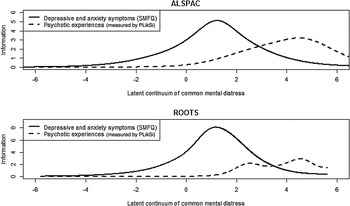
Range of the latent CMD continuum measured by the SMFQ anxiety and depression items compared with PLikSi items
In both cohorts, psychotic experiences were located at the more severe end of the latent continuum of CMD. This can be ascertained by the height and location of the curves displayed on the graphs in Fig. 3. In this figure we have used our model to add up the psychometric contribution that the items from each instrument make to the measurement of the common dimension from the bi-factor model. Psychotic experiences were located further to the more severe end of the CMD dimension on the x-axis while the SMFQ items covered the less severe range.
Location of the items measuring psychotic experiences relative to depressive and anxiety symptoms on the latent continuum of common mental distress. ALSPAC, Avon Longitudinal Study of Parents and Children; SMFQ, Short Mood and Feelings Questionnaire; PLikSi, Psychosis-like Symptoms Interview.

Individual information functions are derived from location of item thresholds and size of factor loading (discrimination power in IRT terms). In both cohorts, the rarer, less frequent items from the PLikSi extend the CMD dimension further towards the right, more severe end.
Post-hoc validation
Parental SDQ scores at age 10 years in the ALSPAC cohort showed a linear relationship with CMD scores at age 13 years (β = 0.17, p < 0.001). This association was virtually identical in the ROOTS cohort where the SDQ was measured at age 15.5 years (β = 0.18, p < 0.001; see online Supplementary Fig. S2).
Discussion
This study indicated that psychotic phenomena, and depressive and anxiety symptoms are manifestations of a unitary, latent continuum of CMD, with psychotic experiences conveying information about the more severe end. These findings have implications for current psychiatric nosology, arguing against the concept of co-morbidity of different diagnostic entities when it occurs together with depression and anxiety in the general population. Our conclusions cannot be generalized to clinical situations where further research should test a similar model.
Without explicitly acknowledging that psychotic experiences may measure the same psychopathological concept as depression and anxiety, the co-occurrence of these symptoms is increasingly recognized in a number of important recent studies (Verdoux et al. Reference Verdoux, van Os, Maurice-Tison, Gay, Salamon and Bourgeois1999; Hanssen et al. Reference Hanssen, Peeters, Krabbendam, Radstake, Verdoux and van Os2003; Nishida et al. Reference Nishida, Tanii, Nishimura, Kajiki, Inoue, Okada, Sasaki and Okazaki2008; Polanczyk et al. Reference Polanczyk, Moffitt, Arseneault, Cannon, Ambler, Keefe, Houts, Odgers and Caspi2010; van Rossum et al. Reference van Rossum, Dominguez, Lieb, Wittchen and van Os2011; Kelleher et al. Reference Kelleher, Keeley, Corcoran, Lynch, Fitzpatrick, Devlin, Molloy, Roddy, Clarke, Harley, Arseneault, Wasserman, Carli, Sarchiapone, Hoven, Wasserman and Cannon2012b ; Sullivan et al. Reference Sullivan, Wiles, Kounali, Lewis, Heron, Cannon, Mahedy, Jones, Stochl and Zammit2014). These suggest that the presence of psychotic experiences in childhood or adolescence may be a marker of multiple concurrent depressive or anxiety disorders (i.e. severity of mental ill-health) or of the likelihood of more clinically concerning behaviours, such as suicidal thoughts or self-harm (Nishida et al. Reference Nishida, Tanii, Nishimura, Kajiki, Inoue, Okada, Sasaki and Okazaki2008; van Rossum et al. Reference van Rossum, Dominguez, Lieb, Wittchen and van Os2011; Kelleher et al. Reference Kelleher, Keeley, Corcoran, Lynch, Fitzpatrick, Devlin, Molloy, Roddy, Clarke, Harley, Arseneault, Wasserman, Carli, Sarchiapone, Hoven, Wasserman and Cannon2012b ; Murray & Jones, Reference Murray and Jones2012; Wigman et al. 2012, Reference Wolke, Waylen, Samara, Steer, Goodman, Ford and Lamberts2014). Longitudinal data indicate that psychotic experiences at age 20 years are later associated with a range of non-psychotic mental disorders (Rossler et al. Reference Rossler, Hengartner, Ajdacic-Gross, Haker, Gamma and Angst2011). One study, conceptually similar to our own, applied psychometric methodology to a range of psychopathology measures in the Dunedin birth cohort (Caspi et al. Reference Caspi, Houts, Belsky, Goldman-Mellor, Harrington, Israel, Meier, Ramrakha, Shalev, Poulton and Moffitt2014); a single, general psychopathology dimension emerged but the concept of differential item contribution to severity was not explored (Spearman, Reference Spearman1904). Our study extends this approach by investigating the location of individual items on the latent continuum of the common factor, replicating the findings in independent samples, and by validating the CMD factor against the overall SDQ score, a well-established psychological measure.
Taken together, these findings suggest that a fresh approach to psychiatric nosology is required because distinct, categorical systems are just not supported by modern modelling techniques. This echoes earlier work based on hierarchical approaches to the classification of symptoms (Sturt, Reference Sturt1981) and diagnosis (Foulds & Bedford, Reference Foulds and Bedford1975). Sturt (Reference Sturt1981) showed that rarer psychopathological items usually occur only in the presence of many common items, while the extension to diagnosis, a more specific formulation of the same idea, was not adopted by major classifications in development such as DSM-III (American Psychiatric Association, 1980) and its successors. The models examined here are, themselves, natural extensions of these views, lending support to a more dimensional approach to classification that negates the increasing trend towards defining multiple co-morbid diagnoses in individuals. This may better reflect clinical reality and common aetiological and pathophysiological factors. Thus, the concept of common mental disorder including depression and anxiety requires redefinition if psychotic phenomena are part of it. We suggest that psychotic phenomena should be considered as being compatible with mild to moderate depression, perhaps with a psychosis criterion akin to that which reflects prominent anxiety symptoms in DSM-5 major depression or manic features in unipolar depression; this would add fidelity and measurement range.
Further, psychotic experiences in people in population settings should no longer be viewed solely as indicating risk for psychotic illness such as schizophrenia. Instead, they may indicate severity of CMD that may fluctuate and, in many instances, resolve (Khandaker et al. Reference Khandaker, Clarke, Cannon, Jones, Koenen, Rudenstine, Susser and Galea2013). Clinical assessments in people suffering what have hitherto been considered at-risk mental states indicate that the majority have affective or anxiety disorders, with suicidal features being common (Hui et al. Reference Hui, Morcillo, Russo, Stochl, Shelley, Painter, Jones and Perez2013). Our findings argue against the need for new categories such as the ‘psychosis risk state’ and provide evidence that psychotic phenomena are part of the panoply of symptoms that reflect mental ill-health; their presence indicates that ill-health is severe rather than qualitatively different (Murray & Jones, Reference Murray and Jones2012). That said, the presence of residual information conveyed by psychotic phenomena (but not depression and anxiety) beyond the common factor means that they can indicate other processes that may indicate psychotic illness; this requires further research.
These findings suggest that ignoring psychotic experiences curtails the proper measurement of mental distress in the general population; the upper end of severity is inadequately addressed, akin to using a 25 cm ruler for a 30 cm problem. Few widely used measurement scales for common psychiatric morbidity include psychotic experiences; for example: the General Health Questionnaire (Goldberg & Hillier, Reference Goldberg and Hillier1979), K-scales (Kessler et al. Reference Kessler, Andrews, Colpe, Hiripi, Mroczek, Normand, Walters and Zaslavsky2002), Clinical Interview Schedule – revised (Lewis et al. Reference Lewis, Pelosi, Araya and Dunn1992), Hospital Anxiety and Depression Scale (Zigmond & Snaith, Reference Zigmond and Snaith1983), MFQ (Angold et al. Reference Angold, Costello, Messer, Pickles, Winder and Silver1995). Psychotic experiences should, therefore, be included alongside symptoms of depression and anxiety as part of the measurement of mental distress, even when the goal is screening.
The presence of a common, underlying trait may explain the complete lack of specificity of risk factors (Kounali et al. Reference Kounali, Zammit, Wiles, Sullivan, Cannon, Stochl, Jones, Mahedy, Gage, Heron and Lewis2014). For example, early life adversity is a well-replicated risk factor for both adult psychotic illness as well as depressive and anxiety disorders (Widom et al. Reference Wigman, van Nierop, Vollebergh, Lieb, Beesdo-Baum, Wittchen and van Os2007; Varese et al. Reference Varese, Smeets, Drukker, Lieverse, Lataster, Viechtbauer, Read, van Os and Bentall2012). Neurodevelopmental differences are a risk factor for both adult depression (van Os et al. Reference van Os, Jones, Lewis, Wadsworth and Murray1997) and schizophrenia (Jones et al. Reference Jones, Rodgers, Murray and Marmot1994; Khandaker et al. Reference Khandaker, Barnett, White and Jones2011). Inflammatory, autoimmune and infectious mechanisms have been associated with both depression and psychotic disorders in adult life (Benros et al. Reference Benros, Nielsen, Nordentoft, Eaton, Dalton and Mortensen2011, Reference Benros, Waltoft, Nordentoft, Ostergaard, Eaton, Krogh and Mortensen2013; Khandaker et al. Reference Khandaker, Zimbron, Dalman, Lewis and Jones2012, Reference Khandaker, Pearson, Zammit, Lewis and Jones2014), and genome-wide association studies have demonstrated the existence of common single nucleotide polymorphisms (O'Donovan et al. Reference O'Donovan, Craddock, Norton, Williams, Peirce, Moskvina, Nikolov, Hamshere, Carroll, Georgieva, Dwyer, Holmans, Marchini, Spencer, Howie, Leung, Hartmann, Moller, Morris, Shi, Feng, Hoffmann, Propping, Vasilescu, Maier, Rietschel, Zammit, Schumacher, Quinn, Schulze, Williams, Giegling, Iwata, Ikeda, Darvasi, Shifman, He, Duan, Sanders, Levinson, Gejman, Cichon, Nothen, Gill, Corvin, Rujescu, Kirov, Owen, Buccola, Mowry, Freedman, Amin, Black, Silverman, Byerley and Cloninger2008; Green et al. Reference Green, Grozeva, Jones, Jones, Kirov, Caesar, Gordon-Smith, Fraser, Forty, Russell, Hamshere, Moskvina, Nikolov, Farmer, McGuffin, Holmans, Owen, O'Donovan and Craddock2010; Smoller et al. Reference Smoller, Craddock, Kendler, Lee, Neale, Nurnberger, Ripke, Santangelo and Sullivan2013). Future research concerning aetiology and pathophysiology of mental illness should consider CMD as a single phenotype, acknowledging the presence of psychotic phenomena in its more severe manifestations. However, these findings do not address how specific psychiatric syndromes emerge (Kirkbride & Jones, Reference Kirkbride and Jones2011).
Strengths of our study include cross-validation of results over two epidemiological samples and the use of recent developments in psychometrics appropriate for potentially skewed latent variables and clustering in the data. Limitations include minor differences in the data collection of the two studies. The relatively small sample size of the ROOTS cohort in comparison with ALSPAC may have led to the slightly discrepant fit indices, but our model addresses potential differences in measurement mode through the orthogonal factors for each instrument or set of items. We analysed non-clinical data, so the extension to a clinical setting requires empirical investigation. Over half of the original ALSPAC cohort did not attend psychiatric assessments at age 13 years. Examination of successive follow-up data from the cohort suggests that attrition is associated with male gender, minority ethnic, and lower socio-economic status (Boyd et al. Reference Boyd, Golding, Macleod, Lawlor, Fraser, Henderson, Molloy, Ness, Ring and Davey Smith2013). However, there is no evidence of difference in co-variation of depressive and psychotic experiences between those included in our analyses and those who were lost to follow-up (Wolke et al. 2009). The selection of the semi-parametric approach constraining model parameters across latent classes might be over-restrictive. Cross-validation of the bi-factor model over different measures of depressive, anxiety and psychotic experiences would further strengthen the generalizability of the CMD concept. The current work could also be extended by including a wider range of psychopathology measures such as those associated with obsessive–compulsive disorder and attention-deficit/hyperactivity disorder. Competing models might place these items on the single distress factor or on separate dimensions. In the future, longitudinal studies with repeated assessments for mood, anxiety and psychotic symptoms analysed within the framework we propose would be useful in order to understand their relationships over time.
In conclusion, data from two methodologically similar epidemiological studies indicate that psychotic experiences and depressive and anxiety symptoms indicate a single, underlying dimension of CMD. Psychotic experiences indicate the more severe end of this factor. The results suggest that psychotic experiences should be included in the assessment of what have hitherto been seen as mild to moderate depressive and anxiety disorders. Diagnostic classification systems should acknowledge that psychotic phenomena occur beyond current concepts of schizophrenia-like disorders and the most severe affective syndromes, particularly in young adults where they appear to be part of a broad range of mental symptoms.
Supplementary material
For supplementary material accompanying this paper visit http://dx.doi.org/10.1017/S003329171400261X
Acknowledgements
The present study was supported by the Wellcome Trust (095844/Z/11/Z and 088869/Z/09/Z; I.M.G., P.B.J. and T.J.C.) and the National Institute for Health Research (NIHR) (RP-PG-0606-1335; P.B.J.) that also supported J.S.; and by a doctoral research training fellowship from the Wellcome Trust to G.M.K. (094790/Z/10/Z). The UK Medical Research Council and the Wellcome Trust (grant reference 092731) and the University of Bristol provide core support for ALSPAC. The ROOTS study was supported by the Wellcome Trust (grant reference 074296), the NIHR Collaboration for Leadership in Applied Health Research & Care East of England (CLAHRC-EoE) and the NIHR Cambridge Biomedical Research Centre. The funding bodies had no role in study design; in the collection, analysis, and interpretation of data; in the writing of the report; and in the decision to submit the paper for publication. We are grateful to all ALSPAC and ROOTS participants and their families, and the wider study teams which included midwives, interviewers, computer and laboratory technicians, clerical workers, research scientists, volunteers, managers, receptionists and nurses.
Declaration of Interest
None.