As a healthcare setting with both frequent broad-spectrum antimicrobial use and acutely unwell patients, the intensive care unit (ICU) is recognized as a critical target for antimicrobial stewardship (AMS) programs.Reference Vincent, Rello and Marshall 1 – Reference Katsios, Burry and Nelson 3 In Australia, the deployment of an AMS service in the ICU has been successful at optimizing antimicrobial therapy.Reference Adhikari, Piza and Taylor 4 – Reference Cairns, Jenney and Abbott 6 Previously, Cairns et alReference Cairns, Bortz and Le 5 discussed a model of an ICU-AMS service that led to an average of 1.6 AMS decisions being made per round, and 86.7% of these decisions were implemented within 24 hours. Internationally, other ICU-AMS programs have demonstrated a reduction in gram-negative resistance and hospital costs.Reference Alvarez-Lerma, Grau and Echeverria-Esnal 7 In a small, single-center study, an AMS service with intermittent postprescription review demonstrated a 78.4% acceptance rate of recommendations.Reference Khdour, Hallak and Aldeyab 8 None of these interventions utilized the electronic medical record (EMR), including the electronic prescribing of medications, which has been proposed as a potential AMS tool.Reference Pogue, Potoski and Postelnick 9 , Reference Micallef, Chaudhry and Holmes 10 The EMR allows for identification and review of all patients receiving antimicrobials remotely and on site. It enables real-time review and assessment of patients receiving antimicrobials.
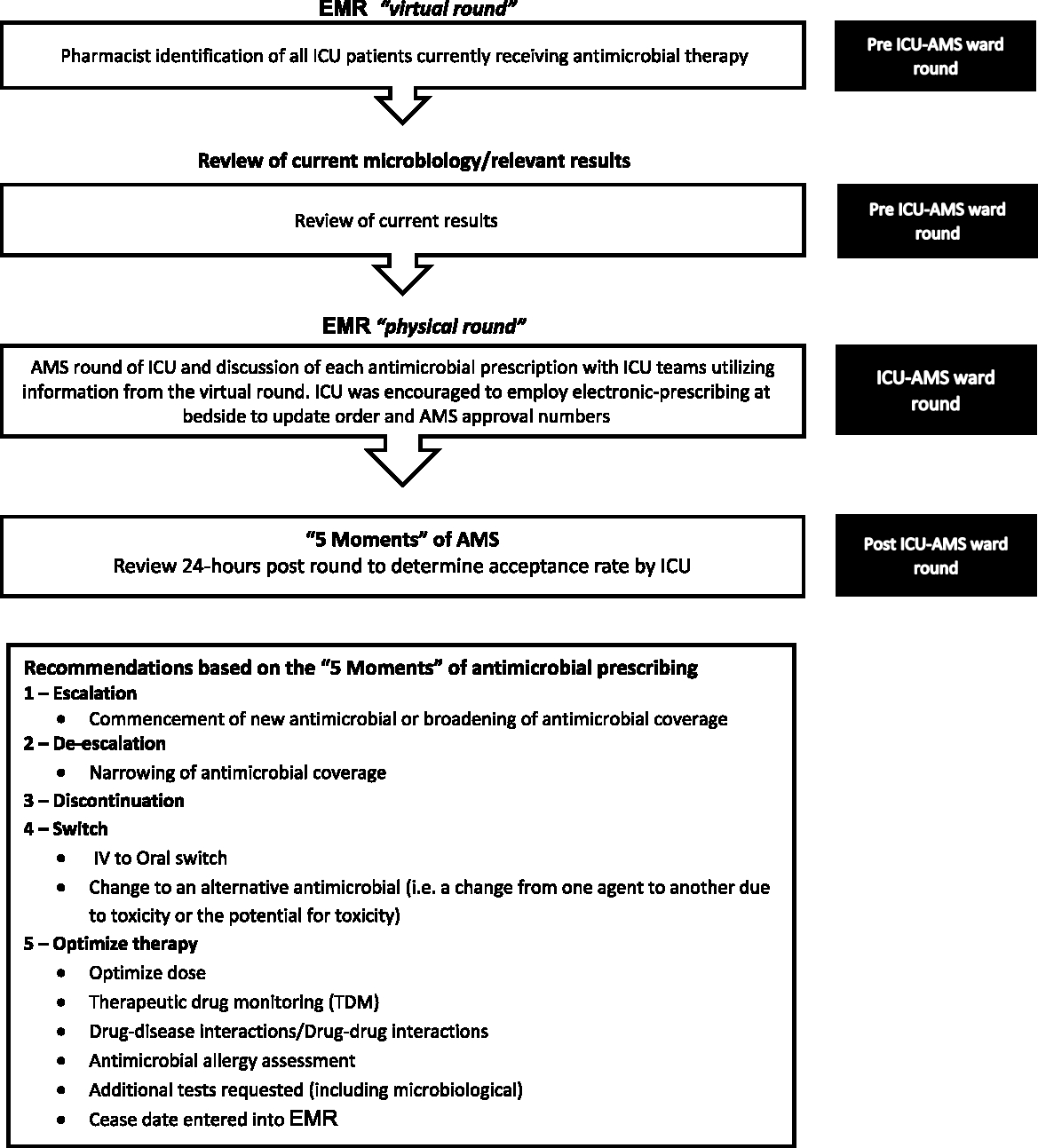
Evaluation of AMS interventions has primarily focused on measuring impacts on antimicrobial consumption: defined daily doses (DDD) per 1,000 occupied bed days (OBD), days of therapy (DOT), and guideline concordance or appropriateness.Reference James, Upjohn and Cotta 11 – Reference Dresser, Bell and Steinberg 13 A key marker of a successful AMS intervention is also clinician acceptance of and/or compliance with recommendations from an AMS team, but the definition and measurement of acceptance of recommendations has been infrequently reported in the ICU setting. Although terms such as “de-escalation,” “dose optimization,” and “intravenous–oral switch” are commonly employed,Reference Dellit, Owens and McGowan 14 a collective metric measurement rubric for classifying and measuring common AMS recommendations remains elusive. The primary objective of this study was to examine the impact of an EMR driven ICU-AMS service on clinician compliance with a range of AMS recommendations. These recommendations were defined by an internally developed metric called the “5 Moments Antimicrobial Prescribing” (Fig. 1). Furthermore, as secondary objectives, we sought to measure the impact of the ICU-AMS service (1) on antibiotic appropriateness, and (2) on the use of high-priority target antimicrobials (ie, vancomycin, meropenem, ceftriaxone, and piperacillin-tazobactam).
New EMR-led ICU-AMS structure. EMR, electronic medical record; ICU, intensive care unit; AMS, antimicrobial stewardship.

Methods
At Austin Health, an EMR-driven ICU-AMS round was implemented, with the support of the ICU, on August 7, 2017, due to the high use of high-priority target antimicrobials within the ICU. Austin Health is a tertiary-care referral hospital encompassing a 29-bed, mixed medical-surgical, open ICU, including acute spinal, cardiothoracic surgery, neurosurgery, hematology, oncology, and transplantation services (ie, liver, renal, and stem cell). Antimicrobials can be prescribed by any member of the ICU medical team. At Austin Health, the EMR system (Millennium, Cerner, Kansas City, MO) includes access to hospital medical records, pathology, radiology, allergy recording, and electronic prescribing. Therefore, the EMR can be utilized as a tool for monitoring the real-time prescribing of all antimicrobials among hospitalized patients. Prior to the new ICU-AMS ward-round implementation, ICU patients were only reviewed by the infectious diseases (ID) unit following a formal referral from the ICU treating team. Austin Health has an institution-wide preapproval AMS system in place for high-priority target antimicrobials (including antifungals). These agents cannot be dispensed or administered without a valid approval number (obtained through the electronic approval system or from the ID team). However, in time-critical scenarios (eg, sepsis), an interim approval can be obtained.
The new EMR-driven ICU-AMS ward round was conducted on weekdays, with a virtual and physical component to the round (Fig. 1). No additional funding was obtained for this intervention, and it was integrated into the workload of the ID/ICU consultant, registrar, and AMS pharmacist. To aid in service efficiency, the EMR was utilized as a virtual round to undertake surveillance of ICU antimicrobial prescribing, microbiology, and other relevant results prior to the physical round. The physical round consisted of a face-to-face bedside consultation within the ICU with an ID clinician; an ID fellow (who also undertook formal ID consults for ICU patients); an AMS pharmacist; and either an ICU clinician, a fellow, or a resident in attendance. All current antimicrobials (including nontarget antimicrobials and antifungals) were reviewed on the round. The ICU was encouraged to utilize electronic prescribing at the bedside and to update orders and approvals in real time.
A prospective study was undertaken from implementation until December 31, 2017, during which ICU-AMS recommendations and ICU compliance data (within 24 hours of completion of the round) were collected. In addition, baseline patient demographic data, admitting unit, microbiology (including multidrug-resistant gram negative [MDR], vancomycin-resistant enterococci [VRE], and methicillin-resistant Staphylococcus aureus [MRSA] colonization status), ICU-length of stay, and mortality were recorded. Although all current antimicrobials were reviewed on the round, only those with a recommendation were included in the study. All recommendations made to the ICU were classified according to our internally developed “5 Moments of Antimicrobial Prescribing”: (1) escalation, (2) de-escalation, (3) discontinuation, (4) switch, and (5) optimization (Fig. 1). The “5 Moments” metric was developed by internal consensus following a literature review of currently available AMS terms/definitions (PubMed search terms: “antimicrobial stewardship” AND (“terminology” OR “classification” OR “definitions” OR “de-escalation” OR “escalation [2005–2017]). Additional data collected about the physical ICU-AMS round included the duration of the round and the presence of an ID physician on the round.
An assessment of antimicrobial appropriateness and use was undertaken before and after ICU-AMS service implementation. The impact of the ICU-AMS round on antimicrobial appropriateness was determined by analyzing data from a point-prevalence survey conducted during the study period (September 27, 2017) and by comparing it with the data from the previous year (October 5, 2016). The point-prevalence survey was conducted as part of the National Antimicrobial Prescribing Survey (NAPS), a standardized electronic auditing tool developed in 2013 to assist healthcare facilities monitor antimicrobial prescribing practices and facilitate local quality improvement. The methodology of the NAPS has been previously described by James et al.Reference James, Upjohn and Cotta 11 , Reference James, McIntosh and Luu 15 The Austin Health ICU NAPS audit was conducted by the same ID clinician in 2016 and 2017, who was independent from the new EMR driven ICU-AMS intervention.
The impact of the ICU-AMS round on high-priority target antimicrobial use was obtained from the monthly antimicrobial consumption data in DDD per 1,000 occupied bed days for the period 6 months before to 9 months after the intervention. We used segmented Poisson regression (with occupied bed days as offset) to evaluate the immediate change and change in trend in antimicrobial usage associated with the ICU-AMS round. The results, obtained using R version 3.4.0 software (R Foundation for Statistical Computing, Vienna, Austria), are reported as percentage change in antibiotics (expressed as DDD per 1,000 OBD), with reductions and increases expressed as negative and positive percentages, respectively. The DDD per 1,000 OBD values were obtained through the National Antimicrobial Utilization Surveillance Program (NAUSP) and consisted of all ICU patients, including patients that did not have any recommendations made by the ICU-AMS round. This study was approved by the Austin Health Ethics Committee (no. LNR/17/Austin/312).
Results
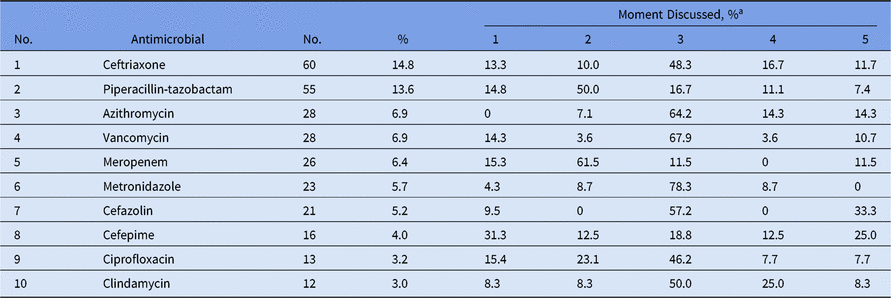
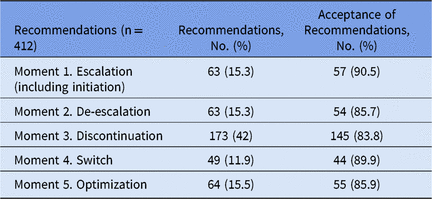
For the 202 patients reviewed (from August 7, 2017, until December 31, 2017) by the ICU-AMS service for whom a recommendation was made, the median age was 61.7 years old. In addition, 48 patients had an antibiotic allergy listed in the EMR, and a 6.4% ICU mortality was noted (Supplementary Table 1 online). Prior to the physical round, 2 hours were allocated to the AMS pharmacist to undertake the virtual round and review of current results. The median time spent in the ICU by the AMS team was 45 minutes per day (interquartile range [IQR], 37.5–45). Among the 405 antimicrobials that received at least 1 AMS recommendation, 342 (84.4%) were intravenous (IV), and 147 antimicrobials (36.3%) were for a respiratory tract infection. The most commonly discussed antimicrobials were ceftriaxone (60 of 405, 14.8%) and piperacillin/tazobactam (55 of 405, 13.6%), others are represented in Table 1. For these 202 patients, 412 recommendations were made in accordance with the “5 Moments” metric. All recommendations were classified according to the “5 Moments” metric. The number of recommendations for each of the “5 Moments” is outlined in Table 2, along with proportion of recommendations that were accepted. The most antimicrobial recommendations by the AMS team to the ICU involved amoxicillin-clavulanate (IV or oral; 26 of 160, 16.3%) and ceftriaxone (15 of 160, 9.3%). Antifungals were infrequently discussed on ward rounds, and 14 of 15 AMS recommendations (93.3%) regarding antifungals were accepted by the ICU. Moreover, 10 of 405 antimicrobial recommendations (2.5%) discussed fluconazole; 4 of 405 (1.0%) discussed anidulafungin; and 1 of 405 (0.2%) discussed liposomal amphotericin. Overall, 355 of 412 AMS recommendations (86.1%) were accepted in the ICU.
Top 10 Most Commonly Discussed Antimicrobials During the ICU-AMS Ward Round

Note. ICU, intensive care unit; AMS, antimicrobial stewardship.
a Moment 1, escalation; moment 2, de-escalation; moment 3, discontinuation; moment 4, switch; moment 5, optimization.
Recommendations and Acceptance of Each of the “5 Moments of Antimicrobial Prescribing”

On univariate analysis, the ICU staff was most likely to implement recommendations if the patient had been in the ICU for 7 days or longer (165 of 182 [90.7 %] vs 190 of 230 [82.6%]; odds ratio [OR], 2.04; 95% confidence interval [CI], 1.08–3.98). Compliance with recommendations in the ICU was not affected by (1) the presence of an ID clinician, (2) immunocompromised status, (3) colonization status of the patient, (4) antibiotic allergy status, (5) age, or (6) sex (P > .05) (Supplementary Table 2 online). Using the “5 Moments” metric, none of the previously described factors were associated with increased compliance: ICU length-of-stay, ID clinician, immunocompromised status, colonization status of the patient, antibiotic allergy status, age, or sex (Supplementary Table 3).
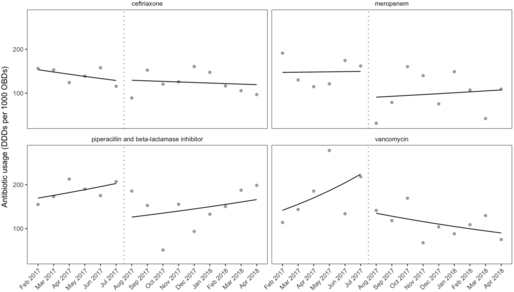
The impact of the ICU-AMS service on antimicrobial usage (DDD per 1,000 OBD) of key target antimicrobials is demonstrated in Figure 2. The ICU-AMS service was associated with an immediate reduction in the use of meropenem (−40.5%; 95% CI, −52.9% to −24.8%), piperacillin-tazobactam (−39.8%; 95% CI, −50.8% to −26.6%), and vancomycin (−36.6%; 95% CI, −48.3% to −22.4%), but not ceftriaxone (1.4%; 95% CI, −18.7% −8.4%). The intervention was also associated with a significant reduction in the monthly trend in use of vancomycin (−13.2% [−17.9%, −8.4%]) but not meropenem (1.8%; 95% CI, −4.1% to 8.0%), piperacillin-tazobactam (−0.1%; 95% CI, −5.2%, 5.2%), or ceftriaxone (2.5%; 95% CI, −3.3% to 8.7%). According to data collected for the ICU NAPS audit, there was an increase in prescribing appropriateness from 21 of 45 (46.7%) before the intervention (October 2016) to 30 of 39 (76.9%) during the study period (September 2017).
DDD antibiotic usage for commonly targeted antibiotics in the ICU 6 months before and 9 months after ICU-AMS intervention. Dotted vertical lines represent commencement of intervention. Solid lines represent preintervention and postintervention trends in antimicrobial use estimated using Poisson segmented regression. The dots on the graph are raw data points. Note. DDDs, defined daily doses; OBDs, occupied bed days; ICU, intensive care unit; AMS, antimicrobial stewardship.

Discussion
Through the deployment of the EMR, an ICU-AMS virtual and face-to-face round was established that provided a targeted service to a large mixed-ICU population. This intervention associated with high clinician compliance and a decrease in high-priority target antibiotic utilization. Prospective audit and feedback in the ICU has long been associated with improved prescribing, decreased antimicrobial resistance, and decreased rates of Clostridium difficile infection.Reference DiazGranados 16 , Reference Elligsen, Walker and Pinto 17 Face-to-face prompting in the ICU has been associated with improved compliance.Reference Weiss, Dibardino and Rho 18 Pathways that incorporate EMR, while maintaining a face-to-face ICU presence, remain desirable to improve antibiotic appropriateness and engagement of ICU clinicians with AMS practices.Reference Cresswell, Mozaffar and Shah 19
In this study, we demonstrated that the ICU team was most likely to implement AMS recommendations if the patient had been in ICU for 7 days or longer (Supplementary Table 2 online). We hypothesize that this is due to the continuity of the ID team compared to the ICU team. The ICU clinician, fellow, and resident rotate frequently, whereas the ID consultant reviews patients for 2–3 weeks at a time, therefore increasing their knowledge of each patient’s infection history while in ICU. Our data also demonstrates that an ID consultant’s presence on the ward round did not affect the uptake of AMS recommendations. This is useful in resource limited settings as it demonstrates the ability of the service to continue when an ID consultant is not present.
Although limited by its quasi-experimental study design and single-center nature, this study provides a framework for an EMR driven ICU-AMS service that has a positive influence on appropriate use of key antimicrobials. Ascertaining the success of an EMR-driven ICU-AMS round requires an understanding of recommendation compliance; however, published rubrics to categorize AMS recommendations are absent. The “5 Moments of Antimicrobial Prescribing” metric provides a useful framework for classifying and reviewing common AMS interventions. This metric can be utilized by other AMS programs to classify and compare interventions and to standardize the assessment of AMS interventions.
The antimicrobials frequently discussed on the rounds were key AMS targets, and the acceptance of recommendations was associated with increased prescribing appropriateness. The low frequency of antifungal recommendations is likely due to the presence of existing agreed-upon ICU antifungal guidelines and a coexisting AMS-led antifungal stewardship program focused on high-risk patients (eg, stem cell transplant and liver transplantation). Subsequent reductions in carbapenem, glycopeptide, and piperacillin-tazobactam were noted, as indicated by our comparison of DDD per 1,000 OBD usage before and after the intervention. Although DDD measurements have known limitations,Reference Barlam, Cosgrove and Abbo 20 a better marker of AMS impact may be antimicrobial appropriateness measures.Reference Morris 21 We noted significant increases in appropriate use following the implementation of an ICU-AMS service, although we acknowledge the limitations associated with data from single point-prevalence surveys and small sample sizes.Reference Spivak, Cosgrove and Srinivasan 12 The use of agents such as meropenem and piperacillin-tazobactam are appropriate in specific patients, and the upward trend in DDD per 1,000 OBD toward the end of the period demonstrates appropriate use of these antibiotics (Fig. 2). This finding is reflected in the increase in appropriateness scores demonstrated by the ICU NAPS data. Future work should measure the clinical predictors of ICU clinician compliance and the qualitative factors related to noncompliance in the ICU-AMS setting.Reference Broom, Broom and Plage 22
In conclusion, the use of an EMR-driven ICU-AMS model demonstrated a decrease in target antibiotic utilization as well as an increase in the appropriateness of antimicrobials. This model was also associated with a high rate of ICU clinician compliance. The “5 Moments of Antimicrobial Prescribing” metric is a structured model for assessing AMS recommendations and compliance. ICU-AMS models that integrate the EMR should be encouraged in centers with appropriate digital resources to achieve subsequent positive impacts on antibiotic prescribing.
Supplementary Material
To view supplementary material for this article, please visit https://doi.org/10.1017/ice.2019.218
Financial support
J.A.T. is supported by a National Health and Medical Research Council Early Careers Fellowship (grant no. APP1139902). A.J.S. is supported by a National Health and Medical Research Council Early Career Fellowship (grant no. APP1141398). K.F.U. is supported by a National Health and Medical Research Council postgraduate research scholarship (grant no. APP1133479). All other authors report no financial support relevant to this article.
Conflicts of interest
All authors report no conflicts of interest relevant to this article.