Considering that gender equality is a fundamental value fostered by all international organizations and most national legislatures, it is alarming that major gender disparities still exist in the public sector worldwide, including in diplomacy, a discipline that was exclusive to male elites until the late twentieth century. Such is the case in the Czech Republic, where women represent less than 25% of all government officialsFootnote 1 and are significantly underrepresented in higher diplomatic positions. In the Czech Ministry of Foreign Affairs (MFA), no woman has ever served as foreign minister, and no female deputy currently acts as head of section. Women make up only 30% of department directors and 14% of Czech ambassadors (MFA 2021). This study constitutes a gender analysis of diplomacy, with the main research aim to explore the key reasons for female underrepresentation in the highest diplomatic positions. Based on the findings, the analysis focuses on work-family balance, which emerges as one of the main challenges to the career advancement of female diplomats.
Theoretical Framework
Gender Research in Diplomacy
Research on the role of women in diplomacy has intensified over the past few decades, thanks to the increased joint efforts of NGOs, academia, and international organizations. Based on the overview provided by Aggestam and Towns (Reference Aggestam and Towns2019), there are three main fields of gender research that could contribute to the transformation of diplomacy. The most developed literature concerns diplomatic history, analyzing the informal involvement of women in diplomacy (e.g., Hendry Reference Hendry and Kurbalija1998) and their struggle to access formal diplomacy in the twentieth century (e.g., Wood Reference Wood2005). The second field maps the current representation and positioning of women in diplomacy and confirms an absolute male overrepresentation in this field, where women occupy less prestigious posts (Towns and Niklasson Reference Towns and Niklasson2017).Footnote 2 The last research area focuses on diplomacy as a gendered institution. Most studies in this field focus on the cultural context and reveal the gendered structures and dynamics of diplomatic negotiations (e.g., Aggestam and Towns Reference Aggestam and Towns2018) and networking (Niklasson Reference Niklasson2020). These studies confirm that diplomacy, as a patriarchal stronghold built on traditional gender norms, is generally ill organized for balancing work and family life, which negatively affects women, particularly as the primary caregivers for children (e.g., Bashevkin Reference Bashevkin2018; Farias de Souza and do Carmo Reference Farias de Souza, do Carmo, Aggestam and Towns2018; Flowers Reference Flowers, Aggestam and Towns2018; Linse Reference Linse and Hannah2004; Niklasson and Robertson Reference Niklasson, Robertson, Aggestam and Towns2018; Rumelili and Suleymanoglu-Kurum Reference Rumelili, Suleymanoglu-Kurum, Aggestam and Towns2018).
Although no extended qualitative research has been done in this field in Europe, several studies and polls affirm these problems. Almost 90% of female diplomats questioned in two polls conducted in London (in 2002 and 2012) agreed that women have to make tough choices between family life and their careers and cited a lack of support in this area as the major obstacle holding women back (Embassy Magazine 2016). The survey also revealed enormous growth in the number of single, divorced, or unaccompanied female diplomats, from 50% to 75%, which indicates that the situation in this field is not improving (Embassy Magazine 2016). Similar findings were obtained by studies conducted in Sweden and Turkey (Aggestam and Towns Reference Aggestam and Towns2018; Niklasson Reference Niklasson2020). Furthermore, another U.K. survey showed that more than 40% of its Foreign Service staff feels that issues relating to work-family balance cannot be discussed openly (Baker Reference Baker2009). Regarding the Central and Eastern Europe (CEE) region, only a few studies have been conducted so far—on equal opportunities in Slovenian diplomacy (Jazbec et al. Reference Jazbec, Lukšíč-Hacin, Pirnat and Kajzer2011), descriptive representation in Czech diplomacy (Borčany Reference Borčany2017), and practices in the Czech Republic and select European Union (EU) countries (Dopita, Kočí, and Cmolíková Reference Dopita, Kočí and Cmolíková2020). These studies affirm very low female representation in top diplomacy (with the lowest rate of 9% in Slovakia [Pető Reference Pető2015]), which might be affected by the overall negative situation in the field of gender equality in the region (Gender Equality Index 2020).
Barriers to Women’s Leadership
In order to analyze the reasons for gender misbalance in top diplomacy, it is essential to review the general research on female leadership (including in politics and business), as some of its main concepts are vital to the research presented here. A starting point is critical mass theory (Kanter Reference Kanter1977), which points out that descriptive as well as substantive types of change will start taking place once a token group reaches about 30% in a given collective (Dahlerup Reference Dahlerup1988). Female ambassadors in most countries represent tokens who, by acceptance of the (male) dominant culture, constantly reinforce the steady low representation of this minority group and the lack of its presence in decision-making (Neumann Reference Neumann2008; Niklasson Reference Niklasson2020).
Based on existing research, it is possible to identify three main levels of female leadership barriers: (1) the individual level, including social pressure, risk aversion, work-family balance considerations, lack of confidence, and nonrecognition of discriminatory practices; (2) the institutional level, including gender bias and stereotyping, lack of networking opportunities, and nontransparent selection processes; and (3) the state level, including unfavorable laws and policies regulating work and family matters. These barriers have multiple negative effects and often result in horizontal and vertical gender segregation, which effectively bars women from working in certain fields and in top positions. Furthermore, it has been confirmed that such disadvantages are stronger at the top of the hierarchy (the glass ceiling notion) and worsen with age. Working mothers face additional systematic disadvantages. Because of maternity leave and caring duties, they endure career interruptions that result in lower salaries and pensions, as well as negative evaluations and perceptions. Many working mothers bear the double burden of working and caring activities and struggle to reconcile their family and career plans.
While problems at the individual and institutional levels might be addressed through training, mentoring, targeted recruitment, voluntary quotas, and flexible work arrangements, tools at the state level are more difficult to enact, and they require a great deal of political will. Some of the best practices have been adopted in Nordic countries, which, thanks to progressive family policies (including shared parental leave, long paternity leave, postmaternity reentry programs, and care for the elderly), have among the highest female labor participation rates as well as gender balanced decision-making. Women in diplomacy face the same types of barriers, even though their combination may differ according to the institutional and national context. Work-family problems in diplomacy might be even more challenging than in other fields because of the need for constant mobility; however, this part of diplomatic life remains still largely underresearched.
Added Value: A Gendered Work-Family Balance Focus
The added value of this research is threefold. First, this study examines the work-family balance challenges faced by female ambassadors. As mentioned earlier, this research field remains largely unexplored, as most studies focus on the role of diplomatic wives or the descriptive representation of female diplomats and their work-related problems (which are not necessarily linked to their private family lives). It is also important to note that the challenges faced by top female diplomats differ from those of diplomatic wives and lower-ranked female diplomats. Unlike diplomatic wives, female ambassadors have a direct contractual link to the MFA, they have different roles in missions, and they act as primary movers within their families (not as an accompanying partner or a tied moverFootnote 3). Female ambassadors also have different job descriptions and different responsibilities than lower-ranked female diplomats, and their partners are expected to be more involved in embassy representation. As a result, this group is more likely to be affected by work-family balance problems.
Second, the study focuses on the Czech Republic in Central Europe—a region that is still largely unexplored by existing research and bears distinct cultural and institutional features as a result of its sociohistorical development. Existing data prove that despite the official ideological proclamation of female equality, female participation in top diplomatic circles (and political decision-making in general) was negligible under previous state-socialist regimes, and this type of inequality persists in the region. Therefore, findings from the Czech case can serve as an illustration of national particularities that are likely shared by other CEE countries.
Finally, this study presents qualitative findings that can serve as the basis for further comparative work. Given the lack of substantial research in this field, we base our assumptions on the findings revealed by studies on diplomatic wives; existing analyses of foreign diplomatic services (including Turkey, Sweden, Brazil, the United States, South Korea, and Japan); and the general sociological work-family balance research, which works with concepts of the private/public sphere, dual careers and linked lives, mobility, gender roles, and gender ideologies.
Male Diplomats and Diplomatic Wives—From Dependents to Dual Careers
Since the formal presence of women in diplomacy was scarce in past centuries, women influenced diplomacy mainly through the informal institution of diplomatic wives (Aggestam and Towns Reference Aggestam and Towns2019, 14). Even though foreign services counted on the logistical and representational work of diplomatic wives, they were hardly credited for their contributions (McCarthy Reference McCarthy2014). Nevertheless, most diplomatic wives regarded themselves as associates rather than “helpmates” (a term used by U.S. State Department employees)—they viewed their experience as a “career” in itself, and often referred to “we” when talking about their experiences in missions (Wood Reference Wood2005, 2, 3; Wood Reference Wood and Jacqueline2007). The first generation of diplomatic wives often had little professional choice other than contributing to their husbands’ work while taking on their rank and status, a role that researchers have called “parallel careers” (Hendry Reference Hendry and Kurbalija1998) or “two persons, single career” (Pavalko and Elder Reference Elder1994). The term “incorporation” has also been proposed, stressing the integration of the wives’ social roles and responsibilities with their husbands’ occupational culture and identity (e.g., in diplomacy, academia, police, and armed services) (Callen Reference Callen and Shirley1975; Finch Reference Finch1983).
However, the role of the diplomatic spouse has been changing as a result of a number of factors, including a shift toward dual-career families, a change in families’ setup and division of caring activities, and a change in the character of diplomatic activities (Enloe Reference Enloe2014; Mildorf Reference Mildorf2020; Nasr Reference Nasr2019). Currently, most Western families rely on dual incomes and many women seek to maintain a fulfilling career, which is exceedingly difficult in the case of constant mobility (Nasr Reference Nasr2019). The concept of portfolio careers, which entails short-term contracts and freelance work across varying fields (Clinton, Totterdell, Wood Reference Michael, Totterdell and Wood2006; Handy Reference Handy1995), requires a great deal of flexibility and does not seem to fit many fields of work. It seems that the situation might be easier in the case of tandem-career couples (when both partners work for the Foreign Service), but many states do not allow a direct hierarchical link between partners and/or do not have sufficient capacity within their embassies.
There has also been a shift in families’ setup, as an increasing number of countries recognize registered partnerships or same-sex marriages (Stephenson Reference Stephenson2020); many diplomats have foreign spouses or live with their partners without being married. However, not all foreign ministries award the same rights and allowances for such diplomatic partners.Footnote 4 There has also been an increase in familial responsibilities, as older family members live longer and children often undertake prolonged studies. Finally, the nature of the role of diplomatic spouses is changing because of multiculturalism, cuts in representative budgets, and the outsourcing of event organization, leaving fewer options for spouses’ activities (Nasr Reference Nasr2019). As a result, many spouses feel uncertain about their roles, and their morale is often low (Nasr Reference Nasr2019). Moreover, an increasing number of women do not identify themselves with this representative role and seek their own career fulfillment instead (Biltekin Reference Biltekin, Sluga and James2016, 255). These findings are very important, as they explain logistical, financial, and psychological problems, including a greater level of flexibility and submission than many male spouses are willing to undertake.
Female Diplomats and Diplomatic Husbands—From Dual Careers to Separate Careers
Many countries only allowed women to formally join diplomatic corps in the second half of the twentieth century. Moreover, their careers were further limited by the “marriage bar,”Footnote 5 forcing women to choose between family and career (e.g., Farias de Souza and do Carmo Reference Farias de Souza, do Carmo, Aggestam and Towns2018; Flowers Reference Flowers, Aggestam and Towns2018; Niklasson and Robertson Reference Niklasson, Robertson, Aggestam and Towns2018; Rumelili and Suleymanoglu-Kurum Reference Rumelili, Suleymanoglu-Kurum, Aggestam and Towns2018). Interestingly, one of the arguments used in favor of this policy was that diplomatic husbands would be harder to control and less loyal to the service than diplomatic wives (Wood Reference Wood2005).
Since the removal of these major legal barriers, the number of female diplomats has been on the rise. This trend has brought a corresponding change in the proportion of male diplomatic partners, who seem to be less willing to follow their female partners as tied movers and feel less obliged to follow traditional diplomatic spousal roles. There are no qualitative data in this field, but surveys confirm that constant mobility, along with the reluctance of men to accompany their partners on missions (often caused by social pressure), is a major problem for female diplomats. Respondents specifically pointed out the stressful situations of dealing with frustrated and out-of-work husbands (Embassy Magazine 2016). This problem had already been confirmed in Sweden in the 1970s, and despite the favorable gender equality environment, the issue of diplomatic partners remains problematic, and female diplomats often face difficulties in convincing their families to accompany them abroad (Robertson and Niklasson Reference Robertson, Niklasson, Aggestam and Towns2018).
This situation results in the phenomenon of ever-increasing numbers of unaccompanied female diplomats on missions, who either prefer to remain single, get divorced, or become separated from their families during their service abroad. As a result, they often face isolation and emotional distancing (Embassy Magazine 2016; Hendry Reference Hendry and Kurbalija1998; Linse Reference Linse and Hannah2004), as well as the additional cost of running two separate households (Vohlídalová Reference Vohlídalová2014). Moreover, as accentuated by the Swedish research, the option of working abroad alone seems to be less acceptable for women (as mothers) than for men (Niklasson and Robertson Reference Niklasson, Robertson, Aggestam and Towns2018). The problem with male partners was also a central theme for a majority of interviewees in the United States (Linse Reference Linse and Hannah2004), the United Kingdom (Embassy Magazine 2016), and South Korea (Tran Thanh Ha 2014), even though interviewed female diplomats in these countries seem to solve this problem differently. While the U.S. study involved a greater number of single female employees, South Koreans seem to marry and raise children before entering diplomacy. In contrast, the British survey noted a high rate of divorce but also pointed out that 62% of lower-ranking diplomats are accompanied on missions (in comparison with only 25% of female ambassadors), which suggests that the younger generation of men is more adaptable.
Such patterns are confirmed in other fields, including the corporate and scientific sectors. Research on academic mobility demonstrates that conservative gender stereotypes and structural conditions make female researchers, especially those with children, far less mobile (Vohlídalová Reference Vohlídalová2014). Similarly, many multinational companies recognize the need to address dual careers as the primary factor affecting their policies and practices in international assignments (Opinion Research Corporation [2008] periodic surveys). Such findings emphasize the intersection of work and family lives and stress the influence of institutional structures on individual choices and life paths, as well as the need to take the whole family into account as a social category when researching mobility.
We thus agree with Han and Moen’s (Reference Han and Moen1999) criticism of the “myth of separate worlds,” which is even more pertinent in cases of mobility and “coupled careers,” when professional and family paths cannot be separated. Furthermore, partners in coupled careers share “linked lives” that are mutually affected (Moen and Sweet Reference Moen and Sweet2002) and form the basis of their career strategies (Elder Reference Elder1994). If one of the partners assumes a larger involvement in the labor market, the other partner has to take on a larger share of the family care. The choice of a concrete strategy depends on each couple’s gender ideology—that is, their attitudes regarding the appropriate roles, rights, and responsibilities of women and men in family and society,Footnote 6 which are, to a great extent, influenced by the existing institutions and structural barriers that shape our choices (Krüger and Lévy Reference Krüger and Lévy2001). Thus, even in cases of dual-career egalitarian couples, once the couples have children, their gender roles often become more traditional (Maříková and Vohlídalová Reference Maříková and Vohlídalová2007). That is, while single men and women have approximately the same rate of mobility, married women are less mobile than married men (Moguérou Reference Moguérou2004). Policies and practices supported through individual foreign ministries and states therefore play a significant role, as they directly impact the mobility and career of female diplomats.
What Work-Family Balance Issues?
For a long time, the institution of diplomatic wives functioned as the “main balancing measure in diplomacy.” MFAs did not have to provide for it; on the contrary, they received it free of charge in a “2 in 1 formula” (Linse Reference Linse and Hannah2004, 253). With the increase in the number of female diplomats and dual careers in diplomatic families, MFAs have been gradually adopting appropriate work-life balance measures. However, the question remains, what kinds and what extent of policies should be secured? A solid indication can be given by the agenda of the MFAs’ human resources offices and diplomatic family associations. For example, the European Union Foreign Affairs Spouses, Partners and Families Association (EUFASA)Footnote 7 indicates the following areas of its activities: partner employment, pension provisions, education, separation and divorce, foreign-born spouses, security/safety, voluntary work, health/insurance, and legal status. These are mostly technical issues connected with the legal and economic security of the diplomat’s family. However, the notion of work-life balance is far larger and also includes health, spirituality, community work, hobbies, rest, and recreation. Nevertheless, there is very little awareness about different measures among employees, and most HR policies still focus on time flexibility and child care only to reduce absenteeism (Wise Reference Wise2003). Moreover, research demonstrates that pro-family policies are effective and help motivate employees (Person et al. Reference Person, Colby, Bulova and Eubanks2010), who evaluate such efforts positively (KRI 2007). Today, work-family balance ranks as one of the most important workplace attributes, second only to compensation, and workers with balanced work and family lives tend to work 21% more productively than overworked employees (CEB 2009).
Several factors influence work-family balance, including gender, time spent at work, family characteristics, and age (as younger employees have fewer family responsibilities [Fuß et al. Reference Fuß, Nübling, Hasselhorn, Schwappach and Rieger2008]). It has also been confirmed that longer working hours leads to more work-home interference (e.g., Van der Heijden and de Vos Reference Van der Heijden, de Vos, De Vos and van der Heijden2015). In contrast, flexible working time, less travel, a smaller number of subordinates, and more job autonomy contribute to a satisfactory work-family balance (e.g., Kelliher and Anderson Reference Kelliher and Anderson2010).
Work-life conflict is not gender-specific, as more than 90% of both male and female employees report such struggles (Williams and Boushey Reference Williams and Boushey2010). However, a number of researchers argue that women are more exposed to such problems, as they are expected to perform a greater portion of caring activities and the risk of conflict is higher in families in which the housework is not shared (e.g., Voydanoff Reference Voydanoff2004). Such tendencies are visible especially in the case of senior managers, who tend to delegate more housework to their partners, which often leads to ego clashes and separations (Drew and Murtagh Reference Drew and Murtagh2005). These problems have also been confirmed in the field of diplomacy, where it is still particularly difficult for women to combine family life with a diplomatic career (Niklasson and Robertson Reference Niklasson, Robertson, Aggestam and Towns2018; Rumelili and Suleymanoglu-Kurum Reference Rumelili, Suleymanoglu-Kurum, Aggestam and Towns2018). Furthermore, research findings suggest there are negative connotations associated with the term “work-family balance,” as well as negative perceptions of its promoters, who are seen as weak, problematic, emotional, and slacking (Farias de Souza and do Carmo Reference Farias de Souza, do Carmo, Aggestam and Towns2018).
It has also been confirmed that the perception of role identity differs most among male and female employees, as men tend to prioritize their work duties over their family duties, whereas women are more involved and committed to their family life (Farias de Souza and do Carmo Reference Farias de Souza, do Carmo, Aggestam and Towns2018). Furthermore, working mothers often suffer from a guilt complex for not spending more time with their children, especially when reliable day care facilities are not available (Buddahapryia Reference Buddhapriya2009). These attitudes also influence female diplomats, who have to confront existing social norms and expectations that they, as women, are responsible for child care and elder care (Flowers Reference Flowers, Aggestam and Towns2018). Moreover, working mothers are more susceptible to biased treatment because the prevailing “ideal worker” archetype represented by males with no caregiving obligations, fully dedicated to the company (Thorne Reference Thorne, Garey and Hansen2011). As a result, working mothers often face direct or indirect discrimination (e.g., King Reference King2008). Nevertheless, there has been a sharp decline in the role of men as the sole provider over previous decades as a result of growing female labor participation and economic recessions (Zuo and Tang Reference Zuo and Tang2000). Moreover, an increasing number of working fathers wish to spend more time with their families without being discriminated against in the workplace (Gerson Reference Gerson2011). Growing demand and need for flexible working arrangements is thus present for most working parents (Thornthwaite Reference Thornthwaite2004).
Based on these findings, it is to be expected that top female diplomats who work (a) in a traditionally male-dominated field, (b) in positions with heavy workloads and long working hours, (c) with a larger number of subordinates, and (d) in conditions of constant mobility are very likely to be exposed to a greater possibility of work-family conflicts. In the CEE region, the situation is worsened by structural conditions and prevailing conservative gender ideologies, which still assume women to be responsible for child and elder care in families (Grunow, Begall, and Buchler Reference Grunow, Begall and Buchler2018). This conclusion is well demonstrated by recent data from the European Institute for Gender Equality, in which Central European countries, particularly Hungary, the Czech Republic, Slovakia, and Poland, occupy the bottom positions in the EU data set (EIGE 2020).
Methodology
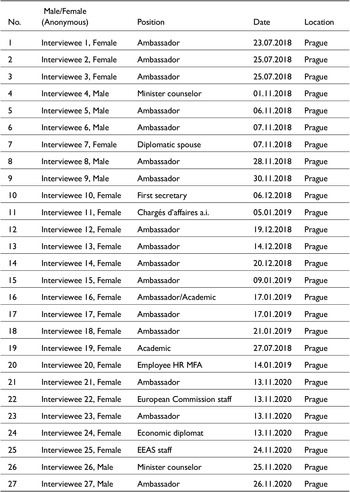
The first part of the study provides background information, including the gender ratio of Czech ambassadors and the current situation in the Czech MFA. The qualitative part of the research consists of a critical discourse analysis of 27 semistructured interviews with 7 maleFootnote 8 and 20 female diplomats and officialsFootnote 9 conducted from July 2018 to November 2020 (see Table 1). The chosen method enabled us to systematically study the interviews and the language used by the interviewees in order to investigate the hidden power relations within socially determined “diplomatic discourse” in the context of the postsocialist national administration.
In the first stage, we selected and approached ambassadors and highly ranked diplomats (i.e., chargés d´affaires), both men and women, attempting to capture various experiences, personal and family backgrounds, and geographical locations of the postings.Footnote 10 Further, during the research, we also contacted other officials and representatives from the MFA, Czech diplomats in the European External Action Service (EEAS), diplomatic spouses, and academics in order to obtain further perspectives on the issue. Interviews were conducted face to face or by phone and lasted from 30 to 120 minutes. Questions were designed based on assumptions stemming from existing research, and participants were asked to comment on the nature of their work, the challenges they face as well, and their perceptions of gender equality and possible gender differences. A “comprehensive interview” approach (Kaufmann Reference Kaufmann2010) was adopted, whereby the semistructured interviews were led more as a narrative rather than an informative discourse, owing to the intersubjectivity that developed between interviewee and interviewer. The researcher thus could go beyond the “surface” proclamations and examine the respondent’s deeper thoughts and attitudes (Glaser and Strauss Reference Glaser and Strauss1967).
List of interviewees

This research provided abundant insights into the situations of top female diplomats and perceptions of gender roles in diplomacy, with a focus on work- and family-related challenges. The obtained information was categorized based on interviewees’ perceptions of gender roles, working styles, the main challenges they face while working for the Czech Foreign Service, their experiences with discrimination, and especially their views on balancing work and family issues (i.e., issues with partners and children and motherhood).
After creating the categorization scheme, the individual interviews were coded and assigned to corresponding categories. The data in the categories were annotated, the data fragments compared with each other and sorted, and finally, connections were identified (van Dijk Reference Teun, Schiffrin, Tannen and Hamilton2001). Segments, or frames of communication, speech patterns as well as similarities and differences among individual responses were examined. The language and practices of respondents and of the institution were studied with the aim of understanding how these practices shape and limit the ways that individuals can think, speak, and conduct themselves (Kendall and Tannen Reference Kendall, Tannen, Schiffrin, Tannen and Hamilton2001). Indeed, the interpretation of the responses was important, as both men and women have strong emotional ties to their gender role (Towns and Niklasson Reference Towns and Niklasson2017). Moreover, senior diplomats are well equipped to remain politically correct and neutral. In this way, the method of discourse analysis provided a rigorous and powerful approach to understanding such complex phenomena (van Dijk Reference Teun, Schiffrin, Tannen and Hamilton2001; Hodges, Kuper, and Reeves Reference Hodges, Kuper and Reeves2008).
Gender Equality Status Quo in the Czech MFA
While there were no female ambassadors in the Czech Republic under state socialism, their share grew to its maximum of 19% in 2015, followed by a period of stagnation and even decline in recent years. As of December 2019, the Czech Republic had 97 male and 16 female ambassadors (14%), which confirms both serious underrepresentation of women in top diplomacy as well as uneven progress in this field (MFA 2021). This seems to be rather surprising, considering the fact that equal numbers of females and males pass through the MFA’s Diplomatic Academy. One of the problems is the politicization of the selection procedure, which is not based on transparent criteria and often includes noncareer diplomats who undergo special individual training and are hired outside the ordinary process. Furthermore, the composition of the Council of Appointments, which nominates ambassadors, has traditionally been gender imbalanced and currently consists only of men. Thus, even though the process is claimed to be gender-blind and based on meritocracy, it is influenced by political and personal ties and by informal rules that are highly gendered.
Some major work-life balance problems were alleviated by the new Foreign Service Act (No. 150/2017),Footnote 11 which introduced health insurance for civil servants and their family members and increased protection for pregnant diplomats, whose foreign positions have to be kept for up to 14 weeks of their maternity leave. Further positive measures in this field include the creation of the MFA’s kindergarten and an internal Gender Focal Point for gender equality and mainstreaming.Footnote 12 There were also two gender audits conducted in the MFA over the last five years, although only one of them was published. Among other issues, these audits stressed several family-related problems that were later reflected in legal reforms, thus proving the relevance and usefulness of this measure. However, it needs to be stressed that most of those changes have only been adopted formally as a response to EU demands and were not accompanied by corresponding changes to the MFA’s internal culture and its official discourse or, most importantly, by practical application.
Career Challenges
Two types of major problems were revealed by both male and female interviewees: (1) the demanding character of the profession and (2) work-family conflicts, which were the main challenge for all diplomats. However, women are apparently affected more disproportionately because of the existing “double burden” and a specific “concept of Czech motherhood” vested in a deeply essentialist understanding of gender roles. These barriers have origins at the personal, institutional, and state levels that are strongly interrelated and historically and politically path dependent. Their mutual correlation will be explained in the following analysis.
Barriers at the Personal and Institutional Levels
Demanding Nature of the Profession
All respondents agreed that “top diplomacy is one of the most demanding professions and perhaps the least flexible one” (e.g., male interviewee 8; female interviewees 12, 17, 18). They frequently used the term “24/7 job” to indicate long working hours and standby availability (including evenings and weekends), which does not leave much time for family and leisure. They also maintained that flexible arrangements (such as part-time jobs, job sharing, or home office) are not feasible in top diplomatic positions. One of the female interviewees pointed out that such exigence is also determined internally through peer pressure, as the MFA’s work culture is still based on the “ideal worker” male archetype—working long hours and participating in late meetings (including Fridays) (female interviewee 18). When asked about a major challenge in their career, however, most of them largely referred to work-family conflicts (e.g., male interviewees 5, 9; female interviewees 1, 3, 14, 16), in one instance even stating that “the work of a diplomat is simply not good for a family life” (male interviewee 5).
Partner Issues
All interviewees confirmed that one of the major problems in foreign missions is to find a suitable occupation for their accompanying partner (e.g., male interviewees 5, 8, 9; female interviewees 11, 13, 16, 17). While problems with partners’ health insurance have been solved by the latest legislation, the MFA offers very little assistance with their employment. Diplomatic partners may theoretically work in Czech embassies, although there are not always available positions, and if so, most of them are of a technical or secretarial nature, unsuitable for people with higher education. Moreover, it is very difficult to find a job for only a few years, and the same situation is repeated upon their return to the Czech Republic. Thus, many diplomatic partners live under the constant stress of trying to find a suitable occupation and risk ending up with minimal pensions.Footnote 13 While most female diplomatic spouses are on maternity leave or unemployed, they still perform important representative work without pay or recognition, out of a sense of duty to conform to unwritten MFA rules (female interviewee 7).
Almost all diplomats agreed that an accompanying partner must scale down or abandon his or her career, and that this situation is much easier for women to adapt to (e.g., male interviewees 5, 8, 9; female interviewees 2, 3, 11, 13, 16, 17). Most male respondents seemed to have taken it for granted and often referred to an implied “sacrifice” on the part of women (e.g., male interviewees 5, 8, 9). Even if they acknowledged the career plans of their female partners, they considered their own careers to be the primary ones. Furthermore, they saw their possible accompanying mission abroad as a period for their personal activities such as writing, not raising children or working for charities, which confirms theoretical assumptions that men are not comfortable in the role of dependents and are less likely to perform traditional representative roles in missions.
This is a sacrifice of a kind… For my wife, who is a diplomat too, it was a difficult choice to join me and put her own diplomatic career on a “standby regime,” but I always tell her that next time we will change our roles and I am already thinking of writing a book when accompanying my wife on her mission. (male interviewee 8)
Most interviewed women observed that an accompanying role would be much more uncomfortable for men; they doubted that men would be willing to stay at home with children; and expressed worries about being alone in their foreign assignments (e.g., female interviewees 2, 3, 11, 13, 15, 16, 17).
Traditionally, an ambassador’s wife should not be employed; it is expected from her to create a suitable home environment for her husband. On the contrary, few men are willing to create such an environment for their wives. And frankly, apart from a few exceptions, they do not know how to do it and feel bad in this position… There are not many men who would like to be an assistant (or, in fact, a secretary) or work at the office counter in the consulate. And people also automatically count on the fact that the woman will take care of the household and the children. Men do not manage this role mentally very well in the long term, even if they try hard. (female interviewee 17)
Interestingly, both men and women held that being an accompanying partner is more difficult for men, even though technically there is no difference regarding their situations (e.g., male interviewees 4, 6, 9; female interviewees 2, 3, 10, 14, 17). Such accounts correspond with the concept of repertoires, through which couples justify various domestic arrangements (Pospíšilová Reference Pospíšilová2018). Only one female diplomat confirmed that she was on a tandem diplomatic mission with her husband. Even though this was a revolutionary and uneasy endeavor in the 1990s, apparently such an arrangement is now possible in the Czech MFA (female interviewee 22). Many female interviewees confirmed that they were separated from their partners during their missions, which is especially difficult for children, who have to move between their parents in different countries (female interviewee 21). One of the interviewees revealed that her husband had major difficulties finding an appropriate job abroad and refused to accompany her on further missions, which was the main reason for her departure from diplomacy (female interviewee 24). Nevertheless, a few female respondents who were abroad with their husbands and small children reported having sufficient support from their husbands and managing well.
I had small children when we were abroad and my husband took care of them. Of course, he was not entirely ready for it but we have managed … Then my daughter refused to go abroad with us when she was 17, so he stayed with her for one year until maturity. (female interviewee 18)
Such cases demonstrate that the reluctance of men to be tied movers is both logistical and cultural, depending in part on their perception of gender roles. Moreover, as one respondent pointed out, it is also an increasing problem for the younger generation of male diplomats, as young educated women do not wish to interrupt their careers any more (female interviewee 25). As a result, most respondents see three possible strategies for balancing their family and professional lives on missions: (1) to live abroad with a family that adapts to the ambassador’s career (typically male ambassadors); (2) to live abroad alone without family (typically female ambassadors); or (3) to be single or divorced (both sexes). Previous research, as well as our interviewees, confirmed that women are more affected by these problems and risk being alone on missions.Footnote 14 Although 70% of our female respondents were married, they were usually alone when working abroad, while 80% of our male respondents were married, and most were accompanied on their foreign missions.
Child Care Issues
Many interviewees mentioned the problem of “uprooting” their children—that is, distorting ties with a larger family and friends,Footnote 15 as well as the Czech language and school system. Education apparently represents one of the major problems, as children from smaller states such as the Czech Republic have to follow mostly English curricula and might have problems integrating into Czech educational systems back home. Another notable difference might reside in lower purchasing power. Life abroad (including schooling, housekeeping, and babysitting) is often far more expensive for the CEE diplomats, and they are more likely to personally fulfill parenting as well as housekeeping duties, which again contributes to additional stress, especially in the case of female diplomats.
Some respondents mentioned their children’s refusal or hesitance to leave the Czech Republic and described it as a very challenging situation in their careers (e.g., male interviewees 5, 6; female interviewees 2, 4, 11, 12, 17). Women often noticed these difficulties in more detail and indicated that their decision to stay in the Czech Republic was mainly influenced by these factors. As a result, many female diplomats do not travel abroad when they have young children and often slow down their careers for almost a decade (female interviewees 2, 4, 11, 12, 17). This period usually includes a three-year break for maternity leave (as there are no state-guaranteed places for children under the age of three in kindergartens), generally followed by another six to 10 years, as women continue to be the primary caregivers for their children, even if they work full-time. This might be the main reason why most of the interviewed female ambassadors were, on average, 10 years older than their male colleagues. In other words, while male diplomats have a continuous uninterrupted career, in which their spouses take care of their children and adapt to their career path, female diplomats often experience a slowdown of up to a decade, during which they are the primary family carers. It is a case of the “motherhood penalty,” which has multiple negative effects, including hampering women’s careers for almost 10 years and diminishing their incomeFootnote 16 as well as their social ties.
Some female diplomats who were on missions with younger children cited social pressure, suggesting that they “should be” taking better care of their children instead of working, while men do not face similar expectations (e.g., female interviewees 2, 11, 13, 16).
No one expected me to long for this career … My wider family accepted it, but they really thought “poor husband.” Really, their support was minimal. I could only do this job thanks to my mother’s dedication; when she moved to our place and assumed the role of housekeeper and carer … But I think that the family did not suffer much. I must mention, however, that my elder son wanted me to be a cleaner when he was in elementary school, because the mother of one of his classmates was a cleaner and she just worked in the morning. (female interviewee 16)
Interestingly, however, younger diplomats did not mention such problems, which may indicate a growing social acceptance of working mothers in leadership positions.
Barriers at the Social and State Levels
Gender Roles and Structural Context
To summarize, the attitudes of our interviewees toward the division between public and private lives were remarkably different. Female respondents were generally more willing to participate in interviews, and they also gave more detailed and personal answers, often referring to family members’ names and/or concrete situations. They also were apparently more worried about the contentment of their partners and children, which were often major factors in their decision-making. Male interviewees, on the other hand, did not reveal many details about their families. They tended to give shorter and more generalized answers, and only one of them expressly regretted not taking paternity leave. This could suggest that either men are less involved in care activities or they are not comfortable discussing their private lives. The interviews also reveal that women tend to interlink public and private lives more naturally, while men still treat these two spheres with conscious distinction. There was also a slight generational difference in the attitude of women. While older diplomats seemed to be more critical and open about work or personal problems, younger ones were more positive but also more reserved. This could indicate that either the situation has improved over the last decade and/or younger diplomats are more careful about their statements, as they still have many years of career ahead of them.
These attitudes correspond with general public opinion, as an overwhelming majority of Czech men (73%) and women (77%) agree with the egalitarian family model, in which breadwinning and caring activities are shared by both partners (Grunow, Begall, and Buchler Reference Grunow, Begall and Buchler2018). At the same time, however, most men believe that the household and children are women’s domain, while they associate themselves with education, hobbies, family budgeting, and home repair (CVVM 2016).Footnote 17 Not surprisingly, then, even in dual-career egalitarian cases (as in our research), couples’ gender roles tend to become more traditional and women become less mobile once they have children. This fact is confirmed by the research data, indicating that 33% of Czech women (as opposed to 20% of men) provide daily care for children, the elderly, or people with disabilities, while almost 70% of women (in contrast to 16% of men) do cooking and housework (Gender Equality Index 2020). Such attitudes were also affirmed in our interviews (e.g., male interviewee 6; female interviewees 7, 11, 13). Nevertheless, at the same time, the interviews also revealed that there are negotiations among partners about more progressive family work division within their families.
In the microcosm of a family, the distribution of burdens and benefits between men and women is a constant struggle. But I would not like to live in a world where it would be the government deciding who does what in a household. (male interviewee 5)
What I miss most is not staying at home with my children during parental leave. It was many years ago, there were not enough benefits on the side of the state and as well I was not 100% ready to be a pioneer. (male interviewee 9)
Two findings stem from such statements. First, these statements confirm the prevailing Czech liberal discourse (also adopted by the Czech MFA), which stresses that family arrangements should be decided individually without state involvement. Second, they also prove that choice in family arrangements is not a gender-neutral and individualized process based solely on an individual’s decisions (Vohlídalová Reference Vohlídalová2014), but it is influenced to a great extent by existing institutions and structural barriers that shape individuals’ choices (Krüger and Lévy Reference Krüger and Lévy2001) and can impose a certain type of family arrangement (Krüger Reference Krüger, Heinz, Huinink and Weymann2009). Thus, the legal and policy norms in the Czech Republic effectively keep women as the primary family caregiver through structural barriers, including a) nonprovision of child care for children under age three, combined with parental allowances provided for a duration of four years, which discourages women’s return to work; b) calculation of parental allowances as a fixed sum, which influences those partners with lower incomes (i.e., mostly women stay home); c) limitation of paternity leave to only one week; and d) systematic rejection of quotas and other positive actions empowering women (Fellegi Reference Fellegi2020).
As far as our respondents are concerned, they all confirmed that the Czech Republic has a formal legal framework guaranteeing gender equality. Nevertheless, many of them maintained that it is not properly implemented and more measures could be undertaken (e.g., male interviewee 5, 26; female interviewees 3 10, 15, 17, 25). Furthermore, all of them agreed that the existing social norms still support traditional gender roles, even when women work full-time.
The Czech Concept of Motherhood and the Double Burden
As far as traditional gender role division is concerned, respondents expressed differing opinions on whether the existing norms could or should change. Most female (and some male) respondents stressed physical and psychological differences between men and women and believed that women are naturally and biologically predisposed toward motherhood, something they believed cannot be changed (e.g., male interviewees 8, 26; female interviewees 2, 11, 13, 14, 15, 16). These respondents seemed to recognize that motherhood has adverse impacts on their career. Nevertheless, they saw no alternative to this situation and maintained that this is the primary reason why further supportive measures are not effective.
I am afraid that no matter what path we are looking for and no matter how many laws we pass, in a certain period of your life you need to devote time to your family and children, so it will more or less disqualify you from the mainstream. (female interviewee 2)
Such attitudes are generally common across Czech society. They have been constructed through historical, cultural, and institutional norms, based on three intertwined concepts. The first is the concept of “threeness”—a public discourse mandating that a mother “has to” stay home for three years, reinforced by the system of state policies since the 1960s (Hašková and Dudová Reference Hašková and Dudová2017, 2). These policies were in line with gender-conservative public sentiments critical of state nurseries (an opinion dating to the prewar era) (Hašková and Saxonberg Reference Hašková and Saxonberg2016, 17). The situation has not changed much over the last several decades, and the rate of children under the age of three in child care is still one of the lowest in Europe (less than 10% in comparison with an average of 33% in the rest of the EU; Hašková and Saxonberg Reference Hašková and Saxonberg2016, 573). There are a few explanations for this phenomenon: a) the lack of nurseries and the low quality of the child care system; b) one of the highest paid leave policies in Europe; and c) prevailing public opinion backed by the public discourse that preschool-age children suffer if the mother works (Hašková and Saxonberg Reference Hašková and Saxonberg2016, 573). In 2016, for example, the government approved a law stipulating the obligation of kindergartens to accept two-year-old children, which provoked criticism from a number of conservative politicians and experts who initiated a petition, “Two-year-olds do not belong in kindergartens,” backed by the unsupported claim that a child who is put in kindergarten before the age of three is at risk of “lifelong harm.” The law was subsequently repealed (Fellegi Reference Fellegi2020).
The second influential factor is the concept of “free individual choice”—a prevailing liberal public discourse introduced in the 1990s as a response to state-socialist obligatory equalization and emancipation, as well as a continuation of the public/private divide from the previous state-socialist era. The 1970s and 1980s were decades of economic stagnation and political suppression (followed by the Soviet invasion in 1968), which, along with a very traditional division of gender roles, resulted in a strong public/private divide, with the home and family being the only sphere for freedom and individual creativity (Hašková and Uhde Reference Hašková and Uhde2009, 70).
Finally, the third factor is the concept of the “natural” place of women at home—an official discourse developed in Germany during the nineteenth century and maintained through a larger regional conservativism (Havelková Reference Havelková1995, 30). Such a conservative stance was not altered but even strengthened during the communist era and prevails today (see the earlier opinions on the gendered division of housework).
All three concepts are still prevalent in Czech public discourse, which generally opposes measures empowering women (particularly quotas), as proven by the following extract from a speech by former prime minister Mirek Topolánek (Reference Topolánek2007), delivered on the launch of the European Year of Equal Opportunities.
A woman is free to choose not to have children, and then I am convinced that she has the same employment opportunities as a man. The law should take this into account and not impose on women protection that they do not care about and which, paradoxically, leads to their discrimination. If a woman decides to play the role entrusted to her by nature, then she does not need the law comparing her with a man. On the contrary, she needs a flexible labour market that will allow her to work under conditions that suit both parties.
These factors resulted in the formation and maintenance of a particularly broad Czech concept of motherhood and of being a “good mother,” which includes child care until maturity (including the first three years of full-day care); housekeeping (since the average family income does not allow for hired household help); familial logistical management; as well as care of older relatives and grandchildren (as state care is not always sufficiently available and private sector care is too expensive). All these tasks are generally understood to be “biologically determined” (even though they can be equally performed by men), and women are largely expected to perform them even if they work full-time. Furthermore, women are held socially responsible for these tasks and are often blamed in the case of family and child-related problems. Most women accept these multiple social burdens and do not seem to argue for more equally shared housework and/or state-backed reconciliation policies. Instead, women believe they must work harder if they want to keep up with their careers (Hašková and Dudová Reference Hašková and Dudová2017).
Internationalization of the Public Discourse—Women “Have to Choose” and They “Have to Work Harder”
Similar to the prevalent public discourse, a majority of our respondents stressed the notion of personal freedom and choice, outlining two options that women have in diplomacy: surrendering higher aspirations at the MFA or working harder in order to manage family and career simultaneously (e.g., male interviewees 5, 8, 9; female interviewees 2, 3, 10, 11, 12, 14, 16). The situation was apparently the worst in the case of the first female ambassadors in the 1990s.
It was really ruthless. Nobody accepted the excuse: “I have children, so I have to leave at four o’clock.” It functioned in this way: If you want to be a woman in a top position, okay, but we men do not care about this. Do it as you please, and if you cannot arrange your family affairs, you will not do this job. (female interviewee 16)
Most of our female respondents thus seemed to have internalized “the working harder imperative” and did not see this double burden as discriminatory (e.g., female interviewees 2, 10, 11, 14, 16).
There was no time for fun… But that was my choice; this is a matter of personal choice. And I see the main equality between men and women in this… If a woman chooses a career, then the society should allow her to pursue her dream. Even if she pays for it, let’s say, with hard discipline. I would compare it to a top athlete’s discipline. (female interviewee 16)
Much of public discourse also maintains that the status quo is the product of “natural development” and that equalizing measures devalue women and their abilities. Many of our female respondents held this belief and did not feel that state intervention or quotas are necessary, even in cases of flagrant discrimination (e.g., female interviewees 2, 3, 11, 13, 16, 19). Their expressions reveal a certain relativization of the problem (which does not concern “confident people”) and a belief that people cannot change the system, which is a quite common attitude in postsocialist countries.
By law, women certainly have equality. Another question is subliminal thinking; it is difficult to prove that people make many decisions, recommendations and practices based on stereotypes… But in no case can we support positive discrimination. Women who want to work in this sector need to have enough self-confidence and just try to assert themselves. (female interviewee 19)
I am a self-confident person; I take things the way they are and I’m not worried about anything I cannot change. I do not even know if we should have any quotas (female interviewee 13)
Similarly, human resources employees also demonstrated an adverse position toward quotas (reflecting the official MFA position) and suggested balancing tools instead. Interestingly, their statements confirm the existence of the “double burden,” as those are women “who have children” and “have to” pick them up from school. Remarkably, instead of sharing this burden with men, the balancing approach is to alter the timing of meetings to allow women to better execute their double burden.
We believe that quotas are not the right instrument. Rather, we try to reconcile family and working life… Simply if a woman wants to have children, her career advancement will be delayed… We work with the fact that women have children and try to adapt it to their requirements, for example, by not holding a meeting at 5 pm when the woman has to pick up children from school/kindergarten, but to adjust it and hold a meeting at 10 a.m. (female interviewee 15)
As indicated by one of the male respondents, women are asked about motherhood and “balancing plans” even during job interviews, while no men reported being asked such questions. This confirms that women are considered to have primary responsibility for child care and that they are disproportionately affected by accompanying prejudice and conscious or subconscious bias.
As I was told by my female colleagues, the question is sometimes asked in job interviews whether they are aware that the job has certain requirements, that they not only spend time in the Czech Republic but also abroad. They also ask how they want to combine their family life or motherhood with your career and if they have any idea how you want to do it. (male interviewee 4)
Remarkably, female respondents did not mention any responsibilities on the part of men toward their families or children, while they kept raising very hard requirements for themselves. However, male respondents seemed to be aware of new expectations of men’s role within families, as witnessed by remarks that “women should also have their turn in focusing on their career” (male interviewee 4) and that they, as men, “could have shared parental leave” (male interviewee 5). Some respondents expressly noted that Czech society has been transitioning to a postpatriarchal society and voiced uncertainties about the new gender order and concerns about new prejudices (e.g., male interviewee 5; female interviewees 12, 19).
I have the impression that the epoch of the patriarchal society is coming to an end. The question is what will replace it, and how men and women will grasp their new social roles. (female interviewee 12)
Finally, there was a quite remarkable difference between the attitudes of female diplomats with experience from the Czech MFA and from EU institutions (such as the EEAS or the European Community) (e.g., male interviewee 26; female interviewees 11, 25). The statements of these latter respondents resonated more with EU discourse (thus confirming the effects of Europeanization). They were more open about their work-related challenges and more vocal about their needs and rights (including in the area of work-family balance). Female diplomats serving in the national administration, on the other hand, navigate the barriers by “leaning in,” generally downplaying the importance of gender differences and adopting the official MFA “merit” discourse based on the “ideal worker” archetype with no caregiving obligations, where family burdens are up to individuals to solve.
Conclusion
This study has presented a gender analysis of the Czech Foreign Service with the aim to explore key reasons for significant female underrepresentation in top diplomatic positions. The interviews revealed that the main challenge faced by both female and male diplomats resides in difficulties balancing work and family life; however, these challenges disproportionately affect women because of a persistent traditional gender role division that has been systematically perpetuated by state laws and policies. The study points to a close correlation between barriers at the personal, institutional, and state levels, and ascertains that family arrangements, largely defined by the historical and structural context in the country, represent one of the most important factors influencing the individual career paths of female diplomats. Hence the study combines several underresearched fields: (a) work-family challenges (b) faced by top diplomatic representatives (c) within the framework of interdepended personal, institutional, and state barriers, and (d) in the particular historical and political postsocialist CEE context.
Since the work-family axis in diplomacy remains rather unexplored, the main research assumptions were based on the literature on diplomatic wives, female leadership, and sociological work-family balance studies working with concepts of dual careers, linked lives, and mobility. The main career challenge identified by the interviewees is to accommodate the raising of children and, most of all, the professional career of accompanying partners, which is more difficult in the case of “diplomatic husbands” who are reluctant to become dependent movers. As a result, many female diplomats choose the strategy of raising their children first and assuming top diplomatic positions later in their careers.
This strategy, however, has two significant effects at the professional and personal levels. First, most female diplomats are generally about ten years older than their male colleagues when they reach the position of ambassador, which results in reduced top professional opportunities and significant economic loss (lower income and pensions). Second, unlike their male counterparts, female ambassadors tend to be on missions without their families. The main underlying factor determining such strategies resides in the prevalent essentialist understanding of gender roles in Czech society and the persistent archetype of the “good mother” maintained through a range of historical, cultural, and institutional norms. This archetype is based on three intertwined concepts: (1) the concept of “threeness” (a social norm expecting three years of personal care of children after birth, reinforced by the system of state policies and nonexistence of state-funded nurseries); (2) the concept of “free individual choice,” accentuating that women voluntarily “choose” caring activities over careers; and (3) the concept of the “natural” place of women at home, stressing the biological determination of such choice. Considering the fact that most Czech women work in the regular or informal economy, such a social expectation of exclusive care resides in a daily “double burden” that effectively hampers the careers of most women.
Political discourse and state policies based on these concepts have a direct impact on the prevailing gender role division in the country and influence couples’ family strategies as well as their career paths. Apparently, all interviewees recognize that existing social norms and the “double burden” are the main reasons for female underrepresentation in top diplomacy. Yet most of them consider these barriers to be natural and do not recognize their discriminatory nature. On the contrary, it is largely expected that women who wish to succeed in this environment need to “work harder” in order to combine their careers with family care, and that it is not the role of the state to interfere with the workplace practices. As result, there has been very little improvement in female representation in the top MFA positions, despite several positive legal steps, such as the provision of health insurance for family members and increased protection during maternity leave (even though more reforms of the appointment processes and targeted support for female diplomats and diplomatic partners would still be needed).
Hence, the main obstacle seems to reside in the overall social and structural context in the country. Apparently, unless caring activities are not redistributed more fairly in society at large, the gender balance in top political and diplomatic representation will hardly be reached. Such change would require holistic legal and policy reforms, providing for state nurseries, the prolongation of paternity leave, fairer sharing of parental leave, and the adoption of positive measures empowering women (including targeted recruitment). Despite the fact that such measures are actively promoted by the EU, Czech (gender imbalanced) political representation is very reluctant to adopt them. Hence, gender equality in the MFA and its Foreign Service (as well as in its foreign policy) is closely interconnected with the overall gender equality status quo in society, and it needs to be researched in this context.
Overall, the study represents the first qualitative research on the work-family challenges faced by top diplomats in the postsocialist region. The study reveals specificities of structural and cultural barriers to women’s public participation in the CEE postsocialist context with prevailing traditional gender norms that aggravate the “working harder to succeed” imperative (Niklasson Reference Niklasson2020). Given similar historical development, the presented study thus lays the groundwork for further regional research in this field. The study also brings new qualitative data from the underresearched work-family axis of top diplomats to the literature on gender and diplomacy in general, since the majority of existing research focuses on the MFA as an institution and on its female representation without a detailed work-family focus (Bashevkin Reference Bashevkin2018; Farias de Souza and do Carmo Reference Farias de Souza, do Carmo, Aggestam and Towns2018; Flowers Reference Flowers, Aggestam and Towns2018; Linse Reference Linse and Hannah2004; Niklasson and Robertson Reference Niklasson, Robertson, Aggestam and Towns2018; Rumelili and Suleymanoglu-Kurum Reference Rumelili, Suleymanoglu-Kurum, Aggestam and Towns2018). This research expands older analysis of dual careers and linked lives in diplomacy from the 1990s (Han and Moen Reference Moen and Sweet2002; Hendry Reference Hendry and Kurbalija1998; Krüger and Lévy Reference Krüger and Lévy2001) by adding the concept of mobility from the private sphere (especially from transnational business) and other fields of the public sphere (e.g., academia; see Vohlídalová Reference Vohlídalová2014).
The study suggests that work-family problems might be more challenging in diplomacy due to “constant” mobility (which is one of the main characteristics of this profession) and tries to capture the family situation in its complexity (diplomat, spouses, and children). The study also focuses on the problem of accompanying male partners from the social as well as the structural perspective, which is an aspect that has not been thoroughly investigated in either the diplomatic or the private sphere. In this respect, the study contributes to the private/public knowledge transfer in the field of dual careers and linked lives under conditions of mobility. The study also reveals a significant influence of the EU gender acquis on national diplomacy that could be further comparatively researched in the European context. Finally, the study indicates more egalitarian gender views among the younger and the EU trained diplomats (both male and female), which should be continuously explored in order to detect development of understanding of gender roles and family arrangement preferences in foreign services.
Acknowledgement
We wish to thank anonymous reviewers, Dr. Ann Towns and Dr. Kateřina Cidlinská for helpful comments and constructive recommendations on earlier drafts of the article.