




No CrossRef data available.
Article contents
Assessing the in-hospital survival benefits of intensive care
Published online by Cambridge University Press: 02 March 2005
Abstract
Objectives: For an efficient and fair allocation of medical resources, one must know which patients benefit more from medical care. The objective of this study is to assess the differential survival benefits of a general intensive care unit (ICU) by acute diagnoses and by Acute Physiological and Chronic Health Evaluation (APACHE II) scores.
Methods: The sample included all patients triaged for admission to the Hadassah-Hebrew University Medical Center ICU during a 7-month period (n = 381). The potential effect of ICU on in-hospital survival was estimated by a bivariate (admission–survival) probit model, using crowding in the unit as the identifying variable, controlling for observable patients characteristics: age, sex, acute diagnoses, and APACHE II score. Using the estimates, the differential predicted survival benefits of ICU were calculated for selected general acute diagnoses and for different APACHE II scores.
Results: Adjusting for age, sex, and general acute diagnoses, the average potential survival benefit of ICU is 17 percentage points (pts). The benefit of ICU for patients with central nervous system problems, with sepsis, or with respiratory failure are higher than average (23 pts). Adjusting for APACHE II scores as well increases the estimated average potential benefit to 21 pts. Over the range of APACHE II scores, the highest benefit (38 pts of potential benefit) is attained for patients with scores around 22.
Conclusions: Survival benefits differ across diagnoses and APACHE II scores. Facing limited resources, admission policies should distinguish between survival probabilities (and survival maximization) and survival benefits (and maximization of ICU benefits). Actual referral and admission policies to the present ICU do not maximize the potential survival benefits of ICU resources.
Information
- Type
- GENERAL ESSAYS
- Information
- International Journal of Technology Assessment in Health Care , Volume 21 , Issue 1 , January 2005 , pp. 66 - 72
- Copyright
- © 2005 Cambridge University Press
In a survey on intensive care admission policies, Bone et al. (1) concluded, “It is distressing to see that after three decades of intensive care medicine, so few studies are available to determine which patients can benefit from care received in these locations.” Because randomized controlled trials are not feasible on ethical grounds, researchers have turned to observational-outcome research to assess the effect of intensive care units (ICU) (9). Most studies of ICU focused on admitted patients (10;12;15). Because admission is not random, predicted outcomes in ICU patients based on various scoring systems (e.g., 2;5–7) suffer from selection bias and have limited relevance to issues of potential effectiveness of ICU and societal allocation of resources. Few studies of the effect of ICU on mortality have used both admitted patients and patients refused admission. Franklin et al. (3) focused on the limited usefulness of Acute Physiological and Chronic Health Evaluation (APACHE II) (5) scores in predicting the assignment of patients to treatments. The authors further emphasized the low sensitivity and specificity of triage decisions based on observed patients' characteristics. Frisho-Lima et al. (4) found that, although the mean APACHE II score and predicted mortality probabilities were similar among sixty-three admitted patients and sixty-four not-admitted patients, observed mortality rates were 38 percent less in patients admitted to the ICU. The authors advocated additional ICU beds to prevent excess mortality. Finally, Metcalfe et al. (8) found a 90 days mortality rate of 37 percent among 480 patients admitted to the ICU and a 46 percent mortality rate among 165 patients refused admission. After partial adjustment of observed characteristics, patients refused admission were 60 percent more likely to die than admitted patients.
These studies focused on the average effect of ICU, leaving the question open of who might benefit more from the limited ICU resources. A further difficulty with these studies is that they took admission to ICU as given. Thus, the conditional (on the admission decision) effect is estimated. The potential effect, which is more appropriate for evaluation purposes, is estimated when possible unobserved correlations between survival prospects at triage and admission are taken into account. An example of an unobserved factor, which might cause such a correlation, is physician or family pressure to admit a patient to intensive care. If this pressure increases with lower survival chances for the patient, and if the admission decision is indeed influenced by the pressure, a negative correlation between survival prospects and admission results, controlling for the patients' observed characteristics. Several other factors in triage decisions, including [see the statement of the Society of Critical Care Medicine Ethics Committee (13)] the purpose of ICU referral, subjective ethical considerations of the admitting or the referring physician, the occupancy in the destination ward if the patient is rejected, are all unobservable to the researcher, resulting in unobserved heterogeneity between patients admitted and refused admission, which might be related to ex-ante survival probabilities.
The present study identifies the differential potential benefits of intensive care for patients who differ in their acute diagnoses and their APACHE II scores. Based on the findings, actual referral and admission policies are evaluated.
METHODS
Setting
The Hadassah-Hebrew University Medical Center in Jerusalem is a tertiary hospital with 650 beds. At the time of the study, the general ICU had six beds in the actual unit and an additional two beds in a nearby recovery room. Additional overflow patients were admitted to the recovery room. The unit admitted surgical and medical patients.
Patients
All patients who were triaged for admission to the ICU were prospectively evaluated (14). During the 7-month study period, 448 requests for admission to the unit were made for 381 patients. Of the 381 patients referred to triage, 319 were admitted and 62 were refused admission. In cases for which there was more than one request, if the patient was admitted, for the purposes of this study, the request by which he or she was admitted was selected. The study was approved by the Institutional Helsinki Committee with a waiver of informed consent.
Variables
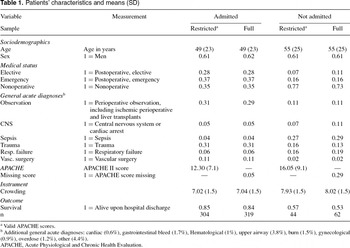
The following variables were considered: age, sex, postoperative (elective or emergency) or medical (nonoperative) status, acute diagnoses, APACHE II scores, crowding in the unit (the number of patients already admitted), and in-hospital survival. In thirty-three patients (9 percent), there was insufficient data to calculate the APACHE II score. The occurrence rate of missing APACHE II score was not random; it was 5 percent among those admitted but 29 percent among those refused admissions. Furthermore, it was 6 percent among in-hospital survivors but reached 20 percent among patients who died during hospitalization. Unfortunately, the data are too limited to deal specifically with the resulting selection. Consequently, two parallel analyses were performed, the first including the full sample and disregarding the APACHE II data, and the second including patients with valid APACHE II scores only (the restricted sample).
Analytical Strategy
To account for unobserved heterogeneity among patients at triage, the bivariate probit model was used. The model consists of two correlated probit equations, one for admission probability and the second for survival probability conditional on the triage decision. (Probit and logistic regressions are similar except for the disturbances' distributional specification.) The correlation between the two equations reflects unobserved factors, which affect both admission decisions and survival. To identify the effect of ICU on survival under these conditions, we need a variable (the identifying variable) that is correlated with the admission decision but is uncorrelated with survival, once the admission decision has been made. The identifying variable in this analysis was crowding in the unit, namely, the number of patients already in the unit at the time of triage. The hypothesis (verified by the data) was that crowding naturally affects admission chances, but for a given decision at triage, it does not affect survival.
Based on the bivariate probit equations, the predicted survival probabilities for selected profiles of patients were estimated. The potential benefits are the difference between survival probabilities of the patients if admitted and survival probabilities if not admitted, when admission is determined by both observed and survival-related unobserved factors.
RESULTS
Patients Admitted and Refused Admission
Eighty-four percent of the full sample (87 percent of the restricted sample) was admitted to ICU (Table 1). Among the admitted patients, in-hospital survival was 84 percent (85 percent in the restricted sample), whereas only 53 percent (57 percent in the restricted sample) of the patients refused admission survived until hospital discharge. This rate amounts to an approximate 30 percentage-points difference. There are several marked observable differences between patients admitted to ICU and patients who were refused admission. Those admitted were younger, included relatively more surgical (emergency or elective) and less medical patients, more patients in need of preoperative observation, fewer patients with sepsis or respiratory failure, and more patients with trauma and with a lower mean APACHE II score (12.3 versus 16.1). Apart from the prevalence of central nervous system problems, all differences are highly significant. Generally, Table 1 indicates that patients who were admitted had a-priori higher chances of survival, based on their observable characteristics.

Average Potential Effect of ICU on Survival
The bivariate probit estimate of the average potential effect of ICU on survival is 17.4 percentage points in the full sample and reaches 21 percentage points in the restricted sample, controlling for the variables in Table 1. The admission equations confirm, in general, the conclusions based on Table 1. In addition, the APACHE II scores have no effect on admission, whereas crowding, the identifying variable, exercises a highly significant negative effect (−0.336 with t = 3.7 in the restricted sample, and −0.379 with t = 4.6 in the full sample). The correlation between the errors in the admission and survival bivariate probit equations is sizable and significantly negative (−0.159 with t = 2.4 in the full sample and −0.492 with t = 2.2 in the restricted sample), confirming the existence of unobserved heterogeneity, where, controlling for observed differences, higher survival probabilities are associated with lower admission probabilities.
Benefits of ICU for Selected Profiles of Patients Based on General Acute Diagnoses
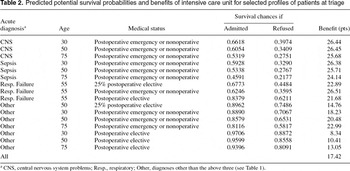
The estimation results indicate that, in the full sample, only three diagnoses (central nervous system disorders, sepsis, and respiratory failure) exercise a significant net effect on survival relative to the group of patients suffering from all other diagnoses listed in Table 1. Table 2 presents the potential survival probabilities and survival benefits (i.e., the difference between survival probabilities if admitted or not) for 16 selected profiles of patients at triage. The profiles describe selected combinations of acute general diagnoses, age, and medical status. The first three profiles are for three age groups of patients with problems in the central nervous system (CNS), all of them being postoperative emergency or nonoperative. Focus was on age 30, 50 (the mean age in the population at triage), and 75. The next three profiles are for patients 30, 50, and 75 years of age with sepsis. For patients with respiratory failure (55 years of age, the mean age of these patients), the survival benefits of ICU for three profiles differing in the medical status of the patients were calculated: (i) 25 percent postoperative elective patients (the mean for that group), (ii) all postoperative emergency or nonoperative patients with respiratory failure; and (iii) all postoperative elective patients. Finally, seven profiles describe selected cases not belonging to the above nine profiles. These patients suffered from “other” general acute diagnoses (Table 1), and the benefits were calculated for the following profiles: (i) age 50 and 29 percent being postoperative elective patients (the mean for that group); (ii) age 30 and all the patients being postoperative emergency or nonoperative; (iii) age 30 and all patients being postoperative elective; (iv–v) same as (ii–iii) but with age 50; (vi–vii) same as (ii–iii) but with age 75.

As seen in Table 2, the potential benefits of ICU for patients with CNS problems, sepsis and respiratory failures are all approximately 23 percentage points, whereas the benefit for patients diagnosed with “other” diagnoses is 15. Patients with any of these three specific diagnoses have lower survival prospects—whether admitted or refused admission—than patients with “other” diagnoses. In all cases, elective patients have higher survival chances than emergency or nonoperative patients but lower survival benefits. Among CNS and sepsis patients, age does not affect survival benefits (although it affects survival probabilities). Among patients with “other” diagnoses, advanced age is associated with lower survival chances but with higher survival benefits of ICU.
APACHE II–Specific Benefits of ICU
Figure 1 presents the potential predicted survival probabilities for all APACHE II scores. These probabilities were calculated from the estimated equation for the restricted sample. All other covariates were taken at their mean values. The APACHE II–specific potential survival benefits of ICU achieve a maximum benefit (38 percentage points) for APACHE II scores of 21–22. As expected, low and high APACHE II scores are associated with lower benefits. Recall that the mean potential survival gain was estimated as 21 percentage points.

Predicted potential survival probabilities.
APACHE II–specific survival benefits were calculated among four groups of patients at triage (not presented for brevity). These groups correspond to the significant determinants of survival found in the restricted sample. Among patients with trauma, the maximal-benefit APACHE II score is higher than for the entire population, 25–27. This score is even higher (30–32) for postoperative elective vascular surgery patients. For all postoperative elective patients, the benefits distribution is similar to that found among all patients, whereas among postoperative emergency and nonoperative patients (excluding trauma and vascular surgeries) the maximal-benefit APACHE score is somewhat lower, 19–21.
APACHE II Distributions among Patients at Triage and Among Admitted Patients
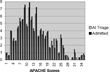
Figure 2 presents the distribution of APACHE II scores among patients referred to the ICU and among those admitted. In both populations, the mass of the distributions is concentrated at scores 6–19. Admission policy tends, however, to prefer patients with scores 9–14 (these patients are overrepresented among admitted patients) to those with scores above 20 (who are underrepresented among admitted patients).

APACHE distributions (%).
DISCUSSION
As far as we know, the present study is the first to evaluate differential potential benefits of intensive care for patients based on their acute diagnoses and their APACHE II scores. Although we recognize the limitations suggested by the sample size and the one-site nature of the study, the results are significant and interesting. The calculation of potential benefits takes into consideration unobserved heterogeneity among patients at triage, where unobserved factors affect both the admission decision and survival, beyond the effects of observed characteristics. Controlling for observed differences among patients, patients with lower chances of survival are more likely to be admitted. Such a pattern was also found in a survey of ICU physicians' attitudes (16). If not admitted, these patients have lower survival probabilities than patients who are similar in their observed characteristics and were actually admitted. Such admission policy might reflect adherence to the “Rule of Rescue,” where priority is given to patients who are closest to death. That policy may also reflect the acceptance of patients who can more easily be cared for in an ICU such as patients receiving mechanical ventilation or vasopressors. The standard (conditional) estimate of the survival benefit of ICU reported in several studies, thus, is likely to underestimate the true benefit.
The survival benefits of ICU vary considerably across groups of patients at triage. Naturally, the sample is too small to allow for broad generalizations and firm conclusions. Some interesting indications, however, do appear. Focusing on potential benefits at triage ignoring APACHE II scores, while the mean benefit is 17.4 percentage points, patients with central nervous system problems or sepsis of all ages might benefit more (26 percentage points) from ICU, and postoperative elective patients (excluding patients with respiratory failure) benefit less (8–13 percentage points, depending on age). Among the profiles considered, the highest benefit (27 percentage points) is enjoyed by postoperative emergency or nonoperative patients with respiratory failure, 55 years of age. The lowest benefit patients are those without central nervous problems, sepsis, and respiratory failure, 30 years of age, after elective surgeries. With few exceptions, it appears that higher benefits correspond with lower survival prospects (whether admitted or not).
Compared with an average benefit of 21 percentage points when APACHE II scores are considered, patients with scores of 21–22 derive 38 percentage points potential survival benefit. Patients with scores less than 7 or greater than 37 derive less than 10 percentage points survival benefits. Furthermore, the distribution of APACHE II–specific benefits changes across groups defined by medical status and diagnoses. Among patients who underwent elective vascular surgeries, for example, the highest benefit occurs for patients with relatively high APACHE II scores (30), whereas for medical patients, the highest benefit occurs for a score of 19.
Although a complex and ethically–emotionally loaded subject, the above findings have strong implications for a critical evaluation of the existing referral and admission policies to ICU. The Society of Critical Care Medicine consensus statement on triage of critically ill patients (13) stated that, in general, patients with good prognoses for recovery have priority over patients with poor prognoses and patients with very poor prognoses and little likelihood of benefit should not be admitted. The statement is unclear whether the critical outcome to be considered should be survival probabilities or survival benefits of the ICU. For example, 75-year-old medical patients suffering from sepsis, have an average potential survival probability at triage of 0.22 if not admitted, and 0.46 if admitted. The potential survival benefit is 24 percentage points. Although the benefit is relatively high, even if admitted, these patients have relatively low survival prospects (0.46). On the other hand, 30-year-old patients after elective surgery might enjoy an average of only 8-percentage point survival benefit, but even if not admitted, their average survival chances are high—0.89 (if admitted, their survival prospects are 0.97). An optimal admission policy should, from society's viewpoint, consider both outcomes.
Examination of actual admission patterns reveal that, whereas patients with CNS problems, sepsis, or respiratory failures might enjoy relatively high benefit from ICU (around 26 percentage points, the average being 17), the proportions of patients admitted are less than the average (73 percent of patients with CNS problems, 42 percent of patients with sepsis, and 63 percent of patients suffering from respiratory failures; the overall admittance rate being 84 percent). Other patients are more likely to be admitted (88 percent), and the survival benefit they might enjoy is around 16 percentage points.
When comparing the APACHE II distribution among patients at triage and that among admitted patients, actual admission policy tends to admit patients with scores 9–19. Admission rates for these patients are around 90 percent (overall rate of admission is 87 percent in the restricted sample). The admission rate of patients with scores 21–25 is 71 percent, and they are less frequent among admitted patients than among the population at triage. As noted above, patients with APACHE II scores in this range enjoy the highest benefit of ICU.
Clearly, actual admission policy in the present ICU does not maximize the survival benefits of ICU. Comparing the benefits distribution and the APACHE II distribution at triage (Figure 2) reveals that the discrepancies actually originate from inappropriate referral policy. The patients at triage have, in general, APACHE II scores that are lower than the maximal-benefit scores. “Too many” patients with scores 6–13 are referred to ICU, whereas patients with scores 16–30 are “too infrequent” among patients at triage, relative to the distribution of benefits. Such a referral policy seriously limits the ability of ICU physicians to exhaust the survival benefits of their practice (11).
POLICY IMPLICATIONS
The policy implications of the findings might be presented along three lines. First, the professional association (The Society for Critical Care Medicine) should invest more effort in defining what it is that intensive care should maximize. In particular, the definition should enable providers to assimilate information on pretreatment survival chances, posttreatment survival probabilities, and survival benefits. That definition together with accumulating evidence on the differential outcomes for different patients should provide directions to enhance the efficiency and equity of intensive care. Second, admission as well as referral policies to intensive care units should follow the above definition, to allow intensive care to exhaust the benefits of its expensive resources. Third, payment methods to hospitals for intensive care should be introduced in ways that prevent selection, while providing incentives for the best use of intensive care beds in the short run, and for an optimal number of such beds in the long run.
CONTACT INFORMATION
Amir Shmueli, PhD (ashmueli@md.huji.ac.il), Department of Health Management, The Hebrew University, P.O. Box 12272, Jerusalem 91120, Israel
Charles L. Sprung, MD, Professor (sprung@hadassah.org.il), Department of Anesthesiology and Critical Care Medicine, Hadassah-Hebrew University Medical Center, P.O. Box 12272, Jerusalem 91120, Israel
References
Bone RC,
McElwee NE,
Eubanks DH et al.
1993
Analysis of indications for intensive care unit admission.
Chest.
104:
1806–
1811.Google Scholar
Consensus conference organized by the ESICM and the SRLF.
1994;
Predicting outcome in ICU patients.
Intensive Care Med.
20:
390–
397.
Franklin C,
Rackow EC,
Mamdani B, et al.
1990;
Triage considerations in medical intensive care.
Arch Intern Med.
150:
1455–
1459.Google Scholar
Frisho-Lima P,
Gurman G,
Schapira A, et al.
1994;
Rationing critical care–what happens to patients who are not admitted?.
Theor Surg.
9:
208–
211.Google Scholar
Knaus WA,
Draper EA,
Wagner DP, et al.
1985;
APACHE II: A severity of disease classification system.
Crit Care Med.
13:
818–
829.Google Scholar
Le Gall JR,
Lemeshow S.
1993;
Saulnier F. A new Simplified Acute Physiology Score (SAPS II) based on a European/North American Multicenter Study.
JAMA.
270:
2957–
2963.Google Scholar
Lemeshow S,
Teres D,
Klar J, et al.
1993;
Mortality probability models (MPM II) based on an international cohort of ICU patients.
JAMA.
270:
2478–
2486.Google Scholar
Metcalfe MA,
Sloggert A,
McPherson K.
1997;
Mortality among appropriately referred patients refused admission to ICUs.
Lancet.
350:
7–
12.Google Scholar
Moses LE.
1995;
Measuring effects without randomized trials? Options, problems, challenges.
Med Care.
33:
AS8–
AS14.Google Scholar
Sax FL,
Charles ME.
1987;
Utilization of critical care: A prospective study of physician triage and patient outcome.
Arch Intern Med.
147:
929–
934.Google Scholar
Shmueli A,
Kaplan E,
Sprung CL.
2003;
Optimizing admissions to intensive care.
Health Care Manag Sci.
6:
131–
136.Google Scholar
Singer DE,
Carr PL,
Mulley AG, et al.
1983;
Rationing intensive care: Physician responses to a resource shortage.
N Engl J Med.
309:
1155–
1160.Google Scholar
Society of Critical Care Medicine Ethics Committee.
1994;
Consensus Statement on the Triage of Critically Ill Patients.
JAMA.
271:
1200–
1203.
Sprung CL,
Geber D,
Eidelman LA, et al.
1999;
Evaluation of triage decisions for intensive care admission.
Crit Care Med.
27:
1073–
1079.Google Scholar
Strauss MJ,
LoGerfo JP,
Yelatzie JA, et al.
1986;
Rationing of intensive care services; An everyday occurrence.
JAMA.
255:
1143–
1146.Google Scholar
The Society of Critical Care Medicine Ethics Committee.
1994;
Attitudes of critical care medicine professionals concerning distribution of intensive care resources.
Crit Care Med.
22:
358–
362.
Patients' characteristics and means (SD)
Predicted potential survival probabilities and benefits of intensive care unit for selected profiles of patients at triage

Predicted potential survival probabilities.
APACHE distributions (%).
 You have
Access
- 25
- Cited by