Infective endocarditis is defined as infection of the endocardial surface of the heart, native or prosthetic valves, or of various devices placed in the heart. Reference Cahill and Prendergast1 Despite advances in diagnosis and treatment, infective endocarditis continues to be a disease with high morbidity and mortality rates. The incidence of infective endocarditis in the paediatric age group has been reported to be 0.34–0.64/100,000 per year. Reference Thom, Hanslik and Russell2 As the survival rates of children with CHD have increased in recent years with repair or palliation, there has been an increase in infective endocarditis cases associated with CHD. In children with infective endocarditis, CHD is the most common underlying risk factor. Rheumatic heart diseases, which were the most common underlying cause in the past, are now the least frequent in developed societies. Reference Esposito, Mayer and Krzysztofiak3–Reference Rosenthal, Feja, Levasseur, Alba, Gersony and Saiman5 It is estimated that 8–10% of paediatric infective endocarditis cases develop in structurally normal hearts. The current increase in invasive cardiac procedures and the use of central venous catheters has caused an increase in the risk of infective endocarditis in individuals without underlying heart disease. Reference Baltimore, Gewitz and Baddour6
The aim of this study was to present the clinical, diagnostic, treatment and follow-up, and microbiological characteristics of patients with infective endocarditis followed up in our clinic between 1995 and 2021 years.
Material and method
Patients
This retrospective study was conducted using the patient database of the Department of Pediatric Cardiology, Çukurova University Hospital, a tertiary referral hospital. The study included all children aged <18 years who were diagnosed with definite or possible infective endocarditis following the modified Duke Criteria between 1995 and 2021. Approval for the study was granted by the Local Ethics Committee. Informed consent was provided by the parents or legal guardians of the children in the study.
Clinical data
A record was created for each patient, including date of birth, gender, underlying CHD, and surgical and interventional treatments. The recorded data of the infective endocarditis episode included the date of infective endocarditis diagnosis, patient history, clinical presentation, echocardiographic findings, biochemical and microbiological data, medical and surgical treatment, complications, and outcome. Patients who met the pathological criteria according to the modified Duke criteria and those who met two major criteria, one major and three minor criteria, or five minor criteria according to the clinical criteria were considered to have definite infective endocarditis and those who met one major and one minor criterion or three minor criteria were considered to have possible infective endocarditis. Community-acquired infective endocarditis was defined as episodes occurring more than 6 months after cardiac surgery in non-hospitalised patients or within the first 72 hours of hospitalisation.
Statistical analysis
Statistical analysis of the data was performed using SPSS for Windows, version 15.0 software (SPSS Inc.; Chicago, IL, USA). Categorical variables were presented as absolute and percentage frequencies, and quantitative variables were summarised as mean and standard deviation values.
Results
Patient characteristics
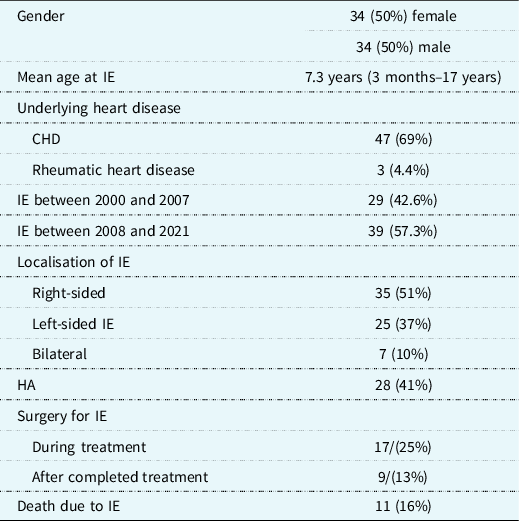
From reviewing patient records, a total of 68 patients diagnosed with infective endocarditis between 1995 and 2021 were identified. According to the modified Duke criteria, 55 (81%) of these patients had definite infective endocarditis and 13 (19%) had possible infective endocarditis. The patients comprised 34 (50%) females and 34 (50%) males, with a mean age at the time of diagnosis of 7.3 years (range, 3 months–17 years). The age groups were determined as 11 (16%) patients aged <1 year, 15 (22%) aged 1–5 years, 20 (29%) in the 6–10 years age group, and 12 (25.5%) in the 11–18 years age group.
Diagnosis was made in the period 1995–2007 in 29 patients, and in 2007–2021 in 39 cases. During the treatment for infective endocarditis, 17 (25%) patients required surgery and 11 patients died. All the patients received 4–6 weeks antibiotic treatment in accordance with the European Society of Cardiology guidelines. The patient characteristics are shown in Table 1.
Characteristics of IE patients
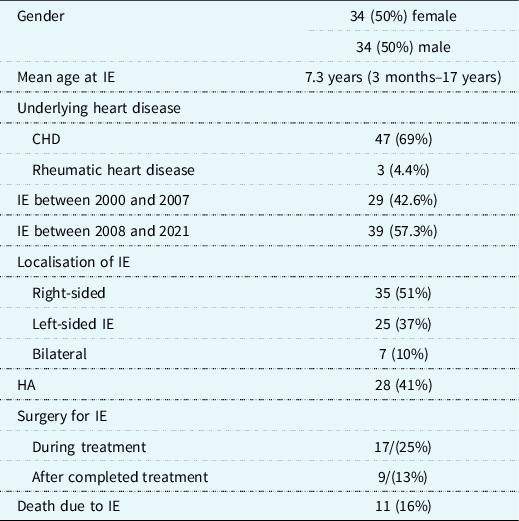
HA, hospital-acquired; IE, infective endocarditis
Underlying risk factors for infective endocarditis
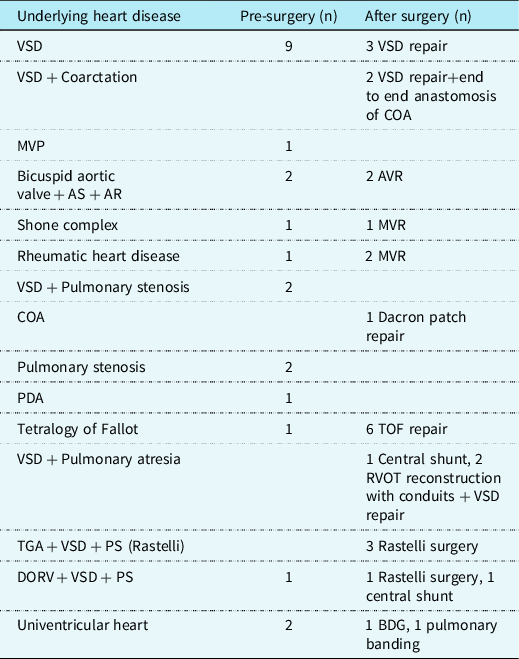
Of the 68 patients, the underlying risk factor was determined to be CHD in 47 (69%), and rheumatic valve disease in 3 (4.4%) patients. Ventricular septal defect was most often underlying CHD (n = 12). The detailed diagnoses of congenital/acquired heart disease and surgical procedures before infective endocarditis episodes are shown in Table 2. Surgery because of CHD was performed on a total of 27 patients (57% of all CHD patients) as palliative in 4 cases and corrective in 23 cases before the infective endocarditis diagnosis. Of the three patients with rheumatic valve disease, mitral valve replacement was performed in two. A total of five patients had a prosthetic valve (three mitral valve replacement and two aortic valve replacement).
Detailed diagnoses of congenital/acquired heart disease and surgical procedures before infective endocarditis episodes
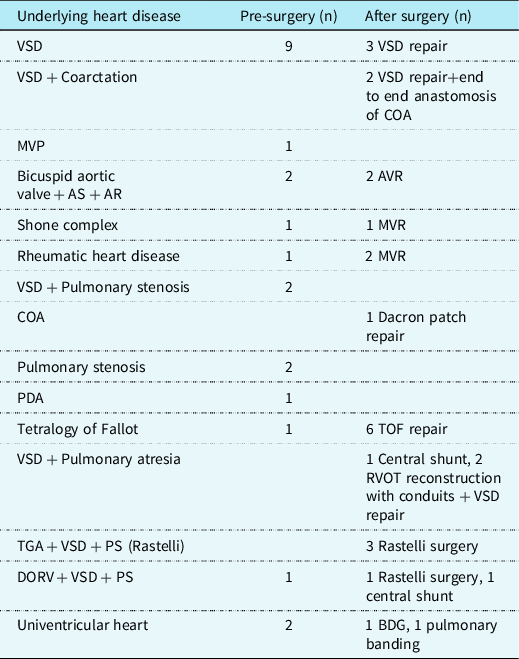
AI, aortic insufficiency; AS, aortic stenosis; AVR, aortic valve replacement; BDG, bidirectional Glenn; DORV, double-outlet right ventricle; MVP, mitral valve prolapse; MVR, mitral valve replacement; PDA, patent ductus arteriosus; PS, pulmonary stenosis; RVOT, right ventricular outflow tract; TGA, transposition of the great arteries; TOF, tetralogy of Fallot; VSD, ventricular septal defect
Out of 23 patients who had corrective cardiac surgeries performed prior to the diagnosis of endocarditis, five of them (22%) had residual defects post-operatively. There was a history of dental treatment in two patients and untreated dental caries in six patients before infective endocarditis. In 18 (26%) of the patients with infective endocarditis, there was no underlying structural heart disease. Of these patients, there was use of broad-spectrum antibiotics in seven, a port catheter in two, a permanent dialysis catheter in two, and immune deficiency in two. Of this group of patients, no risk factor for infective endocarditis could be determined in five. Hospital-acquired infective endocarditis was determined in 28 (41%) of the total patients with infective endocarditis.
Clinical features at infective endocarditis diagnosis
The most frequently determined symptom of the infective endocarditis patients was fever (≥38°C) in 84% of the patients. Pallor was determined in 77% of cases, murmur in 72%, fatigue in 62%, loss of appetite in 55%, splenomegaly in 38%, and skin findings in 20%. At the time of diagnosis, 10 (15%) patients had congestive heart failure and 6 (8%) had neurological findings (changes in consciousness in 2, stroke in 1, meningismus in 1, focal neurological findings in 1). At the time of presentation, two patients had symptoms of pulmonary emboli. Elevated C-reactive protein was determined in 97% of patients, anaemia in 77%, leukocytosis in 78%, and haematuria in 23%.
Echocardiography and lesion location
Vegetation was observed with echocardiography in a total of 59 (86.7%) patients, on transthoracic echocardiography in 54, and on transoesophageal echocardiography in 5. Infective endocarditis was diagnosed and treated according to micro-organism determined in blood culture and/or minor criteria in nine patients without vegetation on transthoracic echocardiography or transoesophageal echocardiography. From the analysis of echocardiography records, 35 (51%) patients were evaluated as right-sided endocarditis, 25 (37%) as left-sided endocarditis, 7 (10%) as bilateral endocarditis, and 1 as aorto-pulmonary shunt endocarditis. Of the 18 children with a structurally normal heart, 11 patients had a right-sided infective endocarditis and 7 children had a left-sided infective endocarditis. Of the five patients with left-sided infective endocarditis without underlying heart disease, two had immunodeficiency and three had the use of broad-spectrum antibiotics. No risk factors were found in two patients with left-sided endocarditis and three patients with right-sided endocarditis. Of the remaining left-sided endocarditis patients, 3 had rheumatic heart disease and 15 had CHD.
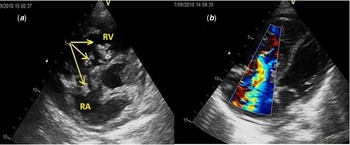
Mitral valve involvement was most common (n = 16, 24%), and the other cardiac structures where vegetation was determined were tricuspid valve (n = 14, 21%), ventricular septum (n = 9, 13%), pulmonary valve (n = 8, 12%; two with native pulmonary valve, six with pulmonary homograft), aortic valve (n = 5, 7%), both mitral and aortic valve (n = 3, 4.4%), over coarctation patch (n = 1, 1.5%), and aorto-pulmonary shunt (n = 1, 1.5%) (Fig 1).
IE in a 9-year-old female with previous history of CHD with restrictive perimembranous ventricular septal defect. ( a ) Echocardiography in the modified short-axis view showing a multiple vegetations on the tricuspid valve and in RV (arrows). RV; right ventricle, RA; right atrium. ( b ) Parasternal four chamber view showing severe tricuspid regurgitation.

Microbiology
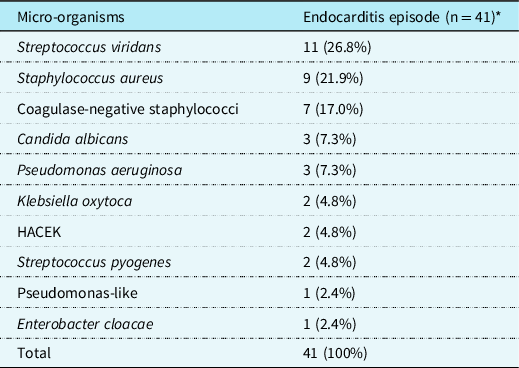
Micro-organisms were isolated as the cause of infective endocarditis in 41 (60%) patients. During the whole study period, according to culture results the most frequently isolated micro-organisms were viridans group streptococci (11 episodes, 27%), S. aureus (9 episodes, 22%), and coagulase-negative staphylococci (7 episodes, 17%). Other less frequently determined micro-organisms were candida, enterococci, pseudomonas species, and HACEK group micro-organisms.
The patients were separated into two subgroups according to the time of diagnosis, as Group 1 diagnosed between 1995 and 2007, and Group 2 diagnosed between 2008 and 2021. Micro-organism production in culture was determined in 18 of the 29 Group 1 patients and in 23 of the 39 Group 2 patients. No significant difference was determined between the two groups in respect of the frequency of production in blood culture (p > 0.05). No significant difference was determined between the groups in respect of viridans group streptococci (p > 0.05).
There was also no prominent causal agent in left, right, or bilateral heart infective endocarditis. The majority of culture-negative endocarditis patients received antibiotic treatment before the blood culture test (22/27, 81%). In children with hospital-acquired infective endocarditis (n = 28), the most common causative organisms were coagulase-negative staphylococci (six episodes) and S. aureus (five episodes). Other organisms included Candida and pseudomonas. Ten patients with hospital-acquired infective endocarditis were culture-negative. The micro-organisms isolated in the infective endocarditis episodes are shown in Table 3.
Micro-organisms isolated in infective endocarditis episode
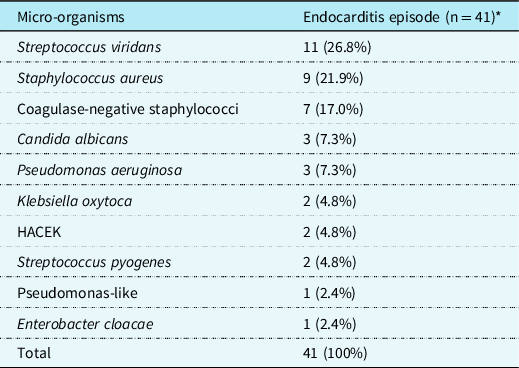
* Culture-negative 27 patients
Outcomes
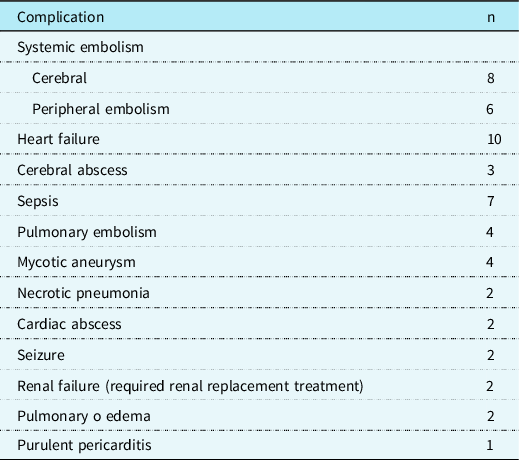
With antibiotic treatment of median 42 days, 42 (68%) patients recovered. Septic emboli were determined in 18 (26%) patients, systemic in 14, and pulmonary in 4. Of the 14 patients with systemic embolisation, there was central nervous system embolisation in 8. Focal neurological findings were determined in six patients, seizure in two, and intracranial abscess in three. Aortic root abscess was observed in one patient, perivalvular abscess in one, and purulent pericarditis in one. Of the six patients with peripheral emboli observed, the emboli were in multiple regions in three (spleen, mesenteric, and renal), renal in two, and mesenteric in one. Necrotising pneumonia developed in two patients with pulmonary embolism. All complications are shown in Table 4.
Complications in patients with infective endocarditis

Early surgery was required in 17 (25%) patients. The mean period of pre-operative antibiotic use in these patients was 7.5 days (range, 4–13 days). The reason for early surgery was severe valve failure in nine patients, large mobile vegetation and removal of infected prosthetic material in four, multiple emboli in three, and mycotic aneurysm in one. CHD repair was performed together with the removal of vegetation in six of these patients, valve replacement was performed in eight cases, valve repair and vegetation removal in one, and repair of mycotic aneurysm in one.
Elective surgery was performed after finishing antibiotic treatment in nine patients. The general mortality rate was 16.6% (11/68). The patients with mortality were left-sided endocarditis in six cases, bilateral endocarditis in three cases, right-sided endocarditis in one case, and shunt endocarditis in one case. In the cultures of these patients, S. aureus was determined in five cases, coagulase-negative staphylococcus in three, and candida albicans in one, strep. viridans in one, and in one case the culture was negative. The cause of death was recorded as septic shock and multiple organ failure in five patients, systemic and intracranial embolism in four, pulmonary emboli in two, and diffuse intracerebral abscess in two. The other two patients died during post-operative intensive care follow-up. In one of these patients prosthetic mitral valve replacement had been performed because of previous rheumatic valve disease. During infective endocarditis, perivalvular abscess developed in this patient, and abscess drainage and vegetation clearance were performed together with mitral valve replacement during the surgery. However, the patient required re-operation for prosthesis failure. The other exitus patient who had fungal endocarditis developed multiple organ failure after the surgery. In one ventricular septal defect pulmonary atresia patient with total correction made using a conduit, there was vegetation in the conduit. Transcatheter pulmonary melody valve replacement was performed in that patient after antibiotic treatment.
Discussion
Despite advances in diagnostic methods and treatment, paediatric infective endocarditis continues to be a significant cause of mortality at the rate of 5–11%. Reference Day, Gauvreau, Shulman and Newburger7–Reference Coward, Tucker and Darville9 According to the results reflected in this study, infective endocarditis continues to be a significant clinical problem. Of the infective endocarditis cases in this study, 25% required early surgical intervention and 16% developed mortality. Several studies have shown similar high rates of infective endocarditis morbidity and mortality. Reference Rosenthal, Feja, Levasseur, Alba, Gersony and Saiman5,Reference Day, Gauvreau, Shulman and Newburger7,Reference Kumar, Garg and Bhatt10
The mean age of the current study patients was 7.3 years, and 16% were aged <1 year. There is known to be a high risk of infective endocarditis in infants with CHD, one of the main reasons for which is the high rate of surgical interventions for CHD in this age. Reference Day, Gauvreau, Shulman and Newburger7,Reference Elder and Baltimore11 This is supported by the finding of this study that the majority of patients in this age underwent surgery because of CHD. Previous endocarditis, the presence of an artificial heart valve, cyanotic CHD, or the presence of residue after CHD surgery are the most high-risk conditions for infective endocarditis. Reference Rushani, Kaufman and Ionescu-Ittu12 There was structural heart disease in 74% of the current study patients. These rates are similar to the data reported in other studies. Infective endocarditis is seen more frequently in patients who have undergone surgery as they have got older and have been implanted with different devices and materials. These implanted materials constitute a risk for infective endocarditis. Almost half of infective endocarditis patients with CHD have undergone surgery. Reference Rosenthal, Feja, Levasseur, Alba, Gersony and Saiman5,Reference Rushani, Kaufman and Ionescu-Ittu12,Reference Di Filippo, Delahaye and Semiond13 In the current study, 57% of the patients with CHD were patients who had undergone surgery for CHD.
Of the 27 patients who underwent surgery in the current study, 16 had cyanotic CHD. The CHDs most often reported together with infective endocarditis are ventricular septal defect, patent ductus arteriosus, aortic valve anomalies, and Fallot tetralogy. In the current study, ventricular septal defect was the most commonly determined cardiac defect. Similarly, Niwa et al reported the combination of ventricular septal defect-infective endocarditis to be most common. Reference Niwa, Nakazawa, Tateno, Yoshinaga and Terai14
Although rheumatic valve diseases were one of the most significant causes of infective endocarditis in the past, now reduced dramatically in developed countries. Reference Kelchtermans, Grossar and Eyskens15 However, in developing countries, rheumatic valve diseases are still a frequent cause of infective endocarditis. Reference Rosenthal, Feja, Levasseur, Alba, Gersony and Saiman5 In the current study, rheumatic valve disease was determined as the cause of infective endocarditis in 4.4% of the cases. The incidence of acute rheumatic fever has been reported as 1/100,000 in developed countries Reference Reller and Menashe16 and as 50–100/100,000 in Turkey. Reference Orun, Ceylan and Bilici17 The rate of rheumatic valve disease in infective endocarditis patients in Turkey was reported as 64% in the 1990s and as 18–36% in the 2000s. Reference Sucu, Davutoğlu, Ozer and Aksoy18,Reference Şimşek-Yavuz, Şensoy and Kaşıkcıoğlu19 According to these data, infective endocarditis associated with rheumatic heart disease has decreased in Turkey, and it is still high compared to developed countries.
It has been reported that 8–10% of paediatric infective endocarditis cases have structurally normal hearts. Reference Stockheim, Chadwick and Kessler20 In the current study, 26% of the cases had a structurally normal heart, and recent publications have reported similarly high rates. Reference Lin, Hsieh, Chen, Huang and Cheng21,Reference Mahony, Lean and Pham22 There was chronic disease and/or immune deficiency in the majority of the infective endocarditis cases with a structurally normal heart in the current study which suggests that the infective endocarditis was related to a invasive devices such as a tunnelled central venous catheter. In 13 of the 18 infective endocarditis cases with a structurally normal heart, there was at least one of these or similar risk factors creating a predisposition to infective endocarditis.
In the current study, the most frequently isolated micro-organism was viridans group streptococcus. This was followed by S. aureus. In different studies, some have reported S. aureus as the most common agent and some, streptococcus viridans. Reference Vogkou, Vlachogiannis, Palaiodimos and Kousoulis23,Reference Cahill, Jewell and Denne25 Culture positivity rates have been reported to be approximately 90% in developed countries and 60% in Turkey. The reason for this difference is that some important microbiological tests cannot be performed in some centres. Reference Şimşek Yavuz, Akar and Aydoğdu26 Another reason for the low culture positivity rate in the current study could be the use of antibiotics before diagnosis in these cases. In a meta-analysis evaluating children and adult patients, no micro-organisms could be cultured in 26.6% of infective endocarditis cases. Reference Vogkou, Vlachogiannis, Palaiodimos and Kousoulis23
Since the infective endocarditis prophylaxis regimen was changed in 2007, conflicting results have been reported in studies related to infective endocarditis epidemiology. Reference Thornhill, Dayer and Lockhart27–Reference Sakai Bizmark, Chang and Tsugawa29 In a study that evaluated the effects of the change in prophylaxis regimen on infective endocarditis incidence, it was reported that in a 5-year period there was no significant change in incidence, but there was an increase in the frequency of viridans group streptococcus in children aged >10 years. It was emphasised that attention must be paid to the fact that dental treatments and related procedures are performed more often in this age group. Reference Bizmark, Chang and Tsugawa30 In the current study, no change was observed in the rates of viridans group streptococcus infection between the periods before and after 2007. Moreover, the low rates of culture-positive infective endocarditis in the current study prevented a strong conclusion in this respect. These findings were similar to those of Kelchtermans et al, who also reported no change in viridans group streptococcus rates before and after 2007. Reference Coward, Tucker and Darville9
It has been reported that almost half of infective endocarditis cases require surgery. Reference Tornos, Iung and Permanyer-Miralda31 Heart failure that cannot be controlled, severe valve failure, and the presence of local or systemic infection that cannot be brought under control constitute indications for surgery. The surgical mortality rate in active infective endocarditis is 6–25%. Reference Jault, Gandjbakhch and Rama32–Reference Murdoch, Corey and Hoen35 In the current study, the mortality rate was 18% (2/11) in patients who required surgery due to the presence of active infection. There are no guidelines related to the surgical recommendations and indications for paediatric infective endocarditis patients. More aggressive surgical approaches have been shown in some clinical conditions, especially in left-sided and S. aureus endocarditis. Reference Shamszad, Khan, Rossano and Fraser36 The high mortality rates in S. aureus endocarditis in this and some previous studies support this view.
Clinical suspicion is very important in the diagnosis of children with risk factors for infective endocarditis. The classic clinical symptoms of infective endocarditis such as fever and sepsis continue to be the primary clinical symptoms seen at the time of presentation. This highlights the importance of clinical suspicion, especially in patients with a history of CHD and implanted prosthetic material. The use of the modified Duke criteria provides an objective evaluation and early identification of suspicious endocarditis cases. Although these criteria support the infective endocarditis diagnosis with objective findings in clinical practice, as sensitivity is low in cases with negative blood culture, or with artificial valve infective endocarditis or right heart infective endocarditis, they should not supersede clinical evaluation. Reference Habib, Hoen and Tornos37
Systemic embolisation is seen in 22–50% of infective endocarditis cases, mostly in the central nervous system. Al-Bassri et al reported neurological complications at a frequency of 23% in children with infective endocarditis. In the same study, mortality was determined to be twofold higher in patients with neurological complications than in those without. Reference AlBassri, Sheikho, Chaikhouni, Al Habshan and Kabbani38 The frequency of neurological complications was determined to be 16% in the current study. Of the 11 patients with neurological complications, 6 were lost to mortality. There is a higher rate of neurological complications in patients with left-sided endocarditis. In the current study, 9 of the 11 patients with neurological complications had left-sided endocarditis.
Limitations
The major limitation of this study was the low number of patients. Another limitation was the retrospective design, resulting in incomplete documentation and data. Collection of weight-based standardised volumes of blood could not be confirmed from the records, as this was a retrospective study.
Conclusion
Although CHD is the most important risk factor, the frequency of infective endocarditis is increasing in individuals with a structurally normal heart. The identification of infective endocarditis in children with risk factors is based on a high level of clinical suspicion. To reduce mortality and prevent complications in endocarditis with a high probability of a complicated course such as S. aureus, early diagnosis and early surgery may be useful. Further studies will serve an important purpose in more definitively predicting the symptoms of neurological complications which are an important cause of morbidity and mortality.
Acknowledgements
None.
Financial support
This research received no specific grant from any funding agency in the public, commercial, or not-for-profit sectors.
Conflicts of interest
None.
Ethical standards
The study was conducted in compliance with the Declaration of Helsinki with ethics approval provided by our hospital’s ethics committees.