INTRODUCTION
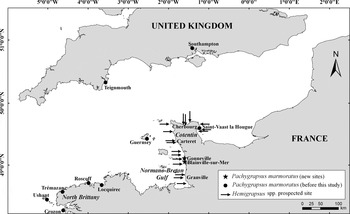
The marbled rock crab, or marbled crab, Pachygrapsus marmoratus (Fabricius, 1787), is a decapod crab that lives in the Black Sea, the Mediterranean Sea and on the north-eastern part of the Atlantic Ocean from Morocco to the English Channel (d'Udekem d'Acoz, Reference Udekem d'Acoz1999; Ingle & Clark, Reference Ingle and Clark2006; Dauvin, Reference Dauvin2008; Brockerhoff & McLay, Reference Brockerhoff, McLay, Galil, Clark and Carlton2011; Crocetta et al., Reference Crocetta, Mifsud, Paolini, Piscopo and Schembri2011). In the English Channel, Ingle & Clark (Reference Ingle and Clark2006) reported sightings (1996–2003) of P. marmoratus in the southern coastal waters of the British Isles: one female (38.3 mm width) in Southampton waters and one male (43.3 mm width) in the Teignmouth region (Figure 1). Later, Dauvin (Reference Dauvin2008) reported the presence of this species on the western coast of the northern Cotentin coast (western English Channel). A specimen was found on the west coast of Guernsey Island in the spring of 2009. This could be the first sighting of P. marmoratus on Guernsey (http://www.marlin.ac.uk/recordingblog/index.php/2009/04/28/marbled-rock-crab-found-on-guernsey/). Earlier observations were reported from the eastern part of the Cotentin at Saint-Vaast La Hougue in February 1908 (Anthony, Reference Anthony1909; Fauvel, Reference Fauvel1929; Vincent & Le Granché, Reference Vincent and Le Granché1996), but the number of individuals observed was unknown. At the same site, a single female was observed in March 1991 (Vincent & Le Granché, Reference Vincent and Le Granché1996, Reference Vincent and Le Granché2007) (Figure 1).
Locations of the sightings of Pachygrapsus marmoratus in the English Channel since the beginning of the 20th Century and the 19 sites prospected around the Cotentin (2008–2011) for the study of the expansion of the invasive Hemigrapsus crabs.

In the framework of a study of the colonization of two Hemigrapsus invasive crabs—H. sanguineus (de Haan, 1835) and H. takanoi Asakura & Watanabe, 2005—in the English Channel (Dauvin, Reference Dauvin2009; Dauvin et al., Reference Dauvin, Tous Rius and Ruellet2009; Dauvin & Dufossé, Reference Dauvin and Dufosse2011), other P. marmoratus specimens were regularly collected at the two sites where it was first recorded in the central part of the western coast of the North Cotentin (i.e. Blainville-sur-mer and Gonneville) (Dauvin, Reference Dauvin2008). The objective of this paper is to report these observations and discuss the distribution of P. marmoratus in the English Channel.
MATERIALS AND METHODS
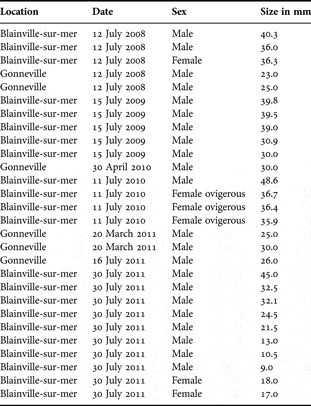
A total of 19 sites were prospected annually since 2008 during the summer (Dauvin, Reference Dauvin2009; Dauvin & Dufossé, Reference Dauvin and Dufosse2011) for Hemigrapsus survey; supplementary observations were made at one site Gonneville in April 2010 and March 2011 (Figure 1). At each of these 19 sites, crabs were sampled under three groups of 30 boulders in the mid-littoral zone, for a total of 90 boulders per site. From July 2008 to July 2011, P. marmoratus was only found at two sites Blainville-sur-mer (49°04′N–1°35′W) and Gonneville (49°05N–1°36W) (Table 1). Both sites are located in the central part of the western coast of the Cotentin between Granville to the south and Carteret to the north. A total of 28 specimens (22 males and six females, including three ovigerous females) were collected from 2008 to 2011. The width of the carapace in mm is given for each specimen in Table 1. The males presented a minimum size of 9.0 mm and a maximum size of 48.6 mm, while the females presented a minimum size of 17.0 mm and a maximum size a 36.7 mm (Table 1). This maximum size of the female was for an ovigerous female. The three ovigerous females were all observed at only one site (Blainville-sur-mer) at the beginning of July 2010.
Date and number of Pachygrapsus marmoratus recorded at both sites—Blainville-sur-mer (49°04′N–1°35′W) and Gonneville (49°05N–1°36W)—from July 2008 to July 2011; size, carapace width in mm.

RESULTS AND DISCUSSION
The 2009–2011 samples included small individuals (9.0 mm), ovigerous females, and large males for a total of 23 individuals; these observations confirmed the presence of the species in the central part of the western coast of the Cotentin since the first sighting of five specimens in 2008 (Dauvin, Reference Dauvin2008). There is no doubt that the population is able to reproduce in this area.
The northern distribution of the Pachygrapsus marmoratus specimens sighted in the eastern part of the Cotentin at Saint-Vaast La Hougue was discussed in detail by Vincent & Le Granché (Reference Vincent and Le Granché1996, Reference Vincent and Le Granché2007). These authors suggested that the rare specimens collected in 1908 and 1991 were likely transported in this north-eastern site by oyster farmers. As the western and eastern coasts of Cotentin were actually important centres of oyster culture within the large transfer of C. gigas between Atlantic and Channel centres of oyster production, the first hypothesis of Cotentin colonization was the transport of specimens with the oysters from the Atlantic sites, where P. marmoratus was a common species (see Noël et al., Reference Noël, Tardy and d'Udekem d'Acoz1997). The second hypothesis, following the suggestion of Ingle & Clark (Reference Ingle and Clark2006), was its introduction through shipping traffic.
At the beginning of the 20th Century, during the 1914–1929 period, P. marmoratus was common on the north Brittany coast and was regularly collected near the Marine Station at Roscoff (Vincent & Le Granché, Reference Vincent and Le Granché1996). This Brittany northern expansion started during a warm period and ceased at the beginning of the 1930s. The last specimen recorded in the scientific literature was collected in 1933 at Trémazan (northern Brittany) (Figure 1) (Vincent & Le Granché, Reference Vincent and Le Granché1996; Ingle & Clark, Reference Ingle and Clark2006).
Nevertheless, the recent sighting of P. marmoratus along the south England coast in Southampton waters and in the Teignmouth region (Ingle & Clark, Reference Ingle and Clark2006), in the Channel Isles at Guernsey (http://www.marlin.ac.uk/recordingblog/index.php/2009/04/28/marbled-rock-crab-found-on-guernsey/) and in the central part of the northern Cotentin (Dauvin, Reference Dauvin2008), may indicate a new period of expansion related to the temperature increase in the western part of the Channel (Figure 1). Since 1980, the sea surface water temperature has been recorded each week in Guernsey at the Signal Station in St Peter Port harbour (http://www.societe.org.gg/planetguernsey/download/5_Impacts.pdf); there has been an overall increase in surface seawater temperature of about 1.7°C during the the 30 years. Pachygrapsus marmoratus may be able to establish temporary population during favourable warm conditions, as suggested by d'Udekem d'Acoz (Reference Udekem d'Acoz1999) and discussed by Vincent & Le Granché (Reference Vincent and Le Granché1996) and Dauvin (Reference Dauvin2008). Diversity changes related to the long-term Russell cycle, with its alternating warm and cold periods, are well documented for the Plymouth area and other coastlines in Great Britain and Ireland, with the expansion of the northern limit of warm temperate species during warm periods (Southward et al., Reference Southward, Langmead, Hardman-Mountford, Aiken, Boalch, Dando, Genner, Joint, Kendall, Halliday, Harris, Leaper, Mieszkowska, Pingree, Richardson, Sims, Smith, Walne and Hawkins2005; Hawkins et al., Reference Hawkins, Moore, Burrows, Poloczanska, Mieszkowska, Herbert, Jenkins, Thompson, Genner and Southward2008).
The reproductive population around the Cotentin appears to remain in a very restricted part of the littoral, despite the long planktonic phase of the larvae—about one month, according to Silva et al. (Reference Silva, Hawkins and Paula2009)—which could ensure a large larval dispersion. Two main questions arose: (1) what is the mechanism that maintained such a local population for four years in Blainville-sur-mer and Gonneville?; and (2) why was the population present only in a very local zone of the Cotentin coast, despite the numerous littoral rocky habitats around the Cotentin?
The presence of water gyres around the Channel Isles in the Normano-Breton Gulf (Salomon & Breton, Reference Salomon and Breton1991, Reference Salomon and Breton1993) could ensure the retention of larvae in this part of the Channel and ensure a colonization of the Guernsey Island from the Central Cotentin population. The origin of the P. marmoratus population in the Normano-Breton Gulf is still unknown. Possibly the genetic analysis of the populations—for example, the study of the genetic patterns of the established P. marmoratus populations from the western Mediterranean to the eastern Atlantic, including English specimens (Fratini et al., Reference Fratini, Schubart, Ragionieri, Koenemann, Schubart and Hald2011)—could resolve this uncertainty.
The maximum size of the adult males collected (45.0 to 48.6 mm) were slightly larger than those found by Ingle & Clark (Reference Ingle and Clark2006) in the southern coastal waters of the British Isles, which measured 43.3 mm, and for the Portuguese populations, which measured 43.6 mm (Flores & Paula, Reference Flores and Paula2002). However, the biggest female (36.7 mm) was slightly smaller than the biggest female in the Southampton waters (38.3 mm) and in southern Portuguese waters (38.8 mm) (Flores & Paula, Reference Flores and Paula2002). These large Cotentin specimens were probably three or four years old, according to Flores & Paula's study of the Portuguese population (Reference Flores and Paula2002), and probably settled in 2004–2005. These estimations suggest that the population may have been established and has survived for a decade.
ACKNOWLEDGEMENTS
Thanks to S. Lozach for her help with the figure and to L.E. Spencer for her help with the English text. I thank the two referees for their very useful comments on the first version of my paper, which improved the final version.