1 Introduction
The rise of the to-infinitive has featured in many diachronic studies of the English complementation system. The majority have concentrated on the complementation patterns found with verbal matrices. The present article, however, focuses on the patterns found with adjectival matrices, more precisely in the extraposition construction. It does so on the basis of qualitative and quantitative analyses of diachronic and synchronic corpus data, such as (1) with anticipatory it and (2) without it.
(1)
Herbert Daniels, the group's founder, believes that it is essential to overcome the social stigma of Aids, which often means that people with the virus lose their homes, jobs and families, and are effectively condemned to death by society.
(CB-BBC)(2)


In both examples, the complement clauses of the deontic adjectival matrices refer to a potential state of affairs (SoA), which is evaluated as desirable (see Wierzbicka Reference Wierzbicka1988: 139). Following Huddleston & Pullum (Reference Huddleston and Pullum2002: 996), I will refer to this semantic type of complement as ‘mandative’. However, the two examples differ in the formal coding of the complement, which in (1) is a to-clause and in (2) a subjunctive that-clause. This last pattern constitutes the most common coding of mandative complements in Old English. I will show that in the Middle English period the to-infinitive supersedes the subjunctive that-clause in the adjectival mandative construction, as has been established for mandative complements of verbal matrices by Los (Reference Los1999, Reference Los2005). I will also point out that this process of supersession has never been completed. Rather, the to-infinitive has been keeping roughly a 3:1 ratio to the that-clause from Early Modern up to Present-day English.
Explanations for this major change in the complementation system have generally been proposed from a language-internal perspective. Thus, many authors have argued that the to-infinitive spread at the expense of the bare infinitive (e.g. Sweet Reference Sweet1903: 118; Callaway Reference Callaway1913; Jespersen Reference Jespersen1940: 10–11; Mustanoja Reference Mustanoja1960: 514; Visser Reference Visser1972: §897; Lightfoot Reference Lightfoot1979: 190; Jarad Reference Jarad1997: 32). In their view, the two infinitives are in competition in a number of environments in Old English, with the to-infinitive winning out over the bare infinitive.Footnote 2 However, Los (Reference Los2005) has convincingly argued that it is necessary to consider the entire complementation system to explain distributional changes of its members. By presenting a clear description of the various syntactic environments and the expressive devices that compete in them, she has been able to show that the to-infinitive did not replace the bare infinitive, but rather the subjunctive that-clause (Los Reference Los2005: ch. 2–7). Regarding the to-infinitive complementing adjectives in the mandative construction, we will see that it also took over from the subjunctive that-clause. In addition to the change in distribution of these two complement types, I will also investigate the role of another language-internal factor, viz. the tense of the matrix clause, and a language-external factor, viz. the Anglo-Saxon versus Romance origin of the adjectival matrices.
The structure of this article is as follows. Section 2 specifies which corpora were used and how the data were collected. Section 3 presents and compares the data bearing out the rise of the to-infinitive with both adjectival and verbal matrices in the Old and Middle English periods. The focus in this article is on the findings for adjectival complements, but they are compared to Los's (Reference Los2005: 185–9) findings for verbal complementation. In section 4, I will look more closely at Los's (Reference Los2005) account of what motivated the rise of the to-infinitive, and I will indicate to what extent this applies to the adjectival data. In addition, I will discuss the role played by the temporal location of the matrix and, as the Middle English data include many adjectives of Romance origin, I will also concentrate on whether language contact has had an effect on the increasing frequency of the to-infinitive. Finally, I will argue that the rise of the to-infinitive with deontic adjectives should ultimately be explained by analogy between verbal and adjectival complementation. In section 5, I will detail the further development of the distribution of mandative to- and that-clauses. As noted above, it will be found that the relative share of the to-infinitive stabilizes around 72 per cent in the Modern English period. This in turn requires an explanation, by way of which I will consider the role of distinct adjective classes and information structure. Section 6 summarizes the main findings and formulates questions for further research.
2 Data and methods
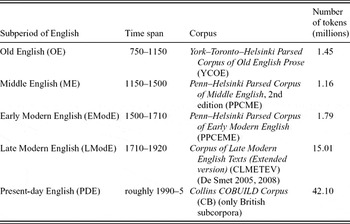
As mentioned above, this study investigates deontic adjectives that take mandative clausal complements across the various historical periods. In general, such adjectives denote different degrees of goodness, properness, desirability or necessity. The Present-day English dataset given in the bottom row of table 2 served as a starting point for the diachronic onomasiological inquiry, i.e. the study of which lexical items across time express the concepts of the semantic domain described above. I used these adjectives in several thesaurus environments to find their historical counterparts. For Old and Middle English I used the online Thesaurus of Old English and the Middle English Dictionary. From the Modern period onwards, I used Roget's Thesaurus (1970) along with the online Oxford English Dictionary. The adjectives thus found were subsequently searched for in five corpora (taking into account spelling variants), which are listed in table 1.
The corpora used for each subperiod

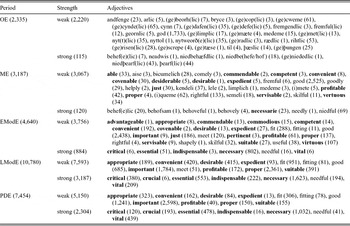
The results of the corpus searches are given in table 2, which shows the adjectives that were investigated per period, with the number of tokens between brackets.Footnote 3 It can be seen that the table also distinguishes between semantically weak and strong adjectives. This distinction can be made on intuitive grounds in the sense that essential in (1), for example, expresses a stronger degree of desirability than rihtlic in (2) (see Övergaard Reference Övergaard1995: 85; Huddleston & Pullum Reference Huddleston and Pullum2002: 997). The two classes also differ in terms of the semantic complement type they can occur with.Footnote 5 Strong adjectives only pattern with mandative complements in deontic constructions, as in (1), whereas weak adjectives are found with both mandative complements, as in (2), and propositional complements, as in (3) below. Such complements refer to propositions presupposed to be true, rather than to SoAs that are still potential. The meaning of the construction as a whole is purely evaluative, rather than deontic (see Van linden & Davidse Reference Van Linden and Davidse2009).
(3) It is important Mr Dorrell has identified community care as a top priority for improvement. It is perfectly obvious it has been grossly under-resourced. (CB-Today)
In this example, the evaluation denoted by the adjectival matrix applies to a situation (viz. the identification of community care as a top priority for improvement) that has already taken place at the moment of the evaluative judgement. As the focus of this article is on mandative constructions, examples such as (3) have been excluded from analysis. I will return to the distinction between weak and strong adjectives in the following sections.
The adjectives under investigation

As can be seen in table 2, the set of adjectives is rather different for the first three periods. In general, these periods witness many changes in the whole lexicon, with the Middle English period as hinge point. Lexical studies have shown that in that period, the original Old English word stock decreased steadily, whereas at the same time the lexicon was enriched with loans, especially from the Romance family, and also new word formations on the basis of Middle English lexical elements (see e.g. Dekeyser Reference Dekeyser, Kastovsky and Szwedek1986, Burnley Reference Burnley1992, Rothwell Reference Rothwell1998). With regard to the semantic domain studied here, it can be noted that some adjectives disappeared, such as niedþearf, others underwent semantic change, such as rightful, and yet others entered into the language due to word formation, such as needful and behofsam, or language contact, such as essential, necessary, convenient and proper. Adjectives of this last type have been marked in boldface in table 2. In fact, they make up a large share of the data studied here, which prompted the research question concerning the possible influence of language contact on the rise of the to-infinitive (see section 4.3). In addition, it can be seen that the set of Early Modern English adjectives is much larger than that of Present-day English ones, which can be explained by semantic changes and concomitant stricter selection restrictions. The adjectives competent and skilful, for instance, are still used in Present-day English, but they are only predicated of humans and they are not used in the mandative construction anymore.
In what follows, I will use all the data presented in table 2.Footnote 6 As the data are not distributed evenly throughout the various periods and as the corpora used differ in size, I will provide normalized frequencies per 100,000 words in addition to the absolute frequencies.
3 The rise of the to-infinitive in Old and Middle English
In Old English adjectival constructions, mandative complements are typically coded by that-clauses, and only marginally by to-clauses. In this section, I will show that a major change occurs in the distribution of the clausal complements during the Middle English period, as has been observed for verbal matrices (Los Reference Los2005). The data bear out that with adjectival matrices the to-clause encroaches on the that-clause from Early Middle English onwards and comes to predominate in Late Middle English.
First it should be noted that, whereas mandative complements in Present-day expressions such as in (1) are generally held to function as subject clauses in an extraposition construction with dummy or expletive it (see Kaltenböck Reference Kaltenböck, Mair and Hundt2000), the syntactic analysis of the Old and Middle English mandative constructions is more controversial. In Elmer's (Reference Elmer1981) view, for example, the that- and to-clauses are complements of a subjectless construction with an optional dative Experiencer (a human referent) and a genitive Theme (viz. the clause). Others regard the clauses as subject clauses as in PDE (e.g. Callaway (Reference Callaway1913: 7) for to-clauses in OE; Warner (Reference Warner1982: 108–9) for both that- and to-clauses in ME; Mitchell (Reference Mitchell1985b: §1963) for that-clauses in OE, while to-clauses can in Mitchell's view be either subjects or subject complements (Reference Mitchell1985a: §1540); see also later formal approaches (Fischer et al. Reference Fischer, van Kemenade, Koopman and van der Wurff2000: 71, 95)). Thirdly, Visser (Reference Visser1972: §863, §903) somehow assumes both analyses, as he deals with the clauses under the heading of subject clauses, but describes them as complements of ‘impersonal phrases’. Traugott (Reference Traugott and Hogg1992: 235) and Denison (Reference Denison1993: 64), finally, state that the discussion is undecidable.
However, OE examples with mandative that-clauses and anticipatory that in the matrix cataphorically referring to the postverbal that-clause can be viewed as containing evidence for the subject clause analysis (Van linden Reference Van Linden2009: 119–20). The invariable postverbal position of the OE clauses has led some formal linguists to posit an expletive subject in the matrix which may be overt, as in (4) below, or non-overt (‘null’), as in (5) (see Hulk & van Kemenade Reference Hulk and van Kemenade1993).Footnote 7 In this sense, the term ‘extraposition’ can be argued to apply to the OE and ME mandative constructions as well.Footnote 8 In the course of ME, the surface subject (h)it became obligatory through the loss of verb-second and the rise of rigid SVO word order (see Allen Reference Allen1995). The examples below illustrate the two formal types of mandative complement, viz. a subjunctive that-clause in (4) and a to-infinitival clause in (5).
(4)
(5)
The two examples have similar impersonal phrases as matrix, and their complements refer to a potential SoA, which is assessed as highly desirable or necessary. We can thus conclude that the two formal complement types are functionally equivalent, that is, their distributions have at least one syntactic environment in common.
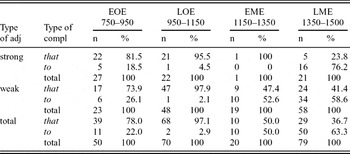
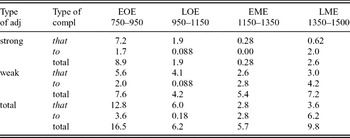
The diachronic data show that during the Middle English period, the to-infinitive started to replace the subjunctive that-clause in the constructions illustrated above. In table 3, I present the absolute frequencies (n) and relative shares (%) of the two formal types in Old and Middle English. In table 4, I present their normalized frequencies per 100,000 words, which have been rounded to one decimal place or at least two significant digits. As the that-clauses found in the corpora invariably occur in extraposed position, I only included to-infinitives found in this same position, thus excluding (ME) to-clauses occurring in the canonical subject position (i.e. preposed clauses).
The development of the distribution of that- and to-clauses in Old and Middle English (absolute and relative frequencies)

The development of the distribution of that- and to-clauses in Old and Middle English (normalized frequencies per 100,000 words)

Tables 3 and 4 show that the overall predominance of that-clauses in Old English changes to an almost equal distribution in Early Middle English, and a predominance of to-clauses in Late Middle English. Fisher's exact tests (see Pedersen Reference Pedersen1996) indicate that the increase of to-infinitives from LOE to EME is highly statistically significant (p = 1.672e-06), whereas their increase from EME to LME is not (p = 0.3125). Of the two lexical classes distinguished here, the weak adjectives present us with the most nuanced picture, in part because they are much more frequent than strong adjectives from LOE to LME. The rise of the to-infinitive is evidenced by the following examples, in which (6) dates from LOE and is construed with a subjunctive that-clause, whereas (7) dates from LME and is construed with a to-clause.
(6)
(7)
Both examples are mandative constructions – they are even translations of the same Bible verse; but they are construed with a different formal type of complement. Examples like these thus illustrate that the to-infinitive replaces the that-clause in the ME period.
The same change in relative frequency of that- and to-clauses has been found with verbal matrices by Los (Reference Los2005). Showing that the to-infinitive gains in frequency after intention and manipulative verbs at the cost of the subjunctive that-clause (for examples of these verbs, see figure 2), Los (Reference Los2005: 185–9) counters the previously held view that the to-infinitive replaced the bare infinitive. The change is illustrated by the following examples from two manuscripts of Gregory's Dialogues (Los Reference Los2005: 179–85).
(8)
(9)
(10)
(11)
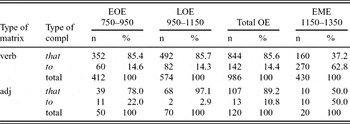
Examples (8) and (9) have the intention verb gewilnian, while (10) and (11) contain niedan/neadian, a verb of persuading and urging. As the clausal argument of both verb classes, the earlier manuscript (C) has a subjunctive that-clause (see (8) and (10)), whereas the later manuscript (H) contains to-clauses (see (9) and (11)). Besides comparison of manuscripts, Los (Reference Los2005) also gives quantitative evidence for the replacement of the that-clause by the to-infinitive. Her data, drawn from the Brooklyn–Geneva–Amsterdam–Helsinki Parsed Corpus of Old English and the PPCME (Los Reference Los2005: 185), are presented in table 5. In this table, I have only included Los's (Reference Los2005) findings about the to-infinitive functioning as complement of intention and manipulative verbs, the latter including verbs of persuading and urging as well as verbs of commanding and permitting.Footnote 9 It can be seen that these complements show a rather ‘abrupt jump in the ratio of to-infinitives to subjunctive clauses’ (Los Reference Los2005: 188), viz. from 14.4% in OE to 62.8% in EME. The adjectival complements, however, show a slightly less abrupt development, viz. from 10.8% in OE to 50.0% in EME (this rise is also statistically significant: Fisher's exact p = 0.0001381). As the complements of the verbal matrices are semantically very similar to the mandative complements of deontic adjectives, we can conclude that, although the adjectival complements have a much lower frequency than the verbal ones, they are nevertheless very comparable to Los's (Reference Los2005) findings, and together these data bear witness to an important ongoing change in the clausal complementation system.
The distribution of mandative that- and to-clauses with verbal and adjectival matrices in Old English and Early Middle English (data on verbal complements from Los Reference Los2005: 186, table 7.6)

4 Explanations for the rise of the to-infinitive
In the literature the rise of the to-infinitive as complement to verbal matrices has generally received language-internal explanations. In this section, I will first focus on the account proposed by Los (Reference Los2005), which encompasses the entire complementation system, and I will investigate whether it also applies to adjectival mandative complements (section 4.1). As her account suggests that the tense of the matrix may have played a role in the replacement of the that-clause by the to-infinitive, I will also examine this language-internal factor for the adjectival complements (section 4.2). Thirdly, I will verify whether the influx of Romance items in the Middle English period (see table 2) has had corollaries in the formal coding of the mandative complements (section 4.3). Having considered all these factors, I will conclude that the rise of the to-infinitive with adjectival matrices in Middle English has to be explained by analogy between verbal and adjectival mandative constructions (section 4.4). I will argue that this process of analogy has to be understood as functioning paradigmatically as well as syntagmatically (see De Smet Reference De Smet2008: 102–27).
4.1 The changing distribution of the to-infinitive
According to Los (Reference Los2005), the supersession of the that-clause by the to-infinitive is motivated by the changing distribution of the latter form. Whereas the to-infinitive originally competed with the purposive to-prepositional phrase (PP), it started to mirror the distribution of the subjunctive that-clause already before the Old English period. Eventually, it ended up replacing this competitor in all its syntactic environments within the verbal complementation system. However, I will show that the adjectival complementation system is not fully comparable to the verbal one discussed by Los (Reference Los2005), and that analogy between the two comes into play.
It is generally agreed that the to-infinitive clause originates in a PP with the allative preposition to and a dative-inflected verbal noun, a view dating back to the work of early Indo-Europeanists such as Bopp (Reference Bopp1871 [1833–52]: iii, §849–86) (see Los Reference Los2005: 4–9, 153–7 for an overview). Whereas the origin of the to-infinitive as a to-PP has led many authors to assume that its categorial status in Old English was still PP, Los (Reference Los2005: ch. 7) adduces various types of evidence showing that the to-infinitive was a clause in Old English already.Footnote 10 In this development from PP to clause, the allative meaning of prepositional to (‘towards a goal’) played a crucial role in that infinitival to typically refers to goals in time, adding ‘prospective relative time reference’ (Los Reference Los2005: 197). According to Los (Reference Los2005: ch. 2–3), the distribution of the to-infinitive originally followed that of the purposive to-PP, competing in three environments in Old English: (i) as purpose adjunct to a verb phrase (VP), (ii) as purpose adjunctFootnote 11 to a noun phrase (NP) (e.g., anweald ‘power’, tima ‘time’) or adjectival phrase (AP) (e.g., gearu ‘ready’), and (iii) as Goal-argument after conative verbs (with meanings like ‘try’), and verbs of persuading and urging (Los Reference Los2005: 198–9).
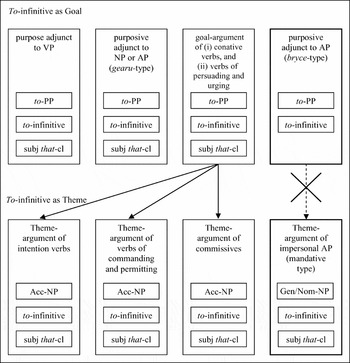
Apart from the to-PP and to-infinitive, another expression could occur in the three purposive environments in Old English as well, viz. the subjunctive that-clause.Footnote 12 In fact, the purposive function must have been its original use (also in Gothic; see Los Reference Los2005: 30). However, by the beginning of the Old English period it had already spread to various other environments (e.g. Mitchell Reference Mitchell1985b: §2033), so that its purposive meaning was often reinforced by to ðon þæt or to ðy þæt (Los Reference Los2005: 41–2). Importantly, Los (Reference Los2005: ch. 4–6) contends that the subjunctive that-clause set the example for the to-infinitive in the prehistoric period, so that the latter is also found in non-purposive environments in Old English, such as the Theme-argument function. She argues that the following changes must have taken place before the Old English period. First, the to-infinitive combining with conative verbs and verbs of persuading and urging was reanalysed from purposive adjunct to Goal-argument (Los Reference Los2005: 67, 99). Later, the to-infinitive spread to intention verbs other than the conative verbs through reanalysisFootnote 13 and analogy with the subjunctive that-clause, which was already established as Theme-argument of these verbs (Los Reference Los2005: 99). Likewise, the use of the to-infinitive with verbs of persuading and urging extended to verbs of commanding and permitting (Los Reference Los2005: 137) and some types of commissives (Los Reference Los2005: 140–6), both taking Theme-arguments. In Early Middle English, then, the to-infinitive won out over the that-clause in most environments, as shown in table 5.Footnote 14
If we try to apply Los's (Reference Los2005) account of the changing distribution of the to-infinitive with verbal matrices to the adjectival data, it becomes clear that we cannot posit a development of the to-infinitive from purposive adjunct to Theme-argument within the adjectival complementation system. The main reason for this lies in the lack of a competing expression shared by these two environments. The purposive to-infinitival construction found with the adjectives studied, most probably the original use of the to-clause with the adjectives, is illustrated in (12). Example (13) shows that this to-clause is in competition with a purposive to-PP.Footnote 15
(12)
(13)
In these examples, the skin of an animal is said to be useful or good for a specific purpose. In (12), the purpose is expressed by a to-infinitive (on to donne), whereas in (13), it is expressed by a to-PP (to sciprapum). It can be argued, however, that this to-PP implies an action: the skin of a walrus is good ‘for the manufacture of ships’ ropes’ or good ‘to make ships’ ropes with’. Syntactically, the construction in (12) consists of a subject (no surface form, such as, for example, hit), a copular finite, an adjectival subject complement, and a to-infinitive with a non-subject gap (viz. an object gap in (12): the syntactic subject (his hyd) is coreferential with the notional object of the to-infinitive) (see Callaway Reference Callaway1913: 149–59; Visser Reference Visser1972: §940; Mitchell Reference Mitchell1985a: §928–31; Traugott Reference Traugott and Hogg1992: 249). Crucially, the fact that the to-clause has a non-subject gap implies that it does not compete with a that-clause (see Van der Wurff Reference Van der Wurff, Adamson, Law, Vincent and Wright1990; Los Reference Los2005: 204, 266–70).Footnote 16
The only other to-infinitival construction with deontic adjectives occurring in Old English is the mandative construction that I am concerned with in this article (see Mitchell Reference Mitchell1985a: §1537–42, 1544–7; Visser Reference Visser1972: §903, 908; Traugott Reference Traugott and Hogg1992: 244). Importantly, in this construction, the to-infinitive is in variation with the subjunctive that-clause, both of which function as Theme-arguments of an impersonal adjectival phrase (see examples (4) and (5) above), but not with the purposive to-PP. We therefore have to conclude that with deontic adjectives – unlike with verbal matrices – we cannot assume a developmental relation between the purposive function of the to-infinitive (in the bryce-construction) and its function as Theme-argument (in the mandative construction), as in these functions it never competed with the same types of expression. (Remember that with verbs, the subjunctive that-clause with the conative verbs and verbs of persuading and urging formed the middle ground.) Hence, the conclusion imposes itself that in the distribution of the to-infinitive with adjectival predicates, at some stage analogy with verbal matrices has played a role: deontic adjectives began to favour to-infinitives by analogy with the increased frequency of to-complements with intention and manipulative verbs.
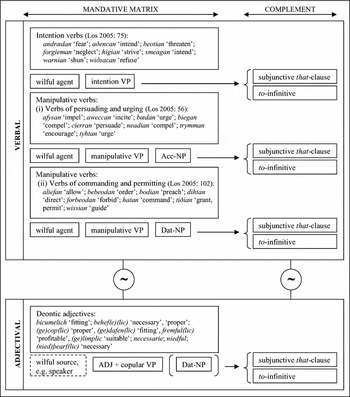
By way of conclusion, I present the distribution of the to-infinitive and the expressions it competes with in figure 1. The full arrows indicate its development from Goal-argument to Theme-argument, as discussed above. The boxes of the adjectival constructions have been put in boldface. The arrow linking the two boxes is dashed and crossed out, reflecting the assumption that we cannot posit a developmental relation between the bryce-construction and the mandative construction.
The distribution of the to-infinitive and its competitors in its development from expression of Goal to Theme-argument

4.2 The role of the tense of the matrix
In this section, the development of the to-infinitive will be linked to a well-described development of its competitor in the mandative construction, viz. the decrease of subjunctive forms in the so-called subjunctive that-clause. It is hypothesized that the loss of subjunctive forms, which began in past environments, may have promoted the use of the to-infinitive in these environments especially.
The loss in frequency of the subjunctive or ‘modally marked’ forms (Visser Reference Visser1972: ch. 7) has received considerable attention in the diachronic literature. In general, this change has been attributed to the attrition of inflectional morphology and the availability of alternative expressive devices, such as modal auxiliaries (e.g. Visser Reference Visser1972: ch. 7; Plank Reference Plank1984).Footnote 17 As the locus of change, a number of authors have pointed to past contexts, as the past subjunctive paradigm was affected first (e.g. Visser Reference Visser1972: §836; Traugott Reference Traugott1972: 150; Plank Reference Plank1984: 346). (However, none of these authors provides details about the data this finding is based on.) The data on the mandative that-clauses complementing the adjectives studied here confirm the past context hypothesis, as shown in table 6.
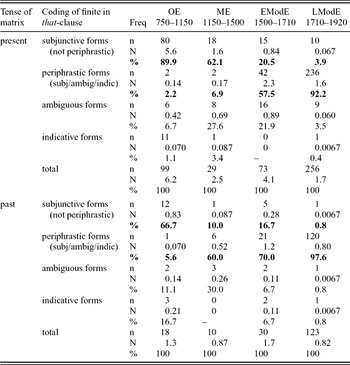
The types of finite forms in mandative that-clauses in present and past contexts

Table 6 bears out the overall decrease in frequency of the unambiguous subjunctive forms in mandative that-clauses from Old English up to Late Modern English (all statistically significant falls with Fisher's exact p-values ranging from p = 8.627e-08 up to p = 0.001271). It also clearly shows that the tense of the matrix has played a crucial role in the Middle English period, with subjunctive forms occurring in 62.1% of the present context data, but only in 10% of the past context data (Fisher's exact p = 0.008362).Footnote 18 The overall development is matched by a steady increase of modal auxiliaries or ‘periphrastic alternants’ (Övergaard Reference Övergaard1995) (all significant increases with 3.455e-15<p<0.0007903, again Fisher's exact p).Footnote 19 In addition, the difference in relative shares of these forms in present contexts as opposed to past ones is most pronounced for the Middle English period, viz. 6.9 versus 60% respectively (Fisher's exact p = 0.001443).Footnote 20 The shares of indicative forms and morphologically ambiguous or ‘neutralized forms’ (López Couso & Méndez Naya Reference López Couso and Naya1996), finally, do not show significant differences for ME (with Fisher's exact p = 1 in both cases). Although the loss of the subjunctive forms was thus, if not promoted (see Plank Reference Plank1984: 346), ‘remedied’ by the modal auxiliaries, the decline of subjunctive forms in that-clauses may have played some role in the increased use of to-infinitives in past contexts.
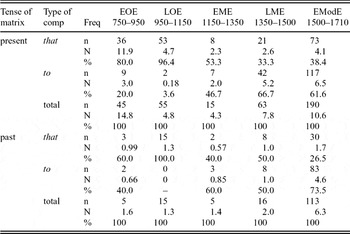
Unfortunately, the data do not give clear indications of the role of the temporal location of the main clause. Table 7 presents the distribution of that- and to-clauses across present and past matrices. In addition to Old and Middle English data, it also includes Early Modern English data so as to detect any belated effects.
The distribution of that- and to-clauses in present and past contexts

Table 7 shows that in Early Middle English the share of to-infinitives in past contexts is higher than that in present contexts, but the figures are very small, and in fact the difference is not statistically significant (Fisher's exact p = 1). In Late Middle English, the share of to-clauses in past contexts is even lower than that in present contexts (viz. 50.0 versus 66.7%), but again the difference is not statistically significant (Fisher's exact p = 0.2530). The Early Modern English data, finally, yield a weakly significant result, with the portion of to-clauses in past contexts (73.5%) exceeding that in present contexts (61.6%) (Fisher's exact p = 0.04454). We can thus conclude that the adjectival data do not point in a clear direction as to the role of the tense of the matrix; they do not plainly indicate that subjunctive that-clauses were replaced more readily in past contexts than in present ones in Middle English, the period in which the past paradigm of the subjunctive mood disappeared.
4.3 The role of language contact
Whereas the previous two sections discussed language-internal factors, this section investigates a language-external factor that may be invoked to account for the rise of the to-infinitive, viz. language contact.
As discussed in section 2, the Middle English period witnesses considerable changes in the lexicon, such as the arrival of many Romance loans. As the data studied here include quite a few borrowed items, the question arises whether the increase of the to-infinitive may also have been influenced by these items bringing with them a preference for to-infinitives from their source language.
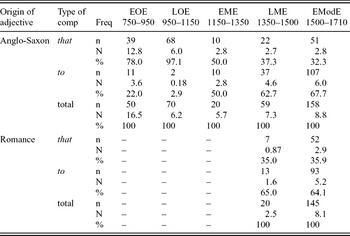
However, study of the data shows that this is not the case. Table 8 summarizes the results of the analysis: it is set up in much the same way as table 7, but the data are split up according to the origin of the adjectives.
The distribution of that- and to-clauses with Anglo-Saxon and Romance adjectives

Table 8 indicates that the Anglo-Saxon versus Romance origin of the adjectives does not correlate with the rise of the to-infinitive. On the one hand, there are no data for borrowed adjectives for the critical period, viz. EME. On the other, the figures for the later periods show that the distribution of that- and to-clauses with Romance adjectives is very similar to that with Anglo-Saxon ones; Fisher's exact tests indicate that the differences are not significant (LME p = 1; EModE p = 0.5449). We can therefore safely exclude the origin of the adjectival matrix as an explanatory factor in the development of the to-infinitive.
4.4 Conclusion
The discussions of the factors that may explain the rise of the to-infinitive seem to point ultimately to analogy between verbal and adjectival mandative complement constructions. The factor of language contact could be ruled out, and the study of the tense of the matrix did not present us with an obvious conclusion. Moreover, the distribution of the to-infinitive would be hard to explain if only the adjectival data were taken into account. As argued in section 4.1, the two to-infinitival constructions found with the adjectives studied do not share competing expressions, so that we could not hypothesize a developmental relation between them. All this confirms the conclusion proposed in section 4.1, viz. that the to-infinitive has come to function as a Theme-argument with adjectival matrices through analogy with the much more frequent verbal matrices, for which a clear development from Goal-argument to Theme-argument has been established by Los (Reference Los2005). Both types of matrices are attested with to-infinitives functioning as Theme-argument already in Old English, and are the locus of large-scale replacement from Early Middle English onwards. The finding that the adjectival constructions manifest a less abrupt replacement by to-infinitives than the verbal ones (see section 3) serves as corroborating evidence for the claim that the latter constructions served as the models of analogical extension.
The data also suggest that the influence of the verbal matrices can be viewed as functioning both paradigmatically and syntagmatically (see De Smet Reference De Smet2008: 102–27). On the one hand, we can identify the spread of the to-infinitive as an example of paradigmatic analogy (De Smet Reference De Smet2008: 119–20), that is, ‘the extension of a construction from one environment to another on the basis of a link between the spreading construction and some other paradigmatically related construction’ (De Smet Reference De Smet2008: 118). In this case, the to-infinitive spread from the intention and manipulative verb constructions (the source syntagm(s)) to the adjectival mandative construction (the target syntagm) with the subjunctive that-clause as the paradigmatically related construction. On the other hand, the to-infinitive can also be argued to ‘extend its range of application on the basis of semantic similarity between the source environment [or source syntagm, AVL] and the target environment of extension [or target syntagm, AVL]’ (De Smet Reference De Smet2008: 103), in this case the semantic similarity between intention and manipulative verb constructions and the adjectival mandative construction. In fact, the semantic similarity between these two constructions resides in their mandative meaning: their semantics includes an element of will emanating from a human source. In the case of intention and manipulative verbs, this human source appears as a referential agent participant, viz. the matrix subject.Footnote 21 In the case of the adjectival constructions, the source is typically left implicit, but retrievable from the context, for instance as the (reported) speaker. The rise of the to-infinitive in the adjectival mandative construction can thus in my view be explained by both paradigmatic and syntagmatic analogy with verbal matrices, as visualized in figure 2 (in which analogy is symbolized by ~).
Paradigmatic and syntagmatic analogy between verbal and adjectival mandative constructions

5 The distribution of that- and to-clauses in Modern English
Analysis of adjectival data from later periods than Middle English reveals that after the major reversal of distribution in the Middle English period, the to-infinitive did not continue to increase in frequency so as to oust the that-clause completely. Rather, the mandative that-clause stabilized around 28 per cent in Early Modern, Late Modern and Present-day English. This requires us to look for explanations for this new type of distribution.
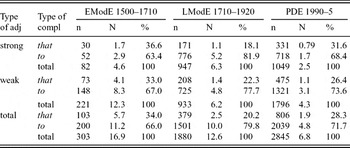
Whereas with verbal matrices mandative to-clauses kept gaining in frequency at the expense of the that-clause up to 1800 (Rohdenburg Reference Rohdenburg1995), no comparable continuous frequency loss of the that-clause is found in the adjectival data. Table 9 details the distribution of that- and to-clauses with weak and strong adjectives from 1500 up to the present.
The development of the distribution of that- and to-clauses in Early Modern, Late Modern and Present-day English

If we compare the Early Modern English data to the Late Middle English data in table 3 above, we can note only small differences (that-clauses: LME 37.2%, EModE 34.0%; to-clauses: LME 62.8%, EModE 66.0%; Fisher's exact p = 0.6909). In Late Modern English, the share of the to-infinitive reaches its highest value with about 80% (a significant increase from EModE with Fisher's exact p = 3.068e-07). However, in Present-day English, it has decreased to about 72% (a significant fall with Fisher's exact p = 1.699e-10). In short, after its rise in Middle English the to-infinitive stabilized at roughly a 3:1 ratio to the that-clause, with only a small peak movement in Late Modern English.
The finding that in these later stages the mandative that-clause is not lost completely but continues to be a (minor) option suggests that the modern distribution may be determined by other factors than those that brought about the rise of the to-infinitive. In the literature on variation in clausal complements of verbal matrices, explanations have been formulated which relate to semantic integration and discourse factors. The iconic principle of semantic clause integration was originally introduced by Givón (Reference Givón1980, Reference Givón1990: ch. 13) and states that ‘the stronger the semantic bond is between the two events, the more intimately [sic] is the syntactic integration of the two propositions into a single clause’ (1990: 516; italics his). He provides cross-linguistic evidence, showing that manipulative verbs, which have a strong semantic bond with their dependent SoA, tend to be coded by non-finite structures such as infinitives, whereas utterance verbs, which have a much weaker semantic bond with their dependent SoA, tend to be coded by ‘more’ finite structures such as that-clauses. The strength of the semantic bond between two SoAs is partly determined by the presence of an element of will (Givón Reference Givón1990: 528–30). Applied to the data presented in table 9, the principle of clause integration would predict that strong adjectival matrices have higher shares of mandative to-clauses than weak matrices, as the first ones involve a stronger element of will than the second ones. However, table 9 shows that this is only the case in Late Modern English.Footnote 22
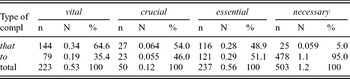
If we look at the data for each adjective of the dataset separately, we can more definitively conclude that the principle of semantic integration does not hold. There are strong adjectives which prefer that-clauses to to-clauses, such as vital and crucial, or with which both clause types are almost equally frequent, such as essential. For these adjectives, the current distribution of mandative clauses is given in table 10. The table also includes the data of another strong adjective, viz. necessary, for the sake of comparison.
The distribution of mandative that- and to-clauses in PDE with vital, crucial, essential and necessary

Although all four adjectives express a strong degree of desirability or necessity and thus should be able to establish an equally strong semantic bond with their dependent SoA, they clearly differ as to types of clausal complement they prefer. Necessary, for example, combines in an overwhelming majority of cases with the to-infinitive (about 95%). As noted above, vital, by contrast, prefers that-clauses to to-infinitives (64.6% to 35.4%), and crucial does so as well, though less markedly (54% to 46%). The distribution of essential, finally, is almost 50–50. We thus have to conclude that the principle of semantic integration as defined by Givón (Reference Givón1990: 516) does not explain the adjectival data. Rather, these data suggest that the distribution of that- and to-clauses may be, to a large extent, lexically determined, understood here as applying to the adjectives individually.Footnote 23
A second type of explanation for distributional patterns of complements relates to discourse factors, such as information structure. In his article on the variation between accusative-and-infinitive-constructions and that-clauses after verbs such as believe, think and judge, Noël (Reference Noël2003: 365), for instance, cites Borkin (Reference Borkin1984: 60–1), who argues that infinitival clauses ‘rely on previous discourse to complete their function’, while that-clauses do not (cf. Kuno Reference Kuno1972). Before we focus on the role of information structure in the variation between that- and to-clauses in extraposition constructions, it should be noted that these are both semantically and syntactically distinct from the constructions studied in Noël (Reference Noël2003) and Los (Reference Los2005). Crucially, the non-finite variants differ in terms of control. Traditionally, control has been defined as an intrasentential phenomenon, referring to the interpretation of an unexpressed argument of a verbal form in a dependent clause (cf. Joseph Reference Joseph2002). The constructions examined in Noël (Reference Noël2003) and Los (Reference Los2005) all have controlled to-infinitives, whereas mandative extraposition constructions do not. In the accusative-and-infinitive-constructions studied in Noël (Reference Noël2003) the to-infinitives are preceded by (oblique) NPs expressing their subjects. It is together with this NP that they form the object clause of the matrix verb. In the following example, the subject of the to-infinitive is marked in bold.
(14) Some unions have been suspicious of ewcs [i.e. European Works Councils, AVL] because they believe them likely to concentrate on small-scale issues. (CB-Times)
The to-infinitive constructions with intention and manipulative verbs discussed in Los (Reference Los2005) also have controlled to-infinitives, as their agents are coreferential with the matrix subject (see (8)–(9)) and matrix object respectively. When manipulative verb constructions are passivized, as in (10)–(11), they involve subject control as well. Extraposition constructions, by contrast, typically do not have controlled to-infinitives. In example (15) below, for instance, the speaker/writer gives us no clue as to who is supposed to educate young people about the dangers of drugs; in (15) the implicit agent has generic or arbitrary reference, or in generative terms ‘arbitrary PRO’ (see Los Reference Los2005: 292).
(15) With the scourge of illegal narcotics infecting every part of the world, it is crucial to educate young people about the dangers of drugs. (CB-Sunnow)
This difference in control relations suggests that the factors motivating the distribution of clausal complements with intention, manipulative, (acquisition of) knowledge and propositional attitude verbs cannot simply be extrapolated to mandative extraposition constructions with adjectival matrices.
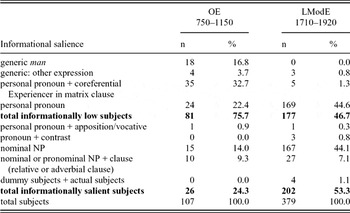
Nevertheless, there are indications that information structure does play a role in the distribution of mandative that- and to-clauses. In particular, a closer look at the informational salience of the subjects of mandative that-clauses in the Old and Late Modern English data shows that LModE has twice as many prominent or heavy subjects as OE, as shown in table 11 (53.3% versus 24.3%, a highly significant increase with Fisher's exact p = 9.504e-08). This finding may (at least partly) explain why the mandative that-clause has resisted total supersession by the to-clause. Whereas the latter ‘does not easily accommodate a large amount of information’ (Noël Reference Noël2003: 370), the that-clause is well suited to holding heavy or complex subjects. This observation is nicely captured by Rohdenburg's (Reference Rohdenburg1995, Reference Rohdenburg1996) Complexity principle, which states that ‘the more complex the dependent clause turns out to be, the greater is the need to make its sentential status more explicit’ (Reference Rohdenburg1995: 368). An example of a that-clause with a ‘complex’ subject is given below.
(16)
It is obvious that, for such narratives to possess any real force and validity, it is essential that their character and authorship should be placed beyond all doubt.
(CLMETEV 1889 Cassels, A reply to Dr Lightfoot's essay)
Table 11 also shows which type of that-clause was replaced by to-infinitival clauses, viz. the one with the indefinite pronoun man as subject (see (6)–(7) above; see also Los (Reference Los2005: 290–3) on verbal matrices). Because man has generic or arbitrary reference, these that-clauses can be replaced by non-controlled to-clauses, as in (7) and (15), without a loss of information, as least as regards the subject. Table 11 confirms that that-clauses with man have disappeared by Late Modern English.
The informational salience of subjects of mandative that-clauses in Old and Late Modern English

Of course, the rise of the to-infinitive was not restricted to non-controlled to-clauses taking over that-clauses with the indefinite pronoun man. In fact, the data call for a broader definition of control in the sense of De Smet (Reference De Smet2007: 91), referring to ‘a primarily interpretative relation of correspondence between some text participant and the agent implicitly invoked by any form referring to an action’ (see Kortmann Reference Kortmann1991, Reference Kortmann, Haspelmath and König1995; Duffley Reference Duffley2000). It is in this – not necessarily intrasentential – sense that to-clauses in examples such as (17) with dummy it as anticipatory matrix subject can be regarded as controlled.
(17)
Before I conclude, it is proper to mention that the kirk-bell, which had to this time, from time immemorial, hung on an ash-tree, was one stormy night cast down by the breaking of the branch.
(CLMETEV 1821 Galt, Annals of the parish)(18)
This Marloe, we are told, presuming upon his own little wit, thought proper to practise the most epicurean indulgence, and openly profess'd atheism; he denied God, Our Saviour; he blasphemed the adorable Trinity . . .
(CLMETEV 1753 Cibber, The lives of poets of Great Britain and Ireland, vol. 1)(19)
Be assured, whenever it may seem fitting for me to take so long a journey, I shall come to you with as cordial a feeling of unchanged and unabated friendship as that with which you I know will receive me.
(CLMETEV 1847 Cottle, Reminiscences of Samuel Taylor Coleridge and Robert Southey)(20)
American State Department officials say that in his meeting with Secretary of State Baker, Mr Shevardnadze made clear that neutrality was not the answer and that Moscow also considered it important to keep American troops in Europe.
(CB-BBC)
In (17), the implicit agent of the to-infinitive to mention clearly is the I-persona, who is explicitly mentioned in the temporal subclause preceding the mandative construction. The that-clause functioning as object of to mention shows that the I-persona does carry out the activity of mentioning. In the complex transitive construction (to think something proper) in (18), the context makes it clear that the subject of the matrix clause (viz. this Marloe) is coreferential with the agent of the to-infinitive to practise. It is the poet Christopher Marlowe who practised the most epicurean indulgence and openly professed atheism. In (19), the agent of the to-infinitive to take is explicitly mentioned in the for-PP preceding the to-clause, viz. for me, and repeated as the matrix subject I. The examples in (18) and (19) illustrate the most typical control relations in complex transitive and for . . . to-infinitive constructions, but these patterns cannot be generalized. Example (20), for instance, is also a complex transitive construction, but the context suggests that the matrix subject Moscow is not the implicit agent of the to-infinitive to keep, as the Soviet Union has no say in NATO resolutions, let alone in US decisions. The examples thus show that the to-infinitive in the mandative construction can have a controlled interpretation, and hence that it was also able to replace non-generic that-clauses.
Even if the contrast with Old English in terms of information structure is striking, LModE that-clauses still include a considerable portion of complements with informationally low subjects (46.70%), especially pronominal subjects (44.59%), as in (21) below. Of course, pronouns can also be used in contrastive contexts, as in (22), but in those cases they were analysed as informationally salient subjects (0.79%).
(21)
The young adventurer is not to expect to have every difficulty smoothed for him by the hand of another. This were to teach him a lesson of effeminacy and cowardice. On the contrary it is necessary that he should learn that human life is a state of hardship, . . .
(CLMETEV 1831 Godwin, Thoughts on man)(22)
With these words he gave him a letter directed, as he had said, but not sealed, which Horatio, after he had manifested the sense he had of so unhoped an obligation, reminded him of. As it concerns only yourself, said the baron, it is properyou should read it first, and I will then put on my signet.
(CLMETEV 1744 Haywood, The fortunate foundlings)
The relatively large share of pronominal subjects in LModE that-clauses suggests that the informational salience of the subject cannot be the only factor motivating the use of finite complements. In what follows, I will mention two other factors that may be relevant, though neither has been examined systematically.
A first additional factor pertains to the modal relation established by the verbal form. A finite clause enables the speaker to specify the type of modal relation the mandative clause has to the matrix event. In (22), for instance, we find both should and will as finite forms in the that-clause, each expressing a different type of modal meaning, whereas this meaning is left unspecified in to-clause complements.Footnote 24 Emphasis on the modal relation is also found with non-contrastive pronominal subjects, as in (23) below, in which the main verb of the finite should (viz. convince) has been elided.
(23)
Never maintain an argument with heat and clamor, though you think or know yourself to be in the right: but give your opinion modestly and coolly, which is the only way to convince; and, if that does not do, try to change the conversation, by saying, with good humor, ‘We shall hardly convince one another, nor is it necessary that we should, so let us talk of something else.’
(CLMETEV 1747 Chesterfield, Letters to his son)
Secondly, that-clauses (even with pronominal subjects) may also be preferred for stylistic reasons. By using a that-clause the speaker/writer can avoid the use of a split infinitive, as in (24), or the immediate succession of to-infinitives, as in (25). The preference for a that-clause in examples such as (25) can be explained by the horror aequi principle (Rudanko Reference Rudanko1998; Rohdenburg Reference Rohdenburg2003; Vosberg Reference Vosberg2003), i.e. ‘the widespread (and presumably universal) tendency to avoid the use of formally (near-)identical and (near-)adjacent grammatical elements or structures’ (Rohdenburg Reference Rohdenburg and Mondorf2003: 236).
(24)
He at once perceived their danger, so they held a council, and came to the following resolutions: That it would be necessary that they should immediately stockade the storehouse, so as to render it impossible for any one to get in;
(CLMETEV 1841 Marryat, Masterman Ready)(25)
There was a considerable difference between the ages of my parents, but this circumstance seemed to unite them only closer in bonds of devoted affection. There was a sense of justice in my father's upright mind which rendered it necessary that he should approve highly to love strongly.
(CLMETEV 1818 Shelley, Frankenstein)
More generally, then, the role of information structure in the distribution of mandative that- and to-clauses can be linked to the distinct grounding properties of the two competing expressions, i.e. properties indicating the relation of the complement to the speech event or ‘ground’ (Langacker Reference Langacker1991: 193–200). While to-clauses do not need an overt subject and depend on the matrix for their temporal anchoring, that-clauses require an overt subject (which may be informationally salient) and offer the possibility of explicitly coding the modal relation of the complement to the matrix (see Halliday Reference Halliday1994: 75–7).Footnote 25
In conclusion, the Modern English data present us with a different type of distributional pattern than the Old and Middle English data, as here the clausal variation cannot be thought of as replacement of an original type by a new competing expression. Therefore, the discussion above proposed other types of explanations than those presented in section 4. The principle of semantic integration (Givón Reference Givón1990: 516) was shown not to apply. The factor of information structure, however, proved more useful: I showed that in Late Modern English, the share of informationally salient subjects is twice as high as that in Old English. More generally, it was shown that the distinct grounding properties of finite and non-finite clauses play an important part. In addition, I invoked stylistic preferences to account for the clausal variation studied here.
6 Conclusion
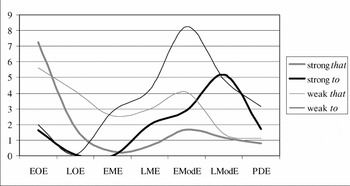
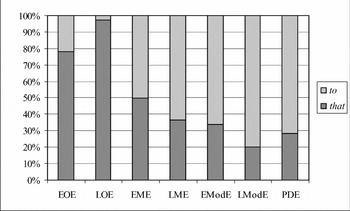
This article has concentrated on the rise of the to-infinitive with deontic adjectival matrices. The development of the distribution of that- and to-clauses across the various historical periods is summarized in the figures below. Figure 3 is based on the normalized frequencies given in tables 4 and 9 above and distinguishes between weak and strong adjectives; figure 4 is based on the relative shares of the that- and to-clauses given in tables 3 and 9 above, and covers the whole dataset.
The development of the distribution of mandative that- and to-clauses with strong and weak adjectives (normalized frequencies)

The development of the distribution of mandative that- and to-clauses (relative shares)

It is clear from figure 3 that the frequencies of the that-clauses (in grey lines) show a general downward movement, whereas the innovative to-infinitives (in black lines) show a steep climb in the ME period (here, the weak adjectives precede the strong ones). It could thus be concluded that the complementation of adjectival matrices showed a similar development to that observed for verbal matrices by Los (Reference Los2005: 185–9). The EModE data show peaks for all lines in the graph, which has to be attributed to the high frequency of the clausal complements in the data. In terms of relative shares of the formal types, the EModE data fit in with a smooth line of development between the LME and LModE data, as can be seen in figure 4. Figure 4 shows particularly clearly that the major reversal in distribution occurs in the EME period (see Los Reference Los2005: 185–9). However, the that-clause remains available as a mandative complement expression, which may even be the preferred option for certain adjectives, such as vital and crucial (see table 10).
The rise of the to-infinitive in adjectival constructions has been explained by analogy with changes that Los (Reference Los2005) observed in the verbal complementation system. It was found that her account of the changing distribution of the to-infinitive for intention and manipulative verbs could not be readily applied to the adjectives studied. In the case of the verbal matrices, the to-infinitive spread from the purposive environment to the Theme-complement environment, on the basis of the semantic similarity between these two syntagms (syntagmatic analogy; see De Smet Reference De Smet2008: 103, 119–20) and the presence of a paradigmatically related construction, viz. the subjunctive that-clause (paradigmatic analogy; see De Smet Reference De Smet2008: 118–20). Within the system of adjectival complementation, however, no such development could be established, as the purposive bryce-construction and the Theme-complement mandative construction did not share competing expressions. One additional language-external factor, viz. the impact of borrowed adjectives, was shown not to have played any role. Regarding the factor of the tense of the matrix, no clear picture emerged from the data, but it could not be ruled out that the loss of the past subjunctive paradigm may have promoted the use of to-infinitives in past contexts. In any case, it would be interesting to see whether the tense of the matrix has had any influence on the complements of verbal matrices. In view of all this, I have therefore made a case that the mechanism of analogical extension was at work between the complementation of adjectival and verbal matrices in the period from Old to Middle English. Mandative constructions with adjectives started favouring the to-infinitive by analogy with the rise of the to-infinitive in mandative constructions with intention and manipulative verbs. I have argued that this distributional change could take place because of the semantic similarity between the verbal and adjectival syntagms as well as the availability of the subjunctive that-clause in both syntagms, i.e. through syntagmatic as well as paradigmatic analogy.
For the later data, however, I proposed that different types of explanations are required. Although the variation in clausal complements of adjectives was seen to be lexically determined to a certain extent, discourse-functional factors proposed in the literature on verbal complementation were shown to also play some role. In general, to-clauses are used when there is no need to express the agent overtly.Footnote 26 Either the speaker has no specific agent in mind (arbitrary reference; non-controlled interpretation of the to-clause), or the context enables us to infer the identity of the agent (controlled interpretation of the to-clause). That-clauses, by contrast, invariably have an overt subject, and as such they are most suited to accommodating informationally salient subjects. They also allow the speaker to specify the modal relation between the finite verb of the SoA in the complement and the matrix. Stylistic motivations such as the horror aequi principle are another factor bearing on the choice of clausal complement. Future research will certainly have to include a more detailed investigation of discourse factors such as information structure and referential continuity, as well as tactic relations (see Noël Reference Noël2003). These may well provide us with a better understanding of the principles governing the current distribution of clausal complements with mandative adjectives.