INTRODUCTION
Human activities have severely affected the condition of freshwater ecosystems worldwide. Cultural eutrophication of lakes by the addition of organic matter and nutrients, such as phosphate and nitrate, has resulted in changes in water quality and ensuing changes in the structure of aquatic communities. Although the importance of zooplanktonic, benthic and fish communities as biological indicators has been widely recognized in many Himalayan lakes of Kashmir, the collection of even basic parasitological community data on lakes is still in its infancy (Shah and Yousuf, Reference Shah and Yousuf2007; Shah, Reference Shah2010). Given that in an aquatic ecosystem the parasite communities of fish may provide information on ecosystem conditions due to their intimate contact with both the host and the aquatic environment, numerous authors concluded that parasite assemblages should be considered not only for their influence on fish health but also for their own changes in prevalence, abundance and diversity in response to environmental quality (Koskivaara, Reference Koskivaara1992; Bagge and Valtonen, Reference Bagge and Valtonen1996; Marcogliese and Cone, Reference Marcogliese and Cone1991, Reference Marcogliese and Cone1996, Reference Marcogliese and Cone1997; Valtonen et al. Reference Valtonen, Holmes and Koskivaara1997, Reference Valtonen, Holmes, Aronen and Rautalahti2003; Lafferty, Reference Lafferty1997, Reference Lafferty2008; Landsberg et al. Reference Landsberg, Blakesley, Reese, McRae and Forstchen1998; Lafferty and Kuris, Reference Lafferty and Kuris1999). The present study, therefore, was carried out on 3 lakes of contrasting trophic status in Kashmir and is an attempt to evaluate how the structure of parasite communities of fish may vary as a function of lake productivity.
MATERIALS AND METHODS
In the present study, data were collected from 3 valley lakes of Kashmir, namely Anchar Lake (34°07′31″ – 34°10′11″N and 74°46′23″ – 74°48′00″E), Dal Lake (34°04′56″ – 34°08′57″N and 74°49′48″ – 74°52′51″E) and Manasbal Lake (34°14′38″ – 34°15′24″N and 74°39′06″ – 74°41′19″E). The selection of 3 lakes was based on their degree of trophic status (Zutshi et al. Reference Zutshi, Subla, Khan and Wanganeo1980; Pandit and Yousuf, Reference Pandit and Yousuf2002; Shah, Reference Shah2010). Detailed limnological descriptions of the study lakes were presented by Shah (Reference Shah2010). For a number of decades both Anchar and Dal lakes have been subject to increasing cultural eutrophication, and are hypertrophic and eutrophic respectively, whereas the Manasbal Lake is a mesotrophic lake with minimal human influence. The Anchar is the shallowest of the three lakes, whereas the Manasbal is the deepest. The study of physico-chemical characteristics is a primary consideration for assessing the water quality of an aquatic system (Hutchinson, Reference Hutchinson1957). In order to have an idea about the status of their water quality, the study lakes were visited within a 3-day period in each month starting from June 2006 through May 2008 for the collection of water samples. In each lake, sampling was undertaken at 5 sampling points that characterized the different regions of the lakes with latitudinal and longitudinal data for each site being recorded with a hand-held global positioning system (GPS). The analytical determinations were done in accordance with the standard methods (APHA, 1998; Wetzel and Likens, Reference Wetzel and Likens2000). Crustaceans, mollusks and oligochaetes, which are reported to be serving as intermediate hosts for many fish parasites, were sampled. The sampling of crustacean hosts was made with the help of a zooplankton net, while for collecting gastropod snails and oligochaetes, sediment samples were procured. Quantitative enumeration of various intermediate hosts was done in accordance with standard methods (APHA, 1998; Wetzel and Likens, Reference Wetzel and Likens2000). Identification of different intermediate host groups was done with the help of keys from Stephenson (Reference Stephenson and Shipley1923), Goodnight (Reference Goodnight and Edmondson1959), Tressler (Reference Tressler and Edmondson1959), Yeatman (Reference Yeatman and Edmondson1959), and Pennak (Reference Pennak1978).
The model fish host chosen for this study was the snow trout, Schizothorax niger Heckel. The fish was selected on the basis of its endemic nature and common accessibility in all the 3 localities (Yousuf et al. Reference Yousuf, Firdous, Peerzada and Pandit2002). Moreover, the fish is the only species of the schizothoracine group that has adapted completely to lacustrine habitats and does not show the spawning migration towards the upper reaches of the streams, which is the characteristic feature of this group. Furthermore, the fish is facing considerable stress as the changing ecology of waters and eutrophication of lakes has resulted in a significant decline in the populations of this native fish over the years. A total of 450 specimens of fish were examined for parasites from June 2006 to May 2008 on a monthly basis. Since it was not possible to collect consistent or replicable fish samples from highly eutrophic Anchar Lake, therefore the sample size from each lake was adjusted to the maximum number of fish collected from Anchar Lake that was mostly 6–7 on each occasion to make the samples comparable. Even though the individual monthly samples were relatively small, this equal consistency ensured that observed changes in the parasite community were real and not artifacts of sampling or procedure. The fish samples of comparable size-class were obtained from the catches of local fishermen. Fish were examined for metazoan parasites according to standard necropsy techniques adopted from Weesner (Reference Weesner1960) and Schmidt (Reference Schmidt1992). For identification of parasites, the works of Yamaguti (Reference Yamaguti1958, Reference Yamaguti1959, Reference Yamaguti1963a,Reference Yamagutib), Fotedar (Reference Fotedar1958), Kaul (Reference Kaul1986), Fayaz and Chishti (Reference Fayaz and Chishti1994, Reference Fayaz and Chishti2000) and Ara et al. (Reference Ara, Khan and Fayaz2000) were consulted.
The level of parasite infection was assessed according to the terminology outlined by Bush et al. (Reference Bush, Lafferty, Lotz and Shostak1997). Helminth community structure was studied at component community level (Bush et al. Reference Bush, Lafferty, Lotz and Shostak1997). The measures of component community structure studied include: the component community richness (CCR), Shannon-Wiener index of diversity, and Simpson's diversity index. To focus attention on the dominant helminth species in each component community in each locality, the Berger-Parker dominance index was also calculated which measures the proportion of total catch that is due to the dominant species (diversity is lower when there is stronger dominance in the sampling unit by one or few species). The calculation of all indices was performed following the protocols of Washington (Reference Washington1984) and Stilling (Reference Stilling1996). The importance of each parasite guild (by pooling parasites in the following categories, i.e. autogenic parasites, and allogenic parasites) within each component community was evaluated by calculating the proportion of individual parasites that it contributed to the assemblage. A species was designated as component species if it was present in >10% of the host sample (Bush et al. Reference Bush, Aho and Kennedy1990). Within a parasite community, the relative abundance of each parasite species, or species evenness, is a key component of the structure of that community (Poulin, Reference Poulin1996). Therefore, species abundance distributions were constructed by plotting the relative abundance of each species, expressed as a percentage of the total number of individual helminths in the community, against its rank, when all species are ranked from most to least abundant (Poulin et al. Reference Poulin, Luque, Guilhaumon and Mouillot2008). One-way analysis of variance (ANOVA) was employed to determine significant differences between the lakes and Tukey's HSD-test was used to make post-hoc pair-wise comparisons. All correlations were carried out using Pearsons's test. The significance of all statistical analyses was established at P values <0·05. All statistical tests were performed using SPSS software (Statistical Package for Social Science) version 12.0 for Windows.
RESULTS
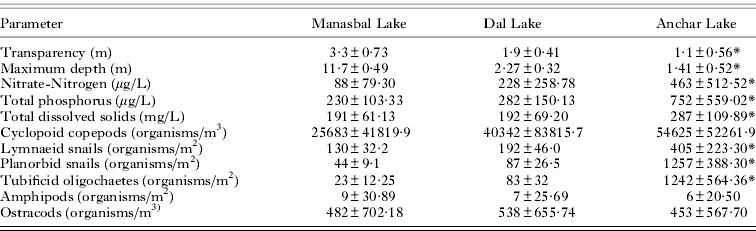
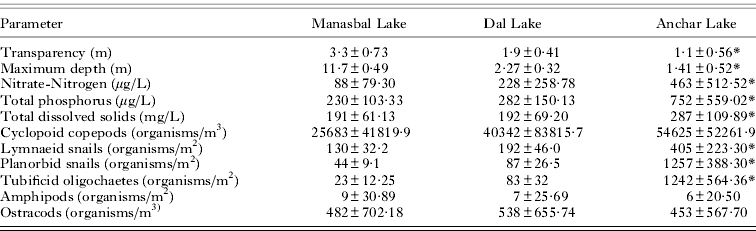
In general, the data on limnological parameters revealed some notable differences among the lakes pointing to differences in their trophic status (Table 1). Secchi depth is a measure of water clarity and is used as a visual index of general lake productivity. It is a function of reflection of light from the surface of the disc and therefore is affected by the absorption characteristics of the water, and of dissolved and particulate matter contained in the water (Wetzel and Likens, Reference Wetzel and Likens2000). The transparency in Anchar Lake was relatively on the lower side and was influenced by turbidity. On the basis of maximum transparency values, the differences among the lakes were significant (F2,69 = 89·544, P < 0·001 respectively); Tukey's HSD test revealed that all the lakes differed significantly from one another.
Limnological characteristics of the three study lakes
* Values significant at P < 0·05.
The depth of an aquatic body plays an important role in concentrating ions in water mass (Hutchinson, Reference Hutchinson1957). Moreover, shallow basins are considered to be the best-suited habitats for emergent vegetation and benthic invertebrates (Wetzel, Reference Wetzel2001). Among the sampling sites within each lake, the depth showed a distinct gradation. The maximum depth recorded at the central site of the lakes varied from 2 m in Anchar to 3 m in Dal to 12·2 m in Manasbal. In respect of maximum depth, the lakes differed significantly from each other (F2,69 = 3842·871, P < 0·001).
Phosphates and nitrates are essential for the growth of primary producers and are usually present in low concentrations in natural unpolluted fresh waters (Wetzel, Reference Wetzel2001). In the eutrophication of lakes, phosphorus has been implicated as the main causal factor (OECD, 1982). It is generally acknowledged that phosphorus is not only an essential nutrient but is also a limiting nutrient for aquatic plant growth and is in fact a key element in enhancing and accelerating eutrophic conditions. The increased level of phosphates in a water body is also an indication of sewage contamination (Hutchinson, Reference Hutchinson1957). The concentrations of phosphates and nitrates were in the order of Anchar >Dal > Manasbal. The differences between the lakes were again significant for both nitrate-N and TP (F₂‚₃₅₇ = 38·654, P < 0·001; F₂‚₃₅₇ = 86·325, P < 0·001 respectively). Furthermore, the values recorded in Anchar were significantly higher than those recorded in Dal and Manasbal (Tukey HSD-test, P < 0·001) for total P, while the differences recorded in Dal and Manasbal were not statistically significant between the two lakes (Tukey HSD-test, P = 0·467).
Patterns in total dissolved solids (TDS) closely followed those of inorganic nutrients; comparatively higher values were recorded in Anchar followed by Dal and Manasbal. The inter-lake differences were statistically significant (F₂‚₃₅₇ = 53·621, P < 0·001); albeit, the values in Anchar were significantly higher than those obtained in Dal and Manasbal (Tukey HSD-test, P < 0·001). In comparison, there were no significant differences in TDS values between Dal and Manasbal (Tukey HSD-test, P = 0·990). The density of free-living intermediate hosts was considered as a factor that might mirror the water quality of study lakes; therefore, the strategy of sampling invertebrate hosts on the basis of abundance was used to estimate their density. The densities of different free-living intermediate host groups are shown in Table 1. In particular, the interlake comparison revealed a much higher numerical dominance and proportion of the planorbid snails and tubificid oligochaetes in Anchar compared to Dal and Manasbal. The numbers and proportions of these two benthic groups are often used as symbolic indicators of organic pollution, due to their dominant status in polluted waters (Marcogliese et al. Reference Marcogliese, Compagna, Bergeron and McLaughlin2001; Lin and Yo, Reference Lin and Yo2008).
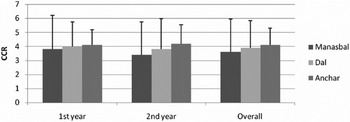
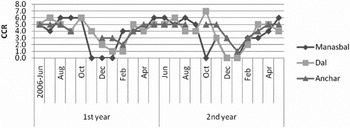
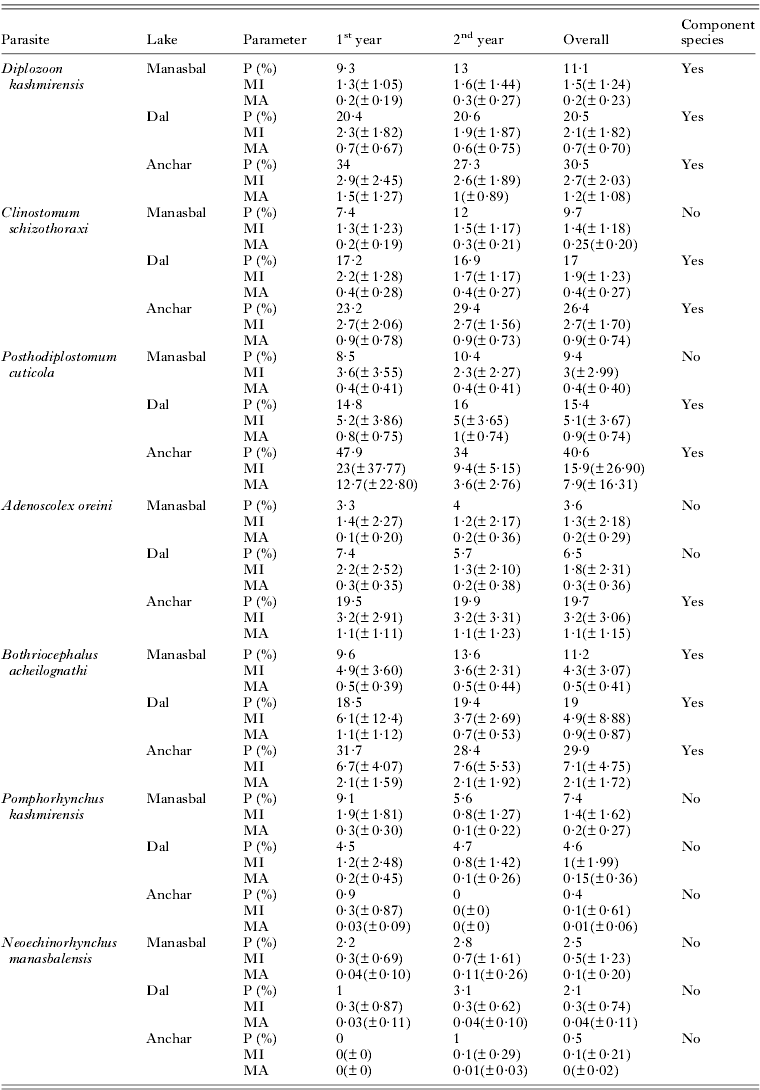
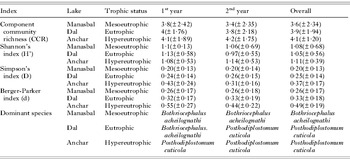
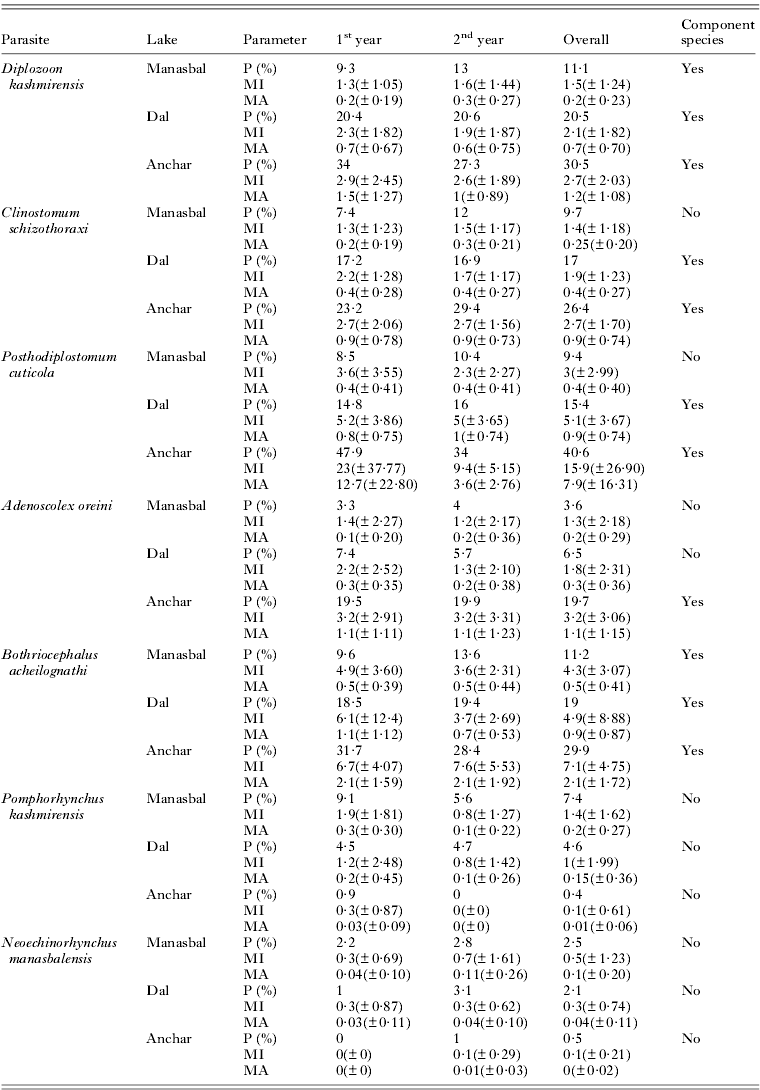
A total of 7 helminth parasite species were recorded during the investigation period. These included Diplozoon kashmirensis Kaw, Clinostomum schizothoraxi Kaw, and Posthodiplostomum cuticola Dubios (=Neascus cuticola Nordmann) from Trematoda, Bothriocephalus acheilognathi Yamaguti and Adenoscolex oreini Fotedar from Cestoda, and Pomphorhynchus kashmirensis Kaw and Neoechinorhynchus manasbalensis Kaw from Acanthocephala. However, nematode parasites were not reported from any lake during the whole study period. For all the parasites analysed in this study, there is an indication of change in prevalence along the seasonal gradient of water temperature. Therefore, interlake comparisons were based on all data combined over all months for a year as well as for the whole investigation period so as to present a general picture of community structure in each lake rather than comparing the data from the same or closest months in each year to minimize the variations due to seasonality. The inter-annual variations recorded for each lake indicating the prevalence, mean intensity and mean abundance are presented in Table 2. The data regarding component community richness, Shannon's index, Simpson's index and Berger-Parker dominance index are given in Table 3. For Manasbal Lake, component communities were less species rich than those of Dal and Anchar, which harboured the richer communities (Fig. 1); however, the differences were not significant (one way ANOVA; F₂‚₆₆ = 0·482, P = 0·620). When the total number of parasite species is considered, a clear seasonality, reflected by an increase from March to October with minimal or zero values in winter, was observed in all lakes (Fig. 2).
Overall and year-wise pattern of component community richness (CCR) in Schizothorax niger (Bars represent standard deviation).

Monthly values of component community richness (CCR) in Schizothorax niger in the three lakes.

Overall and year-wise pattern in prevalence, mean intensity (±s.d.) and mean abundance (±s.d.) of parasites in Schizothorax niger
Diversity characteristics of the helminth component communities of Schizothorax niger in the three lakes

The component community in S. niger of Anchar and Dal was overwhelmingly dominated by larval digenean P. cuticola, as indicated by the relative proportion of this species in the component community, while B. acheilognathi contributed a major proportion to the component community in Manasbal. The intestinal community in Anchar and Dal was, however, dominated by B. acheilognathi and all other intestinal species occurred at low prevalence and formed a small proportion of total number of intestinal helminths. On a monthly basis there was no consistent dominance by either autogenic or allogenic species in Manasbal and Dal, but in the case of Anchar Lake the relative proportions of P. cuticola were considerably and consistently higher. By way of comparison, the order of dominance in the 3 lakes was:
B. acheilognathi >P. cuticola >P. kashmirensis >C. schizothoraxi >D. kashmirensis >A. oreini >N. manasbalensis in Manasbal; P. cuticola >B. acheilognathi >C. schizothoraxi >D. kashmirensis >A. oreini >P. kashmirensis >N. manasbalensis in Dal; and P. cuticola >B. acheilognathi >D. kashmirensis > C. schizothoraxi >A. oreini >P. kashmirensis > N. manasbalensis in Anchar.
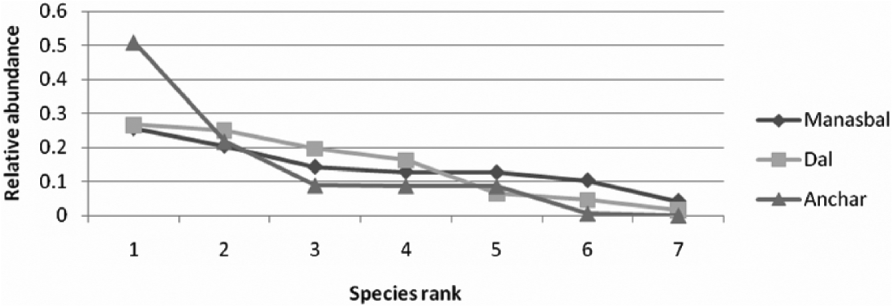
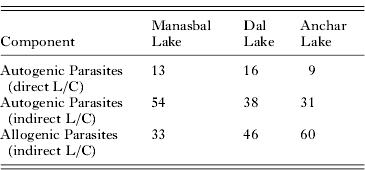
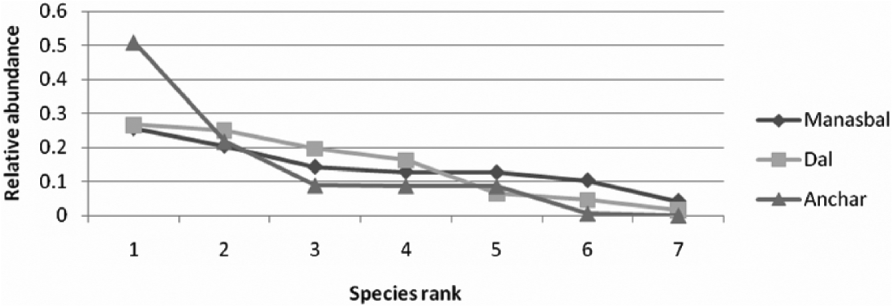
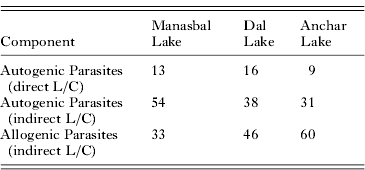
The differences among localities were reflected strongly in the changes in relative abundance of the species. In Anchar, some of the species were accidentals like P. kashmirensis and N. manasbalensis and occurred at low frequency, and thereby gave an erratic element to the community, while a few like P. cuticola and C. schizothoraxi, which occurred at higher frequency, gave a regular degree of continuity to community composition. This was depicted by the abundance-versus-rank plots that displayed different shapes in the 3 lakes (Fig. 3). These plots rank the species from most to least numerically abundant on the x-axis. In Anchar Lake, a steep drop in abundance was noted from first- to second- and third-ranked species, then levelling off for species of intermediate ranks. The most abundant species, i.e. P. cuticola, accounted for about one half of all individuals in the parasite community in Anchar. However, in Dal there was a gradual drop in ranks from first- to last-ranked species. The plot was gentler in Manasbal and the ratio in abundance between the first-, second and third-most abundant species was comparatively lower and then a levelling off was observed. Thus, the differences in abundance between the 2 most abundant species were not wide in Dal and Manasbal. The proportion of helminths in component communities varied from locality to locality in respect of the supply of parasite species available. In general, the parasite community in Anchar was dominated by allogenic individuals, whereas in Dal and Manasbal it was dominated by autogenic individuals. Additionally, the infestation pattern of allogenic parasites was highly overdispersed in Anchar. In contrast, the number of individual parasites recovered per host was comparatively reduced in Manasbal and Dal. On the monthly basis also the majority of communities were dominated by autogenic species in both Dal and Manasbal, whereas there was a consistent dominance of allogenic species in Anchar. However, differences in dominance pattern between the years reflect changes in relative abundance of parasites in each community. In Anchar, the allogenic species form a greater proportion of individuals in the communities although there are collectively more autogenic species, but in Dal and Manasbal, a reverse trend was observed (Table 4). The proportion of allogenic versus autogenic components varied among the lakes and was significantly affected by the character of habitat which affected the abundance patterns of the respective parasites.
Species abundance distributions in helminth communities of Schizothorax niger in the three lakes.
Proportion (in percent) of allogenic and autogenic components in parasite communities of Schizothorax niger in the three lakes
The overall Shannon's diversity index was comparatively higher in Anchar followed by Manasbal and Dal. Although the parasite communities in hosts from Manasbal had a higher mean index than did the communities from Dal, the differences were not significantly different among the lakes (one-way ANOVA; F₂‚₆₆ = 0·066, P = 0·936). During the 1st year, the diversity was highest in Dal followed by Manasbal and Anchar, while the order was Anchar followed by Manasbal and Dal during the 2nd year. Pearson correlation coefficient indicated a significant positive correlation between Shannon's index (H') and component community richness (CCR) across all localities (rp = 0·987, P < 0·001 in Manasbal; rp = 0·875, P < 0·001 in Dal; rp = 0·776, P < 0·001 in Anchar).
The Simpson's index and Berger-Parker index depicted a parallel trend with the highest values reported from Anchar followed by Dal and Manasbal. The differences among the lakes were significant statistically (one-way ANOVA; F₂‚₆₆ = 7·407, P = 0·001 and F₂‚₆₆ = 9·843, P < 0·001 respectively). The Anchar differed significantly from both Dal and Manasbal (Tukey HSD-test), while the values did not vary significantly between Manasbal and Dal (Tukey HSD-test, P = 0·480 and P = 0·400 respectively for Simpson's index and BP index). The comparatively high values for Berger-Parker dominance index in Anchar suggested the presence of some heavily infected hosts in the sample, as was also indicated by the maximum intensity values. The prevalence of dominance was high in Anchar Lake with the Berger-Parker index exceeding 0·50 in 43% of the communities compared to 17% in Dal Lake, the corresponding values never exceeded 0·50 in Manasbal Lake. However, the overall species richness and Shannon's index were comparatively higher in Anchar Lake than both Dal and Manasbal, reflecting a decrease in the proportion of zero infections in the former lake or total absence of infections in the last 2 lakes, i.e. exhibiting zero diversity, during winter months. In Anchar Lake, the overall picture is of a component community exhibiting heavy dominance by one species but surprisingly the diversity is higher than the other 2 lakes, and also the diversity varies within very narrow limits. Moreover, Simpson's index (D) correlated positively and significantly with Berger-Parker (d) index in all the 3 lakes (rp = 0·947, P < 0·001 in Manasbal; rp = 0·968, P < 0·001 in Dal; rp = 0·962, P = 0·005 in Anchar).
In general, the total number of parasite species recovered from S. niger was 7; but, apart from 1 case (October of 2nd year in Dal Lake) the monthly analysed component communities never attained the total species numbers recorded for the whole study period. This seems to be related to respective seasonality of parasites and as well as to the rare status of some species. In fact, much of the increased richness in Anchar Lake was due to species which occurred at low levels of abundance and formed only a small portion of the total abundance. This is further supported by data on Berger-Parker dominance index, and Simpson's index values that were found to be comparatively higher in Anchar Lake than in Dal and Manasbal.
DISCUSSION
The study revealed the helminth component communities in S. niger at Anchar to be comparatively species richer than the other 2 lakes. At Anchar, diversity indices were higher than at Dal and Manasbal. Although the data on component community richness of S. niger did not reveal any significant differences among the lakes, still the component communities in Manasbal were less species rich than the other 2 lakes. However, the estimation of Shannon's index for each host fish species did not lead to the separation of the lakes according to pollution gradient. The parasite species numbers detected in the investigated lakes present only slight differences, though the rates of prevalence are clearly higher in Anchar than in Dal and Manasbal. In contrast, the values for the Simpson's and Berger-Parker indices were consistently and markedly higher in Anchar compared to the data from the other 2 lakes. Thus, the study complements the findings of Poulin (Reference Poulin1996) by providing evidence that when parasites are very abundant, the community would typically consist of a few well-represented (core) species and several rare species, but when parasites are not abundant no species is over-represented in the community.
The component community of S. niger was unusual in that it was overwhelmingly dominated by the digenean P. cuticola in Anchar and Dal. Particularly, P. cuticola was reported to be the most dominant and frequently occurring species when looking at both the abundance and number of worms found. Poulin (Reference Poulin1996) argued that some species of parasites are always abundant due to intrinsically high rates of infection potential. In Manasbal B. achieloganthi contributed a greater proportion to component community of S. niger, but the dominance was not so overwhelming. Thus, the abundance of different species in the parasite communities investigated in this study are clearly unequal, and parasite communities are characterized by one or few dominant species and many subordinate species. Indeed, the abundance-versus-rank plots indicated a huge gap in abundance between the numerically dominant species in the parasite community and the next most common species in Anchar. In contrast, the differences in the relative abundance of the species in parasite communities of Dal and Manasbal were not so steep at all. Poulin et al. (Reference Poulin, Luque, Guilhaumon and Mouillot2008) opined that differences in the rates of recruitment of individuals to the community can result in one or a few numerically dominant species and many rare ones. Considering that the recruitment rates are determined by the prevalence of infection in the intermediate hosts of helminths, the observed patterns in abundance among the lakes can be attributed to differences in the density of these first hosts that act as the source of infection for fish. Results from the present study also realize this expectation. Thus, an increase in the magnitude of the trophic status appears to relate positively to the steepness of the drop in the relative abundance seen on the abundance-versus-rank plots.
The relative ease with which a parasite may colonize a habitat depends on its life-cycle and availability of its intermediate hosts (Marcogliese and Cone, Reference Marcogliese and Cone1991). The density of intermediate hosts may reflect the degree of eutrophication because their abundance is closely related to the physico-chemical characteristics of an aquatic environment (Zander et al. Reference Zander, Reimer, Barz, Dietel and Strohbach1999, Reference Zander, Reimer, Barz, Dietel and Strohbach2000). The stress due to eutrophication leads to a high level of productivity and consequently, to changes in densities of primary consumers such as snails, and crustaceans, and detritivores like annelids which constitute the potential intermediate host guilds in the lakes (Shah, Reference Shah2010). The specific intermediate hosts for P. cuticola, the planorbid snail Gyraulus parvus, and for C. schizothoraxi, the lymnaeid snail, Lymnaea spp. were more frequently detected at the Anchar as opposed to Dal and Manasbal (Shah, Reference Shah2010). Furthermore, the population density of cyclopoid copepods and tubificid oligochaetes, the intermediate hosts of B. achielognathi and A. oreini respectively, has been recorded to be greater at Anchar than those at Dal and Manasbal (Shah, Reference Shah2010). Given that transmission of parasites to a host is achieved by means of a free-living infective stage, the rate of encounter between the hosts and parasites will be influenced principally by their respective densities and their spatial distributions (Crofton, Reference Crofton1971; Anderson, Reference Anderson1978). This may be the reason why the abundance of infection was higher in Anchar. The trophic status of Manasbal is relatively lower than either Dal or Anchar and most intermediate hosts are low in density in this water body (Shah, Reference Shah2010). Acanthocephalans were mostly rare in fish of the lakes. The barrier to their establishment may be due to a general absence or occurrence below threshold levels of amphipod intermediate hosts, necessary to sustain a viable worm population. It is quite possible that the lower prevalence of P. kashmirensis is due to smaller/ markedly reduced intermediate host populations (Shah, Reference Shah2010). Thus, the transmission window for these parasites may be seasonally restricted too. However, the rare status of N. manasbalensis remains unclear as the necessary intermediate ostracod hosts are abundant in all the lakes (Shah, Reference Shah2010). This discrepancy might be due to the fact that ostracods are not important items in the diet of fish (Yousuf et al. Reference Yousuf, Firdous, Peerzada and Pandit2002) and are therefore less vulnerable to infection by N. manasbalensis. The rarity and occasional presence further suggests that these might have been the accidental infections.
The total number of species in component communities of lakes does not indicate a greater magnitude of change because the number of component species changed very little during the investigation period. In Anchar and Dal, all cestode and trematode parasites in S. niger proved to be component species (prevalence >10%) except A. oreini which was not a component species in the latter water body. In contrast, only D. kashmirensis and B. acheilognathi surpassed this limit in Manasbal. These differences may be the reflection of the differences in the proportion of allogenic and autogenic components in their respective component communities. Values of Shannon index were low throughout, and varied somewhat erratically at times, but within unexpectedly narrow limits and indicated a community of low and similar diversity. The addition of new species to the habitat increased richness, but had very little impact on community diversity as long as this was characteristically dominated so heavily by a single species. Therefore, Simpson's and Berger-Parker indices at component community level appeared to be the most satisfactory diversity measures available in this analysis. Both indices indicated an underlying constancy of community structure within each lake than any index and reflected a greater magnitude of differences among the lakes. Parasite species composition included a higher number of autogenic species (5) than allogenic species (2), but the latter group of parasites was more broadly distributed and represented a higher proportion of the total individual parasite count in Anchar. The allogenic species’ dominance in number of individuals can be attributed to the lake's high productivity (the result of extensive eutrophication). This phenomenon has been reported in many eutrophic habitats (Wisniewski, Reference Wisniewiski1958; Esch, Reference Esch1971). The lower infestation potential in Manasbal compared with other two lakes which are no longer in a natural state can be associated with the differences in the nature of the lakes. Thus, the results are consistent with the conclusions of Wiśniewski (Reference Wisniewiski1958) and Esch (Reference Esch1971) in that fishes in eutrophic waters are more infected with larval forms compared to adult parasites. Additionally, the results of this study are also in line with the findings of Marcogliese and Cone (Reference Marcogliese and Cone1991) that the proportion of larval forms is expected to be higher in shallow lakes than in deep lakes. The above discussion also confirms the findings of Zander et al. (Reference Zander, Reimer, Barz, Dietel and Strohbach2000) that the populations of invertebrate intermediate hosts of parasites with complex life-cycle change due to eutrophication, thus changing the concentration of parasites in vertebrate hosts that consume these invertebrates. Thus, in the light of these findings, it stands to reason that the presence or absence of parasites, along with customary methods of environmental monitoring like macroinvertebrate assessments and chemical analyses of sediment and water can be used to track pollution levels and indicate the health status of a lake ecosystem.
ACKNOWLEDGEMENTS
We wish to express our grateful thanks to Professor Azra N. Kamili, Director, Centre of Research for Development, University of Kashmir for providing facilities for laboratory as well as field work. We also would like to thank Ms Shafaq Shahnaz and Dr Sabba Mushtaq for their help and co-operation during samplings.