Introduction
Shepherds were a critical component of the early wool industry in colonial Australia and persisted even after fencing was adopted and rapidly spread in the later nineteenth century. Although the practice seems rather quaint and romantic compared with the integrated Australian wool and mutton industry of today, shepherding remains the norm in many cultures. The reason is simple: it is a highly efficient and effective way of managing sheep where labour is cheap, and the technology of fencing is not available for either financial or cultural reasons. This was the situation for many decades in colonial Australia. By adapting long-established experience in Britain, pastoralists in Australia developed what ‘might well have been the most efficient pastoral industry the world had so far known’ (Blainey, Reference Blainey1982: 121).
Shepherds have a long history in classical literature. Marcus Terentius Varro's (36 BC) Rerum rusticarum includes advice on sheep management and Virgil's (29 BC Georgics III, lines 322–38) instructions to shepherds were identical to those issued to Australian colonial shepherds nearly two millennia later. Many poets were fixated on the idyllic glories of the shepherd's life and dalliances with shepherdesses (Carrier, Reference Carrier1936: 224–5): ‘With few exceptions the life of the shepherd is described as to be desired above that of the “king on his throne”’. This Arcadian view of shepherding (always espoused by non-shepherds!) in England continued into the twentieth century (Gosset Reference Gosset1911; Hudson Reference Hudson1954).
The brutish reality of shepherding in colonial Australia was far from idyllic. They worked in isolation, with poor accommodation and rations, exposed to a range of diseases, and were relatively poorly paid. Despite the crucial importance of shepherds, there has been no detailed assessment of the work, the wages, the people and the conditions under which they worked. These issues are addressed in this paper.
The work of the shepherd
The very few sheep and cattle on the First Fleet to arrive in Sydney in 1788 were precious resources to the foundling colony. They represented food for the future, and needed to be protected and carefully nurtured. In the event, many more sheep had to be imported before the colony was able to consider sheep as wool-producing animals rather than just as food on the hoof. The flocks faced three prime threats: predation by dingoes, theft by Aborigines, and becoming separated so that individual sheep or groups were lost. Following long-established practice in the mother-country, sheep were shepherded during the day, and yarded into folds at night. Even if there had been no predation or theft, shepherds would have been used to prevent sheep wandering off into the wilderness, and to watch for injuries or disease. Shepherding was the most cost-efficient technology in many parts of Britain (Robson, Reference Robson1977); and in the colonies it used the (initially) abundant and cheap convict labour.
The British system was transferred directly to colonial Australia and Peter Cunningham describes the duties in detail:
The sheep here are divided into flocks of about three hundred breeding ewes, or four hundred wethers, in each. Every flock has a shepherd, who takes his sheep out to graze before sun-rise in the morning, and brings them in after sun-set at night. . . . In summer, he sees too that they have water during the heat of the day; and in drawing up under a tree for shade when it is too hot for feeding, . . . The shepherd takes out his victuals with him, and is required to be on the alert all day long, to prevent the sheep from being lost in the woods, or the native dogs from pouncing in among them . . .
Three flocks are always penned together in contiguous hurdles under the charge of a watchman, who counts each regularly in at night, and the shepherd again counts them out in the morning; - so that they form a regular check upon each other, and prevent losses from carelessness or depredation, The watchman has a small weather-proof watch-box to sleep in, and is assisted by a watch-dog: he keeps up a good fire, which generally deters all native dogs from approaching the fold. (1827: vol. 1, 266–8)
The duties remained essentially unchanged into the 1840s (Wilkinson, Reference Wilkinson1849: 78–9).
The logistics of shepherding in the Australian colonies varied somewhat, but most often one or two shepherds were based at an outstation which consisted of a hut with a set of yards made of moveable hurdles for each shepherd. Some outstations had fixed yards made of brush or logs (Henning, Reference Henning1966: 117). A hut-keeper was employed to cook, move the hurdles every few days, and to watch the yarded flocks at night. These outstations were five to twenty-four kilometres from the head station (Anon, 1853: 133; Henderson, Reference Henderson1851: 249).
Most descriptions show that the shepherds ‘tailed’ or followed their flocks, but Cunningham infers that the flocks were led (Reference Cunningham1827: 266). Mexican shepherds working on the Rio Grande Plain of southern Texas in the late 1870s, led their flocks. This slowed down the fastest animals, and allowed the weaker ones to keep up with the flock. The daily routine in Australia was essentially identical to that of shepherds in Montana (Brown and Felton, Reference Brown and Felton1956: 86) and Texas (Lehmann, Reference Lehmann1969: 49–53) in the USA in the 1870s, and Argentina (Gibson, Reference Gibson1893: 67–9) in the mid to late nineteenth century. Most likely using the same routine, English colonists in North America often employed shepherds to watch communal flocks in the seventeenth and eighteenth centuries (Thompson, Reference Thompson1942: 28). In the seventeenth century Spanish settlers in what was to become New Mexico shepherded communal flocks daily, and guarded them at night close to the camp fire with dogs (Thompson, Reference Thompson1942: 111). Although the pastures of England, like those of Australia, are now usually fully fenced, shepherds still work in parts of Great Britain and the profession is celebrated with a nationally televised Shepherd of the Year Award and by accredited training programs (Hart, Reference Hart1977: 104–7). This is in marked contrast to Australia where sheep are left to fend for themselves in paddocks, except when they are mustered for some management operation such as shearing.
Before the end of transportation to the Australian colonies, convicts were assigned as shepherds to sheep-owners who had to feed and clothe the men according to the current rules. Any infraction of discipline was usually met with a flogging. A very few commentators deplored the use of harsh discipline, suggesting that better treatment, food and clothing would be rewarded by more diligence and productivity (Land Commissioners for Van Diemen's Land in 1826–1828, cited by McKay, Reference McKay1962: 85). As sheep became more numerous by the 1830s, there were too few convicts for all the shepherding, so ticket-of-leave men and emancipists were employed. They were employed under the 1828 Masters and Servants Act which gave most power to the master. Shepherds were not permitted to quit, and if they ‘absconded’, they became fugitives. If caught, they could be, and frequently were, taken before a magistrate, flogged and then returned to their old master. If they lost sheep, they could be fined or flogged. It is little wonder that observers often described shepherds as sullen.
Shepherding methods and tools
Nightly penning sheep in moveable yards or folds goes back to antiquity. These were standard equipment in Britain (Loder, Reference Loder and Fussell1620: 17), and were transferred directly to the colonies. Folds served two purposes. They protected the flock at night from predators, and they concentrated the manure from the sheep in one place to fertilise the soil. Folds were moved around fields to spread the manure, and also to minimise spread of diseases such as foot-rot. In the colonies, only the protection function was ever really considered. Contemporary Australian descriptions and illustrations (e.g. figure 2) are consistent with descriptions of English gate hurdles (Wymer, Reference Wymer1946: 55). Hurdles for sheep folds in England were more usually wattled, that is, comprised of thin poles woven horizontally between vertical uprights. It is likely that suitable material was not readily available for wattled hurdles in the colonies, so the mortised variety was made instead (figure 2) and remained unchanged in the late nineteenth century (Shumack, Reference Shumack1967: 33). One of the earliest colonial descriptions of tending sheep at night differentiates between fixed yards and moveable folds, describing how the sheep:
are kept by night either in folds or yards. In the former case the shepherd sleeps in a small moveable box, which is shifted with the folds, . . . In the latter the paling of the yards is always made so high, that the native dog cannot surmount it. (Wentworth, Reference Wentworth1819: 97–108)
Most later descriptions seem to refer to folds made of hurdles, or yards made of branches and logs laid to form circular yards (e.g. Henning, Reference Henning1966: 117).
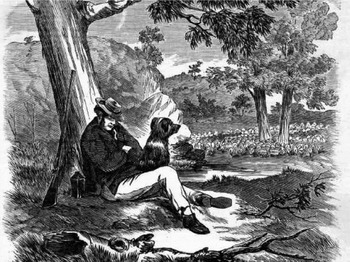
‘Shepherding in Australia’. Presumably the shepherd is having an after-lunch nap while his dog keeps watch on the flock. Source: Australian News for Home Readers, 25th May 1864.

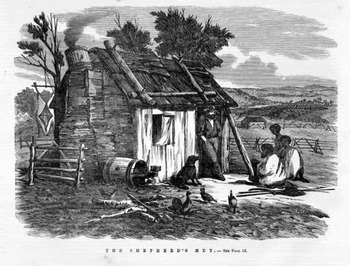
The shepherd's hut showing bark construction with roof weighted down by pegged logs. Leaning against the bark chimney is a mortised hurdle with characteristic diagonal braces. A yard made of hurdles supported by forks is on the right rear. Two details are unrealistic: chickens are unlikely as no contemporary observer recorded them; and relations with Aborigines were hostile more often than not so the presence of spears is problematic. Source: Australian News for Home Readers, 24th February 1864.

The numbers of hurdles required to make a fold varied with the size of the flock, but also, apparently, with the whim of the squatter: sixty hurdles for a flock of six hundred ewes or eight hundred weaners (Joseph Keynes in a letter to George Fife Angas 1st February 1841, cited in Linn, Reference Linn1982: 55); forty-four hurdles for one thousand sheep (Hamilton’ Reference Hamilton1923: 45); seventy-five hurdles for two thousand five hundred sheep (Lang, Reference Lang1852: vol 2, 65). Typical costs were £6. 10s. to £15 per hundred hurdles, and they lasted about five years. An advertising supplement in Stephens (Reference Stephens1839) lists iron hurdles. By the early 1850s, Charles D. Young & Co (post-1851, Plate VIII) were selling their patent wrought iron hurdles advertised specifically for the Australian colonies. It is unlikely that they were widely used in the Australian colonies because of prohibitive transport costs, but in 1853 the Clyde Company ordered some for their Victorian properties (Brown, Reference Brown1963: 526–7).
The use of dogs by colonial shepherds varied widely. Some used them solely as guard dogs at night at the folds (Anon, 1838: 43–4), others encouraged or demanded that their shepherds used dogs in their work. For example, Aeneas McDonald advertised for ‘good shepherds with Sheep Dogs’ for his south Queensland station in 1878 (Anon, 1878). The traditional and iconic shepherd's crook was almost completely unknown in the colonies. On 15th January 1851, Godfrey Mundy ‘met a flock of sheep driven by a shepherd with a real pastoral crook - the crozier of his diocesan authority’ (1852: vol. 3, 249). Most colonial shepherds lacked any prior experience and thus were probably unaware that the crook was an essential tool.
Flock sizes and wages
A persistent Australian historical and rural myth suggests that the gold rushes of the 1850s led directly to fencing (Ward, Reference Ward1978: 176) although this was debunked by Rusden (Reference Rusden1897: vol. 3, 364–5) and more comprehensively by Abbott (Reference Abbott1971, 100 ff.) The basis of the myth is that shepherds absconded to the diggings, forcing pastoralists to pay higher wages, and increase flock sizes to reduce costs. Examining available data on flock sizes and wages reveals that the effect of the gold rushes was minimal as changes were already in train.
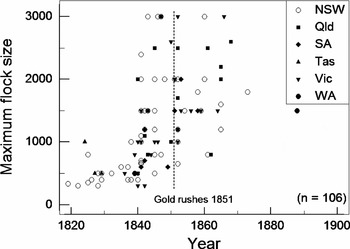
The number of sheep managed by a single shepherd varied between two hundred (in New South Wales in 1828) and fifteen thousand (on horseback in Victoria in 1862), but the general maximum was about three thousand. This was reached in New South Wales by the early 1840s (figure 3), but there was considerable variation between colonies and over time. There is a definite upward trend in the lower bound starting about 1828, and becoming more pronounced from the early 1840s to the 1870s when the minimum rose from about four hundred to about one thousand eight hundred. Despite the alleged lack of labour during the gold rushes of the 1850s, there is little evidence of an abrupt rise in flock sizes. Rather, the increase started earlier in the 1840s when transportation of convicts had ended and squatters were forced to hire free labour (‘A pioneer’, 1893: 140–1; Curr, Reference Curr1883: 353). There is a virtual lack of data after 1870. By this time, pastoralists were rapidly building wire fences in eastern Australia (Winslade, Reference Winslade1994) and shepherding was almost a thing of the past. However, shepherds were still being employed in the Northern Territory until the 1930s before the vast properties were fenced.
Trend in maximum number of sheep managed by a solo shepherd in colonial Australia from 1820 to 1910. Four exceptional data points are omitted: 4250 sheep in 1851 (Mundy, Reference Mundy1852: 300); 10,000 sheep in 1852 (Clark, Reference Clark1955: 84); 6,760 sheep in 1858 (Bowes, Reference Bowes1963: 28); and 15,000 sheep managed on horseback in 1875 (Brodribb, Reference Brodribb1976: 79). Sources: a wide range of contemporary and secondary sources.

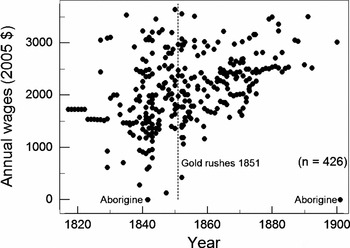
To examine more closely changes due to various influences such as the gold rushes, I present data from a wide range of contemporary and secondary sources for all the Australian colonies (figure 4). There is some duplication of data, where later authors have quoted earlier figures without attribution, but these are impossible to identify. The data are presented as ‘real 2005 Australian dollars’ using the inflation index of Snooks (Reference Snooks1994: Table 7.10) extended using the consumer price index of the Australian Bureau of Statistics (2006). Wages were always quoted as including standard rations and accommodation. The lower bound of wages decreased through the 1830s before rising steadily from the mid-1840s to the end of the century. In any given year, there was a wide range in all colonies. There is no clear pattern of inter-colony differences, except for some very high wages in Queensland, presumably in remote areas where pastoralists struggled to attract shepherds. The range in wages in the 1850s suggests that some pastoralists were trying to retain labour, as well as reflecting regional differences.
Real wages of shepherds from 1810 to 1900 for all colonies. Sources: a wide range of contemporary and secondary sources.

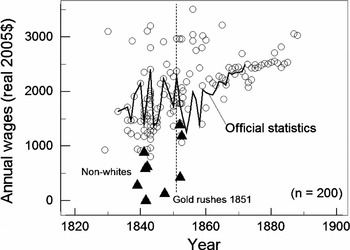
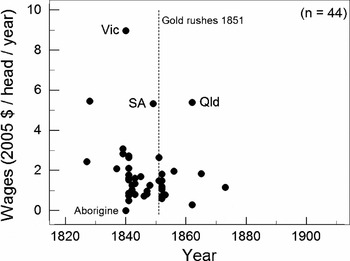
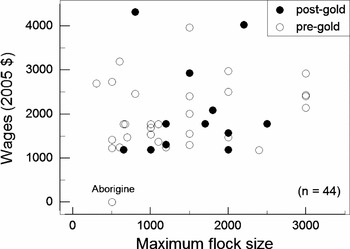
Official statistics from New South Wales (solid line in figure 5) show wages increased sharply in the late 1830s as transportation was coming to an end and pastoralists (and others) were forced to hire free labour. Wages fell abruptly in the depression of the early 1840s, and then oscillated erratically until the gold rushes of the early- to mid-1850s, when they started a long progressive increase, doubling in twenty years to 1870. Using all the New South Wales data, the trend is more obscure. The lower bound of wages decreased through the 1830s then steadily increased during the 1840s before falling until about 1850. From the discovery of gold in 1851, the lower bound increased steadily before flattening in the 1870s. During the gold rush years of the 1850s, some pastoralists paid abnormally high wages to attract shepherds (Coghlan, Reference Coghlan1918: 690; Golding, Reference Golding1973: 112). For the forty-four cases where it is possible to match flock sizes and wages, there is a decline from 1825 to 1875 in the annual wages cost per head of sheep (figure 6). Although there is a rise in the early 1850s after the discovery of gold, it is not high, and scarcely interrupts the overall decline. In other words, despite the complaints of pastoralists, they were achieving slightly lowered costs from their shepherds by increasing flock sizes. However, there is no trend in the relationship between wages and flock sizes, either before or after the gold rushes (figure 7) suggesting that any savings in labour were minimal.
Trends in annual wages of shepherds in New South Wales from 1820 to 1900. Solid line is official statistics of the New South Wales Statistical Register (1850–1859, 1865 and 1873) (years 1851–1872), and Coghlan Reference Coghlan1918 (years 1833–1850). Low wages (triangles) paid to non-whites (Aborigines, Asiatics and kanakas) are discussed in the text. Sources: as for Fig 4; New South Wales Government (1850–1873) and Coghlan (Reference Coghlan1918).

Trend in annual wages cost per head of shepherding from 1825 to 1875. Sources: as for Fig 4.

Relationship between wages and flock sizes for forty-four cases where it is possible to match data both before and after the gold rushes starting in 1851. Sources: as for Fig 4.

To provide additional incentive, some squatters (see the note on terminology at the end of the text) offered bonuses to shepherds, giving cash bonuses or extra tobacco to shepherds with the best flocks, fewest deaths and highest lambings (Anon, 1838: 138–9; Brodribb, Reference Brodribb1976: 96). Perhaps more commonly, pay was docked for losing sheep (Hawker and Linn, Reference Hawker and Linn1992: 123). More complex was the system of ‘thirds’, when shepherds received a third (or other agreed proportion) of the lambs born. This was a major incentive as it allowed ambitious and careful shepherds to acquire capital for relatively little additional effort. The system was of pre-Biblical origins (Genesis 30: 29–34) and was used in seventeenth century England (John Aubrey 1678, cited in Gosset, Reference Gosset1911: 39–40). However, not all favoured this system. William Sorell, the Lieutenant-Governor of Van Diemens Land was scathing: ‘So long as this practice prevails, the sheep owners may expect themselves to be plundered by the direct act or secret connivance of their servants’ (Curr, Reference Curr1824: 155). Profit-sharing was a popular way of ensuring that Argentine shepherds had a vested interest in the flock. Arrangements varied, but typically involved twenty-five per cent of the increase, skins, wool, etc. less twenty-five per cent of costs (Gibson, Reference Gibson1893: 67–8, 91–2).
This analysis of flock sizes and wages shows that a range of agreements was used, and these varied over time in Australia and in other countries. Although wages rose in the gold rushes of the 1850s, this only continued a trend started a few years earlier as the industry recovered from depression. Simultaneously flock sizes increased so that the wages cost per head of sheep declined slightly from 1825 to 1875. With no distinct break in flock sizes or wages related to the gold rushes, a more plausible interpretation is that squatters and pastoralists were demanding (and getting) improved productivity from shepherds by increasing flock sizes fairly continually from the 1840s.
Living conditions: accommodation, rations, diseases and the annual spree
In classical literature, shepherds are free spirits living an idyllic life in an Arcadian paradise. The reality in colonial Australia was brutally different. Accommodation was poor, rations worse, diseases common and any shepherd living on the frontier was ever fearful of Aborigines (Burgmann and Lee, Reference Burgmann and Lee1988: x). Until the ‘proper’ hut (figure 2) could be built at the outstation, shepherds may have lived in bark gunyahs (Farwell, Reference Farwell1974: 139), tents (Hawker and Linn, Reference Hawker and Linn1992: 123–4) or even for extended periods in the open (Boyd, Reference Boyd1843: 41). One squatter setting up his station on the Darling Downs in the 1840s spent ‘twelve months in a tent before we got into any dwelling, as the sheep and shepherds are always the first consideration’ (Hodgson, Reference Hodgson1849: 17).
A well-established outstation had a pole-frame hut, perhaps eleven feet wide by twelve or fifteen feet long, covered with bark stripped off suitable Eucalyptus trees, or shingles (letter Joseph Keynes to George Fife Angas 1st February 1841, cited in Linn, Reference Linn1982: 55). The bark roof would be held down with a framework of logs pegged together. The fireplace would be lined with stones and clay, and smoke dissipated up a bark chimney. An alternative might be huts that:
were just slabs with bark roofs about 24′ x 10′ with two rooms, one room for man and wife and single man in the main room in a bunk, and there would be a slab fireplace for cooking, a three-legged pot and a bucket would be all the household business. The floor was just the ground, no verandah. (McIntyre, 1927: 1–7 cited in French, Reference French1994: 141)
Such a hut was the universal dwelling in the early colonies for all classes: squatters, convicts, free employees, selectors and homesteaders. Godfrey Mundy was unimpressed by the bed he used in a shepherd's hut while travelling in 1846:
I was too tired, however, to care for the discomforts of a bed consisting of a sheet of bark, half a foot too short, laid across tressels [sic], and covered with a bag of chaff and vermin acting as a mattrass [sic] (1852: vol. 1, 322)
Squatters had no incentive to build more permanent structures as they had no secure land tenure until 1847, and they could be dispossessed of ‘their’ land at any time. The ‘Australian shepherd's hut’ in Booth (Reference Booth1873: facing p. 59) is a fantasy with massive interior dimensions suggesting that the artist had never left the city.
In contrast to the bark huts in Australia, the brick houses built for some Argentine shepherds were palatial. Others would have endured freezing in winter and roasting in summer in galvanised iron huts, or discomfort in wattled huts (Gibson, Reference Gibson1893: 122). Shepherds in Montana initially ‘lived in tents in summer and dugouts or cabins in the winter’ (Brown and Felton, Reference Brown and Felton1956: 83). However after the mid-1880s, the ‘sheep wagon’ became the preferred home for shepherds. Based on the traditional wagon of pioneers, these were specially built as mobile homes for shepherds, with multiple layers of canvas for insulation, doors, built-in cupboards, stove, folding table, etc. (Brown and Felton, 1956: 83–4). Some shepherds in Texas in the 1870s were less fortunate. ‘Shelter for the shepherd was not a costly item. . . . it was sometimes a pile of brush’. Other small-scale sheep ranchers lived in small log cabins with canvas roofs (Lehmann, Reference Lehmann1969: 37, 51).
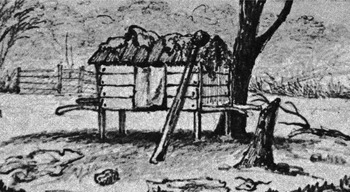
Although Australian shepherds slept in the hut, the hut-keeper slept in a portable watchbox. This had a light pole frame, with projecting handles for carrying and legs for keeping it off the ground, and covered with the ubiquitous bark (figure 8). Most likely his dogs kept him company for warmth. As a boy, Samuel Shumack and his brother ‘slept in one of these contraptions for years. We were quite comfortable in fine weather, but if it rained, which it did frequently, it was misery’ (Shumack, Reference Shumack1967: 33). Bonwick's description of watch boxes used by ‘early’ French shepherds shows that watchboxes were not invented in the colonies (Reference Bonwick1887: 118).
‘Shepherd's watchbox, Villamanatta, 23d March 1854’ by Emma von Stieglitz. The watchbox was a portable hut on legs carried by the hutkeeper and shepherds when the folds were moved, and placed close to the fold, or between a pair of folds. A canvas flap served as a door, and allowed the hutkeeper to exit rapidly if dingoes attacked the sheep. Source: Detail from Plate 30, von Stieglitz Reference Stieglitz1964. (Used with permission of copyright holder, Fullers Bookshop, Hobart).

Shepherds’ wages included rations which varied little over the nineteenth century. In Tasmania, convicts received ten and a half pounds of meat, ten and a half pounds of flour, seven ounces of sugar, three and a half ounces of soap, two ounces of salt per man per week in the late 1820s (Widowson, Reference Widowson1829: 54). Free shepherds received essentially the same in New South Wales in 1846 (Mundy, Reference Mundy1852: vol. 1, 317). The same ration, issued in the 1890s to station hands in the Western Division of New South Wales was called:
ten, ten, two, and one fourth for a single man . . . ten pounds of meat, ten pounds of flour, two pounds of sugar and a quarter of a pound of tea. . . . The tea was called post and rail tea because it was said that the tea was so rough and the pieces of tea so thick, that posts and rails could be split out of the tea issue. (Parr, Reference Parr1977: 73)
Aboriginal shepherds near Carnarvon in Western Australia received a similar ration in 1887, but with the addition of two ounces of tobacco (Carter, Reference Carter1987: 24). Some squatters provided wheat rather than flour, and the hut-keeper ground the grain using a small mill. Flour was universally made into damper, cooked in the hot ashes of the fire. A few made sourdough bread with natural yeasts, but this did not keep as well, and was thus not popular (Richardson, Reference Richardson1925: 72–3). One English visitor and his wife on the Darling Downs in late 1863 recalled ‘at first we had rather a horror of eating damper, imagining it to be somewhat like an uncooked crumpet. Experience, however, showed it to be really very good.’ (Eden 1872, cited in French, Reference French1994: 144)
The quality of the rations provided to shepherds was frequently appalling, but squatters ate essentially the same food. The interminable monotony of the diet based on meat, damper and tea found its way into poetry (Lancelott, Reference Lancelott1852: vol. 1, 263–4). After eating some, William Howitt (Reference Howitt1855: vol. 1, 240) reported ‘I had no idea that commodities so vile could be procured in any part of the world’. Even well connected travellers including Governors faced the same food. In the 1840s, tea gave rise to what may be the earliest Irish joke in Australia:
a stockowner . . . was much pestered by the complaints of one of his shepherds, an Irish emigrant, to the effect that his weekly allowance of tea was insufficient. But as it was ample for most men, the proprietor instituted an inquiry into the matter, and discovered that the ill-advised grumbler knew so little of the use and value of his new acquisition, that he was in the habit of boiling the leaves, and eating it with his meat by way of a vegetable. (Haygarth, Reference Haygarth1848: 26)
One consequence of the poor diet, and poor hygiene exacerbated by water polluted by sheep, was that shepherds (along with other pioneers) suffered a number of diseases including dysentery (Palmer, 1972: 63) and scurvy (Hannsford-Miller, 1990: 28, 39).
Scurvy was an endemic problem as very few hut-keepers or shepherds attempted to grow vegetables, although this changed when more married shepherds were employed, and their wives were paid as hut-keepers. Another manifestation of vitamin C deficiency was Barcoo rot:
a condition where any abrasion or cut festered and spread into infected sores, mostly on exposed parts of the body, such as hands and arms. The sores attracted hundreds of flies which further helped to delay the healing process. A change in diet and climate, with fresh or even tinned fruit and green vegetables normally effected a cure. (Black, Reference Black1988: 18)
Many squatters (and presumably shepherds) avoided scurvy with lime juice, vinegar or pickles, or if these were unavailable, thistles and any native plants they could digest.
Early in the nineteenth century, some settlers, and probably also shepherds, were infected with anthrax (Therry, Reference Therry1863: 264–5), but it was quite uncommon (Anon, 2003). The most common and pervasive disease was sandy blight, an extremely painful condition causing temporary blindness but which could lead to permanent scarring of the cornea. Sandy blight or ophthalmia is a mix of diseases essentially caused by poor hygiene, heat and dust. The ever-present Australian bush flies which target the eyes not only spread the disease but added to the misery of sufferers (Wood, Reference Wood, Pearn and O'Carrigan1983). Queensland shepherds seem to have suffered most from a range of diseases, including fevers and ‘agues’. Some were not properly diagnosed, or even isolated until well into the twentieth century: malaria, dengue fever, leptospirosis, Ross River fever and Q fever (Douglas, Reference Douglas1988). Also widespread and affecting most residents of inland Queensland was Barcoo (or Belyando / Burdekin / Dawson / Paroo) spew (or spue / vomit):
In its mildest form the patient sits down with a good appetite, and enjoys a good meal, but towards the middle or end of his repast sudden qualms assail him, and beating a hurried retreat, he is compelled to sacrifice all to Mother Earth. (Hayman, Reference Hayman1992: 794)
It was not until late twentieth century that a blue-green alga native to most water courses across Australia was identified as the cause (Hayman, Reference Hayman1992: 796; McGregor and Fabbro, Reference McGregor and Fabbro2000: 196).
Sexually transmitted diseases were apparently rife among the early convicts. ‘Syphilis was extremely common among convicts, being spread mainly by sodomy’ (Cannon, Reference Cannon1973: 67). In the 1830s, ‘according to Bishop Ullathorne, in the bush, sodomy was more common among stockmen, “a much more dissolute set”, than shepherds, who lived a more solitary life. Stockmen practised “a great deal of that crime”.’ (Lewis, Reference Lewis1998: 30–1) However, given that shepherds lived with hutkeepers in isolated outstations, their life was considerably less solitary than the bishop may have cared to admit. Indeed, one early Victorian squatter, Captain Foster Fyans believed that ‘there was hardly a shepherd without the disease’ (Bride, Reference Bride1969: 181). Convicts and others infected Aboriginal women, who transmitted the disease back to the whites (Goldsmid, Reference Goldsmid1988: 73). Many shepherds went insane, and although the traditional explanation is boredom exacerbated by alcohol poisoning during the annual spree, Cannon (Reference Cannon1973: 67) suggests that tertiary syphilis may have been the cause.
Shepherds may have also been poisoned by the chemicals used in treating various sheep diseases. For example corrosive sublimate (mercuric chloride) was widely used in treating scab (Haygarth, Reference Haygarth1848: 53), and dips for scab and footrot contained both mercury and arsenic. Shepherds would have been drenched with the solutions which are absorbed through the skin. Semi-sane old shepherds were frequently called ‘hatters’ in Australia (e.g. Wright. Reference Wright1959: 97). While this may have some link to mercury poisoning, the term ‘hatter’ has a difficult etymology (Goldwater, Reference Goldwater1972: 273–5). The term was transferred to the colonies to describe older shepherds in particular, and shepherds in general.
Finally, to add to the misery of the shepherds, and to ensure that a good night's sleep was difficult, the huts were alive with fleas (Lancelott, Reference Lancelott1852: 263) and bed bugs (Mundy, Reference Mundy1852: vol. 1, 322).
One of the best-known behaviours of shepherds and other rural workers of colonial Australia was the annual spree: heading for the nearest hotel or sly-grog shop with the annual wages cheque, drinking vile adulterated alcohol until semi-comatose, and continuing until the cheque was gone or ‘lambed down’ (Millett, Reference Millett1872: 249). Most sheep owners despised their shepherds for the annual binge, and many blamed unscrupulous hotel owners who preyed on the drunken men. But they also benefited because the penniless and hung-over shepherds returned for another year of interminably monotonous shepherding. Characteristically, Mrs Eduard Millett (Reference Millett1872: 249) was more sympathetic than most contemporary commentators. She believed that publicans and the government should each bear some of the responsibility. John Dunmore Lang (Reference Lang1852: vol. 2, 167) essentially blamed squatters who were blocking land reform. This is not entirely fair, but Lang, as a self-appointed champion of the battler class, was a seasoned campaigner against squatters whom he disliked intensely. But Haygarth (Reference Haygarth1848: 30) confirms the connection between the spree and the continuity of employment. While this may well have been true, it cannot have been universal. Even today, many workers on wages have no desire to become self-employed and bear the responsibility for making their own decisions. There is an interesting contradiction between Haygarth's benevolent paternalism in wanting to see shepherds become self-employed, and the real problem for squatters: if the workers were sober, there would be problems employing them.
The origins of such binge drinking probably lie in social behaviour described by Schedvin and Schedvin (Reference Schedvin, Schedvin and Carroll1992: 89 ff). Unfortunately, it has continued to the present and is now acknowledged as a serious social and health problem in both urban and rural areas of Australia (Chikritzhs et al., Reference Chikritzhs, Catalano, Stockwell, Donath, Ngo, Young and Matthews2003: ix–x). Consequently, the annual spree of shepherds is only one manifestation of an historical continuity stretching from mid to late eighteenth-century Britain to present-day Australia.
The shepherds and their backgrounds
Initially convicts were assigned as shepherds to flock owners who applied to the Governor for labour. Presumably there was some attempt to match skills with the jobs, but the demand for shepherds would have far exceeded the supply, and in any event, most convicts were urban. By the late 1830s there was a critical labour shortage as transportation of convicts tailed off. Various government committees investigated the problem and the pastoralists were unanimous in their cries for state-sponsored immigration to alleviate the lack of shepherds (e.g. Committee on Immigration, 1842; Select Committee on Immigration, 1843). However, although there were many experienced shepherds in Britain, they were not necessarily welcome (Marjoribanks, Reference Marjoribanks1851: 39). Edward Curr described his four shepherds who:
were, like most of my servants, rather a nondescript lot, and consisted of the hut-keeper, Antonio Fiore, a native of Calabria, and originally a sailor, . . . [and] three shepherds - one of whom, in days gone by, had been huntsman to a crack pack of fox-hounds in the Green Isle; the second had found his way from the same country to Australia, as a result of his connection with some secret society and an unlucky blow with his shillalah; the third being an active young Scot. (1883: 322)
George Blakiston Wilkinson (Reference Wilkinson1849: 77) describes the motley origins of the shepherds near his property in similar terms. He was convinced that the immigration rules needed changing to favour town-bred men and factory workers to emigrate free because they ‘would make as good shepherds as the man who has been clodhopping all his days’. Despite these frequently repeated views, some thought differently. Poisonous plants wreaked havoc with poorly tended flocks in Western Australia. The only way to avoid many deaths was by careful shepherding:
The lazy London pickpocket or housebreaker may do well enough for a shepherd or hut-keeper upon the plains of Victoria or New South Wales, but amongst the forests of West Australia he is worse than useless. Hence the constant cry from the settlers to their friends in England, ‘above all things send us out respectable intelligent shepherds’. (Millett, Reference Millett1872: 109)
Although the primary image of shepherds is of men, this is not entirely accurate. Squatters and pastoralists seemed to be indifferent to the gender of their shepherds, especially in times of labour shortages and rising wages. Benjamin Boyd stated ‘One of the most vigilant persons I have, is an old Scotch woman, who has charge of 1,500 breeding sheep’ (1843: 42). When married couples were employed, the husband shepherded and the wife was hut-keeper. Children were expected to look after sheep from an early age (Mundy, Reference Mundy1852: vol. 1, 317). John Sidney considered that:
children born in the Bush are no expense, and very little trouble. They live on Indian corn, melons, and potatoes, which grow just by scratching the ground round the hut. . . . Children are . . . valuable in this colony, . . . I have known two little fellows, under ten years of ages, sons of a settler, lamb down a flock of 1,000 ewes. (1848, quoted in Fabian and Loh, Reference Fabian and Loh1980: 39)
Joseph Keynes in a letter written on 1st February 1841, took another view:
[My shepherd's] wife has had another child, she now has two boys and a girl. I hope there is not any more coming; they are not quite so profitable a stock as lambs, their rations cost more and [they do] not make any return. (Linn, Reference Linn1982: 55).
During the gold rushes, at least some wives and children took over shepherding while the male was off at the diggings. On these stations, at least, there was no labour shortage (Suttor, Reference Suttor1887: 82; Lang, Reference Lang1852: vol. 2, 373). At the tender age of eight, Samuel Shumack (Reference Shumack1967: 31–3) was shepherding a flock with his sister near present-day Canberra, and had his own flock of three thousand to shepherd two years later in 1860. He also said that ‘as soon as they could toddle children became shepherds’. Elsewhere, women and children looked after flocks in South Australia in the early 1850s (Hawker and Linn, Reference Hawker and Linn1992: 124), and sixteen year old girls were shepherding in Western Australia in the 1860s (Millett, Reference Millett1872: 122–4). From these examples it is safe to conclude that as more shepherds married, their wives and later their children were expected to contribute to the work.
While it may appear that squatters and pastoralists preferred white (and preferably British) shepherds, the truth is more likely that they simply did not care what race a shepherd was as long as someone was watching their flocks. Besides, non-whites were paid considerably less, so there was a good cost saving. This is borne out by Edward Ogilvie who employed English, Aborigines, and Chinese, and with some difficulty, Germans, to shepherd his sheep in the upper Clarence River of northern New South Wales from the late 1840s to 1860 (Farwell, Reference Farwell1974: 182 ff). By late 1859 Ogilvie's sheep were ‘wholly shepherded by Germans and gins’ (Farwell, Reference Farwell1974: 237). A recurring story about indentured imported labour is deception: the immigrants were frequently signed up on poor wages and they only realised this on arrival in the colonies.
Despite the on-going conflict with Aborigines in many parts of the colonies, squatters and pastoralists, in areas where Aborigines were more peaceful and cooperative, employed Aborigines as shepherds with some success from at least the 1830s in Victoria (Reynolds, Reference Reynolds1990: 89). The Jamieson brothers successfully employed Aborigines on Mildura Station on the Murray River in the 1840s and 1850s (Bride, Reference Bride1969: 379). In the late 1840s Edward Ogilvie:
assigned Aborigines as shepherds or hutkeepers to various flock stations [on the upper Clarence River in northern New South Wales], leaving a European to train them for an initial period. Hence, in subsequent labour shortages, he was always assured of men to look after his sheep. (Farwell, Reference Farwell1974: 182)
The value of Aboriginal children as shepherds is highlighted by attempts in 1886 by ‘the squatter members of the WA Legislative Council . . . to have the legal age of employment of Aborigines lowered to ten’ (Cannon, Reference Cannon1973: 64). About the same time on the Gascoyne River in Western Australia flocks were shepherded by Aborigines ‘- usually a man and his woman or gin. The woman usually does most of the shepherding, the man hunting wallabies, rats and snakes and helping her drive the sheep back to camp at night.’ (Carter, Reference Carter1987: 8). Aboriginal shepherds effectively insulated the South Australian pastoralists from labour problems during the gold rushes. In June 1852, ‘Sir H. Young [Governor of South Australia] stated that upwards of 200,000 sheep were “in charge of shepherds who are aborigines”’ (Rusden, Reference Rusden1897: vol. 2, 630). Even as late as the 1920s and 1930s, Aborigines (including women) were used as shepherds in the Northern Territory (Ford, Reference Ford1966: 163). There was a hidden, but known and accepted, cost to the pastoralists because Aboriginal shepherds stole sheep to share with kin (Reynolds, Reference Reynolds1990: 200). However, there were obvious financial benefits of employing Aborigines because they cost a fraction of a white shepherd. The universal feature of Aboriginal employment was their exploitation. If they received wages, they were paid considerably less than whites. More often, they were not paid at all, just given poor quality rations and cast-off clothes.
Although many colonists were averse to Asiatics, some squatters and pastoralists tried to relieve labour shortages by importing indentured workers (coolies) from Asia. The fate of nearly one hundred workers at Port Phillip in 1848 is illustrative. Although they were to be paid twice what they could earn at home, it was only half what other shepherds were being paid, and their rations were only two-thirds of the Europeans’ (Broome, Reference Broome1984: 63). Edward Ogilvie employed both Chinese and Indian shepherds on his Clarence River station in the early 1850s. He paid them only £7. 4s. 0d. per year, which was considerably less than the whites. Their rations had rice replacing wheat in some acknowledgement of cultural preferences: ten pounds of rice, two ounces of tea, thirteen pounds of beef or fourteen pounds of mutton, plus one pair of boots, a pair of trousers and a shirt each year. Ogilvie preferred Indians because ‘they were not so subject to gusts of passion at some misunderstood trifle, and do not so often leave their sheep in the hurdles or go away in a body’ (Farwell, Reference Farwell1974: 191). However, he seems to have had little choice as Indians were rarely available. Despite Ogilvie's reservations, his sister believed that Chinese ‘made good, trustworthy shepherds’ (E.W. Bundock 1894, cited in Farwell, Reference Farwell1974: 192).
Importing Melanesians (kanakas) from Pacific Islands was an accepted way of obtaining labour in north Queensland in the mid to late nineteenth century. An early attempt to use them in southern New South Wales failed dismally. In 1847 Benjamin Boyd was one of the biggest sheep-owners in Australia with large stations on the Monaro and the Murray River, but with a critical shortage of shepherds. Part of his difficulty was his region's remoteness, but a large part was his own fault. He paid lower wages and had larger flocks than other squatters, and expected his shepherds to camp out in the open. In 1847 he landed sixty-five Melanesians at his private town on the south coast of New South Wales. Each man had signed a contract to work in any position for five years for the princely sum of twenty-six shillings per year. This was at a time when white shepherds were being paid around twenty five pounds. Very quickly some of the kanakas absconded from the Monaro, and some even walked four hundred kilometres to Sydney. The debacle was eventually resolved when the Governor organised their repatriation home. Already unhappy with Boyd, the Legislative Council amended the Masters and Servants Act to exclude contracts with Pacific Islanders. This immediately freed Boyd's kanakas from their contracts, and also meant that another fifty-four men and three women who arrived on his ships in October 1847 were not bound to work for him (Diamond, Reference Diamond1988: 128–38). Boyd was exceptionally ruthless in his treatment of shepherds. The indentured Melanesians had no idea of the value of labour, and were thus tricked into virtual slavery. As Diamond says ‘If white labour could have been hired at equally low rates of pay, there is no reason to suppose that Boyd would not have done so’ (1988: 138).
Kanakas were subsequently employed as shepherds in Queensland where whites were unwilling to venture into remote regions because Aborigines remained a danger. Eventually in 1877 the Queensland government acceded to demands from humanitarians to end what was essentially kidnapping (blackbirding) of Melanesians other than for tropical or semi-tropical agriculture. However, the trade continued and despite the objections of the European labourers, kanakas:
were free to take any employment offered them, without subjecting themselves to Governmental inspection or control. Many of them became shepherds or station hands on stations in the north and west of the colony, where it was difficult for pastoralists to obtain an adequate supply of European labour. (Coghlan, Reference Coghlan1918: vol. 3, 1301)
John Dunmore Lang, in his usual florid rhetoric, considered that ‘the German immigration that is now in progress is nothing more nor less than a mitigated form of the slave trade’ (1861: 33). In 1852, Edward Ogilivie was having trouble importing German shepherds because the agent would not guarantee delivery (Farwell, Reference Farwell1974: 194). The indentured Germans probably realised that they had been deceived and took other work paying higher wages between the port of arrival and the Clarence. However, not all were doomed to disappointment. Those brought out to the Darling Downs between 1852 and 1855 ‘proved to be reliable, frugal and sober workers who invariably managed to save sufficient cash out of their wages of £20–30 per year (and rations) to enable them to take up land in the ‘sixties’ (Waterson, Reference Waterson1968: 126).
Relations with Aborigines
In the last decade, there have been vituperative arguments between Australian historians on the impact of European settlement on Aborigines (see e.g. Dawson Reference Dawson2004). I do not wish to enter this debate, but it is important to point out that there were frequent conflicts between shepherds and Aborigines. There is no doubt that Aborigines stole sheep and attacked and killed shepherds. Some of the killing may have been to defend territory, but a lot seems to have been triggered by the taking of women. On the other side, there is no doubt that shepherds raped Aboriginal women and killed Aborigines in retaliation for real or imagined offences. It would be incredibly naïve to think that squatters and shepherds did not have sexual relations with Aboriginal women: willing partners, rape victims or prostitutes. One end result was the spread of sexually transmitted diseases such as syphilis. The difficulty with prostitution of Aboriginal women was a frequent lack of understanding, or perhaps deliberate misunderstanding, by the shepherd, of the commercial nature of the transaction. A typical example is ‘a shepherd [who] was attacked because he had taken an Aborigine's wife without giving damper in payment for her. . . . [the district Protector of Aborigines] believed that most disputes originated from this cause’ (Nance, Reference Nance1981: 546).
An extreme example of intolerance towards Aborigines, and resulting violence occurred in June 1824 at Bathurst when the Governor, Sir Thomas Brisbane, declared martial law which lasted four months. Rusden believed that the cause of Aboriginal attacks was extreme provocation by whites, especially shepherds (1897: vol. 1, 514–5). Perhaps reporting the same incidents, Henry Suttor, a local resident subsequently wrote that:
The blacks were troublesome at Bathurst in those days - the cause, very frequently, was their ill-treatment by the whites. Poisoned dampers had been left purposely exposed in shepherds’ huts in order to tempt the blacks to steal and to eat. They did eat, and died in horrible agony. (1887: 65)
Any Aboriginal response to such incidents was met with increased violence. Godfrey Mundy describes a typical retaliatory expedition against Aborigines, and the escalating violence that followed (1852: vol. 1, 228–9). While he does not give dates and places, there are witness accounts which confirm that such massacres did indeed occur.
In later years, Aborigines competed directly with whites for unskilled labouring jobs such as shepherding (Reynolds, Reference Reynolds1990: 104–7). As Aborigines frequently worked for rations only, they were considerably cheaper than whites, who were consequently unemployed. There is little doubt that such ‘injustices’ inflamed existing racist antipathy towards Aborigines, and this may have been expressed in violence.
At the bottom of the social order
The adjectives of contemporary writers leave us with no doubt of their views of shepherds: aimless, anti-social, careless, crazy, demanding, diseased, dishonest, drunken, filthy, foul-mouthed, improvident, incompetent, indolent, lacking ambition, misanthropic, perfidious, sullen, truculent, unlettered, useless, witless. Some contemporary commentators clearly despised shepherds. Alexander Marjoribanks seems to quiver with outrage while reporting ‘Dr Thomson, [Member of the Legislative Council for Port Phillip], said [in about 1849] that when shepherds had too high wages, their behaviour became frequently extravagant and quite outrageous, drinking even champagne occasionally, as he himself had been offered a bottle of champagne by one of his own shepherds’ (1851: 262–3). No doubt Thomson would have cheerfully accepted champagne from a bankrupt squatter of his own class. Although generally sympathetic to shepherds, Millett offers an unusually jaundiced view on the standing of shepherds: ‘If a “privileged class” can be said to exist in the colony, it is that of the shepherds, who . . . are paid from thirty to forty pounds a year with the addition of their food’ (1872: 249).
A recurring theme in the biography of a nineteenth century English shepherd is loyalty to the flock owner and to his village (Hudson, Reference Hudson1954). At least two examples show that such loyalty also occurred in the colonies. John Phillips describes an incident when his shepherd, a forty-six year old army deserter and ex-convict transported for highway robbery, would not kill a sheep or borrow his master's tobacco when the boss was absent (“A pioneer”, 1893: 48–9). In another case, Rolf Boldrewood describes a shepherd who saved money, and invested in sheep (Reference Boldrewood1969: 88–9). On his death, he willed his entire estate to the master's son, in appreciation of the support the family had given him. Although a long-lost sister materialised and she received the bulk of the estate, the squatter's son still received £1,000.
Contemporary observers comment specifically on the lowly social position of shepherds (e.g. Mundy, Reference Mundy1852: 314; Haygarth, Reference Haygarth1848: 45). Shepherding was slow, unskilled, interminably monotonous, safe and done on foot. In marked contrast, stock work with cattle was fast, highly skilled, ever-changing, dangerous and done on horseback. Shepherding was drudgery for old men, cattle work was for young men who revelled in the danger (Perkins and Thompson, Reference Perkins, Thompson and Day1998). Lynette Peel suggests that differences in social standing were inherited from Britain, where stock workers (herdsmen and shepherds) were more highly regarded than agricultural labourers (Reference Peel1974: 21–2). While she concludes that ‘To this day, of all the rural activities, grazing is still held in the highest social esteem’, this did not apply to colonial shepherds at the bottom of the social ladder. Schedvin and Schedvin (Reference Schedvin and Schedvin1978: 275–6; 1992: 108ff) suggest that early convicts brought with them attitudes from the social under-classes of Britain, and this tainted both their peers and the views of their betters. While some squatters bemoaned drunken shepherds on their sprees, others despaired of their inability to rise above the squalor of shepherding to become thrifty yeomen farmers, even squatters. Some shepherds managed to become squatters or pastoralists in their own right, usually by accumulating capital in the form of sheep acquired on the system of ‘thirds’. In the 1840s, as many squatters succumbed to bankruptcy, debt-free shepherds were able to become squatters in their own right (Landor, Reference Landor1847; Millett, Reference Millett1872: 117–8).
It is difficult to believe the evidence of James Malcolm, ‘an extensive proprietor in Port Phillip’, before a Select Committee of the Legislative Council of New South Wales, in the year 1845. Malcolm stated that ‘many of my shepherds, after they have been a few years in service, have saved perhaps one or two hundred pounds, and have turned farmers on their own account’. Wages peaked at about fifty pounds in 1840 before falling in the depression of the 1840s to twenty-five pounds. Any shepherd wanting to accumulate £200 would need close on ten years if he saved about fifty per cent of his wages. More likely, such shepherds were accumulating capital in the form of lambs on the ‘thirds’ system. However, woe betide any shepherd who thought that his past status would be forgotten. Captain Foster Fyans’ class sensibilities were particularly offended by squatters who were:
old shepherds. I have known this class to grown rich, the master poor, and in time the worthy would become the licensed squatter. I have known many of them to become wealthy, and some who did not forget themselves; but most were out of place, and it would have been better for the community had they remained shepherd rather than become masters. (Bride, Reference Bride1969: 187)
Ever the champion of the under-classes, John Dunmore Lang (Reference Lang1852: vol. 2, 202–3) noted the effectiveness of the existing social system in hindering the advancement of shepherds, a view supported by Mrs Eduard Millett (Reference Millett1872: 250). But the financial realities of becoming an independent farmer were close to overwhelming even when land could be purchased. The problem was a lack of capital which, after a deposit was put on the land, would scarcely allow development of cultivation (Walker, Reference Walker1957: 75).
Conclusions: appropriate technology for frontier Australia
Eventually, free grazing of sheep in fenced paddocks replaced shepherds. This did not occur instantly across the continent, indeed, shepherds were used in the Northern Territory until at least 1936 (Chambers, Reference Chambers1998: 29). I have looked elsewhere at the transition to fences, suggesting that this was far more complex than most authors have described, and is the story of protracted changes, and learning and re-learning by pastoralists (Pickard, Reference Pickard2007: 158–9). Suffice to say here that before fences could become universal, each of the following six changes was necessary: appropriate and secure land tenure so that squatters and pastoralists would invest in improvements including fences; eradication of dingoes; reduction/end of theft by Aborigines; realisation that sheep camped in the open were more productive and less prone to disease; better technology in the form of iron wire; and scarcity of shepherds and high wages during gold rushes.
These changes were not sequential, flowing in a logical succession as a series of waves across the continent. Instead, as the various colonies and frontiers developed, and individual pastoralists learned that changed management improved production and lowered costs, the knowledge spread. Pastoralists learned from experience and informal diffusion of knowledge, that there were distinct financial advantages in paddocking sheep rather than shepherding them.
Patrick Gordon (Reference Gordon1867: 10–1) gave the first clear statement of the advantages of paddocking, asserting that the sheep carry more wool, and the wool is of sounder staple; a run on being fenced in would carry nearly double the number of sheep which it did before; there would be a saving in wages and rations, and the stockmaster would not be at the mercy of careless, or inexperienced shepherds; foot rot would not be so prevalent; the sheep would grow to a larger size, and fatten better; there would be a larger percentage of lambs from maiden ewes than if they were lambed down in the usual way in yards and hurdles; and coastal districts and scrubby country, at present considered unavailable for sheep-farming, could be utilised by being fenced in. Gordon was a zealous proselytiser and over-stated his case. It is impossible to test many of these claims as fencing was not the only change over this period. Forest and woodland was being ring-barked to improve growth of grasses, better breeding increased wool clips, and so on. Despite this, pastoralists could see advantages in fencing. The sum of these advantages made financial sense, or the pastoralists would not have adopted fences and discarded shepherds.
It is instructive to read the sixteenth century advice of John Fitzherbert: ‘And thoughe a man be but a farmer, and shall haue his farme xx yeres, it is lesse coste for hym, and more profyte, to quyckset, dyche, and hedge, than to haue his cattell goo before the herdeman’ (Reference Fitzherbert1534: 77) [Although a farmer's tenancy may be only twenty years, it is cheaper for him, and he will make more profit if he fences with ditch and hedge, than to have his stock roaming freely with a shepherd]. So perhaps the question to be asked is ‘why did it take so long for Australian colonists to build fences’ rather than ‘why did shepherding persist so long in the colonies?’ The answer is fairly simple: shepherding was a highly appropriate technology that provided the cheapest means of managing sheep to produce wool on both the frontiers and settled areas of the colonies. During the heyday of shepherding, sheep numbers in the colonies grew from the initial flock of fewer than ten individual animals in 1788 to over thirty-six million by 1870 (effectively the end of shepherding) and the export wool clip from zero to over sixty-three million kilogrammes (Barnard Reference Barnard1958, Tables V and IV).
Although despised by their peers, maligned by their social betters, and usually working under very poor conditions, shepherds contributed enormously to the growth of the colonies, and were a cornerstone of the foundation of the wool industry that dominated Australian exports for almost two hundred years.
Note on terminology
Stock-owners who illegally occupied land in colonial Australia in the early part of the nineteenth century became known as ‘squatters’. The term persisted even after land legislation allowed them to obtain annual licences to occupy the land.
‘Paddock’ is any area of land enclosed by fences, usually a subdivision of a farm or grazing property. (UK = field, US = pasture)
Acknowledgements
The Department of Physical Geography, Macquarie University provided funding for parts of this study. Dr Trish Fanning (Graduate School of the Environment, Macquarie University) and Dr Geoff Humphreys (Department of Physical Geography) provided helpful comments on the manuscript. Staff of the Document Supply section, Macquarie University Library located a range of references for me.