Introduction
There is an abundance of literature in support of myringoplasty as a successful operation for both closure of the tympanic membrane and improvement in hearing thresholds. This has been demonstrated both in adultsReference Kotecha, Fowler and Topham1–Reference Black and Wormald4 and children.Reference Black, Hickey and Wormald5–Reference Pignataro, Berta, Capaccio and Zaghis7 However, there is debate in the literature over whether the size of tympanic membrane perforations is predictive of surgical success. Many studies inversely correlate perforation size with successful operative closure,Reference Kotecha, Fowler and Topham1, Reference Bhat and De3, Reference Black and Wormald4 whereas others demonstrate that perforation size is not a determinant for surgical success.Reference Pignataro, Berta, Capaccio and Zaghis7–Reference Gersdoff, Gardin, Decat and Juantegui9 An improvement in audiologically determined air conduction hearing has been widely demonstrated following successful myringoplasty; however, to date only one paper has attempted to correlate audiological improvement with perforation size following successful myringoplasty.Reference Lee, Kelly and Mills10
Objectives
The objectives of this retrospective study were threefold. Firstly, we aimed to investigate the impact of perforation size on successful operative closure of tympanic membrane perforations. Secondly, we aimed to investigate the impact of other variables on successful operative closure of tympanic membrane perforations. Thirdly, we aimed to determine audiological gain following successful closure of tympanic membrane perforations of various, categorised sizes.
Methods
Study design
A retrospective analysis of case notes for patients undergoing myringoplasty between January 2006 and December 2007 was performed. Patients were identified from coded operating theatre records at the Leicester Royal Infirmary.
Exclusion criteria
In order to create a homogeneous list of case notes, we excluded from the study patients with cholesteatoma, retraction pockets, scutum or ossicular erosion, as well as those undergoing combined procedures such as additional cortical mastoidectomy or ossiculoplasty. We also excluded patients whose case notes contained no documentation or illustration of pre-operative perforation size as a percentage of the total surface area of the tympanic membrane. Knowledge of tympanic membrane perforation size was obviously essential in meeting the study objectives, and was obtained either from explicit documentation of percentage size in the clinic notes or from estimation of percentage size based on drawn, diagrammatic representation. Two hundred and forty-seven case notes were initially requested for the study. With the application of exclusion criteria, however, data for only 130 myringoplasties were considered.
Main outcome measures
To address the three study objectives, two main outcome measures were recorded.
Firstly, we documented whether the tympanic membrane was closed following myringoplasty (i.e. success) or not (i.e. failure). Data on the following variables were also recorded: age, sex, perforation size (as a percentage of tympanic membrane surface area), grade of surgeon, surgical technique, graft material, previous myringoplasty and smoking history. Each variable, except age and sex, was analysed with respect to surgical success in closing the perforation.
Secondly, we documented the gain in audiometrically determined, air conduction hearing following successful myringoplasty. The available four-frequency (i.e. 0.5, 1, 2 and 4 kHz), pre- and post-operative, air conduction audiometric thresholds were recorded for each case. All cases were grouped into one of five categories based on perforation size as a percentage of the total surface area of the tympanic membrane (i.e. 0–20, 21–40, 41–60, 61–80 and 81–100 per cent). All unsuccessful myringoplasty cases were excluded from this part of the study. Mean pre- and post-operative, four-frequency, air conduction audiometric thresholds for all successful myringoplasties in each category were calculated and compared.
Statistical analysis
The chi-square test was utilised to statistically analyse the difference in operative success rates between the various perforation size categories and other recorded variables. The paired t-test was used for statistical analysis of air conduction audiometric gain following successful closure of the various perforation categories. All calculations were performed by a statistician at Bedfordshire University.
Results
Patients' ages ranged from seven to 81 years (mean, 30.5 years), and the male to female ratio was 61:69. The overall myringoplasty success rate was 80.8 per cent (105/130). All 130 patient case notes contained information on operative success and the other variables of interest (i.e. age, sex, perforation size, grade of surgeon, surgical technique, graft material, previous myringoplasty and smoking history). Of the case notes for the 105 successful myringoplasties, only 85 contained both pre- and post-operative audiometry results. Therefore, only data from these 85 case notes were considered when determining audiological gain following successful myringoplasty for tympanic membrane perforation. The mean four-frequency audiometric gain for all 85 successful myringoplasties, considered together, was −6.8 dB (p < 0.0001).
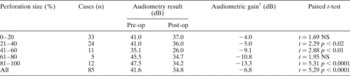
The impact of perforation size and other recorded variables on operative success is shown in Table I. Table II shows the mean pre- and post-operative air conduction thresholds of the successful myringoplasty patients, for the various perforation size categories. Figure 1 illustrates the audiometric gain for each perforation category. Statistical analyses are included in both Tables.
Mean four-frequency audiometric gain following successful closure of tympanic membrane perforations of various sizes (expressed as percentage of total tympanic membrane surface area). Pre-op = pre-operative

Myringotomy success rates for differing tympanic membrane perforation sizes and other variables*

* n = 130 cases. Perf = perforation; op = operative; df = degrees of freedom; NS = not significant
Mean, four-frequency, air conduction audiometry results for patients with successful myringoplasty*

* Whose case notes contained both pre- and post-operative audiometry results. †A negative audiometry gain indicates improved hearing. Pre-op = pre-operative; post-op = post-operative; NS = not significant
Discussion
Findings relevant to the three study objectives are considered below, with comparison to previous published data and discussion of clinical applicability.
Impact of perforation size on successful operative closure
Although lower success rates were observed for patients with larger tympanic membrane perforations, statistical analysis demonstrated no significant difference in surgical success rates between the various perforation size categories. Thus, on the basis of this study, perforation size was not predictive or determinant of successful myringoplasty. This is in keeping with other studies,Reference Pignataro, Berta, Capaccio and Zaghis7–Reference Gersdoff, Gardin, Decat and Juantegui9 and is likely to be explained by the importance of perforation site as a significant determinant of surgical success.Reference Kotecha, Fowler and Topham1, Reference Bhat and De3
Impact of other variables on successful operative closure
No significant effect of grade of surgeon on operative outcomes was observed in this study. This finding is in agreement with two other studies.Reference Bhat and De3, Reference Palva and Ramsay11 In contrast, a number of other studies report poorer success with junior versus senior grade surgeons.Reference Black and Wormald4, Reference Black, Hickey and Wormald5, Reference Vartiainen and Nuutinen12
No surgical technique observed in this study produced any statistically significant improvement in operative success compared with other techniques. This finding agrees strongly with the existing literature.Reference Black and Wormald4, Reference Black, Hickey and Wormald5, Reference Pignataro, Berta, Capaccio and Zaghis7, Reference Vartiainen and Nuutinen12, Reference Gibb and Chang13 This result suggests that either no particular surgical approach is optimal in myringoplasty, or that the technique chosen in each case was appropriate for both the site and size of perforation to be closed. The latter theory is most probable.
Choice of graft material was not found to be a statistically significant factor in the success of tympanic membrane perforation closure. The effect of graft material on the success of myringoplasty is poorly documented in the literature. Only one study was identified which correlated the two variables, and the same conclusion was drawn.Reference Gibb and Chang13
Revision myringoplasties had no significant impact on surgical success in this study, a finding widely supported by the literature.Reference Black and Wormald4, Reference Black, Hickey and Wormald5, Reference Palva and Ramsay11, Reference Vartiainen and Nuutinen12
Similarly, smoking history also had no statistically significant effect on the ‘take’ rate following myringoplasty. This is in contrast with one published study, which found that smoking was associated with a three-fold increase in the chance of long-term graft failure (six months post-surgery).Reference Becvarovski and Kartush14 In this study, all results were obtained from short term follow up only (i.e. up to three months post-surgery); therefore, any delayed smoking-related failure would probably not have been evident.
Therefore, pre-operative tympanic membrane perforation size was found not to be a statistically significant determinant factor for successful myringoplasty; grade of surgeon, operative technique, choice of graft material, previous myringoplasty and smoking history were similarly unrelated.
Audiological gain following successful perforation closure
Achievement of an audiometric gain in hearing thresholds following successful myringoplasty has been widely demonstrated, both in paediatric and adult populations.Reference Kotecha, Fowler and Topham1–Reference Pignataro, Berta, Capaccio and Zaghis7 All these studies combined tympanic membrane perforations of all sizes when considering post-operative audiometric gains. In the current study, when successful closure of all perforations was considered, we observed mean air conduction to improve from 41.6 to 34.8 dB, an audiometric gain of 6.8 dB; this change was highly significant (p < 0.0001). However, given the variation in size of tympanic membrane perforations (which can range from a ‘pinprick’ to subtotal perforation), such generalisation of audiometric improvement following successful myringoplasty is arguably a gross oversimplification. For example, one would expect a significant audiometric gain following successful repair of a subtotal perforation, but little if any gain following a fat plug myringoplasty for a pinprick, dry, central perforation. Thus, studies which calculate mean audiometric gains for a combination of different tympanic membrane perforation sizes misleadingly imply that such gains would be applicable for all perforations, regardless of size. We identified only one paper which attempted to correlate perforation size with audiometric gain following successful closure.Reference Lee, Kelly and Mills10 In this study, mean audiometric gain for each of 261 successful myringoplasties was plotted against pre-operative perforation size in a scatter plot graph. However, for the purposes of statistical testing, perforations were categorised only as ‘small’ (i.e. <50 per cent) or ‘large’ (i.e. >50 per cent). Mean audiometric gain following successful repair of large perforations was found to be significantly greater than that for small perforations (being −10.2 and −7.2 dB, respectively).
As part of our study, we attempted to elaborate further on the impact of pre-operative perforation size on audiometric gain after successful myringoplasty. The purpose of this was to provide evidence to justify attempted closure of tympanic membrane perforations of differing size, for hearing improvement alone. Perforations were categorised into one of five groups based on percentage size (i.e. 0–20, 21–40, 41–60, 61–80 and 81–100 per cent). Air conduction audiometric data for successful myringoplasties in each size category, along with statistical analysis, are listed in Table II, and audiometric gain for each category is illustrated in Figure 1. As one would expect, air conduction improvement following successful myringoplasty correlated well with pre-operative perforation size (Figure 1). The poorest audiometric gains were observed following operative closure of small perforations (i.e. −4.0 dB for 0–20 per cent perforations). Audiometric gains increased progressively for each incremental category of pre-operative perforation size, with maximal audiometric gains being observed for closure of the largest perforation category (i.e. −13.3 dB for 81–100 per cent perforations). Interestingly, audiometric gains for the smallest perforation category (i.e. −4.0 dB in 0–20 per cent perforations) were not statistically significant, despite the fact that this size category accounted for the most cases (n = 33) (Table II). The audiometric gains following successful closure of larger perforations were all statistically significant, with the exception of the 61–80 per cent perforation category (Table II). Although no statistically significant improvement in air conduction was observed for the 61–80 per cent category (mean audiometric gain −10.8 dB), such statistical insignificance was purely due to insufficient numbers within the group (n = 5), not to poor audiological improvement.
• Many published studies have identified myringoplasty as a successful procedure for closing tympanic membrane perforations and improving air conduction hearing
• However, the impact of perforation size upon myringoplasty success and (in successful cases) audiological hearing gain is poorly documented in the literature
• This study found that perforation size was not a statistically significant determinant factor for myringoplasty success
• Audiometrically determined gains in air conduction hearing following successful myringoplasty were found to correlate directly with pre-operative perforation size; however, no statistically significant audiometric improvement was observed following successful closure of small perforations (i.e. 0–20 per cent)
• Based on this study, surgical repair of small perforations should not be undertaken solely to achieve improvement in air conduction hearing
In this study, we have demonstrated that audiometrically determined gains in air conduction hearing following successful closure of tympanic membrane perforations directly correlate with pre-operative perforation size. Furthermore, we observed no statistically significant improvement in air conduction hearing following successful closure of small (i.e. 0–20 per cent) perforations. Therefore, on the basis of this study, surgical repair of small perforations should not be undertaken purely to achieve improvement in air conduction hearing.
Conclusion
The overall success rate of myringoplasty in this retrospective study was 80.8 per cent. Pre-operative perforation size, grade of surgeon, operative technique, choice of graft material, previous myringoplasty and smoking history were not statistically significant determinant factors for successful operative closure of tympanic membrane perforations. Following successful myringoplasty, audiometrically determined gains in air conduction hearing directly correlated with pre-operative perforation size, with larger audiometric gains being observed for larger tympanic membrane perforations. However, no statistically significant improvement in audiometric air conduction was observed following successful closure of small (0–20 per cent) perforations.
This study had obvious limitations, in that it was retrospective and relied completely on the subjective estimation and documentation of pre-operative tympanic membrane perforation size by various different ENT doctors. Undoubtedly, there would have been a wide variation in the quality of size estimation and written or illustrative documentation, which was in no way standardised or objective. This in turn could potentially introduce a high degree of error into the documented results. Furthermore, the methodological exclusions applied to the assessment of audiological gain following successful myringoplasty diminished the number of case notes from 247 to 85. Consequently, there were insufficient numbers to establish certain results as statistically significant. Thus, a larger, prospective study is required with objective, standardised perforation size assessment methods (such as photography), in order to confirm the results of this study as genuinely valid.
This study supports existing evidence that myringoplasty is an effective procedure both for closing tympanic membrane perforations and for improving air conduction hearing thresholds. In addition, our findings provide new evidence to correlate pre-operative tympanic membrane perforation size with audiometrically determined air conduction hearing gains following successful myringoplasty.
Acknowledgement
We would like to thank Dr R Driver at the University of Bedfordshire for performing all statistical calculations.