Psychopathy is a personality disorder characterized in part by diminished emotional processing, callousness, a grandiose and self-centered interpersonal style, and persistent antisocial behavior (Cleckley, Reference Cleckley1976; Hare, Reference Hare1996). While only evident in about 1% of the general population, approximately 15–20% of incarcerated individuals meet clinical criteria for psychopathy (Hare, Reference Hare2003). The frequency and severity of antisocial behavior committed by psychopaths precipitate a disproportionate weight on the criminal justice system and societal costs in general (Kiehl and Hoffman, Reference Kiehl and Hoffman2011). As such, elucidating the etiology of and pathophysiology giving rise to psychopathy has become an urgent priority among criminologists, psychologists, and neuroscientists.
Early neurobiological models of psychopathy emphasized impairments in the brain's response to threat and evaluation of emotional significance (Patrick, Reference Patrick1994; Blair, Reference Blair1995; Lykken, Reference Lykken1995). Continued progress has also highlighted more distributed neurocognitive abnormalities across many cognitive domains (Newman et al., Reference Newman, Schmitt and Voss1997; Kiehl et al., Reference Kiehl, Hare, McDonald and Brink1999; Blair, Reference Blair2001, Reference Blair2005) and in mechanisms driving appropriate shifts of attention (Newman and Lorenz, Reference Newman, Lorenz, Davidson, Scherer and Goldsmith2003). Rather than a simple deficit in fear or threat detection, psychopathic individuals demonstrate normal-range processing of affective information in many contexts, but they may have difficulty incorporating this information into higher-order cognitive functions and modifying their behavior based on competing priorities (Newman et al., Reference Newman, Curtin, Bertsch and Baskin-Sommers2010; Hoppenbrouwers et al., Reference Hoppenbrouwers, Bulten and Brazil2016). Further, functional neural deficits in psychopathy extend beyond centers for emotional processing into more distributed regions of the brain (Kiehl, Reference Kiehl2006; Anderson and Kiehl, Reference Anderson and Kiehl2012). Additional evidence suggests potential limitations in cross-hemispheric neural transmission (Hiatt and Newman, Reference Hiatt and Newman2007; Lopez et al., Reference Lopez, Kosson, Weissman and Banich2007; Hoppenbrouwers et al., Reference Hoppenbrouwers, De Jesus, Sun, Stirpe, Hofman, McMaster, Hughes, Daskalakis and Schutter2014). Contemporary neurobiological models of psychopathy have thus begun to emphasize the discovery of pathophysiology across large-scale neural networks serving these integrative roles (Hamilton et al., Reference Hamilton, Hiatt Racer and Newman2015; Anderson et al., Reference Anderson, Steele, Maurer, Rao, Koenigs, Decety, Kosson, Calhoun and Kiehl2017).
The recent emphasis on integrative impairments in psychopathy has also revived interest in the contributing roles of certain structural and functional elements that have received relatively little attention in the past. Importantly, the corpus callosum (CC) is the largest integrative pathway in the human brain, linking the two hemispheres, but it has received minimal attention in extant psychopathy research. Only one prior study has examined CC morphology in relation to psychopathic traits and antisocial behavior. Raine et al. (Reference Raine, Lencz, Taylor, Hellige, Bihrle, Lacasse, Lee, Ishikawa and Colletti2003) reported increased CC total volume, paired with increased callosal length and reduced thickness among a community sample of individuals (n = 15) with elevated antisocial and psychopathic traits compared with non-antisocial controls (n = 25). These findings were interpreted in support of impaired integrative capacities and evidence for neurodevelopmental abnormalities in psychopathy; however, the direction of the relationships reported therein do not unambiguously align with our emerging understanding about relationships between white matter structure and functional connectivity (e.g. Aboitiz et al., Reference Aboitiz, Scheibel, Fisher and Zaidel1992; Pol et al., Reference Pol, Schnack, Mandl, Cahn, Collins, Evans and Kahn2004; Luders et al., Reference Luders, Phillips, Clark, Kurth, Toga and Narr2012) vis-à-vis emerging findings of limited structural and functional network connectivity in psychopathy (Lopez et al., Reference Lopez, Kosson, Weissman and Banich2007; Motzkin et al., Reference Motzkin, Newman, Kiehl and Koenigs2011; Philippi et al., Reference Philippi, Pujara, Motzkin, Newman, Kiehl and Koenigs2015; Espinoza et al., Reference Espinoza, Vergara, Reyes, Anderson, Harenski, Decety, Rachakonda, Daramaju, Rashid, Miller, Koenigs, Kosson, Harenski, Kiehl and Calhoun2018). Furthermore, there are potential limitations extending Raine's report involving community samples to expectations in an incarcerated sample.
It has become increasingly evident that antisocial behavior is influenced by a number of heterogeneous factors and neurocognitive vulnerabilities (Jorgensen et al., Reference Jorgensen, Anderson and Barnes2016). Identifying neurobiological features that are specific to the pathophysiology of psychopathy requires differentiating them from many other intermingling contributions to antisocial behavior that may also affect the brain. A useful strategy for this is to examine differences attributable to psychopathic traits among antisocial individuals (e.g. an incarcerated sample) while controlling for a variation on other comorbid factors such as substance use severity. In such a context, large samples are paramount to capture potentially subtle but reliable effects that distinguish elements of psychopathic traits from other common features of antisocial populations.
In this study, we set out to examine the relationship between psychopathic traits and CC volume in a large incarcerated sample, evaluated with structural magnetic resonance imaging (MRI). Prior work from our laboratory has demonstrated impaired structural and functional connectivity using multimodal evaluations (diffusion and fMRI) of large-scale cortical networks involving the frontal, temporal, and parietal cortex (Motzkin et al., Reference Motzkin, Newman, Kiehl and Koenigs2011; Philippi et al., Reference Philippi, Pujara, Motzkin, Newman, Kiehl and Koenigs2015; Espinoza et al., Reference Espinoza, Vergara, Reyes, Anderson, Harenski, Decety, Rachakonda, Daramaju, Rashid, Miller, Koenigs, Kosson, Harenski, Kiehl and Calhoun2018). Given limited other empirical resources, we adopted the expectation that reduced connectivity and impaired integrative capacities demonstrated in prior work suggest reduced CC volume in psychopathy. These expectations are guided by evidence that CC volume is directly related to microstructural properties aligning with capacities for improved neural transmission, e.g. number of axons, fractional anisotropy values (Aboitiz et al., Reference Aboitiz, Scheibel, Fisher and Zaidel1992; Luders et al., Reference Luders, Phillips, Clark, Kurth, Toga and Narr2012). Thus, we hypothesized that psychopathic traits, especially those comprising interpersonal and affective personality dimensions, would be negatively associated with the volume of the CC, reflecting a reduced capacity for interhemispheric neural transmission (see also Hiatt and Newman, Reference Hiatt and Newman2007; Lopez et al., Reference Lopez, Kosson, Weissman and Banich2007; Hoppenbrouwers et al., Reference Hoppenbrouwers, De Jesus, Sun, Stirpe, Hofman, McMaster, Hughes, Daskalakis and Schutter2014).
Methods
Participants
Participants were adult incarcerated males between the ages of 22 and 37. These participants were detained in medium to maximum security prisons in New Mexico and Wisconsin, and had volunteered for participation in other ongoing studies which included a collection of T1-weighted MRI scans. All participants provided written informed consent and our research protocols were approved by Ethical and Independent Review Services (E&I), Departments of Corrections, and the Office for Human Research Protections. The final sample (n = 495) was free from other major psychiatric illness (schizophrenia, bipolar disorder), low intelligence (IQ < 70), or significant head injuries (self-reported loss of consciousness >2 h, or abnormalities indicated in clinical neuroradiological review). Self-reported ethnicity indicated 26% of participants were Hispanic/Latino, 70% were not Hispanic/Latino, and 4% chose not to report this data. Self-reported race indicated the sample was 67% white/Caucasian, 22% Black/African American, 6% Native American/Alaska Native, and ⩽1% Asian, Native Hawaiian, or other Pacific Islander. Approximately 4% chose not to identify their race. Ages ranged from 22 to 37 years (M = 29.6, s.d. = 4.4); IQ ranged from 72 to 134 (M = 97.8; s.d. = 12.7). Expanded sample characteristics are available in Table 1.
Sample characteristics, N = 495 incarcerated males

Measures
Intelligence
IQ estimates were calculated using the vocabulary and matrix reasoning subtests of the Wechsler Adult Intelligence Scale III (WAIS-III; Wechsler, Reference Wechsler1997).
Psychopathic traits
Psychopathy was assessed using the Psychopathy Checklist-Revised (PCL-R; Hare, Reference Hare2003). This is an expert-administered rating scale consisting of a semi-structured interview and review of collateral information such as official files and medical records. Twenty items are scored on a three-point scale: zero indicating no evidence, 1 indicating some evidence, and 2 indicating pervasive evidence in many domains of an individual's life. Out of a maximum of 40 points, a score of 30 or higher is the recommended cutoff for a diagnosis of psychopathy, although the PCL-R is also intended to provide a dimensional assessment of psychopathic traits (Hare and Neumann, Reference Hare and Neumann2005). These traits are also divided into two major factors, and further into four facets. Factor 1 includes interpersonal (facet 1) and affective traits (facet 2). Factor 2 includes lifestyle elements (facet 3) and antisocial behavior across the lifespan (facet 4), indicating pervasive developmental problems.
Additional psychiatric diagnoses and substance use severity
Diagnoses for other psychiatric disorders were based on criteria from the Structured Clinical Interview for DSM-IV-TR Axis I disorders – Patient Edition (SCID I-P; First et al., Reference First, Spitzer, Gibbon and Williams2002). Participants meeting criteria for schizophrenia or bipolar disorder were excluded from analyses. Participants were not excluded for substance dependence, as substance use disorders are highly comorbid with psychopathy (Smith and Newman, Reference Smith and Newman1990; Walsh et al., Reference Walsh, Allen and Kosson2007) and occur at high rates among incarcerated individuals in general (Center for Behavioral Health Statistics and Quality, 2015). Analyses accounting for substance use severity as a covariate rely on individual summary scores from the SCID evaluation of substance use. This provides a proxy for substance use severity.
MRI acquisition and processing
MRI data were acquired using the Mind Research Network's Siemens 1.5T Avanto Mobile MRI System equipped with a 12-element head coil. Head motion was limited using padding integrated with the head coil. Scanning sessions were carried out on correctional facility grounds. A high-resolution T1-weighted structural image was acquired for each subject using a four-echo magnetization-prepared rapid gradient-echo sequence (repetition time = 2530 ms; echo time = 1.64, 3.5, 5.36, and 7.22 ms; flip angle = 7°; field of view = 256 × 256 mm2; matrix = 128 × 128; slice thickness = 1.33 mm; no gap; voxel size = 1 × 1 × 1.33 mm; 128 interleaved sagittal slices). All four echoes were averaged into a single high-resolution image (Ly et al., Reference Ly, Motzkin, Philippi, Kirk, Newman, Kiehl and Koenigs2012; Korponay et al., Reference Korponay, Pujara, Deming, Philippi, Decety, Kosson, Kiehl and Koenigs2017).
Structural images were processed using Freesurfer version 5.3.0 (Fischl, Reference Fischl2012). FreeSurfer's preprocessing procedure includes skull-stripping, registration, intensity normalization, spatial normalization (MNI305), tissue segmentation, and surface tessellation. Full details on these processes are available here (Fischl et al., Reference Fischl, Salat, Busa, Albert, Dieterich, Haselgrove, Van Der Kouwe, Killiany, Kennedy, Klaveness and Montillo2002, Reference Fischl, Van Der Kouwe, Destrieux, Halgren, Ségonne, Salat, Busa, Seidman, Goldstein, Kennedy and Caviness2004). FreeSurfer provides anatomical parcellation and volume measurements for five sub-regions of the CC including posterior, mid-posterior, central, mid-anterior, and anterior sections (see Fig. 1). Measures were extracted for total volume and each sub-region, and these values were carried forward in the analyses described below.
Five divisions of the corpus callosum defined by Freesurfer: 1. Anterior 2. Mid-Anterior 3. Central 4. Mid-Posterior 5. Posterior.

Analysis
Bivariate correlations were examined between PCL-R scores (total, factors, and facets), volumetric measures of the CC, age, IQ, substance use, and total intracranial volume. These were followed by multiple regression analyses examining the stability of the associations between PCL-R scores and CC volume with age, IQ, and substance use as covariates. CC volume was established as the dependent variable, examining the total volume and the five sub-component volumes in separate models. In order to examine the contribution of individual PCL-R factors, separate models were examined using either the PCL-R total score, factor scores, or facet scores as independent variables (three models). When factor scores or facet scores were examined, both factors (1 and 2) or all facets (1–4) were included to assess the relative contribution of each dimension while holding other dimensions of psychopathy constant. All models included age, IQ, substance use, and total intracranial volume as covariates. To reduce the likelihood of Type I errors in regression models, we will primarily attend to probability values below 0.006 (following Bonferroni adjustments for separate regression models predicting the volume of five CC divisions plus CC total volume, 0.05/6 = 0.006). As a supplementary analysis, we also examined these effects in a sample restricted to right-handed individuals (n = 414) evaluated with the Edinburgh Handedness Inventory (Oldfield, Reference Oldfield1971), as CC volume has been shown to be related to handedness (Witelson, Reference Witelson1985).
Results
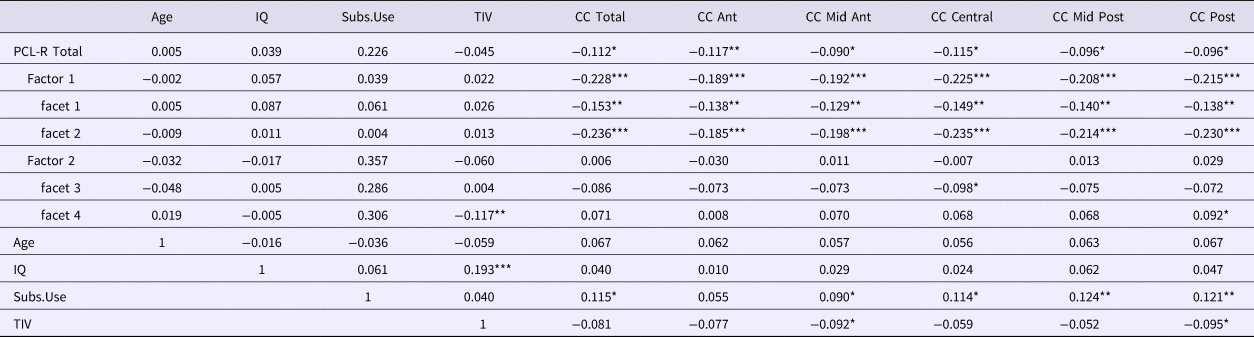
Sample characteristics described above are provided fully in Table 1. Initial bivariate analyses revealed no associations between PCL-R scores, age, and IQ in this sample. As expected, substance use severity was associated with PCL-R total score (r = 0.23, p < 0.001), factor 2 (r = 0.36, p < 0.001), facet 3 (r = 0.29, p < 0.001) and facet 4 (r = 0.31, p < 0.001). A number of small effects failed to survive corrections for multiple comparisons including a trend for negative associations between PCL-R facet 4 and brain volume (TIV), and small positive associations between substance use and CC volume. See Table 2 for complete values.
Bivariate correlations among PCL-R scores, corpus callosum values, and covariates

Subs.Use, Summary scores for SCID substance dependence; TIV, Total Intracranial Volume; CC Total, Corpus Callosum Total Volume; CC Ant, Corpus Callosum Anterior Section; CC Mid Ant, Corpus Callosum Mid-Anterior Section; CC Central, Corpus Callosum Central Section; CC Mid Post, Corpus Callosum Mid Posterior Section; CC Post, Corpus Callosum Posterior Section.
*p < 0.05, **p < 0.01, ***p < 0.001.
Correlational analyses
Addressing our primary hypotheses, consistent patterns of significant negative correlations were apparent between PCL-R Factor 1 scores across all divisions of the CC (rs range −0.19 to −0.23). These effects were strongest for facet 2 (affective) elements of psychopathy, achieving correlations between r = −0.19 and r = −0.24. Facet 1 (interpersonal) achieved slightly smaller correlations between r = −0.13 and r = −0.15. Factor 2 revealed no significant associations with any CC volume measures; effects for a PCL-R total score and facets 3 and 4 were limited to trend-level effects, and did not survive corrections for multiple comparisons. See Table 2 for correlations.
Multiple regression analyses
In regression analyses accounting for covariates, PCL-R Total scores were significant predictors of reduced volume in all five regions of the CC, and CC total volume. When PCL-R factors 1 and 2 were included together in the model, factor 1 emerged as driving this relationship, significantly predicting reduced CC volume in all five regions, and CC total volume. Factor 2 scores were never a significant predictor of CC volume. When the four facets were all included in the model, facet 2 scores emerged as driving this relationship, significantly predicting CC volume in all five regions and CC total volume. Facets 1, 3, and 4 were never significant predictors of CC volume when all four were included simultaneously in the model. Among the covariates, substance use severity emerged as a significant predictor of increased CC volume in the posterior and mid-posterior, central, and anterior sections, but only in the models utilizing the PCL-R total score. Substance use was not a significant predictor of CC volume when PCL-R factor and facet scores were included as predictors. Models utilizing PCL-R total score accounted for the smallest amount of variance in CC volume (R 2 = 0.05), while those using factor and facet scores accounted for up to 10% of the variance in CC volume. Tables 3–5 show full regression results predicting total CC volume. Concomitant results for each of the five subdivisions are available as online Supplementary material (S1–S15). These effects also remained reliable in a supplementary analysis restricted to right-handed individuals comprising 84% of the sample (n = 414), with effects being unchanged or slightly stronger. Similarly, these models accounted for between 5% and 10% of the variance in CC volume (see online Supplementary material S16–S33).
Discussion
We tested the hypothesis that psychopathy is associated with white matter abnormalities in the CC. Consistent with hypotheses, psychopathic personality traits were inversely related to CC total volume, as well as the size of individual subdivisions (posterior, mid-posterior, central, mid-anterior, and anterior sections). Effects were largest for the affective features of psychopathy, represented by facet 2 (and in part Factor 1) of the PCL-R. Factor 2, represented by lifestyle (facet 3) and antisocial features (facet 4), was not significantly related to CC volume in any direction. These findings provide anatomical support for models of impaired neural integrative capacities in psychopathy. These data also represent novel information about the involvement of CC in the pathophysiology of psychopathy in addition to offering clues to certain functional attributes of the CC and its role in integrating cross-hemispheric information.
Surprisingly, little is understood about the functional properties of the CC. While extensive research has documented the behavioral consequences of severing these fiber tracts completely (Gazzaniga, Reference Gazzaniga2005), far less is known about the cellular architecture and how discrete structural properties of the CC contribute to its overall function. For instance, it is still debated whether these cross-hemispheric fibers are primarily excitatory or inhibitory (Bloom and Hynd, Reference Bloom and Hynd2005; van der Knaap and van der Ham, Reference van der Knaap and van der Ham2011), and the relationships between CC volume, neuronal density, cellular integrity (e.g. fractional anisotropy), and functional efficacy remain to be fully described. It is also well-established that the CC increases in size through early adulthood and its late-stage myelination progresses in step with protracted neurodevelopmental processes like frontal cortical maturation (Cowell et al., Reference Cowell, Allen, Zalatimo and Denenberg1992; Pujol et al., Reference Pujol, Vendrell, Junqué, Martí-Vilalta and Capdevila1993; Tanaka-Arakawa et al., Reference Tanaka-Arakawa, Matsui, Tanaka, Uematsu, Uda, Miura, Sakai and Noguchi2015).
In terms of individual differences, CC development is influenced by early environmental factors, showing reduced size among those experiencing neglect (Teicher et al., Reference Teicher, Dumont, Ito, Vaituzis, Giedd and Andersen2004) and among illiterate subjects compared with carefully matched literate controls (Castro-Caldas et al., Reference Castro-Caldas, Miranda, Carmo, Reis, Leote, Ribeiro and Ducla-Soares1999). Several studies indicate the size of the CC is also proportionally larger among those expected to have increased interhemispheric transfer. For instance, the CC is larger in musicians who began training in early life (Schlaug et al., Reference Schlaug, Jäncke, Huang, Staiger and Steinmetz1995), in left-handed individuals (Witelson, Reference Witelson1985), and among the minority of individuals with right-hemisphere language dominance (O'Kusky et al., Reference O'Kusky, Strauss, Kosaka, Wada, Li, Druhan and Petrie1988). These studies may support a direct relationship between CC size and increased capacity for interhemispheric communication.
CC volume and functional connectivity are also associated with many different forms of psychopathology. Schizophrenia, for instance, has often been characterized as a ‘functional disconnection syndrome,’ (Friston, Reference Friston1998; Liang et al., Reference Liang, Zhou, Jiang, Liu, Tian, Liu and Hao2006) and meta-analyses have found that CC size is smaller in patients with schizophrenia compared with control groups (Woodruff, et al., Reference Woodruff, McManus and David1995; Arnone et al., Reference Arnone, McIntosh, Tan and Ebmeier2008). However, a notable lack of consistency exists in this literature and the relationship between CC volumes and schizophrenia may depend on the progression of chronic illness and long-term medication (Arnone et al., Reference Arnone, McIntosh, Tan and Ebmeier2008). It has also been noted that these effects are likely not specific or discriminative of schizophrenia, per se, and often there have been no differences found in CC morphology or histology among patients with schizophrenia, bipolar disorder, or unipolar depression (Nasrallah et al., Reference Nasrallah, McCalley-Whitters, Bigelow and Rauscher1983; Hauser et al., Reference Hauser, Dauphinais, Berrettini, DeLisi, Gelernter and Post1989). Reduced CC size and function has also been reported in autism spectrum disorders (Egaas et al., Reference Egaas, Courchesne and Saitoh1995) and post-traumatic stress disorder (Jackowski et al., Reference Jackowski, Douglas-Palumberi, Jackowski, Win, Schultz, Staib, Krystal and Kaufman2008). These studies converge to support a fundamental relationship between CC size, structural integrity (e.g. fractional anisotropy), and functional efficacy of interhemispheric connections. Further, they relate observed pathological symptomatology with demonstrable disruptions of structural and functional measures of inter-regional neural connectivity.
The research reviewed here does not offer much in terms of specificity of these effects, but it underscores a noteworthy paradigm shift in how the pathophysiology of mental illness is being characterized. In contemporary clinical neuroscience, increasing attention is being directed towards the role of inter-regional connectivity over and above circumscribed, single-region functional abnormalities. In many ways, interactions and impaired connections between intrinsic networks involving many remote brain regions may better account for the fundamental neuropathological etiology of many mental health conditions (Menon, Reference Menon2011; Buckholtz and Meyer-Lindenberg, Reference Buckholtz and Meyer-Lindenberg2012).
Considering the role of abnormal connectivity in psychopathy, traits such as disrupted moral reasoning have already been attributed to individuals with disrupted connectivity across the CC (Miller et al., Reference Miller, Sinnott-Armstrong, Young, King, Paggi, Fabri, Polonara and Gazzaniga2010). Deficient connectivity here may reflect the limited capacity for integration of emotionally guided, holistic reasoning and utilitarian approaches to moral problems. Others have been quick to point out that disruptions of connectivity in psychopathy are not unique to those supporting moral reasoning, but affect a wide range of basic cognitive functions (Pujol et al., Reference Pujol, Batalla, Contreras-Rodríguez, Harrison, Pera, Hernández-Ribas, Real, Bosa, Soriano-Mas, Deus and López-Sola2011). A thorough review of the literature reveals that psychopathic individuals exhibit subtle deficits in language and semantic processing (Kiehl et al., Reference Kiehl, Hare, McDonald and Brink1999, Reference Kiehl, Smith, Mendrek, Forster, Hare and Liddle2004) as well as attention (Newman et al., Reference Newman, Schmitt and Voss1997, Reference Newman, Curtin, Bertsch and Baskin-Sommers2010). This may point to fundamental neurocognitive impairments that precipitate the more conspicuous downstream consequences in emotion and antisocial behavior.
These views have been well summarized in the Impaired Integration model of psychopathy (Hamilton et al., Reference Hamilton, Hiatt Racer and Newman2015). Briefly here, prior literature has demonstrated a number of local and global impairments in structural and functional connectivity associated with psychopathic traits. Psychopathic individuals (especially those with elevated Factor 1 traits) present with reduced functional connectivity between frontoparietal cortical regions, insula, and anterior cingulate cortex, representing hubs for basic networks of attention (Philippi et al., Reference Philippi, Pujara, Motzkin, Newman, Kiehl and Koenigs2015). Both structural integrity and functional connectivity between anterior temporal regions and ventromedial prefrontal cortex are demonstrably diminished in psychopathy (Craig et al., Reference Craig, Catani, Deeley, Latham, Daly, Kanaan, Picchioni, McGuire, Fahy and Murphy2009; Motzkin et al., Reference Motzkin, Newman, Kiehl and Koenigs2011). A recent examination of whole-brain functional connectivity found that Factor 1 elements of psychopathy were associated with disrupted connectivity among the amygdala, orbitofrontal cortex, anterior and posterior cingulate, and superior temporal cortex – affecting most of the paralimbic system (Espinoza et al., Reference Espinoza, Vergara, Reyes, Anderson, Harenski, Decety, Rachakonda, Daramaju, Rashid, Miller, Koenigs, Kosson, Harenski, Kiehl and Calhoun2018). Psychopathic traits have also been associated with inefficiencies in switching between resting state dominant networks and those involved in active, externally focused attention (Sheng et al., Reference Sheng, Gheytanchi and Aziz-Zadeh2010).
The only one prior study has been published examining CC volume and morphology in relation to psychopathy. Raine et al. (Reference Raine, Lencz, Taylor, Hellige, Bihrle, Lacasse, Lee, Ishikawa and Colletti2003) reported larger CC volumes among a sample (n = 15) of community participants characterized by antisocial behavior, elevated psychopathic traits, and substance use, compared to non-antisocial controls. This report also found larger callosal volumes associated with the affective/interpersonal features of psychopathy. The present results appear to conflict with these prior findings; however, many methodological differences may reasonably account for this discrepancy. Raine et al.compared a non-incarcerated sample of antisocial individuals (DSM diagnosis of antisocial personality disorder) to non-antisocial, non-psychopathic individuals and thus it is difficult to rule out effects attributable to antisocial populations, more generally, as opposed to their role in the development of psychopathy per se. Many individuals in the antisocial group scored below the manualized cut-off score for psychopathy diagnosis (Hare, Reference Hare2003), potentially limiting variability on the high end of psychopathic triats. Comparison groups also differed on a number of other potentially relevant variables. There were significant differences on substance dependence between groups, and approximately 40% of the antisocial group reportedly exhibited symptoms of schizophrenia spectrum disorders. Further, there was a trend (p = 0.07) for the antisocial group to have larger head sizes in general, potentially undermining the size and direction of the noted effects.
Notably, the current study examines relationships between CC volume and PCL-R scores in a large forensic sample. This strategy limits some noted variability between antisocial and non-antisocial groups. Our sample provided a comprehensive range of psychopathic traits across a wide age range. We also excluded individuals with a history of psychosis, head injury, or abnormal clinical radiological review. The specificity of the present effects to the emotional/interpersonal features of psychopathy underscores this distinction, while behavioral/antisocial features of psychopathy were unrelated to CC volume in this sample. Quantification of CC volume was also different between these studies. Raine et al. reported those with high PCL-R scores presented with increased total volume and length of the CC, but reduced thickness. The current study used automated segmentation procedures for identifying CC volume in five separate regions. All five regions produced relatively uniform results in our sample, illustrating the consistency of the relationship across the structure. CC length and thickness were not examined as separate metrics in the present study. Finally, the current results were stable when controlling for substance use, age, IQ, and total intracranial volume. Importantly, the present findings noted positive associations between substance use and CC volume, which were significantly different in Raine et al.’s samples, and may have partially accounted for the positive associations reported therein. Future studies should continue to attend to substance use as an influential factor, and examine its relative contribution to CC morphology in more detail.
While the conclusions of both the current study and Raine et al.’s (Reference Raine, Lencz, Taylor, Hellige, Bihrle, Lacasse, Lee, Ishikawa and Colletti2003) study support notions of abnormalities in integrative networks in psychopathy, the present effects may align better with an emerging understanding of the relationship between structure and function in these networks. As noted previously, accumulating evidence has supported direct relationships between the volume of white matter tracts, the microstructural integrity, and their functional efficacy (Aboitiz et al., Reference Aboitiz, Scheibel, Fisher and Zaidel1992; Luders et al., Reference Luders, Phillips, Clark, Kurth, Toga and Narr2012). Reduced volume in major fiber tracts (rather than increased volume) would thus be expected to impair long-range integrative capacities in a uniform direction with the deficits that have been previously reported in psychopathy (Lopez et al., Reference Lopez, Kosson, Weissman and Banich2007; Motzkin et al., Reference Motzkin, Newman, Kiehl and Koenigs2011; Hoppenbrouwers et al., Reference Hoppenbrouwers, De Jesus, Sun, Stirpe, Hofman, McMaster, Hughes, Daskalakis and Schutter2014; Philippi et al., Reference Philippi, Pujara, Motzkin, Newman, Kiehl and Koenigs2015). Still, future research will undoubtedly be helpful in clarifying how these results specifically relate to neural function in the same subjects.
Summary, limitations, and future directions
While accumulating evidence continues to suggest that psychopathic traits are fostered in part by abnormal neural connectivity, direct investigations of neural features supporting large-scale connectivity have been sparse (but see Espinoza et al., Reference Espinoza, Vergara, Reyes, Anderson, Harenski, Decety, Rachakonda, Daramaju, Rashid, Miller, Koenigs, Kosson, Harenski, Kiehl and Calhoun2018). The present study focused on a large incarcerated sample and found reductions in CC volume attributable to the affective/interpersonal features of psychopathy. Several limitations should also be considered. The reported findings may not generalize to a non-forensic sample without a large, dynamic range of psychopathic traits. A number of additional variables may carry unidentified influence, such as childhood trauma and socioeconomic status. Further, the present study was conducted only among males, future studies should examine sex differences in CC volumes. We have also noted that the relationship between CC morphology and functional connectivity may be inferred, to some degree, from large-scale differences across a number of populations; however, a detailed account of how its structure and function align has not been fully described. Nevertheless, other domains of psychopathology associated with impaired connectivity between networks have shown similar effects across structural and functional measures. Finally, this study has only examined volumetric measures of the CC. There are many rapidly advancing tools in MRI analysis examining structural and functional connectivity directly, which will further our understanding of CC structure and function in psychopathy.
Multiple regression analyses with PCL-R total score and covariates predicting CC total volume

Model Summary: R 2 = 0.050, R = 0.223, F (1494) = 5.140. Overall Model p < 0.001
Multiple regression analyses with PCL-R factor scores and covariates predicting CC total volume

Model Summary: R 2 = 0.084, R = 0.290, F (1494) = 7.459. Overall Model p < 0.001
Multiple regression analyses with PCL-R facet scores and covariates predicting CC total volume

Model Summary: R 2 = 0.095, R = 0.308, F (1494) = 6.377. Overall Model p < 0.001
Supplementary material
The supplementary material for this article can be found at https://doi.org/10.1017/S0033291718002921.
Acknowledgements
We would like to thank the inmates and staff with the New Mexico and Wisconsin Departments of Corrections, without their valuable cooperation this work would not be possible.
This work was supported in part by the National Institutes of Health (K.A.K, grant numbers R01DA026964, R01DA026505, R01MH071896, R01DA020870, R01MH070539); (J. D. grant number R01MH087525). J. M. M. is supported by the National Institute on Drug Abuse (NIDA) through F31DA042228.