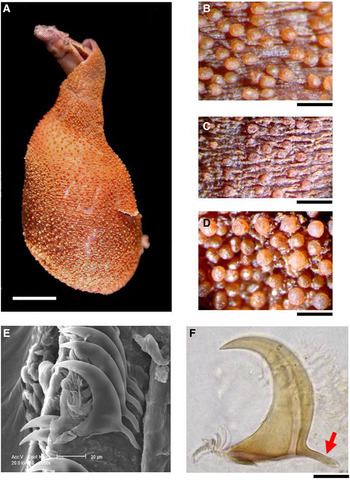
INTRODUCTION
The genus Phascolosoma Leuckart, 1828, is one of the most species-rich genera within the phylum Sipuncula (Murina, Reference Murina1984; Gibbs & Cutler, Reference Gibbs and Cutler1987; Cutler, Reference Cutler1994), with the majority of its species showing a preference for the warmer shallow waters of the world's oceans (Murina, Reference Murina, Rice and Todorović1975). However, a few phascolosomatid species are rare in their geographical distribution (Cutler, Reference Cutler1994), since they show preferences for deep cold waters instead.
Deep-sea communities in the Mediterranean are poorly known (Bazairi et al., Reference Bazairi, Ben Haj, Boero, Cebrian, De Juan, Limam, Lleonart, Torchia and Rais2010). Recent studies conducted over the slope of the Balearic Basin (western Mediterranean) revealed the presence of deep-sea phascolosomatids (Cartes et al., Reference Cartes, Maynou, Fanelli, Romano, Mamouridis and Papiol2009). They were identified as Phascolosoma turnerae Rice, Reference Rice1985 in a taxonomic checklist of the sipunculan fauna for the Mediterranean Sea (Coll et al., Reference Coll, Piroddi, Steenbeek, Kaschner, Lasram, Aguzzi, Ballesteros, Bianchi, Corbera, Dailianis, Danovaro, Estrada, Froglia, Galil, Gasol, Gertwagen, Gil, Guilhaumon, Kesner-Reyes, Kitsos, Koukouras, Lampadariou, Laxamana, Lotze, Martin, Mouillot, Oro, Raicevich, Rius-Barile, Saiz-Salinas, San Vicente, Somot, Templado, Turon, Vafidis, Villanueva and Voultsiadou2010). The new phascolosomatids inhabited muddy bottoms in the Balearic Basin. From this area, a total of 7 other species of sipunculans have been collected (Cartes et al., Reference Cartes, Maynou, Fanelli, Romano, Mamouridis and Papiol2009; Mamouridis et al., Reference Mamouridis, Cartes, Parra, Fanelli and Saiz Salinas2011; Tecchio et al., Reference Tecchio, Ramírez-Llodra, Aguzzi, Sanchez-Vidal, Flexas, Sardà and Company2013) by using different bottom trawls and box-corers at depths between 427 and 2265 m. This relatively high diversity of sipunculans was related to their ability in exploiting particulate organic matter of different quality (more or less degraded), arriving at bathyal depths, as inferred by the quite different stable isotope δ15N found in Aspidosiphon muelleri Diesing, 1851 and Sipunculus norvegicus Danielssen, 1869 (respectively 5.39‰ and 9.57‰, Fanelli et al., Reference Fanelli, Papiol, Cartes, Rumolo, Brunet and Sprovieri2011), two dominant sipunculan species inhabiting the investigated area (Cartes et al., Reference Cartes, Maynou, Fanelli, Romano, Mamouridis and Papiol2009).
After a detailed anatomical study of the phascolosomatid specimens collected, we observed anatomical features unknown to any previously recorded Mediterranean species (Pancucci-Papadopoulou et al., Reference Pancucci-Papadopoulou, Murina and Zenetos1999) of the genus Phascolosoma Leuckart, 1828. Thus, the aims of the present study are: (1) to report this new faunistic finding for the Mediterranean Sea; and (2) to select reliable characters for the distinction of closely related species. The ecological information of those collected specimens is also discussed.
MATERIALS AND METHODS
Specimens of deep-sea phascolosomatids were collected during trawling operations of the RV ‘García del Cid’ in the north-western part of the Mediterranean Sea. Station names, coordinates, depths, sampling dates and number of specimens are listed as follows:
-
— Station BIOM3-OTSB4; 41°07.130″–41°07.841″N 2°22.497″–2°27.977″E; 1039–1103 m; 01/07/2007; 2 specimens.
-
— Station PROMETEO3 M-28; 41°07′60″N 02°52′16″E; 1500 m; 13 May 2009; 1 specimen.
Immediately after sampling, all samples were preserved in 4% borax-buffered formaldehyde, prepared using seawater. Once in the laboratory, the material was studied using standard dissecting techniques and both binocular and compound microscopes. The species identification was based mainly on the works of Cutler (Reference Cutler1994) and Pancucci-Papadopoulou et al. (Reference Pancucci-Papadopoulou, Murina and Zenetos1999). Voucher material was deposited at the Institut de Ciències del Mar (CSIC).
RESULTS
SYSTEMATICS
Phascolosoma (Phascolosoma) turnerae Rice, Reference Rice1985
(Figure 1A–F)
Phascolosoma (Phascolosoma) turnerae: (A) external view; (B) papillae in the anterior part of the trunk; (C) papillae in the middle part of the trunk; (D) papillae at the trunk end; (E) scanning electron micrograph of a hook ring; (F) detail of a hook under the light microscope. Red arrow indicates the characteristic long basilateral extension of the hook. Scale bars: A, 5 mm; B and D, 0.5 mm; C, 0.3 mm; F, 20 µm.
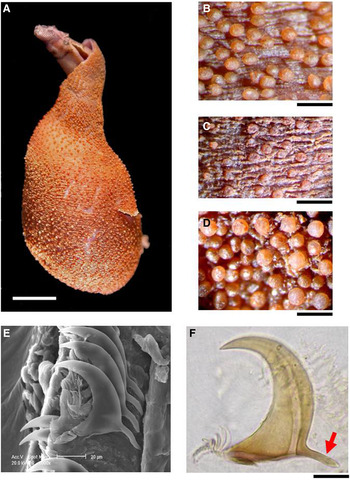
Trunk 23–44 mm long and 9–12 mm wide, light brown in colour (Figure 1A). Skin opaque to translucent. Papillae distributed over the entire trunk, larger and more densely packed at both ends (Figure 1B, D). Introvert 25–42 mm long with some pigmented bands. About 28 digitiform tentacles unpigmented. About 90 hook rings, many incomplete. Under the microscope hooks appear slightly curved without a secondary tooth (Figure 1E). Height 50–75 µm. At the posterior base of the hooks there are long toes and a basal wart. A long clear streak with some expansion is noted. No triangles, but with a characteristic long basilateral extension (Figure 1F). Tubuliform papillae about 10 µm high are placed between the hook rings. Internally, the longitudinal musculature has about 30–34 anastomosing bands. Circular musculature also split in fine bands. Four retractors the ventral arising from 6–8 bands, whereas the dorsal arise from 7–8 bands. The distance from the ventral insertions to the trunk end is 5–10 mm. Gut organized in about 15 spirals. Spindle muscle present and attached posteriorly. Two nephridia, 11 mm long with the posterior 2 mm free. Nephridiopores open a little anterior to the anus. Gonads observed at the base of the ventral retractors.
DISCUSSION
A total of 5 species of Phascolosoma have been reported from the Mediterranean Sea at coastal waters varying from 0 to 230 m deep (Pancucci-Papadopoulou et al., Reference Pancucci-Papadopoulou, Murina and Zenetos1999). The collection of deep-water phascolosomatids in the mainland slope of the Balearic Basin was remarkable, since we were unable to relate them to any representative of the genus Phascolosoma for the Mediterranean Sea. According to Cutler (Reference Cutler1994), the nature of the hooks appears to be species-specific within this sipunculan genus and a global key for the identification of all valid species was constructed by using basically the detailed study of the hooks under the light microscope. In this way, the presence of characteristic hooks with anterior prong-like extensions related our specimens to only the two species exhibiting this character: Phascolosoma turnerae Rice, Reference Rice1985; and P. saprophagicum Gibbs, Reference Gibbs1987. Gibbs (Reference Gibbs1987) differentiated the two species by: (i) the height of the hooks (> 45–80 µm in P. turnerae vs 20–25 µm in P. saprophagicum); and (ii) the external shape of the hooks (sharply-pointed in P. turnerae vs bluntly-rounded in P. saprophagicum). Since our specimens showed sharply bent hooks, 50–75 µm tall, we have identified them with P. turnerae.
The faunistic finding is also interesting from an ecological approach. The species was described originally by Rice (Reference Rice1985) inhabiting submerged wood at bathyal depths in the Strait of Florida and the Gulf of Mexico. The large abundance of sipunculans boring the wood persuaded this author to note a biological association between this sipunculan species and the wood. Similarly, our BIOM3-OTSB4 specimens were collected (after 4.5 ha of trawling) together with a large piece (~25 kg) of a tree trunk, some tree leaves (from purple beech, Fagus sylvatica) and Posidonia oceanica remains, suggesting this ground located near Besós Canyon could be a depocentre area for terrestrial-shelf material. These terrestrial inputs are patchily distributed over the slope (authors, unpublished data), although they are more frequent in the mainland than in the insular slope of the Balearic Basin, with higher levels of total organic matter at 1000–1100 m (Fanelli et al., Reference Fanelli, Papiol, Cartes, Rumolo and López-Pérez2013). δ13C stable isotope signals on sediments close to the BIOM3-OTSB4 haul (between –23.6‰/–24.8‰ Fanelli et al., Reference Fanelli, Papiol, Cartes, Rumolo and López-Pérez2013) also suggests an enrichment of terrigenous sediments there.
Almost simultaneously Edmonds (Reference Edmonds1985) described a new species, Phascolosoma kapalum, from deep bottoms off Australia. In this paper, there was no indication of wood occupation by the sipunculans. Later on, Edmonds (Reference Edmonds1992) compared specimens of P. kapalum with P. turnerae and decided that the two taxa were conspecific, the first name being a junior synonym of the last one. The finding of an extra specimen from a piece of rotting wood off the Great Barrier Reef (Australia) confirmed the character of a deep-sea wood dweller. However, in the review of the subgenus Phascolosoma achieved by Cutler & Cutler (Reference Cutler and Cutler1990), they identified further specimens from bathyal depths in the Gulf of Mexico, but this time the association was noted with tubeworm aggregations near a cold water seep. Other more ecological papers (Olu et al., Reference Olu, Sibuet, Harmegnies, Foucher and Fiala-Medioni1996, Reference Olu, Cordes, Fisher, Brooks, Sibuet and Desbruyères2010; MacAvoy et al. Reference MacAvoy, Fisher, Carney and Macko2005; Cordes et al., Reference Cordes, Bergquist, Predmore, Jones, Deines, Telesnicki and Fisher2006, Reference Cordes, Carney, Hourdez, Carney, Brooks and Fisher2007) reported the species also in mussel beds and sediments at the base of the tubeworm aggregations from different cold seep sites around the Gulf of Mexico, but also offshore the Orinoco River delta in South America (at 1950–2080 m deep in sediment samples).
Another rare phascolosomatid, P. saprophagicum Gibbs, Reference Gibbs1987, was collected from bathyal depths close to Chatham Island (New Zealand). Several specimens were obtained from the crevices and between the attached mussels on a large piece of decaying bone corresponding to a whale skull. Both P. saprophagicum and P. turnerae are the only representatives of the genus colonizing bizarre ephemeral habitats in deeper waters. Moreover, both species share this unique basal projection at the anterior base of the hook. Whereas we can suspect the existence of some genetic affinity between the two species, only DNA has been sequenced by now from P. turnerae (Kawauchi et al., Reference Kawauchi, Sharma and Giribet2012). Consequently, P. turnerae and P. saprophagicum, remain separate valid entities, as was proposed in the last monograph about the phylum (Cutler, Reference Cutler1994).
Recently, a comprehensive and detailed study on the reproductive biology and life-history of P. turnerae was published (Rice et al., Reference Rice, Reichardt, Piraino and Young2012), since the authors were able to maintain several specimens in captivity for long periods of time. Interestingly, other kinds of habitats were reported for the species, such as authigenic carbonate rocks and bundles of plant fibres, which inspired the authors to design artificial collectors of deep-sea phascolosomatids. The species was additionally found in bathyal depths close to the Bahamas and Barbados, showing by now a disjunct geographical distribution of two remote areas: the western Atlantic and south-western Pacific Oceans. To explain this gap, Rice et al. (Reference Rice, Reichardt, Piraino and Young2012) suggested the possibility of a wider distribution than currently known for P. turnerae. This hypothesis is today more plausible, with the discovery of P. turnerae in bathyal depths of the Mediterranean Sea (Bienhold et al., Reference Bienhold, Pop Ristova, Wenzhöfer, Dittmar and Boetius2013; our findings). In this way, these locations within the Mediterranean Sea represent an intermediate spot between the two remote areas where the species was previously collected. The presence of P. turnerae in the Mediterranean Sea has also implications in a potential connection of disjunct metapopulations of P. turnerae from both sides of the Atlantic Ocean. Dispersal trajectories of planktonic larvae were simulated in a recent study of this wood-dwelling species (Young et al., Reference Young, He, Emlet, Li, Qian, Arellano, Van Gaest, Bennett, Wolf, Smart and Rice2012). Its larvae were capable of reaching the mid-Atlantic off Newfoundland, a distance of more than 3000 km, during a long drifting period. Consequently, the possibility of a genetic exchange from west to east in the North Atlantic Drift current is even more probable, specimens of P. turnerae having been collected in the Mediterranean Sea.
Finally, we were unable to note a direct association of P. turnerae with sunken wood in the western part of the Mediterranean Sea. However, Bienhold et al. (Reference Bienhold, Pop Ristova, Wenzhöfer, Dittmar and Boetius2013) did recently by deploying wood colonization experiments offshore the River Nile delta at a depth of 1690 m (eastern Mediterranean Sea). In our case, P. turnerae was the only sipunculan species collected in both hauls, while other sipunculans are relatively abundant from other sampling sites (Cartes et al., Reference Cartes, Maynou, Fanelli, Romano, Mamouridis and Papiol2009; Mamouridis et al., Reference Mamouridis, Cartes, Parra, Fanelli and Saiz Salinas2011; Tecchio et al., Reference Tecchio, Ramírez-Llodra, Aguzzi, Sanchez-Vidal, Flexas, Sardà and Company2013) over the investigated slope. In general, surface deposit-feeder invertebrates were poorly represented in the first reported haul (only 1 holothurian, Mesothuria intestinalis), while the rest of invertebrates were—based on stable isotope analyses in the same area (Fanelli et al., Reference Fanelli, Papiol, Cartes, Rumolo, Brunet and Sprovieri2011, in Reference Fanelli, Papiol, Cartes, Rumolo and López-Pérez2013)—both filter feeders (1 bivalve Abra longicallus; 1 holothurian Ypsilothuria bitentaculata) and carnivores (1 seastar Ceramaster grenadensis). This suggests that inputs of fresh organic matter, as found deeper (e.g. over 1600 m, Cartes et al., Reference Cartes, Maynou, Fanelli, Romano, Mamouridis and Papiol2009), are low within the trawled area, indirectly reinforcing the idea that P. turnerae would have as food source ephemeral material derived from terrestrial inputs, such as remains of wood.
KEY TO THE GENUS PHASCOLOSOMA LEUCKART 1828, FROM THE MEDITERRANEAN SEA [MODIFIED FROM PANCUCCI-PAPADOPOULOU ET AL. (1999) TO ACCOMMODATE THE NEW RECORD]
-
1a. Hooks under the light microscope exhibiting an anterior stout and long projection at the base of their convex side ……… P. turnerae
-
1b. Hooks without an anterior projection at the base of their convex side ……… 2
-
2a. More than 50 complete and incomplete rings of hooks over the full everted introvert ……… 3
-
2b. Less than 50 complete and incomplete rings of hooks ……… 4
-
3a. Hooks with a posterior crescent area, many >75 µm tall; preanal papillae are smooth cones; pigment bands on introvert ……… P. stephensoni
-
3b. Hooks with a granular triangle at their anterior base, but without crescents, most <75 µm tall; no pigment bands on introvert ……… P. granulatum
-
4a. Large rounded hump on concave side of the hook; preanal papillae smooth, posteriorly directed, cone shaped ……… P. perlucens
-
4b. Concave side of hook smooth or with small tooth ……… 5
-
5a. Hooks with distinct triangle; narrow band of red cone-shaped preanal papillae ……… P. scolops
-
5b. Hook triangle indistinct or absent; preanal papillae not distinct from dome-shaped trunk papillae ……… P. agassizii agassizii.
ACKNOWLEDGEMENTS
This study was funded by the Spanish Ministry of Science projects ANTROMARE (J.E.C. and V.M. ref. CTM2009-12214-C02-01/MAR) and PROMETEO (A.M. ref. CTM2007-66316-C02/MAR). The authors thank all the participants of both scientific cruises. Special thanks to Dr Th. Kanellopoulos for scanning electronic microscope shooting at the HCMR premises in Anavyssos.