Introduction
The Australian baobab (Adansonia gregorii F. Muell. section Longitubae), known locally as a boab tree or, in the west Kimberley native dialect, Djunguri, is an iconic Australian species occurring in the far north of Australia (Bindon, Reference Bindon1996; Western Australian Herbarium, 1998). It is a large (5–30 m) bottle-shaped, winter-deciduous tree found in well-drained sandy or loamy soils in low-rainfall areas, mainly along drainage lines and creeks (Bindon, Reference Bindon1996; Western Australian Herbarium, 1998; Paczkowska and Chapman, Reference Paczkowska and Chapman2000). The Kimberley is one of the hottest regions in Australia and is characterized by hot, wet monsoonal summers with average daily temperatures >35°C (November–April) and warm, dry winters with average daily temperatures 30–35°C (May–October) (Bureau of Meteorology, 2008). The boabab is used by the local indigenous people as a water and food source; they extract moisture from the fibrous trunk and consume the fruits, seeds and young shoots. Indeed, there is a developing bush-food industry centred on the commercialization of production methods for tubers derived from the roots and stems of young seedlings harvested after several months of in situ growth (Johnson et al., Reference Johnson, Green, Crowhurst and Robinson2006). As part of this strategy, the development of efficient propagation methods for A. gregorii is also viewed as a priority (Johnson et al., Reference Johnson, Green, Crowhurst and Robinson2006).
A. gregorii is endemic to Australia and is only one of eight known species of Adansonia, with its nearest relatives found in Madagascar and Africa (Baum, Reference Baum1995). The centre of diversity of Adansonia is Madagascar where seven species (six endemic) are currently found, one of which is also found in parts of Africa (Baum, Reference Baum1995). Taxonomically, Adansonia is divided into three sections: Adansonia, Brevitubae and Longitubae, only two of which (Adansonia and Longitubae) are known to possess species with physical dormancy (PY) (Razanameharizaka et al., Reference Razanameharizaka, Grouzis, Ravelomanana and Danthu2006). Of seven Adansonia species investigated for the presence of PY, two species had non-dormant seeds, two species had about 30% of the seeds with PY and the remaining three had >95% of seeds with PY; all seven were found to display orthodox seed storage behaviour as well (Razanameharizaka et al., Reference Razanameharizaka, Grouzis, Ravelomanana and Danthu2006). For seeds from the PY species, a short exposure to boiling water (15–60 s) or soaking in concentrated sulphuric acid (H2SO4) for up to 6–12 h proved effective in making seeds water permeable (Razanameharizaka et al., Reference Razanameharizaka, Grouzis, Ravelomanana and Danthu2006).
Adansonia is in the Malvaceae (Angiosperm Phylogeny Group, 2003) and is one of only 16 families known to have seeds with PY (Baskin et al., Reference Baskin, Baskin and Li2000, Reference Baskin, Baskin and Dixon2006). Species with PY possess diaspores with water-impermeable seed or fruit coats that require pretreatment with seed-coat nicking, hot-water dipping or acid exposure, for example, to make them water permeable and therefore facilitate water uptake and germination (Baskin and Baskin, Reference Baskin and Baskin1998). The germination of A. gregorii seeds without any seed pretreatments is usually very low, although it has been demonstrated that nicking and acid scarification generally improves germination (Johnson et al., Reference Johnson, Green, Crowhurst and Robinson2006). While these treatments have been shown to work to some degree, the type and extent of seed dormancy in A. gregorii is currently unknown, with little information published regarding germination ecology.
This study set out to investigate and describe seed dormancy and germination characteristics in A. gregorii to provide a more systematic approach to the development of efficient propagation methods for this iconic species. Specifically, the aims of this study were to: (1) describe seed characteristics and determine the presence or absence of PY via imbibition experiments; (2) if PY exists, determine optimal dormancy release methods (hot water, acid scarification); (3) determine the optimal temperature range for germination.
Materials and methods
Mature fruits from A. gregorii were collected on 11 July 2008 from wild stands in the Kimberley region (16°52′23″S; 128°16′52″E) of northern Western Australia, approximately 2800 km north-east of Perth. Three weeks after collection, seeds were removed from fruits manually, cleaned of the surrounding pith and placed in a drying room at 15°C and 15% RH until utilized in this study, which commenced in October 2008.
Seed fill was estimated using X-ray assessment (Faxitron X-Ray Specimen Radiography System) on a random sample of four replicates of 25 seeds. Average seed weight was determined on five replicates of 20 seeds and average seed length on four replicates of 20 seeds.
For imbibition studies, ten seeds were non-scarified (control), ten mechanically scarified (using an electric Dremel® to abrade a small section of the seed coat on the side of the seed) and ten seeds each were dipped in boiling water for 1, 2.5 or 5 min. All seeds in the control and various treatments were weighed individually. Each seed in the control and treatments was immersed individually in 5 ml of water in a small 30 ml plastic cup and maintained under ambient conditions (22–24°C) for the duration of the imbibition experiment. After 1, 2, 4, 8, 24, 48 and 72 h, each seed was removed from its cup, blotted dry and re-weighed. Percentage increase in seed mass was calculated following Turner et al. (Reference Turner, Merritt, Baskin, Baskin and Dixon2006) with the amount of water taken up determined as actual increases in seed weights and converted to percentages according to the formula:

where W 1 and W d = mass of imbibed and dry seeds, respectively.
In the first germination experiment, all seeds were initially mechanically scarified (as previously described), surface sterilized in a 2% (w/v) solution of calcium hypochlorite [Ca(ClO)2] for 30 min and rinsed three times in sterile, deionized water. For each temperature three replicates of 20 seeds were placed in 90-mm-diameter Petri dishes on sterilized white sand moistened with sterile water and incubated for 20 d. Seeds were incubated in 12/12 h light/dark (30 μmol m− 2 s− 1, 400–700 nm of cool-white fluorescent light) at 15, 20, 25, 30 or 35°C and were scored for germination every 4 d. Petri dishes were moistened with deionized water as required.
To determine the effectiveness of boiling water in breaking PY, three replicates of 20 seeds were placed in boiling water for 1, 2.5 or 5 min then removed and plunged into cool water (24°C) for several minutes. In addition to these boiling treatments, three replicates of non-treated seeds and three replicates of seeds placed in recently boiled water (temperature range over 5 min 92 to 75°C) for 5 min were also assessed for germinability and imbibition. Following treatments (where required), seeds were surface sterilized and placed into Petri dishes on to moistened white sand and incubated at 30°C. Seeds were scored for germination every 2–3 d for up to 10 d. Upon completion of the germination trial all non-germinated seeds were assessed to determine the number of seeds per replicate that had undergone hydration (imbibition). Hydrated (imbibed) seeds were significantly larger and a lighter brown in colour and, when pressed with a scalpel blade, were easily pierced. On the other hand, non-hydrated seeds were much smaller and had a hard, rigid testa that could not be easily pierced.
To determine the effects of acid scarification on germination, approximately 360 seeds were placed into three (replicate) beakers of concentrated sulphuric acid (H2SO4, 98%) for 30 min, 1, 3, 6, 12 or 24 h. At each removal time 20 seeds per beaker were removed and washed (in replicate groups) under running water for 10 min then placed into a 100 mM NaHCO3 solution for approximately 30 min to neutralize the remaining acid. Following treatment, seeds were surface sterilized and placed into Petri dishes on to moistened white sand and incubated at 30°C. For each acid treatment three replicates of 20 seeds were assessed. Seeds were scored for germination every 2 d for up to 10 d and Petri dishes were re-hydrated as required. Upon the completion of the germination trial all non-germinated seeds were assessed to calculate the number of seeds that had imbibed during the experiment.
Statistical analysis
Differences in germination data were analysed for statistical significance by analysis of variance (ANOVA). Percentage values for germination were arcsine-transformed prior to analysis (non-transformed data appear in all figures) and all data were checked for normality prior to analysis. Fisher's least significant difference (P < 0.05) was used to determine significant differences between treatments. Graphs show exact binomial standard errors (SE, 95% confidence intervals).
Results
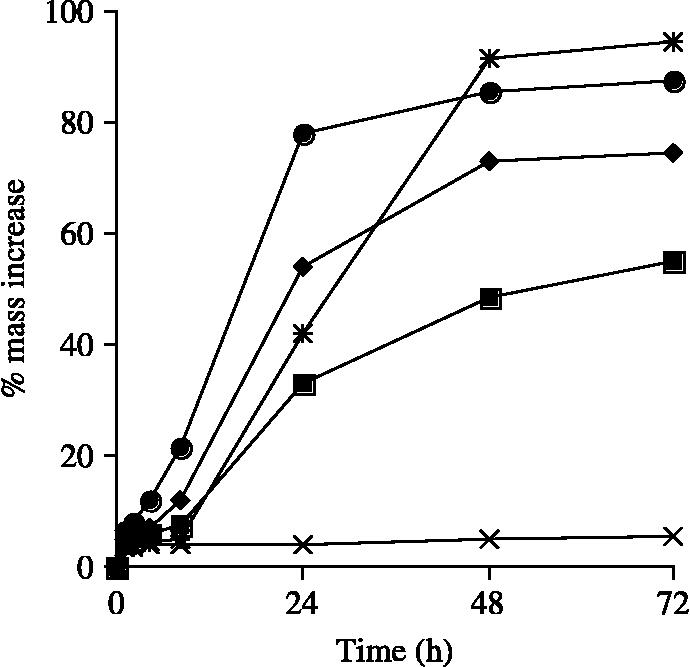
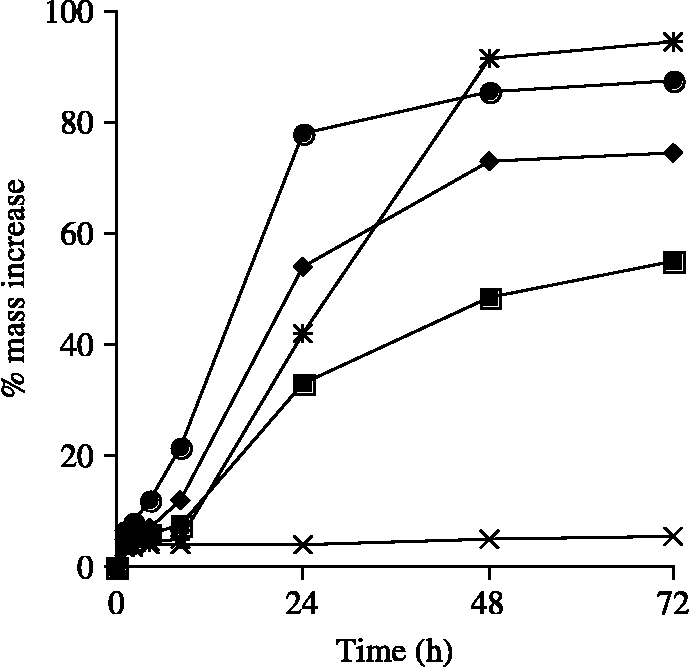
Seeds of A. gregorii were 11.7 ± 0.09 mm in length, had a mass of 591.9 ± 18.30 mg and seed fill was 99.0 ± 1.0%. For the imbibition experiment, all nicked seeds increased in mass rapidly, attaining within 24 h of hydration >40% mass increase (Fig. 1). Following 72 h of incubation all nicked seeds had increased in mass by 88–100%. In comparison, non-treated seeds had increased in mass by only 4–6% over 72 h of moist incubation (Fig. 1). Mean mass increase for boiling water treated seeds ranged from 55 to 88%. However, the number of seeds that had increased in mass was different between the different boiling water treatments. For example, five out of the ten boiling water treated seeds dipped for 1 min had mass increases between 76 and 92%, while the other five varied from 4 to 6%. Eight out of ten seeds dipped in boiling water for 2.5 min and 100% of seeds dipped in boiling water for 5 min had mass increases >83%. None of the remaining seeds in the 2.5-min boiling water treatment increased in mass by more than 6%.
Mean percentage increase (n = 10) in mass of non-treated ( ), nicked (
 ) and boiling water dipped seeds (
 , 1 min;
 , 2.5 min;
 , 5 min) of Adansonia gregorii during 72 h of moist incubation at room temperature (22–24°C). Standard deviations range from 0 to 44.71 and have been omitted for clarity.
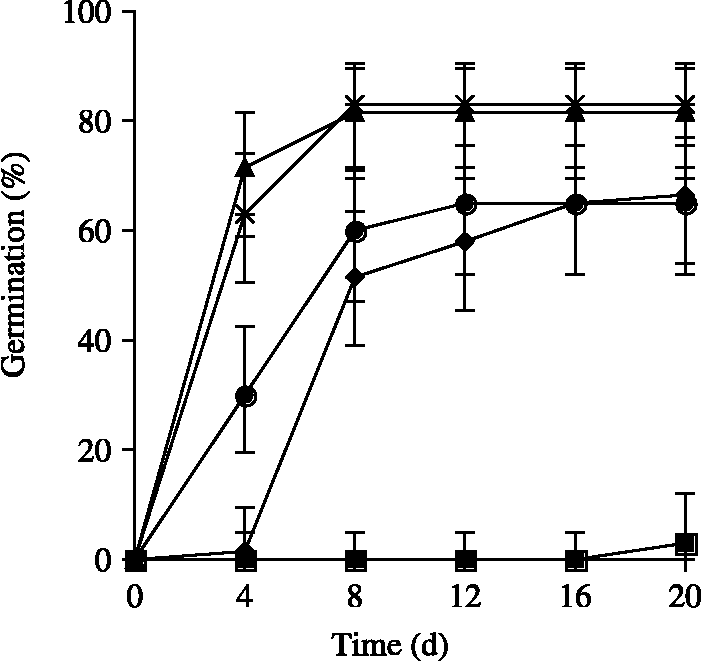
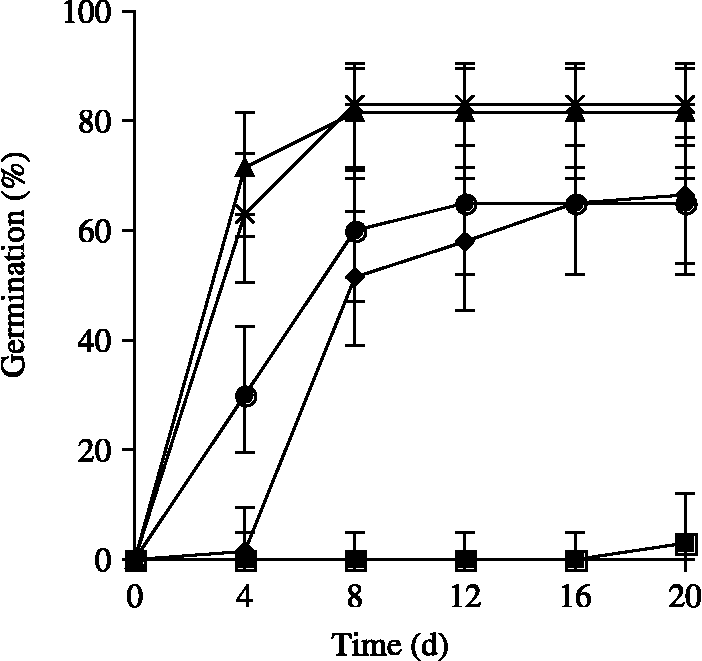
Seeds nicked and incubated at different temperatures exhibited marked differences in germination (Fig. 2) (P < 0.05). Seeds incubated at 30 or 35°C germinated to >80% after only 8 d, while those incubated at lower temperatures ( ≤ 25°C) displayed lower germination rates and lower total germination. For example, seeds incubated at 20 or 25°C attained only 60% germination after 16 d, 20% lower than the germination observed when seeds were incubated at 30 or 35°C. The lowest germination was observed for seeds incubated at 15°C, which after 20 d was < 5% (P < 0.05) (Fig. 2).
Cumulative percentage germination (mean ± binomial SE, n = 3) for nicked seeds of Adansonia gregorii incubated at five different temperatures: , 15°C; , 20°C; , 25°C;  , 30°C; , 35°C. Three replicates of 20 seeds were used for each treatment and germination was monitored for 20 d.
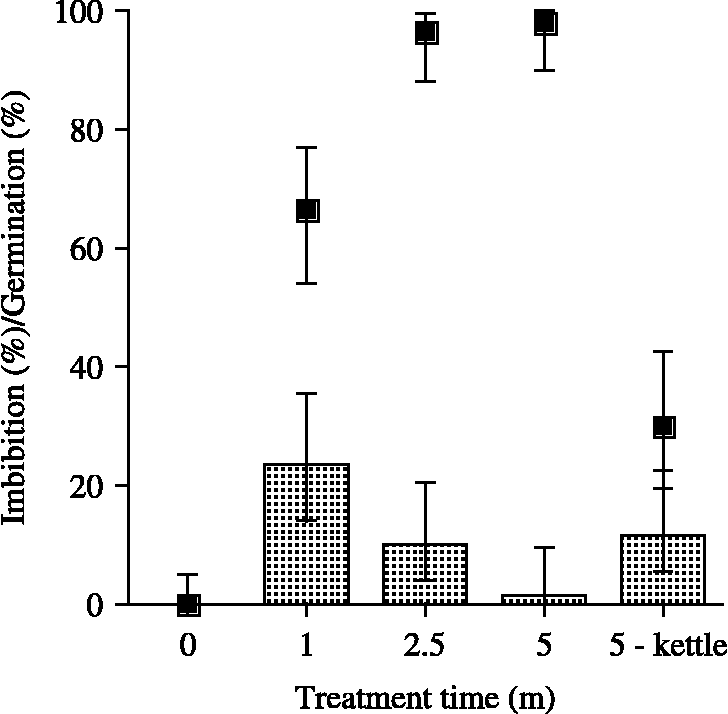
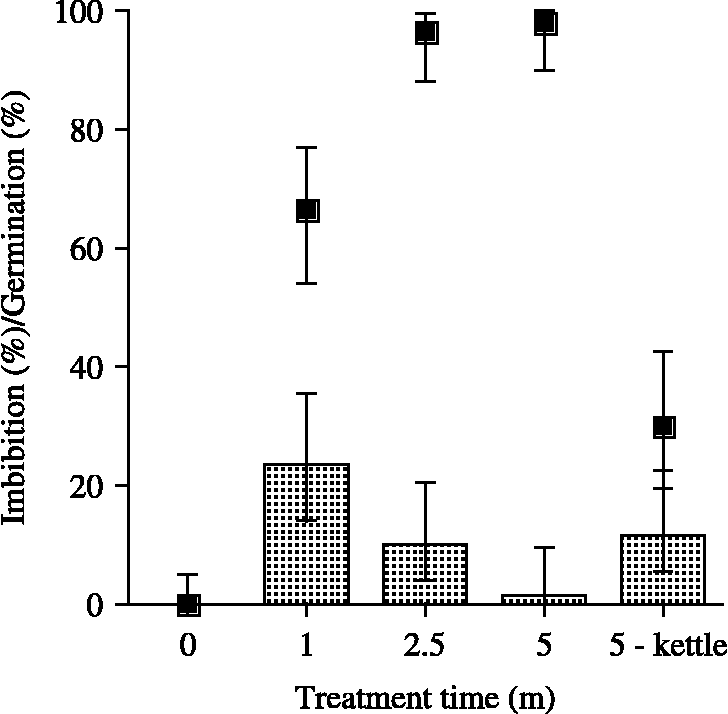
Dipping seeds in boiling water resulted in < 25% germination, regardless of the duration used (Fig. 3). Highest germination (23%) was observed for seeds exposed to boiling water for 1 min (P < 0.05). In comparison, seeds dipped in boiling water for 2.5 or 5 min displayed 10 and 2% germination, respectively. Exposure to hot water (92 to 75°C) for 5 min resulted in 12% germination (P < 0.05). The percentage of seeds that had imbibed also varied significantly between treatments (Fig. 3). None of the non-treated seeds showed signs of imbibition following completion of the experiment (P < 0.05). In comparison, 67% of seeds dipped for 1 min in boiling water were hydrated upon assessment, while >95% of the 2.5 and 5 min boiling water treated seeds had imbibed (P < 0.05). However, seeds exposed to hot water (92 to 75°C) for 5 min had significantly lower imbibition (30%) (P < 0.05). It was also noted that most of the non-germinated imbibed seeds exposed to boiling water exhibited signs of injury when examined closely, such as the collapse and browning of internal tissues, suggesting significant cell damage and death.
Percentage germination ( ) and imbibition () (mean ± binomial SE, n = 3) for seeds of Adansonia gregorii subjected to five treatments – control, dipped in boiling water for 1, 2.5 or 5 min or exposed to near-boiling water derived from a recently boiled kettle – and incubated at 30°C under a 12/12-h photoperiod. Three replicates of 20 seeds were used for each treatment and germination was monitored for 10 d.
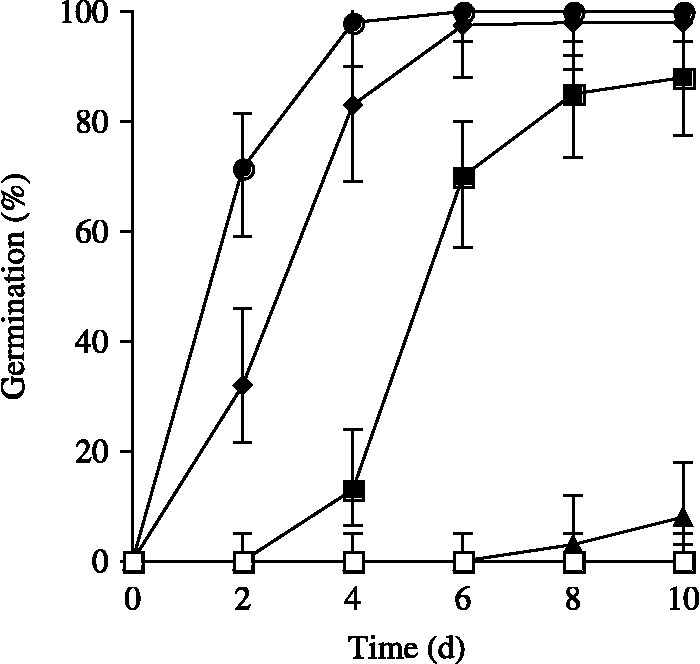
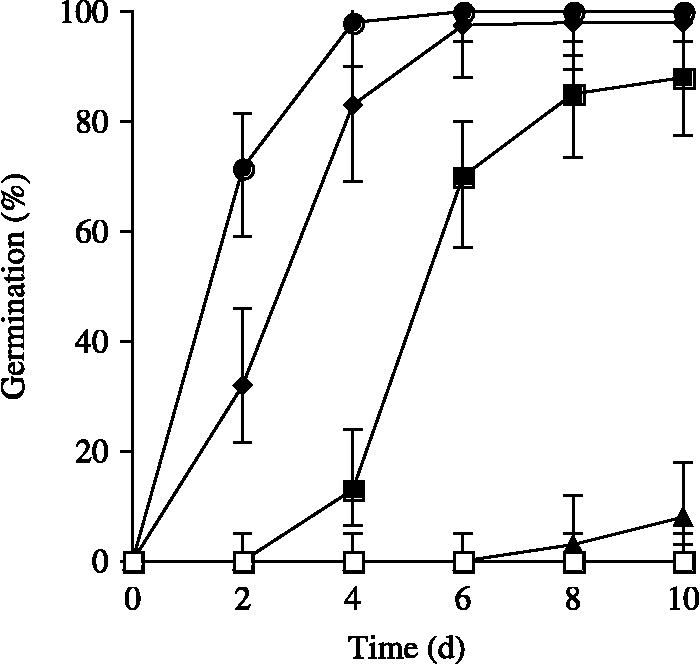
Highest germination for concentrated acid treatments was obtained when seeds were soaked in H2SO4 for 24 h (100% germination), athough germination >85% was also obtained from seeds soaked in acid for 6 and 12 h (Fig. 4) (P < 0.05). For the lower exposure times, i.e. 30 min to 3 h, no germination was observed except for the 3 h H2SO4 treatment (8% germination) (P < 0.05). The germination rate was also most rapid following the 24 h acid treatment and more gradual after acid exposure times of 12, 6 and 3 h. The number of seeds that had imbibed by the end of the experiment was very similar to the number that had germinated, with no hydrated (imbibed) seeds observed for the 0, 30 min or 1 h exposure times. Only the 3, 6 and 12 h treatments had slightly more hydrated seeds (i.e. 13, 97 and 100%, respectively) compared to ones that actually germinated (i.e. 8, 88 and 98%, respectively).
Cumulative percentage germination (mean ± binomial SE, n = 3) for acid (98% H2SO4) scarified seeds of Adansonia gregorii. Seeds were soaked in acid for 0 to 24 h:  , 0, 30 min and 1 h; , 3 h; , 6 h; , 12 h; , 24 h. Three replicates of 20 seeds were used for each treatment and germination was monitored for 10 d.
Discussion
In terms of general seed characteristics, seeds from A. gregorii had high seed fill (99%) and were relatively small in terms of both weight and length compared to those of other Adansonia species. Therefore, based on both these criteria, A. gregorii seed share affinities with A. digitata, A. rubrostipa, A. za, A. madagascariensis and A. perrieri, all of which possess seeds that have been demonstrated to have PY (Baum, Reference Baum1995; Razanameharizaka et al., Reference Razanameharizaka, Grouzis, Ravelomanana and Danthu2006). The two Malagasy species (A. grandidieri and A. suarezensis) with significantly larger seeds, in terms of both weight and length, have non-dormant seeds that germinate readily without any seed pretreatment (Razanameharizaka et al., Reference Razanameharizaka, Grouzis, Ravelomanana and Danthu2006).
As with A. digitata, A. rubrostipa, A. za, A. madagascariensis and A. perrieri (Razanameharizaka et al., Reference Razanameharizaka, Grouzis, Ravelomanana and Danthu2006), seeds of A. gregorii have PY based on an initial imbibition test (Fig. 1). The seeds of other Adansonia species with PY have also been found to be highly germinable once seed coat water impermability has been removed. Razanameharizaka et al. (Reference Razanameharizaka, Grouzis, Ravelomanana and Danthu2006) found that seed coat nicking resulted in >80% germination in five species of Adansonia that had PY, so for all Adansonia species, including A. gregorii, there appears to be no evidence of any type of physiological dormancy (in addition to PY) as seeds germinate rapidly once PY is overcome or, in the case of A. grandidieri and A. suarezensis, seeds are completely non-dormant.
Nevertheless, while the seeds of A. gregorii germinate rapidly, once PY is removed through nicking, their germination response following boiling water exposure was somewhat unexpected and in several ways fundamentally different from the responses observed for A. digitata, A. rubrostipa, A. za, A. madagascariensis and A. perrieri seeds that have PY (Razanameharizaka et al., Reference Razanameharizaka, Grouzis, Ravelomanana and Danthu2006). When the effectiveness of PY removal was assessed based on the number of seeds that had imbibed after boiling water exposure, the optimal exposure time was 2.5 to 5 min, where >90% of seeds had become water permeable. In comparison, 67% seeds exposed to boiling water for 1 min lost PY (Fig. 3). A relatively subtle difference in temperature (approximately 5–20°C) also seemed to have a significant effect on PY loss as well. Near-boiling water (i.e. 92 to 75°C) administered for 5 min was far less effective (only 33% of seeds became water permeable) than boiling water (98°C) administered for 1 min (67% of seeds lost PY). In many other species with PY only a brief exposure to hot water, from 1 s (Baskin et al., Reference Baskin, Davis, Baskin, Gleason and Cordell2004) to 1 min (Turner et al., Reference Turner, Merritt, Baskin, Dixon and Baskin2005) is required to overcome PY in seeds. Indeed, in many cases cooler temperatures (40–80°C) administered as either dry or wet heat for as little as 30 s to 1 min are just as effective (Auld and O'Connell, Reference Auld and O'Connell1991; Cook et al., Reference Cook, Turner, Baskin, Baskin, Steadman and Dixon2008). In comparison, seeds from A. digitata, A. rubrostipa, A. perrieri and A. za with PY required just 15 s exposure to boiling water to germinate to >90%, while optimal exposure for A. madagascariensis seeds was for just 1 min (88% germination) (Razanameharizaka et al., Reference Razanameharizaka, Grouzis, Ravelomanana and Danthu2006). Interestingly, for A. gregorii seeds PY loss via boiling water treatment was not synonymous with germinability, as highest germination was obtained following only 1 min exposure to boiling water (22% germination); seeds exposed for longer periods of time (2.5 or 5 min) had significantly lower germination (10 and 2%, respectively) even though more seeds had lost PY. It appears that while extremely high water temperatures (98°C) for longer than 1 min are required for >90% of seeds to become water permeable, this temperature and length of exposure has a deleterious effect on seed viability, resulting in significant seed injury or even seed death, as demonstrated by the poor appearance of the seeds exposed to boiling water treatments that remained non-germinated but were clearly imbibed. Interestingly, the seeds of A. digitata, A. rubrostipa and A. za all showed a significant decline in germination (90% down to < 60%) following exposure to boiling water for 1 min, while for A. madagascariensis and A. perrieri exposure to boiling water for 3 min also resulted in a significant decline in germination (90% down to < 50%). In all these cases this decline was attributed to seed injury and death (Razanameharizaka et al., Reference Razanameharizaka, Grouzis, Ravelomanana and Danthu2006).
Unlike the other species of Adansonia, none of the non-treated seeds of A. gregorii imbibed or germinated, suggesting that the extent of PY for A. gregorii seeds is more extreme than for any other Adansonia species, where 3–96% of non-treated seeds germinated, depending on the species (Razanameharizaka et al., Reference Razanameharizaka, Grouzis, Ravelomanana and Danthu2006). On the other hand, the response to concentrated H2SO4 was highly significant and very similar to that reported for other Adansonia spp., although the period of exposure for optimal germination (i.e. >80%) was longer than for all other species, except for A. madagascariensis which required at least 12 h exposure to achieve >80% germination (Razanameharizaka et al., Reference Razanameharizaka, Grouzis, Ravelomanana and Danthu2006). Interestingly, the rate of germination was highest and most rapid for seeds exposed to H2SO4 for 24 h (Fig. 4).
Razanameharizaka et al. (Reference Razanameharizaka, Grouzis, Ravelomanana and Danthu2006) identified three dormancy syndromes within Adansonia spp., based on seed-coat water permeability: (1) species with water-permeable seed coats (A. grandidieri and A. suarezensis), which are completely non-dormant; (2) species with weak PY (A. digitata, A. za, A. perrieri and A. rubrostipa), in which a significant proportion of seeds are non-dormant (7–28%) and, for the remaining seeds with PY, a relatively brief exposure to boiling water (15 s) or concentrated H2SO4 (30 min to 3 h) is sufficient to make seeds water permeable; and (3) species with extreme PY (A. madagascariensis), which have a very low number of non-dormant seeds (3%) and require an extended period of exposure to either boiling water (1 min) or concentrated H2SO4 (12 h) for seeds to lose PY. The results presented in this study for A. gregorii suggest that seeds of this species behave in many respects in a similar manner to A. madagascariensis, as they are completely dormant and require an extended period of exposure to concentrated H2SO4 (6–24 h) or boiling water (2.5–5 min) to break PY. However, unlike A. madagascariensis seeds, the seeds of A. gregorii appear to be far more sensitive to boiling water; higher temperatures injure seeds more easily, although a longer period of time is required to completely break PY.
The results from this study will substantially improve the propagation of A. gregorii and will aid in its development as a new bush-food crop. More importantly though, the results presented here provide valuable information on the seed biology of not only A. gregorii but other Adansonia spp., as the results indicate that the form of PY displayed by A. gregorii seeds is quite extreme and in several respects quite unique, having more affinities with A. madagascariensis seeds than with any other Adansonia species. While both taxa belong in the same section, it remains to be seen whether the similarities displayed in this study are parallel evolutionary developments in response to similar evolutionary pressures or a remnant of deeper taxonomic affinities. In light of the findings presented in this study, future research should focus on investigating ecological cue(s) reflective of the local environment that may break dormancy, in conjunction with seed burial studies.
Acknowledgements
S.R.T. is supported under Australian Research Council's Linkage Projects funding scheme (project number LP0669589). The authors would like to thank Patrick Courtney and Bob Elkins (Kings Park and Botanic Garden) for the provision of seeds for this study.