Introduction
Almost three decades after the first case of HIV and AIDS in sub-Saharan Africa was isolated, adolescents, people of reproductive age, as well as high-risk groups have been the focus in HIV/AIDS discourse and policy interventions. Older people aged 50 years and older have only featured in their role as carers for orphans and people living with AIDS (Nyambedha et al. Reference Nyambedha, Wandibba and Aagaard-Hansen2003; Knodel & Im-em, Reference Knodel and Im-em2004; Seeley et al., Reference Seeley, Wolff, Kabunga, Tumwekwase and Grosskurth2009) and hardly ever as people at risk of HIV infection. It is evident that sexual activity, which is the main transmission route for HIV in sub-Saharan Africa (UNAIDS, 2011), tends to decrease with age (Schlesinger, Reference Schlesinger1996; Gott, Reference Gott2001). Nonetheless, sexual activity among older people is still prevalent enough to be considered a risk factor for the spread of HIV among this segment of the population, in addition to other predisposing risk factors.
Recent epidemiological surveillance reports from sub-Saharan Africa highlight that HIV prevalence rates among older people are similar or even higher than the national average, particularly among older men. For instance, the prevalence rate for men aged 55–59 years in Uganda was found to be 5.8% compared with the national average of 6.3% (Ministry of Health & ORC Macro, 2006). Similar findings were observed in Kenya, where the prevalence rate among men aged 50–64 years was found to be 5% compared with 7.1% overall (NASCOP & Ministry of Health, 2008). In a study in Swaziland, the prevalence rate among men aged 50 years and older was higher (18%) than the national average of 15% (Central Statistical Office (CSO) & Measure DHS, 2007). Yet, older people do not perceive themselves as vulnerable, and they are more likely to underestimate their likelihood of contracting HIV (Theall et al., Reference Theall, Elifson, Sterk and Klein2003; Bignami-Van Assche et al., Reference Bignami-Van Assche, Chao, Anglewicz, Chilongozi and Bula2007). In the United States, where people aged 50 years and older account for almost 15% of all new cases and 24% of persons living with HIV or AIDS (Centers for Disease Control, 2008), there has been an upsurge in research focusing on HIV and AIDS in older people. This research has demonstrated that older people do not perceive themselves to be at risk of infection (Theall et al., Reference Theall, Elifson, Sterk and Klein2003; Olivi et al., Reference Olivi, Santana and Mathias2008), that they engage in high-risk sexual behaviour (Lovejoy et al., Reference Lovejoy, Heckman, Sikkema, Hansen, Kochman, Suhr, Garske and Johnson2008), and that they are not likely to take an HIV test unless prompted by a health physician (Akers et al., Reference Akers, Bernstein, Henderson, Doyle and Corbie-Smith2007).
Notably, sexual health of older people in sub-Saharan Africa has received less attention in research. This paper seeks to contribute to the knowledge in this field. Existing research, policies and programmes on HIV/AIDS consider older people to be less sexually active or not engaging in risky sexual behaviour. Therefore, they are rarely the target for HIV/AIDS information and education campaigns aimed at prevention and care. Similarly, multimedia prevention campaigns exclude older people (Williams & Tumwekwase, Reference Williams and Tumwekwase2001). Older people's vulnerability is, thus, increased due to the assumption that they do not deserve a lot of attention.
In addition to being left out of prevention interventions, a number of behaviours or practices relating to older people potentially put them at risk of HIV infection. Research highlights inter-generation sexual relationship to be a key factor in the spread of HIV in sub-Saharan Africa. Further, condom use in inter-generation sex is also low given that young women in particular are unable to negotiate for use whereas older people perceive HIV or STI infection among younger people to be low (Longfield et al., Reference Longfield, Glick, Waithaka and Berman2004). Longfield et al. (Reference Longfield, Glick, Waithaka and Berman2004), in a study carried out in Kenya, found that older and younger people in sexual relationships considered HIV infection to be the least of the potential risk outcomes. In the study, older people worried more about the financial implications, whereas younger people were more concerned about pregnancy. The unbalanced power relations between older men and younger girls, which provide older men with control over sexual relations, also opens the channel for transmission. Cockcroft et al. (Reference Cockcroft, Kunda, Kgakole, Masisi, Laetsang, Ho-Foster, Marokoane and Andersson2010) and Longfield et al. (Reference Longfield, Glick, Waithaka and Berman2004), in their studies on inter-generational sex, highlight the fact that younger women have sex with older people mainly for material and economic benefits, while the interest of older men is non-economic.
Another factor that could put older people at risk is alcohol use and abuse. Consumption of alcohol is prevalent among older people, as exemplified in a Botswana study where up to 34% of the participants reported consuming alcohol (Clausen et al., Reference Clausen, Charlton and Holmboe-Ottesen2006), and research has consistently demonstrated the association between alcohol use and risky sexual behaviour, with far-reaching implications in areas with high HIV prevalence rates. Additionally, alcohol consumption is rife in areas where poverty is high compared with wealthier neighbourhoods, in informal drinking venues in particular, providing fertile ground for sexual networking (Kalichman et al., Reference Kalichman, Simbayi, Kaufman, Cain and Jooste2007).
Little research has been done, however, on how older people perceive their vulnerability to HIV infection. Yet, how an individual perceives their risk means that they are either predisposed to risk-aversion or risk-seeking tendencies. Such studies would be crucial in shaping appropriate prevention intervention for older people. Furthermore, understanding how older people perceive their risk is essential to tailoring behaviour change strategies aimed at raising awareness of people's actual susceptibility to risk, especially if people underestimate or are overly optimistic, or are unrealistic about their level of risk (Branstrom et al., Reference Branstrom, Kristjansson and Ullen2006). This paper aims to contribute to the literature on HIV/AIDS and older people in sub-Saharan Africa by examining their perception of risk of HIV infection. The research questions addressed in this paper are: (1) How do older people perceive their risk of HIV infection and what reasons are given for the level of perceived risk?; and (2) What are the factors associated with perceived level of risk?
Theories of risk perception
Individuals exposed to the same hazard or risk vary in the levels or extent they perceive themselves to be vulnerable to the risk or threat. Different schools of thought and theories attempt to explain the variation in risk perception with regards to health risks, including HIV infection. For instance, perception of susceptibility is a key component of the Health Belief Model, which seeks to understand variability in health-seeking behaviour (Janz & Becker, Reference Janz and Becker1984).
The assessment of a threat by individuals is socially or culturally constructed. Therefore, individuals evaluate their risk using various psychological, social, institutional and cultural factors, and they rarely use scientific or probabilistic reasoning (Prentice-Dunn & Rogers, Reference Prentice-Dunn and Rogers1986). The question of how people become infected and ill from the virus may not be shrouded in much controversy; however, people rationalise why people become infected based on cultural and subjective understanding. Religion and spirituality strongly influence the social and everyday life of most African societies (Campbell et al., Reference Campbell, Skovdal and Gibbs2011). Various studies identify religion as shaping people's attitudes and beliefs regarding HIV/AIDS, both as a protective as well as an inhibiting factor for risk exposure (Gyimah et al., Reference Gyimah, Tenkorang, Takyi, Adjei and Fosu2010). For instance, religion can be preventative through its role in discouraging sexual behaviour that puts people at risk of HIV infection, such as multiple sexual partnership, as well as premarital and extramarital sexual relationships (Miller & Gur, Reference Miller and Gur2002). Conversely, spirituality and belief in a higher power's control over people's lives and destiny can result in feelings of limited control over one's life and ability to control adverse events happening, including contracting HIV. Similarly, some individuals consider HIV infection to be a punishment for wrong-doing by decadent individuals. Consequently, most individuals would regard others as the immoral ones and may not regard themselves within the group of immoral individuals, thereby perceiving less personal risk (Smith, Reference Smith2003).
The Optimistic Bias Theory proposes that individuals underestimate their risk based on the belief that ‘it cannot happen to me’. This is particularly with regards to a comparison group (Weinstein, Reference Weinstein1984) and to health risks that are unusual or embarrassing. Risks or risk outcomes stigmatized by society are more likely to be perceived with an optimistic bias compared with less stigmatized outcomes (Munier, Reference Munier2004). Most individuals maintain their risk to be lower than is the case or to be comparatively better than that of their peers (Weinstein, Reference Weinstein1984). Furthermore, when asked to assess personal vulnerability to a risk, individuals use different reference groups to form their opinion. In particular, people stereotyped to be a high-risk group usually become the reference groups (Prentice-Dunn & Rogers, Reference Prentice-Dunn and Rogers1986). The media and public discourse identify HIV/AIDS high-risk groups as prostitutes and their clients, and gay men (Douglas, Reference Douglas1992). People who do not identify themselves with such high-risk groups may think they are at no or minimal risk of contracting HIV (Joffe & Bettega, Reference Joffe and Bettega2003). Even among members of these groups identified as high risk, most would regard themselves as less at risk, while viewing others in the group as more likely to be at risk of infection (Gold, Reference Gold2006).
Methods
Study setting
The paper uses data from older people living in slum areas of Nairobi, Kenya. The study was conducted in two slum areas. One of the slums, Viwandani, is located to the south-east of the city, whereas Korogocho is located to the north-east. Overall, urban areas in Kenya have consistently had a higher HIV prevalence rate (10%) compared with rural areas (6%), and whereas only 21% of the national population live in urban areas (UN Department of Economic and Social Affairs, 2012), close to 40% of HIV-positive people live in urban areas (National AIDS Control Council, 2005). Conversely, a wide diversity exists within large urban areas with residents of low-income neighbourhoods exhibiting poorer sexual health outcomes, riskier sexual behaviour and consequently higher HIV prevalence rates compared with their counterparts in wealthier areas (Zulu et al., Reference Zulu, Dodoo and Ezeh2002). The urban environment, which is characterized by low-income migrant populations and ethnic heterogeneity, also presents a context where there is little adherence to cultural norms and values. In particular, the norms regarding sexuality are more tolerant (Wallace, Reference Wallace1993), as are attitudes towards behaviours such as premarital sex, marital disruption (South & Lloyd, Reference South and Lloyd1995) and short-term sexual partnering (Browning & Olinger-Wilbon, Reference Browning and Olinger-Wilbon2003). This contrasts with the social structure in rural communities, which epitomises social control and regulated sexual behaviour.
Data
The data come from a baseline survey of a larger longitudinal study that seeks to investigate the well-being of older people living in the slums of Nairobi, Kenya. The survey was conducted in 2006/2007 and 2061 people were interviewed out of 2696 eligible respondents, i.e. a response rate of 76%. All people aged 50 years and older who were resident in the two slums were eligible for interview. Therefore, eligibility was determined by age and residence in the two slum areas. The study was nested on the Nairobi Urban Health and Demographic Surveillance System (NUHDSS) that follows up usual residents of these two slum communities (APHRC, 2010). The NUHDSS maintains a database of usual residents in these two slums which is updated every 4 months. The cut-off age for the study population was 50 years and older to correspond with the age outside the routine HIV epidemiological surveillance of population in sub-Saharan Africa. A structured questionnaire covering various topics including HIV/AIDS was administered using face-to-face interview techniques.
All the interviews were conducted after obtaining verbal and/or written informed consent from the participants. The study protocol and ethics were approved by the Kenya Medical Research Institute's (KEMRI) Ethical Review Committee mandated by the Ministry of Health in Kenya to review all research proposals involving human subjects.
Measures
Perception of risk
The dependent variable, assessing perception of risk, is based on the question, ‘Do you think your chances of contracting HIV/AIDS are small, moderate, great, no risk at all or already have HIV/AIDS?’ This question is modelled on the Demographic and Health Surveys (DHS) which has tested and fielded the question in over 200 surveys and more than 70 countries (Measure DHS, 2011). Due to the sensitive nature of HIV/AIDS, the question was preceded by a statement preparing the respondent about the nature of the questions to follow with assurance of confidentiality.
Explanatory factors
Socio-demographic variables (sex, age, marital status and education) known to influence risk perception were tested to determine the association with perceived vulnerability to HIV/AIDS among older people. Other covariates included to explain perceived risk are religion and willingness to test for the HIV virus. ‘Type of religion’ and ‘level of participation in religious activities’ are hypothesized to have a bearing on how individuals perceive HIV/AIDS. This is because of the ‘morality’ tag is usually associated with HIV infection. The question posed to the respondents to determine their willingness to test for HIV was, ‘I don't want to know the results, but have you ever been tested to see if you have the virus that causes AIDS?’ Those who responded ‘no’ or ‘don't know’ to this question were further asked, ‘Would you be willing to be tested for HIV/AIDS?’ There is no information about whether testing was initiated voluntarily by the respondent, the time when the test was conducted or whether the person was made aware of the test results. Individuals who are unsure or unwilling to take a HIV test are the reference category, compared with those who have ever taken a test and those willing to be tested.
Statistical analyses
The outcome variable, perception of risk, is an ordered variable with the following response options: 0=‘no risk at all’, 1=‘small chance’, 2=‘moderate chance’, 3=‘great chance’. Thus, an ordered logit regression was used to address the research question examining the factors associated with perceived level of risk. Eight individuals who voluntarily reported that they were already infected with HIV were excluded from the analysis. The explanatory variables included in the multivariate models were first tested and only variables significantly associated with perceived risk with a p-value of <0.10 were added to the model. Interaction between explanatory variables was assessed and found to be insignificant. Three sets of regression models were fitted; the first pooled together men and women. Separate models were then fitted by sex with similar explanatory variables. This was to assess gender-specific factors associated with perceived vulnerability to HIV infection given the belief that men and women perceive risks differently (Gustafson, Reference Gustafson1998). At the bivarate level, the chi-squared statistic was used to test for differences by sex in the level of perceived risk, as well as to test the basis for perceiving the level of risk.
Results
Socio-demographic characteristics of the sample
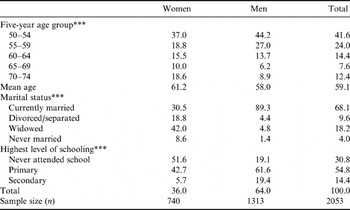
Table 1 presents the percentage distribution of selected characteristics of the study participants comparing men and women. The study sample comprised mainly males (64%), typifying the previous bias towards male migration, especially among early migrants in Nairobi, although in recent times the proportion of women migrants has been on the increase, causing the sex ratio to fall gradually (Beguy et al., Reference Beguy, Bocquier and Zulu2010). There are significant differences between men and women across almost all characteristics presented in Table 1. The men are somewhat younger than the women with almost half of women aged 60 years or over (44%) compared with only about 29% of the men. Whereas over two-thirds (68%) of the population are currently married, only 30% of the women are in a marital union compared with an overwhelming majority of men (89%). Most of the women reported themselves to be widowed (42%) or divorced (19%), compared with only 5% and 4% of the men, respectively. The lower average age for men in the study compared with women could in part explain the difference in marital status. More than half of the older population reported primary schooling as their highest educational level (55%), and 14% had secondary education or higher. However, the men are better educated with more than half of the women (52%) having no formal schooling compared with only one in five men (19%).
Characteristics of study participants by sex

Chi-squared test for between-sex differences and F-test significance levels: ***p<0.001; **p<0.01; *p<0.05.
Perceived level of risk
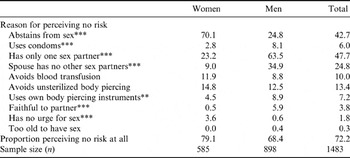
Almost three-quarters (72%) of the older people felt they had ‘no risk at all’ of contracting the HIV virus (Table 2). Of those who felt at risk, a greater proportion sensed only a small chance (62%) while only 15% felt they had a moderate-to-great chance of contracting HIV. Women were more likely to report having no risk at all of contracting HIV compared with men (χ2p<0.001).
Reasons given for perceiving no risk at all of contracting HIV by sexa

a Multiple responses given for their perceived level of risk.
Chi-squared test for between-sex differences and F-test significance levels: ***p<0.001; **p<0.01; *p<0.05.
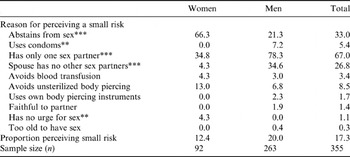
Tables 2–4 present the reasons given for perceived no risk at all, small risk and moderate-to-great risk, respectively, compared by sex. There was a significant difference between men and women in the reasons given for perceiving ‘no risk at all’ and ‘small chance’. However, there were no significant sex differences in reasons given among those who reported a ‘moderate’ and ‘great’ risk of being infected with HIV. Women were more likely to report perceiving ‘no risk at all’ because they abstain from sex (70% vs. 21% for men), followed by having only one sexual partner (23%). Conversely, men were more likely to report perceiving ‘no risk at all’ because they have only one sexual partner (63%), while the second most cited reason was that their spouse has no other sexual partners (35%). Men were more likely to mention being faithful to their partner (6%) compared with women (<1%), whereas women were more likely to report having no sexual urges (4%), compared with about 1% of men. There was no significant difference between men and women in reporting modes of HIV transmission that do not involve sexual intercourse; for example, avoiding blood transfusion (χ2p=0.551) and avoiding unsterilized body piercing (χ2p=0.061) when giving reasons for perceiving ‘no risk at all’ of contracting HIV (Table 2).
Reasons given for perceiving a small chance of contracting HIV by sexa

a Multiple responses given for their perceived level of risk
Chi-squared test for between-sex differences and F-test significance levels: ***p<0.001; **p<0.01; *p<0.05.
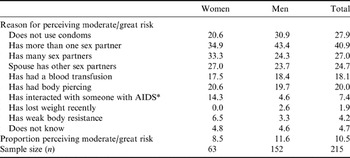
Reasons given for perceiving moderate-to-great risk of contracting HIV by sexa

a Multiple responses given for their perceived level of risk.
Chi-squared test for between-sex differences: ***p<0.001; **p<0.01; *p<0.05.
A similar pattern to the reasons given for perceiving ‘no risk at all’ by sex also emerged when comparing reasons cited by respondents who perceived having only a small chance of contracting HIV/AIDS (Table 4). A third of the women mentioned abstaining from sex (66%) compared with only 21% of men. Men were more likely to report having only one sexual partner (78%) as a reason for perceiving a small chance of contracting HIV compared with only 35% of women (Table 3).
In contrast to the distinct differences between men and women in the reasons cited for perceiving ‘no risk at all’ and ‘small risk’, there were no significant sex differences in the reasons for perceiving a ‘moderate-to-great’ chance of contracting HIV/AIDS. For instance, 21% of women and 31% of men perceived a moderate-to-great chance of contracting HIV because they do not use condoms (χ2p=0.126). The only exception was mentioning contact with someone with AIDS, where a significant proportion of women (14%) compared with men (5%) mentioned this as a risk factor (χ2p=0.014). Overall, older people who perceived a moderate-to-great chance of contracting HIV/AIDS mentioned: having more than one sexual partner (41%), not using condoms (28%), having multiple sexual partners (27%) and their spouse having other sexual partners (25%). These were the four most commonly cited reasons (Table 4).
Bivariate and multiple regression results
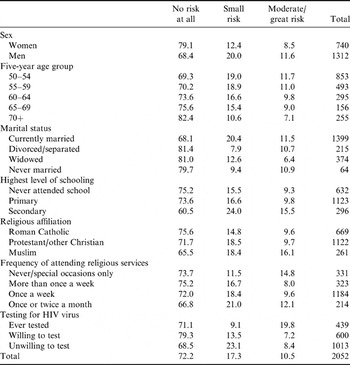
Table 5 presents the percentage distribution of the dependent variable (perceived level of risk of HIV infection) and the independent variables. Chi-squared tests were performed for the bivariate analysis, and the differences in perceived risk across all the independent variables were statistically significance at the 5% level. Age has an inverse relationship with perceived risk, with people in the older age groups being more likely to perceive no risk at all compared with the younger age groups. Respondents currently married were more likely to report having at least a small chance of contracting HIV (32%) followed by those never married (20%). Among older people who are formerly married, a significantly higher percentage of those who were widowed (13%) reported at least a small chance of contracting HIV compared with about 20% of those who were divorced or separated (χ2p<0.001). Older people with some level of education were more likely to perceive a small-to-great chance of contracting HIV compared with those who have never been to school (χ2p<0.001). For instance, 15% of older people with secondary education or more reported a moderate-to-great chance of contracting HIV compared with about 10% and 9% of those with primary and no education, respectively. Across religious groups, one third of the Muslims reported a small, moderate or great risk (35%) compared with 28% of the Roman Catholics and an even lower proportion among other Christians (26%). In relation to testing, older people who have ever been tested for HIV were more likely to perceive a moderate-to-great risk of infection (20%), unlike less than 10% of those who have never been tested (χ2p<0.001).
Perceived level of risk compared across demographic, social interaction and HIV-related characteristics

Chi-squared test for between perceived risk differences significance levels: ***p<0.001; **p<0.01; *p<0.05.
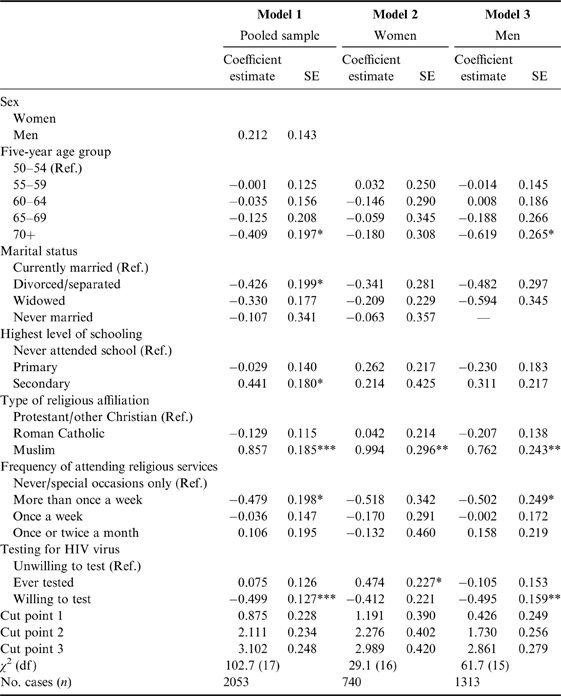
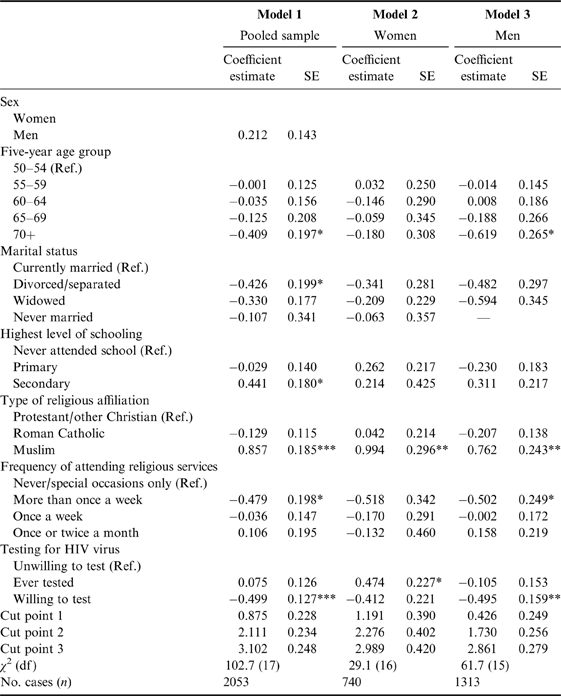
Table 6 presents the results of the estimated ordered logit models. Three models are estimated. The first is the pooled sample where sex is included as one of the explanatory variables. Models 2 and 3 are separate models fitted for women and men respectively. The model chi-squared statistic for the three models is highly significant, thus indicating the overall fit of the estimated models.
Ordered logit regression modelling socio-demographic, social and community interaction and testing for HIV as determinants of perception of risk for HIV infection
Significance levels: ***p<0.001; **p<0.01; *p<0.05.
Determinants of risk perception
The socio-demographic variables included in the multivariate regression models were sex, age, marital status and education. In the pooled model (Model 1), all these factors except sex were statistically significant, albeit marginally after controlling for other factors in the model. The diminished effect of sex can be explained by the sex difference in marital status, which is accounted for in the model and where the majority of the men, unlike women, reported being in a marital union. Whereas all other age groups were not statistically different from the youngest age group (50–54 years), those 70 years and older perceived lower levels of risk compared with the 50–54 year age group. Similarly, being divorced decreased the log of the odds of reporting higher levels of risk. On the other hand, older people with secondary level of education perceived higher levels of risk of HIV infection compared with those with no education. In the split models (Models 2 and 3), however, only age remained statistically significant for women after accounting for other covariates in the models; education and marital status were no longer statistically significant.
Religion became a strong predictor of perceived level of risk of HIV infection in all the models. Older people from the Muslim faith were significantly different in their perception of risk compared with the Protestant Christians. Being Muslim increased the log of the odds ratio of perceiving higher level of risk of infection. On the contrary, frequency of attending religious services has negative coefficients indicating a decreased likelihood of perceiving higher levels of risk of HIV infection. Thus, if one frequently attends religious activities, they perceive lower likelihood of getting infected with HIV. This is especially the case among older people who attend such activities or services more than once a week, compared with those who never attend or only do so on special occasions. Frequency of attendance of religious services was an important factor, particularly for men, and not so much for women.
The effect of testing for the presence of HIV produced interesting results. Older people willing to be tested for HIV had a decreased likelihood of perceiving risk of HIV infection compared with those unwilling to be tested. Conversely, those who have ever been tested for HIV had an increased likelihood of perceiving risk of HIV infection (although not statistically significant). Further, the effect of testing on perception of risk remained strong for both men and women, albeit in different directions. Women who have ever tested for HIV were significantly different from those unwilling to test in that they had an increased likelihood of perceiving higher levels of risk. On the other hand, men willing to be tested had a decreased likelihood of perceiving higher levels of risk compared with men unwilling to be tested.
Discussion
Self-perception of vulnerability to HIV infection is a key predictor of adopting preventive strategies to reduce one's risk of contracting HIV. Therefore, understanding levels of perception of risk of HIV infection and the factors associated with an individual's perception of their own risk is fundamental for effective interventions aimed at preventing infection. This paper set out to understand how older people living in the slums of Nairobi assess their personal vulnerability to HIV infection.
Almost three-quarters of the older people in this study do not believe that they are at any risk of HIV infection. A few studies, primarily in North and South America, that have examined the perception of HIV risk among older people found the proportion perceiving no risk at all to range from 48% to 53% in the United States (Ward et al., Reference Ward, Disch, Levy and Schensul2004) and Brazil (Olivi et al., Reference Olivi, Santana and Mathias2008) respectively. Therefore, it is evident that a notable proportion of older people in the Nairobi slums do not consider themselves to be at risk of infection relative to the nature and level of the HIV epidemic in this region.
The reasons for perceiving no risk at all, or a small risk, were gendered, with older women being more likely to report abstaining from sex, whereas men were convinced that they had only one sexual partner or, similarly, their partner did not have other sexual partners. On the contrary, unlike what has been observed in sub-Saharan Africa where women perceive moderate-to-high risk because they are worried about their partner's sexual behaviour, while men worry about their own sexual risk-taking (Akwara et al., Reference Akwara, Madise and Hinde2003), this study found no sex difference as to why they perceive higher chances of contracting HIV. For instance, there was no significant difference in the proportion of men and women who were concerned because they had multiple sexual partners or because their sexual partner has other concurrent partners. It should be noted, however, that the proportion of women perceiving a moderate or great chance of contracting HIV was smaller (9%) compared with that of men (12%).
The other objective of this paper was to understand the factors associated with HIV risk perception. As expected, age, marital status and education predicted the likelihood of perceiving risk of infection, although to a small extent. Age was negatively associated with perceived risk, whereas those not in a union perceived lower levels of risk of HIV infection. The relationship between marriage and HIV infection with regards to whether marriage is a risk or protective factor is not consistent (Shisana et al., Reference Shisana, Zungu-Dirwayi, Toefy, Simbayi, Malik and Zuma2008). One the one hand, not being in a martial union gives one the confidence that they are in control of their own behaviour and thus their exposure to risk as opposed to having to rely on the partner's faithfulness. The counter position to this argument is that those not in a marital union may underestimate their risk, particularly if they engage in casual or short-term sexual liaisons (Bongaarts, Reference Bongaarts2007).
Numerous studies have identified religion to be a significant factor in influencing HIV risk perception, especially when comparing different faiths, for example, Christianity vis-à-vis Islam. The Muslims in this study had an increased likelihood of perceiving higher levels risk of HIV infection compared with those from the Protestant Christian faith. This could imply a strong belief among the Muslims in the extent to which one has control over the occurrence of adverse life events. Individuals who transfer the locus of control or responsibility to an external factor would feel they have very limited control as such occurrences are subject to an ‘act of God’ or a ‘test from God’ (Kouabenan, Reference Kouabenan1998). Religiosity, on the other hand, expressed in terms of frequency of participating in religious services, was also significantly associated with HIV risk perception. Participation in religious services at least once a week decreased the likelihood of perceiving being at risk of HIV infection compared with those who rarely attend such services. Thus, the role of religion in perception of HIV risk differs for devotees compared with those less devoted. It can be argued that highly religious devotees in this study may relate HIV infection to labels of immorality and as a consequence of wrong-doing for non-religions or less devote people. The devote individuals may thus not engage in risk behaviour such as alcohol consumption or sex outside marriage, and other practices that are deemed immoral, thereby making them feel less at risk of HIV infection, unlike those less devoted (Takyi, Reference Takyi2003).
It emerged from the study that older people who were willing to be tested for HIV had a decreased likelihood of perceiving risk for HIV infection compared with those unwilling to test. Testing is one of the key strategies implemented for the prevention and treatment of HIV infection. Studies also highlight that uptake of HIV testing is influenced by, for instance, HIV-related knowledge and access to education campaigns that promote HIV testing as being beneficial (de Cock et al., Reference de Cock, Marum and Mbori-Ngacha2003). Willingness to test, although not always followed by actual behaviour, is a step in the right direction for prevention and treatment. Empirical studies have found evidence of variation in test results among people who volunteer to be tested and those unwilling to test or those prompted to take a test. Individuals who initiate the test are less likely to test positive than those who are prompted to do so (Obermeyer & Osborn, Reference Obermeyer and Osborn2007). This raises a concern for individuals in this study who are unwilling to take a HIV test and their vulnerability to infection. With increasing HIV testing as a result of improved access and availability of antiretroviral treatment (ART) in sub-Saharan Africa (Matovu & Makumbi, Reference Matovu and Makumbi2007; Phakathi et al., Reference Phakathi, Van Rooyen, Fritz and Richter2011) and ART's role in reducing transmission (Dieffenbach, Reference Dieffenbach2012), it is imperative that HIV testing uptake is intensified and promoted across all ages.
Limitations
One limitation of studies investigating sexuality and sex-related topics that rely on self-reports, including this paper, is the possibility of under-reporting vulnerability due to the sensitive nature of topics and the tendency for bias towards responses that are socially desirable. This is particularly more sensitive among older people due to societal outlook and attitude towards sex in old age (Bauer et al., Reference Bauer, McAuliffe and Nay2007; Minichiello et al., Reference Minichiello, Hawkes and Pitts2011). This may be further compounded by the age difference between the respondents and research assistants, most of whom were in the age range of 25–30 years, with none over the age of 50 years. Although, sex and or age of interviewers is known to influence the outcome of sex- and age-related attitudinal questions (Kane & Macaulay, Reference Kane and Macaulay1993), as well as responses to questions on sensitive issues such as sexual behaviour (Wilson et al., Reference Wilson, Brown, Mejia and Lavori2002), this was not taken into account during the survey. Therefore, the characteristics of the interviewers may have biased the study findings leading to under-reporting of personal risk compounded by the taboo issue of sexuality in old age among African societies (van der Geest, Reference van der Geest2001).
The cross-sectional nature of the data means that this study can only determine association between perception of risk and the covariates investigated. Thus, the causal nature of the observed relationships between HIV risk perception and individual characteristics cannot be ascertained.
Conclusion
Despite high rates of HIV prevalence and a generalized epidemic being reported in the region where this study was conducted, coupled with high general public awareness about HIV/AIDS (NASCOP & Ministry of Health, 2008), the findings of this paper highlight the fact that many older people do not consider themselves to be personally vulnerable to HIV infection. This could be due, in part, to the high proportion of older people, especially women, who reported being asexual. Nonetheless, the two out of seven older people who felt they were at risk of HIV infection merit some attention. In order to influence healthy sexual outcomes and minimize HIV infection among older people, it is imperative to understand how they perceive themselves at risk of HIV infection and whether there are any biases (optimistic or otherwise) in their perceived level of risk. Bearing this in mind, the present paper did not assess how accurately older people perceive their vulnerability to HIV infection. Some studies conducted in sub-Saharan Africa show that individuals, especially young married women, do over-estimate their chances of contracting HIV, while younger men have a more realistic assessment of their risk (Bignami-Van Assche et al., Reference Bignami-Van Assche, Chao, Anglewicz, Chilongozi and Bula2007). However, under-estimation of personal vulnerability can result in fewer preventive measures thereby exposing oneself to the risk of infection (Akers et al., Reference Akers, Bernstein, Henderson, Doyle and Corbie-Smith2007). As a suggestion, examining the relationship between older people's self-perceived risk of HIV infection and objective biomarkers is recommended for future research. In addition, understanding how perceived risk of HIV infection is associated with risky behaviour would provide a better understanding of older people's susceptibility to HIV infection. The present prospect is that the HIV epidemic is ageing given that the population of those infected is growing older due primarily to increased longevity as a result of effective long-term care and treatment, coupled with new diagnosis in later life (Justice, Reference Justice2010; Mills et al., Reference Mills, Barnighausen and Negin2012). The emerging demographic composition of people living with HIV, therefore, will not only require dedicated medical attention due to the complexity of multiple co-morbidities as a result of age-related conditions (Deeks & Phillips, Reference Deeks and Phillips2009), but also targeted behaviour-change educational campaigns to minimize transmission of HIV within and across age cohorts.
Acknowledgments
The author is a recipient of the British Academy Postdoctoral Fellowship (2010–2013). The data used in the analysis were part of a longitudinal project entitled ‘Urbanization Poverty and Health Dynamics in sub-Saharan Africa’ conducted by the African Population and Health Research Centre, University of Southampton, and London School of Hygiene and Tropical Medicine funded by a Wellcome Trust grant (GR078530MA).