Introduction
Investigations of plasmas induced by intense pulses of radiation from X ray or extreme ultraviolet (EUV) range were carried out using various sources. The corresponding experiments performed using high power facilities, delivering high-energy X-ray pulses, concerned so-called laboratory astrophysics. In these experiments, photoionized plasmas were produced by irradiation of a small portion of gas, embedded in a gas cell, or a preformed cold plasma. High-temperature, high-density plasmas, delivering X-ray pulses of high energy, were created employing the pulsed-power Z facility, Sandia National Laboratory (Bailey et al., Reference Bailey, Cohen, Chandler, Cuneo, Foord, Heeter, Jobe, Lake, Liedahl, MacFarlane, Nash, Nielson, Smelser and Stygar2001; Cohen et al., Reference Cohen, MacFarlane, Bailey and Liedahl2003), or high-energy laser systems like GEKKO XII (Fujioka et al., Reference Fujioka, Takabe, Yamamoto, Salzmann, Wang, Nishimura, Li, Dong, Wang, Zhang, Rhee, Lee, Han, Tanabe, Fujiwara, Nakabayashi, Zhao, Zhang and Mima2009) or Shenguang (Wei et al., Reference Wei, Shi, Zhao, Zhang, Dong, Li, Wang, Zhang, Liang, Zhang, Wen, Zhang, Hu, Liu, Ding, Zhang, Tang, Zhang, Zheng, Nishimura, Fujioka, Wang and Takabe2008; Gong et al., Reference Gong, Hao, Li, Yang, Li, Li, Guo, Zou, Liu, Jiang, Peng, Xu, Liu, Li, Zheng, Cai, Liu, Zheng, Wang, Li, Li, Zhang, Zhang, Wang, Wang, Wang, Liu, Yang, Jiang, Zhang and Ding2019).
Photoionized plasmas can be also an active medium for EUV or X-ray lasers. Investigations concerning EUV lasers, with the population inversion obtained via the Auger effect, were performed using laser systems delivering pulses with the energy of tens of Joules. In the corresponding experiments, inner-shell photoionization of krypton (Kr) or xenon (Xe) was followed mainly by the Auger emission accompanied by creation of various excited states. In case of sufficiently high energy and power density of the driving pulse, the population inversion was created, and the lasing was observed (Kapteyn et al., Reference Kapteyn, Lee and Falcone1986; Sher et al., Reference Sher, Macklin, Young and Harris1987; Kapteyn and Falcone, Reference Kapteyn and Falcone1988).
In some experiments concerning laboratory astrophysics, instead of X rays, the EUV pulses were utilized. High-energy EUV pulses were obtained employing a special converter. It was designed to perform experiments on the simulation of a white dwarf photosphere in laboratory conditions (Falcon et al., Reference Falcon, Rochau, Bailey, Ellis, Carlson, Gomez, Montgomery, Winget, Chen, Gomez and Nash2013).
It should be pointed out that the EUV radiation of moderate intensity can be also produced employing much smaller laser or discharge systems. In contrast to large, high power facilities, EUV sources based on low energy laser or discharge systems can operate with a high repetition rate. They are thus employed, for example, in lithography tools. A vacuum chamber where the radiation propagates can be filled with a gas under a low pressure, below 1 bar. The gas, argon or hydrogen, is used for protection of EUV mirrors. An intense EUV beam propagating through these gases create plasmas of low temperature and density. Measurements of the electron density of the Ar plasmas gave the value of approximately 1010 cm−3 (van der Horst et al., Reference van der Horst, Beckers, Nijdam and Kroesen2014). In case of plasmas induced in hydrogen, the electron density was even lower (van der Horst et al., Reference van der Horst, Beckers, Osorio, Astakhov, Goedheer, Lee, Ivanov, Krivtsum, Koshelev, Lopaev, Bijkerk and Banine2016).
Due to the very low gas density, the EUV radiation can propagate over relatively large distances exceeding 1 m; hence, the EUV-induced plasmas are produced in a large volume. On the other hand, plasmas of higher density cannot be produced in such conditions. There is, however, a possibility to create EUV-induced plasmas in small portions of gases, injected under a high pressure into the vacuum chamber, synchronously with the radiation pulses. Irradiation of the gas by the focused EUV beam allows creating microplasmas with a high electron density exceeding 1018 cm−3 (Bartnik et al., Reference Bartnik, Wachulak, Fok, Węgrzynski, Fiedorowicz, Skrzeczanowski, Pisarczyk, Chodukowski, Kalinowska, Dudzak, Dostal, Krousky, Skala, Ullschmied, Hrebicek and Medrik2015). In both cases, the resulting low-temperature plasmas emit the EUV radiation. Its intensity, however, is orders of magnitude lower compared to the EUV emission, from plasmas created by laser pulses or high current discharges. Its detection can be thus a problem, especially in case of temporal measurements. Due to the high repetition rate of the driving EUV sources, time-integrated measurements can be made relatively easy, by the accumulation of multiple radiation signals. The time-resolved measurements, however, require a sufficiently high number of photons in a single pulse. In this case, specialized detection systems, based on multichannel plates (MCPs) (Könneckea et al., Reference Könneckea, Follath, Pontius, Schlappa, Eggenstein, Zeschke, Bischoff, Schmidt, Nolla, Trabanta, Schreck, Wernet, Eisebitt, Senf, Schüßler-Langeheine, Erko and Föhlisch2013) or the EUV collectors, have to be employed. Concerning MCPs, they require a good vacuum for operation. For experimental arrangements where such conditions cannot be maintained, detection systems employing MCPs have to be equipped with additional vacuum installations allowing for differential pumping. Such a system is thus complicated and significantly limits the number of detected photons. It means that for some experimental conditions, with weakly emitting plasmas, time-resolved measurements can be hardly performed.
The other possibility is to gather a significant part of photons emitted from plasmas in an entire sphere using a dedicated EUV collector. The collected radiation can be then detected using a photodiode, sensitive for the EUV photons located in a focal plane of the collector. Such a system was employed for temporal measurements of the weak EUV pulses, emitted from low-temperature plasmas, produced in our experiments. The detection system can operate in the low vacuum conditions. The only limitation, in this case, concerns the EUV absorption in the residual gas. Plasmas of low temperature were induced by irradiation of gases, delivered in a form of small portions, into the vacuum chamber. The gas injection system was synchronized with the driving, laser-produced plasma (LPP), EUV source. Time-resolved measurements were performed for such EUV-induced plasmas, created in helium (He), Kr, and Xe gases.
Experimental arrangement
A schematic view of the experimental arrangement used in our experiments is presented in Figure 1. It consists of three main systems: the LPP EUV source, the gas injection system, and the system for detection of weak EUV pulses. Such radiation pulses are emitted from the EUV-induced, low-temperature plasmas. In our experiments, these plasmas are created by irradiation of gases with intense EUV pulses delivered from the LPP EUV source. The source is based on a double-stream gas-puff target irradiated by laser pulses with a time duration of approximately 10 ns and a pulse energy exceeding 5 J. The laser utilized in experiments is a 10 Hz Nd:YAG laser system (NL 129, EKSPLA) operating at the fundamental wavelength. The gas-puff target is created using a specially prepared valve system, allowing for the pulsed injection of two different gases into the vacuum chamber, in a form of two coaxial streams. The laser beam is focused onto the inner stream, where the LPP is being created. The outer stream prevents a free expansion of the inner gas into the vacuum. This way a high density of the inner gas can be maintained at a required distance (~1.5 mm) from the nozzle outlet. To obtain a high conversion efficiency of the laser pulse energy into the EUV radiation, a high-Z gas is usually employed. In this experiment, it was Xe. The outer gas should be transparent for the EUV photons; hence, mainly a He gas is being used. More details concerning the target system can be found in our earlier works (Fiedorowicz et al., Reference Fiedorowicz, Bartnik, Daido, Choi, Suzuki and Yamagami2000; Bartnik et al., Reference Bartnik, Fiedorowicz, Rakowski, Szczurek, Bijkerk, Bruijn and Fledderus2001). Interaction of laser pulses with the Xe/He target results in Xe plasmas with an electron temperature of approximately 40 eV (Rakowski et al., Reference Rakowski, Bartnik, Fiedorowicz, de Gaufridy de Dortan, Jarocki, Kostecki, Mikołajczyk, Ryc, Szczurek and Wachulak2010). Such plasmas emit intense radiation in the EUV range with a spectral maximum at the wavelength of approximately 11 nm. The LPP is a point-like EUV source emitting the radiation in the full solid angle. A part of the radiation can be collected and focused using an EUV mirror. In our system, an axi-symmetrical, ruthenium-plated, ellipsoidal collector was employed (RITE s.r.o., Czech Republic). The radiation is reflected from its surface under a grazing angle of approximately 15° allowing for efficient focusing of the radiation in the wide wavelength range, λ ≥ 8 nm. The spectrum of the focused radiation is shown in Figure 1a. At the short-wavelength side, it is limited by the very small value of the reflection coefficient. At the long-wavelength range, the source emissivity is low, due to the relatively high electron temperature. A size of the focal spot is comparable to the Xe plasma size. The spot diameter measured as a full width at half maximum (FWHM) of the EUV intensity distribution in the focal plane was approximately 1.4 mm. A fluence of the focused EUV radiation reached a value of 0.4 J/cm2. More details about the LPP EUV source can be found elsewhere (Bartnik, Reference Bartnik2015).
The system for investigation of EUV-induced plasmas: (a) a schematic view of the experimental arrangement, with the detection system containing paraboloidal mirrors, mounted coaxially and (b) the detection system employing paraboloidal mirrors with the additional multilayer, flat mirror.

The next key part of the experimental arrangement is the gas injection system, delivering small portions of gases into the focal region of the EUV collector. The gas is injected using an auxiliary gas-puff valve, synchronized with the LPP EUV source. Regulation of the backing pressure or the valve opening time before the arrival of the driving EUV pulse allows for variation of a density of the injected gas. This way the gas density in the interaction region could be changed within the range of approximately 0.01 ÷ 0.5 of the atmospheric density. Gases were injected through a cylindrical nozzle with a diameter of 2 mm, orthogonally to an optical axis of the EUV focusing collector. The distance between the nozzle outlet and the center of the focal spot was approximately 2.5 mm. The corresponding scheme of the experimental configuration can be seen in Figure 1a.
The last part of the experimental setup is the detection system for temporal measurements of the EUV signals, emitted from the low-temperature plasmas induced in gases. Intensities of these signals are a few orders of magnitude lower comparing to the EUV emission from the LPP. Nevertheless, using a specially prepared detection system, based on a dedicated optical system and an EUV sensitive silicon photodiode, time-resolved measurements were possible. The optical system dedicated for the EUV range was composed of two identical, axi-symmetrical, paraboloidal mirrors (RITE s.r.o., Czech Republic) and a filter for the spectral selection of the detected radiation. For spectrally integrated measurements, the EUV mirrors were mounted coaxially, as can be seen in Figure 1a. Employing an ultra-thin Al foil with a thickness of 250 nm, as an EUV filter (LEBOW, USA), it was possible to cut off the UV–VIS light and measure signals, within a spectral range  ${\rm \lambda} \sim 17 \div 80\,{\rm nm}$, from plasmas created in various gases. The most intense EUV lines from low-temperature plasmas induced in rare gases are located in this range. An additional use of a flat, multilayer mirror allowed for selection of an individual spectral line. Two such mirrors optimized for selective reflection of the radiation with center wavelengths λ = 15.5 ± 0.1 nm and λ = 22.2 ± 0.2 nm, at an angle of incidence 45° (optiX fab GmbH, Germany), were employed. The detection system equipped with one of these mirrors (Fig. 1b) allowed for temporal measurements of an inner-shell emission from plasmas induced in Kr and Xe gases, respectively. For selective measurements of the EUV emission from He plasmas (1s 2–1snp lines), a specially prepared absorption filter, 30 nm Al/100 nm Yb/30 nm Al film, supplied by Luxel, USA, was used. The EUV signals were detected using an AXUV20HS1 photodiode (OPTO DIODE, USA), sensitive for the radiation from a wide wavelength range, including the EUV range.
To be clear which spectral lines are spanned by the detection system, time-integrated spectral measurements were also performed. Spectra in the EUV range were measured using a flat-field toroidal grating spectrograph (McPherson, Model 251), equipped with a back-illuminated CCD camera (Princeton Instruments Inc.). The spectrograph allowed to acquire spectra within a wavelength range of 10 ÷ 95 nm with the spectral resolution of approximately λ/Δλ ≈ 500. To avoid intense radiation from the LPP, an axis of the spectrograph was positioned orthogonally to the axis of the irradiation system. Measurements of the weak spectra were performed by the accumulation of multiple spectral signals. To minimize a thermal noise, the CCD detector was cooled down to a temperature of −65°C.
Experimental results
In the experiments, low-temperature, EUV-induced plasmas were produced by irradiation of three rare gases: Xe, Kr, and He. A time duration of the irradiation EUV pulse corresponded more or less to the driving laser pulse. In Figure 2, the time profile of the LPP EUV pulse is presented. Its pulse width measured as a full duration at half maximum (FDHM) in this experiment was τFDHM = 9.3 ± 0.1 ns.
The LPP EUV pulse profile measured using an AXUVHS5 detector, with an absorption filter Zr 500 nm/parylene 100 nm, τFDHM = 9.3 ns.

Low-temperature plasmas induced in gases using the EUV pulses are partially ionized and excited. A radiative decay of excited states results in emission spectra in a wide wavelength range, including the EUV. Typical spectra recorded in this range for plasmas induced in He, Kr, and Xe gases are presented in Figure 3. It should be pointed out that only the Kr II lines corresponding to the inner-shell transitions (M-shell) are out of the transmission window of the Al filter, used in the detection system, shown in Figure 1a. These lines, however, can be detected separately, employing the multilayer mirror with the center wavelength λ = 15.5 ± 0.1 nm, and the 100 nm Zr foil having a transmission window  ${\sim}5 \div 20\,{\rm nm}$. A spectrum obtained for plasmas induced in the He gas contains one dominating line corresponding to the radiative decay of the excited 2p states in He II ions and a few significantly weaker lines from other He II and He I excited states. Spectra acquired for Kr and Xe plasmas are composed of two spectrally separated groups of lines. In case of the Kr plasma, the short-wavelength part of the spectrum spans a narrow wavelength range
 ${\sim}15 \div 15.7\,{\rm nm}$, while the long-wavelength part is much wider
 ${\sim}35 \div 65\,{\rm nm}$. In case of the Xe plasma, the situation is similar: there is the short-wavelength part
 ${\sim}21.5 \div 22.5\,{\rm nm}$ and the long-wavelength part
 $\sim40 \div 75\,{\rm nm}$. In both cases, the short-wavelength lines correspond to inner-shell radiative transitions following the M-shell (Kr) and N-shell (Xe) ionization. The other lines from the Kr plasma correspond to transitions in Kr II–Kr IV ions, especially from the 4s 24p 34d, 4s 24p 35d, and 4s 24p 35s excited states. Concerning Xe plasmas, the most intense lines originate from Xe III–IV excited ions.
Emission spectra recorded in the EUV range, obtained for low-temperature plasmas, induced in rare gases, ionized by intense EUV radiation pulses: (a) He, (b) Kr, and (c) Xe.

For all plasmas, the spectra were recorded by the accumulation of 10 spectral signals. The 1s–2p He II spectral line was an order of magnitude more intense comparing to Kr and Xe lines; however, spectrally integrated intensities in the EUV range were comparable. More details concerning the spectral investigation of the EUV-induced Kr and Xe plasmas can be found elsewhere (Bartnik et al., Reference Bartnik, Wachulak, Fiedorowicz and Skrzeczanowski2016, Reference Bartnik, Skrzeczanowski, Wachulak, Saber, Fiedorowicz, Fok and Węgrzyński2017).
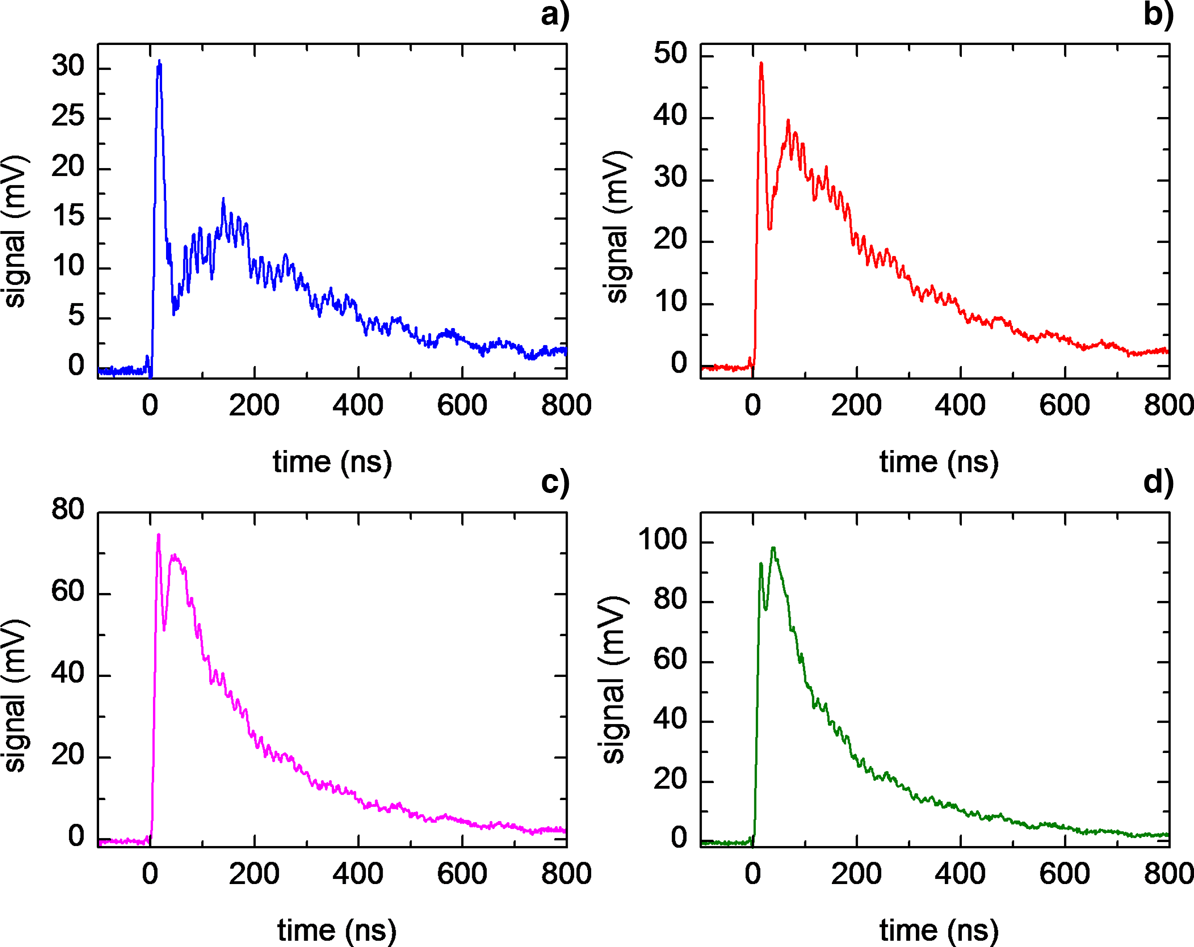
As mentioned above, the EUV detection system, shown in Figure 1, was designed for the time-resolved measurements of the emitted radiation from the EUV-induced plasmas. In principle, it allowed for the detection of spectrally integrated signals. On the other hand, a proper choice of absorption filters or/and multilayer mirrors serving as narrowband, spectral filters, allowed for temporal studies of specific groups of lines. In the simplest case, employing the detection system without any multilayer mirror and using the Al filter, a time profile of the EUV signal corresponding to the entire EUV spectrum could be obtained. Employing the Al/Yb/Al filter for the He plasma, the spectrum of the detected radiation signal could be narrowed to the He I emission. In Figures 4 and 5, signals recorded using these filters, for plasmas induced in the He gas of different densities, are presented.
EUV emission from He plasmas detected in the wavelength range spanned by the Al 250 nm filter  $(\sim17 \div 80\,{\rm nm)}$. Time profiles obtained for plasmas induced in gaseous targets of various densities: (a) ρ ≈ 1.2 × 10⁻² mg/cm3, (b) ρ ≈ 2.6 × 10⁻² mg/cm3, (c) ρ ≈ 5.4 × 10⁻² mg/cm3, and (d) ρ ≈ 1.1 × 10⁻¹ mg/cm3.

EUV emission from He plasmas detected in the wavelength range spanned by the 30 nm Al/100 nm Yb/30 nm Al filter  $(\sim47 \div 80\,{\rm nm})$. Time profiles obtained for plasmas induced in gaseous targets of various densities: (a) ρ ≈ 1.2 × 10⁻² mg/cm3, (b) ρ ≈ 2.6 × 10⁻² mg/cm3, (c) ρ ≈ 5.4 × 10⁻² mg/cm3, and (d) ρ ≈ 1.1 × 10⁻¹ mg/cm3.

The gas densities were varied from ρ ≈ 1.2 × 10⁻² mg/cm3 (~7% He density under 1 bar pressure) to ρ ≈ 1.1 × 10⁻¹ mg/cm3 (~60% He density under 1 bar). The time profiles obtained using either the Al or Al/Yb/Al filter (Figs 4 and 5, respectively) are composed of two peaks. The first peak in both cases is narrow, having a time duration τFDHM ≈ 12 ns with the Al filter and τFDHM ≈ 21 ns with the Al/Yb/Al filter. The second peak is much wider, even exceeding 160 ns. In most cases, its amplitude is larger compared to the second peak; however, the difference is much stronger in case of pulses detected using the Al filter. The time interval between the maxima is decreasing with the increase of the gas density. This effect is visible in both cases, using the Al or Al/Yb/Al filter; however, the time intervals in the second case are longer, up to approximately 120 ns. Generally, time duration of the EUV emission is very long, exceeding 800 ns. Comparing to the EUV driving pulse, only the first peak has the FDHM comparable to this pulse.
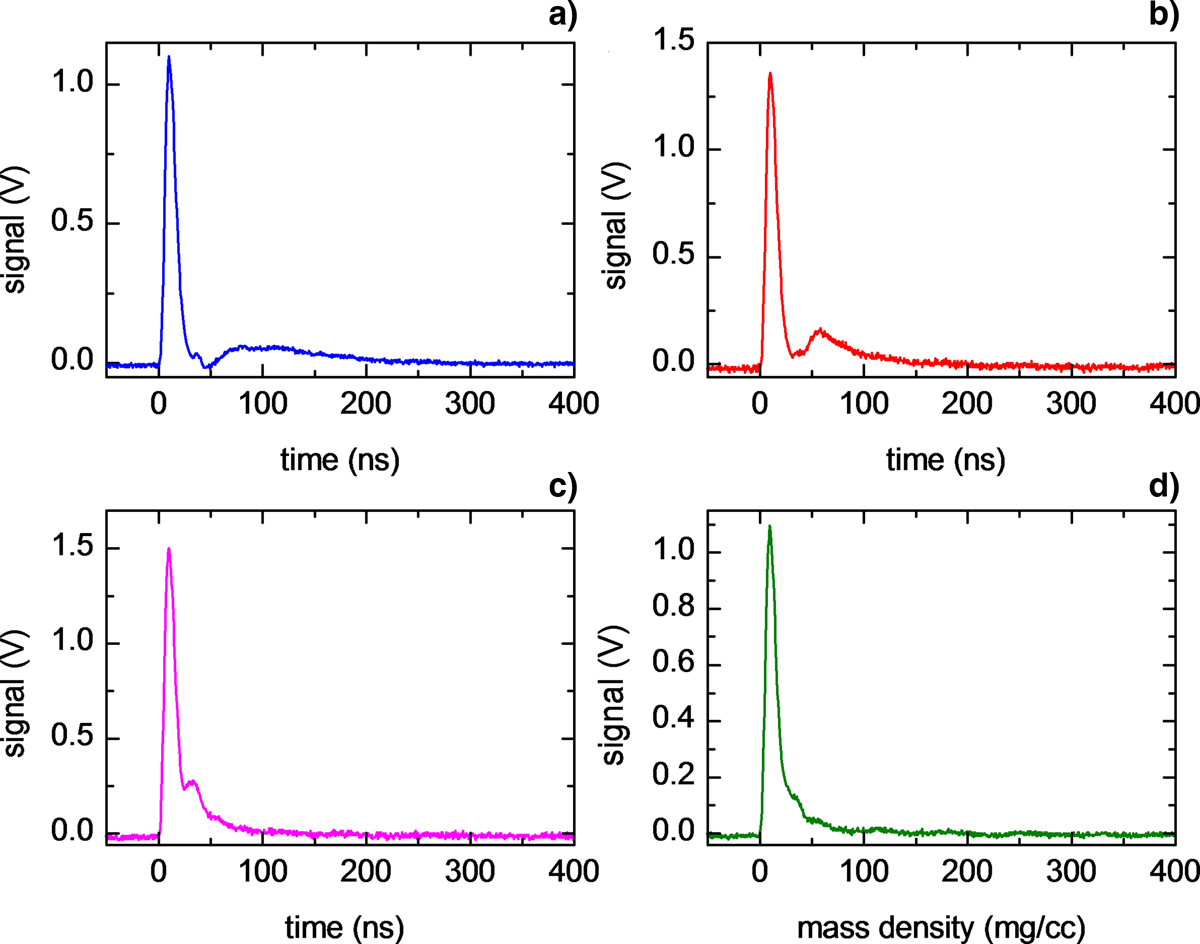
As stated above in case of low-temperature plasmas, induced in high-Z gases such as Kr and Xe, time-resolved measurements can be performed separately for lines originating from inner-shell transitions, and lines corresponding to radiative transitions of outer electrons in single or multicharged ions. In Figure 6, examples of time profiles obtained for these transitions are presented. In contrast to the profiles obtained for He plasmas, time profiles corresponding to Kr and Xe plasmas have only a single maximum. There can be noticed, however, significant differences between EUV pulses recorded in the wide spectral range, and the pulses corresponding to the inner-shell emission. Time profiles obtained in the first case are relatively wide with FDHMs  $\sim17.5\,{\rm ns}$ for Kr and
 $\sim15.6\,{\rm ns}$ for Xe plasmas, respectively. Signals decrease slowly, after a time of 80 ns from a beginning of the driving pulse, there is still some signal at a level of a few percent in respect to the maximum value.
Time profiles of the EUV emission from plasmas created in Kr and Xe gases: (a) Kr, spectral range  ${\rm \lambda} \sim 17 \div 80\,{\rm nm}$, τFDHM ≈ 17.5 ns; (b) Kr, M-shell emission, τFDHM ≈ 9.4 ns; (c) Xe, spectral range
 ${\rm \lambda} \sim 17 \div 80\,{\rm nm}$, τFDHM ≈ 15.6 ns; and (d) Xe, N-shell emission, τFDHM ≈ 10.4 ns.

Signals corresponding to the inner-shell emission are significantly shorter, their FDHMs are  $\sim9.4\,{\rm ns}$ (Kr) and
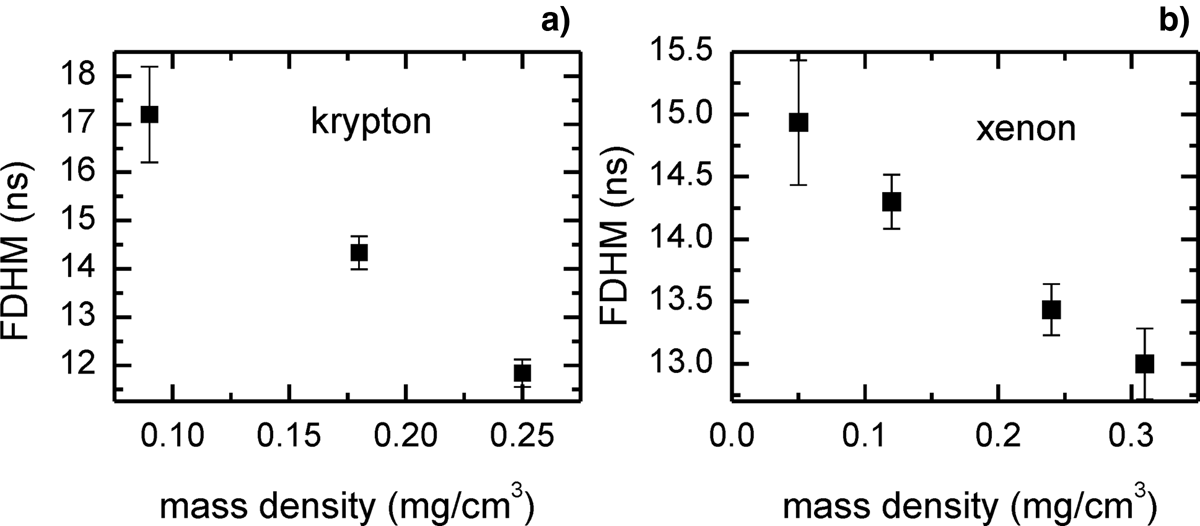
 $\sim10.4\,{\rm ns}$ (Xe). In contrast to the signals obtained using the Al filter, these values are practically independent on the gas density. In case of pulses corresponding to the EUV emission in the wide spectral range, an influence of the density on pulse profiles was observed. In Figure 7, dependencies of FDHMs of the signals from Kr and Xe plasmas, versus the gas density, are presented. It can be noticed that the larger density of the gas, the smaller FDHM.
An influence of the gas density, used for the creation of the EUV-induced plasmas, on pulse widths of the emitted EUV radiation: (a) Kr plasma and (b) Xe plasma.

Discussion of the results
The EUV photons delivered to the interaction region, using our irradiation system shown in Figure 1, have energies with a spectral maximum at ~110 eV. Energies of such a value are sufficient for ionization of any atom or molecule. The binding energy of He electrons in the ground state is 24.59 eV (Kelly, Reference Kelly1987); hence, a single photoelectron has enough energy for further ionization up to 3 atoms or 3–4 excitations from the ground state. In case of Kr and Xe, the corresponding ionization potentials are 14 (Saloman, Reference Saloman2007) and 12.13 eV (Saloman, Reference Saloman2004), respectively. It means that the number of released electrons, due to interaction of a single photon with atoms of these gases, can be even two times higher. Kr and Xe atoms, however, have complex electronic structures and except ionization from outer shells, the inner-shell ionization is also possible. Binding energies of M-shell electrons in Kr that can be released by the EUV photons are 93.8 and 95 eV. For Xe N-shell electrons, the corresponding values are 67.5 and 69.5 eV (http://henke.lbl.gov/optical_constants/). It should be pointed out that energies of photoelectrons released from outer shells by 110 eV photons are  $\sim96\,{\rm eV}$ (Kr) and
 $\sim98\,{\rm eV}$ (Xe). It means that the inner-shell ionization can be induced also by photoelectrons. In case of Kr atoms, however, it concerns only the most energetic photoelectrons, corresponding to photoionization by photons with energies ≥ 108 eV. The N-shell ionization of Xe atoms can be driven by photoelectrons released by photons with energies much lower ≥ 80 eV (λ ≤ 15.5 nm). Looking at the spectrum of the focused EUV radiation (Fig. 1a), it can be concluded that most of the driving photons have such energies. It means that the M-shell ionization of Kr atoms is driven mainly by the EUV photons, while in case of Xe atoms, some contribution to the N-shell ionization can be attributed to interaction with photoelectrons. It can influence the time duration of the inner-shell emission, which is limited by the Auger relaxation time. The Auger decay of the core hole is very short with a few-femtosecond lifetime (Drescher et al., Reference Drescher, Hentschel, Kienberger, Uiberacker, Yakovlev, Scrinzi, Westerwalbesloh, Kleineberg, Heinzmann and Krausz2002). Taking into account that radiative transition probabilities are a few orders of magnitude lower compared to the radiationless probabilities (Sampaio et al., Reference Sampaio, Madeira, Guerra, Parente, Santos, Indelicato and Marques2015), the inner-shell emission cannot be noticeable longer than the time duration of the ionizing pulse. In fact, in case of Kr, the Kr M-shell emission time,
 ${\rm \tau} _{{\rm FDHM}}\sim 9.4\,{\rm ns}$ (Fig. 6b), corresponds almost exactly to the EUV pulse, in case of the N-shell emission from Xe, it is a little longer,
 ${\rm \tau} _{{\rm FDHM}}\sim 10.4\,{\rm ns}$ (Fig. 6d). In principle, this longer emission time could be attributed to the N-shell ionization by photoelectrons, released during the EUV irradiation, and present during some time after stopping of the irradiation pulse. This time can be estimated from the formula τ = (n Xeσv e)−1, where σ is the total ionization cross section for Xe atoms, v e is the electron velocity, and n Xe is Xe atomic density. Taking into account that σ = 8 × 10⁻¹⁶ cm2 (Bartlett and Stelbovics, Reference Bartlett and Stelbovics2002), v e ≈ 5 × 108 cm/s for the electron energy
 $\sim70\,{\rm eV}$ and
 $n_{{\rm Xe}}\sim 10^{17}\,{\rm c}{\rm m}^{-3}$, it can be shown that this time is very short τ ≈ 25 ps. In fact, this time is even shorter, due to the electron impact excitation that should be also considered. The longer time, τFDHM, comparing to the driving EUV pulse should be, thus, considered as the instrumental effect, connected with a low signal-to-noise ratio, not as the real physical effect.
Concerning the EUV emission recorded in a wide spectral range (using the Al filter), it concerns mainly radiative decay of the excited Kr III–IV and Xe III–IV states. Such states can be created due to Auger decay of 3d 9 (Kr) and 4d 9 (Xe) states (Viefhaus et al., Reference Viefhaus, Braune, Korica, Reinkoster, Rolles and Becker2005; Palaudoux et al., Reference Palaudoux, Lablanquie, Andric, Ito, Shigemasa, Eland, Jonauskas, Kucas, Karazija and Penent2010). As mentioned above, probabilities of Auger decay of those states are a few orders of magnitude higher compared to the radiative channels. Hence, it should be expected that spectrally integrated emission from Kr III–IV or Xe III–IV ions is also orders of magnitude higher comparing to the corresponding inner-shell emission. In fact, the difference is not so large, hardly exceeding one order of magnitude in both cases. Apart from that lifetimes of the excited states, estimated based on the corresponding oscillator strengths (Raineri et al., Reference Raineri, Almandos, Bredice, Gallardo, Trigueiros and Pettersson1998; Bredice et al., Reference Bredice, Raineri, Almandos, Gallardo and Trigueiros2000; Raineri et al., Reference Raineri, Lagorio, Padilla, Gallardo and Almandos2008) are of the order of 1 ns, while the emission was detected during significantly longer times, exceeding 80 ns. It means that the excited states have to be created also by collisional excitation and recombination. Concerning the collisional excitation, it should be taken into account that photoelectrons lose their energies after a few collisions with atoms or ions. The estimated average time between these collisions is less than 100 ps, which means that electrons capable for excitation of ions are present during a short time, of the order of 1 ns, after stopping of the driving EUV pulse. After that time only electrons of low energy are present and creation of the excited states is possible only due to recombination processes, mainly radiative recombination. Based on the Kramers formula, it can be roughly estimated that the recombination cross section for electrons of low energy, of the order of 1 eV, is approximately three orders of magnitude smaller comparing to the ionization or excitation cross sections. Hence, the excited states of Kr and Xe ions can appear during a relatively long time of the order of hundreds of nanoseconds. Radiative decay of these states results in emission of the EUV photons detected during a long time after the driving radiation pulse.
Concerning the EUV radiation emitted from He plasmas, it originates from excited atoms or singly charged ions. It can be noticed that the EUV spectrum of He plasmas is dominated by He II lines. These lines gave the main contribution to the signal detected in the entire EUV spectral range, using the Al filter. By using the Al/Yb/Al filter, it was possible to cut off a part of the signal corresponding to the He II ions and measure only the He I signal. Transmission of the Al 250 nm filter for the wavelength range 50–60 nm (He I lines), exceeds 50%, while the Al/Yb/Al filter transmission in this range is approximately 40%. The second maximum of signals detected using the first filter has the amplitude over three times higher comparing to signals detected employing the second one. It means that significant contribution to the second maximum originates from the He II emission lines. On the other hand, there is only a small contribution of He I emission to the first maximum of the detected signal, corresponding to the time of the gas irradiation, by the driving EUV pulse. It can be thus concluded that the EUV irradiation results mainly in ionization, simultaneous ionization and excitation and double ionization. There is only a small contribution of the excitation of neutral atoms, resulting in the first peak, detected using the Al/Yb/Al filter. Similarly to Kr and Xe plasmas, the emission at a long time after the irradiation is connected with recombination to the excited states. It should be pointed out that creation of the He II excited states (He+*) due to the radiative recombination requires the presence of He++ ions. Taking into account that the recombination coefficient for He++ ions is a few times higher comparing to He+ ions (Pequignot et al., Reference Pequignot, Petitjean and Boisson1991), it explains higher contribution of He II emission in the second peak of the signal detected using the Al filter. It requires, however, a comparable number of singly and doubly charged ions. There is also a problem concerning the minimum of the EUV emission, vanishing for the highest gas density. Its presence can be connected with a high excitation energy of He atoms, from a ground state, exceeding 21 eV. Shortly after the photoionization phase, energies of electrons drop below this value. Starting from this moment excited states cannot be created via collisional excitation. The only possibility is recombination which is, however, significantly slower comparing to ionization, excitation, and radiative decay processes. For low electron temperatures of the order of  $\sim1\,{\rm eV}$, the radiative recombination rate (Pequignot et al., Reference Pequignot, Petitjean and Boisson1991) is over four orders of magnitude lower comparing to electron impact ionization rate. What is, however, more important, the recombination rate for electron temperature
 $\sim10\,{\rm eV}$, for He ions, is still an order of magnitude lower. It means that creation of the excited states due to the radiative recombination increases with a decrease in the electron temperature. This temperature decreases due to the energy exchange between electrons and ions and can be estimated from a thermalization time (Spitzer, Reference Spitzer1962)
 ${\rm \tau} _{{\rm ei}}\approx 10^{13}{\rm AT}_{\rm e}^{3/2} /n_{\rm e}Z^2\ln \Lambda \; \lsqb s \rsqb$. For the electron temperature
 $T_{\rm e}\sim 10\,{\rm eV}$ and the density
 $n_{\rm e}\sim 10^{17}$, the thermalization time is approximately 50 ns and corresponds to the time interval between a maxima of the detected signal. This time decreases with the density which was also observed in the experiment.
Summary
In this work, time-resolved measurements of the EUV emission, from low-temperature plasmas induced in He, Kr, and Xe gases were performed. Plasmas were created by irradiation of gases injected into the vacuum chamber, with intense EUV pulses. The measurements were carried out using the EUV detection system, composed of the paraboloidal collector, the EUV-sensitive photodiode, and a proper absorption filter. Additionally, for measurements in narrow spectral ranges, multilayer mirrors were employed. In case of high-Z gases (Kr and Xe), it was shown that the corresponding time duration of the EUV emission, measured in a wide wavelength range  $\sim17 \div 80\,{\rm nm}$, significantly exceeded a pulse width of the driving EUV pulse. Measurements performed in narrow spectral ranges, corresponding to the inner-shell emission, indicated that the emission time within a measurement error was equal to the driving EUV pulse duration. It was thus concluded that electrons with energies sufficient for the inner-shell ionization practically do not exist after the time of irradiation. Concerning He plasmas, time-resolved measurements were performed for the entire spectral range of the EUV emission (1s–np, 1s 2–1snp lines) and for the 1s 2–1snp lines only. It was shown that the emission is dominated by the He II lines, especially during the irradiation phase. The radiation is emitted a long time after the irradiation, even after hundreds of nanoseconds. There is also the second maximum of the EUV emission attributed to increase in the recombination rate connected with a decrease in the electron temperature after the end of the irradiation.
Financial support
This work was supported by the National Science Centre, Poland, grant agreement no. UMO-2016/21/B/ST7/02225 and partially by European Union's Horizon 2020 Programme (LASERLAB-EUROPE) grant agreement no. 654148.