PART 1: THE AVAILABILITY OF EARLY VERBS IN PARENTAL SINGLE-WORD UTTERANCES
The theory of syntactic bootstrapping
In this paper we wish to address one of the unsolved questions in the field of language development, which is how much can children learn from the interactive context about the meaning of verbs they hear. According to one approach (e.g. Gleitman, Reference Gleitman1990), the interactive context may be a good source for the meaning of nouns but it is not a good source for the meaning of verbs, because the majority of times when parents use verbs to address young children, there is a temporal mismatch between the uttering of the verb and the action event referred to by the verb. In this approach, in order to learn from the non-linguistic context what a novel verb refers to, the expectation is that parental input line up temporally with ongoing events. The measures of the transparency of input is the occurrence of the event referred to by the verb within a narrow temporal window adjacent to the utterance. In several studies, this expectation was found to be unfulfilled in the majority of cases; about 60–70% of all parental uses of verbs are temporarily ‘mismatched’ with the event the verb refers to. Instead of referring to actions visible in the environment, they mostly refer to imminent actions (Gleitman, Reference Gleitman1990; Ibbotson, Lieven & Tomasello, Reference Ibbotson, Lieven and Tomasello2013; Lederer, Gleitman & Gleitman, Reference Lederer, Gleitman, Gleitman, Tomasello and Merriam1995; Tomasello & Kruger, Reference Tomasello and Kruger1992; Verlinden & Gillis, Reference Verlinden, Gillis and Van Besien1988). Indeed Gleitman (Reference Gleitman1990, p. 15) claimed that “positive imperatives pose one of the most devastating challenges to any scheme that works by constructing word-to-world pairings, for the mother will utter ‘Eat your peas!’ if and only if the child is not then eating the peas. Thus a whole class of constructions is reserved for saying things that mismatch the current situation.” Under the assumption that the meaning of verbs is learned by a kind of ostensive definition as nouns are, it seems unclear how the child would be able to match the verb to the world and get its meaning.
The conclusions drawn from these studies is that verb meaning is not recoverable from the non-linguistic context of input utterances. As learning verbs from the ‘world’ or the non-linguistic context appears uninformative by itself, Gleitman and her colleagues suggested that the only way children can get the meaning of verbs in an utterance is by using the information provided by the linguistic context, that is, by the sentences in which the verb appears. In her seminal paper on the subject, Gleitman (Reference Gleitman1990) says:
The idea here is that children deduce verb meanings in a procedure that is sensitive to their syntactic privileges of occurrence. They must do so, because either (a) there is not enough information in the whole world to learn the meaning of even simple verbs, or (b) there is too much information in the world to learn the meanings of these verbs.’ (Gleitman, Reference Gleitman1990, p. 5)
The proposed learning procedure is syntactic bootstrapping, by which children learn about a verb's meaning from sentences exhibiting the verb's subcategorization frames, i.e. whether the verb is transitive or intransitive, has one or two objects, and so on. This means that, according to Gleitman, children do not map words to the world but to sentences: “To make use of this information source in acquiring the verb vocabulary, the learner must perform a sentence-to-world mapping rather than a word-to-world mapping” (1990, p. 23). That is, the theory of syntactic bootstrapping points to multiword sentences and not single-word utterances in the linguistic input as the source of learning verbs by young children.
Transparent input to blind children
A major source for Gleitman's (Reference Gleitman1990) dissatisfaction with the interactive context as a source for verb meaning came from a study of blind children (Landau & Gleitman, Reference Landau and Gleitman1985). In that study, it was found that blind children respond to the perception verbs look and see by attempting to manually explore a spatially near object. After exploring in detail the speech of one of the mothers to a blind child, Gleitman points out there is a problem with the explanation that the children have learned the meaning of such verbs as invitations for manual exploration as the overall the use of these verbs in the speech of the mother is not transparently correlated with availability of objects nearby. Only in 73% of cases when the mother says the verb look and in 35% of cases when she says the verb see in some utterance are there objects nearby. Gleitman proposes that the key to the children learning the meaning of these verbs in interaction is that for certain sentence frames the probability of there being an object nearby is very high, while in others it is not, and the blind children could have learned the meaning of look and see if they only parsed the sentences the mother said and selectively attended to the ones that signalled with a high probability the nearby-ness of an object while ignoring the others. Distinguishing between some syntactic sentence frames and others means using syntax to extract lexical meaning – which is what the theory of syntactic bootstrapping proposes for the acquisition of a verb vocabulary.
Although it is undoubtedly correct that different sentence frames in which verbs occur have distinct correlations with the non-linguistic context, if only because some are idiomatic expressions with special meanings (e.g. look up to somebody means admiring them, not observing them in the environment), it appears that in the case of the blind child's mother, Gleitman's specific conclusions may have been the result of an error in analysis. In her Tables 2 and 3, Gleitman (Reference Gleitman1990) presents ‘Subcategorization frames for common verbs’ and the results of ‘Spatial / syntactic analysis of Look and See’. It appears that the most frequent ‘subcategorization frame’ for look is Look!, This is NP and for see it is See?, This is NP, which Gleitman calls V!, S and V?, S, respectively. This pattern of verb use has a perfect 100% of near objects for look and the highest percent of near objects for see. In her conclusions, Gleitman calls this utterance type ‘deictic interjective use’ and considers them sentences, and the type itself the result of syntactic analysis that the child does. Her conclusions are that if the child maps sentences to the world, not words, and focuses on such sentences, the “NEARbyness of the object becomes a much more reliable clue than previously”. There is of course a grave difficulty with this analysis: the relevant utterances consist of two sentences, not one, and the verb itself occurs as a single-word utterance, not part of a multiword, syntactically connected sentence. In any case, the additional sentence This is NP does not provide a subcategorization frame or an argument structure for the verbs look or see, and the conclusions made in the paper that children learn these perception verbs because of the input from a full sentence's syntactic and semantic information are unfounded.
As these kind of utterances were the most frequent ones in the data, and, in addition, other single-word sentence frames also had high percentages of near objects associated with them, it seemed worthwhile to formally check the hypothesis that there was a consistent advantage in the blind mother's speech to single-word verbs, as far as transparent environment was concerned. Collapsing all different ‘Canonical sentence frames’ for look according to the syntactic status of the sentence in which the verb was embedded – namely, all V., V!, and V? sentences, ignoring the additional sentences such as this is NP – we get 20 tokens of the single-word verb look, all 100% referring to near objects, and 14 tokens of multiword sentences containing look, of which only 5 (36%) refer to near objects. The same analysis gives 7 single-word see with 4 or 57% of near objects, and 11 multiword sentences of see with 3 or 27% near objects. It appears that in Gleitman's blind child input data, single-word perception verbs are much more likely to have a near and available object than the same verbs in multiword sentence frames. This raises the possibility that what makes acquisition of the canonical meaning of these verbs possible for young blind children is not the syntactic sentence frame but, rather, the lack of one. That is, instead of showing the better correlation of some sentences with the extralinguistic environment, actually the results show that single-word utterances as a class have better mapping to the environment than syntactically constructed sentences giving explicit ‘subcategorization frames’ and argument structures for the same verbs.
Do children learn verbs from single-word input?
Gleitman's data raise the possibility that young children acquiring English learn verbs from single-word input sentences. Besides the obvious reason why this may happen, which is that single-word input utterances pose a lower processing load on young children learning their first vocabulary, there are some other arguments to support this hypothesis.
First, there are some previous findings regarding the efficacy of the single-word input for the acquisition of nouns in English. Various researchers have found that, in all probability, children learn their early nouns from parental single-word utterances (Brent & Siskind, Reference Brent and Siskind2001; Lew-Williams, Pelucchi & Saffran, Reference Lew-Williams, Pelucchi and Saffran2011). Brent and Siskind (Reference Brent and Siskind2001) found that 75% of 18-month-olds' first words had previously appeared in isolation in their own mothers' speech, and, moreover, that the frequency of hearing a word in isolation but not the overall frequency of words in mothers' speech predicted children's learning the word for later use. Finally, the significant superiority of single-word input over sentences was found even when the noun modelled for learning was placed in the position claimed to pull children's attention the most, that is, in an utterance-final position (Keren-Portnoy, Vihman & Lindop-Fisher, in prep.). It appears that single-word input has a clear advantage for learning new words, at least when these are nouns.
Second, it is very possible that the findings cited above regarding the supposed temporal mismatch between verbs children hear, and the non-linguistic context that should support their interpretation, stem from a misunderstanding of how children learn the meaning of words in interaction.
In the studies of the acquisition of verbs cited above, the expectation was that parental input would line up temporally with ongoing events, in a manner reminiscent of ostensive definition: the parent uses a verb to describe some action event, and the action it refers to happens in the here-and-now of the immediate environment. The measures of the transparency of input used in these studies were the occurrence of the event referred to by the verb within a narrow temporal window adjacent to the utterance. This expectation rests on the presupposition that utterances inevitably describe events. Under that assumption, events referred to by verbs should be current and observable, and as they are not, it appears as if there were a mismatch between ‘word’ and ‘world’ (Gleitman, Reference Gleitman1990).
However, there is no evidence that listeners, including young children, assume all utterances are inevitably descriptions of the world. Indeed, it is not really disputed that when young children hear an imperative demand such as Look!, Stop!, Give me that!, or Eat your peas!, they understand quite well that the speaker has made a request of them. If they are not familiar with the words used, instead of searching the environment for some ongoing event that the sentence may describe, they in all probability search for cues, what it is that the speaker wants them to do. More formally, when we come to explain the process of acquisition of verbs by young children, the mapping we should be looking for is not of the verb with a concurrent, past, or future action-event that the verb may describe or refer to, but with the speaker's communicative intent in uttering the verb. Such a process is one of pragmatic matching in which children interpret parents' utterances as communications and learn the verbal content as expressions of the guessed intents. This is not a verb-specific process but a general one, applying to the learning of nouns or adjectives and other form classes as well as verbs. In particular, through this process verbs and nouns are learned in a likewise manner, thus simplifying the theory of form–meaning mapping. Pragmatic matching as a fundamental process of learning was first suggested by Macnamara (Reference Macnamara1972) in his seminal article on word learning and language acquisition in general; further developments of this concept are to be found in publications by Bruner (e.g. Reference Bruner1975/76), as well as by Antinucci and Parisi (Reference Antinucci, Parisi, Lennenberg and Lennenberg1975), Bates (Reference Bates1976), Ninio (Reference Ninio1992), and others. Our redefinition of the learning process from a kind of ostensive definition or semantic matching of word-to-world, to a pragmatic matching of word to guessed utterance meaning, solves the temporal mismatch problem by sidestepping it.
The difference between the model of pragmatic matching and the model used by Gleitman and the other previous researchers is clearest when we consider the gestures that accompany the verbal utterance, which are often considered in the literature not to be informative for acquisition as they do not parallel the verbal content (Schaffer, Hepburn & Collis, Reference Schaffer, Hepburn and Collis1983). Under the perspective of pragmatic matching, the parallels searched for were the wrong kinds. For example, handing an object to the addressee may be unrelated to the semantics of the verb take in the utterance Take it!, but it makes transparent the communicative intent of the speaker, which is a proposal that the addressee take the object. Another example may be the single word imperative Look!, accompanied by a point to the object the speaker wants the addressee to look at. The act of pointing is not the meaning of the verb ‘to look’, but it does make the force of the request to look at some environmental object transparent. If under the word-to-referent theory of learning, such utterances pose a grave problem of interpretation, under the model of the child matching words to communicative intent, such utterances are transparent, as they are accompanied by the gestural or action equivalent of the request. As the environment is not failing to provide the verb's meaning, there is no need to look for this information in the linguistic context, that is, in sentences. The simplest and shortest utterances, namely, single-word parental verbs, can deliver the required input to learning the verbs' meaning.
It follows that the alternative hypothesis to the theory of syntactic bootstrapping is that the interactive context of language use provides sufficient information for understanding parental utterances during acquisition, making it possible for the child to map meaning to a novel linguistic form. This is in fact one of the central presuppositions of the social-interactionist theory of language development (e.g. Bruner, Reference Bruner1975/76). Unless proven otherwise, on this presupposition the obvious source for learning any vocabulary item, including verbs, are the simplest and shortest utterances in the linguistic input, whose meaning children guess from the utterances' non-linguistic, interactive context.
This does not imply that verb learning cannot or does not make use of syntactic distributional evidence. There exists experimental evidence that shows that children are able to deduce something about the meaning of a word from its syntactic distribution. This source of information may be especially important for the acquisition of verbs that are acquired at later ages, such the belief verbs think and know, which do not usually appear until the end of the third year of life (e.g. Papafragou, Cassidy & Gleitman, Reference Papafragou, Cassidy and Gleitman2007). Such verbs also tend not to be presented by adult speakers in the form of single-word utterances. This implies that this type of learning is unlikely to play a central role in the acquisition of the earliest vocabulary of verbs by pre-syntactic children, which is the topic of the present study.
The same argument applies also to another of the major early justifications of the syntactic bootstrapping hypothesis, which was the ‘human simulation paradigm’ experiments (Gillette, Gleitman, Gleitman & Lederer, Reference Gillette, Gleitman, Gleitman and Lederer1999). In these experiments, adults watched videos of mother–child interaction and had to guess the verbs said by the mother solely on the basis of the non-verbal interaction, without hearing any of the speech that went on. What was found was that adults had considerable difficulty guessing the verbs said by the mothers, and in particular, some verbs such as know, like, love, say, think, have, make, and pop were never correctly identified by any subject. It should be noticed that belief verbs are heavily represented in the list of verbs which are impossible to identify on the basis of the non-verbal environment. As mentioned before, children tend not to learn such verbs early, nor are they typically presented by adult speakers in the form of single-word utterances. It is likely that syntactic distribution is an important source for learning the meaning of many verbs, but not so much for the earliest-acquired verb vocabulary, which is our focus of interest in the present study. Indeed, the adult participants of the Gillette et al., study were much better at guessing that the mothers said the verb look, which, under the perspective of pragmatic matching, tends to be transparently reflected in the non-verbal, interactive environment. In fact, they were as good at guessing this verb as they were with nouns, on average, which demonstrates that it is the environmental context rather than the syntactic one that helps the young learners to grasp its meaning.
Testing the simplest source hypothesis in the acquisition of Hebrew
In a recent study, support for the simplest source hypothesis was found in a study of the acquisition of transitive verbs by Hebrew-speaking young children (Ninio, Reference Ninio2015). In this study, single-word and multi-word input speech were compared as the source of children's early verbs. The parental sample was the pooled speech of forty-eight Hebrew-speaking mothers who were observed in dyadic interaction with their infants (0;10–2;8). The mothers produced 1,513 transitive verbs in single-word utterances and 30,511 transitive verbs in multi-word utterances. The hypothesis was tested on the first verbs produced by an unrelated sample of young children. The acquisition data consisted of the first twenty verbs produced by six children aged between 1;2 and 2;1, collected by Armon-Lotem and Berman (Reference Armon-Lotem and Berman2003). It was found that the frequency of single-word utterances in the input corpus predicts the acquisition of verbs by the children much better than the frequency of multi-word utterances: the token frequency of verbs in mothers' single-word utterances had a highly significant 0·66 correlation with number of children acquiring the verb as their first twenty, accounting for 43·4% of the variance, whereas verbs in mothers' multi-word utterances only had a non-significant 0·29 correlation, accounting for a mere 8·1% of the variance. The results were replicated on the sample of young children of the same mothers, using token frequency of their single-word utterances as the measure of acquisition. This time, both maternal single-word and multi-word token distributions had significant correlations with the frequencies of children's single-word utterances of verbs (r = 0·76 and 0·44, respectively), but the relative token frequencies of maternal single-word utterances accounted for three times as much variance in child speech than multi-word maternal frequencies, 58·4%. vs. 19·6%. It seems that in Hebrew acquisition, children's first transitive verb vocabulary is learned from single-word input rather than from maternal sentences.
The present study
In the reported study, we focus on the acquisition of English, and test the hypothesis that young children learn verbs from parents' single-word input, rather than from multi-word sentences. We shall attempt to predict children's early verbs by the relative token frequency of parental sentences containing verbs, comparing single-word and multi-word utterances. As in the study examining the acquisition of Hebrew, we will concentrate on transitive verbs. Our hypothesis will be as tested on tokens of single-word utterances consisting of various verbs produced by a sample of children as the measure of acquisition.
We choose yet again transitive verbs for testing our hypothesis because by comparison with intransitive verbs, the single-word bare transitive verb omits not only the information that the verb has a subject-argument but also that it has one or more object-arguments. If, as the syntactic bootstrapping hypothesis claims, children acquiring English rely on the syntactic structures in which verbs appear to infer their meanings (e.g. Fisher, Reference Fisher1996; Gleitman, Reference Gleitman1990; Imai et al., Reference Imai, Li, Haryu, Okada, Hirsh-Pasek, Golinkoff and Shigematsu2008; Naigles, Reference Naigles1990), single-word transitive verbs serve as considerably poorer input for English-reared children than are single-word intransitive verbs, as there is more of the argument structure that is hidden by argument dropping. If children need the arguments of a verb to be present in input sentences in order to learn the verb's meaning, then the comparison of full sentences and single-word transitive verbs can certainly serve as a clear test case.
As this study is an attempt to replicate for English the Ninio (Reference Ninio2015) findings regarding the acquisition of transitive verbs in Hebrew, the two languages should be compared on some relevant parameters. Although both are nominative–accusative languages with a basic SVO word order, the two languages are known to differ in licensing subject and object-drop. Hebrew is a partially pro-drop and object-dropping language; subjects and objects can usually be omitted if they are discourse topics and can be recovered from the linguistic and extralinguistic context (Berman, Reference Berman1980; Doron, Reference Doron1999; Goldberg, Reference Goldberg, Mikkelsen and Potts2002; Landau, Reference Landau2010). English, on the other hand, requires all arguments to be overtly expressed, and in particular it prohibits object-drop, except in highly restricted conditions (Dixon, Reference Dixon2005; Goldberg, Reference Goldberg, Horn and Ward2004; Haegeman, Reference Haegeman1990; Huddleston & Pullum, Reference Huddleston and Pullum2002; Massam & Roberge, Reference Massam and Roberge1989; Quirk, Greenbaum, Leech & Svartvik, Reference Quirk, Greenbaum, Leech and Svartvik1985). In particular, some verbs but not others are lexically specified for object-dropping (Fillmore, Reference Fillmore1986; Liu, Reference Liu2008). Given the typological difference, it is thus an open question whether we can replicate the Hebrew findings in an English corpus.
METHOD
Participants
We used an already constructed large corpus or collection of transcribed sentences, representing English-language parent–child dyadic conversation, which was built and annotated in a previous stage of this study (Ninio, Reference Ninio2011). We systematically sampled the English transcripts in the CHILDES (Child Language Data Exchange System) archive (MacWhinney, Reference MacWhinney2000). CHILDES is a public domain database for corpora on first and second language acquisition. The publicly available, shared archive contains documentation of the speech of more than 500 English-speaking parents addressed to their young children. The CHILDES archive stores the transcribed observations collected in various different research projects. In building our corpora, we followed closely the principles established in linguistics for constructing systematically assembled large corpora (Francis & Kučera, Reference Francis and Kučera1979).
We selected projects among the ones available using the criteria that the observations were of normally developing young children with no diagnosed hearing or speech problems, and of their parents, native speakers of English, their speech produced in the context of naturalistic, dyadic parent–child interaction. We restricted the child's age during the observed period to three years and six months. This process resulted in the selection of parents and children from thirty-three research projects in the CHILDES archive: the British projects Belfast, Howe, Korman, Manchester, and Wells, and the American projects Bates, Bernstein-Ratner, Bliss, Bloom 1970 and 1973, Brent, Brown, Clark, Cornell, Demetras, Feldman, Gleason, Harvard Home-School, Higginson, Kuczaj, MacWhinney, McMillan, Morisset, New England, Peters-Wilson, Post, Rollins, Sachs, Suppes, Tardif, Valian, Van Houten, and Warren-Leubecker (MacWhinney, Reference MacWhinney2000). From these projects, we selected 471 observational studies involving a different target child of the correct age range, namely, below 3;6. For more details of the corpus building and the coding process performed at the previous stage of the study, see Chapter 2 of Ninio (Reference Ninio2011).
Children's corpus of single-word sentences
We built a corpus of young children's single-word speech. Children's utterances were included only if they were spontaneous, namely, not immediate imitations of preceding adult utterances. For each utterance marked in the original transcriptions as one uttered by the child, we hand-checked the context to make certain that the line was indeed child speech (and not, for example, an action description or parental sentence erroneously marked as child speech). We limited each child's contribution to the period in which he or she produced at the most 300 multi-word utterances. Of the total sample of 471 children in the selected observations, 268 produced spontaneous single-word utterances consisting of a verb, and of these, 252 children produced single-word transitive verbs. Their mean age was 1;11·20 (SD 4·3). We did not measure MLU but according to our estimation, the speech of this sample belonged to Brown's Early Stage I of grammatical development (Brown, Reference Brown1973).
Parents' corpora
Using the same transcribed observations from which we took the children's speech, we built a corpus of parental utterances containing verbs. Each parent was selected individually, so that from the same research project involving the same target child, we included in the study either the mother, or the father, or both parents as separate speakers, as long as either or both passed the criteria for inclusion. In 35 of the 471 studies there were two active parents interacting with the target child, resulting in a parental sample of 506 different parents.
In order to avoid severely unequal contributions to the pooled corpus, the number of utterances included from each parent was restricted to a maximum of 3,000. We excluded the speech of parents addressed to other adults present in the observational session or on the telephone, as this speech may be ignored by young children because of unfamiliar subjects. The resultant parental corpus contains almost 1·5 million (1,470,811) running words of transcribed speech based on naturalistic observations of interaction between parents and their young children, representing several hundred hours of transcribed speech. Most of the children addressed were under three years of age, and 93% of the parents in the sample talked to a child between one year and two and a half years of age in all or the majority of the observations we included in the corpus. The mean age of the children addressed was 2·25 years.
The corpora of English-language parental child-directed speech represent the linguistic input that young children receive when acquiring syntax. Although each separate study is by necessity limited in its coverage of the phenomenon, the different studies pooled together can provide the requisite solid database for generalization. The use of pooled corpora of unrelated parents as a representation of the linguistic input is a relatively conventional move in child language research (e.g. Goodman, Dale & Li, Reference Goodman, Dale and Li2008; Naigles & Hoff-Ginsberg, Reference Naigles and Hoff-Ginsberg1995; Zamuner, Gerken & Hammond, Reference Zamuner, Gerken and Hammond2005). Multiple speakers of child-directed speech may provide a good estimate of the total linguistic input to which children are exposed, which includes, besides the speech of the individual mother or father, the speech of grandparents, aunts and uncles, older siblings and other family members, neighbours, care professionals, and so forth, represented in our corpus by the speech of mothers and fathers unrelated to the individual child. The pooled database represents the language behaviour exhibited by the community as a whole when addressing young children.
The analyses of a study using corpus data do not attempt to demonstrate that particular children learned particular verbs from their own parents. When working with a corpus pooling the speech data of a large number of, respectively, parents and children, the aim is, rather, to create a dataset of typical child-directed speech and use this to make predictions about children's average order of acquisition, thus finding out which of a possible set of factors are most predictive of development. The variability exploited for statistical testing is not, thus, individual differences, but rather contrasts between the effects of several different potential sources of input.
As our analytic plan was to find what kind of input, single-word or sentences, was more likely to serve as a model for learning by young children, we checked the transcribed dialogue and the action and other contextual comments in order to ascertain that we include only spontaneous utterances from target parent to target child. This means we excluded parental utterances if they imitated the child's previous utterance, for example to ask for clarification or to provide feedback. We wanted parental utterances that can serve as models for the child's learning – if the parent imitates the child, this cannot be considered a model for new learning. This was in particular important for single-word sentences by parents that were likely to be verbatim repetitions of children's single-word sentences. The exclusion of such utterances alongside children's imitation ensured that we did not arrive at a positive correlation between parental and child frequencies for particular verbs because of mutual imitation of participant speakers.
Preparation of the database of verbs
We derived a child corpus of single-word verbs and two parental corpora, one of single-word utterances consisting of verbs and the other of multi-word sentences including verbs. The verbs in the corpora were manually identified in the previous stage of the project. The transcribed observations of the CHILDES archive are tagged for part of speech using an automatic tagger, but this program has a tendency to tag as nouns polysemous noun–verb lexemes such as drink, play, colour, swim, and look, and this would have compromised the present study. We checked all multi-word utterances with verbs for the existence of some syntactic relation between the verb and other words in the clause, discounting verbs lacking syntactic relations with the rest of the sentence. We also excluded from the corpus two-word utterances in which a verb was accompanied only by a vocative or an interjection (e.g. Look, John) as they fell in between the definition of single-word utterance and multi-word utterance despite the fact that there is no syntactic relation between the words. The exceptions were the interjections oh, ah, and aah that were ignored when defining single-word utterances comprising verbs (e.g. Aah, stop!), as they are very close to non-verbal vocalizations and do not appear to require syntactic processing.
We lemmatized all verbs in the corpus into their respective stem-groups. Lemmatization is the grouping of related verb forms that share the same stem and differ only in inflection or spelling. For example, eat, eats, ate, eaten, and eating all belong to the stem-group or lemma of eat. In the case of irregular verbs changing their shape when inflected, such as the had and has forms of the verb have, these forms were also included in the lemma of the relevant stem. This process neutralizes differences in morphological shape irrelevant for the syntactic behaviour of verbs, such as differences of tense, aspect, and person. We used the lemmas in order to trace the verbs children used to the verbs in parental utterances, ignoring possible morphological differences. This analysis assumes that young children ignore the differences in morphological form between verbs belonging to the same lemma, so that they treat an inflected form such as eats as equivalent to an uninflected form such as eat.
All verbs in parental sentences were classified as transitive or intransitive, based on their actual semantics in the relevant utterance. The classification was based on the linguistic and non-linguistic context of each utterance in the transcribed observation. As there is much lability or ambitransitivity in English verbs, relying merely on an a priori classification would have been misleading. Verbs requiring an expressed object of any kind (direct, indirect, oblique) were classified as transitive verbs. Verbs not requiring an object were classified as intransitive. There were two kinds of verbs that we did not separate in further analyses: verbs which are always intransitive (e.g. go, stand, run, at least in non-idiomatic usage) or verbs that do have transitive versions but were currently used with an intransitive version, either as an unergative verb (denoting an activity, e.g. eat, read, play; see Vendler, Reference Vendler1957) or as the middle voice of an unaccusative verb (denoting a happening with the patient as subject, e.g. break, turn, spill; see Dixon & Aikhenvald, Reference Dixon, Aikhenvald, Dixon and Aikhenvald2000). There were 604 tokens of verbs that are always intransitive, and 87 tokens of transitive verbs in a momentary intransitive version.
RESULTS AND DISCUSSION
Distribution of tokens of verbs in children's single-word speech
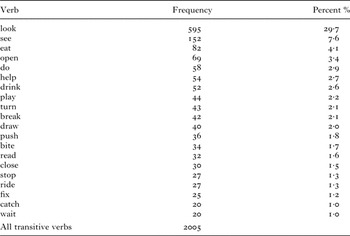
Children produced 2,665 single-word sentences which were verbs: 2,005 or 75·23% were transitive, while 660 or 24·77% were intransitive. The 2,005 transitive utterances produced by this sample represented 117 different verbs. We focused in this study on transitive verbs, and the intransitive set will not be further analyzed. It is noteworthy that three-quarters of all single-word verbs by children are transitive, demonstrating that such verbs do not pose any special difficulty for the children.
Table 1 presents the twenty most frequent verb lexemes in the children's single-word corpus and their pooled token frequency. The verb lexemes are given in this and the following tables in their bare infinitive form.
Frequency of children's twenty most frequent transitive verbs in single-word utterances and their proportion of the total

Distribution of tokens of verbs in parents' single-word speech and multi-word speech
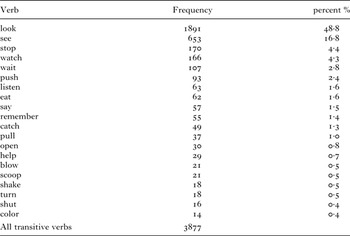
The parents' corpus yielded a total of 336,182 verbs. All parental sentences containing verbs were separated into a corpus of single-word utterances and a second corpus of multi-word utterances. There were 4,366 single-word utterances with verbs; the great majority (3,877, 88·8%) were transitive verbs. There were 331,816 verbs appearing in syntactic multi-word contexts. The verbs forming part of multi-word sentences were also transitive in the majority of cases, but in a less extreme way (58·6%). Surprisingly, object-dropping in single-word utterances of verbs is not avoided by English-speaking parents, and in actuality single-word expression of verbs appears to be mostly devoted to such object-dropper items. As we coded as transitive only the actual use of verbs in the specific context, it appears that parents are confident that young children would be able to interpret their single-word verbs with omitted semantic objects.
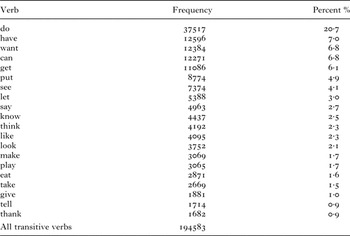
Parents produced 3,877 single-word utterances containing transitive verbs, using 128 different verbs. They produced a much larger number of transitive verbs in multi-word sentences, namely 194,583, using 570 different verbs. This means that verb tokens expressed in single-word utterances consist of only 1·95% of all transitive verbs in this parental corpus; all the rest are embedded in the syntactic context of multi-word sentences.
For each transitive verb lexeme, we tabulated the token frequency of utterances using that verb in single-word or multi-word utterances. Table 2 presents the twenty most frequent verbs in parental single-word utterances, and Table 3 presents the twenty most frequent verbs in parental multi-word sentences.
Parents’ twenty most frequent transitive verbs in single-word utterances

Parents’ twenty most frequent transitive verbs in multi-word sentences

As the distributions show, the ranking of specific transitive verbs by relative frequency is noticeably different in single-word and multi-word utterances, probably due to the verbs' varying ability to appear without a direct object complement. For instance, do is the most frequent verb in multi-word utterances but it is not among the first twenty verbs by frequency in single-word utterances. And, similarly, look is the most frequent single-word verb but only thirteenth in the multi-word list, with merely 10% of the frequency of the most frequent verb do. The difference in distributions suggests that we can make differential predictions based on the relative token frequency of parental single-word and multi-word utterances.
There were considerable differences in number of verb types between children's single-word utterances (117), parents' single-word utterances (128), and parents' multi-word sentences containing transitive verbs (570). In order to make a fair comparison of the potential of the two kinds of parental corpora to be the functional input to children's verbs, we opted to concentrate on the 117 different verbs children produced as their single-word verbal utterances and predict them by the distribution of the same verbs in the parental corpora, rather that by all the different verbs produced by parents. There were a total of 3,715 tokens of these 117 lexemes in parents' single-word corpus, and 167,489 tokens in parents' multi-word sentences. This means that in the total 171,204 tokens of the 117 child-used verbs in parental speech, 2·17% occurred in single-word utterances, and the rest, 97·8% of all tokens, occurred in a syntactic context as part of a multi-word sentence.
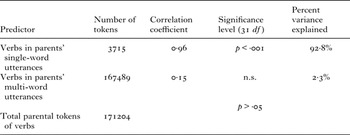
We computed Pearson correlation coefficients between verbs' token frequencies in parental single-word and multi-word speech, and between the verbs' token frequencies in children's single-word utterances. Table 4 presents the correlation coefficients for 117 transitive verbs.
Correlations of verb tokens in single-word and multi-word utterances in the speech of a sample of parents with children's tokens in single-word utterances (N = 2005) for 117 transitive verbs

Verbs in single-word utterances by parents predict children's early transitive verbs with a much larger and highly significant correlation coefficient, accounting for 92·8% of all variance, whereas verbs in parental multi-word utterances do not predict significantly the relative frequency of the verbs in children's single-word utterances, accounting for a mere 2·3% of variance. These results support the hypothesis that children learn their earliest verbs from parental single-word utterances rather than multi-word sentences, this in spite of the considerable frequency differential favouring multi-word input. These results should be taken with the caveat that in this study individual children's data were not correlated with their own parents' input, but rather the pooled child and parent corpora were treated as representations of, respectively, a generalized ‘young child's speech’ and ‘parental input’. The differential correlations found are therefore suggestive rather than conclusive evidence regarding the sources of children's single-word verbs.
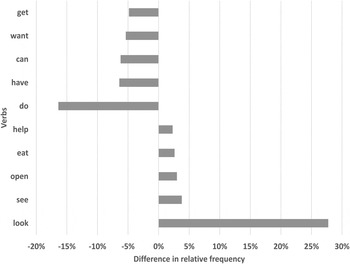
We examined the mismatch between parental multi-word sentences and children's single-word utterances to pinpoint the reason for the low correlation between them. Figure 1 presents the differences in relative frequency of the verbs used by children and parents in the ten verbs with the most difference between children's single-word utterances and parents' sentences, the five largest to each direction of difference.
Differences in relative frequency of the verbs used by children in single-word utterances, and parents in multi-word sentences.

We can see that the verbs do, have, want, can, and get are critically over-represented in parents multi-word utterances relative to the few children who learn them to generate their single-word utterances, whereas look and to a lesser extent see and open and the others are under-represented in the parental multi-word corpus. The over-represented verbs are parents' most frequent ones in their speech overall, with a very high token size; this does not help children to adopt them for their productive use as single-word utterances. What they do learn to say are verbs such as look, which are used often as single-word verbs by adults but much less as components of multi-word utterances. Look accounts for 29·7% of children's verbs in single-word speech but for only 1·9% of parents' verbs in multi-word sentences, the difference is 27·8% in their relative frequency (see Tables 1 and 3). By contrast, the distribution of parental single-word tokens is very close to what is expected from the proportions in children's single-word speech, including the five verbs mentioned above. The maximum ‘missing models’ are for the verb open, which the children use in 3·4% of their single-word sentences but the parents in only 0·8% of theirs. The difference of 2·7% is negligible when compared to the missing 27·8% of look from the multi-word corpus. The verbs possessing the largest token frequency in children's speech, such as look and see, are amply demonstrated by parents in their single-word speech (look 48·8%, see 16·8%). In summary, the vast difference between the correlation of parents’ single-word and multi-word sentences using different verbs, with children's use of the same verbs in their single-word speech, is accounted for by the distinction in the two parental use systems in the verbs employed, when in multi-word sentences parents use a large proportion of verbs which are not, apparently, suited for single-word use, either by parents or by children. Children learn to say in single-word utterances what is especially appropriate for single-word use, such as look and see. These results replicate the results of the Hebrew study mentioned above (Ninio, Reference Ninio2015), but the specific verbs used as frequent single-word verbs by both parents and young children are not identical, as in Hebrew this set included verbs such as the translation equivalent of take, which are very infrequent in the English single-word speech.
Part 1 of this study thus adopted a probabilistic approach to verb learning by pre-syntactic children, namely, examined and demonstrated the availability of target verbs in single-word utterances. In a second, contextual analysis, we shall look at the status of omitted objects of parental single-word transitive verbs, asking whether the verbs are presented with sufficient contextual information in order to retrieve the missing objects.
PART 2: THE STATUS OF THE OMITTED OBJECTS OF PARENTAL TRANSITIVE VERBS IN THE NON-LINGUISTIC, INTERACTIVE CONTEXT
The hypothesis of speaker's attentional object warranting object-drop in single-word verbs in the input
The results of the correlational analysis suggest that children's single-word transitive verbs are learned from single-word verbs in the input. According to the syntactic bootstrapping hypothesis, this should not be happening, as the lack of a full sentence presenting the subcategorization frame of the verb poses a special problem for transitive verbs as children miss the postverbal noun phrases or oblique-object phrases that reliably signal that the verb is semantically transitive, namely, has some object (e.g. Fisher, Reference Fisher1996; Gleitman, Reference Gleitman1990; Naigles, Reference Naigles1990). Imai et al. (Reference Imai, Li, Haryu, Okada, Hirsh-Pasek, Golinkoff and Shigematsu2008) claim that argument-drop puts children at a disadvantage, for instance children acquiring Chinese who are presented with many bare argument-dropping verbs in the input (but see Chan, Tardif, Chen, Pulverman, Zhu & Meng, Reference Chan, Tardif, Chen, Pulverman, Zhu and Meng2011). This claim is apparently unwarranted, and as we have found in the present study, English-speaking young children can and do learn verbs from single-word input utterances.
However, to make the single-word input theory viable, we need a process by which young children have information in interaction that a single-word verb is semantically transitive. When Gleitman (Reference Gleitman1990) defined a necessary environmental correlate to the meaning of perception verbs such as look for blind children, her choice was the presence of a nearby object that the blind child is invited to explore manually. This particular environmental correlate is, however, inappropriate for sighted children as the speaker can direct them to orient at a far-away object, such as a bird flying outside the window. In general, a purely objective characterization of the environment is seldom helpful when searching for the meaning of linguistic utterances. Instead, we should analyze the pragmatics of the situation to understand how young children come to understand partial communicative information presented in interaction.
Under the social-interactive approach to language development, infants possess a precocious social understanding that enables them to interpret the significance of social signals, actions, and events in their environment, well before they can talk or understand speech. Young children's precocious pragmatic abilities make it possible for them to crack the linguistic code (Antinucci & Parisi, Reference Antinucci, Parisi, Lennenberg and Lennenberg1975; Bates, Reference Bates1976; Bruner, Reference Bruner1975/76; Zinober & Martlew, Reference Zinober, Martlew and Barrett1985). Thus, we decided to approach this problem from a different direction and ask: Under what conditions can an adult hearer retrieve the dropped object of a transitive verb from the context? We will hypothesize that the same pragmatic interpretation process by which adult speakers infer the identity of dropped objects is also used by children to infer the existence of a dropped object and its identity. That is, due to children's precocious pragmatic skills, the same information warranting object drop in adults is utilized by children to infer the verbs’ meaning.
According to linguistic analysis, languages may allow the omission of arguments which are pragmatically inferable (Harley & Noyer, Reference Harley, Noyer and Peeters2000; Huang, Reference Huang1984). There are two kinds of possible sources for a dropped object: the prior discourse and the momentary interactive situation. Thus, the major distinction regarding object-drop is whether it is discourse-warranted or situation-warranted. Discourse-warranted object-drop relies on given or continuing topics previously established in discourse. This type might be less appropriate for young children than the second variety, which is a situationally transparent topic helped along by physical presence in the context and/or deictic signalling (Erteschik-Shir, Ibnbari & Taube, Reference Erteschik-Shir, Ibnbari and Taube2013; García-Velasco & Portero Muñoz, Reference García-Velasco and Portero Muñoz2002; Huang, Reference Huang1984, Reference Huang, Jaeggli and Safir1989; Liu, Reference Liu2008). Taking again the most frequent single-word transitive verb, namely, look, we have decided to treat this verb as the prototypical object-dropping exemplar and to tentatively generalize its pragmatic behaviour into a hypothesis for all single-word transitive verbs.
According to a pragmatic analysis, in order for an adult addressee to retrieve the semantic object of a single-word imperative Look!, the dropped object is to be understood as the speaker's momentary focus of attention. The addressee should find what the speaker is attending to – and that is what the speaker demands that the hearer, too, attend to.
To generalize this pragmatic principle to all single-word utterances consisting of transitive verbs, we will say that the dropped object is the speaker's current focus of attention, at the time of speech. To find the elided transitive object, the addressee should identify the speaker's focus of attention, using the usual pragmatic interpretation processes by which the other person's focus of attention is identified and followed in interaction. According to the developmental literature, infants manage this task at a very early age. For example, Bruner (Reference Bruner1975/76) says:
What Scaife and Bruner (1975) have found is that as early as four months in some children and with high frequency by nine months, the infant turns his regard in the same direction as a facing experimenter turns his … What has been mastered is a procedure for homing in on the attentional locus of another: Learning where to look in order to be tuned to another's attention. It is a discovery routine and not a naming procedure. It is totally generative within the limited world inhabited by the infant in the sense that it is not limited to looking at oranges or dolls or rattles. (Bruner, Reference Bruner1975/76, p. 269)
This means that if our hypothesis is correct and parents’ single-word transitive verbs have as their elided object the speaker's focus of attention, young children at the relevant age – which in our case is around two years of age – should be able to discover this fact about single-word verbs as they have no difficulty finding and following the parent's focus of attention in interaction.
Our hypothesis is that for parental speech consisting of single-word transitive verbs, there exist in the environment a concrete object, person, or event that the parent-speaker is attending to at the time of uttering the relevant utterance, and that single-word transitive verbs in the parental input indeed have as their dropped object the speaker's focus of attention. That is, we hypothesize that parents’ verbs are situationally warranted. The alternative hypothesis is that the elided object is discourse-warranted, not having a concrete presence in the environment, and although theoretically the speaker may have them as his or her attentional object, this is conceptual, not perceptual, attention to some entity or event the speaker thinks of.
To test this hypothesis, we examined the corpus of parents’ single-word transitive verbs and classified the exemplars according to the immediate interactive context. We already had this information on record as, at the time of choosing transitive verbs with definite objects for this study, we examined each verb's context to ensure that the word was a verb and not a noun, and that an ostensibly transitive verb indeed possesses a definite object (see the earlier section ‘Preparation of the database of verbs’). When the verb had, instead, an indefinite object, and possibly referred to an activity and not to an action, the utterance was excluded from the corpus analyzed.
On the basis of the interactive context we classified each utterance of parents’ single-word verbs as an exemplar of discourse-warranted object-drop or of situation-warranted object-drop. Checking the contextual information, we found that of 3,130 transitive verbs with a definite semantic object, 3,002 or 95·9% had that object as a concrete entity in the environment that was the focus of perceptual attention by the adult speaker. In the rest of the cases, that is, 128 or 4·1%, the verb had a conceptual object whose omission was supported by previous mention in the discourse.
As we hypothesized, with a few exceptions, all dropped objects were the focus of the speaker's perceptual attention at the time of utterance. As the basic requirement of face-to-face communication is to identify the speaker's focus of attention, these very short verbal utterances certainly utilized the basic tendency to follow the other's line of attention.
Broadly speaking, there were three kinds of such single-word verbs. The first were perceptual verbs – look, see, watch, hear, listen, smell, feel, and some others. In these cases the speaker oriented at some concrete focus of attention in the environment: she pointed to, looked at, or held out some object. The point of the utterances was to direct addressee's attention to the focus of the speaker's attention, meaning that the requirement to follow the speaker's focus of attention was actually the meaning of the verb and not only a way to identify its dropped object. If the child simply followed the adult's line of attention, he or she already complied with the request encoded by the verb. Not surprisingly, these were the most frequent types of utterances, and close to 80% of all tokens of single-word transitive verbs in the input were of this type. We may say that, in English, the prototypical single-word verb is a perception verb requesting from the hearer-child joint attention in the clearest, most transparent circumstances. This category contained the verbs most often taken up and produced by young children, with look and see together accounting for 37% of all the single-word verbs our sample of children produced.
Interestingly, the most frequent and prototypically transparent single-word verb in Hebrew input speech is not a perception verb but a marker of an offer of object transfer, the imperative qax or qxi ‘take’, which is said when handing an object to a listener (Ninio, Reference Ninio2015). As this utterance was inevitably accompanied by the speaker holding up an object for the addressee to see, we may say it had a strong perception component, functioning similarly to English perceptual verbs such as look.
Beyond the very frequent perception verbs, the second kind of dropped-object verbs with a definite object were manipulation verbs – eat, drink, swallow, bite, open, close, shut, turn, push, play, read, brush, dry, scrub, clip, dip, switch, catch, scoop, shake, throw, bounce, kick, blow, burn, and others. There were many different verbs of this kind in the input but their token frequency was relatively low (see Table 2). In these cases the speaker oriented at a concrete focus of attention in the environment, possibly at an object in possession of the addressee or in the process of being transferred to the addressee's possession. In other words, at the time of utterance, it could be the addressee who is pointing at the object, holding it out, manipulating it, trying to reach it, or trying to manipulate it; the adult's utterance builds on an existing orientation to an object. The most frequent of these verbs, push, typically had the child orienting to some button or toy that, according to the format of the activity engaged in, should be pushed; the adult request is not out of the blue but a reminder that the child should now do the agreed-on action of pushing. The second most frequent verb, eat, was said typically in a situation in which the child already had some food in his possession, maybe before him on a plate or in his hand, and the adult demanded that he continue with the activity of eating it. The next verb by frequency, catch, was said just as the adult threw a ball or something similar at the child in an ongoing ball-game. By contrast to the perceptual verbs, these verbs basically followed the children's already established focus of attention, and adopted it as the dyad's joint focus of attention. The child needed to decode this joining move in order to identify his or her own focus of attention as the thing now talked about, and, of course, to understand what was the demand made by the adult with respect to that focus. As we saw, the demanded act was in most cases part of an ongoing already established activity format, not a brand new act that the child needed to guess from the context.
The third type of verbs with a concrete perceptual focus of attention were verbs used for action-negotiation – stop, try, finish, help, do, quit, and some similar others. In these cases, the addressee was typically in mid-activity, and the focus of the speaker's attention was the addressee's act which she wanted to regulate, either to encourage its continuation or to make the child stop it. As with the previous type, the action to be stopped or finished is not an unknown; the child-hearer is already engaged in it, and once he understands that the adult is relating to this action, the only open question to be solved is whether the adult's utterance is a request to engage in it, or a demand to disengage from it. We may suppose that the non-verbal accompaniment of these utterances, including their intonation, is sufficient to resolve the question. It is worth pointing out that, in contrast to Tomasello and Farrar's (Reference Tomasello and Farrar1986) findings regarding the acquisition of nouns, children were less likely to learn a verb that was modelled by parents when they were following the child's focus of attention (such as the manipulation verbs eat or open, or the action regulating verbs stop or help), much preferring verbs that were used when the parents directed the children to change the focus of their attention, such as look and see. For example, the action regulating verbs stop and help, which typically follow a child's focus of attention, together accounted for 4·04% of all the single-word verbs the children produced, whereas the two verbs look and see, which typically direct children's attention to a new focus, together accounted for a much higher 37·3% of all the single-word verbs our sample of children produced. In actuality, none of the verbs except for the last two accounted for more than 4% of the single-word verbs used by the children, and most were produced very rarely indeed. As look and see are two verbs inherently redirecting attention, it is a safe generalization that such verbs are easier to acquire than verbs following the speaker's focus. Apparently, the attention-directing imperative is much better reflected in ongoing interaction than any other request for action or description of action.
The few verbs with a discourse-warranted object-drop were remember, say, think, forget, guess, improvise, and a few more with very low token frequency. For instance, Child #11 from the Tardif corpus (1;5·16) had the following conversation with her mother:
mother: What's this one?
child: Doggies.
mother: here # do you know how to turn that on?
mother: Can you do that one?
mother: Remember?
mother: It's just like your bumbleball.
mother: (Ex)cept this one's green.
mother: Can you turn it on?
mother: Do you remember how to turn it on?
mother: Here's the button.
mother: Can you pull it?
The omitted object of the verb in the single-word question Remember? is ‘how to turn [that toy] on’ – later on said in a full sentence. As we saw, there are very few non-perceptual dropped objects of this type. Checking the children's output, most of these words such as remember, think, forget, guess, and improvise were not produced by children as their single-word utterances. The verb say was produced a few times, but never as a demand that the parent say something, the use that is modelled in parental utterances. Children use this word as a repetition request, instead of pardon; when they narrate a story with a protagonist saying something; and as a request to explain what a written word ‘says’. We may summarize that single-word verbs in the input that rely on discourse-warranted elision of the object are not taken up by young children in their own speech.
In conclusion, in all but a very few cases, when a single-word utterance with a transitive verb is uttered by parents related to a definite object, the speaker oriented to a specific object in the environment so that that object was the referent of the dropped syntactic object of the single-word transitive verb. Thus, the formally unexpressed, elided semantic object of the verb was a transparent object of attention of the speaker at the moment of utterance. The process by which a child could retrieve the missing object consisted of following the adult's line of attention, a move that they perform in any case from as early as a few months of age.
Moreover, examination of the interactive events within which the adult utterance is embedded provided at least a direction to the solution of the quandary: How can young children understand and learn the meaning of verbs when these refer not to an ongoing activity visible in the environment, but to some ‘imminent action’? In the case of the most frequent category of verbs appearing as singe-word utterances, the group of look and the other perception verbs, the child's following the speaker's orientation to a perceptually identifiable object of attention already satisfies the request made by the speaker. Indeed, it is impossible to distinguish between the child following the speaker's line of attention just because that is what interactants do, and the child complying with the request to look because he understands the verb uttered. When we consider the two other, relatively infrequent, types of single-word transitive verbs, the manipulation verbs and the action regulation ones, the examination of the context revealed that in fact the relevant action was already established in the interactive context, and the role of the child was merely to understand that, in his utterance, the adult speaker relates to these acts and wants them performed or else dropped. The interactive context provides transparency, which the young child's precocious pragmatic abilities are more than ready to make use of.
To summarize, the data support the theory that children are able, almost without exception, to adopt parental single-word transitive verbs for their own use when these have a strong environmentally recoverable object. Moreover, despite the fact that most parental single-word verbs were imperatives, and as such were said by researchers to refer to ‘imminent acts’ rather than to ongoing acts, the action the verb referred to was in some sense present in the interactive environment, either because the children complied with a request to orient to some new focus by following the parent's line of regard, or because the act requested was part of the activity format already engaged in by the interacting dyad. The two transparency phenomena are inter-related: a parent would say Drink! when the bottle was already in the child's hands, and that implies not only that the semantic object of the verb was contextually recoverable but that the act of drinking was well understood and agreed on by the participants as the thing to do with the object. In other words, in a pragmatically driven system, there is a transparent source for the meaning of parents’ single-word verbs and that is the reality constructed by the dyad leading up to, and existing at, the moment of speech.
Our overall conclusion is that pragmatics is important in conceptualizing vocabulary acquisition, even of such logically complex lexemes as verbs, and maybe especially in their case. Once again we found that, in models of language acquisition, the emphasis should be on the pragmatics of use and social meaning, as suggested by Bruner (Reference Bruner1975/76).
The model of acquisition of an initial vocabulary of verbs from parental single-word utterances is an alternative to the theory of syntactic bootstrapping, according to which children have to learn verbs from multi-word sentences in order to be provided with information about the verbs’ semantic arguments. There is an inherent paradox in syntactic bootstrapping, namely, that children need to already have a mastery of the semantics of some verb and know how its arguments are expressed in a syntactically constructed sentence in order to learn that very verb. The major advantage of learning verbs in the single-word stage is that it can provide the child with the verb vocabulary deemed necessary for learning the basics of syntax by such authorities as Caselli, Casadio, and Bates (Reference Caselli, Casadio and Bates1999), Macnamara (Reference Macnamara1972), and Pinker (Reference Pinker1984), with unexpressed null objects paving the way to pre-syntactic learning. We may expect the next step of development to be one in which the previously unexpressed objects get a nominal or pronominal expression, heralding syntactically accurate multi-word speech.
The results of this study, although suggestive, do not describe the complete developmental trajectory of single- and multi-word verb learning. In order to complete the picture, we should trace early acquired verbs into their usage in multi-word, syntactically structured sentences. In particular, focusing exclusively on single-word utterances, we cannot really know how well the children have learned the verb meanings; all we know is that they are using them as single words in the correct context, as their parents do. To be convinced that the children have indeed mastered the verbs’ correct semantics, we should observe the verbs employed in other conditions of use as well. This is an interesting topic for a future study.