1 Introduction
One of the most discussed topics in the area of connectivity or reconstruction effects in wh-movement has been a putative contrast between arguments and adjuncts regarding Binding Condition C. Numerous authors have claimed that R-expressions contained within arguments of a moved N obligatorily reconstruct for Binding Condition C, but R-expressions contained within adjuncts do not. The following contrast is representative.

This contrast was first presented in van Riemsdijk & Williams (Reference van Riemsdijk and Williams1981) and further discussed in Freidin (Reference Freidin and Lust1986), Barss (Reference Barss and Cardinaletti1988: 40), Lebeaux (Reference Lebeaux1988), Chomsky (Reference Chomsky, Hale and Keyser1993), Sauerland (Reference Sauerland1998), Fox (Reference Fox1999), and Takahashi & Hulsey (Reference Takahashi and Hulsey2009), among many others. All of these references have taken the contrast to be well established, and have proposed various explanations for it.
At the same time, this putative contrast has been questioned by various authors. Bianchi (Reference Bianchi1995), Lasnik (Reference Lasnik, Dimitriadis, Lee, Moisset and Williams1998), Safir (Reference Safir1999: 609), Kuno (Reference Kuno, Horn and Ward2004), and Henderson (Reference Henderson2007: 206–207) all suggest that this contrast is not as strong as it has been made out to be, or may even be non-existent. Our own observations over a number of years indicate that less than 20% of native English speakers feel that there is any contrast of this type. The vast majority freely permit coreference in examples like (1a), and many even find that to be the most salient interpretation for the pronoun.
Given this lack of clarity in the empirical picture regarding reconstruction for Condition C, we undertake a series of grammaticality surveys using Amazon Mechanical Turk. We find absolutely no evidence for reconstruction of R-expressions contained within arguments or adjuncts of a fronted N. We suggest that those speakers who report such a contrast (linguists, primarily) are following a pragmatic bias, which we attempt to spell out. However, we do find reconstruction for Condition C with fronted PPs. An R-expression that is the complement of a fronted P must reconstruct. The literature also reports that R-expressions as complements of fronted Vs and As also obligatorily reconstruct (Huang Reference Huang1993, Heycock Reference Heycock1995, Leddon & Lidz Reference Leddon and Lidz2006, Adger et al. Reference Adger, Drummond, Hall and van Urk2016). This means that fronted Ns are special in not requiring reconstruction of their dependents, whether those dependents are arguments or adjuncts. This indicates, we suggest, that Ns never actually take syntactic arguments, as various authors have suggested (e.g., Dowty Reference Dowty, Chierchia, Partee and Turner1989; Grimm & McNally Reference Grimm, McNally, Aloni, Franke and Roelofsen2013, Reference Grimm, McNally, D’Antonio, Moroney and Little2015). What appear to be semantic arguments of nouns are syntactic adjuncts. Adjuncts do not reconstruct. We propose that this follows in a top-down derivation from an economy condition on copying in chains: copying is always minimal. The highest copy contains all material, but subsequent lower copies will be just the minimal amount of material that is necessary for syntactic and semantic convergence. Adjuncts are therefore simply left out of lower copies.
We proceed by first illustrating the current state of the literature in Section 2. Section 3 presents three experiments conducted using Amazon Mechanical Turk. Section 4 summarizes the generalization that we are led to regarding reconstruction. In Section 5, we outline our analysis of the lack of reconstruction for Binding Condition C. In Section 6, we spell out the pragmatic bias that we think was behind judgments of the argument–adjunct asymmetry in the previous literature.
2 The current empirical picture
In this section, we present the types of examples that have been given in the literature, in order to motivate the particular studies that we undertake.
Those authors who claim that there is a contrast between arguments and adjuncts have presented examples of several different types. First, some authors claim that there is a contrast with CPs that are either arguments of a noun or adjuncts to a noun, like the following.

Safir (Reference Safir1999) says that he finds the contrast weak with CPs, but that the contrast is very sharp with PP arguments versus PP adjuncts. He presents examples like the following.

Other authors have offered examples of PP arguments of nouns in contrast with PP or CP adjuncts, like the following.

Additionally, Sauerland (Reference Sauerland1998, Reference Sauerland, Schwabe and Winkler2003) claims that there is a difference between arguments and adjuncts in reconstruction for Condition C with relative clauses (Sauerland cites an earlier draft of Safir (Reference Safir1999) for these).Footnote [2]

In contrast to the above, other authors have presented examples of R-expressions contained within arguments to a fronted N that they judge to be grammatical with coindexing. The following are some examples.

The most extensive set of examples is provided by Kuno (Reference Kuno, Horn and Ward2004). He presents numerous examples. We organize them by CP complements to nouns in (12) and PP complements to nouns in (13).Footnote [3]

Additionally, Leddon & Lidz (Reference Leddon and Lidz2006) report on an experiment testing reconstruction for Binding Condition C in both adults and children. They find that adults always reconstruct with predicates (more on this in Section 4), but not with fronted arguments. Adults permit coreference in examples like the following 23% of the time.

Leddon & Lidz (Reference Leddon and Lidz2006) note that the subjects’ coreferential responses were evenly distributed across both subjects and items, meaning that there are not two distinct populations of speakers with respect to reconstruction (i.e., two dialects). Leddon & Lidz (Reference Leddon and Lidz2006) moreover report that children overwhelmingly prefer the coreferential interpretation in questions like (14), answering with that one 67% of the time (in contrast to fronted predicates, where they overwhelmingly prefer the disjoint interpretation; more on predicates in Section 4).
Given these contradictory judgments, we attempt to clarify the empirical picture by conducting a series of surveys on coreference in A-bar movement contexts.
3 Studies using Amazon Mechanical Turk
We report here on three experiments run using Amazon Mechanical Turk (see Gibson, Piantadosi & Fedorenko Reference Gibson, Piantadosi and Fedorenko2011, Sprouse Reference Sprouse2011). Experiment 1 looks at CP within fronted NPs. Experiment 2 looks at PPs within fronted NPs. Experiment 3 then tests fronted PPs.
3.1 Experiment 1: CPs within NPs
Experiment 1 examined wh-movement of NPs that include CPs within them. We designed experimental items in a
 $2\times 2$
design with factors argument versus adjunct (whether the CP was an argument of the N, or a relative clause) and wh-movement versus no wh-movement. The following is a sample set from the paradigm.

We used embedded wh-questions for two reasons: first, to provide another possible referent for the pronoun, in the form of the matrix subject; second, so that subjects would not be confused about what question they should be answering. Rather than trying to ask them directly about coreference possibilities, we gave them a forced choice question about who the referent of the pronoun was. For instance, for the set of four sentences above, the question was Who authorized the announcement? A: the staffer; B: Hillary Clinton. In half of the experimental items the relevant R-expression was the second choice of the two, and in half it was the first choice, to guard against any bias for picking the first or second of two choices.
This method has the disadvantage that we cannot know for sure from any results whether subjects truly disallow a given referent. However, it has the advantage that it is a very natural task and does not require that the subjects try to engage in any metalinguistic analysis, which could be faulty or trigger reasoning outside the grammar. In practical terms, we believe that this method can provide a reasonable amount of evidence for or against a grammatical constraint on coreference. If a referent truly is ruled out by the grammar, then we should see choices of that referent at a rate close to zero. If there is no grammatical constraint, then we should see subjects behaving at around chance, which in a two-choice task is 50%.Footnote [4] Since the experimental items are set up to directly compare argument and adjunct CPs, we will also be able to see whether naive subjects treat them differently, as some of the theoretical literature would lead us to expect.Footnote [5]
We distributed the experimental items into four lists so that each subject saw only one of the four sentences in the set in (15). We created eight such sets, so that each subject judged two of each type. The complete set of items appears in the Appendix. We also included 16 filler items with comprehension questions, to check that subjects were engaged in the task. Subjects therefore read 24 sentences and answered one question about each. Within each list, the order of sentences was randomized.
Using Amazon Mechanical Turk, we recruited 20 subjects for each list, for a total of 80 subjects. Subjects were paid 60 cents for participating. We limited recruitment to subjects with IP addresses in the United States, and also asked them to say what their native language was and what country they were from. Subjects who reported a language other than English as their native language were excluded from the analysis. Subjects were also excluded if they got more than two questions wrong on the filler items. Five subjects were excluded for one of these reasons, leaving a total of 75 subjects in the analysis: 49 male, 25 female, 1 other. The age range was 20–62 (median age
 $=$
30).
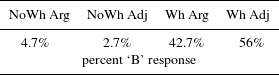
Results are shown in Table 1, in the form of percentage of ‘B’ responses. This is the response that violates Binding Condition C in the NoWh conditions, and would violate it if there were complete reconstruction in the Wh conditions. As can be seen, where there is no wh-movement, subjects choose the Condition C violating answer at a rate close to zero. In contrast, in the two wh-movement conditions, the answer that would violate Condition C if there were complete reconstruction is chosen at a rate close to chance (50%). There is a difference between arguments and adjuncts, such that we see a higher percentage with adjuncts, but this difference is small.
Results of Experiment 1, CPs.

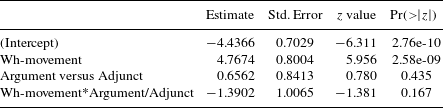
Statistical analysis was run using R (R Core Team 2012). Responses were analyzed by means of linear mixed-effect modeling using the R-package lme4 (using glmer with family binomial). The two fixed effects in the analysis were wh-movement and the argument/adjunct distinction. Following the recommendations in Barr et al. (Reference Barr, Levy, Scheepers and Tily2013), we first included by-subject random intercepts and slopes and by-item random intercepts. However, the maximal model failed to converge, so we ended up simplifying to a model using only random intercepts for both subjects and items. Table 2 shows the results.
Summary of fixed effects in the mixed-effects model for Experiment 1.

The last column lists the
 $p$
-values. As can be seen, only a main effect of wh-movement is significant. There is no main effect of the argument/adjunct distinction, and no interaction. This means that, in these types of examples, wh-movement simply bleeds Binding Condition C. R-expressions contained within adjuncts and R-expressions contained within arguments in a fronted wh-phrase are free to corefer with a lower pronoun.
We conclude from this that there is no reconstruction for Condition C at all with CPs that front as part of wh-NPs. While the literature has claimed that argument CPs do reconstruct for Binding Condition C, we find no evidence for such reconstruction in the broader population. Our subjects chose the Condition C violating antecedent for the pronoun at a rate close to chance, indicating that there is no grammatical constraint against that coreference.
3.2 Experiment 2: PPs within NPs
Experiment 2 examined wh-movement of NPs that include PPs within them. As noted above, Safir (Reference Safir1999) claimed that the argument–adjunct distinction is most robust with PP dependents of fronted NPs. We followed the same experimental design, and constructed experimental items in a
 $2\times 2$
design with factors argument versus adjunct (whether the PP was an argument of the N, or an adjunct) and wh-movement versus no wh-movement. The following is a sample set from the paradigm.Footnote
[6]

As before, subjects were given a forced-choice question regarding the referent of the pronoun. For the set of four sentences above, the question was Who considers the portrait valuable? A: the chambermaid; B: the countess. Once again, in half of the experimental items the relevant R-expression was the second choice of the two, and in half it was the first choice, to guard against any bias for picking the first or second of two choices.
As in Experiment 1, the experimental items were distributed into four lists so that each subject saw only one of the four sentences in the set in (16). Eight such sets were created, so that each subject judged two of each type. See the Appendix for the full set of items. Sixteen fillers were used, so subjects read 24 sentences and answered one question about each. The order of the items was randomized within each list.
We recruited 20 subjects for each list, for a total of 80 subjects, again using Amazon Mechanical Turk. The recruitment was limited to subjects with IP addresses within the United States. Subjects were excluded from the study if they reported that their native tongue was not English or if they answered more than two questions wrong on the filler items. Five subjects were excluded for one of these reasons, leaving 75 subjects in the analysis: 34 male, 41 female. The age range was 21–69 (median age
 $=$
31).
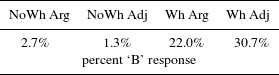
Results are shown in Table 3, in the form of percentage of ‘B’ responses. This is the response that violates Binding Condition C in the NoWh conditions, and would violate it if there were complete reconstruction in the Wh conditions. As can be seen in Table 3, where there is no wh-movement, subjects choose the Condition C violating answer at a rate close to zero. In contrast, in the two wh-movement conditions, the answer that would violate Condition C if there were reconstruction is chosen at a higher rate, though now at a lower rate than in Experiment 1 (lower than chance, but still much higher than zero). Note that the rates here roughly match what Leddon & Lidz (Reference Leddon and Lidz2006) found for adults on similar items.
Results of Experiment 2, PPs.

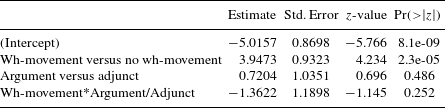
We analyzed the results using R (R Core Team 2012). As before, the responses were analyzed via linear mixed-effect modeling, using the R-package lme4. Wh-movement and the argument/adjunct distinction were the fixed effects in the analysis. As in Experiment 1, we included by-subject random intercepts and slopes and by-item random intercepts and slopes, following the recommendations in Barr et al. (Reference Barr, Levy, Scheepers and Tily2013). Because the maximal model failed to converge, we simplified the analysis to include only random intercepts for subjects and items. The results are shown in Table 4.
Summary of fixed effects in the mixed-effects model for Experiment 2.

As can be seen from the last column in Table 4, there is a main effect of wh-movement, but no main effect of the argument–adjunct contrast. Contrary to the expectations of the standard view in the literature, there is also no interaction between the argument–adjunct contrast and wh-movement. As with CPs, we find no statistically significant difference between argument and adjunct PPs regarding reconstruction for Condition C. We see only a main effect of wh-movement: Wh-movement bleeds Condition C.
We conclude that the literature that has claimed that there is a difference between argument and adjunct PPs is incorrect. We find no effect of the argument–adjunct distinction. Instead, we see only a main effect of wh-movement, such that fronting an NP that contains a PP bleeds Condition C for any R-expressions contained within the PP.Footnote [7]
There is still the question of why the rates are below chance in this experiment, as opposed to Experiment 1 with CPs, where the rates were within a few percentage points of chance (50%). We suspect that the difference is the linear distance between the R-expression and the pronoun. In the wh-movement conditions in Experiment 1, there are multiple words in between the R-expression in the fronted wh-phrase and the pronoun in the lower clause (typically 4–5 words). In contrast, in Experiment 2, the R-expression and the pronoun are either adjacent or they are separated by only 1–2 words. Adger et al. (Reference Adger, Drummond, Hall and van Urk2016) find an effect of linear distance on coreference between a pronoun and an R-expression. The further the distance between the R-expression and the pronoun is, the more likely subjects are to choose coreference. Our guess is that this difference in linear distance is what is behind the lower rate in Experiment 2. In any case, although the rate is below chance, it is still significantly higher than zero, which we take to indicate that there is no grammatical constraint on coreference. Most importantly, there is no difference between argument PPs and adjunct PPs.
3.3 Interim summary
Experiments 1 and 2 have found no support for the argument–adjunct asymmetry in reconstruction for Binding Condition C that previous literature has reported. Rather, speakers freely permit coreference between an embedded pronoun and an R-expression contained within a fronted wh-phrase.
We might conclude at this point that A-bar movement simply bleeds Condition C. Given this possibility, we decided to check a data point from Reinhart (Reference Reinhart1976) that was very important to the development of syntactic theory. It will turn out that not all A-bar movement bleeds Condition C.
3.4 Experiment 3: Fronted PPs
The important data point involves fronted PPs. Reinhart (Reference Reinhart1976, Reference Reinhart1983) used these to argue for the importance of c-command in Binding Condition C. These present a contrast like the following example.

According to Reinhart (Reference Reinhart1976, Reference Reinhart1983), (17b) is a Condition C violation, with the pronoun subject c-commanding the R-expression to its left. Bruening (Reference Bruening2014) showed that this explanation is untenable, and instead analyzed (17b) as involving reconstruction of the fronted PP. Since the PP semantically modifies the VP, it reconstructs to the edge of the vP phase (in the phase theory of Chomsky Reference Chomsky, Martin, Michaels and Uriagereka2000; see (Bruening Reference Bruening2014: 361–363) for details). In this reconstructed position, the pronoun subject binds the R-expression. One of the arguments for this analysis is the fact that further embedding the R-expression obviates Condition C.

Further embedding the R-expression would not change backward c-command, so Reinhart’s analysis would still expect a Condition C violation. In contrast, if a relative clause inside a fronted constituent does not need to reconstruct (as we saw above), then the reconstruction analysis predicts this contrast.
Given our findings that most subjects do not show reconstruction for Condition C at all, we began to wonder whether Reinhart’s original contrast is actually real. We decided to test both it and Bruening’s embedding effect using the paradigm and method from Experiments 1 and 2. The two factors were now R-expression versus pronoun and embedded versus non-embedded. All sentences in the paradigm had a fronted PP. As before, the clause with fronting was embedded, to provide another possible antecedent for the pronoun. In this case, the forced-choice question had to vary depending on the item. We show a sample set of items, with the question corresponding to each item, below.

Given the literature, we now expect the following pattern of responses. First, in the Pro NoEmb and Pro Emb conditions, there should be no grammatical condition ruling out either R-expression as a referent for the pronoun, so we expect around chance performance, or 50% ‘B’ responses (but note that in the Pro Emb condition, it is most natural to take the pronoun to refer to the higher NP, and this is what we find in the results). Second, if the Rexpr NoEmb condition really is a Condition C violation, we should expect close to zero ‘B’ responses. In contrast, in the Rexpr Emb condition, if the relative clause does not need to reconstruct, we expect around 50% ‘B’ responses again. If the contrast is not real and there is no reconstruction for Condition C at all, we expect roughly 50% ‘B’ responses in all four conditions.
As before, we distributed the experimental items into four lists so that each subject saw only one of the four sentences in the set in (19). We created eight such sets, so that each subject judged two of each type. The complete set of items appears in the Appendix. We also included filler items with comprehension questions, to check that subjects were engaged in the task. Within each list, the order of sentences was randomized.
Eighty subjects were recruited via Amazon Mechanical Turk. Ten subjects were excluded for getting more than two comprehension questions wrong on the filler items, leaving 70 subjects whose data entered the analysis. Of these, 33 were female and 37 male; the age range was 23–70 with a median age of 36.5.
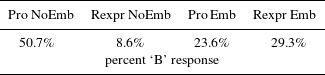
Results are shown in Table 5, in the form of percentage of ‘B’ responses. This is the response that would violate Binding Condition C if there were complete reconstruction of the fronted PP in the Rexpr conditions. We see a high percentage of ‘B’ responses in the Pro NoEmb condition, and a lower but still high percentage of ‘B’ responses in the two Emb conditions. An embedded R-expression does not seem to differ from an embedded pronoun, as Bruening (Reference Bruening2014) claimed. In the original Reinhart sentence, the Rexpr NoEmb condition, the rate of ‘B’ responses is much lower, closer to zero.
Results of Experiment 3, fronted PPs.

We take these results to support the reconstruction account. We find a high percentage of ‘B’ responses in all conditions except the Rexpr NoEmb condition, exactly the one that Reinhart (Reference Reinhart1976) claimed was a Condition C violation and Bruening (Reference Bruening2014) analyzed as Condition C under reconstruction.
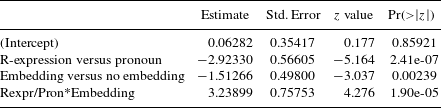
As in Experiments 1 and 2, statistical analysis was run using R, following the same procedures. The two fixed effects in the analysis were R-expression versus pronoun and embedding versus no embedding. Once again, the maximal model failed to converge, so we simplified to a model with only random intercepts for both subjects and items. Table 6 shows the results.
Summary of fixed effects in the mixed-effects model for Experiment 3.

We see significant main effects of both factors and a significant interaction in the last column of Table 6. The effects go in the opposite direction. For pronouns, embedding reduces the number of ‘B’ responses because, as noted above, it is most natural in the Pro Emb condition to take the pronoun to refer to the higher NP. In contrast, embedding increases the number of ‘B’ responses with R-expressions. We interpret this to mean that reconstruction takes place in the NoEmb condition, but embedding the R-expression results in it no longer being reconstructed in the Emb condition.
We conclude that Reinhart (Reference Reinhart1976, Reference Reinhart1983) was correct to analyze Near Dan, he saw a snake as a Condition C violation on the coreferential reading, and Bruening (Reference Bruening2014) was correct to analyze this as Condition C under reconstruction. The fronted PP reconstructs to a position lower in the sentence, where it is in the command domain of the pronoun subject. A relative clause within the PP does not need to reconstruct, so if the R-expression is contained within such a relative clause, there is no Condition C violation.
At this point, we can also say something about the response percentages. In a two-choice task, chance performance is 50%. However, we only expect to see 50% if there is no grammatical constraint at work and all other factors are equal, in particular if there is no pragmatic reason to prefer one referent or another. As we saw in Experiment 2, decreasing the linear distance between the R-expression and the pronoun decreased the coreferent responses. In Experiment 3, we now see the same thing: in two of the conditions, it is most natural to take the pronoun to refer to the other NP, and so we see choice of the ‘B’ response at levels between 20 and 30%. It therefore appears that if there is no grammatical constraint but there is some pragmatic bias toward one of the readings (based on, e.g., linear order and distance), then we seem to get between 20 and 30% selection of the choice that is less preferred. In contrast, where there is a grammatical constraint, choice of the ungrammatical referent is low and close to zero. In Experiment 3, it is 8.6%. This might seem to be high, but it is significantly lower than 20–30% and is probably just noise.
To summarize to this point, we previously saw no reconstruction of dependents of fronted Ns. Now, we can see that this is not general: it is not the case that A-bar movement simply bleeds Condition C. We do see reconstruction for Condition C with fronted PPs. The complement of a fronted P does reconstruct and give rise to a Condition C violation. Condition C is only bled completely with dependents of fronted Ns.
4 When reconstruction happens
Fronted PPs are patterning with fronted VPs and APs. The literature has universally concluded that reconstruction is necessary with fronted VPs and APs (e.g., Huang Reference Huang1993, Heycock Reference Heycock1995, Leddon & Lidz Reference Leddon and Lidz2006). In contrast to the claimed argument–adjunct asymmetry debunked above, we have found no one who disagrees with the following judgment.Footnote [8]

Leddon & Lidz (Reference Leddon and Lidz2006) found in their experiment that neither adults nor children respond with the coreferential interpretation with fronted predicates, in contrast to fronted arguments. In another series of experiments (which we discovered after running the three experiments reported here), Adger et al. (Reference Adger, Drummond, Hall and van Urk2016) also find that speakers allow coreferential interpretations with fronted arguments but not with fronted predicates. Their evidence converges with ours on a lack of Condition C reconstruction with either arguments or adjuncts to fronted Ns. However, they, like Leddon & Lidz (Reference Leddon and Lidz2006), find that subjects never permit coreferential interpretations with fronted predicates. An R-expression that is an argument of a fronted predicate uniformly gives rise to a Condition C violation if it is covalued with a pronoun that commands its base position. If it is further embedded, Condition C once again disappears.

In this example, the R-expression is not an argument of the fronted predicate, but is instead embedded within a dependent of an argument.
The generalization we arrive at is that the complement of a V, P, or A must reconstruct along with the V, P, or A, but dependents of Ns never reconstruct. In (21), what reconstructs is something like how pleased with the pictures: the head A pleased reconstructs along with its argument with and the argument of the P with, pictures. However, the relative clause, being a dependent of the N, does not reconstruct. This is why we do not see a Condition C violation in (21) but we do in (20). In (20), the A head afraid reconstructs, as does its complement P of and the N head of the P’s complement, Margaret.
We offer the following generalization about when reconstruction for Binding Condition C takes place.

We do posit reconstruction of the head of a fronted NP. We analyze this as the source of strong crossover. Consider the following example.

If the head N has to reconstruct, then this is a Condition C violation: she binds the R-expression which girl (or just the head girl).Footnote [9]
In contrast, dependents of Ns do not reconstruct.

Only the head portrait reconstructs, so there is no Condition C violation with the countess.
With a fronted PP, the P and the head of its NP complement reconstruct.

In (25a), this results in near Dan reconstructing, giving rise to a Condition C violation. In (25b), only near (the) man reconstructs, with no Condition C violation. As we saw above, the same holds for VPs and APs (20)–(21).
To summarize, Vs, As, and Ps reconstruct along with the head of their complement, but in NPs, only the head N reconstructs.
5 Analysis: Minimal copy
The task now is to account for the difference between Ns, on the one hand, and Vs, As, and Ps, on the other. Some recent work indicates that Ns might be special in never actually taking syntactic arguments. Phrases that appear to be semantic arguments of Ns behave in many ways like syntactic adjuncts. For instance, they are always optional (see especially Reuland Reference Reuland2011, Adger Reference Adger2013, Grimm & McNally Reference Grimm, McNally, Aloni, Franke and Roelofsen2013). Syntactic phenomena that were supposed to distinguish arguments of N from adjuncts of N, like one-replacement, have been shown not to (e.g., Payne et al. Reference Payne, Pullum, Scholz and Berlage2013). Perhaps the lack of reconstruction that we have found is part of the same pattern: syntactic arguments must reconstruct, but adjuncts do not need to. The difference between Vs, As, and Ps, on the one hand, and Ns on the other, is that Vs, As, and Ps take syntactic arguments, but Ns never do. (Note that we are not claiming that Ns do not take semantic arguments; we are only claiming that if they do, the syntax treats them as adjuncts. However, see Dowty (Reference Dowty, Chierchia, Partee and Turner1989) and Grimm & McNally (Reference Grimm, McNally, Aloni, Franke and Roelofsen2013, Reference Grimm, McNally, D’Antonio, Moroney and Little2015) for claims that Ns do not take arguments semantically, either.)
If this is so, then we want an analysis in which reconstruction of arguments is obligatory but reconstruction of adjuncts is not, and probably never takes place.Footnote [10] One type of analysis that has been proposed for this pattern involves late merger (Lebeaux Reference Lebeaux1988, Reference Lebeaux and Rothstein1992, Reference Lebeaux2009; Chomsky Reference Chomsky, Hale and Keyser1993; Fox & Nissenbaum Reference Fox, Nissenbaum, Bird, Carnie, Haugen and Norquest1999; Bhatt & Pancheva Reference Bhatt and Pancheva2004; Hulsey & Sauerland Reference Hulsey and Sauerland2006; Takahashi & Hulsey Reference Takahashi and Hulsey2009; Stanton Reference Stanton2016). In the late merger analysis, adjuncts can be merged to a phrase countercyclically after the phrase has moved.
We do not adopt this analysis, for two reasons. First, as Sportiche (Reference Sportiche2017) shows, permitting late merger leads to numerous unwanted predictions. It is simply too unconstrained. Second, we believe that a more explanatory analysis is available. Note that permitting late merger of adjuncts does not actually explain anything; it just restates the lack of reconstruction.
We suggest instead that the lack of reconstruction of adjuncts follows from general economy conditions. Suppose that the copy mechanism involved in chain formation is constrained by economy. If it is, it will always copy as little as possible, basically only what is necessary for convergence. Adjuncts, being optional, will always be left out when a copy is made. On a traditional bottom-up derivation, this does not help us: we predict that adjuncts will have to stay in the lowest position of the chain. We therefore switch to a top-down, or, more precisely, left-to-right, derivational model (e.g., Phillips Reference Phillips1996, Reference Phillips2003; Bruening Reference Bruening2014; Al Khalaf Reference Al Khalaf2015, Reference Al Khalaf2017; Osborne & Gross Reference Osborne and Gross2017). In this type of model, the highest copy of a fronted XP is built and merged into the derivation first. This highest copy will contain all of the material that is part of that XP. For instance, in Which corner of John’s room was he sitting in?, the wh-NP which corner of John’s room is built and merged into Spec-CP.Footnote [11]

When the derivation reaches the preposition in, an unpronounced copy of the wh-phrase must be merged as the complement of in. Copying is constrained to be minimal, so the adjunct is simply left out (we leave out many details of this tree).

This explains why there is no Condition C violation: the PP does not need to be copied into the lowest position, and economy applied to copying forces it not to be.
This analysis does without countercyclic merger. We do not need to countenance such an operation in the grammar. It also explains why reconstruction does not take place with dependents of Ns: copies are constrained to be as minimal as possible.
If syntactic complements of Vs, As, and Ps must be copied, then we explain why we do see reconstruction with these categories. Copying is constrained to be as minimal as possible, but complements cannot be left out. To go through an example, in *How afraid of Margaret1 does she1 expect John to be?, the syntax again builds the structure from left to right, merging a full copy of the fronted wh-AP in spec-CP.

When the derivation reaches the verb be, a full copy must be merged (again, we leave out many details in the tree).

The R-expression is bound by the pronoun in this position, explaining the ungrammaticality of coreference.
Our analysis also explains the embedding effect noted by Bruening (Reference Bruening2014), seen in examples like (25). In *Near Dan1, he1 saw a snake, a full copy of Dan must be merged into the lower site, since Dan is the complement of the P. Following Bruening (Reference Bruening2014), the lower position of the PP is the edge of the vP phase.

In contrast, in Near the man that Dan1 was approaching, he1 saw a snake, the R-expression is embedded within an adjunct to an N. In our analysis, adjuncts of N do not need to reconstruct, and by minimal copying they never do. This means then that only a minimal copy of the complement of P is merged into the derivation, so only the head N is copied, not the relative clause.

This analysis accounts for all of the facts, without needing to allow countercyclic merger. We explain the lack of reconstruction as an effect of economy: copying is always minimal. Complements cannot be left out of lower copies, but adjuncts can and therefore must be. All dependents of Ns are syntactically adjuncts, so they are always left out of lower copies.Footnote [12]
6 Pragmatic bias
Our Experiments 1 and 2 have shown that there really is no argument–adjunct asymmetry in reconstruction, and CP and PP dependents of N do not reconstruct for Binding Condition C at all. However, now the question arises of why so many publications reported that coreference was bad in examples like (32).

We suggest that speakers who rule out coreference in such examples are not doing so because of Condition C under reconstruction. Rather, they are following some sort of pragmatic restriction. As is well known, Condition C is not the only factor that can render coreference unacceptable. In sequences like the following, most English speakers will also reject coreference.

Since coreference here crosses two sentences, the strong preference against coreference cannot be due to Condition C, which is a principle of sentence grammar. It must be due to some pragmatic constraint governing discourse (on there being two distinct constraints against coreference, one syntactic and one pragmatic; see Balaban et al. Reference Balaban, Belletti, Friedmann and Rizzi2016).
It is not entirely clear what the nature of the pragmatic bias involved in (32) is. However, if it is correct that the judgment against coreference is pragmatic and not syntactic in nature, then we expect that manipulations that improve coreference in examples like (33) will also improve coreference in wh-questions like (32). One such manipulation involves first setting up a discourse referent, then referring back to it with a pronoun, and then using the R-expression again, but this time embedded, for instance as part of a conjoined noun phrase. Doing this greatly improves coreference in examples like (33).

This confirms that the strong preference against coreference in (33) is not due to Condition C, because simply embedding an R-expression inside a coordinate NP does not improve Condition C violations.

This is because the R-expression is still bound by the pronoun. In contrast, in (33) and (34), syntactic binding is not at issue, pragmatic principles are.
We then predict that speakers who find coreference bad in (32) will find it improved in contexts like the following examples.

We have had great difficulty in locating any English speakers who find coreference bad in (32), and so have been unable to test this systematically. The small number of speakers that we have found who rule out coreference in (32) have generally reported to us that they find coreference much improved in (36a–b). We take this to support the pragmatic bias account and to argue against reconstruction for Binding Condition C for those speakers who find coreference unacceptable in (32). However, since it is difficult to locate speakers who find coreference bad in (32), we will have to leave further testing of the pragmatic hypothesis to future research.
7 Conclusion
Our surveys using Amazon Mechanical Turk found no support for the argument–adjunct distinction that has dominated discussion of reconstruction in the syntax literature. Neither arguments nor adjuncts to fronted nouns reconstruct for Binding Condition C. Those speakers who dislike coreference probably do so for pragmatic, not syntactic, reasons. We did find reconstruction for Condition C with fronted PPs, in contrast to fronted NPs. Ps, Vs, and As all require reconstruction of their complements, whereas apparent arguments and adjuncts of Ns do not reconstruct. We suggested that all dependents of Ns are syntactically adjuncts, and adjuncts do not need to be present in lower copies. We proposed that this follows in a left-to-right model of syntax, where copy formation is constrained by economy to always be minimal. In addition to clarifying the empirical picture regarding reconstruction, this paper therefore also provides support for a left-to-right model of syntax.
APPENDIX: EXPERIMENTAL ITEMS
Experiment 1: CPs within NPs
(1)
(a) A female staffer told everyone which of the announcements that Hillary Clinton was running for president she had actually authorized.
(b) A female staffer told everyone which of the announcements that Hillary Clinton had tried to take back she had actually authorized.
(c) A female staffer told everyone that she had actually authorized one of the announcements that Hillary Clinton was running for president.
(d) A female staffer told everyone that she had actually authorized one of the announcements that Hillary Clinton had tried to take back.
(2)
(a) An advisor told me which of the claims that the president had misled the public he would never discuss again.
(b) An advisor told me which of the claims that the president had made he would never discuss again.
(c) An advisor told me that he would never again discuss one of the claims that the president had misled the public.
(d) An advisor told me that he would never again discuss one of the claims that the president had made.
(3)
(a) Lady Agatha announced which of the guesses that Miss Elizabeth was the masked performer she would reward with a kiss.
(b) Lady Agatha announced which of the guesses that Miss Elizabeth liked the best she would reward with a kiss.
(c) Lady Agatha announced that she would reward one of the guesses that Miss Elizabeth was the masked performer with a kiss.
(d) Lady Agatha announced that she would reward one of the guesses that Miss Elizabeth liked the best with a kiss.
(4)
(a) A statistician explained which of the predictions that that candidate would lose he would not pay any attention to.
(b) A statistician explained which of the predictions that that candidate had heard he would not pay any attention to.
(c) A statistician explained that he would not pay any attention to some of the predictions that that candidate would lose.
(d) A statistician explained that he would not pay any attention to some of the predictions that that candidate had heard.
(5)
(a) The editor told me which of the reports that that philanthropist had embezzled he would not comment on.
(b) The editor told me which of the reports that that philanthropist had submitted he would not comment on.
(c) The editor told me that he would not comment on one of the reports that that philanthropist had embezzled.
(d) The editor told me that he would not comment on one of the reports that that philanthropist had submitted.
(6)
(a) A Hollywood reporter told me which of the rumors that that male movie star was getting married he had confirmed in private.
(b) A Hollywood reporter told me which of the rumors that that male movie star had publicly denied he had confirmed in private.
(c) A Hollywood reporter told me that he had privately confirmed one of the rumors that that male movie star was getting married.
(d) A Hollywood reporter told me that he had privately confirmed one of the rumors that that male movie star had publicly denied.
(7)
(a) A spokesman let slip which of the demands that the CEO admit to wrongdoing he was feeling really guilty about.
(b) A spokesman let slip which of the demands that the CEO had made he was feeling really guilty about.
(c) A spokesman let slip that he was feeling really guilty about one of the demands that the CEO admit to wrongdoing.
(d) A spokesman let slip that he was feeling really guilty about one of the demands that the CEO had made.
(8)
(a) A lady in waiting told us which of the threats that the Queen would be attacked she thought should be taken seriously.
(b) A lady in waiting told us which of the threats that the Queen had made she thought should be taken seriously.
(c) A lady in waiting told us that she thought one of the threats that the Queen would be attacked should be taken seriously.
(d) A lady in waiting told us that she thought one of the threats that the Queen had made should be taken seriously.
Experiment 2: PPs within NPs
(1)
(a) A female reporter told me which investigation into Hillary Clinton’s email server she never publicly discussed.
(b) A female reporter told me which investigation that Hillary Clinton initiated she never publicly discussed.
(c) A female reporter told me that she never publicly discussed one investigation into Hillary Clinton’s email server.
(d) A female reporter told me that she never publicly discussed one investigation that Hillary Clinton initiated.
(2)
(a) The chambermaid told me which portrait of the countess she considered to be the most valuable.
(b) The chambermaid told me which portrait in the countess’s collection she considered to be the most valuable.
(c) The chambermaid told me that she considered one particular portrait of the countess to be the most valuable.
(d) The chambermaid told me that she considered one particular portrait in the countess’s collection to be the most valuable.
(3)
(a) A secret service agent let slip which attack on the president he was very unnerved by.
(b) A secret service agent let slip which attack within the president’s vacation compound he was very unnerved by.
(c) A secret service agent let slip that he was very unnerved by one particular attack on the president.
(d) A secret service agent let slip that he was very unnerved by one particular attack within the president’s vacation compound.
(4)
(a) A literature professor explained which unauthorized biography of Putin he was most angry about.
(b) A literature professor explained which unauthorized biography that mentioned Putin he was most angry about.
(c) A literature professor explained that he was very angry about one unauthorized biography of Putin.
(d) A literature professor explained that he was very angry about one unauthorized biography that mentioned Putin.
(5)
(a) A female aide told us which critique of the Queen’s policies she was absolutely furious about.
(b) A female aide told us which critique from the Queen’s critics she was absolutely furious about.
(c) A female aide told us that she was absolutely furious about one critique of the Queen’s policies.
(d) A female aide told us that she was absolutely furious about one critique from the Queen’s critics.
(6)
(a) The assistant didn’t know which evaluation of the department head’s performance he should submit as part of a periodic review.
(b) The assistant didn’t know which evaluation from the department head’s office he should submit as part of a periodic review.
(c) The assistant didn’t know that he should submit one evaluation of the department head’s performance as part of a periodic review.
(d) The assistant didn’t know that he should submit one evaluation from the department head’s office as part of a periodic review.
(7)
(a) The decorator was unsure which corner of the empress’s bedroom she wanted to barricade off.
(b) The decorator was unsure which corner that the empress wasn’t using she wanted to barricade off.
(c) The decorator was unsure whether she wanted to barricade off one corner of the empress’s bedroom.
(d) The decorator was unsure whether she wanted to barricade off one corner that the empress wasn’t using.
(8)
(a) The research assistant needs to figure out which container of the professor’s secret formula he left out all night.
(b) The research assistant needs to figure out which container that the professor needs he left out all night.
(c) The research assistant needs to figure out whether he left one container of the professor’s secret formula out all night.
(d) The research assistant needs to figure out whether he left one container that the professor needs out all night.
Experiment 3: Fronted PPs
(1)
(a) The policeman said that near him, Dan saw a snake.
(b) The policeman said that near Dan, he saw a snake.
(c) The policeman said that near the woman he was approaching, Dan saw a snake.
(d) The policeman said that near the woman Dan was approaching, he saw a snake.
(2)
(a) The witness reported that beside him, the homeless man discovered a body.
(b) The witness reported that beside the homeless man, he discovered a body.
(c) The witness reported that beside the car he was looking at, the homeless man discovered a body.
(d) The witness reported that beside the car the homeless man was looking at, he discovered a body.
(3)
(a) Jane said that behind her, another woman heard an owl.
(b) Jane said that behind another woman, she heard an owl.
(c) Jane said that behind the tree she was trimming, another woman heard an owl.
(d) Jane said that behind the tree another woman was trimming, she heard an owl.
(4)
(a) The magician said that in front of him, the assistant had drawn a floating symbol.
(b) The magician said that in front of the assistant, he drew a floating symbol.
(c) The magician said that in front of the table he was standing beside, the assistant drew a floating symbol.
(d) The magician said that in front of the table the assistant was standing beside, he had drawn a floating symbol.
(5)
(a) The trick rider said that under her, the contortionist was expecting some padding.
(b) The trick rider said that under the contortionist, she was expecting some padding.
(c) The trick rider said that under the blanket she was on, the contortionist was expecting some padding.
(d) The trick rider said that under the blanket the contortionist was on, she was expecting some padding.
(6)
(a) The waitress said that around her, the hostess heard a strange whispering.
(b) The waitress said that around the hostess, she heard a strange whispering.
(c) The waitress said that around the menu she was carrying, the hostess heard a strange whispering.
(d) The waitress said that around the menu the hostess was carrying, she heard a strange whispering.
(7)
(a) The mason reported that beneath him, the jackhammer operator discovered a skeleton.
(b) The mason reported that beneath the jackhammer operator, he discovered a skeleton.
(c) The mason reported that beneath the concrete he was working on, the jackhammer operator discovered a skeleton.
(d) The mason reported that beneath the concrete the jackhammer operator was working on, he discovered a skeleton.
(8)
(a) The flight attendant said that beside her, the passenger had placed a glass of water.
(b) The flight attendant said that beside the passenger, she had placed a glass of water.
(c) The flight attendant said that beside the seat she was adjusting, the passenger had placed a glass of water.
(d) The flight attendant said that beside the seat the passenger was adjusting, she had placed a glass of water.