Introduction
The genus Mycoblastus was introduced by Norman (Reference Norman1853), based on the widespread species, Mycoblastus sanguinarius. Despite being visually striking, the genus has received scant attention from taxonomists. For the temperate Northern Hemisphere, useful accounts have been published by Schauer (Reference Schauer1964), James (Reference James1971), Tønsberg (Reference Tønsberg1992) and Watson & James (Reference Watson, James, Purvis, Coppins, Hawksworth, James and Moore1992), the last reference serving as a sound treatment of species that occur in Europe and North America. Additional species have been described from Asia, including the Himalayas (M. indicum; Awasthi & Agarwal Reference Awasthi and Agarwal1968), Java (M. endoxanthus and M. grisomarginatus; Groenhart Reference Groenhart1950, Reference Groenhart1954), the Philippines (M. dendrophorus; Vainio Reference Vainio1921) and Japan (M. japonicus; Müller Argoviensis Reference Müller Argoviensis1891), whereas Aptroot et al. (Reference Aptroot, Diederich, Sérusiaux and Sipman1997) recorded an unidentified species from New Guinea. Most of the earlier authors initially named their species in Lecidea, and the transfer to Mycoblastus of these as well as Southern Hemisphere taxa was undertaken by Zahlbruckner (Reference Zahlbruckner1926).
The first species ofMycoblastus recognized from austral regions was from Chile, described by Nylander (Reference Nylander1855) as Lecidea dissimulans. Soon after, M. campbellianus was described from Campbell Island (also as a Lecidea) by Nylander (Reference Nylander1876). Other taxa soon followed, mainly based on New Zealand collections, and the transfer of some of these toMycoblastus was effected by Müller Argoviensis (Reference Müller Argoviensis1894). In more recent times, Zahlbruckner (Reference Zahlbruckner1941) and Dodge (Reference Dodge1948, Reference Dodge1965, Reference Dodge1970) added taxa, although the latter author's have since proved to have been misplaced generically. However, apart from the accounts by Galloway (Reference Galloway1985, Reference Galloway2007) and the unpublished thesis of Kantvilas (Reference Kantvilas1985), there has been no attempt to undertake a revision of austral species, even though herbarium collections clearly indicate that the genus is a significant component of local lichen floras.
Mycoblastus is characterized by a crustose thallus containing a green coccoid photobiont, large, conspicuous, typically black or dark-coloured, immarginate apothecia, frequently rich in colourful pigments, richly branched, anastomosing paraphyses, and lecanoralean asci, typically containing either one or two relatively large, hyaline, usually simple ascospores. The genus was accommodated within its own family, Mycoblastaceae, by Hafellner (Reference Hafellner1984) and is retained there, together with Tephromela, by Lumbsch & Huhndorf (Reference Lumbsch and Huhndorf2007).
Species of Mycoblastus occur mostly on organic substrata, such as bark, humus or peaty turf, in cool moist environments. On the basis of the present study, the genus consists of approximately 20 species, with roughly equal representation in both hemispheres. Whereas many species are widespread in their particular hemisphere, no species are shared between northern and southern temperate zones.
Material and Methods
The study is based chiefly upon extensive herbarium collections held in MSC, assembled by Dr H.A. Imshaug and his co-workers during several expeditions to various austral regions in the 1960s and 1970s, on the author's field experience and collections from Tasmania and south-eastern Australia, held in HO, and on selected reference and type material from other herbaria (as cited in the text).
Observations of apothecial anatomy were undertaken using light microscopy on hand-cut sections, mounted in water, 10% KOH (K), 50%HNO3 (N), Lugol’s Iodine (IKI) and lactophenol Cotton Blue. Initial measurements of apothecial tissues were made in water, whereas asci, ascospores, paraphyses and hyphae were measured in K. With the exception of M. disporus, M. bryophilus and M. leprarioides, for which fertile material was limited (or absent), ascospore measurements are based on at least 100 observations, and are presented in the format: smallest measurement–mean–largest measurement; single outlying values are given in parentheses.
Chemical analyses using thin-layer chromatography followed standard methods (Orange et al. Reference Orange, James and White2001), mainly using solvents A and C, and comparison with a range of reliable reference specimens. High-performance liquid chromatography (Feige et al. Reference Feige, Lumbsch, Huneck and Elix1993) of type material and selected specimens was undertaken by J. A. Elix in Canberra. Nomenclature of ascus types follows Hafellner (Reference Hafellner1984).
In order to simplify the species descriptions, the reactions of the main pigments in water, K and N are not repeated throughout. The two standard pigments, ‘cinereorufa-green’ of Meyer & Printzen (Reference Meyer and Printzen2000) and ‘fucatus-violet’ are referred to as such in the text, and their characteristics are summarized in the general account (below).
Authorities for lichen taxa cited in text are included only at their first mention.
Comparative reference material examined. Megalaria grossa (Pers. ex Nyl.) Hafellner: Australia: Tasmania : Little Fisher River, 41°45′S 146°20′E, 920 m, 1987, G. Kantvilas 56/87 (BM, HO).
Megalaria laureri (Th. Fr.) Hafellner: USA: Michigan: W of Kingston Lake, 1970, R. C. Harris 6055 (HO, MSC).
Megalaria melaloma (C. Knight) Kantvilas: Australia: New South Wales: Braidwood district, SE of Rossi, 1967, W. A. Weber & D. McVean L-49319 (COLO, HO).
Tasmidella variabilis Kantvilas, Hafellner & Elix var. variabilis: Australia: Victoria: Baw Baw NP, Mt Erica car park, 37°53′S 146°21′E, 1050 m, 2008, G. Kantvilas 187/08 (HO, MEL).
Tephromela atra (Huds.) Hafellner: Autralia: Tasmania: Edwards Road, 1980, G. Kantvilas 324/80 (BM, HO).
Japewia tornoensis (Nyl.) Tønsberg: USA.: Washington: Falls Creek near Carson, 1994, G. Kantvilas, J. Davis & D. Shaw s.n. (HO).
Japewiella tavaresiana (H. Magn.) Printzen: Ireland: Lough Corrib, 53°30′N 9°22′W, 3 m, 1998, H. Hertel 39505 (H. Hertel: Lecideaceae Exsicc. 303) (HO).
General features of the genus Mycoblastus
Thallus characters
Species of Mycoblastus have a crustose, potentially variable thallus, and the same taxon may exhibit forms ranging from thin and effuse to thick, warty or papillate. In many cases, thallus morphology can be interpreted in terms of substratum and habitat characteristics. At least one taxon has an entirely granular-sorediate thallus resembling a Lepraria. A prothallus is usually evident, and when the thallus is particularly thin or dispersed, this may lend a purplish hue to the whole lichen. The presence or absence of soredia is usually important and used in this account as a species-defining character. However, at present no obvious ‘species-pairs’ in the sense of Poelt (Reference Poelt1970) are known, with the possible exception of the Northern Hemisphere's M. affinis (fertile, esorediate) and M. alpinus (usually sterile, sorediate).
Thallus chemistry
Thallus chemistry is an important and useful taxonomic character. The most common compound occurring in Southern Hemisphere taxa is the depside, perlatolic acid. In the Northern Hemisphere, this compound is known only from M. caesius, but the somewhat similar compound, planaic acid, is more widespread. Atranorin, fumarprotocetraric acid and compounds allied to the latter (physodalic and virensic acids) are also known from the genus. Fatty acids have been detected in most species but hitherto, despite concerted efforts, no consistent pattern in their occurrence has been found. They often occur in only trace concentrations, pose technical difficulties as regards their detection and identification, and are hence considered of limited taxonomic value.
Pigments
Apothecial pigments provide a major character in the description of species of Mycoblastus. Two main pigments were observed in the species studied. First, there is a blue-green pigment that approximates to the ‘cinereorufa-green’ pigment of Meyer & Printzen (Reference Meyer and Printzen2000). This pigment varies from vivid to dull blue-green or olive-green. The intensity and clarity of the pigment may depend on habitat, but is also affected by whether the apothecial tissues are inspersed with granules, crystals or oil droplets. The pigment is ± unchanged in K or, more frequently, turns an olive-green to grey-green. In N, the pigment turns crimson. Cinereorufa-green pigment is recorded by Meyer & Printzen (Reference Meyer and Printzen2000) in M. sanguinarius and appears to be widespread in the genus. The second pigment recorded is an intensely violet pigment termed here ‘fucatus-violet’. This pigment was described by James (Reference James1971) from the European species,M. fucatus (Stirt.) Zahlbr. It gives a K+ vivid turquoise-green reaction; in N it slowly turns orange and gradually fades to colourless.
These two pigments may occur separately or together. When overlying each other or intermixed, the resulting colour is often a deep indigo-blue. In doubtful cases, confirmation of which pigment is present can be achieved by using the two main reagents: using K, even minute quantities of fucatus-violet will produce a vivid turquoise-green; using N, even minute traces of cinereorufa-green will yield a crimson reaction.
The disposition and intensity of the pigments can vary greatly, but this is not considered an important taxonomic character. Pigments may be confined to an epihymenial layer, or penetrate between the asci into the hymenium, or be present at the edge of or within the excipulum. Sometimes they may also extend into a subhypothecial band. Such variation can sometimes be interpreted as a response to microhabitat (with increasing exposure generally leading to heavier pigmentation) or to age of the apothecia (older apothecia are typically darker).
Mycoblastus sanguinarius and its allies also contain a deep red subapothecial pigment that some authors (e.g. Watson & James Reference Watson, James, Purvis, Coppins, Hawksworth, James and Moore1992) call rhodocladonic acid. The relatively rare yellow-orange pigment, hybocarpone, occurs beneath the apothecia of M. kalioruber; it yields an intense K+ red reaction. Other unknown pigments (usually reddish or yellowish) occur in some species, and secalonic acid appears to be responsible for some of the yellow, K+ orange-yellow coloration in M. coniophorus.
Although the presence of crystals and oil droplets in the apothecial tissues can be very striking, it is applied only to a limited extent as a taxonomic character in this work. The degree of inspersion may also be linked to habitat and age.
Photobiont
The photobiont of Mycoblastus is a unicellular green alga with essentially globose to irregularly subglobose cells, 5–16 μm wide. The individual cells separate readily in squash preparations in KOH. The photobiont is not Trebouxia (as seen, for example, in Lecanora); this has substantially larger cells. On the basis of purely qualitative, comparative observations of sections of lichen thalli, the photobiont is similar to that seen in Pertusaria or Megalaria. The photobiont of the latter genus is thought to be Dictyochloropsis (Tschermak-Woess Reference Tschermak-Woess1984).
Asci
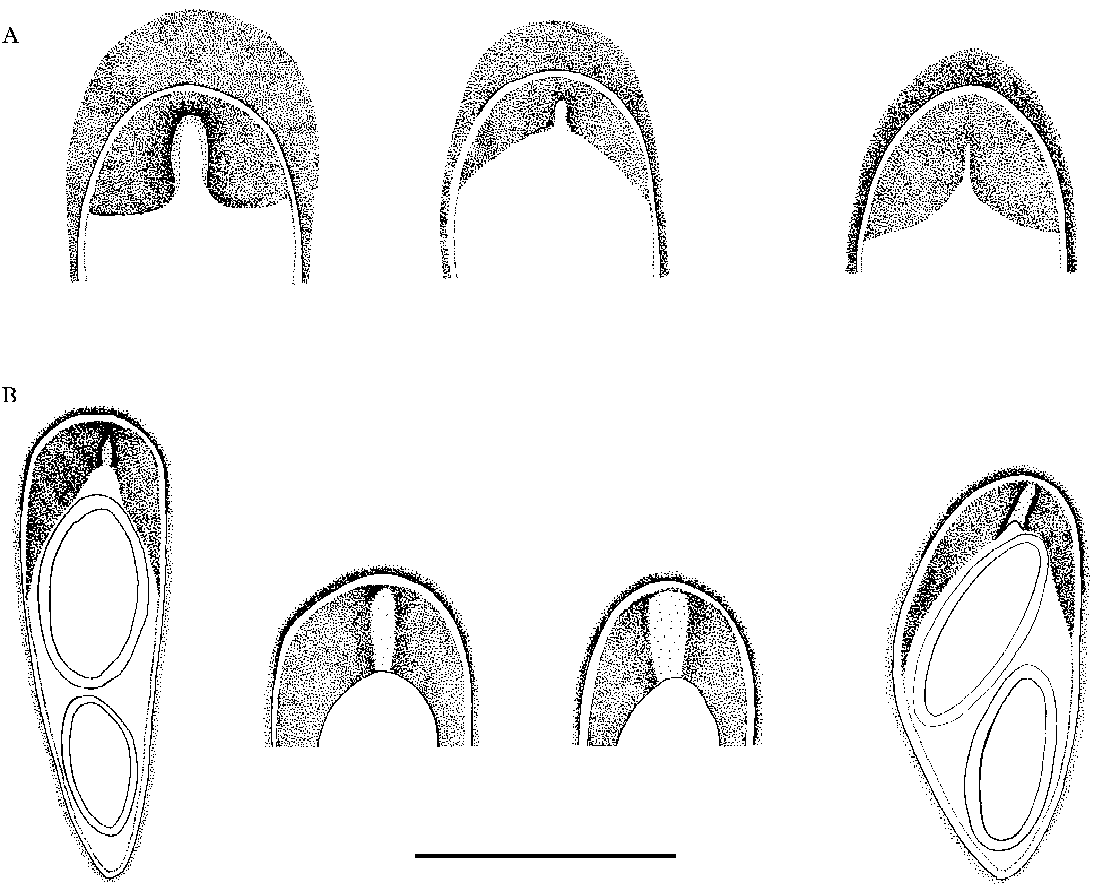
The ascus of Mycoblastus sanguinarius was depicted and described by Hafellner (Reference Hafellner1984) who noted one-spored asci with a thick amyloid tholus, with a distinct ocular chamber and masse axiale in the form of a pale border; the ascus also had a prominent amyloid cap composed of compacted gel. This type of ascus, termed the ‘Mycoblastus-type’ after Hafellner (Reference Hafellner1984), is also found in the other one-spored taxa, including M. sanguinarioides (described below); it is depicted in Fig. 1A where the similarities to Hafellner's drawing are clearly evident. The amyloid reaction is restricted to the asci and surrounding gel, and does not occur through the whole hymenium. So intense is the amyloid reaction that ascus structure is best observed using very dilute Lugol's reagent after pre-treatment with KOH and washing with water.
Mycoblastus species, asci with the amyloid parts stippled. A, M. sanguinarioides (Kantvilas s.n., 1996); B, M. dissimulans (Kantvilas 1086/81). Scale = 50 μm.
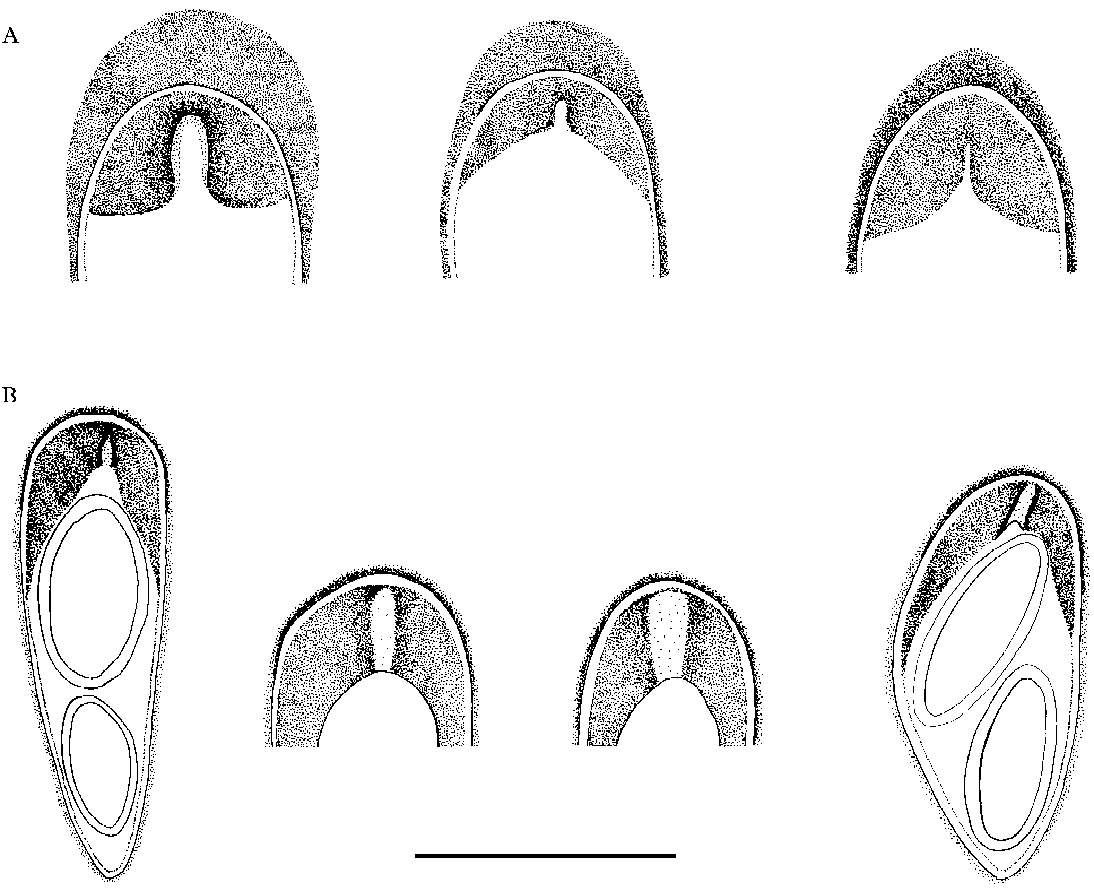
A different type of ascus is found in the other austral species studied. In these species, the ascus is at least two-spored. The tholus is very well-developed and intensely amyloid, but is pierced totally (or almost so) by a barrel-shaped to conical, weakly amyloid masse axiale; the tholus tissue adjacent to the masse axiale usually stains slightly more intensely. There is also a blunt to beak-like ocular chamber, although this may be absent in older asci where the apex of the ascoplasm is ± neatly rounded. The ascus is surrounded by a thin, external, ‘fuzzy’ amyloid layer, but there is no thick, heavily amyloid cap (Fig. 1B). This type of ascus more closely approximates a Biatora-type or Lecidella-type, and is not unlike that seen in certain species of Megalaria (for example, see Kantvilas Reference Kantvilas2008). As in M. sanguinarius, the amyloid reaction is restricted to the asci themselves, and is best observed using extremely dilute Lugol's reagent.
Paraphyses
The structure of the paraphyses differs between the species studied. Paraphyses are invariably highly branched, but their thickness varies, as does the degree to which they separate in K. In M. dissimulans, for example, they remain densely conglutinated, whereas in M. campbellianus they are usually lax. The paraphyses may also be rather robust and become ± moniliform in the uppermost part. The apices of all species generally remain conglutinated, and a gelatinous cap is frequently developed that encases the apical cell. Pigment tends to occur around these caps, so that in section, they give the impression of a cellular epithecium. It is still unclear to what extent the variation in paraphyses is induced by age or habitat, and this character is not applied rigorously in the delimitation of taxa.
Ascospores
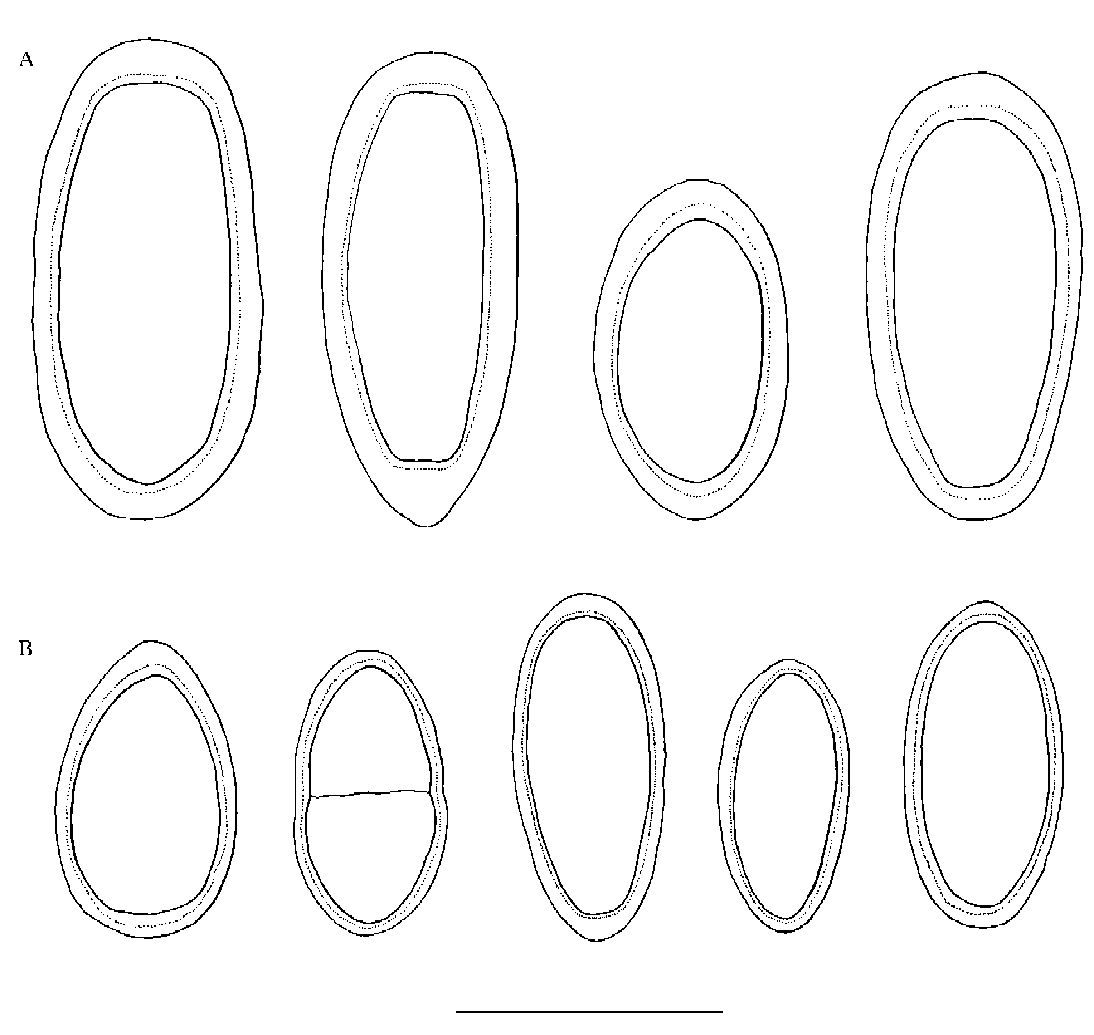
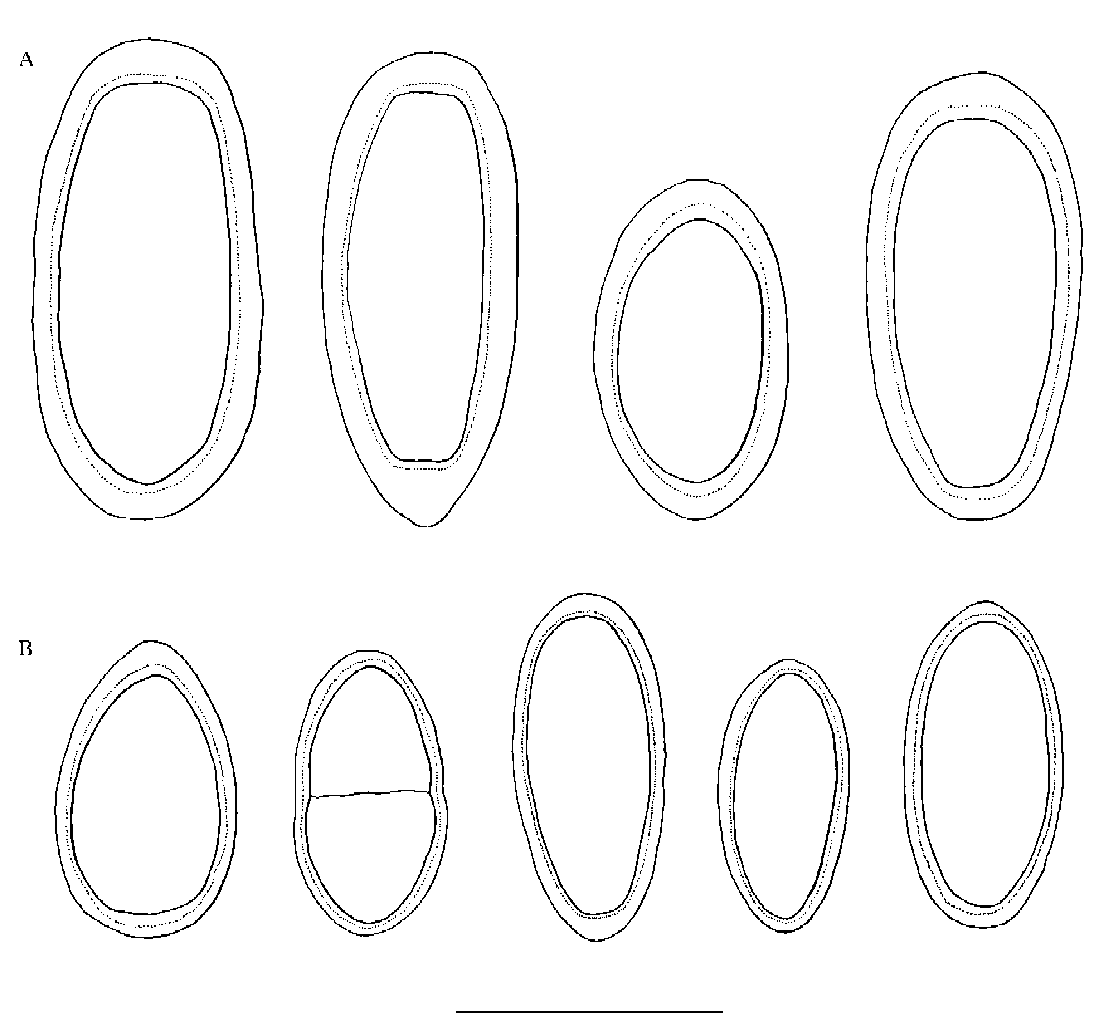
The size of ascospores and their number in the ascus is critical for species identification. Two states are found in Mycoblastus: broadly ellipsoid to cylindrical ascospores that occur almost always singly in the ascus (as found in M. sanguinarius and M. sanguinarioides, hereafter referred to as the ‘M. sanguinarius group’; Fig. 2A); and ovate to broadly ellipsoid ascospores that are usually two per ascus (as found in the other species studied; e.g. M. dissimulans; Fig. 2B). In the latter type, 3- or even 4-spored asci are known, but these additional spores are usually aborted before maturity.
Mycoblastus species, ascospores. A, M. sanguinarioides (Kantvilas s.n., 1996); B, M. dissimulans (Kantvilas 1086/81). Scale = 50 μm.
The ascospores have a double wall that is clearly discernible in light microscopy: there is a thin inner wall and a thick, gelatinous outer wall. Measurements cited in this paper include both layers. Occasionally the outer wall swells noticeably and ruptures, releasing an ascospore with only the thin, inner wall.
Mycoblastus is generally regarded as simple-spored (Hafellner Reference Hafellner1984) and this is certainly true for the M. sanguinarius group. However, apparently septate ascospores have been consistently observed in other species. In many cases, these septate spores are clearly old and deformed, and the septum is frequently thin, crooked and more akin to a plasma bridge as seen in many normally simple-spored lichens. However, well-formed ascospores with a distinct true septum have been observed, albeit very occasionally, in all members of the M. dissimulans group (Fig. 2B).
Taxonomic position
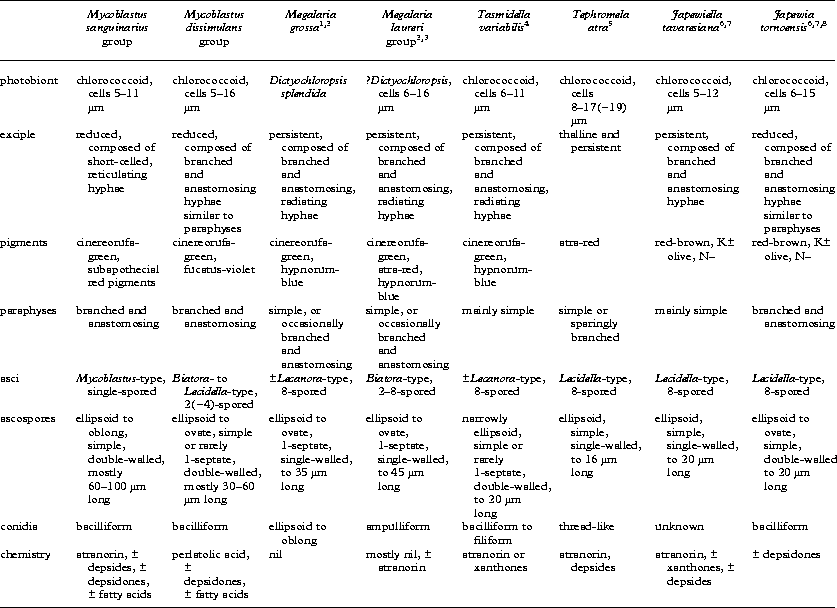
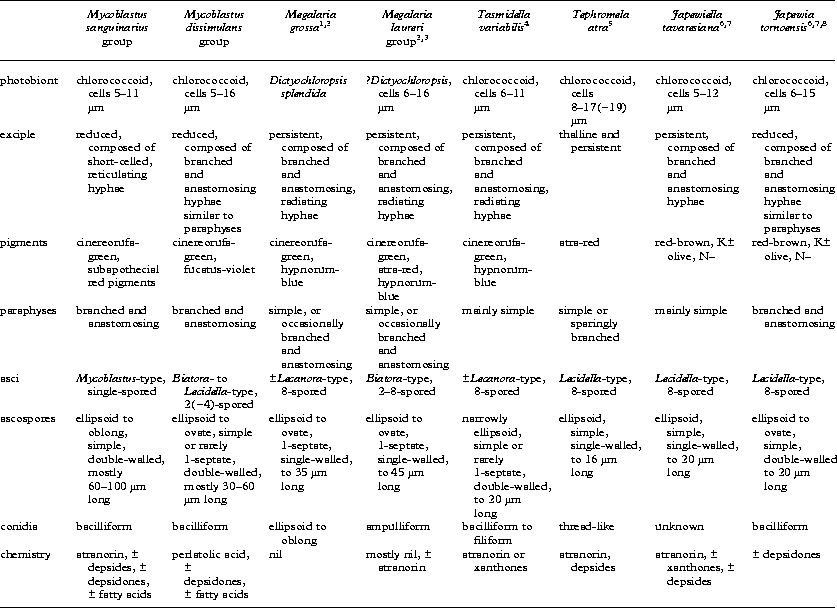
Despite their superficial similarities, there appear to be two distinct groups evident in Mycoblastus, supported by differences in ascus structure, ascospores and thallus chemistry. This infra-generic division requires further exploration, a task that is in progress but beyond the scope of the present paper. Some species (M. affinis and M. sanguinarius) have been included in several studies dealing with systematic relationships based on DNA sequence data, albeit in a cursory way. Strong support for the relationship between Mycoblastus and Tephromela, as well as with Calvitimela, was found by Arup et al. (Reference Arup, Ekman, Grube, Mattson and Wedin2007), Ekman et al. (Reference Ekman, Andersen and Wedin2008) and Miądlikowska et al. (Reference Miądlikowska, Kauff, Hofstetter, Fraker, Grube, Hafellner, Reeb, Hodkinson, Kukwa, Lücking, Hestmark, Otalora, Rauhut, Büdel, Scheidegger, Timdal, Stenroos, Brodo, Perlmutter, Ertz, Diederich, Lendemer, May, Schoch, Arnold, Gueidan, Tripp, Yahr, Robertson and Lutzoni2006), although all these authors concede that further studies are needed. A comparative morphological and anatomical analysis of the systematic placement of Mycoblastus will be explored in a later contribution. However, on the basis of ascus structure, the presence of pigments, granules and oil droplets, and the generally large, simple or one-septate ascospores, a relationship with Megalaria and the family Megalariaceae may be worthy of serious consideration. In this family, the genus Tasmidella has occasionally septate, double-walled ascospores (Kantvilas et al. Reference Kantvilas, Hafellner and Elix1999). Even more similar, and probably related, is the genus Japewia (Tønsberg Reference Tønsberg1990; Printzen Reference Printzen1999; Spribille & Printzen Reference Spribille and Printzen2007). Japewia shares many characters with the M. dissimulans group, including a Lecidella-type ascus, reduced exciple, branched and anastomosing paraphyses and double-walled ascospores. It differs mainly by lacking an inspersed hymenium and dark, K+, N+ pigments. Salient features of these genera and other possibly related taxa are compared in Table 1.
Key to austral species of Mycoblastus
1 Thallus not sorediate 2
Thallus sorediate 5
2(1) Asci one-spored, with the ascospore ellipsoid to oblong, usually >60 μm long; apothecia frequently with small patches of reddish pigment beneath; thallus containing atranorin M. sanguinarioides
Asci at least two-spored, with ascospores ellipsoid to ovate, usually <60 μm long; red pigments not present beneath apothecia; thallus lacking atranorin but containing perlatolic acid 3
3(2) Thallus P+ orange-red (containing physodalic acid) M. disporus
Thallus P− (physodalic acid lacking) 4
4(3) Upper part of hymenium containing cinereorufa-green and/or fucatus-violet pigments; hypothecium colourless to pale yellow, usually K+ yellowish or yellow-orange; containing perlatolic acid ± fatty acids M. dissimulans
Upper part of hymenium with cinereorufa-green pigment only; hypothecium vivid yellow, K+ intense blood red; containing hybocarpone in addition to perlatolic and fatty acids M. kalioruber
5(1) Soredia usually whitish or at least paler than the thallus, occurring in discrete soralia, becoming diffuse and confluent only in later stages of development 6
Soredia concolorous with the thallus, not in discrete soralia, arising from cracks and soon becoming scattered and confluent, sometimes forming a granular crust 7
6(5) Soralia P+ orange-red (containing virensic acid in addition to perlatolic acid); soredia farinose; typically epiphytic or on wood M. campbellianus
Soralia P− (containing perlatolic acid, ± fatty acids); soredia granular; typically on soil or turf M. bryophilus
7(5) Thallus typically fertile; soredia scattered at first, later becoming confluent, P− (containing perlatolic acid, ± fatty acids); very common and widespread M. coniophorus
Fertile material unknown; soredia confluent from the outset and forming a thick, granular crust, P+ red (containing protocetraric acid in addition to perlatolic acid) M. leprarioides
The Species
Mycoblastus bryophilus Imshaug ex Kantvilas sp. nov
Mycoblasto dissimulanti (Nyl.) Zahlbr. similis sed thallo granulari, areolato vel noduliformi, sorediis grossis granularibusque in soraliis discretis, 0·5–2·5 mm latis instructo differens.
Type: New Zealand, Campbell Island, rock outcrops on north side of west end of Lyall ridge at 500–600 ft [150–180 m] elevation, 18 January 1970, R. C. Harris 5539 (MSC—holotypus; HO—isotypus).
Comparison of salient features of Mycoblastus and superficially similar genera (based on observation of selected specimens and literature).
2 Ekman & Tønsberg (Reference Ekman and Tønsberg1996);
3 Kantvilas (Reference Kantvilas, Elix and Jarman2008);
4 Kantvilas et al. (Reference Kantvilas, Hafellner and Elix1999);
6 Printzen (Reference Printzen1999);
7 Spribille & Printzen (Reference Spribille and Printzen2007);
8 Tønsberg (Reference Tønsberg1990).
(Fig. 4A & B)
Thallus whitish cream, rarely greenish or brownish grey, matt, composed of scattered, crowded or contiguous granules, areoles or nodules mostly 0·2–1·5 mm wide, smooth or abraded, becoming sorediate; soralia concolorous with the thallus or paler, rather erumpent, usually ± discrete, c. 0·5–2·5 mm wide; soredia very coarsely granular, sometimes fusing in irregular patches to 10 mm wide but not forming a continuous sorediate crust; prothallus effuse, often rather glossy and ± gelatinous, blue-grey to brownish; cortex absent; medulla white; photobiont cells ± globose, 5–12 μm diam.
Apothecia very rare and usually not developed, 0·3–1·5 mm diam., dull to glossy black to brown-black, superficial, markedly convex to subglobose, basally constricted, immarginate. Exciple in section, 20–90 μm thick, hyaline to pale brownish, usually streaked with varying amounts of cinereorufa-green and fucatus-violet pigments, composed of radiating, heavily conglutinated hyphae, 1–2·5 μm thick. Hypothecium 140–250 μm thick, hyaline to pale yellow-brown, dilute yellowish in K, inspersed with oil droplets 2–12 μm wide, subtended by a hyaline to pale yellowish subhypothecium, intensifying yellow in K, and a band of cinereorufa-green pigment. Hymenium to c. 150 μm thick, hyaline to pale yellowish, likewise inspersed with oil droplets, pigmented in the upper part with a thick layer of cinereorufa-green pigment that overlies additional fucatus-violet pigment. Asci 2-spored, approximating the Biatora- or Lecidella-types, 130–150 × 40–50 μm; very few mature asci observed. Paraphyses numerous, highly branched, separating easily in K or remaining conglutinated, 1·5–4 μm thick; apices mostly 3–6 μm thick, occasionally with the ultimate cells encased in pigment. Ascospores ovate to broadly ellipsoid, simple, 50–58·7–66 × 26–34·5–40 μm (very few observed); wall (1–)3–4 μm thick.
Pycnidia not found.
Chemistry. Perlatolic acid, rangiformic acid (± trace), norrangiformic acid (± trace) and norcaperatic acid (± trace); thallus K−, KC−, C−, P−, UV± whitish.
Etymology. The specific name refers to the habitat of the new species, which commonly overgrows terricolous bryophytes (and other small plants). The name was first applied as an unpublished herbarium name to material collected and distributed by Henry Imshaug (MSC).
Remarks. Mycoblastus bryophilus is closely related to M. dissimulans (see below) in so far as both species contain perlatolic acid as the major compound, and have apothecia usually with both cinereorufa-green and fucatus-violet pigments. They differ by the former being sorediate. The soredia in this taxon differ from those of the other sorediate species found in the study area in that they occur in delimited, albeit irregular soralia and are extremely coarse. In M. coniophorus and M. leprarioides, the soredia are diffuse and occur ± across the entire thallus, whereas in M. campbellianus they are farinose. Although the ascospores of M. bryophilus appear to be marginally larger than those of M. dissimulans, this may be an artefact of a significantly smaller sample size for the former.
In cold, treeless environments, both M. bryophilus and M. dissimulans occur together and intermixed; indeed much of the MSC material distributed under the former name is non-sorediate and, in this study, is ascribed to M. dissimulans. Specimens need to be checked carefully, bearing in mind that the thallus of M. dissimulans from terricolous habitats may be likewise granular-nodulose and quite abraded but does not form soredia, whereas M. bryophilus forms discrete soralia that sometimes become very prominent and erumpent. Such specimens may resemble sterile thalli of Dibaeis arcuata (Stirt.) Kalb & Gierl that may grow in similar habitats.
Only two specimens of this taxon had apothecia, and then only very few and with very few, well-developed ascospores; consequently the description and measurement of fertile characters are scant and provisional.
Distribution and ecology. Mycoblastus bryophilus is known from Campbell Island, where the abundance of collections suggests it is common, and from Tasmania. It occurs mainly over bryophyte turfs, peaty soil, litter or the rotting bases of plant tussocks in cold, windswept, treeless habitats. However, of the five Tasmanian collections studied, one is from the papery bark of a Leptsopermum in highland woodland, another is from the dead fronds of the tiny epiphytic fern, Apteropteris applanata, which grows on Athrotaxis in alpine woodland, and a third is from rock.
Specimens examined. New Zealand: Campbell Island: St Col Peak, 1969, H. A. Imshaug 45990 (MSC); summit of Mt Dumas, 1970, H. A. Imshaug 47005 (MSC); Lyall ridge, 1969, R. C. Harris 4399 (HO, MSC); Paris-Villarceau ridge, 1970, H. A. Imshaug 46616 (HO, MSC); NE of Mt Sorenson, 1970, R. C. Harris 5120 (MSC).—Tasmania: c. 2 km SE of Lake Emmett, 42°38′S 146°33′E, 980 m, 1990, G. Kantvilas 151/90 (HO); summit of Black Bluff, 41°27′S 145°57′E, 1335 m, 2000, G. Kantvilas 132/00 (HO); Mt Wedge Track, 42°51′S 146°17′E, 1000 m, 2002, G. Kantvilas 622/02 (HO); King William Saddle, 42°13′S 146°06′E, 840 m, 1984, G. Kantvilas 177/84 & P. W. James (BM, HO). Flinders Island: head of Leventhorpe Gully, 40°04′S 148°05′E, 330 m, 2007, G. Kantvilas 68/07 (HO).
Mycoblastus campbellianus (Nyl.) Zahlbr
Cat. lich. univ. 4: 3 (1926) —Lecidea campbelliana Nyl., C. r. hebd. Séanc. Acad. Sci. Paris 83: 90 (1876); type: New Zealand, Insula Campbell, 1874, Filhol (H-NYL 11050!—holotype).
Mycoblastus minor Zahlbr., Denkschr. Akad. Wiss. Wien math.-naturwiss. Kl. 104: 294 (1941); type: New Zealand, East Waiotapu Valley, Rotorua, June 1936, on manuka twigs, K.W. Allison 28 (CHR 378615!—lectotype, fide Galloway Reference Galloway1985).
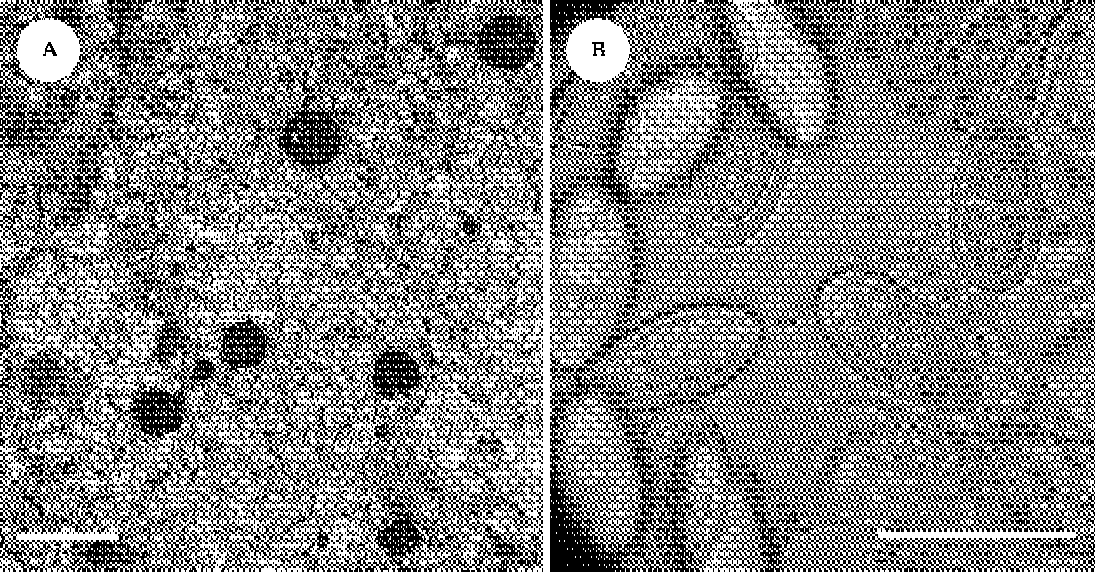
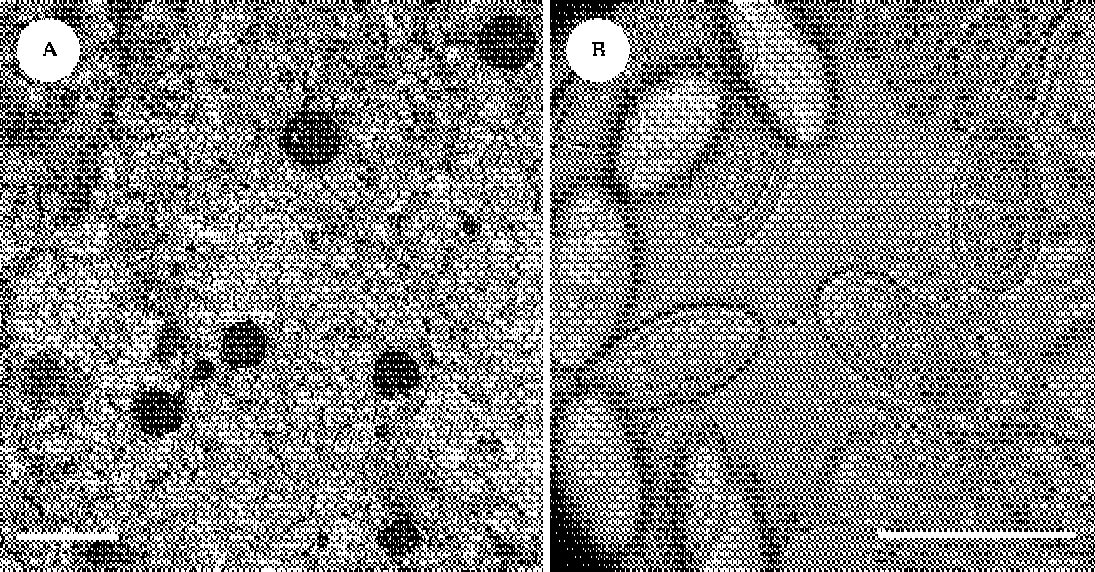
Mycoblastus campbellianus (Kantvilas 369/07). A, habit; B, ascospores. Scales: A = 1 mm; B = 40 μm.
(Fig. 3A & B)
Thallus whitish, cream, grey-brown or dull greyish, sometimes patchily blue-grey due to the underlying prothallus, matt, ± continuous, smooth or a little uneven, generally deeply cracked, 40–180 μm thick, sorediate; soralia white, 0·2–0·5(−1·2) mm wide, initially discrete, speck-like or sometimes tuberculate, soon becoming diffuse or confluent and spreading unevenly across the thallus; soredia farinose to granular; cortex absent; medulla white; photobiont cells ± subglobose, 5–11 μm diam.
Apothecia 0·3–0·5(−0·8) mm diam., scattered, ± superficial, basally constricted, strongly convex and top-shaped when well developed, occasionally sunken in the thallus surface, abraded or excavate, glossy black to blue-black, rarely dark reddish brown or piebald, immarginate. Exciple in section often excluded, in young apothecia 20–60 μm thick, with bright cinereorufa-green pigment at the outer edge, composed of radiating, very heavily conglutinated hyphae, 2–4 μm thick, at the outer edge expanding to 4–5 μm thick. Hypothecium 85–200 μm thick, colourless to pale yellowish, intensifying in K and N, sometimes yellow-orange, inspersed with minute crystals that mostly dissolve in K, occasionally with a subhypothecial band of cinereorufa-green pigment. Hymenium 80–140 μm thick, inspersed with oil droplets and minute granules that mostly dissolve in K, entirely or in the upper part bright cinereorufa-green pigmented. Asci 2(−4)-spored, approximating the Biatora- or Lecidella-types, 70–98 × 24–47 μm. Paraphyses numerous, highly branched, mostly separating readily in K, 2–3·5 μm thick, ± moniliform in the upper part; apices typically enlarged, 3–5 μm thick, in extreme casesthe ultimate cells developing roundish, blue-green pigmented, gelatinous caps, 8–13 × 7–12 μm that form a conglutinated, ‘cellular’ epithecial layer 15–40 μm thick. Ascospores ovate to broadly ellipsoid, 27–38·7–51(−56) × 17–22·4–29(–32) μm, 0(–1)-septate; wall (1·5–)2·5–5 μm thick.
Pycnidia not found.
Chemistry. Perlatolic acid, hyperperlatolic acid, virensic acid and protocetraric acid (±); very rarely with additional caperatic or norcaperatic acids; thallus and soralia K−, C−, KC−, P+ orange-red, UV+ white. Perlatolic acid is invariably the major compound present whereas the concentration of the other compounds varies. Virensic acid is sometimes barely detectable on a TLC plate, but the soralia nevertheless give a P+ orange-red reaction.
Remarks. Mycoblastus campbellianus is a very distinctive species in the austral flora, characterized by a thallus with farinose soredia that occur in discrete, roundish, white soralia, by the presence of virensic acid in addition to perlatolic acid, and by the relatively small apothecia and ascospores. The presence of the blue-green, cinereorufa-green pigment in the apothecia allies this species to M. bryophilus, M. coniophorus, M. dissimulans and the Northern Hemisphere's M. affinis, M. caesius and M. sanguinarius, but it differs from all of these species by its chemical composition, readily confirmed by the P+ orange-red reaction of the soralia. It differs further from M. dissimulans (with which it often grows) by a range of characters: the thallus of M. dissimulans is much thicker and often areolate, papillate or verrucose, whereas that of M. campbellianus is thin and generally ± smooth; M. dissimulans may be coarsely abraded but not truly sorediate. Of the species listed above, only M. bryophilus, M. caesius and M. coniophorus are truly sorediate but in those species the soredia are very coarse, and form at cracks in the thallus, at the edges of slightly upturned areoles or on points of abrasion, rather than in discrete soralia.
The apothecia and ascospores of M. campbellianus are generally a little smaller than those of the other species studied. The hymenium is also not as densely inspersed, and then mainly with crystals rather than oil droplets; probably for this reason, the blue-green pigment appears much clearer and brighter. The crystals fluoresce in polarized light and dissolve in KOH. The paraphyes of M. campbellianus are also distinctive, separating readily in K and being generally more robust and moniliform than those of the other species mentioned above.
Two unusual specimens of this species have been collected in Tasmania. One (Kantvilas s.n.) lacks virensic acid but accords with M. campbellianus in every other macro- and micro-character. The other (Kantvilas 22/00) is from rock and contains additional atra-red (Meyer & Printzen Reference Meyer and Printzen2000) pigment in the subhypothecium. A further, as-yet unidentified, superficially similar species occurs in the New Guinea highlands (collected by A. Aptroot); it differs by containing perlatolic acid and atranorin, and has fucatus-violet pigment in the apothecia.
The thallus of M. campbellianus varies from being thick and prominent to very thin, but the white fleck-like soralia are always conspicuous. Sterile specimens are common and may resemble three other sorediate, frequently sterile lichens that occur in similar habitats: Austroblastenia pauciseptata (Shirley) Sipman (containing pannarin; P+ orange), Pertusaria novaezelandiae Szatala (containing hypothamnolic acid; K+ violet) and an unidentified Trapelia (containing gyrophoric acid; C+ red).
Although the detailed description of Mycoblastus minor given by Zahlbruckner (Reference Zahlbruckner1941) concurs with all the salient features of M. campbellianus, the synonymy of these names, proposed by Galloway (Reference Galloway1985) and accepted here, could not be confirmed by examination of the type of the former. The specimen studied (in CHR) includes a wide range of crustose lichens, dominated by a Tephromela, but no species ofMycoblastus was evident.
Distribution and ecology. Mycoblastus campbellianus is a species of cool to cold climates, and has been recorded from the North and South Islands of New Zealand (Galloway Reference Galloway2007), Tasmania (Kantvilas et al. Reference Kantvilas2008), Campbell Island, Macquarie Island (Dodge Reference Dodge1948), the highlands of south-eastern Australia, Staten Island, Tierra del Fuego and southern Chile. It typically occurs as an epiphyte, although one specimen seen is from peaty soil and another is from rock.
In Tasmania, it occurs in a wide range of vegetation types, including cool temperate rainforest, wet eucalypt forest, wet scrub, subalpine heathland and alpine communities. It typically colonizes a wide range of bark types as well as decorticated wood, and is part of a diverse community that includes Coccotrema cucurbitula (Mont.) Müll. Arg., Fuscidea australis Kantvilas, Loxospora solenospora (Müll. Arg.) Kantvilas, Melanelia subglabra (Räsänen) Essl., Menegazzia globulifera R. Sant., M. pertransita (Stirt.) R. Sant., Pannaria microphyllizans (Nyl.) P.M. Jørg., Parmelia tenuirima Hook.f. & Taylor, P. salcrambidiocarpa Hale, Tasmidella variabilis Kantvilas et al. and Thelotrema lepadinum (Ach.) Ach. Also often present together with M. campbellianus are M. coniophorus, M. dissimulans and M. kalioruber.
Selected specimens examined. Argentina: Isla de los Estados: Puerto Basil Hall, 54°45′S 64°10′W, 1971, H. A. Imshaug 51405 & K. Ohlsson (MSC); Puerto Cook, 54°46′S 64°02′W, 10 m, 1971, H. A. Imshaug 51636 & K. Ohlsson (MSC); Puerto San Juan, 54°45′S 63°54′W, 1971, H. A. Imshaug 51825 & K. Ohlsson (MSC); Puerto Parry, 54°47′S 64°22′W, 1971, H. A. Imshaug 53885 & K. Ohlsson (MSC); Bahia Capitan Canepa, 54°49′S 64°28′W, 45 m, 1971, H. A. Imshaug 53084 & K. Ohlsson (MSC); Bahia Crossley, 54°48′S 64°40′W, 1971, H. A. Imshaug 50844 & K. Ohlsson (MSC).—Tierra del Fuego: Bahia Valentin, 54°53′S 65°29′W, 10–15 m, 1971, H. A. Imshaug 50488a & K. Ohlsson (MSC).—Chile: Prov. Magallanes: B. Fortescue, 53°42′S 72°01′W, 1969, H. A. Imshaug 44924 & K. Ohlsson (MSC).—New Zealand: Campbell Island: S of Tucker Cove Station, 1969, R. C. Harris 4878 (MSC); N of Beeman Station, 1970, R. C. Harris 5771 (MSC); Garden Cove toward Filhol Peak, 1970, R. C. Harris 5197 (MSC); N side of Perseverance Harbour, 1969, R. C. Harris 4833 (MSC); E of Mt Sorenson, 1970, R. C. Harris 5164 (MSC); S slope of Mt Honey, 1970, H. A. Imshaug 4783 (MSC); base of Lyall Ridge, 1969, H. A. Imshaug 46075 (MSC).—Tasmania: Little Fisher River, 41°45′S 146°20′E, 880 m, 1984,G. Kantvilas 437/84 & P. James (BM, HO); Lake Dobson, 42°41′S 146°35′E, 1030 m, 1981, G. Kantvilas 652/81 & P. James (BM, HO); track to Clear Hill, 42°41′S 146°16′E, 1000 m, 2000, G. Kantvilas 27/00 (HO); Mt Maria, 42°37′S 148°07′E, 705 m, 2000, G. Kantvilas 22/00 (HO); Lake Adelaide, 41°50′S 146°15′E, 1060 m, 2002, G. Kantvilas 68/02 (HO); near Little Florentine River, 42°44′S 146°25′E, 430 m, 2000, G. Kantvilas 70/00 (HO); Boyd Lookout, 42°49′S 146°21′E, 2006, G. Kantvilas 282/06 (HO); Little Fisher River, 41°45′S 146°20′E, 880 m, 1982, G. Kantvilas s.n. (HO); Long Tarns, 41°47′S 146°21′E, 1270 m, 2006, G. Kantvilas 405/06 (HO); Blue Peaks, 41°43′S 146°23′E, 1290 m, 2006, G. Kantvilas 416/06 (HO).—Australia: Victoria: Errinundra Saddle, Rainforest Walk, 37°19′03″S 148°50′19″E, 910 m, 2008, G. Kantvilas 177/08& J. Elix (HO, MEL); Errinundra Plateau, Bonang River Picnic Area, 37°17′02″S 148°48′25″E, 810 m, 2008, G. Kantvilas 131/08& J. Elix (HO).
Mycoblastus coniophorus (Elix & A. W. Archer) Kantvilas & Elix comb. nov
Pertusaria coniophora Elix & A. W. Archer, in J. A. Elix, A. Aptroot & A. W. Archer, Mycotaxon 64: 20 (1997); type: Australia, Victoria, Cape Conran, 18 km E of Marlo. 37°49′S 148°44′E, on dead wood, 21 November 1978, J. A. Elix 5297 (CANB!—holotype).
Pertusaria coniophorella Elix & A. W. Archer, Austral. Lichenol. 60: 21 (2007); type: Australia, New South Wales, Cotten-Bimbang National Park, junction of Oxley Highway and Tobins Road, c. 70 km E of Walcha, 31°22′22″S 152°03′37″E, 1040 m, on dead wood in wet Eucalyptus forest with tree fern understorey, 28 April 2005, J. A. Elix 36398 (CANB!—holotype).
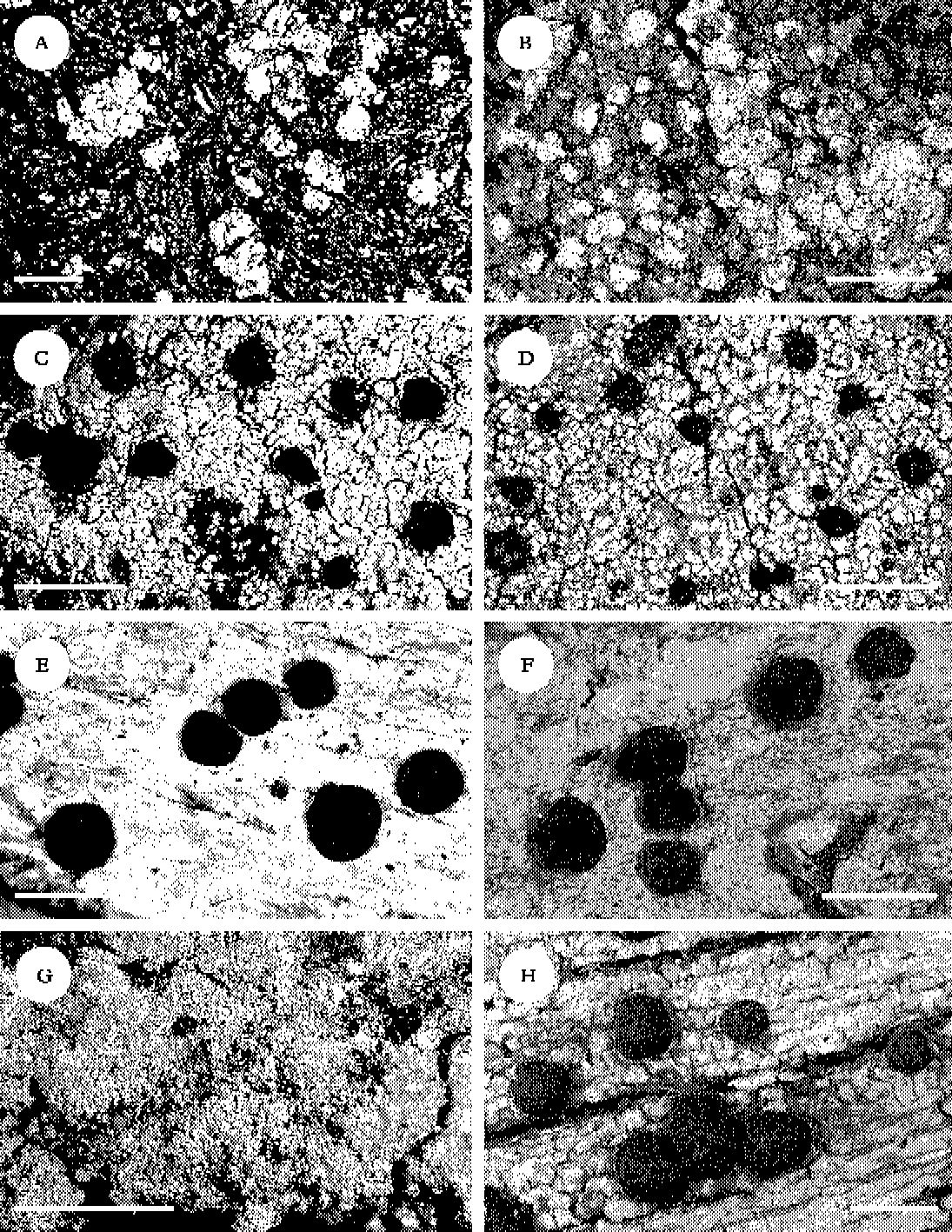
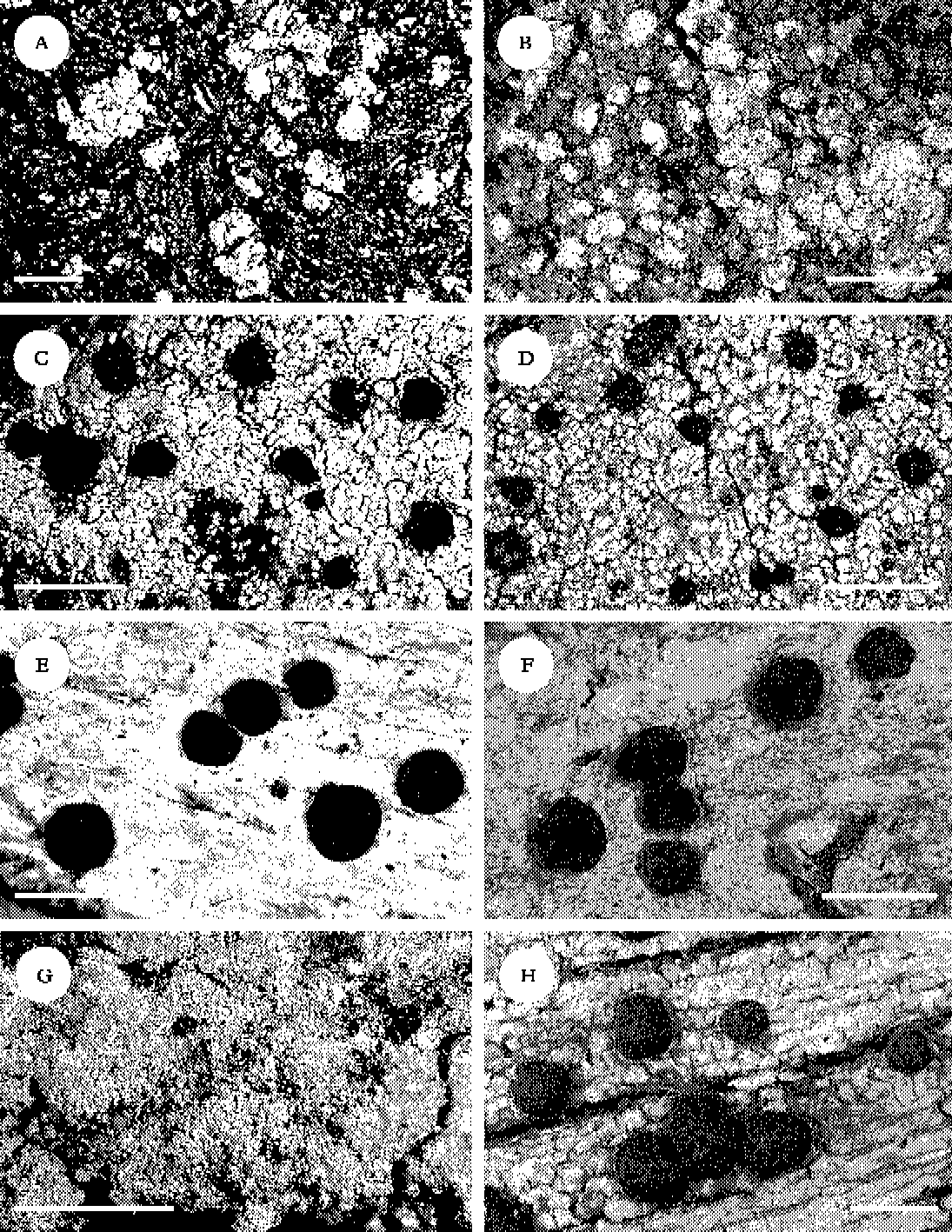
Mycoblastus species, habit. A, M. bryophilus (Kantvilas 622/02); B, M. bryophilus (isotype); C, M. coniophorus (Kantvilas 97/85); D, M. disporus (holotype); E, M. dissimulans (Kantvilas 1086/81); F, M. kalioruber (Kantvilas 154/90); G, M. leprarioides (holotype); H, M. sanguinarioides (Kantvilas s.n., 1996). Scale = 2 mm.
(Fig. 4C)
Thallus whitish cream to pale yellowish white, occasionally tinged a little greyish green, 40–350 μm thick, continuous, smooth to deeply cracked to rather scurfy-areolate, sometimes rather verruculose-lumpy, sorediate; soredia concolorous with the thallus, very coarsely granular, arising from cracks in the thallus or at the edges of areoles, at length spreading across the thallus and sometimes forming a granular-sorediate crust to c. 1 mm thick; cortex absent; medulla white, but sometimes locally yellowish beneath the apothecia; photobiont cells subglobose, 7–12 μm diam.
Apothecia 0·5–1·5(−2) mm diam., scattered or rarely confluent, superficial, strongly convex to subglobose, basally constricted, dull or glossy blue-black to black, occasionally devoid of pigment and then pale reddish brown or piebald, immarginate. Exciple in section usually well developed, persistent, 35–75 μm thick, hyaline to pale yellow-brown, colour intensifying in N, K+ yellow, composed of very densely conglutinated, branched and anastomosing, radiating hyphae 1–3 μm thick. Hypothecium 140–200 μm thick, hyaline to pale yellow brown, ± unchanged or intensifying yellow in K and N, densely inspersed with oil droplets 3–20 μm wide and minute granules mostly insoluble in K, subtended by a pale yellow-brown subhypothecium, intensifying yellowish in N, K+ intense yellow to orange-yellow, occasionally with a band of cinereorufa-green pigment beneath. Hymenium 110–170 μm thick, hyaline to pale yellow-brown, intensifying yellowish in K, inspersed with granules and oil droplets as in the hypothecium, in the upper part densely cinereorufa-green pigmented, sometimes with the pigment diffusing into the whole hymenium. Asci 2-spored, approximating the Biatora- or Lecidella-types, 90–125 × 30–44 μm. Paraphyses highly branched, persistently heavily conglutinated and not separating in K, ± evenly 1·5–3 μm thick, occasionally somewhat moniliform towards the apices; apices not or slightly enlarged to 3–4 μm, sometimes with gelatinous caps 8–15 μm wide. Ascospores broadly ellipsoid to ovate, (27–)29–43·1–60 × 17–24·2–34(–38) μm, simple or rarely spuriously 1-septate; wall 2–5 μm thick.
Pycnidia not found.
Chemistry: Perlatolic acid, frequently accompanied by either, or both, caperatic acid and norcaperatic acid, often only in trace concentrations; secalonic acid sometimes detectable by TLC (possibly confined to apothecia); thallus (particularly sorediate areas) K−, C−, KC−, P± weak orange, UV+ white.
Remarks. This species is characterized by the sorediate thallus containing perlatolic acid, the two-spored asci and by the presence of cinereorufa-green pigment in the apothecia. Only three other sorediate species are known in the study area: M. campbellianus, which has farinose soredia in discrete soralia and contains additional virensic and/or protocetraric acids; M. bryophilus, which is chiefly terricolous, often contains additional fucatus-violet pigment, and has coarse soredia in discrete, erumpent soralia; and M. leprarioides, which forms an entirely granular-sorediate crust, and contains additional protocetraric acid.
The most similar species to M. coniophorus is the Northern Hemisphere taxon, M. caesius. Specimens from the Pacific North-West of North America (collected and determined by T. Tønsberg) have a similar thallus, likewise containing perlatolic acid, with scattered coarse soredia and similar-sized ascospores, 42–50 × 20–29 μm. However, M. caesius differs by several subtle characters. Its thallus is thinner, often rather dispersed and discontinuous, and conspicuously delimited and underlain by a dark prothallus, giving it a purplish tinge. The apothecia of M. caesius sometimes contain additional ‘fucatus-violet’ pigment together with or just beneath the cinereorufa-green pigment, yielding an indigo-blue tinge; fucatus-violet pigment has never been observed in M. coniophorus. Furthermore, the K+ yellow reaction in the exciple and subhypothecium of M. caesius is absent or very weak, the hymenium is less inspersed, and the paraphyses are generally more robust and more lax in K. Whereas some particular specimens of M. coniophorus could well be accommodated within a broad concept of M. caesius, after an examination of a very large range of material, I have preferred to keep the taxa separate. Certainly no material of M. caesius seen ever approaches the typical form of M. coniophorus, with its relatively thick, coarsely granular sorediate, cream-coloured thallus.
The species was initially described as a Pertusaria, based on a sterile specimen. It was characterized by its chemical composition, comprising perlatolic, confluentic and 2-O-methylconfluentic acids, and by the presence of isidia (Elix et al. Reference Elix, Aptroot and Archer1997). The interpretation of the latter feature is unusual, because the type specimen has a clearly abraded, verruculose-sorediate thallus. The cited chemical composition was incorrect and the type specimen contains perlatolic acid only.
Distribution and ecology. This species is currently known from southern Chile, Juan Fernandez, Auckland Island, Macquarie Island, Tasmania and south-eastern Australia, where it is usually found as an epiphyte in scrub and forest, or more rarely, on soil and turf in treeless vegetation. With some hesitation, it is also recorded here from Prince Edward Island, based on material previously identified as M. caesius by Øvstedal & Gremmen (Reference Øvstedal and Gremmen2007); this small, sterile specimen is highly abraded, and is not greatly dissimilar from some forms of M. bryophilus. On the basis of herbarium material available, M. coniophorus is particularly common in Tasmania, but is much rarer elsewhere. It seems surprising that no specimens from the main islands of New Zealand could be located, nor is any species that matches M. coniophorus referred to by Galloway (Reference Galloway1985, Reference Galloway2007).
In Tasmania, M. coniophorus is extremely common and widespread, although mainly in the lowlands and essentially outside of the south-west of the island, a region with many distinctive and/or endemic elements (Kantvilas Reference Kantvilas1995). It is found mostly in cool temperate rainforest, wet sclerophyll forest and wet scrub. Here it occurs on a wide variety of trees and shrubs, including species with rough, flaky bark such as Nothofagus cunninghamii, species with smooth bark such as Nematolepis squamea, and species with papery bark such as Melaleuca species. It is typically part of a rich assemblage of chiefly crustose lichens, dominated by Thelotrema lepadinum and Coccotrema cucurbitula. It is also occasionally found in dry sclerophyll forest where it favours locally moister, more shaded sites such as fallen logs. Two Tasmanian specimens are from rock: one in buttongrass moorland, the other in eucalypt woodland.
Selected specimens examined. Chile: Prov. Magallanes: SE point of Isla Williams, 48°46′S 74°24′W, 1969, H. A. Imshaug 43419 & K. Ohlsson (MSC). Prov. Chiloe: Puerto Ballena, 44°08′S 73°29′E, 1969, H. A. Imshaug 43134 & K. Ohlsson (MSC).—Juan Fernandez: Mas a Tierra: Valle Anson, slope of Cerro Damajuana, 210 m, 1965, H. A. Imshaug 38256B (MSC).—New Zealand: Auckland Island: Sealers Creek Cove, mouth of Laurie Harbour, 1973, H. A. Imshaug 57862 (MSC).—Macquarie Island: between Bauer Bay and Mawson Point, 54°33′35″S 158°51′40″E, 6 m, 1986, R. D. Seppelt 15918 (HO).—Tasmania: Mt Cameron, 40°59′S 147°56′E, 350 m, 1997, G. Kantvilas 124/97 & J. A. Elix (HO); Ben Ridge Road, 830 m, 1981, G. Kantvilas 1100/81 (HO); Granville Harbour, 41°49′S 145°02′E, 20 m, 1984, G. Kantvilas 231/84 & P. James (BM, HO); summit ridge of Mt Scott, 41°18′S 147°31′E, 965 m, 2002, G. Kantvilas 223/02 (HO); Cox Bight, West Beach, 43°29′S 146°13′E, seal-level, 1985, G. Kantvilas 97/85 (BG, BM, HO, MSC); W of Tahune Bridge, 43°06′S 146°40′E, 90 m, 2003, G. Kantvilas 100/03 (HO); c. 3 km S of Teepookana, 42°13′S 145°26′E, 220 m, 1990, G. Kantvilas 651/90 (HO); Bruny Island, Coal Point, 43°20′S 147°19′E, 2 m, 2005, G. Kantvilas 140/05 (HO); Maria Island, Montgomery Creek, 42°40′S 148°07′E, 5 m, 2003, K. Felton s.n. (HO); slopes of Mt Albert, 42°21′S 147°52′E, 850 m, 2008, G. Kantvilas 251/08 (HO). Flinders Island: Mt Killiecrankie, 39°49′S 147°52′E, 310 m, 2006, G. Kantvilas 37/06 (HO).—Australia: Victoria: Errinundra Saddle, Rainforest Walk, 37°19′03″S 148°50′19″E, 910 m, 2008, G. Kantvilas 174/08& J. Elix (HO, MEL); Errinundra Plateau, Bonang River Picnic Area, 37°17′02″S 148°48′25″E, 810 m, 2008, G. Kantvilas 132/08& J. Elix (HO). New South Wales: Mt Hyland Nature Reserve, 20 km N of Hernani, 30°10′44″S 152°25′19″E, 1340 m, 2005, J. A. Elix 36633 (CANB, HO); Monga State Forest, near Mongarlowe River, 35°35′S 149°55′E, 1986, G. Kantvilas s.n. (HO).—Prince Edward Island: S of Golden Gate, 2003, N.J. Gremmen G03-204 (BG).
Mycoblastus disporus (C. Knight) Kantvilas comb. nov
Megalospora dispora C. Knight, Trans. N. Z. Inst. 12: 378 (1880); type: New Zealand, Charles Knight 305 (WELT–hb. Knight Vol. 58A, p. 4!—holotype).
(Fig. 4D)
Thallus whitish, matt, rather waxy, ± continuous, smooth or more commonly unevenly lumpy and verruculose, cracked, to 300 μm thick, not sorediate; cortex absent; medulla white; photobiont cells ± globose, 8–16 μm diam.
Apothecia 0·5–1·5 mm diam., scattered, superficial, basally constricted, strongly convex to hemispherical, glossy black to blue-black or brown-black, immarginate. Exciple in section soon ± excluded, in young apothecia 30–60 μm thick, hyaline to pale brownish, or with cinereorufa-green and fucatus-violet pigments throughout or at the outer edge, composed of radiating, branched and anastomosing, conglutinated hyphae, 2–3 μm thick, expanding to 3–4 μm thick at the outer edge. Hypothecium 100–160 μm thick, colourless, unchanged in K and N, usually inspersed with oil droplets 2–10 μm diam., subtended by a colourless to pale straw-coloured subhypothecial band, likewise inspersed, unchanged or intensifying yellowish in K. Hymenium 150–180 μm thick, inspersed with oil droplets, in the upper part with a thick band of cinereorufa-green pigment, with or without additional fucatus-violet pigment, with the pigments diffusing down between the asci. Asci elongate-clavate, (1–)2(–4)-spored, approximating the Biatora- or Lecidella-types, 100–150 × 36–50 μm. Paraphyses numerous, highly branched, mostly separating readily in K, ± evenly 2–3 μm thick; apices sometimes pigmented and usually enlarged to 3–5(–6) μm wide. Ascospores ovate to broadly ellipsoid, 40–61·5–66(–70) × 18–34·3–38 μm, simple or spuriously 1-septate; wall 3–4(–6) μm thick.
Pycnidia not found.
Chemistry: Perlatolic acid, physodalic acid, with traces of protocetraric acid; thallus K−, KC−, C−, P+ orange-red, UV+ faint whitish.
Remarks. The esorediate thallus containing perlatolic acid, the two-spored asci and the presence of cinereorufa-green and fucatus-violet pigments ally this species to M. dissimulans. It differs solely in its chemical composition, namely the presence of additional physodalic and protocetraric acids and the absence of any fatty acids. Only three specimens of this taxon were available for study. The type (from New Zealand) differs from the two Tasmanian specimens by having somewhat smaller ascospores (40–48 × 18–24 μm); it contains only cinereorufa-green pigment. The two Tasmanian specimens differ from each other in that one (Kantvilas 66/99) has high concentrations of both pigments, whereas the other has only cinereorufa green. However, so unusual is the chemistry of the three specimens, notably in the presence of physodalic acid, unrecorded in any other species of the genus, that I have elected to treat all three specimens as conspecific pending further material becoming available.
Distribution and ecology. Mycoblastus disporus has been recorded from Tasmania, where it is uncommon, and from New Zealand. In Tasmania, it has been collected at only two localities: from the bark of the low shrub, Richea sprengelioides, in alpine heathland, and from trunks of Athrotaxis cupressoides in open montane rainforest.
Specimens examined. Tasmania: unnamed lake, 1·5 km W of Chalice Lake, 41°53′S 146°08′E, 1180 m, 1999, G. Kantvilas 66/99 (HO); Mt Wedge, 42°51′S 146°18′E, 1140 m, 1981, G. Kantvilas 880/81 (HO).
Mycoblastus dissimulans (Nyl.) Zahlbr
Cat. lich. univ. 4: 3 (1926) —Lecidea dissimulans Nyl., Ann. Sci. Nat., sér. 4 (Bot.) 3: 167 (1855); type: Chile, ad cortices arborum, C. Gay (H-NYL 10905!—lectotype, here designated).
Lecidea concordans Nyl., Lich. Novae Zealandiae: 108 (1888); type: New Zealand, Greymouth, 1886, Richard Helms 236 (H-NYL 10903! —holotype).
?Mycoblastus hypomelinus (Stirt.) Müll. Arg.,Bull. Herb. Boissier 2, App. 1: 57 (1894) —Lecidea hypomelina Stirton, Proc. Phil. Soc. Glasgow 10: 305 (1877); type: New Zealand, Wellington, J. Buchanan (GLAM—holotype, n.v.).
Arthonia diaphora Stirt., Proc. Phil. Soc. Glasgow 10: 301 (1877); type: New Zealand, near Wellington, August 1876, J. Buchanan (GLAM—lectotype, fide Galloway Reference Galloway1985; BM! —isolectotype).
(Figs 1B, 2B, 4E)
Thallus whitish, cream or dull olive-grey, in part blue-grey due to the underlying prothallus, or sometimes very thin and ± inapparent, 25–250(−500) μm thick, matt to rather waxy and glossy, ± continuous and smooth to rather deeply cracked and areolate, at times rather warty-papillate, sometimes becoming abraded and scurfy but never sorediate; cortex absent; medulla white; photobiont cells globose, 5–10 μm diam.
Apothecia 0·3–1·5(−1·8) mm diam., scattered or crowded and confluent, superficial, basally contricted, strongly convex to subglobose, black to blue-black, rarely pale to reddish brown or piebald, smooth and glosssy or uneven and scabrid, sometimes excavate, occasionally (when very young) with a thin proper margin but soon becoming immarginate. Exciple in section mostly excluded, in young apothecia 20–80 μm thick, hyaline to pale yellowish, intensifying yellowish in K and N, mostly also with patches of fucatus-violet and/or cinereorufa-green pigments, composed of radiating, branched and anastomosing, heavily conglutinated hyphae 1–3 μm thick. Hypothecium 90–200(–350) μm thick, hyaline to pale yellowish brown, intensifying yellowish in K and N, inspersed with crystals, granules and oil droplets 3–10 μm wide that partly dissolve in K or N, subtended by a yellowish to orange subhypothecium, usually K+ yellow to yellow-orange, N+ deep yellow, typically also with a cinereorufa-green band. Hymenium 100–150(–180) μm thick, likewise densely inspersed with crystals, granules and oil droplets to 20 μm diam., hyaline to pale yellowish brown, in the upper part usually continuously or patchily pigmented with cinereorufa-green and/or fucatus-violet, with the pigments sometimes diffusing down between the asci. Asci 2-spored, approximating the Biatora- or Lecidella-types, 86–120(–147) × (29–)34–50 μm. Paraphyses numerous, highly branched, separating rather well in K, relatively stout, unevenly 1–4 μm thick; apices rounded, sometimes enlarged to 5 μm thick, at times developing a cell-like, gelatinous cap, 5–20 μm wide. Ascospores simple or very rarely 1-septate (usually ± spuriously), ovate to broadly ellipsoid, 36–43·1–56(–61) × 19–24·5–34(–36) μm; wall 1·5–5(–7) μm thick.
Pycnidia immersed, black, speck-like; conidia bacilliform 5–6·5 × 1 μm.
Chemistry. Perlatolic acid, hyperperlatolic acid (±), caperatic acid (±), norcaperatic acid (±), rangiformic acid (±), norrangiformic acid (±) and/or roccellic acid (±); thallus K−, C−, KC−, P−, UV+ whitish.
Notes on the type specimens. There are two specimens collected by Claude Gay of Lecidea dissimulans Nyl. in the Nylander Herbarium in Helsinki; both are very fragmentary. One (no. 70905) contains perlatolic acid and is here designated the lectotype. The second (no. 70904) has apothecia typical of the species as defined in this paper, but the thallus contains atranorin and lichesterinic acid. This is an unusual chemistry and may derive from the thallus of an adjacent or underlying lichen.
The type specimen of Lecidea hypomelina Stirt. could not be located in either GLAM or BM, despite Galloway (Reference Galloway1985) citing it as being in the former repository. The synonymy given above is therefore tentative and is based on interpretation of the comprehensive description of this taxon by Galloway (Reference Galloway1985) and specimens under that name in MSC determined by H. A. Imshaug.
It is curious that none of the type specimens of the four taxa synonymized above, nor any previously published description, makes any reference to the presence of fucatus-violet pigment, despite this pigment occurring rather frequently, albeit mostly in collections from Tasmania.
Remarks. Mycoblastus dissimulans is an extremely variable species, both with respect to the morphology of the thallus (thick or thin; smooth or variously uneven) and the intensity and nature of the pigmentation of its apothecia. Specimens from soil may be particularly variable, with the thallus sometimes consisting of dispersed granules, areoles or papillae over an effuse, rather gelatinous prothallus. Such specimens have been distributed by MSC under the unpublished herbarium name ‘Mycoblastus falklandicus Imsh.’ The species is characterized by the combination of an esorediate thallus that invariably contains perlatolic acid, the presence of either or both cinereorufa-green and fucatus violet pigments in the apothecia, and by the two-spored asci. In some respects, it is the non-sorediate counterpart of M. coniophorus, although fucatus-violet pigment has never been observed in that species. The thallus of M. dissimulans may become very abraded and scurfy, exposing the white medulla, but it is never truly sorediate. It is also related to M. bryophilus (see above), which is truly sorediate. Also superficially similar is the Northern Hemisphere's M.affinis, but that species has Mycoblastus-type asci and differs chemically, containing atranorin and planaic acid. In the New Guinea highlands, there is a superficially similar, undescribed species that is identical to M. dissimulans in every respect, except that it has incrementally larger ascospores that occur up to 4 per ascus.
Mycoblastus dissimulans has been a most enigmantic species to delimit. The diagnostic apothecial pigments can vary dramatically. In the extensive South American, Juan Fernandez and New Zealand material examined, no fucatus-violet pigment was detected, yet in specimens from Tasmania and the subantarctic islands, this pigment is commonly present and mostly (at least in Tasmania) dominant. Indeed, it is the Tasmanian material that caused the greatest difficulties, and specimens with no pigmentation at all, with only cinereorufa-green or only fucatus-violet, or with cinereorufa-green in various relative concentrations together with fucatus-violet, were all observed. In general, the most heavily pigmented apothecia are either the largest (and presumably oldest) or those from specimens growing in exposed habitats. Similarly the degree of inspersion with crystals and oil droplets also varies greatly, and is also probably related to age or habitat. The concentration of fucatus-violet tends to increase with exposure, but there seems no consistent pattern, and every hypothesis formed during this study needed to be discounted with almost every succeeding observation.
Perlatolic acid is the constant, major substance present in all specimens, but any combination of a range of fatty acids (see above) is usually also present. No pattern in the occurrence of the fatty acids could be discerned, and these appear to offer no assistance in delimiting any taxonomic groups. After large numbers of repeated extractions, I suspect that the concentration of these compounds may even vary across a single thallus.
Distribution and ecology. Mycoblastus dissimulans is very widespread in the cool temperate Southern Hemisphere and, in this study, has been recorded from Juan Fernandez, southern Chile, New Zealand, Auckland Island, Campbell Island, the Falkland Islands, Staten Island and Tasmania. It is a common epiphyte in forest and scrub, occurring on a very wide range of host plants and bark types. In treeless environments, such as alpine altitudes or the high latitudes, it may often occur on peaty turf or terricolous bryophytes and herbs.
In Tasmania, M. dissimulans is one of the most common epiphytic crustose lichens in higher rainfall areas in rainforest, scrub and heathland, especially in western parts of the island. It inhabits a wide range of bark types and host species, although canopy branches and young limbs of hosts such as Nothofagus cunninghamii, N. gunni, Phyllocladus aspleniifolius and Anodopetalum biglandulosum appear to be particularly favoured. The species is typically a component of a very rich assemblage of crustose lichens that includes Coccotrema cucurbitula, Austroblastenia pauciseptata, Leiorreuma exaltata (Mont. & Bosch) Staiger, Mycoblastus coniophorus, Pertusaria novaezelandiae, Megalospora lopadioides Sipman, Miltidea ceroplasta (C. Bab.) D. J. Galloway & Hafellner and Thelotrema lepadinum.
Selected specimens examined. Falkland Islands: East Falklands: cliffs on rock dome at summit of Mt Kent, [450 m], 1968, H. A. Imshaug 40452 & R. C. Harris (HO, MSC); summit ridge of N peak of Two Sisters, 1968, H. A. Imshaug 40403 & R. C. Harris (MSC).—Argentina: Isla de los Estados: Puerto Vancouver, summit ridge E of Monte Tres Puntas, 54°47′S 64°06′E, 1971, H. A. Imshaug 52217 & K. Ohlsson (MSC); Puerto Cook, summit of peak S of Monte Orejas de Burro, 54°45′S 64°01′W, 470 m, 1971, H. A. Imshaug 51595 & K. Ohlsson (MSC); Bahia Capitan Canepa, 54°49′S 64°27′E, 120 m,. 1971, H. A. Imshaug 53126 & K. Ohlsson (MSC); Puerto Celular, summit of mountain on S side of cove, 54°48′S 64°19′W, 430 m, 1971, H. A. Imshaug 52469 & K. Ohlsson (MSC); Puerto Roca, 54°45′S 64°12′W, 360 m, 1971, H. A. Imshaug 51168 & K. Ohlsson (HO, MSC).—Chile: Brunswick Peninsula: Puerto Cutter, 1967, H. A. Imshaug 39367 & R. C. Harris (MSC). Prov. Magellanes: W side of Puerto Alert, 49°52′S 75°14′W, 1969, H. A. Imshaug 43887 & K. Ohlsson (MSC); B. Fortescue, 53°42′S 72°01′W, 1969, H. A. Imshaug 44968 & K. Ohlsson (MSC); NE side of Puerto Gallant, 53°41′S 72°00′W, 1969, H. A. Imshaug 45114 & K. Ohlsson (HO, MSC); E shore of Puerto Bueno, 1969, H. A. Imshaug 44562 & K. Ohlsson (MSC); E side of Isla Pilot, 1969, H. A. Imshaug 43754 & K. Ohlsson (MSC).—Juan Fernandez: Mas a Tierra: Cordón Salsipudes, 670 m, 1965, H. A. Imshaug 38096B (MSC); El Yunque, 430 m, 1965, H. A. Imshaug 37790 (MSC); Cordón Salsipuedes, 670 m, 1965, H. A. Imshaug 38111 (MSC); Portezuelo de Villagra, ridge towards El Pirámide, 580 m, 1965, H. A. Imshaug 38275B (MSC); main ridge near junction with Cordón Escarpado, 640 m, 1965, H. A. Imshaug 37967 (MSC); Valle Colonial, trail to Portezuelo de Villagra, 450 m, H. A. Imshaug 37679I (MSC). Mas a Fuera: Los Innocentes, 1000 m, 1965, H. A. Imshaug 37430 (MSC); Quebrada de las Vacas, near summit of ridge on N side of canyon beneath Cordón Barril, 700 m,1965, H. A. Imshaug 37315G (MSC).—New Zealand: Campbell Island: head of Garden Cove toward Filhol Peak, 1970, R. C. Harris 5190 (MSC); near western summit of Mt Lyall, [390 m], 1969, R. C. Harris 4781 (HO, MSC); between Garden Cove and Mt Filhol, 1970, H. A. Imshaug 46815 (HO, CHR, MSC); summit of Mt Honey, 1969, H. A. Imshaug 46415 (HO, MSC); summit of Filhol Peak, 1970, R. C. Harris 5072 (HO, MSC).Auckland Island: between Smith Harbour and Norman Inlet, 1973, H. A. Imshaug 57226 (MSC); head of Tandy Inlet, 1973, H. A. Imshaug 57571 (MSC); between Smith Harbour and Norman Inlet, 1973, H. A. Imshaug 57226 (MSC); head of Tandy Inlet, 1973, H. A. Imshaug 57571 (MSC). South Island: just below Mount Arthur Hut, 41°12′S 172°43′E, 1260 m, 1993, L. Tibell 19624 (AK, HO); near start of Punchbowl Creek Track, Arthurs Pass NP, 1971, H. A. Imshaug 48199 (MSC); Buller Gorge, 1972, H. A. Imshaug 55814 (MSC).—Tasmania: Lake Skinner, 42°56′S 146°41′E, 970 m, 2008, G. Kantvilas 198/08 (HO); Algonkian Mountain, 42°24′S 146°03′E, 940 m, 1990, G. Kantvilas 136/90 (HO); W of Tahune Bridge, 43°06′S 146°40′E, 90 m, 2003, G. Kantvilas 64/03 (HO); Mt Sprent, 42°47′S 145°59′E, 500 m 1987, G. Kantvilas 15/87 (hb. Vězda, HO); Flinders Island, Strzelecki Peaks, 40°12′S 148°04′E, 750 m, 1997, G. Kantvilas 295/97 (HO); c. 3 km S of Teepookana, 42°13′S 145°26′E, 220 m, 1990, G. Kantvilas 652/90 (HO); Weindorfers Forest, 41°38′S 145°56′E, 960 m, 1984, G. Kantvilas 371/84 & P. James (BM, HO); Mt McCutcheon helipad, 42°22′S 145°40′E, 400 m, 1984, G. Kantvilas 257/84 & P. James (BM, HO); Five Road, 42°44′S, 146°25′E, 450 m, 1981, G. Kantvilas 267/81 (BM, HO); Tornado Ridge, Cape Pillar, 43°11′S 147°57′E, 280 m, 2005, G. Kantvilas 260/05 (HO); Mt. Freycinet, 42°13′S 148°18′E, 600 m, 1995, G. Kantvilas 147/95 (HO).
Mycoblastus kalioruber Kantvilas sp. nov
Thallo esorediato, typice olivaceo-griseo vel olivaceo-brunneo, acida perlatolicum roccellicumque continenti, ascis bisporis, ascosporis 36–68 μm longis, 18–36 μm latis, et praecipue pigmento aurantiaco, kalio rubro, in hypothecio subhypothecioque locato recognita.
Typus: Tasmania, Pine Lake, 41°45′S 146°42′E, 1200 m alt., on Athrotaxis cupressoides in open montane rainforest, 4 June 1989, G. Kantvilas 191/89 (HO—holotypus; BM—isotypus).
(Fig. 4F)
Thallus dull olive-grey to olive-brown, rather waxy when well-developed, somewhat patchy to continuous, smooth to uneven to verruculose, becoming deeply cracked and areolate, sometimes rather flaky, rarely scurfy-abraded but never sorediate, mostly 80–500 μm thick, rarely very thin, bluish grey to inapparent; cortex absent; medulla mostly white but sometimes locally yellow-orange beneath the apothecia; photobiont cells ± subglobose, 6–14 μm diam.
Apothecia 0·5–1·6 mm diam., roundish and scattered, or crowded, deformed rhomboid and confluent, usually convex to subglobose and markedly constricted at the base, occasionally rather adnate and sunken into the thallus, black, rarely brownish, dark bluish green or piebald, smooth and glossy when young, becoming uneven, scabrid or in part eroded, immarginate. Exciple in section very soon excluded, 20–50 μm thick, colourless to pale yellowish within and with a diffuse band of cinereorufa-green pigment at the outer edge, composed of branched and anastomosing, radiating hyphae 2·5–3 mm thick. Hypothecium 120–250 μm thick, vivid yellow, K+ intense blood-red, N+ yellow-orange, very densely inspersed with minute granules that mostly dissolve in KOH and golden oil droplets to 18 μm diam. Hymenium 90–160 μm thick, not or only sparsly inspersed with granules and oil droplets, in the uppermost part thickly to diffusely cinereorufa-green pigmented, in the lower part colourless to pale yellow, K+ fleetingly golden yellow, colourless in N. Asci 2-spored, approximating the Biatora- or Lecidella-types, broadly ellipsoid, 80–110 × 30–50 μm. Paraphyses numerous, highly branched and anastomosing, separating readily in K, rather knobbly to moniliform, unevenly 2·5–4·5 μm thick; apices not expanded, colourless or with pale cinereorufa-green caps. Ascospores ovate to broadly ellipsoid, simple, rarely spuriously 1-septate when over-mature, (36–)40–49·5–60(–68) × (18–)20–28·1–36 μm; wall 2–5 μm thick.
Pycnidia not found.
Chemistry. Perlatolic acid, hyperperlatolic acid (minor) and roccellic acid; thallus K−, KC−, C−, P± very faint orange, UV+ white. The major pigment in and beneath the apothecia is hybocarpone (determined by J.A. Elix).
Etymology. The specific epithet refers to the characteristic pigment which turns a vivid blood-red (ruber) in KOH (kalium).
Remarks. With its esorediate thallus containing perlatolic and fatty acids, and two-spored, Biatora- or Lecidella-type asci, M. kalioruber is most closely related to M. dissimulans, and is recognized unequivocally by the presence of the orange-yellow subhypothecial pigment (hybocarpone) that turns vivid red with the addition of KOH. So strong is the reaction that in microscope sections, the red coloration ‘bleeds’ into the entire preparation. Even macroscopically, the pigment is often visible beneath the apothecia. The pigment is not the same as that found in the Northern Hemisphere's M. sanguinarius, nor in the Tasmanian taxon, M. sanguinarioides, both of which differ further by having single-spored,Mycoblastus-type asci and larger ascospores. A further difference between M. kalioruber and M. dissimulans is that whereas the former contains only cinereorufa-green pigment in the epithecium and hymenium, the latter contains either or both of fucatus-violet and cinereorufa-green pigments. Although anatomical sections are required to unequivocally separate these species, M. kalioruber tends to have a thicker thallus that is olive-tinged; the thallus of M. dissimulans tends to be whitish to dull grey and generally thinner.
Distribution and ecology. Mycoblastus kalioruber is known only from Tasmania, where it occurs in heathland, scrub, eucalypt forest and rainforest. Although it is widespread across higher rainfall areas of the island, including coastal peaks of the East Coast and Bass Strait islands, it is most abundant in subalpine and alpine vegetation. A very typical vegetation type for the species is open montane rainforest where it inhabits the bark and wood of the dominant tree, Athrotaxis cupressoides, as well as the trunks and twigs of various undershrubs. There it grows in a rich lichen association that includes Austroblastenia pauciseptata, Coccotrema cucurbitula, Hypogymnia lugubris (Pers.) Krog, Leifidium tenerum (Laurer) Wedin, Megalospora lopadioides, Menegazzia testacea P. James & D. J. Galloway, M. pertransita, Mycoblastus dissimulans, Tasmidella variabilis and Usnea inermis Motyka. Although primarily an epiphyte, it has been collected on quartzitic rocks and dead wood.
Selected specimens examined. Tasmania: Lake Osborne Track, Hartz Mountains, 43°13′S 146°45′E, 820 m, 1981, G. Kantvilas 528/81 & P. James (BM, HO); Lonely Tarns, 42°58′S 146°27′E, 910 m, 2000, G. Kantvilas 479/00 (HO); Lake Cygnus, 43°08′S 146°14′E, 880 m, 2006, G. Kantvilas 493/06 (HO); Mt Freycinet, 42°13′S 148°18′E, 600 m, 1995, G. Kantvilas 146/95 (HO); Lake Emmett, 42°38′S 146°33′E, 980 m, 1990, G. Kantvilas 154/90 (HO); Lake Mackenzie, 41°41′S 146°23′E, 1100 m, 2005, G. Kantvilas 354/05 (HO); Mt Sprent, 42°47′S 145°59′E, 500 m, 1987, G. Kantvilas 14/87 (hb. Vězda, HO); Sentinel Range summit, 42°52′S 146°15′E, 880 m, 2007, G. Kantvilas 335/07 (HO); 4 km N of Precipitous Bluff, 43°25.5′S 146°36.5′E, 730 m, 1990, G. Kantvilas 112/90 (HO). Flinders Island: Mt Strzelecki, 40°12′S 148°05′E, 710 m, 2006, Kantvilas 47/06 (HO).
Mycoblastus leprarioides Kantvilas & Elix sp. nov
Species apotheciis destituta, thallo toto granulari-sorediato, pallide flavido, acida perlatolicum protocetraricumque continenti recognita.
Typus: Australia, Victoria, Mt Baw Baw National Park, Mt Erica car park, 37°53′S 146°21′E, 1050 m altitude, on base of eucalypt in cool temperate rainforest, 13 April 2008, G. Kantvilas 185/08 (HO—holotypus; MEL—isotypus).
(Fig. 4G)
Thallus pale grey-green, initially composed of minute (to c. 0·5 mm), inconspicuous areoles, becoming sorediate and soon consisting entirely of a contiguous, pale yellowish, sorediate crust to c. 1 mm thick; soredia coarsely granular, with individual granules to c. 0·08 mm wide; prothallus effuse, ± gelatinous, pale greyish, evident only in the youngest, peripheral parts of the thallus; photobiont cells ± globose, 5–10 μm diam.
Apothecia unknown.
Pycnidia unknown.
Chemistry. Perlatolic acid (major), protocetraric acid (minor), virensic acid (trace, hyperperlatolic acid (trace), anziaic acid (trace), 4-O-methylolivetoric acid (trace); thallus K−, KC−, C−, P+ red, UV± whitish.
Etymology. The specific epithet refers to the superficial resemblance of this taxon to a species of Lepraria.
Remarks. This is an enigmatic species, ascribed tentatively to the genus Mycoblastus on the basis of its chemical composition (dominated by perlatolic acid) and chloroccoid photobiont that is the same as that found in other species of the genus. Initially the thallus is comprised of tiny areoles but these soon dissolve entirely into coarse soredia. The thallus of M. leprarioides resembles some forms of M. coniophorus which may also be entirely granular sorediate, but that taxon is invariably fertile and lacks protocetraric acid. No fertile material of M. leprarioides has been found to date, and in the field, it could easily be mistaken for a coarse species of Lepraria.
A clearly related but chemically different taxon, also collected in Victoria (Elix 38675), remains undescribed. Like M. leprarioides, it has an entirely granular sorediate yellowish thallus, but it differs chemically in containing perlatolic acid and hybocarpone. This chemical composition is similar to that of M. kalioruber.
Distribution and ecology. The new species is known only from the type collection. It grew on thick bark on the buttress of a mature eucalypt in cool temperate rainforest dominated by Nothofagus cunninghamii.
Also examined: Australia: Victoria: Bemm River Scenic Reserve, 37°37′30″S 148°53′12″E, 65 m, 2008, J. A. Elix 38675 (CANB).
Mycoblastus sanguinarioides Kantvilas sp. nov
A Mycoblasto sanguinario thallo tenuiore et acidum aliphaticum diversum contineti differt.
Typus: Tasmania, Pelion Plains, 1 km W of Pelion Hut, 41°50′S 146°02′E, 890 m altitude, on eucalypt stump in Eucalyptus delegatensis open forest, 11 March 1992, G. Kantvilas 267/92 (HO—holotypus; BM—isotypus).
(Figs 1A, 2A, 4H)
Thallus whitish, continuous, rather waxy, smooth to verruculose, often becoming cracked and areolate, 120–250 μm thick, not sorediate; cortex absent; medulla white except occasionally with discrete specks of a red pigment beneath the apothecia, K+ intensifying orange-red, N+ orange-yellow and slowly dissolving; photobiont cells globose, 5–11 μm diam.
Apothecia 0·5–2 mm diam., roundish, scattered, superficial, generally rather adnate, strongly convex to ± hemispherical, glossy, black, immarginate, occasionally fused in clusters to 3 mm wide. Exciple in section ± excluded from the first, in very young apothecia to c. 40 μm thick and heavily cinereorufa-green pigmented, composed of a reticulum of short-celled hyphae, typically with adhering thalline tissue. Hypothecium 60–160 μm thick, colourless, sparsely inspersed with scattered oil droplets 6–18(–50) μm diam. and minute granules that fluoresce bluish white in polarized light and dissolve in K, subtended by a pale straw coloured subhypothecium intensifying yellowish in K, unchanged in N, sometimes with dilute patches of cinereorufa-green pigment. Hymenium 110–160 μm thick, colourless in the lower part, very heavily pigmented cinereorufa-green in the upper part, sparsely inspersed as the hypothecium. Asci single-spored, of the Mycoblastus-type, elongate-clavate, 110–130 × 40–52 μm. Paraphyses numerous, very heavily and persistently gelatinized, branched and anastomosing, 1·5–2 μm thick, of ± even thickness throughout but with apices sometimes swollen to 3–4 μm and cinereorufa-green pigmented. Ascospores broadly ellipsoid to ± oblong, simple, (60–)64–93·1–104 × 28–46·1–52(–55) μm; wall 5–12 μm thick, consisting of two distinct layers.
Pycnidia immersed in the thallus, scattered, resembling minute, black, apothecial initials; conidia bacilliform, 6–8 × 1 μm.
Chemistry. Atranorin and caperatic acid; thallus K+ faint yellow, KC−, C−, P−, UV−. The red pigment that is occasionally found beneath some apothecia appears to be similar to rhodocladonic acid but differs by fading to a reddish brown in herbarium specimens.
Etymology. The specific epithet refers to the similarity between this taxon and the Northern Hemisphere M. sanguinarius.
Remarks. Within the austral lichen flora, this species is readily distinguished from all other known species of Mycoblastus by its one-spored,Mycoblastus-type asci, relatively large ascospores and distinctive chemical composition; all the other taxa have Biatora- to Lecidella-type, typically two-spored asci and contain perlatolic acid, often in combination with other compounds. The species is also readily recognizable in the field by its whitish thallus and glossy, black, rather adnate apothecia. The occurrence of the reddish pigment beneath the apothecia is very sporadic and unstable: relatively few specimens studied display this character, and of these, many apothecia lack the pigment anyway (see below).
Separation of the new species from M. sanguinarius is more problematic, although well supported by a detailed study of large numbers of specimens of both taxa. The thallus of M. sanguinarius is generally thicker, coarser and more rugose-verrucose. The reddish pigments in both species display the same reactions in K and N but, on the basis of qualitative observations, appear to be different. In M. sanguinarius, the pigment is almost always present, more extensive and persistently bright red. In M. sanguinarioides on the other hand, the pigment is only occasionally present, and although it appears bright red in freshly collected specimens, it soon turns brownish and ultimately fades altogether. Many specimens of the latter taxon which, when first collected, displayed distinctive patches of red were found, on re-examination several years later, to lack the red pigment almost completely. The key difference between the two taxa, however, is the thallus chemistry. Both taxa contain atranorin, but the accompanying fatty acid is clearly different, at least when observed in solvent C of Culberson & Johnson (Reference Culberson and Johnson1982). Literature concerning M. sanguinarius (e.g. Watson & James Reference Watson, James, Purvis, Coppins, Hawksworth, James and Moore1992) states that the fatty acid in that species is caperatic acid but this does not appear to be the case, and the fatty acid present appears to have a Rf value more similar to that of bourgeanic acid. Two specimens from the United Kingdom contained both bourgeanic and caperatic acids. Mycoblastus sanguinarioides, however, does contain caperatic acid, usually together with norcaperatic acid; it never contains bourgeanic acid.
Also similar is M. japonicus Müll. Arg., which also has single spored, Mycoblastus-type asci, large, ellipsoid to cylindrical ascospores and a bright red sub-apothecial pigment. This species is easily distinguished from both M. sanguinarius and M. sanguinarioides by its thallus chemistry which comprises atranorin together with fumarprotocetraric acid.
Distribution and ecology. Mycoblastus sanguinarioides is known from Tasmania where it is relatively abundant, and from a single locality in mainland Australia (eastern Victoria). It typically occurs on the lignin of various trees, especially Eucalyptus and Athrotaxis, although it has also been observed on the bark of Banksia marginata. It grows mostly in wet forests or in wet heathlands and grassy woodlands with emergent, mature trees, usually in open situations on logs. Not infrequently it has also been observed on dead wood fallen from the forest canopy. The species ranges from lowland to alpine altitudes.
Selected specimens examined. Tasmania: Three Thumbs, 42°36′S 147°52′E, 480 m, 1989, G. Kantvilas 203/89 (HO); Lake MacKenzie, 41°41′S 146°23′E, 1100 m, 2005, G. Kantvilas 353/05 (HO); Travellers Rest Lake, 42°03′S 146°15′E, 950 m, 2003, G. Kantvilas 10/03 (HO); Tanina Bluff, 42°39′S 147°02′E, 890 m, 2005, G. Kantvilas 204/05 (HO); 0·5 km SW of Narcissus Hut, 42°01′S 146°06′E, 740 m, 2004, G. Kantvilas 59/04 (HO);c. 7 km E of Lake Leake, 42°01′30″S 147°55′E, 400 m, 1996, G. Kantvilas s.n. (HO); W of Tomalah Creek, 43°05′S 146°39′E, 270 m, 1999, G. Kantvilas 399/99 (HO).—Australia: Victoria: Errinundra Saddle, Rainforest Walk, 37°19′03″S 148°50′19″E, 910 m, 2008, G. Kantvilas 167/08 & J. Elix (HO, MEL).
Other Southern Hemisphere names pertaining to Mycoblastus
Several additional Mycoblastus names have been recorded for the Southern Hemisphere, but are not treated above. These are dealt with below.
Mycoblastus austroshetlandicus C.W. Dodge
Instit. Antarctico Chileno 6: 6 (1965).
The type specimen of this species (in FH) was examined by A. M. Fryday who determined it as Farnoldia dissipabilis (Nyl.) Hertel (A. M. Fryday, pers. comm.). It has eight-spored asci with relatively small ascospores, 22–25 × 10 μm (Dodge Reference Dodge1965), characters inconsistent with Mycoblastus.
Mycoblastus hookeri C.W. Dodge
Nova Hedwigia 19: 477 (1970); type: New Zealand, North Island, Kawakawa, on branch of Trophis, J. D. Hooker, ex hb. Taylor no. 642 (FH!— holotypus).
This species is based on a specimen of Megalospora gompholoma (Müll. Arg.) Sipman subsp. gompholoma.
Mycoblastus implicatus (Stirt.) Müll. Arg
Bull. Herb. Boissier 2, app. 1: 56 (1894) —Lecidea implicata Stirt., Rep. Trans. Glasgow Soc. Field Nat. 1: 19 (1873); type not seen.
Galloway (Reference Galloway1985) records this as a synonym of Ochrolechia pallescens (L.) A. Massal., but did not locate the type specimen. The original description (Stirton Reference Stirton1873) refers to eight-spored asci and pale fruiting bodies, characters not consistent with Mycoblastus.
Mycoblastus perustus (Nyl.) C. W. Dodge
B.A.N.Z.A.R.E. Rep., ser. B, 7: 102 (1948).—Lecidea perusta Nyl. in Cromb., J. Bot. 13: 334 (1874); type: Kerguelen, Royal Sound, February 1875, A. E. Eaton (BM!— lectotypus, fide Hertel Reference Hertel1984).
This widespread austral taxon is now known as Poeltidea perusta (Nyl.) Hertel & Hafellner (Rambold Reference Rambold1989).
Mycoblastus stephanodes (Stirt.) C. W. Dodge
B.A.N.Z.A.R.E. Rep., ser. B, 7: 103 (1948).—Lecidea stephanodes Stirt. in Cromb., J. Linn. Soc. Bot. London 16: 221 (1877); type: Kerguelen's Land, January 1875,H.N. Mosely (BM!— lectotypus, fide Hertel Reference Hertel1984).
This subantarctic taxon is now known as Porpidia stephanodes (Nyl.) Hertel.
Salient features of other taxa studied
Mycoblastus affinis (Schaerer) Schauer
Thallus. Grey to greenish grey, usually thick and verruculose-warty, not sorediate.
Pigments. Cinereorufa-green in the epihymenium, usually appearing very deep indigo bluish.
Asci. Mycoblastus-type (?); ascospores (1–)2 per ascus, broadly ellipsoid, (40–)47–70 (100) × (25–)30–42 μm (James Reference James1971).
Chemistry. Atranorin, planaic acid, roccellic acid (±), norcaperatic acid (±).
Distribution. Temperate Northern Hemisphere.
Selected specimens examined. USA: Alaska: vicinity of Juneau, Mt Roberts Trail, 1962, H. A. Imshaug 28226B (MSC). Washington: near Mt Adams, 1994, G. Kantvilas & J. Davis s. n. (HO).Oregon: Multnomah Co., Larch Mt, 1962, S. Sushan sl-1899A (MSC).—Canada: British Columbia: 15 miles NE of Stillwater, S of Powell River, 1969, K. E. Ohlsson 997 (MSC).—Switzerland: Val Bregaglia, 46°20′N 9°34′E, 1999, G. Kantvilas (HO).—Austria: Klingelbergalm, 1540 m, 1989, R. Türk 8644 (A. Vězda:Lich. Sel. Exsicc. 2362) (HO).
Mycoblastus alpinus (Fr.) Kernst
Thallus. Grey, verruculose-warty, sorediate; soredia granular, yellowish, initially in punctiform soralia, then spreading to ± cover the entire thallus. Only sterile specimens seen and hence pigments, asci and ascospores not observed.
Chemistry. Atranorin and planaic acid, with usnic acid in the soralia.
Distribution. Temperate Northern Hemisphere.
Specimens examined. Poland: Rysianka Mountains near Sopotnia Wielka, 1250 m, 1970, J. Nowak (Lich. Pol. Merid. Exsicc. 38) (MEL).—USA: Alaska: Atqasuk, dry ridge to W of ITEX site, 2001, A. M. Fryday 8096 (MSC).
Mycoblastus caesius (Coppins & P. James) Tønsberg
Thallus. Grey with a purplish tinge due to underlying prothallus, areolate-warty, sorediate; soredia granular, ± concolorous with the thallus, scattered.
Pigments. Predominantly cinereorufa-green in the epihymenium, sometimes with traces of fucatus-violet, with the combination appearing very deep indigo bluish.
Asci. Approximating the Biatora- or Lecidella-types; ascospores 2 per ascus, ovate to broadly ellipsoid, (30–)40–50 × 20–30 μm.
Chemistry. Perlatolic acid, frequently with traces of several fatty acids.
Distribution. Chiefly in temperate oceanic areas of the Northern Hemisphere.
Selected specimens examined. USA: Washington: E of La Push, 47°54′N 124°33′W, 30 m, 1994, T. Tønsberg 21265 (BG, HO, MSC); Olympic Peninsula, N of Forks Village, 47°57.6′N 124°23.5′W, 70–80 m, 1999, T. Tønsberg 27132 (BG, HO); Olympic Peninsula, SE of Forks, 1999, T. Tønsberg 27212a (BG); Olympic Peninsula, between Sappho amd Clallam Bay, 48°11′N 124°13′W, 50 m, 1991, T. Tønsberg 13941 (BG). Alaska: Tongass Nat. Forest, Mitkof Island, 2001, T. Tønsberg 30241 (BG).
Mycoblastus fucatus (Stirt.) Zahlbr
Thallus pale to dark grey or grey-brown, smooth to areolate-warty, sorediate; soredia granular, grey-green, in discrete soralia.
Pigments dominated by fucatus-violet in the epihymenium.
Asci: not observed; ascospores (1–)2(−3) per ascus, broadly ellipsoid, (25–)30–48(−52) × 15–21 μm (James Reference James1971).
Chemistry. Atranorin, fumarprotocetraric acid (James Reference James1971).
Distribution. Western Europe; a specimen from China, distributed by A. Vězda (Lich. Rar. Exsicc. 66) is of a different, distinct species.
Specimens examined. Germany: Regierungsbezirk Trier, 50°18′N 6°26′E, 590 m, 1999, V. John (H. Hertel: Lecideaceae Exsicc. 333) (HO); weg von Aremberg nach Eichbach, 1990, H. T. Lumbsch & G. B. Feige 7759a (hb. Lumbsch, HO).—Lithuania: Punia Forest Nature Reserve, 2006, J. Motiejunaite 7625 (BILAS, HO).—Belgium: Membach, 1984, E. Sérusiaux 6771 (HO, LG).
Mycoblastus glabrescens (Nyl.) Zahlbr
Thallus whitish cream, smooth, esorediate.
Pigments. Cinereorufa-green in the epihymenium.
Asci Mycoblastus-type; ascospores: 1–2 per ascus, broadly ellipsoid; mature spores not observed.
Chemistry. Atranorin, chloroatranorin, nephrosterinic acid.
Distribution. North-western North America.
When Nylander (Reference Nylander1864) introduced this species in his Prodromus Florae Novo-Granatensis (first published in the previous year), he was mistaken in believing it originated from Colombia, South America. The type specimen was collected by John Scouler, who was active in the Columbia River area of the Pacific North-West of the USA (Scouler Reference Scouler1905). The label simply states ‘‘Columbia, Scouler, ex hb. Hooker’’. The specimen is a minute fragment with only one intact apothecium. Whereas the chemistry is unusual, all other characters suggest that this name is a synonym of M. affinis. However, no other specimens examined from the same region contained nephrosterinic acid, and instead had the typical M. affinis chemistry of atranorin and planaic acid.
Specimen examined. [USA] Columbia, J. Scouler (H-NYL 10908—holotype).
Mycoblastus japonicus Müll. Arg
Thallus brownish grey, thick, verrucose to bullate, not sorediate.
Pigments. Pale olive-green pigment (possibly very dilute cinereorufa-green) in epihymenium, bright red pigment (cf. rhodocladonic acid) beneath the apothecia.
Asci. Mycoblastus-type; ascospores 1 per ascus, broadly ellipsoid to cylidrical, 65–84 × 26–32 μm (Müller Argoviensis Reference Müller Argoviensis1891).
Chemistry. Atranorin, fumarprotocetraric acid; an alternative chemistry, identical to that of M. sanguinarius, has been recorded by Huneck & Schmidt (Reference Huneck, Schmidt, Daniels, Schulz and Peine1995).
Distribution. Japan.
Specimen examined. Japan: Mt Fuji, 1971, R. Filson 14017& S. Filson (MEL).
Mycoblastus sanguinarius (L.) Norman
Thallus pale to dark grey, usually thick and verrucose-papillate, occasionally sorediate.
Pigments. Cinereorufa-green in epihymenium, usually appearing very deep indigo bluish; bright red pigment (rhodocladonic acid) beneath the apothecia.
Asci. Mycoblastus-type; ascospores 1 per ascus, broadly ellipsoid to cylidrical, 70–100 × 25–45 μm (Brodo et al. Reference Brodo, Sharnoff and Sharnoff2001).
Chemistry. Atranorin, bourgeanic acid (±), caperatic acid (±).
Distribution. Temperate Northern Hemisphere.
Selected specimens examined. USA: Washington: near Mt Adams, 1994, G. Kantvilas & J. Davis s.n. (HO).—Canada: Quebec: E side of Lac Jean Pere, 47°04′N 76°32′W, 1977, H. A. Imshaug 60308 (HO, MSC).—Japan: Honshu: fourth steps of Mt Fuji, Subaru Line Highway, 2100 m, 2004, G. Kantvilas, H. Kashiwadani & K. Moon s.n. (HO).—Great Britain: Scotland: Resipole, 1994, G. Kantvilas, B. J. Coppins & A. M. O'Dare s.n. (HO).—Sweden: c. 10 km NE of Kramfors, 63°00′N 17°56′E, 170 m, 1984, H. Hertel & R. Moberg (H. Hertel: Lecid. Exsicc. 129) (HO).
This project was commenced whilst I was a visitor at the Michigan State University Herbarium (MSC), East Lansing, Michigan, USA; I gratefully acknowledge support from US National Science Foundation, Award No. DBI–9808 735 (L. A. Prather, PI) that permitted me to visit the herbarium to study H. A. Imshaug's extensive lichen collections. In particular, I thank A. M. Fryday for his hospitality and support throughout this visit, and for his help in various ways since. S. J. Jarman prepared the photographs, and compiled and scanned the line drawings for publication. I thank J. Elix for assistance with chemical analyses and for alerting me to the relevance of certain Australian collections pertinent to Mycoblastus. T. Tønsberg and T. Spribille helped improve the manuscript in the capacity of referees. The assistance of curators of the herbaria cited in the text is gratefully acknowledged. In particular, I thank K. Watson (GLAM) and S. LaGreca (formerly BM) for their searches for authentic material of M. hypomelinus, T. Tønsberg for supplying comparative material of M. caesius, and D. O. Øvstedal and A. Aptroot for other loans. O. Vitikainen is further acknowledged for assistance with locating and interpreting several literature references. I also take this opportunity to acknowledge with pleasure the role of P. W. James, who as my first teacher and mentor in lichenology many years ago, kindled my interest in this genus and encouraged the collections and field observations that underpin this paper.