I. INTRODUCTION
Upconversion of light from infrared to visible wavelength in rare earth (RE) ions-doped glasses attracted much attention because of their potential use in infrared converters and upconversion short wavelength solid-state lasers.Reference Giri, Singh and Rai1, Reference Silva, Kassab, Luthi, Araujo, Gomes and Bell2 The trivalent neodymium ion (Nd3+) is one of the most important active ions in the RE family due to its favorable energy level structure. Spectroscopic results demonstrate that the Nd3+ ions are good candidates for upconversion luminescence.Reference Fernandez, Balda, Mendioroz, Sanz and Adam3, Reference Annapurna, Dwivedi, Kundu and Buddhudu4
Usually, host materials with low phonon energy are in favor of strong upconversion luminescence because it can reduce the nonradiative loss caused by the multiphonon relaxation. Recently, sincere attention has been focused on the development of Nd3+-doped low phonon glasses (like antimonate, germanate, tellurite, and fluoride glasses), which display efficient upconversion of the infrared into visible light.Reference Verma, Kumar and Rai5–Reference Kumar, Babu, Sasikala and Moorthy10 Titanium dioxide can be a good candidate for upconversion generation due to its low cutoff phonons of energy (∼600–700 cm−1).Reference Porto, Fleury and Damen11, Reference Mazza, Barborini, Piseri, Milani, Cattaneo, Li Bassi, Bottani and Ducati12 However, to the best of our knowledge, there is no report dealing with the upconversion fluorescence characteristic of Nd3+-doped TiO2-based glasses, mainly due to the difficulty of titanate glass formation by traditional melt-quenching method.
In this article, we report the fabrication of Nd3+-doped high titanium dioxide (∼80 mol%) containing La2O3–ZrO2–TiO2 (LZT) glasses by containerless processing in an aerodynamic levitation furnace (ALF). The upconversion property sensitized by Yb3+ ion is investigated with special emphasis. The purpose of this investigation is to develop a low phonon titanate glass, and understanding of the upconversion behavior of Nd3+ in this glassy host predicting its potential laser properties.
II. EXPERIMENTAL
The composition (mol%) of the base LZT oxide glass is 20La2O3–xZrO2–(80 − x)TiO2, where x varied as 1, 2, 3, and 4. Neodymium and ytterbium ions in the form of Nd2O3 and Yb2O3 were added in. The concentrations of Yb3+ ion was fixed of 0.2 mol% while Nd3+ concentration varied as 0.6, 1.2, 1.8, and 2.4 mol%, respectively. Raw materials were mixed in ethanol in stoichiometric composition. After sintering at 1073 K for 10 h, the mixed powder was compressed into rods each with a 2 mm diameter and a 3 mm length. Rod samples with a mass of about 150 mg were levitated in an ALF. A pyrometer was utilized to measure the temperature of the sample. A high-resolution charge-coupled device video camera equipped with a telephoto objective lens was used to obtain a magnified view of the sample. Laser power was used to carefully bring the sample to the desired temperature prior to quenching. After quenching at a cooling rate of about 300 K/s, 3-mm-diameter glass spheres could be obtained. Then, the sphere samples were polished to be 2-mm-thick wafers for the following measurements.
The structures of the samples were identified by x-ray diffraction (XRD) measurements. Upconversion luminescence spectra were recorded by a spectrofluorometer. A 980-nm continuous wave diode laser was used as the excitation source.
III. RESULTS AND DISCUSSION
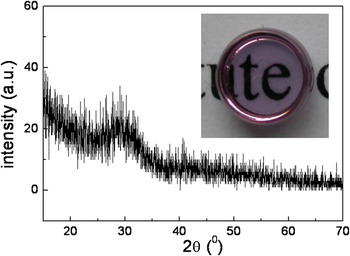
The Nd3+/Yb3+ co-doped LZT samples prepared by levitation method are spheres with diameter of about 3 mm. Figure 1 shows the typical XRD pattern of the LZT sample (for the sample of 1.2 mol% Nd3+ and 1 mol% ZrO2). The broad peak near 30° followed by other broad peaks of lesser intensities is characteristic for the amorphous structure. The inset in Fig. 1 is a photo of the polished sample. It is obvious that the Nd3+/Yb3+ co-doped LZT glass performs high transparency in the region of visible light.
Typical x-ray pattern for the Nd3+/Yb3+ co-doped La2O3–ZrO2–TiO2 (LZT) sample. Inset shows the photo of the LZT wafer with both sides well polished (1.2 mol% Nd3+ and 1 mol% ZrO2 sample).

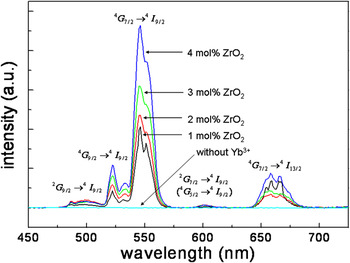
The upconversion emission spectra of Nd3+/Yb3+ co-doped LZT glasses have been recorded using 980 nm excitations. Figure 2 shows the upconversion spectra of RE-doped LZT glasses for different ZrO2 contents with a fixed Nd3+ concentration of 1.2 mol%.
Upconversion emission spectra of Nd3+/Yb3+ co-doped LZT glasses with varied ZrO2 content upon excitation at 980 nm, where the concentrations of Nd3+ is fixed of 1.2 mol%. The bottom curve shows the upconversion emission spectrum of Nd3+-doped LZT glass without Yb3+ ion.

All the spectra show similar features except for an increase in intensities of the upconversion bands. Three intense upconverted bands are observed centered at 521, 545, and 655 nm, respectively. By going over many emission spectra of Nd3+ ions, these upconversion bands are assigned to be 4G 9/2→4I 9/2, 4G 7/2→4I 9/2, and 4G 7/2→4I 13/2 transitions of Nd3+ ions, respectively.Reference Som and Karmakar8, Reference Mendioroz, Balda, Al-Saleh and Fernanders13, Reference Zhang, Heo, Zhao and Chung14
It is apparent that the green emission at 545 nm has the highest peak intensity irrespective of the ZrO2 concentrations. The red emission at 655 nm is much weaker than the green emission at 545 nm but is almost the same as the green emission at 521 nm. In addition to these three intense bands, two very weak emission bands also appear at 496 nm (green or blue) and 603 nm (orange) originated from the Nd3+: 2G 9/2→4I 9/2 and 4G 5/2 (or 2G 7/2)→4I 9/2 transitions, respectively.Reference Wei, Huang, Shi, Qiao and Seo15, Reference Wang, Guo, Wu and Zhang16
From Fig. 2, one can also clearly see that the intensities of the intense upconversion emissions increase with the increasing of ZrO2 concentration. This owes mainly to the lower phonon energy of ZrO2 (cutoff phonon energy of ∼470 cm−1)Reference Rosa, Torres, Salas and Rodriguez17 than that of TiO2. And thus the nonradiative loss by the multiphonon relaxation can be effectively reduced. However, too much ZrO2 added in may reduce the glass-forming ability. As a result, glass samples with amorphous structure are difficult to be obtained even by containerless processing method. In our present experiments, the maximum of ZrO2 concentration for glass sample is only 4 mol% or so. For the sample with ZrO2 concentration of ∼5 mol%, it is translucent. When ZrO2 concentration gets even larger, the as-prepared sample becomes opaque and thus no glass is obtained.
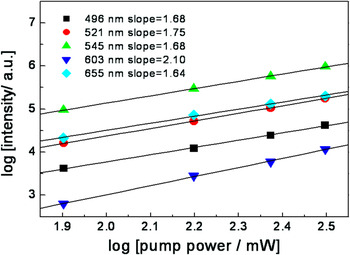
To get more insight into the upconversion mechanism, the dependence of the upconversion emission intensity I was studied as a function of the incident pump power P. The emission intensity I varies with the m th power of the pump power P according to the relation I ∝ Pm,Reference Pollnau, Gamelin, Luthi, Gudel and Hehlen18 where m is the number of pump photons absorbed per upconverted photon emitted. Figure 3 shows the typical lines of log I–log P plot for the RE-doped LZT glasses. The plot of log I versus log P yields a straight line with slope m. The values of the slope m for 496, 521,545, 603, and 655 nm upconverted emissions are 1.68, 1.75, 1.68, 2.10, and 1.64, respectively. This indicates that two photons are involved for all the upconversion processes.
Dependence of upconversion fluorescence intensities on excitation power at 980 nm excitation for Nd3+/Yb3+ co-doped LZT glass (1.2 mol% Nd3+ and 1 mol% ZrO2).

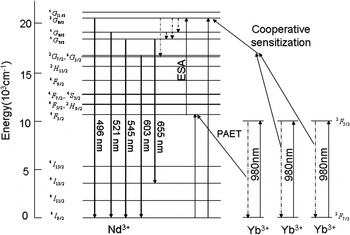
Disregarding the presence of avalanche upconversion, two possible mechanisms could be responsible for the observed luminescence: excited-state absorption (ESA) and energy transfer (ET). In general, Nd3+ ions cannot absorb the 980 nm photons directly due to the nonexistence of a matching energy level. However, Yb3+ ions adsorb this infrared radiation efficiently. So ET process plays an important role for the upconversion emissions in the Nd3+/Yb3+ co-doped LZT glasses. To demonstrate the role of Yb3+ in the upconversion emissions, the upconversion spectrum of Nd3+-doped LZT glass without Yb3+ is also illustrated in Fig. 2 by the bottom curve. It is clear that no significant upconversion bands are observed without Yb3+ ion as sensitization dopant. So, it can be concluded that ET process from Yb3+ to Nd3+ ions must be the predominant process responsible for the upconversion emissions in the Nd3+/Yb3+ co-doped LZT glasses. Based on the energy matching conditions and the quadratic dependence on excitation power, the following possible upconversion mechanisms are achieved and sketched in Fig. 4.
Energy level diagram of Nd3+ and Yb3+ in LZT glasses and possible mechanisms for upconverted emissions upon 980 nm excitation.

Initially, the first incident photon induces the Yb3+: 2F 7/2→2F 5/2 transition. Then, an ET process occurs from the 2F 5/2 level of Yb3+ to the 4F 3/2 level of Nd3+. Since there is an energy gap of approximately 1000 cm−1 between the Nd3+: 4F 3/2 and Yb3+: 2F 5/2 metastable excited states, ET between these trivalent neodymium and ytterbium ions, therefore performs by a phonon-assisted process. Such phonon-assisted ET (PAET) or migration from a lower level to an upper level has also been found in other matrix.Reference Singh, Kumar and Rai19–Reference Santos, Vermelho, Gouveia, De Araujo, Neto, Cassanjes, Ribeiro and Messaddeq21 Then, a second photon is adsorbed, involving the excitation of Nd3+ in 4F 3/2 level to 2G 9/2 level by means of ESA: 4F 3/2(Nd3+) + photon→2G 9/2(Nd3+). The level of 2G 9/2(Nd3+) can also be populated by ET from two excited Yb3+ ions through the cooperative sensitization. Cooperative excitation of RE ions has been reported in many cases in the presence of Yb3+ as a codopant.Reference Giri, Singh and Rai1, Reference Eiichiro and Shigeo22 During this process, a pair of excited Yb3+ ions in the 2F 5/2 level transfer their energy to one nearby Nd3+ ion, exciting Nd3+ to 2G 9/2 state from the ground state. This process can be described as: 2F 5/2(Yb3+) + 2F 5/2(Yb3+) + 4I 9/2(Nd3+)→2F 7/2(Yb3+) + 2F 7/2(Yb3+) + 2G 9/2(Nd3+). The radiative decay from 2G 9/2(Nd3+) level to the ground state then occurs producing the 2G 9/2→4I 9/2 emissions centered at 496 nm.
The populated 2G 9/2 level of Nd3+ can relax rapidly and nonradiatively to the next lower 4G 9/2 and 4G 7/2 levels due to the small energy gap between them. In fact, the rate of multiphonon relaxation from 2G 9/2 level is so high that every electron is expected to immediately relax to 4G 9/2 or 4G 7/2 level. This is the reason why the emission at 496 nm is very weak. The above processes then produce the 4G 9/2→4I 9/2, 4G 7/2→4I 9/2, and 4G 7/2→4I 13/2 emissions centered at 521, 545, and 655 nm, respectively. Nd3+ ions at the 4G 9/2 level can also decay to 4G 7/2 level by means of multiphonon relaxation process because of that the estimated energy gap between the 4G 9/2 level and the next lower 4G 7/2 level is only about 400 cm−1. It decreases the 521 nm emission intensity. Since the ground state 4I 9/2 is more stable than the exited state 4I 13/2, more Nd3+ ions would radiatively decay from 4G 7/2 level to 4I 9/2 level than those to 4I 13/2 level. As a result, the intensity of 545 nm emission is higher than that of 655 nm emission. As to the emission at 603 nm, its intensity is very weak mainly due to the possible fact that only a few Nd3+ ions can decay from 2G 9/2 to 4G 5/2 (or 2G 7/2) level because nonradiative multiphonon relaxation is less likely to occur from this level due to the large energy gap.
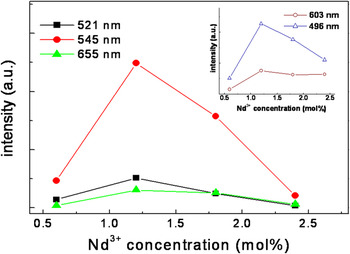
The effect of the Nd3+ ion on the upconversion emission intensity of LZT glass was also presented. Figure 5 shows the concentration dependence of upconversion emission intensity on Nd3+ concentration. It can be found that the doped Nd3+ ions enhance the emission intensity because ET process becomes efficient by concentration increasing of Nd3+ ions due to the shortened distance between RE ions.Reference Tirtha and Basudeb23 The highest intensities are found to be at the concentration of 1.2 mol% Nd3+ ions. Beyond this concentration, intensities of the bands are seen to decrease due to the increase in nonradiative processes, indicating the occurrence of concentration quenching.
Upconversion emission intensity as a function of Nd3+ ion concentration in Nd3+/Yb3+ co-doped LZT glasses, where ZrO2 content is fixed of 1 mol%.

IV. CONCLUSIONS
Nd3+-doped LZT glasses were successfully fabricated by containerless method with incorporated Yb3+ ions as sensitizers for the first time. Upon 980 nm excitation, three intense emissions centered at 521, 545, and 655 nm and two weak emissions at 496 and 603 nm were observed in these titanate glasses. The highest intensity of luminescence was found for glasses with 1.2 mol% Nd3+. The intensities of upconversion luminescence are enhanced by increasing concentration of ZrO2.
ACKNOWLEDGMENT
This work was performed under the project supported by the fund of the National Natural Science Foundation of China (Grant Nos. 51072209 and 50802105), project supported by the Shanghai Committee of Science and Technology, China (Grant No. O9JC1415300), and project supported by Innovation Fund of Shanghai Institute of Ceramics, CAS (Grant No. Y17ZC11601G).