





Introduction
Urinary tract infection (UTI) is a common diagnosis, seen in both inpatient and ambulatory settings, and can be associated with high morbidity and mortality.Reference Foxman1 Despite being common, proper diagnosis of UTI remains challenging as it is multifactorial, involving a combination of the host’s conditions, signs and symptoms of infection referable to the urinary tract, urinalysis findings, and urine culture results. Urine cultures by themselves are non-specific and cultures obtained without clinical indications are common among medical and surgical inpatients, including at Department of Veterans Affairs (VA) hospitals.Reference Drekonja, Gnadt, Kuskowski and Johnson2–Reference Leis, Gold, Daneman, Shojania and McGeer4 Oftentimes, patients with positive urine cultures but no urinary tract symptoms known as asymptomatic bacteriuria, receive unnecessary antibiotic treatment which in turn may lead to antibiotic related complication. Reference Nicolle, Gupta and Bradley5–Reference Colgan, Jaffe and Nicolle7
Multiple antibiotic stewardship and healthcare epidemiology programs around the US have implemented protocols to reduce unnecessary treatment of asymptomatic bacteriuria. Reference Luu and Albarillo8 Furthermore, several studies have showed that incorporating clinical decision support systems into electronic medical record (EMR) systems are one successful method of improving urine culture diagnostic and therapeutic stewardship in hospitalized patients.Reference Hecker, Fox and Son9–Reference Kalorin, Dixon and Fike12 In their 2020 study, Watson et al observed the effects of an order set in the EMR of 5 hospitals in Texas which required choosing an indication for urine culture. They found that appropriate urine culture orders increased from 42% to 57% (P = .03), and the number of urine cultures performed among the 5 sites decreased from 1,175.8 tests per 10,000 patient days to 701.4 tests per 10,000 patient days following the implementation of the new order set (a 40.4% reduction).Reference Watson, Trautner and Russo10 In another recently published study by Torres et al, the implementation of a UTI order set, which required symptom documentation and identification of special populations demonstrated a reduction in both the number of urine cultures performed and catheter associated UTI.Reference Torres, Lyden, Gillett, Rupp and Van Schooneveld13
Similarly, at the VA Connecticut Healthcare System (VACTHS) there had been recognition of inappropriate ordering of urine culture among hospitalized patients. A preliminary evaluation indicated that for 77% of urine cultures obtained between 01/01/2023 and 10/31/2024 the patients did not meet criteria for UTI. This study aimed to assess the effect of implementing a mandatory, permanent documentation tool, referred to as the urine culture order note (UCON), on urine culture ordering practices at our institution, with a focus on both the appropriateness and frequency of orders.
Methods
Study design
This is a retrospective, observational, single-center, before-and-after quasi-experimental quality improvement project conducted at the 182-bed VACTHS West Haven campus between 01/01/2023 and 10/31/2024. Inclusion criteria consisted of hospitalized patients aged ≥18 years who had urine cultures performed during the study period. Exclusion criteria included patients aged <18 years and non-hospitalized patients with urine cultures. The project was reviewed by the VACTHS Research Office and was deemed not research.
Intervention
Study intervention was the introduction of a mandatory urine culture order note linked to urine culture orders. Practitioners were required to indicate a reason for ordering urine cultures from a drop-down menu of appropriate patient signs and symptoms of UTI, before a urine culture order would be generated. In brief, providers choose a corresponding patient population (ie, non-catheterized, catheterized, pregnant, nephrostomy tube, spinal cord injury, or scheduled urologic procedure). Once a patient population is selected, the provider is guided to provide the signs and symptoms of UTI and can add information in a free text comment section (Supplementary Material 1–3). After the note is completed, a pended urine culture order is automatically generated. The note was first introduced on 7/28/2023 for hospitalized patients and became mandatory on 5/23/2024 when ordering a urine culture in the Computerized Patient Record System, the VA’s EMR system. Educational activities were implemented between 11/15/2023 and 2/28/2024 by co-authors (DN and AC) to introduce the UCON to clinicians (licensed independent practitioners and trainees) including internal medicine, general surgery, urology, primary care and emergency medicine, prior to mandatory launch date on 5/23/2024.
Data collection and outcomes
A list of urine cultures obtained from inpatients was generated from the Microbiology Laboratory. Patient data was collected from EMR chart review by infectious diseases (ID) fellows (D.N and T.L). Patients were included in the study if they had a urine culture obtained during their hospital stay from 1/1/2023 to 10/31/2024. Baseline characteristics included age, sex, presence of existing urinary catheters (ie, indwelling urinary bladder (Foley) catheters, suprapubic catheters, nephrostomy tubes), history of spinal cord injury, urinary symptoms and duration. We defined a patient as having an existing catheter if the catheter had been in place for at least 48 hours before or at the time of urine culture collection. Laboratory data included serum white blood cell count and urinary white blood cell per high power field (wbc/hpf) on day of urine culture collection.
Study outcomes were number of urine cultures per 100 admission and their appropriateness. Urine culture appropriateness was evaluated from chart review based on Infectious Diseases Society of America (IDSA) guidelines for the diagnosis of UTI. In brief, non-catheterized patients with suspicion for UTI had to have ≥2 qualifying urinary symptoms (QUS) that include dysuria, gross hematuria, new urinary frequency and/or urgency, suprapubic pain, flank pain and fever > 100.4°F (Supplementary material 4). Individuals who were catheterized had specific requirements for ordering urine cultures which are described in Supplementary Material 5. To be considered appropriate, indications in the UCON had to match the documented indication in the patient admission or progress note in the chart. For instance, if fever was checked in the UCON, the patient’s documented vital signs within the 48 hours before the UCON had to reflect a temperature of greater than 100.4°F, or if suprapubic tenderness was checked, the patient’s progress note physical examination had to document the same finding.
To ensure robust quality control, a senior ID physician (LMD) assessed complex cases that required additional adjudication. The same senior physician randomly selected an additional 10% of all cases to review and independently assess for appropriateness. Each dichotomous case was discussed among the ID fellows and the senior physician to reach agreement on whether a urine culture order was appropriate or not.
Statistical analysis
Data were analyzed using descriptive statistics including mean, standard deviation, median, interquartile range, and percentages. Continuous variables were compared using the independent t-test. Categorical variables were compared using χ2 and Fisher’s exact tests. To assess change in appropriateness and number of urine cultures before and after the mandated use of the UCON, interrupted time series analyses were performed using generalized linear model. A P-value < .05 was considered statistically significant. Data was analyzed using SAS 9.4 (Cary, NC).
Results
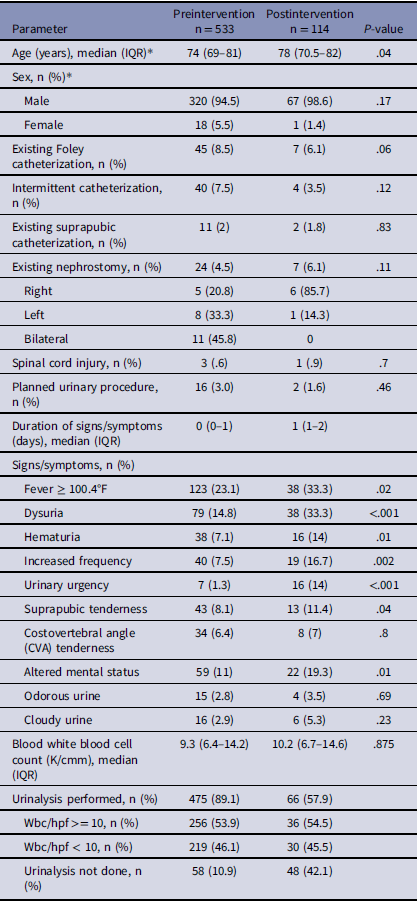
We reviewed 533 urine cultures during the preintervention period, and 114 urine cultures during the postintervention period. Patient demographics including age and sex, baseline characteristics including existing catheterization and spinal cord injury, and laboratory values are summarized in Table 1.
Patient demographics, baseline characteristics, and laboratory values by intervention cohort

Table 1. Long description
A table comparing patient demographics, baseline characteristics, and laboratory values by intervention cohort. The table has 25 rows and 5 columns. Column headers are Parameter, Preintervention n=533, Postintervention n=114, and P-value. Row 1: Age (years), median (IQR), 74 (69-81), 78 (70.5-82), .04. Row 2: Sex, n (%), Male, 320 (94.5), 67 (98.6), .17. Row 3: Sex, n (%), Female, 18 (5.5), 1 (1.4), .17. Row 4: Existing Foley catheterization, n (%), 45 (8.5), 7 (6.1), .06. Row 5: Intermittent catheterization, n (%), 40 (7.5), 4 (3.5), .12. Row 6: Existing suprapubic catheterization, n (%), 11 (2), 2 (1.8), .83. Row 7: Existing nephrostomy, n (%), 24 (4.5), 7 (6.1), .11. Row 8: Existing nephrostomy, Right, 5 (20.8), 6 (85.7). Row 9: Existing nephrostomy, Left, 8 (33.3), 1 (14.3). Row 10: Existing nephrostomy, Bilateral, 11 (45.8), 0. Row 11: Spinal cord injury, n (%), 3 (.6), 1 (.9), .7. Row 12: Planned urinary procedure, n (%), 16 (3.0), 2 (1.6), .46. Row 13: Duration of signs/symptoms (days), median (IQR), 0 (0-1), 1 (1-2). Row 14: Signs/symptoms, n (%), Fever >= 100.4°F, 123 (23.1), 38 (33.3), .02. Row 15: Signs/symptoms, n (%), Dysuria, 79 (14.8), 38 (33.3), <.001. Row 16: Signs/symptoms, n (%), Hematuria, 38 (7.1), 16 (14), .01. Row 17: Signs/symptoms, n (%), Increased frequency, 40 (7.5), 19 (16.7), .002. Row 18: Signs/symptoms, n (%), Urinary urgency, 7 (1.3), 16 (14), <.001. Row 19: Signs/symptoms, n (%), Suprapubic tenderness, 43 (8.1), 13 (11.4), .04. Row 20: Signs/symptoms, n (%), Costovertebral angle (CVA) tenderness, 34 (6.4), 8 (7), .8. Row 21: Signs/symptoms, n (%), Altered mental status, 59 (11), 22 (19.3), .01. Row 22: Signs/symptoms, n (%), Odorous urine, 15 (2.8), 4 (3.5), .69. Row 23: Signs/symptoms, n (%), Cloudy urine, 16 (2.9), 6 (5.3), .23. Row 24: Blood white blood cell count (K/cmm), median (IQR), 9.3 (6.4-14.2), 10.2 (6.7-14.6), .875. Row 25: Urinalysis performed, n (%), 475 (89.1), 66 (57.9). Row 26: Wbc/hpf >= 10, n (%), 256 (53.9), 36 (54.5). Row 27: Wbc/hpf < 10, n (%), 219 (46.1), 30 (45.5). Row 28: Urinalysis not done, n (%), 58 (10.9), 48 (42.1).
Blood white blood cell count reference range 4.5–11.0 K/cmm. Wbc/hpf: white blood cells per high power field.
* Age and sex are among unique patients, as opposed to all cultures.
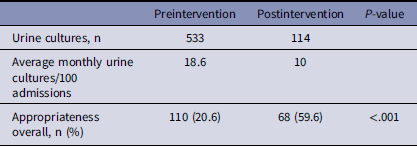
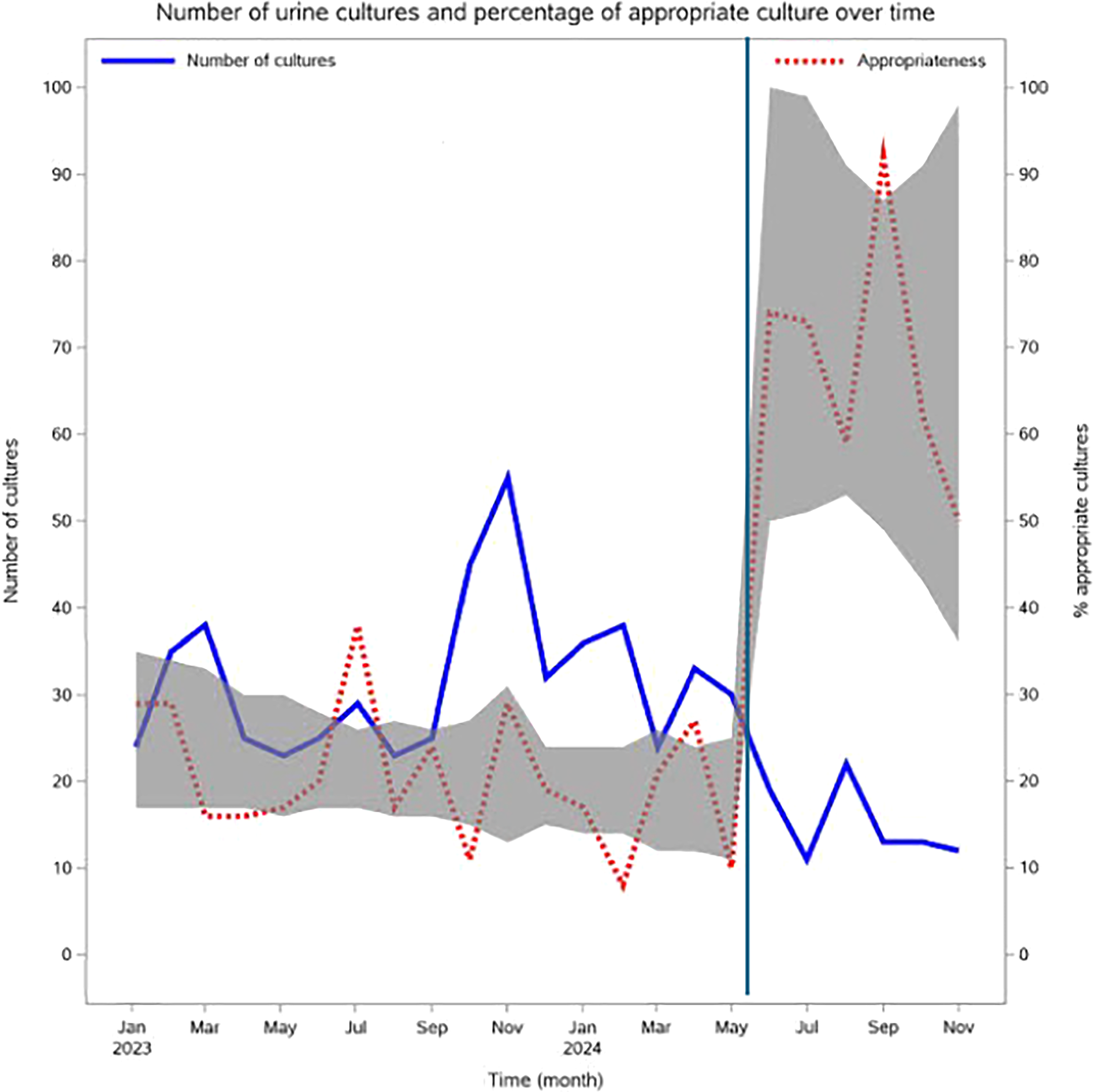
Pertinent symptoms that were present at a higher rate in the postintervention cohort included fever > 100.4°F (33.3% vs 23.1%, P = .02), dysuria (33.3% vs 79%, P < .001), hematuria (14% vs 7.1%, P = .01), increased urinary frequency (16.7% vs 7.5%, P < .001), and suprapubic tenderness (11.4% vs 8.1%, P = .04). There was no statistical difference with regards to costovertebral angle (CVA) tenderness. Odorous and cloudy urine were recorded at numerically higher rates in the postintervention cohort, but the difference was not statistically significant. Altered mental status was documented in 11% and 19.3% in the preintervention and postintervention cohort respectively (P = .23) (Table 2). We observed a higher proportion of urine culture appropriateness in the postintervention period (59.6%) compared to the preintervention period (20.6%) (P < .001) (Figure 1). Study outcomes are summarized in Table 2, Figure 1.
Study outcomes

Table 2. Long description
A table comparing urine culture data pre and post intervention. The table has three rows and four columns. The columns are labeled Preintervention, Postintervention, and P-value. The rows are labeled Urine cultures, n, Average monthly urine cultures/100 admissions, and Appropriateness overall, n (%). Row 1: Preintervention, 533; Postintervention, 114. Row 2: Preintervention, 18.6; Postintervention, 10. Row 3: Preintervention, 110 (20.6 percent); Postintervention, 68 (59.6 percent). The P-value for the third row is less than .001.
Number of urine cultures and percentage of appropriate cultures over time. Number of urine cultures (blue line) and percentage of appropriate urine culture orders (red dotted line) over the project period January 2023 to October 2024. Gray area: 95% confidence interval of appropriateness percentage, calculated using generalized linear model. The vertical line indicated the start of mandatory urine culture order note.

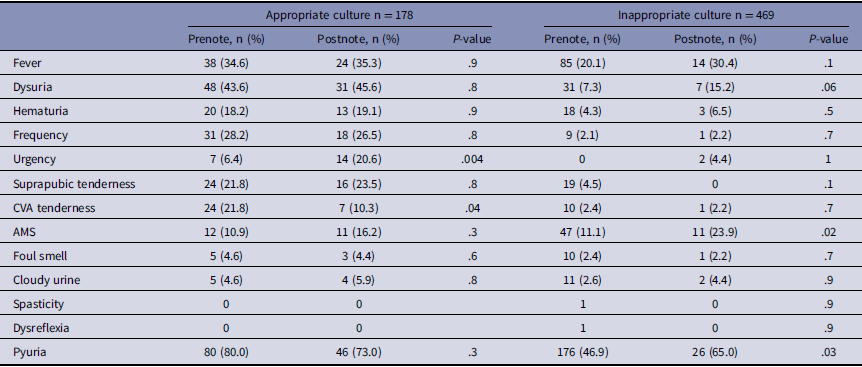
Further stratification of overall symptoms, especially QUS, was performed within the appropriate and inappropriate urine culture groups (Table 3). Among the appropriate culture group, 115 patients (64.6%) had two or more QUS. Seventeen of 21 patients who did not have adequately documented QUS were undergoing urological procedures. In contrast, all of patients in inappropriate culture group had less than 2 QUS.
Signs/symptoms among appropriate and inappropriate urine culture groups

Table 3. Long description
A table comparing signs and symptoms between appropriate and inappropriate urine culture groups. The table has 12 rows and 10 columns. Column headers are: Appropriate culture n = 178, Inappropriate culture n = 469, Prenote n (%), Postnote n (%), P-value, Prenote n (%), Postnote n (%), P-value. Row labels are: Fever, Dysuria, Hematuria, Frequency, Urgency, Suprapubic tenderness, CVA tenderness, AMS, Foul smell, Cloudy urine, Spasticity, Dysreflexia, Pyuria. Row 1: Fever, 38 (34.6), 24 (35.3), 0.9, 85 (20.1), 14 (30.4), 0.1. Row 2: Dysuria, 48 (43.6), 31 (45.6), 0.8, 31 (7.3), 7 (15.2), 0.06. Row 3: Hematuria, 20 (18.2), 13 (19.1), 0.9, 18 (4.3), 3 (6.5), 0.5. Row 4: Frequency, 31 (28.2), 18 (26.5), 0.8, 9 (2.1), 1 (2.2), 0.7. Row 5: Urgency, 7 (6.4), 14 (20.6), 0.004, 0, 2 (4.4), 0.1. Row 6: Suprapubic tenderness, 24 (21.8), 16 (23.5), 0.8, 19 (4.5), 0, 0.1. Row 7: CVA tenderness, 24 (21.8), 7 (10.3), 0.04, 10 (2.4), 1 (2.2), 0.7. Row 8: AMS, 12 (10.9), 11 (16.2), 0.3, 47 (11.1), 11 (23.9), 0.02. Row 9: Foul smell, 5 (4.6), 3 (4.4), 0.6, 10 (2.4), 1 (2.2), 0.7. Row 10: Cloudy urine, 5 (4.6), 4 (5.9), 0.8, 11 (2.6), 2 (4.4), 0.9. Row 11: Spasticity, 0, 0, 0.9, 1, 0, 0.9. Row 12: Dysreflexia, 0, 0, 0.9, 1, 0, 0.9. Row 13: Pyuria, 80 (80.0), 46 (73.0), 0.3, 176 (46.9), 26 (65.0), 0.03.
Qualifying urinary signs/symptoms (QUS) include fever, dysuria, hematuria, frequency, urgency, suprapubic tenderness and costovertebral angle (CVA) tenderness. AMS, altered mental status.
We evaluated appropriateness of urine culture by chart review done by ID specialists. Among the appropriate group, of the 21 subjects who did not have documented QUS, 16 were undergoing elective urological procedures. Overall, for those who had less than 2 documented QUS, reasons for corresponding appropriateness included having had Foley catheters, nephrostomy tubes, complicated medical and urinary histories where ID consultants deemed that urine cultures were a necessary part of the infectious work-up. In the inappropriate group, we noted that almost all cases (except 2 cases where repeat urine cultures were obtained to monitor UTI clearance) had less than 2 QUS.
Discussion
In this study, we assessed if implementing a UCON would impact urine culture ordering practice at our institution. One outcome was to assess urine culture appropriateness following the intervention. Overall, urine culture appropriateness improved significantly from 20% to 59.6% when the UCON was mandatory. The average monthly urine culture rate per 100 admissions fell from 18.6 before the intervention to 10 afterward, a significant decrease of 46.3%.
The number of CAUTIs at VACTHS decreased from 17 during the preintervention period to 1 during the intervention period. Notably, education and voluntary use of UCON on their own did not influence the outcome. This was demonstrated during the “buffering period” from 7/18/2023 to 5/22/2024, when UCON was available but not required, and was used only twice. The findings indicate that UCON, when paired solely with education, produced no measurable effect; it was the implementation of a mandatory requirement that yielded a significant impact.
The strength of our study was to have ID specialists’ assessment of urine culture appropriateness by applying criterion for urine cultures based on IDSA guidelines highlighted in Supplementary Material 4–5.Reference Nicolle, Gupta and Bradley5 QUS included dysuria, gross hematuria, new urinary frequency and/or urgency, suprapubic pain, flank pain and fever > 100.4°F. We did not include odorous or cloudy urine as QUS of UTI.Reference Jump, Crnich and Nace14 Similarly, altered mental status or confusion was also excluded as a QUS of UTI due to insufficient evidence of its association with UTI without first having evaluated for other causes of altered mental status.Reference Mayne, Bowden, Sundvall and Gunnarsson15 It is important to note that we did not stratify hosts’ immunological statuses (immunocompetent vs immunocompromised) since they are not an influential variable as to when a urine culture is appropriate.Reference Nicolle, Gupta and Bradley5,Reference Luu and Albarillo8 Another strength of our project was the added validation by co-author and senior ID physician (LMD) who reviewed challenging cases and other cases at random. LMD conducted an independent review of 101 cases, reaching agreement in 77%. The remaining cases required further discussion to achieve resolution.
A distinctive aspect of this intervention is its note-based format. Since UCON becomes a permanent, visible part of the medical record, practitioners are more likely to document it accurately. In contrast, in many widely studied clinical decision support system interventions, healthcare providers may feel less compelled to be fully accurate, believing their responses are unlikely to be reviewed.
There were several challenges utilizing UCON. During our chart review, it was not uncommon to find UCON indications that did not correspond with patients’ clinical symptoms as documented in a medical record note. For instance, UCON might indicate dysuria while the progress note records no symptoms or even states “patient denies urinary symptoms.” Similarly, fever may be selected despite the patient’s recorded temperature not supporting this finding. We were unable to verify whether the UCON was utilized to record symptoms instead of documenting them in the patient progress note or if symptoms were randomly chosen in the UCON to bypass it to get to the urine culture order. In addition, the “other indication” option can be used to circumvent the order note and get to the urine culture order. Some of the free texted indications worth mentioning were “septic shock,” “intensive care unit evaluation,” “per attending’s request,” “per patient’s request.” We also observed that there are methods to completely avoid the UCON, such as ordering urine cultures under the heading of “body fluid cultures.” It is important to note that UCON is not a restriction, and providers can order urine cultures if clinically indicated using the “other indication” text box. A major persistent challenge is prevailing institutional practices regarding urine culture ordering. Indeed, the practice of ordering urinalysis, urine cultures and treating positive urine cultures, even in the setting of low suspicion for infection is a long-standing practice which we do not expect to change quickly.Reference Leis, Rebick and Daneman16 Future study should focus on better understanding providers’ urine ordering perspectives and incorporating their feedback on the UCON to gain buy in and trust in this practice change.
It merits pointing out that during the study period at our institution, there was no reflex-to-microscopic criteria which often include positive leukocyte esterase, and most commonly pyuria defined as either having more than 5 or 10 wbc/hpf.Reference Ourani, Honda, MacDonald and Roberts17 This laboratory stewardship intervention has demonstrated a significant reduction in the number of urine cultures performed and a decrease in the rate of bacteriuria by reinforcing the criteria that reflex to a urine culture only when the urinalysis shows either >5 or >10 wbc/hpf.Reference Luu and Albarillo8,Reference Sarg, Waldrop and Beier18 Perhaps future studies might consider using this technique in conjunction with UCON to assess their impact on appropriateness of urine cultures.
Our study has several limitations. We did not assess for adverse outcomes with use of the UCON (for example, sepsis secondary to UTI, mortality secondary to urosepsis, UTI treatment delay, hospital length of stay, hospital readmission rate). In addition, reviewers may have misinterpreted patients’ QUS, especially when documentation was incomplete, which could have affected the determination of urine culture appropriateness during the chart review process. This project was also conducted at a single VA medical center where most of our patients are males, therefore, gender generalization and external validation is limited. Finally, we limited our review to 6 months postintervention, so sustainability of the intervention in maintaining increased urine culture appropriateness is not known.
Our study suggests that a mandatory urine culture order note can increase the appropriateness of urine culture practices and reduce the number of urine cultures performed. Future studies should concentrate on extending urine culture stewardship education programs and implementing UCONs outside of inpatient settings, such as ambulatory clinics and emergency departments.
Supplementary material
The supplementary material for this article can be found at https://doi.org/10.1017/ice.2026.10533.
Acknowledgements
We want to acknowledge Beth Warne, a Yale School of Public Health Class of 2024 Master of Public Health (MPH) student, who briefly worked on this project in its early stages analyzing preliminary data as part of her MPH thesis project.
Author contribution
T.L.—contributed to data collection, statistical analysis, literature review, writing of the manuscript and processing of suggestions by co-authors in the subsequent drafts. D.N.—contributed to launching UCON, delivering education, data collection, statistical analysis, literature review, and edits of manuscript. L.M.D.—contributed to data collection, data quality control, edits of manuscript. A.C.—contributed to delivering education, edits of manuscript. A.P.—contributed to launching UCON, delivering education, edits of manuscript. and A.F.—contributed to launching UCON, edits of manuscript.
Financial support
None reported.
Competing interests
All authors report no conflicts of interest relevant to this article.


 Open access

