

Introduction
Common wheat is an allopolyploid species comprised of three subgenomes: A, B and D. It is widely recognized that modern hexaploid wheat originated from the hybridization of tetraploid wheat (Triticum turgidum, AABB) and its diploid progenitor, Aegilops tauschii (DD). Tetraploid wheat was derived from the hybridization of two diploid progenitors, Triticum urartu (AA) and an unconfirmed species (BB genome) related to Aegilops speltoides (SS). The origination of the B genome of hexaploid wheat remains controversial. It is therefore important to develop molecular markers specific to A, B and D genomes to understand the origin and evolution of common wheat.
Since the establishment of the restriction fragment length polymorphism (RFLP) technique, many strategies for the production of molecular markers have been developed and play a vital role in wheat breeding. Of these, polymerase chain reaction (PCR)-based molecular marker techniques have been applied widely because of their higher polymorphism, lower cost and ease of application. Molecular marker techniques using randomly amplified polymorphic DNA, sequence characterized amplified region and microsatellite DNA are widely used to develop genome- or chromosome-specific markers of various species. However, genome-specific markers are the more advanced detecting tools when compared to single chromosomal markers in application to wheat breeding. To date, genome-specific markers have been established for Daspyrum (Liu et al., Reference Liu, Yang, Feng, Zhou, Chi and Ren2006), Aegilops tauschii (Rayburn and Gill, Reference Rayburn and Gill1986), Secale (Liu et al., Reference Liu, Yang and Li2008) and Pseudoroegneria (Liu et al., Reference Liu, Yang, Liu, Li and Ren2007). Using repetitive sequences as molecular markers (Dennis et al., Reference Dennis, Gerlach and Peacock1980; Liu et al., Reference Liu, Atkinson, Chinoy, Devos and Gale1992) were largely taken into account. Wheat genomes consist of over 75% repetitive sequences (Flavell and Smith, Reference Flavell and Smith1976), in which the transposable elements, including retrotransposons, transposons and miniature inverted transposable elements, are observed. In this study, we isolated a specific repetitive DNA sequence from the A and B genomes of common wheat by simple sequence repeat (SSR) analysis. NCBI BLAST revealed that this sequence had a high similarity to part of Gypsy Ty3-LTR retrotransposon Fatima. Based on the conserved region of this sequence, we performed PCR analysis on a set of triticeae species using a pair of newly designed primers. Based on the results of PCR amplification and sequence comparison, we speculated on the possible evolutionary features of this Fatima sequence among genomes, and developed PCR-based molecular markers for detecting the A and AB genomes.
Materials and methods
Materials
Triticum monococcum, T. monococcum ssp. aegilopoides (AmAm), T. urartu (AuAu), T. dicoccoides (AABB), T. carthlicum (AABB), T. turgidum (AABB), Aegilops speltoides (SS), Ae. longissima (SlSl), Ae. sharonensis (SshSsh), Ae. bicornis (SbSb), Ae. searssi (SsSs), Ae. tauschii (DD), Ae. ventricosa (SsSs),Ae. ventricosa (DDMM), Crithopsis delileana (KK), Australopyrum retrofractum (WW), Agropyron cristatum (PP), Hordeum vulgare (HH), Pseudoroegneria spicata (StSt), Thinopyrum intermedium (JJJsJsStSt), Thinopyrum elongatum (EE) and Dasypyrum breviaristatum (VbVb) were obtained from the National Plant Germplasm System, USDA-ARS (Aberdeen, Idaho, USA). Secale africanum (RaRa) was obtained from Prof. Gustafson (Missouri Garden, USA). Chinese Spring Langdon substitution lines were provided by Dr. Joppa (North Dakota State University, USA). Chinese Spring, S. cereale cv. Jingzhou (RR) and D. villosum (VV) were provided by the Key Lab of Plant Breeding and Genetics, Sichuan Agricultural University, China. Professor Xianzhi Zhang (Sichuan Agricultural University, China) produced the Triticale line Fenzhi-1. T. teres (AADD), T. aestivum cv. Anyuepaideng–S. africanum amphiploid (AABBDDRR) and Ae. tauschii–S. silvestre amphiploid (DDRR) were developed by Prof. Huaren Jiang (Sichuan Agricultural University, China).
Methods
DNA isolation
Total genomic DNA was prepared from young leaves after reaching the seedling stage following the method of Yang et al. (Reference Yang, Li, Feng, Jiang and Ren2005).
SSR analysis and specific PCR primer design
Using Triticale Fenzhi-1 and Triticum species, and Secale as a control, a set of 102 SSR primer pairs (Roder et al., Reference Roder, Korzun and Wendehake1998) was tested. SSR primers were synthesized by Biocolor Company (Shanghai, China). According to the conserved sequence region of FZ387, a pair of primers FaF and FaR was designed:
FaF: 5′-CACGTCTTGTTAAAGCAGAGA-3′;
FaR: 5′-GGAGGAGACCATCCACTTG-3′.
The total reaction volume of PCR was 25 μl, containing 10 mmol Tris-HCl (pH 8.3), 2.5 mmol MgCl2, 200 μmol of each dNTP, 400 nmol primer, 50 ng of template DNA and 0.5 U Taq polymerase (TaKara, Japan). SSR amplification was performed in a MyCycle™ Thermal Cycler (Bio-RAD, USA). The cycling parameters were as follows: 94°C for 3 min (denaturation); 40 cycles at 94°C for 1 min, 54°C for 1 min, 72°C for 1 min; and a final extension at 72°C for 10 min.
Cloning, sequencing and analysis of the specific PCR product
The PCR products were excised from a 1.0% agarose gel and purified using a gel extraction kit (Biocolor, Shanghai, China). The purified products were ligated into the pMD18-T Vector (TaKaRa, Japan), and then introduced into Escherichia coli JM109 by heat shock transformation. Nucleotide sequencing was performed on a polyacrylamide gel with the ABI prism 377 sequencer (PerkinElmer) as an automated fluorescent sequencing system. The BLASTn program in the GenBank database was used to search for sequence similarities.
Results
Sequence cloning, sequencing and analysis
From a total of 102 pairs of SSR primers tested, the primer Xgwm614 was selected. Amplified by Xgwm614, a specific band of about 400 bp of Triticale Fenzhi-1 genomes was produced; no equivalent band was found using DNA of Secale and other genotypes as a template. The Triticale Fenzhi-1-specific PCR band was cloned and sequenced. Its full length was 387 bp, and it was named FZ387 (GenBank accession no. EF179137). The BLASTn search showed that the 13–379 bp section of FZ387 had a 94% similarity to the 1792–2158 bp section of the Gypsy-Ty3 LTR-retrotransposon Fatima sequence from T. monococcum (AY485644). Moreover, the 16–379 bp section of FZ387 showed 95% similarity to the Fatima sequence of T. turgidum (AY494981). Based on the results of BLASTn and BLASTx searches we initially assumed that FZ387 might be a part of the non-LTR retrotransposon Fatima-like sequence.
Identification of PCR-based marker
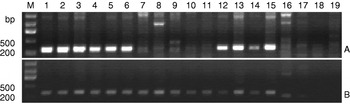
The pair of primers FaF and FaR combined with the pair of SSR primers Xgm614F (5′-GATCACATGCATGCGTCATG-3′) and Xgwm614R (5′-TTTTACCGTTCCGGCCTT-3′) were applied to test the validity of the molecular marker (Fig. 1). By using primers Xgwm614F and FaR, PCR amplification was performed in Triticum, Aegilops section Sitopsis and Secale species. The amplification results indicated that a specific band of about 350 bp (designated as A350) existed in species containing the A and AB genomes, but no amplification existed in Aegilops section Sitopsis, Secale and Ae. tauschii–S. silvestre amphiploid (Fig. 2A). We presumed that A350 might be a specific marker for the A genome. The same amplification was performed with modification of primers FaF and Xgwm614R. The result suggested that a specific band ~350 bp in length (designated as AB350) was amplified in species containing the A genome, S genome and AB genomes, respectively, except in Ae. tauschii and Secale (Fig. 2B). Therefore, AB350 might be a molecular marker for both the A and S genomes.
Schematic of specific primers designed from the sequence.

Amplification results using primers Xgwm614F and FaR (A) and FaF and Xgwm614R (B). Lanes: M, Marker II; 1, T. monococcum; 2, T. aegilopoides; 3, T. urartu; 4, T. dicoccoides; 5, T. carthlicum; 6, T. turgidum; 7, Ae. speltoides; 8, Ae. longissima; 9, Ae. sharonensis; 10, Ae. bicornis; 11, Ae. searssi; 12, CS T. aestivum; 13, Triticale Fenzhi-1 with branched-like; 14, T. aestivum cv. Anyuepaideng–S. africanum amphiploid; 15, T. monococcum–Ae. tauschii amphiploid; 16, Ae. tauschii; 17, Aegilops tauschii–S. silvestre amphiploid; 18, S. cereale cv Jinzhou; 19, S. africanum.

Mapping of the A genome-specific DNA band
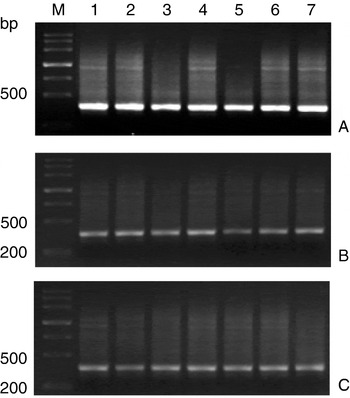
We used primer pair Xgwm614F and FaR to amplify Chinese Spring Langdon disomic and telosomic substitution lines for locating A350. The results of the amplification showed that the specific band of 350 bp appeared in both disomic and telosomic substitution lines (Fig. 3A–C), suggesting that A350 existed on both short and long arms of all A chromosomes.
Amplification results of CS Langdon substitution lines by primer Xgwm614F and FaR. (A) Lanes: M, marker II; 1, CS1D(1AL); 2, CS2D(2AL); 3, CS3D(3AL); 4, CS4D(4AL); 5, CS5D(5AL); 6, CS6D(6AL); 7, CS7D(7AL). (B) Lanes: M, marker II; 1, CS1D(1AS); 2, CS2D(2AS); 3, CS3D(3AS); 4, CS4D(4AS); 5, CS5D(5AS); 6, CS6D(6AS); 7, CS7D(7AS). (C) Lanes: M, marker II; 1, T. monococcum; 2, CS1D(1A); 3, CS2D(2A); 4, CS3D(3A); 5, CS5D(5A); 6, CS6D(6A); 7, CS7D(7A).

Verification of specific markers in relatives
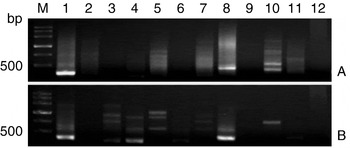
Both A350 and AB350 appear useful for targeting A and AB genomes and A, S and AB genomes, respectively. In order to show whether they are A-, S- and AB-specific or not, several relatives including Ps. spicata, Th. intermedium, Th. elongatum, S. africanum, D. villosum, D. breviaristatum, Ae. ventricosa, C. delileana, Au. retrofractum, Ag. cristatum and H. vulgare were scanned using PCR with the two pairs of primers Xgwm614F and FaR, and FaF and Xgwm614R. Both results showed that the 350-bp band was detected only in Chinese Spring (CS) and Ae. ventricosa, but no amplification existed in other species (Fig. 4A,B). It is suggested that the target band appeared in ABD genomes and DM genomes; however, there was no relevant band in the E, St, R, V, K, W, P and H genomes. Meanwhile, the amplification results for the D genome showed no target band, indicating that the 350-bp band appearing in DM genomes as a result of amplification of the M genome. From these results, it is therefore demonstrated that the two PCR-based molecular markers allow AB chromatin to be traced.
Amplification results of triticeae species using primers Xgwm614F and FaR (A) and FaF and Xgwm614R (B). Lanes: M, marker I; 1, CS T. aestivum; 2, Ps. spicata; 3, Th. intermedium; 4, Th. elongatum; 5, S. africanum; 6, D. villosum; 7, Dasypyrum breviaristatum; 8, Ae. ventricosa; 9, C. delileana; 10, Au. retrofractum; 11, A. cristatum; 12, H. vulgare.

Sequence analysis
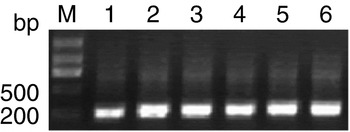
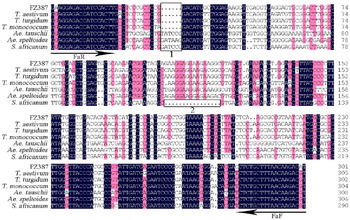
Using primers FaF and FaR to amplify T. aestivum, T. turgidum, T. monococcum, Ae. tauschii, Ae. speltoides and S. africanum, bands of ~300 bp were obtained and sequenced for the six species (Fig. 5, their specific lengths being 306 bp, 303 bp, 305 bp, 309 bp, 307 bp and 291 bp, respectively (GenBank accession nos. EU730688, EU730689, EU730690, EU730691, EU730692 and EU730693). Sequence comparison was performed within the six sequences and FZ387 using DNAMAN (Lynnon Biosoft, Vaudreuil, Quebec, Canada) (Fig. 6). The result showed homology as high as 81.38% among the seven sequences; the three sequences from Ae. tauschii, Ae. speltoides and S. africanum were 6 bp longer than FZ387 and the other three sequences from T. aestivum, T. turgidum, T. monococcum (Fig. 6, box 1); a 16-bp deletion existed in the sequence from S. africanum compared with the other six sequences (Fig. 6, box 2); the three sequences from genus Aegilops, Ae. tauschii, Ae. speltoides and genus Secale, S. africanum, had significant differences compared to the other four sequences belonging to genus Triticum. The sequence alignment showed that FZ387 had similarities with five groups of sequences, including the three sequences from T. aestivum, T. turgidum, T. monococcum, the two sequences from Ae. tauschii and Ae. speltoides, the sequence from Ae. speltoides, the sequence from Ae. tauschii, and the sequence from S. africanum, being 91.78%, 84.00%, 75.65%, 70.00% and 75.48%, respectively. Depending upon the above sequence analysis and the amplification results shown in Fig. 2, we postulated that significant diversity might exist in the internal sequence of this Fatima-like element among triticeae genomes.
Amplification results of triticeae species using primers FaF and FaR. Lanes: M, marker II; 1, T. monococcum; 2, T. turgidum; 3, T. asetivum; 4, Ae. tauschii; 5, S. africanum; 6, Ae. speltoides.

Alignment of the partial Fatima sequence. The sequences of primer FaF and FaR are marked with arrows. Box 1 shows 6 bp variation when comparing sequences from Ae. tauschii, Ae. speltoides and S. africanum with FZ387 and sequences from T. aestivum, T. turgidum and T. monococcum. Box 2 shows a 16 bp deletion in the sequence from S. africanum compared with the other six sequences. Identical bases conserved in all sequences are shown in blue. Identical bases conserved except one base in all sequences are marked in pink. (See online for a colour version of this figure.)

Discussion
Cultivated wheat is not only the principal crop all over the world, it is also important in China. With the progress in genetic studies and wheat breeding using wild and cultivated relatives, wheat yield, quality and disease resistance have been greatly improved. A PCR-based molecular marker assisted approach has been widely applied in wheat breeding. Many molecular markers have been established (Yang et al., Reference Yang, Liu and Feng2006; Liu et al., Reference Liu, Yang and Li2008) in wheat and its relatives, by using random amplification of polymorphic DNA (RAPD), SSR, inter simple sequence repeats (ISSR) and other techniques. For instance, based on microsatellite sequencing of wheat, Roder designed 279 primers specific to A, B and D genomes (Roder et al., Reference Roder, Korzun and Wendehake1998). Rayburn and Gill (Reference Rayburn and Gill1986) isolated a repetitive sequence from Ae. tauschii, named pAS1, which specifically hybridized D chromosomes in hexaploid wheat by fluorescent in situ hybridization (FISH). In the present study, using rye as a control, SSR analysis was carried out on wheat species using primer Xgwm614, which is located on 2A. A specific DNA band was amplified in triticale Fenzhi-1. Sequence analysis showed that this sequence was part of the Ty3-gypsy retrotransposon Fatima. According to the conserved region of this sequence, a pair of primers was designed. PCR amplification was performed in Triticum species. Fortunately, we established two PCR-based molecular markers for targeting both the A and AB genomes, and also provided an efficient approach to detect chromosomes and understand the evolution of wheat genomes.
Retrotransposons are widely distributed in plant genomes, and they are transcribed into RNA, and then reverse transcribed and reintegrated into the genome, therefore duplicating the element. The major classes of retrotransposons either contain long terminal repeats (LTR) at both ends or lack LTRs and possess a polyadenylate sequence at their 3′ termini. Mutations are frequently generated through the DNA to RNA and RNA to DNA steps. Genomic studies indicate that, in all species of higher plants, the sequences of retrotransposons, even in the same family, are heterogeneous in different genomes. Observation of the PDR1 retrotransposon in the pea showed that variations were accumulated in the gag region (Vershinin and Ellis, Reference Vershinin and Ellis1999). These features of the retrotransposon were easily used to develop molecular markers and have been broadly applied in genetic and evolutionary studies, such as sequence-specific amplification polymorphisms (S-SAP), which were improved over amplified fragment length polymorphisms (AFLP) (Waugh et al., Reference Waugh, McLean and Flavell1997), retrotransposon-based insertion polymorphisms (RBIP), inter-retrotransposon amplified polymorphisms (IRAP) and retrotransposon-microsatellite amplified polymorphisms (REMAP) (Kalendar et al., Reference Kalendar, Grob, Regina, Suoniemi and Schulman1999), which detected polymorphism of retrotransposon insertion sites. In the present investigation, a partial sequence of retrotransposon was obtained by SSR primer, and a pair of primers were designed. PCR amplifications of tested materials were performed usin SSR primer Xgwm614 and a newly designed primer FaR. The results showed that, using primers Xgwm614F and FaR, no target band appeared in Aegilops section Sitopsis species (the potential donor of wheat B chromosome), Ae. tauschii and Secale (Fig. 2A); using primers FaF and Xgwm614R, no amplifications were detected only in Secale and Ae. tauschii (Fig. 2B). It is therefore implied that the 5′ terminus of FZ387 mutated in Aegilops section Sitopsis species, and the variations of the 5′ and 3′ terminals of FZ387 existed in both Ae. tauschii and Secale. It is possible that various factors, including biotic and abiotic stresses, might result in divergent evolutionary tendencies for the retrotransposon in the origination and evolution of different genus species, and the genetic diversity of this retrotransposon Fatima-like sequence existing among triticeae genomes may cause the divergence and similarity among genomes.
Acknowledgements
We are grateful to the key programme of the National Natural Science Foundation of China (grant no. 30730065), National Natural Science Foundation of China (grants no. 30671288 and no. 30671136), and the programme for New Century Excellent Talents in University (NCET-06-0810) for their financial support.