Introduction
Clinical treatments alone are not sufficient to eliminate the symptoms and functional deficits associated with severe and persistent mental illness (SPMI) (Dixon et al. Reference Dixon, Dickerson, Bellack, Bennett, Dickinson, Goldberg, Lehman, Tenhula, Calmes, Pasillas, Peer and Kreyenbuhl2010). Services provided by clinical teams need to be complemented by services that support the person to live with functional deficits. These personalised support services, along with stable accommodation, have been identified as critical elements for optimal community care (Whiteford, Reference Whiteford1994; Thornicroft & Tansella, Reference Thornicroft and Tansella2004). While clinical services have been extensively evaluated (Thornicroft & Tansella, Reference Thornicroft and Tansella2004), and increasing evidence exists for housing service types (Leff et al. Reference Leff, Chow, Pepin, Conley, Allen and Seaman2009; Lloyd-Evans et al. Reference Lloyd-Evans, Slade, Jagielska and Johnson2009), there is limited research on personalised support.
In this paper, we define personalised support as non-clinical, one-on-one support from a worker who has competencies in delivering support to a person with mental illness, but who may not have formal clinical training (Warner et al. Reference Warner, Ford, Bagnall, Morgan, McDaid and Mawhinney1998). Based on published literature from the USA, UK, Australia, New Zealand, Hong Kong and Scandinavia, personalised support can be broken down into four discrete service types: living skills, community access, emotional support and advocacy. Living skills aim to improve the day to day functioning of patients through side by side instruction, role-modelling, corrective feedback and positive reinforcement, and include services such as personal hygiene, budgeting and shopping (Godley et al. Reference Godley, Sabin, McClure, Smerken and Manion1988; Weir & Rosen, Reference Weir and Rosen1989; Kleiner & Drews, Reference Kleiner and Drews1992; Mak & Gow, Reference Mak and Gow1996; Kemp, Reference Kemp1997; Bradshaw & Haddock, Reference Bradshaw and Haddock1998; Warner et al. Reference Warner, Ford, Bagnall, Morgan, McDaid and Mawhinney1998; Clarkson et al. Reference Clarkson, McCrone, Sutherby, Johnson, Johnson and Thornicroft1999; Tauber et al. Reference Tauber, Wallace and Lecomte2000; Huxley et al. Reference Huxley, Evans, Beresford, Davidson and King2009; Dixon et al. Reference Dixon, Dickerson, Bellack, Bennett, Dickinson, Goldberg, Lehman, Tenhula, Calmes, Pasillas, Peer and Kreyenbuhl2010; Meehan et al. Reference Meehan, Stedman, Robertson, Drake and King2011). Community access includes support in the activities of recreation and leisure, such as engaging in community events, peer-based activities, recreation, music, art and physical activities (Kleiner & Drews, Reference Kleiner and Drews1992; Mak & Gow, Reference Mak and Gow1996; Kemp, Reference Kemp1997; Bradshaw & Haddock, Reference Bradshaw and Haddock1998; Warner et al. Reference Warner, Ford, Bagnall, Morgan, McDaid and Mawhinney1998; Harris et al. Reference Harris, Brown and Robinson1999; Meehan et al. Reference Meehan, Stedman, Robertson, Drake and King2011). Emotional support aims to assist patients in addressing acute and ongoing psychosocial stressors though activities include befriending, listening, providing practical problem solving and management of stressors (Godley et al. Reference Godley, Sabin, McClure, Smerken and Manion1988; Kleiner & Drews, Reference Kleiner and Drews1992; Mak & Gow, Reference Mak and Gow1996; Kemp, Reference Kemp1997; Bradshaw & Haddock, Reference Bradshaw and Haddock1998; Meek, Reference Meek1998; Warner et al. Reference Warner, Ford, Bagnall, Morgan, McDaid and Mawhinney1998; Clarkson et al. Reference Clarkson, McCrone, Sutherby, Johnson, Johnson and Thornicroft1999; Harris et al. Reference Harris, Brown and Robinson1999; Huxley et al. Reference Huxley, Evans, Beresford, Davidson and King2009; Meehan et al. Reference Meehan, Stedman, Robertson, Drake and King2011). Advocacy is speaking, acting or writing on behalf of a person to improve their welfare (Kleiner & Drews, Reference Kleiner and Drews1992; Warner et al. Reference Warner, Ford, Bagnall, Morgan, McDaid and Mawhinney1998; Clarkson et al. Reference Clarkson, McCrone, Sutherby, Johnson, Johnson and Thornicroft1999; Meehan et al. Reference Meehan, Stedman, Robertson, Drake and King2011).
Several terms are used to describe the staff delivering personalised support. They include support worker (Tipper et al. Reference Tipper, Mountain, Lorimer and McIntosh2006; Manthorpe et al. Reference Manthorpe, Martineau, Moriarty, Hussein and Stevens2010; Pace, Reference Pace2010), indigenous community member (Kleiner & Drews, Reference Kleiner and Drews1992; Tauber et al. Reference Tauber, Wallace and Lecomte2000; Nagel & Thompson, Reference Nagel and Thompson2006), aftercare worker (Mak & Gow, Reference Mak and Gow1996; Meek, Reference Meek1998; Clarkson et al. Reference Clarkson, McCrone, Sutherby, Johnson, Johnson and Thornicroft1999), peer support worker (Klein et al. Reference Klein, Ram and Whitecraft1998; Reynolds et al. Reference Reynolds, Lauder, Sharkey, Maciver, Veitch and Cameron2004; Rivera et al. Reference Rivera, Sullivan and Valenti2007), social cooperative worker (Thomas, Reference Thomas2004), personal helper and mentor (Department of Families, Housing, Community Services and Indigenous Affairs, 2010) and enabler (Kleiner & Drews, Reference Kleiner and Drews1992). We endorse the definition of a support worker as ‘a person who is employed on an individual basis to foster independence and provide assistance for a service user in areas of ordinary life such as communication, employment, social participation and who may take on secondary tasks in respect of advocacy, personal care and learning’ (Manthorpe et al. Reference Manthorpe, Martineau, Moriarty, Hussein and Stevens2010). Support workers have competencies in delivering support to a person with mental illness, but may not have formal clinical training. Although some support workers may have lived experience of mental illness, this is not a pre-requisite.
This paper reviews the evidence for the effectiveness of personalised support for people with SPMI. Specifically, it aims to examine the quality of program evaluations conducted to date, evaluate the effects of programs on patient outcomes, review which service types have been evaluated, and assess the quality of the evidence for personalised support.
Methods
Search strategy
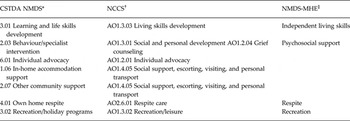
We reviewed existing systems for classifying support services for people with mental illness in the Australian literature (Australian Institute of Health and Welfare, 2003, 2008, 2010; Wood & Pennebaker, Reference Wood and Pennebaker2004) and identified indicative activities (listed in Table 1), which were then used to generate appropriate search terms. Medline MeSH search terms ((‘social support’ OR ‘rehabilitation’ OR ‘respite care’ OR ‘recreation’ OR ‘patient advocacy’ OR ‘consumer advocacy’ OR ‘crisis intervention’ OR ‘activities of daily living’ or ‘community health aides’) AND ‘psychotic disorders’) were modified to fit with analogous PsycINFO Descriptors and Google Scholar advance search terms. Searches of Medline, PsycINFO and Google Scholar from year of inception to March 2011 returned 1596 articles. An additional 27 articles were retrieved from review article reference lists and citation searches of older key articles, bringing the total to 1623.
Relevant categories from Australian classification systems describing support services for people with mental illness

*Commonwealth State/Territory Disability Agreement National Minimum Data Set (Australian Institute of Health and Welfare, 2008).
†National classifications of community services (Australian Institute of Health and Welfare, 2003).
‡National Minimum Data Set – Mental Health Establishments (Australian Institute of Health and Welfare, 2010; Wood & Pennebaker, Reference Wood and Pennebaker2004).
Selection criteria
Articles were reviewed at title level to identify those that: were focused on patients with SPMI; evaluated support workers delivering personalised support services for individual patients; and measured patient outcomes. One thousand five hundred and twenty-one articles were excluded at title level, and 55 more excluded after review of their abstracts. Fifty-four articles were reviewed at the full text level of which 38 articles were rejected, leaving 16 articles for inclusion.
As personalised support can overlap with other mental health community support sector services, we created a set of parameters to delineate which services were in scope. Firstly, because supported accommodation provides both housing plus support, we only included studies that described and evaluated the personalised support component of services that housed patients, rather than supported accommodation as a whole. Secondly, supported employment was defined as out of scope for this review as it targets vocational outcomes.
Data extraction and synthesis
We adapted the ‘PICO’ (patient/intervention/comparator/outcome) framework (Guyatt et al. Reference Guyatt, Oxman, Kunz, Atkins, Brozek, Vist, Alderson, Glasziou, Falck-Ytter and Schünemann2011) by including an assessment of study quality. Information on the quality of the evidence is essential to allow policy-makers and service providers to have confidence in evaluations of services (Guyatt et al. Reference Guyatt, Oxman, Vist, Kunz, Falck-Ytter, Alonso-Coello and Schünemann2008). Quality of selected articles was assessed using the Effective Public Health Practice Project's Quality Assessment Tool for Quantitative Studies (QATQS), which rates studies on: selection bias; study design; confounders; blinding; data collection methods; withdrawals and dropouts; intervention integrity; and analysis; to give an overall rating of: strong, moderate, or weak (Thomas, Reference Thomas1998). This tool was selected based on recommendations from a systematic review of quality assessment tools (Deeks et al. Reference Deeks, Dinnes, D'amico, Sowden, Sakarovitch, Song, Petticrew and Altman2003).
We developed a template for collating information extracted from the 11 identified studies. The template fields included: patient characteristics (diagnosis and service setting); study descriptors (study design, brief description of study and quality rating); intervention (including service types, description of intervention and presence of peer support workers); comparison group (yes or no, brief description if yes); and outcomes (patient outcomes evaluated and study results).
Key patient-based outcomes were identified, and the evidence from the selected studies relating to each outcome was grouped together. Using the Grading of Recommendations Assessment, Development, and Evaluation (GRADE) guidelines (Balshem et al. Reference Balshem, Helfand, Schünemann, Oxman, Kunz, Brozek, Vist, Falck-Ytter, Meerpohl, Norris and Guyatt2011; Barbui & Cipriani, Reference Barbui and Cipriani2011), and taking into account the quality of the relevant studies, an assessment was made of the strength of evidence for each patient-based outcome (Balshem et al. Reference Balshem, Helfand, Schünemann, Oxman, Kunz, Brozek, Vist, Falck-Ytter, Meerpohl, Norris and Guyatt2011).
Results
Patient characteristics
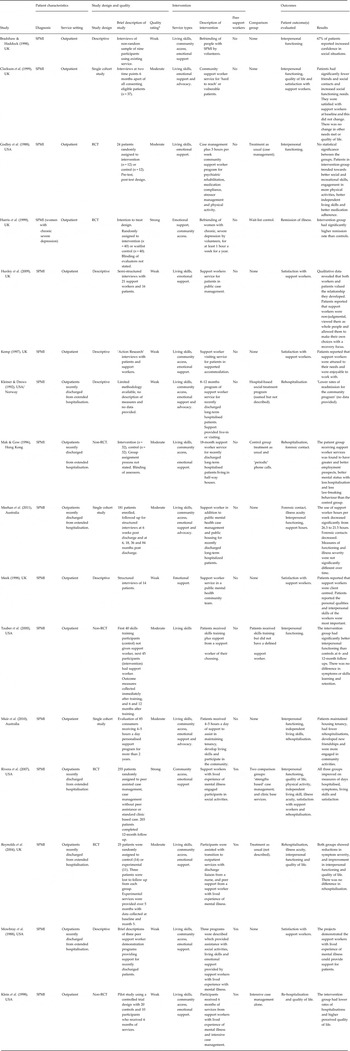
The systematic review identified 16 studies that evaluated the outcomes of personalised support programs for people with SPMI. The included studies are summarised in Table 2. All studies examined programs targeted at outpatients with SPMI. One targeted chronically depressed women (Harris et al. Reference Harris, Brown and Robinson1999). Six studies specifically included patients recently discharged from long-term psychiatric hospitals (Mowbray et al. Reference Mowbray, Chamberlain, Jennings and Reed1988; Kleiner & Drews, Reference Kleiner and Drews1992; Mak & Gow, Reference Mak and Gow1996; Reynolds et al. Reference Reynolds, Lauder, Sharkey, Maciver, Veitch and Cameron2004; Rivera et al. Reference Rivera, Sullivan and Valenti2007; Meehan et al. Reference Meehan, Stedman, Robertson, Drake and King2011). No other specific patient characteristic identifiers were noted by the included studies.
Studies evaluating patient outcomes of support worker delivered personalised support services for individual patients

*Based on the Effective Public Health Practice Project, QATQS (Thomas, Reference Thomas1998).
SPMI, severe and persistent mental illness; RCT, randomised control trial.
Quality of evidence for effectiveness of personalised support
The quality of the design of each of the 11 selected studies was rated using the QATQS (Thomas, Reference Thomas1998). Four studies used a randomised control trial (RCT) design: two were rated as being of strong quality (Harris et al. Reference Harris, Brown and Robinson1999; Rivera et al. Reference Rivera, Sullivan and Valenti2007), while one used non-validated outcome measures and was rated of moderate quality (Godley et al. Reference Godley, Sabin, McClure, Smerken and Manion1988) and another had a small sample size and limited description of participants and was rated as being of moderate quality (Reynolds et al. Reference Reynolds, Lauder, Sharkey, Maciver, Veitch and Cameron2004). Three used a non-randomised control design; two were rated as being of moderate quality (Mak & Gow, Reference Mak and Gow1996; Tauber et al. Reference Tauber, Wallace and Lecomte2000); and one was rated as being of weak quality (Klein et al. Reference Klein, Ram and Whitecraft1998). Three used a single cohort design and were rated as being of moderate quality (Clarkson et al. Reference Clarkson, McCrone, Sutherby, Johnson, Johnson and Thornicroft1999; Muir et al. Reference Muir, Fisher, Abello and Dadich2010; Meehan et al. Reference Meehan, Stedman, Robertson, Drake and King2011). The remaining six were descriptive studies; all were rated as being of weak quality (Mowbray et al. Reference Mowbray, Chamberlain, Jennings and Reed1988; Kleiner & Drews, Reference Kleiner and Drews1992; Kemp, Reference Kemp1997; Bradshaw & Haddock, Reference Bradshaw and Haddock1998; Meek, Reference Meek1998; Huxley et al. Reference Huxley, Evans, Beresford, Davidson and King2009).
Patient outcomes
The selected studies investigated a wide range of patient-based outcomes. These were grouped into three domains: personal functioning (including interpersonal interactions, problem solving and living skills); illness acuity (including symptoms, rehospitalisation and forensic contact); and satisfaction with support workers. A summary of the evidence for each of the outcome domains is given below.
Personal functioning
Nine studies discussed the effect of personalised support on personal functioning, broadly encompassing interpersonal interactions, problem solving, quality of life and living skills (Godley et al. Reference Godley, Sabin, McClure, Smerken and Manion1988; Bradshaw & Haddock, Reference Bradshaw and Haddock1998; Klein et al. Reference Klein, Ram and Whitecraft1998; Clarkson et al. Reference Clarkson, McCrone, Sutherby, Johnson, Johnson and Thornicroft1999; Tauber et al. Reference Tauber, Wallace and Lecomte2000; Reynolds et al. Reference Reynolds, Lauder, Sharkey, Maciver, Veitch and Cameron2004; Rivera et al. Reference Rivera, Sullivan and Valenti2007; Muir et al. Reference Muir, Fisher, Abello and Dadich2010; Meehan et al. Reference Meehan, Stedman, Robertson, Drake and King2011).
The first study, rated to be of strong quality, was an RCT of 203 patients randomly assigned to peer-assisted case management (n = 70), case management without peer assistance (n = 66) or standard clinic-based care (n = 67) (Rivera et al. Reference Rivera, Sullivan and Valenti2007). In the peer intervention group, support workers with lived experience of mental illness engaged participants in social activities and helped develop supportive social networks. On the Pattison Network Inventory (Stein et al. Reference Stein, Rappaport and Seidman1995), a measure of social networks, all three groups showed improvement. The group receiving peer-assisted case management showed an increase in the number of contacts, but this was due to contact with peer assistants and clinical staff, rather than family or outside friends. There were no significant differences over time or between groups on the Lehman Quality of Life Inventory (Lehman, Reference Lehman1988), a measure of subjective and objective dimensions of quality of life.
The second study, rated to be of moderate quality, was a non-randomised case control study, provided all patients in the program with a specific skills training program (Tauber et al. Reference Tauber, Wallace and Lecomte2000). The 45 patients in the intervention group received additional living skills support from a support worker, while the 40 patients in the control group did not. The supported group had significantly higher scores on the Assessment of Interpersonal Problem Solving Skills scale, a test of patient's abilities to navigate social situations (Donahoe et al. Reference Donahoe, Carter, Bloem and Hirsch1990), at 6 and 12 months follow up. There were no differences in symptoms or skills learning and retention.
The third study, rated as being of moderate quality, followed a single cohort of 37 patients for 6 months (Clarkson et al. Reference Clarkson, McCrone, Sutherby, Johnson, Johnson and Thornicroft1999). They received case management and a community support worker service. The study showed statistically significant decreases in patients' number of friends and contacts on the Social Network Schedule, a measure of friends and contacts (Leff et al. Reference Leff, O'Driscoll, Dayson, Wills and Anderson1990), an increase in their social functioning needs on the Camberwell Assessment of Need, a measure of social, functioning and health needs (Phelan et al. Reference Phelan, Slade, Thornicroft, Dunn, Holloway, Wykes, Strathdee, Loftus, McCrone and Hayward1995), and no change in quality of life on the Lancashire Quality of Life Profile, a measure of perceived life quality (Oliver, Reference Oliver1991). It appears that support workers may have obviated the need for independent friends, confounding the measures of friends and contacts.
The fourth study, a single cohort study of moderate quality (n = 85), evaluated a housing and support program that provided 4–5 hours per day of support to assist in maintaining tenancy, develop living skills and participate in the community (Muir et al. Reference Muir, Fisher, Abello and Dadich2010). After 2 years, the percentage of patients with established friendships had increased significantly from 67 to 91%.
The fifth study, a small, moderate-quality RCT of outpatients recently discharged from extended hospitalization compared 11 patients receiving assistance with transition to outpatient services (discharge liaison from a nurse, and peer support from a support worker with lived experience of mental illness) with an undescribed ‘treatment as usual’ comparison group (n = 14) (Reynolds et al. Reference Reynolds, Lauder, Sharkey, Maciver, Veitch and Cameron2004). Personal functioning was rated using the Colorado Client Assessment Record (Herman & Mowbray, Reference Herman and Mowbray1991). Both the control and intervention group showed significant improvements in social and role functioning, with no difference between the groups.
The sixth, a pilot non-randomised control trial of weak quality, compared 10 patients receiving 6 months of services from support workers with lived experience of mental illness and intensive case management to a control group of 20 patients receiving intensive case management alone (Klein et al. Reference Klein, Ram and Whitecraft1998). On the Lehman Quality of Life Inventory (Lehman, Reference Lehman1988) the intervention group reported small, but statistically significant differences compared with controls at the end of the study on the living, income and health subscales, but not on the family or friends subscales.
Three studies showed no change in personal functioning. The first study, rated as being of moderate quality, was an RCT that used non-validated measures created for the study to assess outcomes (Godley et al. Reference Godley, Sabin, McClure, Smerken and Manion1988). Twelve patients were assigned to each of case management as usual or case management plus 3 hours per week of support worker contact providing living skills and emotional support. The study showed trends towards better social and recreational skills, medication adherence and independent living skills, but these did not reach statistical significance.
The second study, rated as being of moderate quality, followed a single cohort of 181 recently discharged long-term hospitalised patients for 7 years (Meehan et al. Reference Meehan, Stedman, Robertson, Drake and King2011). They received support worker services plus clinical case management and public housing program. There was no change on the Living Skills Profile, a measure of function and disability (Rosen et al. Reference Rosen, Hadzi-Pavlovic and Parker1989), over the 7 years. Patients' need for support worker hours per week reduced from 26.3 to 21.5 hours, suggesting a possible improvement in patients autonomous personal functioning.
The third study, rated as being of weak quality, was a descriptive study of nine patients receiving a volunteer befriending service (Bradshaw & Haddock, Reference Bradshaw and Haddock1998). It found that 67% of the patients reported that the service improved their confidence in social situations (Bradshaw & Haddock, Reference Bradshaw and Haddock1998).
Illness acuity
Eight studies addressed illness acuity in terms of: rehospitalisation (Kleiner & Drews, Reference Kleiner and Drews1992; Mak & Gow, Reference Mak and Gow1996; Klein et al. Reference Klein, Ram and Whitecraft1998; Reynolds et al. Reference Reynolds, Lauder, Sharkey, Maciver, Veitch and Cameron2004; Rivera et al. Reference Rivera, Sullivan and Valenti2007; Muir et al. Reference Muir, Fisher, Abello and Dadich2010); forensic contact (Mak & Gow, Reference Mak and Gow1996; Meehan et al. Reference Meehan, Stedman, Robertson, Drake and King2011); and changes in symptoms (Harris et al. Reference Harris, Brown and Robinson1999; Reynolds et al. Reference Reynolds, Lauder, Sharkey, Maciver, Veitch and Cameron2004; Meehan et al. Reference Meehan, Stedman, Robertson, Drake and King2011).
The first study, rated as being of strong quality, was an RCT of a befriending program for chronically depressed women in inner London. It involved 40 patients in the intervention arm and 40 in a waitlist control group (Harris et al. Reference Harris, Brown and Robinson1999). After 1 year, a statistically significantly larger proportion of the befriended group (65% v. 39%) had achieved remission on an adaptation of the Present State Examination (Finlay-Jones et al. Reference Finlay-Jones, Brown, Duncan-Jones, Harris, Murphy and Prudo1980).
The second study, a strong-quality, RCT of peer-assisted intensive case management described above reported that the intervention and control groups all had similar reductions in hospitalisations (Rivera et al. Reference Rivera, Sullivan and Valenti2007).
The third study, a moderate-quality single cohort study of housing and support described above, reported a decrease in hospitalisations over the 2 years of the study (Muir et al. Reference Muir, Fisher, Abello and Dadich2010).
The fourth study, rated as being of moderate quality, was a non-randomised matched control program that provided 18 months of support worker services to 32 patients following discharge from a halfway house and compared them with 32 matched controls (Mak & Gow, Reference Mak and Gow1996). Those who received support worker assistance had significantly fewer re-hospitalisations (12.5% v. 46.1%) and forensic contacts (3.1% v. 15.6%); although scores on the Brief Psychiatric Rating Scale (Overall & Gorham, Reference Overall and Gorham1962) were not significantly different.
The fifth study was the 7-year single cohort study described above. It reported a reduction in forensic contacts (Meehan et al. Reference Meehan, Stedman, Robertson, Drake and King2011). Twenty-two percent of participants were under a forensic order at time of entry into the study, while only 2.7% of participants committed an offence over the 7 years of the study. However, there was no reduction of illness acuity on the Health of the Nation Outcome Scales (Wing et al. Reference Wing, Beevor, Curtis, Park, Hadden and Burns1998).
The sixth study, a small, moderate-quality, RCT of nurse and peer-assisted community transition, described above, reported that both the intervention and control group had reduced symptoms on an unnamed symptom scale, but that there was no-significant difference between the intervention and control groups in terms of rehospitalisations (Reynolds et al. Reference Reynolds, Lauder, Sharkey, Maciver, Veitch and Cameron2004).
The seventh study, a weak-quality pilot non-randomised control trial of peer support workers, described above, reported that in the intervention group had zero inpatient days during the 6-month study period, compared with an average of 15 days for the control group (Klein et al. Reference Klein, Ram and Whitecraft1998).
The eighth study, rated as being of weak quality, was a descriptive study of a support worker program targeting long-term hospitalised patients (Kleiner & Drews, Reference Kleiner and Drews1992). This study reported ‘lower rates of readmission for the community program’ compared with unmatched ‘hospital-based control programs’; however, very little empirical data were provided and limited information was given on study methodology.
Satisfaction with support workers
Six studies reported data on satisfaction with support workers using un-validated measures created for each study (Mowbray et al. Reference Mowbray, Chamberlain, Jennings and Reed1988; Kemp, Reference Kemp1997; Meek, Reference Meek1998; Clarkson et al. Reference Clarkson, McCrone, Sutherby, Johnson, Johnson and Thornicroft1999; Huxley et al. Reference Huxley, Evans, Beresford, Davidson and King2009; Meehan et al. Reference Meehan, Stedman, Robertson, Drake and King2011).
The first, the 6-month cohort study described above, reported that participants were satisfied with their support workers, but that there was no statistically significant change in levels satisfaction with workers over the 6 months of the study (Clarkson et al. Reference Clarkson, McCrone, Sutherby, Johnson, Johnson and Thornicroft1999).
The second, the 7-year cohort study described above, reported high levels of satisfaction with support workers, but also noted that levels of satisfaction did not significantly change over the duration of the study (Meehan et al. Reference Meehan, Stedman, Robertson, Drake and King2011).
The other four studies were all descriptive studies that were rated as being of weak quality and examined patients' perceptions of support workers through semi-structured interviews with convenience samples of patients (Mowbray et al. Reference Mowbray, Chamberlain, Jennings and Reed1988; Kemp, Reference Kemp1997; Meek, Reference Meek1998; Huxley et al. Reference Huxley, Evans, Beresford, Davidson and King2009). Patients reported that support workers valued them, were non-judgmental, viewed them as whole people, allowed them to be open and honest, allowed them to make their own choices, had a recovery focus (Huxley et al. Reference Huxley, Evans, Beresford, Davidson and King2009), were attuned to their needs (Mowbray et al. Reference Mowbray, Chamberlain, Jennings and Reed1988; Kemp, Reference Kemp1997) and were client centred (Meek, Reference Meek1998).
Peer delivered services
Four studies described personalised support services delivered by support workers with lived experience of mental illness, referred to in the literature as ‘peers’ (Mowbray et al. Reference Mowbray, Chamberlain, Jennings and Reed1988; Klein et al. Reference Klein, Ram and Whitecraft1998; Reynolds et al. Reference Reynolds, Lauder, Sharkey, Maciver, Veitch and Cameron2004; Rivera et al. Reference Rivera, Sullivan and Valenti2007); however, only limited improvements in patient outcomes could be ascribed to peer support worker interventions.
The strong-quality RCT study of peer-assisted intensive case management reported no differences in outcomes between the peer-assisted intervention and the control groups (Rivera et al. Reference Rivera, Sullivan and Valenti2007). The small, moderate-quality, RCT of nurse and peer-assisted community transition reported that both the intervention and control groups had reductions in illness severity and improvements in interpersonal functioning and quality of life (Reynolds et al. Reference Reynolds, Lauder, Sharkey, Maciver, Veitch and Cameron2004). The other two studies were of weak quality, with one showing small changes in quality of life and re-hospitalisation favouring the intervention group (Klein et al. Reference Klein, Ram and Whitecraft1998); and the other reporting satisfaction with peer support workers (Mowbray et al. Reference Mowbray, Chamberlain, Jennings and Reed1988).
Service types
An attempt was made to examine outcomes specifically associated with the four key service types: living skills, community access, emotional support and advocacy. Multiple service types were delivered within programs in 9 of the 11 identified studies. This made attributing outcomes to specific service types within a multi-component program challenging. Of the two studies where only one service type was described, one was descriptive study of emotional support (rated as being of weak quality), which measured patients opinions of support workers, but reported no other patient outcomes (Meek, Reference Meek1998), and the other was a case-control study (rated as being of moderate quality), which examined support workers providing living skills support as an adjunct to a specific living skills training program that may not be generalisable to other personalised support services (Tauber et al. Reference Tauber, Wallace and Lecomte2000). No clear pattern of service types within programs leading to specific outcomes could be discerned. As a result, an evaluation of efficacy of specific service types could not be undertaken at this time.
Discussion
In our study, we found that using GRADE guidelines (Balshem et al. Reference Balshem, Helfand, Schünemann, Oxman, Kunz, Brozek, Vist, Falck-Ytter, Meerpohl, Norris and Guyatt2011) and assessing the quality of the relevant studies, the strength of evidence for personalised support services on patient-based outcomes was weak to moderate.
The strength of the evidence for personalised support services improving personal functioning is weak in the studies published to date. A variety of non-comparable measures were used. Five studies showed significant changes from baseline. Only one reported greater improvement for the intervention than for the controls; however, the intervention was tied to a specific skills training program that may not be generalisable to other personalised support services (Tauber et al. Reference Tauber, Wallace and Lecomte2000). Two other controlled studies showed that the intervention and control arms both demonstrated improvements in social functioning (Reynolds et al. Reference Reynolds, Lauder, Sharkey, Maciver, Veitch and Cameron2004; Rivera et al. Reference Rivera, Sullivan and Valenti2007). An uncontrolled trial reported improvements from baseline (Muir et al. Reference Muir, Fisher, Abello and Dadich2010). Three studies reported no change (Godley et al. Reference Godley, Sabin, McClure, Smerken and Manion1988; Bradshaw & Haddock, Reference Bradshaw and Haddock1998; Meehan et al. Reference Meehan, Stedman, Robertson, Drake and King2011). One uncontrolled trial found that personal functioning significantly worsened (Clarkson et al. Reference Clarkson, McCrone, Sutherby, Johnson, Johnson and Thornicroft1999). The reduction in personal functioning appears to have been partially a result of support workers reducing the need for independent friends (Clarkson et al. Reference Clarkson, McCrone, Sutherby, Johnson, Johnson and Thornicroft1999). Another study reported that an increase in the number of contacts for the intervention group was due to visits with peer assistants rather than new friends (Rivera et al. Reference Rivera, Sullivan and Valenti2007). This raises the possibility that support workers create a perverse incentive to become dependent on the social interactions of their services, rather that assisting patients to developing new social networks.
There is moderate strength of evidence for improvement in illness acuity. An uncontrolled study of moderate quality reported reduction in illness acuity (Muir et al. Reference Muir, Fisher, Abello and Dadich2010), while an RCT of strong quality reported that both intervention and control groups had reduced illness acuity from baseline (Rivera et al. Reference Rivera, Sullivan and Valenti2007). Two other studies reported mixed results (Reynolds et al. Reference Reynolds, Lauder, Sharkey, Maciver, Veitch and Cameron2004; Meehan et al. Reference Meehan, Stedman, Robertson, Drake and King2011). Two patient groups for which there is evidence of improvement in illness acuity are women with depression and patients who have recently been discharged from hospital.
The strength of the evidence for service satisfaction is moderate. All six studies, rated to be of moderate or weak quality, found evidence that patients were satisfied with support worker services (Mowbray et al. Reference Mowbray, Chamberlain, Jennings and Reed1988; Kemp, Reference Kemp1997; Meek, Reference Meek1998; Clarkson et al. Reference Clarkson, McCrone, Sutherby, Johnson, Johnson and Thornicroft1999; Huxley et al. Reference Huxley, Evans, Beresford, Davidson and King2009; Meehan et al. Reference Meehan, Stedman, Robertson, Drake and King2011).
The strength of evidence to date for peer support worker interventions is weak. Four studies described personalised support services delivered by support workers with lived experience of mental illness and were of strong (Rivera et al. Reference Rivera, Sullivan and Valenti2007), moderate (Reynolds et al. Reference Reynolds, Lauder, Sharkey, Maciver, Veitch and Cameron2004) and weak quality (Mowbray et al. Reference Mowbray, Chamberlain, Jennings and Reed1988; Klein et al. Reference Klein, Ram and Whitecraft1998). The studies with strong and moderate quality showed no difference between the peer-delivered intervention and controls (Reynolds et al. Reference Reynolds, Lauder, Sharkey, Maciver, Veitch and Cameron2004; Rivera et al. Reference Rivera, Sullivan and Valenti2007), whereas the weak quality studies reported small improvements in personal functioning and illness acuity (Klein et al. Reference Klein, Ram and Whitecraft1998) and satisfaction with peer support workers (Mowbray et al. Reference Mowbray, Chamberlain, Jennings and Reed1988).
Strengths and limitations
This is the first study to attempt to systematically review the literature for evidence regarding personalised support services. The quality of the research to date has been inconsistent and this introduced some limitations to our study. Firstly, the provision of service types varied to such a degree that it was difficult to draw definitive conclusions about the effectiveness of programs. Similarly, patient-related outcomes were challenging to assess due to the use of disparate outcomes measures. Secondly, these services were targeted at people with SPMI, who are a heterogeneous group. This further complicates drawing conclusions on service efficacy. Thirdly, the majority of the studies evaluated provided multi-component programs, precluding the attribution of outcomes to specific service types.
Implications
There is an emerging consensus on the major components of personalised support and the outcomes that these services can deliver. This study provides an organising framework for personalised support with the identification of four service types and three key patient outcome domains. Although personalised support programs may be effective in improving patient outcomes or preventing deterioration in functioning, the evidence to date is of insufficient quality to prove or refute this. Future, higher quality research on the effect of specific service types on patient outcomes would be of use to develop programs targeted at specific patient needs. This is particularly timely given the recent call by the Grand Challenges on Global Mental Health group for more research into efficacy of interventions for serious mental disorders delivered by lay health workers (Collins et al. Reference Collins, Patel, Joestl, March, Insel, Daar, Anderson, Dhansay, Phillips, Shurin, Walport, Ewart, Savill, Bordin, Costello, Durkin, Fairburn, Glass, Hall, Huang, Hyman, Jamison, Kaaya, Kapur, Kleinman, Ogunniyi, Otero-Ojeda, Poo, Ravindranath, Sahakian, Saxena, Singer and Stein2011).
Conclusions
Personalised support services grew out of a need to assist patients with functional deficits. Services evolved from unstructured charity services to a major component of the mental health service sector. In Australia, funding to the broader non-government sector, the main provider of personalised support services, has grown more than 7-fold in the period from 1993 to 2008 (Department of Health and Ageing, 2010) and growth is likely to continue. However, the evidence to date for the effectiveness of personalised support services has not been well established. If the goal of these services is to help patients overcome functional deficits though a rehabilitation model, funding for quality research and evaluation of programs, including information of patient outcomes, is needed.
There is moderate evidence that personalised support services can reduce illness acuity, notably for chronically depressed women and patients transitioning from long-term hospitalisation, and there is moderate strength of evidence for patient satisfaction with services. However, the evidence is of inconsistent quality, and is weak for personal functioning. Programs may be effective, but, to date, insufficient resources have been invested in service evaluation in this sector. More focused research on the efficacy of key types of personalised support should be undertaken. In particular, studies should be designed to evaluate a single service type against a single outcome, determined prior to the commencement of the study. Identifying how to tailor these services to specific patient needs will assist efficient service delivery.
Declaration of Interests
The authors have no conflicts of interest to declare.