Introduction
Delirium is a disturbance of attention or awareness that is accompanied by a change in baseline cognition that cannot be better explained by a pre-existing or evolving neurocognitive disorder (American Psychiatric Association, 2013). The prevalence of delirium in emergency department patients aged 75 years and over is between 7% and 16 % (Fontova Almató et al., Reference Fontova Almató, Basurto Oña and Congost Devesa2012). Delirium is associated with a longer hospital stay, cognitive and functional decline, and a higher rate of institutionalization and mortality (Hogan et al., Reference Hogan2006; Witlox et al., Reference Witlox, Eurelings, de Jonghe, Kalisvaart, Eikelenboom and van Gool2010; Catic, Reference Catic2011; Kennedy et al., Reference Kennedy, Enander, Tadiri, Wolfe, Shapiro and Marcantonio2014; Jackson et al., Reference Jackson, Wilson, Richardson and Lord2016).
Drugs are a major etiological cause of delirium. Older patients are more vulnerable to their effects due to multiple illnesses and frailty (Midlov̈ et al., Reference Midlov̈, Eriksson and Kragh2009; Wehling, Reference Wehling2013). It is estimated that in this population 12–39% of delirium is caused by drugs (Catic, Reference Catic2011). Drugs with anticholinergic properties have been identified as a cause of delirium. To measure the anticholinergic load, many scales have been created to produce a reliable list of drugs (Carnahan et al., Reference Carnahan, Lund, Perry, Culp and Pollock2002; Hilmer et al., Reference Hilmer2007; Boustani et al., Reference Boustani, Campbell, Munger, Maidment and Fox2008; Rudolph et al., Reference Rudolph, Salow, Angelini and McGlinchey2008). These lists have similarities and discrepancies mainly due to the methodological differences in their development method (Durán et al., Reference Durán, Azermai and Vander Stichele2013; Naples et al., Reference Naples2015). Other drugs, such as opioids, steroids, and sedatives are also associated with delirium (Inouye et al., Reference Inouye, Westendorp and Saczynski2014). The anticholinergic load may, therefore, fall short in the identification and estimation of delirium risk because they focus only on drugs with anticholinergic properties.
The Delirium Drug Scale (DDS) is an evaluation scale developed to assess a patient's drug burden for delirium (Nguyen et al., Reference Nguyen, Pelletier, Payot and Latour2016). Our hypothesis is that DDS score predicts the incidence of delirium. The primary goal of this study is to validate the relationship between the DDS score and the incidence of delirium in an older ambulatory population.
Methods
This study was an observational retrospective cross-sectional chart review study at the Centre Hospitalier de l'Université de Montréal (CHUM) in Canada. It took place in three emergency departments of a tertiary care university health center. Patients eligible for the study were aged 75 years and older, and were admitted between October 9, 2012, and April 30, 2013. During this period, a pharmacy technical assistant during week days in all emergency department to obtain the patient's pharmacy medication list. Pharmacists, physicians, and nurses also obtained medication list when the pharmacy assistant wasn't present. All patients were screened and included if there was a medication list by a pharmacy or long-term care facility of less than a month old before admission, or medication reconciliation by a hospital pharmacist. Patients were excluded if they were transferred to intensive or palliative care, to another hospital, or discharged within less than 48 hours. Patients referred to the emergency department by a medical outpatient clinic were excluded. In the event that a patient was admitted numerous times during the screening period, only the first visit was observed. The study was approved by the CHUM Research Centre Ethics Committee.
Demographic, medication and clinical data including weight, height, admission creatinine, glycemic and electrolyte level and the Mini-Mental State Examination (MMSE) was extracted from the medical records. Systematic chart review was used for potential demographic confounding factors, such as age and gender, and risk factors for delirium (dementia, stroke, history of seizure, Parkinson's disease, visual and hearing impairment, fracture, diabetes, chronic pain, constipation, and polypharmacy [more than nine drugs], drug or alcohol dependence, history of delirium, depression, anxiety, insomnia, and immobility). Drugs were described using their American Hospital Formulary service (AHFS) classification code (American Society of Hospital Pharmacists., 2015). Precipitating delirium factors, such as infection, surgery, fall, use of bladder catheters, urea and electrolyte imbalance, acute kidney or liver failure were collected. The selected risk and precipitating factors were previously described in publications (Trzepacz and Meagher, Reference Trzepacz, Meagher, Yudofsky and Hales2007; Inouye et al., Reference Inouye, Westendorp and Saczynski2014). The presence of these factors is based on the physician's medical history and diagnosis in the clinical case sheets. The diagnosis was done using current Canadian practice guidelines.
The DDS is an evaluation tool designed to assess the risk of delirium imputable to drugs. It is the result of a literature review and expert consensus. The method of the DDS conception was described in a prior publication (Nguyen et al., Reference Nguyen, Pelletier, Payot and Latour2016). The expert panel evaluated 265 drugs and selected 96 drugs for the DDS scale. The DDS list scores drug from a 0 to 2 scale according to the potential of inducing delirium. In the design of the DDS scale, the mean inter-rater reliability score for the four expert in the panel was 0.634. The DDS score was calculated for each patient with two formulas. The gross DDS score is the sum of the points for all drugs in the DDS list. The weighted DDS score is the sum of the weighted DDS score for each drug calculated with the formula in Figure 1.
Weighted DDS score formula.

In this study, DDS drug exposure was considered low if the gross DDS score was between 1 and 2 and if the weighted DDS score was between 0 and 1 excluding the value of 0. A high DDS drug exposure was of more than two for the gross DDS and one for the weighted DDS score. All drugs taken before admission were collected from the medication list or the medication reconciliation. Drug active principle, dosage, and dosage regimen were collected. Topical dermatological, ophthalmological, and inhalation medications were excluded from data collection because of their low systemic absorption. Only drugs taken on a regular basis were considered in the DDS calculation. Since the patients were not interviewed, the use of as needed medication could not be documented.
Outcome measures
The presence of delirium upon admission was systematically reviewed by the investigators in the patient chart during the first 120 hours of hospital stay. Since delirium is often under diagnosed, physician diagnosis was insufficient. Delirium diagnosis was made if it was written in the patient's clinical case sheet or discharge summary by the acting physician or if validated keywords were present in the medical or nursing observation sheets (Inouye et al., Reference Inouye, Leo-Summers, Zhang, Bogardus, Leslie and Agostini2005). Only prevalent delirium defined as a delirium present upon the admission of the patient to the emergency department were included. In order to be included, the symptoms of delirium must be present before or up to 48 hours after the patient's admission. Delirium starting during the hospital stay were excluded.
Statistical analysis
The continuous variables are described by using means and standard deviation and a categorical variable, by using proportions. The χ 2and t-student test was used to compare demographic and medical data to the incidence of delirium. The DDS score does not have a normal distribution since most patients are either unexposed or exposed to only one medication in the DDS list. The association of the gross and weighted DDS score with delirium incidence was assessed using the Mann-Whitney test. Logistic regression analysis was used to evaluate the association between DDS and delirium to control for confounding variables, including demographic, risk, and precipitating factors of delirium described previously in the method. All variables were included in the analysis independently of their univariate association to delirium. Since the study was carried out in different hospitals, the location of the emergency department was included to the logistic regression to assess if a hierarchical structure of the data was present. A Hosmer and Lemeshow Goodness-of-fit test and Cox and Snell R-squared test were done to determine whether the gross or weighted DDS score fit better the data (Hosmer et al., Reference Hosmer, Lemeshow and Sturdivant2013). By default, all missing data for categorical variables were assigned the value 0, meaning not present and all missing data for continuous variables were collected as missing, and no value was assigned to these variables. SPSS software version 24 was used to assess the statistical analysis, and an alpha value of 0.05 was chosen.
Results
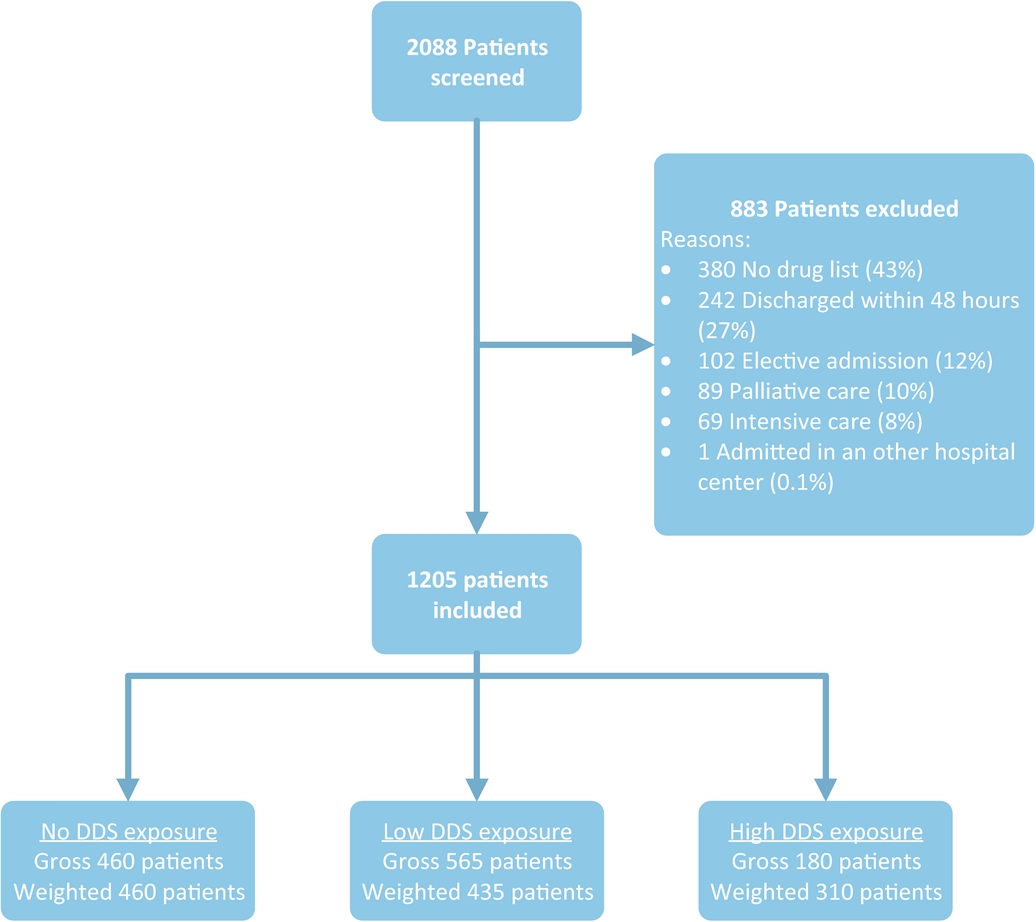
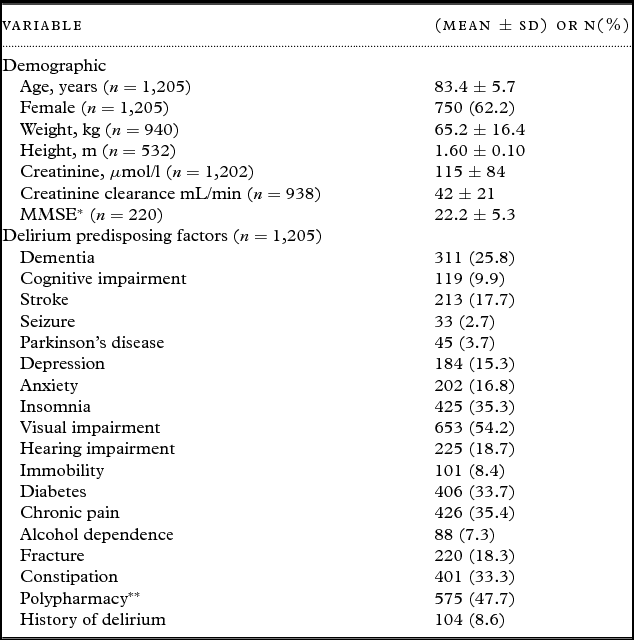
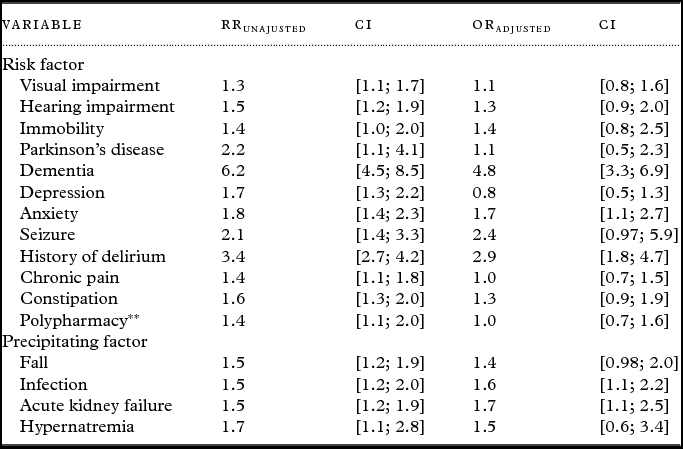
A total of 2,088 patient charts were screened, and 1,205 were included in the analysis. The reasons for a patient exclusion are summarized in Figure 2. The characteristics of the population are described in Table 1. The overall population had a mean age of 83.4 years, and 62.4% were female. The prevalence of delirium was 19.1%. Age, dementia, Parkinson's disease, visual and hearing impairment, immobility, depression, anxiety, history of delirium, seizures, chronic pain, constipation, and polypharmacy were significantly associated with an increased incidence of delirium. Infection, acute kidney failure, fall, and hypernatremia were also associated with delirium. Statistically, significant unadjusted relative risks (RR) or adjusted Odd Ratio (OR) for delirium for categorical variables are shown in Table 2.
Inclusion and exclusion.

Characteristics of the population

*Mini-Mental State Examination.
**Polypharmacy: more than 9 drugs.
Unadjusted relative risk (RR) and adjusted Odd Ratio (OR) for risk and precipitating factors for delirium (*)

*Stroke, fracture, diabetes, drug or alcohol dependence, insomnia, surgery, use of bladder catheters, urea, and electrolyte imbalance other than hypernatremia, acute liver failure were not associated to delirium.
**Polypharmacy: more than 9 drugs.
The most frequently ordered central nervous system drugs were sedatives (40%) followed by antidepressants (23%) and antipsychotics (13%). Platelet-aggregation inhibitors (51%), statins (48%), diuretics (47%), angiotensin-converting enzyme inhibitor and angiotensin receptor antagonists (45%), beta blockers (45%), and anticoagulants (20%) accounted for the main cardiovascular-prescribed drugs. Analgesic drugs were prescribed to 36% of patients while non-steroidal anti-inflammatory, proton pump inhibitors, and laxatives were used in 51%, 49%, and 27% of patients, respectively.
Upon admission to the emergency department, 745 patients (62%) were exposed to DDS medication. The most frequently ordered DDS medications in the overall population were lorazepam (17%), oxazepam (13%), citalopram (9%), pregabalin (9%), and prednisone (6%). The mean gross and weight DDS score were of 1.2 ± 1.4 and 0.67 ± 0.8, respectively. In the univariate analysis, the gross and weighted DDS score was associated with the incidence of delirium in the emergency department (p < 0.001). The RR for the low and high exposure according to the gross DDS score was of 1.26 (CI: 0.95; 1.66) and 2.18 (CI: 1.61; 2.96) compared to a score of 0. The RR for low and high exposure according to the weighted DDS score was of 1.28 (CI: 0.95; 1.71) and 1.77 (CI: 1.32; 2.36) compared to no exposure. When adjusted for confounding variables, the gross DDS score was associated with the incidence of delirium with an odd ratio (OR) of 1.29 (CI: 1.16; 1.44). The OR for the low and high exposure according to the gross DDS score was of 1.07 (CI: 0.82; 1.40) and 1.34 (CI: 1.14; 1.57) compared to no exposure. In the multivariate logistic regression, the results indicated the association between the weighted DDS score and delirium with an OR of 1.52 (CI: 1.27; 1.83). The OR for low and high exposure according to the weighted DDS score was of 1.21 (CI: 0.60; 1.67) and 1.60 (CI: 1.24; 2.05) compared to no exposure. The only risk and precipitating factors that were significantly associated with delirium in the multivariate logistic regression were dementia, anxiety, insomnia, history of delirium, infection, and acute kidney failure. The location of the emergency department was not significantly associated with the incidence of delirium (p = 0.095). The Goodness-of-fit test resulted in a p-value of 0.117 and 0.053 for gross and weighted DDS score. The R-squared was equal to 0.205 for both scales.
Discussion
We found that the score of the Drug Delirium Scale is associated with an increased risk of delirium incidence. In addition, the risk of delirium increases as the DDS score rises from low to high exposure. This effect is independent of risk and precipitating factors for delirium. In the multivariate analysis, we found that a low exposure to DDS medication does not significantly increase the odds of delirium. This suggests that a low exposure to DDS medication could be safely tolerated if the benefits of the therapy outweigh the risks. There does not seem to be any difference between the gross and weighted scale in predicting delirium. The result of the Goodness-of-fit shows that both scales fit the model and the R-squared values are the same. This could be attributed to a generalized use of a low range of DDS medication dosage making both scales of evaluation very similar. It is also possible that it is not a crucial risk factor for delirium since the association has not been clearly demonstrated.
The DDS score was calculated with the medication list before hospital admission. To make sure delirium was not caused by drugs taken during the hospital stay, only delirium present upon admission were included. The delirium symptoms had to be present before admission. Since the study was carried out in a teaching hospital where medical hospital residents can diagnose patients, the chart review was extended to the first 120 hours of hospital admission in order not to miss late delirium diagnosis.
Best and colleagues found that a high exposure to an anticholinergic and sedative medication, using the drug burden index, was associated with delirium (Best et al., Reference Best, Gnjidic, Hilmer, Naganathan and McLachlan2013). Landi and colleagues observed the association between the anticholinergic load using the Anticholinergic Risk Scale and delirium (Landi et al., Reference Landi2014). However, results were adjusted using the Charlson comorbidity or the Cumulative Illness Rating Scale index, which are not validated for delirium. Points, such as hypertension and peripheral vascular disease do not have the same weight as delirium risk factor for delirium-like diabetes and kidney failure. Important precipitating factors, such as infections, acute renal failure, and trauma were not controlled.
In 2014, Kalish and colleagues found that the use of two or more anticholinergic drugs was associated with an increased risk of hospitalization for acute confusion or dementia (Kalisch Ellett et al., Reference Kalisch Ellett, Pratt, Ramsay, Barratt and Roughead2014). The anticholinergic exposure combined three anticholinergic scales. However, the diagnosis method of delirium is unclear. The presence of delirium was not systematically assessed in all hospitalized patients. Delirium is often misdiagnosed, especially in its hypoactive form. Risk factors for delirium were not controlled. Results were reported as a composite endpoint, and it is not possible to isolate the effect on delirium. Due to these limitations, it is not possible to conclude that the risk of delirium is increased with the use of anticholinergic drugs.
In contrast, Campbell and colleagues were not able to find an association between the anticholinergic load of the Anticholinergic Cognitive Burden Scale and delirium (Campbell et al., Reference Campbell, Perkins, Hui, Khan and Boustani2011).
The goal of this study was to validate the effectiveness of the scale in predicting the incidence of delirium in ambulatory patients. The positive association found between DDS and delirium confirms the validity of the scale. Unlike previous anticholinergic scales, the DDS includes all drugs that are associated to delirium. It allows a broader evaluation of the drug burden in delirium. We have not compared the predictive value of the previous scale and the DDS score. This could be the object of future studies. To extend the validity of the scale, this study should be performed in different elderly populations. The predictive value of the scale must also be validated over time in a prospective cohort study.
This study has many strengths. The DDS is based on a systematic literature review and expert consensus. The DDS not only considers anticholinergic drugs, but all drugs leading to delirium making it a complete assessment of delirium drug burden. The analysis was done using a large sample. It systematically assessed every patient hospitalized through the emergency department. Therefore, patients from medical and surgical wards were all included and contribute to the generalizability of these results. Many risk and precipitating factors were taken into account in the multivariate analysis.
Some limits must still be considered. This was a single-center study with three emergency departments. Further studies in different settings and countries are necessary in order to ensure that the results are generalizable. In a retrospective study, the accuracy of the data may be questioned, as missing information is inherent to patient chart documentation. Patients weren't systematically screened for delirium leading to a possible underestimation of its prevalence. In a previous Canadian study, only 35% of cases of delirium were diagnosed in the emergency department.(Élie et al., Reference Élie, Rousseau, Cole, Primeau, McCusker and Bellavance2000) In previous studies, the prevalence of delirium in the emergency department was from 7% to 16% (Fontova Almató et al., Reference Fontova Almató, Basurto Oña and Congost Devesa2012; Kennedy et al., Reference Kennedy, Enander, Tadiri, Wolfe, Shapiro and Marcantonio2014). The prevalence of delirium is higher in this study probably because the patients were older. The similarity between reported and our delirium prevalence possibly reduces the amount of undiagnosed delirium cases but does not exclude it since a systematic delirium screening tool was not used upon admission. Delirium especially in its hypoactive form was probably equally misdiagnosed in the exposed and unexposed group and therefore has a low bias impact in the study.
The most frequent reason for patients exclusion was because their medication list was not available. It is possible, patients excluded were not taking any medication but this was not documented in the patient chart so it could not be collected. It is also possible that these patients had very few medications rendering the medication list less necessary. This could create a selection bias for more severely ill patients. It is also possible these patients were admitted at nighttime or during the weekend when medical staffing is lower. In this case, the risk of selection bias evenly distributed in the groups. Patient exclusion was done to reduce bias related to a higher or lower intrinsic risk of delirium. Patients electively admitted are not acutely ill, which lowers their risk of delirium so they were excluded. Critical and terminal illness can induce delirium that puts these patients at a higher risk of delirium than the general ambulatory population. The evaluation of drug consumption is based on a list and not a patient interview or pill count. The possibility that medication was purchased and not taken remains. Even if a large number of confounding variables were considered, some known risk factors, such as functional impairment and precipitating factors such as the use of restraints and drug withdrawal and unknown confounding variables were not evaluated.
Conclusion
This study found that DDS was associated with delirium incidence at the time of admission to the emergency department. The association persisted in the multivariate analysis along with 6 of the 26 known risks and precipitating factors for delirium. DDS is an assessment tool for the detection of patients with a high-delirium risk due to drug burden. It can also act as a decision tool for clinicians when a new medication is added to a patient's drug therapy. The results indicate that the number and potency of drug exposure rather than the dose is associated with delirium. Further research is required to confirm these results and investigate whether a reduction in DDS score can reduce the risk of delirium.
Conflict of interest
None.
Description of authors’ roles
Mr Nguyen designed the study, supervised the data collection, carried out the statistical analysis and wrote the paper, Mrs Pelletier, Dr. Latour, and Dr. Payot participated in the study design, creating the drug list and assisted with writing thepaper.
Acknowledgments
This work was supported by the pharmacy department and the geriatric department of the Montreal University Hospital Centers. The authors would like to thank Chovet, Manon, and Pham, Bao-Chau for their contribution in collecting the data of this study and Marjorie Harvey for her contribution to the draft of this manuscript. There is no funding source.