1. Introduction
The livelihoods of 25 million farmers and 100 million laborers living in developing economies depend on the production and sale of coffee (Fairtrade, Reference Fairtrade2012; Jha et al., Reference Jha, Bacon, Philpott, Méndez, Läderach and Rice2014). While coffee can be grown in direct sunlight or under the cover of shade trees, most producers favor the sun approach for its higher yields (DaMatta, Reference DaMatta2004; Atallah et al., Reference Atallah, Gómez and Jaramillo2018), despite shade-grown coffee production requiring fewer inputs (DaMatta, Reference DaMatta2004), yielding higher quality coffee (Muschler, Reference Muschler2001), providing environmental services, and supporting biodiversity – especially if the shade is from native forest (Tscharntke et al., Reference Tscharntke, Clough, Bhagwat, Buchori, Faust, Hertel, Hölscher, Juhrbandt, Kessler, Perfecto and Scherber2011; López-Bravo et al., Reference López-Bravo, de Virginio-Filho and Avelino2012). Although all coffee farmers face low and volatile coffee prices (Fairtrade, Reference Fairtrade2012) in the parts of the world where shade-grown coffee production under native forest persists (Jha et al., Reference Jha, Bacon, Philpott, Méndez, Läderach and Rice2014), once coffee becomes unprofitable for shade-grown production, the shade-grown coffee forests and their ecosystem services are put in jeopardy. Forest in Oaxaca, Mexico faces risks despite being designated a biodiversity ‘hotspot’, a center for plant diversity, and an Important and Endemic Bird Area (CONABIO, 2009; BirdLife International, 2019) due to the high level of shade-coffee production in the rustic style under native forests. It is estimated that 99 per cent of the coffee plantations in Mexico grow under shade (FIRA, 2016), with most of the organic coffee grown in Oaxaca and Chiapas (SAGARPA, 2019). Yet, Mexican coffee production and coffee area harvested have both declined dramatically in the two decades prior to 2017 (SIAP, 2018).
During ‘The Coffee Crisis,’ when coffee prices dropped to 100-year lows between 1989 and 2002, shade-grown coffee farmers in regions like Oaxaca responded by seeking off-farm employment in cities or abandoning their shade-coffee farms (Philpott and Dietsch, Reference Philpott and Dietsch2003; Perfecto et al., Reference Perfecto, Vandermeer, Mas and Pinto2005). The low prices forced households to make tough decisions regarding labor allocation: maintain coffee bushes to protect future yields or work temporarily off-farm to earn wages. With uncertainty over future prices, many farmers chose to forgo maintenance, causing their coffee bushes to yield less coffee in subsequent years. In Oaxaca, lower yields from the lack of maintenance together with low prices contributed to the eventual abandonment of shade-grown coffee farms, with those forests becoming targets for conversion to subsistence cropping or logging (Lin et al., Reference Lin, Perfecto and Vandermeer2008). Coffee prices eventually recovered but fell sharply in 2012, and again in 2015 (ICE, 2018). With these recent drops in price and uncertainty over future prices, concerns regarding abandonment (Schroth et al., Reference Schroth, Laderach, Dempewolf, Philpott, Haggar, Eakin, Castillejos, Moreno, Pinto, Hernandez and Eitzinger2009) and deforestation (De Beenhouwer et al., Reference De Beenhouwer, Aerts and Honnay2013) have reemerged. Various policies and programs attempt to protect forests and farmers from low and variable prices, and the resulting abandonment of shade-grown coffee farms. Mexico currently uses a payment for ecosystem services (PES) program for maintaining forest cover that includes shade-grown coffee farms (PRONAFOR, 2014) and has previously used a coffee price floor program (Ávalos-Sartorio and Blackman, Reference Ávalos-Sartorio and Blackman2010). In addition, farmers have been encouraged to invest in USDA Organic (USDA, 2019), Rainforest Alliance Sustainable Agriculture (UTZ, 2019), Bird Friendly (Smithsonian, 2019), or Fairtrade (Fairtrade, Reference Fairtrade2019) certification, through which farmers receive a premium or guaranteed price for their product. Costly certification, in both time and money, limits such policies' impact (Oxfam, 2005; Jha et al., Reference Jha, Bacon, Philpott, Méndez, Läderach and Rice2014). Farmers' decisions about investment in programs promoting long-term shade coffee production are further complicated by low prices, frequent price fluctuations and low savings.
In addition to limited data specific to under-forest shade-grown coffee farmers, little research analyzes the decisions of shade-grown coffee farmers amid low and uncertain prices and their reactions to existing or alternative policies. Atallah et al. (Reference Atallah, Gómez and Jaramillo2018) develops a coffee farmer decision model of optimal use of shade given shade's impact on yield and pest control. Heidkamp et al. (Reference Heidkamp, Hanink and Cromley2008), Kitti et al. (Reference Kitti, Heikkilä and Huhtala2009), and a set of econometric land use models (see online appendix) address changes in coffee production patterns by focusing on a producer's transition to sun production or subsistence cropping and how those decisions contribute to deforestation. Hernandez-Aguilera et al. (Reference Hernandez-Aguilera, Conrad, Gómez and Rodewald2019) examine the pest control and price premium incentives needed to encourage farmer transitions from sun to shade-grown systems, but most coffee farmers in Oaxaca already grow coffee under shade. While it is important to understand the shade-sun transition and pest management decisions in some settings, the existing literature does not include typical developing country setting aspects of a farmer's decision to relocate to work off-farm during the off-season or the decision to abandon the shade-grown coffee property amid price uncertainty, as seen across Oaxaca (Bacon et al., Reference Bacon, Ernesto Mendez, Gómez, Stuart and Flores2008; Lewis and Runsten, Reference Lewis and Runsten2008). With respect to policies, Kitti et al. (Reference Kitti, Heikkilä and Huhtala2009), Ferraro et al. (Reference Ferraro, Toshihiro and Conrad2005), Atallah et al. (Reference Atallah, Gómez and Jaramillo2018) and Hernandez-Aguilera et al. (Reference Hernandez-Aguilera, Conrad, Gómez and Rodewald2019) evaluate the effectiveness of conservation payments, price premiums, or both, in generating more shade-grown coffee production. Each study finds conditions under which the policies encourage conservation, yet the assessments do not incorporate the role of transactions and certification costs facing farmers in semi-subsistence settings or the incidence of policy costs. Additional costs are often discussed as limiting factors for the effect of price premiums and sustained production (Lyngbaek and Muschler, Reference Lyngbaek and Muschler2001; Valkila, Reference Valkila2009), but have not been explicitly analyzed in a farmer decision model.
Here, developing and analyzing a farm-level, dynamic model of a representative farmer's labor allocation decision that includes shade-grown coffee farm abandonment decisions under low and uncertain prices extends this literature to address the widespread phenomenon of abandonment and analyze policies whose effectiveness relies on farmer decisions. This article examines the decisions of shade-grown coffee farmers in reaction to existing and hypothetical policy scenarios designed to reduce shade-grown coffee farm abandonment. Using parameters and data from the first Coffee Crisis, this analysis provides policy guidance for the current crisis. Our baseline – no policy – results suggest that abandonment of shade production is slow but one that is difficult to reverse once begun. Farmers often set on the path to abandonment from the moment they forgo maintenance to earn off-farm income to meet subsistence needs in a bad price year, highlighting the importance of the timing of the policy. We consider price premiums that increase prices received by the farmer, price floors that guarantee a certain price, and payments for ecosystem services that are lump sum payments to the farmer, finding that earlier implementation results in less abandonment. Policies that enable shade-grown coffee farmers to remain on farms and maintain productivity, rather than work off-farm, prevent abandonment. Policies that impose costs and waiting periods prove less effective at stemming abandonment than those that enable farmers to develop a financial cushion that permits maintenance of yields in low price years. Although several policies can limit abandonment, the cost effectiveness and policy performance depend on the perspective of the institution bearing the policy costs.
2. Characteristics of case study setting to inform stylized analysis
The shade-grown coffee farms and farmers in the forests of Oaxaca's Sierra Sur y Costa provide the empirically-based stylized facts for this analysis. Most farmers in the region grow coffee under natural forests due to the geophysical and property rights landscape. These farmers typically have small subsistence crop plots, but the terrain and high altitude limit the long-term profitability of other cash crops including sun-grown coffee (e.g., Blackman et al., Reference Blackman, Albers, Ávalos-Sartorio and Crooks2005; Ávalos-Sartorio et al., Reference Ávalos-Sartorio, Blackman and Albers2006; Ávalos-Sartorio and Blackman, Reference Ávalos-Sartorio and Blackman2010). During our fieldwork in Oaxaca in the early 2000s, stakeholders described the shade-grown coffee agronomic setting, issues surrounding access to policies to sustain shade-grown coffee farming, farmer constraints, and motivations behind abandonment (see online appendix). One co-author living in the area as a professor and CGIAR representative conducted hundreds of general discussions in Spanish or using a local translator in non-Spanish speaking areas with stakeholders – including local development organizations, farmers from many socioeconomic backgrounds, agronomists, coffee buyers, coffee roasters, cooperatives and lenders – over several years (Batz et al., Reference Batz, Albers, Ávalos-Sartorio and Blackman2005; Ávalos-Sartorio et al., Reference Ávalos-Sartorio, Blackman and Albers2006). We conducted approximately 15 semi-structured interviews with individual farmers and groups of farmers who farm at different elevations and who represent different ethnic groups, and approximately 10 semi-structured interviews with coffee cooperatives, agronomists, organic and shade-grown (bird-friendly) coffee certification organizations, and development organizations. Those interviews collected detailed information of shade-grown coffee farming decisions including off-farm labor versus maintenance activities; access to cooperatives, credit and certification organizations; price variability and perceptions; marketing procedures; and other information about uses of the forest, political affiliations and concerns about the future. Overall, the farmers represented a range in language, location, cooperative membership, gender and income level.
These stakeholders reported that over one-quarter of coffee producers had abandoned their coffee farms and approximately three-quarters were forgoing maintenance in 2000, depicting a path toward abandonment that begins when they are unable to meet basic needs in a year with low prices and, given few wage opportunities in rural areas, must temporarily move to towns to find off-farm wage work to earn cash income. By leaving the farm, they are unable to perform important farm maintenance activities (e.g., pruning coffee bushes) which: (1) causes the tree to make too many branches and not develop properly; (2) weakens the tree branches that exist; and (3) requires cutting the tree back to one branch and waiting for regrowth (FAO, 1977). Through these mechanisms, forgoing maintenance lowers future yields (Bustamante et al., Reference Bustamante, Isaza, van Heeran, Torres and Romero2009), which makes it more likely that farmers will not meet subsistence needs through coffee production in subsequent years and will need to forgo maintenance to work off-farm again, further lowering yields. Even if prices recover, the damages to yields can be significant enough that the farmer is unable to reverse the damage without a substantial investment. When this series of events drives shade-grown coffee production profitability too low, farmers choose to abandon production.
While other recently-pressing issues (i.e., rising labor costs due to labor migration to cities, the re-emergence of coffee leaf rust, and pests such as the Coffee Berry Borer) exacerbate the problem of abandonment through decreased yields and increased costs, due to our basis in farmer discussions during the first coffee crisis, the focus of this analysis is on the description of decisions identified by those shade-grown coffee farmers: low and uncertain prices, off-farm earnings and the impact of maintenance on yield. Although we collected only enough data to parameterize a model of a representative farmer, this fieldwork-based analysis fills a gap in understanding responses of farmers to price uncertainty and common policies.
3. Stylized model of farmer decisions
3.1 Conceptual model
Based on the depiction of decisions from the shade-grown coffee farmers and drawn from Batz et al. (Reference Batz, Albers, Ávalos-Sartorio and Blackman2005), a stylized dynamic model of annual farmer decisions in the presence of future price uncertainty is developed to predict abandonment decisions.Footnote 1 Using the current time period's observed price and expectations of future prices, and considering the impact of current decisions on future yields, the farmer makes a dynamically-optimal one-period production decision that generates a level of yield and income in that period. The farmer sees the current coffee price and forms expectations of uncertain future coffee prices while recognizing that prices are serially correlated, meaning the current period price depends on prices in the previous period (i.e., farmers observing low prices now expect low prices in the near future). The farmer makes production decisions to maximize the expected net present value of his stream of profits, subject to annual subsistence, wealth (or savings) and labor constraints, and to evolution of yield over time. Although future yields are not uncertain in this framework, the farmer recognizes that decisions in the current period affect the level of yield in future periods because yield declines as a deterministic function of failure to perform coffee bush maintenance. Featuring yield as a function of past actions creates a non-Markov yield evolution – the level of yield in the following year depends on previous maintenance – and generates path-dependence of farmer actions and outputs. With path-dependence in yields, serially correlated uncertain price paths, and irreversible abandonment of coffee farming, the farmer solves a complicated stochastic dynamic optimization problem in each period to determine the dynamically-optimal production decision for the current period, while considering past maintenance efforts, current price and all possible future pathways for prices and decisions.
More specifically, in each year, the farmer decides how to allocate labor between coffee production and off-farm employment: harvest and maintain coffee bushes, harvest only, or abandon production. Maintaining coffee bushes helps sustain yields but is time consuming. Farmers who harvest and maintain (HM) spend their entire labor allotment completing these activities and do not work off-farm. Those who harvest only (HO) and forgo maintenance in the current time period use their remaining labor hours for working off-farm and earning wages. Each period of no-maintenance depresses future yields and sets the farm's productivity on a different path than occurs with maintenance – the transition to an alternate path of yield productivity demonstrates path dependence of the farmer decisions. If coffee production is no longer profitable, the farmer abandons (A) and devotes his entire labor allotment to off-farm work. Stakeholder interviews revealed that repeated lack of harvest and maintenance causes damage to coffee bushes from which yields cannot recover without substantial investment. Because farmers do not have access to such funds, abandonment becomes an irreversible decision (e.g., Wernau and Whelan, Reference Wernau and Whelan2018; Terazono et al., Reference Terazono, Webber and Schipani2019). Unlike annual agricultural production decisions, the farmers' decisions in any time period must consider the impact of those decisions on future values and opportunities, such as the irreversibility of abandonment and the negative impact on future yield of forgoing maintenance. The farmers' decisions are further altered when considering the impact policies have on costs and prices.
3.2 Farmer decision model
The farmer selects one of the three labor/production decisions in each time period, t, while knowing that period's price, pt. The farmer's per period profit function is:

with ${k_t}$ representing the chosen action from the set ${K_t} = H{M_t}, H{O_t}, {A_t};$
 q(k) being the amount of coffee produced with action k; w being off-farm wage; l(k) the amount of labor in off-farm wage for that action choice k; and c(k) the costs of action k. To reflect observations and to simplify the solution method, and with ${\beta ^s}$
 as the discount factor to time s, the farmer is forward-looking over a finite number of years, T. In every specific time period, s, the farmer solves the stochastic dynamic optimization problem for the current period s while considering T years, subject to a set of per-period constraints and equations of motion for the state variables (described below); that period's known price, ps; that period's wealth, Ws; expectations about uncertain and stochastic future prices, pt; and future wealth, Wt:

The farmer's chosen action has implications for current and future yield, labor, cost, subsistence, wealth, and irreversibility constraints. The model accounts for the path dependence of current yield as a function of maintenance activities completed in prior years through the yield growth function (equation (2)). Performing maintenance in past years leads to higher current yield (Bustamante et al., Reference Bustamante, Isaza, van Heeran, Torres and Romero2009). If, however, the farmer forgoes maintenance to earn off-farm wages to meet subsistence needs, yield in the subsequent year is reduced. Abandoning in the prior year results in no yield for all subsequent years. The logistic yield function with slower growth from lack of maintenance is:

in which $\bar{q}$ is the maximum yield or the yield carrying capacity. The intrinsic growth rate, $\gamma$
 , is reduced by a factor of m if the farmer performed no maintenance in the previous year, with no yield uncertainty. Both the non-Markov property of yield's dependence on prior maintenance and abandonment's irreversibility introduce path-dependence into the farmer's decisions. Assuming a binding per-period labor time constraint,

off-farm labor in each time period is

in which HM requires the full allotment of labor time and off-farm labor hours are zero. When HO, the farmer has a fixed number, $l,$ of hours (unused maintenance hours) to contribute to off-farm work. With A, the farmer gives his entire labor allotment, L, to off-farm work. Costs also depend on the action:

Harvest-related costs are ${c_h}$ , maintenance-related costs are ${c_m}$
 , and any policy-related costs are ${c_g}$
 . These policy costs can be payments (e.g., certification costs or interest payments) that increase the farmer's operating costs or receipts (e.g., loans or PES) that reduce costs. The benchmark case contains no policy-related costs (${c_g}$
 = 0). The final costs are intra-year credit costs, ${c_c},$
 for short-term loans to be repaid at harvest, which reflect regional credit access described by the stakeholders. Additional constraints on the farmer include those related to the irreversibility of abandonment,

to per-period subsistence constraints,

and to wealth accumulation:

In each time period, the farmer must meet a minimum subsistence income level, S, by spending down accumulated wealth, ${W_t}$ , spending some of the value of the management decision in that year,$ {v_t}({{k_t},{p_t}} )$
 , or some combination of the two. Wealth is a state variable whose equation of motion or accumulation depends on the farmer's wealth in previous time period ${W_{t - 1 }}$
 , the value of the management decision last year, the subsistence level and an exogenous rate of savings, $\tau$
 , on income above subsistence (equation (8)).
Because coffee prices are serially correlated, the price in time t + n,

is a function of the price in the previous year, $p_{(t-1)+n}$ ; the mean price that is also the initial price, ${p_0}$
 ; a governmental price support ${p_g}$
 (e.g., price floor or conservation payment); and a random error term, ${\varepsilon _t}$
 (e.g., Williams and Wright, Reference Williams and Wright1991). In the benchmark, price supports are zero $({p_g} = 0).$
 In each period, the farmer forms price expectations using the known actualized price for that period, equation (9), and knowledge of the distribution of the random error term.
The value of coffee production changes across years due to price variation and as a function of the impact of prior maintenance on yields; the non-Markov characteristic of yield means that a farmer's current decisions alter the values available in future periods. Therefore, the farmer considers the expected values in T future years, based on the current year's information about those values, and uses that information to decide on the current year's action, but the farmer waits to make the decision about the next year's action until that year's price information is available (Albers, Reference Albers1996). In each period, the farmer solves equation (1) subject to per period constraints and the equations of motion in equations (2)–(8). In all, the model focuses on the joint production-labor allocation and abandonment decisions amid price uncertainty when current decisions about incurring maintenance costs determine future yield levels, and the implications of policy costs and benefits when available to the farmer.
4. Methods of analysis
4.1 Numerical method to solve the farmer's stochastic dynamic optimization
We develop and employ a backward induction numerical solution method in MATLAB to determine the dynamically-optimal, current period decision based on the current level of price and state variables, while facing uncertainty about future, serially correlated, and stochastically-variable prices; path dependence in yield and abandonment; and within-period constraints. The farmer considers T – here 10 – future time periods of uncertain prices and decision pathways in making his current period decision.Footnote 2 The program computes the farmer's expected net present value of each current production decision based on the path-dependent expected value of every possible future production decision, conditional on meeting the within-period constraints. Then, the program identifies the highest expected net present value of the possible current period decisions – HM, HO, or A – and selects that choice as the solution to the individual period's stochastic dynamic optimization problem (see online appendix, sections V and VI).
4.2 Time path simulation framework
The individual current period decision rule cannot provide information about how per-period choices accumulate over time in the presence of path-dependent yield levels and irreversible abandonment. For this purpose, it is informative to simulate a series of constrained dynamically-optimal farmer decisions to elucidate time patterns in decisions and responses to price variability. To provide that time path information, we develop a simulation framework that defines a series of farmer optimal current period decisions. The simulation uses the numerical method described in section 4.1 to solve for the first period's optimal production decision; that production decision provides the ‘initial condition’ for yield in the second period. The second period's problem is then solved after drawing a realized price for the time period and employing the numerical method in section 4.1. The simulation continues through 20 years of the farmer making a current year optimal decision based on a single realized coffee price, all previous decisions' impact on yield, and forward-looking 10 years. We repeat the 20-year decision pathway simulation analysis for a total of 1,000 price path series iterations – randomly generating the prices in each iteration and consequently 1,000 different price paths for consideration (see online appendix, equation (A1) and section VII). Over those 1,000 price paths, we identify and explore how actualized time paths of prices interact with the path dependence of actions to influence time paths of actions when the farmer makes decisions under uncertainty about future prices. We identify a baseline percentage of these price paths in which the representative farmer abandons by each year, and the set of farmer decisions leading up to abandonment. Because we consider one representative farmer in 1,000 price path scenarios, we cannot interpret our results as a percentage of farmers abandoning by a particular time because it is the price path that varies and not the farmer who varies across these 1,000 price-outcome paths.
4.3 Parameterization to reflect the Oaxacan setting
We use the data gathered from our stakeholder interviews in Oaxaca to parameterize the model through calibration that reflects observed actions and trends. The discussions with farmers, cooperatives, extension workers and wholesalers gave us specifics on costs, wealth, wages, labor hours and yield observations (online appendix, table A1).Footnote 3 Although dated, the data provides enough information to create a stylized model characterizing the region's typical farmer. The parametrized model captures a main point emphasized by the farmers and extension workers – forgoing maintenance of coffee bushes led to a noticeable reduction in yield (Bustamante et al., Reference Bustamante, Isaza, van Heeran, Torres and Romero2009). In the absence of specific agronomic estimates of this relationship, we used reported yield and yield changes from the semi-structured interviews to calibrate parameters and functions that correspond to the observed biomass and yield growth reported by farmers and extension workers.
4.4 Policy characterizations
We introduce various policies into the representative farmer's decision to explore the impact of policies on each current period decision but also on how the pathway of those decisions evolves over time for different stochastically-defined price paths. In particular, we are interested in examining the impact of policies on farmers' decisions to forgo maintenance and to abandon coffee farming. To consider the impact of policy, we compare the no-policy decision paths to with-policy decisions paths, over 1,000 identical price paths. The policies alter the prices and/or costs (online appendix, section II); we analyze PES that impact costs, price floors that impact prices, and price premiums that can impact both prices and costs.
5. Baseline results
First, we establish the relevance of the parameterized model by using the actual prices from 1998 to 2018 as a single price path (online appendix, section IV). In that case, the representative farmer seeks off-farm employment and neglects maintenance, choosing HO, in the first year following the price drop in 1998 and continues to choose HO for approximately three years before abandoning production in 2002. Given the lack of data specific to small-scale shade coffee producers' decisions, we cannot conduct an empirical validity test of this baseline.Footnote 4 However, stakeholder interviews stated that 25 per cent of under-forest shade coffee farmers had abandoned coffee and 75 per cent of under-forest shade coffee farmers were forgoing coffee maintenance in 2000. That information places our representative farmer's decision to forgo maintenance in 2000 with 75 per cent of then-coffee farmers. Despite the data lacuna, author observations and stakeholder interviews suggest that the representative farmer's abandonment decision and years of forgone maintenance when facing the true price path matches stylized facts from Oaxaca during the crisis, generating confidence in the simulation model predictions.
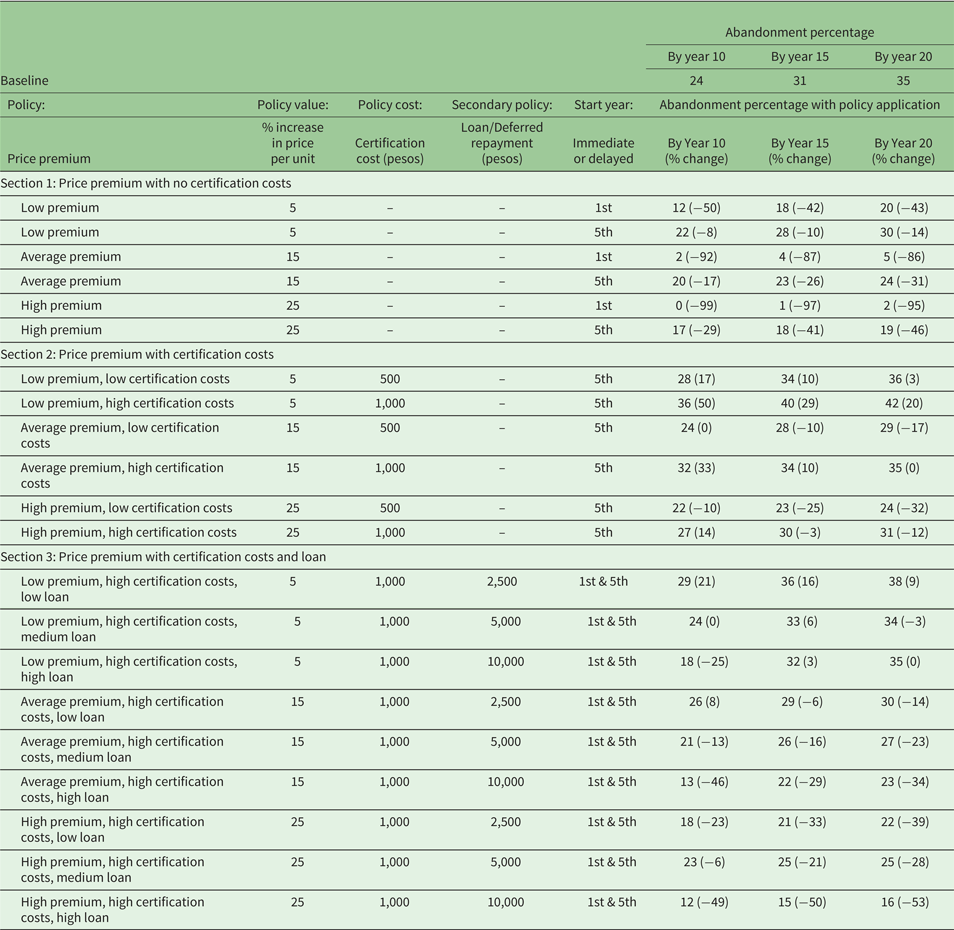
Moving to the 1,000 generated prices path and the no-policy baseline, the representative farmer abandons production by Year 10 in 24 per cent of the 1,000 price path iterations. The percentage of price paths in which abandonment occurs (or the abandonment percentage) is 31 per cent by Year 15 and 35 per cent by Year 20 is (table 1). Such summary statistics mask the process or decisions leading up to abandonment, but we examine each decision pathway to demonstrate that abandonment is a gradual process. Across the set of baseline price paths, no farmer shifts directly from HM to A. Instead, farmers forgo maintenance and HO for several years before eventually abandoning. On average, the farmer can only neglect maintenance for about 5 (4.97) consecutive years before yields have been reduced to levels that make abandonment optimal (online appendix, table A4, baseline row). In about 16 per cent of the price paths, the farmer is able to ‘bounce-back’ from HO to HM. Fewer ‘bounce-backs’ could reflect that the farmer is more resilient to low price years because forgoing maintenance and HO is not needed but, in contrast, fewer bounce-backs could reflect that the farmer cannot bounce from HO to HM because of low yields and low prices leading to A rather than to HM. In the baseline case, of the 16 per cent ‘bounce-back’ pathways, 42 per cent of bounce backs result in later A due to the ongoing low yields that make the shade-grown coffee farmer vulnerable in later low price years (online appendix, table A4, baseline row). On average, a farmer can shift to HO for 1.2 years and still be able to return to HM. For all price paths of the baseline, the farmer never returns to HM after three consecutive years of choosing to HO, which suggests that after two years of HO, the likelihood of being able to return to HM is low. Results of the baseline simulations show that low prices, coupled with subsistence and wealth constraints, force farmers to neglect maintenance. That inability to perform maintenance puts them on a path that can lead to abandonment.
Abandonment results for price premium policies

Notes: Abandonment percentages for the baseline – no policy – model as compared to the abandonment percentages for all permutations of price premium policies considered in this analysis: premium size, with or without certification costs, and certification cost coverage loan. For the baseline run, abandonment occurs in 24% of the 1,000 price path iterations by Year 10. The percentage in which abandonment occurs grows to 35% by Year 20. When implementing a low premium without certification costs (section 1, row 1) starting immediately in the first period (t = 1, 1st), the percentage that abandon falls to 12% by the 10th year (result column 1). When compared to the baseline, this represents a 50% reduction in abandonment by the 10th year (result column 1, value in parentheses). Delaying the start of the low premium to the 5th year (t = 5, 5th), requiring 1,000 pesos certification costs, and offering a loan of 2,500 that is paid out in Year 1 (t = 1, 1st) (section 3, row 1), the abandonment percentage rises to 29% by Year 10, which is a 21% increase in abandonment with this policy.
6. Stylized policy analysis
In this section, we examine the effects of four different policies – Price premiums, Premiums with loans, Price floors, and Payments for Ecosystem Services – on shade-grown coffee abandonment rates across price paths. To facilitate a comparative assessment of abandonment percentages with and without policy intervention, the representative farmer is ‘automatically enrolled’ in the policy.Footnote 5
6.1 Price premiums
By the nature of the production process, the coffee grown in Oaxaca is organic and bird-friendly, which generates price premiums in the international market following certification. Specifically, the farmers could certify coffee as UTZ - Rain Forest Alliance, USDA Organic or Bird Friendly; however, farmers face a lengthy and costly certification process prior to qualifying to receive the price premium. We analyze policies through which farmers receive a 5 per cent (low), 15 per cent (average), and 25 per cent (high) price premium (FAO, 2009) with no, low or high certification costs, and examine different start times for the price premium implementation. Here, we assume the farmer is ‘auto-enrolled’ in the price premium program but consider a first period decision to ‘opt-out’ of the program in the case of costly certification.
Without certification costs, price premiums are quite effective at slowing abandonment (section 1 of table 1). The abandonment percentage declines by 50 per cent (low), 92 per cent (average), and 99 per cent (high) by Year 10 if the price premium policy is implemented immediately in Year 1 of the time horizon.Footnote 6 Even when the policy is delayed and started in Year 5, the abandonment percentage falls by 8 per cent. Premiums are an effective anti-abandonment policy for two reasons. First, they shift up the distribution of prices, which creates more profit from HM in good years and enables savings to accumulate. That wealth added to the higher price makes farmers able to perform maintenance in subsequent bad price years, avoiding periods of HO. Second, the price increase makes bounce-backs more frequent and long-lasting. Compared to the baseline's 16 per cent of price paths with bounce-backs to HM from HO, average premiums nearly double (to 32.2 per cent), and high premiums almost triple (to 44.6 per cent), the number of price paths with bounce-backs, while the number of those bounce-backs that result in abandonment declines from 42 to 5 per cent (average) and 2 per cent (high) (online appendix, table A4). The premiums make the farmer more resilient to bad price years. The bounce-backs are less likely to result in abandonment because the farmer is able to use accumulated wealth rather than forgoing maintenance. By the time the farmer must seek off-farm employment, his coffee bushes have been well maintained, making the one or two years of HO less detrimental to the operation. The farmer can then bounce-back to HM without facing low enough yields to make coffee production unprofitable because the increase in prices from the premium offsets the losses in yield.
6.2 Price premiums with certification costs
In reality, however, certification comes at significant cost to farmers in terms of time and money. Before ever receiving the premium, farmers must pay to have inspectors survey and approve the property. The costs of inspection include travel, reporting, translation and compliance fees, followed by a waiting period of three years for certification and the premium. To include certification costs in our analysis and, reflecting this setting, we assume that the farmer pays certification costs for three years before receiving the premium. Following Batz et al. (Reference Batz, Albers, Ávalos-Sartorio and Blackman2005), we chose 1,000 pesos per hectare per year for the high cost cases and 500 pesos for low cost cases. In many of the cost/premium scenarios, abandonment increases compared to the no policy case (section 2 of table 1). For the high cost, low premium case, the abandonment percentage increases by as much as 50 per cent compared to baseline, which is the opposite impact as for the no cost, low premium case. The upfront certification costs are too high for the farmer to cover without seeking off-farm employment. In addition, he must forgo maintenance earlier in more situations than without these costs. Forgoing maintenance helps him pay for certification, but by the time he receives the price premium, the resource stock has been depleted and coffee production is no longer profitable – bounce-backs are more frequent but lead to later abandonment (online appendix, table A4). With these high costs and low or average premium values, the policy can lead to even more abandonment than in the baseline (section 2 of table 1).
As a caveat, some farmers in these policy situations would decide not to become certified to avoid the high certification costs and would continue selling coffee without marketing it as shade-grown. For the policy cases in which abandonment increases compared to the baseline, we evaluated the pathways of farmers who had a first period choice to ‘opt in’ or ‘opt out’ of the policy rather than being auto-enrolled. In those cases, the farmer optimally ‘opts out’ in 24 to 32 per cent of the price path iterations, but farmers on many of those price paths still abandon.Footnote 7 The opt-out option reduces the abandonment percentage across cases and across time, as compared to the auto-enroll case. Despite the ability to opt out, the policy's high certification costs interact with subsistence constraints to increase the abandonment percentage during the early years of the policy, as compared to the no-policy baseline abandonment percentage. In most cases, however, the ability to opt-out of the policy enables the policy to reduce abandonment percentage by Year 20 as compared to the no-policy baseline (online appendix, table A5).
6.3 Price premiums with certification costs and loans
Because the upfront costs of certification exacerbate abandonment (or limit enrollment), we consider a hypothetical loan program to help cover the certification costs in which farmers pay back the loan with interest within three years of starting to receive the price premium. Using an interest rate of 9 per cent, which is comparable to other agricultural loan programs in Mexico, we examine the abandonment percentages when the loan covers only a portion of the certification costs (low loan), all of the certification costs (medium loan), and covers all costs plus additional support (high loan). The size of the loan and the premium determines the direction and magnitude of impact of these policies on abandonment (section 3 of table 1). A low loan combined with a small premium does not help; the abandonment percentage rises. Because the loan does not cover all certification costs, farmers must still forgo maintenance to earn enough income to pay the remaining costs. Once the farmer starts receiving the premium, the premium is not large enough to make up for yield declines from lack of maintenance and the loan payments. In order for a low loan to reduce abandonment percentages, the premium must be larger. When combining a larger loan with a small premium, more abandonment can occur because the farmer is unable to pay back the loan. The larger loan helps delay abandonment because the farmer does not forgo maintenance as early but, upon receiving the price premium, the increase in income does not cover loan payments. To fulfill the loan payments, the farmer must seek off-farm employment and the path toward abandonment begins. In general, the loan must be large enough to cover the costs of certification and the premium received must be large enough to help cover the interest and loan payments. In such cases, farmers avoid forgoing maintenance, and HO throughout the certification loan repayment periods then capture benefits of the premium.
6.4 Price floor
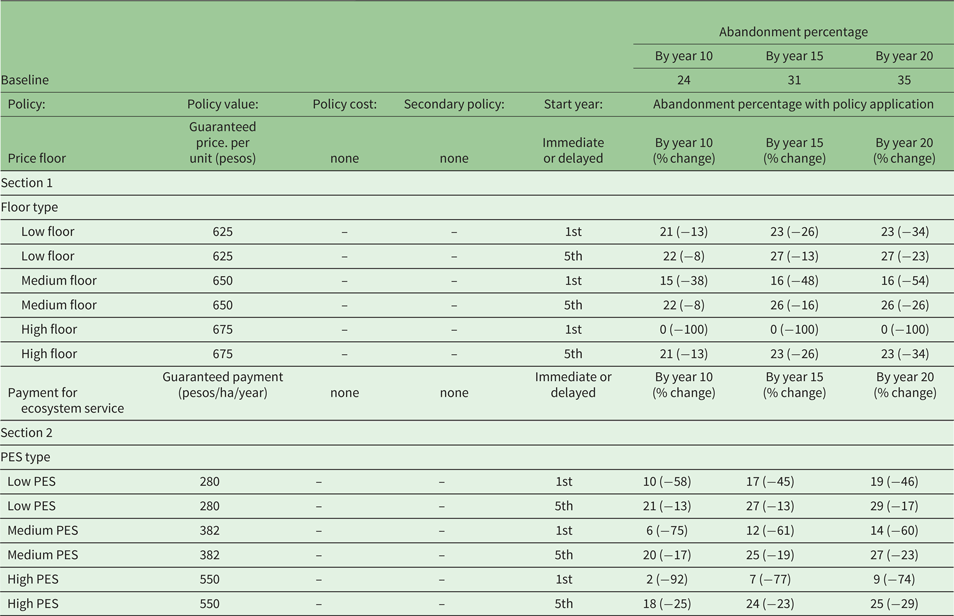
In the past, Mexico has used a price floor policy to help protect farmers against years of low coffee prices. The now defunct Mexican Coffee Council (CMCAFE) initiated the Fund for the Stabilization, Strengthening and Reordering of Coffee Production (Fondo de Estabilización, Fortalecimiento y Reordenamiento de la Cafeticultura) in 2001 to provide registered coffee producers with a guaranteed price (Ávalos-Sartorio and Blackman, Reference Ávalos-Sartorio and Blackman2010). Similarly, farmers are eligible for a guaranteed price if they are Fairtrade participants (Fairtrade, Reference Fairtrade2019). During the ‘Coffee Crisis’, the price floor was 675 pesos per quintal of pergamino, which is about 10 per cent lower than the mean price in our analysis. Implementing a 675 peso price floor in the first year reduces abandonment to zero in all price paths (section 1 of table 2). Slightly lower price floors of 650 and 625 pesos did not eliminate abandonment but were effective. As compared to the baseline, even the lowest price floor that was considered decreased the abandonment percentage by 34 per cent by Year 20. These price floors guarantee a future price that is enough to meet subsistence needs without off-farm wages, allowing continual maintenance to protect yield.
Abandonment results for price floor and PES policies
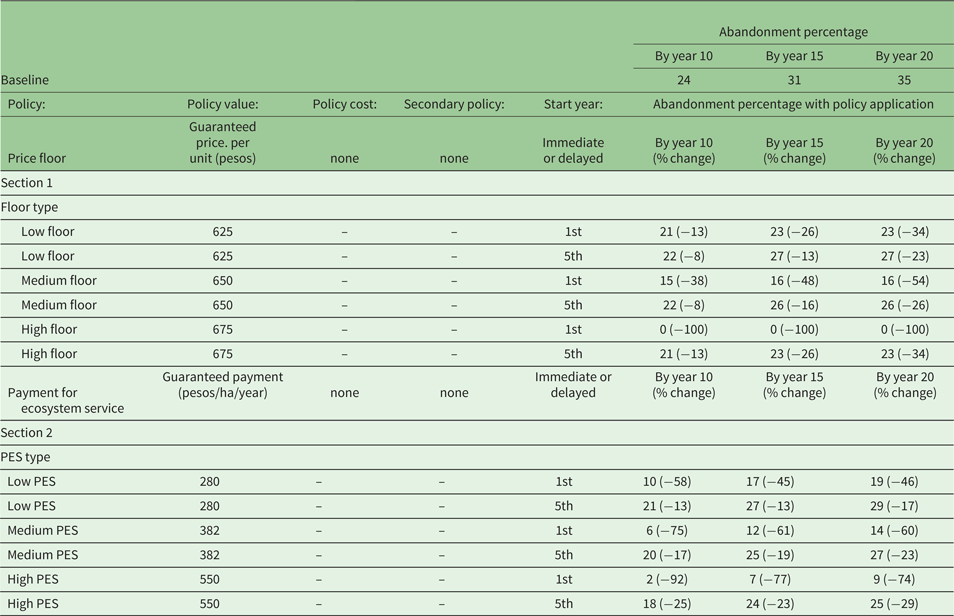
Notes: Section 1: Abandonment percentages for the baseline – no policy – model as compared to the abandonment percentages for all price floor policy runs. For the baseline run, abandonment occurs in 24% of the 1,000 price path iterations by Year 10. The percentage in which abandonment occurs grows to 35% by Year 20. When implementing a low price floor (row 1) immediately in the first period (t = 1, 1st), the percentage that abandon falls to 21% by the 10th year (result column 1). When compared to the baseline, this represents a 13% reduction in abandonment by the 10th year (result column 1, value in parentheses).
Section 2: Abandonment percentage for the baseline – no policy – model as compared to the abandonment percentage for all PES policy runs. For the baseline run, abandonment occurs in 24% of the 1,000 price path iterations by Year 10. The percentage in which abandonment occurs grows to 35% by Year 20. When implementing a low PES (row 1) immediately in the first period (t = 1, 1st), the percentage that abandon falls to 10% by the 10th year (result column 1), producing a 58% reduction in abandonment by the 10th year (result column 1, value in parentheses).
6.5 Payment for ecosystem services
Mexico's ‘National Forestry Program’ rewards farmers for maintaining forest cover to produce ecosystem services with a minimum annual payment of 280 pesos/hectare to farmers, with higher payments (medium 382 pesos/ha/yr and high 550 pesos/ha/yr) for higher levels of ecosystem services (PRONAFOR, 2014). Receiving an annual payment of 280 pesos decreases the abandonment percentage by Year 10 by 58 per cent, with larger magnitudes of the impact at higher payment levels (section 2 of table 2). This policy helps create a buffer of wealth, from savings, with which to weather bad price years. Although payments for forest cover do not create a marginal incentive for shade-grown coffee production itself, through this savings accumulation, the farmer is better protected against later low price years and can avoid forgoing maintenance and HO more often. The shade-grown coffee farmer also has the added benefit of knowing that the PES payment is certain income in each year, which lowers the price the farmer would need to observe in order to continue with HM in future periods.
6.6 Timing
The timing of the policy intervention is critical to its impact because farmers' near-term decisions to forgo maintenance affect their ability to respond to the policy later, and in our analysis, they do not know of the forthcoming policy. The efficacy of each policy drops with later implementation because some farmers have already begun the path to abandonment. If premiums, PES payments, and price floors start too late, they do not help create the buffer of wealth needed to perform maintenance during bad price years. In addition, by the time the policies are in place, some farmers are already experiencing yield declines such that even large price supports cannot always restore profitability. To examine the impact policy timing has on decisions, we analyze the five lowest price paths from our 1,000 price paths; and five paths with a significant price drop after the 4th year, focusing on average- and medium-sized policies.
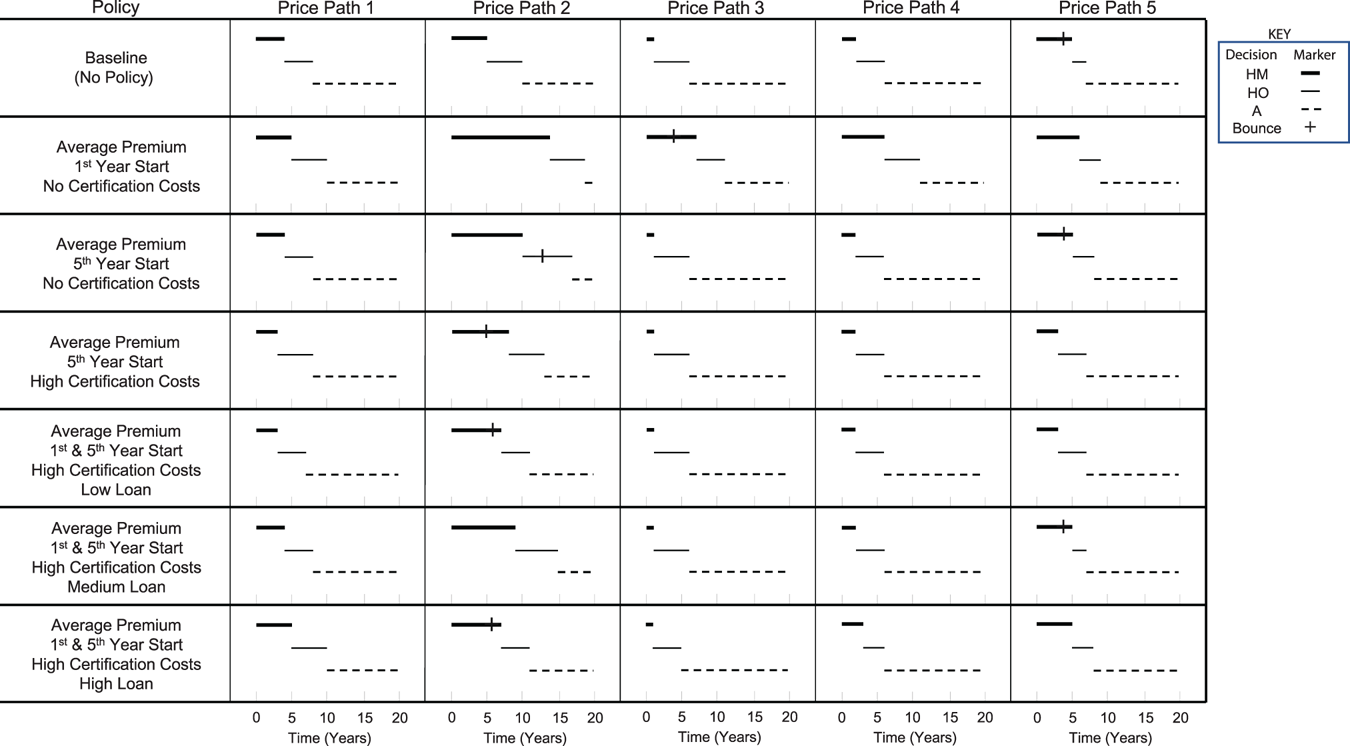
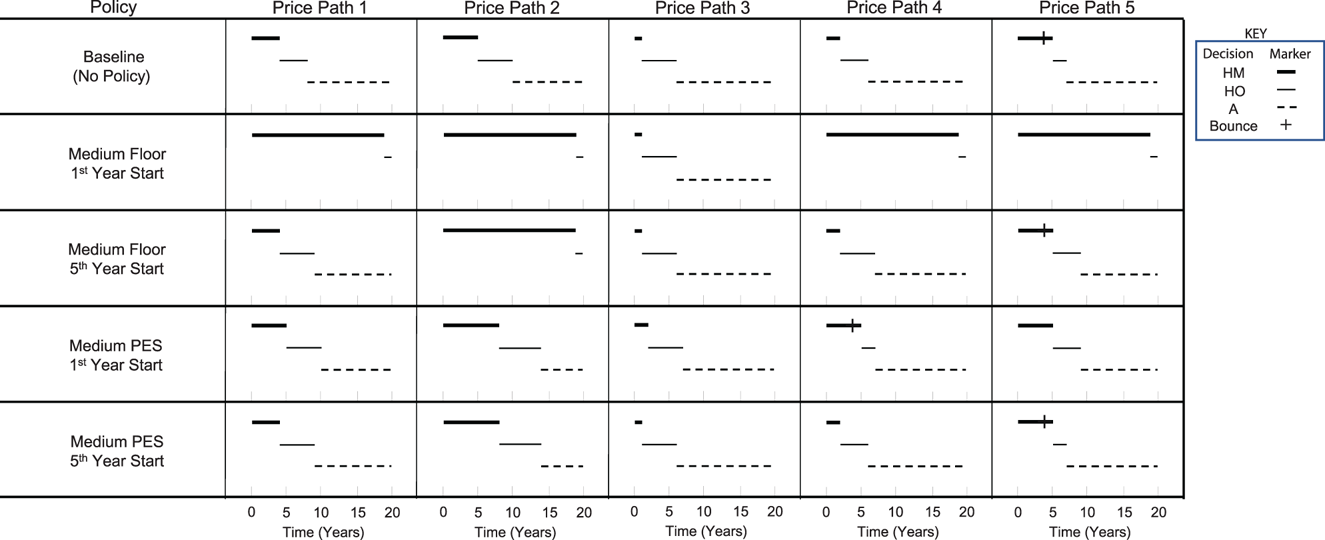
For each of the lowest price paths in the baseline (figure 1, row 1), HM is chosen less than HO, and the length of time until A is relatively short. When prices are low, the farmer seeks off-farm employment and forgoes maintenance immediately. The most successful policies for reducing abandonment for all price paths are a price premium or price floor implemented in the 1st year without certification costs (figure 1, 2nd row of both panels). These same policies are less effective if implemented in Year 5 (figure 1, 3rd row of both panels) and even less so if the policy adds to the farmer's financial burden (figure 1, both panels, 4th row and above). The response to delayed policies that pose excess costs do not significantly differ from the baseline (e.g., figure 1, top panel, row 1 vs row 6). Similar results occur in the set of cases with significant price drops in time period 4 (figure 2). Policies implemented in Year 1 reduce the effects of the later price drop (figure 2, top panel, row 2; and bottom panel, rows 2, 4 and 6) but policies implemented in Year 5 have less impact (e.g., figure 2, bottom panel, rows 3 and 7). To have the best chance of avoiding abandonment, the policy needs to be low cost and occur early for policies to deter the start of yield degradation from no maintenance.
Decision comparisons across the lowest price paths.
The price path 1, in the baseline (column 1, row 1) the farmer harvests and maintains (HM) for the first 4 years, then harvests only (HO) for the next 4 years, and then abandons (A). In that same price path for an average premium with no certification costs starting in the 1st year (column 1, row 2), the farmer HMs for 5 years, HOs for the next 5 years, and then abandons. A bounce indicates that the farmer shifts to HO or HM for only one period. In the baseline for price path 5, the farmer HO in Year 5 but returns to HM in Year 6

Decision comparisons across price paths with a significant price drop in Year 4.
The five lowest price paths (of the 1,000 iterations) have the lowest average price for the 20-year time horizon. The figure compares the decisions over the 20 years for the baseline run of each low price path and the decisions for that same price path for select policies. Take for example, price path 1, in the baseline (column 1, row 1), the farmer harvests and maintains (HM) for the first 4 years, then harvests only (HO) for the next 4 years, and then abandons (A). In that same price path for a medium PES starting in the 1st year (column 1, row 4), the farmer HMs for 5 years, HOs for the next 5 years, and then abandons. A bounce indicates that the farmer shifts to HO or HM for only one period. In the baseline for price path 5, the farmer HO in Year 5 but returns to HM in Year 6

6.7 Policy costs and ‘bang for the buck’
Early implementation of high value and low cost policies (to the farmer) reduce abandonment. These policies impose costs on governments, NGOs and coffee buyers, albeit while reducing the risk of biodiversity loss. To characterize the cost effectiveness, or bang for the buck, of policies, we calculate the average avoided abandonment per discounted dollar (or unit of currency) spent for each policy. We consider who bears the policy costs to determine the cost effectiveness from the perspectives of the Mexican Government and global society (table 3). Here, we consider the Mexican Government's responsibility for funding price floor, PES payment, and loan program policies,Footnote 8 in addition to a scenario in which they cover certification costs. When the Mexican Government does not cover certification costs, it prefers any of the price premium policies to the price floors or PES payments (table 3, columns 8 and 9) because it bears few costs for these abandonment-reducing policies. Instead, the cost burdens associated with price premium policies fall on the global society; international coffee buyers pay the premium and farmers pay for the certification. If the Mexican Government covers certification costs, the average cost of paying for certification is still lower than costs for other policies (table 3, columns 6, 7 and 11). First year price floors present high Mexican Government-borne costs but produce large reductions in abandonment. The PES and price floor policies rank toward the bottom of cost effectiveness for the Mexican Government because of the high costs it bears. Although high price floors reduce abandonment the most among policies here, the Mexican Government prefers the low floor implemented in the first year due to low costs that are paid only in low price years. PES prove costliest to the Mexican Government (table 3, columns 11 and 12) because the payments must be paid every year. Although PES effectively avoid abandonment, the Mexican Government can reach similar avoided abandonment levels with cheaper policies.
Policy performance and average costs
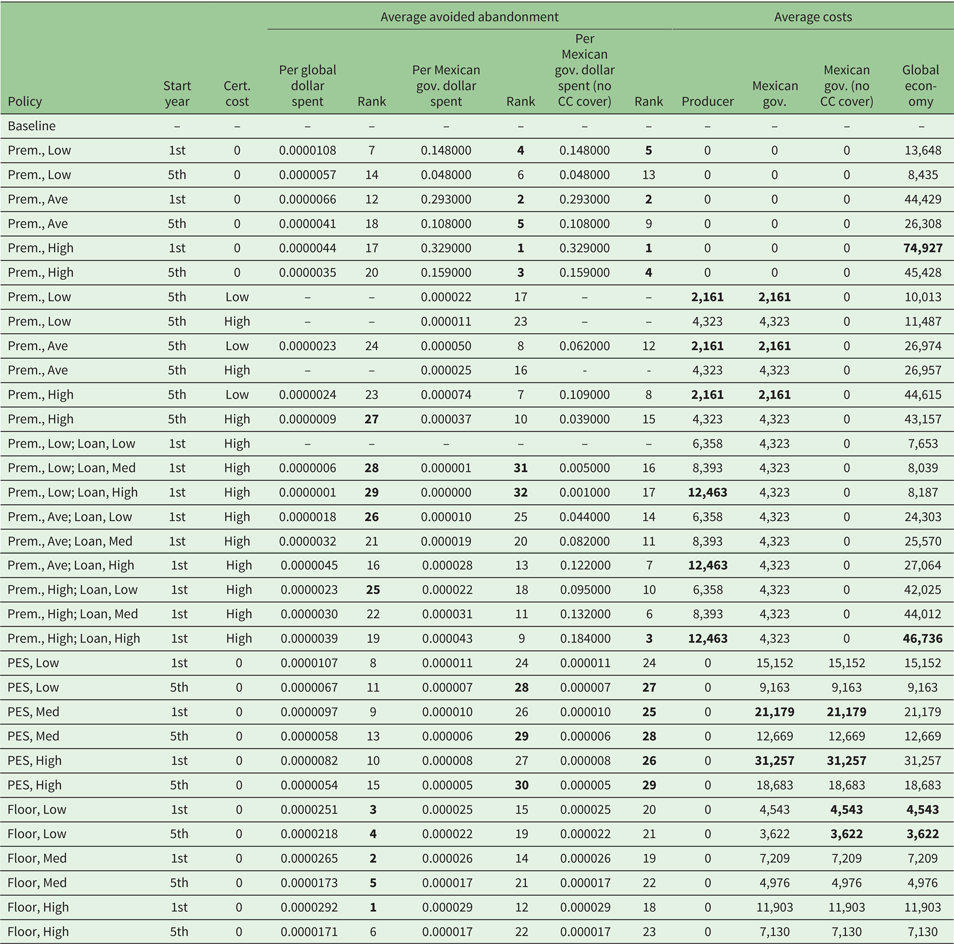
Notes: Average avoided abandonment columns (4–9): Ranking is from best (1) to worst (34). Bolded rankings represent the five best and five worst policies. A dash represents the inability to calculate a ranking for that policy (e.g., the high price floor has no abandonment, indicating there is no average amount of time that the farmer will harvest only (HO) before abandoning (A).
Average costs columns (10–13): Bolded values represent the highest and lowest average costs.
The perspective of global society includes all costs: consumers bear price premium costs, farmers incur certification process costs, costs farmers pay in interest with loans, and the Mexican Government incurs costs from PES payments and price floors. As a result, the policies with the best bang-for-the-buck for the global society are price floors and PES payments (table 3, columns 4 and 5). The price floor policies outrank all other policies because they impose the lowest cost to the society (table 3, column 13) and perform well in avoided abandonment, followed by PES policies and price premiums without loans. The least cost-effective policies are price premiums with certification costs and loans, because both farmers and consumers incur costs, and because the delayed implementation from the certification process reduces the avoided abandonment. From both the Mexican Government and Global perspectives, savings from delaying implementation do not outweigh the extra abandonment.
7. Conclusion
Low prices, price volatility, and price uncertainty are realities in the coffee market that have implications for farmer decisions to abandon shade-grown coffee production. We build a stakeholder-grounded, stylized farm-level model of a farmer's labor allocation decision that explicitly includes the option to abandon amid low and uncertain prices, the trade-off between performing farm maintenance activities and working off-farm for wages, and the negative impact on future yields of forgoing maintenance. Because farmers often must meet subsistence needs by working off-farm and forgoing maintenance, abandonment occurs as a slow process that is difficult to reverse once begun. Although this research focuses on how prices lead to abandonment and the effectiveness of policies to stem that abandonment, the emphasis on farmer decisions lends itself to future work that incorporates yield uncertainty and policies to promote yield-rehabilitating investments following low levels of maintenance. With this focus on low and uncertain prices, subsistence constraints, and yield-maintaining labor requirements, the results demonstrate that effective policies to deter abandonment of shade-grown coffee production under forests impose few additional costs on farmers, help farmers to develop financial cushions that permit maintenance during low price years, and are implemented prior to farmers starting on the path to abandonment. Understanding the decision-making process for these types of small-scale farmers is crucial for development of effective policy measures (Holden and Binswanger, Reference Holden, Binswanger and Lutz1998). Without recognition of constraints or transactions costs, government policies may inadvertently fail to help small-scale producers (Krueger, Reference Krueger1990). Our research supports effective policy formation by modeling decisions for the small-scale farmers who are pillars of the valuable coffee industry, yet about whom little data exists.
International organizations that promote certification programs, such as ‘bird-friendly coffee,’ enable certified farmers to capture some of the global value for their production process through price premiums. If the farmers receive price premiums without any additional costs, this analysis is consistent with other studies that suggest higher prices will encourage shade-production or conservation (Ferraro et al., Reference Ferraro, Toshihiro and Conrad2005; Kitti et al., Reference Kitti, Heikkilä and Huhtala2009; Atallah et al., Reference Atallah, Gómez and Jaramillo2018; Hernandez-Aguilera et al., Reference Hernandez-Aguilera, Conrad, Gómez and Rodewald2019). In contrast, this analysis also demonstrates that the costs of certification and the waiting period before capturing that higher price can cause farmers to forgo maintenance and begin the path toward abandonment, which the subsequent price with premium rarely reverses. Some certifying NGOs grant immediate certification while spreading the cost over a transition period, which, in this framework, can dramatically reduce abandonment, but questions remain about the level of ecosystem services generated during that transition period. (Coffee Habitat, 2018). Similarly, prompt implementation of policies proves critical for stemming abandonment because those policies enable farmers to meet subsistence needs while performing yield-maintaining actions and/or to develop savings that make farmers less vulnerable to low price years that would otherwise necessitate forgoing maintenance for off-farm work.
Governments may prefer price premium policies because the government incurs few costs, which fall instead on farmers (certification costs) and coffee buyers who pay the premium, while these policies stem abandonment and reduce threats to forests and biodiversity. Without considering the incidence of the policy costs, however, this research finds price floors to be more cost effective in stemming abandonment because farmers do not face such low prices that they need to forgo maintenance and because policy costs are incurred only in low price years. PES also prevent abandonment because farmers have higher incomes in all years and can accumulate savings to use during low-price years, which makes the price that triggers off-farm work to meet subsistence needs higher. The costs of PES programs are, however, high because the payments occur in each year, which leads to lower cost effectiveness in slowing abandonment.
The model explored here was developed during, and parameterized with data from, the first Coffee Crisis. Confirming its current relevance, in a case using actual prices in this model, the farmer sought off-farm employment immediately following the price drop in 1998 and abandoned by 2002 in the absence of policy support, as observed in the region and depicted as common in stakeholder interviews in 2000. The model, then, creates a lens for informing current coffee policy discussions. Data since 2000 show that the hectares used for coffee production fell by 25 per cent between 2003 and 2017 and yield per hectare fell by more than 50 per cent (SIAP, 2018), which corresponds to data collected from a small subregion of Oaxaca that found 31 per cent of coffee farms in their sample had been abandoned by 2010 (Hite, Reference Hite2011). As a proxy for more recent abandonment, the percentage of coffee area harvested fell to below 80 per cent in 2017 (SIAP, 2018), representing a lag in abandonment of a few years following significant price drops (e.g., in 2015). As a caveat, our model results cannot be directly compared to these statistics. First, this analysis describes the response of a single representative farmer to 1,000 price paths rather than the responses of a heterogenous set of farmers to one actual price path. Second, because these data aggregate over all coffee farmer types – including our small-scale farmers and large sun-grown plantation farmers alike – they do not exclusively describe the small-scale shade coffee farmers of our model and analysis. Third, our no-policy baseline and single policy simulations do not reflect either the range and heterogeneity of the true policy setting or non-price shocks such as weather-induced yield declines. Because heterogeneities do exist in policy, we assess a range of policy values that considers fluctuations around observed values of current policies intended to keep farmers in shade-grown coffee and to protect forests from conversion following abandonment of coffee due to drops in coffee prices. Currently, most coffee producers in Mexico qualify for PES payments of 280 pesos/hectare through Mexico's ‘National Forestry Program’ (PRONAFOR, 2014), or for a price premium of 15 per cent through Organic or Bird Friendly certification (FAO, 2009), or for Fairtrade price guarantees (similar to a price floor) at $1.40 per pound (Fairtrade, Reference Fairtrade2019). Our model predicts that at these policy levels – low PES, low floor and average premium values – only a small amount of abandonment would persist. However, despite availability of these policies, barriers to participation exist and, as a consequence, the current state of coffee production in Mexico coincides more with the predictions of our no policy case with actual prices. In addition, farmers face new issues in conjunction with the low and volatile price difficulties including abandonment's impact on labor costs due to migration to towns and the yield-limiting coffee leaf rust (Ávalos-Sartorio, Reference Ávalos-Sartorio, Pinstrup-Andersen and Cheng2007; Leutert, Reference Leutert2018).
The analysis here suggests that policy during the current coffee price crisis should focus on prompt implementation of programs that enable small-scale coffee farmers to meet subsistence needs without forgoing maintenance to work off-farm. Without upfront costs, price premiums from certification programs can make farmers resilient to low price years. Policies that impose costs on farmers, however, can exacerbate their difficulties in meeting subsistence, and then increase abandonment. Concerns about the cost incidence on governments of cost-effective price floor policies suggest combining those programs with price premium policies – with the cost burden on coffee buyers – to spread the costs of avoiding abandonment across more actors. Still, when costs such as certification costs fall on farmers, the costs can drive labor decisions that lead farmers down a multi-year path to abandoning shade-grown coffee production under natural forests, which puts farmers, biodiversity and ecosystem service flows at risk.
Supplementary material
The supplementary material for this article can be found at https://doi.org/10.1017/S1355770X20000443.
Acknowledgements
The authors are grateful to Reinhold Muschler for discussions about shade-grown coffee production and policy; to Allen Blackman and various stakeholders for fieldwork participation; to Michael Batz for preliminary computational research assistance; and to Jeffrey Williams for analysis of coffee price paths.