1. Introduction
The passage of the Family and Medical Leave Act (FMLA) in 1993 marked the culmination of a decades-long campaign to guarantee job-protected leave for workers in the United States. Employers covered by the FMLA are required to provide twelve weeks of unpaid, job-protected leave for employees who are pregnant, sick, new parents, or caring for an ill family member. Many states also passed similar laws in the years immediately preceding the passage of the FMLA. The design of these policies is unusual when compared to maternity and parental leave policies worldwide or to related social policies in the United States. Observers and scholars most commonly note the lack of a paid leave guarantee in federal policy, which sets the United States apart as a global outlier. American leave policies are distinctive in other ways as well: They are strictly gender neutral in their provisions and they bundle together several types of leave. This article investigates why those latter features emerged.
I argue that the distinctive policy design of family and medical leave in the United States is explained by its roots in contestation over the civil rights policy regime that emerged in the 1960s. This policy regime was embedded in a range of policies, including civil rights statutes and changing equal protection jurisprudence, that shared an antidiscrimination logic. Before the 1960s, advocates had unsuccessfully pursued maternity leave provision through a social insurance model akin to that of programs such as unemployment insurance. When the new civil rights policy regime emerged, it altered the resources that advocates of maternity leave expansion could draw from their institutional environment. Advocates creatively and strategically reformulated their demands to fit an interpretation of this new policy regime. They first pursued a nondiscrimination standard that would require employers to provide maternity leave on the same terms as other kinds of leave, advancing this claim in administrative agencies, courts, and legislatures during the 1970s. Contestation over this pregnancy nondiscrimination standard led advocates to pursue gender-neutral parental and medical leave legislation during the 1980s–90s. During this iterative policymaking process, the civil rights policy regime enabled advocates to make new claims in new venues, but it also constrained them as they sought to defend their gains and counteract alternative interpretations of the regime. Importantly, this approach was unable to counteract other factors that prevented the adoption of a paid leave policy.
This article makes several substantive and theoretical contributions. First, it argues that scholarship on U.S. social policy should pay more attention to the impact of civil rights on social policy development after the 1960s. In particular, social scientists have insufficiently analyzed the role of civil rights in the development of new social policies and programs. Second, it builds on actor-centered theories of institutional change to show how political actors can draw on resources across policy domains during the policy process. The case analyzed here illustrates the significance of this kind of boundary-crossing across policy domains: Studying social policy without attention to advocates’ deployment of civil rights claims would make it difficult to explain the distinctive design of family and medical leave. Third, this article offers a reconceptualization of “policy regimes” and argues that we can productively use this concept in the analysis of policy development. Specifically, it introduces the concept of the civil rights policy regime and illustrates the utility of this concept in the analysis of this case.
2. Family and medical leave policy in the United States
The provisions of family and medical leave policy vary across the United States, with a national floor set by the Family and Medical Leave Act of 1993 (FMLA). The FMLA guarantees up to twelve weeks of unpaid, job-protected leave per year for workers with one year of tenure in a firm with fifty or more employees. Employers are required to reinstate workers to the same or a similar position upon their return from leave. Eligible workers can take leave for several reasons: “Medical leave” can be taken during pregnancy, illness, or temporary disability, and “family leave” can be taken to care for a new child or an ill family member. In over twenty states, leave policies exceed the benefits of the FMLA either in the duration of leave provided or the leniency of eligibility requirements. Most of these state-level leave laws were passed in the late 1980s, and several have since been amended.Footnote 1 Since 2002, nine states and Washington, DC, have passed paid family and medical leave laws.Footnote 2
The policy design of family and medical leave differs from that of other U.S. social policies that provide security for periods when individuals are unable to work. Unlike unemployment insurance or workers’ compensation, family and medical leave at the national level does not adopt a social insurance model with a system of wage compensation managed by an administrative agency. Instead, family and medical leave policy requires employers to reinstate employees after a period of leave, and administrative agencies (such as the U.S. Department of Labor's Wage and Hour Division) are charged with enforcing these requirements. This design is more akin to fair labor standards policies, such as minimum wage requirements, and as such is part of the complex web of policies that form the public-private welfare state, wherein social provision is delegated to private actors such as employers.
This approach to providing leave contrasts starkly with leave policies in other countries. The most apparent and frequently cited cross-national differences are the lack of wage compensation and the short duration of guaranteed leave in the United States.Footnote 3 However, other features set U.S. policy apart as well. Family and medical leave policy is gender neutral—unlike the prevalent global pattern, there are no separate provisions for pregnancy or maternity. It also has unusually broad coverage of different types of leave: Job-protected leave for pregnancy, medical, parental, and caregiving are bundled together into one pool. In other developed economies, the general pattern of policy development was to enact maternity leave first, and then paternity and other types of leave, with the specific provisions varying across types of leave.Footnote 4 The United States was a relative latecomer in guaranteeing maternity leave: Out of twenty-three OECD countries, over 80 percent had passed maternity leave laws by 1964, and 86 percent had done so by 1993.Footnote 5 However, the United States was relatively early in guaranteeing paternity leave: by 1994, only 39 percent of developed economies did so.Footnote 6 The provision of leave to care for ill children and family members is even more uneven and recent, with many OECD countries only adopting such policies during the 1990s–2000s.Footnote 7
The gender-neutrality and broad-coverage features of U.S. leave policy are particularly significant because efforts to create paid leave programs have been layered onto this policy design. All ten states and territories that have adopted paid family and medical leave policies have done so by creating wage compensation mechanisms on top of their existing leave policies.Footnote 8 Consequently, these jurisdictions offer paid leave for pregnancy, medical, parental, and caregiving purposes.Footnote 9 The most prominent federal proposal for paid leave also maintains the gender-neutral and broad-coverage features of the FMLA.Footnote 10
3. Theory and concepts
3.1. Theorizing policy development
This article is situated in American political development scholarship that has demonstrated the variegated and complex structure of U.S. social policy, where “various social benefits remain operationally, fiscally, and symbolically separate from one another.”Footnote 11 Scholars have shown how regulatory and fiscal tools have often been used to induce social provision through the private sector, a phenomenon that has been termed “the public-private welfare state” or “the hidden welfare state.”Footnote 12 They have also shown that different social groups experience starkly different kinds and levels of social provision and regulation, amid dramatic subnational variation.Footnote 13 Taken together, this literature portrays U.S. social policy as multidimensional and fragmented, and cautions against taking a coherent “welfare state” for granted.Footnote 14
Building on this tradition, I focus on a relatively understudied factor in the development of U.S. social policy: the impact of civil rights law and policy. Historical accounts have explored cases where civil rights laws have enabled challenges to some racial and gendered exclusions in social policyFootnote 15 and the role they have played in promoting women's employment and access to social protection.Footnote 16 A large literature has also examined the role of backlash to civil rights gains in driving support for social policy retrenchment.Footnote 17 However, social scientists have yet to more broadly assess the impact of civil rights law and policy on the design of social policies. This article presents evidence from one case where civil rights influenced the development of a new social policy program: It shows that contestation over civil rights (specifically, employment discrimination law) transformed the demands that advocates made for maternity leave provision, and consequently transformed the design of leave policy.
In the analysis below, I argue that the civil rights policy regime shaped the distinctive policy design of family and medical leave through the strategic and creative action of women's movement advocates. In making this argument, I adopt an actor-centered theory of institutional change, emphasizing the agency of policy advocates who reformulated their policy demands to fit an interpretation of the newly emergent policy regime. Advocates acted as policy entrepreneurs, engaging in a process of transposition, that is, “the application of preexisting routines and schemas to new circumstances.”Footnote 18 Their initial act of transposition—applying the antidiscrimination logic of the civil rights policy regime to claims about maternity leave provision—initiated a policy process that resulted in a gender-neutral and broad-coverage leave policy.
The insight that significant policy changes can transform subsequent political processes is a familiar one in political development scholarship, most prominently found in the literature on “policy feedback.”Footnote 19 While much policy feedback research has focused on how positive or negative feedback loops determine the survival of a given policy or on effects in the mass public, some of the literature has more broadly investigated how policy change reshapes future processes of agenda setting and problem definition.Footnote 20
This broader line of policy feedback research converges fruitfully with actor-centered theories of institutional change, which emphasize how political actors can pursue change by creatively interpreting and recombining resources drawn from the wider institutional environment. In their theory of “creative syncretism,” Gerald Berk and Dennis Galvan argue that institutions can be seen as “bundles of resources available for creative reinterpretation and recombination” by political actors.Footnote 21 Philip Rocco and colleagues use the term “institutional reconfiguration” to describe how policy entrepreneurs can creatively recombine such resources to “develop new ideas, tactical repertoires, and infrastructures to challenge existing policies.”Footnote 22 Similarly, Adam Sheingate argues that policy entrepreneurship is more likely to occur under “complex systems,” which “provide resources for the creative acts of recombination at the heart of innovation.”Footnote 23
Such creative interpretation and recombination can enable policy entrepreneurs to advance their claims, but it also subsequently modifies and constrains their goals and strategies.Footnote 24 For example, in the case analyzed below, the emergence of the civil rights policy regime enabled advocates of maternity leave to pursue their goal of maternity leave provision in a new way: advancing claims that employment discrimination law required provision of maternity leave. When opponents later challenged state-level maternity leave laws using an alternative interpretation of employment discrimination law, however, advocates’ earlier decision to formulate their demands in antidiscrimination terms constrained how they could respond.
Building on these actor-centered theories of institutional change, this article emphasizes that actors pursuing policy change can draw on resources across policy domain boundaries when formulating goals and strategies. While theories of policy feedback and actor-centered theories of institutional change invite inquiry about how actors move across policy domains, they rarely investigate such processes in practice. Policy feedback studies tend to investigate how feedback effects from prior policy changes affect future developments in the same policy domain or program.Footnote 25 A recent systematic literature review of research on policy entrepreneurs found that those studies that do address boundary-crossing tend to focus on vertical boundary-crossing between levels of government rather than horizontal boundary-crossing across policy domains.Footnote 26 This article provides evidence from one case of how actors can transpose resources across apparently distinct policy domains. Scholars and observers generally describe “civil rights” and “social welfare” as separate policy domains, reflecting how issues have been defined and constructed in U.S. politics. However, political actors need not perceive the boundaries between these policy domains as impenetrable. In the case analyzed here, advocates of maternity leave provision formulated their demand as a civil rights claim, which offered certain advantages (e.g., the ability to draw on the authority of civil rights enforcement agencies). This crucial decision to engage in transposition across policy domains subsequently led to family and medical leave policy's gender-neutral and broad-coverage design.
3.2. Policy regimes
I describe the change in the institutional environment to which advocates responded as the emergence of a new policy regime. I use the concept of policy regimes to refer to a governing arrangement embedded in a set of public policies.Footnote 27 The specific case of interest here is the civil rights policy regime, which emerged in antidiscrimination legislation and equal protection jurisprudence during the “rights revolution” of the 1950s–60s. I conceptualize a policy regime as having three dimensions. First, it contains a policy logic, shared across the policy instruments in which the regime is embedded, which defines a target problem and the corresponding role of government action. The civil rights policy regime's logic defines discrimination on the basis of a protected category as a target problem and defines the corresponding role of government as prohibiting such discrimination. While race was initially the central protected category, political actors successfully contested and expanded the definition to include sex and other categories. Second, the policy logic is interpreted and enforced by political institutions, such as administrative agencies or courts. The interpretation and enforcement of the civil rights policy regime occurs primarily through courts and agencies, such as the Equal Employment Opportunity Commission, and sometimes through legislatures. Third, political actors such as policymakers and interest groups develop shared expectations that political institutions will interpret and enforce the policy logic. These actors need not agree with each other but, rather, recognize the presence of a policy logic and contest its interpretation and enforcement. For example, both advocates and opponents contested the meaning of the civil rights policy regime's antidiscrimination logic, pressuring administrative agencies, courts, and legislators to adopt an interpretation that would align with their preferences.
This conceptualization differs from the most common use of the term policy regimes in the study of social policy, associated with the once-dominant welfare regimes theory. This theory defined welfare policy regimes as “the specific institutional arrangements adopted by societies in the pursuit of work and welfare.”Footnote 28 Gøsta Esping-Andersen proposed a typology of such regimes, each possessing a “social policy logic” arising from the “organization of state-economy relations.”Footnote 29 Scholars have widely used this typology of regimes to characterize and explain cross-national variation in social provision.Footnote 30 For example, the United States was classified as a “liberal” welfare regime, characterized by means-tested benefits, traditional work-ethic norms, and a lack of decommodification.Footnote 31 Welfare regimes theory, however, has been subject to numerous sustained critiques. Feminist critiques from Ann Orloff, Jane Lewis, Diane Sainsbury, and others have argued that it fails to analyze how gender shapes systems of social provision.Footnote 32 Historical-institutionalists have argued that different factors explain social policy development in states classified in the same regime type and that regime patterns are not enduring in the face of changing structural and institutional contexts.Footnote 33 American political development research on the variegation and complexity of U.S. social policy also challenges the notion that this policy domain can be described as governed by a single, enduring regime.Footnote 34
These critiques of welfare regime theory are persuasive, but we need not abandon the concept of policy regimes altogether in the analysis of social policy development. The core flaw of welfare regimes theory's conceptualization is that it first assumes a bounded problem or issue area (“work and welfare”), and then characterizes a policy logic underlying the set of policies that address that problem.Footnote 35 This approach leads to a deterministic view that has difficulty explaining incremental change or recognizing how multiple logics can shape policy development. To address this flaw, my reconceptualization decouples policy regimes from bounded policy domains.Footnote 36 Instead of describing stable features of a particular policy domain, policy regimes here describe contestable governing arrangements that actors encounter during the policy process. As such, this conceptualization allows for the possibility that multiple logics, embedded in multiple policy regimes, can interact during policy development.Footnote 37
This conceptualization offers several further advantages for the study of policy development. First, identifying a policy regime rather than a specific policy as the independent variable enables us to see the effect of a logic embedded in several policies. In the case analyzed here, for example, it was not only the employment discrimination provision of Title VII of the Civil Rights Act that shaped policy development, but also other policies that shared this provision's antidiscrimination logic, including state-level employment discrimination laws, administrative regulations, and judicial rulings. Second, this conceptualization helps to further incorporate the role of ideas and agency in the analysis of policy change. Congruent with a growing body of work that shows how ideas and institutions interact in all stages of policy development, it enables analysis of one way in which political actors can creatively deploy ideas that are embedded in institutions to shape policy design.Footnote 38 Third, decoupling regimes from bounded policy domains enables us to see how actors can deploy the logic of a policy regime across multiple domains. This is one way in which actors can engage in the kind of horizontal boundary-crossing discussed above.
4. Argument
My core argument is that the gender-neutral and broad-coverage design of family and medical leave policy was the result of advocates’ creative and strategic use of resources provided by the civil rights policy regime. The emergence of this regime, and particularly the prohibition against sex discrimination in employment, changed the bundle of resources available to advocates of maternity leave provision. Specifically, the regime offered advocates a new policy logic that they could apply to their demands and new venues in which to advance their claims. In response, state actors and opponents contested the meaning of the civil rights policy regime and how it applied to advocates’ claims. Advocates continued to reformulate demands in order to defend prior policy gains and respond to opponents’ use of the regime.
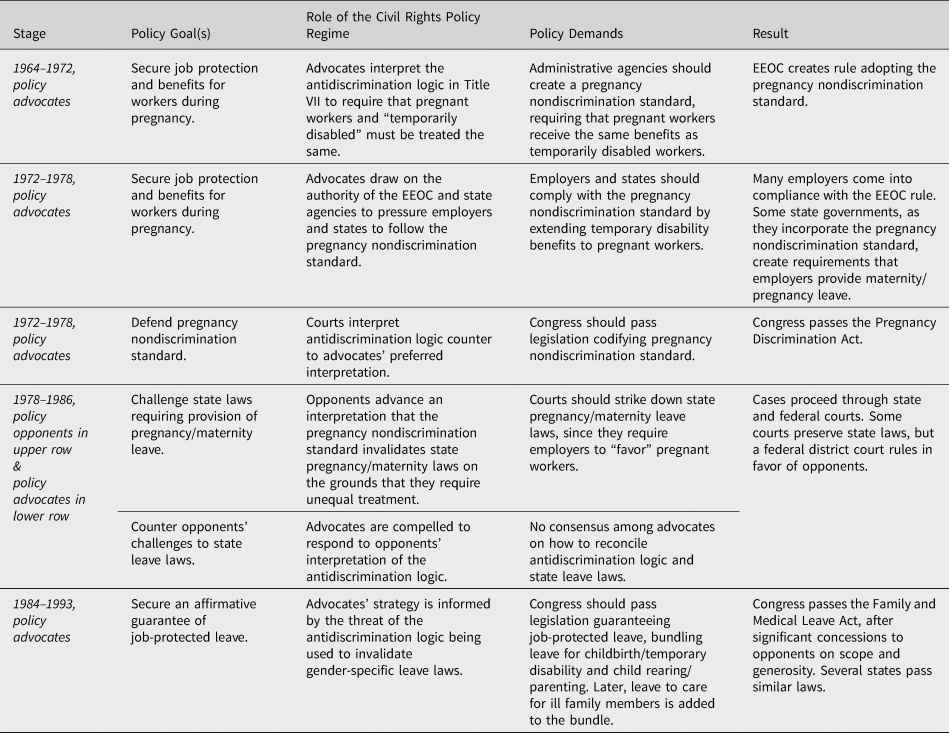
Table 1 summarizes the stages of this iterative policy development process. First, during 1964–72, advocates argued that antidiscrimination law required employers to provide pregnant workers the same leave benefits available to sick or temporarily disabled workers, and successfully secured an administrative regulation with this pregnancy nondiscrimination standard. During 1972–78, two processes occurred concurrently. Advocates and legislators used their newly won pregnancy nondiscrimination standard, and civil rights law more broadly, to pressure employers and states to increase pregnancy leave provision. Meanwhile, opponents successfully challenged the pregnancy nondiscrimination standard in the courts, and advocates responded by pursuing and securing legislation to codify this standard. Then, during 1978–86, opponents of leave policy deployed the civil rights policy regime's antidiscrimination logic to challenge recently passed state-level pregnancy leave statutes in the courts. In response, during 1984–93, advocates turned to a legislative strategy to establish an affirmative guarantee of job-protected leave that would withstand legal challenges.
Summary of the Iterative Policy Development Process

By tracing contestation over these successive stages, we can see how the civil rights policy regime shaped the design of family and medical leave policy. By the final stage of the process, advocates were committed to pursuing a gender-neutral policy so as to defend prior policy gains and counter possible challenges from opponents. Over the course of the process, in order to make antidiscrimination claims, advocates had to analogize maternity leave to other kinds of leave available to men (e.g., analogizing leave for childbirth to leave for illness). Since this entailed a policy design that offered a pool of leave that employees could use for multiple purposes, it opened the possibility of adding and bundling further categories of leave, including leave to care for ill family members. As they embarked on their legislative campaign, advocates expressed a desire for paid leave benefits but faced significant barriers in pursuing a paid leave program. The civil rights policy regime, with its emphasis on individual rights, did not provide resources that could help overcome these barriers.
Stated formally, I argue that the civil rights policy regime was a necessary (but not sufficient) condition for the policy design of family and medical leave. Several other factors played a role in the policy process, but these cannot explain the gender-neutral and broad-coverage features of the policy. Advocates and policymakers referred to changing economic conditions and changes in the discourse on gender and family as they formulated goals and strategies during the policy process. However, while these trends may have contributed to the relative salience of the issue over time, they do not explain the key decisions pertaining to policy design.Footnote 39 Another key factor during this period was the influence of business interests, which scholars often point to when explaining the weakness of U.S. social policy and patterns of retrenchment during the late twentieth century.Footnote 40 Business interests were the primary opponents of leave provision throughout the period studied in this article, and their political power does help explain the failure to adopt a paid leave policy. However, this constraint cannot explain how the gender-neutral and broad-coverage features of leave policy emerged. Both the strength of business interests and advocates’ use of the civil rights policy regime must be considered together in order to explain family and medical leave's policy design.Footnote 41
This article builds on existing research about family and medical leave policy. Several social science studies have examined the passage of leave legislation during this period. Most of these studies seek to explain policy adoption, investigating how party politics, interest group resources and strategies, and structural and economic changes explain the success or failure of federal and state proposals.Footnote 42 This article turns its focus to explaining policy design, particularly the gender-neutral and broad-coverage features of leave policy. Studies by Lise Vogel, Steven Wisensale, and Anya Bernstein have attended most closely to developments in policy design.Footnote 43 This article extends their work theoretically and substantively. It more closely investigates how advocates and opponents applied and contested the antidiscrimination logic of civil rights as they formulated demands, and traces how early decisions by advocates had significant downstream effects. It also draws on a wider range of historical evidence to show how the civil rights policy regime shaped the process across stages of policy development and levels of government.Footnote 44 For more on the sources used for historical evidence, see Appendix A.
5. Historical analysis
5.1. Maternity leave advocacy before 1964
Prior to the 1960s, advocates of maternity leave provision generally attempted to create a social insurance program similar to unemployment insurance or workers’ compensation. Under such a policy, workers would be entitled to a specified period of leave for pregnancy and childbirth, during which they would receive partial wage compensation through a tax-funded program. This gender-specific social insurance approach was the norm across industrialized countries at the time, as reflected in a convention on maternity leave adopted by the International Labor Organization (ILO) in 1919. By 1952, at least forty countries had created social insurance programs for maternity leave provision.Footnote 45
In the United States, there were several failed proposals for maternity leave through a social insurance model during the first half of the twentieth century. Legislative proposals for health insurance and social insurance programs in New York and Massachusetts during 1919–20 and in Congress during the 1930s–40s included provisions for wage compensation during maternity leave. Some of these proposals failed narrowly, while most did not gain much traction.Footnote 46 During the 1940s, labor feminists and advocates in the Women's Bureau and Children's Bureau pursued two strategies to expand provision of maternity leave benefits: campaigning for new social insurance programs and securing benefits through collective bargaining.Footnote 47 In 1952, Frieda Miller and other advocates from the Women's Bureau played an important role in crafting new ILO standards on maternity benefits, which recommended the provision of job-protected maternity leave through a social insurance program. Despite their prominence at the ILO proceedings, these American advocates were barely able to launch public debate on the home front, let alone achieve policy adoption.Footnote 48
One exception to the broader failure of the social insurance approach serves as an example of the road not taken. In the 1940s, several states considered legislation that would create tax-funded temporary disability insurance (TDI) programs. TDI programs provided wage compensation for ill or “temporary disabled” workers and were designed to bridge the gap between workers’ compensation and unemployment insurance programs.Footnote 49 Rhode Island, the first state to adopt such a policy, included coverage of pregnancy in its 1942 law. In the program's early years, 22 percent of claims were made by pregnant women.Footnote 50 State officials complained that maternity benefits were a “drain” on the program, and the legislature curtailed the generosity of benefits in 1946 and 1950.Footnote 51 All four states that passed TDI programs after Rhode Island explicitly excluded pregnant workers.Footnote 52
A Women's Bureau report in 1960 summarized the bleak situation: No states required employers to provide job-protected maternity leave, only Rhode Island provided wage compensation during maternity leave, six states had statutes requiring mandatory leave for pregnant women without job security or wage compensation, and thirty-five states excluded pregnant women from accessing unemployment insurance benefits.Footnote 53 Employers frequently dismissed pregnant workers or imposed mandatory leave without job protection.Footnote 54
Existing scholarship offers some clues about why social insurance programs providing maternity leave were not adopted during this period. During the Progressive Era, the United States exhibited a “maternalist welfare state,” where policies such as mothers’ pensions and protective labor legislation were premised on the logic that women were primarily caregivers and exempted from formal employment.Footnote 55 The Sheppard-Towner Act of 1921 provided funding for maternity and infant care, but it did not address the impact of maternity on women's employment.Footnote 56 This gendered logic in social policy persisted in the New Deal Era, where new social insurance programs tended to reinforce the male-breadwinner model and presume that white women were outside the formal labor market. Agricultural and domestic work, in which many women of color were employed, were largely excluded from New Deal social insurance programs.Footnote 57 Advocates of maternity leave provision thus faced an unfavorable environment suffused with gendered assumptions about labor, race, class, and family structures.
By the early 1960s, advocates continued to support a social insurance approach to maternity leave provision, albeit with a lack of consensus on policy design. This state of affairs was reflected in the proceedings of the President's Commission on the Status of Women (PCSW), an advisory body that brought together representatives from labor unions, women's movement organizations, state governments, and federal administrative agencies. The PCSW was tasked with evaluating policies pertaining to women's issues and making recommendations to the executive branch.Footnote 58 In its 1963 report, the PCSW endorsed adopting maternity leave by expanding social insurance programs but remained vague on details.Footnote 59 The PCSW's Committee on Private Employment decried the lack of maternity leave provision in the United States but offered no clear policy recommendation.Footnote 60 The Committee on Social Insurance and Taxes reported that it was divided “as to the best method of securing or providing maternity benefits.”Footnote 61 At this time, some activists such as Pauli Murray were lobbying the PCSW to make sex discrimination claims similar to the race discrimination claims that were prominent in national politics, but most PCSW members remained uncertain about such an approach.Footnote 62
5.2. 1964–1978: Pursuing a pregnancy nondiscrimination standard
The politics of maternity leave advocacy began to change after the enactment of the Civil Rights Act of 1964. Title VII of the Act included a prohibition on sex discrimination in employment.Footnote 63 Soon after the law passed, a debate ensued among women's movement organizations about how to interpret and react to the sex discrimination provision.Footnote 64 The National Organization for Women (NOW), formed in 1966, argued that Title VII should invalidate all employment legislation that made sex-based classifications. Many labor feminists and older women's movement organizations opposed this interpretation and sought to retain some “protective legislation” that relied on sex-based distinctions, such as laws that set maximum working hours for women.Footnote 65 A few advocates modified their position after the passage of Title VII. For example, Esther Peterson, a prominent labor feminist and then–special assistant to the president for consumer affairs, had initially opposed sex discrimination legislation but saw Title VII as an opportunity to standardize protective legislation with benefits for both women and men.Footnote 66 Despite this range of positions, women's movement advocates broadly agreed that policies requiring job-protected maternity leave were commensurate with Title VII. NOW's stance was that policies entailing differential treatment based on “real biological factors, such as maternity leaves, separate rest rooms, pregnancy and the like … [were] compatible with Title VII.”Footnote 67 Pauli Murray and Mary Eastwood, two prominent advocates of the equal-treatment approach, argued that maternity legislation was an exception where sex-specific laws “would not be constitutionally objectionable if classification by sex were prohibited.”Footnote 68
The Equal Employment Opportunity Commission (EEOC) was charged with enforcing Title VII, but it was initially reluctant to enforce the sex discrimination provision due to neglect, confusion, and a lack of capacity.Footnote 69 Top-level EEOC officials believed their role was primarily to address racial discrimination, even though one-quarter of the complaints the agency received in its first year were about sex discrimination, among which the most frequently reported issue was “loss of jobs due to marriage or pregnancy.”Footnote 70 NOW and other advocates pressured the EEOC to implement the sex discrimination provision by issuing guidelines on a number of topics, including job-protected maternity leave.Footnote 71 The EEOC did issue guidelines in 1966 stating that firing employees because of pregnancy was unlawful, but allowed several exemptions and enforced the rule weakly.Footnote 72 The agency gradually addressed sex discrimination more often in response to intensifying pressure, but its actions to protect pregnant workers remained limited.Footnote 73
Meanwhile, some women's movement advocates were reformulating demands for maternity leave provision by drawing on the resources made available by the emerging civil rights policy regime. The application of an antidiscrimination logic to maternity leave provision was first made by the Citizens’ Advisory Council on the Status of Women (CAC), which succeeded the PCSW in late 1963. In the initial years after the passage of Title VII, CAC members maintained frequent communication with EEOC officials and sought to balance the new law with protective legislation for women. From 1967 onward, the CAC increasingly embraced the sex discrimination provision in Title VII, responding to debates launched by NOW and to growing examples of successful judicial action by other interest groups.Footnote 74 This shift extended to their ongoing interest in maternity leave provision. In 1968, the CAC's Task Force on Social Insurance and Taxes recommended that “the general system of protection against temporary wage loss because of disability should include protection of working women against loss of earnings when they are unable to work before and after childbirth,” suggesting that maternity leave could be analogized to paid leave provided for temporary disabilities.Footnote 75 In 1970, the CAC went further and formulated a policy demand for maternity leave provision centered on an antidiscrimination logic, recommending that:
Childbirth and complications of pregnancy are, for all job-related purposes, temporary disabilities and should be treated as such under any health insurance, temporary disability insurance, or sick leave plan of an employer, union, or fraternal society. Any policies or practices of an employer or union, written or unwritten, applied to instances of temporary disability other than pregnancy should be applied to incapacity due to pregnancy or childbirth, including policies or practices relating to leave of absence, restoration or recall to duty, and seniority.
No additional or different benefits or restrictions should be applied to disability because of pregnancy or childbirth, and no pregnant woman employee should be in a better position in relation to job-related practices or benefits than an employee similarly situated suffering from other disability.Footnote 76
The CAC's 1970 recommendation was intended to inform rule making by the EEOC and other administrative agencies.Footnote 77 The recommendation focused on “childbirth and complications of pregnancy,” requiring that these be treated the same as other temporary disabilities that employees may experience. As CAC Chair Jacqueline Gutwillig later explained, this formulation made an implicit distinction between the “childbirth” and “child-rearing” aspects of maternity. Leave benefits for each of these could be pursued on gender-neutral grounds: The former could be analogized to temporary disability, while the latter was more straightforwardly applicable to both men and women.Footnote 78
Adopting a nondiscrimination logic offered the advantage of using the enforcement capacity of the EEOC to expand access to maternity leave through “the present framework of fringe benefits” provided by employers, without the need for legislative action.Footnote 79 The civil rights policy regime enabled this new kind of claim, but it also presented certain limitations, as Catherine East, the executive secretary of the CAC, clearly explained: “EEOC has absolutely no authority to require an employer to set up a system of sick leave, or temporary disability, or any other system. All they have the authority to do is to say, if you do have one, you cannot discriminate against women or blacks or anything else.”Footnote 80 The CAC defended its antidiscrimination formulation against the counterargument that pregnant workers should receive special benefits, arguing that “giving special treatment for pregnancy will inevitably lead to situations in which men and other women who are suffering from disabilities other than pregnancy will have less benefits than pregnant women,” which it argued was “not sociologically or economically justified and would be divisive.”Footnote 81
As the CAC formulated its new policy demand, advocates elsewhere were also taking advantage of resources provided by the civil rights policy regime. Women's movement and civil rights advocates continued to lobby government officials to institute sex nondiscrimination policies similar to that in Title VII. In 1967, President Johnson added sex to the list of protected categories in an Executive Order banning discrimination by federal contractors.Footnote 82 The Office of Federal Contract Compliance (OFCC) issued guidelines to enforce this order in 1970, including a requirement that contractors provide job-protected maternity leave to pregnant workers.Footnote 83 Legal feminists and OFCC officials held joint conferences to train lawyers and activists to file complaints and suits under the new rules.Footnote 84 Starting in 1971, several state antidiscrimination agencies adopted new regulations requiring employers not to discriminate against pregnant workers in the provision of leave benefits, echoing the CAC's recommendation.Footnote 85 Some EEOC officials argued publicly that sex discrimination law should be interpreted as requiring the provision of job-protected pregnancy leave, pressuring the agency to take a clear position.Footnote 86 Internally, the EEOC had been formulating new guidelines addressing pregnancy leave since 1970, and feminists in the agency, such as Commissioner Ethel Walsh, were pushing for these to be finalized more quickly.Footnote 87
The EEOC finally issued new guidelines on sex discrimination in April 1972, including a rule on “employment policies relating to pregnancy and childbirth.”Footnote 88 The rule was two-pronged. First, it largely adopted the CAC's recommendation, stating that “disabilities caused or contributed to by pregnancy, miscarriage, abortion, childbirth, and recovery therefrom are, for all job-related purposes, temporary disabilities and should be treated as such under any health or temporary disability insurance or sick leave plan available in connection with employment.” This created an affirmative right for pregnant women to access any available leave programs. Second, the rule stated that “termination of an employee who is temporarily disabled … by an employment policy under which insufficient or no leave is available” constituted a Title VII violation if it impacted one sex disproportionately. Since the rule considered pregnancy a temporary disability, this effectively meant that employers were required to reinstate pregnant workers who took a leave of absence, even if they offered no generic leave policy to all workers. This new rule came at a time when enforcement of the civil rights policy regime was being strengthened, with the passage of legislation that expanded the scope of employers covered by Title VII and gave the EEOC authority to sue employers.Footnote 89
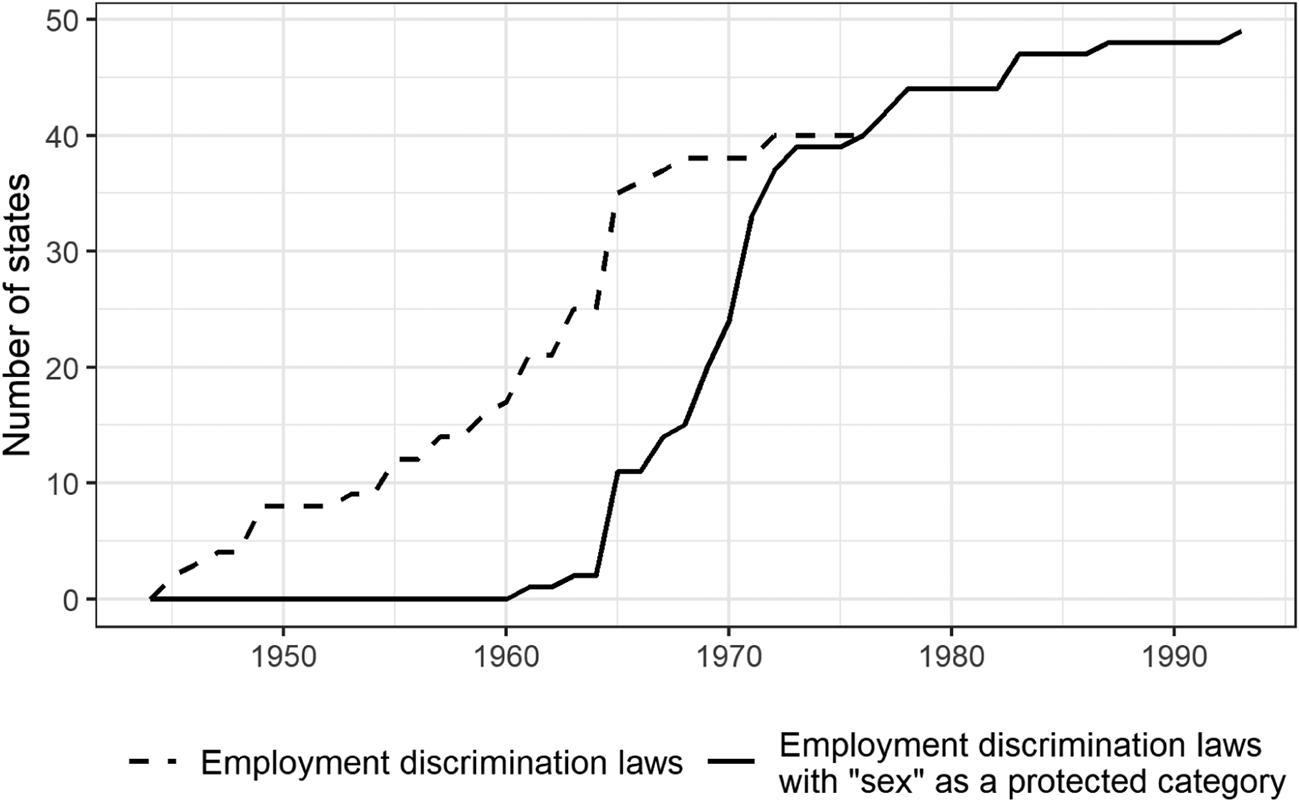
Meanwhile, the inclusion of sex as a protected category in employment discrimination law was becoming increasingly common on the state level. Out of the twenty-six state-level employment discrimination laws on the books in 1964, only the ones in Wisconsin and Hawaii included sex as a protected category.Footnote 90 In 1965, nine more states included sex discrimination provisions in their employment discrimination laws. Some, like Maryland and Nebraska, did so as part of new laws modeled on Title VII, whereas others, such as New York and Massachusetts, were adding sex discrimination provisions to employment discrimination laws that had existed since the 1940s. By 1970, nearly half of all states included sex as a protected category in their employment discrimination laws (see Figure 1). As state-level antidiscrimination agencies and the EEOC intensified enforcement of sex discrimination law, state-level protective legislation also came under increasing scrutiny. Despite labor feminists’ earlier attempts to retain some protective legislation, the growing trend was either repeal or extension of benefits to men.Footnote 91
Growth of State Laws Prohibiting Sex Discrimination in Employment.
Sources: See Appendix B.

In this context, the new EEOC rule equipped advocates to lobby employers and states to extend job-protected leave for pregnant workers.Footnote 92 As press coverage of the EEOC's new rule and subsequent litigation grew, employers became significantly more likely to adopt leave policies compliant with the rule.Footnote 93 Labor unions such as the United Steelworkers of America and the Communications Workers of America used the new guidelines to strengthen their position in negotiations with employers, with the latter filing over 100 charges at the EEOC as a part of their effort to secure better maternity leave benefits for workers.Footnote 94 State agencies enforcing employment discrimination laws continued to create pregnancy nondiscrimination rules, and over a dozen states had adopted such regulations by 1976.Footnote 95 Hawaii, Rhode Island, and New York all took action to cover pregnant workers in their state-run TDI programs between 1973 and 1976.Footnote 96
During this period, it seemed that the CAC's vision of pursuing child-rearing leave on gender-neutral grounds was a viable one as well. In 1971, two men filed a complaint alleging that the New York City Board of Education was in violation of Title VII because they provided post-childbirth (i.e., child-rearing) leave for mothers but not for fathers. The EEOC seemed ready to rule in their favor before the Board of Education changed its policy to allow child-rearing leave for both men and women in 1973.Footnote 97 A male teacher in Seattle made a similar claim in a complaint to the Washington State Human Rights Commission in 1974, but the school district agreed to grant a one-year paternity leave and the teacher dropped his complaint.Footnote 98
After early successes in changing state and employer policies, the viability of the pregnancy nondiscrimination approach was threatened by unfavorable judicial action. Initially, it seemed that the courts might support advocates’ position: Several federal courts upheld the EEOC's guidelines in the early 1970s, and the Supreme Court struck down mandatory leave policies that dismissed pregnant workers without job protection in 1974.Footnote 99 However, in two subsequent cases, Geduldig v. Aiello (1974) and GE v. Gilbert (1976), the Supreme Court rejected the pregnancy nondiscrimination standard.
Geduldig v. Aiello began as two class-action lawsuits filed in 1972 by women who were denied benefits during pregnancy under California's TDI program. The plaintiffs, represented by feminist and labor lawyers, argued that the program's exclusion of pregnant workers violated the Fourteenth Amendment's equal protection clause. This argument was supported by a broad coalition of feminist, labor, and liberal groups as well as the EEOC.Footnote 100 In response, the state of California argued that pregnancy was not similar to temporary disability since it was a “normal” and voluntary condition, and that excluding pregnant workers was justified by concerns over program costs. Although the case concerned a state-run program, several interest groups representing businesses filed amicus curiae briefs, echoing California's arguments and using the opportunity to challenge the EEOC's 1972 guidelines.Footnote 101 A federal district court had ruled in favor of the plaintiffs in 1973, endorsing the pregnancy nondiscrimination standard. The next year, however, the Supreme Court ruled that the exclusion of pregnant workers did not constitute sex discrimination and was justifiable based on the state's rational interest in keeping the TDI program solvent.Footnote 102
The EEOC continued to implement its guidelines after the setback in Geduldig, since it drew its regulatory authority from Title VII rather than the Fourteenth Amendment.Footnote 103 Policy advocates similarly emphasized that their pregnancy discrimination claims were based on the authority of Title VII and similar state laws, which they argued imposed a stricter standard than the Fourteenth Amendment.Footnote 104 This defense was tested in GE v. Gilbert, a case that arose when several General Electric employees challenged the company's exclusion of pregnant workers from disability benefits as a violation of Title VII. Feminist lawyers working on the case built on their arguments in Geduldig and further argued that the exclusion of pregnant workers from benefit programs was part of a broader pattern of favoring male breadwinners.Footnote 105 The Supreme Court's decision in 1976 dealt a major blow to advocates and the EEOC. The Court denied that pregnancy discrimination constituted sex discrimination, ruling that this interpretation was not supported by the “plain meaning” of Title VII nor by congressional intent, and struck down the EEOC's 1972 guidelines.Footnote 106
The Gilbert ruling set off a firestorm among policy advocates. Within a week of the ruling, a coalition of feminist groups formed to pursue a congressional override. The Campaign to End Discrimination Against Pregnant Workers quickly ballooned to comprise more than 200 groups.Footnote 107 The coalition joined labor feminists, women's movement organizations such as NOW and the League of Women Voters, and civil rights groups such as the NAACP under the leadership of ACLU attorney Susan Deller Ross and labor attorney Ruth Weyand, who had been part of the litigation team in Gilbert.Footnote 108 In subsequent months, the coalition even expanded to include “strange bedfellows” such as some conservatives and antiabortion groups.Footnote 109
The advocacy coalition pursued legislation that would codify the EEOC's guidelines on pregnancy discrimination. In Congress, advocates and their legislative allies framed the bill as protection for families, especially vulnerable mothers, during a time of market insecurity. Conservatives were particularly attracted to what Deborah Dinner has called “neomaternal” arguments emphasizing “the social value of reproduction.”Footnote 110 Although advocates were making new kinds of arguments, the content of the bill was firmly situated in the civil rights policy regime. Continuing to pursue a nondiscrimination policy design offered two key advantages. First, it would allow advocates to defend gains made under the EEOC rule and similar state-level regulations and to continue their strategy of expanding leave provision through regulatory enforcement and litigation.Footnote 111 Second, even as they articulated the particular needs of pregnant workers, a nondiscrimination design enabled advocates to claim that the bill would not constitute special benefits for pregnant workers.Footnote 112 In response to advocates, business interests mobilized to oppose the bill, largely repeating their arguments from Geduldig and Gilbert that pregnancy could not be analogized to illness and that the proposed policy would impose significant costs on employers.Footnote 113
Success came quickly—the Pregnancy Discrimination Act (PDA) was passed and signed into law in 1978. The PDA amended Title VII to state that sex discrimination included discrimination “on the basis of pregnancy, childbirth, or related medical conditions” and that women affected by those conditions “shall be treated the same for all employment-related purposes … as other persons not so affected but similar in their ability or inability to work.”Footnote 114 As such, it codified the first of the EEOC rule's two prongs, analogizing pregnancy to temporary disability. This allowed advocates to continue their strategy from the mid-1970s, and indeed, the rate of litigation concerning maternity leave policies intensified after the passage of the PDA.Footnote 115 However, the statute did not adopt the EEOC rule's second prong, which required employers to reinstate workers who took a leave of absence for pregnancy regardless of the leave benefits they offered other workers.
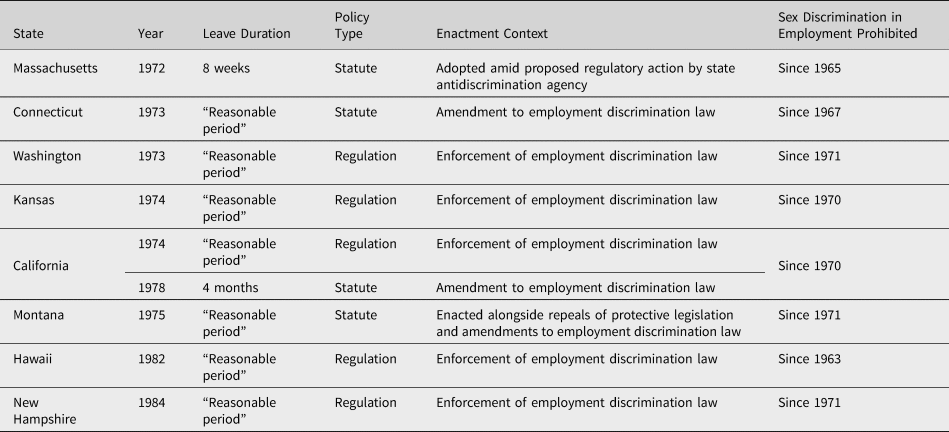
While national-level advocacy had yet to yield an affirmative guarantee of job-protected maternity leave, several states were moving in this direction. Between 1972 and 1978, new regulations or legislation in at least six states required employers to provide voluntary job-protected pregnancy leave (see Table 2). This pattern of policy adoption was part of ongoing adaptation to the civil rights policy regime. Massachusetts, which passed a law guaranteeing eight weeks of voluntary job-protected pregnancy leave in 1972, did so after the state's Commission Against Discrimination had considered adopting a similar provision as part of its guidelines on sex discrimination and amid efforts to repeal earlier protective legislation.Footnote 116 Connecticut passed a law in 1973 that barred pregnancy discrimination and required employers to provide a “reasonable period” of leave with reinstatement rights, codifying the state antidiscrimination agency's existing interpretation of employment discrimination law.Footnote 117 Administrative agencies that enforced antidiscrimination laws in Washington, Kansas, and California created regulations that imposed an affirmative requirement on employers to provide job-protected pregnancy leave during 1973–74.Footnote 118 In Montana, the state legislature created a committee to study how protective labor legislation should be reconciled with antidiscrimination law. One of the commission's recommendations was to enact legislation requiring employers to provide a reasonable period of job-protected leave to pregnant workers, which the state legislature adopted as the Montana Maternity Leave Act in 1975.Footnote 119 In 1978, California passed legislation that codified its earlier administrative regulation and created an affirmative guarantee of four months of leave.Footnote 120
State Statutes and Regulations on Pregnancy Leave, 1972–84

After the passage of the PDA in 1978, only Hawaii and New Hampshire adopted policies requiring employers to provide a reasonable period of pregnancy leave, through administrative regulations issued in 1982 and 1984.Footnote 121 Seven states amended their employment discrimination laws to include provisions prohibiting discrimination on the basis of pregnancy, childbirth, or related conditions, but—like the PDA—did not include affirmative guarantees of job-protected pregnancy leave.Footnote 122 It is unclear why the enactment of affirmative guarantees of leave stalled after 1978, but a plausible explanation is that ongoing litigation over pregnancy leave laws (discussed below) created uncertainty about whether such policies could survive legal challenges.
To summarize, there were three developments during 1964–78 where the civil rights policy regime influenced the strategic action and policy demands of political actors (as shown in rows 1–3 of Table 1). First, during 1964–72, women's movement advocates reacted to the inclusion of sex discrimination in Title VII by developing a pregnancy nondiscrimination standard and pressuring the EEOC to adopt it. Once it was adopted, they used the EEOC rule to pressure states and employers to expand maternity leave provision. Second, during 1972–78, these advocates defended their pregnancy nondiscrimination standard against judicial challenges, but the Supreme Court rejected their interpretation of the civil rights policy regime. They turned to a legislative strategy and succeeded in codifying a pregnancy nondiscrimination standard by statute. Third, also during 1972–78, state-level policymakers continued to adapt to the inclusion of sex as a protected category in the civil rights policy regime and the emergence of a pregnancy nondiscrimination standard. In addition to adopting rules similar to the EEOC's, several states went further and interpreted sex discrimination law as imposing an affirmative requirement to provide pregnant workers with job-protected leave.
5.3. 1978–1993: Pursuing a gender-neutral guarantee of leave
Both the pregnancy nondiscrimination standard and state laws affirmatively requiring the provision of pregnancy leave emerged out of adaptation to the civil rights policy regime and advocates’ creative interpretation of it. State-level policymakers and EEOC officials saw the two types of policies as compatible with each other.Footnote 123 However, after 1978, opponents of leave policies began to use the pregnancy nondiscrimination standard to attack state pregnancy leave laws, arguing that the latter required employers to favor pregnant workers over those who were not pregnant. Opponents now deployed resources provided by the civil rights policy regime; rather than simply denying advocates’ interpretation of the antidiscrimination logic, they advanced an alternate interpretation that fit their goal of restricting the provision of maternity leave.
The first major challenge was to the Montana Maternity Leave Act, in Miller-Wohl Co. v. Commissioner of Labor & Industry. In this case, an employer argued that the Montana statute's requirement to provide job-protected leave to pregnant women violated the PDA, since it offered a benefit to pregnant women but not to other workers.Footnote 124 This set off some debate among advocates about how to respond. Some regional advocates and the state antidiscrimination agency argued in amicus briefs that while the Leave Act did create a gender-based classification, it did not constitute invidious discrimination and instead furthered the PDA's broader goal of equal employment opportunity.Footnote 125 Meanwhile, several organizations that were part of the coalition behind the PDA—including the ACLU and NOW—filed a joint brief arguing that both the PDA and the Leave Act imposed substantive obligations on the employer, which could be resolved by extending leave benefits to both sexes. In 1984, the Montana Supreme Court ruled against the employer using the simpler argument that the Leave Act fulfilled the broader goals of Title VII and the PDA, since “by removing pregnancy-related disabilities as a legal grounds for discharge from employment, the [Leave Act] places men and women on more equal terms.”Footnote 126
Meanwhile, a similar case from California was being heard in the federal judiciary. In Cal Fed v. Guerra, an employer challenged California's statute requiring four months of job-protected pregnancy leave as violating the PDA. Pro-business interest groups supported employers’ arguments in both Miller-Wohl and Cal Fed, advancing an interpretation of the antidiscrimination logic in Title VII and the PDA as invalidating any state laws requiring “preferential treatment” of pregnant employees.Footnote 127 In 1984, a federal district court ruled in favor of the employer, finding that the California statute was preempted by the PDA.Footnote 128 This ruling made clear that opponents’ mobilization of the civil rights policy regime to invalidate leave policies was viable, and it prompted advocates to find a strategy that would reconcile a pregnancy nondiscrimination standard with statutory provision of maternity leave.
The coalition that had advocated for the PDA (and the EEOC rule before it) was splintered in its responses to opponents’ arguments in Cal Fed. The various amicus curiae briefs filed by advocates when the case made its way to the Supreme Court in 1986 captured the contours of this debate. Several feminist organizations, labor unions, and California elected officials formed the Coalition for Reproductive Equality in the Workplace, which defended the statute as consistent with the PDA because it relieved the discriminatory burden that inadequate leave policies placed on women (a similar argument to the Montana Supreme Court's ruling in Miller-Wohl).Footnote 129 Several other regional legal feminist organizations made similar arguments, with some arguing that not guaranteeing leave would constitute pregnancy discrimination.Footnote 130 The ACLU and NOW, joined by the AFL-CIO and several other feminist and labor organizations, repeated their position from Miller-Wohl that sex-specific leave statutes violated discrimination law, but that the proper remedy would be for courts to order job-protected leave benefits to be extended to all temporarily disabled workers, including men.Footnote 131
Amid this lack of consensus, advocates soon found an opportunity to pursue a legislative strategy for securing job-protected leave policies that would be capable of withstanding judicial review. Rep. Howard Berman (D-CA), who had been the primary sponsor of California's pregnancy leave statute, introduced a similar pregnancy leave bill in Congress in 1984. Berman had promised to introduce a federal version of the bill during his 1982 congressional campaign. The overturning of his state's statute by the federal district court in 1984 spurred him to do exactly that.Footnote 132 News of Berman's proposal, however, was “greeted with chagrin by the handful of feminist attorneys and organization representatives who had formed themselves into a committee to draft a theoretically sound disability and parental leave bill for Congressional consideration.”Footnote 133 This group of policy advocates included representatives from the Women's Legal Defense Fund (WLDF), NOW, and leaders from previous policy campaigns such as Wendy Williams and Susan Deller Ross.Footnote 134 Fearing that Berman's proposal for a gender-specific pregnancy leave law would face legal challenges, they convened to draft a gender-neutral alternative.Footnote 135
The drafting effort was led by Donna Lenhoff, associate legal director and staff attorney at the WLDF. Lenhoff and a handful of other advocates met with Berman in 1984 to discuss their preference for a gender-neutral proposal.Footnote 136 At the meeting, Lenhoff argued that pursuing a maternity-only bill would present tensions with civil rights law and pit feminists once again into an equal-versus-special treatment debate; that such a policy could prove counterproductive to women's empowerment; and that the growing publicity around Cal Fed offered an opportunity to pursue a broad, gender-neutral leave policy.Footnote 137 Working closely with the Congressional Caucus for Women's Issues (CCWI), the advocacy coalition's first draft offered twenty-six weeks of unpaid leave for temporary disabilities (including pregnancy) or care for a newborn or newly adopted child, and a separate pool of ten days of paid leave for illness or to care for ill dependents.Footnote 138 Berman and allied California legislators were concerned that a gender-neutral leave proposal of this kind would be too broad in scope to pass through Congress. They instead preferred a pregnancy-only bill, which they argued would appeal “to all the people who claim to be pro-family and pro-life.”Footnote 139 By the end of 1984, however, the WLDF-led advocacy coalition had persuaded Berman, and he handed the bill sponsorship duties to Rep. Pat Schroeder (D-CO) and the CCWI.Footnote 140 In the subsequent year, the advocacy coalition continued to expand, adding numerous feminist organizations, liberal interest groups, and labor unions.Footnote 141 In 1985, Schroeder introduced the Parental and Disability Leave Act, which offered twenty-six weeks of temporary disability leave in any one calendar year and eighteen weeks of parental leave in any two years.Footnote 142 The coalition continued to recruit more support for the bill in Congress, focusing on chairs of key committees.Footnote 143 In 1986, Schroeder and Rep. William Clay (D-MO) introduced a new version of the bill entitled the Parental and Medical Leave Act, and Sen. Christopher Dodd (D-CT) introduced a parallel bill in the Senate.Footnote 144
During 1984–86, the advocacy coalition and allied legislators made three significant decisions about policy design that persisted through the eventual passage of the FMLA. First, advocates insisted on gender-neutral leave provision. Anne Radigan, a CCWI staff member, recalled in 1988 that the advocacy coalition's position from the beginning was that “the only tolerable initiative was one that distinguished disability leave from parenting leave while ensuring both for everybody.”Footnote 145 This approach was the legislative manifestation of the argument made by some feminists in Miller-Wohl and Cal Fed that the best way to reconcile sex discrimination and pregnancy leave laws was to extend leave benefits in a gender-neutral manner.Footnote 146 Besides the need to respond to legal challenges, advocates also feared that a pregnancy-only leave policy would deter employers from hiring women.Footnote 147 They further argued that gender-neutral leave could encourage men to take on more caregiving responsibilities.Footnote 148 Recounting the legislative process several years later, Lenhoff summed up the decision to pursue gender-neutral leave: “The FMLA's gender neutrality was built in so that the act would pass muster legally; women would not be the only ones taking time off from work to care for new children or seriously ill relatives, and employers would not have women's right to take leave time as an excuse not to hire or promote them.”Footnote 149
Advocates maintained their commitment to a gender-neutral policy design throughout the legislative process. As discussed above, they rejected Berman's initial proposal in 1984 for a pregnancy-only leave bill. In early 1985, several Californian members of Congress suggested a bill that would combine gender-specific pregnancy leave with gender-neutral parental leave; the advocacy coalition firmly rejected this proposal and insisted on a gender-neutral approach.Footnote 150 This commitment persisted even after the Ninth Circuit Court of Appeals in 1985 and the Supreme Court in 1987 upheld California's pregnancy leave law in appeals of the Cal Fed case, thus overturning the district court ruling that had initially sparked the legislative strategy.Footnote 151 Rep. Schroeder used the news as an opportunity to argue that the potential short-term benefits of a narrow gender-specific bill were no longer necessary since the California statute could remain on the books.Footnote 152 Rep. Berman and Sen. Dodd stated in hearings that they were pleased with the Supreme Court's ruling, but urged Congress to extend protections nationwide since only a few states had similar laws.Footnote 153 Some advocates were not convinced that legal challenges were over for good: Lenhoff argued that the Supreme Court's ruling was limited “to the issue of whether California was pre-empted from requiring pregnancy disability leave. The Court did not address the issue of whether California employers also subject to Title VII … could lawfully provide pregnancy leave only.”Footnote 154 By 1988, when Sen. Dan Quayle (R-IN) proposed a maternity-only leave policy as an amendment during legislative debate, none of the legislators allied with the advocacy coalition were willing to entertain this alternative.Footnote 155
Some scholars have argued that advocates’ decision to “de-gender” the bill made it harder to achieve its passage. Megan Sholar argues that increasing the scope of coverage of the bill intensified opposition from the business lobby, and Anya Bernstein suggests that a maternity-only bill would have enjoyed more legislative support as it would have aligned with traditional gender norms and covered fewer people.Footnote 156 Rep. Berman and some of his Californian colleagues in Congress had expressed similar concerns during the drafting of the bill as well.Footnote 157 While the focus of my analysis is to explain policy design rather than policy adoption, it suggests that advocates’ preference for a gender-neutral bill was strategically well-grounded. As discussed above, advocates had to take the threat of legal challenges seriously. A maternity-only proposal would also have made advocates vulnerable to the critique that they were pursuing a policy that offered “special benefits” to one social group. The gender-neutral approach allowed advocates and legislators to frame the bill as a “family bill” or as “parents legislation” that would provide benefits for a larger group of people.Footnote 158 They could also frame the bill as one that “discourages, rather than encourages, sex discrimination” on the part of employers and that would “not reify stereotypic gender roles for women and men.”Footnote 159 Furthermore, as discussed in detail below, a design that pooled multiple reasons for leave would invite the addition of more types of leave and consequently broaden the advocacy coalition.
The second significant policy design decision that advocates made early on was to pursue unpaid leave.Footnote 160 In their early meetings, the advocacy coalition had agreed that an optimal policy would include wage compensation, but many members believed that passing a paid leave bill was unfeasible because of Republican control of the presidency and the Senate.Footnote 161 The bills they introduced instead called for a commission to study possible mechanisms to provide paid leave.Footnote 162 Advocates frequently mentioned the need for paid leave in congressional hearings, while supporting the unpaid leave proposal as a necessary and helpful “first step.”Footnote 163 In one hearing, Rep. Schroeder candidly admitted that the lack of paid leave in the bill was a problem, saying, “I am sorry about that. We just are not sure that the country is ready to move that far that fast.”Footnote 164 The debate on paid leave would reemerge periodically during the legislative process, but no wage replacement provision was ever included in a bill.Footnote 165
The barriers facing any effort to create a paid leave program were high, and the civil rights policy regime did not offer any particular resources to overcome these barriers. By the 1980s, the United States was in a period of social policy retrenchment. Ascendant conservatives and allied pro-business interest groups attacked existing social programs and stymied efforts to create new ones.Footnote 166 These dynamics were manifested in the leave policy debate in Congress: Republican legislators and business interests were the most prominent and consistent opponents of leave bills in Congress. Even though advocates anticipated this opposition and made no serious effort to propose paid leave, business interests still attacked their proposal as an unwarranted mandate that would impose heavy costs and logistical challenges on employers.Footnote 167 Advocates challenged these arguments in numerous ways, such as presenting alternative cost estimates and gathering testimony from employers who supported leave policies, but none of these responses drew specifically on the civil rights policy regime. Given that advocates had to make concessions in their unpaid leave proposal to win support from even a few Republican legislators, their assessment that a paid leave bill was not viable seems accurate. Antidiscrimination law, with its emphasis on individual rights, did not offer a bridge to redistributive policy design.Footnote 168 The inability to pursue paid leave during this period suggests that this lack of a redistributive orientation is a limitation of using the civil rights policy regime to pursue social policy expansion.
A third major policy design decision, made in mid-1986, was to expand parental leave into broader “family” leave that included leave to care for a seriously ill child, spouse, or parent. The House version of the bill was amended in committee in 1986 to include leave to care for ill parents, reportedly at the behest of key committee member Rep. Marge Roukema (R-NJ).Footnote 169 Future iterations of the bill were renamed the Family and Medical Leave Act and eventually covered care for ill spouses as well.Footnote 170 Members of the advocacy coalition were strongly in favor of broadly covering caregiving leave, arguing that workers in single-parent or dual-worker households—especially women—bore heavy caregiving burdens.Footnote 171 Including family care especially appealed to AARP, which took a more prominent role in the advocacy coalition from 1989 onwards and insisted that family leave cover care for both elder parents and spouses.Footnote 172 Michelle Marks argues that the broadening of the policy design was fueled by the inclusion of more coalition partners, which in turn strengthened the strategic alliance of interest groups advocating for the bill.Footnote 173 The civil rights policy regime indirectly enabled this broadening of coverage, as the decision to pursue a gender-neutral design that covered medical and caregiving leave as distinct categories created the possibility to add more categories of leave.Footnote 174
While advocates held firm on these policy design decisions, they conceded a series of amendments that weakened the scope of the bill. Opposition from Republicans and business interests, led by the U.S. Chamber of Commerce and the National Federation of Independent Businesses, gained steam as the bill became more prominent. Opponents were unable to deploy an antidiscrimination logic to challenge the design of these leave bills, as they had done in challenges to state pregnancy leave laws. They did mobilize consistently and aggressively, however, and exerted influence over Republican legislators.Footnote 175 The advocacy coalition and the bill's cosponsors gradually agreed to several compromises during 1986–92 in an attempt to win Republican support and build a veto-proof majority.Footnote 176 As Anya Bernstein notes, “the decision to pursue a gender-neutral bill was virtually the only issue on which the leaders of the national family and medical leave coalition refused to compromise.”Footnote 177 In these amendments, the overall length of leave was reduced, family leave and medical leave durations were combined into one pool of twelve weeks, and eligibility requirements were amended to exclude workers with under one year of tenure and all employers with fewer than fifty employees.Footnote 178
Meanwhile, there was a wave of activity on leave bills in state legislatures, spurred by ongoing debate in Congress, the prominence of the Cal Fed case, and organizing by groups in the advocacy coalition.Footnote 179 During 1986–90, at least forty state legislatures considered some form of leave law.Footnote 180 Policy design in state proposals mirrored the trajectory of the federal bill: For example, in 1987, there were twenty-eight gender-neutral proposals covering parental and medical leave, compared to seven that covered pregnancy only.Footnote 181 During 1986–92, thirteen states passed gender-neutral leave laws similar to the bills being debated in Congress, and nine more passed similar laws that applied only to state employees. Some of these early laws covered parental leave, but from 1988 onwards, family and medical leave became the most prevalent policy design. Meanwhile, only four states passed pregnancy-specific leave laws, and none of these passed after 1989, reflecting the consolidation of the gender-neutral and broad-coverage framework.Footnote 182
On the federal level, family and medical leave became a prominent issue in partisan politics. In the 1988 election, George Bush expressed opposition to the bill and won the presidency, but Democrats who supported the bill won a majority in Congress as well. With added impetus from the passage of a childcare bill in 1990, Democrats brought Schroeder's leave bill to the floor and passed it in both chambers, only to face a presidential veto.Footnote 183 In 1992, with family values rhetoric dominating the election and Bill Clinton campaigning in support of the bill, Democrats in Congress passed it again to “bait” another veto from Bush. This time, the Senate overrode the veto, but the House failed to do so. Congress passed the bill for the third time in 1993, and it became the first major piece of legislation signed by the newly elected President Clinton.Footnote 184
To summarize, there were two developments during 1978–93 where the civil rights policy regime influenced the strategic action and policy demands of political actors (as shown in rows 4–6 of Table 1). First, in the early 1980s, opponents challenged state pregnancy leave laws in the courts, advancing an interpretation that the antidiscrimination logic embedded in Title VII and the PDA invalidated these laws. In response, advocates diverged in their attempts to reconcile state leave laws with the antidiscrimination logic. Second, during 1984–93, advocates turned to a legislative strategy. Advocates insisted on a gender-neutral leave bill that would withstand legal challenges, and they decided to propose an unpaid leave bill because paid leave seemed unfeasible at the time. During legislative debates, advocates agreed to compromise on wage compensation, eligibility restrictions, and leave duration, but never on gender neutrality. A gender-neutral bill entailed pooling distinct types of leave; this enabled the addition of leave to care for ill family members. The unpaid, gender-neutral, broad-coverage model was adopted in many states during 1986–92 and was finally enacted federally as the FMLA in 1993.
5.4. Family and medical leave since 1993
The legacy of the FMLA and its state counterparts in expanding social protection has been mixed. The number of workers with access to job-protected leave did increase significantly after the passage of the FMLA.Footnote 185 However, family and medical leave policy continues to exclude many low-income workers due to the lack of wage compensation and the large number of workers exempted under the law's small-employer and tenure provisions.Footnote 186 As of 2020, about 89 percent of the civilian workforce had access to unpaid family leave, but only 21 percent had access to paid family leave.Footnote 187 Catherine Albiston has shown that cultural conceptions of work, gender, and disability have informed the behavior of courts and employers with respect to leave policy, hindering many workers from accessing leave benefits. However, Albiston has also shown that the FMLA created a framework of meaning that enabled workers to recognize collective grievances and mobilize rights in negotiations with employers.Footnote 188
The impact of the FMLA's policy design on subsequent policy development, however, is clear and significant. Between 2002 and 2020, nine states and Washington, DC, passed paid family and medical leave laws, and all have retained the gender-neutral and broad-coverage design. Four of these new laws created a system for paid family leave benefits by expanding existing TDI programs, and six created or will create new tax-funded social insurance programs. In all cases, the paid benefit system was layered onto provisions in existing unpaid leave laws.Footnote 189 The most prominent federal proposal for paid leave, the Family and Medical Insurance Leave (FAMILY) Act, adds a tax-funded social insurance component to the existing gender-neutral, broad-coverage model.Footnote 190 This kind of layering is what policy advocates hoped for during the campaign for the FMLA, although the wave of paid leave legislation arrived later than they had hoped.Footnote 191
The impact of the policy design formulated in the 1980s can also be seen in the recent wave of short-term paid leave policies that have been adopted in several municipalities and states since the early 2000s. Commonly referred to as “earned sick time” or “paid sick days,” these policies allow employees to accrue paid sick days at a set rate per hour worked, which employers are required to pay for. As they only provide a few days of leave per year, these policies are not a replacement for long-term family and medical leave. However, it is notable that most paid sick days laws have borrowed the broad-coverage design of the FMLA, including provisions stating that sick days can be used for pregnancy and caregiving purposes.Footnote 192
This is not to say that possibilities for alternative policy designs were completely foreclosed. In the late 1990s, a slew of paid leave proposals focused only on parental leave, largely in response to a Clinton administration regulation that enabled states to utilize surplus unemployment insurance as wage replacement for new parents taking leave.Footnote 193 Since the 2000s, however, the design of the FMLA has become further entrenched as new paid leave enactments followed its model and advocates remained firmly committed to it. In 2017, when the Trump administration proposed a six-week paid parental leave policy funded through the unemployment insurance system, the contemporary advocacy coalition expressed strong opposition for this pared-down approach.Footnote 194 In 2020, the federal government created a temporary paid leave program that covered medical and caregiving needs related to COVID-19. Advocates pushed for stronger protections—including coverage of more types of leave and job protection guarantees—and used the opportunity to advance their campaign for a permanent, comprehensive guarantee of paid family and medical leave.Footnote 195
6. Discussion and conclusion
In this article, I have argued that the gender-neutral and broad-coverage design of family and medical leave policy in the United States is explained by its origins in contestation over the civil rights policy regime. The emergence of the civil rights policy regime in the 1960s provided advocates with new resources: They could formulate demands based on the new policy logic and advance their claims in new venues by pressuring the institutions charged with civil rights enforcement to adopt their demands. Advocates’ decision to use these resources in the early 1970s launched a policy development process that unfolded over the next two decades. As Table 1 shows, advocates reformulated their demands in each stage, in response to gains and losses from previous stages. The decision to use resources from the civil rights policy regime ultimately acted as a constraint on advocates, as they had to contend with other actors’ competing interpretations and claims. As the process unfolded, advocates moved between venues and levels of government to advance their goal of securing job-protected leave for pregnant workers.
When the FMLA was finally passed into law in 1993, on the heels of state-level policy adoption during 1986–92, it marked a rare example of a new social policy program being created in an era of retrenchment. The limitations of the law—its lack of paid benefits and eligibility restrictions—reflected the challenges that advocates faced in a political environment dominated by conservative Republicans and business interests. It is striking that an advocacy coalition was able to pass a leave bill in this context. Their commitment to the legislation and their insistence on its gender-neutral design were the result of earlier advocates’ creative interpretation and application of the civil rights policy regime to the issue of maternity leave in the 1970s.
The analysis of this case suggests that American political development scholars should pay greater attention to the impact of the civil rights policy regime on social policy. Several domain-specific studies have shown that civil rights law has been used to challenge discriminatory barriers in existing social policies such as higher education subsidies, homeownership policies, public assistance programs, and labor protections.Footnote 196 As this case has shown, civil rights law has also influenced the development of new social policies. In addition to family and medical leave, another area where this has occurred is disability policy.Footnote 197 While these developments have been studied separately, we lack a systematic analysis of the advantages, limitations, and downstream consequences of a civil rights approach to social policy expansion.Footnote 198 Such a systematic analysis is particularly worthwhile, given that many organizations in the civil rights movement of the mid-twentieth century had a “dual agenda” of achieving antidiscrimination protections and expanding social welfare provision.Footnote 199
Theoretically, this article underscores how advocates, acting as policy entrepreneurs, can transpose resources across policy domains in creative and consequential ways. This case study offers an example of this kind of horizontal boundary-crossing by policy entrepreneurs. The outcome of this policymaking process, the FMLA, fits more neatly into the “social welfare” or “labor standards” domains than into “civil rights,” which can obscure the crucial impact of the latter domain on the design of the policy. By tracing the historical origins of advocates’ commitments and remaining open to the potential relevance of multiple policy domains, scholars can better explain how distinctive policy design features emerge. Analyzing boundary-crossing by advocates also shows the value of actor-centered theories of institutional change. Without attention to the agency of those who applied an antidiscrimination logic when formulating a demand for maternity leave, we cannot explain the gender-neutral and broad-coverage design of leave policy.
In advancing its argument, this article has also offered a reconceptualization of “policy regimes” and introduced the concept of the “civil rights policy regime.” Referring to a policy regime instead of a particular policy instrument has several advantages for the analysis of this case. First, the concept draws our attention to the causal role of a policy logic embedded in multiple policy instruments. It was not only Title VII but also Fourteenth Amendment jurisprudence, antidiscrimination regulations, and state employment discrimination statutes that played a role in this process. As they advanced their claims, advocates also embedded the antidiscrimination logic in additional regulations and statutes, further expanding the scope of the policy regime. Second, the concept emphasizes how the political institutions charged with interpreting and enforcing policy logics become venues for contestation. Since the antidiscrimination logic was embedded in multiple policy instruments, evoking it enabled advocates to advance their claims in a variety of venues, including the EEOC, state antidiscrimination agencies and legislatures, the courts, and Congress. Third, the concept reminds us that as political actors accept the presence of a policy logic over time, they may develop and advance conflicting interpretations of it. The alternative interpretations of the antidiscrimination logic advanced by opponents, which were sometimes accepted by courts, forced advocates to respond and reformulate their policy demands. This contestation influenced advocates’ commitment to the policy design feature of gender neutrality.
Insofar as they offered limited social protection to workers, the FMLA and state leave laws were only partial victories for advocates. However, their distinctive policy design features continue to shape the development of leave policy. With more states adopting paid leave policies in the twenty-first century, the United States is finally beginning to incorporate paid maternity benefits in its social insurance system, as advocates envisioned and other countries did in the early twentieth century. Since these paid leave programs have retained the gender-neutral and broad-coverage features of the FMLA, the United States will remain cross-nationally distinctive in its leave policy. To understand why these features have persisted, we must recognize the creative and strategic ways in which advocates deployed the civil rights policy regime during the 1970s–90s.
Supplementary Material
The supplementary material for this article can be found at https://doi.org/10.1017/S0898588X21000018.
Acknowledgments
I thank Chloe Thurston, Ann Orloff, Daniel Galvin, David Bateman, Emily Zackin, Elizabeth Remick, Warren Snead, Margaret Brower, Traci Burch, Reuel Rogers, Jim Mahoney, Emilio Lehoucq, Matthew Nelsen, S. R. Gubitz, and SAPD's anonymous reviewers for their helpful guidance and suggestions. I am also grateful for feedback from participants at the 2017 Social Science History Association Conference, the 2018 Law & Society Association Conference, the 2018 Policy History Conference, the 2018 Northwestern APD Workshop, the 2018 Midwest Law & Society Retreat, the 2019 Toronto Political Development Workshop, and the ABF Doctoral Fellows Group. I am indebted to archivists and librarians at the National Archives, the Schlesinger Library, the California State Archives, the Montana Historical Society, and the Pritzker Legal Research Center for their assistance. This research was supported by the Northwestern University and American Bar Foundation Doctoral Fellowship.