Background
Many studies have observed parent–child relationships in later life focusing on the structural indicators of intergenerational exchanges such as intergenerational co-residence, parent–child face-to-face and phone contact, and proximity (Grundy, Reference Grundy and Palloni2001; Tomassini et al., Reference Tomassini, Glaser, Wolf, van Groenou M and Grundy2004a, Reference Tomassini, Kalogirou, Grundy, Fokkema, Martikainen, van Groenou M and Karisto2004b; Grundy and Murphy, Reference Grundy, Murphy, Ebtehaj, Lindley and Richards2006, Reference Grundy and Murphy2018; Hank, Reference Hank2007). Overall, high levels of co-residence and close geographical proximity as well as frequent contact have conventionally been considered as proxy indicators of strong bonds between parents and their adult children.
Since the early 1970s, several theoretical frameworks have been developed to adapt different aspects of intergenerational relationships that have been applied to data that mainly comes from the United States of America (USA) and northern Europe (Bengtson and Roberts, Reference Bengtson and Roberts1991; Silverstein and Bengtson, Reference Silverstein and Bengtson1994, Reference Silverstein and Bengtson1997; Silverstein et al., Reference Silverstein, Chen and Heller1996). Of these theoretical approaches, probably the most widely used to interpret older parent relationships with their children is the intergenerational solidarity model developed by Bengtson (Bengtson, Reference Bengtson1975; Bengtson and Schrader, Reference Bengtson, Schrader, Mangen and Peterson1982). It identifies six elements to conceptualise such a theory, where the ‘associational’ solidarity (frequency of intergenerational interaction) is probably the most recurrent indicator used in research jointly with the structural solidarity (that measures the availability and the characteristics of the pool of children in terms of parent–child proximity). The other dimensions are less frequently explored in quantitative research given their more subjective nature and the more difficult operationalisation of the indicators to include in the analysis. Among these dimensions, ‘affectual’ solidarity (emotional closeness) focuses on the rating of ‘affection, warmth, closeness, understanding, trust, respect, etc. for family members’ that can provide an indication on the evaluation of the quality of relationships from both generations (Bengtson and Roberts, Reference Bengtson and Roberts1991: 857). Additionally, other developments of the solidarity model have been applied in later research. For example, the theory of social breakdown or the ambivalence theory (Luescher and Pillemer, Reference Luescher and Pillemer1998) that states the potential negative outcomes of a strong involvement of adult children in their parents’ lives, providing evidence that in some cases excessive care from children may have a detrimental effect on the parents’ wellbeing. Further improvements of the solidarity paradigm allow for the co-occurrence of conflict or negative feeling and emotional closeness in relationships as an indirect expression of ambivalence in feeling between generations (Bengtson et al., Reference Bengtson, Giarrusso, Mabry and Silverstein2002; Suitor et al., Reference Suitor, Gilligan and Pillemer2011). Emotional closeness, conflict and ambivalence can be transmitted over generations (Hank et al., Reference Hank, Salzburger and Silverstein2017), and when positive and negative feelings are taken into account the ambivalence could be seen as a sign of emotional intensity in the relationship (Silverstein et al., Reference Silverstein, Gans, Lowenstein, Giarrusso and Bengtson2010). Numerous applications of the solidarity and ambivalence models have been utilised in analysing different kinds of individual data, mainly in the USA and in western European countries (Silverstein and Bengtson, Reference Silverstein and Bengtson1997; Bengtson et al., Reference Bengtson, Giarrusso, Mabry and Silverstein2002; Daatland and Lowenstein, Reference Daatland and Lowenstein2005; van Gaalen and Dykstra, Reference van Gaalen and Dykstra2006; Silverstein et al., Reference Silverstein, Gans, Lowenstein, Giarrusso and Bengtson2010; Hank et al., Reference Hank, Salzburger and Silverstein2017). How these theories, mainly tested in ‘individualistic countries’, may be applied to more ‘familistic’ countries is open to debate. Indeed, while overall high levels of solidarity between family members are observed in Europe and the USA, studies also show large geographic differences in the strength of adult intergenerational ties (Hank, Reference Hank2007; Silverstein et al., Reference Silverstein, Gans, Lowenstein, Giarrusso and Bengtson2010; Brandt and Deindl, Reference Brandt and Deindl2013; Katz et al., Reference Katz, Lowenstein, Halperin and Tur-Sinai2015). In particular, southern European countries have been found to have high levels of intergenerational interaction (both in terms of co-residence and contact, as well as help provided to older parents), but rarely have other kinds of indicators on the quality of relationships been considered. Recently, Lowenstein (Reference Lowenstein2007) and Lowenstein et al. (Reference Lowenstein, Katz and Gur-yaish2007) found rather low rates of close parent–child relationships in Spain mixed with high rates of balanced exchange patterns (see also Katz et al., Reference Katz, Gur-Yaish and Lowenstein2010). Likewise, a study that observed social involvement with children in six developed countries has found that, holding constant the level of exposure to children, ‘intergenerational relations were less emotionally connected in Spain than in the other countries’ (Silverstein et al., Reference Silverstein, Gans, Lowenstein, Giarrusso and Bengtson2010: 1017). Two kinds of explanation have been suggested for such an unexpected result: on one side, the limited availability of public care services may strain family relationships when older parents are in need of care, and on the other side, the rapid modernisation of the country may have created a generation gap that has affected young people. It is therefore timely to explore the perceived rating of parent–child relationships in other ‘familistic’ countries where family ties are expected to be stronger and more intense, and welfare policies favour family responsibility, with welfare provisions playing a residual role. Italy, in this sense, may represent an interesting context to explore the rating of parent–child relationships and its association with structural indicators of intergenerational exchanges. In recent decades, Italy has incurred a number of demographic changes (such as a strong decline in fertility and an increase in the divorce rate) that can be ascribed to the second demographic transition, but interestingly these changes have rarely affected structural indicators of intergenerational solidarity (for co-residence: Tomassini and Wolf, Reference Tomassini and Wolf2000; Tomassini et al., Reference Tomassini, Wolf and Rosina2003; for contacts: Tomassini et al., Reference Tomassini, Kalogirou, Grundy, Fokkema, Martikainen, van Groenou M and Karisto2004b; for care: Broese van Groenou et al., Reference Broese van Groenou, Glaser, Tomassini and Jacobs2006; Tomassini et al., Reference Tomassini, Glaser and Stuchbury2007; for proximity: Tomassini et al., Reference Tomassini, Glaser, Askham, Arber, Davidson and Ginn2003). In particular, recent data show a high level of interaction (i.e. frequency of contact) and co-residence between older Italian parents and their adult children compared to other European countries (Hank, Reference Hank2007; Grundy and Murphy, Reference Grundy and Murphy2018). Based on this empirical evidence, the interesting question is therefore whether such strong structural ties may be an indicator of family solidarity and therefore a corresponding evaluator of a good rating of parent–child relationships, or conversely whether an over-involvement of adult children may cause distress among older parents and consequently affect evaluation (Silverstein et al., Reference Silverstein, Chen and Heller1996). Specifically, most of the studies on intergenerational transfers examine the structural characteristics of intergenerational interaction (both in terms of co-residence and contacts), emphasising the potential association with multiple measures of parents’ wellbeing, such as life satisfaction or psychological wellbeing (see e.g. Silverstein et al., Reference Silverstein, Chen and Heller1996; Katz, Reference Katz2009). Rarely, other kinds of outcome indicators (such as the rating of the parent–child relationships) have been considered. Hence, our analysis focuses on the most used structural indicator of intergenerational exchanges in Italy, i.e. frequency of contact, in view of its association with the rating of the parent–child relationships. In fact, how parents perceive the relationship with a specific child is a less-studied dimension and is rarely available in large-scale national surveys. Nevertheless, within the parent–child solidarity framework, this measure allows the level of parent–child affectual solidarity to be rated. Another interesting point is how the rating of parent–child relationships is somehow associated with the sex of the child. A recent paper explored how the sex of the child impacts on wellbeing in later life: in southern Europe especially, daughters seemed to provide greater happiness to their parents (Grundy and Murphy, Reference Grundy and Murphy2018). Further, parental gender may be an important concern when we consider parental and adult child co-habitation (Carr, Reference Carr2004; Pudrovska, Reference Pudrovska2009; Grundy and Murphy, Reference Grundy and Murphy2018), and gender roles in parenting may lead to different associations between satisfaction with relationships with children and other independent factors. Men and women are indeed connected differently to different types of solidarity (Blome et al., Reference Blome, Keck and Alber2009), thus parental gender differences also need to be considered once we analyse variables related to functional support and emotional closeness.
Aims and research questions
As several studies used structural indicators of intergenerational exchanges (e.g. frequency of contact) as proxy for strong parent–child relationships, the first aim of this research is to assess the statistical association between frequency of contact of and satisfaction with relationships with children. We used frequency of contacts since it is the only indicator (together with proximity) present in the survey that is asked for every child, while the others (e.g. care) are asked without reference to a specific child. Secondly, this study analyses factors that are associated with the rating of satisfaction with the relationship with a child. Considering each individual parent–child dyad, the models combine both selected parental and child characteristics. In order to understand whether there are gender differences in scoring the relationship with children and to check whether there is a gender partiality when assessing relationships with children, separate models for fathers and mothers have been performed. To our knowledge, this is the first Italian study to investigate the determinants of satisfaction of parent–child relationships in later life. In general, the rating of the satisfaction of parent–child relations is rather new in research as it is rarely included as a question in national surveys.
Data
The 2009 Italian IMF (‘Indagine Multiscopo sulle Famiglie e Soggetti Sociali’) was used to analyse the rating of satisfaction with child relationships. This cross-sectional survey is carried out every five years on the private household population of Italy by the Italian Statistics Institute (ISTAT) and it includes approximately 15,000 people aged 65 years and over. The response rate is around 80 per cent. The unit of the sample is the de facto household selected from the Register of Population. The survey covers a wide variety of topics, including questions on household structure, demographic background, socio-economic characteristics, housing and life histories. Since 2003, the IMF has been the Italian variant of the European Gender and Generation Survey (GGS).
Relevant for this study is the section of the questionnaire on family exchanges, including household composition, kin availability (children, parents, grandchildren, grandparents, siblings and other relatives), exchanges with non-coresident children (i.e. face-to-face and phone contact) and satisfaction with relationships with a specific non-coresident child. In this study, we selected parents older than 65 with at least one child living outside the household as the question on the satisfaction with relationships is asked about non-coresident children only. The resulting sample size is 6,888 older parents. Successively, parents with all their children living at home (which is 8.4% of the total sample of older parents) were excluded from the analysis.
To each parent, information on non-coresident children was requested for up to three children. Among those who have at least one child living outside the household, parents who have up to three children comprise 89.8 per cent of the sample. For those who have more than three children living outside the household, the questionnaire was restricted to the three living closest to their parents.
In order to create a data-set where each record refers to a single parent–child dyad, the file was restructured preserving the information on parents, but having for each parent one, two or three records depending on the number of children living outside the household: the resulting data-set therefore comprises 14,525 parent–child dyads.
Dependent variable
After having listed sex, age, proximity and frequency of contact with up to three children living outside the household, a parent is asked to rate their satisfaction on the relationship with the specific child with a scale from 0 (not satisfied) to 10 (completely satisfied). Such a quantitative rating is quite rare in large national representative surveys and it can be considered not only an indicator of parent–child relationship quality, but also it is possible to estimate its correlation with other more used variables. Parents answered all the questions about their children, but a small percentage (5.7% of the dyads considered) did not answer the specific question on satisfaction. We therefore analysed the disparities between the total sample and the sample without the missing cases according to all the covariates used in the model, showing no significant differences between the two groups. The missing cases have been excluded from the analysis, leaving a sample of 13,691 parent–child dyads.
Independent variables related to parents’ characteristics
Older parents’ sex, age and marital status have been included in the model. We performed a joint model with both sexes and two separate ones for mothers and fathers to assess gender-specific differences in the association of the selected variables on the outcome. We hypothesised, as in previous studies, that emotional involvement and expectations are stronger for mothers than for fathers (Umberson, Reference Umberson1992). Age was introduced into the model as continuous. Age is strongly associated with life events, such as retirement, grandparenting, widowhood and loss of functional independence, and for this reason is often significant in its association with intergenerational exchanges. Marital status has been coded as three categories: married parents (reference category), separated or divorced, and widowed parents. Previous research shows, for example, that divorced men are penalised in terms of structural indicators of exchanges as they co-reside less and see their children less frequently compared to their married counterpart. The same is not always true for women, as previously shown for Italy (Tomassini et al., Reference Tomassini, Kalogirou, Grundy, Fokkema, Martikainen, van Groenou M and Karisto2004b), as the structural indicators for intergenerational exchanges do not vary significantly by marital status.
The number of living children was coded as: one (reference category), two, and three or more. Additionally, a dummy variable was created as to whether the older parent has a co-resident child to check whether the presence at home of a child may affect the rating of the relationship with the others living at distance.
As socio-economic indicators, we included education (those with a secondary diploma or higher versus those with compulsory schooling only) and tenure as a dichotomic variable to distinguish owner-occupiers from those in other tenures. Two indicators compare the centre and the south of the country with the north (the latter normally considered closer to continental Europe in terms of intergenerational exchanges and therefore less ‘familistic’). Presence of illness limiting to daily life was used as health dummy indicator with no such illnesses as the reference category. We preferred this indicator to self-perceived health status and presence of chronic disease (both present in the survey) as it could be more related to need for support, thus avoiding the potential spurious relation between the reported measure of satisfaction of the parent–child relationship (outcome variable) and a self-reported measure of health. All the above listed socio-economic characteristics have been identified as key determinants of later-life exchanges in previous studies.
Independent variables related to children's characteristics
In order to assess the first research question on the association of the structural indicators of intergenerational transfers, with the subjective evaluation of the relationship with a specific child, the variables on face-to-face and phone contact were analysed measuring the correlation with a Spearman's rho (ρ) value. The questionnaire investigated the frequency of such exchanges (once a day, more than once a week, once a week, less than four times a month, few times a year and never) for up to three non-coresident children. For the multilevel model, we recoded face-to-face and phone contact into three categories: every day (reference category), at least once a week and less than once a week. Other control variables for children include their sex, age (as continuous) and proximity to parental home. The latter though has not been included in the final model due to the high correlation with the variables on contact (the closer you live the higher the probability of seeing your parent more often) that have been included in the models instead.
Methods
To address the study's first research question, Spearman's ρ tests were performed on the original variables of the questionnaire regarding face-to-face/phone contact and satisfaction of the relationship with a child.
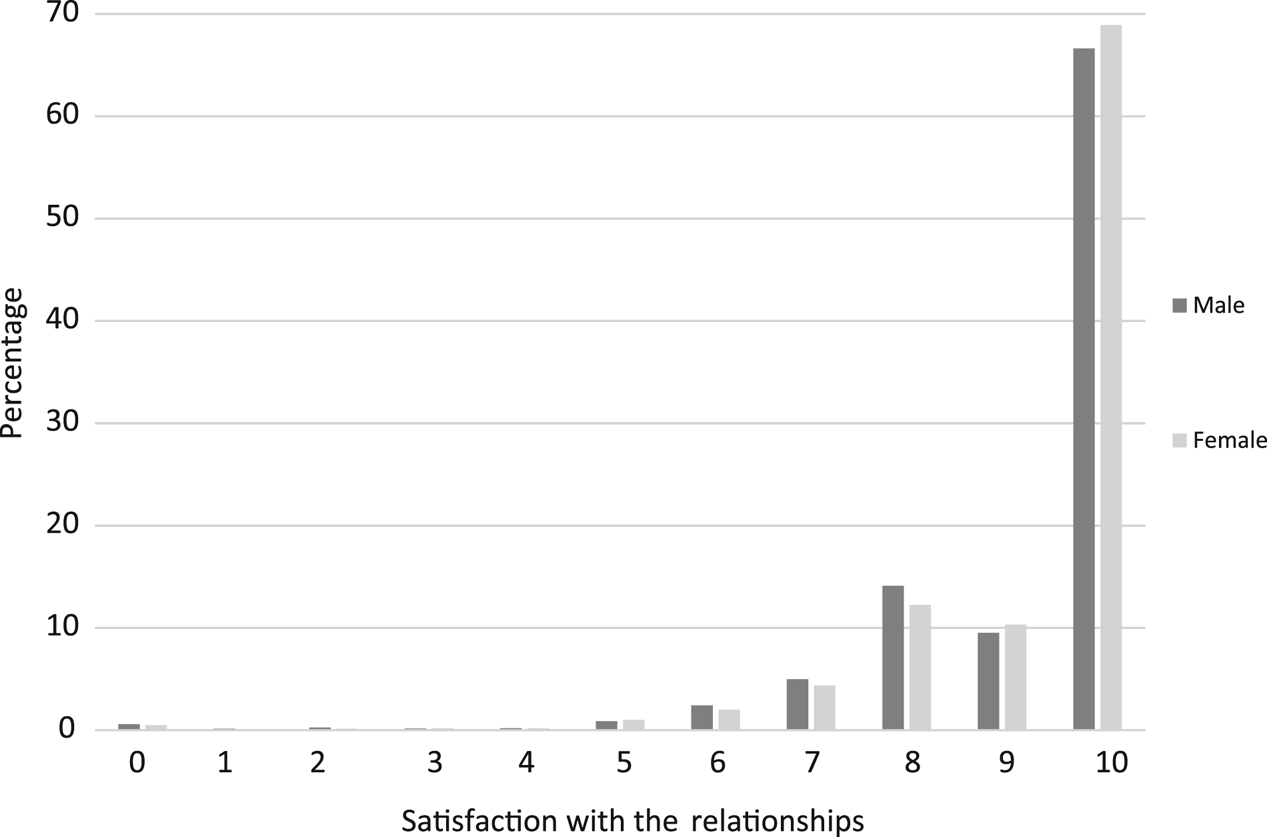
The outcome variable, satisfaction with the relationship with children, was coded as a ten-point Likert scale. Figure 1 shows how negatively skewed the variable is. In order to operationalise the outcome variable better, we analysed the frequency distribution jointly with a Multiple Correspondence Analysis run on the outcome variable and the same covariates used in the multilevel models. Considering that categories 1 to 7 have really small frequencies (less than 2 per cent) and the distance of these low frequency categories from all the other categories, we have aggregated the closer categories into one (Grassi et al., Reference Grassi, Nucera, Zanolin, Omenaas, Anto and Leynaert2007), to obtain a more robust analysis. Therefore, the resulting three categories of the outcome variables were: low satisfaction (with scores of 1–7), high satisfaction (scores of 8 and 9) and top satisfaction (score of 10). The new outcome variable has a natural ordering among the levels, ranking from 1 (low satisfaction) to 3 (top satisfaction), and could be modelled using an ordered logistic regression (ORL). But using ORL would imply an important assumption: under this model, the odds ratio assessing the effect of an exposure variable for any of these comparisons must be the same for each subsequent category. In our data, this condition is not verified, so considering the hierarchical nature of the data (children are nested in family) we use a multilevel approach. Multilevel models provide a flexible regression modelling framework for handling data sampled from clustered population structures, such as students within classes within schools, patients within hospitals, repeated measurements within individuals or children within families. Ignoring the multilevel structure of the data can lead to incorrect inferences because the standard errors of regression coefficients are underestimated. Moreover, if the higher-level units such as neighbourhood or family are left out of the model, then we cannot explore potentially important questions about their effects, which we refer to as ‘context’ (Steele et al., Reference Steele, Rasbash and Jenkins2013). It is because most social data have a strong hierarchical structure that multilevel models are becoming so widely used in social science. One natural application of multilevel models is family studies, where children are nested within families (Raudenbush et al., Reference Raudenbush, Brennan and Barnett1995; O'Connor et al., Reference O'Connor, Dunn, Jenkins, Pickering and Rasbash2001; Jenkins et al., Reference Jenkins, Rasbash and O'Connor2003; Snijders and Bosker, Reference Snijders and Bosker2012).
Distribution of the outcome variable on satisfaction with the relationship with children, Italy, 2009.
Note: Satisfaction scale: 0 (not satisfied) to 10 (completely satisfied).

All tests were considered significant at a 5 per cent level and all analyses were performed using Stata software (release 13.0; StataCorp, College Station, TX). Maximum likelihood estimation is carried out by means of the gllamm procedure of Stata (Rabe-Hesketh and Skrondal, Reference Rabe-Hesketh and Skrondal2004). The high flexibility of gllamm allows a fit to the model without any programming. The estimation algorithm implemented in gllamm, namely Newton–Raphson with adaptive Gaussian quadrature, is well established. In the application, ten quadrature points turn out to be enough for an accurate estimate. The drawback of this algorithm is the long computational time, which increases rapidly with model complexity.
Results
The Spearman ρ indicates that there is a small, but significant relation between the original structural indicators of exchanges (face-to-face and phone contact) with the original ten scores variable for satisfaction. For both sexes Spearman ρ was 0.281 for face-to-face contact and 0.217 for phone contacts (p < 0.000). Fathers tend to have a higher level of correlation when considering face-to-face contact (0.298) compared to mothers (0.267) and smaller correlation when considering phone contact (0.214 and 0.230, respectively).
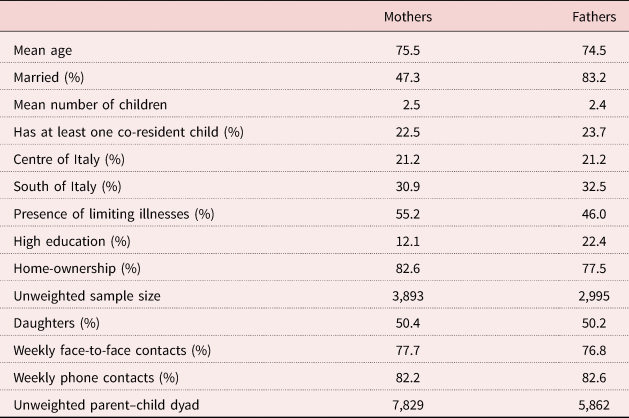
Table 1 presents the main characteristics of parents aged 65 or more in 2009 with at least one child living outside the household (N = 6,888). Mothers were more likely to be older than men and to suffer from limiting long-standing illnesses, while fathers were more likely to be married and to have higher education. Remaining characteristics, such as the number of children and geographical distribution, were similar for men and women. Regarding the parent–child dyads, mothers and fathers have similar patterns in face-to-face and phone contact with their children.
Main sample characteristics by gender, parents aged 65 or more years, and parent–child dyads, Italy, 2009

Figure 1 shows the frequency distribution of the outcome variable by sex of parents. As described in earlier sections, the distribution is negatively skewed and around two-thirds of the sample rated their relationship with children with the top score (10). Parents who declared themselves satisfied at level 8 and 9 have been classified as scoring ‘high satisfaction’ while those with a score less than 8 for the relationship with their child have been classified as scoring ‘low satisfaction’. More mothers than fathers rated their relationship with their child as the top score (10), while fathers are slightly more likely to rate their relationship with their child as less than 8.
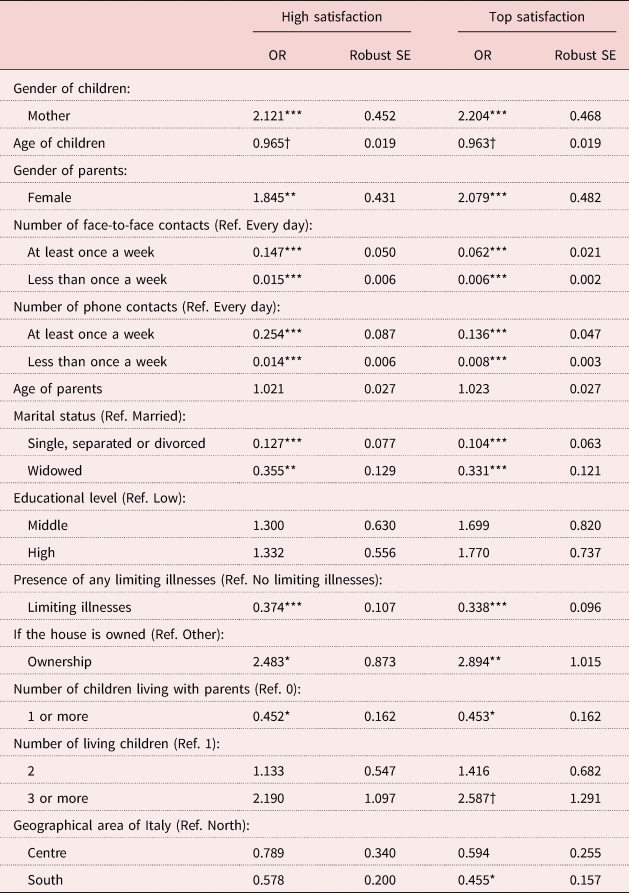
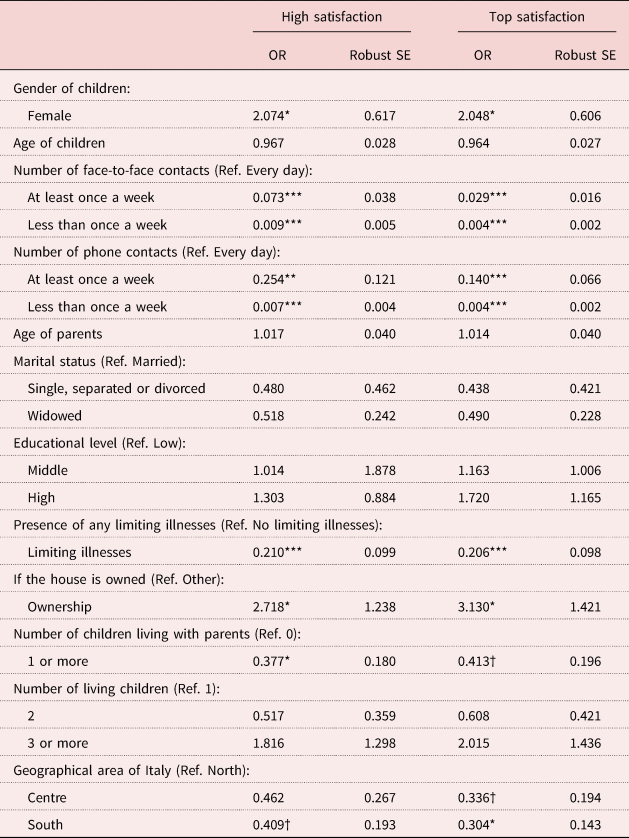
The results of the multilevel models are summarised in Table 2, which shows the coefficients for mothers and fathers jointly, while the separate analyses for fathers and mothers are shown in Tables 3 and 4. The criterion for choosing the relevant covariates is the likelihood ratio test, with a p-value threshold of 5 per cent. The variance of the second level in the final model is 25.186; the correspondent variance in the null model is 97.311.
Relative risk ratio for having high and top satisfaction (versus low satisfaction) with the relationship with children, Italy, 2009

Notes: OR: odds ratio. SE: standard error. Ref.: reference category.
Significance levels: † p ⩽ 0.10, * p ⩽ 0.05, ** p ⩽ 0.01, *** p ⩽ 0.001.
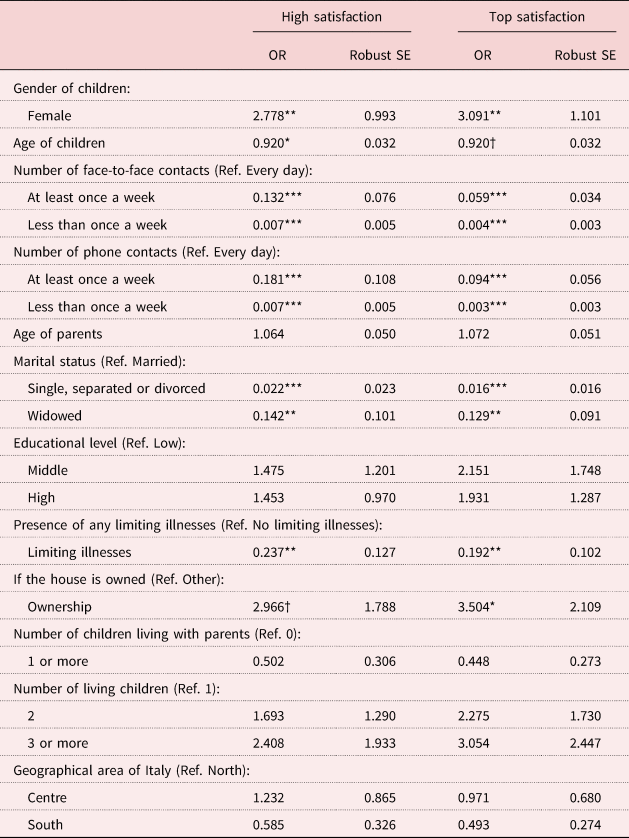
Relative risk ratio for having high and top satisfaction (versus low satisfaction) with the relationship with children, Italy, 2009 (fathers)

Notes: OR: odds ratio. SE: standard error. Ref.: reference category.
Significance levels: † p ⩽ 0.10, * p ⩽ 0.05, ** p ⩽ 0.01, *** p ⩽ 0.001.
Relative risk ratio for for having high and top satisfaction (versus low satisfaction) with the relationship with children, Italy, 2009 (mothers)

Notes: OR: odds ratio. SE: standard error. Ref.: reference category.
Significance levels: † p ⩽ 0.10, * p ⩽ 0.05, ** p ⩽ 0.01, *** p ⩽ 0.001.
The coefficients presented in Table 2 indicate the relative risk ratio (RRR) of having high or top satisfaction, compared to low. For each independent variable included in the model, RRR values greater than 1 therefore indicate that higher values of the explanatory variable increase the predicted probability of having high or top satisfaction, compared to low, while RRR values less than 1 indicate the opposite. To interpret the RRR correctly it is often useful to express it as percentage changes using 100 × (RRR − 1).
Table 2 shows that age of children, the age of parents, the education level of parents, the number of children (except for top satisfaction) and the geographical area are not statistically significant for predicting the level of satisfaction with relationships with children.
The odds of high satisfaction compared to low satisfaction is reduced by an estimated 85.3 per cent for at least once-a-week contacts and 98.5 per cent for those who see their children less than once a week when compared to parents who see their children every day. Similarly, the odds are also reduced by 74.6 per cent for at least once a week and by 98.6 per cent for sporadic phone contact (i.e. less than once a week). That means that more frequent contact with children is strongly associated with the probability of being highly satisfied compared to low satisfaction. Considering marital status, the odds are reduced by 87.3 per cent for divorced/separated or single parents and by 64.5 per cent for widowed compared to married parents. Having some limiting illness also reduced the odds of being highly satisfied compared to being less satisfied (−62.6 per cent). High satisfaction is increased for mothers by 84.5 per cent compared to fathers and if the child is female the risk is doubled.
For top satisfaction the trends are similar, but the effects are somehow stronger compared to those of high satisfaction. Comparing the results of high with top satisfaction, the main differences concern only one variable: living in southern Italy. More specifically, the odds of having top satisfaction compared to having low satisfaction is reduced by 54.5 per cent if grandparents live in southern Italy compared to the north.
Overall, the variables in the final model explain a 74 per cent second-level variability.
In Tables 3 and 4 we show the results by gender, as it could be an important element of variation.
Table 3 shows the RRR estimates for the joint model and compares the results stratifying by gender. The more important differences highlighted for the two genders are that home-ownership and having children living with parents loses statistical significance for fathers. Whereas age of children becomes significant, i.e. the odds of having top satisfaction is reduced by 8 per cent with each one-year increase in the age of children. On the other hand, marital status is not significant for mothers.
Conclusions and discussion
Despite the recognition of the importance of assessing the influence of family structure on family relationship quality (Mancini and Blieszner, Reference Mancini and Blieszner1989), few studies have achieved this target, especially for countries outside the USA and western Europe. The present study tries to shed light on this in the context of a ‘familistic’ country such as Italy to understand the structural determinants of older parents’ satisfaction with their relationships with their adult children. Overall, it is shown that Italian older parents are highly satisfied with their relationships with their children. Two-thirds of parents rated their satisfaction with the maximum score (10) and less than 10 per cent of them provided a score of less than 8.
The relation between structure (i.e. face-to-face and phone contact) and satisfaction indicators is not very strong, but statistically significant. This result may be encouraging in the use of contact variables as proxy for good parent–child relations. Indeed, the multilevel and multivariate models confirm, as found in previous studies, that frequent contact is significantly associated with the highest values of satisfaction (Lendon et al., Reference Lendon, Silverstein and Giarrusso2014). Our research shows how satisfaction is positively associated with being a mother. Older Italian mothers tend to have closer relationships in terms of care, contact and co-residence with their children (Tomassini et al., Reference Tomassini, Glaser, Askham, Arber, Davidson and Ginn2003, Reference Tomassini, Kalogirou, Grundy, Fokkema, Martikainen, van Groenou M and Karisto2004b), therefore the positive effect of being female was expected. Being married had also the positive effect anticipated by previous studies, but only for fathers. Fathers in a couple tend to be more satisfied with the relationships with their children living outside the household than fathers who are widowed or separated/divorced. Fathers may shape their relationships with children through their spouse; therefore, once they are alone, they may experience a more strained relationship with their children. Interestingly, the same is not true for mothers: marital disruption does not have a significant effect for mothers, as they continue to have satisfying relationships with their children. This gender difference of the effect of marital status has been found in Italy in other structural variables of intergenerational exchanges as well (Tomassini et al., Reference Tomassini, Kalogirou, Grundy, Fokkema, Martikainen, van Groenou M and Karisto2004b). Presence of limiting illness has a detrimental effect on satisfaction for both older mothers and fathers. It would be interesting to explore whether such an effect is due to unmet demand for care from parents. Mild or severely disabled parents may be in need of care and, if children are unable to provide such care, parental satisfaction is compromised (Silverstein et al., Reference Silverstein, Gans, Lowenstein, Giarrusso and Bengtson2010). Therefore, lower satisfaction in the presence of limiting health problems may arise from the unfulfilled expectations of parents for their children, as proposed in previous studies (Silverstein et al., Reference Silverstein, Gans, Lowenstein, Giarrusso and Bengtson2010; Lendon et al., Reference Lendon, Silverstein and Giarrusso2014). If this is true, it may help to explain why daughters are better ‘rated’ than sons by both mothers and fathers. Daughters are more active than sons in terms of intergenerational exchanges with their older parents and therefore they may be preferred to sons in later life. A recent paper explored how the sex of the child impacts on wellbeing in later life. In southern Europe particularly, daughters seemed to provide greater happiness to their parents (Grundy and Murphy, Reference Grundy and Murphy2018). D'Ovidio et al. (Reference D'Ovidio, d'Errico, Scarinzi and Costa2015) found a significant increase in coronary heart disease risk associated with the presence of two or more sons – but not daughters – in the households of employed women in Italy. These results seem to suggest the overall positive effect of a daughter on parents’ different health outcomes even in different cultural contexts.
Interestingly, parental age is not significant in rating relationships with children, possibly due to conflicting effects of increasing involvement with adult children in old age as shown for some structural indicators (e.g. care and co-residence) and, on the other side, the other roles that adult children have that may inhibit such involvement. Education is not significant to explain satisfaction with child relationships, as found in several previous studies.
This study has several limitations. Firstly, it excludes parental satisfaction with co-resident children. According to a number of previous studies, co-residence as well as frequent contact reduce the likelihood of having detached relationships with children, so it is possible that the proportion of parents rating their relationships with children positively will be even higher. In any case, the presence of a co-resident child does not significantly affect the rating with the children living outside the household.
Another point is on the meaning of the variable on satisfaction used in this study. It may be strongly associated with reciprocity, with expectations and with self-evaluation of the older person as a parent. The latter may mean that more than rating their children, parents may rate themselves as parents and this could explain the high proportion of parents that rate their relationship with children with the top score. A comparative rating from the children's point of view would have been essential to check whether parents and children have dissimilarities in the perception of their relations, but regrettably the questionnaire was restricted to the members belonging to the surveyed household. Previous studies have shown that parents tend to over-report higher satisfaction compared to their children: the intergenerational stake phenomenon suggests that this over-reporting is due to the fact that parents invest a lot of resources in raising children and have a stake in feeling successful in their parental role (Lendon et al., Reference Lendon, Silverstein and Giarrusso2014).
Another critical point of this study may be that satisfaction may be affected by a contingent positive or negative situation, but this is true for all subjective indicators when they are considered as outcomes. Unfortunately, it was only possible to investigate the association of parental satisfaction with the relationship with a child with structural variables, without considering the emotional and the psychological dimension of satisfaction since no such variables are present in the survey. Hence, due to data restrictions, the models do not capture the entire complex picture of late-life family relations as developed by Bengtson et al. (Reference Bengtson, Giarrusso, Mabry and Silverstein2002). Despite this limitation, this study has shone light on the association between structural dimensions (such as intergenerational contact) of the solidarity model (often present in national surveys) and the parental rating of the satisfaction in the relationship with their children. An additional restriction of our study results from the use of cross-sectional data: it is difficult to assess the causal direction of the significant associations found, for example, between contact with children and satisfaction.
For future developments, it would be interesting to compare Italy with the other countries involved in the GGS program whose questionnaires included the rating of relationships with children to check whether the overall level of satisfaction and the effects of the covariates may be similar in other cultural contexts and diverse welfare regimes.
Nevertheless, this study may provide some useful answers to the general debate on future parent–child relationships and their potential effect on support in later life in family-oriented familial cultures. The analysis provides a useful suggestion to researchers on the significant association between structural and functional indicators of family interactions, and to policy makers on the influence of family in terms of emotional support to older people.
Data
This research uses data from the Italian National Institute of Statistics (ISTAT).
Conflict of interest
The authors declare no conflicts of interest. The views expressed in the paper are those of the authors only.