Catheter-associated urinary tract infection (CAUTI) is one of the most common health care associated infections and is reportable to National Healthcare Safety Network (NHSN).Reference Magill, Edwards and Bamberg1 The most important risk factor for development of CAUTI is prolonged use of a urinary catheter.
One of the biggest challenges in managing CAUTI is diagnosis. Due to the presence of an indwelling urinary catheter, many symptoms commonly present in cases of non–catheter-associated UTI, such as dysuria and urinary frequency, cannot be assessed. Frequently, fever is the only symptom present in CAUTI. Unfortunately, fever in a person with an indwelling urinary catheter is a non-specific finding, as alternative causes of fever are often present.
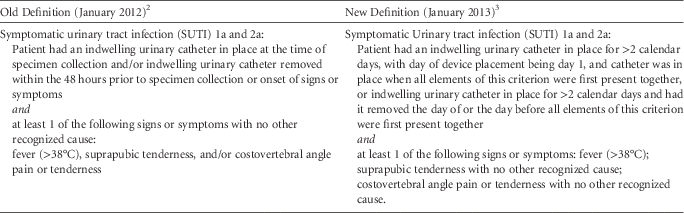
Prior to 2013, the wording of the NHSN CAUTI definition was interpreted by many as suggesting that, if a source of fever other than the urinary tract was present (eg, another NHSN-defined infection), then fever would not necessarily count as a symptom for diagnosing CAUTI (Table 1).2 In January 2013, the wording of the NHSN CAUTI definition was changed to clearly state that fever should be counted as a symptom of CAUTI regardless of whether another fever source is present (Table 1).3
Changes in Definitions for Urinary Tract Infection from 2012 to 2013Footnote a

a Only changes are noted.
The objective of this study was to determine the impact of the 2013 changes in the CAUTI definition on the frequency and clinical relevance of CAUTI cases meeting NHSN criteria and to compare cases that met NHSN CAUTI criteria according to the definition used prior to 2013 with the cases that only met criteria according to the current definition.
Methods
A retrospective cohort analysis was conducted at the Detroit Medical Center, an 8-hospital healthcare system in southeastern Michigan with >2,000 beds. The study included all patients with positive urine cultures admitted to various adult intensive care units (15 ICUs from 4 adult-care hospitals) from July 1, 2012, to June 30, 2013.
A list of patients in the intensive care units (ICUs) with positive urine cultures was obtained from clinical microbiology databases. Patients were screened initially to identify those who met criteria for CAUTI according to the 2013 NHSN definition, in which fever was the only symptom (Table 1).3 Some patients had two distinct episodes of CAUTI during the study period, by NHSN definitions.4 Data abstracted from the medical charts included demographics, comorbid conditions, presence of systemic inflammatory response syndrome (SIRS),Reference Comstedt, Storgaard and Lassen5 urinalysis results, length of stay (LOS) in the hospital and ICU, presence of other NHSN-defined infections, other causes of fever, and hospital mortality.
Statistics and Analysis
All analyses were performed using SAS 9.3 (Cary, NC). Bivariate analyses for dichotomous and ordinal variables were conducted using the Fisher’s exact test and/or χ2 test. Continuous variable analyses were conducted using the Student’s t test or Wilcoxon rank sum test.
Results
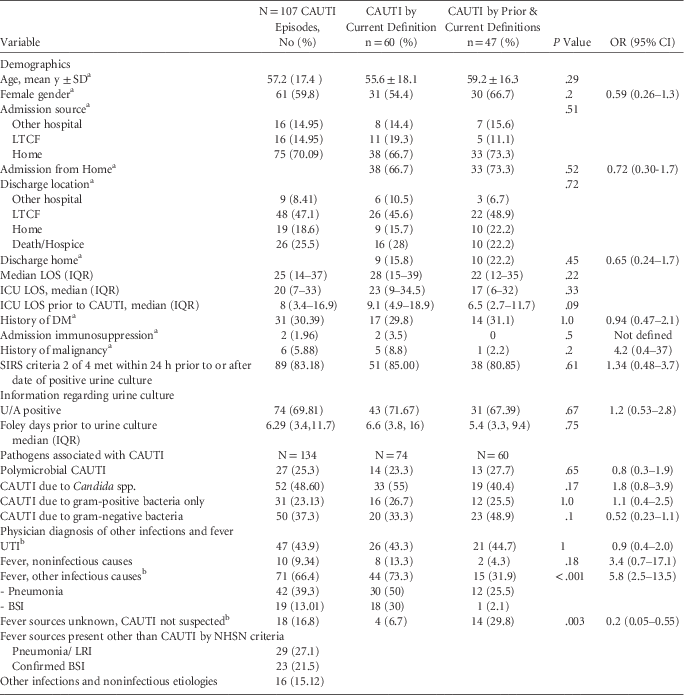
A total of 102 patients, who accounted for 107 episodes of CAUTI according to current NHSN criteria, were identified (5 patients had 2 unique CAUTI episodes) (Table 2). Prior to urine culture, the median ICU LOS was 8.0 days [interquartile range (IQR) 3.4–16.9], and the median duration for which the Foley catheter had been in place prior to culture was 6.3 days (IQR, 3.4–11.7). Of 107 urine cultures, 134 yielded pathogens; 27 urine cultures (25.3%) were polymicrobial (Table 2). Candida species were the most common types of organisms identified (48.6%).
Comparison of CAUTI Episodes According to Current (2013) and Prior (2012) NHSN Definitions

a Denominator for these variables are number of unique subjects (n=102): CAUTI according to 2013 definition only (n=57), and CAUTI according to both 2012 and 2013 definitions (n=45).
b A total of 146 physician diagnoses among 107 CAUTI episodes were related to suspected fever source (ie, 31 subjects had>1 fever source).
NOTE. The percentages use episodes of CAUTI (n=107) (n=60 for CAUTI according to 2013 definition only; and n=47 CAUTI according to both 2012 and 2013 definitions) as denominator.
CAUTI, catheter-associated UTI; NHSN, National Healthcare Safety Network; OR, odds ratio; CI, confidence interval; SD, standard deviation; LTCF, long-term care facility; LOS, length of stay; IQR, interquartile range; ICU, intensive care unit; DM, diabetes mellitus; UTI, urinary tract infection; SIRS, systemic inflammatory response syndrome; UA, urinanalysis; LRI, lower respiratory tract infection; BSI, bloodstream infection.
Physician diagnosis of urinary tract infection (UTI) was made in 47 (43.9%) patients (Table 2). In 71 patients (66.4%), a source of fever other than UTI was suspected by clinicians, with the most common being pneumonia (39.3%).
At the time of positive urine culture, 48 (44.8%) patients had an NHSN-defined infection other than CAUTI (Table 2). A total of 12 patients (11.2%) were suspected to have noninfectious etiologies for fever.
Patients who were determined to have potential sources of fever other than CAUTI (n=60, including 48 with NHSN-defined infections and 12 with noninfectious causes of fever) were categorized as having CAUTI according to the NHSN 2013 definitions only. The remainder of cases (n=47) were categorized as having CAUTI according to both current and prior NHSN definitions (Table 2). The only statistically significant difference between the two groups was a higher frequency of physician-diagnosed infection other than CAUTI among patients in the CAUTI NHSN 2013 definitions cohort [odds ratio (OR), 5.8; P<.001]. Candida spp. also tended to occur more frequently among patients in this group (OR, 1.8; P=.17). A trend was identified toward increased median duration of ICU stay prior to positive urine culture among patients in the 2013 NHSN CAUTI definitions cohort compared with patients categorized as having CAUTI according to both current and prior NHSN definitions (ie, 9.1 d vs 6.5 d, respectively, P=.09).
Discussion
CAUTI has garnered increased attention due to its impact on Centers for Medicare and Medicaid Services (CMS) reimbursement.6 Even small increases in CAUTI rates can lead to notable decreases in hospital CMS reimbursement. In this study, changes made in the wording of the NHSN definition for CAUTI in 2013 were associated with a >2-fold increase in NHSN-defined CAUTIs. In >50% of cases categorized as CAUTI according to the 2013 criteria, other non-UTI fever sources were present. In addition, treating physicians identified infections other than CAUTI significantly more frequently in the 2013 CAUTI criteria group than cases categorized as CAUTI according to both 2012 and 2013 criteria. In addition, Candida spp., an organism often considered to be a colonizer of the urinary tract was more commonly recovered in cases of CAUTI according to 2013 criteria only.Reference Kauffman, Fisher, Sobel and Newman7 Taken together, these findings suggest that, in the majority of cases categorized as CAUTI according to the 2013 definition only, UTI was not recognized by treating clinicians as being present and/or being clinically meaningful, and that in many instances, positive urine cultures likely represented asymptomatic colonization.
Patients who had CAUTI according to NHSN 2013 definitions only, often had other infections outside the urinary tract; these patients trended toward longer durations of ICU stay prior to urine culture and tended to have Candida spp. as a urinary pathogen more frequently. These findings suggest that patients with CAUTI according to NHSN 2013 definitions represented a population of ICU patients that was relatively ill, with increased healthcare exposure, compared with patients who met CAUTI criteria according to both prior and current criteria. Patients with increased severity of illness and healthcare exposure are more likely to have longer durations of indwelling Foley catheterization and, thus, bacteruria.Reference Marigliano, Barbadoro and Pennacchietti8 Therefore, hospitals and ICUs that care for patients who have higher severity of acute and/or chronic illness and an increased risk for an indwelling Foley catheter are at an increased risk for infection and fever in general (ie, other than CAUTI) and are more likely to be impacted by increased CAUTI rates as a result of changes in the 2013 definition.
Implementation of the 2013 NHSN CAUTI criteria has resulted in a dramatic increase in CAUTI cases reported within our healthcare system as well as others.Reference Neelakanta, Sharma and Munoz9 Unfortunately, hospitals are being fiscally penalized by CMS, based on the 2013 CAUTI definition, which lacks specificity and frequently identifies CAUTI cases that are not clinically relevant. CAUTI rates according to the 2013 definition are not necessarily a true measure of clinical quality.
Acknowledgments
Financial support: No financial support was provided relevant to this article.
Potential conflicts of interest: All authors report no conflicts of interest relevant to this article.