In Brazil, legislators depart from their ideology when voting in Congress. Since their votes determine public policy, the government and party leaders seek to influence how legislators cast their votes, which gives rise to a government-opposition cleavage instead of an ideological one (Leoni Reference Leoni2002; Zucco Reference Zucco2009; Zucco and Lauderdale Reference Zucco and Benjamin2011; Izumi Reference Izumi2016).
This research note investigates whether the same government-opposition dimension that emerges from roll call voting appears in speeches as well. One would expect that speeches reveal more information about legislators’ ideological preferences than taking votes by yeas and nays. Since what ultimately matters is how legislators vote—not what they say—the government would be less likely to spend limited resources to exert pressure on activities with a tiny relationship to policy outcomes. Consequently, legislators would feel free to express their sincere preferences. Yet this is not what happens.
Based on a statistical analysis of senators’ speeches, this study argues that political parties are distributed in a government-opposition dimension instead of an ideological one. By showing that legislators’ speeches split along these lines, the study aims to contribute to a long strand of scholarship on legislative politics in Brazil. This research note also contributes to the literature on policy positions of Latin American political parties by using speeches as the primary source of data. Conventional sources for measuring policy positions, such as roll calls and surveys, have important limitations in sample selection (Carrubba et al. Reference Clifford, Gabel, Murrah, Clough, Montgomery and Schambach2006) and interpersonal comparability (Brady Reference Brady1985; King et al. Reference King, Murray, Salomon and Tandon2004). However, a growing literature on quantitative text analysis has emerged and has overcome these limitations (cf. Bäck and Debus 2016).
Latin American countries were just recently added to this literature. By collecting an impressive amount of data, these recent studies have generated important contributions to the field (Moreira Reference Moreira2020; Arnold et al. Reference Arnold, Doyle and Wiesehomeier2017). Moreira, for instance, analyzed up to 120,000 speeches of Brazilian deputies. He argues that parliamentary communication cannot be reduced to a government-opposition relationship. Despite his remarkable work collecting and analyzing an impressive amount of data, the analysis is limited to the impact of the government-coalition division on the emphasis each legislator attributes to economic and social agendas. Nothing is said about legislators’ policy positions.
In line with Moreira’s efforts, Arnold et al. (Reference Arnold, Doyle and Wiesehomeier2017) also analyzed an impressive amount of data. Using the scaling model Wordfish (Slapin and Proksch Reference Slapin and Proksch2008), the authors estimated policy positions of 73 presidents in 13 Latin American countries between 1980 and 2014. The scaling model proposed by Slapin and Proksch (Reference Slapin and Proksch2008) assumes that documents employing the same set of words express policy positions more similar to each other than documents that use distinct sets of words. However, there are other sources of variation in word usage besides policy preferences (Lauderdale and Herzog 2016). To overcome this limitation, instead of modeling word frequencies, the statistical model proposed in this study is based on sentiment analysis of 64,097 speeches made by 347 senators between 1995 and 2014 in Brazil.
This research note proceeds to present the conventional ideological classifications of Brazilian political parties, based on manifestos and surveys with voters, politicians, and experts. It also discusses the limitations of these data sources. The following sections present the statistical model based on sentiment analysis and then the results for the Brazilian case, and discuss the reasons why presidents and party leaders exert pressure over legislative speechmaking. The concluding section offers final considerations.
Policy Positions In Brazil, Data Sources, And Limitations
In the past 30 years in Brazil, scholars have developed a variety of theories about how legislators cast their votes and what the role of the president and political parties is in influencing legislators to behave in a way contrary to their own beliefs or ideology (Abranches Reference Abranches1988; Ames Reference Ames2000; Amorim Neto 2009; Figueiredo and Limongi Reference Figueiredo and Limongi1999; Freitas Reference Freitas2016; Izumi Reference Izumi2016; Leoni Reference Leoni2002; Mainwaring Reference Mainwaring1999; Neiva Reference Neiva2011a; Pereira and Mueller 2002; Santos Reference Santos2003; Zucco Reference Zucco2009). At the same time, many sources have been used as primary data for estimating the ideology of the main actors in the Brazilian political system.
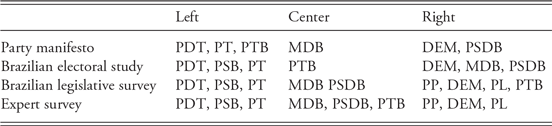
Table 1 presents an approximate ideological classification of Brazilian political parties based on different data sources.Footnote 1 In general, regardless of the data used, the basic ordering of parties corresponds to the common wisdom of their positions: PT (Workers’ Party), PDT (Democratic Labor Party), and PSB (Brazilian Socialist Party) are on the left; MDB (Brazilian Democratic Movement) and PSDB (Party of the Brazilian Social Democracy) in the center; and DEM (Democrats) and PP (Progressives) on the right. See table 4 in the appendix.
Ideological Ordering of Brazilian Parties, by Source

Sources: Authors’ elaboration based on Tarouco and Madeira 2011; CESOP 2017; Power and Zucco Reference Zucco2009; Wiesehomeier and Benoit 2009.
But we observe some idiosyncrasies across the sources. For instance, Tarouco and Madeira (2013) contend that based on party manifestos, the PTB (Brazilian Labor Party) is a left-wing party and the PSDB is a right-wing party. According to respondents to the Brazilian Electoral Study (CESOP 2017), the PTB is to the left of the PMDB. However, according to the Brazilian Legislative Survey (Power and Zucco Reference Zucco2009), the PMDB is a centrist party and the PTB is a right-wing party. Moreover, the expert survey conducted by Wiesehomeier and Benoit (2009) places the PTB in the center of the scale. Yet despite these idiosyncrasies, the Brazilian political parties all can be placed along a left-right scale.
The use of party manifestos and surveys to measure policy positions constitutes an important breakthrough in Brazilian political science. But it also has some limitations. Ideological placements made by voters and citizens may suffer from inconsistencies related to both a lack of information and low levels of political knowledge. Conducting surveys with members of the parliament is an alternative method. They are more politically informed and better able to provide political parties’ placements than are voters (Converse Reference Converse and Apter1964). However, in the Brazilian case, right-wing politicians tend to place themselves to the left of where they actually are, due to the memories of the military regime of 1964–1985 (Pierucci Reference Pierucci1999; Power and Zucco Reference Zucco2009, 2012; Rodrigues Reference Rodrigues1987). Moreover, many politicians decline to participate in these surveys.
Still, experts may provide better placements than voters and less biased placements than the political elite. Experts can synthesize a large amount of information, including manifestos, speeches, and roll calls, to estimate policy positions. Unfortunately, expert surveys are expensive and need to secure continuous funding to conduct new waves regularly. Another limitation is that we cannot conduct new surveys to extend the analysis further back into the past.
Yet behavioral data (i.e., data from manifestations that indirectly reveal ideological preferences, such as party manifestos, roll calls, bills, and speeches) can be collected and analyzed at any time. Moreover, nowadays, all the information governments produce is being stored at an unprecedented rate. As a consequence, political texts, which have a widely recognized potential to reveal information about policy positions, have become easily and cheaply available to researchers. Together with the availability of data, important methodological developments have been made in the field of quantitative text analysis for measuring policy positions, such as Wordscores (Laver et al. Reference Laver, Benoit and Garry2003) and Wordfish (Slapin and Proksch Reference Slapin and Proksch2008).
A Statistical Model For Scaling Opinions
Several sources have been used by the extant scholarship to estimate policy positions. Roll calls (Poole and Rosenthal Reference Poole and Rosenthal2007; Clinton et al. Reference Clinton, Jackman and Rivers2004), surveys (Aldrich and McKelvey 1977), a combination of roll calls and surveys (Zucco and Lauderdale 2011), and texts (Bäck and Debus 2016; Laver et al. Reference Laver, Benoit and Garry2003; Slapin and Proksch Reference Slapin and Proksch2008) are fine examples. The use of text as data has grown continuously in political science, which constitutes an important contribution, because political conflict often occurs in written and spoken words (Monroe and Schrodt 2009; Grimmer and Stewart 2013). Candidates debate each other in electoral campaigns, representatives introduce bills in legislative bodies, opposition parties criticize the government in the media, and so on. Language is an important way to express and build political preferences.
This section develops a Bayesian procedure to estimate the policy positions of political actors from text data. Instead of using word frequencies to model the policy positions, this approach is based on sentiment analysis classifications (Pang and Lee Reference Pang and Lee2008; Liu Reference Liu2012). Sentiments (or opinions) are fundamental to all human activities (Pang and Lee Reference Pang and Lee2008; Liu Reference Liu2012). According to Liu (Reference Liu2012, 11), “an opinion is a quadruple, (g, s, h, t), where g is the opinion (or sentiment) target, s is the sentiment about the target, h is the opinion holder, and t is the time when the opinion was expressed.” In sentiment analysis, the focus is on opinions that express positive or negative sentiments. For example, in his speech at the formal sitting for the enactment of the 1988 Brazilian Constitution (October 5, 1988), Federal Deputy and President of the Constitutional Assembly Ulysses Guimarães said, “I hate and despise dictatorship” (Eu tenho ódio e nojo à ditadura). In this quotation, the opinion holder (h) is the deputy, Guimarães. He has a negative sentiment (s) about the dictatorship (g), and his sentiment was expressed on October 5, 1988 (t).
We assume that political actors have opinions about a wide range of topics; that is, they are not restricted to a small political agenda. Furthermore, actors with differ-ent policy positions have different opinions about different topics. Liberal politicians probably exhibit positive judgments about same-sex marriage and negative judgments about the death penalty. Conservative politicians probably exhibit opposite positions on these topics.
Opinions are usually expressed by words: candidates engage in debates to defend their opinions; political parties use manifestos to present their policies to voters; legislators take positions introducing bills and making speeches. Our approach assumes that opinions expressed by words provide relevant information about policy positions. If this assumption holds, and we also assume that opinions are independently and identically distributed, we can model the number of positive (or negative) opinions on topic k ϵ{1, …, K} by an actor i ϵ{1, …, I} as a binomial process. The functional form of the model looks as follows:
 $${{\mathop{\rm Y}\nolimits} _{ik}}\tilde{\mathop{\rm B}\nolimits} {\mathop{\rm iminal}\nolimits} ({{\mathop{\rm p}\nolimits} _{ik}},{{\mathop{\rm n}\nolimits} _{ik}})$$
 $${\rm{logit}}({{\rm{p}}_{ik}}) = {\alpha _k} + {\beta _k}*\theta i$$
where Yik is the number of positive (or negative) opinions and nik is the sum of positive and negative opinions expressed by actor i on topic k.Footnote 2 αk and β k are parameters associated with the probability of a positive (or negative) opinion. And θi is the policy position of actor i. This is similar to a Binomial-IRT model with αk being the difficulty parameter, βk being the discriminant, and θi being the ability parameter. We can deduce the likelihood function as follows:
 $$\eqalign{
& {\mathop{\rm L}\nolimits} (\alpha ,\,\beta ,\,\theta |{\mathop{\rm N}\nolimits} ,\,{\mathop{\rm Y}\nolimits} ) = {\Pi ^I}_{i = 1}{\Pi ^K}_{k = 1}({{nik} \over {Yik}}){\{ {\mathop{\rm logit}\nolimits} ({a_k} + {\beta _k}*{\theta _i})\} ^{{\mathop{\rm Yik}\nolimits} }}* \cr
& {\{ 1 - {{\mathop{\rm logit}\nolimits} ^1}({a_k} + {\beta _k}*{\theta _i})\} ^{nik - Yik}} \cr} $$
where α is a K length vector of αvalues, β is a K length vector of β k values, θ is an I length vector of θi values, N is an I*K matrix of nik values, and Y is an I*K matrix of Yik values.
To complete the statistical model, we need to specify some vague and normal prior distributions.
 $${\alpha _k}{\tilde \rm N}\,(0,1)$$
 $${\beta _k}{\tilde \rm N}\,(0,1)$$
 $${\theta _k}{\tilde \rm N}\,(0,1)$$
It yields the posterior distribution:
 $${\mathop{\rm p}\nolimits} (\alpha ,\,\beta ,\,\,\theta |{\mathop{\rm N}\nolimits} ,\,Y)\,\alpha \,{\mathop{\rm P}\nolimits} \,(\alpha ,\,\beta ,\,\,\theta )\,*\,{\mathop{\rm L}\nolimits} \,(\alpha ,\,\,\beta ,\,\,\theta |{\mathop{\rm N}\nolimits} ,\,Y)$$
Following Hare et al. (Reference Hare, Armstrong, Baker, Carroll and Poole2014, 762), we set the polarity of the scale constraining two actors in θ1 ~ N (0, 1) T (–1.1, –0.9) and θ2 ~ N (0, 1) T (0.9, 1.1). We estimate the model parameters via Markov Chain Monte Carlo (MCMC) sampling procedure. We implement the code in JAGS using the R package rjags (Plummer Reference Plummer2015).
Our approach does not assume that documents that use the same set of words are more similar to each other than documents that use a distinct set (Laver et al. Reference Laver, Benoit and Garry2003; Slapin and Proksch Reference Slapin and Proksch2008), allowing for other sources of variation in word usage (Lauderdale and Herzog 2016). For example, if we observe a document about economics and a document about sports, the variation in word usage is driven entirely by the topic, not by policy positions. Furthermore, it is also possible that documents about the same topic expressing the same opinion use a completely different set of words.
A silly example will help us to make this point clear. Let us suppose we observe the sentences (1) “I love to eat broccoli” and (2) “I hate to eat broccoli.” Both sentences use almost the same set of words, but they express completely divergent opinions. At the same time, the sentence (3) “My favorite food is broccoli” manifests the same opinion that sentence (1) does, but it uses a very different set of words. In these sentences, the words love, hate, and favorite are fundamental to defining the sentiment about the topic. But current scaling methods for text data have not considered this factor. They are opinion-blind. We overcome these limitations by modeling sentiments instead of words.
Estimates For Brazilian Political Parties
Brazil has a multiparty presidential system. The legislative body in Brazil is the National Congress (Congresso Nacional). It is composed of the Chamber of Deputies (Câmara dos Deputados) and the Federal Senate (Senado Federal). According to the country’s constitution, the Chamber of Deputies represents the people, and the Senate represents the states. Every four years, deputies are elected to a four-year term from a multimember district using an open-list proportional representation system. Senators are elected to an eight-year term with simple plurality rules, alternating between one-third and two-thirds of the seats.
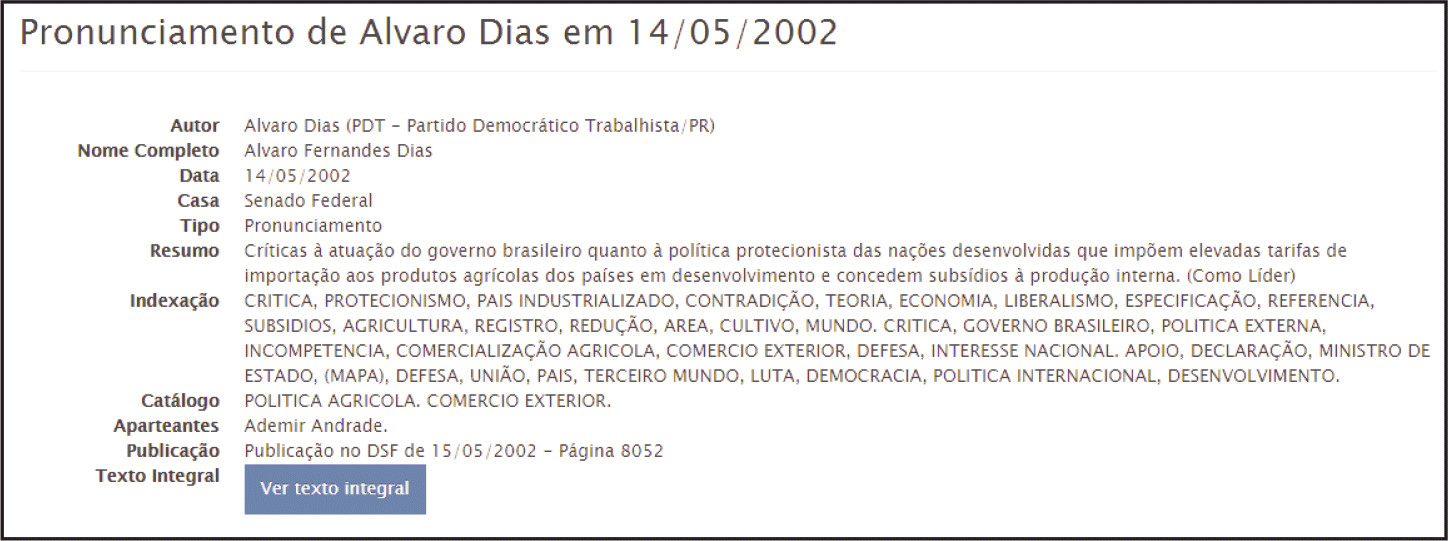
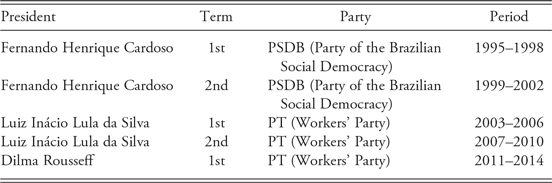
We estimated the policy positions of the main Brazilian political parties between 1995 and 2014.Footnote 3 In total, we reviewed five presidential terms ruled by three different presidents.Footnote 4 The speeches given on the Senate floor are available on the Senate website, where each one of them has an abstract. The analysis developed below relies on these abstracts.Footnote 5
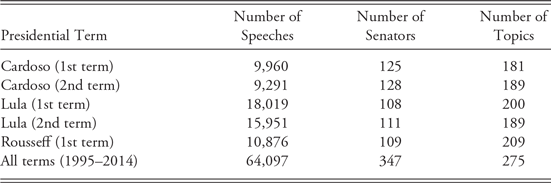
Table 2 presents descriptive statistics. In total, we considered 64,097 speeches and 347 senators who made at least one speech. The three largest parties—PT, PSDB, and PMDB—were responsible for more than 60 percent of the speeches. The Senate staff classified the speeches by themes, and we used them as topics in the analysis. There were 275 topics, of which the most recurrent were tribute (12,141), performance (7,074), federal government (5,604), regional development (3,138), and senate (2,922). Some speeches were classified as more than one topic. For example, the senator Mário Couto (PSDB) made a speech on March 16, 2011 about human rights and foreign policy, so we duplicated the speech in our database, one entry as human rights and another one as foreign policy. About 45 percent of the speeches were classified as more than one topic.
Number of Speeches, Senators, and Topics

Source: Authors’ elaboration based on data from the Brazilian Federal Senate.
To classify the opinions, we applied the Naive Bayes Classifier. To set up the model, we selected a random sample of one thousand speeches and classified them as positive or negative by hand. The classification was made based on the speeches’ abstracts. In general, an abstract presents an opinion about the topic expressed by the author. In our sample, 52.5 percent of the speeches were classified as positive and 47.5 percent as negative. Then, using this training set, we classified our test set using the Naive Bayes Classifier. In this case, 45 percent of the speeches were classified as positive and 55 percent as negative.Footnote 6
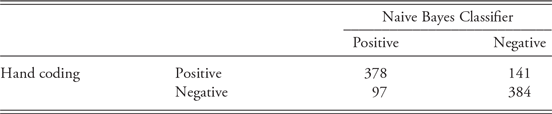
For accuracy evaluation, we selected another random sample of one thousand from the test set and classified it by hand. Then we cross-validated this hand classification with the result we got from the algorithm. Table 3 shows the results. The accuracy is high, 76.2 percent.
Accuracy Evaluation

Source: Authors’ elaboration.
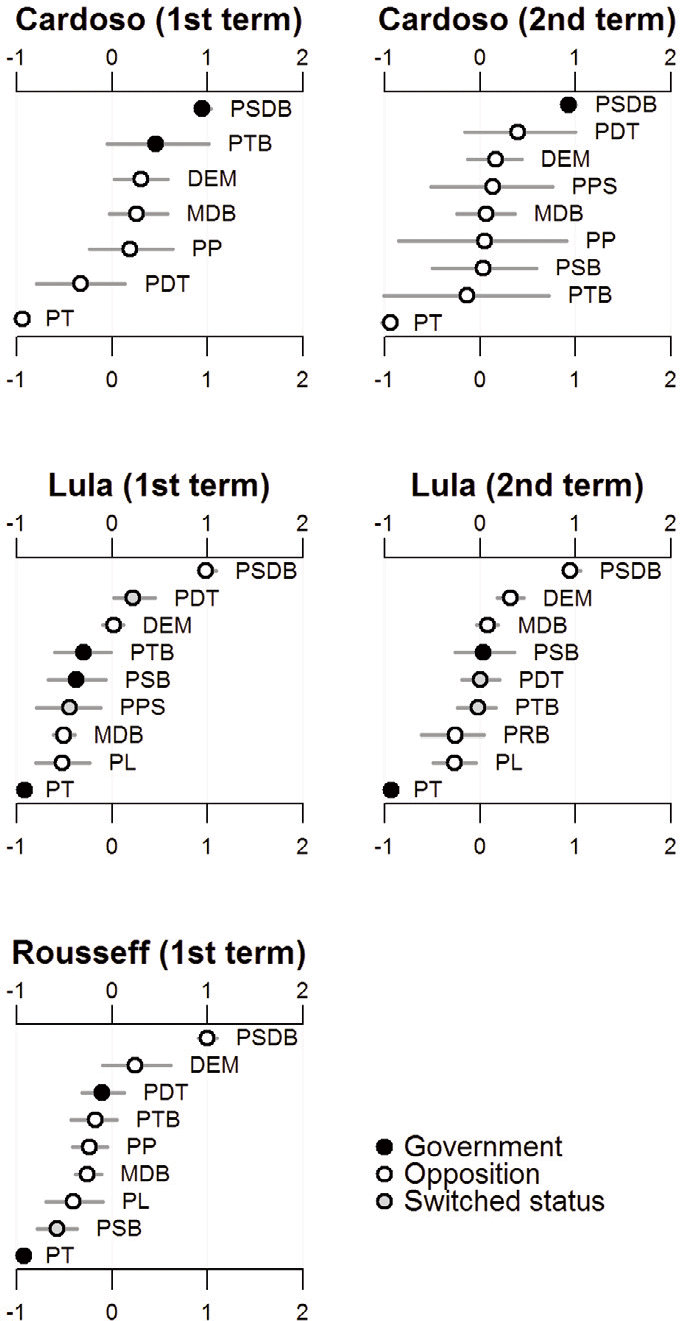
Figure 1 presents the results by presidential term. To identify the model, we constrained PT and PSDB positions at θPT ~ N (0, 1) T (–1.1, –0.9) and θPSDB ~ N (0, 1) T (0.9, 1.1), respectively, in all models. We were modeling the number of positive opinions.
Brazilian Political Parties’ Policy Positions by Presidential Term
Note: Each point represents the posterior mean for the policy position (θi). The horizontal gray lines are the 95 percent credible intervals.
Source: Authors’ elaboration based on data from the Brazilian Federal Senate.

We generated 55,000 samples, discarding the first 5,000 and thinning the remaining by a factor of 50. This yielded a set of 1,000 samples. To formally assess the chain convergence, we used the Geweke diagnostic (Geweke 1992). This method is based on a test for equality of means of the first (10 percent) and the last (50 percent) part of a Markov Chain. If the two means are equal, we can conclude that the samples were drawn from the stationary distribution. The test statistic is a standard z-score. The results show that only 109 out of 1,979 (6 percent) parameters have a statistic outside the interval [–1.96, 1.96], indicating that there is no evidence against chain convergence.
As depicted in figure 1, the model does not recover an ideological cleavage (see above). In effect, one can observe a clear government-opposition dimension with PT and PSDB—the parties that dominated presidential elections and led government and opposition alternately—on the extremes of the scale. During Cardoso’s first term (PSDB), the division between government and opposition was clear. Cardoso governed with an alliance of his party with center-right parties. On the left side of the scale, we observe the two main opposition parties, PT and PDT (both left-wing parties). On the other side, we observe the party of the president (PSDB) and parties with cabinet positions; namely, PTB, DEM, and MDB. Between the two blocks is the PP, which was seen as a right-wing party.Footnote 7 This party started Cardoso’s first term in the opposition and then joined the government in April 1996. A long bargaining process to pass the constitutional amendment that allowed re-election made the PP a coalition partner. But even before this event, evidence from roll call data shows that this party supported the government on the plenary (Izumi Reference Izumi2016).
Cardoso’s second term was more complicated. There is not much difference between parties. All of them supported the president, except for the Workers’ Party. The cabinet composition was basically the same one that concluded Cardoso’s first term, a center-right coalition composed of three parties: DEM, MDB, and PP.Footnote 8 But during this period, even left-wing parties without a ministerial position, such as the PDT, supported the president. Similar results were found by Zucco and Lauderdale (2011), who argue that this is due to the ideological coherence of the coalition.
President Lula (PT) started his government with a broad coalition of seven parties from across the ideological spectrum: PL, PCdoB (Communist Party of Brazil), PSB, PTB, PDT, Cidadania (Citizenship), and PV (Green Party).Footnote 9 Two changes occurred in the composition of his cabinet in the second year of Lula’s presidency: the MDB joined the government coalition, and the PDT went to the opposition, after disagreements over some public policies. In the next year, the cabinet composition changed again: the Cidadania and the PV left the coalition, whereas the PP became a new member. These movements are consistent with what is presented in figure 1. The opposition is composed of PSDB, DEM, and PDT. All the remaining parties supported the president.
In his second term, Lula composed an alliance with PL, PCdoB, PSB, PTB, PMDB, PP, and PRB (Republicans).Footnote 10 Four months later, the PDT joined the government coalition, and in September 2009, the PTB moved out to the opposition. Both the PDT and the PTB manifested progovernment positions. On the other side, the PSDB and the DEM opposed the government.
In 2011 Dilma Rousseff (PT) started her government supported by six parties (PL, PCdoB, PSB, MDB, PDT, and PP). In this period, we observe two cabinet changes. The first occurred in March 2012 when the PRB joined the government coalition. The second occurred in October 2013 when the PSB, PT’s natural ally, left the government to support Eduardo Campos in the next presidential election in 2014. Even after this change, the PSB continued to support the government coalition agenda. Likewise, the PTB also supported President Rousseff on the Senate floor—although this party did not have a cabinet position. On the other side of the spectrum, PSDB and DEM, the core of the opposition throughout the Workers’ Party administration, were close to each other.
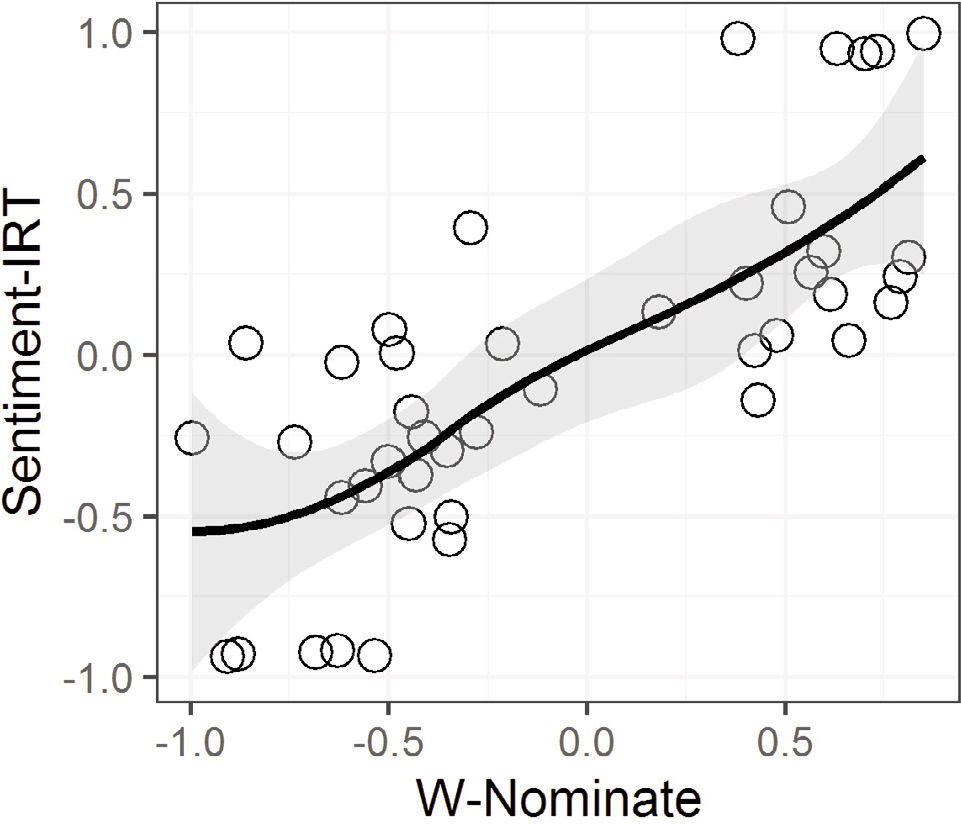
To corroborate our claim about the interpretation of our measures as a government-opposition conflict, we compare party positions estimated by our method (based on senators’ speeches) to W-Nominate scores (based on roll call data). Evidence from roll call votes suggests that presidents play an important role in influencing the behavior of Brazilian legislators. For instance, Zucco (Reference Zucco2009) shows that W-Nominate ideal point estimates in one dimension for the Chamber of Deputies recover a government-opposition dimension instead of an ideological one. The same goes for the Brazilian Senate (Neiva Reference Neiva2011a, b; Izumi Reference Izumi2016).
Figure 2 depicts the comparison between those scores. The strong correlation (r= 0.76) supports the claim that our sentiment scores recover the same government-opposition dimension.
Comparison Between W-Nominate and Sentiment-IRT
Note: Each point represents a political party in a given presidential term. The horizontal axis is the average of party members’ coordinates estimated by W-Nominate. It was estimated using roll call data from the Brazilian Federal Senate. The vertical axis is the posterior mean for the policy position(θi)
Sources: Authors’ elaboration based on data from the Brazilian Federal Senate and CEBRAP Legislative Database.

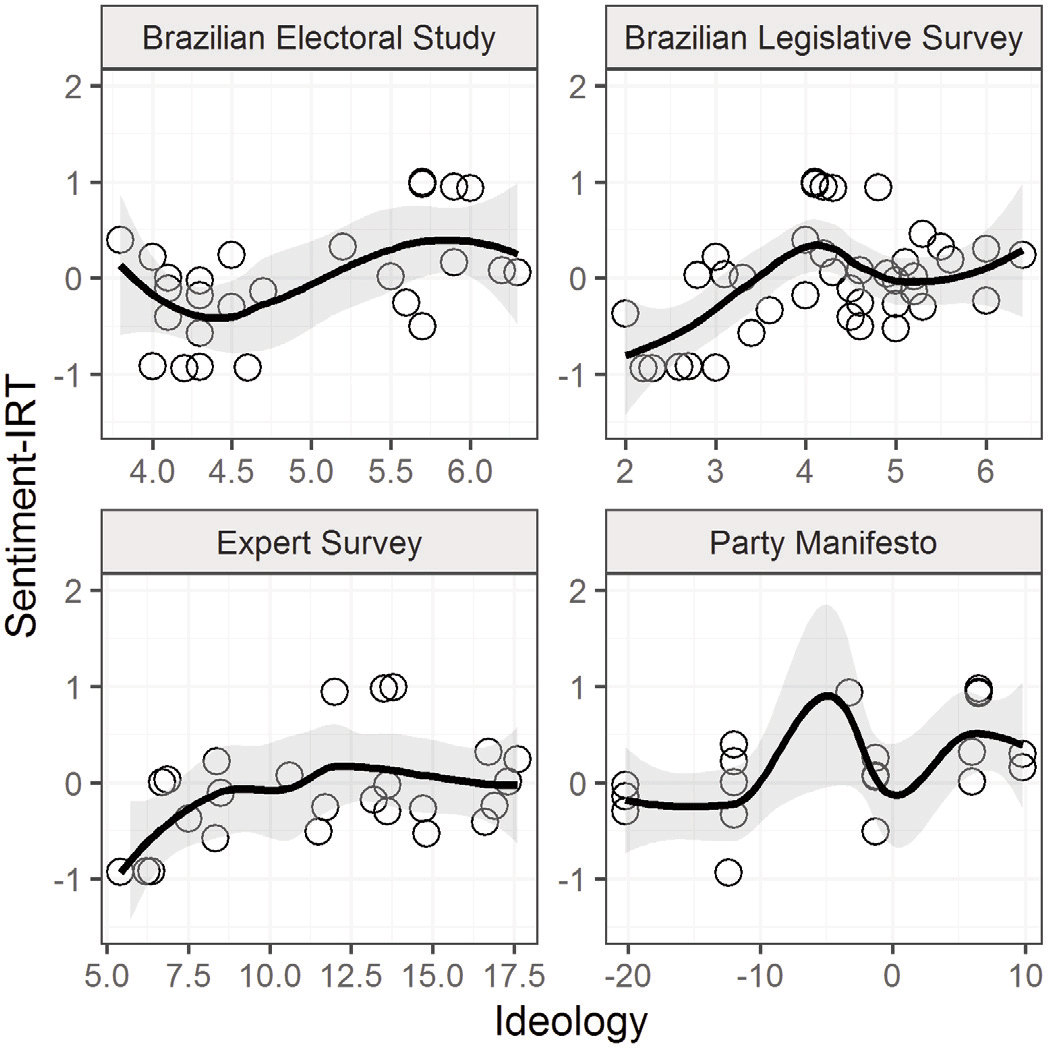
The comparison between the measures of ideology presented above and the index we created supports our claim. Figure 3 shows that there is no relationship between our measure, based on speeches, and measures of ideology, based on party manifestos and surveys with voters, legislators, and experts.
Comparison Between Sentiment-IRT and Ideological Placements
Note: Each point represents a political party in a given presidential term. The vertical axis is the posterior mean for the policy position (θi). The horizontal axis represents the ideological placement.
Sources: Authors’ elaboration based on data from the Brazilian Federal Senate; Tarouco and Madeira Reference Tarouco and Rafael2013; CESOP 2017; Power and Zucco Reference Zucco2009; Wiesehomeier and Benoit 2009.

Traditionally, political scientists have relied almost exclusively on roll call votes to analyze the influence of presidents and political parties on the behavior of legislators. Given that legislative speeches have almost no relationship to policy out-comes (Highton and Rocca 2005), presidents and party leaders would be less likely to spend their time and resources to exert pressure on these activities. However, in this research note, we show that this influence can be extended to legislative activities other than roll call votes.
According to a body of scholarship, presidents play an important role in influencing the behavior of Brazilian legislators. They control the legislative agenda (Figueiredo and Limongi Reference Figueiredo and Limongi1999) and distribute cabinet positions (Amorim Neto 2009), thereby forming government coalitions. Parties join the cabinet and, in turn, provide legislative support for executive proposals. As a result, legislators are urged to cast a favorable vote for a proposal, even though this position might go against their own beliefs or ideology. Based on roll calls, parties are ordered in a nonideological continuum, which extends from the full support of the coalition agenda to the full opposition (Leoni Reference Leoni2002; Zucco Reference Zucco2009; Zucco and Lauderdale 2011; Izumi Reference Izumi2016).
However, legislative speeches may offer a different scenario. Because speeches only indirectly affect policy outcomes as legislators try to persuade their colleagues, legislative speeches are relatively unconstrained compared to roll calls. As a consequence, speeches might reveal more information about the legislators’ preferences than roll call votes do. Legislators feel free to express their preferences because party leaders are less likely to punish them as long as they toe the party line (Schwarz et al. Reference Schwarz, Traber and Benoit2017).
In summary, it is puzzling that presidents and party leaders exert influence over how legislators speak, instead of only over how they vote. A full answer to this puzzle is beyond the scope of this research note, but we can venture some explanation. First, legislative debates play a central role in policymaking after all. In general, it is not rare that bills introduced in Congress are debated by legislators before they make a final decision. Therefore, one can imagine that legislators use arguments as an attempt to persuade their colleagues to change their minds. This means that debates may affect policy outcomes in the sense that legislators can change their votes because they were convinced by their colleagues’ arguments—which constitutes an advance in terms of the democratic process (Reference Habermas and McCarthyHabermas 1984–87). Moreover, roll calls—the main source for the analysis of legislative behavior—tend to concentrate on a few issues. Given that most of the decisionmaking process does not rely on roll calls—that is, bills are enacted or rejected without going to the floor for a recorded vote—speeches might be extremely relevant and decisive for passing legislation (Bäck and Debus 2016; Carrubba et al. Reference Clifford, Gabel, Murrah, Clough, Montgomery and Schambach2006; Reference Clifford, Gabel and HugCarrubba et al. 2008; Hug Reference Hug2009; Schwarz et al. Reference Schwarz, Traber and Benoit2017).
Second, even though speeches are supposedly innocuous to policy outcomes, legislators invest substantial time and effort in crafting legislative speeches for electoral considerations. For single-minded seekers of re-election, taking popular positions on a wide range of topics is as important as it is for changing policy (Mayhew Reference Mayhew1974; Fenno Reference Fenno1978). The problem is that governments and political parties sometimes have to make unpopular decisions, and legislators must vote in line with party leaders, despite their preferences. Then legislators can use earlier stages of the legislative process to deliver speeches that depart from the position their parties present to constituents (Bäck and Debus 2016). This parliamentary dissent secures personal support at the polls, providing name recognition that translates into votes for individual legislators. But the party suffers from the dissent.
The negative effect of party dissent is another reason to believe that presidents and party leaders might exert some sort of influence over how legislators speak, not only over how they vote. Party names can serve as brands that associate all members of a party with the party platform (Aldrich Reference Aldrich1995; Cox and McCubbins 1993). Parties need to protect their labels to keep a summary of expected actions in voters’ minds. Thus, speeches of dissidents must be avoided because an improved party brand is beneficial for all party members.
In the context of parliamentary governments, for instance, Martin and Vanberg (2008) argue that legislative debates are used by coalition members to justify publicly the policy compromises that they have made in government. Thus, leaders of coalition partners have incentives to influence legislative speeches when those compromises conflict with the platforms and manifestos their parties presented at the previous elections. At the same time, opposition parties, which are largely excluded from policymaking, can use their speeches to scrutinize the actions of the government and offer alternative policies to voters.
Although the American politics scholarship demonstrates that legislative speeches are connected to legislators’ electoral considerations, there are some specificities in the Brazilian case that challenge this relation. According to a large strand of literature on Brazilian politics (Mainwaring Reference Mainwaring1999; Ames Reference Ames2000; Samuels Reference Samuels1999), political campaigns in Brazil are candidate-centered and personalistic, with no place to cultivate a partisan vote. According to Mainwaring (Reference Mainwaring1999), Brazil is an extreme case of party underdevelopment, where electoral rules personalize politics and hinder party development by incentivizing deviant behavior. In the Brazilian political system, according to the author, there are no enduring parties that effectively represent the interests of civil society, and party leaders lack the means to exert control over their representatives. In this context, there is no reason to think that party leaders exert influence over how legislators speak in order to reinforce party recognition.
It seems more likely—given what is known about Brazilian legislative and party politics (Figueiredo and Limongi Reference Figueiredo and Limongi1999; Leoni Reference Leoni2002; Pereira and Mueller 2002; Santos Reference Santos2003; Amorim Neto 2009; Zucco Reference Zucco2009; Zucco and Lauderdale 2011; Freitas 2016; Izumi Reference Izumi2016)—that legislators use the tribune to convey their position to the “government” (with some strategic goal in mind) and not to voters. If anybody is paying attention to these speeches, it is probably those responsible for whipping votes. The main goal of party leaders who join the government coalition is to advance the policy agenda introduced by the president and cabinet. To achieve just that, they need to watch the rank and file and make sure they toe the party line, which, in this case, is in accordance with the government coalition’s agenda.
Writing in the context of coalition formation in parliamentary democracies, Laver and Schofield (Reference Laver and Schofield1998) argue that party disunity hurts parties’ ability to join the cabinet. Political parties displaying ambiguous policy positions or intraparty tensions are seen by the government as incapable of providing the number of votes they are expected to deliver. In other words, if a political party does not present a credible array of expected actions on the floor, the government has no incentives to invite this party to join the cabinet. Indeed, “reputation and credibility are the currency with which politicians and parties hope to procure executive power” (Mitchell 1999, 270).
How do they carry out the expected actions? Since plenary time is scarce, the leadership is likely to be very selective about whom they allow to talk and what topics they allow to be raised on the floor (Cox Reference Cox, Weingast and Wittman2006). Legislators whose positions deviate from the party line may be denied the chance to express their preferences through speeches. At the same time, leaders may use their ability to steer the agenda to prevent the debate about topics that would divide the party on the floor. It is similar to what happens with proposals that would divide the party and never come to a vote (Cox and McCubbins 2005). Preventing dissidents from taking the floor by exerting negative agenda control may be one way to strengthen the party label.
Concluding Remarks
Relying on a dataset with up to 64,000 Senate speeches, this study estimated the policy position of Brazilian political parties. As we have seen, a nonideological government-opposition dimension captures the distribution of party positions. Although these findings resemble the results from roll call data analysis, they were unforeseen. The earlier stages of the legislative process are expected to be innocuous to policy outcomes. Consequently, party leaders would have fewer incentives to coerce the behavior of their copartisans in speeches than in roll calls. But the analysis here shows that this does not happen. Coalition and party leadership seems to be somehow influencing not only how legislators vote but also how they speak. We suggest that, contrary to expectations, the importance of speeches to the policymaking process and the attention given by leadership to the party brand might influence the sets of incentives and constraints frontbenchers and backbenchers face regarding legislative speechmaking.
Moreover, given the characteristics of the Brazilian political system, legislators might use their speeches to signal their position to the leadership and the government, instead of to their constituencies. Voters rarely get to know which legislators are speaking in the assembly’s tribune, but leaders are close by, and even though they might not be there listening all the time, they have resources to quickly learn what the rank and file are publicly saying. Future research might also explore these findings to show in detail how those mechanisms operate.
This research note is only a first step in a promising line of research. Our analysis estimates only the policy positions of political parties and shows that there is not much difference between the findings for speeches and recorded votes. Therefore, any incongruities that might exist between these two estimates at the legislator level are still unknown. In future research, we believe it is essential to investigate this aspect in order to advance our knowledge of political institutions and legislative behavior at the individual level.
Regarding the methodological contribution of this research note, we build on the increasing availability of text data in recent times, as well as the techniques for analyzing them. This kind of data and methods is fundamental for political scientists because written and spoken words are the main way that political conflict is not only expressed, but also built. We developed a statistical model to estimate the policy position of political actors using text data, based on an approach that relies on sentiment analysis classifications. Instead of modeling word frequencies, like the current scaling methods for text data, our procedure models the opinions expressed by the documents. In this way, we connect the literature about Item Response Theory with sentiment analysis.
An advantage of our model is its ability to extend to encompass alternative specifications. For example, one could model dynamics allowing the parameters θi to vary over time (Martin and Quinn 2002). In this specification, one could assume that the policy positions follow a random walk process, in which θi,t is not independent of θi,t–1
Another possibility is to include information other than texts. Following Clinton and Jackman (2009), one could use an informative prior via hierarchical modeling to include this information. These additional data can come from the accumulated knowledge produced by previous research. Particularly in the Brazilian case, a long debate has persisted about how legislators behave and what the role of the president is in modeling legislators’ preferences. Our model allows one to include these insights.
APPENDIX
Example of a Speech Abstract on the Brazilian Federal Senate Website
Source: Brazilian Federal Senate. https://www25.senado.leg.br/web/atividade/pronunciamentos/-/p/pronunciamento/324676

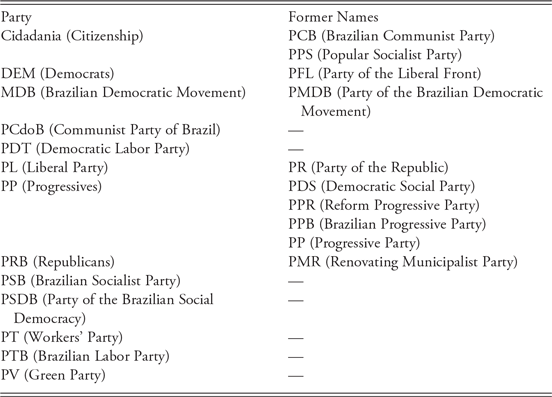
Current and Former Names of Brazilian Parties

Source: Authors’ elaboration based on CEBRAP Legislative Database
Presidential Terms

Source: Authors’ elaboration
SUPPORTING INFORMATION
For replication data, see the authors’ file on the Harvard Dataverse website: https://dataverse.harvard.edu/dataverse/laps