Introduction
Clinicians are frequently asked to judge the ability of older individuals to take care of themselves and make good decisions. There are two major concepts relevant to this capacity: (1) specific capacities (i.e. activities of daily living (ADLs)) and (2) global capacity (i.e. general decision making ability) (ABA–APA, 2005). Assessment of these capacities in older adults is a complex issue, particularly in the area of mild cognitive impairment (MCI) where cognitive abilities may be diminished, but ADLs are supposed to be “relatively intact.”
Activities of daily living or higher order instrumental ADLs (IADLs) include skills such as financial management, keeping appointments, accuracy of medication use, and driving. In the dementia literature, executive function and global cognitive measures (e.g. the Dementia Rating Scale-2 (DRS-2); Jurica and Leitten, Reference Jurica and Leitten2001) appear to be the most predictive of IADL and ADL ability (Royall et al., Reference Royall, Lauterbach, Kaufer, Malloy, Coburn and Black2007). However, little is known about cognitive correlates of IADLs in MCI. It is now widely accepted that changes, and even impairments, in higher order IADLs can be seen in pre-dementia conditions like MCI (Nygard, Reference Nygard2003). Assessing these changes and rendering decisions about capabilities during MCI is complicated, and much is left to be discovered about the nature and extent of higher order functional difficulties with these individuals.
Clinicians have judged as many as 40% of individuals with MCI to have impairments in ability to provide consent for research participation (Jefferson et al., Reference Jefferson, Lambe, Moser, Byerly, Ozonoff and Karlawish2008b). At a minimum, global decision-making ability includes the ability to understand relevant information and communicate a choice (Appelbaum et al., Reference Appelbaum, Appelbaum and Grisso1998). Additional criteria outlined by the American Psychiatric Association (1998) can include an appreciation of how information applies to ones self specifically and logical reasoning ability.
One tool frequently used to help clinicians and researchers render an opinion about IADLs and decision-making ability is cognitive assessment. In Alzheimer's disease (AD), decision-making capacity has been shown to be associated with language, memory, and executive function (Marson et al., Reference Marson, Chatterjee, Ingram and Harrell1996; Reference Marson, Hawkins, McInturff and Harrell1997). In amnestic MCI, medical decision-making capacity appears to be most related to verbal memory performance (Okonkwo et al., Reference Okonkwo2008), and financial capability is highly dependent upon attention and executive function (Okonkwo et al., Reference Okonkwo, Wadley, Griffith, Ball and Marson2006). Yet other research suggests that MCI individuals who have difficulties in understanding the nature and procedures of a research study have more difficulty on measures of executive function and not memory (Jefferson et al., Reference Jefferson, Lambe, Moser, Byerly, Ozonoff and Karlawish2008b).
While full neuropsychological evaluations are not available to all individuals, screening batteries such as the DRS-2 may provide some insights into daily functional ability and abilities related to decision-making. One study (Fields et al., Reference Fields2010) recently examined how the DRS-2 could predict ADLs in a large sample of 2,469 individuals, ranging in diagnosis from cognitively normal to dementia. They found that the lower DRS-2 scores, particularly on the subscales of Initiation/Perseveration (I/P) and Memory, were significantly related to worse ADLs. However, this group based their assessment of ADLs on the Record of Independent Living (ROIL; Weintraub, Reference Weintraub1986), a questionnaire geared toward individuals with dementia. The ROIL may have limited utility in MCI. Similarly, the DRS has been reported to significantly predict ADLs in mild to moderate AD (Fitz and Teri, Reference Fitz and Teri1994) and in a mixed psychiatric/dementia sample (Nadler et al., Reference Nadler, Richardson, Malloy, Marran and Hosteller Brinson1993). There is little information about how the DRS-2 performance may relate to IADLs and decision-making-related skills, particularly in the MCI population.
Methods
Study participants
Sixty-seven individuals with MCI by Mayo criteria (Petersen, Reference Petersen2004) and thought to have a high likelihood of progression to clinically probable AD (Petersen and Morris, Reference Petersen and Morris2005) were recruited from the Emory and Mayo Alzheimer's Disease Research Centers and through clinical referrals from neurology/neuropsychology practices at these centers. Subjects were enrolled in a larger trial on cognitive rehabilitation (Greenaway et al., Reference Greenaway, Hanna, Lepore and Smith2008). This study examines pre-intervention data only. All individuals completed full cognitive and neurologic evaluations and were diagnosed with amnestic single-domain MCI. As such, all individuals in this study were judged to have basically intact performance in other areas of cognition, including executive function. Subjects had an informant who had regular contact with the individual. All subjects and informants consented prior to participation in this research, and the respective Institution Review Boards approved conduct of the study.
Measures
All participants completed the DRS-2 and their informants completed the Everyday Cognition assessment (ECog; Farias et al., Reference Farias, Mungas, Reed, Cahn-Weiner, Jagust and Baynes2008). The ECog is an informant-based measure designed for individuals with MCI that assesses a participant's ability to perform everyday tasks in the following areas or subscales: memory, language, visuospatial abilities, executive function/planning, executive function/organization, and executive function/divided attention. The Executive Function subscales will subsequently be referred to solely as “Planning,” “Organization,” and “Divided Attention.” The ECog was modified with its authors' support to assess the participant's current functional ability rather than the original comparison to performance ten years prior. Higher scores reflect poorer performance on the ECog, while higher scores reflect better performance on the DRS-2.
Individual items from the ECog were selected for further analysis as they related to key IADLs, including Memory item 8 (M8) “remembering appointments, meetings, or engagements,” Organization item 2 (EO2) “balancing the checkbook without error,” Organization item 3 (EO3) “keeping financial records organized,” and Organization item 6 (EO6) “using an organized strategy to manage a medication schedule.”
Individual items from the ECog were also selected for relevance to decision-making skills, including Language item 6 (L6) “understanding the point of what other people are trying to say,” Language item 9 (L9) “understanding spoken directions or instructions,” Planning item 4 (EP4) “thinking things through before acting,” Planning item 5 (EP5) “thinking ahead,” and Language item 4 (L4) “communicating thoughts in a conversation.” These ECog items were reviewed retrospectively, and not phrased specifically to assess decision-making competency. As such, they will be referred to as “decision-making-related” items in the remainder of this paper.
The ECog does not specifically ask about driving. Thus, we used the ROIL (Weintraub, Reference Weintraub1986) question about driving in our analysis. This question asks how much assistance the individual requires to drive, ranging from 0 (“does not need help”) to 4 (“cannot perform task”).
Data analysis
Statistical Package for the Social Sciences (SPSS) software was used in data analyses. An individual's ECog subscale score was omitted if more than one item was left blank/do not know. This happened most frequently on the visuospatial subscale (n = 14 omitted) followed by the organization scale (n = 8 omitted). Pearson correlations were utilized to examine the relationship between subscale and total scores on the DRS-2 and ECog, and Spearman's rho was used in analyzing correlations between the ECog and ROIL driving item. Only significant correlations (p < 0.05) for the Total Score and DRS-2 subscales were examined in receiver operating characteristic (ROC) analyses to determine the accuracy of the DRS-2 variables in predicting whether individual functional abilities were normal or impaired (mild, moderate, or severe). Given multiple analyses, reporting of significance was adjusted to p < 0.01.
Results
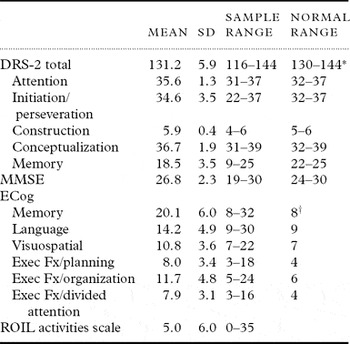
Participants had a mean age of 73.8 years (SD = 7.2), 15.8 years of education (SD = 2.7, range 12–20 years), and 54% were males. The majority of subjects were Caucasian (92%), but also included African American (6%) and Hispanic (2%) individuals. Cholinesterase inhibitors were used by 58% of the subjects. Informants completing functional status information on the individual with MCI were most often the spouse (70%), but also included adult children (19%), brothers/sisters (5%), or a friend (6%). The average DRS-2 and ECog performances can be found in Table 1.
Summary of cognitive and functional status

DRS-2: Dementia Rating Scale 2nd edition; MMSE = Mini-Mental State Examination; ECog = Everyday Cognition Scale; ROIL = Record of Independent Living; Exec Fx = Executive Functioning.
*Normal range scores are based on Mayo Older Adult Normative Studies data (30) for a 74-year-old participant (the average age of those participating in this study).
†Based on the score that would be obtained by selecting “no difficulty” on all items of that subscale. Scores lower than this in the current sample reflect a failure of the participant to answer every item.
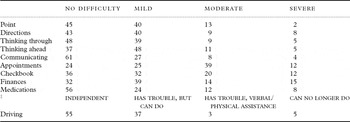
On IADL questions, 51% of MCI individuals were reported to have moderate to severe difficulty with remembering appointments. Most individuals reported that the individual with MCI had mild to no difficulty on the remaining IADL questions. However, a sizeable minority expressed significant concerns about the individual with MCI balancing the checkbook, maintaining financial records, and managing medication (see Table 2). The vast majority of individuals were reported to have mild or no difficulty on questions related to decision-making ability. Age and education were not significantly correlated with performance on any individual IADL or decision-making-related item.
Percentage of MCI informants reporting each level of functioning

‡Heading titles are different between the Everyday Cognition items and the ROIL item
Point = “understanding the point of what other people are trying to say”; Directions = “understanding spoken directions or instructions”; Thinking through = “thinking things through before acting”; Communicating = “communicating thoughts in a conversation”; Appointments = “remembering appointments, meetings, or engagements”; Checkbook = “balancing the checkbook without error”; Finances = “keeping financial records organized”; and Driving = “driving ability from ROIL.
The DRS-2 Total Score was significantly correlated with all subscales of the ECog: Memory (r = −0.42, p < 0.001), Language (r = –0.44, p < 0.001), Visuospatial (r = –0.47, p < 0.001), Planning (r = –0.34, p < 0.01), Organization (r = –0.54, p < 0.001), and Divided Attention (r = –0.39, p < 0.01). The DRS-2 I/P subtest was significantly correlated with the ECog subscales of Visuospatial (r = –0.37, p < 0.01), Organization (r = –0.45, p < 0.001), and Divided Attention (r = –0.36, p < 0.01). The Memory subscale of the DRS-2 correlated significantly with the ECog Memory (r = –0.39, p < 0.001) and Organization (r = –0.34, p < 0.01) subscales. No other significant correlations were found between the DRS-2 and ECog subscales. Age and education were not significantly correlated with ECog performance.
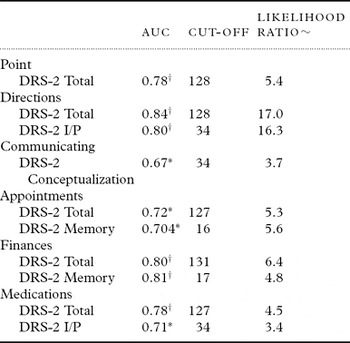
The ROC analysis revealed that the DRS-2 Total score, Memory, I/P, and Conceptualization subscales were significantly better than chance in predicting specific IADLs or decision-related abilities. Area under curve (AUC) and likelihood ratios are provided in Table 3.
AUCs, cut-offs, and likelihood ratios for predicting IADL impairment

DRS-2 = Dementia Rating Scale 2nd edition; MMSE = Mini-Mental State Examination; ECOG = Everyday Cognition scale.
*p ≤ 0.01, †p < 0.001. ~Value indicates increase in risk of impaired IADL if DRS score falls below cutoff, e.g. a person with total DRS of less than 128 is 5.4 times more likely to have difficulty understanding the point of conversation than persons with DRS of about 128.
Discussion
In keeping with the MCI diagnostic criterion (Petersen, Reference Petersen2004), most informants in our sample reported that these single-domain amnestic MCI individuals had little difficulty with specific IADLs or decision-making-related abilities. However, when asked about specific IADLs, 51% of the informants in this study reported that the individual with MCI had moderate to severe difficulty remembering appointments. It is not surprising that a memory-related IADL was most often endorsed as impaired in this sample with amnestic MCI.
In addition, despite intact functioning in other cognitive domains per both neuropsychological assessment and clinician opinion, these individuals were also reported to have at least moderate difficulty in executive-function-related IADLs, including balancing the checkbook (32%), financial records (29%), and use of an organized strategy of medication management (20%). This is in keeping with reported impairments in executive function (Royall et al., Reference Royall, Chiodo and Polk2004) and executive-function-related IADLs (Bangen et al., Reference Bangen2010) in individuals with amnestic MCI. Evidence for the presence of IADL impairment in MCI is accumulating (Tuokko et al., Reference Tuokko, Morris and Ebert2005; Farias et al., Reference Farias, Mungas, Reed, Harvey, Cahn-Weiner and Decarli2006). Our findings on specific IADL function support the report of the authors of the ECog, who found that significantly more difficulties in IADLs on the ECog were reported among individuals with MCI compared with healthy controls (Farias et al., Reference Farias, Mungas, Reed, Harvey, Cahn-Weiner and Decarli2006).
A notable number of these individuals with MCI were reported to have at least moderate difficulty in decision-making-related items such as understanding the point someone is trying to make (15%), understanding directions (17%), thinking things through before acting (14%), and communicating thoughts in a conversation (12%). Aspects of understanding relevant information, showing rational thought, and being able to communicate a choice are key aspects of decision-making ability. While we cannot directly state that these individuals would have impaired decision-making capacity, these findings suggest that perhaps it cannot be automatically assumed that decision-making capability is always intact in MCI.
Relationship to the DRS-2
The DRS-2 was significantly associated with many aspects of IADLs in the current study. Specifically, the DRS-2 Total Score was highly related to all six subscales of the ECog, including 18% of the variance (i.e. r2) for the ECog Memory, 19% for Language, 22% for Visuospatial, 12% for Executive Function/Planning, 29% for Executive Function/Organization, and 15% for Executive Function/Divided Attention. Royall et al. (Reference Royall, Lauterbach, Kaufer, Malloy, Coburn and Black2007) likewise reported that the DRS accounted for more than 20% on average of functional outcomes. In fact, in their large meta-analysis (Royall et al., 2007), the DRS explained more variance in functional ability than formal tests of attention, executive function, memory, verbal, or visuospatial function. In our study, the DRS-2 was also significantly predictive of performance on all specific IADL items, and comprehension questions related to decision-making abilities.
Specific subscales on the DRS-2 also showed significant relationships to function abilities in the current study. The I/P subscale of the DRS-2 was correlated with ECog subscales, including Visuospatial, Organization, and Divided Attention. This is consistent with other findings (Boyle et al., Reference Boyle, Malloy, Salloway, Cahn-Weiner, Cohen and Cummings2003) that I/P from the DRS-2 is significantly correlated to IADL function on the Lawton Brody ADL Questionnaire (also informant-based) in AD subjects. The DRS-2 I/P is conceptualized to examine executive function aspects of cognitive ability. Many authors have reported that executive functioning is predictive of functional ability in elderly patients, particularly in dementia (Boyle et al., Reference Boyle, Malloy, Salloway, Cahn-Weiner, Cohen and Cummings2003; Royall et al., Reference Royall, Palmer, Chiodo and Polk2005; Cahn-Weiner et al., Reference Cahn-Weiner2007). We found the DRS-2 I/P subscale to be also significantly predictive of organizing medications.
In addition to the I/P subscale, the Memory subscale of the DRS-2 was also significantly related to IADL abilities. This is consistent with the findings in a mixed normal aging, MCI, and AD sample using the DRS-2 and the ROIL (Fields et al., Reference Fields2010). In our study, the DRS-2 Memory subscale was correlated with the ECog Memory and Organization, supporting similar findings in some studies (Jefferson et al., Reference Jefferson2008a; Tomaszewski Farias et al., Reference Tomaszewski Farias2009) and contrasting with findings in other studies (Boyle et al., Reference Boyle, Malloy, Salloway, Cahn-Weiner, Cohen and Cummings2003). The DRS-2 Memory subscale was further predictive of performance on specific IADLs of organizing financial records and remembering appointments, meetings, or engagements. Others have found financial capability to relate more to executive function (Okonkwo et al., Reference Okonkwo2008).
Only 8% of the sample reported that the individual with MCI needed assistance or could no longer drive independently, suggesting that driving ability may be better preserved than other IADLs examined in amnestic MCI. The fact that we found no significant relationships to driving, while others found that the I/P and Memory subscales from the DRS-2 explained a significant amount of variance in reported driving ability (Fields et al., Reference Fields2010) is likely explained by the fact that the sample in that study, ranging from normal aging to AD, provided more range of scores for use in cognitive predictions.
In terms of decision-making-related skills, the DRS-2 I/P subscale was predictive of ability to understand and think through information, and the Conceptualization subscale helped predict ability to communicate with others. Similarly, Jefferson and colleagues (2008b) found that executive functioning and information processing were the strongest correlates of understanding information related to research studies in their capacity to consent to research study in MCI. In contrast, Okonkwo et al. (Reference Okonkwo2008) found that short-term verbal memory was the most relevant cognitive domain to medical decision-making capacity, followed to a lesser degree by executive functioning. Bambara et al. (Reference Bambara, Griffith, Martin, Faught, Wadley and Marson2007) found that the DRS-2 Total Score was significantly correlated with the ability to understand and appreciate the consequences of treatment choice on a measure of consent capacity in individuals with chronic partial epilepsy. There are no comparison papers that we are aware of with the DRS-2 and decision-making ability in MCI or dementia.
Limitations
We studied only individuals with single-domain amnestic MCI, and there is growing evidence that ADLs are differentially affected in various subtypes of MCI (Bangen et al., Reference Bangen2010). The sample further included persons who volunteered to participate in intervention research, and such individuals may have more or less functional impairment than the general MCI population. This study also used an informant-based IADL measure, and informants’ ability to predict that functional status is not always accurate (Harvey et al., Reference Harvey, Velligan and Bellack2007).
In addition, our relatively small sample limits our findings. We found several additional items at the p < 0.05 level that were not “significant” after correcting for multiple analyses. With further research and a larger sample, these “trends” may prove to be significant.
We acknowledge that this study is a preliminary investigation into decision-making ability in MCI, as this was a retrospective examination of items related to aspects of decision-making skills. A true assessment of decision-making capacity would be tailored toward an individual situation, examining the individual's understanding of the situation/choice (e.g. medical procedure or research participation) and ability to communicate their decision. Nonetheless, we thought it important to introduce the argument that researchers and clinicians may not always be able to assume that an individual with MCI has intact decision-making capacity. Follow-up research to examine decision-making capacity in MCI utilizing specific measures of capacity will be needed to confirm and expand upon these findings.
Conclusions
Informants largely report intact IADL and decision-making-related abilities in individuals with single-domain MCI. However, a notable percentage reports significant concerns about aspects of IADLs and skills necessary for decision-making ability. The DRS-2 can help explain a notable amount of variance in functional ability in MCI. In particular, the DRS-2 Total Score, I/P, and Memory subscales were significantly correlated with items related to both decision-making-related ability and IADLs of financial management, remembering appointments, and medication management.
Conflict of interest
None.
Description of authors' roles
Both Drs. Greenaway and Smith contributed to study concept and design. Dr. Greenaway performed the statistical analyses and wrote the paper. Dr. Smith helped with the statistical analyses and the preparation of the paper. Ms. Hanna and Mr. Duncan recruited subjects, performed the assessments with the subjects, compiled the data, and assisted in the preparation of the paper.
Acknowledgments
This study was supported in part by the Emory University Alzheimer's Disease Research Center AG0255688, Alzheimer's Association New Investigator Award NIRG-07-58843, and a Mayo Clinical Research Award and Clinical Program Investigator Award.