1 Introduction
HuroCup is a broad-based, highly challenging multi-event competition for intelligent humanoid robots. The HuroCup competition is held annually under the umbrella of the Federation of International Robot Soccer Association (FIRA). As the name implies, FIRA’s main focus is on robotic soccer and includes several subleagues including MiroSot (small, but very fast wheeled robots controlled by a global vision system), AndroSot (humanoid robots that play soccer being controlled by a global vision system), RoboSot (large wheeled robots that use local vision systems including omnidirectional vision), and SimuroSot (a simulation only league where teams of simulated MiroSot robots play against each other).
The initial idea for a humanoid competition as part of FIRA was proposed by Prof. Jong-Hwan Kim in 2002 to Prof. Thomas Braunl from the University of Western Australia. Prof. Kim’s proposal was to develop a league of soccer playing humanoid robots to follow the main theme of FIRA. Prof. Braunl asked Prof. Jacky Baltes to join the organization of this league since Prof. Baltes had significant prior experience with robotic competitions. Profs. Baltes and Braunl agreed early on that the new competition, HuroSot, would have three primary goals: (a) provide useful research challenges and benchmark problems for humanoid robotics researchers; (b) provide both motivation and an entry point for those interested in humanoid robotics, ranging from professionals to amateurs; and (c) provide a connection to the general public, not only for entertainment purposes but to motivate interest in robotics, artificial intelligence, and related technology.
The main research focus of the HuroSot competition, therefore, was to provide an important benchmark problem for the development of humanoid robots. As such, the organizing committee decided that a competition for humanoid robots should include several complete and varied tasks. The reason for this is that a good benchmark must satisfy several criteria including not being easily cheated by special purpose hacks, and being a good predictor for real-world performance (Baltes, Reference Bagot, Anderson and Baltes2000). Given a single precise task, a humanoid robot will always be outperformed by some special purpose solution engineered specifically for that one task. For example, when trying to built a robot that delivers mail in an office, all other things being equal, a wheeled robot will be much cheaper, more robust, and will perform the task faster than a humanoid robot walking on two legs. The humanoid shape is only beneficial when a single robot must perform a large variety of different tasks (e.g. deliver the mail, but also mow the lawn, wash the dishes, and carry people out of a burning building). Therefore, the humanoid robot competition was designed as a competition for multi-event humanoid robots and thus heavily focussed on versatility, flexibility, and robustness of the robot’s hardware and software. This versatility and flexibility is also highly regarded in human athletes. For example, decathletes are often referred to as ‘King of the Athletes’.
Second, the organizing committee felt that the events should address research challenges that are unique to humanoid robots. This is why playing soccer was not included in HuroSot: the main research challenges in soccer at the moment are similar for wheeled local vision platforms and humanoid robots. After having achieved reliable walking on a flat, even surface, the main challenge for a local vision robot in soccer are localization (where is the robot on the playing field?) and mapping (where are the other players, the ball, the opponents?). A lot of research in soccer competitions, such as FIRA and RoboCup has thus been focussed on implementing practical methods for those problems—particle filters being one of the most popular approaches (Bagot et al., Reference Baltes2008; Quinlan & Middleton, Reference Baltes and Anderson2009). However, apart from some minor differences in the motion and sensor models, there is very little difference between localization and mapping for a humanoid or wheeled soccer playing robot.
In attempting to organizing committee identified the following three key areas of research unique to humanoid robots:
-
1. Active balancing. Clearly, to efficiently cross many different environments, such as building, stairs, forests, and rubble piles, a humanoid robot must be able to walk over uneven terrain and be able to maintain its balance when colliding with other objects. To extend the balancing capabilities of the humanoid robots was always one of the main focusses in the rules for HuroCup. The lift and carry event and the weightlifting event as briefly described in Sections 5.3 and 5.9 are good examples of events that foster research into active balancing.
-
2. Complex motion planning. A humanoid robot consists of many d.f. So the development of motions is more difficult for a humanoid robot with more than 20 d.f. as opposed to a differential drive wheeled robot with 2 d.f.. In simple tasks, a sufficient set of parameterized motion models can be developed quickly. For example, in soccer less than a dozen motions are necessary (e.g. walk forward, walk backward, turn left, turn right, shuffle left, shuffle right, kick left leg, kick right leg, stand up forward, and stand up backward). These can be developed by capturing key frames and interpolating the positions. However, humans are able to create an almost infinite number of motions when faced with certain problems. An extreme example are arm amputees that learn to use their mouth to hold screw drivers or paint a picture. Even in everyday life, people will use their legs to turn off lights or open doors if their hands are full carrying some heavy books. In HuroCup, the wall climbing event is especially focussed on this topic.
-
3. Human–robot interaction. Humanoid robots also need to be able to interact with other robots and humans in meaningful ways. This means that they need to be able to employ human-like methods of communication. That means that humanoid robots must understand speech, but also be able to read signs or instructions and understand gestures. Furthermore, the robots need to be able to generate speech and gestures as naturally as humans if they are to be employed as helper robots for the elderly or assistant robots for fire fighters. The introduction of markers into the marathon event is an example of this type of initiative.
Another consideration of the organizing committee was the desire to keep the cost of designing and implementing robots for the competition reasonable. Team sports such as soccer require many players with almost identical design. This greatly increases the cost but offers few additional opportunities for high-quality robotics research. Therefore, the organizing committee decided that teams should be able to compete with just a single robot. The organizing committee felt that there is large scope in multi-agent research, but that heterogeneous teams that consist of players from different randomly selected teams will provide much more interesting multi-agent research challenges while at the same time greatly reducing the cost of participation, since each team still would only require a single robot. The organizing committee developed the rules for united soccer particularly to encourage this type of research.
2 The early years (2002–2006): HuroSot
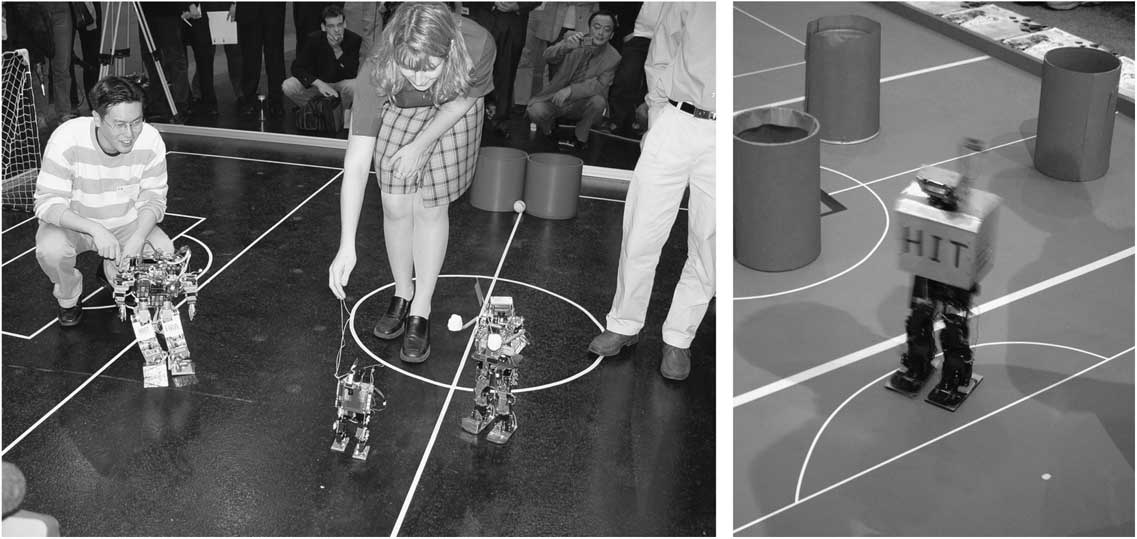
Since the performance of the humanoid robots was still very poor in 2002, the organizing committee decided on three events: sprint, obstacle run, and penalty kicks. The sprint consisted of a 2 m dash forward (see Figure 1, left).
Participants of the HuroSot 2003 competition in Vienna, Austria. From left to right: team HansaRam (KAIST, Korea), Team Tao Pie Pie (University of Manitoba, Canada), team Manus (National University of Singapore, Singapore) (left) and team HIT from China during the obstacle run at HuroCup 2004 in Singapore (right)

The penalty kick was kicking a ball into an empty net, and the obstacle run consisted of avoiding five randomly placed obstacles in the playing field (see Figure 1, right).
The rapid improvement in the performance can be seen by the performance of the winning team team Manus from the National University of Singapore. In 2003, they set a record of 1 minute; 4 seconds for 2 m walking forward, but improved that time to 24 seconds in 2004.
To make the competition more challenging, several changes were made in the rules. The sprint event was extended to include a leg where the robot had to walk backwards in the 2005 competition.
More importantly, after some heated discussion, non-human-like sensors like laser range finders, omnivision lenses, and infrared sensors were disallowed in 2005. In addition, the kinematics of the robots were limited to be human like, thus outlawing feets or heads that can turn 360°.
3 Growing up (2007–2011): a new name: HuroCup
The biggest change in the HuroSot competition occurred in 2006. The HuroSot competition had proven itself to provide a rich and varied environment for high-quality research in humanoid robotics, attract many teams, and the capabilities of the robots had dramatically improved over the years. So HuroSot was extended to eight events and became a separate competition in FIRA. Due to this change, the organizers also decided to change the name from HuroSot to HuroCup.
HuroCup also added two different size classes. Robots in the kid-sized category must be smaller than 60 cm and robots in the teen-sized category must be >80 cm. There are also other rules that mainly limit the maximum foot size of the robot.
To mark this occasion, the name of the competition was changed from HuroSot to HuroCup.
The new events introduced into HuroCup were as follows: basketball, weightlifting, lift and carry (uneven terrain), and marathon.
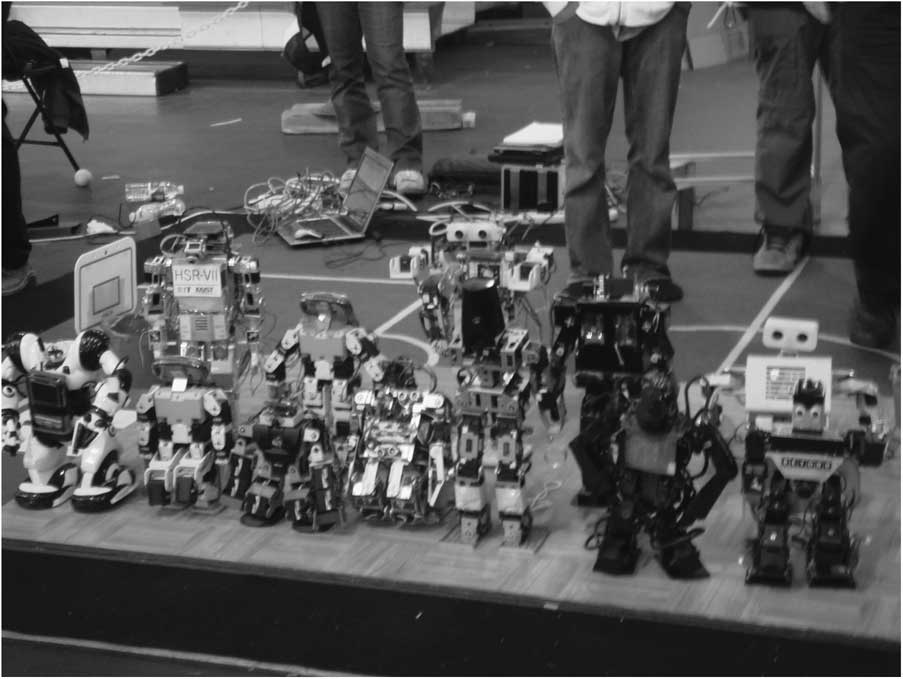
The participants of the HuroCup 2007 competition in San Francisco, USA are shown in Figure 2.
Participants of HuroCup 2007 in San Francisco, USA

4 Today (2015)
The 20th anniversary of FIRA Robot World Cup and Conference was held in Daejeon, Korea from 4th to 9th August 2015. This year was also a very important year for HuroCup. Responding to the greatly improved performance of the robots in recent years, the organizing committee decided to introduce two drastic changes: first, the length of the marathon run was extended from 200 to 421.95 m. This more than doubles the length of the marathon from previous years and it also means that the performance of the robots has improved by an order of magnitude from the first running of the HuroCup marathon event in 2007. The reason for this change was that batteries lasted long enough for the teams to use their standard walking gaits rather than having to develop special highly energy-efficient walking gaits to consume battery power. Second, the long jump event was introduced into the HuroCup competition. This is the first jumping event for HuroCup and an important step, as the organizers of the HuroCup competition see jumping as an intermediate step to the development of running robots. The currently used electric servo motors are not able to provide enough power (i.e. sufficient torque at high enough speeds) to allow a robot to execute highly dynamic motions such as jumping and running. The power to weight ratio of such robots is too poor.
Furthermore, jumping and running robots require compliance in their design. A robot that uses stiff materials (aluminium or carbon fibre) directly connected to gear boxes will quickly damage its gears and motors when jumping or running. Instead, the new generation of robots will need to include some compliance. One possible solution is the use of series elastic actuators (SEA) first introduced by Pratt (Pratt & Williamson, Reference Durrant-Whyte and Bailey1995). Martins from the team WF Wolves implemented a SEA that can be attached as a module to existing electric Robotis servos, which is a promising direction of future research (Martins et al., Reference Martins, Pretto, Gerndt and Guerra2015). For a running humanoid robot, compliance will allow a robot to absorb the impact, store the energy for a short period of time, and then release it for the next running step. Compliance also has several other important advantages as it will allow robots and humans to work together in a safe environment. It also should be noted that compliant humanoid robots will move more like humans and less like robots, as humans and other animals are also built around soft and compliant structures (Figure 3).
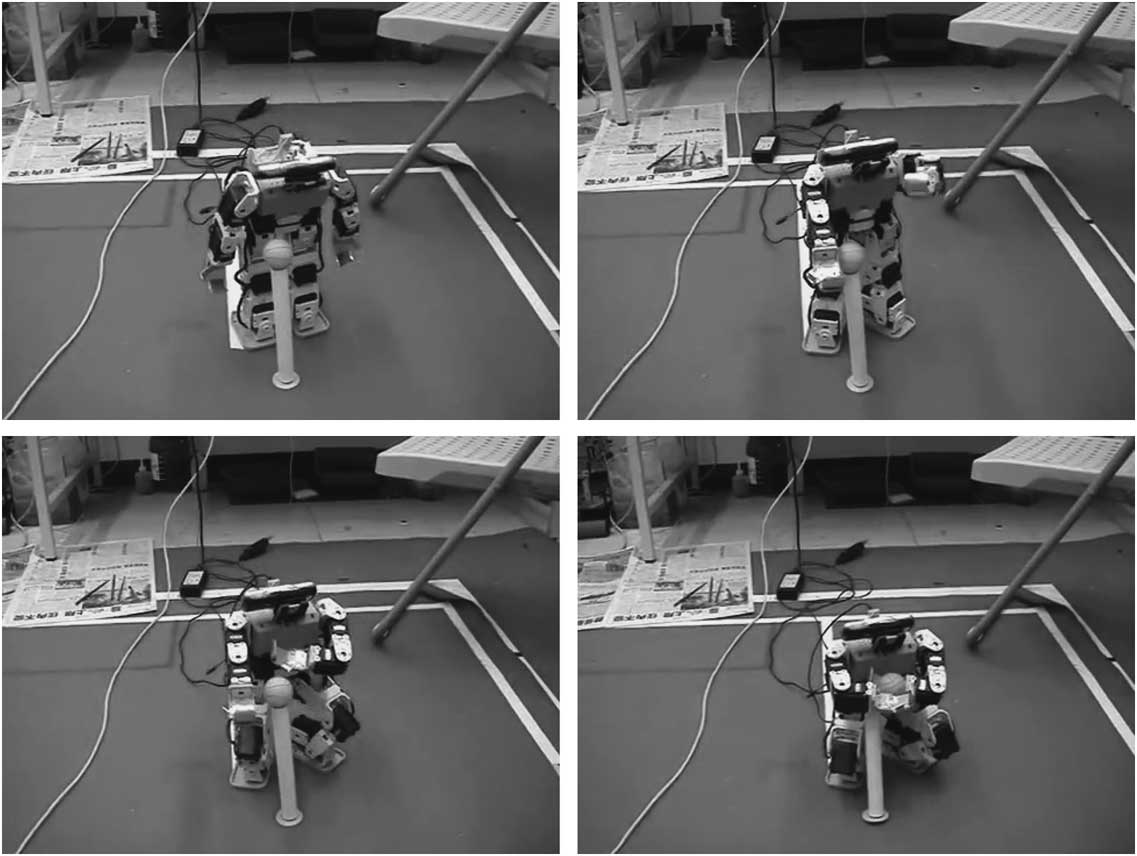
Basketball pickup motion for team Rogue from Canada practicing for HuroCup 2009

5 HuroCup events in 2015
This section gives a brief introduction to the HuroCup events in 2015.
5.1 Basketball
The intent of the HuroCup basketball event is to focus on object manipulation, complex motion planning, and hand–eye coordination. The robot needs to pick up a table tennis ball (placed on a randomly positioned stand elevated at shoulder height) and then throw it from outside either a five-point or three-point circle into the basket. If a robot is unable to throw, it can also walk to the basket and dunk the ball for 2 points.
One of the main challenges is that since the ball is much smaller than a soccer ball, the object manipulation has to be more accurate. When playing soccer, if a robot misses when trying to kick the ball, it is in a good position to try again. But in basketball, a failed attempt will usually mean the ball is no longer on the elevated stand, which makes locating and retrieving in the available time prohibitive to a second chance. The movements of the robots are currently so coarse and the error in the position estimate of the ball from the vision system so high that inverse kinematics alone do not provide the necessary accuracy. Some supplemental form of perceptual feedback is necessary.
In fact, most experienced teams in basketball use a visual serving approach where the position of the robot’s hand is matched to the position of the ball in the camera image before attempting to pick up the ball (see Fig. 3).
Another challenge is the throw, which requires accurate motor control and synchronization to be able to score from the three-point and five-point line. Initially, teams added powerful wrist motors to the robot to increase the distance of the throw, but those motors hindered performance in especially the running events, so few teams use them in 2015. Phenomena such as this validate the multi-event process: in an ideal comparison setting for the breadth expected of a humanoid, any significant physical alteration intended to benefit one particular event should be enough of a detriment in other events to limit such benefit overall (Figure 4).
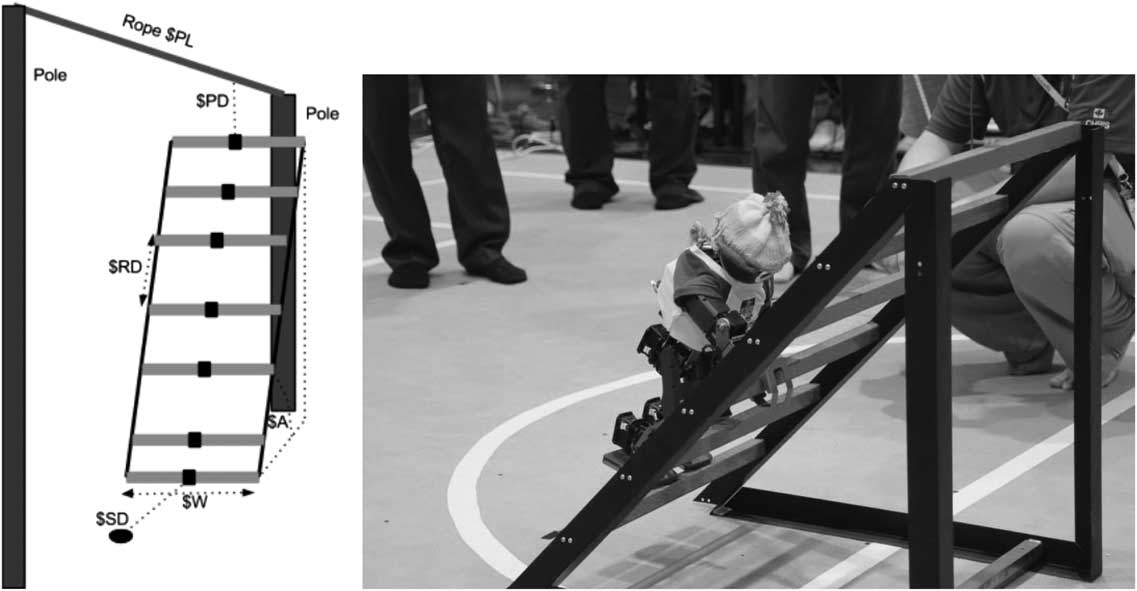
Images from the climbing event: (left) climbing event playing field and (right) robot from team Snobots from Canada climbing the ladder

5.2 Climbing
The focus of the climbing event, introduced in 2007, is also on complex motion planning and hand–eye coordination. The climbing event provides a rich-enough environment that pre-programming all necessary motions becomes intractable. While there are many forms that climbing can take on, in the current climbing event the robot must climb up a ladder with unevenly spaced rungs. The distance between the rungs varies from 10 to 20 cm and cannot be predicted consistently from run to run. The nature of the ladder is known, so the appearance of a rung can be predicted in the visual field, and it’s possible range is known from the known range of spacing distance, but like the basketball event some form of feedback must generally be employed to searching for the next rung and properly grasp it. Complex motion planning comes into play since the robot must remain firmly balanced on the ladder while searching for the next rung, and remain balanced while executing the change in motions to grasp the next rung.
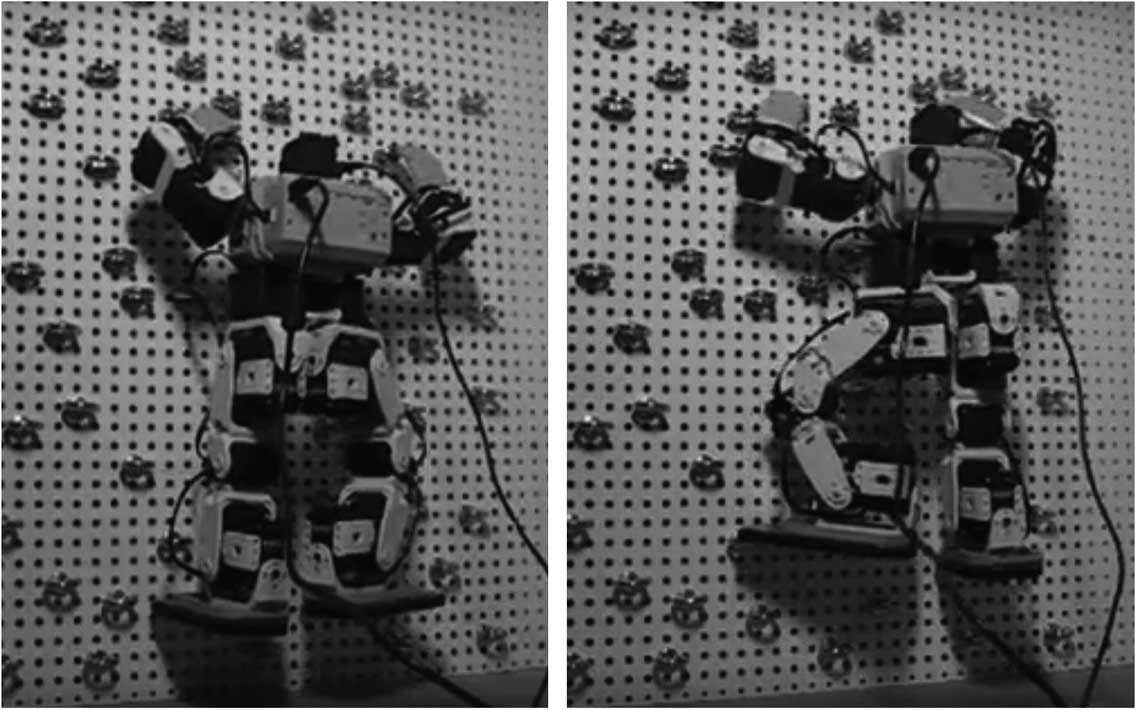
Recent changes in the climbing event serve as a good example of providing a strong challenge to existing technology while at the same time extending that challenge to motivate future developments. For the 2016 event, climbing has been extended to a two-level platform as shown in Figure 4. The ladder under the conditions described above remains the first stage, and a second stage is then added by rigging a taught rope at the top of the ladder for robots to continue climbing for an additional score if they are able to do so. The concept of keeping close to the bounds of technology also means occasionally pulling back for a period of time. When the climbing event was first envisioned, Wickrath demonstrated a wall climbing robot as shown in Figure 13. A Bioloid humanoid robot climbed up a vertical wall using hooks that locked into eye hooks attached to the pegboard. However, the feet of the robot needed to extend significantly in order to avoid knees hitting the wall as the robot climbed (Wickrath, Reference Montemerlo, Thrun, Koller and Wegbreit2010). While this was an excellent demonstration it was both extremely challenging (both in motion planning and especially the visual perception problem since the robot cannot see the entire wall) and required modifications to the robot that would not have been amenable to most of the other events. So, while this goal is being kept in mind, it was postponed and the event reconfigured to its current form.
5.3 Lift and carry
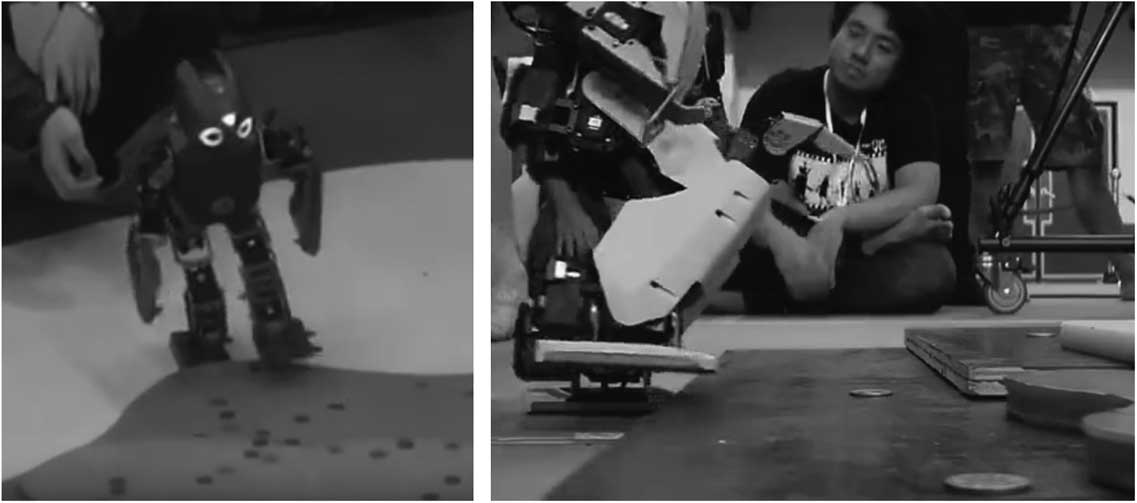
The lift and carry event provides a field of difficult uneven terrain for the robot to cross, as shown in Figure 5. This field consists of randomly cut sheets of wood that are between 1.5 and 2.5 cm in height. A collection of 0.5–0.8 cm high and 3–6 cm disks are placed randomly on top of the sheets. Each sheet is colour coded to allow the robot to construct a three-dimensional model of the environment using vision. The visual image perceived at the start of the event, along with the colour coding, are the sum total of knowledge of the field the robot possesses.
Team MCU from Taiwan competing in the lift and carry event during HuroCup 2014 (left) and a close up from team NTNU from Taiwan (right) from the Taiwan Humanoid Open 2015 competition

In the lift and carry event, the robot must start from a random position on the edge of the playing field and walk towards the highest peak. Once it reaches the highest peak, it must leave the playing field by moving towards any edge. This forms one iteration of the event, and after each iteration a weight is added to a basket attached to the robot. A fall at any point terminates the event.
This event has gradually become more complex over time. Initially, teams were allowed to choose their own starting points, and the original field had no disk obstacles. There are many possibilities for future changes, both along the dimensions that have already been complicated and in new aspects as well. For example, the weights currently being used (batteries) can move but have limited shifting potential compared with other possibilities (liquid).
5.4 Long jump
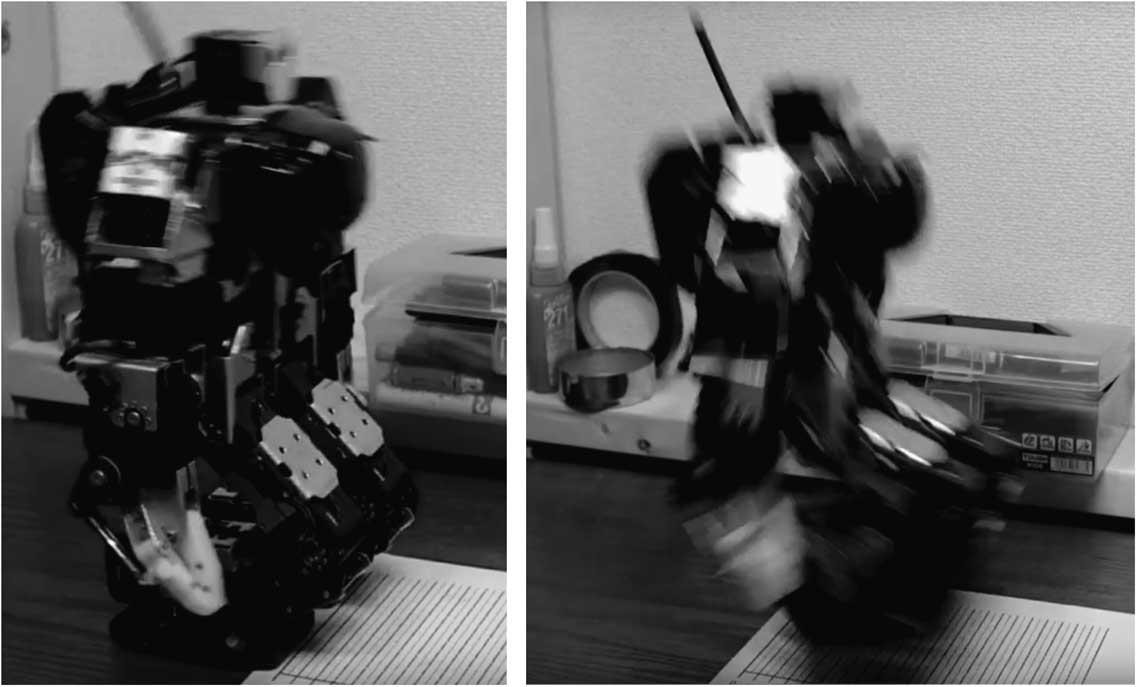
In the long jump event, the robot needs to make a single jump and land safely afterwards as shown in Figure 6.
Team Shibata from Japan practicing the long jump for HuroCup 2015

The long jump is the newest event in HuroCup and focusses on (a) highly accurate synchronization in motor control to generate enough force to jump; (b) exploiting the natural dynamics of the robot; and (c) reducing the impact forces during landing so that the servo motors are not damaged.
The event is fairly self-explanatory: the robot must do a single jump with both feet on the ground behind the starting line, and the longest jump is the winner. The distance only counts if the robot remains upright upon landing, and both feet much leave the ground before the robot passes the starting line. There are currently no restrictions on movement up to the starting line—that is, if a robot could truly run, a running start would be permitted. Thus far no team has attempted this, the timing challenge of gaining speed while planting both feet before the starting line is a very difficult one.
Currently, teams begin from a standing position at the starting line and use a rocking motion to build momentum and then employ that momentum in a forward jump. Since jumps made using this technique are fairly short, a high speed camera is used to measure performance.
This event serves as a precursor to many physically challenging human events such as running, free jumping, or managing falls, in that it encompasses all the primary motions that go into these. In a sense, running is a series of one-legged hops, and while walking is a series of controlled falls, those falls have much more damage potential when done quickly and with force, and so reducing the impact of these becomes crucial. Like the other events, this provides a challenge but also places some boundaries on teams and lets them grow into performing such motions well: a long jump is a single motion that begins and ends, as opposed to longer ongoing running or jogging gaits.
While there is already a built in extension to this event, since teams do not necessarily have to start from a standing position, there are many other variations that can be added (and which are common in human jumping events as well), such as extending to multiple jumps, adding a height requirement for a mixed high/long jump, etc.
5.5 Marathon
The marathon is an extreme endurance event both for humans and robots. Robots must follow a taped track using a single battery charge only. The initial marathon event in 2007 was held indoors and covered a distance of 42.195 m (1/1000 of the human marathon distance). Team HansaRam from KAIST in Korea won in a time of 37:30 minutes. The fast evolution in the walking capabilities of the robot can be seen clearly in this event. Already in the next year, team aiRobot from National Chung Keng University in Taiwan won the marathon in 4:35 minutes.
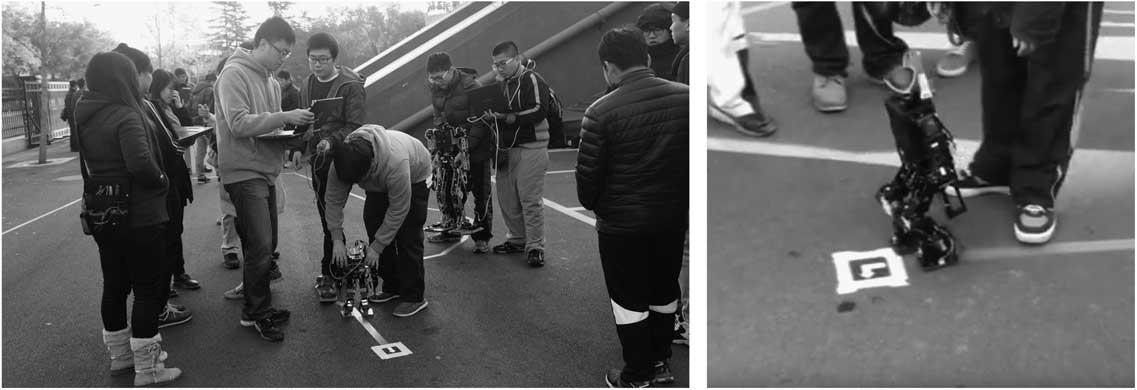
Many improvements were made to the marathon event to keep pace with the improvement of the robot’s capabilities. In 2015, the marathon distance was 421.95 m (1/100 of the human marathon distance and 10 times the distance of the first marathon run in 2007) and the event has moved outdoors. Furthermore, the taped track includes breaks and the robot has to recognize markers (small signs with arrows pointing left, forward, or right) to find the continuation of the track. The track and markers are shown in Figure 7.
Images from the marathon event: teams NYP from Singapore (front) and team National Chung Keng University from Taiwan (back) practicing during HuroCup 2014 (left), and team TKU from Taiwan interpreting the marker correctly at HuroCup 2015 (right)

Since the marathon event is now held outdoors, teams have to deal with huge variations in lighting (from sunshine in the open to shadows in the corners), more uneven terrains (since there are always small cracks in the concrete), and the weather (clouds or, in 2013, even monsoon rains).
Some images from recent marathon competitions are shown in Figure 7.
5.6 Obstacle run
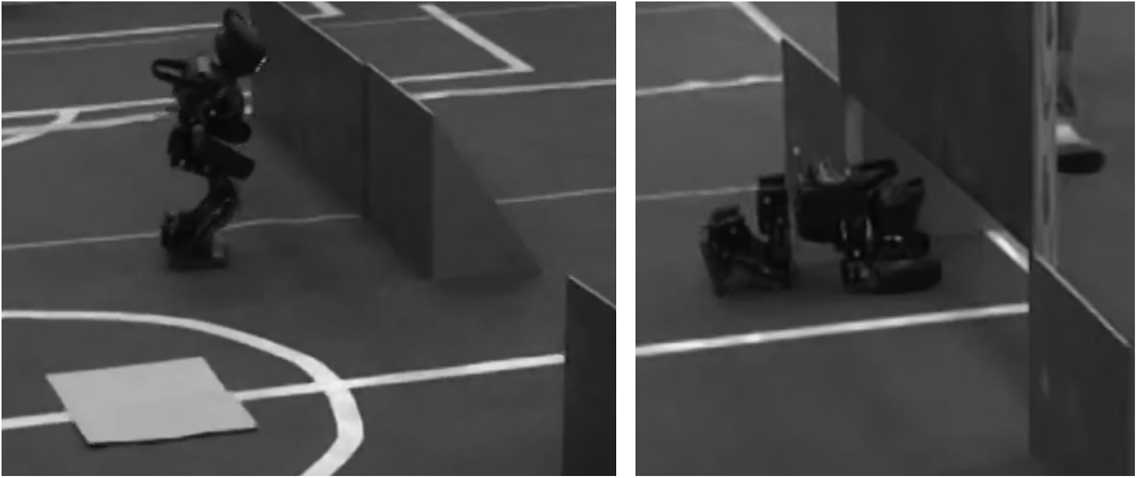
The obstacle run is a navigation challenge for the robots. The robot must cross from one side of the playing field to the other. A number of obstacles comprising of blue walls, yellow simulated holes, and red gates are distributed at random over the playing field as shown in Figure 8. The robot is not allowed to touch any of the obstacles.
Team MCU from Taiwan successfully passing through a narrow gap in the walls (left) and underneath a gate obstacle (right)

This is a classic 2.5 dimensional simultaneous localization and mapping (SLAM) problem and most teams use a variation of particle filters and well-known SLAM algorithms from the literature (Montemerlo et al., Reference Quinlan and Middleton2002; Durrant-Whyte & Bailey, Reference Pratt and Williamson2006).
Another issue that is not as popular in the research literature is the ability of the robot to perform accurate local obstacle avoidance and approach obstacles closely without touching them. For example, the gaps in the walls and the opening of the gate need to be approached with high precision as can be seen in Figure 8. Otherwise, the robot will touch the walls or gates. This provides practical elements that teams must consider in both secondary obstacle avoidance and even the primary means of path planning (since some mechanisms are biased towards producing paths that naturally take one near obstacles (Baltes & Anderson, Reference Wickrath2003).
5.7 Sprint
The sprint event was one of the inaugurating three events of the HuroSot competition in 2002, and was intended as an entry-level event accessible to any team with a humanoid robot, since it requires no grippers or special-purpose upper body equipment. The only necessary skills for the humanoid robot are walking on a flat surface and rudimentary navigation skills.
The event is still intended as the most entry level of all the challenges, but has evolved significantly since its inception. Currently, the robot must walk 3 m forward (forward leg), cross the end line, and then walk 3 m backwards to the start line (backward leg), while simultaneously remaining inside of its 1 m wide lane. The first robot to complete the backward leg is declared the winner. Teams are allowed to place markers into the end zone to help the robot maintain its position within the lane.
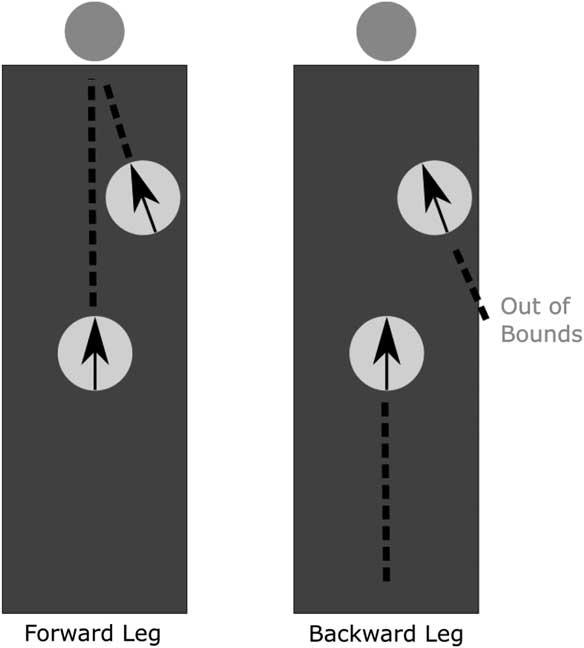
This seemingly simple setup has some subtle challenges associated with it, however. The strategy for navigation while walking forward is simple—the robot just needs to turn towards the target and keep moving forward. However, while walking backwards this simple strategy will fail as shown in Figure 9.
The simple navigation strategy (turn towards and then walk to the target) fails during the backward leg of the HuroCup sprint event

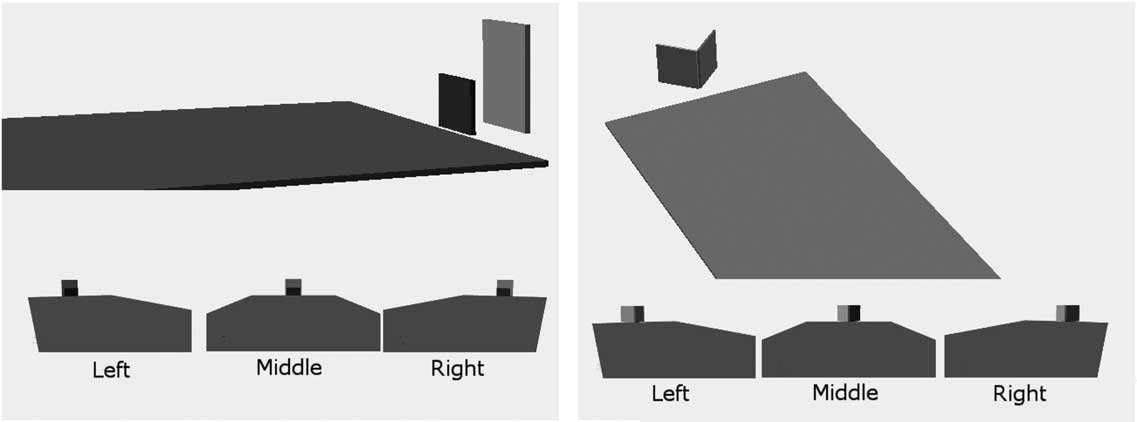
For the backward leg, the design of the marker must allow the determination of the centre line of the lane. Two possible marker designs that are commonly used by teams are shown in Figure 10. Markers serving this purpose are used in a number of human sports; for example, swimming generally involves keeping in lanes, and a swimmer’s head might be positioned facing up or down depending on the stroke used. Lanes are similarly marked with floating elements and on the bottom of the pool.
Two types of markers commonly used by HuroCup teams in the sprint event to indicate position of the robot within the lane rather than just a target point. The view from the robot when looking at the marker from the right, middle, and left positions on the lane is shown

A few teams also try to use proprioception (e.g. Z axis gyroscopes and accelerometers) to help the robot maintain its position within its lane. However, this requires a smooth walking gait and fails should the robot fall during its run.
5.8 United soccer
The united soccer competition is a soccer game between robots with an important additional challenge from a multi-agent systems standpoint. The two teams (Red and Blue) are made up out of randomly selected robots. This means that the team is challenged to develop an agent that can play well with others, knowing that they will have a similar goal in terms of playing good soccer, but not that they will be running the same code or taking the same approaches towards team-based play (e.g. whether roles are recognized or not). There is a strong benefit to developing players that can dynamically follow the actions of others, as opposed to relying on other players having the identical understanding of plays, roles, etc. through shared code. A common communication protocol is defined to allow the robots to send their perception, goals, and intentions to the other players in order to facilitate coordinated interaction, and to listen to messages from the referee (e.g. Kick Off Red Team).
Because it is entirely possible to provide the worst-playing robot on an otherwise good team, the challenge needs to be scored so that agents do not overly benefit from coincidental inclusion among strong teammates. Thus players are given individual scores during the match: a robot that scores a goal receives 10 points. Scoring is also used to provide intermediate feedback on individual play: a robot that completes a path receives 2 points, and a robot that walked out of the playing field receives −1 point.
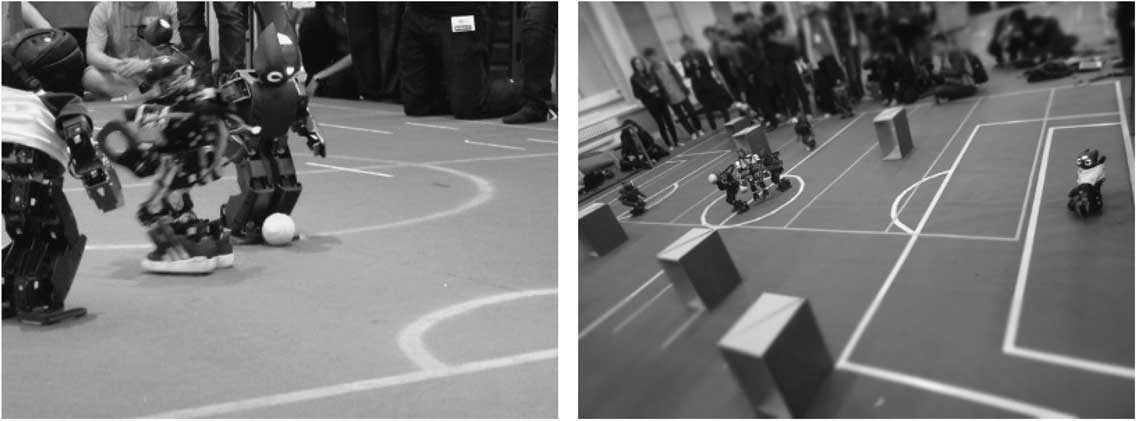
Richer interaction between robots is promoted by encouraging robots to pass to one another. Because on a mixed team there will be additional problems identifying teammates, there will not always be the same number of passing targets during any play than might be true on a single homogeneous team. This is further complicated by the fact that robots will likely be less coordinated than on a traditional robot soccer team, so more collisions, falls, and other penalties must be anticipated. To counter this, passing poles are placed randomly in the environment (see Figure 11) to provide the same opportunities for additional points awarded for passing. When a ball touches one of these, it is counted as a pass and a single point is awarded to that robot. Multiple repeated points are not awarded for the same pole to the same robot. The poles also serve for enforcing obstacle avoidance, and points are deducted for colliding with these.
The united soccer competition during HuroCup 2012 in Bristol (left) and HuroCup 2013 in Shah Alam (right)

There are a great many ways this challenge can be expanded as technology moves forward. Most easily, currently the poles are not moved between ball stoppages, so robots can use them in localization if they wish. A simple complication would be moving the poles between plays. As genuine passing between previously unknown robots becomes more common, the poles can also serve as a passing control point, similar to means used to enforce the offside rule in sports such as ice hockey and soccer (Figure 12).
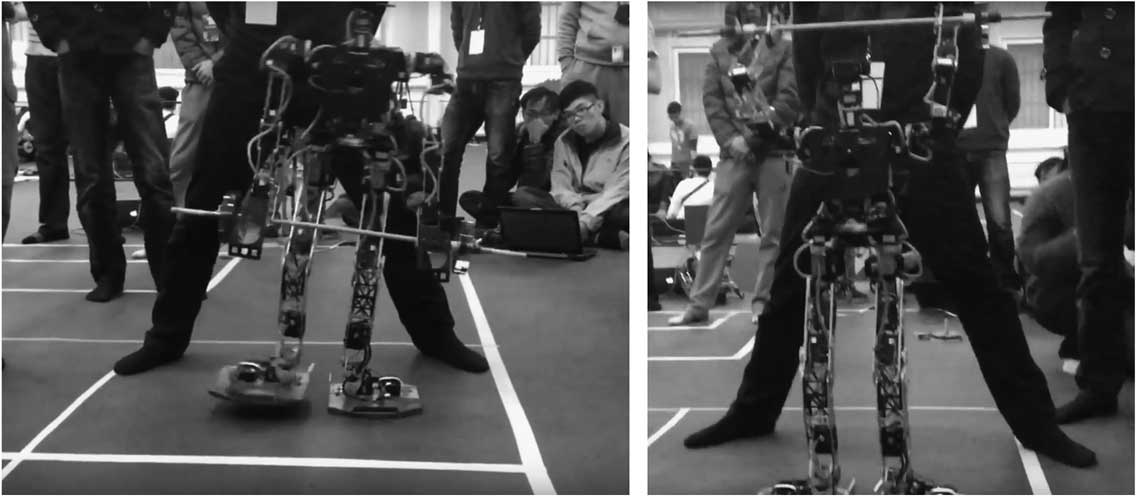
Team Dagobot from NKFUST in Taiwan during the HuroCup 2014 competition showing the different positions of the weight bar during the weightlifting event

5.9 Weightlifting
The weightlifting event is similar to human weightlifting, with some additional challenge of balance and directionality while carrying weight. In this event, the robot must lift and carry a weight bar that uses DVDs as weights and the robot with the maximum weight in at most three attempts wins. While human weightlifting competitions often involve the ‘clean and jerk’, this alone would not provide much challenge to teams apart from installing the most powerful shoulder servos they can afford (with the cost of possible performance sacrifice in other events due to weight and power drain). Therefore, in the HuroCup competition, balance, motion, and directionality are added. The robot must pick up the weight bar and then walk towards a lift line with the weight bar held low. Then with at least one foot touching the lift line, the robot must lift the weight bar above its head and continue to walk towards the finish line (See Fig. 12). Lifting the weight bar from its low to high position greatly changes the centre of mass of the robot and thus teams must adjust their walking gait to compensate under these conditions. Lifting the weight bar may also add physical complications in the grip as well. If a hand held in a closed loop as opposed to a tight grip is used, for example, the weight bar will roll along the hand as it is moved from how to high, making for a sometimes sudden weight shift.
Another aspect of the weightlifting competition is the need to synchronize the motions of all servos to lift a heavy weight bar, since the torques from the shoulder servos alone are not enough to lift the weight bar.
6 2016 and beyond: future direction of the HuroCup competition
HuroCup will strive to continue to create a competition, that is, both meaningful for researchers looking to work on cutting-edge research in humanoid robotics, but also entertaining for spectators. These two goals are often conflicting and HuroCup is trying to tread a thin line between those objectives. However, the organizing committee takes its role as steering the most challenging benchmark for intelligent humanoid robots seriously and will not yield to suggestions to simplify the competition to provide more entertainment. For example, there have been several attempts to introduce remote-controlled robots or more powerful sensors into the competition (e.g. RGB-D cameras or Kinect sensors), which undoubtedly make the robots perform better and possibly make the competition more exciting for spectators. However, the HuroCup community rejected those proposals since it would have shifted the focus away from artificial intelligence and computer vision.
Each year, the organizing committee introduces minor improvements and extensions to the HuroCup rules. Often these are in response to ‘bugs’ in the current rules which some teams may have actively tried to exploit.
However, there are also several strategic changes planned for the rules. First, the HuroCup community will continue to move further away from structured environments (e.g. colour-coded objects, flat even walking surfaces, or known positions) to unstructured environments (e.g. uneven terrain, randomized object colours and textures, or randomized positions).
Second, the rule development will put more emphasis on compliant robot designs that allow the storage of energy for short periods of time and to explosively release this energy when needed. This type of design would allow a robot to run, which would be immediately useful in the long jump and running events (sprint, marathon, and obstacle run), but also in the basketball event since it would allow more powerful throws. For example, the organizing committee plans to introduce hurdles into the obstacle run event within the next 3 years.
Third, a major rule development is the replacement of the stair climbing event with a wall climbing event within the next 5 years. Moving back to vertical wall planning opens up an enormous number of possibilities for testing adaptability in robots. For example, moving to the use of fingers rather than the hooks described in Section 5.2, and various rules for dealing with the visual perception problem. For the latter, a robot could be given a brief glance at the wall and then have to reconstruct the configuration through the climb. A relaxed version of such an event could give the robot a precise map of hand holds. Figure 13 shows a prototype version of the competition as demonstrated by Wickrath (Reference Montemerlo, Thrun, Koller and Wegbreit2010).
A Robotis Bioloid robot from the University of Dortmund in Germany demonstrating wall climbing on a previously unknown climbing wall

Long-term plans include the introduction of other major athletic events such as swimming. However, the organizing committee feels that the poor buoyancy of the robots and the difficulties in waterproofing a robot means that further development is needed to make swimming a practical event.
7 Conclusion
This paper describes the history of the HuroCup competition from its inaugural competition in 2002 with three teams and three events to today’s competition with over 40 teams participating in nine events. In the near future, the complexity and scale of the tasks will continue to increase. The control of the robot will be forced to become tighter (e.g. the gap between obstacles in the obstacle run will be reduced), the environment will become more varied (e.g. rung spacing will be varied more and the angle of the climbing wall will become steeper). The lift and carry competition will move from artificial colour-coded uneven fields to natural ones such as gravel roads or lawns.
Acknowledgements
This work was supported in parts by a Discovery Grant RGPIN 352400-713002 from the National Science and Engineering Council of Canada.