


INTRODUCTION
Elections in established democracies regularly attract less than half of the voting-age population (Blais Reference Blais2010), raising concerns not only for the equal representation of all citizens, but also for the overall legitimacy and stability of the democratic regimes. Participation is unequal (Wolfinger and Rosenstone Reference Wolfinger and Rosenstone1980) and tends to be more so when it is lower (Rosenstone and Hansen Reference Rosenstone and Hansen1993), threatening the representativeness of elected officials and public policies. Low and unequal turnout may be largely driven by the cost of participating (e.g., Piven and Cloward Reference Piven and Cloward1988). This article studies the impact of a specific type of costs: voter registration costs.
In many democracies such as Canada, Australia, Italy, Germany, Sweden, and Indonesia voter registration is automatic and done by the state (Brennan Center for Justice 2009; Sénat 2006). In others such as the United States and France, registration is self-initiated: citizens who wish to vote must register first, and they need to go through this process again each time they move. Many citizens are not registered (Insee Premiere 2012; US Census Bureau 2012) or are registered at an old address (Braconnier and Dormagen Reference Braconnier and Dormagen2007; Braconnier et al. Reference Braconnier, Dormagen, Gabalda and Niel2016). One view is that self-initiated registration does not matter much because these citizens fail to register due to their low interest in voting, and most of them would abstain if they were registered. Another view holds that self-initiated registration is largely responsible for low participation, because registration costs (in terms of time it takes and the information it requires) can be much higher than the cost of voting itself, and they occur at a time when interest in the election is far from its peak. To the extent that registering is more difficult or costly for some citizens than others, self-initiated registration may also be responsible for unequal participation.
To disentangle both views, a natural empirical test is to check the extent to which voter turnout is affected by changes in the registration costs. The first view predicts a minimal impact, the second a substantial one.
Observational studies first ran this test using variation in voter registration laws. Gosnell (Reference Gosnell1930) identifies such laws as one of the most important institutional factors explaining lower turnout rates in the United States, compared to Europe (also see Jackman Reference Jackman1987; Powell Reference Powell1986). Converse (Reference Converse1972) exploits temporal rather than spatial variation and notes that the introduction of voter registration laws at the turn of the 19th century in the United States coincided with a large drop in participation. However, other authors point out that concomitant trends may have contributed to this drop (e.g., Rusk Reference Rusk1970). This controversy illustrates an important limit of observational studies, namely the difficulty of separating the impact of voter registration laws from other factors, including other institutional variations. In addition, the adoption of different registration rules by different countries, states, or counties might reflect unobserved motives correlated with participation.Footnote 1 These limits may help explain why different studies reach opposite conclusions on the effects of laws which, since the 1960s, have relaxed voter registration requirements. Some studies find little or no effect on turnout and inequality (e.g., Brown and Wedeking Reference Brown and Wedeking2006; Nagler Reference Nagler1991). Others find strong effects (up to 10 percentage points) on voter turnout of “motor voter” provisions (Knack Reference Knack1995), registration deadlines closer to the election (e.g., Vonnahme Reference Vonnahme2012), or election-day registration (Knack Reference Knack2001). These studies further report that less stringent requirements decrease inequality in the electorate by bringing in younger and less educated citizens as well as frequent movers (e.g., Highton Reference Highton1997; Rosenstone and Wolfinger Reference Rosenstone and Wolfinger1978), although this alters the electorate’s overall demographic composition and partisan balance only minimally.Footnote 2
To isolate the causal impact of voter registration costs from correlated factors, we designed a large field experiment that facilitated registration for a random group of households. Prior to the 2012 French presidential and parliamentary elections, we conducted in-depth preparatory field work in 10 cities to identify households likely to include unregistered citizens. We then randomly assigned these 20,500 households to one control or six treatment groups. Treatment households received home canvassing visits providing either information about registration or help to register at home. Depending on the city, the visits were conducted by nonpartisan students, NGO members, or members of political parties. Treatments further varied the timing of the visits (early, during the two to three months before the registration deadline, or late, during the last month before the deadline) and their frequency (once or twice). We evaluate the effects of the interventions using administrative data on registration and turnout, data collected by the canvassers during the visits, and comprehensive survey data collected door to door on 1,500 respondents after the elections.
Our method draws on a large experimental literature pioneered by Gerber and Green (Reference Gerber and Green2000). While many studies evaluate the impact of door-to-door canvassing on voter turnout (e.g., Arceneaux and Nickerson Reference Arceneaux and Nickerson2010; Green, Gerber, and Nickerson Reference Green, Gerber and Nickerson2003; Pons and Liegey Reference Pons and Liegey2016) and vote shares (e.g., Barton, Castillo, and Petrie Reference Barton, Castillo and Petrie2014; Pons Reference Pons2016), fewer experiments study voter registration (Bennion and Nickerson Reference Bennion and Nickerson2011; Reference Bennion and Nickerson2016; John, MacDonald, and Sanders Reference John, MacDonald and Sanders2015; Nickerson Reference Nickerson2007). Perhaps closest to this article is a U.S. experiment, Nickerson (Reference Nickerson2015), which reports that voter registration drives substantially increase registration, but that only a small fraction of this impact translates into increased voter turnout.
Our experiment extends the existing literature in a number of important directions. We endeavored to study the full scope of consequences of self-initiated registration by closely examining how our interventions raised registration rates, how newly registered citizens differed from the rest of the electorate, and, importantly, how facilitating registration affects subsequent outcomes among the newly registered including their participation and their political interest and knowledgeability. To study each link of this causal chain in full depth, we identified six central subquestions which motivated the experimental variation we introduced between the different treatment groups and the data we collected. All six questions relate to the impact of voter registration costs, and participation costs more generally.
First, we ask whether the number of registrations increases when registration is simplified. Reducing the costs may simply facilitate the registration of people who would have registered regardless. Instead, we find that the visits increased new registrations by 29% on average. In addition, the impact of our treatments is proportional to the extent to which they facilitate registration. This reinforces the conclusion that a large fraction of citizens fail to register not out of apathy (not wanting to participate), but because it is too costly.
Second, the random variation we introduced in the content of the visits brings the first experimental evidence on the respective impact of two obstacles inherent to self-initiated registration: information costs and bureaucratic barriers. Information-only visits increased registration, but visits that offered to register people at home had a higher impact, indicating that both information costs and administrative costs are barriers to registration. Visits paid closer to the registration deadline were also more effective, suggesting that registration requirements’ effects are reinforced by procrastination.
Third, we measure the extent to which increased registration translates into increased participation. Using 135,000 turnout observations, we find that 93% of the citizens registered due to the visits voted at least once in 2012.Footnote 3 This striking result suggests that self-initiated registration excludes a large number of citizens who are prepared to vote, conditional on getting registered. Comparing across groups, we find that the propensity to vote of the marginal registrant decreases as registration is made easier. In addition, we exploit a unique feature of our setting—the fact that four successive electoral rounds of very different salience took place in France in the span of two months in 2012—to further characterize the propensity to vote of the citizens registered due to the visits. Their participation in the presidential elections was higher than in the less salient parliamentary elections and it decreased more in-between than other citizens’ did, suggesting that two conditions at least need to be met for unregistered citizens to participate: reduced registration costs and high electoral salience. In this experiment, the visits may have further enhanced the registrants’ subsequent participation through a classic mobilization (“get-out-the-vote”) channel.
Fourth, we ask whether the inclusion of new citizens comes at the cost of disengaging those who would have registered regardless of the reduced cost. Most of the literature on registration implicitly assumes that one’s propensity to vote does not depend on the obstacles one has to overcome to get registered. However, Erikson (Reference Erikson1981) hypothesized that “the prospective voter who undergoes the cost of registration may be more likely to vote than if registration were free in order to ‘protect’ the sunk cost of the registration investment.” We provide the first experimental evidence on this hypothesis: we test whether home registration decreased the participation of those who would have registered on their own at the town hall otherwise. Two treatment groups were designed to isolate this effect by creating symmetric groups of newly registered citizens but with varying rates of home registration, following a strategy inspired from Karlan and Zinman (Reference Karlan and Zinman2009). We do not find any disengagement effect.
Fifth, we check if instead of disengaging citizens who would have registered regardless, the visits empowered those who would have remained unregistered. Many studies document a strong relationship between political behavior and attitudes on one hand and political interest and knowledgeability on the other (e.g., Palfrey and Poole Reference Palfrey and Poole1987; Zaller Reference Zaller1992), but the direction of causality has been unclear (e.g., Leighley Reference Leighley1991). We provide experimental evidence—the first, to our knowledge—of the causal impact of political participation on individuals’ knowledgeability about politics. By the time of the postelectoral survey, political interest and information were larger in the treatment groups than in the control group, suggesting that citizens registered due to the visits became more interested and attentive to the elections as a result of being able to participate in them.
Finally, we investigate the effect of voter registration costs on the equal representation of all groups by checking how citizens registered due to the visits differ from other registered citizens. To address this question, our survey collected a wealth of individual-level sociodemographic information unparalleled in other experiments. We combine these data with information available from the voter rolls for all registered citizens and find that citizens registered due to the visits differ systematically from other citizens. In our sample, they are more likely to be immigrants, young, less educated, and their political preferences are slightly more to the left. This suggests that self-initiated registration might skew electoral outcomes away from being accurate representations of the citizenry and their interests.
The remainder of the article is organized as follows. The next section provides more background information on the experimental setting and design. We evaluate the impact of the visits on registration and turnout in the third and fourth sections, on politicization in the fifth section, and on the composition of the electorate in the sixth section. The final section concludes with a discussion.
EXPERIMENTAL SETTING AND DESIGN
Setting
In France, it is the responsibility of citizens to register and reregister each time they move.Footnote 4 To register, one must file an application, submitting a form, an ID, and proof of address such as a recent utility bill. Most people register in person at the town hall, although the application can be brought to the town hall by a third party, mailed in, or in some cities, completed online. Nine percent of eligible citizens registered for the first time or updated their registration status in 2011, before 31 December, the registration deadline for the French 2012 elections (Insee 2012). Nonetheless, 7% of all people living in metropolitan France who were eligible to register remained unregistered (Insee Premiere 2012)Footnote 5 and around 15% were “misregistered” at an old address, making voting relatively more costly to them (Braconnier et al. Reference Braconnier, Dormagen, Gabalda and Niel2015).
Seventy-nine percent of registered voters participated in the first round of the French presidential elections on April 22, 2012. François Hollande of the left-wing Parti Socialiste and Nicolas Sarkozy of the right-wing UMP qualified for the second round. Turnout at the second round on May 6 was high again (80%) and François Hollande was elected president with 52% of the vote.
Similarly to the presidential elections, the parliamentary elections consist of two rounds, unless a candidate obtains more than 50% of the votes in the first round. They took place on June 10 and 17. Fewer voters (57% and 55%) participated in these elections than either the presidential elections or the previous parliamentary elections (Figure A1 in the Online Appendix). The Parti Socialiste won in 57% of the constituencies.
Experimental Design
This study took place in ten cities, ranging in size from 10,000 inhabitants to more than 200,000 (Figure A2).Footnote 6 The main criteria for selection of the cities were the availability of groups of people willing to take part in the experiment as unpaid canvassers and the logistical and financial support that the municipality could provide. In each city, we selected precincts characterized by relatively lower turnout rates at previous elections, and thus likely to host many unregistered and misregistered citizens. Within these 44 precincts, in-depth preparatory field work identified apartments in which unregistered and misregistered citizens were likely to reside by systematically comparing names found on the mailboxes with the list of registered citizens as of January 2011 (see more details in Online Appendix A). Overall, the experimental sample contains 20,502 apartments, located at 4,118 addresses.
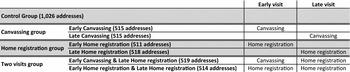
One fourth of these apartments were allocated to the control group and three fourths to the treatment group, after randomization at the address level and stratification by precinct and number of registered citizens at each address. Treatment apartments received registration visits carried out by 230 canvassers belonging to three groups: students, NGO members, and party activists.Footnote 7 Each precinct was covered by a different group of canvassers. All canvassers received an identical one-day training, based on role plays. In a randomly selected third of the treatment apartments, canvassers encouraged people to register and provided information about the process (hereafter, the canvassing group); after a conversation of one to five minutes, they distributed a leaflet that summarized this information (an example can be found in Figure A3). In a second third, the canvassers offered to register people at home so that they would not have to register at the town hall (hereafter, the home registration group): the canvassers filled out the registration form of those who accepted, completed it with a picture of ID, collected a proof of address, and brought the file to the town hall themselves. The remaining apartments received two separate visits (hereafter, the two-visits group).
The canvassing, home registration, and two-visits groups were each further randomly divided into two subgroups (see Figure 1). Half of the canvassing and home registration apartments were visited early, two to three months before the registration deadline, whereas the other half were visited late, during the last month before the deadline. Half of the two-visits apartments received an early canvassing visit and a late home registration visit, whereas the other half received two home registration visits. On average, 46.2% of the apartments visited only once opened their door, and 65.1% of the apartments visited twice opened their door at least once.Footnote 8
Experimental Design

With a total of six different treatment groups and one control group, our experiment may seem overly intricate. However, all this instrumental variation was designed to address the six questions laid out in the introduction, and thereby to understand the full scope of consequences of voter registration costs and effects of facilitating registration. We first estimate the impact of the visits on registration itself and disentangle different factors: information, logistical costs, and timing.
Ethical issues are inherent to the experimental nature of the present study (Desposato Reference Desposato and Desposato2016). While informed consent was sought from respondents to our postelectoral survey, subjects were unaware that they were participating in a research project when the registration visits took place, as is the case in most field experiments. Following the Belmont report (United States 1978), the first element which made this acceptable is that the research could not have been carried out in another way: to closely mirror real-world conditions, it was important that the subjects behaved normally. In addition, expected benefits of the visits largely outweighed potential costs, likely satisfying the “half-doubled rule” proposed by Findley and Nielson (Reference Findley, Nielson and Desposato2016). Benefits included getting registered and being able to vote (for the subjects) and identifying the most cost-effective method to foster new registrations (for society). While increasing political participation is presumably normatively good and there were no important direct foreseeable costs or risks for the participants, the visits could have the unintended consequence of affecting electoral outcomes, for instance if citizens registered due to the visits had different political preferences than the median voter. In practice, however, the risk of changing the winner’s identity was small: since the sample was divided across different regions and municipalities, it included only a small portion of each of the corresponding constituencies. We notified the French National Commission on Informatics and Liberty of all the individual data collected in the study, in compliance with French law (Law 78-17 on “Information Technology, Data Files and Civil Liberty” of January 6, 1978), and received approval for the experiment by the Institutional Review Board of one of the authors’ university.
IMPACT ON REGISTRATION
Data
We identify the citizens who registered in 2011 by comparing the January 2011 and January 2012 administrative voter lists. We locate their apartment based on their listed address and by matching their last name or marital name with the names initially found on the mailboxes. In addition to the voter lists, we collected administrative records on the registration date, previous registration status, and previous city of registration, if any, for all citizens who registered in 2011.
Overall Impact
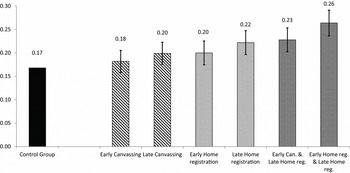
To assess the impact of the visits on registration, we would ideally measure changes in the individual registration status of citizens initially unregistered or misregistered. However, there is no systematic list of these citizens. Instead, we use the apartment as the unit of observation and the number of new registrations which occurred in 2011 in each apartment as the outcome. This number is 0 if no one registered, 1 if one citizen in the apartment registered, and higher than 1 if several people in the apartment registered. By definition, the number of new registrations does not include citizens registered prior to 2011. As shown in Figure 2, in the average control group apartment, 0.17 citizens registered in 2011. The number of new registrations was higher in each treatment group, from 0.18 in the group which received an early canvassing visit to 0.26 in the group which received two home registration visits.
Impact on the Number of New Registrations Among Initially Unregistered and Misregistered Citizens

To investigate the statistical significance of the differences shown in Figure 2 more systematically, we estimate the following OLS regression:
 $$\begin{equation}
NR_{i,b}=\alpha +\sum _{t=1}^{6}\beta _{t}T_{b}^{t}+X_{i,b}^{^{\prime }}\lambda +\sum _{s}\delta _{b}^{s}+\epsilon _{i,b},
\end{equation}$$
where NR i, b is the number of new registrations in apartment i of building b, Tt b are dummies corresponding to the six treatment groups, δ s b are strata fixed effects, and X i, b is a vector of apartment and building characteristics. X i, b includes the number of mailboxes in building b (a proxy for social housing since buildings with social housing are typically bigger) and the number of last names found on the mailbox of apartment i that were absent from the 2011 voter rolls (a proxy for the initial number of unregistered and misregistered citizens in the apartment). The key coefficients of interest are the β t ’s, which indicate the differential number of new registrations in apartments of the different treatment groups. The β t ’s are intent-to-treat estimates: they are not adjusted to take into account the fraction of opened doors.
The fact that randomization was conducted at the building level has two important consequences for our empirical strategy. First, in this and all other regressions, we need to adjust standard errors for clustering at this level. Second, the assignment of all apartments of a particular building to the same treatment condition reduces the scope for spillovers between the control and treatment groups and makes it more likely that the stable unit treatment value assumption (SUTVA), on which our identification strategy relies, is satisfied.Footnote 9
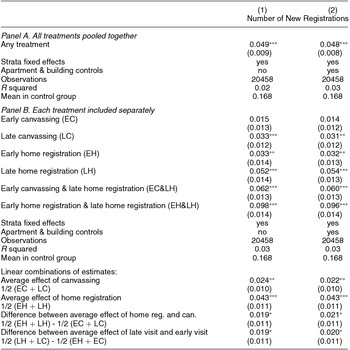
The results from Equation (1) are presented in Table 1. The number of new registrations in the average control apartment was 0.168. In panel A, the six treatment groups are pooled together. On average, the visits increased the number of new registrations by 0.049 (29%). This effect is statistically significant at the 1% level and robust to the inclusion of apartment and building controls. Disentangling by initial registration status, we find that the visits significantly increased registration of citizens originally unregistered, registered in another city, and registered at another address in the same city, by 47%, 18%, and 32%, respectively (Table A3).Footnote 10
Impact on the Number of New Registrations

Notes: Unit of observation is the apartment. We include all newly registered citizens in the sample apartments. Controls include number of mailboxes in the building and number of last names found on the mailbox of the apartment that were absent from the 2011 voter rolls. Clustered standard errors in parentheses.
***, **, * indicate significance at 1, 5, and 10%.
Effect of Information, Logistical Costs, and Timing
Which mechanisms explain these effects? The variations in the timing and type of visits in the canvassing and home registration groups were introduced to disentangle two types of obstacles hindering registration—lack of information about the process and administrative cost of registering—and to examine whether these obstacles are reinforced by procrastination. We now study more closely the respective importance of these three impediments to registration and the extent to which the visits alleviated them.
First, early and late canvassing visits increased the number of new registrations by 0.014 (8%) and 0.031 (18%) respectively, for an average of 0.022 (13%), significant at the 5% level (Table 1, panel B). This suggests that imperfect information prevents some eligible citizens from registering to vote. In addition to providing information, the visits may also have mobilized citizens, for instance by serving as a reminder of civic duty or exerting social pressure. However, additional evidence supports the view that, to a large extent, increased information explains the impact: many respondents to the postelectoral survey were unaware of the December 31 deadline and assumed that they could register up to a few days before the elections. In addition, discussions held at the door brought anecdotal evidence that many citizens do not know which documents are required for the registration application, and that misregistered citizens often have mistaken beliefs about the administrative steps they must take to update their registration status.
Second, in addition to providing information, home registration visits offered people the opportunity to register at home. Early and late home registration visits increased the number of new registrations by 0.032 (19%) and 0.054 (32%) respectively. Their average effect of 0.043 (26%) nearly doubled the effect of canvassing visits, a difference marginally significant (at the 10% level). This suggests that, conditional on available information, the administrative cost of registering also impedes registration.
Third, we compare the impact of visits conducted in October and November 2011 to that of visits conducted in December 2011. Late canvassing and home registration visits had a larger effect than early visits, a difference also marginally significant (at the 10% level). The sign of this difference might be surprising at first, since early visits left more time to register. A possible interpretation is that early visits also left more time to procrastinate and, eventually, to forget the discussion with the canvassers. People who have to register may indeed be particularly prone to procrastinate, as they have to pay the cost now and will only get the benefit (voting) later. Previous empirical evidence of procrastination among registration applicants supports this interpretation (Bennion and Nickerson Reference Bennion and Nickerson2011), as does anecdotal evidence about long queues of citizens registering within the last days and last hours before the registration deadline. Another possible interpretation that could coexist with the first is that the visits were complementary to the media campaign (whose intensity increased as the registration deadline came closer) or to the saliency of the presidential election (which increased over time). In the case of saliency playing a big role, our finding suggests that later deadlines will produce higher registration rates because they allow for a registration drive right at the time the public eye turns toward the election.
We now investigate the extent to which the large impact of the visits on registration translated into increased turnout at the 2012 elections.
IMPACT ON TURNOUT
Data
Attendance sheets signed by voters who cast a ballot on Election Day are available for consultation until ten days after each poll. We took pictures of attendance sheets at the 2012 French presidential and parliamentary elections and digitized them. Thanks to this administrative data, we measure the actual voting behavior of all registered citizens in the sample addresses. Altogether, our analysis is based on approximately 135,000 individual turnout observations.
Voter Turnout in the Control and Treatment Groups
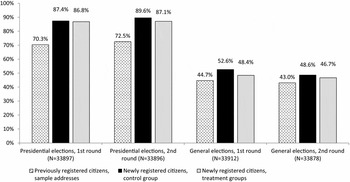
Figure 3 shows the participation rates of newly registered citizens in the control and treatment groups, as well as the participation of citizens who were previously registered (prior to 2011) and who live in the sample addresses. Turnout was very high at the presidential elections overall, and much lower at the parliamentary elections. Newly registered citizens in the control and treatment groups were more likely to participate at each electoral round than previously registered citizens. Finally, newly registered citizens in the treatment groups were almost equally likely to participate as those in the control group. To investigate these differences more systematically, we estimate specifications of the form in Equation [2]:
 $$\begin{equation}
V_{i,b}=\alpha +\gamma N_{i,b}+\sum _{t=1}^{6}\delta _{t}T_{b}^{t}\times N_{i,b}+\epsilon _{i,b},
\end{equation}$$
where V i, b and N i, b are dummies equal to 1 if, respectively, i participated in the election and if he or she is a newly registered citizen. Previously registered citizens are the omitted category.
Electoral Participation by Registration Status and Treatment Group

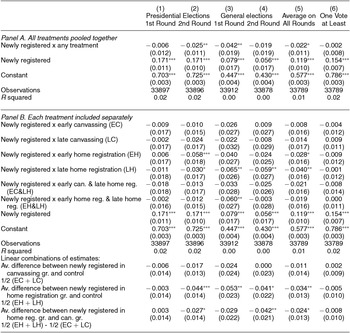
The results are shown in Table 2. Panel A pools the six treatment groups together. The difference between the participation of newly registered citizens in the treatment groups and in the control group is small and significant only for the second round of the presidential elections and for the first round of the parliamentary elections. Using the average individual participation as the outcome (column 5), we find an overall difference of 2.2 percentage points, marginally significant (at the 10% level). The fraction of newly registered citizens who voted at least once in 2012 is not significantly different in the control and treatment groups (column 6).
Electoral Participation of Citizens by Registration Status and Treatment Group

Notes: Unit of observation is the individual participation at a given electoral round. We include all previously registered citizens (registered before 2011) and newly registered (registered in 2011) in the sample addresses. Previously registered citizens are the reference group. We estimate differences in the propensity to vote of previously and newly registered citizens, and newly registered citizens in the control and the treatment groups. Column 6: “One vote at least” is equal to 1 if the individual participated in any of the four rounds. Clustered standard errors in parentheses.
***, **, * indicate significance at 1, 5, and 10%.
Turnout differences between newly registered citizens in the control and treatment groups are potentially the sum of a selection and a treatment effect. The selection effect is that citizens who registered as a result of the visits (henceforth the “compliers”) may participate less than the citizens who would have registered regardless of whether or not they received a visit (the “always-takers”). The treatment effect is that, conditional on registration, the visits themselves may have affected participation, even for people who would have registered anyway. We now disentangle the two effects.
Average Turnout of the Citizens Registered Due to the Visits
We first focus on the selection effect of the visits. One possible view is that information and registration costs are small and similar for everyone, so that the registration process selects all interested citizens and only excludes citizens with very low interest in voting. We should then expect compliers to vote much less than the always-takers. Another view, however, holds that the cost of registering is in general higher than the cost of voting, so that many citizens modestly interested in the elections but prepared to vote fail to register. In addition, to the extent that information and registration costs vary across citizens, the registration process may also exclude citizens who have a high interest in the elections but face an unusually high registration cost. Then, we may expect high participation rates among compliers, conditional on registration. The model included in Online Appendix B provides a more formal exposition of both views.
The difficulty is that newly registered citizens in the treatment groups include both compliers and always-takers, and we do not know which category any particular individual belongs to. As a result, we do not directly observe turnout differences between compliers and always-takers. We can, however, infer them from the turnout differences between the newly registered citizens in the control and treatment groups. Our analysis assumes that there were no “defiers” (citizens who would register absent the canvassers’ visit but would not if they receive it). It seems implausible that the information and help provided by the visits deterred anyone from registering when they would have done so otherwise. While it is possible that some citizens found the registration process described by the canvassers overly cumbersome, they would likely have reached the same conclusion if, deciding to register on their own, they had obtained the same information from another source. These citizens would likely not register, regardless of receiving the visits, making them “never-takers” rather than defiers.
Denote by Vg the average turnout of newly registered citizens in group g (g = 0 in the control group and g = T in the treatment groups); by V A, g and V C, g the average turnout of always-takers and compliers in group g; and by P C, g the proportion of compliers among all newly registered citizens in group g. By definition, the control group only includes always-takers. Thus
 $$\begin{equation*}
V_{0}=V_{A,0}.
\end{equation*}$$
The treatment groups, instead, include both always-takers and compliers:
 $$\begin{equation*}
V_{T}=V_{A,T}\left(1-P_{C,T}\right)+V_{C,T}P_{C,T}.
\end{equation*}$$
Thus
 $$\begin{eqnarray*}
V_{T}-V_{0}&= & \underbrace{\left(V_{C,T}-V_{A,T}\right)}_{\mbox{selection effect}} P_{C,T} \\
&& +\, \underbrace{\left(V_{A,T}-V_{A,0}\right)}_{\mbox{treatment effect on the always-takers}}
\end{eqnarray*}$$
which can be rewritten as
 $$\begin{eqnarray}
V_{C,T}-V_{A,T}&=&\frac{1}{P_{C,T}}\left(V_{T}-V_{0}\right)\nonumber\\
&&-\,\frac{1}{P_{C,T}}\left(V_{A,T}-V_{A,0}\right).
\end{eqnarray}$$
We use Equation (3) to estimate the difference between the participation of compliers and always-takers. Our preferred estimate is based on the assumption that the visits did not have any treatment effect on the participation of the always-takers, conditional on registration:
 $$\begin{equation*}
V_{A,T}-V_{A,0}=0.
\end{equation*}$$
This assumption is supported by empirical evidence presented in the Get-out-the-vote Effect subsection. Under this assumption, Equation (3) simplifies to
 $$\begin{equation*}
V_{C,T}-V_{A,T}=\frac{1}{P_{C,T}}\left(V_{T}-V_{0}\right)
\end{equation*}$$
and the difference between the participation of compliers and always-takers can be computed by scaling by a factor
 $\frac{1}{P_{C,T}}$
the difference between the participation of newly registered citizens in the treatment and control groups. In addition to this preferred estimate, we compute and report a lower bound of the difference between the participation of compliers and always-takers. To obtain this lower bound, we allow for the highest possible treatment effect on the always-takers and plug in Equation (3) the 95% upper confidence limit of the treatment effect estimates (presented in the Get-out-the-vote Effect subsection). We similarly compute a lower bound of the participation of compliers (see Online Appendix C for the detailed calculations).
Pooling all treatment groups together, from Table 1, column 2, we get
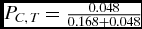 $P_{C,T}=\frac{0.048}{0.168+0.048}$
. Therefore,
 $\frac{1}{P_{C,T}}=\left(\frac{0.168+0.048}{0.048}\right)=4.5$
. In addition, from Table 2, panel A, column 5, we have that, averaging over the four electoral rounds, VT
− V
0 = −0.022. We infer that on average the compliers were only 9.9 percentage points (V
C, T
− VA
= 4.5 × 0.022 = 9.9) less likely to participate in the 2012 elections than the always-takers, conditional on registration (lower bound: 16.7 percentage points). Since the always-takers’ average participation was 69.5% (0.577 + 0.119), we obtain that the compliers’ average participation was 59.6% (lower bound: 54.5%). Using the same method and the estimates reported in column 6, we find that 93.0% of the compliers participated in at least one of the four rounds (lower bound: 87.2%). This fraction is strikingly high, and only a nonsignificant 1.1 percentage points lower than the always-takers.
We now consider the compliers selected by each treatment separately, using results reported in Table 2, panel B. On average, voter turnout of newly registered citizens was lower in all treatment groups, compared to the control group (column 5). However, this difference is significant neither in the group “Early Canvassing” nor in the group “Late Canvassing,” and we fail to reject the null that, on average, compliers selected by a canvassing visit had the same propensity to vote as always-takers. On the contrary, the difference with the control group is statistically significant in both the “Early Home registration” and “Late Home registration” groups. The participation of newly registered citizens in the home registration groups was also lower compared to the canvassing groups, a difference marginally significant (at the 10 percent level). We infer from the estimated δ’s that the propensity to vote of compliers selected by home registration visits was 52.8%, or 16.7 percentage points lower than the always-takers, on average.Footnote 11 However, the fraction who participated in at least one of the four rounds remained very high, at 91.5% (column 6).
We verify that these results are not driven by compositional effects: they are robust to comparing compliers and always-takers who share the same initial registration status (see Online Appendix D and Table A5).
Turnout as a Function of Election Salience
To better characterize the propensity to vote of the compliers, who were registered due to the visits, we now investigate the extent to which their choice to vote depends on electoral salience. We estimate the drop in their participation between the highly salient presidential elections and the less salient parliamentary elections and compare it with the average turnout decline among always-takers. Formally, we run seemingly unrelated regressions of Equation (2) using participation at each round as a different outcome, and we compute the point estimates and standard errors of linear combinations of the coefficients. Consider, for instance, the previously registered citizens, who are the omitted category in Equation (2). The percent decline in their turnout between the presidential and the parliamentary elections is
 $\frac{{1}/{2}\left(\alpha _{G1}+\alpha _{G2}\right)-{1}/{2}\left(\alpha _{P1}+\alpha _{P2}\right)}{{1}/{2}\left(\alpha _{P1}+\alpha _{P2}\right)}$
where α
P1, α
P2, α
G1, and α
G2 are the estimated constants for each round. The results are presented in Table A6. In the control group, the turnout decline between the presidential and parliamentary elections was significantly stronger among newly registered citizens (42.8%) than among previously registered citizens (38.4%). In addition, the turnout decline was larger among newly registered citizens in the treatment groups (45.3% on average) than in the control group, but the difference is significant only for the home registration group. When we control for the initial registration status, we find that the turnout decline was larger by 3 percentage points among newly registered citizens in the treatment groups, a difference marginally significant (at the 10% level).
Overall, these findings suggest that facilitating registration, in particular offering home registration in addition to information provision, does select voters who are slightly less likely to participate, and whose participation depends more on the salience of the elections. However, the selection effect of the visits is strikingly small: 93.0% of citizens registered due to the visits—nearly as high a rate as among citizens who registered on their own—voted at least once during elections that took place several months after the canvassers’ visits. We infer that absent any visit, compliers’ failure to register is driven less by lack of interest in the elections than by registration costs that are too high.
Get-Out-the-Vote Effect
We now focus on the treatment effect of the visits and examine whether they affected participation independently of registration, including for people who would have registered anyway. First, the visits might have had a mobilization effect similar to that documented by the large get-out-the-vote literature starting with Gerber and Green (Reference Gerber and Green2000). Existing evidence suggests that canvassing has a larger impact on voter turnout when it takes place during the last week of the campaign (Gerber and Green Reference Gerber and Green2015; Nickerson Reference Nickerson2006), predicting a modest get-out-the-vote effect of our visits, which took place more than four months before the elections. On the other hand, our visits were unusual in providing actual help to people, which may have enhanced any mobilization effect.
The get-out-the-vote effect of the visits may have affected both compliers, contributing to the large participation rates reported above, and always-takers. We thus now relax the assumption that always-takers’ participation was identical in the control and treatment groups, conditional on registration. To isolate the get-out-the-vote effect of the visits, we consider citizens whose turnout could only have been affected by it: those living in the sample apartments who registered before 2011 or in 2011, but before the visits started. Note that this population does not include any complier, and that it includes a fraction of the always-takers but excludes those who registered after the start of the visits. We estimate Equation (4) on this sample:
 $$\begin{equation}
V_{i,b}=\alpha +\sum _{t=1}^{6}\beta _{t}T_{b}^{t}+X_{i,b}^{^{\prime }}\lambda +\sum _{s}\delta _{b}^{s}+\epsilon _{i,b},
\end{equation}$$
where X i, b includes age, gender, the number of previously registered citizens in the apartment, and the number of mailboxes in the building.
The interventions did not significantly affect the participation of citizens who had registered prior to the visits at any of the four rounds, their average participation, or the likelihood that they participated at least once (Table A8).Footnote 12 However, we cannot draw conclusions about the get-out-the-vote effect of the visits on compliers, who again could not be included in the sample used for the estimation.
Disengagement Effect
Let us now investigate whether the visits that offered home registration had a specific treatment effect on citizens who were registered at home and would have registered on their own at the town hall otherwise. This effect may be positive, for instance if offering home registration generated larger social pressure than simply providing information. There were, however, reasons to expect a negative effect. If citizens who make an effort to register on their own get more involved politically, increasing their electoral participation, home registration could decrease their participation by reducing this engagement effect. Several factors might underlie this (dis)engagement effect. Deciding to register is a way to state one’s intention to vote, which might have a self-prediction effect analogous to asking people in advance if they intend to vote (e.g., Greenwald et al. Reference Greenwald, Carnot, Beach and Young1987). But deciding to register is more than a simple statement: it is actually costly. People who have registered might choose to vote to repay the sunk cost of registration and justify the corresponding effort (Erikson Reference Erikson1981). The effort made to register might also be used by the registrant to manage his self-concept as an engaged citizen. The registrant might then adjust his subsequent participation according to this reaffirmed identity (Bénabou and Tirole Reference Bénabou and Tirole2006). In addition to being costly, registering may be enjoyable for some. As a result, it may generate an attachment to the act of participating and contribute to the formation of a habit (Fujiwara, Meng, and Vogl Reference Fujiwara, Meng and Vogl2016; Gerber, Green, and Shachar Reference Gerber, Green and Shachar2003; Meredith Reference Meredith2009). Finally, regardless of the cost and benefits of registering, the self-determination theory provides substantial evidence that one’s sense of autonomy when performing a given task (here, registration) affects one’s intrinsic motivation to perform follow-up tasks (here, voting) (Ryan and Deci Reference Ryan and Deci2000).
It is difficult to isolate the disengagement effect of the visits since any difference between the participation of citizens registered at home and at the town hall can also reflect a selection effect: citizens registered at home differ from those registered at the town hall on several dimensions. To control for the selection effect, our strategy, inspired by Karlan and Zinman (Reference Karlan and Zinman2009), was to encourage some citizens to register at the town hall during an early visit and surprise them by offering home registration in a later visit. By that time, we expected that the most motivated citizens would already have registered at the town hall: if home registration has a disengagement effect, they would be protected from it. But the less motivated citizens, still not registered, would accept to register at home so that the two visits combined would select the same citizens as if home registration had been offered from the start.
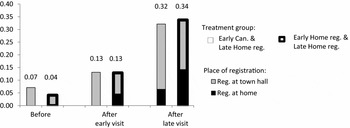
The treatment groups Early Canvassing & Late Home Registration and Early Home Registration & Late Home Registration were designed to implement this strategy. We focus on apartments that opened their door during the late visit and were thus all offered home registration. Figure 4 shows the average number of new registrations made at home and at the town hall in these apartments at three stages: before the early visit, after the early visit, and after the late visit. By the time of the registration deadline, the average number of new registrations was very close in the two groups, suggesting that newly registered citizens selected by the two interventions are identical. As an additional support for this claim, we successfully check that newly registered citizens in the two groups are identical for all observable characteristics (Table A9). In addition, the number of home registrations was much higher in the group Early Home Registration & Late Home Registration, where citizens were offered to register at home from the start. We can therefore attribute to the disengagement effect of home registration any difference between the number of votes cast by initially unregistered and misregistered citizens in the two groups.
Controlling for the Selection Effect of Home Registration

We estimate the following model:
 $$\begin{equation}
NV_{i,b}=\alpha +\beta T_{b}^{EH\&LH}+\epsilon _{i,b},
\end{equation}$$
where
 $T_{b}^{EH\&LH}$
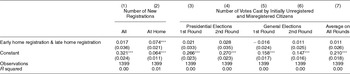
is a dummy equal to 1 for apartments in the treatment group Early Home Registration & Late Home Registration and 0 in the group Early Canvassing & Late Home Registration. Table 3 presents the results. We first check that the number of new registrations does not differ significantly between the two groups (column 1) and that there is a statistically significant difference (at the 1 percent level) between the number of home registrations in both groups (column 2). Despite this difference, we cannot reject the null that the number of votes cast by initially unregistered and misregistered citizens is identical in both groups for any of the four electoral rounds and for their average (columns 3–7). In sum, we do not find any evidence that the way in which one gets registered (at the town hall or at home) affects one’s subsequent participation, or that home registration disengages citizens who would have registered on their own otherwise. Instead, the next section shows that the visits had actually the opposite effect of empowering the compliers.
Treatment Impact of Home Registration

Notes: Unit of observation is the apartment. We include all newly registered citizens living in apartments which opened their door at the second visit, in the treatment groups “Early canvassing & late home registration” and “Early home registration & late home registration.” The omitted group is “Early canvassing & late home registration.” Clustered standard errors in parentheses.
***, **, * indicate significance at 1, 5, and 10%.
IMPACT ON POLITICIZATION
Data
Public opinion scholars have long studied how people’ s political interest and knowledgeability affect their participation, choices, attitudes, and receptiveness to external communication (e.g., Neuman Reference Neuman1981; Zaller Reference Zaller1992). Closest to the present study is the repeated finding that voters are more interested and informed than nonvoters (e.g., Palfrey and Poole Reference Palfrey and Poole1987; Powell Reference Powell1986). Given this difference, some authors raise the concern that institutions facilitating participation might bring in voters who are unlikely to cast a well-considered ballot and might add noise to the final results (e.g., Jakee and Sun Reference Jakee and Sun2006; Selb and Lachat Reference Selb and Lachat2009). But political interest and knowledgeability are not necessarily fixed. In addition to affecting participation, they may also be influenced by it, making the direction of causality unclear. In particular, citizens induced to register and vote might also become more interested in the campaign, as they know that they will be able to vote, and in the results of elections in which they participate (e.g., Leighley Reference Leighley1991; Lijphart Reference Lijphart1997; Robson Reference Robson1923). We provide experimental evidence—the first, to our knowledge—of this relationship. Our test relies on the postelectoral survey which we administered door-to-door to a sample of 1,500 respondents. Respondents were surveyed at their apartment within the month following the second round of the parliamentary elections. The survey was administered only to French citizens who were not registered at their address as of January 2011, independently of their registration status by the registration deadline, so that the sample selection was unaffected by the interventions.Footnote 13
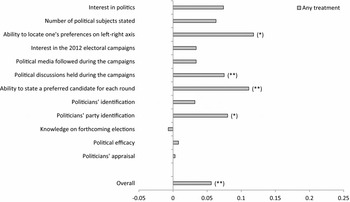
To evaluate the impact of the visits on politicization, we group a series of 36 questions on political interest and competence asked during the postelectoral survey into a global index and 12 subindices, defined to be the equally weighted average of the z scores of their components, following Kling, Liebman, and Katz (Reference Kling, Liebman and Katz2007).
Results
As can be seen in Figure 5, the interventions increased the overall index of political interest and competence among citizens who were initially unregistered or misregistered by 0.06 standard deviations, an effect significant at the 5% level. The effect is of similar magnitude (0.6, 0.7, and 0.5 standard deviations) in the canvassing, home registration, and two-visits groups, it is significant at the 5% level in the home registration group, and marginally significant (at the 10% level) in the canvassing group (Table A10). The effect is positive for all but one of the 12 subindices, and it is significant for four of them: the ability to locate one’s political preferences on the left-right axis; to locate prominent local and national politicians on this axis; to state the candidate one voted for or one would have voted for at each round; and the frequency of the political discussions held during the campaign with family members, friends, colleagues, and neighbors. These results suggest that the visits and the subsequent registrations increased both interest in the electoral campaigns and political competence, of which the command of the left-right axis is a key component (Gaxie Reference Gaxie1978; Palfrey and Poole Reference Palfrey and Poole1987). By contrast, the effects on political efficacy and on politicians’ appraisal are very small and not significant. This is perhaps not too surprising, but it increases our confidence that the other positive effects we measure are not just the expression of gratitude or of a stronger desire to fulfill surveyors’ expectations among those who received the visits.
Impact on the Level of Politicization

As a result of these effects, the overall level of political interest and competence of newly registered citizens in the treatment groups was not lower than in the control group by the time of the postelectoral survey, which alleviates the possible concern that facilitating participation includes uninterested and uninformed citizens. Instead, to the extent that these findings are not only driven by direct effects of the discussions with the canvassers, they lend support to the view that inducing citizens to become active voters can actually increase their political interest and competence.
The finding that facilitating registration can dramatically increase turnout and interest in the elections is particularly important in a context where abstention steadily increases and threatens the legitimacy of elected governments. Perhaps equally central to the functioning and stability of democracy is the equal representation of all groups. While the introduction of new voting technologies or the adoption of compulsory voting have been found to increase equality of representation at the same time that they enhance participation (Fowler Reference Fowler2013; Fujiwara Reference Fujiwara2015), evidence from get-out-the-vote studies point to the opposite effect: on average, existing mobilization interventions actually widen disparities in participation by mobilizing under-represented citizens less than high-propensity individuals (Enos, Fowler, and Vavreck Reference Enos, Fowler and Vavreck2014). We now examine the extent to which the registration visits affected the social makeup of the electoral rolls and the distribution of political preferences among registered voters.
IMPACT ON ELECTORATE’S COMPOSITION AND ITS PREFERENCES
Data
In addition to the data on political interest and competence exploited in the previous section, the postelectoral survey includes information on respondents’ sociodemographic characteristics, political preferences, and choices of candidates at the presidential and parliamentary elections. We complete the analysis using data from the voter rolls available for all registered citizens, but on three characteristics only: age, gender, and place of birth.
Impact on the Composition of the Electorate
As mentioned above, the postelectoral survey was only administered to individuals who were initially unregistered or misregistered. Let us emphasize some of the most salient traits among the sociodemographic characteristics summarized in Table A1, panel C. The average respondent is young (36 years old, which is more than 10 years younger than the average French adult), and has relatively low education: 42% do not have any diploma or have less than an end-of-high-school diploma, which is less than the overall adult population. Ten percent—slightly more than the overall adult population—are unemployed, and 27% are inactive. More than half live in social housing and 42% earn less than the minimum wage (1100 euros a month). Twenty-four percent were born outside of France, 22% are binationals, and 40% speak a language other than French with family members. Finally, half of the respondents have lived in the city for more than 10 years, and 17% arrived less than two years ago.
To identify the variables which best predict registration and the extent to which their influence was affected by the visits, we estimate the following OLS model:
 $$\begin{eqnarray}
I_{i,b}&=&\alpha +\beta T_{b}+\sum _{k}\gamma _{k}Z_{i,b}^{k}\nonumber\\
&&+\,\sum _{k}\delta _{k}Z_{i,b}^{k}\times T_{b}+\epsilon _{i,b},
\end{eqnarray}$$
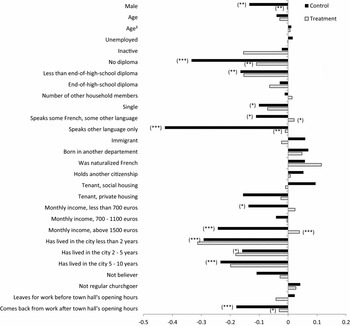
where I i, b is a dummy equal to 1 if citizen i of building b is registered in his city and 0 otherwise, and Tb is a dummy equal to 1 if her building was allocated to one of the treatment groups. The key coefficients of interest are the γ k ’s and the δ k ’s, which measure the effect of the characteristics Z i, b and of their interaction with the treatment dummy. Figure 6 shows the effect of any characteristic k in the control group (γ k ) and in the treatment groups (γ k + δ k ) and reports the statistical significance of the γ k ’s and the δ k ’s.
Impact on the Selection Operated by the Registration Process

In the control group, all other things being equal, males and single persons are significantly less likely to register. In line with the resource model of political participation (Brady, Verba, and Schlozman Reference Brady, Verba and Schlozman1995), we also find that the likelihood to be registered is lower among citizens with time constraints (in this case, because they return from work after the town hall’s closing time); those with no diploma or with less than an end-of-high-school diploma; those who speak another language than French or a combination of French and another language at home; poorest citizens and, perhaps surprisingly, richest citizens, compared with those with a monthly income between 1100 and 1500 euros. Finally, those who arrived in the city a short time ago are less likely to be registered, probably because the requirement to reregister after each move makes registration more costly for them. Quite strikingly, the negative influence of several of these variables was compensated by the visits. We find that males, uneducated citizens, citizens speaking a language other than French at home, citizens with a high monthly income, and citizens coming back from work after the town hall’s opening hours were significantly more likely to register in the treatment groups than in the control group. We would expect some of the coefficients to be significant by random chance. We thus test the joint significance of the γ k ’s and the joint significance of the δ k ’s and reject both nulls with a p value of 0.00 (Table A11).Footnote 14
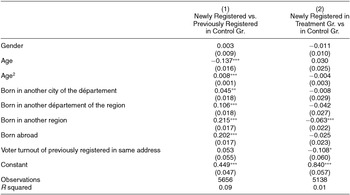
Next we turn to comparing the compliers and always-takers with previously registered citizens, using the voter rolls data. We run two simple selection equations. We first restrict the sample to registered citizens in the control group, and regress a dummy equal to 1 if the citizen is newly registered and 0 if he was previously registered, on a set of characteristics. The results are shown in Table 4, column 1. We find that newly registered citizens are younger, more likely to be born further away from the city where they live, and more likely to be immigrants than previously registered citizens. Next we include all newly registered citizens in the sample and regress the treatment dummy on the same characteristics (column 2). The compliers are less likely than the always-takers to be born in another region and they live at addresses where previously registered citizens have a lower turnout on average. This suggests that the interventions helped counterbalance a social environment otherwise relatively less conducive to political participation. However, compliers do not differ from always-takers on other dimensions, including age and being an immigrant.
Impact on the Selection Operated by the Registration Process (Voter Rolls)

Notes: Unit of observation is the registered citizen. Column 1 includes all registered citizens in the control group and regresses a dummy equal to 1 if the citizen is newly registered and 0 if he or she was previously registered on the independent variables. Column 2 includes all newly registered citizens and regresses a dummy equal to 1 if the citizen is in the treatment group and 0 if he or she is in the control group on the independent variables. Clustered standard errors in parentheses.
***, **, * indicate significance at 1, 5, and 10%.
Overall, these findings suggest that the self-initiated registration process disenfranchises some categories of citizens who are also more likely to face economic and social exclusion—the young, the uneducated, and immigrants—and that our visits fostered better representativeness of the citizenry in the electorate by increasing the number of registrations among these people. While Nickerson (Reference Nickerson2015) also finds larger effects of registration visits on the number of registrations in areas with lower socioeconomic status, get-out-the-vote interventions usually have the opposite effect of reinforcing political inequality. A possible interpretation for these contrasting findings is that our interventions, in particular the home registration visits, were more intensive than the typical mobilization campaign and thus more suitable to mobilize disenfranchised citizens. A complementary interpretation is that get-out-the-vote and registration visits target different populations. Unlike citizens targeted by get-out-the-vote efforts, who are already registered, citizens targeted by our visits were initially unregistered or misregistered and, as a result, more likely to belong to under-represented segments of the citizenry, making any impact of our visits more likely to reinforce political equality. Let us now finally examine whether these citizens also have different political preferences.
Impact on the Preferences of the Electorate
The vote shares obtained by left-wing candidates were 67%, 74%, 69%, and 75% at the two rounds of the presidential and parliamentary elections respectively, at the precinct of the average newly registered citizen. Yet, newly registered citizens’ reported likelihood to vote for left-wing candidates, as measured in the postelectoral survey, was significantly higher: 83%, 90%, 91%, and 95% respectively. Newly registered citizens in the treatment groups were equally likely to report voting for a left-wing candidate as in the control group. These findings are robust when excluding the precincts where visits were made by partisan canvassers. Nonetheless, there are several important caveats that one must bear in mind when considering these results, which draw on the comparison between official vote shares on one hand and self-reported vote choices on the other. First, respondents’ answers might be subject to social desirability bias and over-report for the winner. Second, in France, left-wing voters are known to be more inclined to take part in surveys than right-wing voters. This selection bias might affect the results of our survey as well.
As a complementary approach, we predict differences between the political preferences of the newly registered and the previously registered citizens and between the compliers and always-takers based on their demographics. The procedure is detailed in Online Appendix F, and the results presented in Table A12. Again, the results are robust to excluding precincts visited by partisan canvassers, in which the preferences of newly registered citizens in the treatment groups were most likely to be directly affected by the discussions with the canvassers. We predict that newly registered citizens are 1.7 to 3.4 percentage points more likely to be on the left than those previously registered, except for the first round of the parliamentary elections but that there is no significant difference between the political preferences of newly registered citizens in the control and treatment groups. Using the same method as in the Average Turnout of the Citizens Registered due to the Visits subsection, this suggests that the political preferences of compliers are similar to the always-takers but more to the left than previously registered citizens. This finding supports the view that, in the sample areas, the citizens disenfranchised by the registration process are ideologically more to the left than the median registered citizen.
DISCUSSION AND CONCLUSION
This project examined the effects of a series of canvassing and home registration interventions targeting unregistered and misregistered citizens in ten French cities. The experiment found that the self-initiated registration system excludes a large fraction of the citizenry which is otherwise prepared to vote. Lack of information and the cost of going through the administrative registration process are equally important impediments to registration. These obstacles decrease registration and voting disproportionately for some segments of the population, including younger and less educated citizens, as well as immigrants.
Self-initiated registration could theoretically serve to select more interested and competent voters, and to increase their political involvement. And indeed, compared to citizens registered due to the visits, those who register on their own are a little more likely to participate in the elections, and their participation depends less on the salience of the election. Still, the most striking finding of our experiment resides in the fact that a large majority of those registered as a result of our visits took part in the Spring 2012 elections. In fact, 93% participated in either the presidential or the parliamentary elections. Moreover, we do not find any evidence for a disengagement effect of home registration. Quite the contrary, citizens registered and induced to vote due to the interventions also became more interested in the campaign and in the elections than if they had remained unregistered.
Predicting the Effects of Changes in the Registration Rules
Any change in the registration rules might create a temporary information gap which, our results suggest, should not be underestimated. However, new rules could also contribute to facilitate the acquisition of information about registration. For instance, postponing the registration deadline to a few weeks or a few days before the elections, when electoral campaigns are most intense, would facilitate the transmission of information to unregistered citizens and could decrease procrastination: in our experiment, late visits were more effective than early ones. Our results further imply that registration rules that both increase information and decrease the cost to register should bring still greater effects.
Further down the line, can our results serve to anticipate the effects of moving away self-initiated registration towards an automatic registration procedure administered by the state? While our experiment does not enable us to outline the general equilibrium effects of switching to automatic registration, we can try and identify the direct effects. In automatic registration systems, the state can rely on different techniques to register voters (Brennan Center for Justice 2009). Some, including civil registry and data-sharing from tax authorities and other government agencies, do not involve any personal contact with the registrants. These techniques would likely have a selection effect similar to the one measured in this study, bringing in a sizable fraction of the electorate that is only slightly less prepared to vote than citizens already registered. At the same time, conditional on registration, these techniques may have different and perhaps negative treatment effects on the participation of newly registered citizens than our visits, which involved face-to-face discussions with the canvassers. Those registered may be disengaged as a result of not playing any part in the registration process, and some may not even realize that they are registered and eligible to vote.
As a substitute from impersonal registration techniques, some countries, such as Canada, South Africa, Rwanda, and Indonesia rely on door-to-door enrollment to register eligible citizens, mimicking more closely the conditions of our experiment (Electoral Institute for the Sustainability of Democracy in Africa 2010). The impact on voter participation of implementing automatic registration through this technique should thus be equally high—and perhaps even higher—as the impact of our home registration visits. In our experiment, the treatment group that offered home registration to the largest group of citizens offered it twice, once during the two to three months before the registration deadline, then again during the last month before the deadline. We estimate that this intervention increased overall participation by 5.1% in the first round and 4.9% in the second round of the presidential election, and by 3.9% and 4.4% in the corresponding parliamentary elections.Footnote 15 These estimates are lower bounds of the increased turnout that would result from registering the entire population through door-to-door visits. Were registration universal, the large number of citizens who in our study did not use the possibility of getting registered at home would be registered too, and a fraction would vote. The data produced in the study does not enable us to estimate this fraction precisely, but there are reasons to believe that it would be relatively large. Indeed, the debriefing meetings we held with the canvassers revealed that only a slim minority of respondents who did not register with them invoked the rejection of elections and voting as their motivation. Their choice is likely explained by another factor: the trust they had to show toward the canvassers. Accepting the offer of home registration implied entrusting strangers with copies of electricity bills, ID cards or passports, and trusting them to file the registration application before the deadline. Canvassing is much less developed in France than in the United States (Pons Reference Pons2016) and there is no tradition of voter registration drives. The respondents in our sample were thus offered a service that they were unfamiliar with. An automatic registration procedure led by the state would naturally not face such trust issues.
Our findings also suggest that, beyond enhancing participation, implementing an automatic voter registration policy would likely increase the social and ethnic representativeness of the electoral rolls and the actual vote. Would this transformation alter election outcomes? At the level of our 44 precincts, the citizens disenfranchised by the registration process are ideologically more to the left than the median registered citizen. These results may be linked to the characteristics of the areas concerned. The vote choice of citizens at the margin of registering may depend relatively more than other citizens on the context (here, favorable to the left), similarly as their level of participation depends relatively more on the salience of the election. But in any event, election outcomes would be more in line with the true distribution of political opinions and orientations within the population on the whole.
Generalizability of the Findings
While our sample was not randomly selected, it includes multiple regions, municipalities of varying size (from 10,000 inhabitants to the capital, Paris) and wealth, and different types of canvassers, enhancing the external validity of our findings. In addition, the sample precincts were selected for their large fractions of unregistered citizens and should thus be quite representative of French areas that would be the most affected by changes in the registration system. Our visits generated sizeable and statistically significant increases in the number of new registrations among citizens who were previously not registered, registered in another city, or registered at another address in the same city, and the effect was strongest for the first category. This suggests that registration visits like the one studied in the experiment would have strong effects in areas where the distribution of these three types of citizens differs from our setting, but larger effects where the number of citizens who were not registered before is larger.
To what extent do our results generalize to other countries with self-initiated registration? A recent experiment conducted in the United States finds comparable impact of home registration visits on registration, but much lower impact on turnout (Nickerson Reference Nickerson2015). There are two complementary interpretations of these different findings. The first is that unregistered citizens in the Unites States have a lower propensity to vote than those in France. Indeed, in our study, the comparison between citizens registered as a result of canvassing visits and those registered through the more intensive home registration visits brings suggestive evidence that the propensity to vote of the marginal registrant decreases as the registration cost decreases. But the registration cost has substantially decreased in the Unites States, following the 1993 National Voter Registration Act, and with the possibility offered by the postal service to register after moving. In France, it remains high, due in particular to the early registration deadline.
An alternative interpretation is that low-salience congressional and off-year gubernatorial elections account for the bulk of Nickerson’s sample and that American elections are less salient than French elections, on average: participation at the U.S. 2012 presidential elections was 58%, versus 74% for the French 2012 presidential elections. In our study, we find that the participation of citizens registered as a result of the visits depends more on the saliency of the elections than that of other citizens, which completes the argument.
The generalizability of the findings should be tested more directly by future research. To the extent that the results do generalize more broadly, they lend support to the view that the costs related to electoral participation remain one of the major causes of abstention. This view is somewhat counterintuitive: the cost of voting has steadily decreased in most countries since the 19th century, with the transition from censitary to universal suffrage, elimination of literacy tests and poll taxes, increased density of polling stations, and decreased travel cost (e.g., Garrigou Reference Garrigou1992). An important reason why the cost to register still generates such important effects might be that, differently from the cost of voting itself, each person pays it separately. All citizens vote on the same day, very visibly, and it is not a task that one can put off. Only a minority of citizens have to register every year; they do it inconspicuously and on different dates—so there is less social pressure to complete the task and more opportunity to procrastinate it. Removing avoidable costs may increase the likelihood citizens will overcome these other obstacles and participate—a lesson that might extend beyond voter registration to other prerequisites to voting, such as acquiring a valid voter ID.
SUPPLEMENTARY MATERIAL
To view supplementary material for this article, please visit https://doi.org/10.1017/S000305541700003X





Comments
No Comments have been published for this article.